Article

Learning-Aided Adaptive Robust Control for Spiral Trajectory Tracking of an Underactuated AUV in Net-Cage Environments


by
Zhiming Zhu
1,2,
Dazhi Huang
1,*,
Feifei Yang
1,
Hongkun He
1,
Fuyuan Liang
1 and
Andrii Voitasyk
1,2
1
Makarov College of Marine Engineering, Jiangsu Ocean University, Lianyungang 222005, China
2
College of Electrical Engineering of Ship, Admiral Makarov National University of Shipbuilding, 54025 Mykolaiv, Ukraine
*
Author to whom correspondence should be addressed.
Appl. Sci. 2025, 15(19), 10477; https://doi.org/10.3390/app151910477
Submission received: 28 August 2025 / Revised: 22 September 2025 / Accepted: 23 September 2025 / Published: 27 September 2025

Abstract

High-precision spiral trajectory tracking for aquaculture net-cage inspection is hindered by uncertain hydrodynamics, strong coupling, and time-varying disturbances acting on an underactuated autonomous underwater vehicle. This paper adapts and validates a model–data-driven learning-aided adaptive robust control strategy for the specific challenge of high-precision spiral trajectory tracking for aquaculture net-cage inspection. At the kinematic level, a serial iterative learning feedforward compensator is combined with a line-of-sight guidance law to form a feedforward-compensated guidance scheme that exploits task repeatability and reduces systematic tracking bias. At the dynamic level, an integrated adaptive robust controller employs projection-based, rate-limited recursive least-squares identification of hydrodynamic parameters, along with a composite feedback law that combines linear error feedback, a nonlinear robust term, and fast dynamic compensation to suppress lumped uncertainties arising from estimation error and external disturbances. A Lyapunov-based analysis establishes uniform ultimate boundedness of all closed-loop error signals. Simulations that emulate net-cage inspection show faster convergence, higher tracking accuracy, and stronger robustness than classical adaptive robust control and other baselines while maintaining bounded control effort. The results indicate a practical and effective route to improving the precision and reliability of autonomous net-cage inspection.

1. Introduction

Autonomous underwater vehicles (AUVs) have attracted sustained interest across scientific, commercial, and defense domains owing to their ability to execute missions beyond human reach. Typical applications include subsea cable and pipeline inspection, seabed mapping, search and rescue, and pollution source localization; they are also increasingly deployed for inspection tasks in aquaculture net-cages [1,2,3]. To meet diverse operational demands, an AUV must track prescribed trajectories in three-dimensional space with high accuracy. This requirement is challenging because AUVs possess highly nonlinear, strongly coupled, multi-degree-of-freedom dynamics with uncertain parameters and are exposed to unknown environmental disturbances such as currents and waves [4,5]. Torpedo-shaped platforms are often underactuated, i.e., the number of actuators is smaller than the degrees of freedom, which imposes additional nonholonomic constraints on controller design.
Offshore aquaculture with large net-cages is expanding as a means to increase marine food production and improve food security. However, long-term exposure to wind, waves, and currents leads to issues such as net damage and biofouling, which increase operational risk and maintenance costs. Manual underwater inspection is inefficient, hazardous, and difficult to scale for continuous monitoring. These constraints motivate robotic inspection within the cage interior, where the AUV must follow near-wall spiral trajectories in confined spaces with pronounced curvature and coupled wave–current disturbances.
To address the trajectory tracking problem for AUVs, a wide spectrum of control strategies have been explored. Classical proportional–integral–derivative (PID) control, while simple, often lacks the required performance under strong nonlinearities and time-varying disturbances [6]. To enhance robustness, nonlinear techniques such as sliding-mode control (SMC) offer strong guarantees against bounded uncertainties but may induce chattering detrimental to actuators and motion smoothness [7,8,9]. More advanced approaches, including adaptive control [10,11,12,13,14] and robust control techniques, are designed to handle parametric uncertainties and external disturbances. Many of these robust solutions rely on state observers or output-feedback designs to ensure stability even with limited sensor information, a challenge pertinent across various autonomous systems from underwater vehicles to intelligent connected vehicles [15,16]. Intelligent methods based on neural networks or reinforcement learning [17,18] can handle parametric uncertainties or learn complex dynamics. However, these methods primarily focus on general adaptation and robustness. The spiral inspection task inside a net-cage is fundamentally repetitive, a structural characteristic that most conventional controllers do not explicitly leverage to systematically cancel recurring tracking errors. Furthermore, for the specific net-cage application, specialized controllers like the helix-derived path-following method by Chen et al. [3] have been developed. While effective for a predefined path, such fixed-parameter designs may lack adaptability to variations in currents or vehicle dynamics.
The need to simultaneously handle uncertainty and exploit task repeatability motivates the use of learning-aided adaptive robust control (LARC). This framework synergistically combines the model-based robustness of adaptive robust control (ARC) [19,20,21] with the data-driven error-cancellation capabilities of Iterative Learning Control (ILC) [22,23,24]. Its efficacy has been well-established in high-precision mechatronics [25]. The application of LARC to AUVs is an emerging and promising research direction. A foundational study by Guo et al. [26] successfully applied a model–data-driven LARC for the spatial trajectory tracking of underactuated AUVs, demonstrating its potential in general open-water scenarios. Their work provides a valuable benchmark for LARC in marine robotics. However, their study did not address the specific constraints of confined industrial environments like net-cages, which involve highly structured spiral trajectories, pronounced near-wall hydrodynamic effects, and the need for operational reliability. This leaves a critical gap between the general LARC framework and its practical application in autonomous aquaculture.
To fill this gap, this paper adapts and validates a learning-adaptive robust control (LARC) strategy that is specifically tailored for the spiral trajectory inspection of an underactuated AUV operating inside a marine net-cage. The proposed approach is designed to address the challenges of confined underwater environments, such as limited maneuverability, external disturbances, and the need for precise trajectory tracking along the cage boundary. To better situate our approach among existing solutions, Table 1 provides a comparative analysis of representative control strategies reported in the literature, highlighting their suitability with respect to the key requirements of the net-cage inspection task, including robustness, adaptability, and implementation feasibility.
As highlighted in Table 1, the proposed LARC strategy is uniquely positioned to address all key aspects of the problem. To the best of our knowledge, this is the first study to apply LARC to this specific scenario. The main contributions of this work are as follows:
First, we adapt the LARC framework to the net-cage inspection task by integrating a serial iterative learning compensator with a feedforward-compensated line-of-sight (FFC-LOS) guidance law. This integration is specifically designed to exploit task repeatability and enhance tracking accuracy for spiral trajectories in a confined environment.
Second, we develop an integrated dynamic controller that combines adaptive-robust feedback with projection-based, rate-limited recursive least-squares (RLS) identification. This controller is validated against a composite disturbance profile that emulates the unique hydrodynamic effects of near-wall operations.
Third, we provide a comprehensive validation of the proposed strategy, establishing its superiority over relevant baselines. A Lyapunov-based analysis confirms the uniform ultimate boundedness (UUB) of all closed-loop signals. Furthermore, comparative simulations demonstrate that a single ILC iteration is sufficient to significantly reduce periodic tracking errors, achieving substantial performance gains over standard ARC, RC, and PID controllers.

2. Vehicle Model and Control Objective

2.1. Underactuated AUV Model

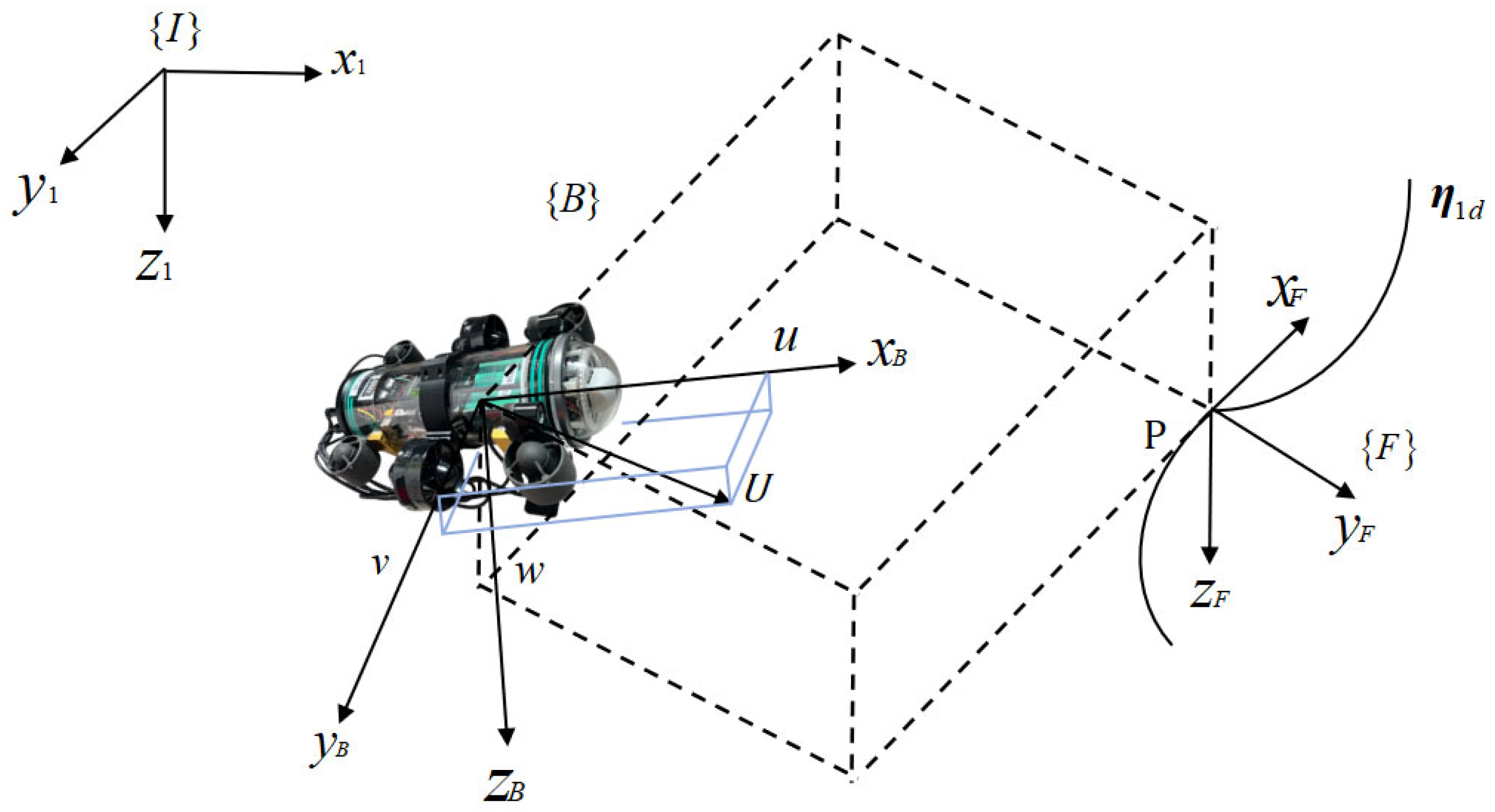
In this paper, an underactuated AUV with neutral buoyancy is considered. Before formulating the mathematical model, the spatial coordinate frames are specified. As illustrated in Figure 1, three frames are adopted: an earth-fixed inertial frame { I } , a body-fixed frame   { B } , and a Serret–Frenet path frame { F } . The subsequent kinematic and dynamic equations are expressed with respect to these frames.
The vehicle considered is a torpedo-shaped AUV with port–starboard and dorsal–ventral symmetry and approximately neutral buoyancy. The center of gravity lies below the center of buoyancy, providing a positive metacentric height and passive roll stability in the error dynamics mode. Under normal cruising conditions, the roll angle remains small and self-stabilizing; hence, roll is neglected, and a five-degree-of-freedom model is adopted for control design.
Let the position–orientation vector in the inertial frame { I } be η = [ x , y , z , θ , ψ ] T , where ( x , y , z ) are positions and ( θ , ψ ) denote pitch and yaw. Let the linear and angular velocities in the body frame { B } be ν = [ u , v , w ] T and ω = [ q , r ] T , respectively. The kinematic mapping between body-frame velocities and the time derivatives of inertial positions and attitudes is given by a Jacobian J ( η 2 ) determined by the Euler angle convention used here (pitch–yaw). Detailed derivations follow standard marine control texts (e.g., Fossen) [27] and are omitted for brevity. Standard marine control notation is followed (e.g., Fossen [27]), and only the expressions relevant to this study are retained.
η ˙ = J ( η 2 ) ν
x ˙ y ˙ z ˙ θ ˙ ψ ˙ = cos ψ cos θ sin ψ sin ψ sin θ 0 0 sin ψ cos θ cos ψ sin ψ sin θ 0 0 sin θ 0 cos θ 0 0 0 0 0 1 0 0 0 0 0 1 cos θ u v w q r
The dynamic model is derived from the Newton–Euler equations and relates forces/torques acting on the AUV to its accelerations. The model accounts for rigid-body inertia and added-mass effects (matrix M ( ) ), Coriolis and centripetal terms ( C ( ν ) ) , hydrodynamic damping ( D ( ν ) ), and hydrostatic restoring forces/torques ( g ( η 2 ) ). Because hydrodynamic terms are complex, accurate modelling is difficult and constitutes a major source of uncertainty for control design. Following the standard formulation, the compact underactuated AUV dynamics can be written as:
M ν ˙ + C ν ν + D ν ν + g η 2 = τ + τ d
where τ denotes the control input and τ d lumps unknown time-varying environmental disturbances (e.g., currents and waves).
Expanding the components yields the per-DOF equations:
m 11 u ˙ = m 22 v r m 33 w q d u u d u u u u + τ 1 + τ d u m 22 v ˙ = m 11 u r d v v d v v v v + τ d v m 33 w ˙ = m 11 u q d w w d w w w w W B sin θ + τ d w m 55 q ˙ = m 33 m 11 u w d q q d q q q q z G W z B B sin θ + τ 2 + τ d q m 66 r ˙ = m 22 m 11 u v d r r d r r r r + τ 3 + τ d r
Here, m ( i i ) denote inertia terms, including added mass; d ( ) denote hydrodynamic damping coefficients. The control input vector is τ = [ τ 1 , 0,0 , τ 2 , τ 3 ] T , where τ 1 is the propeller thrust and τ 2 , τ 3 are the stern-plane pitch and yaw control moments. Since no lateral actuator is installed, the vehicle is underactuated. The term τ d represents unknown time-varying external disturbances such as currents and waves.
Assumption 1.
During three-dimensional tracking, the pitch angle remains within a reasonable operational range (e.g., | θ | < π / 2 ). This is appropriate for net-cage inspection tasks, as excessive pitch compromises sensing (sonar, cameras) and may degrade hydrodynamic performance. External disturbances and their time derivatives are assumed to be bounded.
Assumption 2.
The control inputs are subject to actuator limits; there exist known positive constants τ i , m a x such that | τ i | τ i , m a x . Angular rates and their derivatives are bounded.

2.2. Control Objective

Let η 1 d ( t ) = [ x d ( t ) , y d ( t ) , z d ( t ) ] T be a given desired spatial trajectory, which is assumed to be continuously differentiable up to a sufficient order. The position tracking error is defined as e p ( t ) = [ η 1 ( t ) η 1 d ( t ) , where η 1 ( t ) = [ x ( t ) , y ( t ) , z ( t ) ] T is the actual position of the AUV.
The control objective is to design a control law for the input τ such that, in the presence of parametric uncertainties and external disturbances, all signals in the closed-loop system are uniformly ultimately bounded (UUB). Specifically, the position tracking error e p ( t ) should converge to an arbitrarily small neighborhood of the origin, i.e., for any given performance bound ϵ > 0 , there exists a finite time T such that e p ( t ) ϵ for all t T .

3. Controller Design

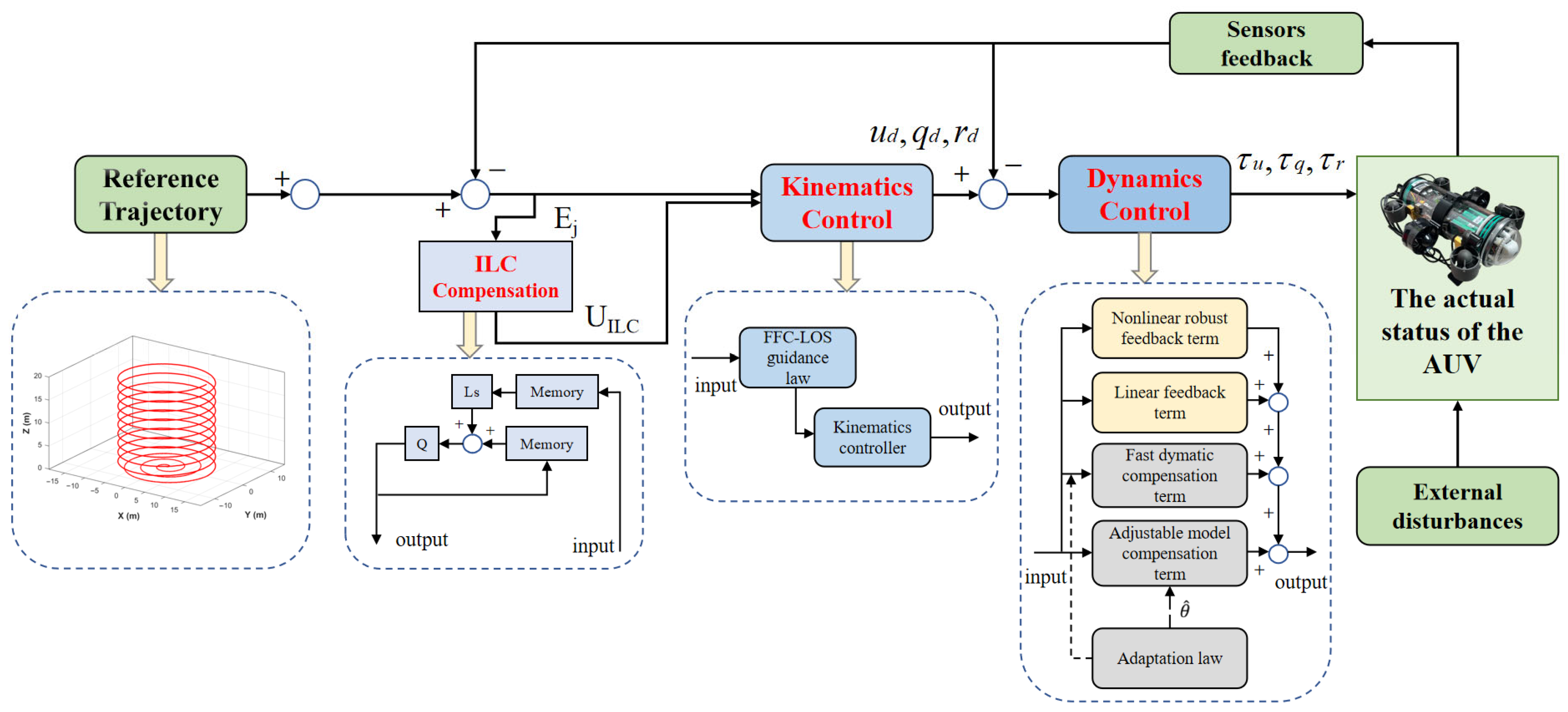
To fulfil the above control objective, a hierarchical (cascaded) control architecture is employed. The outer kinematic loop computes desired velocity commands from the position tracking errors, while the inner dynamic loop generates the actual forces and moments required to track those commands. The overall learning-aided adaptive robust control framework is illustrated in Figure 2.

3.1. Kinematics Controller Design

3.1.1. Iterative Learning Feedforward Compensation

For repetitive missions such as net-cage inspection, iterative learning is effective for improving path-tracking accuracy. In this work, a serial ILC structure is adopted as a feedforward compensator placed upstream of the feedback loop. During the (j + 1)-th execution of the task ( j = 1,2 ,   ,   j 0 , T ), the ILC update law is defined as:
η I L C , j + 1 ( t ) = Q s η I L C , j ( t ) + L s η 1 e , j ( t )
where η I L C is the feedforward compensation signal at the j-th iteration, expressed in the Serret–Frenet frame, and η 1 e , j is the position tracking error recorded during the j-th iteration (also expressed in the Serret–Frenet frame { F } and is defined in Equation (5). Q s is a low-pass Q-filter used to ensure robustness to non-repetitive disturbances, and L s is the learning-gain function. The ILC operates off-line to generate the feedforward term that will be applied in the next run to correct the reference trajectory.

3.1.2. Error Dynamics Model for Trajectory Tracking

To design the controller, an error dynamics model is required. The position error in the inertial frame is { I } , with e p = η 1 η 1 d , and with mapping e p to the Serret–Frenet frame F attached to the desired path via the frame transformation matrix   T F I ( ) . This yields the along-track, cross-track, and normal errors x e ,   y e , and z e , i.e., taking into account the ILC feedforward compensation, the adjusted error is given by:
η 1 e = x e y e z e = R I F η 2 d η 1 η 1 d η I L C
Here, R I F denotes the rotation matrix from the inertial frame { I } to the Serret–Frenet frame F . To derive the error dynamics model, Equation (5) is differentiated concerning time. This requires taking the time derivative of R I F , substituting the AUV kinematics in Equation (1), and using the differential geometric relations of the Serret–Frenet frame (the Frenet–Serret formulas). After a series of coordinate transformations and algebraic simplifications, the rates of the error variables can be expressed in terms of the errors themselves and the actual vehicle velocities and attitudes. As the derivation is lengthy, we present the results directly and refer the reader to [24] for details. Combining the above differentiation with the kinematic Equation (1) yields the error dynamics model [24]:
x ˙ e = U   cos ψ e cos θ e U d + ψ ˙ d cos θ d y e θ ˙ d z e y ˙ e = U   sin ψ e cos θ e ψ ˙ d cos θ d x e ψ ˙ d sin θ d z e z ˙ e = U   sin θ e + θ ˙ d x e + ψ ˙ d sin θ d y e θ ˙ e = q + α ˙ θ ˙ d ψ ˙ e = r cos θ + β ˙ ψ ˙ d
In these expressions, U = u 2 + v 2 + w 2 is the vehicle speed, U d is the desired path speed magnitude, and θ e and ψ ˙ e are the pitch and yaw tracking errors. The symbols α and β denote the angle of attack and the sideslip angle, respectively.

3.1.3. Kinematic Control Law Based on FFC-LOS

On the basis of the above error model, a kinematic controller is designed to generate virtual velocity commands. We propose a feedforward-compensated look-ahead guidance (FFC-LOS) method:
ν d = u d q d r d = U d cos ψ los cos θ los k z z e k θ θ e k y y e k ψ ψ e
where k y , k z , k θ , k ψ are control gains. The angles θ los and ψ los are the LOS guidance angles augmented by the ILC compensation, defined by:
θ los = arctan z e + η ILC , z Δ z ψ los = arctan y e + η ILC , y Δ y
where Δ y and Δ z are look-ahead distances. Controller (7) ensures convergence through the feedback terms, while the LOS angles steer the attitude towards the path; the ILC terms provide the feedforward correction.

3.2. Dynamic Controller Design

The goal is to design the control input τ so that the actual velocity ν tracks the desired velocity ν d generated by the kinematic controller (here, ν d = [ u d , q d , r d ] T ). The velocity-tracking error is defined as e ν = ν ν d . The dynamic model in (3) is rewritten in a parameter-affine form as:
M ν ˙ = Φ ν , η 2 Θ + g 0 η 2 + τ + τ d
where Φ ( ν , η 2 ) is the regressor constructed from the system states, Θ is the vector of unknown hydrodynamic parameters, and g 0 η 2 collects known hydrostatic terms.

3.2.1. Online Parameter Identification via Projection and Rate-Limited RLS

To cope with parametric uncertainty, a recursive least-squares (RLS) algorithm with a forgetting factor is adopted to estimate Θ online. To ensure physical plausibility and robustness, a projection operator and a rate limiter are incorporated. The modified update laws are given by
Θ ^ ˙ = Pro j Θ ^ Γ Φ T e ν , f , Γ ˙ = λ Γ β Γ Φ T Φ Γ
Here, Θ ^ ˙ denotes the estimate of Θ ; Pro j θ ^ i ( ) projects the tentative update onto known physical bounds, and the rate limiter constrains the update speed. Γ is the adaptive gain matrix, and e ν , f is the filtered velocity-tracking error based on the prediction error. These modifications enhance the stability and convergence of the identification process.

3.2.2. Adaptive Robust Control Law

The dynamic control input τ = [ τ 1 , τ 2 , τ 3 ] T is composed of two parts:
τ = τ a + τ s
The model-based adaptive term   τ a utilizes the online parameter estimate Θ ^ to compensate for the estimated nonlinearities and coupled dynamics of the system. This term acts as a feedforward component, aiming to counteract the predictable parts of the vehicle’s dynamics, thereby reducing the burden on the feedback controller:
τ a = Φ ν , η 2 Θ ^ g 0 η 2 + M ν ˙ d
The robust feedback term τ s suppresses all residual uncertainties, including parameter estimation errors and external disturbances. It consists of a linear feedback part and a nonlinear robust part:
τ s = K D e ν + τ s 2
where K D is the feedback gain matrix. The nonlinear term τ s 2 is chosen such that:
τ s 2 h ,     τ s 2 h
with h > 0 denoting a known upper bound for the lumped uncertainty. This composite control law integrates model information with robust feedback to achieve strong attenuation of uncertainties and disturbances.

3.3. Closed-Loop Stability Analysis

Applying the kinematic controller (7) and the dynamic control law (11) to the AUV system, the Lyapunov function is defined for the entire closed loop as V = V k i n + V d y n , where V k i n is a positive definite function of the kinematic errors, e.g., V k i n = 1 2 k p ( x e 2 + y e 2 + z e 2 ) and V d y n = 1 2 e ν T M e ν +   1 2 i θ ~ i T Γ i 1 θ ~ i , θ ~ i = θ ^ i θ i denotes the dynamic part with M the inertia matrix, and θ ~ i the parameter estimation error.
To establish stability, consider the time derivative of the Lyapunov function V = V k i n + V d y n , i.e.,
V ˙ = V ˙ k i n + V ˙ d y n
First, by differentiating V d y n ., one obtains:
V ˙ d y n = e ν T M e . ν + i θ ~ i T Γ i 1 θ ^ . i
Using e . ν = ν . ν . d and the dynamic model in (9) yields:
e ν T M e . ν = e ν T ϕ T θ + τ + τ d M ν . d
Substituting the control law (11) with τ = τ a + τ s and simplifying gives:
e ν T M e . ν = e ν T ϕ T θ ~ + τ s + τ d
Hence, V ˙ d y n   can be written as:
V ˙ dyn = e ν T Φ Θ ~ + τ s + τ d + Θ ~ T Γ 1 Θ ^ ˙
By the properties of the adaptation law (10), the projection operator ensures θ ~ i T ( Γ i 1 θ ^ . i ϕ i e ν , i ) 0 , and by the design of the robust term τ s (handling e ν T τ d via Young’s inequality), the dynamic subsystem is input-to-state-stable (ISS). Combining the kinematic and dynamic subsystems and invoking a backstepping argument, the following bound holds for suitably chosen controller gains:
V ˙ c 1 V + c 2
where c 1 > 0 and c 2 > 0 depend on the control gains and known bounds on the uncertainties. This inequality implies that the Lyapunov function is bounded; hence, the tracking errors (position and velocity) and the parameter estimation error are uniformly ultimately bounded (UUB). By selecting appropriate gains (while respecting actuator limits), the steady-state errors can be driven into an arbitrarily small neighbourhood of the origin. Therefore, the overall LARC control system is stable.

4. Simulation Setup and Results

To assess the effectiveness and advantages of the proposed LARC strategy for spiral inspection inside marine net-cages, simulations are conducted in a MATLAB/Simulink (version R2024a, The MathWorks, Inc., Natick, MA, USA) environment on an underactuated AUV. The reference path follows a typical inspection pattern—bottom exploration first, then side-wall spiralling. The proposed method is compared with ARC, RC, and PID, and performance is evaluated in terms of tracking accuracy, robustness, and learning capability. Specifically, ARC denotes adaptive robust control without the ILC feedforward term, which is equivalent to LARC at the iteration index k = 0 . RC denotes a fixed-parameter nonlinear robust controller that retains the same dynamic-loop structure as our design but removes parameter estimation and adaptive tuning; it consists only of linear proportional feedback together with the designed nonlinear robust term.
The controllers are implemented on the 4 kg AUV platform described in Table 2. The nominal system parameters are set according to the platform characteristics. To ensure physical plausibility and reproducibility, all controller gains are carefully tuned. The main settings are as follows. For the kinematic loop, the position error feedback gain is K p = d i a g ( 0.6 , 0.6 , 1.0 ) . For the iterative learning module, the learning gain is L s = 0.35 and the robustness Q f i l t e r is Q ( s ) = 1 0.8 s + 11 . In the dynamic loop, the core RLS identifier uses a forgetting factor λ = 0.98 , with initial covariance P ( 0 ) = 100 I (where I is the identity matrix), and the parameter update rate is limited by   θ ˙ m a x = 10 . The linear feedback gain for the velocity error channel is K D = d i a g ( 2.5 , 8 , 7.5 ) , chosen to match the actuation capability of the AUV. For the adaptive-robust term that estimates the upper bound of the disturbance, the gain is set to γ ρ = 0.5 , and the boundary layer thickness of the saturation function is δ = 0.05 .
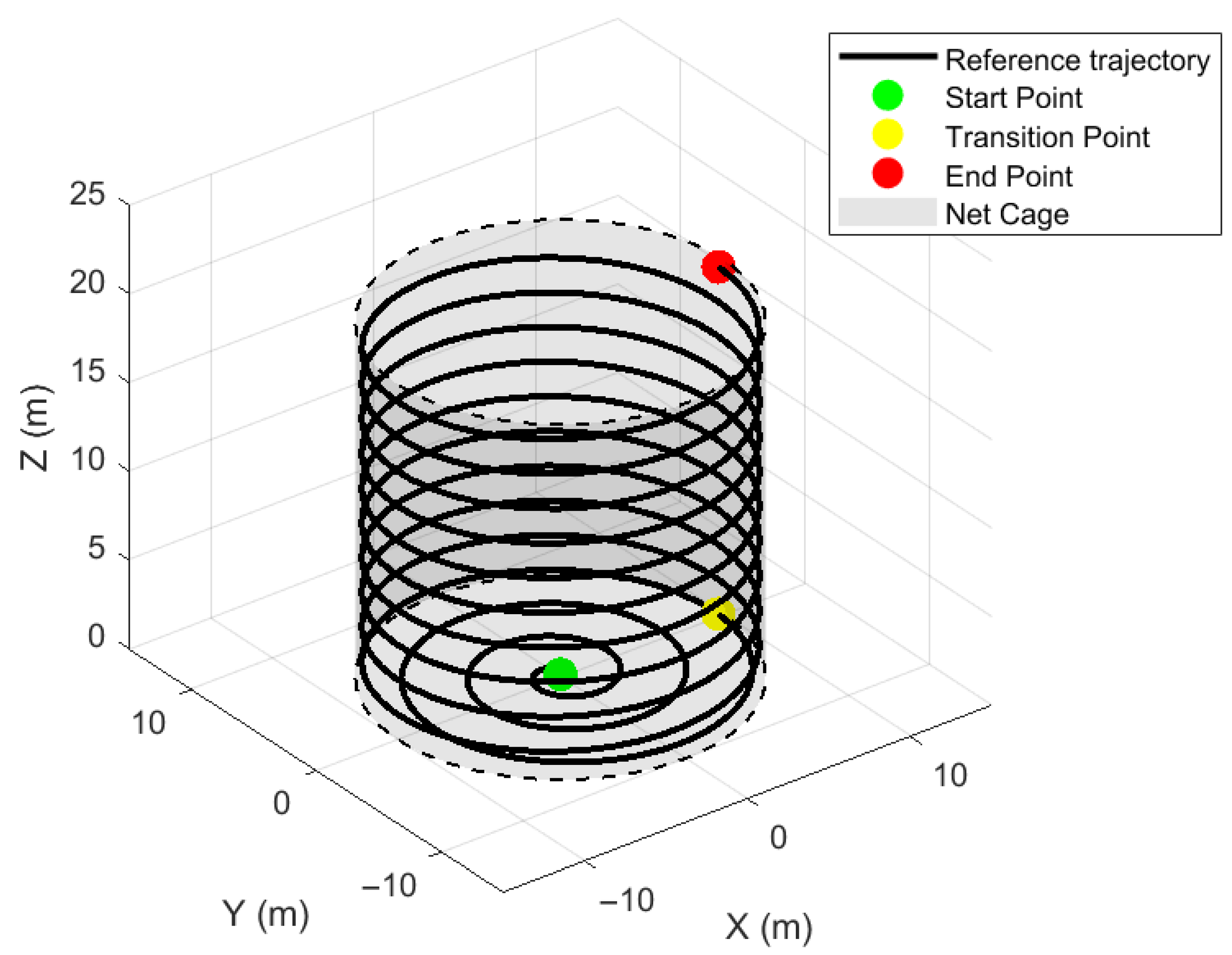
The reference path comprises a planar bottom spiral followed by a three-dimensional side-wall spiral (Figure 3), which emulates a practical inspection route inside a circular aquaculture net-cage and ensures full coverage of the cage. Stage I—bottom planar spiral ( 0 t 150   s )—is defined as:
x d ( t ) = ( 9.7 150 t ) c o s ( 0.04 π t ) y d ( t ) = ( 9.7 150 t ) s i n ( 0.04 π t ) z d ( t ) = 0.15
Stage II—side-wall spatial spiral ( 150 s t 600 s )—is given by:
x d ( t ) = 9.7   c o s 6 π + 2 45 π ( t 150 ) x d ( t ) = 9.7   s i n 6 π + 2 45 π ( t 150 ) z d ( t ) = 0.15 + 19.55 · ( t 150 450 )
The initial conditions are x ( 0 ) = 0   m , y 0 = 0   m , z ( 0 ) = 0.15 m , u ( 0 ) = 0.01 m / s , and v ( 0 ) = w ( 0 ) = q ( 0 ) = r ( 0 ) = θ ( 0 ) = ψ ( 0 ) = 0 . The total simulation horizon is 600 s, and external disturbances are injected from t = 100   s . The integration step is 0.01 s. The feedforward compensation uses a single learning iteration ( k = 1 ) . To emulate realistic marine conditions, a composite disturbance τ d ( t ) comprising time-varying current and periodic wave components is introduced. The disturbance profiles (amplitudes and dominant frequencies) are carefully selected to pose a meaningful yet reasonable challenge to the AUV control system. The overall disturbance model is given in:
τ d t = τ d u t τ d v t τ d w t τ d q t τ d r t , τ d u t = 1.5 sin 0.8 t + π 6 + 0.5 cos 1.5 t τ d v t = 2.0 sin 0.6 t + π 6 + 0.8 cos 1.2 t τ d w t = 2.5 sin 0.9 t + 1.0 cos 2.0 t τ d q t = 0.5 sin 0.7 t + π 4 + 0.2 cos 1.8 t τ d r t = 0.4 sin 0.5 t + π 2 + 0.3 cos 1.6 t
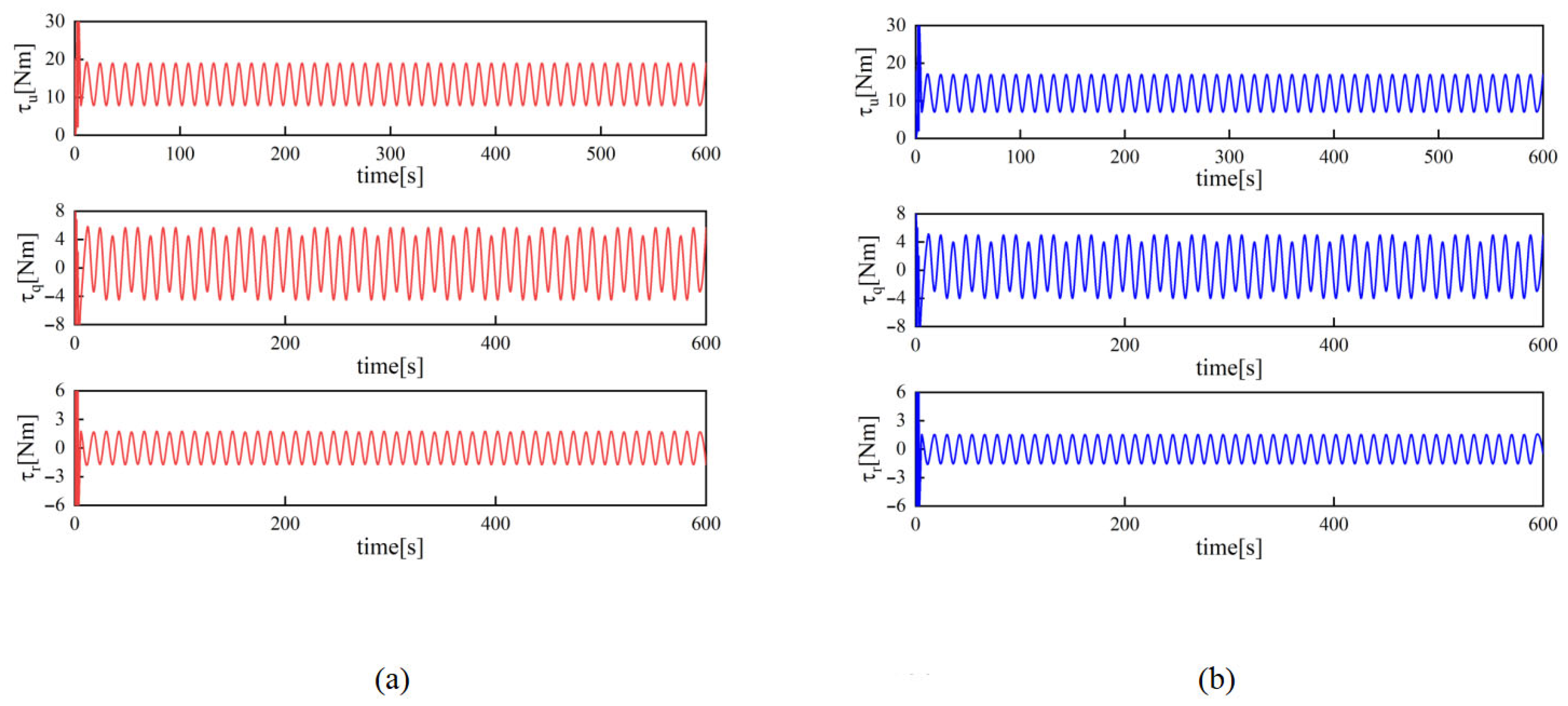
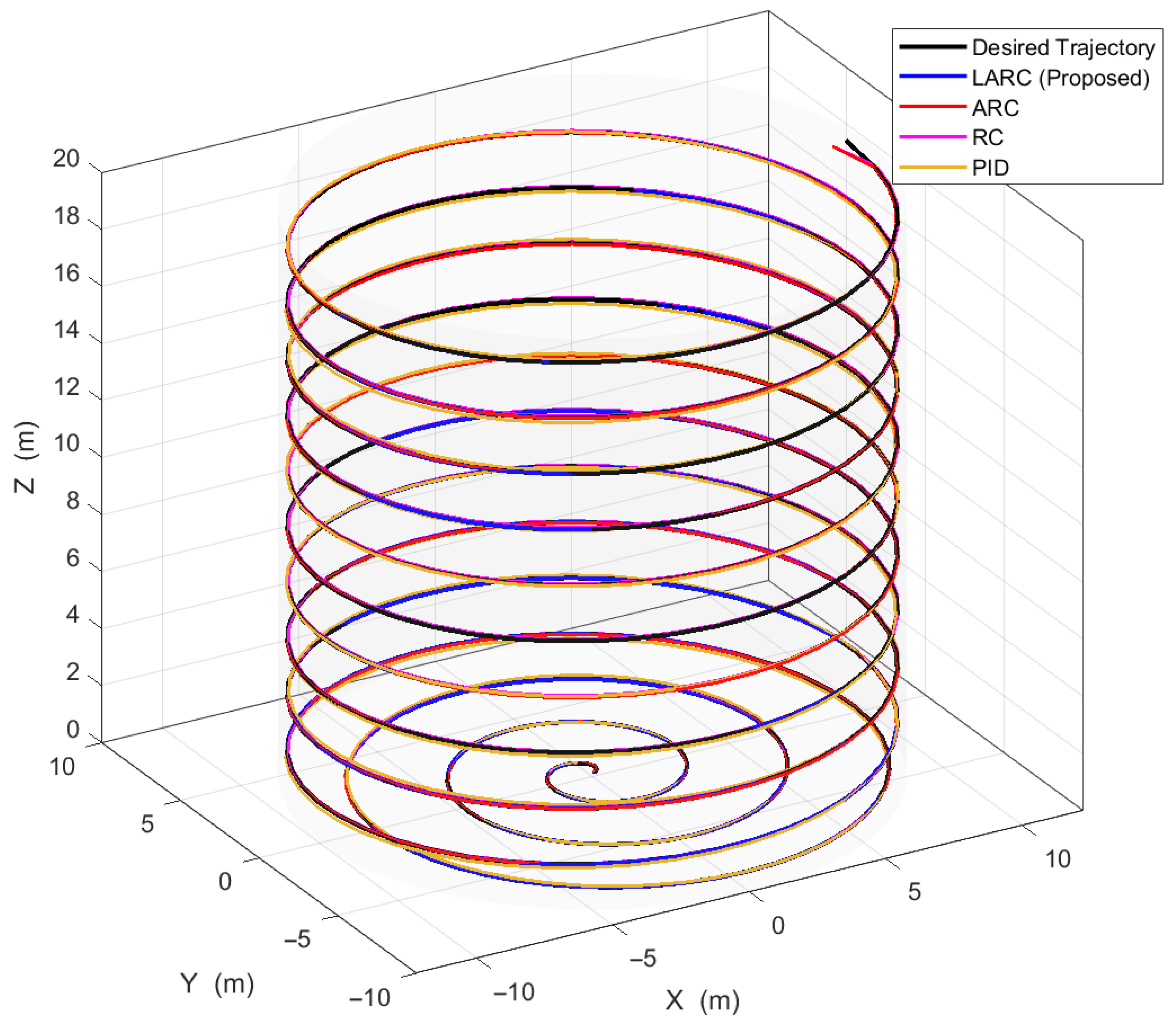
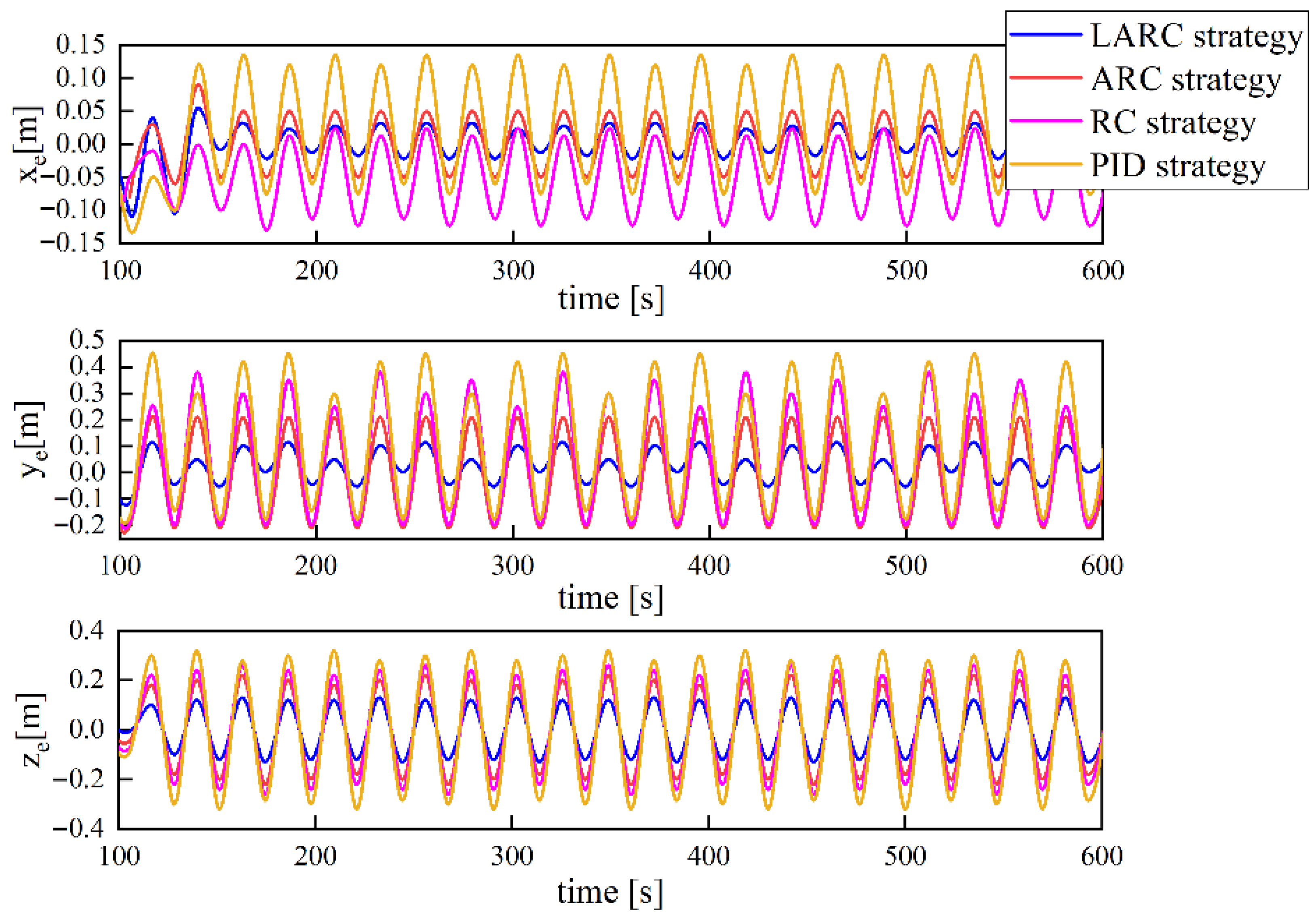
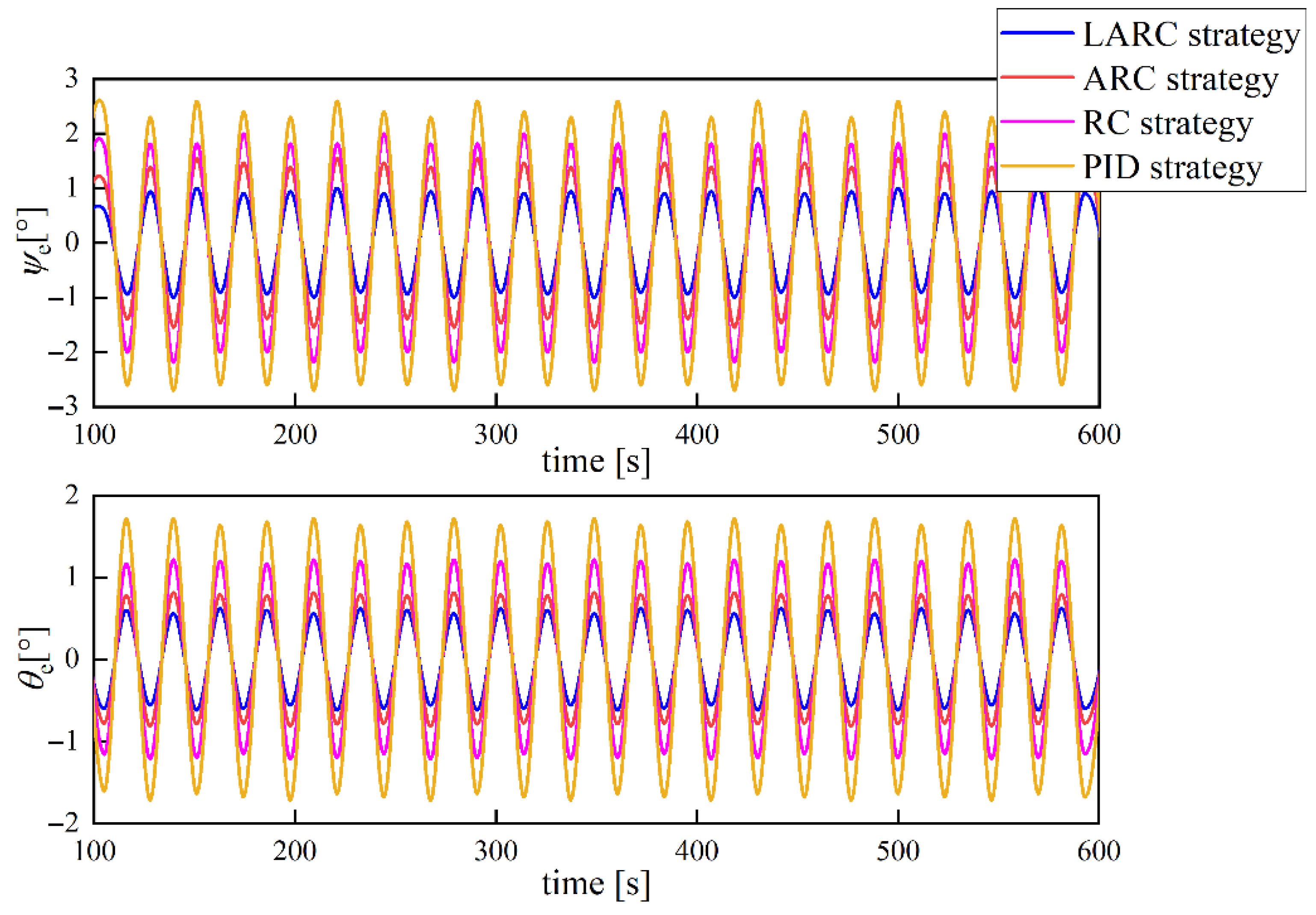
Figure 4 presents the spatial tracking performance in the spiral diving scenario with disturbances, confirming that the proposed controller steers the AUV closely along the desired path (color code: desired trajectory—grey dashed; LARC—blue; ARC—orange; RC—indigo; PID—dark yellow). Figure 5 and Figure 6 report, respectively, the three-dimensional position errors and the attitude tracking errors (pitch and yaw) after the disturbance is applied (t ≥ 100 s). The vehicle governed by LARC shows the smallest position deviations and the lowest amplitudes of pitch/yaw oscillation among all the methods. Figure 7 gives the control inputs under disturbances for LARC and ARC; all inputs remain within reasonable bounds.
To substantiate the effectiveness and stability of the proposed strategy in the spiral diving scenario, we performed a quantitative analysis using the mean absolute error (MAE) and mean squared error (MSE) as common evaluation metrics. The detailed indices under disturbances are summarized in Table 3. The proposed LARC achieves the highest tracking accuracy in the x , y , and z positions as well as in pitch and yaw, followed by ARC, then RC, and finally PID. LARC also shows an advantage in control effort. Relative to ARC, the total MAE and total MSE are reduced by approximately 34.2% and 55.6%, respectively. This comparison isolates the performance gain brought by the ILC module. Across all metrics, LARC consistently outperforms ARC; in particular, for the cross-track and normal errors that dominate periodic motion, LARC exhibits strong attenuation. This benefit stems from the feedforward learning that cancels the repeatable components of the spiral trajectory and of the disturbances.
Simulations in MATLAB/Simulink were performed to validate the proposed learning-aided adaptive robust control under a spiral trajectory representative of net-cage inspection with strong time-varying disturbances. The controller follows the desired three-dimensional path most closely and attains a lower mean absolute error and mean squared error than adaptive robust control, a fixed-parameter robust controller, and a classical proportional–integral–derivative controller. All controllers remain stable under bounded disturbances, with the proposed design achieving the smallest steady-state error.
Analysis across repeated runs confirms the learning effect: a single update of the iterative learning feedforward compensator yields a marked reduction in tracking error by cancelling repeatable components. Examination of the controller structure indicates that recursive least-squares adaptation enhances robustness to modelling uncertainty, while the learning component further attenuates errors arising from task repetitiveness, leading to consistent gains in net-cage inspection scenarios.

5. Conclusions

This paper has presented a learning-aided adaptive robust control (LARC) scheme for spiral trajectory tracking of underactuated AUVs in aquaculture net-cage environments. At the kinematic level, a feedforward-compensated LOS guidance law augmented with iterative learning was developed to exploit task repeatability. At the dynamic level, an adaptive robust controller with projection-based, rate-limited RLS identification and nonlinear robust terms was designed to suppress parametric uncertainty and environmental disturbances.
Theoretical analysis established uniform ultimate boundedness (UUB) of all closed-loop error signals, while the simulation results validated the effectiveness of the proposed strategy. In particular, compared with ARC, the proposed LARC reduced the mean absolute error (MAE) and mean square error (MSE) by approximately 34.2% and 55.6%, respectively. Against classical PID and RC baselines, LARC also achieved higher tracking accuracy and faster convergence while maintaining bounded control effort.
Overall, the results demonstrate that adapting LARC to the spiral inspection of net-cages provides a practical and effective solution for enhancing the precision and robustness of autonomous aquaculture inspection robots. The successful simulation results strongly motivate the transition to physical validation. Future work will focus on implementing and testing the proposed LARC strategy on our experimental AUV platform, first in tank tests and subsequently in sea trials. Extensions to multi-robot cooperative inspection will also be explored.

Author Contributions

Conceptualization, Z.Z. and D.H.; methodology, Z.Z.; software, F.Y.; validation, H.H. and F.L.; formal analysis, A.V.; investigation, Z.Z.; resources, D.H.; data curation, F.Y.; writing—original draft preparation, Z.Z.; writing—review and editing, D.H., H.H. and A.V.; visualization, H.H. and F.L.; supervision, D.H.; project administration, D.H.; funding acquisition, D.H. All authors have read and agreed to the published version of the manuscript.

Funding

This research was funded by the 2025 Modern Agricultural Machinery and Technology Promotion Project of Jiangsu Province, grant number (NJ2025-12).

Institutional Review Board Statement

Not applicable.

Informed Consent Statement

Not applicable.

Data Availability Statement

The original contributions presented in this study are included in the article. Further inquiries can be directed to the corresponding author.

Conflicts of Interest

The authors declare no conflicts of interest.

Abbreviations

The following abbreviations are used in this manuscript:
AUVAutonomous Underwater Vehicle
LARCLearning-Aided Adaptive Robust Control
ARCAdaptive Robust Control
ILCIterative Learning Control
RLSRecursive Least-Squares
LOSLine-Of-Sight
FFC-LOSFeedforward-Compensated Look-Ahead Guidance
RCRobust Controller
PIDProportional–Integral–Derivative
UUBUniform Ultimate Boundedness
ISSInput-to-State Stability
MAEMean Absolute Error
MSEMean Squared Error
DOFDegree(s) of Freedom
Q-filterLow-Pass Q-Filter

References

  1. Li, D.; Du, L. AUV Trajectory Tracking Models and Control Strategies: A Review. J. Mar. Sci. Eng. 2021, 9, 1020. [Google Scholar] [CrossRef]
  2. Jawhar, I.; Mohamed, N.; Al-Jaroodi, J.; Zhang, S. An Architecture for Using Autonomous Underwater Vehicles in Wireless Sensor Networks for Underwater Pipeline Monitoring. IEEE Trans. Ind. Inform. 2018, 15, 1329–1340. [Google Scholar] [CrossRef]
  3. Chen, Y.; Qiao, J.; Liu, J.; Zhao, R.; An, D.; Wei, Y. Three-Dimensional Path-Following Control System for Net-Cage Inspection Using Bionic Robotic Fish. Inf. Process. Agric. 2022, 9, 100–111. [Google Scholar] [CrossRef]
  4. Degorre, L.; Fossen, T.I.; Chocron, O.; Delaleau, E. A Model-Based Kinematic Guidance Method for Control of Underactuated Autonomous Underwater Vehicles. Control Eng. Pract. 2024, 152, 106068. [Google Scholar] [CrossRef]
  5. Zhang, Z.; Lin, M.; Li, D. A Double-Loop Control Framework for AUV Trajectory Tracking under Model Parameters Uncertainties and Time-Varying Currents. Ocean Eng. 2022, 265, 112566. [Google Scholar] [CrossRef]
  6. Jalving, B. The NDRE-AUV Flight Control System. IEEE J. Ocean. Eng. 1994, 19, 497–501. [Google Scholar] [CrossRef]
  7. Elmokadem, T.; Zribi, M.; Youcef-Toumi, K. Terminal Sliding Mode Control for the Trajectory Tracking of Underactuated Autonomous Underwater Vehicles. Ocean Eng. 2017, 129, 613–625. [Google Scholar] [CrossRef]
  8. Xu, J.; Wang, M.; Qiao, L. Dynamical Sliding Mode Control for the Trajectory Tracking of Underactuated Unmanned Underwater Vehicles. Ocean Eng. 2015, 105, 54–63. [Google Scholar] [CrossRef]
  9. Zhou, J.; Zhao, X.; Chen, T.; Yan, Z.; Yang, Z. Trajectory Tracking Control of an Underactuated AUV Based on Backstepping Sliding Mode with State Prediction. IEEE Access 2019, 7, 181983–181993. [Google Scholar] [CrossRef]
  10. Rezazadegan, F.; Shojaei, K.; Sheikholeslam, F.; Chatraei, A. A Novel Approach to 6-DOF Adaptive Trajectory Tracking Control of an AUV in the Presence of Parameter Uncertainties. Ocean Eng. 2015, 107, 246–258. [Google Scholar] [CrossRef]
  11. Guerrero, J.; Torres, J.; Creuze, V.; Chemori, A. Trajectory Tracking for Autonomous Underwater Vehicle: An Adaptive Approach. Ocean Eng. 2019, 172, 511–522. [Google Scholar] [CrossRef]
  12. Lapierre, L.; Jouvencel, B. Robust Nonlinear Path-Following Control of an AUV. IEEE J. Ocean. Eng. 2008, 33, 89–102. [Google Scholar] [CrossRef]
  13. Mahapatra, S.; Subudhi, B. Design of a Steering Control Law for an Autonomous Underwater Vehicle Using Nonlinear H-Infinity State Feedback Technique. Nonlinear Dyn. 2017, 90, 837–854. [Google Scholar] [CrossRef]
  14. Zhang, W.; Teng, Y.; Wei, S.; Xiong, H.; Ren, H. Robust H-Infinity Control of an Unmanned Underwater Vehicle with Riccati-Equation Solution Interpolation. Ocean Eng. 2018, 156, 252–262. [Google Scholar] [CrossRef]
  15. Viadero-Monasterio, F.; Meléndez-Useros, M.; Zhang, N.; Zhang, H.; Boada, B.; Boada, M. Motion Planning and Robust Output-Feedback Trajectory Tracking Control for Multiple Intelligent and Connected Vehicles in Unsignalized Intersections. IEEE Trans. Veh. Technol. 2025, 1–13. [Google Scholar] [CrossRef]
  16. Su, R.; Zhang, D.; Li, C.; Gong, Z.; Venkatesan, R.; Jiang, F. Localization and Data Collection in AUV-Aided Underwater Sensor Networks: Challenges and Opportunities. IEEE Netw. 2019, 33, 86–93. [Google Scholar] [CrossRef]
  17. Luo, W.; Cheng, B. Disturbance Suppression and Neural-Network Compensation Based Trajectory Tracking of an Underactuated AUV. Ocean Eng. 2023, 288, 116172. [Google Scholar] [CrossRef]
  18. Li, Z.; Wang, M.; Ma, G. Adaptive Optimal Trajectory Tracking Control of AUVs Based on Reinforcement Learning. ISA Trans. 2023, 137, 122–132. [Google Scholar] [CrossRef]
  19. Yao, B.; Tomizuka, M. Adaptive Robust Control of SISO Nonlinear Systems in a Semi-Strict Feedback Form. Automatica 1997, 33, 893–900. [Google Scholar] [CrossRef]
  20. Hu, C.; Yao, B.; Wang, Q. Integrated Direct/Indirect Adaptive Robust Contouring Control of a Biaxial Gantry with Accurate Parameter Estimations. Automatica 2010, 46, 701–707. [Google Scholar] [CrossRef]
  21. Mohanty, A.; Yao, B. Indirect Adaptive Robust Control of Hydraulic Manipulators with Accurate Parameter Estimates. IEEE Trans. Control Syst. Technol. 2011, 19, 567–575. [Google Scholar] [CrossRef]
  22. Ahn, H.S.; Chen, Y.; Moore, K.L. Iterative Learning Control: Brief Survey and Categorization. IEEE Trans. Syst. Man Cybern. Part C Appl. Rev. 2007, 37, 1099–1121. [Google Scholar] [CrossRef]
  23. Saab, S.S.; Shen, D.; Orabi, M.; Kors, D.; Jaafar, R.H. Iterative Learning Control: Practical Implementation and Automation. IEEE Trans. Ind. Electron. 2021, 69, 1858–1866. [Google Scholar] [CrossRef]
  24. Bristow, D.A.; Tharayil, M.; Alleyne, A.G. A Survey of Iterative Learning Control. IEEE Control Syst. Mag. 2006, 26, 96–114. [Google Scholar]
  25. Hu, C.; Hu, Z.; Zhu, Y.; Wang, Z.; He, S. Model–Data-Driven Learning Adaptive Robust Control of Precision Mechatronic Motion Systems with Comparative Experiments. IEEE Access 2018, 6, 78286–78296. [Google Scholar] [CrossRef]
  26. Guo, L.; Zhou, R.; Guo, Q.; Ma, L.; Hu, C.; Luo, J. Spatial Trajectory Tracking of Underactuated Autonomous Underwater Vehicles by Model–Data–Driven Learning Adaptive Robust Control. J. Mar. Sci. Eng. 2025, 13, 1151. [Google Scholar] [CrossRef]
  27. Fossen, T.I. Handbook of Marine Craft Hydrodynamics and Motion Control; John Wiley & Sons: Chichester, UK, 2011. [Google Scholar]
Figure 1. Schematic diagram of AUV’s spatial trajectory tracking.
Applsci 15 10477 g001
Figure 2. Schematic diagram of the LARC strategy for underactuated AUV.
Applsci 15 10477 g002
Figure 3. Two-stage spiral trajectory tracking diagram.
Applsci 15 10477 g003
Figure 4. Trajectory tracking under disturbances: spiral diving scenario with four control strategies.
Applsci 15 10477 g004
Figure 5. AUV position tracking errors in the spiral trajectory scenario under parametric uncertainty and disturbances, comparing four control strategies.
Applsci 15 10477 g005
Figure 6. AUV attitude errors (pitch and yaw) in the spiral trajectory scenario under parametric uncertainty and disturbances, comparing four control strategies.
Applsci 15 10477 g006
Figure 7. Control inputs in the spiral trajectory scenario under parametric uncertainty and disturbances: (a) LARC; (b) ARC.
Applsci 15 10477 g007
Table 1. Comparison of control strategies for net-cage inspection.
MethodApplication ContextAdaptability to UncertaintyHandles Repetitive Tasks?Data RequirementsStability Guarantees
Proposed LARC (This Work)Net-Cage Spiral InspectionHigh (RLS + Robust Term)Yes (via ILC)Model-based + past trial dataUUB
LARC (Guo et al. [26])General 3D TrajectoryHigh (RLS + Robust Term)Yes (via ILC)Model-based + past trial dataUUB
Helix Controller (Chen et al. [3])Net-Cage Helical PathLow (Fixed Parameters)Implicitly (path-specific)Model-basedNot specified
RL-based Control [16]General 3D TrajectoryHigh (Learned Policy)Possible (with task framing)Large interaction datasetProbabilistic/none
SMC [7,8,9]General 3D TrajectoryHigh (Robust to Bounds)NoModel-based (sliding surface)Asymptotic/UUB
Table 2. Basic parameters of AUV simulation platform.
ParametersValue
Main body length396 mm
Main body width300 mm
Main body height122 mm
Total weight4 kg
Total buoyancy39.2 N
Table 3. Performance of four controllers in spiral diving under uncertainty and disturbances.
Performance IndicesLARCARCRCPID
Total MAE1.74082.64623.61974.8502
Total MSE1.26192.84075.39299.4220
MAE (xe)0.0276630.051860.0720810.094767
MSE (xe)0.0011640.0048080.0076090.010173
MAE (ye)0.0594870.1442790.1550640.247647
MSE (ye)0.0049930.0293370.0282990.070097
MAE (ze)0.1197670.1955810.2353490.296163
MSE (ze)0.0146770.038960.0561670.08886
MAE (ψe)0.9404071.4588721.9661732.532558
MSE (ψe)0.8882182.1343473.8816076.432326
MAE (θe)0.5934880.7956281.191071.67907
MSE (θe)0.3528370.6332481.4192462.820502
Disclaimer/Publisher’s Note: The statements, opinions and data contained in all publications are solely those of the individual author(s) and contributor(s) and not of MDPI and/or the editor(s). MDPI and/or the editor(s) disclaim responsibility for any injury to people or property resulting from any ideas, methods, instructions or products referred to in the content.