Article

Research on Motion Control Method of Wheel-Legged Robot in Unstructured Terrain Based on Improved Central Pattern Generator (CPG) and Biological Reflex Mechanism


1
School of Electrical and Information Engineering, Anhui University of Science and Technology, Huainan 232001, China
2
School of Mechanical and Electrical Engineering, Anhui University of Science and Technology, Huainan 232001, China
*
Author to whom correspondence should be addressed.
Appl. Sci. 2025, 15(15), 8715; https://doi.org/10.3390/app15158715
Submission received: 28 June 2025 / Revised: 24 July 2025 / Accepted: 5 August 2025 / Published: 6 August 2025

Abstract

With the development of inspection robot control technology, wheel-legged robots are increasingly used in complex underground space inspection. To address low stability during obstacle crossing in unstructured terrains, a motion control strategy integrating an improved CPG algorithm and a biological reflex mechanism is proposed. It introduces an adaptive coupling matrix, augmented with the Lyapunov function, and vestibular/stumbling reflex models for real-time motion feedback. Simulink–Adams virtual prototypes and single-wheeled leg experiments (on the left front leg) were used to verify the system. Results show that the robot’s turning oscillation was ≤±0.00593 m, the 10° tilt maintained a stable center of mass at 10.2° with roll angle fluctuations ≤±5°, gully-crossing fluctuations ≤±0.01 m, and pitch recovery ≤2 s. The experiments aligned with the simulations, proving that the strategy effectively suppresses vertical vibrations, ensuring stable and high-precision inspection.

1. Introduction

Wheel-legged mobile robots have the advantages of good mobility, strong obstacle-crossing ability, and high energy efficiency compared with traditional wheeled or footed mobile robots [1]. The robot uses wheeled motion on relatively flat terrain, which increases the speed of movement. The robot adopts foot motion when passing through complex terrain such as gullies and pits, which improves its ability to cross obstacles. The CPG is a bionic motion control model that generates rhythmic motion signals such as walking and swimming by virtue of a small amount of oscillator coupling [2]. The CPG algorithm exhibits several advantages over traditional dynamics model-based control methods, including self-excited oscillations, the absence of global trajectory planning, and natural immunity to perturbations [3]. The Matsuoka and Kimura models are representative of the neuron model CPG, while the Kuramoto phase oscillator and Hopf harmonic oscillator are dominant in the oscillator model CPG [4,5]. However, most of the existing CPG studies focus on symmetric gait generation in structured environments, where the parameters are often fixed or dependent on manual tuning [6]. Therefore, it is difficult for robots to cope with sudden changes in slope and ground stiffness in unstructured terrain, such as slopes and gullies. During unilateral terrain disturbances, the conventional symmetric coupling matrix is unable to maintain body equilibrium and is prone to sideways tilting or capsizing.
Currently, CPG controllers are being widely used in the motion control of various types of bionic robots, commonly including quadruped robots [7,8], bionic snakes/worms [9,10], and bionic robotic fishes [11]. This phenomenon has been the subject of recent scholarly inquiry, leading to a range of perspectives on the mechanisms underlying animal adaptations. For example, Li, Guanda et al., proposed an innovative approach termed the Adaptive Analog Central Pattern Generator (AI-CPG) [12]. This approach entails the modification of feedforward patterns based on sensory feedback, thereby ensuring the stabilization and balance of the body. Additionally, it demonstrates the capacity to adapt to alterations in the environment or the target’s velocity [12]. Bellegarde et al., put forward a framework that integrates the CPG into a deep reinforcement learning framework, with the objective of producing robust omnidirectional quadrupedal locomotion [13]. Chen, Shuxiao et al. proposed a learning torque control framework that enables quadrupeds to traverse a variety of terrains and resist external disturbances while following user-specified commands [14]. Auddy et al. proposed a multilevel CPG model (ML-CPG) for adaptive control of quadrupedal robots [5]. Huang, S.C. et al. proposed a method using deep reinforcement learning (DRL) to enhance the gait output of central pattern generators (CPG) for hexapod robots, aiming to improve their terrain adaptability. They validated the model through experiments on rough terrains, slopes, and stairs, showing better performance than using DRL or CPG alone [15]. Watanabe, T. et al. have presented a data-driven DRL method to optimize a hierarchically structured control policy including the central pattern generator (termed HRL-CPG) [16]. They evaluated the method’s applicability in real robot control, noting that stable gaits emerged with few trials, and deduced that it enables robots to adapt to diverse environments within a moderate amount of physical time [16]. In recent years, researchers have endeavored to incorporate stability mechanisms into the CPG framework. These efforts have included methods such as adjusting gait amplitude through force feedback or introducing a virtual impedance model to suppress body sway [17]. However, these methods continue to exhibit deficiencies in terms of feedback delay and parameter coupling conflict, and they fail to leverage the full potential of multi-source sensor information (e.g., IMU (inertial measurement unit), foot-end force) to achieve closed-loop control.
To address the aforementioned issues, a sensor-embedded CPG stability enhancement algorithm is proposed. This study has achieved breakthroughs in three key areas: First, we innovatively propose a sensor-embedded CPG control framework that integrates IMU and foot-end force feedback directly into the rhythm generation layer for real-time stability adjustment. Second, at the theoretical level, we establish a stability criterion for the CPG-body system based on an augmented Lyapunov function, while developing a dual adaptive mechanism combining force-amplitude adaptation and IMU-driven asymmetric coupling to address terrain variations. Finally, experimental validation shows that in motion control on complex terrains, this algorithm performs excellently. The center-of-mass fluctuations are strictly confined to 59.3–65% of the permissible values, and the displacement standard deviation is as low as 0.002006–0.003467 m. Moreover, stable rhythmic motion can be restored in about 2 s. This fully verifies that the algorithm can achieve high-precision motion control on complex terrains, demonstrating strong stability and rapid recovery capability.

2. Modeling of Wheel-Legged Robot Systems

2.1. Mechanical Design of Wheel-Legged Robots

The full elbow foot-end tandem shown in Figure 1 was used to design the combined configuration of the wheel and leg. In order to meet the needs of complex underground space inspection, the robot body was designed to have a height of 450 mm, a length of 460 mm and a width of 430 mm. The unstructured topography of the subsurface space has complex landforms such as bumps, slopes, and gullies. In order to enable the inspection robot to operate with high precision and high stability in such complex environments, it is necessary to conduct systematic technical tests on its motion state. Therefore, the quantification of stability indices in the field of robotics was proposed to analyze the motion performance indicators and ensure compliance with the technical specifications of refined inspection operations. The robot must maintain a total fluctuation amplitude within ±0.01 m during turning operations. When traversing terrains such as slopes and bumps, its traverse angle fluctuation should not exceed 10°. For asymmetric grooved terrain challenges, the center-of-mass fluctuation range is required to stay within ±0.01 m, and the robot must achieve a maximum spanning width of ≥0.5 times the leg length. Additionally, the pitch-angle recovery time of the body should be ≤1.2 s. These represent the key performance standards the robot is mandated to meet.
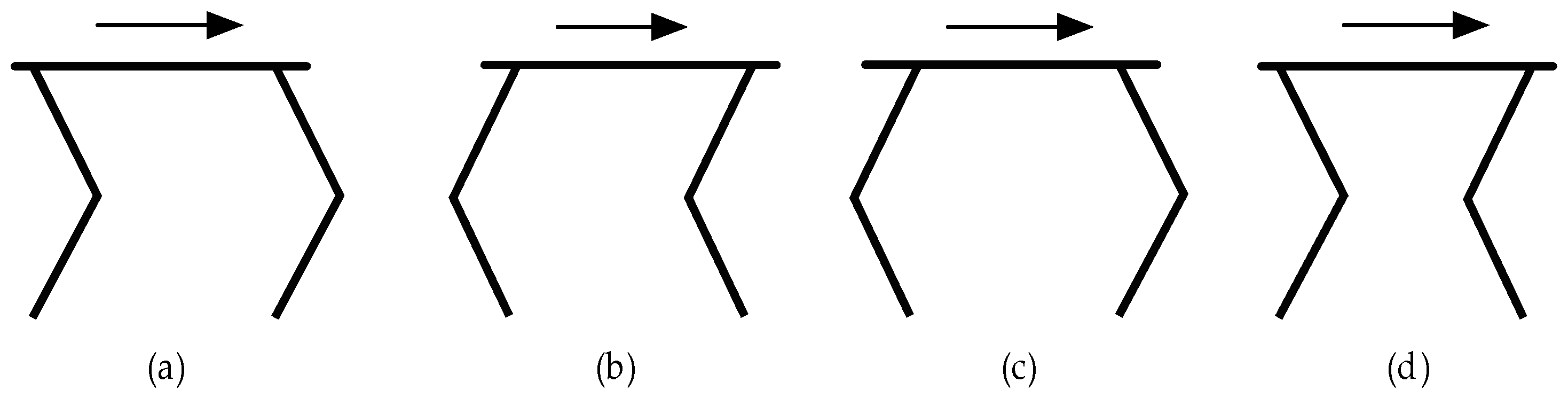
In the context of quadruped wheel-legged robots, four distinct joint configurations exist, as illustrated in Figure 2. The all-elbow configuration was selected as the joint configuration for the experiment, primarily due to its uniform joint form, which simplifies control. Additionally, this configuration facilitates the installation of contact sensors at the foot ends, thereby enabling more convenient implementation of obstacle negotiation.
A dynamic control model was constructed based on the CPG algorithm to meet the demand for improving the obstacle-crossing performance of wheel-legged robots in unstructured and complex terrains. Mainstream CPG models can be categorized into two primary classes: neuron-based models (e.g., the Matsuoka model) and nonlinear oscillator-based models (e.g., the Hopf oscillator) [18,19]. While neuron-based models provide a more accurate mimicry of biological neural systems, they necessitate the tuning of 8–12 coupled parameters, resulting in high computational complexity. In contrast, the Hopf oscillator exhibits three pivotal advantages: (1) limit cycle characteristics that ensure stability against perturbations, (2) decoupled amplitude–frequency adjustment capabilities, and (3) phase response properties facilitating sensor synchronization [17,18]. Studies have demonstrated that, compared to the Matsuoka model, the Hopf oscillator reduces computational resource consumption by 40%. Owing to its concise mathematical formulation and independently adjustable parameters, this model employs coupled order-reduction methods to simplify multi-degree-of-freedom (multi-DOF) control. The knee-hip joint coupling function is shown in (1).
ψ = 1 , knee 1 , elbow θ k ( t ) = 0 ,   ( θ ˙ h < 0 ,   S t a n c e   ) sgn ( ψ ) A k 1 θ h ( t ) A h 2 ,   ( θ ˙ h 0 ,   S w i n g   )
where θ h and θ k are the hip and knee control signals. Ah, and Ak are the hip and knee amplitudes. Respectively, ψ denotes the arrangement form of the leg joints, and ψ = 1 denotes when the joint arrangement form of the robot leg is the elbow type.
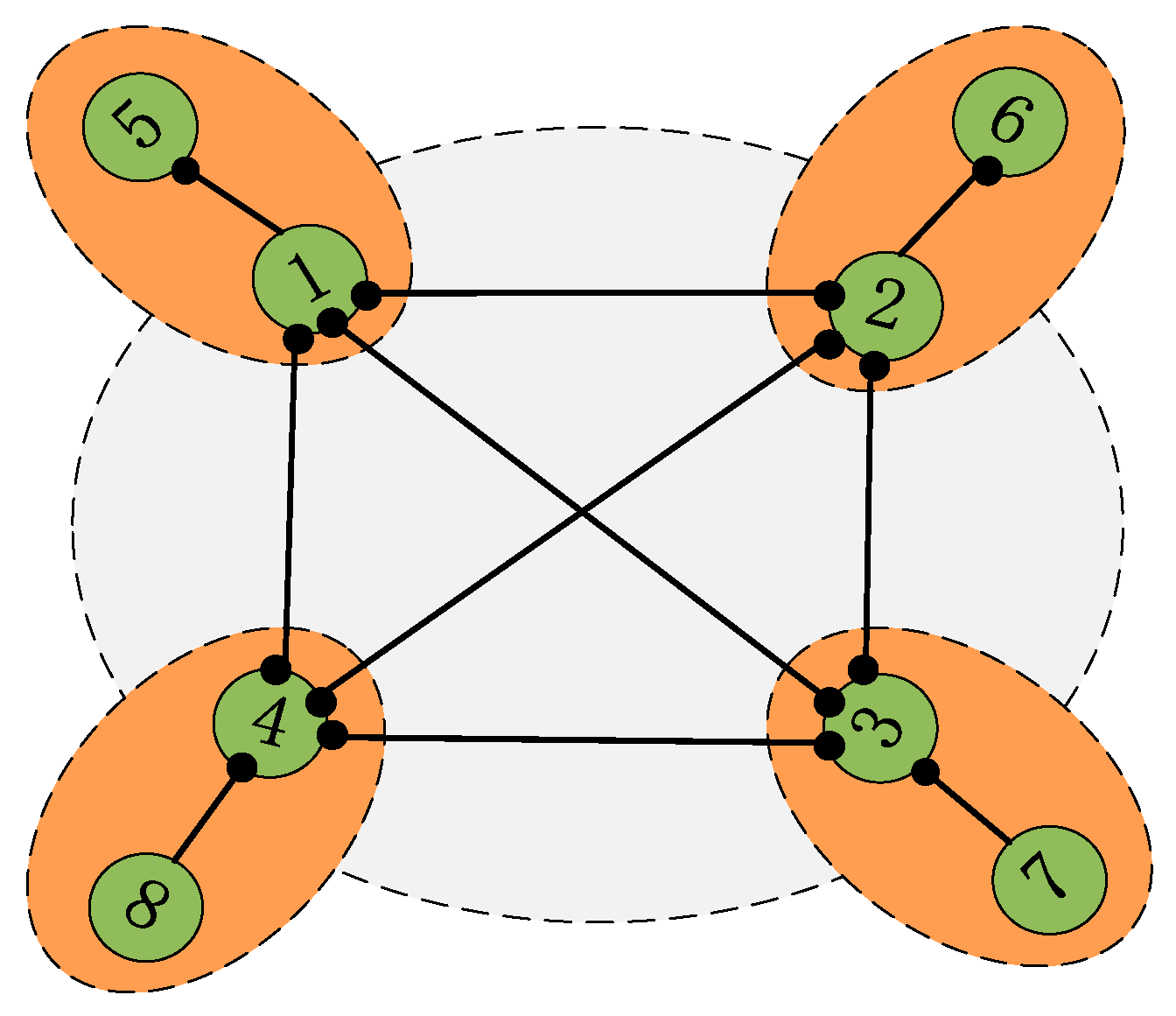
The coupled reduced-order method was used to simplify the multi-degree-of-freedom control. In this way, the number of control signals required by the system can be reduced, and the complexity of the control system can be decreased, as shown in Figure 3. Circles numbered 1–4 denote hip joints, and 5–8 denote knee joints. Lines connecting these circles represent the kinematic coupling relationships between hip and knee movements. Through the motion mapping function, the hip joint, as the “primary movement”, drives the coupled knee joint to perform auxiliary movements. This coupling directly reduces the number of independent control signals required for multi-degree-of-freedom control. Instead of controlling all hip/knee joints individually, the system utilizes this coupling relationship to coordinate movements with fewer different input signals, thereby simplifying the complexity of control [20,21].

2.2. CPG Algorithm Model Improvement

The traditional CPG algorithm has the problem of insufficient motion stability in unstructured and complex terrain, and its fixed coupling weights and phase differences are difficult to adapt to the body perturbations and gait instability triggered by sudden terrain changes, which needs to be solved urgently [22]. To solve this problem, the dynamic parameter adaptive optimization strategy was proposed. The coupling weights and phase differences are designed as variables that change dynamically over time and are directly embedded in the IMU with the feedback from the foot-end force sensors, as shown in (2). The symbol definitions in (2) are presented in Table 1.
x ˙ i y ˙ i = α ( μ r i 2 ) ω i ω i α ( μ r i 2 ) x i y i + Δ i t + j = 1 4 R ( θ i j ) x j y j r i 2 = ( x i u 1 ) 2 + ( y i u 2 ) 2 ω i = ω s t e α v i + 1 + ω s w e α v i + 1 ω s t = β 1 β ω s w θ h i = x i θ k i = sgn ( φ ) A k A h y i , y i 0 0 , y i > 0
In order to break through the traditional limitation of only considering the convergence of the rhythm, the augmented and broadened Lyapunov functions of the CPG state and the body motion state were constructed to evaluate the stability of the control system, as shown in (3). Specifically, V serves as the total cost function for motion optimization, balancing position tracking errors. xi denotes the actual position of the i-th joint, while x i * indicates the desired target position. β i j as inter-joint coupling weights and R θ j i is compared as the motion mapping output with the reference value   R θ j i * .
V = 1 2 i ( x i x i * ) 2 + 1 2 i , j β i j ( R ( θ i j ) R ( θ i j ) * ) 2
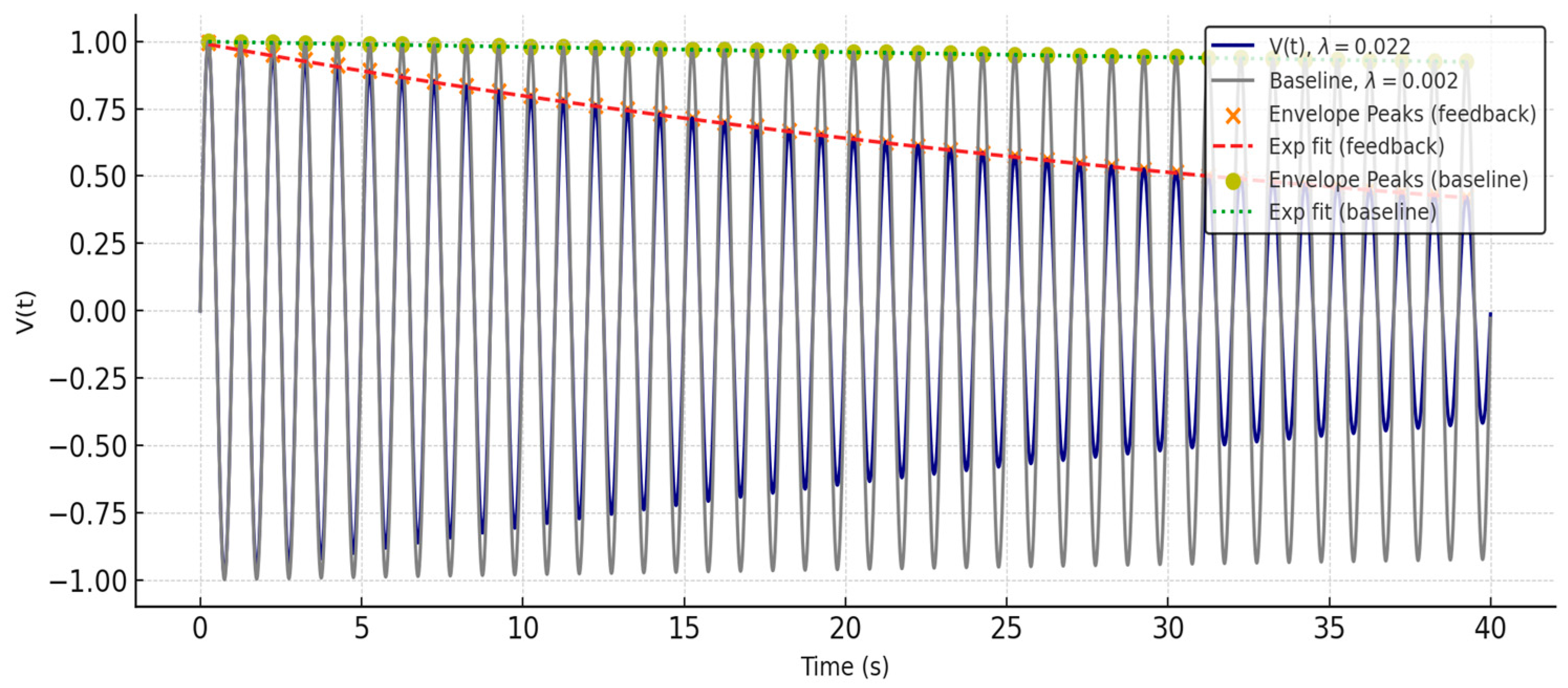
Under the premise that the desired trajectory x i * ( t ) and the reference mapping ( R ( θ j * ) ) are bounded and continuous, and that the control input is designed to minimize the Lyapunov function V, its time derivative satisfies V . ≤ 0. To further illustrate the convergence, we calculated V exp ( t ) (experimental group, CPG + Reflex) and V baseline ( t ) (baseline group, CPG + No Reflex) at each moment based on the CPG hip joint data, and extracted all local peaks V exp , max ( t ) and V b a s e l i n e , max ( t ) . As shown in Figure 4, the experimental group exhibited a decay rate λ = 0.022 s−1 with a goodness-of-fit R2 = 0.94, indicating a significant exponential decay of the Lyapunov function’s peak envelope. A high R2 (close to 1) indicates a strong fit between the exponential decay model and the data, and a large λ reflects the rapid decay of the peak envelope, verifying the system’s asymptotic stability. In contrast, the baseline group shows a much smaller decay rate λ = 0.002 s−1 and a lower R2 = 0.12. This dual improvement quantitatively demonstrates gains in stability and convergence speed.

2.3. Turning and Side-Stepping Modeling

To address the avoidance requirements of wheel-legged robots when encountering insurmountable obstacles in unstructured terrain, a dynamic obstacle-avoidance control model was constructed. Define that at time t, the signal value of the hip joint of the i-th leg is   h i t and the driving signal value of the knee joint is k i t . For the swing phase ω s w of the gait, the precise mathematical description of the control signal p i t of the lateral shift and lateral swing joints is shown in (4).
p i = 1 , 4 ( t ) = h i ( t ) , h ˙ i > 0 h i ( t π 2 W s w ) , h ˙ i 1 > 0 p i ( t t 2 ) , e l s e
Let   p i t be the output signal of the lateral swing joint. The precise mathematical description of the output signal D i t of the steering joint is shown in (5).
D i ( t ) = p i ( t ) , i = 1 , 3 p i ( t ) , i = 2 , 4

2.4. Modeling of the Robot’s Slope Movement

A dynamic amplitude adjustment model of CPG based on force feedback was constructed to solve the problem of motion instability caused by sudden changes in the foot-end force in unstructured terrain. The amplitude is adaptively adjusted according to the deviation between the measured value of the foot-end force sensor and the expected force in this paper, so that the output amplitude of the CPG can be rapidly adjusted to adapt to external disturbances when the foot-end force is abnormal. The CPG amplitude adjustment function is shown in (6). The adjustment angles for the robot’s slope movement are shown in Table 2.
A i ( t ) = A i * γ ( F f o o t , i F r e f , i )
where A i t represents the output amplitude of the i-th CPG unit, and γ is a positive definite adjustment coefficient. For F f o o t , i , it represents the actual force exerted on the foot of the i-th leg, The term   F r e f , i   denotes the pre-defined reference force for the i-th leg’s foot. When the force on the foot-end is abnormal, the output amplitude of the CPG can be adjusted rapidly to adapt to external disturbances.
The robot acquires the terrain slope signal, designated as α, via the torso-mounted pitch direction inclinometer. This signal is subsequently integrated into the feedback phase of the CPG model, denoted as S·G. The torso attitude angle exhibits a linear relationship with the extent of equilibrium position adjustment. Consequently, the vestibular reflexes are modeled as a linear function of slope, as illustrated in (7).
s v g v = α ^
Let the vestibular feedback term s v in the reflection information matrix be the actual slope value measured by the inclinometer in the pitch direction. The vestibular reflection coefficient g v is calculated from (8).
s v = α g v = k 2 / k 1 k 3
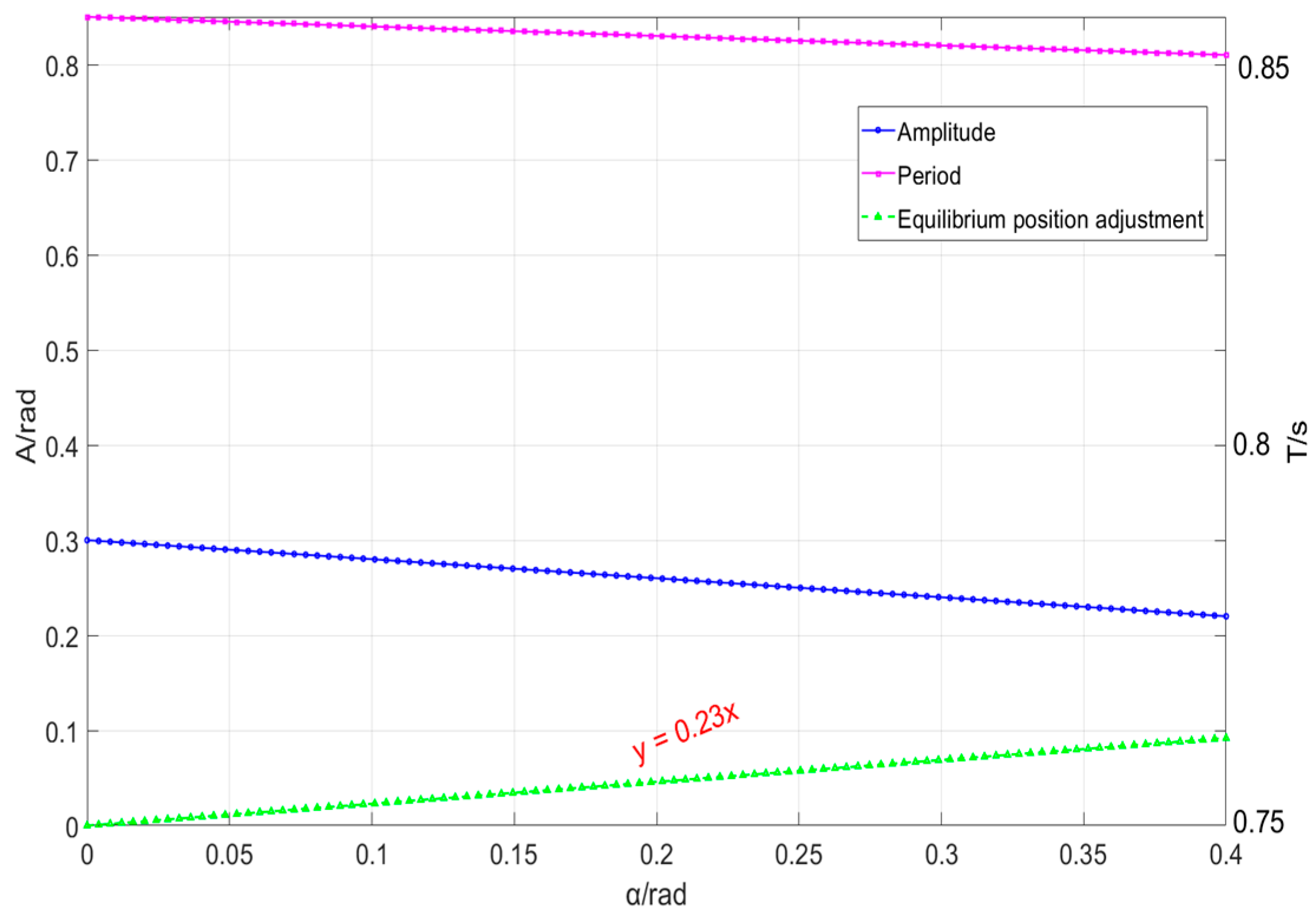
Through iterative adjustment of the slope parameter α and subsequent numerical fitting, a linear relationship Δ θ =   k 1 × α k 1 = 0.23 was established between the introduced slope and the equilibrium position adjustment, as depicted in Figure 5.
A sufficient condition for a wheel-legged robot to achieve slope locomotion with optimal energy efficiency is a linear relationship between the body pitch angle and the slope gradient, expressed as Δ α = k 2 × α , k 2   . This is a standardized proportional factor used in the slope control of legged robots, quantifying the linear mapping relationship between terrain slope variations and the corresponding adjustment of the torso pitch angle. Through extensive energy-based dynamic modeling, it was derived that when k 2 =   0.24 , the metabolically analogous energy consumption can be minimized. Where Δα denotes the body pitch angle adjustment. The relationship between the joint equilibrium position Δ θ and Δ α is defined in (9), with l = 0.15 m representing leg length, l l = 0.40 m representing body length, and θ0 representing the initial equilibrium position.
Δ α = arctan l cos ( θ 0 Δ θ ) cos ( θ 0 + Δ θ ) l sin ( θ 0 + Δ θ ) sin ( θ 0 Δ θ ) + l l
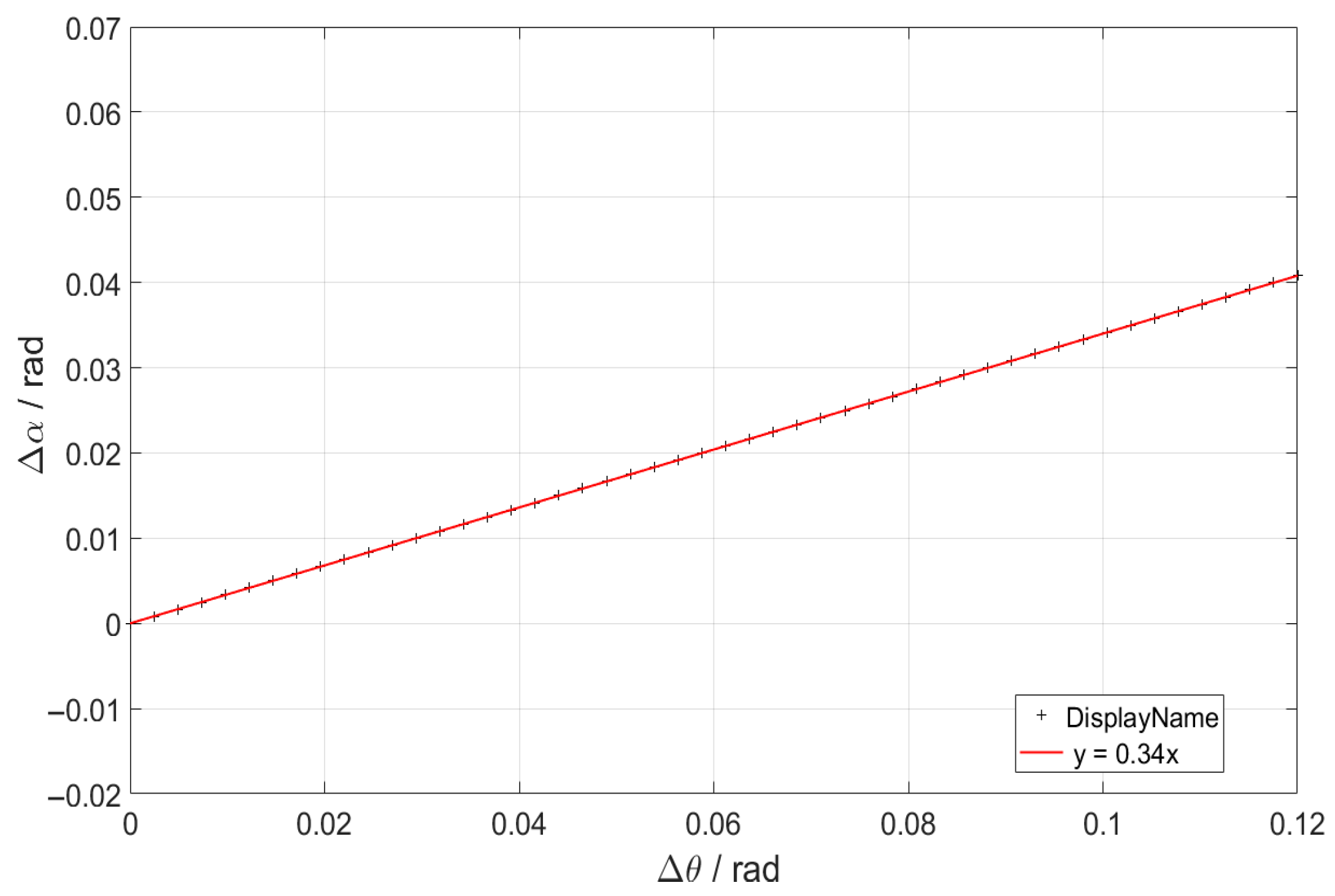
For Δ θ 0 , 0.13 , the solution for ∆α, as illustrated in Figure 6, approximates a linear dependency Δ α = k 3 × Δ θ .
The knee balancing position is adjusted in opposition to that of the hip, Δ θ k = Δ θ h =   k 1 s v g v , where g v = 3.07 ,   k 1 = 0.23 ,   k 2 = 0.24 ,   k 3 = 0.34 . The solution for Δ θ k is shown in (10).
Δ θ k = 3.07 sgn ( ψ ) k 1 α 3.07 sgn ( ψ ) k 1 α 3.07 sgn ( ψ ) k 1 α 3.07 sgn ( ψ ) k 1 α

2.5. The Foot-Slipping Reflex

The objective of this study was to address the issue of wheel-legged robots that are prone to stepping instability in gully terrain. To this end, mammalian posture reflex biomechanisms were employed to develop an orientation-sensitive CPG coupling matrix optimization model. The robot adjusts its body posture through the coordinated movement of four legs to realize fast recovery from complex perturbations. Because the perturbations in different directions in the body’s motion may be different, the coupling matrix should reflect this directional asymmetry. In order to enable the robot to perturb in different directions, the asymmetric coupling matrix shown in (11) was implemented.
K t = K 0 + K I M U t
K I M U t i j = K i j Δ t a n h λ Δ θ i j ( t ) , where θ i j t is the phase deviation amount related to the body’s motion, and Kij and λ are design parameters. K0 is the basic coupling matrix. The coupling matrix K(t) transmits control signals and continuously adjusts the motion parameters of θ h , i t , θ k , i t . At the instant of stepping out of the air, the robot rapidly elevates the stepping leg, propels forward with considerable force, traverses the gully, and then descends to re-land. The remaining legs execute the original rhythmic motion. According to the aforementioned control strategy, the stepping–stepping reflex model is established, as illustrated in (12). The symbol definitions in (12) are presented in Table 3.
Θ ^ ( t ) = Θ ( t ) + F k Θ s ( t ) Θ ( t ) = [ θ h , i ( t ) , θ k , i ( t ) ] Θ s ( t ) = [ θ s , h , i ( t ) , θ s , k , i ( t ) ] φ = [ φ i ] θ h , i ( t ) = A h sin ( 2 π t / T + φ i ) θ k , i ( t ) = A k sin ( 2 π t / T + φ i + φ k ) ( F k = 0 , F u l l w a v e ) max ( 0 , A k sin ( 2 π t / T + φ i + φ k ) ) ( F k = 1 , H a l f w a v e ) θ s , h , i ( t ) = A s , h sin ( ( 2 π ( t / T ) φ s ) / T s ) θ s , k , i ( t ) = A s , k sin ( ( 2 π ( t / T ) φ s ) / T s ) i = 1 , 2 , , n

2.6. Coordinated CPG and Dynamic Balance Control for Legged Robots

Reference joint trajectories ( θ ref , θ ˙ ref , θ ¨ ref ) are generated by the CPG to establish gait rhythms, and the CPG’s oscillator amplitude and frequency support real-time modulation. Because the CPG outputs contain purely kinematic information, the dynamic layer maps them to feasible forces based on physical constraints (13) and calculates the ground reaction forces f i through whole-body dynamics equations. In (13), v ¨ denotes the center of mass acceleration, and ω ˙ denotes the angular acceleration. Is denotes the moment of inertia of the robot’s torso about its center of mass, and P g , i is the moment arm from the point of force application to the center of mass.
m v ¨ = m g + i = 1 n f i I s ω ˙ = i = 1 n P g , i × f i
While the CPG provides idealized kinematic references, the zero moment point (ZMP) (14) introduces physical feasibility constraints—bridging the gap between gait planning and real-world stability [23,24]. In (14), z i is the z-axis coordinate of the i-th foot-end contact point; f i y represents the y-axis component of the ground reaction force on the i-th foot end; x i denotes the x-axis coordinate of the i-th foot-end contact point; and f i z is the z-axis component of the ground reaction force on the i-th foot end.
P z = i = 1 n z i f i y x i f i z i = 1 n f i z
Combine the optimized foot-end forces f i with the CPG trajectories and substitute them into the inverse dynamics model (15), where M(θ) is the inertia matrix, C ( θ , θ ˙ ) is the Coriolis/centrifugal force matrix, the gravity vector, and J T ( θ ) is the Jacobian transpose. Directly output the joint driving torque τ to complete the closed-loop mapping from the robot’s whole-body balance requirements to the joint execution commands.
τ M ( θ ) θ ¨ ref + C ( θ , θ ˙ ) θ ˙ ref + G ( θ ) + J T ( θ ) f
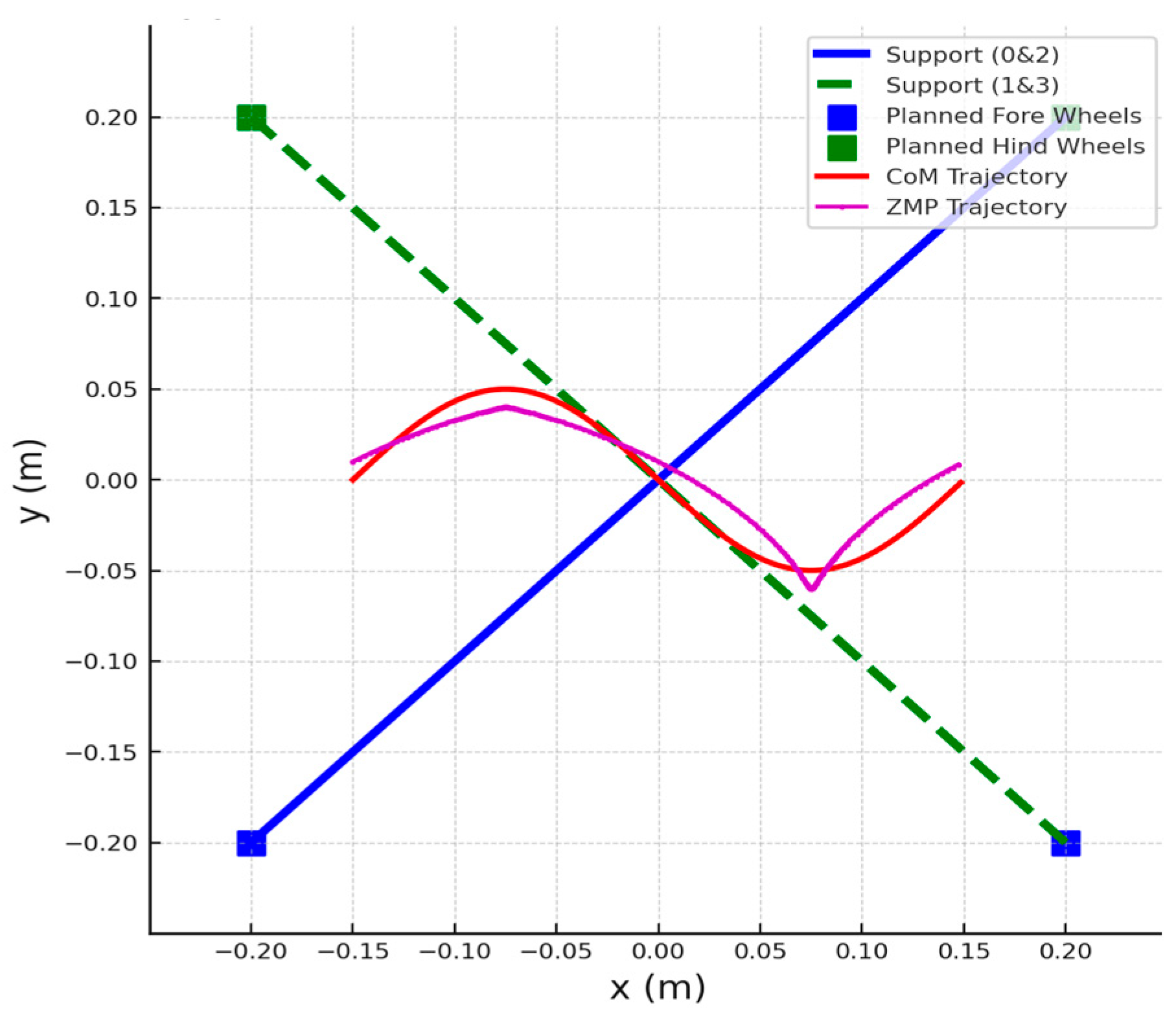
MATLAB was combined with CoppeliaSim to verify the aforementioned robot gait control scheme involving CPG, ZMP, and inverse dynamics. The simulation results were visualized in MATLAB, as shown in Figure 7, and demonstrate that the scheme satisfies both stability and dynamic constraints: the ZMP trajectory strictly lies within the support polygon (meeting core gait stability needs), and the CoM trajectory aligns coordinately with the ZMP trajectory, thereby verifying the ability of the scheme to be implemented.

3. Results

3.1. Simulation Verification with ADAMS and MATLAB/SIMULINK

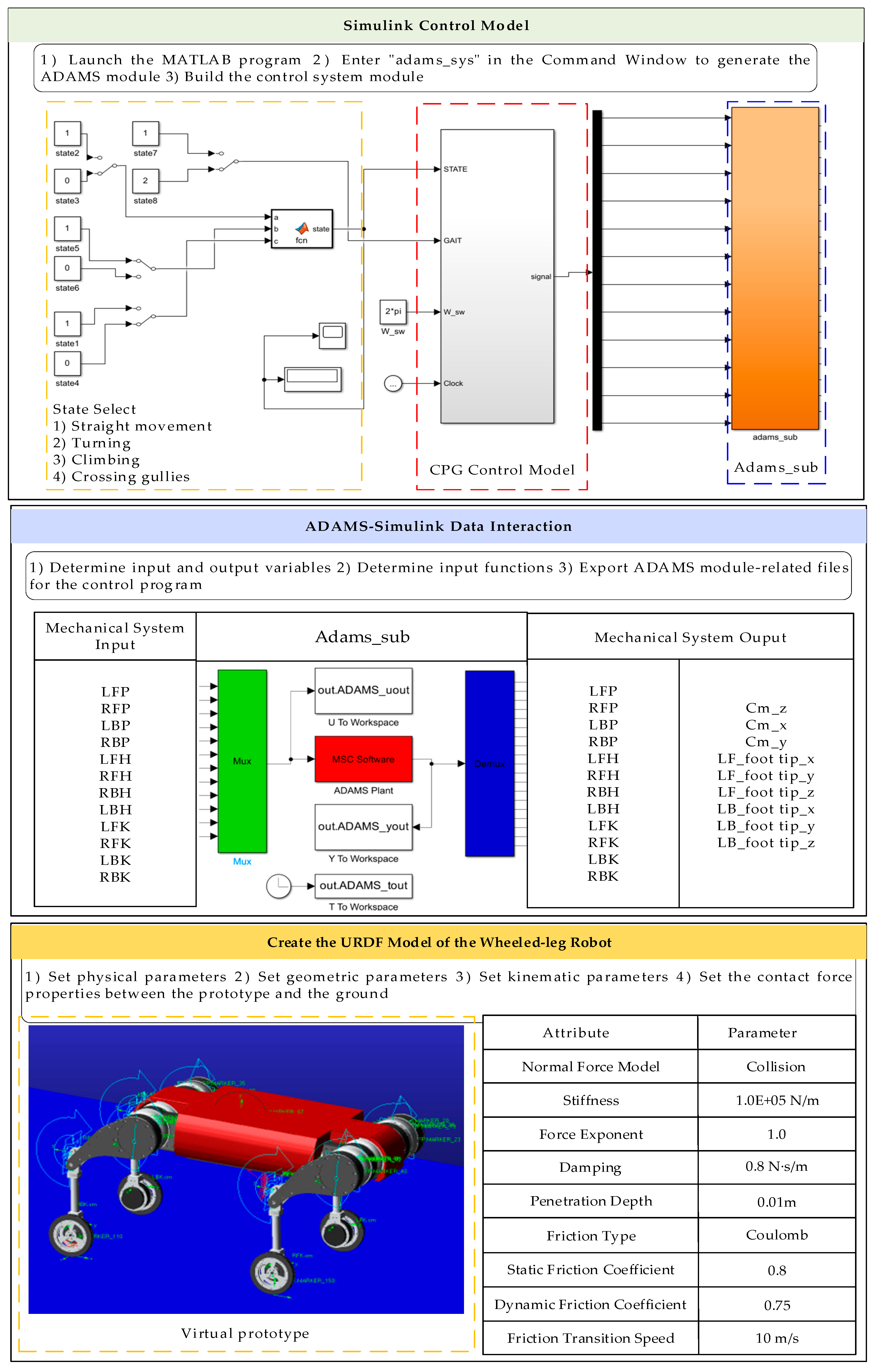
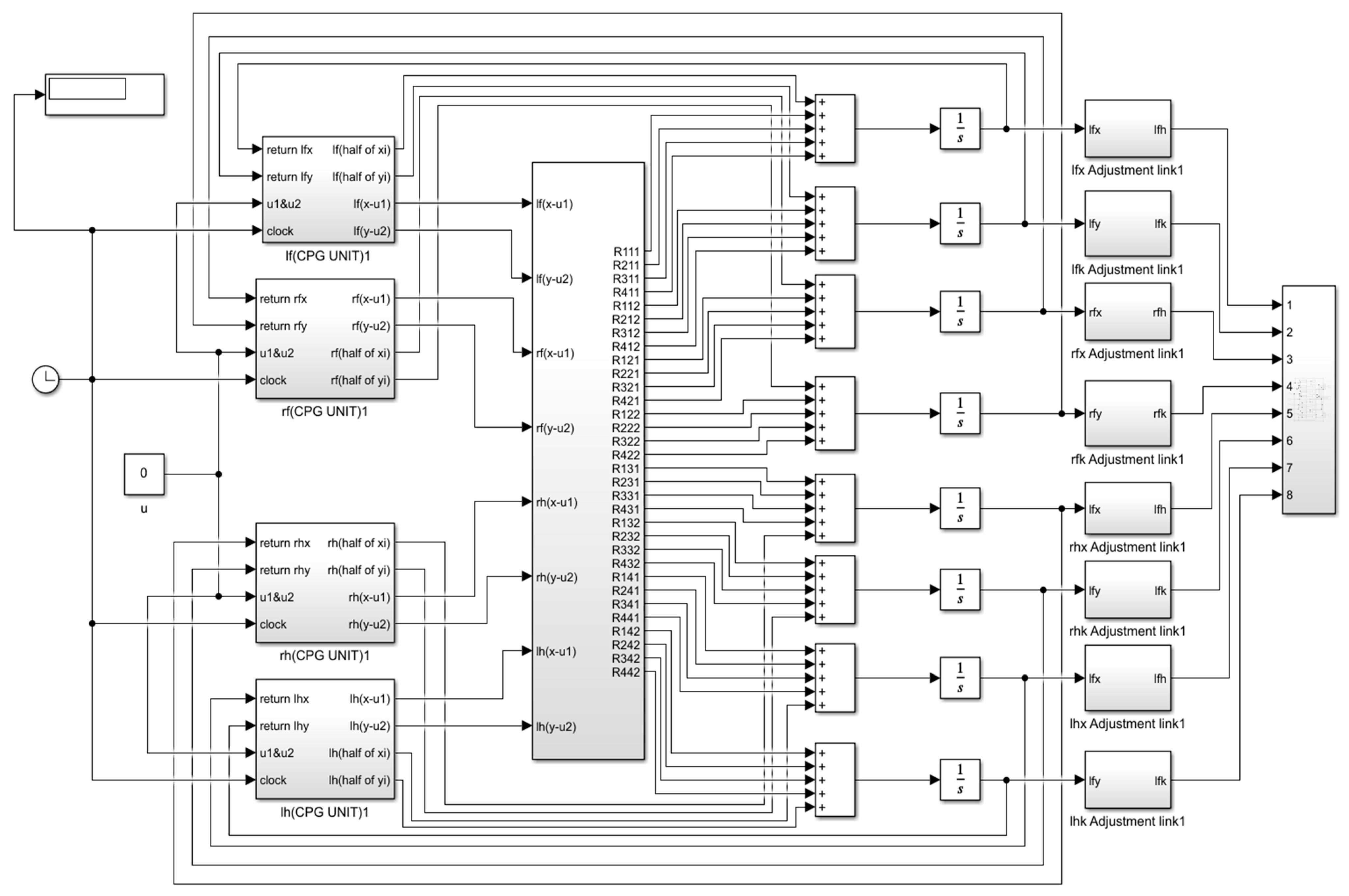
To verify the effectiveness of the enhanced CPG algorithm combined with the biological modeling mechanism in unstructured complex terrains, a simulation model was built using the multi-body dynamics co-simulation platform of ADAMS 2020 and MATLAB/Simulink R2024b. Communication between ADAMS_sub and MATLAB/Simulink is achieved through a module, allowing Simulink output signals to be transmitted to regulate robot motion. The simulation control flow is shown in Figure 8 (where “LF” stands for the robot’s left front leg, “LB” for the left back leg, “RF” for the right front leg, “RB” for the right back leg, and “cm” for the robot’s center of mass). The robot’s CPG control network model is illustrated in Figure 9. Decentralized CPG units generate rhythmic signals through internal oscillation mechanisms, which are then coupled via a weighted matrix to coordinate multi-joint movements. After processing by integration and adjustment links, eight-channel control signals are output to drive the hip, knee, and lateral swing joints. Adaptive gaits are thereby realized through self-organized neural dynamics and environmental feedback modulation.

3.1.1. Obstacle Avoidance Simulation

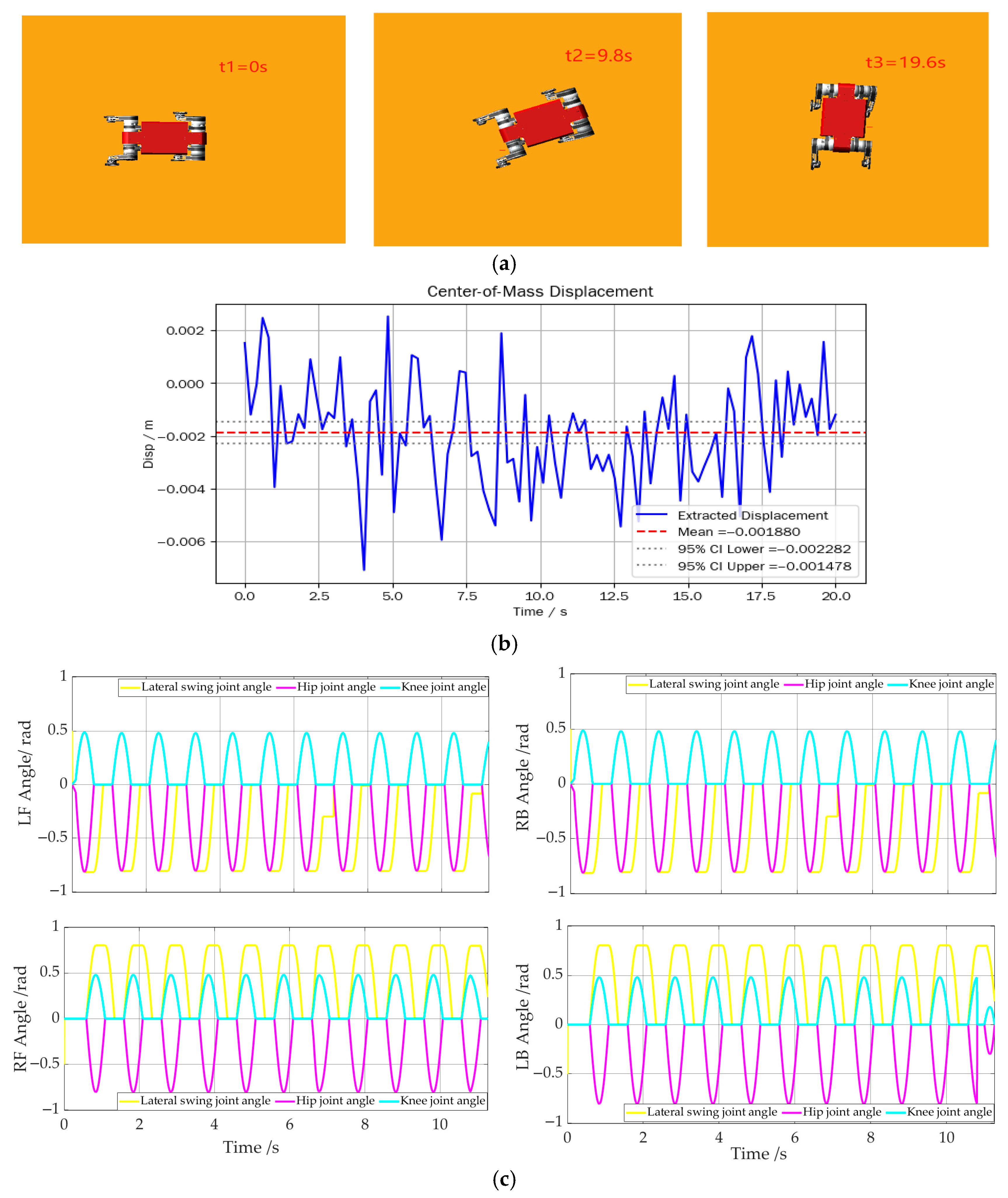
In order to verify the autonomous obstacle avoidance ability of a wheel-footed robot in unstructured terrain, a dynamic obstacle avoidance simulation experiment based on Trot gait modulation was designed. When the robot encounters an uncrossable obstacle, the system triggers a steering command according to a preset node to realize path switching. The simulation results are displayed in Figure 10.
To evaluate the motion stability of the robot, we conducted an analysis of the center-of-mass displacement data. First, we calculated the sample mean to reflect the central tendency of the data:
x ¯ = 1 n i = 1 n x i  
Based on n = 100 data points, the mean value of the center-of-mass displacement was obtained as x ¯ = −0.00180 m. Next, we calculated the sample standard deviation to quantify the degree of data dispersion:
s = 1 n 1 i = 1 n ( x i x ¯ ) 2
The calculated s = 0. 00206. To assess the reliability of the mean, we derived the 95% confidence interval using the t-distribution:
C I = x ¯ ± ( t α / 2 , n 1 s n )
For n − 1 = 99 degrees of freedom, the critical t-value ( t 0.025 , 99 ) at the 95% confidence level was approximately 1.984. After calculation, the standard error was 0.00035, and then the 95% confidence interval was obtained as [−0.00318, −0.00178].
It is evident from the results that despite minor fluctuations in the center-of-mass displacement during the robot’s movement, the overall trend remained stable.

3.1.2. Slope Motion Simulation

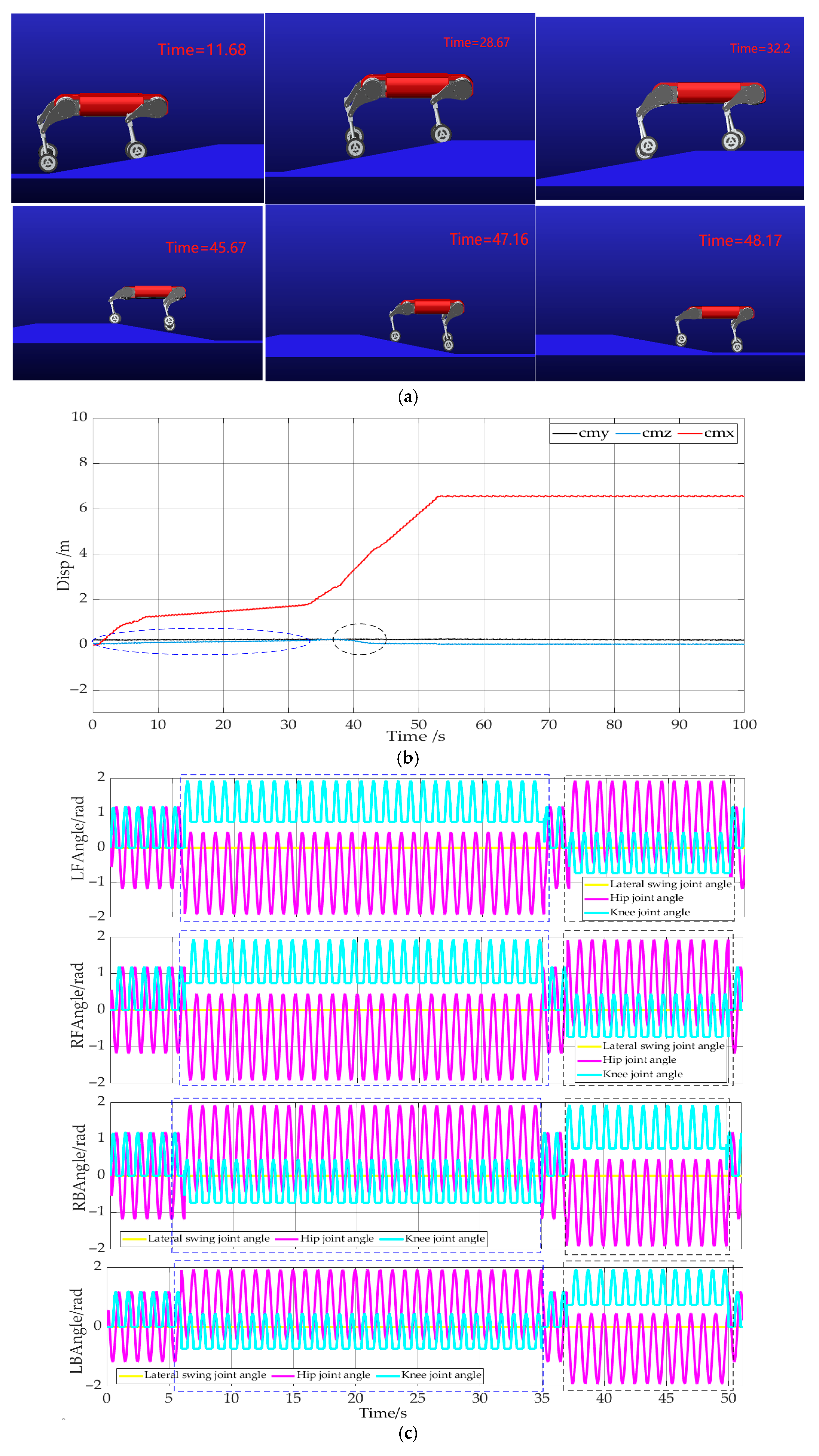
In order to quantitatively evaluate the motion control performance of the improved CPG algorithm in sloping terrain, a standardized slope model with a slope of 10° was constructed. This model was created using SOLIDWORKS 2024 software and imported into the ADAMS simulation environment. The simulation of the robot’s slope motion is illustrated in Figure 11a, and the friction coefficient of the slope was adopted as the rubber-cement ground friction coefficient. The center of mass motion trajectory in the case of slope is illustrated in Figure 11b, and the joint motion curve is demonstrated in Figure 11c. Among them, the blue dashed line indicates that the robot is going uphill, and the black dashed line indicates that the robot is going downhill.
As illustrated in the center-of-mass displacement curve derived from Figure 11b, the slope prediction algorithm yields a slope of 0.979852, which corresponds to an approximate angle of 10.2°. The initial flat-to-ramp error is substantial, with the Z-axis exhibiting fluctuations up to 0.1159 m. However, subsequent stabilization within ±0.01181 m is observed. To ensure high precision inspection, it is imperative that vertical fluctuation is maintained within ±0.035 m. As illustrated in Figure 11c, during uphill locomotion, the hip of the front leg is shifted backward, the hip of the back leg is shifted forward, and the knee joints undergo a counter adjustment. The downhill strategy employed in this study is diametrically opposed to the conventional approach.

3.1.3. Gap Movement Simulation

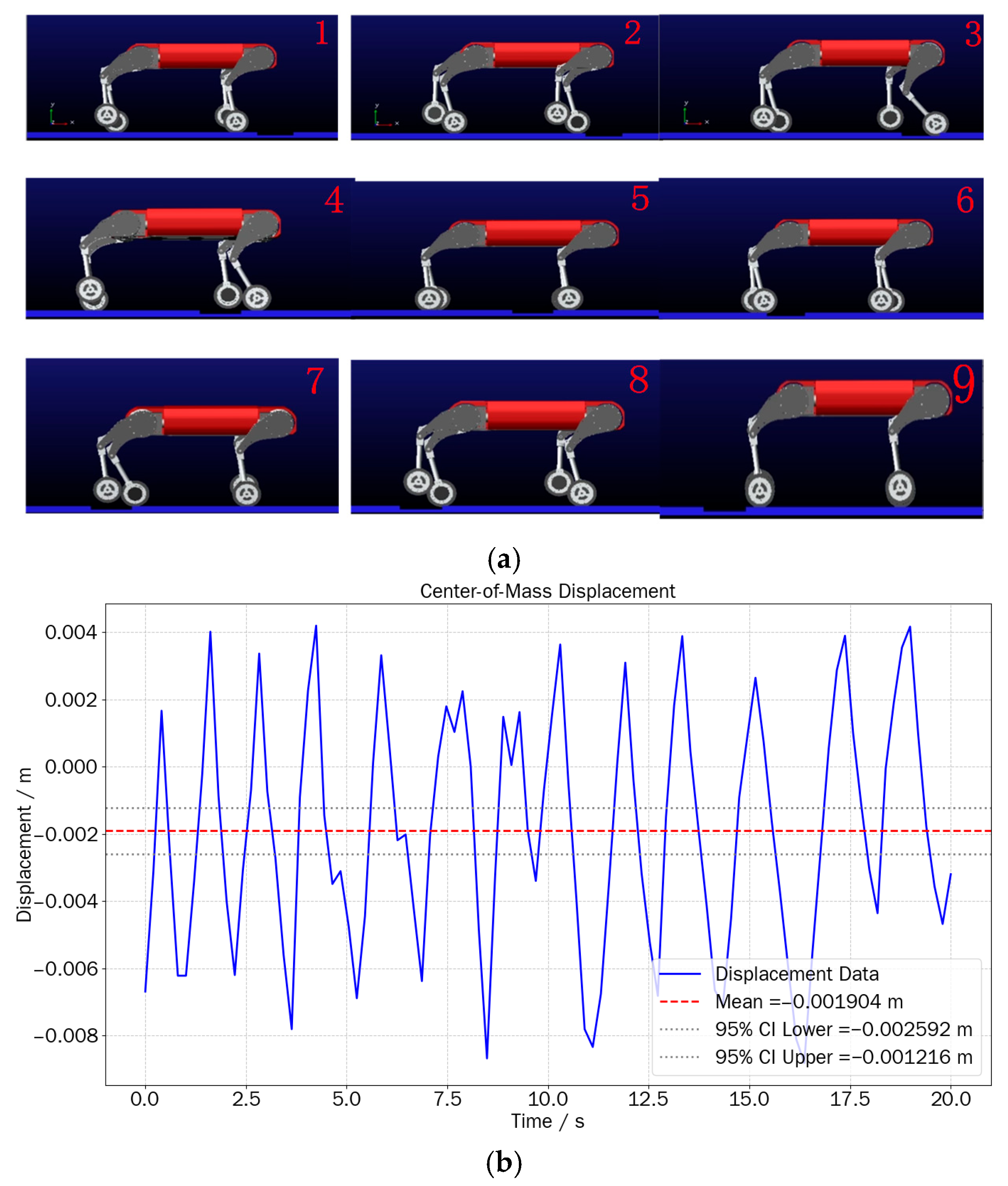
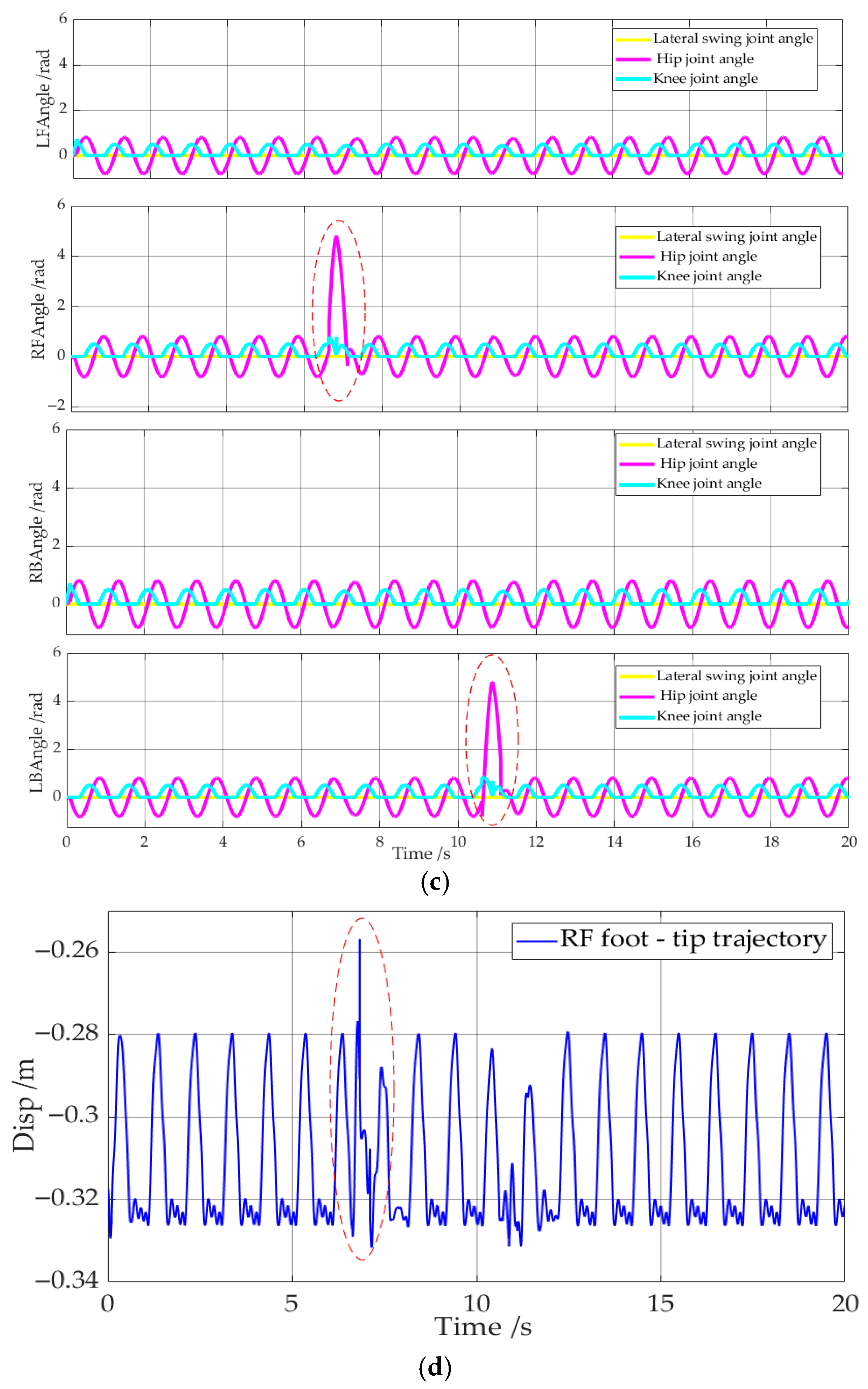
In order to verify the adaptive spanning ability of the wheel-legged robot in gully terrain and the effectiveness of the biological posture reflex control strategy, simulation experiments were carried out using the joint platform of ADAMS and MATLAB/Simulink. A gully terrain with a span of 0.25 m and a depth of 0.015 m (both sides are flat) was constructed, as shown in Figure 12. The results showed that the stepping leg showed delayed oscillation and increased amplitude, reaching forward to the new landing point. Taking the foot-end trajectories of the right front leg (RF) and the left back leg (LB) as an example, the Z-axis displacements at the moment of stepping out of the air suddenly increased, as marked by the red dashed line, and then resumed the rhythm.
Based on (16), (17), and (18), the average value of the center-of-mass displacement of the robot when crossing the gully was −0.001904, the standard deviation was 0.003467, and the 95% confidence interval was obtained as [−0.002592, −0.001216], as shown in Figure 12b. Figure 12d shows that at 7 s, the joint amplitude rose from ±0.20 rad to ±0.28 rad, with a longer swing phase. This reflects the system’s active gait adjustment for terrain changes. Rhythmic motion was restored within approximately 2 s, highlighting the system’s rapid recovery and strong stability.

3.2. Verification of Practical Experiments

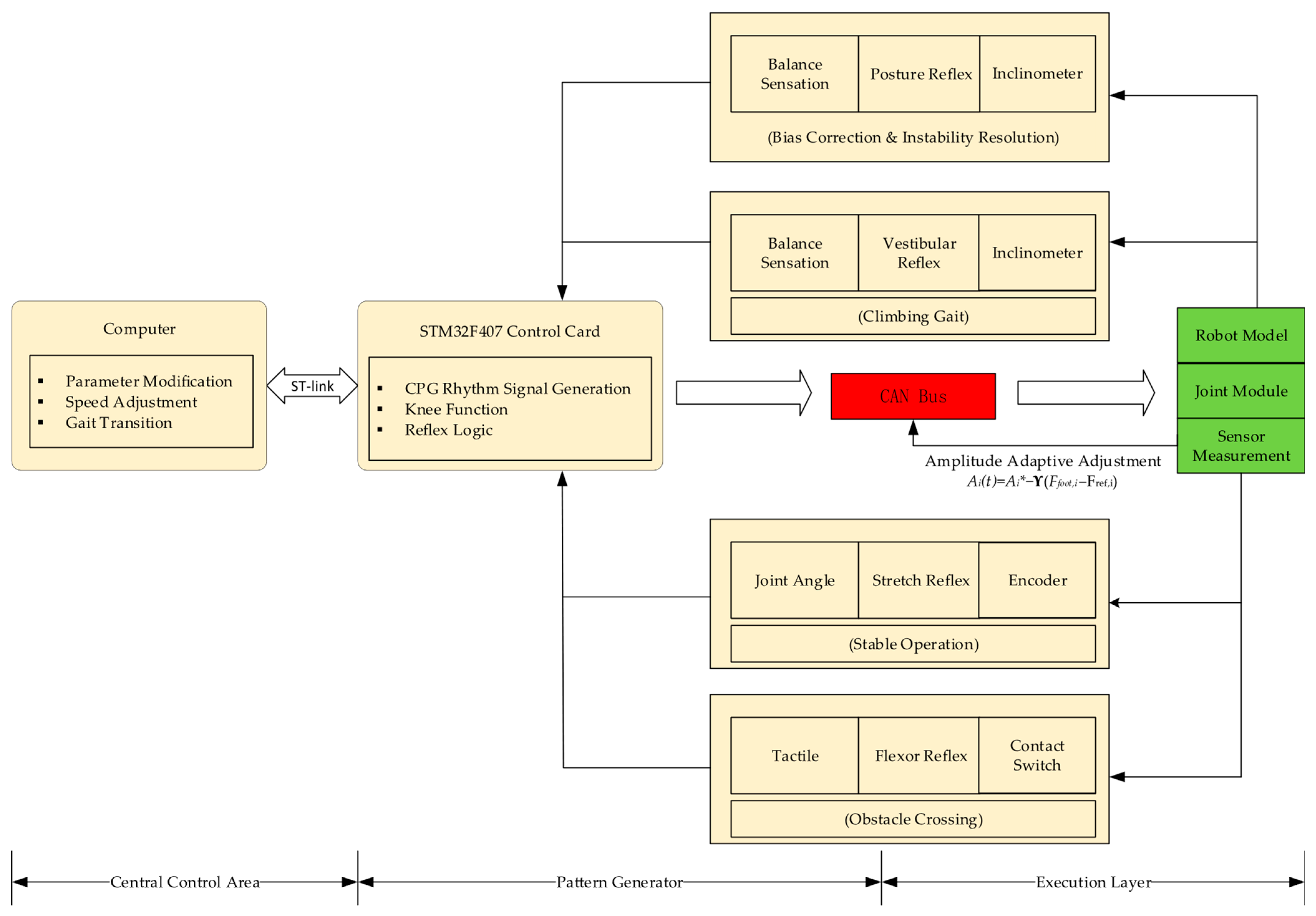
In order to verify the effectiveness and robustness of the control system based on the improved CPG algorithm and the modeling of biological reflex mechanisms, an experimental platform for the single-wheeled leg of the wheel-legged robot, as shown in Figure 13, has been constructed. Given the structural symmetry of the leg, the left front leg was selected for simplification of the process while maintaining the core features. The hierarchical motion control system architecture of the robots was divided into a central control layer, a pattern generation layer, an execution layer, and a reflex regulation network. The functional division realized by each layer of the control system is as follows:
(1)
Central layer: simulates the advanced nerve center of animals, and regulates the speed of the robot, as well as selecting and switching motion modes.
(2)
Pattern generation layer: constructs a rhythm generator by coupling neuron oscillators, sets the number of oscillators according to the number of the robot’s hip joints, generates rhythm signals for the hip and knee joints, and realizes the generation of CPG rhythm signals.
(3)
Execution layer: the execution mechanism is composed of drivers, motors, etc., to simulate the function of the animal muscle-skeletal movement system.
(4)
Reflex regulation layer: establishes a robot motion feedback network based on a three-level multi-reflex tissue system, uses a variety of sensors to collect robot status information and external environment information, and models biological reflexes such as the stretch reflex, flexor reflex, and vestibular reflex.
The platform integrates components like joint motors, sensors (MPU6050, force sensors), an STM32F407VET6 microcontroller, and an upper-computer system. Real-time performance and resource utilization of the CPG-based gait control algorithm on the STM32F407VET6 are shown in Table 4. The STM32F407VET6 controls high-precision servo motors via CAN bus (FOC (field-oriented control) algorithm). IMU data are displayed on OLED and foot force sensors trigger CPG adjustments via IO. This platform verifies algorithms in real-world scenarios, comparing experimental and simulation data to assess control accuracy, stability, and adaptability in complex terrains, supporting engineering applications.

3.2.1. Turn Verification

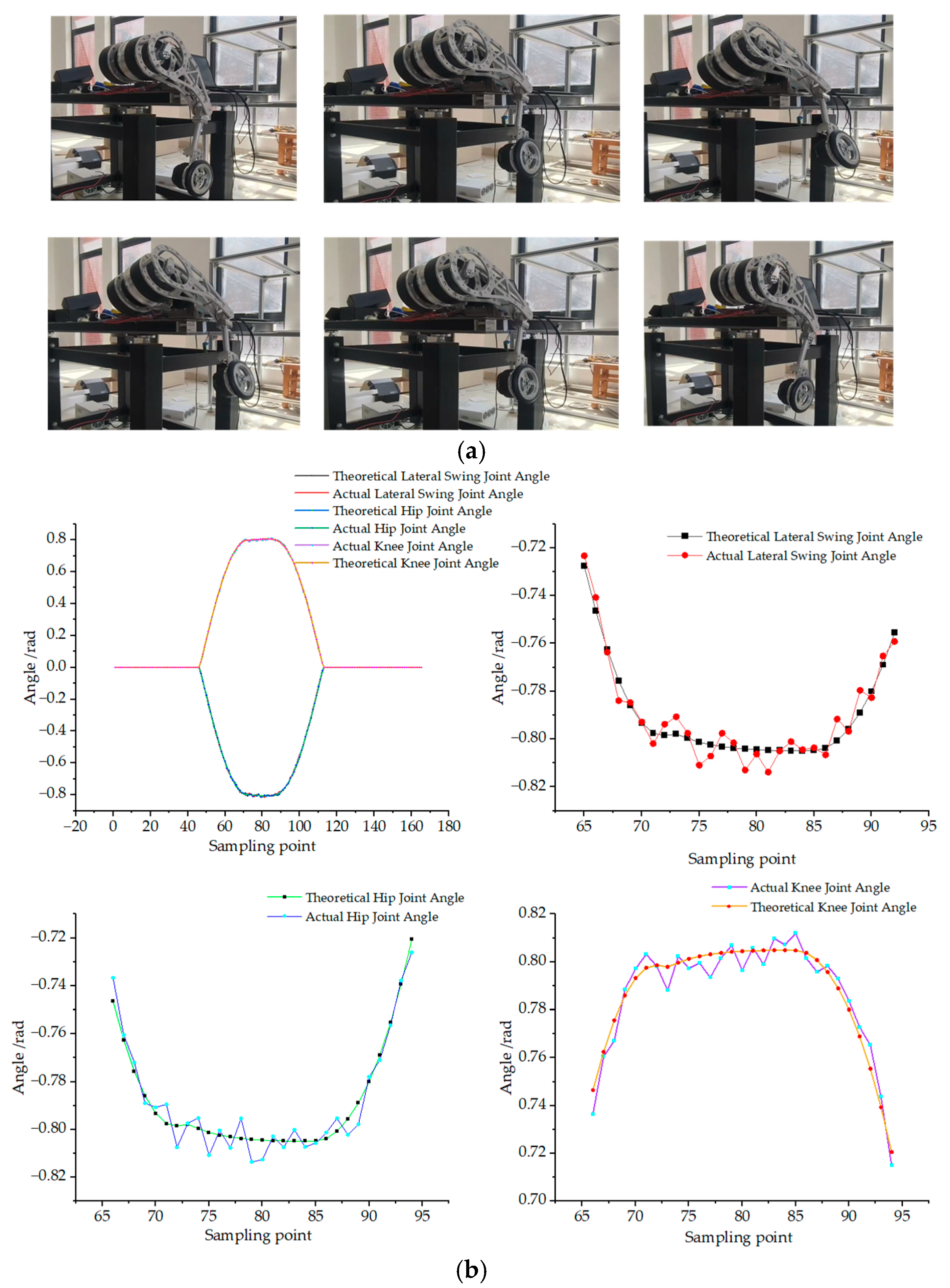
The left front leg motion mode switching experiment triggered by a key interrupt is shown in Figure 14. The joint deviation data for turn verification is shown in Table 5.

3.2.2. Climbing Verification

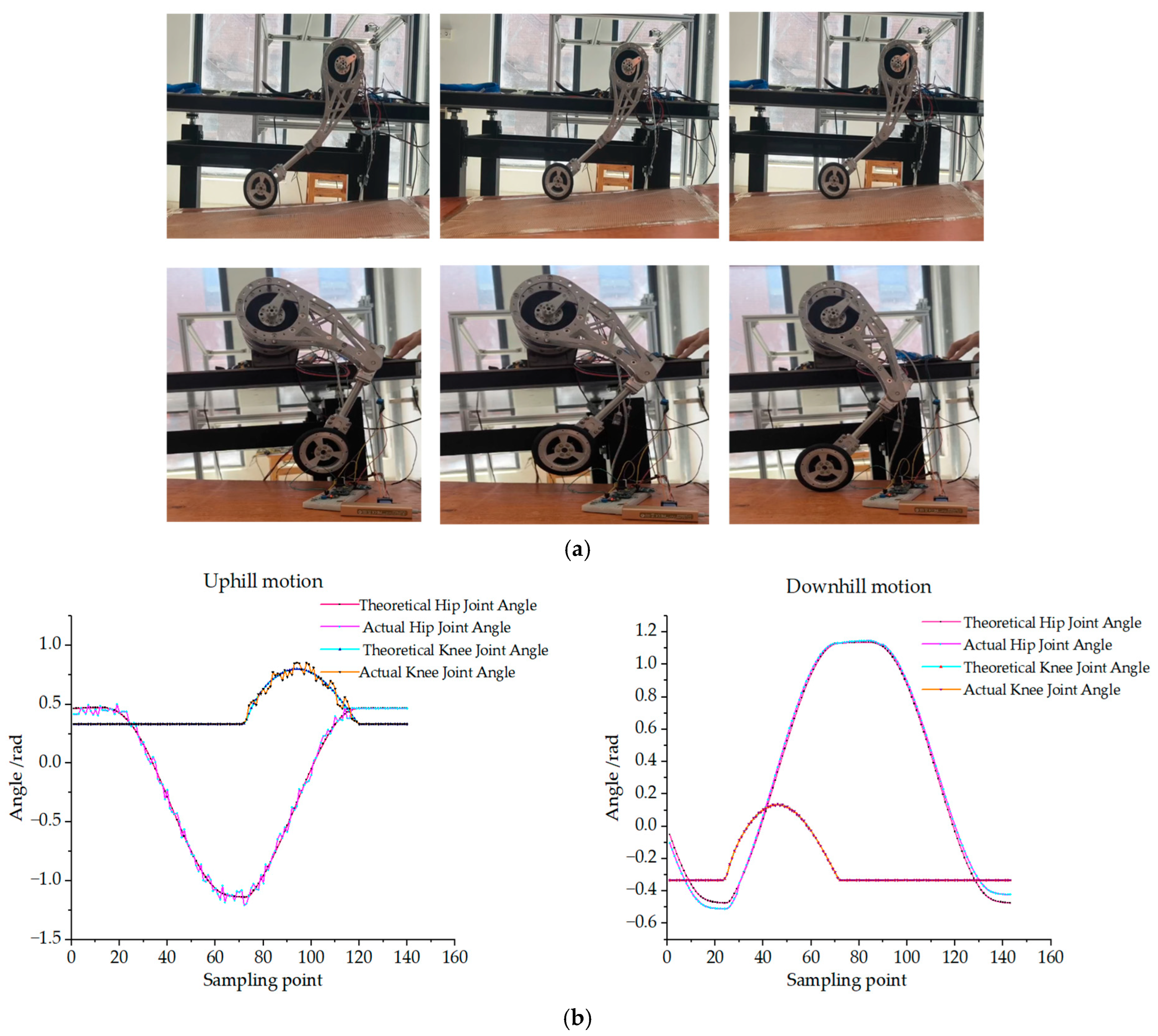
To evaluate the control effectiveness of the improved mechanism based on biological vestibular reflexes in actual tilt motion, the left foreleg climbing experiment, as shown in Figure 15, was conducted. The joint deviation data for climbing verification are shown in Table 6.

3.2.3. Verification Across the Gap

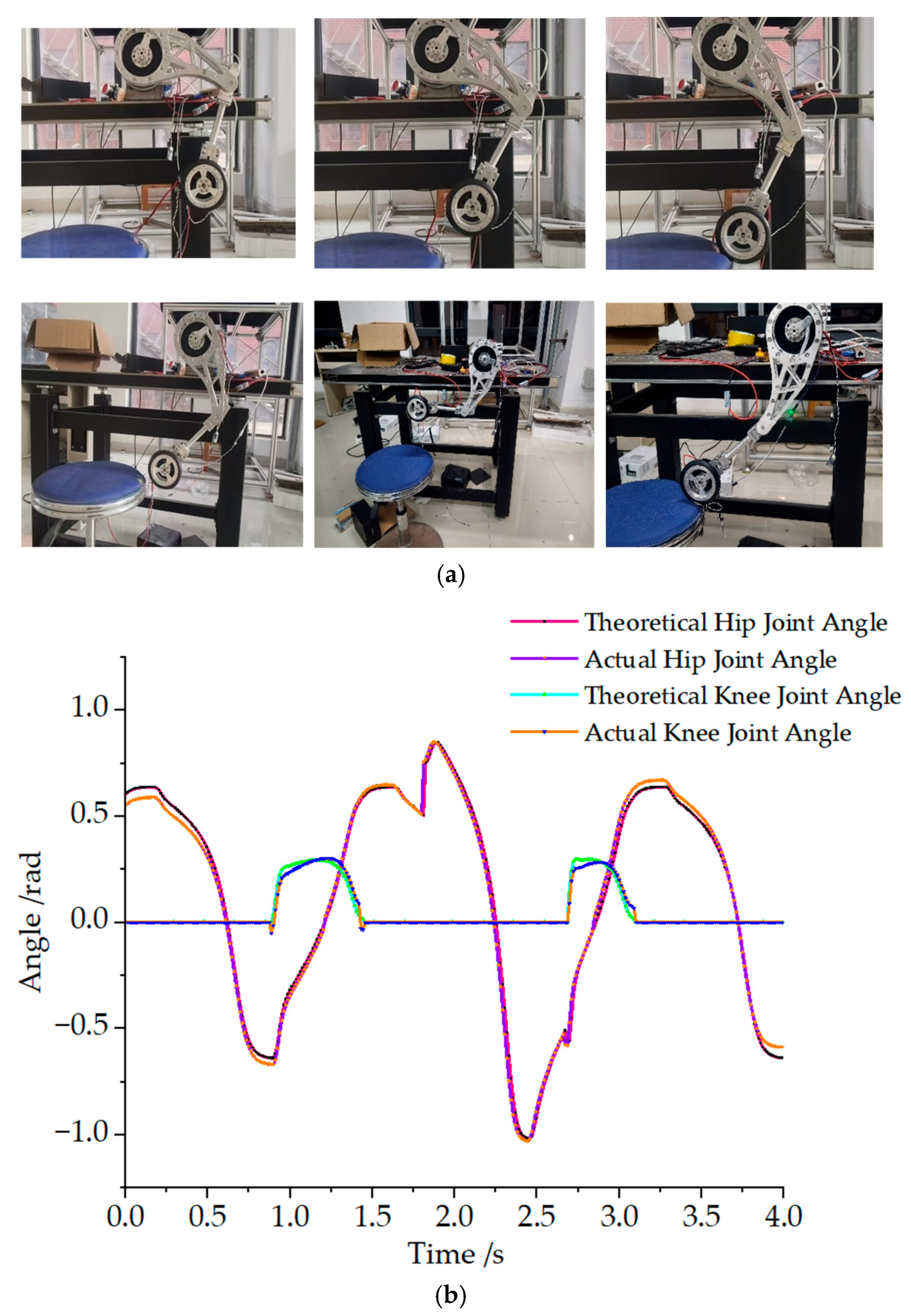
In order to verify the effectiveness of the treadmill reflex model based on the biological reflex mechanism on the gully-crossing ability of wheel-footed robots, unstructured terrain experiments, as shown in Figure 16, were carried out. The joint deviation data and recovery in gully crossing are shown in Table 7.
In summary, the control algorithm proves effective, as the actual motions match the simulations well. The small errors observed during turning, climbing, and gully crossing, combined with the short recovery time in gully crossing, demonstrate that the wheel-legged robot exhibits good motion control performance, stability, and adaptability in complex terrains. Thus, it meets the requirements of high-precision inspection and navigation in complex environments.

4. Conclusions

In order to embed the stability mechanism into the CPG framework, a sensor-embedded CPG stability enhancement algorithm was proposed, which dynamically corrects the coupling weights and phase differences of the CPG through real-time feedback from IMU and foot-end force sensors, and directly embeds the stability constraints in the rhythm generation layer. The foot-end force-amplitude adaptive mechanism was designed with an IMU-driven asymmetric coupling matrix to enable fast stability recovery under terrain perturbations.
The conclusions of the research are as follows:
  • A simulation and experimental platform were built for wheel-footed robots, and the stability constraints were directly embedded in the rhythm generation layer by real-time acquisition of IMU and end-of-foot force sensor data, dynamic correction of coupling weights and phase differences in the CPG network, and realization of closed-loop control. Through the above closed-loop control, the rapid response capability of the robot to terrain perturbations was greatly improved.
  • The foot-end force-magnitude adaptive mechanism and the IMU-driven asymmetric coupling matrix were designed to reduce motion oscillations and center-of-mass displacement fluctuations in complex environments such as cornering, hill climbing, and gully crossing to ensure overall motion stability and meet the requirements of high-precision inspection.
  • Both simulation tests and real experiments validate the excellent stability recovery capability of the sensor-embedded CPG stability enhancement algorithm under a variety of unstructured terrain conditions, providing a reliable and efficient closed-loop control strategy for autonomous motion and environment adaptation of wheel-footed robots.

5. Discussion

While CPG-based control with biological reflexes shows promise in simulation and single-leg tests, limitations exist.
Current validation has mainly been conducted through simulations and single-leg setups; however, multi-limb interactions in real-world full wheel-legged robot scenarios, especially regarding lateral disturbance handling (e.g., side winds), needs further study. Also, the energy efficiency of the system over varied terrains requires empirical evaluation.
Future work will focus on the following:
  • Implementing the system in the full wheel-legged robots to test multi-limb coordination.
  • Developing reflexes for lateral disturbances, potentially incorporating vestibular-like sensors.
  • Adapting to complex terrains including dynamic environments with obstacles, hybrid wheel-legged transitions, and sloped/slippery surfaces.
  • Using machine learning to optimize CPG and reflex parameters for specific terrains, reducing manual tuning.
These steps will advance wheel-legged robot applications in real, unstructured environments.

Author Contributions

J.G. was responsible for the review and editing, resource provision. R.F. contributed to writing—original draft, review and editing, software development, methodology design, validation, and conceptualization. H.Y. contributed to the project administration, and funding acquisition. H.P. and H.T. contributed to manuscript review, editing, and validation. All authors have read and agreed to the published version of the manuscript.

Funding

This work was supported by the Anhui Provincial Key Research and Development Plan (202004a07020046).

Institutional Review Board Statement

Not applicable.

Informed Consent Statement

Not applicable.

Data Availability Statement

The original contributions presented in this study are included in the article. Further inquiries can be directed to the corresponding authors.

Acknowledgments

Sincere thanks are extended to Anhui University of Science and Technology for the technical support provided during this study.

Conflicts of Interest

The authors declare no conflicts of interest.

References

  1. Zhang, Y.; Qiao, G.; Wan, Q.; Tian, L.; Liu, D. A Novel Double-Layered Central Pattern Generator-Based Motion Controller for the Hexapod Robot. Mathematics 2023, 11, 617. [Google Scholar] [CrossRef]
  2. Wang, Y.; Xue, X.H.; Chen, B.F. Matsuoka’s CPG With Desired Rhythmic Signals for Adaptive Walking of Humanoid Robots. IEEE Trans. Cybern. 2020, 50, 613–626. [Google Scholar] [CrossRef] [PubMed]
  3. Wei, S.X.; Wu, H.B.; Liu, L.; Zhang, Y.X.; Chen, J.; Li, Q.F. A CPG-based gait planning and motion performance analysis for quadruped robot. Ind. Robot. Int. J. Robot. Res. Appl. 2022, 49, 779–797. [Google Scholar] [CrossRef]
  4. Liu, C.; Xia, L.; Zhang, C.; Chen, Q. Multi-Layered CPG for Adaptive Walking of Quadruped Robots. J. Bionic Eng. 2018, 15, 341–355. [Google Scholar] [CrossRef]
  5. Auddy, S.; Sven, M.; Stefan, W. Hierarchical control for bipedal locomotion using central pattern generators and neural networks. In Proceedings of the 2019 Joint IEEE 9th International Conference on Development and Learning and Epigenetic Robotics (ICDL—EpRob), Oslo, Norway, 19–22 August 2019; pp. 13–18. [Google Scholar]
  6. Katayama, S.; Murooka, M.; Tazaki, Y. Model predictive control of legged and humanoid robots: Models and algorithms. Adv. Robot. 2023, 37, 298–315. [Google Scholar] [CrossRef]
  7. Wang, J.Y.; Hu, C.X.; Zhu, Y. CPG-Based Hierarchical Locomotion Control for Modular Quadrupedal Robots Using Deep Reinforcement Learning. IEEE Robot. Autom. Lett. 2021, 6, 7193–7200. [Google Scholar] [CrossRef]
  8. Huang, Y.; Bing, Z.; Walter, F.; Rohregger, A.; Zhang, Z.; Huang, K.; Morin, F.O.; Knoll, A. Enhanced quadruped locomotion of a rat robot based on the lateral flexion of a soft actuated spine. In Proceedings of the 2022 IEEE/RSJ International Conference on Intelligent Robots and Systems (IROS), Kyoto, Japan, 23–27 October 2022; pp. 2622–2627. [Google Scholar]
  9. Liu, X.P.; Zang, Y.; Gao, Z.Y.; Liao, M.L. Locomotion gait control of snake robots based on a novel unified CPG network model composed of Hopf oscillators. Robot. Auton. Syst. 2024, 179, 104746. [Google Scholar] [CrossRef]
  10. Zhang, Q.W.; Xu, J.; Fang, H.B. Spatial locomotion of a metameric earthworm-like robot: Generation and analysis of gaits. Multibody Syst. Dyn. 2024, 61, 325–360. [Google Scholar] [CrossRef]
  11. Lee, C.; Chung, D.; Kim, J.; Kim, J. Nonlinear Model Predictive Control With Obstacle Avoidance Constraints for Autonomous Navigation in a Canal Environment. IEEE/ASME Trans. Mechatron. 2024, 29, 1985–1996. [Google Scholar] [CrossRef]
  12. Li, G.D.; Ijspeert, A.; Hayashibe, M. AI-CPG: Adaptive Imitated Central Pattern Generators for Bipedal Locomotion Learned Through Reinforced Reflex Neural Networks. IEEE Robot. Autom. Lett. 2024, 9, 5190–5197. [Google Scholar] [CrossRef]
  13. Bellegarda, G.; Ijspeert, A. CPG-RL: Learning Central Pattern Generators for Quadruped Locomotion. IEEE Robot. Autom. Lett. 2022, 7, 12547–12554. [Google Scholar] [CrossRef]
  14. Chen, S.; Zhang, B.; Mueller, M.W.; Rai, A.; Sreenath, K. Learning torque control for quadrupedal locomotion. In Proceedings of the 2023 IEEE-RAS 22nd International Conference on Humanoid Robots (Humanoids), Austin, TX, USA, 12–14 December 2023; pp. 1–8. [Google Scholar]
  15. Huang, S.C.; Zheng, M.H.; Hu, Z.Y.; Liu, P.X. Enhancing hexapod robot mobility on challenging terrains: Optimizing CPG-generated gait with reinforcement learning. Neurocomputing 2025, 622, 129328. [Google Scholar] [CrossRef]
  16. Watanabe, T.; Kubo, A.; Tsunoda, K.; Matsuba, T.; Akatsuka, S.; Noda, Y.; Kioka, H.; Izawa, J.; Ishii, S.; Nakamura, Y. Hierarchical reinforcement learning with central pattern generator for enabling a quadruped robot simulator to walk on a variety of terrains. Sci. Rep. 2025, 15, 11262. [Google Scholar] [CrossRef] [PubMed]
  17. Cao, Y.; Lu, Y.; Cai, Y.R.; Bi, S.S.; Pan, G. CPG-fuzzy-based control of a cownose-ray-like fish robot. Ind. Robot. 2019, 46, 779–791. [Google Scholar] [CrossRef]
  18. Sun, Y.; Ubellacker, W.L.; Ma, W.L.; Zhang, X.; Wang, C.H.; Csomay-Shanklin, N.V.; Tomizuka, M.; Sreenath, K.; Ames, A.D. Online Learning of Unknown Dynamics for Model-Based Controllers in Legged Locomotion. IEEE Robot. Autom. Lett. 2021, 6, 8442–8449. [Google Scholar] [CrossRef]
  19. Al-Shuka, H.F.N.; Allmendinger, F.; Corves, B.; Zhu, W.H. Modeling, stability and walking pattern generators of biped robots: A review. Robotica 2014, 32, 907–934. [Google Scholar] [CrossRef]
  20. Zhou, Z.; Zhang, C.; Li, C.; Zhang, Y.; Shi, Y.; Zhang, W. A tightly-coupled LIDAR-IMU SLAM method for quadruped robots. Meas. Control. 2024, 57, 1004–1013. [Google Scholar] [CrossRef]
  21. Zhou, X.; Zhang, Y.; Qiu, Z.; Shan, Z.; Cai, S.; Bao, G. Locomotion control of a rigid-soft coupled snake robot in multiple environments. Biomim. Intell. Robot. 2024, 4, 100148. [Google Scholar] [CrossRef]
  22. Hutter, M.; Gehring, C.; Jud, D.; Lauber, A.; Bellicoso, C.D.; Tsounis, V.; Hwangbo, J.; Bodie, K.; Fankhauser, P.; Bloesch, M.; et al. ANYmal—A highly mobile and dynamic quadrupedal robot. In Proceedings of the 2016 IEEE/RSJ International Conference on Intelligent Robots and Systems (IROS), Daejeon, Korea, 9–14 October 2016; pp. 38–44. [Google Scholar]
  23. Li, J.; Wang, J.; Yang, S.X.; Zhou, K.; Tang, H. Gait Planning and Stability Control of a Quadruped Robot. Comput. Intell. Neurosci. 2016, 2016, 9853070. [Google Scholar] [CrossRef] [PubMed]
  24. Farhad, A.; Mahdi, K.; Moosavian, S.A.A. Bio-inspired central pattern generator for development of Cartesian motor skills for a Quadruped Robot. World J. Adv. Res. Rev. 2021, 12, 66–85. [Google Scholar] [CrossRef]
Figure 1. Overall structure of the four-wheel-legged robot.
Applsci 15 08715 g001
Figure 2. Joint configuration forms of robots: (a) all-knee type; (b) all-elbow type; (c) outer-knee-elbow type; (d) inner-knee-elbow type.
Applsci 15 08715 g002
Figure 3. Multi-degree-of-freedom coupled reduced-order control scheme.
Applsci 15 08715 g003
Figure 4. Lyapunov function evolution with peak envelope linear fit.
Applsci 15 08715 g004
Figure 5. The relationship between the introduced slope and CPG output.
Applsci 15 08715 g005
Figure 6. The linear relationship between the balance position adjustment amount and the body posture angle.
Applsci 15 08715 g006
Figure 7. Gait stability verification with ZMP, CoM, and support polygon.
Applsci 15 08715 g007
Figure 8. Virtual model of the wheel-legged robot.
Applsci 15 08715 g008
Figure 9. Robot CPG control network simulation model.
Applsci 15 08715 g009
Figure 10. Simulation of robot turning motion: (a) simulation of turning and obstacle avoidance; (b) curve diagram of the displacement of the center of mass; (c) curve diagram of the joint movement.
Applsci 15 08715 g010
Figure 11. Simulation of the robot’s climbing motion: (a) simulation of upward and downward slope movements; (b) curve diagram of center-of-mass displacement; (c) curve diagram of the joint movement.
Applsci 15 08715 g011
Figure 12. Simulation of the robot’s gully-crossing motion: (a) simulation of the movement of crossing a gully; (b) curve diagram of the displacement of the center of mass; (c) curve diagram of joint motion; (d) RF foot-tip trajectory curve.
Applsci 15 08715 g012aApplsci 15 08715 g012b
Figure 13. Framework of the single-wheeled-leg control system.
Applsci 15 08715 g013
Figure 14. Verification experiment of turning motion: (a) experimental verification of turning movement; (b) joint angle deviation curves in turning verification.
Applsci 15 08715 g014
Figure 15. Verification experiment of climbing motion: (a) experimental verification of climbing movement; (b) joint angle deviation curves in climbing verification.
Applsci 15 08715 g015
Figure 16. Verification experiment of gully-crossing motion: (a) experimental verification of the movement of crossing a gully; (b) joint angle deviation curves in climbing verification in crossing a gully.
Applsci 15 08715 g016
Table 1. Symbol definitions for locomotion control equations.
SymbolDefinitionSymbolDefinition
x i , y i State variables of the i-th oscillator w s t , w s w Natural frequencies in stance and swing phases, respectively
ri2Euclidean distance from the i-th joint to the reference point μ1, μ2. θ h j Hip joint angle of leg i, directly equal to xi
a = 10Convergence rate constant
Sensitivity: larger a accelerates stabilization but may induce overshoot; smaller a slows response, risking instability under rapid terrain changes.
θ k j Knee joint angle of leg i, Ak, Ah serves as amplitude gains for hip and knee oscillators
μ = 0.25Desired squared limit-cycle amplitude
Sensitivity: higher μ increases stride motion amplitude, enhancing obstacle crossing but raising energy costs; lower μ conserves energy but may reduce terrain adaptability.
Δ i t Additional phase correction term generated from lMU/foot-end force sensor feedback
ω i   Adaptive weighting factor for hip–knee coordination
Larger ωi strengthens hip-driven coordination, improving stability on slopes; smaller ωi increases knee autonomy, useful for fine terrain adjustment but risking phase mismatch.
R θ j i   Motion mapping function that transforms angular coordinates into linear position contributions.
β = 0.5Decay coefficient for stance–swing transition
Sensitivity: higher β accelerates phase transitions, enabling faster gait adaptation but potentially causing abrupt motions; lower β ensures smooth transitions but may delay obstacle response.
φFoot-ground contact signal
Table 2. Adjustment angles of the robot’s joints on the slope.
Change in Equilibrium PositionFront LegBack Leg
Hip JointKnee JointHip JointKnee Joint
Uphill−∆θ∆θ∆θ−∆θ
Downhill∆θ−∆θ−∆θ∆θ
Table 3. Definition and value of stomp-reflection parameters.
SymbolMeaningTest Value
θJoint angle-
ACPG oscillation amplitude12°
TCPG oscillation period2 s
φPhase matrix of hip joint relative to oscillatorDiagonal gait of [0, π, 0, −π]
φhkHip-knee joint phase differenceπ/2
FkKnee joint waveform mode1: Half-wave mode
θ0Initial position30°
nNumber of legs4
AsOscillation amplitude of gap terrain stomp-reflection40°
TsOscillation period of gap terrain stomp-reflection0.53 s
tsEquivalent time within the rhythmic movement cycle-
FsStomp-reflection response switch0.1
φsEquivalent delay phase of ideal stomp time0.36π
Table 4. Algorithm performance and resource use on STM32F407VET6.
Indicator CategoryParameter DescriptionValue
Control CycleInterrupt Period1 ms (1 kHz)
IMU Data Output Frequency200 Hz
Sampling Rate of Force Sensor/Contact Switch500 Hz
Encoder Count Input Frequency1 kHz
CPU UtilizationSingle-time Consumption of Core Algorithm (CPG Gait Calculation)28 μs (≈2.8% CPU@168MHz)
Total Consumption Time (Including Attitude Calculation + Reflex Response)<200 μs (≈20% CPU@168MHz)
Memory OccupationProgram Flash Occupation240 KB (23% of Total Capacity)
SRAM Global/Buffer Area Occupation48 KB (25% of Total Capacity)
Timing JitterInterrupt Trigger Jitter<0.5 μs
Test Scenario-Typical Operation Mode
Table 5. Joint deviation data for turn verification.
Lateral Swing JointHip JointKnee Joint
Maximum Deviation0.0099100.0097500.009980
Average Deviation0.0018670.0019340.001855
Table 6. Joint deviation data for climbing verification.
Hip JointKnee Joint
Maximum Deviation on Uphill0.0696200.068230
Average Deviation on Uphill0.0299790.012280
Maximum Deviation on Downhill0.0523600.005910
Average Deviation on Downhill0.0276380.001977
Table 7. Joint deviation and recovery in gully crossing.
Hip JointKnee Joint
Maximum Deviation0.1222800.052360
Average Deviation0.0322780.007029
Recovery time≤2 s
Disclaimer/Publisher’s Note: The statements, opinions and data contained in all publications are solely those of the individual author(s) and contributor(s) and not of MDPI and/or the editor(s). MDPI and/or the editor(s) disclaim responsibility for any injury to people or property resulting from any ideas, methods, instructions or products referred to in the content.