1. Introduction
Over the past 55 years, loss of control in flight (LOC-I) has been the leading cause of fatalities across all aviation sectors, regardless of the aircraft type. Although the number of fatal accidents involving commercial jets has declined from 11 per million departures in 1960 to less than 0.3 in 2022, accidents caused by loss of control in flight continue to dominate aviation safety statistics [
1].
To mitigate the risk of failures, onboard systems, including flight control systems, are designed with a high level of redundancy. Nevertheless, several severe incidents in the past have resulted in partial or total loss of control over the aircraft’s control surfaces. In these situations, engine thrust often remained the only available means of controlling the aircraft. Thrust modulation has been successfully used by pilots to maintain a stable flight path or pitch angle. However, in scenarios requiring simultaneous control in longitudinal and lateral channel, maintaining control becomes significantly more difficult, often leading to catastrophic outcomes that have claimed over 1200 lives [
2]. Following the crash of Azerbaijan Airlines’ Embraer 190-100 IGW on 25 December 2024, where hydraulic controls were lost after the aircraft was struck by a surface-to-air missile and crashed on an attempted emergency landing at Aktau International Airport, Kazakhstan, an additional 38 fatalities were recorded [
3].
Such failure scenarios involve several critical factors:
▪ Phugoid motion (long-term pitching oscillations).
▪ Slow aircraft response to thrust changes.
▪ High pilot workload.
▪ Significant difficulty in maintaining an approach path during landing.
▪ Lack of airspeed control in an event of total hydraulic failure.
These considerations justify the development of a thrust-based control system that would enable safe flight and landing of an aircraft deprived of other control capabilities. Such a system should be simple to implement on existing machines, requiring only modifications to the flight control computer (FCC) software, without changes to engine control computers or cockpit instrumentation.
This paper is structured as follows:
▪
Section 4 outlines the research environment;
▪
Section 5 discusses the identification of the aircraft model;
▪
Section 6 details the design of the control system;
▪
Section 7 presents simulation test results of the emergency control system conducted in the X-Plane 11 flight simulator;
▪
Section 9 outlines future development plans for the system.
2. Related Work
The idea of using collective and asymmetric thrust variations as an aircraft emergency stabilisation and control mechanism was originally introduced more than 30 years ago and investigated mainly on theoretical grounds. In the civil aviation sector to date, only a couple of emergency thrust control systems are known to pass at least extensive simulation testing. One of the main requirements connecting the existing solutions was the low cost of system implementation. This factor obviously influenced the choice of control algorithms and, therefore, the maximum achievable precision of the system.
Inspired by a story of the United Airlines Flight 232 disaster from 1989, which occurred due to loss of total hydraulic control, research conducted by the NASA Dryden Flight Research Center between 1991 and 1997 was the first to determine the potential of using engine thrust for aircraft emergency control [
4]. The scope of the research included analytical studies, a simulation, and in-flight trials. One of the main project objectives was to investigate the degree of control that could be achieved by manipulating thrust levers among a diverse set of aircrafts, including Boeing 747, McDonnell Douglas MD-11, Learjet 24, and even Piper PA-30. For each of the machines studied, unique difficulties in performing a safe landing were found as a result of the aircraft’s phugoid oscillations and Dutch roll, slow engine response, and poor control moments [
5].
In response to the identified problem, a control system called Propulsion-Control Aircraft (PCA) was developed to provide emergency control in flight. Computations of the appropriate thrust control commands (instantaneous values of all the EPR coefficients) passed on to the FADEC controller were performed by two control systems in the longitudinal and lateral channel. The task of suppressing phugoid oscillations was accomplished by proportionally combining the signals of airspeed error, pitch rate, and pitch angle with a filtered-out DC component.
Characteristic features of the PCA system included up to four control modes in the longitudinal channel, distinguished by the tail engine management method (for three-engine jets) and the level of integration with the aircraft’s onboard systems, as well as the option for coupling with the ILS via special final approach algorithm, making the commanded flight path angle dependent on the altitude above the tarmac [
6]. The method of combining control outputs from the PCA channels, however, has not been described in the literature. Despite successful in-flight trials, the system did not meet with approval from the FAA, who were of the opinion that the implementation of such a system would not be financially justified considering the extremely low likelihood of total control failure [
7].
The concept of thrust-based emergency control had not been revisited until a research programme conducted by Mitsubishi Heavy Industries (MHIs) in 2010. The development of its “Thrust-only Flight-control” (TOFC) system was focused on the control of a four-engine Boeing 747-400 [
8]. The proposed control law consisted of two main modules: the first one computing required aircraft angular acceleration based on commanded flight path angle, roll angle and feedback signals, and the second one responsible for optimal distribution of engine control commands. This ensured an independent thrust utilisation of each of the aircraft’s engines.
One of the TOFC system’s distinctive features was a novel approach to controller design based on the H-infinity techniques. The programme also explored various methods of cockpit system integration, from information display for supporting pilot actions to full integration with the control column and ILS. The MHI’s project was concluded with emergency landing simulations and evaluation by professional pilots.
Concurrently with the work of Japanese engineers, research into aircraft emergency control technology was also conducted in Europe by the German Aerospace Center (DLR). It was noted that longitudinal and lateral thrust control was significantly limited by the utilisation of the same engines in both control channels. On this account, a control priority algorithm was developed, in which an absolute value of the lateral channel control output was used to determine the limits of the longitudinal channel control output (the lateral channel control was prioritised as opposed to the PCA system) [
9]. This approach ensured the sum of the control signals would not exceed the limits of each engine and the commanded asymmetric thrust would override the collective thrust.
Particularly worth mentioning is the approach taken during the evaluation of the developed system. During the first part of the in-simulator trials, the test pilots were not instructed on the system’s operation in order to test its accessibility. The system was also demonstrated in flight on a VFW-Fokker 614 [
10].
Each of the aforementioned concepts presented satisfactory control properties under realistic flight conditions. However, no similar system has been implemented in any airliner so far. The motivation of this paper is to explore the introduced control problem and to identify the capabilities and limitations associated with the control system design. The authors’ objective is to propose a concept of an emergency thrust control system, which would ensure the recovery of a twin-engine airliner under simulated controls failure, a safe aircraft diversion to a selected airport, and an automatic landing using available on-board equipment.
3. Proposed Solution
3.1. Design Principles
The control algorithm has been prepared in accordance with following guidelines:
- ▪
The system starts its operation at any aircraft in-flight attitude, assuming that engines 1 and 2 are fully operational;
- ▪
The system controls the position of both engines’ thrust levers;
- ▪
The system recognises the position of the aircraft’s landing gear and adjusts the parameters of the control paths accordingly;
- ▪
The system does not provide any control over the flaps; it is assumed they are also subject to failure and remain in the 0° position;
- ▪
The control algorithm does not take into account changes in aircraft weight or control surface hardovers during failure;
- ▪
The system uses flight measurements that are typically available on board;
- ▪
The aircraft is equipped with a measuring system providing the actual flight path angle indications;
- ▪
The system provides control over the aircraft until touchdown, whereupon engine thrust is minimised and the braking system is activated.
The aircraft’s motion in a three-dimensional space is described by longitudinal and lateral channels. The cross-coupling that exists between these channels (discussed further in
Section 3.5) implies that any change in the lateral channel, i.e., the aircraft rolling, results in a change in the longitudinal channel, e.g., induced oscillation in the pitch angle. In the considered controls-failure scenario, the aircraft control in both channels is performed using the same mechanism: engines No. 1 and No. 2, thereby constituting another cross-coupling in the system. This factor affects the shaping of the control algorithm and imposes the development of a method for determining the output thrust lever control commands.
This chapter focuses on the proposed concept of the emergency thrust control system. The development process included the identification of selected aircraft mathematical model, a control system design, its implementation in a simulation environment, and Software-In-the-Loop tests. Control signals were divided into four groups (see
Table A1 in
Appendix A):
- ▪
Inputs in the longitudinal channel: , , , , , , ;
- ▪
Inputs in the lateral channel: , , , , , , ;
- ▪
Inputs of the thrust management module: , , ;
- ▪
Control outputs: , .
A detailed graphical representation of the control signals routing in the control system can be found in
Section 6.4.
3.2. Control System Architecture
A shared feature among the existing emergency thrust control systems is their control path-shaping process, which is based on experimental, manual selection of control parameters. This makes it difficult to determine whether a resulting configuration is the best one available due to a presence of local minima/maxima of the non-linear system. The control law proposed in this paper is based on the idea of optimal control by deploying LQRI controllers [
11,
12] in both control channels.
3.3. Longitudinal Control
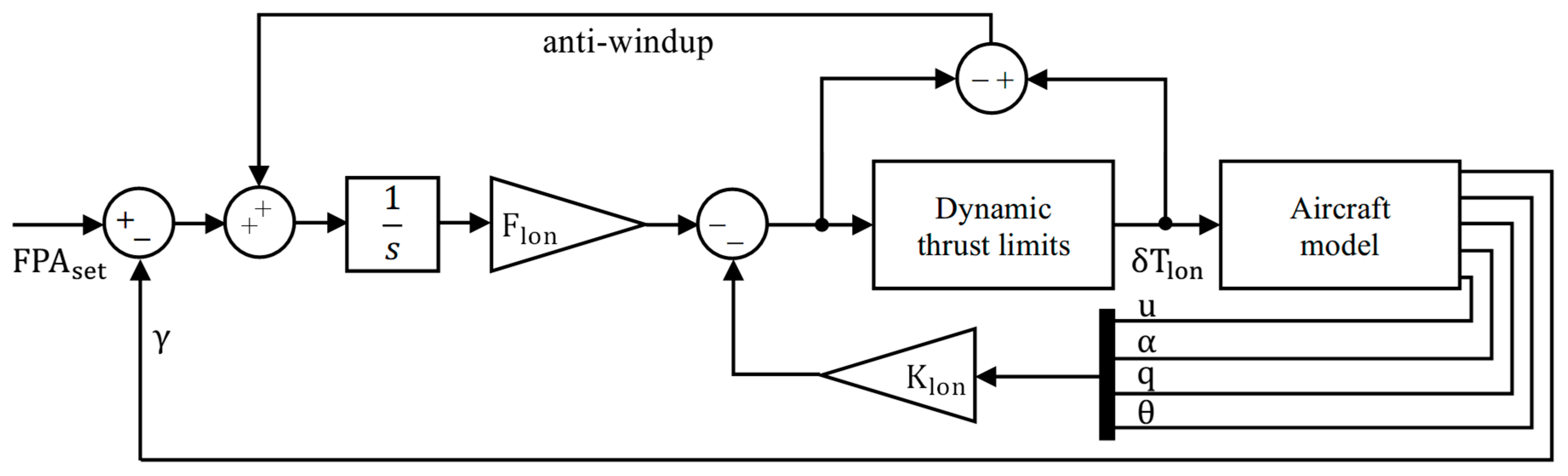
The control in the longitudinal channel (
Figure 1) is accomplished by the regulation of flight path angle
. A signal present in the main control path is an integral of the flight path angle error and the anti-windup component preventing saturation of the control path. The gain vector
of the LQR controller converts the
,
,
and
measurements into a feedback signal, which is further subtracted from the main control path. The feed-forward gain
present in the system is responsible for bringing the main control path signal down to the feedback level. The resulting collective thrust lever position control is dynamically limited by the actual control conditions, i.e., the maximum negative and positive deflection of the thrust lever from the steady-state position.
3.4. Lateral Control
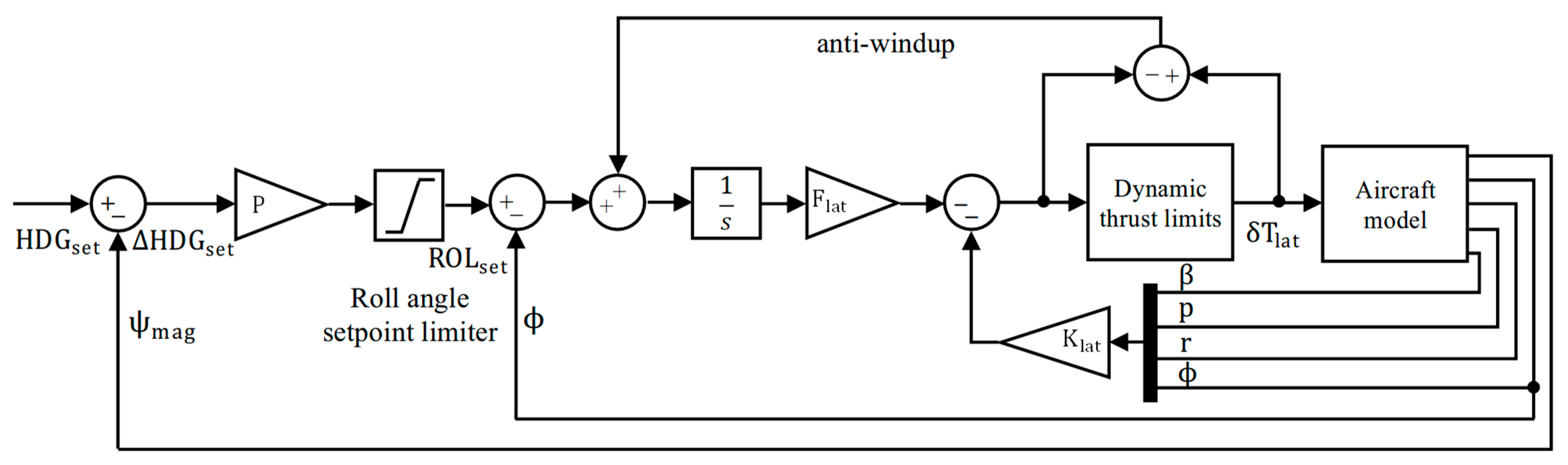
The lateral channel control law consists of two control loops (
Figure 2). The structure of the inner loop with the LQRI controller is virtually identical to the loop used for the flight path angle control, except for the measurements corresponding to the lateral aircraft motion (
,
,
and
) being used to compute the controller feedback signal. The inner control loop is in control of the roll angle
. The role of the aircraft heading control
, a superior control parameter, is filled by the outer loop with the proportional controller P. The main control signal here is a deviation from the commanded heading
, determined from
and
by an external module (see
Section 6.4). This signal is then transformed to the commanded roll angle
by applying a ±20° saturation. The control output signal
is a thrust lever deflection of the No. 1 engine. Thrust asymmetry is obtained via inversion of this signal for the second engine.
3.5. Cross-Coupling of Control Channels
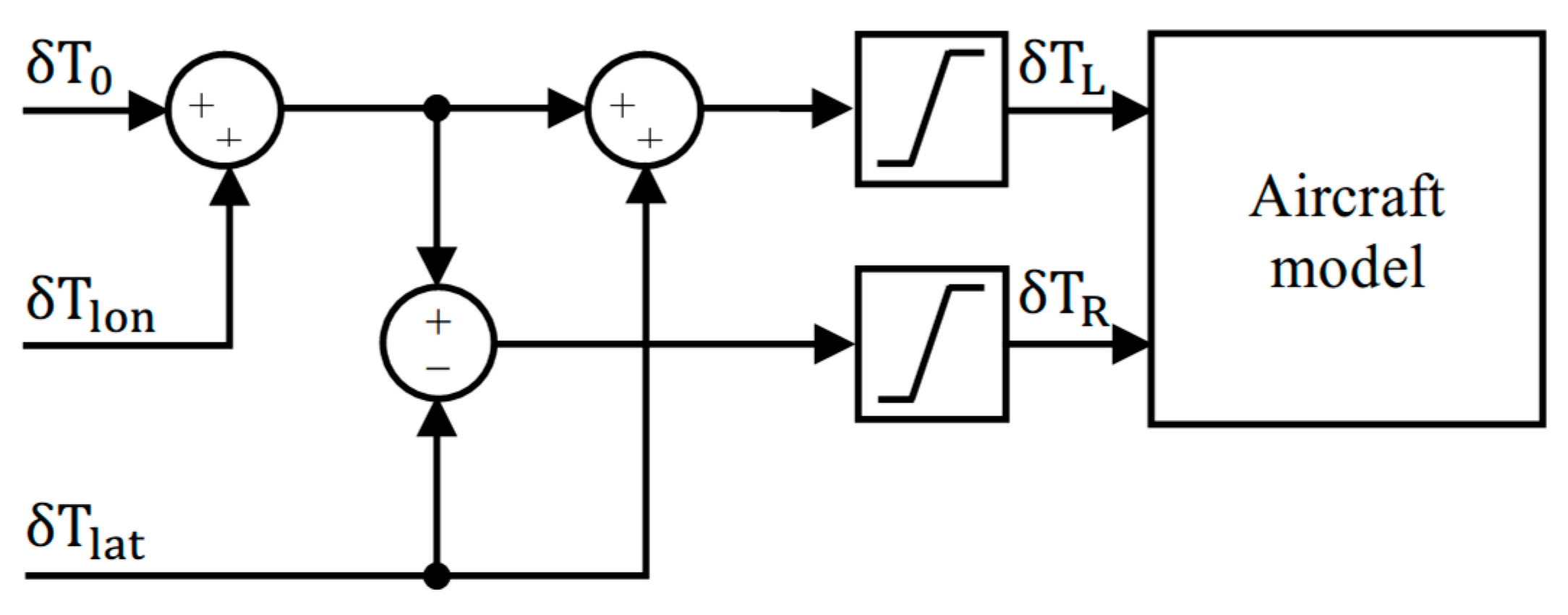
The main challenge in designing an emergency thrust control system is dealing with the problem of cross-coupled control, i.e., controlling two parameters in two different control systems with a single control mechanism. In this particular case, it refers to the aircraft’s engines simultaneously maintaining the heading and the flight path. Designing the system requires shaping the control signals in such a way that one controller does not completely exclude the operation of the other. This shaping can be achieved by appropriately combining the control outputs (
Figure 3), applying control priority weights and selecting the speed of the LQRI controllers.
4. Research Platform
The platform setup consisted of a computer with a preconfigured MATLAB and Simulink R2022a environment, an X-Plane 11 flight simulator with UDP connectivity, and a joystick. Data transmission modules designed in Simulink enabled the recording of flight parameters and allowed feedback control commands to be sent to the simulator.
To design data transmission and control system modules, several toolboxes, including Control System Toolbox, Embedded Coder, Simulink Desktop Real-Time, Real-Time Kernel for Desktop Real-Time, DSP System Toolbox, Signal Processing Toolbox, System Identification Toolbox, and Simulink Control Design, need to be installed.
The control system concept was designed using the Simulink Connected IO Mode template, a part of the Desktop Real-Time package preconfigured to run external data transmission. The template extends the simulation capabilities to include real-time mode. Handling of the input and output signals from data transmission blocks during simulation is performed by a system kernel parallel to execution of the control algorithms in Simulink application. Both processes are run on a single machine using shared memory for data transmission. In this project, the Software-In-the-Loop simulations were not run in real-time mode due to limitations of the accessible hardware.
5. Aircraft’s Model Identification
5.1. Aircraft Tested
As an aircraft available in the X-Plane 11 environment, a Boeing 757-200 model was selected for this research (see
Table 1). It is a medium-sized narrow-body airliner originally designed for short- to medium-range US domestic routes.
To determine the relationship between the aircraft’s state variables and thrust levers deflection required for a full state model identification, the features of System Identification Toolbox were widely used.
5.2. Mathematical Model Structure
The aircraft’s mathematical model can be expressed in a form of the linear state-space equations, separately for longitudinal and lateral motion. A general form of such a model is presented in Equations (1) and (2).
A full state linear representation of the longitudinal channel according to [
15] is given in (3).
A steady state is considered to be the aerodynamic equilibrium state of the aircraft in straight-line flight. Since the variable
is not actually represented by any on-board measurement, through the use of relation (4), it is possible to transform Equation (3) into a form that is useful from a control system design perspective.
By omitting the disturbance part, which is not considered in this paper, the final form of the longitudinal state equation takes the form (5) [
15].
To represent the aircraft’s lateral motion, the full linearised state equation is given in (6) [
15].
Using relation (7) and accounting for the effects of thrust asymmetry on the aircraft’s lateral channel, which are described in greater detail in [
16], the state Equation (8) used in the process of model identification and LQRI control system design is obtained.
It is worth noting that the model state variables are increments of the flight parameters and not their absolute values. The term of an increment has been omitted in descriptions of only these parameters, whose values in a steady state are equal to zero. Therefore, it is possible to distinguish two groups of the state variables, described by the relations (9) and (10). To emphasise the flight parameters of non-zero steady-state values, they are marked with uppercase letters.
During a real flight in a steady state, the slip angle usually assumes non-zero values. It is associated with the influence of parameters such as the arrangement and type of propulsion system, the structure of an airframe, and the position of an aircraft’s centre of gravity. On the grounds of the general characteristics and the propulsion of the chosen aircraft model, the value of in the steady state is marginally small; thus, this parameter has been assigned to the group (10).
5.3. Model Identification Process
The direct objective of the aircraft’s model identification, as described in (5) and (8), was to estimate all the dimensional aerodynamic derivatives present in the state and input matrices and related to the deflection of the thrust levers.
The values of the flight parameters in (9) may change according to flight conditions. It concerns, in particular, the changes in flight altitude, airframe configuration, and the aircraft’s mass loss related to fuel consumption. The knowledge of the flight parameters’ behaviour is crucial both for correct model identification and for further designing the control system. The correlation between flight conditions and selected flight parameters was determined by the observations made in simulator tests and is presented in
Table 2.
Out of the listed parameters, the change in altitude affects only the required position of the thrust levers in equilibrium (level flight). Its lack of noticeable effect on the other flight parameters is in accordance with the principles of flight mechanics. In flight at Mach speeds below the critical Mach number, all aerodynamic forces and moments acting on the aircraft appear proportional to the square of the equivalent airspeed (EAS). This implies that at a given equivalent airspeed, the aircraft’s controllability and responsiveness, as well as the aerodynamic loads acting on it, are almost constant and equal to the states occurring at a standard sea level, regardless of the actual altitude. Consequently, the steady states at different flight altitudes, with a frozen aircraft’s configuration, are represented by a constant EAS value.
For the 757-200 model configured with a take-off weight of 177,000 lb, including a fuel weight of 30,000 lb, the all-fuel consumption results in a change of approximately 13% in the total weight of the aircraft. Its effect on the dynamics and flight performance was neglected under the established design principles.
5.3.1. Analysis of Thrust Lever Positions in Steady States
For the purpose of the identification process, the relationship between thrust lever position and flight altitude in the aircraft’s aerodynamic steady state states was analysed. This was required both to determine the actual increments of the
variable to be measured during a control input trial, and also to determine the steady-state thrust lever positions for aircraft control at any flight altitude. The altitude is further connected to specific atmospheric conditions, including air density and temperature. A more detailed description of this phenomenon is provided in
Appendix B.
5.3.2. Thrust Lever Position Measurements in Aircraft’s Steady States
A number of flights involving a model of a Boeing 757-200 were carried out on the prepared research platform. During the simulations, under windless atmospheric conditions, the measurements of the thrust lever position along with the values of ambient pressure and temperature from the aircraft’s sensors were collected. The recording of these parameters began after the aircraft had been stabilised at a predetermined altitude, with a minimal amplitude of phugoid motion and a total aircraft weight of approximately 174,000 lb. The data was collected for both retracted and extended landing gear configurations. The averaged measurements are shown in
Table A2 in
Appendix B.
5.3.3. Approximation of Thrust Lever Position as a Function of Air Density
The obtained measurements were converted to SI units. For each measurement point (flight altitude), the air density
was determined according to (11).
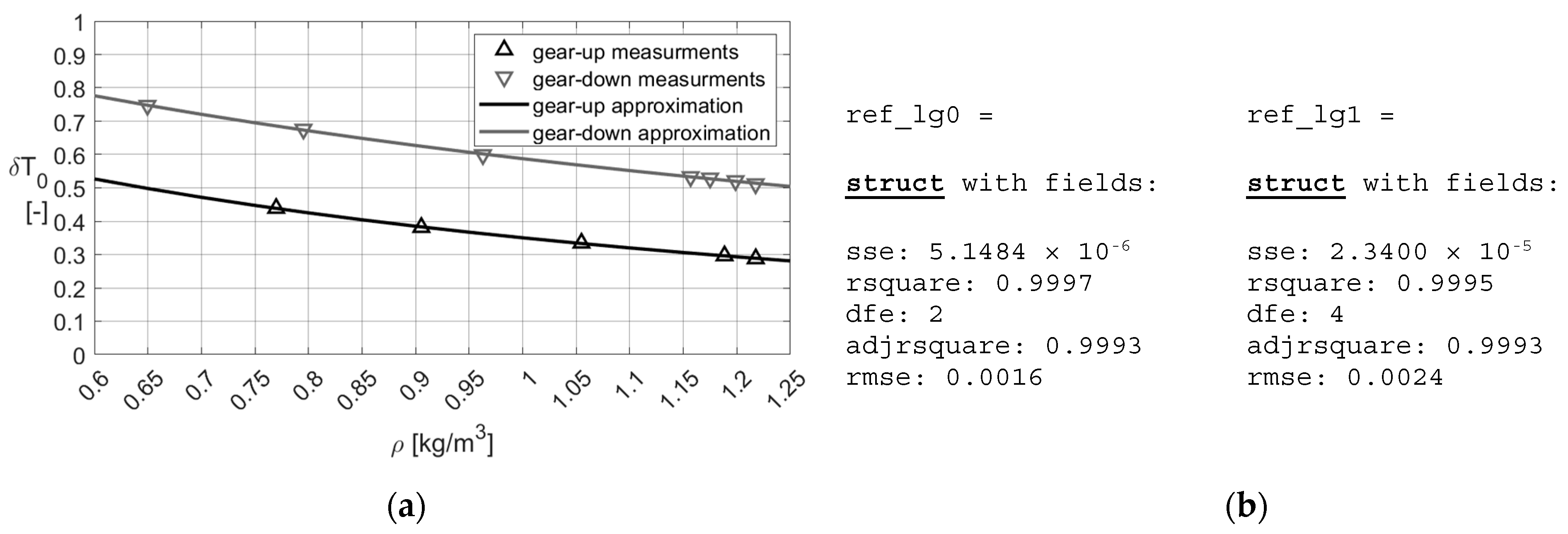
Next, an approximation of the relation between
and
values in steady states was computed to form a rational function. The resulting functions for flight with retracted and extended landing gear are described by Equations (12) and (13), respectively. The fitness of determined approximations is described by the parameters shown in
Figure 4b.
5.4. State-Space Model Identification
Flight trials conducted for the purpose of model identification consisted of upsetting the aircraft’s steady state in various planes of motion by means of specific control inputs. The aim of the introduced inputs is to excite the aircraft dynamics in a way that enables the estimation of all sought-after aerodynamic derivatives. The excitation of specific dynamic modes requires the use of appropriate control inputs [
17].
5.4.1. Measurement of Flight Parameters in Thrust Lever Input Trials
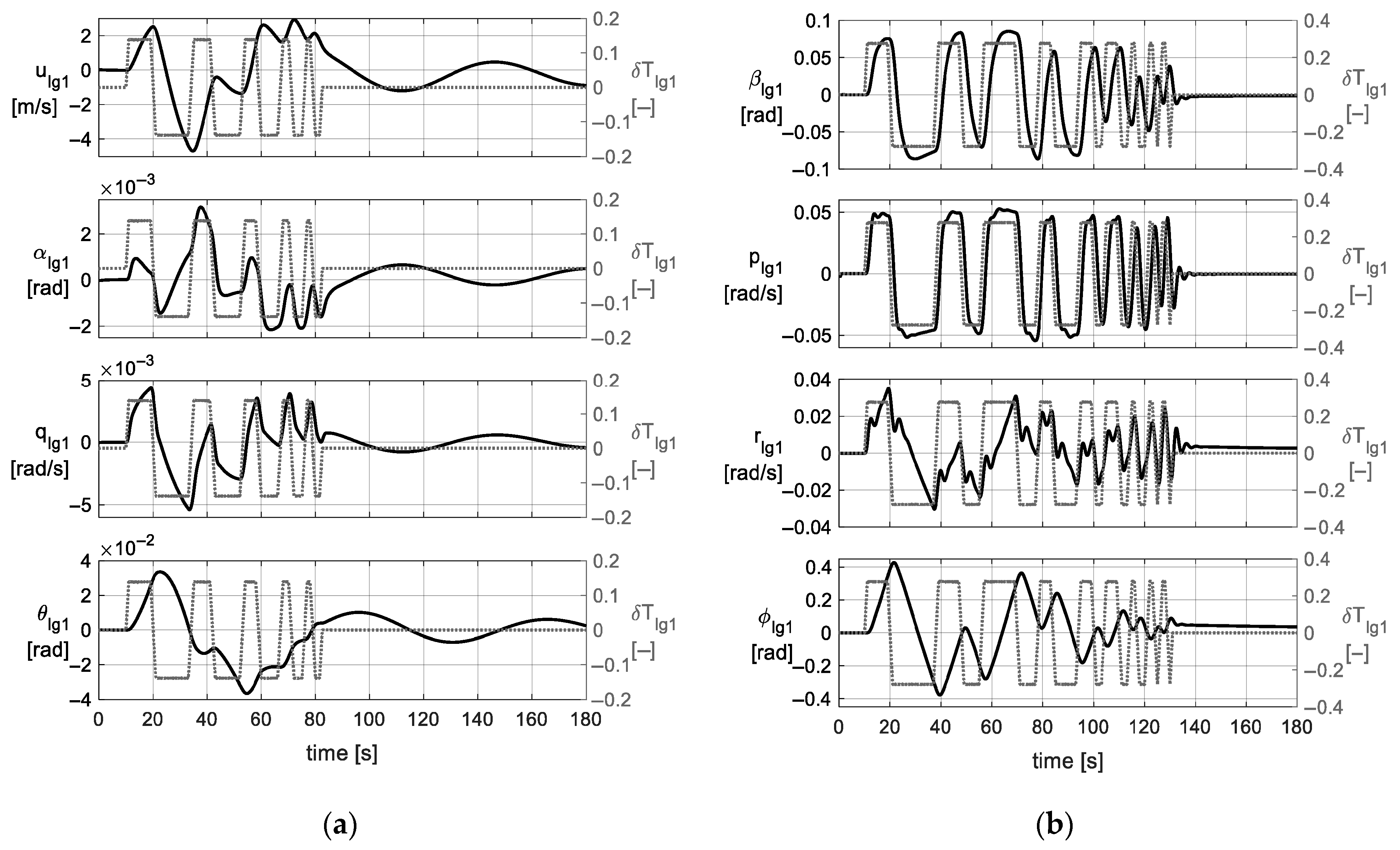
As part of the data acquisition for identification, eight simulated flight trials were conducted, four with the landing gear retracted and four with it extended. During each flight, an automated input sequence was performed, recording specific parameters at a flight altitude of approximately 1000 ft and an aircraft weight of nearly 174,000 lb. The range of input frequencies was aligned with the dynamics of the lever-engine system. Hence, very rapid changes in lever deflection, which would have been filtered out by the system, were omitted. The shaping of the sequence took into account the so-called ‘small disturbance theory’, a principle stating that small control excitations minimise non-linearity in the response of the test object. All flights followed a fixed pattern.
Flights in a given configuration were conducted in pairs to obtain datasets both for model identification and verification. Each dataset included the recording of steady-state parameters a few seconds before the start of the manoeuvre and several dozens of seconds of the aircraft’s free response after the input sequence. Exemplary input trial measurements are presented in
Figure A1 in
Appendix B.
The excitation of the aircraft dynamics in the longitudinal channel was achieved by means of a collective deflection of the thrust levers from the position determined by the developed approximating functions (
Section 5.3.3). The parameters captured included equivalent airspeed
, angle of attack
, pitch rate
, and pitch angle
. The acquired data were converted to SI units. The averaged constant values recorded during the first 5 to 10 s of steady-state flight were then subtracted from the corresponding measurements to obtain the required increments of flight parameters.
When conducting the measurement of lateral motion dynamics, the thrust levers were deflected opposite to each other. The use of equal-value inputs did not eliminate the phenomenon of cross-coupling between the channels affecting the final measurement results. Due to the non-linear relation between the lever position and the thrust produced by the engine, as well as the dihedral effect occurring when the aircraft rolls, performing any turns means inducing oscillations in the longitudinal channel. In an attempt to minimise the impact of these phenomena on datasets reliability, input shaping was applied.
5.4.2. Estimation of Aircraft’s Dynamic Models
The identification of longitudinal and lateral motion state-space models was performed using the “ssest” function, as a part of the System Identification Toolbox. During the aircraft’s dynamics identification, special attention was paid to ensure a close correspondence between computed models and their mathematical description from
Section 5.2. For this reason, after the first execution of the
ssest() function, specific state matrix coefficients were fixed with their known, theoretical values, which were entered manually. For such corrected models, the function was executed again. The percentage fitness of state responses to measured data, computed for the four models, are shown in
Table 3.
A quantitative assessment of the estimated model, returned by the
ssest() function, includes the percentage fitness expressed as in (14).
5.5. Model Verification
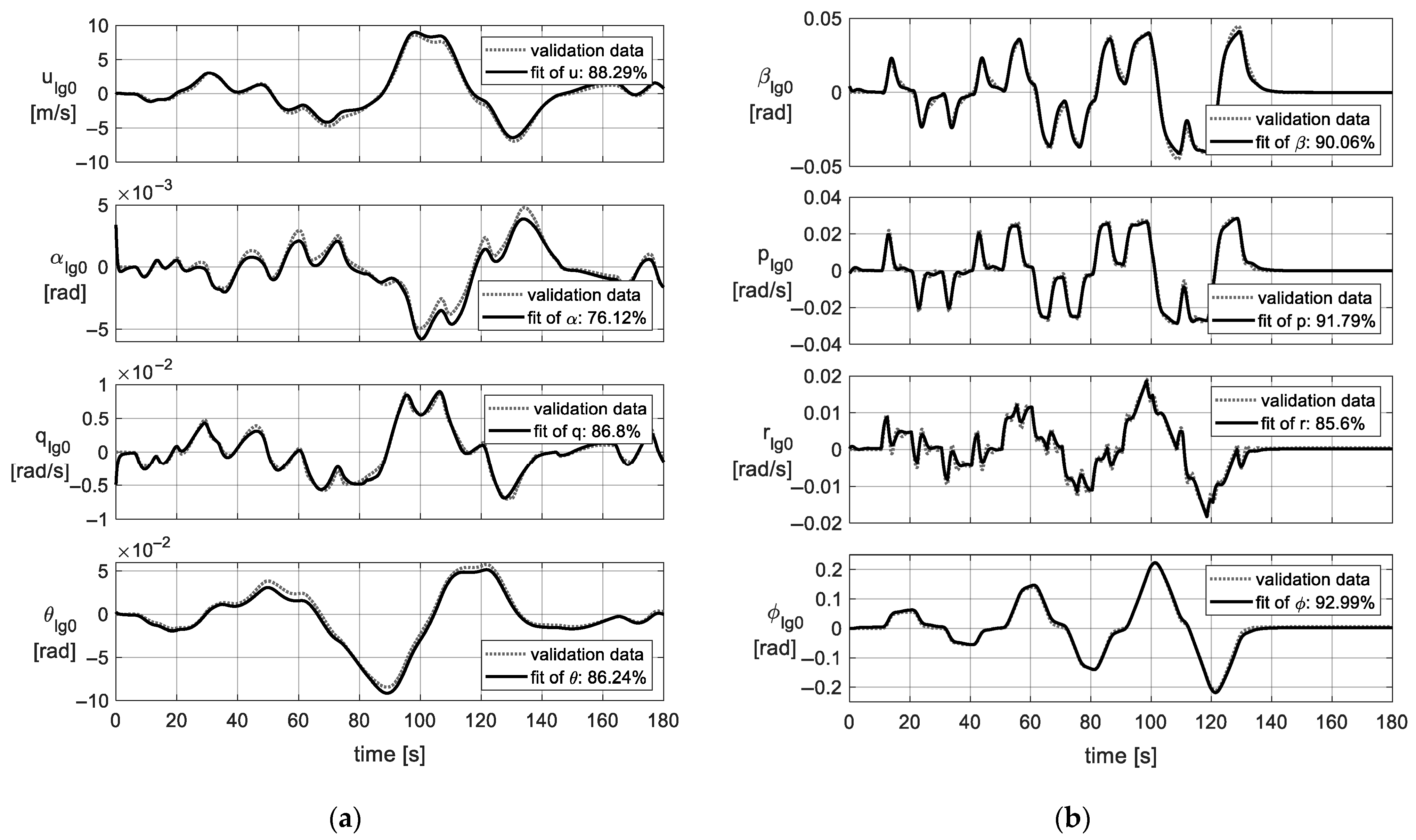
For the purpose of verifying the estimated models, four datasets were prepared, with each containing the measurements corresponding to a different control input sequence. Using the
compare() function, the models’ responses were compared with the verification data. Example results are shown in
Figure A2 in
Appendix B. For all the estimated models, the state variables’ fit value of at least 70% was achieved.
6. Control System
6.1. Preparation of Simulink Models
For testing of longitudinal and lateral control channels, previously discussed state-space models were combined into two separate Simulink models with a linear state transition corresponding to the change in landing gear position. At the moment of transition between states, coefficients of state and control matrices changed according to (15).
During the transition in the aircraft’s longitudinal channel, there is a change in non-zero steady-state flight parameters values, including equivalent airspeed, angle of attack, and pitch angle. This means that a disturbance of the steady state occurs when the landing gear is being extended or retracted. This situation was also taken into account in the Simulink models. The disturbance associated with a linear transition between two known object dynamics was modelled as an instantaneous parameter deviation from the steady state, which was being added to a vector of state variables. As an example, the equation describing an instantaneous deviation of the equivalent airspeed
is provided in (16)
The control systems developed for testing were standalone, i.e., the Simulink models used to tune the LQRI controllers did not take into account the presence of cross-coupling, as discussed previously. For this reason, at this stage of working with the model, it is only possible to speak of a preliminary controller tuning, bearing in mind the premises of expected real control system dynamics. The final shape of the developed control system was established on the basis of simulation tests conducted for various controller settings, with the Simulink model adapted to work with a simulator.
6.2. Determining LQRI Control Parameters
The purpose of the designed control system is to provide control in the aircraft’s longitudinal and lateral channels in the event of a control surfaces failure. The main control-related difficulties include the relatively long response of the object, the strict limitations of the engines’ operating range, variable dynamics related to the airframe configuration, as well as the previously mentioned cross-coupling of the control channels. Concurrently, the very occurrence of a failure, the so-called “freeze” of controls, imposes a control realisation at a predefined steady state equivalent airspeed. Its value for the selected aircraft in a researched configuration is almost twice the recommended approach speed. This means that during an emergency landing, the landing gear structure will be subjected to loads for which it was not originally designed. To prevent a crash landing, the emergency system has to guarantee a precise touchdown.
The quality of setpoint (e.g., glideslope angle) tracking is, among other things, related to the controller speed. The process of determining the LQRI controllers’ settings was divided into two stages. The first stage investigated the maximum control speed that could be achieved with zero overshoot in both control channels. The second stage consisted of experimentally selecting settling times to minimise the interaction between the control channels.
6.2.1. Flight Path Angle Control System
The flight path angle control system (
Figure 1) uses feedback from measurements of equivalent airspeed
, angle of attack
, pitch rate
, pitch angle
, and flight path angle
, to determine the control signal for collective thrust levers deflection. The control system consists of two discrete LQR controllers, an integrator I, a control signal limiter, and an ‘anti-windup’ component preventing the control signal from rising when the limit of the thrust lever position is reached.
The developed system takes into account the change in aircraft dynamics related to the landing gear position, realising a linear transition between the determined settings of the LQRI controller according to Equation (17). The purpose of this solution is to reduce overshoot and eliminate the control signal disturbance caused by controller gain matrix switching during landing gear extension or retraction. The control limit used in the model has constant limits [−0.3; 0.7]. In reality, however, these values are constantly changing, and such changes are mainly dependent on the flight altitude.
The flight path angle controller settings were computed using the
lqrd() function implementing the discrete control law (18) that minimises the discrete cost function (19) based on the continuous linear model and the assumed Q and R weight matrices.
The process of determining the controller settings started with the formulation of state and input matrices for the model with an integrating component. The applied output matrix
is responsible for calculating the flight path angle
from the state variables
and
according to relation (20).
Subsequently, the weight matrices Q and R were determined. To select the weight values, the diagonal form of the Q matrix was adopted, in which the last element of the last row denotes the weight of the
error integral. In general, high weight values were assigned to the state variables to be tracked by the control system. As a result of
lqrd() execution, the gain vector
was obtained. Its first four elements formed the
gain vector for state feedback, and the last element was the gain of integral term
. The values of initial weight matrices and the longitudinal controller settings are presented in
Table A4a in
Appendix C.
Of all the coefficients in the Q matrix, increasing the weight of , the error integral had the greatest effect on reducing the settling time, while leaving the values of and weights low. Faster control was achieved at the expense of an overshoot of a few percent, and in future, this can be eliminated by increasing the weights of and . When using the same weight matrices to determine the controller settings for the aircraft model with extended landing gear, the resulting step responses were almost identical.
A verification of controller settings conducted on the prepared control system Simulink model revealed that, regardless of the weights, the control signal limitation had a dominant effect on the obtained settling time.
A step response of the flight path angle control system with the LQRI controller settings presented and a setpoint increment of 5°, resulted in a settling time of 11.96 s. For smaller inputs, this time interval may be slightly shorter.
6.2.2. Heading Control System
The use of an external control loop in the control law discussed in
Section 3.4 is necessary for two reasons. Firstly, the designed control system has to be capable of limiting the roll angle. The limiter range was initially set at ±20°. This constraint is dictated by the flight safety; the limited and non-linear engine operating range; and the rolling motion’s effect on exciting oscillations in the longitudinal motion, which grows as the roll angle increases. Therefore, the constraint also affects the cross-coupling dynamics of the control channels. As for the second reason, the solution offers much better control over the controller’s dynamics and precision. The use of the LQRI controller alone with feedback including
did not offer such a possibility due to the strict coupling of the aircraft roll with a given heading setpoint, which exists in such a configuration. The coupling means that small heading changes would be achieved at small roll angles with a significant increase in the settling time.
The designed system computes the control output for the left engine thrust lever. Since the available range for increasing and decreasing the lever deflection differs, the control output is limited symmetrically with respect to the narrower range. In the prepared model of the heading control system, with a left lever deflection range of [−0.3; 0.7], the control limits were set to [−0.3; 0.3].
Table A4b in
Appendix C shows the settings of the designed lateral P-LQRI controller.
Due to the aircraft’s lateral control constraints, the settling time of heading changes corresponding to prepared controller settings was not investigated. The response time was closely related to the magnitude of a given setpoint. However, other relevant system parameters were measured from the step responses. That being said, the settling time taken to achieve the maximum roll angle (20°), was found at 12.86 s. The turn rate at the maximum roll angle reached a value of approximately 1.55°/s for both landing gear positions. Knowledge of these parameters was important for the second stage of controllers’ tuning, run under the Software-In-the-Loop tests of designed control system.
6.3. Overall System Stability Characteristics
The airliner chosen for the design of control system is a highly non-linear system with strictly limited thrust control capabilities. Performing theoretical stability analysis of such a system is a complex problem due to the presence of cross-couplings, which are problematic to model. The decoupled models of the aircraft’s longitudinal and lateral dynamics proposed in this paper are only indirectly related through the module shown in
Figure 3. Consequently, these models are unsuitable for a global stability assessment of the real aircraft control system, even for a single, stationary airframe configuration.
An additional challenge in stability analysis arises from the use of anti-windup mechanism in both control channels. While global stability assessment is practically infeasible, the local stability of each control model considered separately can be inferred under several assumptions.
Firstly, the aircraft model in the studied configurations exhibited longitudinal static stability with very low dynamic damping, resulting in phugoid oscillations that decay slowly over time (as presented in
Figure A1a in
Appendix B). Therefore, open-loop collective thrust control does not cause instability, even under maximum thrust inputs. The magnitude of the inputs, however, directly affects the amplitude of the induced phugoid oscillations. The eigenvalues for the open-loop longitudinal control are presented in
Table A5a.
Secondly, the linear-quadratic regulator algorithm yields a stable state-feedback control loop. The eigenvalues for the closed-loop longitudinal and lateral control systems, excluding the anti-windup mechanism, are shown in
Table A5b,c.
Lastly, the implemented anti-windup mechanism is intended to improve system stability under real operating conditions—in this case, during flight simulator trials. It limits the accumulation of the integration state, which would otherwise significantly degrade closed-loop performance, potentially leading to so-called bang–bang control effect and adverse oscillations in the system. Such phenomena may occur when the initial conditions of the system are considerably distant from the steady state. The anti-windup mechanism attempts to minimise the difference between saturated and unsaturated control signals by re-computing the integral action state, ensuring that the controller output remains at the saturation limit.
6.4. Architecture of Emergency Thrust Control System
The proposed emergency thrust control system consists of modules performing the following functions:
▪ Computation of thrust lever position in steady state.
▪ Heading setpoint conversion.
▪ Flight path angle control.
▪ Heading control.
▪ Control signal mixing.
▪ Glide path tracking.
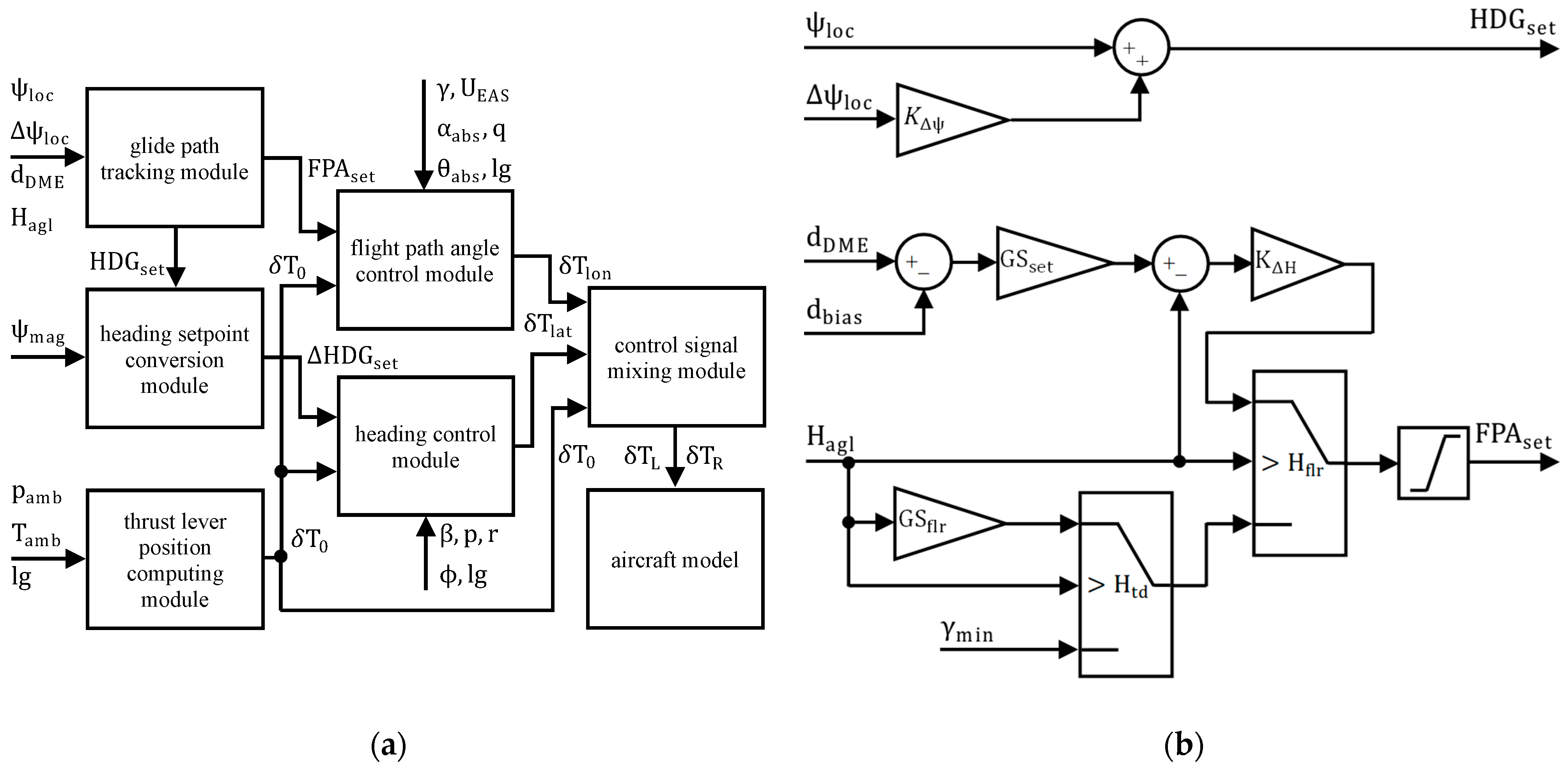
A simplified diagram of signal connections between the modules is shown in
Figure 5a.
The thrust lever position computing system employs the function described in
Section 5.3.3. Based on the measurements of
and
the thrust lever position
, corresponding to the flight’s aerodynamic steady state, is determined as a base signal for controlling the aircraft’s engines.
The heading setpoint conversion module is responsible for computing the heading angle error passing on the input of the heading control system. The system determines the smallest angle between the heading setpoint and the current magnetic heading , specifying, at the same time, the direction of turn in the range of [−180°; 180°]. The presented solution eliminates a problematic, from a control perspective, transition of heading from 359° to 0° when turning to the right and from 0° to 359° when turning to the left. The prepared module imitates the operation of navigation systems found in airliners.
In comparison with the Simulink model prepared for the initial system tuning, two significant changes associated with the system adaptation to the aircraft’s in-flight-simulator control were introduced into the structure of the flight path angle control module. The first change concerned the measurement signal processing. The adopted control method required each of the feedback signals to represent a value increment from a steady-state flight. Therefore, specific constant values had to be subtracted from the measured equivalent airspeed , angle of attack , and pitch angle . The second change involved the introduction of a dynamic thrust lever deflection limiter block. As the value of signal varies with flight altitude, the available lower and upper lever deflection ranges are being defined.
The heading control system performs the task of minimising the heading error computed by the heading conversion module. In the target structure of the designed system, in similar way to the flight path angle control, a dynamic limiter block was applied. The computation of instantaneous control output limits required defining a value of the narrower of available thrust lever deflection ranges.
Another important role is filled by the module presented in
Figure 3. Its task is to combine the control outputs of flight path (
) and heading (
) control systems and to define direct control commands
and
for the thrust levers’ absolute position.
Figure 5b shows the glide path tracking system. It is designed to define the setpoints of flight path angle and heading to guide and track the glide path to a selected runway. The featured system performs its intended function according to the signals from the on-board ILS receiver and the altitude indications of the radio altimeter
. The ILS signal inputs include heading towards the localizer
, heading error
, and distance from the localizer
.
The specific nature of emergency thrust control makes the ILS glideslope tracking alone insufficient for securing a safe landing. The proposed system provides a full control over the course of the approach, i.e., a selection of glideslope angle , flare initiation altitude , minimal flight path angle upon touchdown and touchdown location based on the distance between the localizer and the runway threshold .
7. SIL Simulations
7.1. Tracking of Flight Trajectory Changes
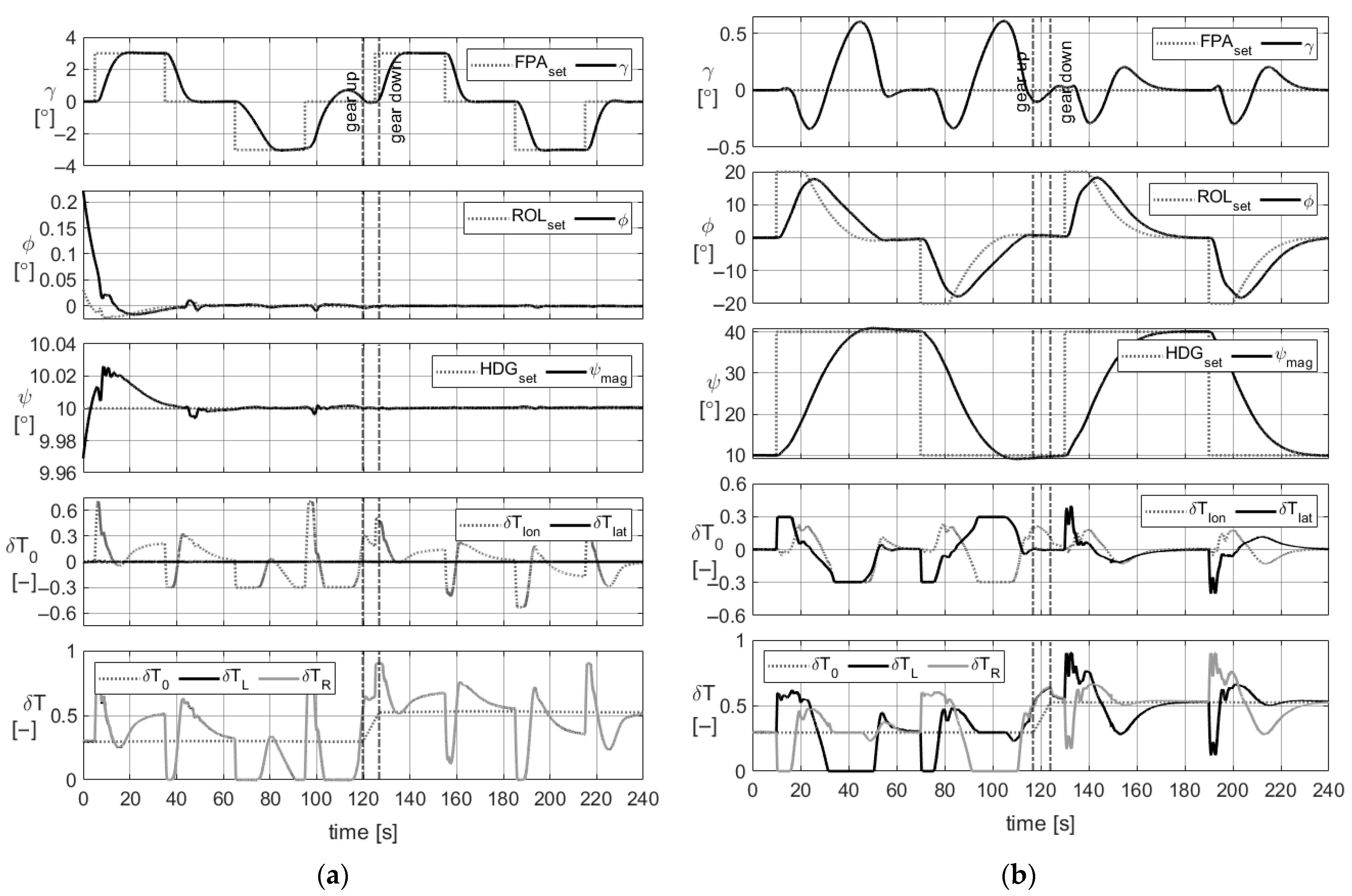
The system performance at a given configuration was evaluated on the grounds of three in-simulator control trials, which included tracking the set flight path angle changes at a constant heading, tracking the set heading changes at a constant flight path angle, as well as tracking a spiral trajectory involving aircraft’s simultaneous descent and turning.
During the initial simulation trials, the overall conformity between the responses of the simulator-tested system and the Simulink model with separated control channels was established. In a pure pitch manoeuvre, the tested system reached a flight path angle setpoint in a time close to that of the model. As for the heading control, it initially achieved fairly precise setpoint tracking, which improved further into the flight with extended landing gear. Meanwhile, the conducted trials revealed the extent of the cross-coupling issue between the control channels.
Beginning with a levelled flight, excessive roll control leads to a rapid drop in lift and lowering of the flight path angle, which induce an aircraft’s phugoid motion. The flight path angle control system attempts to compensate for the arising disturbance by increasing the collective component of thrust lever deflection . The aircraft gains speed. While coming out of a turn, an increase in lifting force combined with the equivalent airspeed above the equilibrium point results in a significant increase in the flight path angle.
The dataset recorded during the trials made it possible to specify the changes to the control system necessary to minimise the effect of roll motion on the change in the aircraft’s flight path angle. Thus, the attention was paid to the control loops in the heading control system, while the flight path angle control system was left unchanged.
As a first step, the weights of the Q matrix were significantly reduced and the new LQRI controller settings of the roll angle control loop were assigned. This resulted in a much smoother and slower step response of rolling motion. The second adjustment involved a reduction in external loop proportional gain for heading control (from P = 1.7 to 1.1). This action resulted in earlier and less abrupt emergence from a turn, which is a key factor affecting the dynamics of the lateral movement and the associated magnitude of the disturbance in the longitudinal channel.
The definitive settings of the heading control system are shown in
Table A4c in
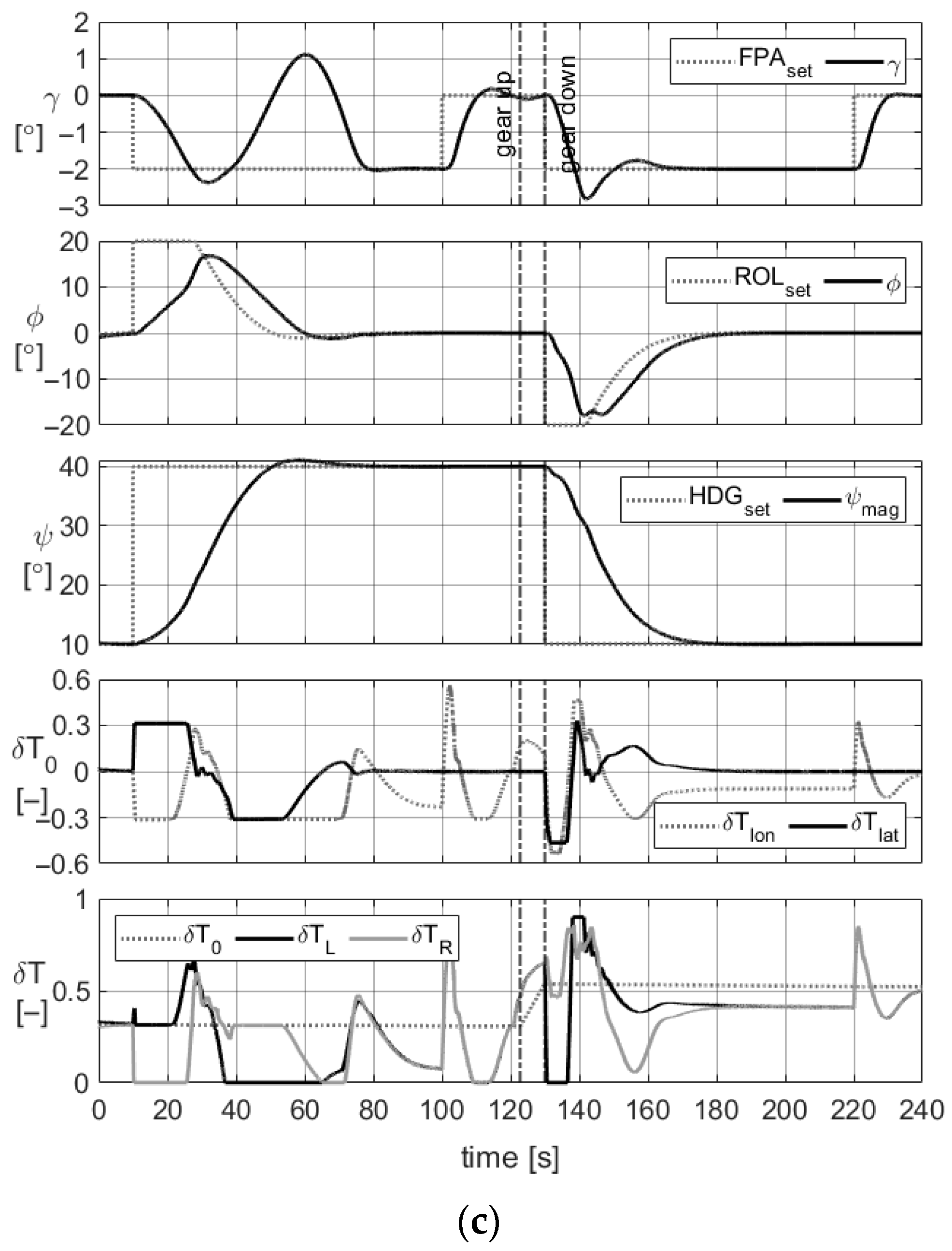
Appendix C. Measurements recorded during the final flight path and heading tracking trials are provided in
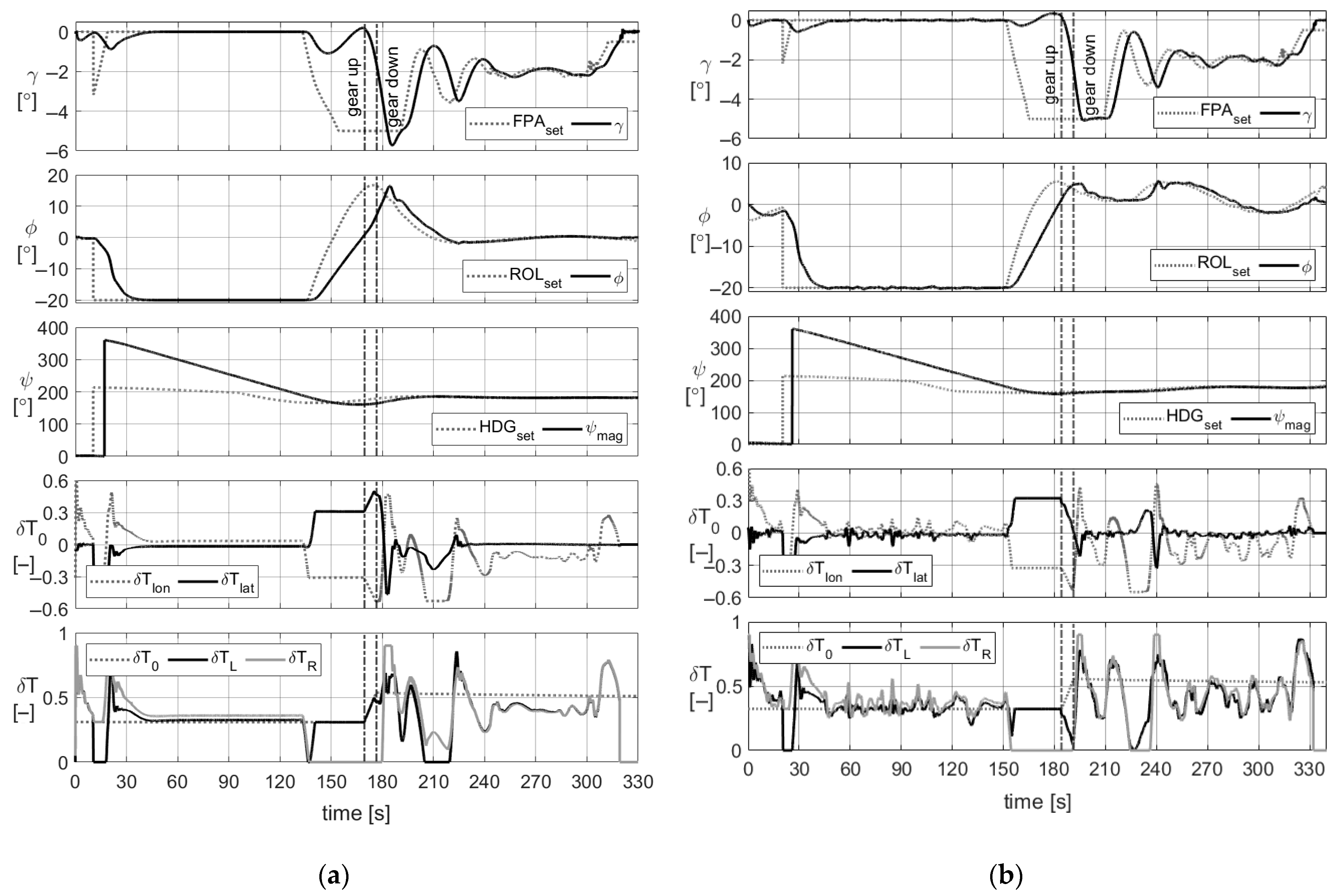
Figure 6. Step response characteristics of both longitudinal and lateral control systems under SIL tests, including setpoint values, rise times, settling times, and overshoot are provided in
Table A6 in
Appendix C.
Setting changes in the heading control loop had no significant effect on extending the settling time of the system. It was comparable to the time values obtained previously. However, smoother changes to the roll angle resulted in an almost twofold decrease in the flight path angle disturbance magnitude in comparison to the preceding trials. In addition, a significantly smaller heading overshoot was observed during the gear-up flights.
The cross-coupling issue is especially apparent while making a sharp turn in the aircraft with the retracted landing gear. As the control output reaches its lower limit during the maneouver and the position of one of the thrust levers is set to 0, the longitudinal control system is not capable of the rapid airspeed reduction necessary to compensate for the positive fluctuation of the flight path angle.
The worst considered scenario of aircraft control using thrust levers is represented by the task of tracking a spiral trajectory (
Figure 6c). In this situation, maintaining a negative flight path angle with the landing gear up is impossible. The landing gear extension and associated increase in required thrust
significantly improve the control performance in both channels.
7.2. Landing Attempts
Performing a landing with frozen control surfaces requires maintaining an airspeed well above the predicted structural value. In the case of Boeing 757-200, the recommended approach speed is 132 kts in relation to the approximately 235 kts recorded during the SIL simulation of the system. In this context, a landing attempt with ILS-generated glide path, given the extended flight path settling time, will undoubtedly result in landing gear damage and the aircraft crashing. The developed glide path tracking module made it possible to adjust the course of an approach to the known dynamics of thrust control. For the purpose of conducted simulations, a glideslope of 2° was prepared, intersecting with the airport apron just before the runway threshold.
The automatic approach attempts were carried out in the following sequence: stabilise the flight at an altitude of approx. 2500 ft (parallel to the runway centreline); execute a 180° turn in the direction of ILS localizer; and follow the glide path until the beginning of a flare manoeuvre, i.e., an increase in the angle of attack just before touchdown. Due to the control dynamics, the flare was initiated at an altitude of 150 ft.
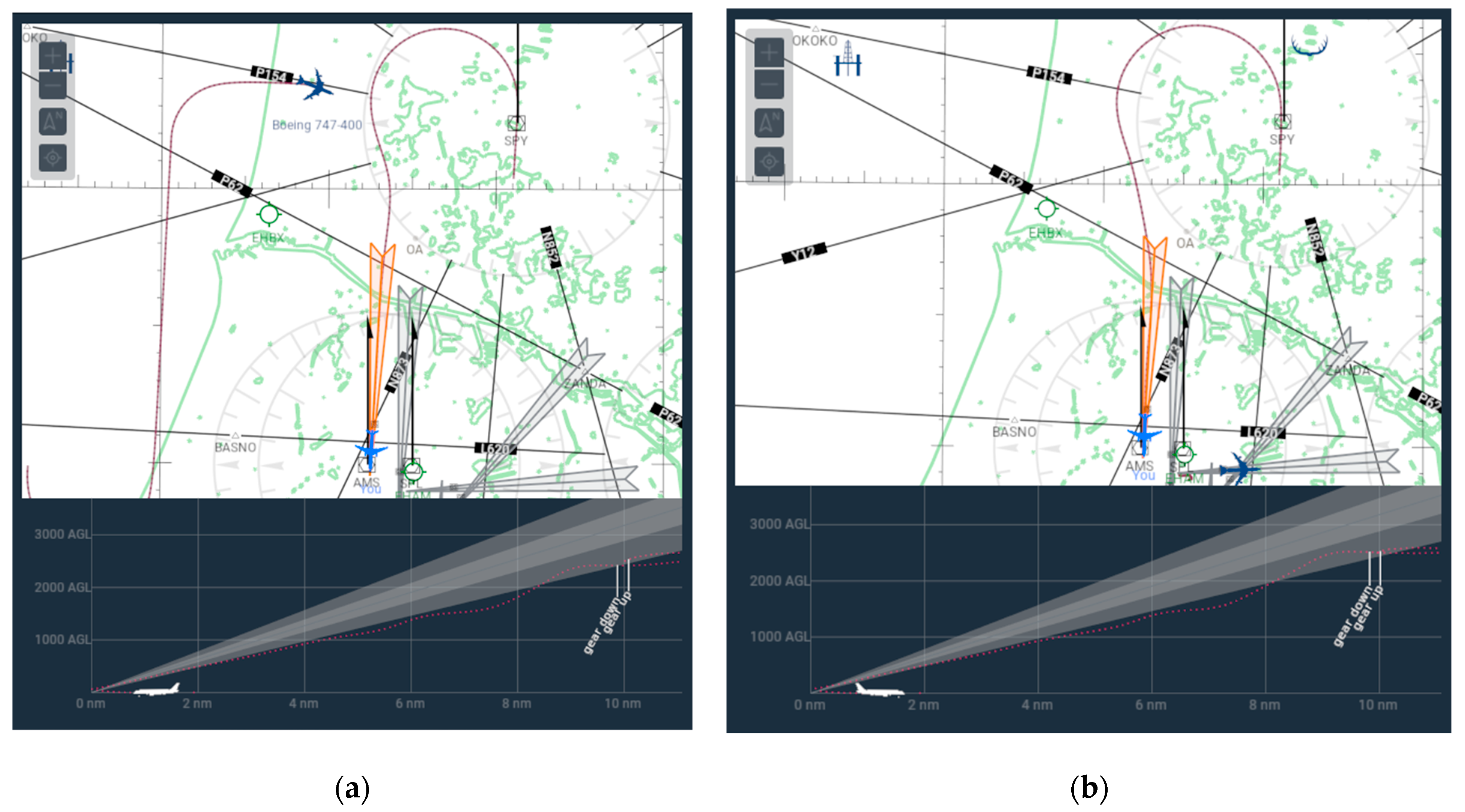
Figure 7a shows the approach trajectory and glide path (red dashed line) recorded during one of the landing attempts. With an approach flight path angle of
, the landing aircraft is just below the standard ILS glideslope.
Figure 8a shows the control parameters recorded during this attempt. Extending the landing gear as the aircraft comes out of a turn helps one to achieve a negative flight path angle. Starting from an altitude of 150 ft, the tracking module gradually increases the set flight path angle to −0.5° at 50 ft, which, in combination with a presence of the ground effect, results in landing gear coming into contact with the runway surface at a flight path angle of approximately −0.35°.
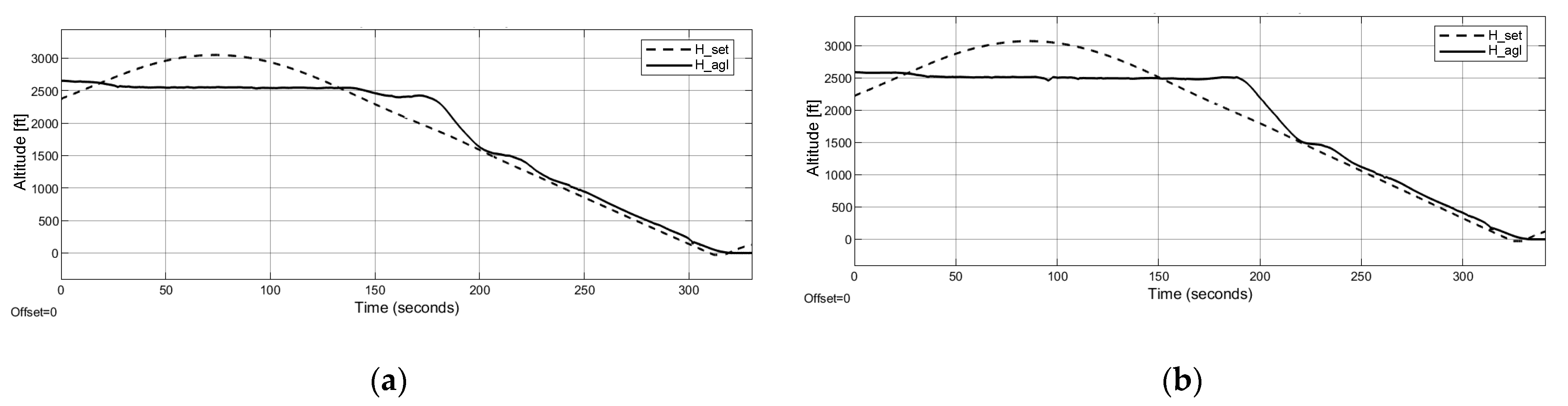
Figure 9a also shows the resulting tracking of a defined glide path.
In order to determine the overall control robustness to possible disturbances, the ability to safely perform the manoeuvre and the difficulties associated with its realisation, some of the landing attempts were carried out in windy conditions. The X-Plane simulator allows the scheduling of weather conditions with parameters such as general wind speed and direction, gust speed changes, and the presence of windshear. The recorded landing attempt was performed under conditions of 110° wind direction at a speed of 14 kts with gusts up to 17 kts and windshear in a range of 18°. For the aircraft landing on a 182° heading, this was effectively a wind blowing from the left (
Figure 7b).
Figure 8b shows the recorded control parameters.
Despite the disturbances, the designed control system assures tracking of the setpoints of flight path angle and heading by actively changing the thrust lever position ( and signals). However, the settling time taken to reach the glide path direction was extended in connection with roll angle fluctuations between the 180th and 270th second of the simulation. The short approach distance, combined with the lateral gusts, resulted in the landing aircraft being within the lateral boundaries of the runway just before touchdown. Nevertheless, the system enabled the machine to land safely with a final flight path angle close to the value obtained during the attempt made in windless conditions.
As shown in
Figure 9b, even in the presence of gusts, the control system maintained the set glide path. Landing the aircraft in such conditions, however, must be preceded by appropriate planning of the waypoints leading towards the airport. The aircraft’s drift due to lateral gusts results in the heading control system, which is tracking the approach direction, requiring more time to eliminate the occurring heading error, and therefore a greater initial distance from the runway threshold.
8. Research Summary
This article addresses the challenge of controlling an aircraft during complete control surface failure. In such scenarios, maintaining flight and executing an emergency landing are tasks that primarily rely on engine thrust modulation. Manual thrust lever control is particularly difficult due to human perceptual limitations, including long response delays that compromise control precision—an issue that often hinders safe landings. A review of the existing technical literature reveals a limited number of automated solutions for aircraft emergency thrust control. Over the past 30 years, developed systems have demonstrated good performance in both simulation studies and real flight trials. However, due to a lack of interest from the aviation industry, this subject remains underexplored.
Based on this background, the key challenges and constraints associated with designing an emergency thrust control system were identified. Consequently, the development of a control system based on linear-quadratic control with error integration (LQRI) was initiated. Utilising the MATLAB and Simulink environment and the X-Plane 11 flight simulator allowed for a faithful representation of flight dynamics. Through system configuration, aircraft model identification, control law design, and component integration, a functional thrust control system was realised.
In the conducted software-in-the-loop (SIL) simulations, the system demonstrated correct performance. Despite the limitations of the research platform and issues related to cross-coupling between control channels, satisfactory tracking of the flight path angle and heading was achieved. Final testing involved automatic landing attempts under windless conditions and moderate crosswinds of up to 17 knots (8.75 m/s). In both cases, smooth touchdowns near the runway threshold were performed with a flight path angle exceeding −0.5°. These results indicate that the developed system could facilitate successful landings at approach speeds significantly higher than the aircraft’s recommended approach speed. Additionally, crosswind landing tests provided insights into the system’s robustness against external disturbances, which was deemed acceptable under the tested wind conditions.
9. Conclusions
The impact of measurement noise filtering on the control system’s performance was beyond the scope of this study. Although the inherent signal transport delay associated with the research platform’s limitations may produce similar effects, further system development should include a more comprehensive analysis of system stability, particularly with respect to this issue.
The thrust control system concludes its operation by applying the brakes once the wheels contact the runway. The aircraft’s movement during the landing rollout—where it decelerates to a complete stop—is not addressed in this paper. Maintaining the aircraft within the runway centreline during braking is a separate control problem, which is particularly relevant under crosswind conditions.
Controlling the aircraft during the landing phase could be achieved with an additional module that manages engine thrust, including engagement of the thrust reversers. The goal of such a module would be to minimise lateral deviation from the centreline, based on measurements from the onboard inertial navigation system (INS) or the ILS localizer signal, as used in this work. Developing a control law for this purpose would require knowledge of the aircraft’s dynamics on the runway, which change as speed decreases. This would necessitate the use of gain scheduling in the control loop. An additional challenge lies in the non-linear relationship between the thrust lever position and the resulting reverse thrust. Establishing an accurate aircraft dynamic model based on simulator trials may be difficult; therefore, constructing such a model would require detailed knowledge of the aircraft’s structural parameters—such as moments of inertia for the airframe components—and an approximation of the reverse thrust corresponding to specific thrust lever positions.
The emergency thrust control system proposed in this paper was fine-tuned for two specific configurations of the studied aircraft. When discussing the potential generalisation of the developed control algorithm to other aircraft types and scenarios, several factors must be considered.
Firstly, the dynamic characteristics of a particular aircraft in a given configuration can vary significantly—not only between different aircraft types but also within the configurations of a single model due to changes in the flaps setting, landing gear extension, gross weight, or centre of gravity position. This aspect has been previously studied by NASA Dryden, who tested their PCA system on a variety of aircraft models (as mentioned in
Section 2). The use of linear-quadratic optimisation to compute LQRI controller settings can help normalise control dynamics across multiple configurations of a single aircraft, but not between different aircraft types. Ultimately, the values of
and
matrices are specific to a single aircraft configuration. It is the integral action that provides a degree of robustness to certain changes around the tuned configuration.
A key limitation when it comes to generalising the developed system is the need to subtract steady-state constants from the measured feedback signals of the flight path angle controller to obtain the increments of airspeed (
), angle of attack (α), and pitch angle (θ), as well as to compute the steady-state thrust lever positions (
). As discussed in
Section 5.3, the values of these constants are characteristic of a given configuration but can also change during flight—primarily due to factors such as fuel consumption. For the system to operate correctly across a broader, or even complete, range of aircraft configurations, these constants must be determined, preferably directly and without the need for additional flight trials, which would otherwise make system generalisation impractical.
Several approaches can be considered to address this issue. One possibility is developing a method for filtering out unknown, transient constant values from the feedback signals. Such a filter would need to operate continuously onboard throughout the flight. However, this approach does not resolve the problem of determining , which is essential for proper system operation and would likely require at least extensive knowledge of engine performance characteristics.
A second, more versatile solution is to define a detailed, parametrised six-degree-of-freedom non-linear model of aircraft dynamics, from which approximate constant values could be determined. An additional benefit of this approach would be the ability to linearise the model across a wide range of steady states, thereby enabling the generation of a look-up table containing linearised models and corresponding controller settings. However, modelling such a system introduces challenges related to accuracy requirement and possible distortions.
The third approach involves the use of Big Data; that is, utilising all flight data collected by airlines. Based on the recorded flights of a given aircraft unit, it is possible to determine a realistic multidimensional performance envelope covering airspeed, altitude, temperature, atmospheric pressure, thrust lever setting, elevator trim, and angle of attack under steady flight conditions. Thousands of such flights are conducted under diverse conditions for each aircraft model, which in theory ensures high accuracy for this approach.
The implementation of these concepts remains an open challenge in the field of adaptive control.