Analysis of Acoustic Emission Waveforms by Wavelet Packet Transform for the Detection of Crack Initiation Due to Fretting Fatigue in Solid Railway Axles




Abstract
1. Introduction
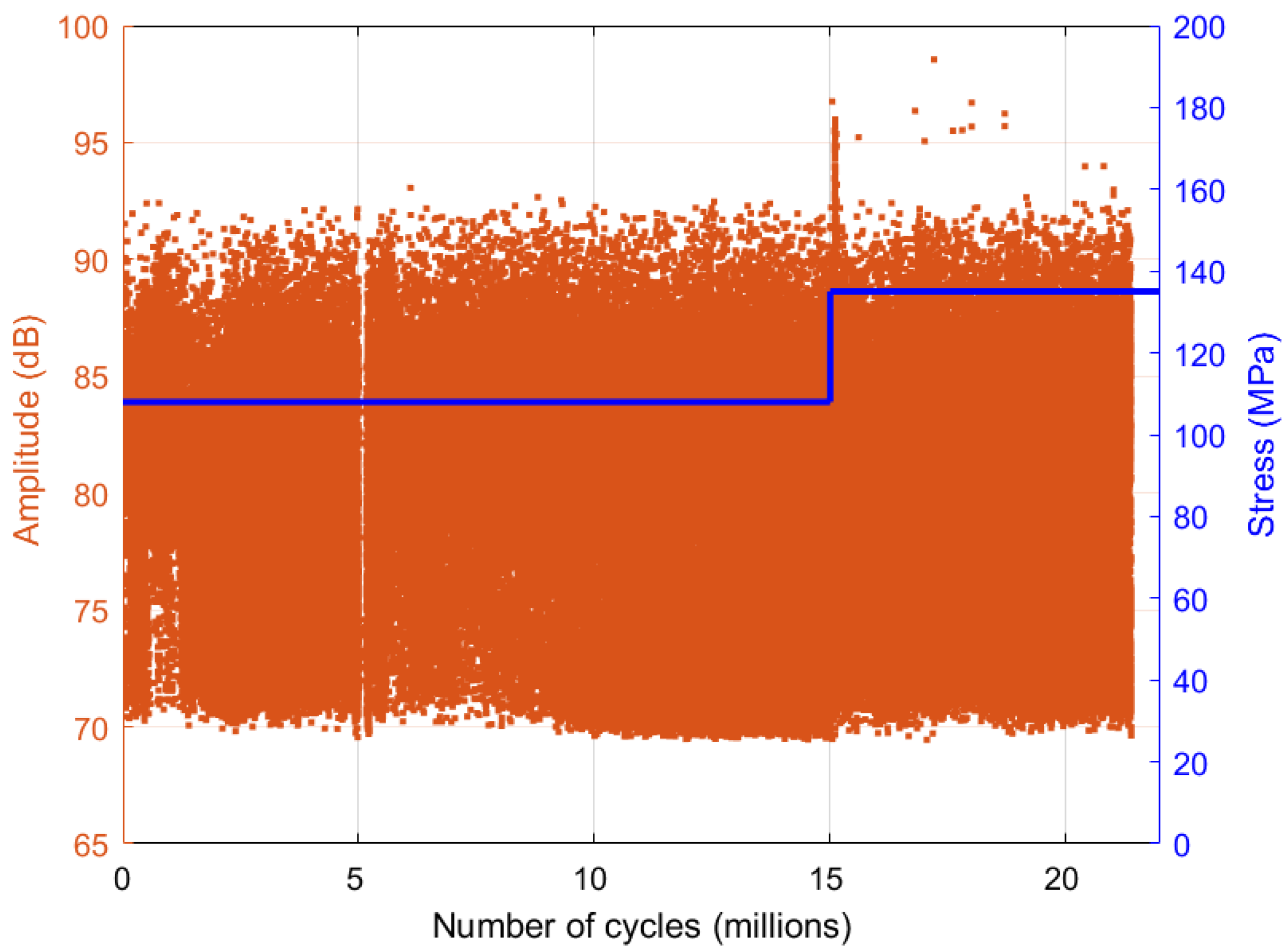
2. Description of the Experimental Full-Scale Test
3. Wavelet Packet Transform
4. Selection of the Mother Wavelet
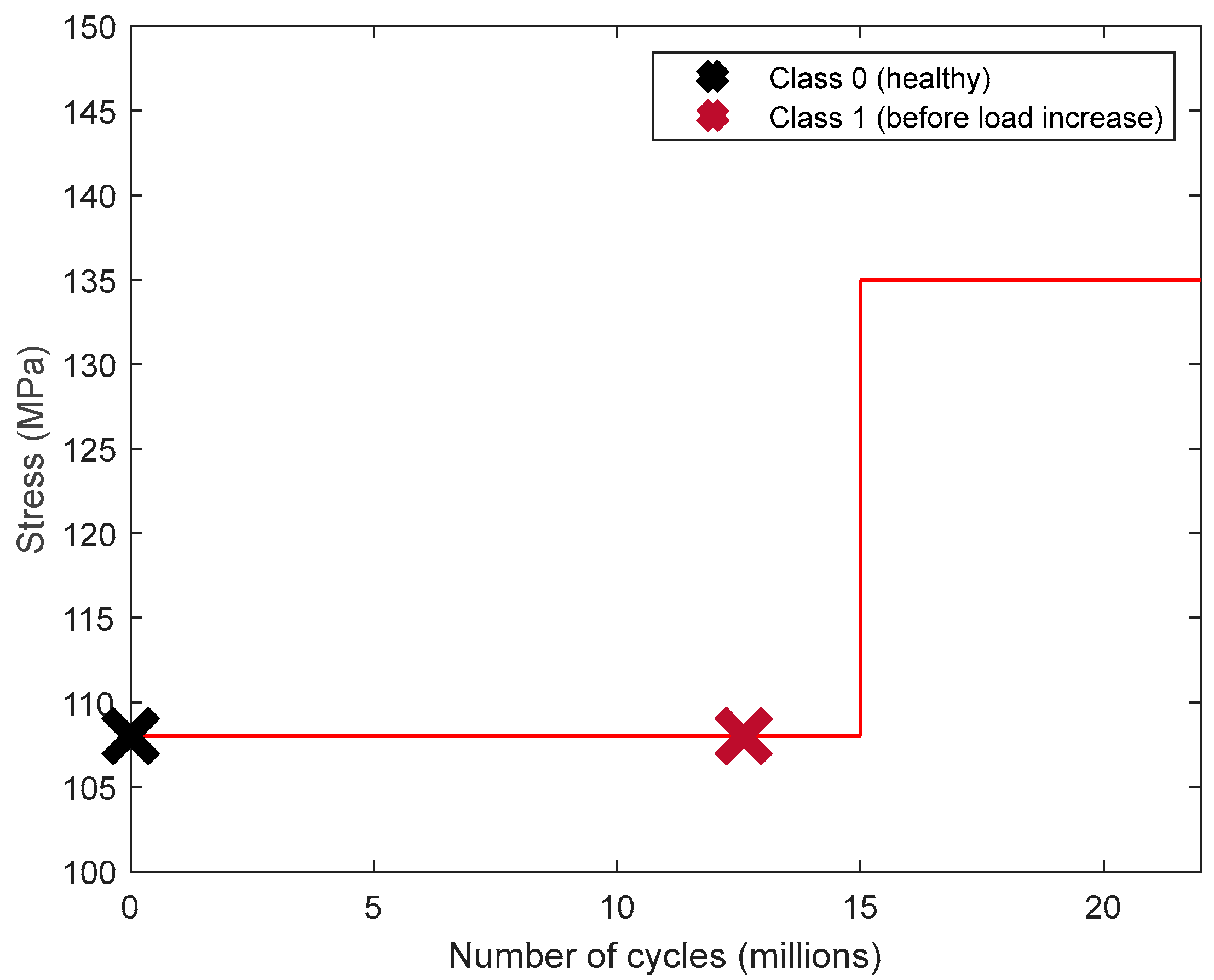
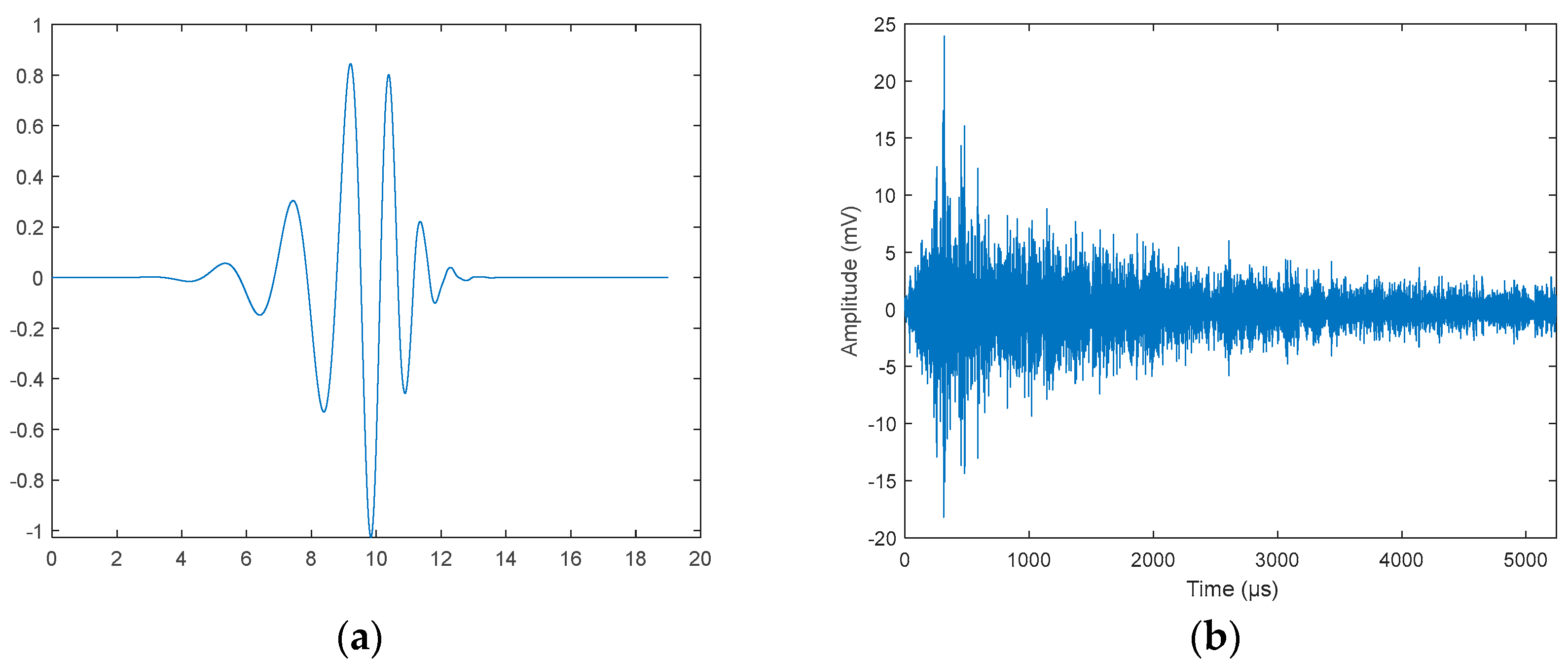
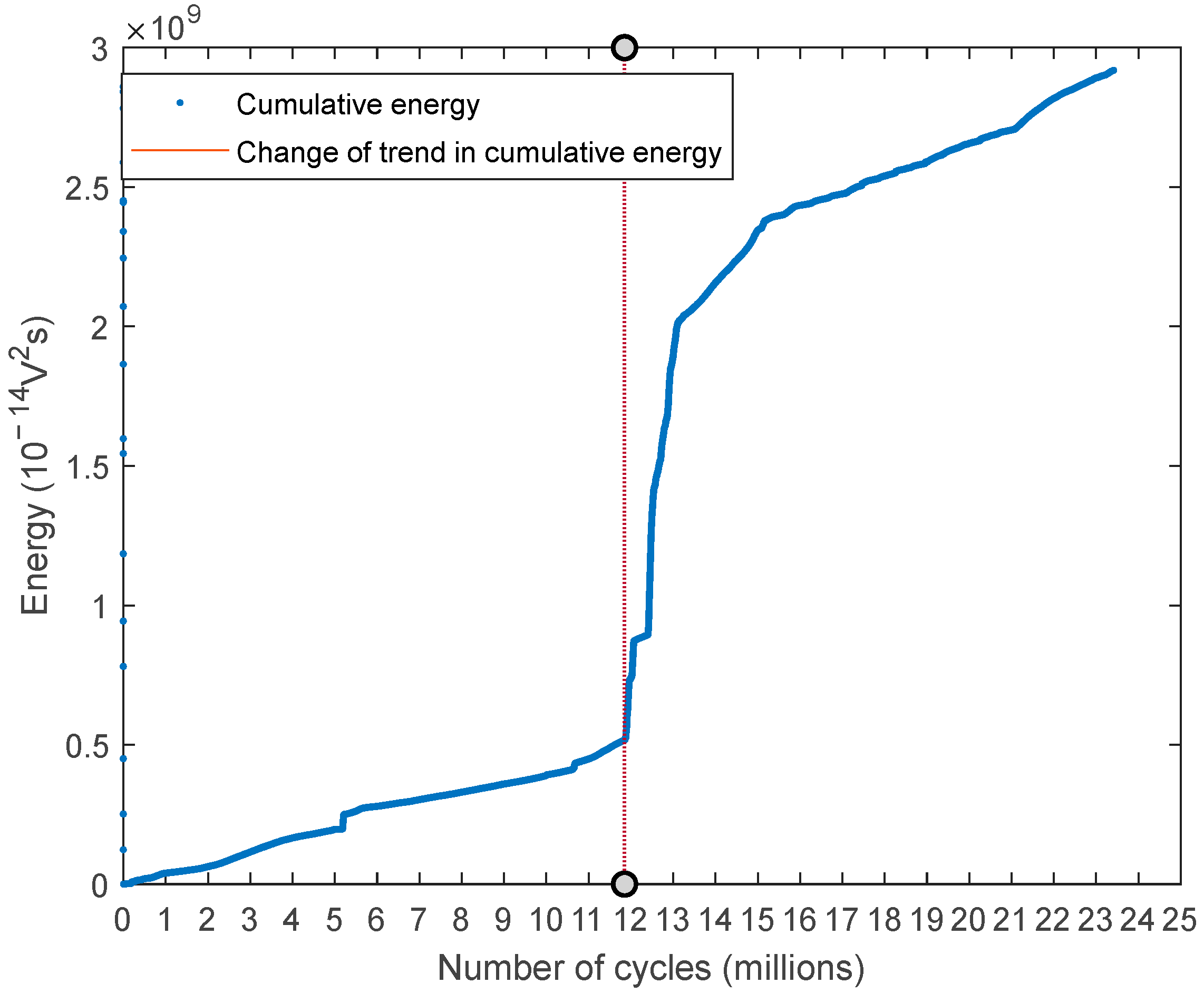
- First, two different conditions of the axle must be selected (Figure 4). The first class or condition, from now on called “class 0”, should be considered at the very beginning of the test, since it is known that the axle has the healthiest condition and there should be no crack initiation yet. The second one, from now on called “class 1”, can be considered before the load increase so that it can be analyzed under the same test conditions and that sufficient time has passed for susceptible changes to occur. This selection will be justified with a subsequent change point analysis (CPA) in point 3. During the fretting fatigue test, a continuous acoustic emission (AE) monitoring system recorded a large number of raw signals throughout the cycling process. However, many of these signals corresponded to background noise, frictional contact, or spurious sources unrelated to material degradation. To ensure the relevance and quality of the data analyzed, a manual preselection process was applied and only some of the signals displaying a clear burst-type waveform, characteristic of AE events linked to crack initiation or structural activity, were retained. As a result, a curated dataset of 822 waveforms was obtained: 528 from the healthy condition (class 0), collected during the first 100,000 cycles, and 294 from the early damage condition (class 1), acquired over the subsequent 10,000 cycles. The larger number of waveforms in the healthy class reflects the need for a more comprehensive baseline characterization of the undamaged system, which is essential for assessing deviations associated with incipient damage. Figure 4 shows both selected classes, the number of cycles of each class and the stress conditions applied during the test.
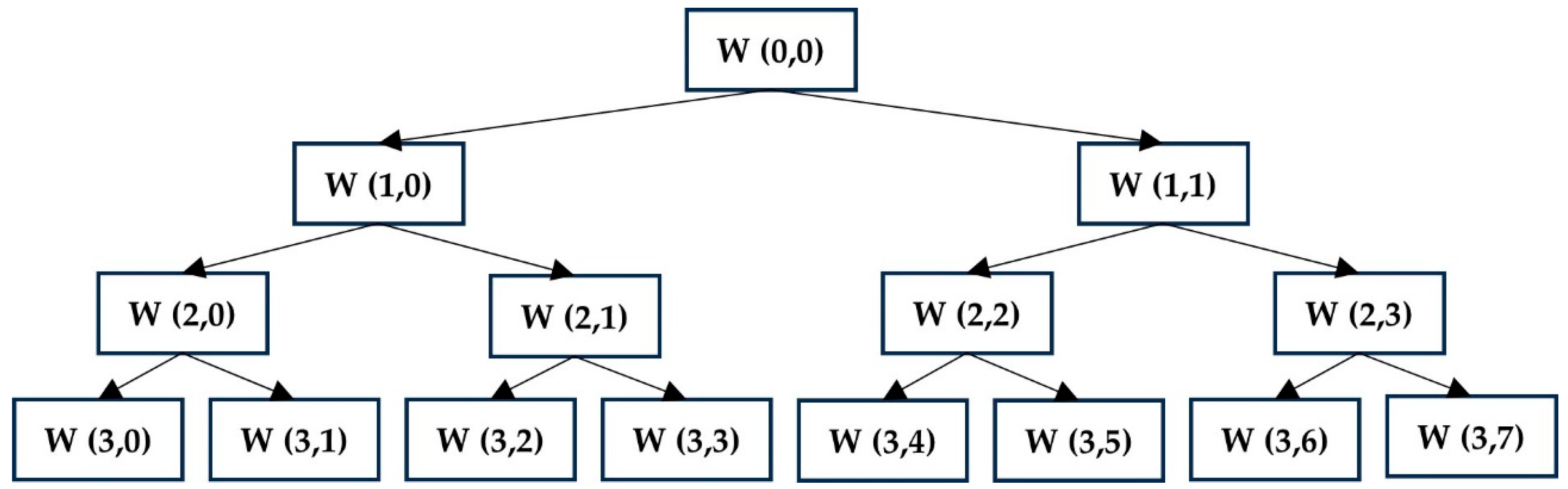
- WPT with a decomposition level of 3 is applied, with different mother wavelets and the mean energy of the eight obtained packets are calculated, which means that the frequency range is divided into eight equal parts. Considering the sampling frequency shown in Table 1, each packet has a resolution of 3.125 × 10⁵ Hz (2.5 × 10⁶ Hz/8).
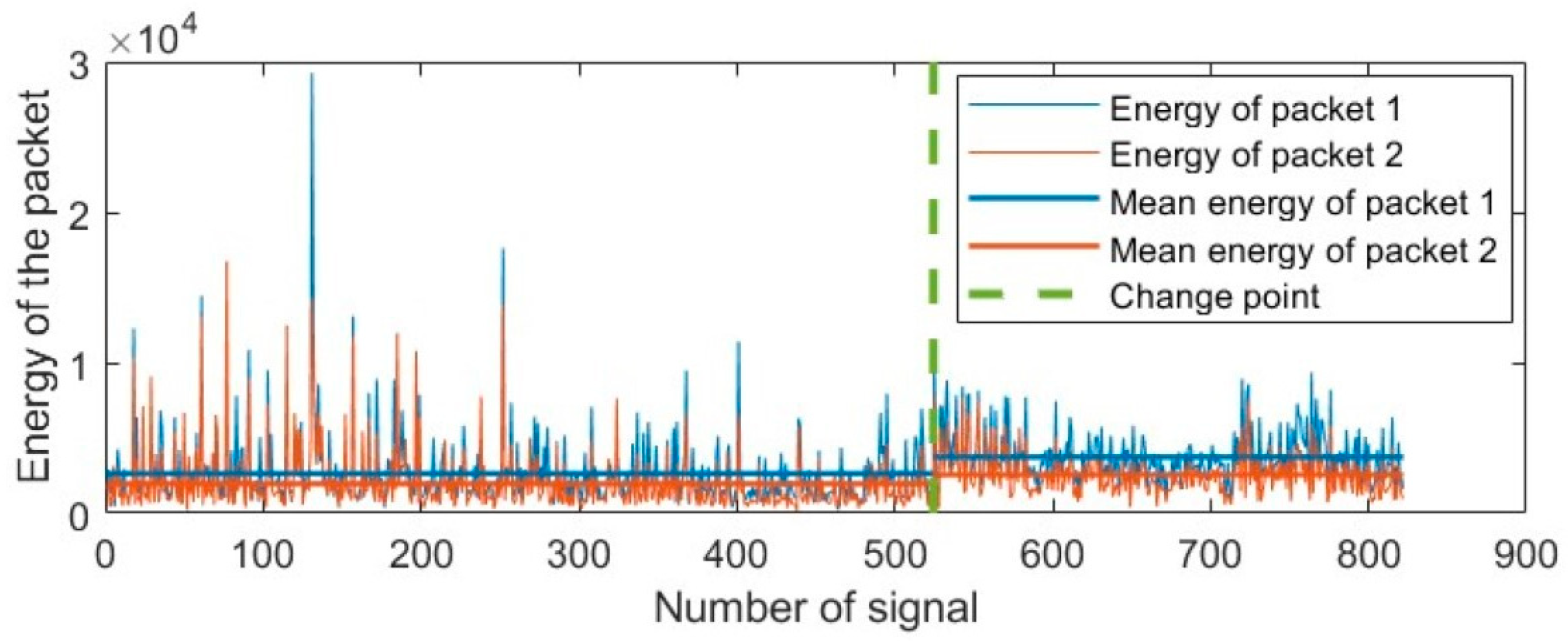
- A change point analysis (CPA) is performed [53] to check the previous selection of classes 0 and 1. This algorithm allows to find noticeable trend changes in the data, according to statistical parameters such as the mean, as in this case (packets energy). It also sets when that change happens. If the energy of all packets is represented for all the selected signals (Figure 5), where the energy of packet 1 (blue) and packet 2 (orange) stand out from the rest and, therefore, contain most of the energy, it can be seen that the selection of the data is well carried out, because there is an increase in the mean energy with class 1. In this way, it is proved that there is a considerable increase in the mean energy from measure 525, which almost corresponds with the beginning of class 1.
- The DEV value for each mother wavelet is calculated (this parameter was defined in previous work [25]). It measures the difference in energy between two signal conditions: in this case, the healthy condition (i.e., class 0) and another condition taken at a higher number of cycles (i.e., class 1). A higher DEV value indicates a greater energy contrast between both states, meaning the wavelet is more effective at highlighting differences associated with the progression of damage. This is particularly relevant in the context of crack detection, since the key to early and reliable identification of structural changes lies in the ability to discriminate subtle variations in signal features. A wavelet that maximizes the DEV value ensures greater sensitivity to damage, improving the model’s ability to differentiate between normal and anomalous conditions. Therefore, selecting the mother wavelet with the highest DEV is essential for optimizing the performance of the monitoring system (Equation (6)).where is the number of packets, is the packet number, is the mean energy of packet for the instantaneous condition (defective), and is the mean energy of packet for the reference condition (healthy).
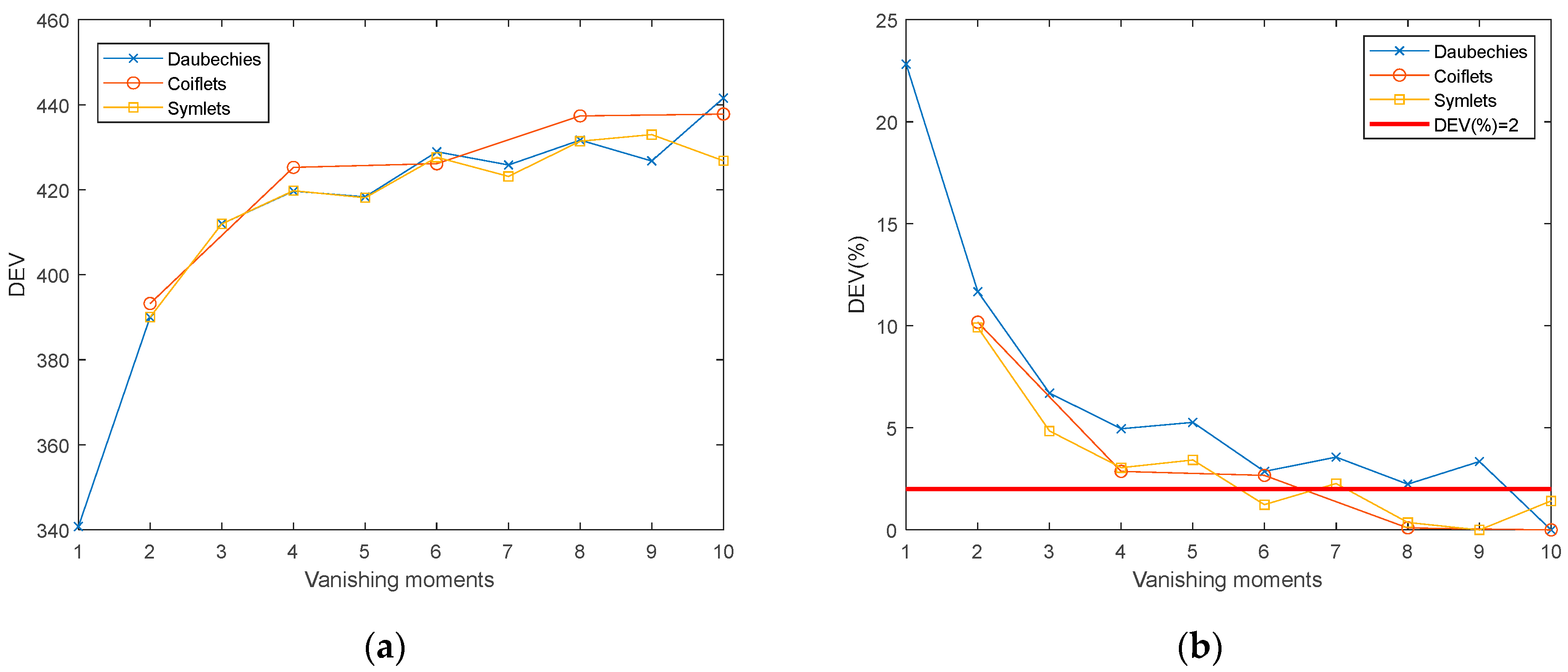
- According to point 4, the mother wavelets (MW) with the highest DEV values will be preselected ( . These values will be used for each MW to calculate the variation in the DEV ( with Equation (7). Those MW with less than 2% variation in the DEV value with respect to the one with the highest DEV value will also be preselected. The choice of the 2% threshold is based on its successful application in previous studies [25], where it provided an effective compromise between sensitivity and selectivity in the context of wavelet-based signal characterization. In this work, the same criterion was adopted to retain mother wavelets whose DEV values were within 2% of the maximum observed value. This threshold ensures that only wavelets with comparable discriminatory power are selected, while preventing the inclusion of marginally relevant ones. Although heuristic in nature, the 2% value was also verified in the present study through preliminary sensitivity analysis, showing that variations in the threshold (e.g., 1% or 5%) had negligible influence on the ranking of top-performing wavelets, but resulted either in unnecessary narrowing or broadening of the candidate set. Therefore, the use of the 2% threshold is not arbitrary but reflects a practical and validated trade-off suitable for the current application. The DEV evolution for all mother wavelets is shown in Figure 6a. In Figure 6b, the DEV variation (%) values are shown.
5. Post Processing of Acoustic Emission Raw Data
6. Conclusions
Author Contributions
Funding
Institutional Review Board Statement
Informed Consent Statement
Data Availability Statement
Acknowledgments
Conflicts of Interest
Abbreviations
| AE | Acoustic Emission |
| COIF | Coiflet mother wavelet |
| CPA | Change Point Analysis |
| DB | Daubechies mother wavelet |
| DEV | Degree of Energy Variation |
| DWT | Discrete Wavelet Transform |
| EDM | Electrical Discharge Machining |
| FNR | False Negative Rate |
| NDT | non-destructive testing |
| PLB | Pencil Lead Break |
| SHM | Structural Health Monitoring |
| SYM | Symlet mother wavelet |
| TPR | True Positive Rate |
| UT | Ultrasonic Testing |
| WPT | Wavelet Packet Transform |
| WT | Wavelet Transform |
References
- EN 13260:2020; Railway Applications—Wheelsets and Bogies—Wheelsets—Product Requirements. European Committee for Standardization: Belgium, Brussels, 2020. Available online: https://standards.iteh.ai/catalog/standards/cen/2918a430-161a-4376-8927-f4df6fa45507/en-13260-2020 (accessed on 14 March 2023).
- Section G—Wheels and Axle Manual (2020). Available online: https://aarpublications.com/section-g-wheels-and-axle-manual-2016g.html (accessed on 14 March 2023).
- Waterhouse, R.B. Fretting Corrosion. In Proceedings of the Institution of Mechanical Engineers, London, UK, 14 January 1955. [Google Scholar]
- Waterhouse, R.B. Fretting Fatigue. Int. Mater. Rev. 1992, 37, 77–98. [Google Scholar] [CrossRef]
- Szolwinski, M.P.; Farris, T.N. Mechanics of Fretting Fatigue Crack Formation. Wear 1996, 198, 93–107. [Google Scholar] [CrossRef]
- Zou, L.; Zeng, D.; Tian, X.; Jiang, G.; Dong, Y.; Zhao, H.; Lu, L. Experimental and Numerical Study on the Multi-Site Fretting Fatigue Crack Initiation of Press-Fitted Axles. Fatigue Fract. Eng. Mater. Struct. 2024, 47, 473–490. [Google Scholar] [CrossRef]
- Nesládek, M.; Španiel, M.; Jurenka, J.; Růžička, J.; Kuželka, J. Fretting Fatigue—Experimental and Numerical Approaches. Int. J. Fatigue 2012, 44, 61–73. [Google Scholar] [CrossRef]
- Dong, Y.; Zeng, D.; Zhao, H.; Wu, P.; Song, Y.; Li, X.; Lu, L. Fretting Fatigue Strength Evaluation of Scaled Press-Fitted Railway Axle Containing a Circumferential Groove Defect. Int. J. Fatigue 2025, 194, 108824. [Google Scholar] [CrossRef]
- Gao, J.-W.; Dai, X.; Zhu, S.-P.; Zhao, J.-W.; Correia, J.A.F.O.; Wang, Q. Failure Causes and Hardening Techniques of Railway Axles—A Review from the Perspective of Structural Integrity. Eng. Fail. Anal. 2022, 141, 106656. [Google Scholar] [CrossRef]
- Kwon, S.-J.; Seo, J.-W.; Choe, J.; Hong, S.-K. Fretting Crack Detection of a Railway Axle with a Mounted Wheel Using an Induced Current Potential Drop and Electromagnetic-Field Distribution. J. Mech. Sci. Technol. 2023, 37, 6453–6460. [Google Scholar] [CrossRef]
- Xu, T.; Lu, L.; Zeng, D.; Zou, L. Fretting Fatigue Crack Growth Simulation and Residual Life Assessment of Railway Press-Fitted Axle. Eng. Fract. Mech. 2023, 286, 109290. [Google Scholar] [CrossRef]
- García-Prada, J.C.; Castejon, C.; Gómez, M.J.; Alvarez, J.; Moreno, A.; Kappes, W. Euraxles-WP5: Non Destructive Testing (NDT) and Verification on the Reliability of Axles in Service. In Proceedings of the 17th International Wheelset Congress, Kiev, Ukraine, 22–27 September 2013. [Google Scholar]
- Carboni, M.; Crivelli, D. An Acoustic Emission Based Structural Health Monitoring Approach to Damage Development in Solid Railway Axles. Int. J. Fatigue 2020, 139, 105753. [Google Scholar] [CrossRef]
- Deng, X.-J.; Xui, G.-J.; Liu, S.-Q. Research on Fatigue Crack Detection of Rail Vehicle Axle Based on Acoustic Emission. Struct. Health Monit. 2015, 2015. [Google Scholar] [CrossRef]
- Jiang, C.; Pan, S.; Zhang, C.; Li, F. Experimental Research on Fault Location for the Axle of Railway Vehicles Based on Acoustic Emission Technique. Int. J. Control Autom. 2016, 9, 91–98. [Google Scholar] [CrossRef]
- Zhou, Y.; Lin, L.; Wang, D.; He, M.; He, D. A New Method to Classify Railway Vehicle Axle Fatigue Crack AE Signal. Appl. Acoust. 2018, 131, 174–185. [Google Scholar] [CrossRef]
- Marks, R.; Stancu, A.; Soua, S. Fatigue Crack Growth Monitoring Using Acoustic Emission: A Case Study on Railway Axles. In Proceedings of the Advances in Condition Monitoring and Structural Health Monitoring, Singapore, 2–5 December 2019; Gelman, L., Martin, N., Malcolm, A.A., Liew, C.K., Eds.; Springer: Singapore, 2021; pp. 551–560. [Google Scholar]
- Rolek, P.; Bruni, S.; Carboni, M. Condition Monitoring of Railway Axles Based on Low Frequency Vibrations. Int. J. Fatigue 2016, 86, 88–97. [Google Scholar] [CrossRef]
- Gómez, M.J.; Castejón, C.; Corral, E.; García-Prada, J.C. Railway Axle Condition Monitoring Technique Based on Wavelet Packet Transform Features and Support Vector Machines. Sensors 2020, 20, 3575. [Google Scholar] [CrossRef]
- Chong, S.Y.; Shin, H. A Review of Health and Operation Monitoring Technologies for Trains. SMART Struct. Syst. 2010, 6, 1079–1105. [Google Scholar] [CrossRef]
- Lanzagorta, J.L.; Aizpurua, I.; Vázquez, P.R.; Castro, I. New Ways to Inspect Railway Axles: From Simulation to Experimental Validation. NDT E Int. 2021, 121, 102439. [Google Scholar] [CrossRef]
- Carboni, M.; Zamorano, M. On MONITORING fretting Fatigue Damage in Solid Railway Axles by Acoustic Emission with Unsupervised Machine Learning and Comparison to Non-Destructive Testing Techniques. Proc. Inst. Mech. Eng. Part F J. Rail Rapid Transit. 2024, 238, 256–267. [Google Scholar] [CrossRef]
- Grosse, C.U.; Ohtsu, M.; Aggelis, D.G.; Shiotani, T. (Eds.) Acoustic Emission Testing; Springer: Berlin/Heidelberg, Germany, 2008; ISBN 978-3-540-69895-1. [Google Scholar]
- Deshpande, A.; Kumar, M. Artificial Intelligence for Big Data: Complete Guide to Automating Big Data Solutions Using Artificial Intelligence Techniques; Packt Publishing Ltd.: Birmingham, UK, 2018; ISBN 978-1-78847-601-0. [Google Scholar]
- Zamorano, M.; Gómez Garcia, M.J.; Castejón, C. Selection of a Mother Wavelet as Identification Pattern for the Detection of Cracks in Shafts. J. Vib. Control 2022, 28, 3152–3161. [Google Scholar] [CrossRef]
- Wai Keng, N.; Leong, M.; Hee, L.; Abdelrhman, A. Wavelet Analysis: Mother Wavelet Selection Methods. Appl. Mech. Mater. 2013, 393, 953–958. [Google Scholar] [CrossRef]
- Zamorano, M.; Avila, D.; Marichal, G.N.; Castejon, C. Data Preprocessing for Vibration Analysis: Application in Indirect Monitoring of ‘Ship Centrifuge Lube Oil Separation Systems’. J. Mar. Sci. Eng. 2022, 10, 1199. [Google Scholar] [CrossRef]
- Grosse, C.U.; Reinhardt, H.W.; Motz, M.; Kroplin, B. Signal Conditioning in Acoustic Emission Analysis Using Wavelets. NDT. Net. 2002, 7, 1–9. Available online: https://www.ndt.net/article/v07n09/08/08.htm (accessed on 14 March 2023).
- Ebrahimian, Z.; Ahmadi, M.; Sadri, S.; Li, B.Q.; Moradian, O. Wavelet Analysis of Acoustic Emissions Associated with Cracking in Rocks. Eng. Fract. Mech. 2019, 217, 106516. [Google Scholar] [CrossRef]
- Barbosh, M.; Dunphy, K.; Sadhu, A. Acoustic Emission-Based Damage Localization Using Wavelet-Assisted Deep Learning. J. Infrastruct. Preserv. Resil. 2022, 3, 6. [Google Scholar] [CrossRef]
- Kek, T.; Kusić, D.; Grum, J. Wavelet Packet Decomposition to Characterize Injection Molding Tool Damage. Appl. Sci. 2016, 6, 45. [Google Scholar] [CrossRef]
- Wang, C.H. Introduction to Fracture Mechanics; DSTO Aeronautical and Maritime Research Laboratory: Victoria, Australia, 1996. [Google Scholar]
- Chai, M.; Hou, X.; Zhang, Z.; Duan, Q. Identification and Prediction of Fatigue Crack Growth under Different Stress Ratios Using Acoustic Emission Data. Int. J. Fatigue 2022, 160, 106860. [Google Scholar] [CrossRef]
- Beale, C.; Niezrecki, C.; Inalpolat, M. An Adaptive Wavelet Packet Denoising Algorithm for Enhanced Active Acoustic Damage Detection from Wind Turbine Blades. Mech. Syst. Signal Process. 2020, 142, 106754. [Google Scholar] [CrossRef]
- Liu, T.; Jin, Y.; Wang, S.; Zheng, Q.; Yang, G. Denoising Method of Weak Fault Acoustic Emission Signal under Strong Background Noise of Engine Based on Autoencoder and Wavelet Packet Decomposition. Struct. Health Monit. 2023, 22, 3206–3224. [Google Scholar] [CrossRef]
- Zhao, Y.; Ma, Y.; Du, J.; Wang, C.; Xia, D.; Xin, W.; Zhan, Z.; Zhang, R.; Chen, J. Noise Reduction Based on a CEEMD-WPT Crack Acoustic Emission Dataset. Appl. Sci. 2023, 13, 10274. [Google Scholar] [CrossRef]
- Wang, Z.; Ding, K.; Ren, H.; Ning, J. Quantitative Acoustic Emission Investigation on the Crack Evolution in Concrete Prisms by Frequency Analysis Based on Wavelet Packet Transform. Struct. Health Monit. 2022, 21, 1046–1060. [Google Scholar] [CrossRef]
- Workman, G.L.; Kishoni, D.; Moore, P.O. (Eds.) Ultrasonic Testing; American Society for Nondestructive Testing: Columbus, OH, USA, 2007; ISBN 978-1-57117-163-4. [Google Scholar]
- Gao, L.; Wang, H.; Zhou, J.; Zhou, X. Selection of Optimal Mother Wavelet for Acoustic Emission Signal Processing of Gas Pipeline Leakage. In Proceedings of the TEPEN 2022, Baotou, China, 18–21 August 2022; Zhang, H., Ji, Y., Liu, T., Sun, X., Ball, A.D., Eds.; Springer Nature: Cham, Switzerland, 2023; pp. 294–305. [Google Scholar]
- Foletti, S.; Beretta, S.; Gurer, G. Defect Acceptability under Full-Scale Fretting Fatigue Tests for Railway Axles. Int. J. Fatigue 2016, 86, 34–43. [Google Scholar] [CrossRef]
- Foletti, S.; Beretta, S.; Bertozzi, F.; Carboni, M.; Cervello, S.; Regazzi, D. Experiments on Crack Propagation and Threshold at Defects in Press-Fits of Railway Axles. Procedia Struct. Integr. 2017, 7, 484–491. [Google Scholar] [CrossRef]
- Pourheidar, A.; Regazzi, D.; Cervello, S.; Foletti, S.; Beretta, S. Fretting Fatigue Analysis of Full-Scale Railway Axles in Presence of Artificial Micro-Notches. Tribol. Int. 2020, 150, 106383. [Google Scholar] [CrossRef]
- EN 13261:2020; Railway Applications—Wheelsets and Bogies—Axles—Product Requirements. British Standards Institution: London, UK, 2020. Available online: https://standards.iteh.ai/catalog/standards/cen/30ad3acd-39c1-4372-a5a4-69892c4d555d/en-13261-2020 (accessed on 14 March 2023).
- Hirakawa, K.; Toyama, K.; Kubota, M. The Analysis and Prevention of Failure in Railway Axles. Int. J. Fatigue 1998, 20, 135–144. [Google Scholar] [CrossRef]
- Cervello, S. Fatigue Properties of Railway Axles: New Results of Full-Scale Specimens from Euraxles Project. Int. J. Fatigue 2016, 86, 2–12. [Google Scholar] [CrossRef]
- E976-15(2021); Committee Guide for Determining the Reproducibility of Acoustic Emission Sensor Response. ASTM International: West Conshohocken, PA, USA, 2021.
- Mallat, S. A Wavelet Tour of Signal Processing; Academic Press: Cambridge, MA, USA, 1999; ISBN 978-0-12-466606-1. [Google Scholar]
- Riabova, S. Application of Wavelet Analysis to the Analysis of Geomagnetic Field Variations. J. Phys. Conf. Ser. 2018, 1141, 012146. [Google Scholar] [CrossRef]
- Jensen, A.; la Cour-Harbo, A. Ripples in Mathematics; Springer: Berlin/Heidelberg, Germany, 2001; ISBN 978-3-540-41662-3. [Google Scholar]
- Zamorano, M.; Gómez, M.J.; Castejón, C. Optimal Selection of the Mother Wavelet in WPT Analysis and Its Influence in Cracked Railway Axles Detection. Machines 2023, 11, 493. [Google Scholar] [CrossRef]
- Castejón, C.; Lara, O.; GARCIA-PRADA, J.C. Automated Diagnosis of Rolling Bearings Using MRA and Neural Networks. Mech. Syst. Signal Process. 2010, 24, 289–299. [Google Scholar] [CrossRef]
- Hernández, A.; Castejón, C.; García-Prada, J.C.; Padrón, I.; Marichal, G.N. Wavelet Packets Transform Processing and Genetic Neuro-Fuzzy Classification to Detect Faulty Bearings. Adv. Mech. Eng. 2019, 11, 1687814019831185. [Google Scholar] [CrossRef]
- Taylor, W. Change-Point Analysis: A Powerful New Tool For Detecting Changes; Report No. M38.1; Baxter Healthcare Corporation: Deerfield, IL, USA, 2000; Available online: https://variation.com/wp-content/uploads/change-point-analyzer/change-point-analysis-a-powerful-new-tool-for-detecting-changes.pdf (accessed on 28 July 2025).
- MathWorks. Machine Learning Toolbox, Version 12.4; MathWorks: Natick, MA, USA, 2024. Available online: https://www.mathworks.com/products/statistics.html (accessed on 28 July 2025).
- Ullah, Z.; Saleem, F.; Jamjoom, M.; Fakieh, B. Reliable Prediction Models Based on Enriched Data for Identifying the Mode of Childbirth by Using Machine Learning Methods: Development Study. J. Med. Internet Res. 2021, 23, e28856. [Google Scholar] [CrossRef]
- Smith, T.C.; Frank, E. Introducing Machine Learning Concepts with WEKA. Methods Mol. Biol. Clifton. 2016, 1418, 353–378. [Google Scholar] [CrossRef]
- Marfo, A.; Chen, Z.; Li, J. Acoustic Emission Analysis of Fatigue Crack Growth in Steel Structures. J. Civ. Eng. Constr. Technol. 2013, 4, 239–249. [Google Scholar] [CrossRef]




| Parameter | Value |
|---|---|
| Channel | 1 |
| Sampling rate for the acquisition of AE features | 10 MHz |
| Sampling rate for the acquisition of AE transient waveforms | 5 MHz |
| Max samples per set | 524,288 |
| Pre-Trigger | 200 μs |
| Acquisition threshold (with respect to a reference voltage amplitude of 1 μV) | 69 dB |
| Frequency filter | 230–850 kHz |
| Pre-Amp gain | 34 dB |
| Rearm Time | 3.2 μs |
| Mother Wavelet | Success Rate (%) |
|---|---|
| Db10 | 96.8 |
| Coif4 | 95.6 |
| Coif5 | 96.4 |
| Sym6 | 95.6 |
| Sym8 | 95.7 |
| Sym9 | 96.0 |
| Sym10 | 95.7 |
Disclaimer/Publisher’s Note: The statements, opinions and data contained in all publications are solely those of the individual author(s) and contributor(s) and not of MDPI and/or the editor(s). MDPI and/or the editor(s) disclaim responsibility for any injury to people or property resulting from any ideas, methods, instructions or products referred to in the content. |
© 2025 by the authors. Licensee MDPI, Basel, Switzerland. This article is an open access article distributed under the terms and conditions of the Creative Commons Attribution (CC BY) license (https://creativecommons.org/licenses/by/4.0/).
Share and Cite
Zamorano, M.; Gómez, M.J.; Castejon, C.; Carboni, M. Analysis of Acoustic Emission Waveforms by Wavelet Packet Transform for the Detection of Crack Initiation Due to Fretting Fatigue in Solid Railway Axles. Appl. Sci. 2025, 15, 8435. https://doi.org/10.3390/app15158435
Zamorano M, Gómez MJ, Castejon C, Carboni M. Analysis of Acoustic Emission Waveforms by Wavelet Packet Transform for the Detection of Crack Initiation Due to Fretting Fatigue in Solid Railway Axles. Applied Sciences. 2025; 15(15):8435. https://doi.org/10.3390/app15158435
Chicago/Turabian StyleZamorano, Marta, María Jesús Gómez, Cristina Castejon, and Michele Carboni. 2025. "Analysis of Acoustic Emission Waveforms by Wavelet Packet Transform for the Detection of Crack Initiation Due to Fretting Fatigue in Solid Railway Axles" Applied Sciences 15, no. 15: 8435. https://doi.org/10.3390/app15158435
APA StyleZamorano, M., Gómez, M. J., Castejon, C., & Carboni, M. (2025). Analysis of Acoustic Emission Waveforms by Wavelet Packet Transform for the Detection of Crack Initiation Due to Fretting Fatigue in Solid Railway Axles. Applied Sciences, 15(15), 8435. https://doi.org/10.3390/app15158435