Article

Influence of Playing Position on the Match Running Performance of Elite U19 Soccer Players in a 1-4-3-3 System


Laboratory of Evaluation of Human Biological Performance, Department of Physical Education and Sports Sciences, Aristotle University of Thessaloniki, University Campus of Thermi, 57001 Thessaloniki, Greece
*
Author to whom correspondence should be addressed.
Appl. Sci. 2025, 15(15), 8430; https://doi.org/10.3390/app15158430
Submission received: 4 April 2025 / Revised: 8 July 2025 / Accepted: 29 July 2025 / Published: 29 July 2025
(This article belongs to the Section Applied Biosciences and Bioengineering)

Abstract

The development of Global Positioning System (GPS) technology has contributed in various ways to improving the physical condition of modern football players by enabling the quantification of physical load. Previous studies have reported that the running demands of matches vary depending on playing position and formation. Over the past decade, despite the widespread use of GPS technology, studies that have investigated the running performance of young football players within the 1-4-3-3 formation are particularly limited. Therefore, the aim of the present study was to create the match running profile of playing positions in the 1-4-3-3 formation among high-level youth football players. An additional objective of the study was to compare the running performance of players between the two halves of a match. This study involved 25 football players (Under-19, U19) from the academy of a professional football club. Data were collected from 18 league matches in which the team used the 1-4-3-3 formation. Positions were categorized as Central Defenders (CDs), Side Defenders (SDs), Central Midfielders (CMs), Side Midfielders (SMs), and Forwards (Fs). The players’ movement patterns were monitored using GPS devices and categorized into six speed zones: Zone 1 (0.1–6 km/h), Zone 2 (6.1–12 km/h), Zone 3 (12.1–18 km/h), Zone 4 (18.1–21 km/h), Zone 5 (21.1–24 km/h), and Zone 6 (above 24.1 km/h). The results showed that midfielders covered the greatest total distance (p = 0.001), while SDs covered the most meters at high and maximal speeds (Zones 5 and 6) (p = 0.001). In contrast, CDs covered the least distance at high speeds (p = 0.001), which is attributed to the specific tactical role of their position. A comparison of the two halves revealed a progressive decrease in the distance covered by the players at high speed: distance in Zone 3 decreased from 1139 m to 944 m (p = 0.001), Zone 4 from 251 m to 193 m (p = 0.001), Zone 5 from 144 m to 110 m (p = 0.001), and maximal sprinting (Zone 6) dropped from 104 m to 78 m (p = 0.01). Despite this reduction, the total distance remained relatively stable (first half: 5237 m; second half: 5046 m, p = 0.16), indicating a consistent overall workload but a reduced number of high-speed efforts in the latter stages. The results clearly show that the tactical role of each playing position in the 1-4-3-3 formation, as well as the area of the pitch in which each position operates, significantly affects the running performance profile. This information should be utilized by fitness coaches to tailor physical loads based on playing position. More specifically, players who cover greater distances at high speeds during matches should be prepared for this scenario within the microcycle by performing similar distances during training. It can also be used for better preparing younger players (U17) before transitioning to the U19 level. Knowing the running profile of the next age category, the fitness coach can prepare the players so that by the end of the season, they are approaching the running performance levels of the next group, with the goal of ensuring a smoother transition. Finally, regarding the two halves of the game, it is evident that fitness coaches should train players during the microcycle to maintain high movement intensities even under fatigue.

1. Introduction

Football is one of the most popular sports in the world [1,2], continuously evolving. Performance in football depends on factors such as technique, tactics, physical condition, and the mental and psychological abilities of the players [3,4,5,6,7]. Previous studies have observed significant changes in game load [8], such as an increase in the distance covered at high speed (~30%), sprinting distance (~35%), and the number of sprints (~80%). These changes were observed over a period of 6 years in the English Premier League, illustrating the increased intensity of the sport. Furthermore, recent studies suggest that intensity will continue to rise in the coming decades [9,10].
The development of technology has helped coaching staff perform their duties more effectively. Regarding physical condition, the development of Global Positioning Systems (GPSs) has aided in monitoring match and training loads, contributing to better player training and injury prevention [11]. This technology has enabled the tracking of load during matches, allowing for a better understanding of the running demands on players. Additionally, the use of this equipment allows for performance evaluation between halves [12,13], with the goal of improving performance.
Existing literature shows that load varies depending on the formation the team plays in [14], as well as the player’s position [15,16]. In the Chinese football league, it has been observed that Side Defenders in the 1-3-5-2 formation cover greater distances at high intensity compared to the 1-4-4-2 formation [17]. It has also been reported that Central Defenders in formations with three defenders cover more distance than those in formations with two Central Defenders [17,18,19]. Furthermore, Central Midfielders cover less sprinting distance in the 1-4-4-2 formation compared to the 1-4-2-3-1 formation [17]. High-intensity actions also appear to be more frequent in the 1-4-3-3 formation compared to the 1-4-4-2 formation [20,21]. As for Forwards, it has been reported that in formations with a single central Forward (1-4-3-3), less distance is covered at high speeds compared to formations with two central Forwards (1-3-5-2) [22,23], although some studies do not support this finding [24]. Regarding positions, Central Midfielders cover greater distances compared to all other positions [16,20,25,26]. Side positions in the 1-4-3-3 formation are observed to perform more intense actions [12].
Concerning halftime changes, a previous study on the 1-4-3-3 formation in professional football players found a decrease in the distance covered by all playing positions in the second half. Monitoring speed zones, a reduction in distance in the first two zones (0 to ~14 km/h) was also reported by other researchers [13,27]. In the high-speed running zone (>~19 km/h), the findings are unclear, as a decline in performance has been reported [12], but some studies indicate the maintenance of performance [27,28]. Similar (unclear) observations have been made for sprints, regardless of formation [12,29,30].
The existing literature clearly shows that the overwhelming majority of research on the effect of formations on the running profile of players focuses on professional players, not amateurs or younger players [31,32]. A previous study involving younger players observed the effect of age on the running profile [32]. In one of the first studies [33] that investigated the load during matches of youth football players (U12–U16), differences were observed between age groups, and it is advisable to use both relative and absolute measurement values. However, it should be noted that this study did not distinguish between playing positions nor did it reference the tactical formation. As previously mentioned, these two factors have been shown to influence running performance. In another study conducted on U17 players [34], significant variations in running performance were observed depending on position, with Side Midfielders covering the greatest distance at high intensity, performing the most sprints and accelerations, while Central Defenders displayed the lowest values. A decline in running performance towards the end of the match was also noted. In a recent study [35], which compared running load among young footballers in two different formations, differences were observed between playing positions in both formations (1-4-4-2 vs. 1-3-6-1), with midfielders covering greater distances and Central Defenders covering less distance and at lower speeds. Finally, in a study involving U19 footballers [36] in the 1-4-2-3-1 formation, Central Midfielders were found to cover the greatest distance at higher speed, while Central Defenders covered the least sprint distance. Moreover, Central Midfielders performed the highest number of accelerations and decelerations among all positions.
Despite the growing interest in performance analysis in soccer, there remains a significant gap in the literature concerning the influence of playing position on the match running performance of youth soccer players. While several studies have explored positional differences in professional or elite adult players [12,18], there is a notable lack of research focusing on younger age groups. Most existing studies have emphasized top-level competition, leaving youth and amateur categories underrepresented in the data [31,32]. This limitation hinders the development of age-appropriate training protocols, as the physical and tactical demands placed on youth players may differ substantially from those experienced at the professional level. Moreover, the few studies that do focus on youth athletes often generalize findings across positions without accounting for formation-specific roles or the physiological development stage of the players. Addressing this gap is essential for creating evidence-based training strategies that facilitate both athletic development and a smoother transition between age categories in competitive football.
The creation of a running profile helps coaches understand the actual loads players experience depending on the formation and position they play in. This way, coaches can quantify training based on the real demands of the position, using training time more effectively (e.g., more high-intensity running for Side Midfielders than Central Defenders) [37]. Additionally, youth fitness coaches can use these running profiles in specific formations to better prepare players for the next step in their careers (e.g., preparing an Under-17 player for a smoother transition to Under-19 in terms of physical conditioning). As mentioned earlier, the formation a team uses affects the running performance of the players. There is a wide variety of formations; however, the 1-4-3-3 formation is used particularly frequently by both professional teams and teams with young players. Nevertheless, the literature concerning the running profile of playing positions within the 1-4-3-3 formation is particularly limited.
Based on the above, the purpose of this study was to create the running profile of high-level young players (Under-19) when playing in the 1-4-3-3 formation and to investigate the differences between playing positions in the formation and between halves. Based on previous studies on professional players, we hypothesize that side players will cover the greatest distance as well as the greatest distance at high intensity. We also hypothesize that the running performance of the players in the second half will decrease as a result of fatigue, according to the existing literature.

2. Methods

2.1. Participants

The study involved 25 football players (18.1 ± 0.6 years, 12.4 ± 2.4 training age) from a professional football academy competing in the national Under-19 league of professional clubs in the country. The team held 5 training sessions per week and played one match. The team participated in 26 league matches, of which 18 were used for the study. Eight matches were excluded as they met one or more of the following criteria: (a) the team changed its formation at any point, (b) a player was sent off with a red card, or (c) weather conditions could affect performance (e.g., heavy rain). More specifically, 1 match was excluded because a player from the team received a red card, 1 match was excluded due to heavy rain, and 6 matches were excluded because the team changed its formation during the match. As mentioned above, 18 matches were used in which the team played with a 1-4-3-3 formation and 10 were home matches and 8 were away matches. This study only included players who played the full 90 min in the same position. The positions in which the players were categorized were Central Defenders (CDs) (5 players), Side Defenders (SDs) (5 players), Central Midfielders (CMs) (6 players), Side Midfielders (SMs) (5 players), and Forwards (Fs) (4 players). Goalkeepers were not included in the study. Each player participated in at least 7 matches. The football players were informed about the study and signed a consent form. For those who were minors, their parents were also informed and gave their consent for their children’s participation in the study by signing the corresponding form. The local Institutional Review Board approved the study (approval number 217/2024) in accordance with the Helsinki Declaration (2013).

2.2. Anthropometric Measurements

Before the start of the study, the anthropometric characteristics of the players were measured. Specifically, body weight was measured using a digital scale with an accuracy of 0.1 kg (Seca 220e, Hamburg, Germany). Height was measured using a stadiometer with an accuracy of 0.1 cm (Seca 220e, Hamburg, Germany). To calculate body fat percentage, the thickness of four skinfolds (biceps, triceps, subscapular, suprailiac) was measured using a skinfold caliper (Lange, Beta Technology, Santa Cruz, CA, USA). First, body density was calculated, and then the body fat percentage was determined using the specific equations [38,39,40].

2.3. Global Positioning System Variables

For the recording of the external load, the WIMU PRO device 18 Hz (Realtrack Systems S.L., Almeria, Spain) was used, whose accuracy and reliability are referenced in previous studies [41,42].
The speed zones used were the following:
  • Zone 1 (Z1): 0.1–6 km/h (rest, walking).
  • Zone 2 (Z2): 6.1–12 km/h (low-speed running distance).
  • Zone 3 (Z3): 12.1–18 km/h (medium-speed running distance).
  • Zone 4 (Z4): 18.1–21 km/h (high-speed running distance).
  • Zone 5 (Z5): 21.1–24 km/h (very-high-speed running distance).
  • Zone 6 (Z6): ≥24.1 km/h (sprint running distance).

2.4. External Load Variables

The variables used to form the players’ running performance profile were total distance (TD) and distances at different movement speeds.

2.5. Statistical Analysis

The statistical analyses were conducted using IBM SPSS Statistics (version 29 for Windows) [43], Jamovi (version 2.6.23.0 for Windows) [44], and JASP (version 0.19.3.0 for Windows) [45] for visualization purposes. All values are reported as mean ± standard deviation (M ± SD). Initially, the normality of the data was assessed using the Shapiro–Wilk test. Variables that followed a normal distribution included Z2, Z4, Z5, and TD. For these variables, parametric tests—specifically one-way ANOVA—were applied to examine differences among playing positions. The homogeneity of variances for these variables was evaluated using Levene’s test and Bartlett’s test, both of which indicated no significant violations. When significant effects were found, Tukey’s post-hoc test was employed to explore pairwise differences between positions. For variables that violated the normality assumption, namely Z1, Z3, and Z6, non-parametric Kruskal–Wallis tests were used. In the presence of significant effects, pairwise post-hoc comparisons were performed to further investigate inter-positional differences. Effect sizes (ESs) were calculated based on Cohen’s conventions [46]. For parametric tests, η2 was used, while ε2 was employed for non-parametric analyses. The effect size thresholds were defined as follows: small (0.01 < 0.06), moderate (0.06 < 0.14), and large (>0.14) [46].
A secondary analysis was conducted to examine movement patterns across the first and second halves of the match. After splitting the data by half, normality was reassessed using the Shapiro–Wilk test, and variables that met the normality assumption—including TD and Z1 to Z5—were analyzed using paired-samples t-tests. Z6, which did not meet the assumption of normality, was analyzed using the Wilcoxon Signed-Rank test. Effect sizes were also calculated for these comparisons: Cohen’s d was reported for parametric tests and Rank–Biserial Correlation was used for the non-parametric test [46]. According to Cohen’s guidelines, effect sizes were interpreted as small (0.20–0.49), moderate (0.50–0.79), and large (≥0.80) [46]. The statistical significance level was set at p < 0.05.

3. Results

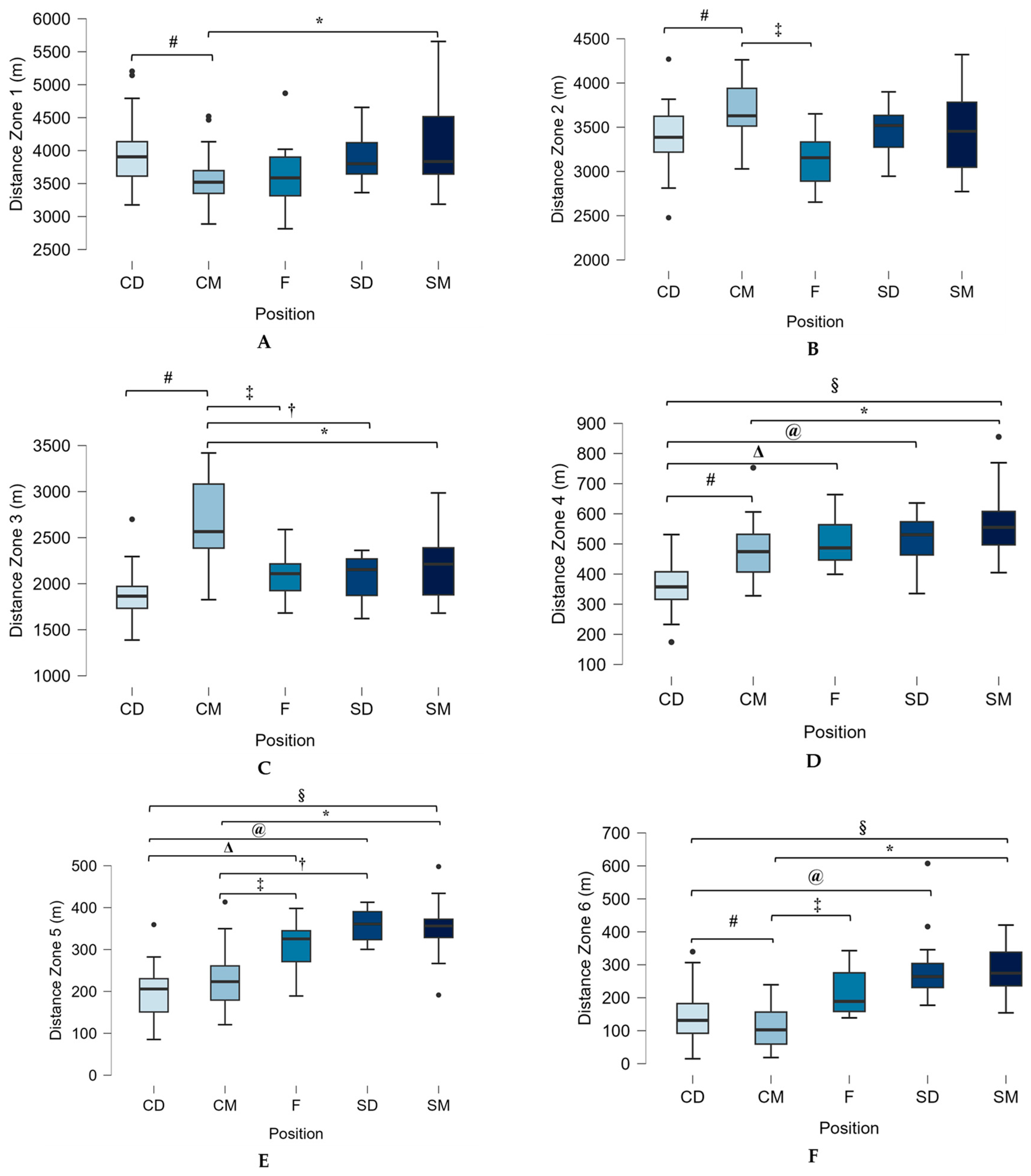
Regarding the various speed zones and total distance, the statistical analysis revealed significant differences across playing positions (Table 1). Specifically, in Z1, the Kruskal–Wallis test identified a moderate statistically significant difference between player positions (H = 13.1, ES = 0.132, p = 0.011), while Z2 demonstrated a large significant variation among positions (F = 4.627, ES = 0.163, p = 0.002,). Likewise, in Z3, notable large significant differences across players’ positions were observed (H = 40.8, ES = 0.412, p < 0.001) as well as in Z4 (F = 18.856, ES = 0.443, p < 0.001). Similarly, Z5 exhibited one of the largest effect sizes recorded (F = 28.811, ES = 0.548, p < 0.001), with large significant differences across nearly all positional roles. In Z6, large significant differences were noted after the implementation of the Kruskal–Wallis test (H = 51.1, ES = 0.516, p < 0.001). Finally, in total distance covered, also, a large significant difference was indicated among playing positions (F = 8.761, ES = 0.269, p < 0.001).
The post-hoc analysis (Table 1 and Figure 1) indicated significant position-specific differences in distance covered across all zones. In Z1CDs covered significantly more distance (M = 3944.37 ± 492.66 m, 95% CI [3772.47, 4116.27]) than CMs (M = 3591.30 ± 406.79 m, 95% CI [3427.00, 3755.61]), indicating greater low-intensity movement among defenders. In Z2 CMs (M = 3683.81 ± 326.68 m, 95% CI [3551.86, 3815.76]) showed significantly higher values compared to Fs with an average of 3148.77 ± 324.19 m, 95% CI [2899.58, 3397.96] and CDs (M = 3403.56 ± 351.23 m, 95% CI [3281.01, 3526.11]). In Z3 CMs covered significantly the greatest distance (M = 2643.15 ± 467.15 m, 95% CI [2454.47, 2831.84]) compared to CDs (M = 1877.18 ± 281.63 m, 95% CI [1778.91, 1975.44]), Fs (M = 2103.14 ± 258.11 m, 95% CI [1904.74, 2301.55]) and SDs with an average of 2054.43 ± 262.88 m, 95% CI [1908.85, 2200.01].
In Z4SMs recorded the highest values (M = 570.18 ± 118.31 m, 95% CI [507.14, 633.23]), followed by SDs (M = 517.89 ± 83.12 m, 95% CI [471.87, 563.92]) and Fs (M = 508.34 ± 90.35 m, 95% CI [438.89, 577.80]), all of whom outperformed CDs (M = 357.62 ± 74.74 m, 95% CI [331.54, 383.70]). This underscores the greater demands on wide and attacking roles in this speed zone. In Z5 was indicated that SDs (M = 358.11 ± 37.89 m, 95% CI [337.13, 379.09]) and SMs (M = 351.45 ± 67.61 m, 95% CI [315.42, 387.48]) significantly outpaced CDs (M = 195.11 ± 62.32 m, 95% CI [173.37, 216.85]) and CMs (M = 225.00 ± 74.23 m, 95% CI [195.01, 254.98]), where F (M = 305.59 ± 65.23 m, 95% CI [255.45, 355.73]) also covered more distance. In Z6, SDs (M = 291.13 ± 106.67 m, 95% CI [232.06, 350.21] and SMs (M = 286.77 ± 75.79 m, 95% CI [246.38, 327.16]), respectively, again showed significantly higher values, while CMs (M = 112.62 ± 68.40 m, 95% CI [84.99, 140.24]) and CDs (M = 141.59 ± 73.35 m, 95% CI [116.00, 167.19]) recorded the lowest distances. Forwards (M = 213.22 ± 70.44 m, 95% CI [159.08, 267.37]) also demonstrated high values.
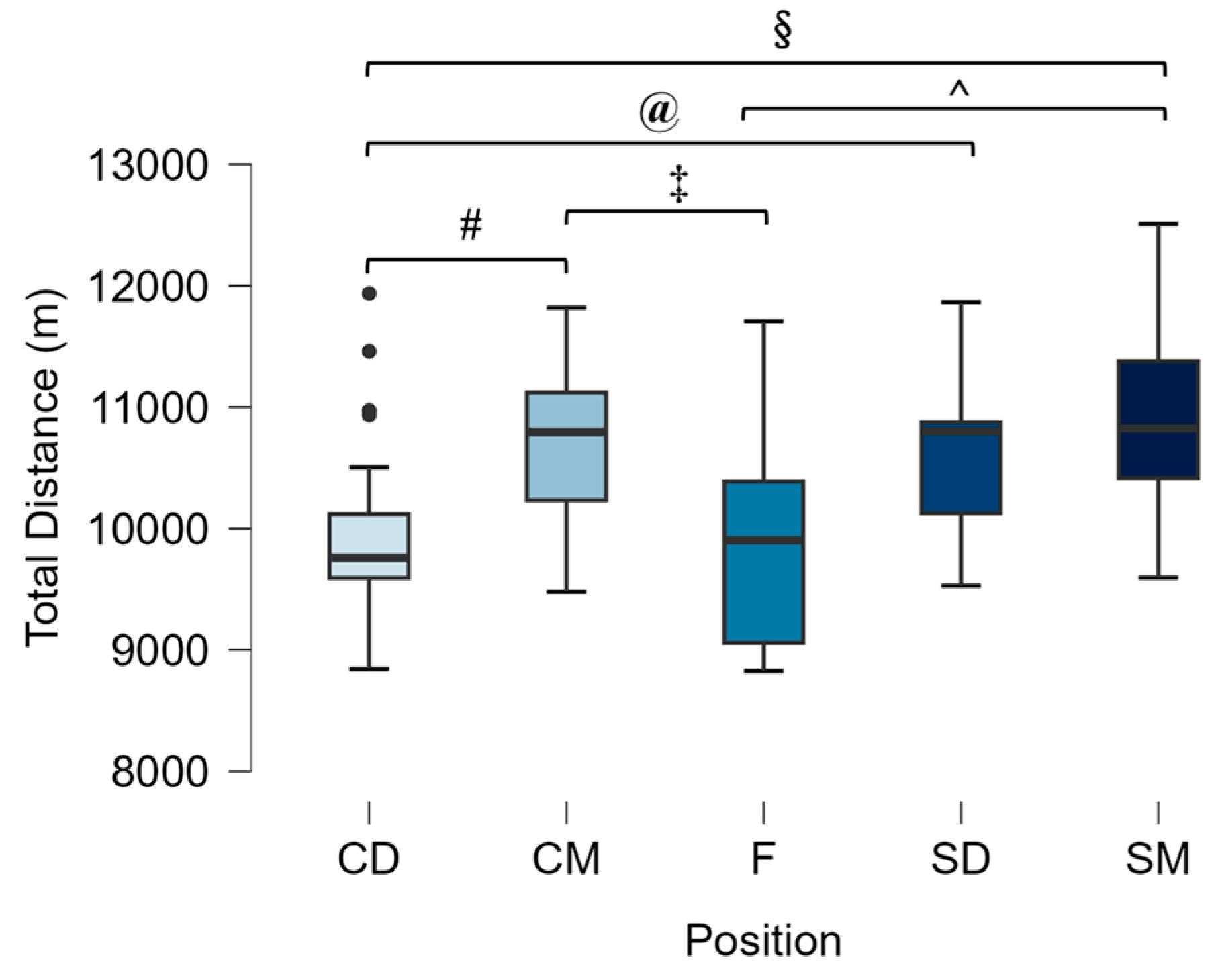
In terms of TD covered (Table 1 & Figure 2), SMs recorded the highest values (M = 10,932.63 ± 790.58 m, 95% CI [10,511.36, 11,353.89]), followed by CMs (M = 10,732.83 ± 630.91 m, 95% CI [10,478.00, 10,987.66]) and SDs (M = 10611.97 ± 652.72 m, 95% CI [10,250.51, 10,973.44]). In contrast, CDs (M = 9919.43 ± 685.83 m, 95% CI [9680.13, 10,158.73]) and Fs (M = 9958.11 ± 947.26 m, 95% CI [9229.98, 10,686.24]) recorded significantly lower values.
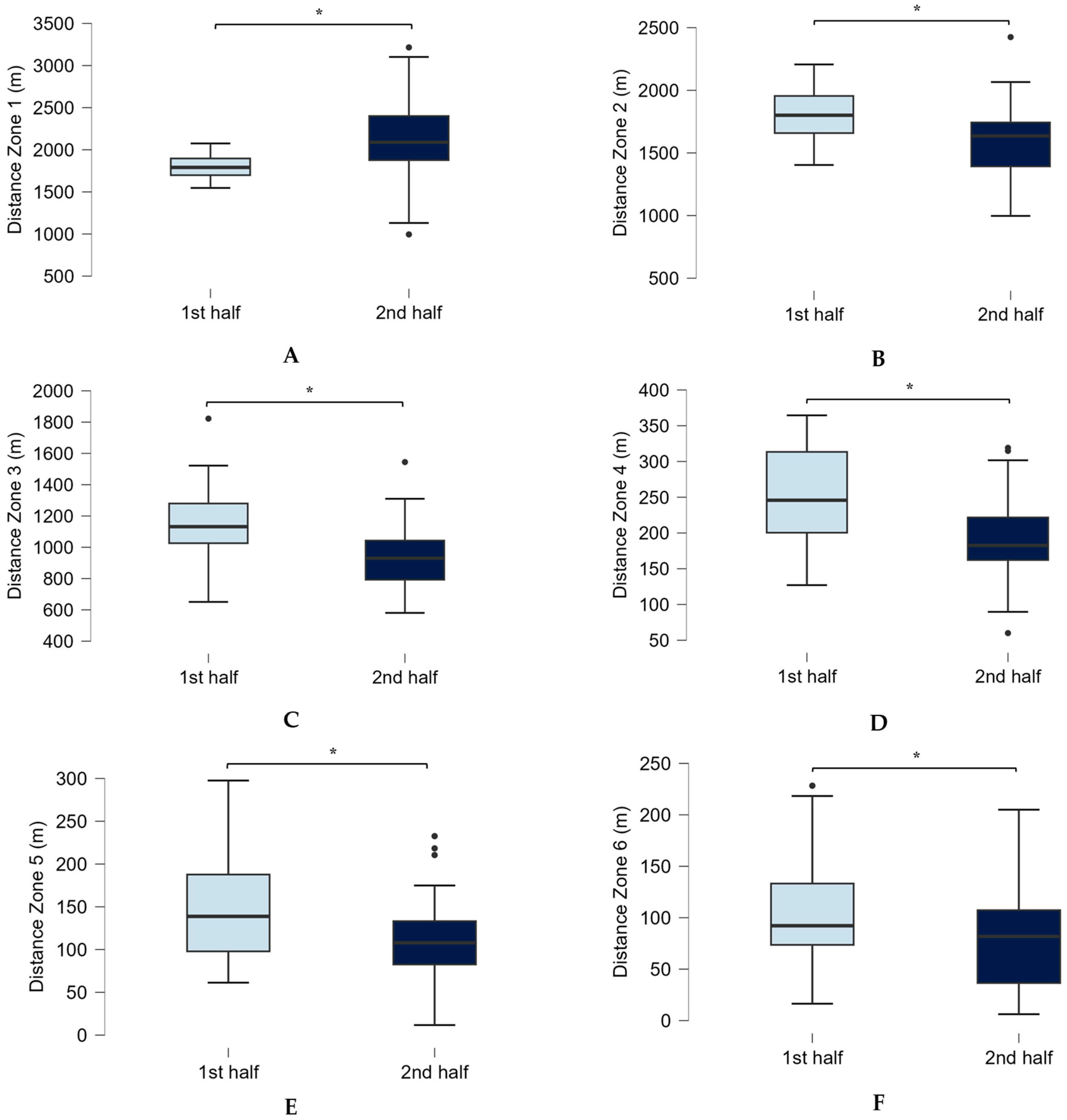
The analysis of distance covered across different performance zones revealed significant differences between the first and second halves of the matches (Table 2). Z1 showed a moderate significant increase (t = −4.26, ES = −0.665, p < 0.001) in the second half (M = 2145.90 ± 517.60 m, 95% CI [1982.52, 2309.28]) compared to the first half (M = 1794.75 ± 144.38 m, 95% CI [1749.18, 1840.32), suggesting that players engaged in more low-intensity movements as the match progressed. In contrast, Z2 displayed a moderate significant reduction in the second half (t = 4.65, ES = 0.727, p < 0.001,), as players covered significantly less distance in Z2 during the second halves (M = 1575.59 ± 318.09 m, 95% CI [1475.19, 1675.99]) compared to the first halves (M = 1803.50 ± 204.77 m, 95% CI [1738.86, 1868.13]). A similar trend was observed in Z3, with a large decline in the second half (t = 5.54, ES = 0.865, p < 0.001), as the first half showed greater distances covered (M = 1139.43 ± 228.40 m, 95% CI [1067.34, 1211.53]) compared to the second half (M = 943.346 ± 196.396 m, 95% CI [881.356, 1005.337]).
Z4 followed the same pattern, with large statistically significant lower distances (t = 5.34, ES = 0.834, p < 0.001) recorded in the second half (M = 193.33 ± 57.22 m, 95% CI [175.27, 211.39]) compared to the first half (M = 251.11 ± 66.54 m, 95% CI [230.11, 272.11]). A similar decline was also noted in Z5, where the second half showed significantly moderate reductions (M = 109.78 ± 50.49 m, 95% CI [93.85, 125.72]) compared to the first half (M = 144.09 ± 58.30 m, 95% CI [125.69, 162.50]),—smaller compared to the previous zones—(t = 3.67, ES = 0.573, p < 0.001). For Z6, the Wilcoxon Signed-Rank test revealed a small significant decrease in performance (W = 627, ES = 0.456, p = 0.01), where the first half displayed greater maximal sprint distances (M = 104.15 ± 53.45 m, 95% CI [87.28, 121.02]) compared to the second half (M = 77.96 ± 51.72 m, 95% CI [61.64, 94.28]), reinforcing the trend of declining sprint performance over time (Table 2 and Figure 3).
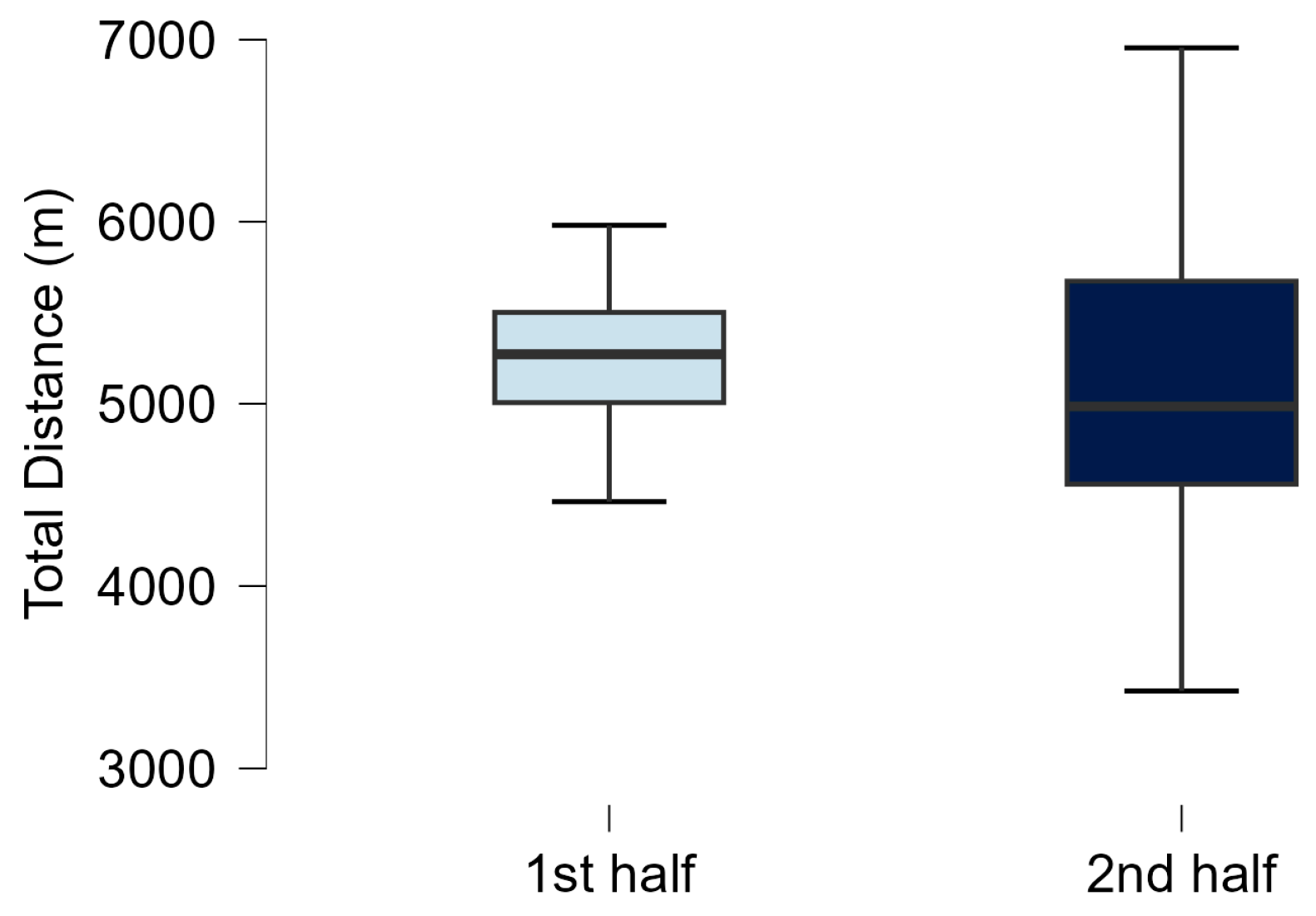
Lastly, interestingly, while players covered slightly more TD in the first half (M = 5237.04 ± 350.49 m, 95% CI [5126.41, 5347.66]) than in the second half (M = 5046.97 ± 823.57 m, 95% CI [4787.02, 5306.92]), no significant differences (t = 1.41, ES = 0.220, p > 0.05) between halves were indicated (Table 2 and Figure 4). These results may suggest that while the total distance covered remains stable, the intensity and distribution of movement patterns shift considerably as the match progresses and may highlight the need for tailored conditioning programs to maintain performance levels, particularly in high-speed and sprinting activities during the latter stages of a match.
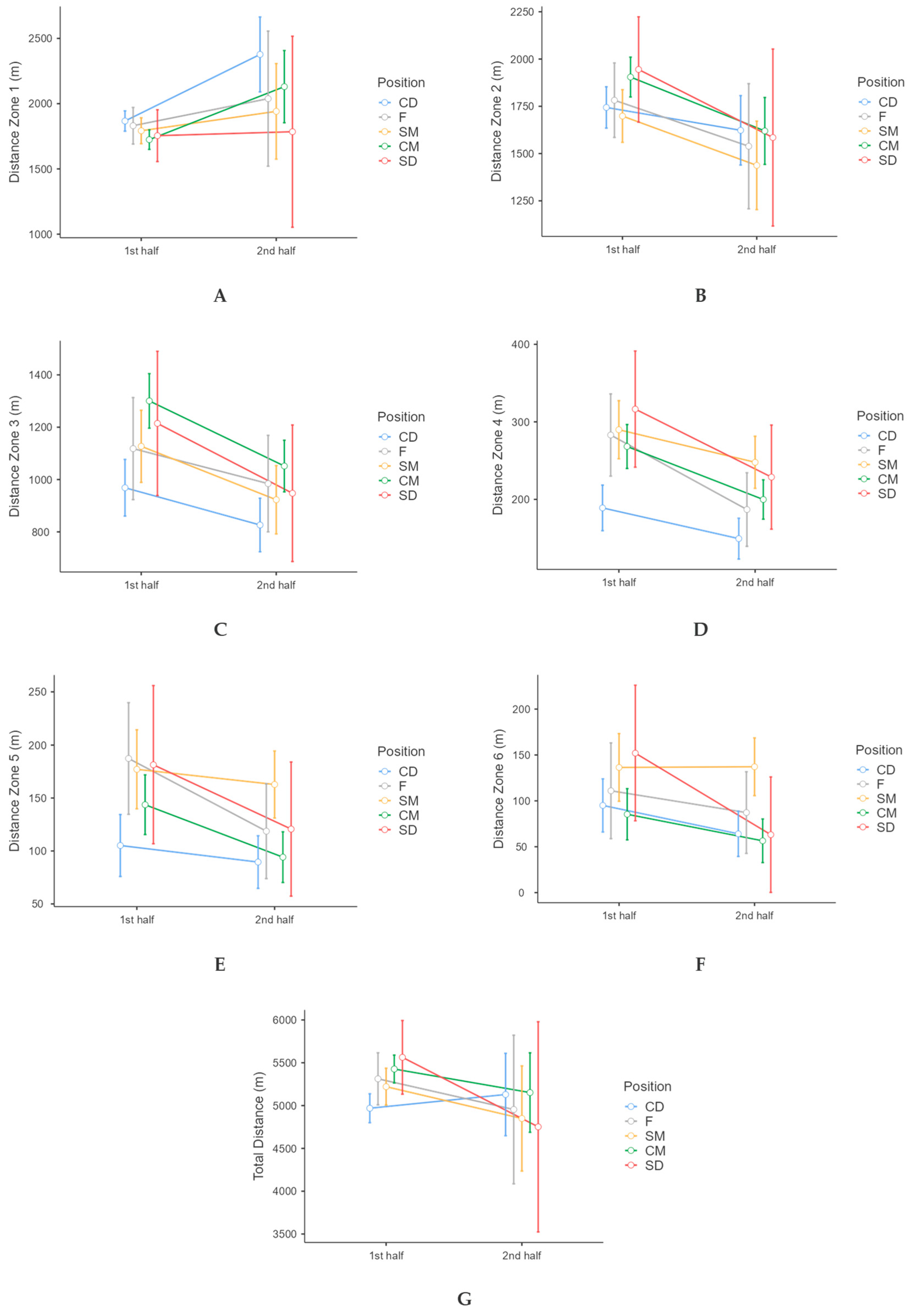
For CDs, there was no statistically significant difference in total distance covered, t = −0.903, p = 0.384. However, CDs significantly increased their distance in Z1 Distance Zone 1 (t = −3.785, p = 0.003) and showed a significant decrease in Z3, (t = 3.400, p = 0.005), as well as in Z4 (t = 2.751, p = 0.018). No significant differences were found in Z2, (t = 1.791, p = 0.098), Z5, (t = 1.293, p = 0.220) or Z6 (Z = −1.71, p = 0.087). These results could suggest that CDs altered their physical output across intensity zones, shifting toward lower-intensity movements in the second half (Table 3 and Figure 5).
For CMs, no significant change was found in total distance covered (t = 1.11, p = 0.286). However, significant increases occurred in Z1 (t = −3.36, p = 0.005), in Z2 (t = 2.63, p = 0.021), in Z3 (t = 3.40, p = 0.005), in Z4 (t = 2.81, p = 0.015), and in Z5 (t = 2.57, p = 0.023). A marginal decrease was also observed in Z6 (Z = −1.98, p = 0.048). These results may indicate substantial second-half reductions in moderate and high-intensity activity among CM players (Table 3 and Figure 5).
For Fs, no significant difference in total distance between halves (t = 0.651, p = 0.561) was found. Likewise, no significant changes were detected in Z1 through 3, with p-values ranging from 0.146 to 0.673. A statistically significant decrease occurred in Z4, (t = 3.369, p = 0.043). Although Z5 showed a non-significant decline (t = 2.850, p = 0.065), Z6 remained unchanged (Z = −0.73, p = 0.465). These findings could indicate that Fs redistributed their running load by reducing moderate-intensity efforts in the second half (Table 3 and Figure 5).
For SDs, although all zones demonstrated numerical reductions between halves, none of the differences reached statistical significance (Table 3 and Figure 5). TD declined, (t = 2.25, p = 0.266) and similar patterns emerged in Z2-5–5 (p-values from 0.061 to 0.300) and Z6 (Z = −1.34, p = 0.180). Z1 showed a minor non-significant increase (t = −0.35, p = 0.785).
For SMs, no significant difference in total distance between halves was observed (t = 1.05, p = 0.329). While there was no significant change in Z1 (t = −0.74, p = 0.484), a significant decrease was observed in Z2 (t = 2.53, p = 0.039). Other zones, including Z3 (t = 2.18, p = 0.066), Z4 (t = 1.93, p = 0.095), Z5 (t = 0.64, p = 0.542), and Z6 (Z = −0.14, p = 0.889), did not differ significantly. These findings could highlight a second-half decline in moderate-intensity performance (Table 3 and Figure 5).

4. Discussion

The purpose of this study was to create the running performance profile of young high-level football players based on their playing position in the 1-4-3-3 formation and to detect possible differences between positions. Additionally, the change in running performance between the two halves was examined. The results confirmed our hypotheses that the greatest total distances, as well as the distances covered at higher intensities in this formation, would be covered by players positioned on the wings.
In one of the first studies [32] that investigated the effect of playing position on the running performance of young football players, it was observed that midfielders covered the greatest distance, while the SDs and Fs covered the greatest distance at high speeds. The position with the least external load was that of the CDs. This study was conducted with a large number of players aged 13 to 18, but it did not separate the playing positions (SD, CD, SM, CM, F) in relation to the formation. The lack of reference to the formation may obscure or exaggerate the differences between playing positions, which limits the usefulness of the findings for coaches.
In another study [30], it was observed that the CDs covered the least total distance and also the least distance in sprints and high-speed running. The researchers also noted that the CMs covered the greatest total distance, and together with the CDs, they covered the least distance in sprints. In contrast, the Fs covered a greater distance in sprints than the Side Midfielders. However, for a better evaluation of the findings in this study, it is important to mention that the formation in which the players were positioned was not specified. The findings of these two studies are partially in agreement with ours. Specifically, in our study, the CDs covered the shortest distance, followed by the Forwards. On the other hand, the greatest distance was covered by the SMs, followed by the CMs (10,933 vs. 10,733 m), with the values being close to each other. In sprints, the shortest distance was covered by the CMs, while the greatest distance was covered by the SDs and SMs (291 vs. 287 m). The observed differences with the findings of other studies are likely due to the playing formations. Regarding the central positions, there is a high number of players, which limits the space available for covering long distances at high speeds. Additionally, the tactical role of CDs, which is heavily focused on defensive duties, is another limiting factor for covering high-speed distances.
Studies that refer to specific formations are relatively limited, especially in young high-level players. Below, we will mention some studies that refer to specific formations. In a recent study [22] on young high-level athletes, three formations (1-4-4-2, 1-4-3-3, 1-3-5-2) were compared, and it was observed that in the 1-4-3-3 formation, the CDs covered the shortest total distance, which can be attributed to their positioning and primarily defensive responsibilities. On the other hand, CMs recorded the greatest total distance, likely due to their dual role in both attack and defense, requiring constant movement across large areas of the pitch. Regarding high-speed running and sprints, SDs were found to cover the greatest distances, particularly in formations that required them to support both offensive and defensive transitions along the flanks. In contrast, CDs covered the least distance at high speed, reflecting their more static positioning and concentration in central defensive zones. These findings closely align with the results of the present study, reinforcing the idea that tactical formation and positional role significantly affect the physical performance and running profiles of players, even at the youth level. This emphasizes the importance of tailoring training programs not only to the player’s position but also to the specific demands of the team’s tactical system.
Before proceeding with comparisons of the results with other studies, it is important to note that when speed zones are set with different thresholds or classification criteria, direct comparisons become difficult, as the resulting data may vary significantly depending on how each study defines and categorizes movement intensities. For example, what one study may classify as high-speed running could fall under a different category in another study with slightly adjusted speed thresholds. These inconsistencies can lead to misinterpretation of results or inaccurate conclusions when evaluating physical performance across different research contexts. Therefore, careful consideration must be given to the methodology used in each study, particularly the definitions of speed zones, in order to ensure valid and meaningful comparisons. In a study [12] with a similar design conducted on professional football players for the same formation (1-4-3-3), it was observed that in the first speed zone (6-11.8 km/h), Fs covered the shortest distance. It was also noted that the CMs covered the greatest distance in the first three speed zones (Z2: 11.9–15.7 km/h; Z3: 15.8–19.7 km/h). In the present study, in Z3, the CDs covered the shortest distance, findings that align with previous research [12,27,47], while the greatest distance in this zone was covered by the CMs. This observation is likely connected to the tactical role of this position, which requires constant positioning of the CM players based on the ball’s position, the opponents, and teammates in the four phases of the game [48]. In the fourth zone, the most distance was covered by SMs, and the least by the CDs. The tactical role of CDs is primarily focused on the team’s defensive function, and the area they cover in front of the goal does not allow them to cover long distances in high speed. Finally, the greatest distance at maximum speed was covered by the SDs, followed by the SMs. Similar findings are reported in previous studies [12]. The wide players (SDs and SMs) in the 1-4-3-3 formation have space on the flanks to make high-speed runs both during the attacking phase and during defensive transitions. Therefore, in this case as well, we observe that the tactical role of the position (active involvement throughout both the attacking and defensive phases), combined with the availability of space with fewer players, affects the running performance of the players. In a recent study [49] conducted on high-level young athletes (U17), it was observed that the CMs covered the greatest distance, while the Fs achieved high performances in Zones 5 and 6. Finally, the wide players SDs and SMs stood out for their performances in high-intensity and maximum-speed distances.
From the results comparing the running performance between the two halves, it was shown that there was no significant difference in total distance. However, differences were observed in all speed zones. Generally, an increase was noted only in the distance covered in Zone 1, and a decrease in distances in all other zones. Previous studies present unclear results on this matter. Some studies report a decrease in distance covered in Zone 1 in the second half [28], while others did not observe any differences [12,27]. However, at this point, it should be emphasized again that the methodology, such as the different speed zone thresholds, varies.
In the present study, an increase in distance covered was observed for both CDs and CMs in Z1. In Z2, the CMs continued to increase their distance in the second half, while SMs covered less distance compared to the first half. As previously mentioned, there is considerable variation in the thresholds used to define speed zones across studies—for example, Zone 1 ranges from 6–11.8 km/h [12], 7.2–14.3 km/h [13], and 0–11 km/h [28]. Such discrepancies may contribute to inconsistencies in reported outcomes.
Findings related to Zone 2 remain inconclusive in the literature, with some studies reporting maintained performance by Fs [12], and others highlighting the role of SDs [27]. In Zone 3, a decline in performance was noted for the CDs, while the CMs exhibited an increase in distance covered. These results are partially consistent with prior studies, which have shown decreased second-half performance for CDs, SDs, and CMs [12,27,29,50].
In Z4, the present study identified reduced performance among CDs and Forwards, while CMs demonstrated improvements in both Z4 and Z5. Previous research has often reported performance declines in high-intensity zones for CMs and CDs during the second half [12], though other studies have found no such reductions [13,27,28,50]. Finally, in the sprint zone (Z6), a decrease in performance was observed for the CMs, contrasting with findings from Vardakis et al. (2020) [12], who reported that only the SDs failed to maintain sprint performance. Several other studies also reported consistent sprint performance throughout both halves of play [13,27,28,29].
The decrease in performance in the second half can be explained by fatigue, the team’s tactics [51], and the match outcome [24]. The scoreline of a soccer match can significantly influence the running performance of players, as it often dictates the tactical demands placed on individuals and the team as a whole. For instance, when a team is trailing, players are typically required to adopt a more aggressive and high-intensity approach, often leading to increased sprinting and total distance covered as they attempt to regain possession and create scoring opportunities. Conversely, teams in the lead may adopt a more conservative strategy, focusing on maintaining possession and defensive shape, which can reduce the physical demands on players, especially in high-intensity efforts [52]. Studies have shown that contextual factors such as match status (winning, drawing, or losing) can alter players’ physical output, with higher physical performances often observed during periods when teams are losing [53]. Therefore, understanding the influence of scoreline dynamics is crucial for coaches and performance analysts when interpreting match data and planning training sessions. In the present study, considering that in 14 out of the 18 games, the study team won, and of these, 8 were with a goal difference greater than two, this may partially explain the decline in performance in the second half. Fatigue is another factor that could affect running performance in the second half, but since fatigue assessment measurements were not taken, only assumptions can be made.
As mentioned earlier, this is one of the few studies that depict the running performance profile of high-level young football players in the 1-4-3-3 formation. The differences between playing positions in the formation suggest the impact of the tactical role on external load. Knowledge of the demands of the position helps coaches in personalizing the external load of players throughout the weekly cycle, aiming to improve performance and prevent injuries.
Although this study provides important information, it has some limitations. The study involved only one football team, which limits the ability to generalize the results. Additionally, matches from only one competitive season were used. Furthermore, contextual variables (score, home or away match) that could influence running performance were not taken into account in this study. The team’s philosophy, playing style, and the individual instructions given to players during matches were also not considered. A further potential limitation of this study is the use of both parametric and non-parametric tests across variables, which, although based on distributional assumptions, may affect analytical consistency and could be addressed in future research through the application of mixed models or generalized linear models. Therefore, future research on larger samples of young players, where contextual variables that could affect running performance are also considered, will provide a more complete picture of the running profile in this formation.

5. Conclusions

The findings of this study highlight the importance of position-specific training based on the unique physical and tactical demands of each role within the 1-4-3-3 formation. Coaches should tailor training loads during the weekly microcycle to reflect these demands, ensuring that wide players—who typically perform more high-speed running—engage in drills that replicate these intensities, while CDs, who operate in more compact zones, focus on shorter-distance and position-specific movements. This individualized approach not only improves training efficiency but also reduces the risk of undertraining or overtraining certain players. Furthermore, youth development programs can use this information to align the physical preparation of younger age groups (e.g., U17) with that of older teams (e.g., U19). By gradually exposing younger players to the running demands of their future roles, coaching staff can facilitate smoother transitions between age levels and better prepare athletes for the physical requirements of elite competition.

Author Contributions

Y.M., T.I.M., A.E.K. and V.M. designed the study and provided critical feedback on the manuscript; V.B., L.V., A.M., I.M. and A.S., collected and processed. A.S., A.M. and Y.M. analyzed the data. Y.M., A.S. and V.B., revised the first draft; A.S. and Y.M. conducted the statistical analysis. All authors have read and agreed to the published version of the manuscript.

Funding

This research received no external funding.

Institutional Review Board Statement

The study was conducted in accordance with the Declaration of Helsinki, and approved by the Ethics Committee of the School of Physical Education and Sport Science at Thessaloniki (App. No. 217/2024, 12 November 2024).

Informed Consent Statement

Informed consent was obtained from all subjects or parents of subjects involved in the study.

Data Availability Statement

Data are available upon request from the corresponding author.

Acknowledgments

The authors thank the players of the team who participated in the study.

Conflicts of Interest

The authors declare no conflicts of interest.

References

  1. FIFA. Professional Football 2021. Available online: https://publications.fifa.com/en/annual-report-2021/around-fifa/professional-football-2021/ (accessed on 1 January 2023).
  2. FIFA. Advancing Football. Available online: https://inside.fifa.com/advancing-football (accessed on 18 June 2025).
  3. Malina, R.M.; Cumming, S.P.; Kontos, A.P.; Eisenmann, J.C.; Ribeiro, B.; Aroso, J. Maturity-Associated Variation in Sport-Specific Skills of Youth Soccer Players Aged 13–15 Years. J. Sports Sci. 2005, 23, 515–522. [Google Scholar] [CrossRef]
  4. Nicholls, A.R.; Earle, K.; Earle, F.; Madigan, D.J. Perceptions of the Coach-Athlete Relationship Predict the Attainment of Mastery Achievement Goals Six Months Later: A Two-Wave Longitudinal Study among F.A. Premier League Academy Soccer Players. Front. Psychol. 2017, 8, 684. [Google Scholar] [CrossRef]
  5. Van-Yperen, N.W.; Duda, J.L. Goal Orientations, Beliefs about Success, and Performance Improvement among Young Elite Dutch Soccer Players. Scand. J. Med. Sci. Sports 1999, 9, 358–364. [Google Scholar] [CrossRef]
  6. Williams, A.M.; Drust, B. Contemporary Perspectives on Talent Identification and Development in Soccer. J. Sports Sci. 2012, 30, 1571–1572. [Google Scholar] [CrossRef]
  7. Williams, A.M.; Ford, P.R.; Drust, B. Talent Identification and Development in Soccer since the Millennium. J. Sports Sci. 2020, 38, 1199–1210. [Google Scholar] [CrossRef] [PubMed]
  8. Barnes, C.; Archer, D.T.; Hogg, B.; Bush, M.; Bradley, P.S. The evolution of physical and technical performance parameters in the English Premier League. Int. J. Sports Med. 2014, 35, 1095–1100. [Google Scholar] [CrossRef] [PubMed]
  9. Lago-Peñas, C.; Lorenzo-Martinez, M.; López-Del Campo, R.; Resta, R.; Rey, E. Evolution of physical and technical parameters in the Spanish 2012–2019. Sci. Med. Football 2023, 7, 41–46. [Google Scholar] [CrossRef] [PubMed]
  10. Nassis, G.P.; Massey, A.; Jacobsen, P.; Brito, J.; Randers, M.B.; Castagna, C.; Mohr, M.; Krustrup, P. Elite football of 2030 will not be the same as that of 2020: Preparing players, coaches, and support staff for the evolution. Scand. J. Med. Sci. Sports 2020, 30, 962–964. [Google Scholar] [CrossRef]
  11. Fousekis, A.; Fousekis, K.; Fousekis, G.; Vaitsis, N.; Terzidis, I.; Christoulas, K.; Michailidis, Y.; Mandroukas, A.; Metaxas, T. Two or four weeks acute: Chronic workload ratio is more useful to prevent injuries in soccer? Appl. Sci. 2023, 13, 495. [Google Scholar] [CrossRef]
  12. Vardakis, L.; Michailidis, Y.; Mandroukas, A.; Mavrommatis, G.; Christoulas, K.; Metaxas, T. Analysis of the running performance of elite soccer players depending on position in the 1-4-3-3 formation. Ger. J. Exerc. Sport Res. 2020, 50, 241–250. [Google Scholar] [CrossRef]
  13. Bradley, P.S.; Sheldon, W.; Wooster, B.; Olsen, P.; Boanas, P.; Krustrup, P. High intensity running in English FA Premier League soccer matches. J. Sports Sci. 2009, 27, 159–168. [Google Scholar] [CrossRef]
  14. Baptista, I.; Johansen, D.; Figueiredo, P.; Rebelo, A.; Pettersen, S.A. A comparison of match-physical demands between different tactical systems: 1-4-5-1 vs. 1-3-5-2. PLoS ONE 2019, 14, e0214952. [Google Scholar] [CrossRef]
  15. Schuth, G.; Carr, G.; Barnes, C.; Carling, C.; Bradley, P.S. Positional interchanges influence the physical and technical match performance variables of elite soccer players. J. Sports Sci. 2016, 34, 501–508. [Google Scholar] [CrossRef] [PubMed]
  16. Rivilla-García, J.; Calvo, L.C.; Jiménez-Rubio, S.; Paredes-Hernández, V.; Muñoz, A.; Van den Tillaar, R.; Navandar, A. Characteristics of very high intensity runs of soccer players in relation to their playing position and playing half in the 2013–2014 Spanish La Liga season. J. Hum. Kinet. 2019, 66, 213–222. [Google Scholar] [CrossRef]
  17. Zhang, W.; Gong, B.; Tao, R.; Zhou, F.; Ruano, M.Á.; Zhou, C. The influence of tactical formation on physical and technical performance across playing positions in the Chinese super league. Sci. Rep. 2024, 14, 2538. [Google Scholar] [CrossRef] [PubMed]
  18. Modric, T.; Versic, S.; Sekulic, D. Position specific running performances in professional football (soccer): Influence of different tactical formations. Sports 2020, 8, 161. [Google Scholar] [CrossRef]
  19. Tierney, P.J.; Young, A.; Clarke, N.D.; Duncan, M.J. Match play demands of 11 versus 11 professional football using Global Positioning System tracking: Variations across common playing formations. Hum. Mov. Sci. 2016, 49, 1–8. [Google Scholar] [CrossRef]
  20. Aquino, R.; Vieira, L.H.P.; Carling, C.; Martins, G.H.; Alves, I.S.; Puggina, E.F. Effects of competitive standard, team formation and playing position on match running performance of Brazilian professional soccer players. Int. J. Perform. Anal. Sport 2017, 17, 695–705. [Google Scholar] [CrossRef]
  21. Vieira, L.H.P.; Aquino, R.; Lago-Penas, C.; Martins, G.H.M.; Puggina, E.F.; Barbieri, F.A. Running performance in Brazilian professional football players during a congested match schedule. J. Strength Cond. Res. 2018, 32, 313–325. [Google Scholar] [CrossRef]
  22. Borghi, S.; Colombo, D.; La Torre, A.; Banfi, G.; Bonato, M.; Vitale, J.A. Differences in GPS variables according to playing formations and playing positions in U19 male soccer players. Res. Sports Med. 2021, 29, 225–239. [Google Scholar] [CrossRef]
  23. Arjol-Serrano, J.L.; Lampre, M.; Díez, A.; Castillo, D.; Sanz-López, F.; Lozano, D. The influence of playing formation on physical demands and technical-tactical actions according to playing positions in an elite soccer team. Int. J. Environ. Res. Public Health 2021, 18, 4148. [Google Scholar] [CrossRef]
  24. Plakias, S.; Michailidis, Y. Factors affecting the running performance of soccer teams in the Turkish Super League. Sports 2024, 12, 196. [Google Scholar] [CrossRef]
  25. Dellal, A.; Wong, D.P.; Moalla, W.; Chamari, K. Physical and technical activity of soccer players in the French First League–with special reference to their playing position. J. Sports Sci. 2010, 11, 278–290. [Google Scholar]
  26. Vigh-Larsen, J.F.; Dalgas, U.; Andersen, T.B. Position-specific acceleration and deceleration profiles in elite youth and senior soccer players. J. Strength Cond. Res. 2017, 32, 1114–1122. [Google Scholar] [CrossRef] [PubMed]
  27. Di Salvo, V.; Baron, R.; Tschan, H.; Calderon Montero, F.J.; Bachl, N.; Pigozzi, F. Performance characteristics according to playing position in elite soccer. Int. J. Sports Med. 2007, 28, 222–227. [Google Scholar] [CrossRef]
  28. Barros, R.M.; Misuta, M.S.; Menezes, R.P.; Figueroa, P.J.; Moura, F.A.; Cunha, S.A.; Anido, R.; Leite, N.J. Analysis of the distances covered by first division Brazilian soccer players obtained with an automatic tracking method. J. Sports Sci. Med. 2007, 6, 233–242. [Google Scholar]
  29. Ingebrigtsen, J.; Dillern, T.; Shalfawi, S.A. Aerobic capacities and anthropometric characteristics of elite female soccer players. J. Strength Cond. Res. 2011, 25, 3352–3357. [Google Scholar] [CrossRef] [PubMed]
  30. Varley, M.C.; Gregson, W.; McMillan, K.; Bonanno, D.; Stafford, K.; Modonutti, M.; Di Salvo, V. Physical and technical performance of elite youth soccer players during international tournaments: Influence of playing position and team success and opponent quality. Sci. Med. Football 2016, 1, 18–29. [Google Scholar] [CrossRef]
  31. Kaldaras, V.; Michailidis, Y.; Gissis, I.; Metaxas, T.I. The running performance of amateur football players in matches with a 1-4-3-3 formation in relation to their playing position and the 15-min time periods. Appl. Sci. 2024, 14, 7036. [Google Scholar] [CrossRef]
  32. Buchheit, M.; Mendez-Villanueva, A.; Simpson, B.M.; Bourdon, P.C. Match running performance and fitness in youth soccer. Int. J. Sports Med. 2010, 31, 818–825. [Google Scholar] [CrossRef]
  33. Harley, J.A.; Barnes, C.A.; Portas, M.; Lovell, R.; Barrett, S.; Paul, D.; Weston, M. Motion Analysis of Match-Play in Elite U12 to U16 Age-Group Soccer Players. J. Sports Sci. 2010, 28, 1391–1397. [Google Scholar] [CrossRef]
  34. Pettersen, S.A.; Brenn, T. Activity Profiles by Position in Youth Elite Soccer Players in Official Matches. Sports Med. Int. Open 2019, 3, E19–E24. [Google Scholar] [CrossRef]
  35. Goto, H.; King, J.A. Playing Formation Affects Match Running Performance in Youth Soccer: 4-4-2 vs 3-6-1. Kyushu Univ. Bull. 2023, 13, 65–73. [Google Scholar]
  36. Samolis, V.; Stafylidis, A.; Vlachakis, P.; Trampas, A.; Karampelas, D.; Michailidis, Y. The Running Performance of Elite Under-19 Football Players in Matches with a 1-4-2-3-1 Formation in Relation to Their Playing Position. Appl. Sci. 2025, 15, 6961. [Google Scholar] [CrossRef]
  37. Oliva-Lozano, J.M.; Gómez-Carmona, C.D.; Pino-Ortega, J.; Moreno-Pérez, V.; Rodríguez-Pérez, M.A. Match and Training High-Intensity Activity-Demands Profile during a Competitive Mesocycle in Youth Elite Soccer Players. J. Hum. Kinet. 2020, 75, 195–205. [Google Scholar] [CrossRef]
  38. Slaughter, M.H.; Lohman, T.G.; Boileau, R.A.; Horswill, C.A.; Stillman, R.G.; Van Loan, M.D.; Bemben, D.A. Skinfold equations for estimation of body fatness in children and youth. Hum. Biol. 1988, 60, 709–723. [Google Scholar] [PubMed]
  39. Durnin, J.V.G.A.; Rahaman, M.M. The assessment of the amount of fat in the human body from measurements of skinfold thickness. Br. J. Nutr. 1967, 21, 681–689. [Google Scholar] [CrossRef] [PubMed]
  40. Siri, W.E. The gross composition of the body. Adv. Biol. Med. Phys. 1956, 4, 239–280. [Google Scholar] [PubMed]
  41. Gómez-Carmona, C.D.; Bastida-Castillo, A.; García-Rubio, J.; Ibánez, S.J.; Pino-Ortega, J. Static and Dynamic Reliability of WIMU PROTM Accelerometers According to Anatomical Placement. Proc. Inst. Mech. Eng. Part P J. Sports Eng. Technol. 2019, 233, 238–248. [Google Scholar]
  42. Munoz-López, A.; Granero-Gil, P.; Pino-Ortega, J.; De Hoyo, M. The Validity and Reliability of a 5-Hz GPS Device for Quantifying Athletes’ Sprints and Movement Demands Specific to Team Sports. J. Hum. Sport Exerc. 2017, 12, 156–166. [Google Scholar] [CrossRef]
  43. IBM Corporation. IBM SPSS Statistics for Windows, version 29.0.2.0 [Computer Software]; IBM Corporation: Armonk, NY, USA, 2025; Available online: https://www.ibm.com/analytics/spss-statistics-software (accessed on 30 January 2025).
  44. The Jamovi Project. Jamovi, version 2.6 [Computer Software]; The Jamovi Project: Sydney, Australia, 2025; Available online: https://www.jamovi.org (accessed on 30 January 2025).
  45. JASP Team. JASP, version 0.19.3.0 [Computer Software]; JASP Team: Amsterdam, The Netherlands, 2025; Available online: https://jasp-stats.org (accessed on 30 January 2025).
  46. Cohen, J. Statistical Power Analysis for the Behavioral Sciences; Routledge: Abingdon, UK, 2013. [Google Scholar]
  47. Metaxas, T.I. Match running performance of elite soccer players: VO2max and players position influences. J. Strength Cond. Res. 2021, 35, 162–168. [Google Scholar] [CrossRef]
  48. Smpokos, E.; Mourikis, C.; Linardakis, M. Seasonal physical performance of a professional team’s football players in a national league and European matches. J. Hum. Sport Exerc. 2018, 13, 720–730. [Google Scholar] [CrossRef]
  49. Michailidis, Y.; Stafylidis, A.; Vardakis, L.; Kyranoudis, A.E.; Mittas, V.; Leftheroudis, V.; Mandroukas, A.; Metaxas, T.I. The Running Performance of Elite Youth Football Players in Matches with a 1-4-3-3 Formation in Relation to Their Playing Position. Appl. Sci. 2025, 15, 3984. [Google Scholar] [CrossRef]
  50. Vigne, G.; Gaudino, C.; Rogowski, I.; Alloatti, G.; Hautier, C. Activity profile in elite Italian soccer team. Int. J. Sports Med. 2010, 31, 304–310. [Google Scholar] [CrossRef]
  51. Asian-Clemente, J.; Suarez-Arrones, L.; Requena, B.; Santalla, A. Influence of Tactical Behaviour on Running Performance in The Three Most Successful Soccer Teams During the Competitive Season of The Spanish First Division. J. Hum. Kinet. 2022, 82, 135–144. [Google Scholar] [CrossRef] [PubMed]
  52. Bradley, P.S.; Lago-Peñas, C.; Rey, E.; Gómez Díaz, A. The Effect of High and Low Percentage Ball Possession on Physical and Technical Profiles in English FA Premier League Soccer Matches. J. Sports Sci. 2013, 31, 1261–1270. [Google Scholar] [CrossRef] [PubMed]
  53. Lago-Peñas, C.; Lago-Ballesteros, J.; Dellal, A.; Gómez, M. Game-Related Statistics That Discriminated Winning, Drawing and Losing Teams from the Spanish Soccer League. J. Sports Sci. Med. 2010, 9, 288–293. [Google Scholar] [PubMed]
Figure 1. Positional analysis of movement demands across distance zones. Note: Zone 1 (0.1–23 6 km/h), Zone 2 (6.1–12 km/h), Zone 3 (12.1–18 km/h), Zone 4 (18.1–21 km/h), Zone 5 (21.1–24 km/h), and Zone 6 (above 24 24.1 km/h). The boxplots (AF) illustrate the distribution of key performance metrics across playing positions: Center Defender (CD), Center Midfielder (CM), Forward (F), Side Defender (SD), and Side Midfielder (SM). The following symbols denote significant pairwise differences: CM vs. SM (*),CM vs. CD (#), CM vs. SD (†), CM vs. F (‡), SM vs. CD (§), CD vs. SD (@), CD vs. F (Δ). (A) Distance Zone 1 *#; (B) Distance Zone 2 #‡; (C) Distance Zone 3 *#†‡; (D) Distance Zone 4 *#@§Δ; (E) Distance Zone 5 *†‡@§Δ; (F) Distance Zone 6 *#‡§@. Dots represent statistical outliers (IQR method) retained for analysis, as they may reflect meaningful individual variability in physical performance.
Applsci 15 08430 g001
Figure 2. Positional analysis of total distance covered: distribution across playing roles. Note: The boxplots illustrate the distribution of Total Distance across playing positions: Center Defender (CD), Center Midfielder (CM), Forward (F), Side Defender (SD), and Side Midfielder (SM). Dots represent statistical outliers (IQR method) retained for analysis, as they may reflect meaningful individual variability in physical performance. Dots represent statistical outliers (IQR method) retained for analysis, as they may reflect meaningful individual variability in physical performance. The following symbols denote significant pairwise differences: CM vs. CD (#), CM vs. F (‡), SM vs. CD (§), CD vs. SD (@), SM vs. F (^).
Applsci 15 08430 g002
Figure 3. Positional analysis of movement demands: distribution across speed zones. Note: Zone 1 (0.1–23 6 km/h), Zone 2 (6.1–12 km/h), Zone 3 (12.1–18 km/h), Zone 4 (18.1–21 km/h), Zone 5 (21.1–24 km/h), and Zone 6 (above 24 24.1 km/h). The boxplots (AF) illustrate the distribution of distance covered across different intensity zones across the first and second halves of the matches. The symbol * indicates significant differences at p < 0.05. (A) Distance Zone 1 *; (B) Distance Zone 2 *; (C) Distance Zone 3 *; (D) Distance Zone 4 *; (E) Distance Zone 5 *; (F) Distance Zone 6 *. Dots represent statistical outliers (IQR method) retained for analysis, as they may reflect meaningful individual variability in physical performance.
Applsci 15 08430 g003
Figure 4. Positional analysis of total distance covered: distribution across playing roles. Note: The boxplots illustrate the distribution of total distance (m) covered across the first and second halves of the matches, with no statistically significant difference observed (p > 0.05).
Applsci 15 08430 g004
Figure 5. Within-position comparison of distance covered across halves in different intensity zones and total distance. Note: Zone 1 (0.1–23 6 km/h), Zone 2 (6.1–12 km/h), Zone 3 (12.1–18 km/h), Zone 4 (18.1–21 km/h), Zone 5 (21.1–24 km/h), and Zone 6 (above 24 24.1 km/h). The boxplots (AG) depict the distribution of distance covered across intensity zones and total distance between halves, highlighting within-position differences in physical performance across the match. Mean values were used for all variables in the visualizations. Statistically significant differences between halves were observed as follows: Central Defenders (CD) showed an increase in Zone 1 and decreases in Zones 3 and 4; Forwards (F) exhibited a reduction in Zone 4; Side Midfielders (SM) decreased in Zone 2; Central Midfielders (CM) increased in Zone 1 and decreased in Zones 2, 3, 4, and 5.
Applsci 15 08430 g005
Table 1. Distance covered (in meters) per playing position across distance zones and total distance.
95% Confidence Interval Mean
Mean ± SDLowerUpperTest StatisticESp
Distance Zone 1 CD3944.37 ± 492.663772.474116.27H = 13.10.1320.011 *#
CM3591.30 ± 406.793427.003755.61
F3679.03 ± 585.233229.184128.88
SD3913.01 ± 384.613700.024126.00
SM4104.41 ± 661.713751.824457.01
Distance Zone 2 CD3403.56 ± 351.233281.013526.11F = 4.6270.1630.002 #‡
CM3683.81 ± 326.683551.863815.76
F3148.77 ± 324.192899.583397.96
SD3477.39 ± 272.313326.593628.19
SM3452.43 ± 450.793212.213692.64
Distance Zone 3 CD1877.18 ± 281.631778.911975.44H = 40.80.4120.001 *#†‡
CM2643.15 ± 467.152454.472831.84
F2103.14 ± 258.111904.742301.55
SD2054.43 ± 262.881908.852200.01
SM2167.41 ± 372.781968.772366.05
Distance Zone 4 CD357.62 ± 74.74331.54383.70F = 18.8560.4430.001 *#@§Δ
CM476.97 ± 97.26437.68516.25
F508.34 ± 90.35438.89577.80
SD517.89 ± 83.12471.87563.92
SM570.18 ± 118.31507.14633.23
Distance Zone 5 CD195.11 ± 62.32173.37216.85F = 28.8110.5480.001 *†‡@§Δ
CM225.00 ± 74.23195.01254.98
F305.59 ± 65.23255.45355.73
SD358.11 ± 37.89337.13379.09
SM351.45 ± 67.61315.42387.48
Distance Zone 6 CD141.59 ± 73.35116.00167.19H = 51.10.5160.001 *#‡§@
CM112.62 ± 68.4084.99140.24
F213.22 ± 70.44159.08267.37
SD291.13 ± 106.67232.06350.21
SM286.77 ± 75.79246.38327.16
Total Distance CD9919.43 ± 685.839680.1310,158.73F = 8.7610.2690.001 ^#‡§@
CM10,732.83 ± 630.9110,478.0010,987.66
F9958.11 ± 947.269229.9810,686.24
SD10,611.97 ± 652.7210,250.5110,973.44
SM10,932.63 ± 790.5810,511.3611,353.89
Note: CD = Central Defender; CM = Central Midfielder; F = Forward; SD = Side Defender; SM = Side Midfielder; TD = Total Distance; Z1–Z6 = Distance Zone 1 to Distance Zone 6; M = Mean; SD = Standard Deviation; CI = Confidence Interval; ES = Effect Size; p = p-value; F = One-way ANOVA test statistic; H = Kruskal–Wallis test statistic. The following symbols denote significant pairwise differences: CM vs. SM (*), SM vs. F (^), CM vs. CD (#), CM vs. SD (†), CM vs. F (‡), SM vs. CD (§), CD vs. SD (@), CD vs. F (Δ).
Table 2. Descriptive statistics of distance covered per zone and total distance between first and second halves.
95% Confidence Interval Mean
Mean ± SDLowerUpperTest
Statistic
ESp
Distance Zone 1 *1st half1794.75 ± 144.381749.181840.32t = −4.26−0.6650.001 *
2nd half2145.90 ± 517.601982.522309.28
Distance Zone 2 *1st half1803.50 ± 204.771738.861868.13t = 4.650.7270.001 *
2nd half1575.59 ± 318.091475.191675.99
Distance Zone 3 *1st half1139.43 ± 228.401067.341211.53t = 5.540.8650.001 *
2nd half943.35 ± 196.40881.361005.34
Distance Zone 4 *1st half251.11 ± 66.54230.11272.11t = 5.340.8340.001 *
2nd half193.33 ± 57.22175.27211.39
Distance Zone 5 *1st half144.09 ± 58.30125.69162.50t = 3.670.5730.001 *
2nd half109.78 ± 50.4993.85125.72
Distance Zone 6 * 1st half104.15 ± 53.4587.28121.02W = 6270.4560.01 *
2nd half77.96 ± 51.7261.6494.28
Total Distance1st half5237.04 ± 350.495126.415347.66t = 1.410.2200.16
2nd half5046.97 ± 823.574787.025306.92
Note: The symbol * indicates significant differences at p < 0.05.
Table 3. Means, standard deviations, and 95% confidence intervals (bootstrap method) for total distance covered across different intensity zones and match halves by playing position (in meters).
95% Confidence Interval Mean
Mean ± SDLowerUpper
Total Distance (m)—1st halfCD4968.92 ± 314.504817.625138.67
CM5426.84 ± 289.155289.685576.64
F5312.73 ± 284.935028.585520.30
SD5563.65 ± 87.615501.705625.60
SM5221.09 ± 318.795006.395418.41
Total Distance (m)—2nd halfCD5129.52 ± 658.064808.765478.58
CM5151.99 ± 901.464698.295624.33
F4954.35 ± 1117.323914.455781.75
SD4751.75 ± 598.284328.705174.80
SM4849.15 ± 963.774198.985462.29
Distance Zone 1—1st halfCD1867.13 ± 133.031798.611935.19
CM1724.30 ± 165.251645.761818.23
F1831.05 ± 126.171746.351949.85
SD1754.60 ± 121.341668.801840.40
SM1792.30 ± 90.891736.281852.88
Distance Zone 1—2nd halfCD2377.26 ± 450.782150.362623.90
CM2130.39 ± 461.871895.882358.97
F2038.35 ± 841.851307.152829.73
SD1784.90 ± 243.251612.901956.90
SM1941.11 ± 531.571610.852277.05
Distance Zone 2—1st halfCD1743.92 ± 236.551622.621867.48
CM1904.80 ± 194.421800.181998.45
F1782.13 ± 151.241662.531906.25
SD1944.70 ± 34.791920.101969.30
SM1698.40 ± 133.491614.171781.99
Distance Zone 2—2nd halfCD1623.02 ± 278.951476.321761.98
CM1619.62 ± 370.221432.911805.40
F1538.80 ± 252.481290.201680.75
SD1584.90 ± 224.291426.301743.50
SM1437.54 ± 353.701203.381663.82
Distance Zone 3—1st halfCD968.64 ± 152.89886.951042.08
CM1300.46 ± 219.281192.781419.99
F1118.18 ± 199.83924.351248.08
SD1214.55 ± 3.751211.901217.20
SM1127.03 ± 208.62982.231256.08
Distance Zone 3—2nd halfCD826.27 ± 141.55747.05895.75
CM1051.51 ± 230.95943.151166.69
F984.38 ± 86.68910.801057.95
SD947.55 ± 58.20906.40988.70
SM922.75 ± 181.65807.471036.55
Distance Zone 4—1st halfCD189.00 ± 37.74170.62207.81
CM268.20 ± 67.98235.63302.36
F283.03 ± 43.76247.13316.60
SD316.45 ± 4.31313.40319.50
SM289.84 ± 46.78257.38319.47
Distance Zone 4—2nd halfCD149.35 ± 42.70127.07171.63
CM199.82 ± 56.55170.91228.72
F186.88 ± 17.24170.65200.55
SD228.70 ± 16.26217.20240.20
SM247.83 ± 45.06218.93277.39
Distance Zone 5—1st halfCD105.18 ± 39.8086.69127.95
CM143.67 ± 67.51112.88180.10
F187.35 ± 48.65146.90227.80
SD181.40 ± 17.40169.10193.70
SM177.11 ± 40.76149.71203.67
Distance Zone 5—2nd halfCD89.55 ± 44.0465.05112.79
CM94.17 ± 45.6574.25120.39
F118.70 ± 37.9995.85155.85
SD120.70 ± 14.99110.10131.30
SM162.80 ± 46.69133.67193.41
Distance Zone 6—1st halfCD95.03 ± 51.6369.92124.88
CM85.39 ± 51.3162.80115.54
F110.98 ± 46.2681.18156.40
SD152.00 ± 26.59133.20170.80
SM136.41 ± 55.85101.36169.16
Distance Zone 6—2nd halfCD64.10 ± 41.3042.9185.19
CM56.46 ± 35.0937.6472.87
F87.23 ± 83.0123.13169.08
SD63.15 ± 42.7832.9093.40
SM137.16 ± 38.22113.80162.19
Note: Statistically significant differences between halves were observed: Central Defenders (CD) showed an increase in Zone 1 and decreases in Zones 3 and 4; Forwards (F) exhibited a significant reduction in Zone 4; Side Midfielders (SM) decreased significantly in Zone 2; Central Midfielders (CM) increased significantly the distance covered in Zone 1 and decreased in Zones 2, 3, 4, and 5. 95% confidence intervals were computed using the bootstrap method.
Disclaimer/Publisher’s Note: The statements, opinions and data contained in all publications are solely those of the individual author(s) and contributor(s) and not of MDPI and/or the editor(s). MDPI and/or the editor(s) disclaim responsibility for any injury to people or property resulting from any ideas, methods, instructions or products referred to in the content.