Article

Monitoring and Diagnostics of Non-Thermal Plasmas in the Food Sector Using Optical Emission Spectroscopy


Faculty of Electrical Engineering and Computing, University of Zagreb, Unska 3, 10000 Zagreb, Croatia
*
Author to whom correspondence should be addressed.
Appl. Sci. 2025, 15(15), 8325; https://doi.org/10.3390/app15158325
Submission received: 16 June 2025 / Revised: 11 July 2025 / Accepted: 24 July 2025 / Published: 26 July 2025
(This article belongs to the Special Issue Innovative Technology in Food Analysis and Processing)

Abstract

Non-thermal plasma technology is used in the food sector due to its many advantages such as low operating costs, fast and efficient processing at low temperatures, minimal environmental impact, and preservation of sensory and nutritional properties. In this article, the plasma was generated using a high-voltage electrical discharge (HVED) with argon at a voltage of 35 kV and a frequency of 60 Hz. Plasma monitoring and diagnostics were performed using optical emission spectroscopy (OES) to optimise the process parameters and for quality control. OES was used as a non-invasive sensor to collect useful information about the properties of the plasma and to identify excited species. The values obtained for electron temperature and electron density (up to 2.3   eV and up to 10 23   m 3 ) confirmed that the generated plasma is a non-thermal plasma. Therefore, the use of OES is recommended in the daily control of food processing, as this is necessary to confirm that the processes are non-thermal and suitable for the food sector.

1. Introduction

The food sector faces numerous challenges that are not always related to food production and processing. Climate and environmental changes are influencing the pace of economic development not only in Europe but also worldwide. Greenhouse gas emissions, global hunger, food insecurity, environmental sustainability, economic growth and targeted investments are key areas for action. The Farm to Fork strategy addresses the sustainable production, processing, distribution and consumption of food while reducing losses and waste. The Farm to Fork strategy is part of the European Green Plan, which aims to make the EU climate neutral by 2050 [1]. Food production is a chain of processes that harbours numerous hazards. Successful risk and hazard management begins immediately after harvesting and continues through to processing at the production site [2]. The food production process includes various stages, and each stage is important: from cleaning, processing, separation to packaging at the end [3]. Waste management in food production must not be neglected either [4]. The food sector must keep pace with the nutritional and consumer demands of a constantly growing population. The challenges facing the food sector, such as food safety and security [5,6], minimal processing [7,8], and consumer and regulatory acceptance [9,10], are driving scientists to explore technologies that provide an alternative to traditional food processing technologies. When new technologies are introduced in food production, they must not only support sustainability and ensure global food safety but also be environmentally sound when it comes to protecting crops or food from spoilage or other adverse effects. An effective technology should successfully minimise the safety risks associated with food microbiology while maintaining the quality characteristics of the product, with the common goal of extending shelf life [11]. Non-thermal processing technologies for food preservation appear as an alternative to conventional thermal processing, with better end product characteristics [12], nutritional value and food quality [13,14]. Non-thermal technologies such as pulsed electric fields (PEF), high-pressure processing (HPP), non-thermal plasma (NTP), cold plasma technology (CP), etc., play an important role in the modern food sector for several reasons. Processing with non-thermal technologies enables the preservation of nutritional and sensory properties. They can be used for a wide range of foods, are constantly innovated and follow marketing trends. Non-thermal technologies offer considerable advantages to the food sector compared to the thermal technologies that are also used. However, most non-thermal technologies are developed in scientific research laboratories that cannot compete with the broad industrial application of established thermal technologies. Therefore, direct comparisons in terms of production costs, environmental impact, energy consumption, economic justification and technological feasibility are difficult to draw. Optimisation of the process parameters of non-thermal technology is required to increase efficiency, effectiveness and sustainability [15]. Each non-thermal technology has a unique mechanism of action, and the choice of technology and parameters depends on the specifics of the food matrix and the desired results [16,17,18,19,20,21,22]. An interdisciplinary approach to researching any non-thermal technology is required to overcome the limitations and challenges of industrial processing.
In non-thermal plasma technology, only partially ionised plasma is used. Although the degree of ionisation is lower, it is still such that the system can be regarded as a plasma system. The cooling of the neutral atoms and ions dominates the energy transfer from the electrons, which keeps the plasma system at lower temperatures and allows it to be applied to heat-sensitive materials. All plasma production processes for food applications, such as dielectric barrier discharge, high-voltage electrical discharge, or plasma jet, must generate plasma at low temperatures in order to maintain food quality, sensory and nutritional properties and microbial safety.
Sterilisation, which includes thermal, chemical and radiation processes, is normally used to inactivate microbes. However, sterilisation by heat processes cannot be used on heat-sensitive materials as permanent and irreparable damage may occur. When sterilising with chemical processes and radiation, it is important to protect staff and their workplace. The most important application of non-thermal plasmas is the sterilisation of various surfaces, including sensitive ones, as they can deactivate microorganisms without damaging them. Non-thermal plasma technology is suitable for both solid and liquid foods. Due to the high diffusivity of the plasma’s active chemical components, this treatment works quickly and on the entire food surface. Non-thermal plasma technology is environmentally friendly [23] and energy efficient as it requires low energy input [24,25]. The fact that non-thermal plasma consists of positively and negatively charged particles, ions and electrons, quanta of electromagnetic radiation, and excited and unexcited atoms and molecules makes it an effective means of decontamination [26]. To achieve the desired results, the appropriate plasma source must be selected and the plasma parameters (applied voltage, direct or indirect irradiation, type of gas, treatment time, etc.) must be adjusted [27]. Optimisation of decontamination is necessary to achieve successful elimination of the target microbial population. Analysing the effects of plasma on cellular targets also allows for a better understanding of the antimicrobial effect of non-thermal plasma [28,29,30,31,32]. Non-thermal plasma treatment technology for food preservation has a recognised potential to simultaneously meet consumer demands and deliver high-quality processed foods with extended shelf life, without additives and without heat treatment [33,34,35]. Due to the conditions under which non-thermal plasma processes are carried out, the results are very satisfactory for consumers, as the degradation of nutrients is minimised and high quality and greater freshness are perceived [36].
Non-thermal plasma technology also has practical applications in food packaging. The influence of cold plasma on the polymer materials used for this purpose is particularly important. Non-thermal plasma surface treatment of packaging material can be used as a surface pre-treatment for cleaning or activation, surface deposition, surface functionalisation, surface etching or surface sterilisation. The advantage of non-thermal plasma over the various chemical processes (using chemicals such as hydrogen peroxide, sodium benzoate, sorbic acid, phthalates, adipates, etc.) used in the food packaging industry is that it is a simple, safe and environmentally friendly alternative [37,38].
High-voltage electrical discharge is a process in which current flows from a high-voltage electrode into a neutral fluid (gas, liquid) and ionises it completely or partially. A discharge channel is created in the area of the electrode, which is characterised by a highly conductive plasma due to the high temperature and density of the electrons in the plasma. The method of high-voltage electrical discharge based on the application of plasma is used in the food industry to extract bioactive components [39,40,41], to inactivate microorganisms [42,43,44], and to maintain food quality [45,46,47], as well as to replace conventional food processing methods such as pasteurisation and sterilisation.
Despite the many proven benefits of using non-thermal plasma technology in the food sector, there are also some challenges and limitations that need to be considered. Plasma systems are complex systems where it is not easy to monitor the interaction of the reactive species with the food components. Depending on the working gases used and operating parameters (duration of non-thermal plasma application, choice of non-thermal plasma source…), various reactive species such as reactive oxygen and nitrogen species (ROS and RNS) are formed, which can lead to the formation of toxic by-products or impair food quality. Under laboratory conditions, research is conducted with smaller quantities of food, which leads to scaling problems when processing larger quantities of food. The standardisation protocols require precise process monitoring, subsequent diagnostics of the plasma used and the use of Industry 4.0 technologies for reliable prediction of results [48,49,50].
The monitoring and control of any process in plasma technology is linked to a fundamental understanding of the physical and chemical properties of the plasma system used or generated. Optical emission spectroscopy is used as a diagnostic sensor to collect useful information about the properties of the plasma and to identify the excited species generated in the plasma, as these are critical parameters in all plasma technology applications. Optical emission spectroscopy is compatible with non-thermal plasma environments and contamination-sensitive applications and provides near-real-time feedback. The spectral resolution of the optical emission spectroscopy system allows the separation of many closely spaced emission peaks, which is a characteristic of any plasma system [51,52].
The aim of this study was to demonstrate the necessity of using optical emission spectroscopy as a non-invasive sensor for the monitoring and diagnosis of non-thermal plasma. The particular novelty of this research is the performance of spectroscopic measurements in an experimental setup with high-voltage electrical discharge, which is already used in the laboratory for the extraction of bioactive components or for the inactivation of microorganisms. The measurements performed in our experiment with the optical emission spectrometer allowed us to determine the composition of generated plasma, and the valuable contribution of this study is the determination of the most important plasma properties, electron temperature and electron density, using actual measurement data rather than theoretical assumptions or simulations. When using non-thermal technologies, the working temperature interval is important, and by applying our spectroscopic method, it could be shown that plasma technology, as a non-thermal technology, can be suitable for use in the food sector after optimising the process parameters. No comparable studies can be found in the literature, and no data on electron temperatures and electron densities are available that have been determined in actual experimental measurements with non-thermal plasma technology in the food sector. The authors found this topic to be of interdisciplinary interest and, despite the increasingly widespread use of non-thermal plasma technology, still under-researched. Researchers, not only from the food sciences but also from the natural sciences and computer science, can make an important contribution to these investigations.

2. Materials and Methods

2.1. High Voltage Electrical Discharge

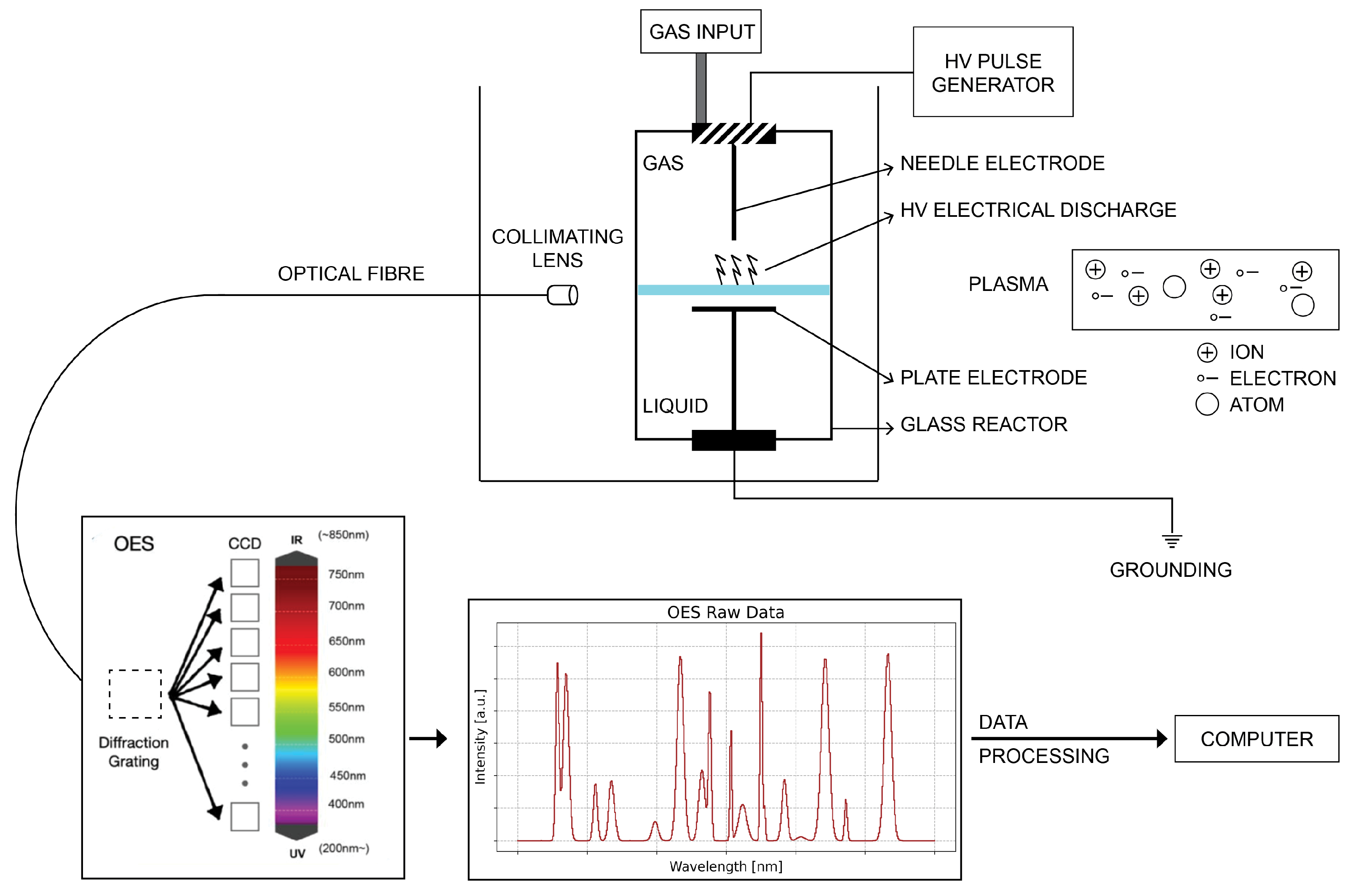
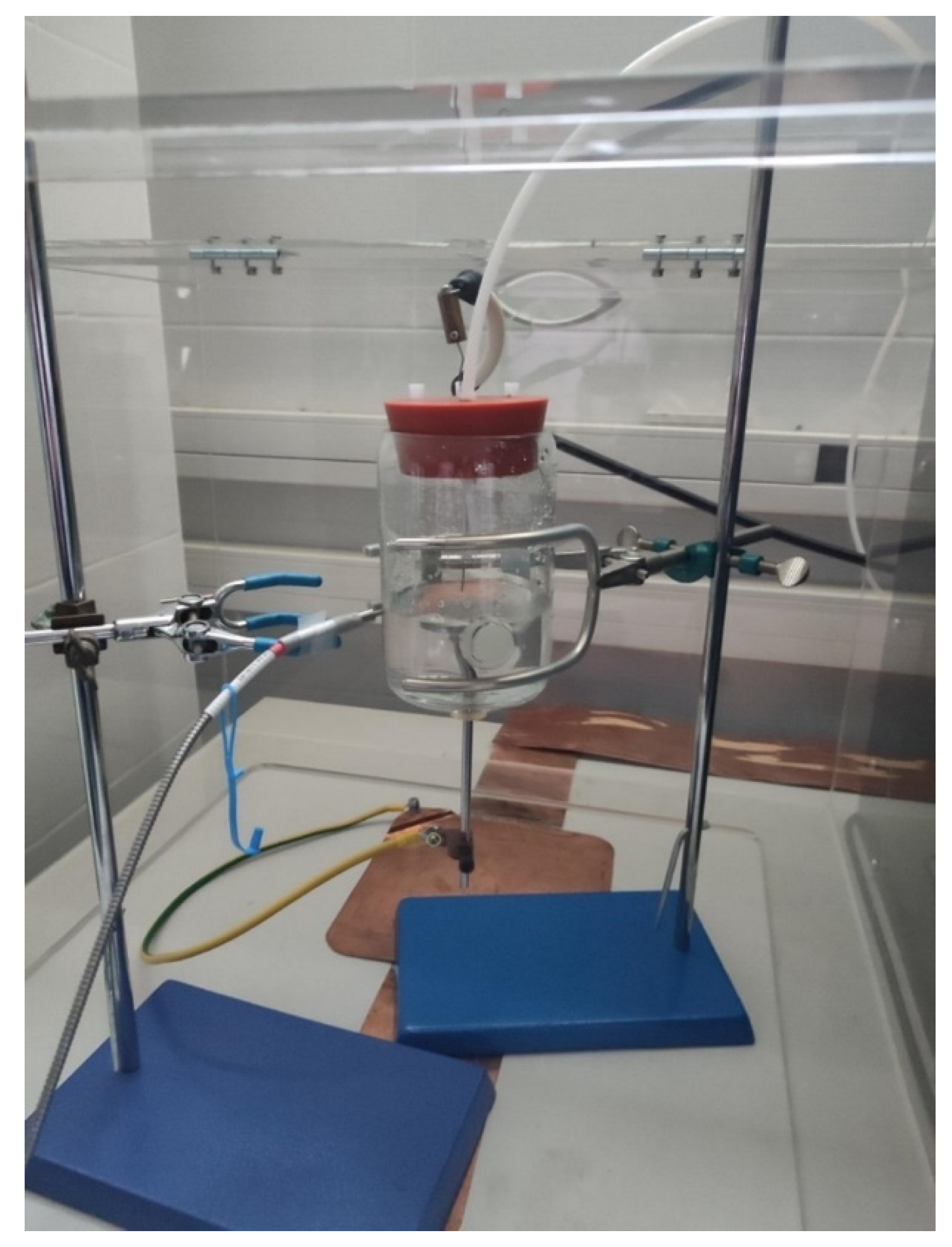
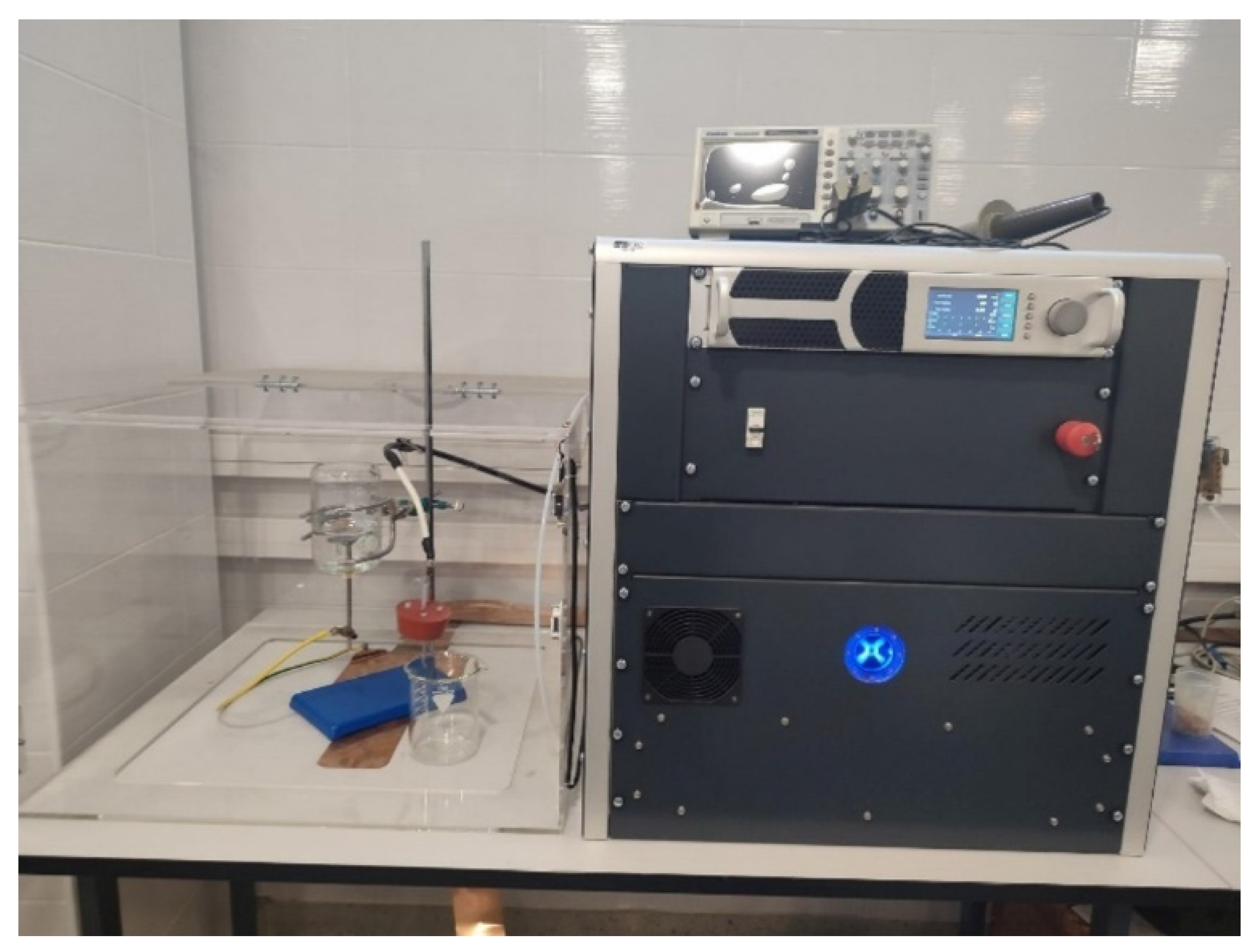
The experimental setup (Figure 1) for high-voltage electrical discharge consisted of a closed Plexiglas box containing a glass reactor (300–1000 mL) with a point-to-plate electrode configuration. A stainless-steel medical needle (Microlance TM 3.81 cm) was used as the high-voltage electrode and a stainless-steel electrode was used as the ground electrode. In such laboratory experiments, plasma can be generated in the liquid and gaseous phase. The high-voltage electrode was located in the gas phase above the water surface. The plate electrode was placed in a certain amount of distilled water (depending on the size of the reactor and the position of the electrodes), which covered it so that the electrode did not touch the walls of the glass reactor (Figure 2). Argon was used as the working gas for our measurements, and the plasma was characterised in the gas phase. A separately installed IMPEL HVG60/1 high-voltage pulse generator (manufacturer IMPEL GROUP Ltd., Zagreb, Croatia) generated electrical discharges (Figure 3). The device consisted of a part that fed control pulses into the high-voltage system and monitored and controlled the correct operation of the device. The second part converted the input AC voltage of 230 V AC into a DC high voltage of 1–60 kV DC, and the third part transmitted the resulting high voltage in the form of pulses with the parameters set by the user: operating time (0–1800 s), pulse frequency (10–300 Hz), pulse duration (0.40–2.00 µs), HV current (0.1–16 mA). Earthing of the device was mandatory. The measurements were carried out at an operating time of 5 min, a high voltage of 35 kV, a pulse frequency of 60 Hz, a pulse duration of 0.40 µs, and an HV current of 0.4 mA.

2.2. Optical Emission Spectroscopy

Optical emission spectroscopy is a general term for techniques used to obtain optical emission spectra, i.e., the light emission of an excited sample. In plasma analysis, it is necessary to determine the wavelength of a particular spectral line, which enables the identification of a particular species in the plasma system.
Optical emission spectroscopy has very good analytical performance, especially for quality control and material science analyses. The application of optical emission spectroscopy to plasma systems generated by high-voltage electrical discharges is fast and simple and allows high spectral reproducibility and the achievement of consistent results under different conditions with relative standard deviations below 30%, which is in line with common guidelines, e.g., of the Association of Official Agricultural Chemists. The estimation of uncertainty in optical emission spectroscopy is influenced by the overlap of spectral lines, the operating conditions to reduce background noise, and the characteristics and method of using optical fibres for signal transmission. The use of spectrometers with high optical resolution is recommended, while ensuring thermal stability, low humidity and minimal mechanical vibrations.
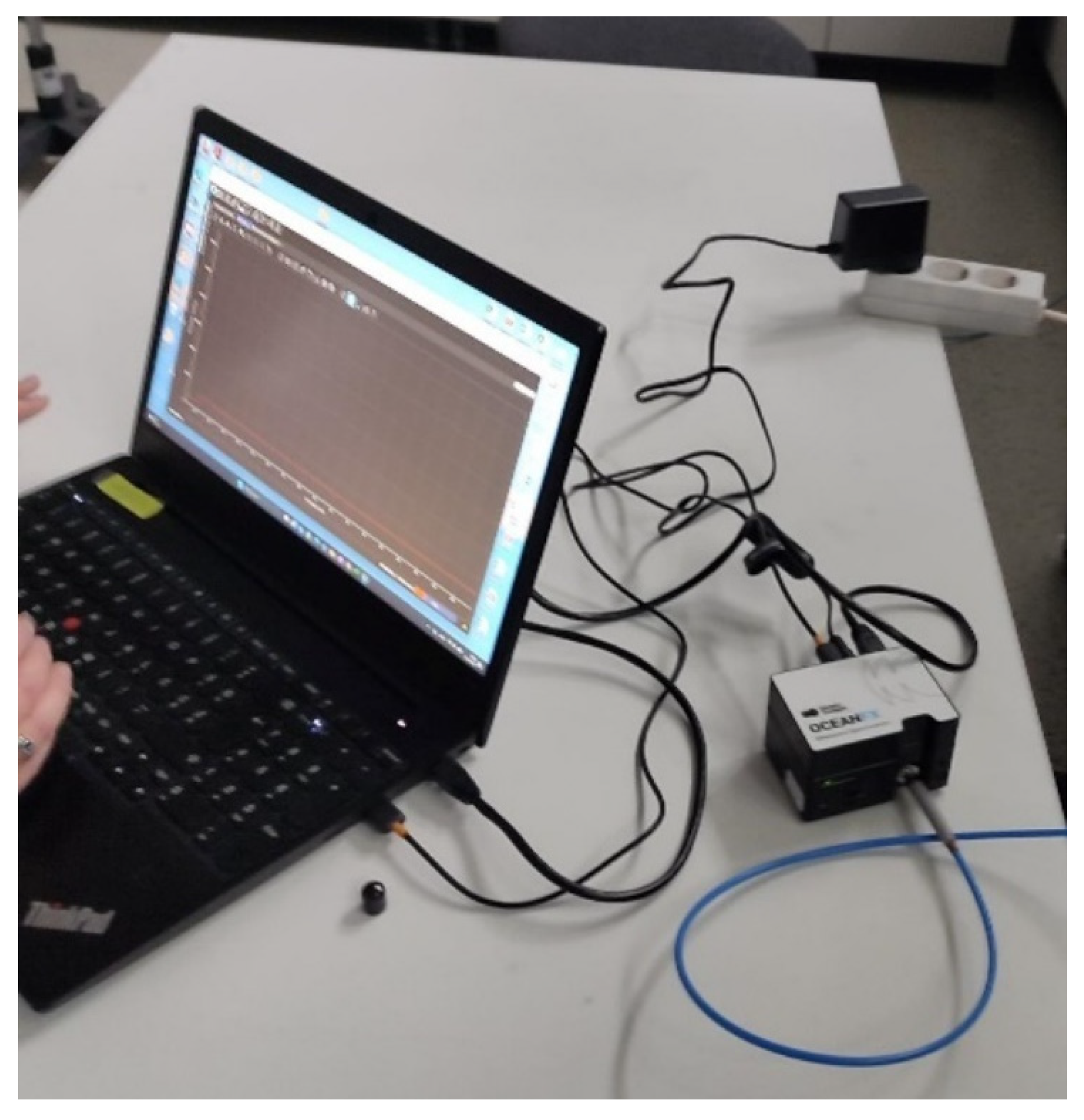
Plasma diagnostics were carried out using the Ocean FX extended range optical emission spectrometer OCEAN-FX-XR1-ES (manufacturer Ocean Optics, Orlando, FL, USA) (Figure 4). The emission of a specific volume in the plasma chamber was transmitted to the spectrometer via an optical fibre (600 µm FIBRE, solarisation resistant, 2 m, S/N). The optical fibre was mounted near a glass reactor above the water surface. The collimating lens 74-UV Collimating Lens UV/VIS 200–2000 nm (manufacturer Ocean Optics, Orlando, FL, USA) can be screwed onto the end of a fibre to collimate the light. The spectrometer is connected to a computer for data processing. The OCEAN FX-XR1-ES is a versatile extended range spectrometer (wavelength 200–1025 nm) that features fast acquisition (up to 4500 scans per second; varies depending on operating system and computer performance), onboard averaging (up to 5000 spectra), onboard processing for improved signal-to-noise ratio (SNR 290:1 full signal), and a reduced data transfer time. The integration time is 10 μs–10 s, the optical resolution is 1.69 nm FWHM (typical) and the thermal stability is 0.11 pixels/°C. It is used for high-speed processes and the measurement of fast events, including flicker in illumination. The spectrometer can be easily connected to other devices via Wi-Fi, RS-232, Gigabit Ethernet and USB. A version of the spectrometer with increased sensitivity (-ES) has a converging lens for the detector, which increases the efficiency of light collection. The spectra were recorded with an integration time of 250 ms and 30 scans for averaging.

2.3. Plasma Diagnostics

A closed plasma system with constant temperature is in thermodynamic equilibrium if the radiation field is given by Planck’s law, the energy distribution of each type of particle in the system corresponds to the classical Maxwell–Boltzmann distribution, the ratio of the population densities of the two energy states is given by the Boltzmann distribution and the principle of detailed equilibrium is applied.
Complete thermodynamic equilibrium cannot be achieved in laboratory plasmas, and deviations from equilibrium occur. Radiation losses are always present. Electrons react more strongly to an electric field than ions due to their much smaller mass. Therefore, electrons gain more energy per unit of time than ions. The temperature of the ions remains lower than the temperature of the electrons. The energy difference between the ground state and the first excited state is usually large, while the energy difference between the excited states is small, especially in noble gases.
However, at high plasma densities, collisions occur frequently enough to maintain the steady-state population density according to the Boltzmann relation and the Saha equation, which indicates the degree of ionisation of the plasma system. Therefore, we can use the concept of local thermodynamic equilibrium (LTE). Electron collisions are much faster and more frequent than ion collisions and therefore provide equilibrium [53].
Radiative emission from atoms and ions occurs when electrons in the observed system transition from one energy level to another and is characterised by spectral lines. Spectroscopic methods are used to observe the radiation emitted by the plasma. In emission spectroscopy, the intensity of the spectral lines can provide various data about the plasma. The radiation intensity I i j is expressed as follows:
I i j = E i j N i A i j
where E i j is the difference between the energy levels E i and E j , and E i > E j , A i j is the transition probability and N i is the population of the upper energy state of i . In most laboratory experiments, measuring the absolute intensity is difficult and sometimes impossible, so the intensity ratio of the spectral lines of the plasma is used:
I i j I m n = λ m n N i A i j λ i j N m A m n
where λ i j is the wavelength of the spectral line corresponding to the transition from energy state i to energy state j . The population of atomic states N generally depends on the temperature and density of the plasma. The simplest approach to determine the electron temperature from the emission of spectral lines is possible if the population densities of the upper levels of the two lines are in partial local thermodynamic equilibrium (PLTE), i.e., if they are connected by the Boltzmann factor, e E i / k B T e , i.e., the probability that a certain number of atoms of energy E i are present in a system of temperature T e .
A more precise estimate of the temperature of the generated plasma can be obtained using the Boltzmann plot, which is a straight line with the slope k B T e :
ln I i j λ i j g i A i j = 1 k B T e E i + ln 4 π Z h c N i
where the above quantities ( I i j , λ i j , A i j , N i ) are also refer to g i as the statistical weight of the energy level, E i as the energy level of the upper state for the emission, T e the electron temperature, Z the partition function, k B the Boltzmann constant, h the Planck constant and c the speed of light [53].
Different mechanisms of spectral line broadening (Doppler, strong, natural, instrumental) influence the spectral profile of the emitted light [53]. The method of Boltzmann plot has an advantage in that optically thick lines can be identified by a large deviation of their data points from the fit expressed by a straight line, always assuming that the transition probabilities of the observed lines are known with sufficient accuracy. The most comprehensive compilation of atomic transition probabilities is available on the website of the National Institute of Standards and Technology (NIST), USA, as the Atomic Transition Probability Bibliographic Database [54]. The database compares theoretical transition probabilities, which were determined using various approximation methods, with experimental values, which were determined using various methods. The comparison of the experimental and theoretical values allows for a fairly good estimate of the final uncertainty, which is also given.

2.4. Statistical Analyses

In this study, the method of least squares was applied, a method for processing experimental data with elements of numerical mathematics and statistics that makes it possible to determine the functional dependence of the measured variables on the experimental data. The function and the values of the function parameters are determined in such a way that the sum of the squares of the differences between the measured and calculated values is minimised, i.e., the function is determined by the curve that approaches the given points as closely as possible. The determined functional dependence makes it possible to predict the value of the measured variable in areas that are not covered by the measurement.
The experimental measurements in our study provided data for intensities in arbitrary units for the corresponding wavelengths of the spectral lines. Each detected spectral line corresponded to the transition of electrons from one energy level to another. Using the NIST spectral data, the results of n measurements are plotted in a two-dimensional rectangular Cartesian coordinate system in which the i-th measurement result corresponds to the coordinates of the i-th point x i ,   y i , the equation of the linear function: y = a x + b , that best fits the measurement results, can be found using the following expressions:
a = n i = 1 n x i y i i = 1 n x i i = 1 n y i n i = 1 n x i 2 i = 1 n x i 2
b = 1 n i = 1 n y i a n i = 1 n x i
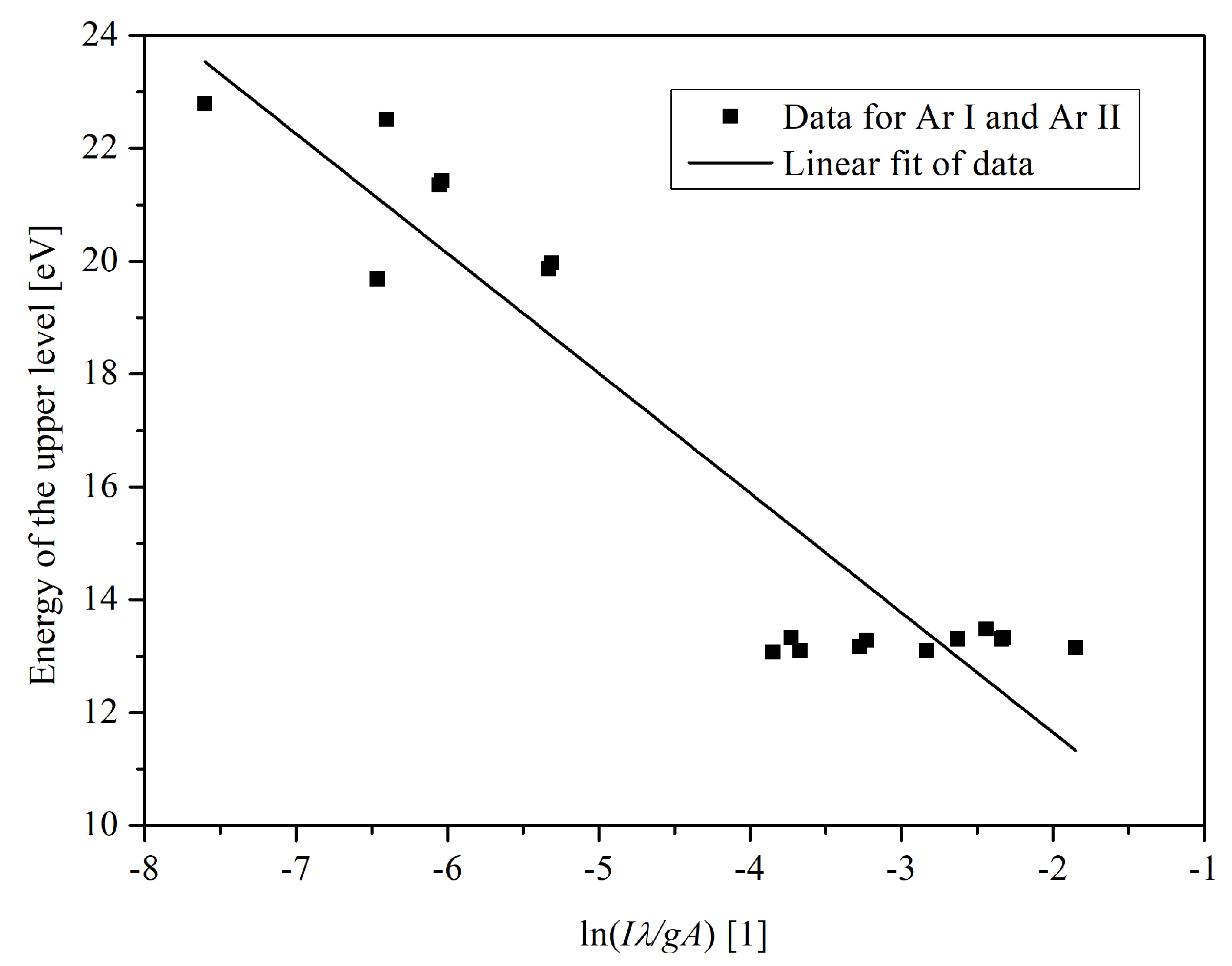
A linear fit was made using the east squares method, i.e., a line whose slope coefficient gives the thermal energy of the electron. The graph created in this way is called a Boltzmann plot.

3. Results and Discussion

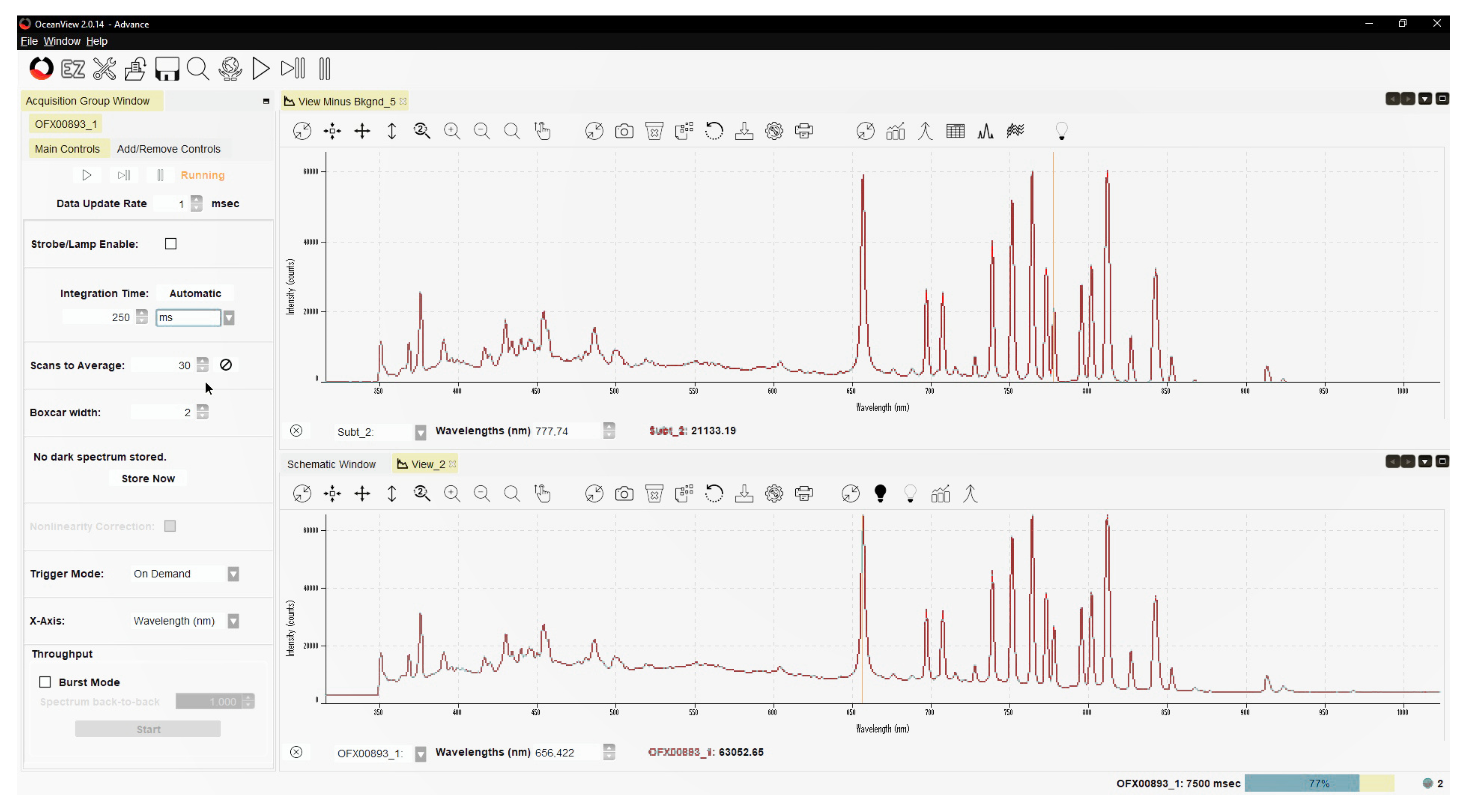
The spectrum obtained with an optical emission spectrometer is shown in Figure 5. The spectral resolution of an optical emission spectrometer (ratio between the wavelength of the measured light and the full width at half maximum (FWHM) of the analysed spectral peak) was a limiting factor when analysing emission lines or monitoring plasmas. Overlapping spectral lines of different species or multiple lines with wavelengths close to the expected wavelength posed a problem in the accurate identification of emission lines. Therefore, it was important to use a high-resolution spectrometer, as we used in our experiment, and spectral line tables with transition probabilities between different energy levels [54].
The generated plasma was dominated by emissions of argon and oxygen. Due to the high radiation intensity, a spectral line of emission of the hydrogen atom was observed at 656.3 nm, corresponding to Hα, the first line of the Balmer series at the transition n = 3 2 ( n is the principal quantum number of the electron). The radiation intensities of the oxygen spectral lines were significantly lower than the radiation intensities of the argon spectral lines, so that only argon lines were considered for the estimation of the electron temperature using the Boltzmann plot (Table 1).
The Boltzmann plot (Figure 6) shows two groups of points that are related to the energies at which ionisation takes place and the degree of ionisation: Ar I and Ar II. In transient plasmas, which receive energy from short high-voltage pulses, the density and temperature of the electrons change rapidly. Although high-voltage electrical discharges due to ionisation do not occur continuously in space and time, assuming a partial local thermodynamic equilibrium, it can be concluded that the temperature of a closed plasma system corresponds to the value resulting from the Boltzmann relation and the Saha equation. Despite the spatial inhomogeneity of the plasma, small volumes are used under laboratory conditions, and the assumption of partial local thermodynamic equilibrium is valid. There are always enough fast, high-energy electrons in the tail of the Maxwell distribution to cause ionisation, even at temperatures characteristic of low-temperature plasmas. The radiation intensities of the spectral lines of Ar I were higher than the intensity for Ar II, and the system reached a temperature reflecting that it is a complex system of electrons, ions and neutral atoms. The addition of energy to the system supported ionisation and the plasma state, but recombination and cooling occurred rapidly. The temperature of the ions and neutral atoms, which were not ionised, remained low at 300–350 K. The use of non-thermal plasma technology can increase the temperature of the system to a lesser extent, but not enough to cause thermal damage or change the properties of the system to which it is applied. Non-thermal technologies work at temperatures up to 350 K, but non-thermal plasma technology works at temperatures close to room temperature. The Boltzmann plot in our study with experimentally obtained spectral data gave the electron temperature T e = 24 ± 2 · 10 3   K and the electron thermal energy k B T e = 2.1 ± 0.2   eV .
In optical emission spectroscopy, the signal was averaged over the observed interval to increase the signal-to-noise ratio (SNR). However, laboratory-generated plasmas are almost always inhomogeneous, which should be taken into account when making assumptions to fulfil the thermodynamic equilibrium conditions: local thermodynamic equilibrium or partial local thermodynamic equilibrium. The requirement for the complete local thermodynamic equilibrium can be expressed as follows:
n e m 3 1.4 · 10 20 E i E j eV 3 k B T e eV 1 / 2
E i , E j are the energies of the two states i and j. Since the plasma generated in the experiments fulfils the conditions of the partial local thermodynamic equilibrium, the requirement for a complete partial local thermodynamic equilibrium should be replaced by the requirement for a low-temperature range in which radiative recombination dominates:
n e m 3 1 · 10 20 E E g eV 5 / 2 k B T e eV 3
where E E g is the ionisation energy of the lower level (ground state g) [53]. For argon, the ionisation energy of the ground state is E g = 15.759 ± 0.001   eV . The estimated electron density in our study was in the range of 10 21 10 23   m 3 .
The electron temperature and electron density results obtained in our plasma monitoring and analysis are consistent with similar research on the application of non-thermal plasma technology in the food sector.
In examining cold plasma as an emerging non-thermal technology for food processing, the authors provide a comprehensive overview of cold plasma applications for the microbiological decontamination of a variety of foods. They emphasise the importance of selecting the appropriate cold plasma technology for different food products depending on the characteristics of the generated plasma, especially the electronic temperature, which should not exceed 20,000 K. The working temperatures range up to 330 K, which preserves the sensory and nutritional properties of the food and reduces the treatment time. In addition, the impressive results of decontamination of various fruits and vegetables are listed [3].
In a review of research on the effects of non-thermal plasmas on food nutrients and grain-based raw materials in surface sterilisation and decontamination processes, non-thermal plasma treatments at an estimated electronic temperature of about 10,000 K have shown promising results in modifying the properties of food raw materials, with an improvement in physicochemical properties with working temperatures not exceeding 330 K [55].
The food packaging industry is facing numerous challenges related to the growing number of bacteria that are resistant to various treatment methods. It is shown that cold atmospheric plasma with electron temperatures around 10,000 K and ionic temperatures, i.e., gas temperatures around 300 K, can inactivate microorganisms such as spores and microbial toxins and extend the shelf life of food without undesirable effects. The advantages of using non-thermal plasmas clearly outweigh the disadvantages such as equipment costs and material incompatibility [37].
In a review of the effects of cold plasmas on food quality, the authors divide low-temperature plasmas into thermal plasmas, i.e., quasi-equilibrium plasmas that are in local thermodynamic equilibrium, and non-thermal plasmas, in which the electron temperatures are about 10,000–100,000 K and the temperatures of the heavier species are about 300–1000 K. In addition to the excellent results of microbiological analyses carried out after cold plasma treatment of various types of fruit, vegetables and meat, they emphasise the importance of the choice of the operating parameters (plasma source, electrode configuration and spacing, applied voltage, treatment time, working gas, etc.), which influence the discharge characteristics, the concentration of reactive species and the efficiency of the process [56].
In a review of the influence of non-thermal plasmas on the microstructure and ingredients of foods, the authors show that after elastic collisions in the plasma, the electron temperature can be more than 10,000 K, while the ion temperature remains at room temperature. The temperature of the process gas remains much lower than the electron temperature, which enables non-thermal plasma treatment in the low-temperature range. During inelastic collisions, an energy transfer of more than 15 eV can take place, leading to excitation, dissociation and ionisation, i.e., the formation of reactive species in the plasma, which are responsible for functional changes and inactivation of microorganisms. The importance of optimising the operating parameters in non-thermal plasma treatments and the positive results obtained are again emphasised [25].
The use of non-thermal plasmas for decontamination is always associated with some challenges, and it is pointed out that the main problem lies in the control of various physical and chemical processes and biological influences at the molecular level and below. Laboratory-generated low-temperature plasmas have thermal electron energies of up to 10 eV, i.e., electron temperatures of 100,000 K, while the gas and ion temperatures remain significantly lower, in the range from room temperature to several thousand K. Research in the field of low-temperature plasmas focuses on the mechanisms of plasma generation and plasma diagnostics, which gives an insight into the potential of utilising non-thermal plasmas [57].
In a study on the properties of cold atmospheric plasmas, authors propose the use of cold atmospheric plasmas at an average working temperature of 300–330 K in food processing and agriculture, among others. The estimated thermal energies of the electrons depend on the type of gas in which the discharge takes place, so that the values range from 2.2 eV in argon to 3.5 eV in air or helium. In one of the papers, the electron density is estimated to be around 1022 m−3. They emphasise the importance of understanding the physical, chemical and biophysical processes together with the discharge parameters in order to determine the effects on the material to be treated [58].
The measurements of the electron temperature and the density of the atmospheric plasma are carried out in research with atmospheric argon plasma generated by a dielectric barrier discharge. The determined electron temperature is in the range of 1–10 eV and the estimated electron density is 1019–1024 m−3 under the assumption of a partial local thermodynamic equilibrium [59]
The electron density and temperature of the cold argon plasma jets are determined at normal atmospheric pressure using the optical emission spectroscopy method and the Stark expansion analysis method for two emission lines in the study [60]. Depending on the applied high voltage, the electron temperatures were up to 1.32 eV and the electron density was in the order of magnitude of 1023 m−3.
In the experimental investigation of the cold atmospheric pressure plasma jet and its application, the authors used argon as the working gas. The optical characterisation of the discharge was carried out by means of Stark broadening and the Boltzmann plot method using optical emission spectroscopy. The results are 1 eV for electron temperature and 1022 m−3 for electron density [61].
A parametric study of the electron temperature of an industrially produced plasma jet was carried out using optical emission spectroscopy. The results for the electron temperature (1 eV) and the density (1021 m−3) show that it is a non-thermal plasma with numerous applications [52].
A comparison of the experimentally determined parameters for non-thermal plasmas is shown in Table 2. These experiments were not performed for food applications but show that the values for electron temperature and electron density are comparable in plasmas generated in the same way as they are generated for food applications, i.e., by gas discharge or plasma jet. A specific contribution of this work is the monitoring and diagnostics of non-thermal plasma generated by high-voltage electrical discharge, a well-established method for plasma generation in the food sector. Optical emission spectroscopy as an established diagnostic tool in plasma physics is usually only used for the detection of spectral lines in the food industry. Coupling a carefully selected optical emission spectrometer with a high-voltage electrical discharge is recommended for the daily control of food processing, especially to confirm that the processes are non-thermal and suitable for food industry applications such as extraction of bioactive components or microorganism inactivation.
The parameter values obtained in our study show that it is a non-thermal plasma that can be successfully used as a non-thermal technology, especially for the inactivation of microorganisms [3,26,33,37,43,55,56,57,62,63,64,65,66,67,68,69].

4. Conclusions

Today, plasma technology is established as a key and cross-sectional technology in many industries as a modern technological standard. It has a wide range of applications, from industry to mechanical engineering and medicine to research, and plays an important role in various areas of human life and activity.
Plasma can be generated at different pressures and temperatures. Changing the pressure and temperature values leads to a change in the chemical species in the generated plasma, which can significantly affect the behaviour of the plasma system but also enables the generation of plasmas suitable for a very wide range of applications. In our case, we confirmed that precise control and adjustment of these parameters is key to maintaining stable, reliable and reproducible processes.
Furthermore, our results confirm that monitoring the plasma with optical emission spectroscopy in near-real time is important to determine whether it is a plasma system at all. The high spectral resolution, a key feature of an optical emission spectrometer, allows for a more accurate identification of the excited species generated in the plasma and facilitates plasma diagnostics, i.e., the determination of the most important parameters describing the plasma, electron density, and electron temperature. For a better interpretation of the results and a better adaptation of the working conditions, it is suggested to perform measurements with different parameters of the high-voltage pulse generator (operating time, high voltage, pulse frequency, pulse duration and HV current) and different parameters for the optical emission spectrometer (integration time, scans to average). It is also possible to use other working gases instead of argon. Non-thermal plasma diagnostics in the food sector can also be improved in the future through the use of Industry 4.0 technologies: Big Data analysis for a more accurate assessment of physical quantities based on spectroscopic measurements and machine learning for predictions and finding patterns in the dynamics of complex non-thermal plasma systems.

Author Contributions

Conceptualization, S.P. and F.K.; methodology, S.P.; software, S.P. and F.K.; validation, S.P.; formal analysis, S.P. and F.K.; investigation, S.P. and F.K.; resources, S.P.; data curation, S.P. and F.K.; writing—original draft preparation, S.P. and F.K.; writing—review and editing, S.P.; visualisation, S.P. and F.K.; supervision, S.P.; project administration, S.P.; funding acquisition, S.P. All authors have read and agreed to the published version of the manuscript.

Funding

This research was funded by the European Union’s Horizon 2020 PRIMA (The Partnership for Research and Innovation in the Mediterranean Area) programme under grant agreement No: 2032—Functionalized Tomato Products (FunTomP).

Data Availability Statement

Data are contained within the article.

Conflicts of Interest

The authors declare no conflict of interest.

References

  1. European Commission. The European Green Deal; Farm to Fork Strategy; European Union, 2020. Available online: https://food.ec.europa.eu/document/download/472acca8-7f7b-4171-98b0-ed76720d68d3_en?filename=f2f_action-plan_2020_strategy-info_en.pdf (accessed on 15 December 2024).
  2. Cioca, A.-A.; Tušar, L.; Langerholc, T. Food Risk Analysis: Towards a Better Understanding of “Hazard” and “Risk” in EU Food Legislation. Foods 2023, 12, 2857. [Google Scholar] [CrossRef]
  3. Harikrishna, S.; Anil, P.P.; Shams, R.; Dash, K.K. Cold Plasma as an Emerging Nonthermal Technology for Food Processing: A Comprehensive Review. J. Agric. Food Res. 2023, 14, 100747. [Google Scholar] [CrossRef]
  4. Sarangi, P.K.; Pal, P.; Singh, A.K.; Sahoo, U.K.; Prus, P. Food Waste to Food Security: Transition from Bioresources to Sustainability. Resources 2024, 13, 164. [Google Scholar] [CrossRef]
  5. Pai, A.S.; Jaiswal, S.; Jaiswal, A.K. A Comprehensive Review of Food Safety Culture in the Food Industry: Leadership, Organizational Commitment, and Multicultural Dynamics. Foods 2024, 13, 4078. [Google Scholar] [CrossRef]
  6. Dangal, A.; Timsina, P.; Dahal, S.; Rai, K.; Giuffrè, A.M. Advances in Non-Thermal Food Processing Methods-Principle Advantages and Limitations for the Establishment of Minimal Food Quality as Well as Safety Issues: A Review. Curr. Nutr. Food Sci. 2024, 20, 836–849. [Google Scholar] [CrossRef]
  7. Santos, M.I.; Grácio, M.; Silva, M.C.; Pedroso, L.; Lima, A. One Health Perspectives on Food Safety in Minimally Processed Vegetables and Fruits: From Farm to Fork. Microorganisms 2023, 11, 2990. [Google Scholar] [CrossRef]
  8. Zdulski, J.A.; Rutkowski, K.P.; Konopacka, D. Strategies to Extend the Shelf Life of Fresh and Minimally Processed Fruit and Vegetables with Edible Coatings and Modified Atmosphere Packaging. Appl. Sci. 2024, 14, 11074. [Google Scholar] [CrossRef]
  9. Günden, C.; Atakan, P.; Yercan, M.; Mattas, K.; Knez, M. Consumer Response to Novel Foods: A Review of Behavioral Barriers and Drivers. Foods 2024, 13, 2051. [Google Scholar] [CrossRef]
  10. Laureati, M.; De Boni, A.; Saba, A.; Lamy, E.; Minervini, F.; Delgado, A.M.; Sinesio, F. Determinants of Consumers’ Acceptance and Adoption of Novel Food in View of More Resilient and Sustainable Food Systems in the EU: A Systematic Literature Review. Foods 2024, 13, 1534. [Google Scholar] [CrossRef]
  11. Wei, W.; Yang, S.; Yang, F.; Hu, X.; Wang, Y.; Guo, W.; Yang, B.; Xiao, X.; Zhu, L. Cold Plasma Controls Nitrite Hazards by Modulating Microbial Communities in Pickled Radish. Foods 2023, 12, 2550. [Google Scholar] [CrossRef]
  12. Birania, S.; Attkan, A.K.; Kumar, S.; Kumar, N.; Singh, V.K. Cold Plasma in Food Processing and Preservation: A Review. J. Food Process Eng. 2022, 45, e14110. [Google Scholar] [CrossRef]
  13. Farooq, S.; Dar, A.H.; Dash, K.K.; Srivastava, S.; Pandey, V.K.; Ayoub, W.S.; Pandiselvam, R.; Manzoor, S.; Kaur, M. Cold Plasma Treatment Advancements in Food Processing and Impact on the Physiochemical Characteristics of Food Products. Food Sci. Biotechnol. 2023, 32, 621–638. [Google Scholar] [CrossRef]
  14. Fernandes, F.A.N.; Rodrigues, S. Cold Plasma Processing on Fruits and Fruit Juices: A Review on the Effects of Plasma on Nutritional Quality. Processes 2021, 9, 2098. [Google Scholar] [CrossRef]
  15. Picart-Palmade, L.; Cunault, C.; Chevalier-Lucia, D.; Belleville, M.-P.; Marchesseau, S. Potentialities and Limits of Some Non-Thermal Technologies to Improve Sustainability of Food Processing. Front. Nutr. 2019, 5, 130. [Google Scholar] [CrossRef]
  16. Silva, F.V.M.; Oey, I. Non-Thermal Technologies for Food Processing. Appl. Sci. 2023, 13, 7734. [Google Scholar] [CrossRef]
  17. Fernandes, F.A.N.; Rodrigues, S.; Ozuna, C. Editorial on the Special Issue “Non-Thermal Technologies in Food Science”. Processes 2024, 12, 2862. [Google Scholar] [CrossRef]
  18. Dao, U.H.; Lamphun, J.N.; Tongdonyod, S.; Taya, S.; Phongthai, S.; Klangpetch, W. Optimization of High-Pressure Processing for Microbial Inactivation in Pigmented Rice Grass Juice and Quality Impact Assessment during Refrigerated Storage. Foods 2024, 13, 2995. [Google Scholar] [CrossRef]
  19. Zhou, Y.; Zuo, H.; Dai, Z.; Guo, Z.; Holman, B.W.B.; Ding, Y.; Shi, J.; Ding, X.; Huang, M.; Mao, Y. Changes to Pork Bacterial Counts and Composition After Dielectric Barrier Discharge Plasma Treatment and Storage in Modified-Atmosphere Packaging. Foods 2024, 13, 4162. [Google Scholar] [CrossRef]
  20. Park, G.-S.; Seo, H.; Lee, H.-B.; Lee, J.-W.; Shahbaz, H.M.; Jeong, S.-H.; Lee, D.-U. Enhanced Peelability and Quality of Whiteleg Shrimp (Litopenaeus Vannamei) Using Pulsed Electric Field (PEF) Treatment. Foods 2025, 14, 148. [Google Scholar] [CrossRef]
  21. Pasdar, N.; Mostashari, P.; Greiner, R.; Khelfa, A.; Rashidinejad, A.; Eshpari, H.; Vale, J.M.; Gharibzahedi, S.M.T.; Roohinejad, S. Advancements in Non-Thermal Processing Technologies for Enhancing Safety and Quality of Infant and Baby Food Products: A Review. Foods 2024, 13, 2659. [Google Scholar] [CrossRef]
  22. Safwa, S.M.; Ahmed, T.; Talukder, S.; Sarkar, A.; Rana, M.R. Applications of Non-Thermal Technologies in Food Processing Industries-A Review. J. Agric. Food Res. 2024, 18, 100917. [Google Scholar] [CrossRef]
  23. Bilea, F.; Garcia-Vaquero, M.; Magureanu, M.; Mihaila, I.; Mildažienė, V.; Mozetič, M.; Pawłat, J.; Primc, G.; Puač, N.; Robert, E.; et al. Non-Thermal Plasma as Environmentally-Friendly Technology for Agriculture: A Review and Roadmap. CRC Crit. Rev. Plant Sci. 2024, 43, 428–486. [Google Scholar] [CrossRef]
  24. López, M.; Calvo, T.; Prieto, M.; Múgica-Vidal, R.; Muro-Fraguas, I.; Alba-Elías, F.; Alvarez-Ordóñez, A. A Review on Non-Thermal Atmospheric Plasma for Food Preservation: Mode of Action, Determinants of Effectiveness, and Applications. Front. Microbiol. 2019, 10, 622. [Google Scholar] [CrossRef]
  25. Muhammad, A.I.; Xiang, Q.; Liao, X.; Liu, D.; Ding, T. Understanding the Impact of Nonthermal Plasma on Food Constituents and Microstructure—A Review. Food Bioproc. Tech. 2018, 11, 463–486. [Google Scholar] [CrossRef]
  26. Sanito, R.C.; You, S.-J.; Wang, Y.-F. Degradation of Contaminants in Plasma Technology: An Overview. J. Hazard. Mater. 2022, 424, 127390. [Google Scholar] [CrossRef]
  27. Bogusławska-Wąs, E.; Dłubała, A.; Sawicki, W.; Ożgo, M.; Lepczyński, A. The Effect of Cold Plasma on Selected Parameters of Bovine Colostrum. Appl. Sci. 2023, 13, 5490. [Google Scholar] [CrossRef]
  28. Mravlje, J.; Regvar, M.; Vogel-Mikuš, K. Development of Cold Plasma Technologies for Surface Decontamination of Seed Fungal Pathogens: Present Status and Perspectives. J. Fungi 2021, 7, 650. [Google Scholar] [CrossRef]
  29. Todorova, Y.; Benova, E.; Marinova, P.; Yotinov, I.; Bogdanov, T.; Topalova, Y. Non-Thermal Atmospheric Plasma for Microbial Decontamination and Removal of Hazardous Chemicals: An Overview in the Circular Economy Context with Data for Test Applications of Microwave Plasma Torch. Processes 2022, 10, 554. [Google Scholar] [CrossRef]
  30. Konchekov, E.M.; Gudkova, V.V.; Burmistrov, D.E.; Konkova, A.S.; Zimina, M.A.; Khatueva, M.D.; Polyakova, V.A.; Stepanenko, A.A.; Pavlik, T.I.; Borzosekov, V.D.; et al. Bacterial Decontamination of Water-Containing Objects Using Piezoelectric Direct Discharge Plasma and Plasma Jet. Biomolecules 2024, 14, 181. [Google Scholar] [CrossRef]
  31. Cherif, M.M.; Assadi, I.; Khezami, L.; Ben Hamadi, N.; Assadi, A.A.; Elfalleh, W. Review on Recent Applications of Cold Plasma for Safe and Sustainable Food Production: Principles, Implementation, and Application Limits. Appl. Sci. 2023, 13, 2381. [Google Scholar] [CrossRef]
  32. Vaka, U.; Ramkumar, M. Application of Non-Thermal Plasma Technology for Enhancing Food Processing and Storage: A Review. Food Chem. Adv. 2024, 5, 100788. [Google Scholar] [CrossRef]
  33. Pinela, J.; Ferreira, I.C.F.R. Nonthermal Physical Technologies to Decontaminate and Extend the Shelf-Life of Fruits and Vegetables: Trends Aiming at Quality and Safety. Crit. Rev. Food Sci. Nutr. 2017, 57, 2095–2111. [Google Scholar] [CrossRef]
  34. Jiang, H.; Lin, Q.; Shi, W.; Yu, X.; Wang, S. Food Preservation by Cold Plasma from Dielectric Barrier Discharges in Agri-Food Industries. Front. Nutr. 2022, 9, 1015980. [Google Scholar] [CrossRef]
  35. Li, Y.; Huang, X.; Yang, Y.; Mulati, A.; Hong, J.; Wang, J. The Effects of Cold-Plasma Technology on the Quality Properties of Fresh-Cut Produce: A Review. Foods 2025, 14, 149. [Google Scholar] [CrossRef]
  36. Sonawane, S.K.; T, M.; Patil, S. Non-Thermal Plasma: An Advanced Technology for Food Industry. Food Sci. Technol. Int. 2020, 26, 727–740. [Google Scholar] [CrossRef]
  37. Barjasteh, A.; Kaushik, N.; Choi, E.H.; Kaushik, N.K. Cold Atmospheric Pressure Plasma Solutions for Sustainable Food Packaging. Int. J. Mol. Sci. 2024, 25, 6638. [Google Scholar] [CrossRef]
  38. Karthik, C.; Mavelil-Sam, R.; Thomas, S.; Thomas, V. Cold Plasma Technology Based Eco-Friendly Food Packaging Biomaterials. Polymers 2024, 16, 230. [Google Scholar] [CrossRef]
  39. Roselló-Soto, E.; Barba, F.J.; Parniakov, O.; Galanakis, C.M.; Lebovka, N.; Grimi, N.; Vorobiev, E. High Voltage Electrical Discharges, Pulsed Electric Field, and Ultrasound Assisted Extraction of Protein and Phenolic Compounds from Olive Kernel. Food Bioproc. Tech. 2015, 8, 885–894. [Google Scholar] [CrossRef]
  40. Li, Z.; Fan, Y.; Xi, J. Recent Advances in High Voltage Electric Discharge Extraction of Bioactive Ingredients from Plant Materials. Food Chem. 2019, 277, 246–260. [Google Scholar] [CrossRef]
  41. Drévillon, L.; Nemer, G.; Mitri, S.; El Kantar, S.; Maroun, R.G.; Louka, N.; Koubaa, M. Application of High-Voltage Electrical Discharges and Other Alternative Technologies for Microbial Cell Lysis and Extraction of Biocompounds. In Processing of Food Products and Wastes with High Voltage Electrical Discharges; Elsevier: Amsterdam, The Netherlands, 2023; pp. 199–222. [Google Scholar]
  42. Anpilov, A.M.; Barkhudarov, E.M.; Christofi, N.; Kop’ev, V.A.; Kossyi, I.A.; Taktakishvili, M.I.; Zadiraka, Y. Pulsed High Voltage Electric Discharge Disinfection of Microbially Contaminated Liquids. Lett. Appl. Microbiol. 2002, 35, 90–94. [Google Scholar] [CrossRef]
  43. Delsart, C.; Grimi, N.; Boussetta, N.; Miot Sertier, C.; Ghidossi, R.; Vorobiev, E.; Mietton Peuchot, M. Impact of Pulsed-Electric Field and High-Voltage Electrical Discharges on Red Wine Microbial Stabilization and Quality Characteristics. J. Appl. Microbiol. 2016, 120, 152–164. [Google Scholar] [CrossRef]
  44. Pan, D.; Wen, D.; Guo, X.; Song, H.; Bai, S. Factors Influencing the Sterilization of E. Coli in a High-Voltage Electric Field: Electric Field Strength, Temperature and Humidity. Processes 2025, 13, 551. [Google Scholar] [CrossRef]
  45. Marček, T.; Kovač, T.; Jukić, K.; Lončarić, A.; Ižaković, M. Application of High Voltage Electrical Discharge Treatment to Improve Wheat Germination and Early Growth under Drought and Salinity Conditions. Plants 2021, 10, 2137. [Google Scholar] [CrossRef]
  46. Wang, Q.; Li, Y.; Sun, D.-W.; Zhu, Z. Enhancing Food Processing by Pulsed and High Voltage Electric Fields: Principles and Applications. Crit. Rev. Food Sci. Nutr. 2018, 58, 2285–2298. [Google Scholar] [CrossRef]
  47. Tiban, N.N.; Šimović, M.; Polović, M.; Šarić, A.; Tomac, I.; Matić, P.; Jakobek, L. The Effect of High Voltage Electrical Discharge on the Physicochemical Properties and the Microbiological Safety of Rose Hip Nectars. Foods 2022, 11, 651. [Google Scholar] [CrossRef]
  48. Al-Sharify, Z.T.; Al-Najjar, S.Z.; Anumudu, C.K.; Hart, A.; Miri, T.; Onyeaka, H. Non-Thermal Technologies in Food Processing: Implications for Food Quality and Rheology. Appl. Sci. 2025, 15, 3049. [Google Scholar] [CrossRef]
  49. White, S.; Jackson-Davis, A.; Gordon, K.; Morris, K.; Dudley, A.; Abdallah-Ruiz, A.; Allgaier, K.; Sharpe, K.; Yenduri, A.K.; Green, K.; et al. A Review of Non-Thermal Interventions in Food Processing Technologies. J. Food Prot. 2025, 88, 100508. [Google Scholar] [CrossRef]
  50. Allai, F.M.; Azad, Z.R.A.A.; Mir, N.A.; Gul, K. Recent Advances in Non-Thermal Processing Technologies for Enhancing Shelf Life and Improving Food Safety. Appl. Food Res. 2023, 3, 100258. [Google Scholar] [CrossRef]
  51. Charoux, C.M.G.; Free, L.; Hinds, L.M.; Vijayaraghavan, R.K.; Daniels, S.; O’Donnell, C.P.; Tiwari, B.K. Effect of Non-Thermal Plasma Technology on Microbial Inactivation and Total Phenolic Content of a Model Liquid Food System and Black Pepper Grains. LWT 2020, 118, 108716. [Google Scholar] [CrossRef]
  52. Giannakaris, N.; Gürtler, G.; Stehrer, T.; Mair, M.; Pedarnig, J.D. Optical Emission Spectroscopy of an Industrial Thermal Atmospheric Pressure Plasma Jet: Parametric Study of Electron Temperature. Spectrochim. Acta Part B At. Spectrosc. 2023, 207, 106736. [Google Scholar] [CrossRef]
  53. Kunze, H.-J. Introduction to Plasma Spectroscopy; Springer: Berlin/Heidelberg, Germany, 2009; Volume 56, ISBN 978-3-642-02232-6. [Google Scholar]
  54. NIST (National Institute of Standards and Technology). NIST Atomic Spectra Database (Ver. 5.12), [Online]. Available online: https://physics.nist.gov/asd (accessed on 15 December 2024).
  55. Barros, J.H.T.; Sampaio, U.M.; Montenegro, F.M.; Steel, C.J.; de Amorim Filho, J.; Clerici, M.T.P.S. Efeito Do Plasma Não Térmico Nos Nutrientes de Alimentos e Matérias-Primas à Base de Cereais. Res. Soc. Dev. 2022, 11, e15611326261. [Google Scholar] [CrossRef]
  56. Pankaj, S.; Wan, Z.; Keener, K. Effects of Cold Plasma on Food Quality: A Review. Foods 2018, 7, 4. [Google Scholar] [CrossRef]
  57. Lu, X.; Bruggeman, P.J.; Reuter, S.; Naidis, G.; Bogaerts, A.; Laroussi, M.; Keidar, M.; Robert, E.; Pouvesle, J.-M.; Liu, D.; et al. Grand Challenges in Low Temperature Plasmas. Front. Phys. 2022, 10, 1040658. [Google Scholar] [CrossRef]
  58. Artem’ev, K.V.; Bogachev, N.N.; Gusein-zade, N.G.; Dolmatov, T.V.; Kolik, L.V.; Konchekov, E.M.; Andreev, S.E. Study of Characteristics of the Cold Atmospheric Plasma Source Based on a Piezo Transformer. Russ. Phys. J. 2020, 62, 2073–2080. [Google Scholar] [CrossRef]
  59. Tabaie, S.S.; Iraji, D.; Amrollahi, R. Measurement of Electron Temperature and Density of Atmospheric Plasma Needle. Vacuum 2020, 182, 109761. [Google Scholar] [CrossRef]
  60. Zachi, B.; Abood, Z.; Khadayeir, A. Measurement of Electron Temperature (Te) and Electron Density (Ne) Cold Plasma Jets Optical Emission Spectroscopy (OES) Method. Mustansiriyah J. Pure Appl. Sci. 2024, 2, 126–133. [Google Scholar]
  61. Baniya, H.B.; Guragain, R.P.; Baniya, B.; Subedi, D.P. Experimental Study of Cold Atmospheric Pressure Plasma Jet and Its Application in the Surface Modification of Polypropylene. Rev. Adhes. Adhes. 2020, 8, S1–S14. [Google Scholar] [CrossRef]
  62. Doshi, P.; Šerá, B. Role of Non-Thermal Plasma in Fusarium Inactivation and Mycotoxin Decontamination. Plants 2023, 12, 627. [Google Scholar] [CrossRef]
  63. Laskowska, M.; Boguslawska-Was, E.; Kowal, P.; Holub, M.; Dabrowski, W. Efficiency of Using Non-Thermal Plasma in Microbiology and Medicine. Postep. Mikrobiol. 2016, 55, 172–181. [Google Scholar]
  64. Ziuzina, D.; Patil, S.; Cullen, P.J.; Keener, K.M.; Bourke, P. Atmospheric Cold Plasma Inactivation of Escherichia Coli, Salmonella Enterica Serovar Typhimurium and Listeria Monocytogenes Inoculated on Fresh Produce. Food Microbiol. 2014, 42, 109–116. [Google Scholar] [CrossRef]
  65. Kim, J.H.; Min, S.C. Microwave-Powered Cold Plasma Treatment for Improving Microbiological Safety of Cherry Tomato against Salmonella. Postharvest Biol. Technol. 2017, 127, 21–26. [Google Scholar] [CrossRef]
  66. Min, S.C.; Roh, S.H.; Niemira, B.A.; Boyd, G.; Sites, J.E.; Fan, X.; Sokorai, K.; Jin, T.Z. In-Package Atmospheric Cold Plasma Treatment of Bulk Grape Tomatoes for Microbiological Safety and Preservation. Food Res. Int. 2018, 108, 378–386. [Google Scholar] [CrossRef]
  67. Ali, M.; Cheng, J.; Sun, D. Effects of Dielectric Barrier Discharge Cold Plasma Treatments on Degradation of Anilazine Fungicide and Quality of Tomato (Lycopersicon Esculentum Mill) Juice. Int. J. Food Sci. Technol. 2021, 56, 69–75. [Google Scholar] [CrossRef]
  68. Ojha, S.; Fröhling, A.; Durek, J.; Ehlbeck, J.; Tiwari, B.K.; Schlüter, O.K.; Bußler, S. Principles and Application of Cold Plasma in Food Processing. In Innovative Food Processing Technologies; Elsevier: Amsterdam, The Netherlands, 2021; pp. 519–540. [Google Scholar]
  69. Han, L.; Patil, S.; Boehm, D.; Milosavljević, V.; Cullen, P.J.; Bourke, P. Mechanisms of Inactivation by High-Voltage Atmospheric Cold Plasma Differ for Escherichia Coli and Staphylococcus Aureus. Appl. Environ. Microbiol. 2016, 82, 450–458. [Google Scholar] [CrossRef]
Figure 1. Experimental setup for high-voltage electrical discharge (HVED) with optical emission spectrometer (OES).
Applsci 15 08325 g001
Figure 2. Part of high-voltage electrical discharge (HVED) setup: glass reactor with electrodes.
Applsci 15 08325 g002
Figure 3. High-voltage pulse generator.
Applsci 15 08325 g003
Figure 4. Optical emission spectrometer (OES).
Applsci 15 08325 g004
Figure 5. Spectrum obtained with optical emission spectroscopy.
Applsci 15 08325 g005
Figure 6. Boltzmann plot.
Applsci 15 08325 g006
Table 1. Identified spectral lines in the plasma *.
Ion λ i j (nm) A i j (s−1) E j (eV) E i (eV) g j g i λ i j g i A i j · 10 7 ( nm s - 1 )
Ar II351.4387331.36 × 108 19.26108416322.78797918464.31
Ar II376.5269699.8 × 10719.22290215122.514803938666.40
Ar II392.8622822.44 × 10716.8124722519.967499072440.25
Ar II413.1723278.5 × 10718.42654910321.426489514224.30
Ar II427.7527868.0 × 10718.45411401321.3517998466413.37
Ar II454.5051664.71 × 10717.14002743919.8671570384424.12
Ar II487.9863458.23 × 10717.14002743919.680048951469.88
Ar I696.543006.4 × 10611.5483544213.3278570553362.78
Ar I706.721753.8 × 10611.5483544213.3022274755371.96
Ar I738.398018.5 × 10611.6235927213.3022274735173.74
Ar I750.386804.5 × 10711.8280711613.4798868231166.75
Ar I772.376005.2 × 10611.5483544213.1531438753495.11
Ar I794.817591.86 × 10711.7231603913.2826390213142.44
Ar I801.478549.3 × 10611.5483544213.0948725655172.36
Ar I811.531093.3 × 10711.5483544213.075715715735.13
Ar I826.452151.53 × 10711.8280711613.3278570533180.05
Ar I842.464732.15 × 10711.6235927213.094872563578.37
* λ i j is the wavelength of the spectral line corresponding to the transition from energy state i to energy state j ; A i j is the transition probability; the energy of the upper level E i and the energy of the lower level E j ; g i and g j are the statistical weights of the energy levels; ratio λ i j / g i A i j is used in the Boltzmann plot.
Table 2. Comparison of experimentally determined plasma parameters from different studies.
Plasma SourceGasElectron TemperatureElectron DensityReference
Gas dischargeArUp to 2.2 eV1022 m−3[58]
Air/HeUp to 3.5 eV
Dielectric barrier dischargeAr1–5 eV1019–1024 m−3[59]
Plasma jet systemArUp to 1.3 eV1023 m−3[60]
Plasma jet systemAr1 eV1022 m−3[61]
Plasma jet systemAr1 eV1021 m−3[52]
Disclaimer/Publisher’s Note: The statements, opinions and data contained in all publications are solely those of the individual author(s) and contributor(s) and not of MDPI and/or the editor(s). MDPI and/or the editor(s) disclaim responsibility for any injury to people or property resulting from any ideas, methods, instructions or products referred to in the content.