Article

A Decentralized Multi-Venue Real-Time Video Broadcasting System Integrating Chain Topology and Intelligent Self-Healing Mechanisms


1
School of Integrated Circuits, Shandong University, Jinan 250101, China
2
School of Software, Shandong University, Jinan 250101, China
3
School of Political Science and Public Administration (SPSPA), Shandong University, Qingdao 266237, China
*
Author to whom correspondence should be addressed.
Appl. Sci. 2025, 15(14), 8043; https://doi.org/10.3390/app15148043
Submission received: 21 June 2025 / Revised: 14 July 2025 / Accepted: 16 July 2025 / Published: 19 July 2025

Abstract

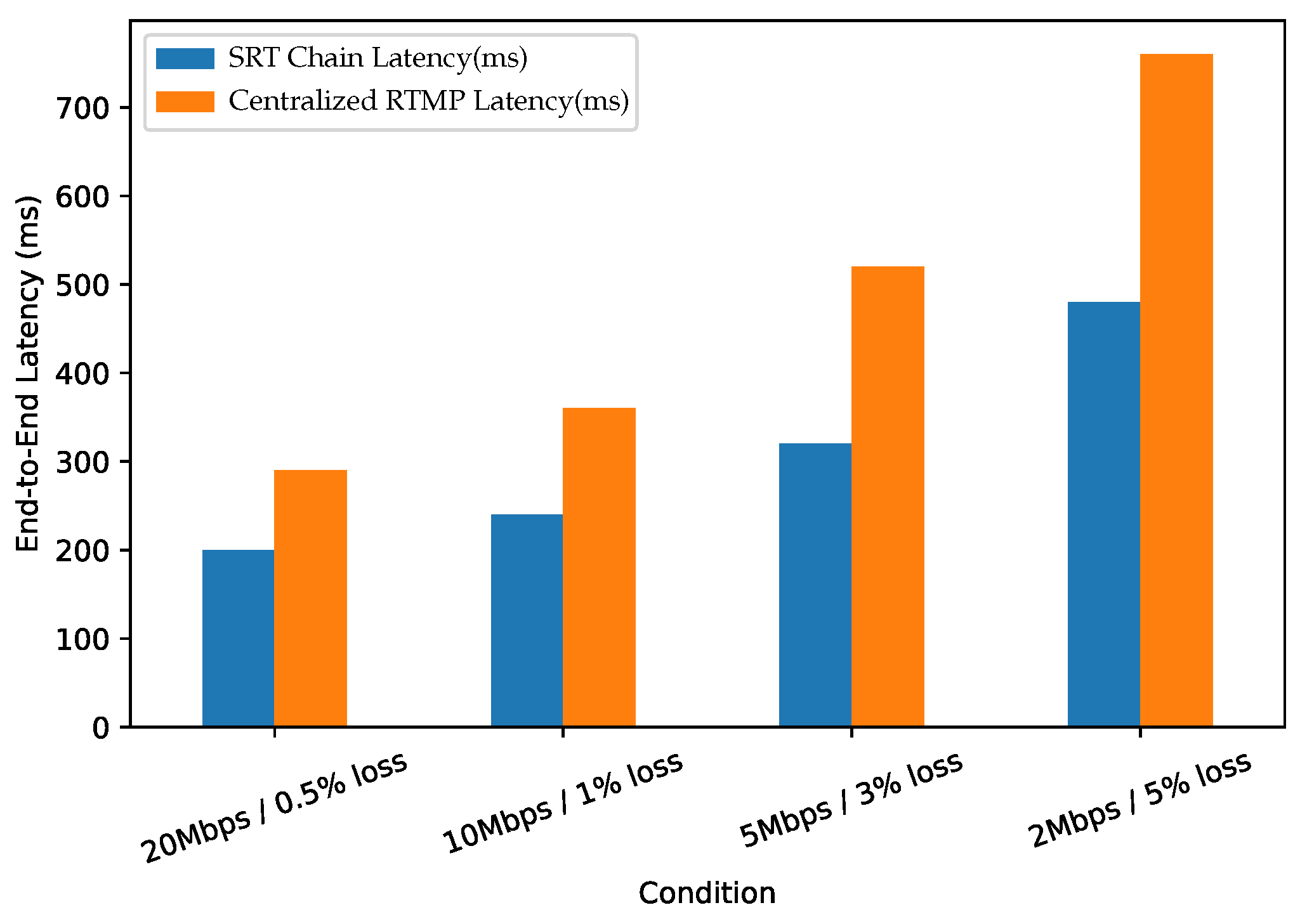
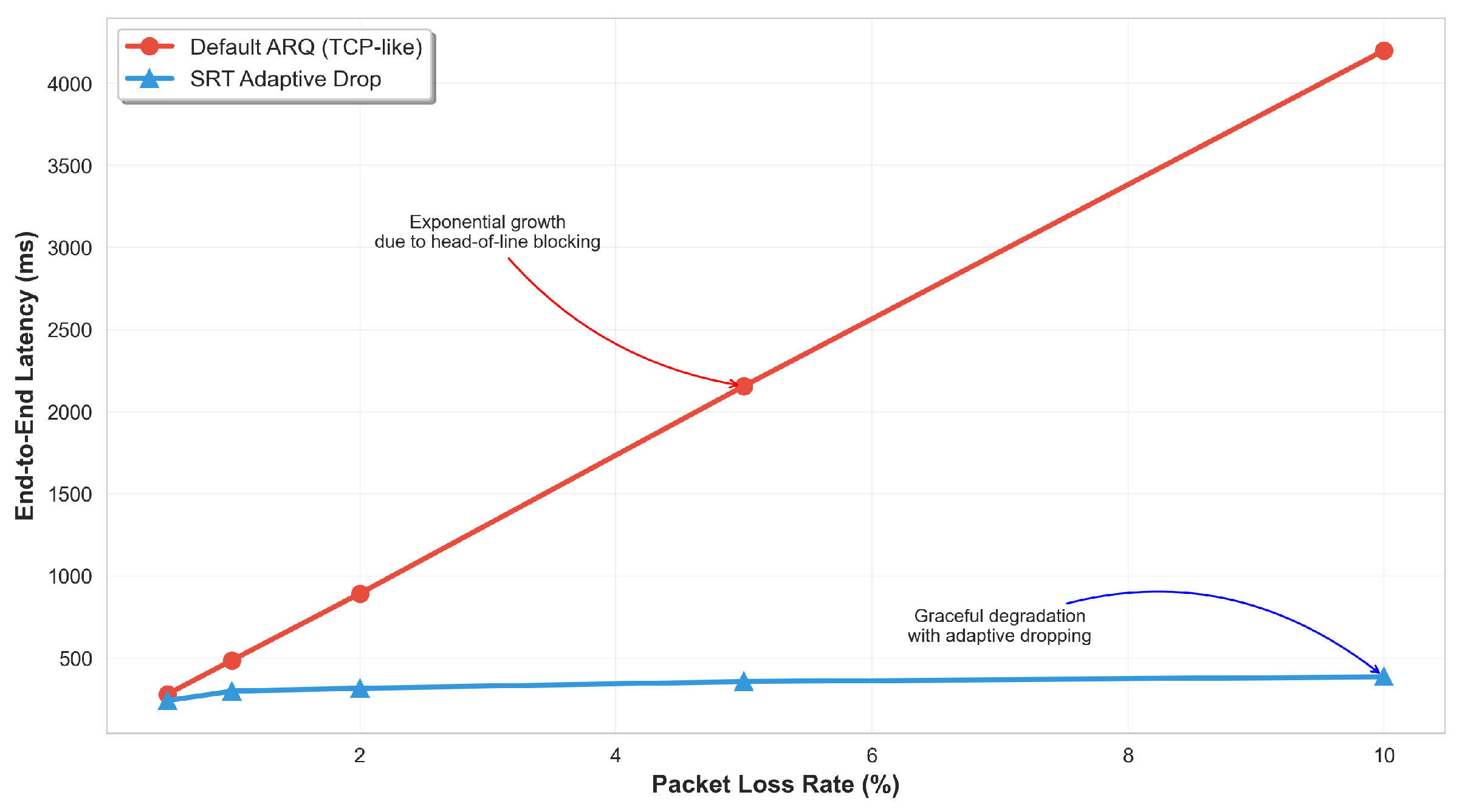
The rapid growth in large-scale distributed video conferencing, remote education, and real-time broadcasting poses significant challenges to traditional centralized streaming systems, particularly regarding scalability, cost, and reliability under high concurrency. Centralized approaches often encounter bottlenecks, increased bandwidth expenses, and diminished fault tolerance. This paper proposes a novel decentralized real-time broadcasting system employing a peer-to-peer (P2P) chain topology based on IPv6 networking and the Secure Reliable Transport (SRT) protocol. By exploiting the global addressing capability of IPv6, our solution simplifies direct node interconnections, effectively eliminating complexities associated with Network Address Translation (NAT). Furthermore, we introduce an innovative chain-relay transmission method combined with distributed node management strategies, substantially reducing reliance on central servers and minimizing deployment complexity. Leveraging SRT’s low-latency UDP transmission, packet retransmission, congestion control, and AES-128/256 encryption, the proposed system ensures robust security and high video stream quality across wide-area networks. Additionally, a WebSocket-based real-time fault detection algorithm coupled with a rapid fallback self-healing mechanism is developed, enabling millisecond-level fault detection and swift restoration of disrupted links. Extensive performance evaluations using Video Multi-Resolution Fidelity (VMRF) metrics across geographically diverse and heterogeneous environments confirm significant performance gains. Specifically, our approach achieves substantial improvements in latency, video quality stability, and fault tolerance over existing P2P methods, along with over tenfold enhancements in frame rates compared with conventional RTMP-based solutions, thereby demonstrating its efficacy, scalability, and cost-effectiveness for real-time video streaming applications.
Keywords: decentralized video broadcasting; real-time streaming; SRT protocol; IPv6 network; chain topology; intelligent self-healing; fault tolerance; low-latency transmission; distributed systems; peer-to-peer architecture decentralized video broadcasting; real-time streaming; SRT protocol; IPv6 network; chain topology; intelligent self-healing; fault tolerance; low-latency transmission; distributed systems; peer-to-peer architecture