Article

Integrating Multi-Model Simulations to Address Partial Observability in Population Dynamics: A Python-Based Ecological Tool


1
Faculty of Applied Sciences, Macao Polytechnic University, Macao SAR 999078, China
2
BUPT Network Information Center, Beijing University of Posts and Telecommunications, Beijing 100876, China
*
Author to whom correspondence should be addressed.
Appl. Sci. 2025, 15(1), 89; https://doi.org/10.3390/app15010089
Submission received: 20 November 2024 / Revised: 13 December 2024 / Accepted: 23 December 2024 / Published: 26 December 2024

Abstract

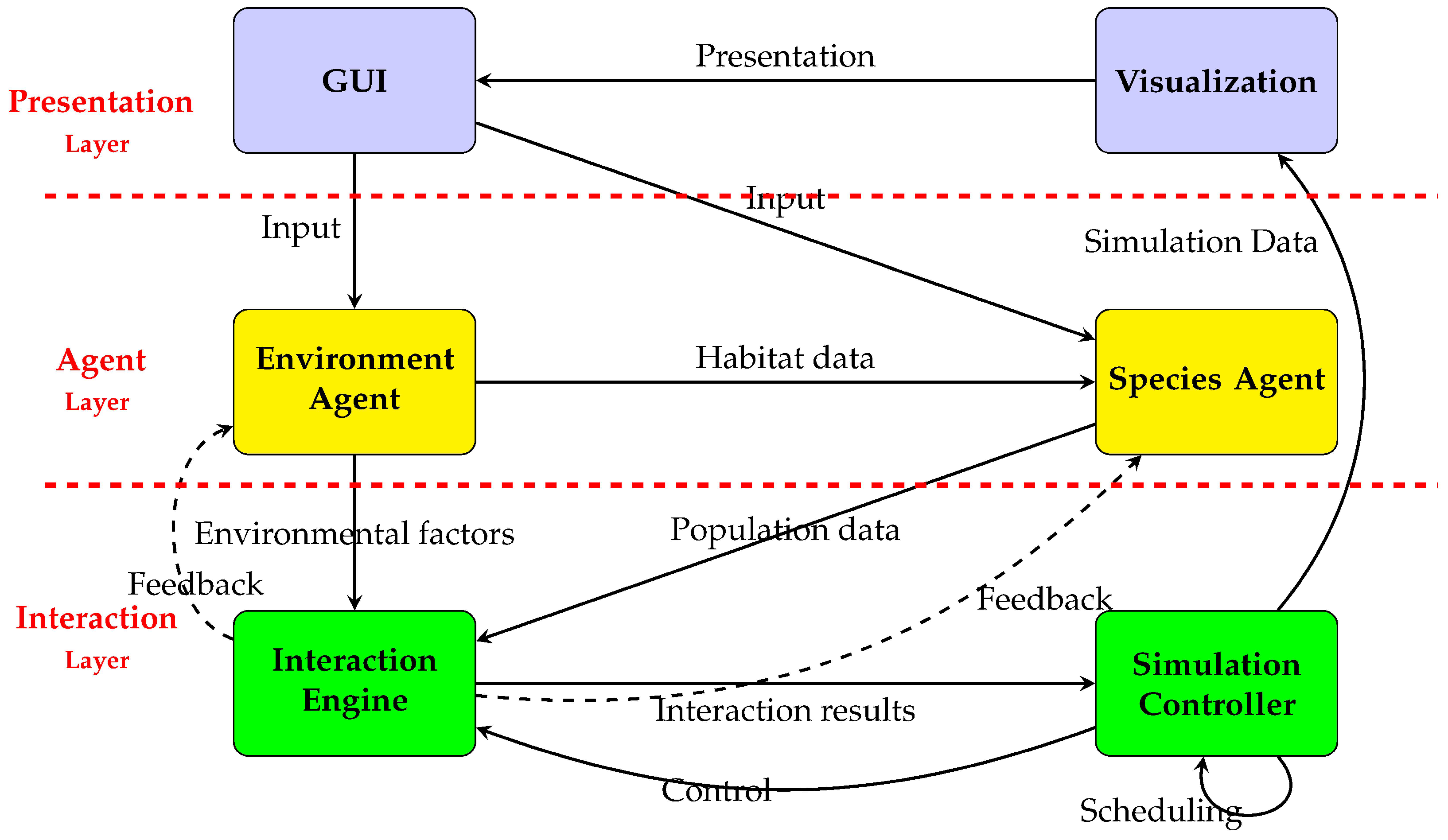
Species richness is a crucial factor in maintaining ecological balance and promoting ecosystem services. However, simulating population dynamics is a complex task that requires a comprehensive understanding of ecological systems. The current tools for wildlife research face three major challenges: insufficient multi-view assessment, a high learning curve, and a lack of seamless secondary development with Python. To address these issues, we developed a novel software tool named WAPET (Wildlife Analysis and Population Ecology Tool) (Python 3.10.12). WAPET integrates Monte Carlo simulation with ecological models, including Logistic Growth, Random Walk, and Cellular Automata, to provide a multi-perspective assessment of ecological systems. Our tool employs a fully parameterized input paradigm, allowing users without coding to easily explore simulations. Additionally, WAPET’s development is entirely Python-based, utilizing PySide6 and Mesa libraries and enabling seamless development in Python environments. Our contributions include the following: (I) integrating multiple ecological models for a comprehensive understanding of ecological processes, (II) developing a no-code mode of human–computer interaction for biodiversity stakeholders and researchers, and (III) implementing a Python-based framework for easy extension and customization. WAPET bridges the gap between comprehensive modeling capabilities and user-friendly interfaces, positioning itself as a versatile tool for both experienced researchers and non-computational stakeholders in biodiversity decision-making processes.
Keywords: simulation software; species richness; Python-based framework simulation software; species richness; Python-based framework