Integrating Multi-Model Simulations to Address Partial Observability in Population Dynamics: A Python-Based Ecological Tool


Abstract
1. Introduction
2. Related Work
2.1. Specialized Tools for Ecological Systems
2.2. General-Purpose Simulators
2.3. Educational Platforms
2.4. Integration with Python and AI
3. Methodology
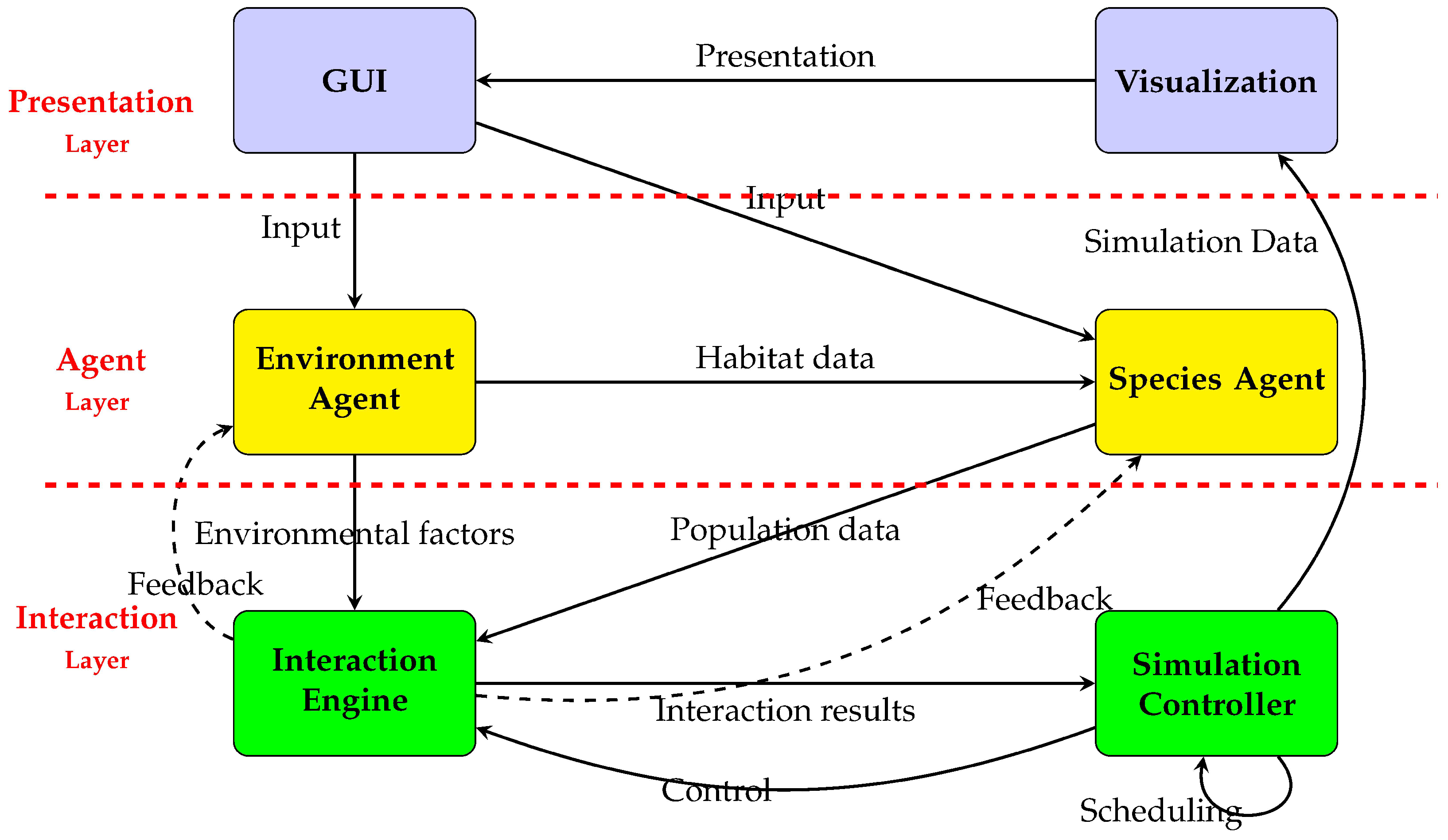
3.1. Architecture
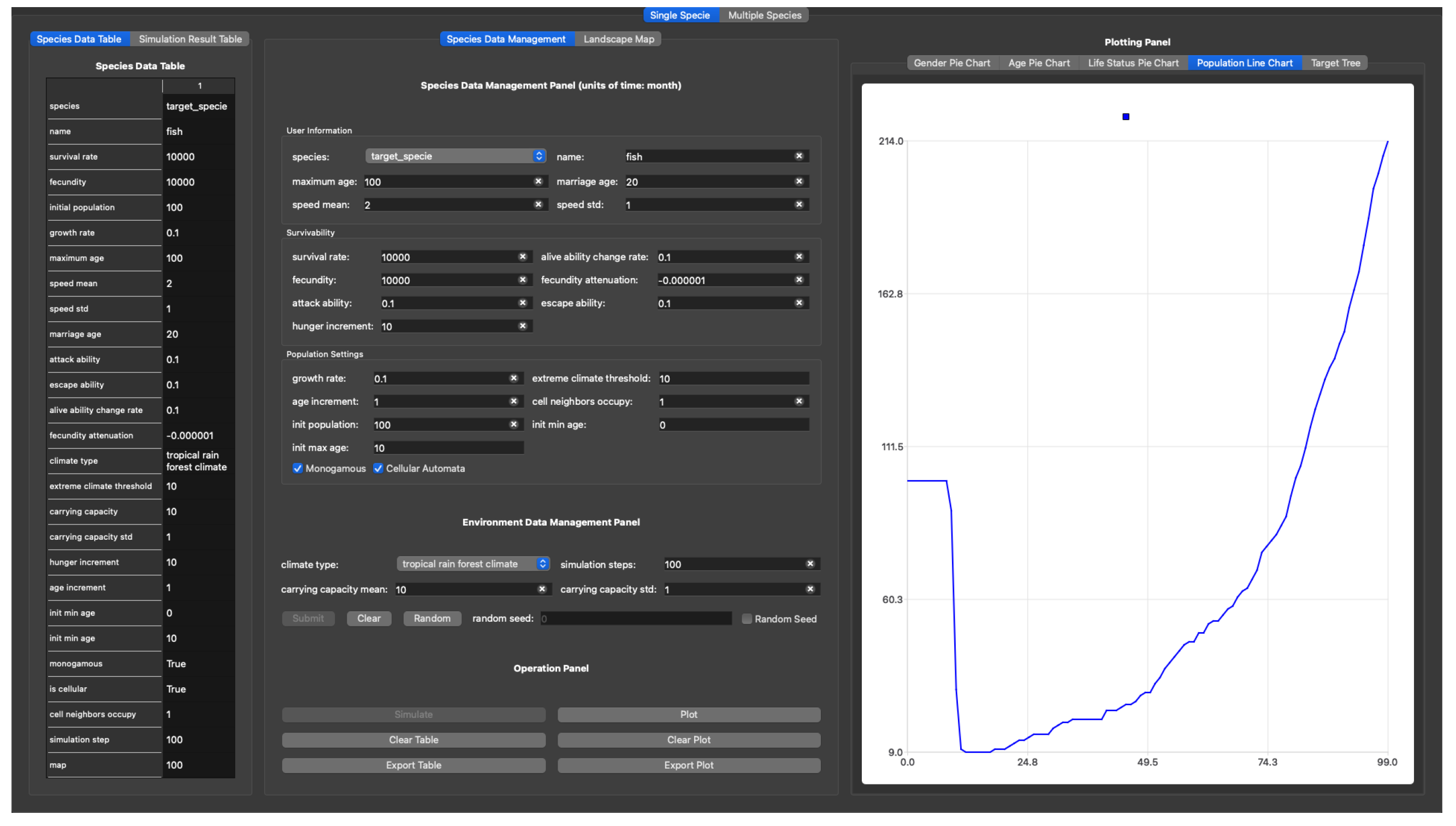
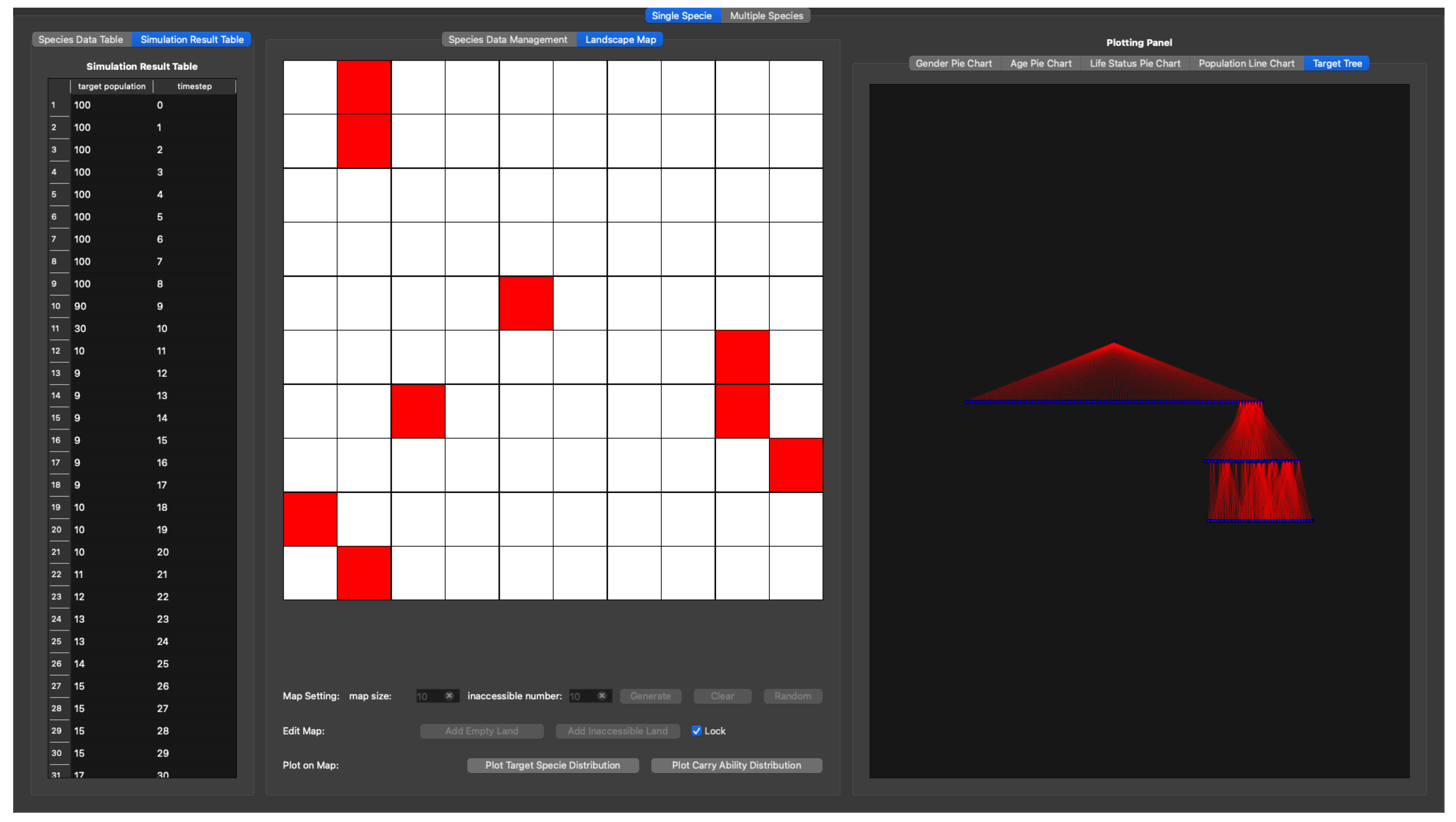
3.2. GUI
3.3. Environment Agent
3.3.1. Soil Agent
3.3.2. Climate Agent
3.4. Species Agent
3.5. Interaction Engine
3.5.1. Logistic Growth Model
3.5.2. Random Walk Model and Cellular Automata
- Birth: dead cell (0) becomes living (1) if it has three living neighbors.
- Survival: living cell (1) remains alive with two or three living neighbors.
- Death: living cell (1) dies (0) if neighbors are not two or three.
3.5.3. Other Models
Attack and Escape
Mating and Giving Birth
- Mating condition assessment: First, check whether the individual’s age exceeds the specified minimum mating age, , and the individual must be alive. Additionally, the individual must be of the opposite sex to the potential partner. For monogamous individuals, it further checks whether the individual already has a partner. If all these conditions are met, they indicate that the individual can mate; otherwise, they indicate that mating is not possible.Mathematically, this rule can be expressed as follows:where is the gender of the agent k, is the agent k’s survival, and is the agent k being married.
- Mating execution: When the mating conditions are satisfied, the Species Agent attempts to find potential mating partners within the grid where the current individual resides. By traversing the same grid for conspecifics, if both individuals meet the mating conditions, they will pair up as partners, updating each other’s partner and status to reflect their new married state.
- Reproductive process: Following successful mating, individuals can reproduce. The reproductive behavior of the population is regulated by population density. Specifically, the population size N and the environmental carrying capacity affect the reproductive probability, which is calculated using the logistic growth model:where r represents the growth rate, N is the current population size in the grid, is the carrying capacity of that grid, and is the fertility factor for individual fertility as age changes. If the reproductive conditions are met, a new individual is generated, and its attributes (such as location, parent information, etc.) are initialized.
3.6. Simulation Controller
3.6.1. Scheduling Overview
3.6.2. Agent Scheduling
3.6.3. Component Interaction
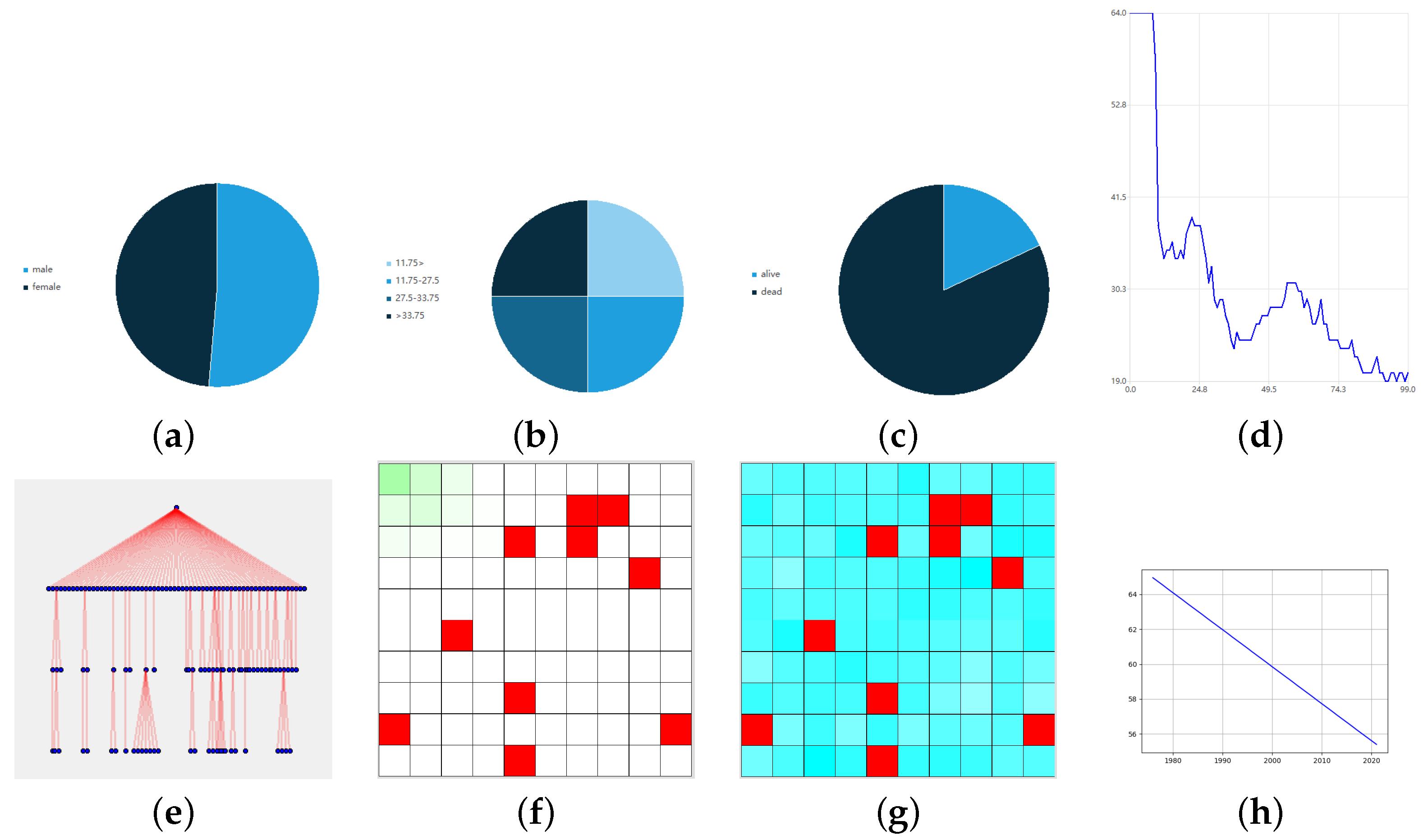
3.7. Visualization Tool
4. Conclusions
Author Contributions
Funding
Institutional Review Board Statement
Informed Consent Statement
Data Availability Statement
Conflicts of Interest
References
- Coulson, T.; Guinness, F.; Pemberton, J.; Clutton-Brock, T. The demographic consequences of releasing a population of red deer from culling. Ecology 2004, 85, 411–422. [Google Scholar] [CrossRef] [Scilit]
- Mace, G.M.; Norris, K.; Fitter, A.H. Biodiversity and ecosystem services: A multilayered relationship. Trends Ecol. Evol. 2012, 27, 19–26. [Google Scholar] [CrossRef] [Scilit] [PubMed]
- Clark, J.S.; Carpenter, S.R.; Barber, M.; Collins, S.; Dobson, A.; Foley, J.A.; Lodge, D.M.; Pascual, M.; Pielke, R., Jr.; Pizer, W.; et al. Ecological forecasts: An emerging imperative. Science 2001, 293, 657–660. [Google Scholar] [CrossRef] [Scilit] [PubMed]
- Hanski, I. Habitat loss, the dynamics of biodiversity, and a perspective on conservation. Ambio 2011, 40, 248–255. [Google Scholar] [CrossRef] [Scilit]
- Bankes, S. Exploratory modeling for policy analysis. Oper. Res. 1993, 41, 435–449. [Google Scholar] [CrossRef] [Scilit]
- Shamsaddini, S.; Ahmadi Gohari, M.; Kamyabi, H.; Nasibi, S.; Derakhshani, A.; Mohammadi, M.A.; Mousavi, S.M.; Baneshi, M.R.; Hiby, E.; Harandi, M.F. Dynamic modeling of female neutering interventions for free-roaming dog population management in an urban setting of southeastern Iran. Sci. Rep. 2022, 12, 4781. [Google Scholar] [CrossRef] [Scilit]
- Wiegand, T.; Moloney, K.A.; Naves, J.; Knauer, F. Finding the missing link between landscape structure and population dynamics: A spatially explicit perspective. Am. Nat. 1999, 154, 605–627. [Google Scholar] [CrossRef] [Scilit]
- Barbosa, P.; Schumaker, N.H.; Brandon, K.R.; Bager, A.; Grilo, C. Simulating the consequences of roads for wildlife population dynamics. Landsc. Urban Plan. 2020, 193, 103672. [Google Scholar] [CrossRef] [Scilit]
- Fulton, E.A. Approaches to end-to-end ecosystem models. J. Mar. Syst. 2010, 81, 171–183. [Google Scholar] [CrossRef] [Scilit]
- Bastian, M.; Heymann, S.; Jacomy, M. Gephi: An open source software for exploring and manipulating networks. ICWSM 2009, 8, 361–362. [Google Scholar] [CrossRef] [Scilit]
- Eberlein, R.L.; Peterson, D.W. Understanding models with Vensim™. Eur. J. Oper. Res. 1992, 59, 216–219. [Google Scholar] [CrossRef] [Scilit]
- Borshchev, A. Multi-method modelling: AnyLogic. In Discrete-Event Simulation and System Dynamics for Management Decision Making; John Wiley & Sons: Hoboken, NJ, USA, 2014; pp. 248–279. [Google Scholar]
- Tisue, S.; Wilensky, U. NetLogo: A simple environment for modeling complexity. Int. Conf. Complex Syst. 2004, 21, 16–21. [Google Scholar]
- Grignard, A.; Taillandier, P.; Gaudou, B.; Vo, D.A.; Huynh, N.Q.; Drogoul, A. GAMA 1.6: Advancing the art of complex agent-based modeling and simulation. In Proceedings of the PRIMA 2013: Principles and Practice of Multi-Agent Systems: 16th International Conference, Dunedin, New Zealand, 1–6 December 2013; Springer: Cham, Switzerland, 2013; pp. 117–131. [Google Scholar]
- Collier, N. Repast: An extensible framework for agent simulation. Nat. Resour. Environ. Issues 2001, 8, 4. [Google Scholar]
- Luke, S.; Cioffi-Revilla, C.; Panait, L.; Sullivan, K.; Balan, G. Mason: A multiagent simulation environment. Simulation 2005, 81, 517–527. [Google Scholar] [CrossRef] [Scilit]
- Minar, N.; Burkhart, R.; Langton, C.; Askenazi, M. The Swarm Simulation System: A Toolkit for Building Multi-Agent Simulations; SFI Working Paper 1996-06-042; Santa Fe Institute: Santa Fe, NM, USA, 1996. [Google Scholar]
- Stubben, C.; Milligan, B. popbio: Construction and analysis of matrix population models. In R Package, version 2.8; R Project: Vienna, Austria, 2007. [Google Scholar]
- Salguero-Gómez, R.; Plotkin, J.B. WiSP: A web-based interactive simulation program for population dynamics. Environ. Model. Softw. 2012, 37, 230–232. [Google Scholar]
- Conroy, M.J.; Carroll, J.P. A Guide to Wildlife Radio Tracking; Springer Science & Business Media: Berlin/Heidelberg, Germany, 2011. [Google Scholar]
- Joppa, L.N.; McInerny, G.; Harper, R.; Salido, L.; Takeda, K.; O’Hara, K.; Gavaghan, D.; Emmott, S. Troubling trends in scientific software use. Science 2013, 340, 814–815. [Google Scholar] [CrossRef] [Scilit]
- Marru, S.; Gunathilake, L.; Herath, C.; Tangchaisin, P.; Pierce, M.; Mattmann, C.; Singh, R.; Gunarathne, T.; Chinthaka, E.; Gardler, R.; et al. Apache airavata: A framework for distributed applications and computational workflows. In Proceedings of the 2011 ACM Workshop on Gateway Computing Environments, Seattle, WA, USA, 18 November 2011; pp. 21–28. [Google Scholar]
- Decker, D.J.; Riley, S.J.; Siemer, W.F. Human Dimensions of Wildlife Management; JHU Press: Baltimore, MD, USA, 2012. [Google Scholar]
- Berkes, F. Evolution of co-management: Role of knowledge generation, bridging organizations and social learning. J. Environ. Manag. 2009, 90, 1692–1702. [Google Scholar] [CrossRef] [Scilit]
- Clark, J.S. Testing disturbance theory with long-term data: Alternative life-history solutions to the distribution of events. Am. Nat. 1996, 148, 976–996. [Google Scholar] [CrossRef] [Scilit]
- Verhulst, P.F. Notice sur la loi que la population suit dans son accroissement. Corresp. Math. Phys. 1838, 10, 113–129. [Google Scholar]
- Codling, E.A.; Plank, M.J.; Benhamou, S. Random walk models in biology. J. R. Soc. Interface 2008, 5, 813–834. [Google Scholar] [CrossRef] [Scilit]
- Kareiva, P.; Shigesada, N. Analyzing insect movement as a correlated random walk. Oecologia 1983, 56, 234–238. [Google Scholar] [CrossRef] [Scilit] [PubMed]
- Hogeweg, P. Cellular automata as a paradigm for ecological modeling. Appl. Math. Comput. 1988, 27, 81–100. [Google Scholar] [CrossRef] [Scilit]
- Fitzpatrick, M. Create GUI Applications with Python & Qt6 (PySide6 Edition); Martin Fitzpatrick: Amersfoort, The Netherlands, 2021. [Google Scholar]
- Masad, D.; Kazil, J.L. Mesa: An Agent-Based Modeling Framework. In Proceedings of the SciPy, Austin, TX, USA, 6–12 July 2015; pp. 51–58. [Google Scholar]
- Grimm, V.; Revilla, E.; Berger, U.; Jeltsch, F.; Mooij, W.M.; Railsback, S.F.; Thulke, H.H.; Weiner, J.; Wiegand, T.; DeAngelis, D.L. Pattern-oriented modeling of agent-based complex systems: Lessons from ecology. Science 2005, 310, 987–991. [Google Scholar] [CrossRef] [Scilit] [PubMed]
- Paszke, A.; Gross, S.; Massa, F.; Lerer, A.; Bradbury, J.; Chanan, G.; Killeen, T.; Lin, Z.; Gimelshein, N.; Antiga, L.; et al. Pytorch: An imperative style, high-performance deep learning library. Adv. Neural Inf. Process. Syst. 2019, 32, 8026–8037. [Google Scholar]
- Kramer, O. Scikit-learn. In Machine Learning for Evolution Strategies; Springer: Cham, Switzerland, 2016; pp. 45–53. [Google Scholar]
- Bellman, R. Dynamic programming. Science 1966, 153, 34–37. [Google Scholar] [CrossRef] [Scilit]
- Kaelbling, L.P.; Littman, M.L.; Cassandra, A.R. Planning and acting in partially observable stochastic domains. Artif. Intell. 1998, 101, 99–134. [Google Scholar] [CrossRef] [Scilit]
- Laplace, P.S. Théorie Analytique des Probabilités; Courcier: Paris, France, 1820. [Google Scholar]
- Curtis, S.; Fair, A.; Wistow, J.; Val, D.V.; Oven, K. Impact of extreme weather events and climate change for health and social care systems. Environ. Health 2017, 16, 23–32. [Google Scholar] [CrossRef] [Scilit]
- Reichstein, M.; Bahn, M.; Ciais, P.; Frank, D.; Mahecha, M.D.; Seneviratne, S.I.; Zscheischler, J.; Beer, C.; Buchmann, N.; Frank, D.C.; et al. Climate extremes and the carbon cycle. Nature 2013, 500, 287–295. [Google Scholar] [CrossRef] [Scilit]
- Naveau, P.; Nogaj, M.; Ammann, C.; Yiou, P.; Cooley, D.; Jomelli, V. Statistical methods for the analysis of climate extremes. Comptes Rendus Géoscience 2005, 337, 1013–1022. [Google Scholar] [CrossRef] [Scilit]
- UK Office for National Statistics; Department for Environment, Food & Rural Affairs. Smoothed [Dataset]. Available online: https://www.gov.uk/government/statistics/butterflies-in-the-wider-countryside-uk (accessed on 1 December 2024).


| Methods | Specialized Tools | General-Purpose Simulators | Education Platforms | WAPET |
|---|---|---|---|---|
| Open-source | ✓ | − | ✓ | ✓ |
| Multi-view | − | ✓ | ✓ | ✓ |
| No-code | − | − | − | ✓ |
| Python-based | − | − | − | ✓ |
Disclaimer/Publisher’s Note: The statements, opinions and data contained in all publications are solely those of the individual author(s) and contributor(s) and not of MDPI and/or the editor(s). MDPI and/or the editor(s) disclaim responsibility for any injury to people or property resulting from any ideas, methods, instructions or products referred to in the content. |
© 2024 by the authors. Licensee MDPI, Basel, Switzerland. This article is an open access article distributed under the terms and conditions of the Creative Commons Attribution (CC BY) license (https://creativecommons.org/licenses/by/4.0/).
Share and Cite
Yu, Y.; Li, H.; Liu, Y.; Ma, Y. Integrating Multi-Model Simulations to Address Partial Observability in Population Dynamics: A Python-Based Ecological Tool. Appl. Sci. 2025, 15, 89. https://doi.org/10.3390/app15010089
Yu Y, Li H, Liu Y, Ma Y. Integrating Multi-Model Simulations to Address Partial Observability in Population Dynamics: A Python-Based Ecological Tool. Applied Sciences. 2025; 15(1):89. https://doi.org/10.3390/app15010089
Chicago/Turabian StyleYu, Yide, Huijie Li, Yue Liu, and Yan Ma. 2025. "Integrating Multi-Model Simulations to Address Partial Observability in Population Dynamics: A Python-Based Ecological Tool" Applied Sciences 15, no. 1: 89. https://doi.org/10.3390/app15010089
APA StyleYu, Y., Li, H., Liu, Y., & Ma, Y. (2025). Integrating Multi-Model Simulations to Address Partial Observability in Population Dynamics: A Python-Based Ecological Tool. Applied Sciences, 15(1), 89. https://doi.org/10.3390/app15010089