Article

A Deep Curriculum Learning Semi-Supervised Framework for Remote Sensing Scene Classification

1
School of Computer Science and Engineering, Taizhou Institute of Science and Technology, Nanjing University of Science and Technology, Taizhou 225300, China
2
Aliyun School of Big Data, Changzhou University, Changzhou 213164, China
3
Jiangsu Engineering Research Center of Digital Twinning Technology for Key Equipment in Petrochemical Process, Changzhou University, Changzhou 213164, China
*
Author to whom correspondence should be addressed.
Appl. Sci. 2025, 15(1), 360; https://doi.org/10.3390/app15010360
Submission received: 19 October 2024 / Revised: 27 December 2024 / Accepted: 29 December 2024 / Published: 2 January 2025
(This article belongs to the Section Computing and Artificial Intelligence)

Abstract

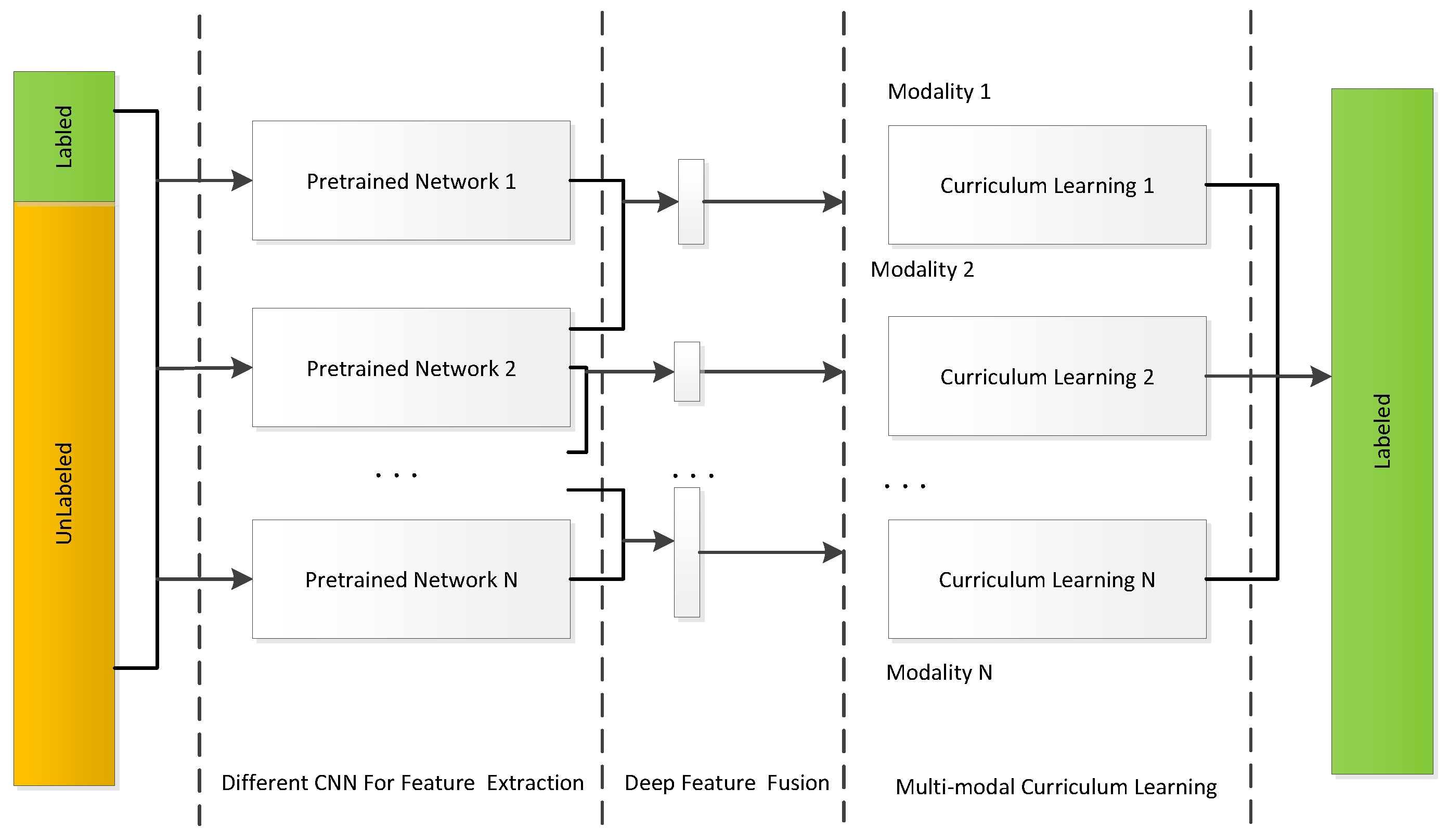
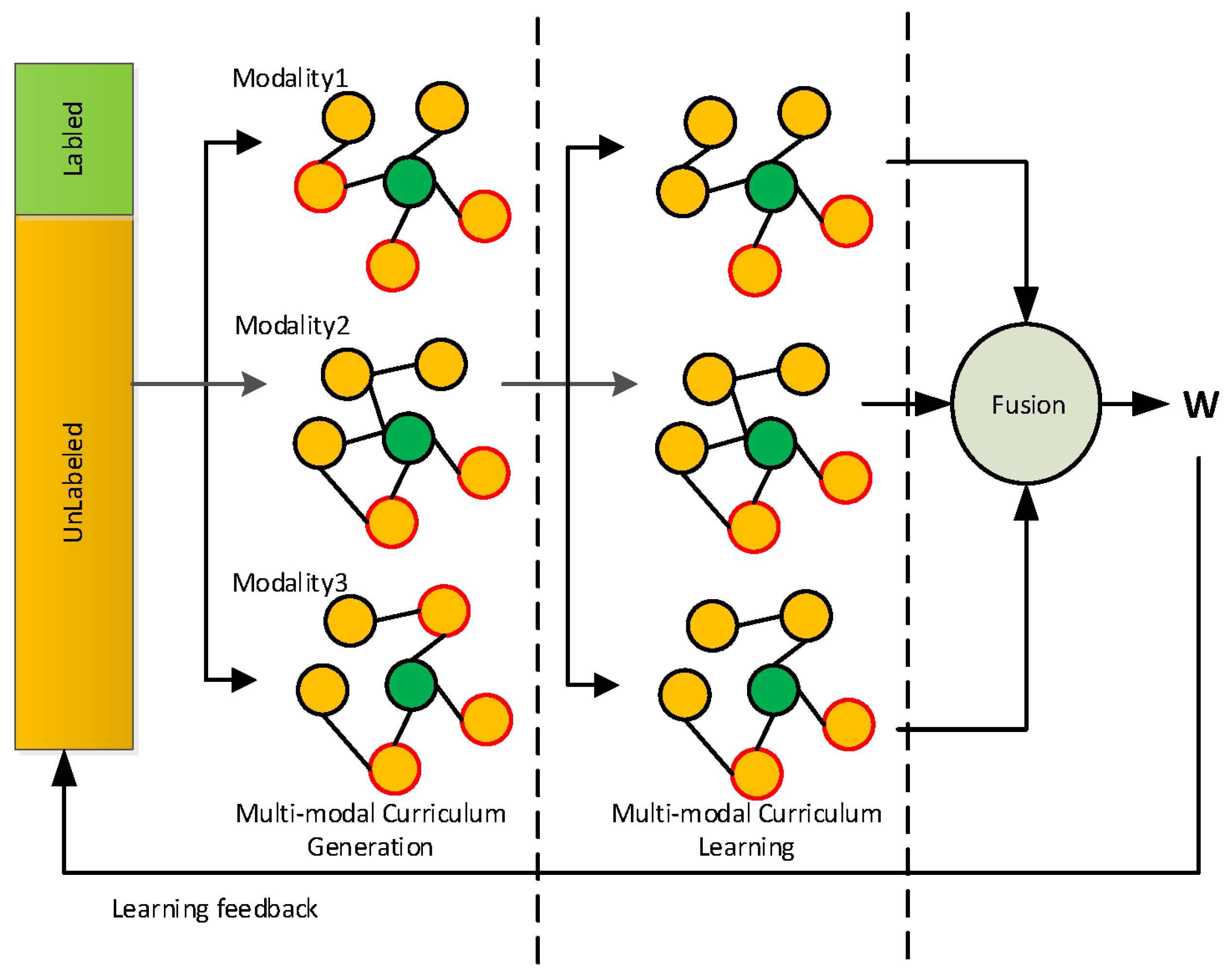
In recent years, deep learning has witnessed astonishing success in the field of remote sensing in images. Generally, deep learning requires a large amount of labeled training data. Nevertheless, in remote sensing, sufficient labeled data are scarce because labeled data are often difficult, expensive, or time-consuming to obtain. To address these problems, we propose a deep curriculum learning semi-supervised framework (DCLSSF) for remote sensing image scene classification. This framework employs a multimodal deep curriculum learning method which can realize the classification of images on a range of easy–difficult. Specifically, by utilizing multiple pretrained networks to extract multiple deep features of images as their multimodal feature representations, it can comprehensively mine the information from labeled and unlabeled images from diverse perspectives. Subsequently, a feature fusion method is used on deep features of different modalities to obtain deep fusion features with a strong discrimination ability and low dimensionality. Finally, the multimodal deep features are fed into multimodal curriculum learning methods for classification. Multimodal curriculum learning can integrate the easy curricula recommended by each modal according to the order of the samples of each modal and then learn step by step. Experiments on three publicly available datasets (UC Merced, AID, and NWPU-RESISC45) show that the semi-supervised classification framework achieves high accuracy rates (99.14%, 97.95%, and 93.01%), even surpassing those of the most supervised classification methods. The DCLSSF method can not only fully exploit the rich features extracted by the multimodal deep learning network but can also perform the semi-supervised classification of unlabeled samples in a range of easy–difficult.
Keywords: convolutional neural network (CNN); feature fusion; curriculum learning; semi-supervised learning; image classification convolutional neural network (CNN); feature fusion; curriculum learning; semi-supervised learning; image classification