Review

The Use and Impact of Virtual Reality Programs Supported by Aromatherapy for Older Adults: A Scoping Review


1
School of Nursing, University of British Columbia, Vancouver, BC V6T 2B5, Canada
2
IDEA Lab, University of British Columbia, Vancouver, BC V6T 2B5, Canada
3
International Collaboration on Repair Discoveries, GF Strong Rehabilitation Research Program, Department of Occupational Science and Occupational Therapy, Faculty of Medicine, University of British Columbia, Vancouver, BC V6T 2B5, Canada
4
School of Computing Science, Simon Fraser University, Vancouver, BC V5A 1S6, Canada
5
Department of Systems Design Engineering, University of Waterloo, Waterloo, ON N2L 3G1, Canada
6
School of Health and Exercise Sciences, University of British Columbia (Okanagan), Kelowna, BC V1V 1V7, Canada
*
Author to whom correspondence should be addressed.
Appl. Sci. 2025, 15(1), 188; https://doi.org/10.3390/app15010188
Submission received: 19 November 2024 / Revised: 25 December 2024 / Accepted: 27 December 2024 / Published: 28 December 2024

Featured Application

The findings of this scoping review provide valuable insights for healthcare practitioners, geriatric caregivers, and designers of multisensory interventions aimed at improving the well-being of older adults. By identifying the types of VR programs supported by aromatherapy and their reported outcomes, this study highlights how combining VR and olfactory inputs can enhance spatial awareness, emotional well-being, and social engagement in older adults. These insights can be used to develop tailored, immersive interventions in long-term care facilities, hospital settings, rehabilitation centers, or community programs to address age-related challenges such as memory decline, stress, and social isolation. Moreover, the evidence underscores the importance of customizing VR content to individual preferences, ensuring both efficacy and comfort in older adult populations. Future applications could involve incorporating these findings into training modules for healthcare professionals or leveraging multisensory VR environments to promote cognitive and emotional health, ultimately fostering a more holistic approach to aging care.

Abstract

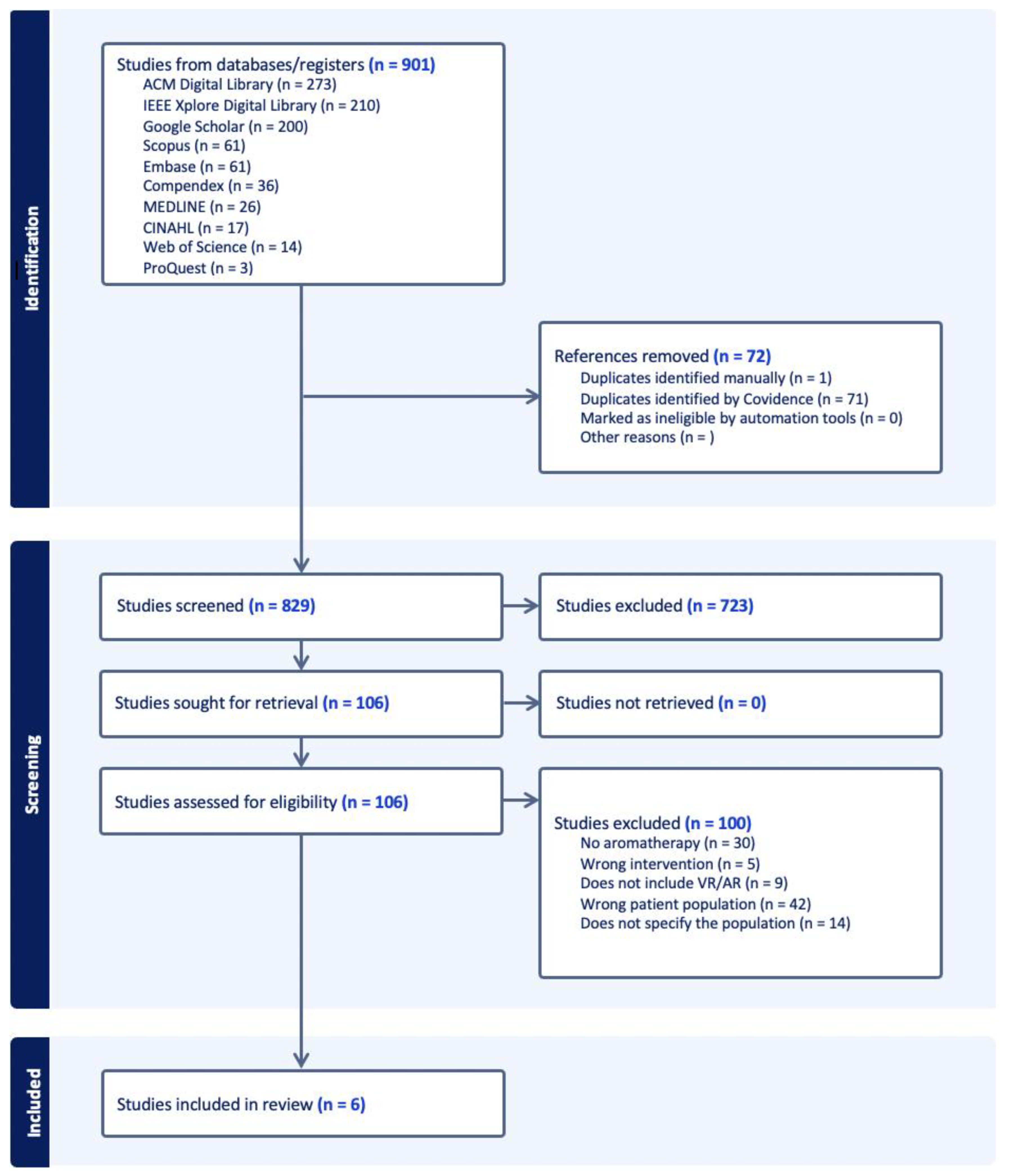
Both virtual reality (VR) and aromatherapy have shown significant potential in enhancing the health and well-being of older adults. Aromatherapy has been noted to improve the immersive quality of VR experiences. However, the combined use of these interventions for older adults has not been systematically explored. This scoping review aims to identify existing VR programs supported by aromatherapy and evaluate their outcomes on older adults’ well-being. Following the Joanna Briggs Institute methodology and PRISMA-ScR guidelines, the review included both published and unpublished studies. A search across ten databases yielded 901 publications, from which six studies were analyzed, involving 94 participants with a mean age of 70 to 83 years. Results revealed positive impacts on well-being, cognition, and social engagement. Outcome measures included physical, psychological, emotional, and cognitive aspects like spatial orientation, stress, happiness, memory, and social interaction. Benefits included enhanced spatial awareness, memory, happiness, and reduced stress. Multisensory VR environments also fostered socialization through shared experiences and nostalgia. However, the individual differences in VR experiences indicate a need for personalized content. Despite promising findings, limited evidence supports clinical application in nursing practice. Further research is required to validate the health benefits of combining VR with aromatherapy.
Keywords: virtual reality; aromatherapy; older adults; multisensory interventions; well-being; stress reduction; memory; social engagement virtual reality; aromatherapy; older adults; multisensory interventions; well-being; stress reduction; memory; social engagement