1. Introduction
In the realm of logistics and supply chain management, the transportation problem (TP) stands as a fundamental challenge, aiming to satisfy the distribution of goods from suppliers to consumers while minimizing overall transportation costs. Over the years, extensive research has been conducted to develop efficient algorithms and methods for solving various transportation problems with precise and deterministic values of supply and demand units such as transportation costs.
The northwest corner method (NWC) is one of the methods that discovers a basic feasible solution to various transportation problems [
1]. The method is named after the fact that it stands from the northwest corner cell of the transportation table and proceeds in a systematic manner. Despite the fact that is an easy and applicable method, it does not always guarantee an optimal solution [
1]. The least-cost method (LCM) is an alternative method, which focuses on selecting the cell with the minimum cost during the allocation process [
2]. Vogel’s approximation method (VAM) is known for yielding values relatively close to the optimum, often aligning precisely with it [
3]. Although VAM is more complex than the LCM, since it imposes penalties on cells characterized by high transportation costs, it tends to achieve more favorable initial solutions than LCM [
3].
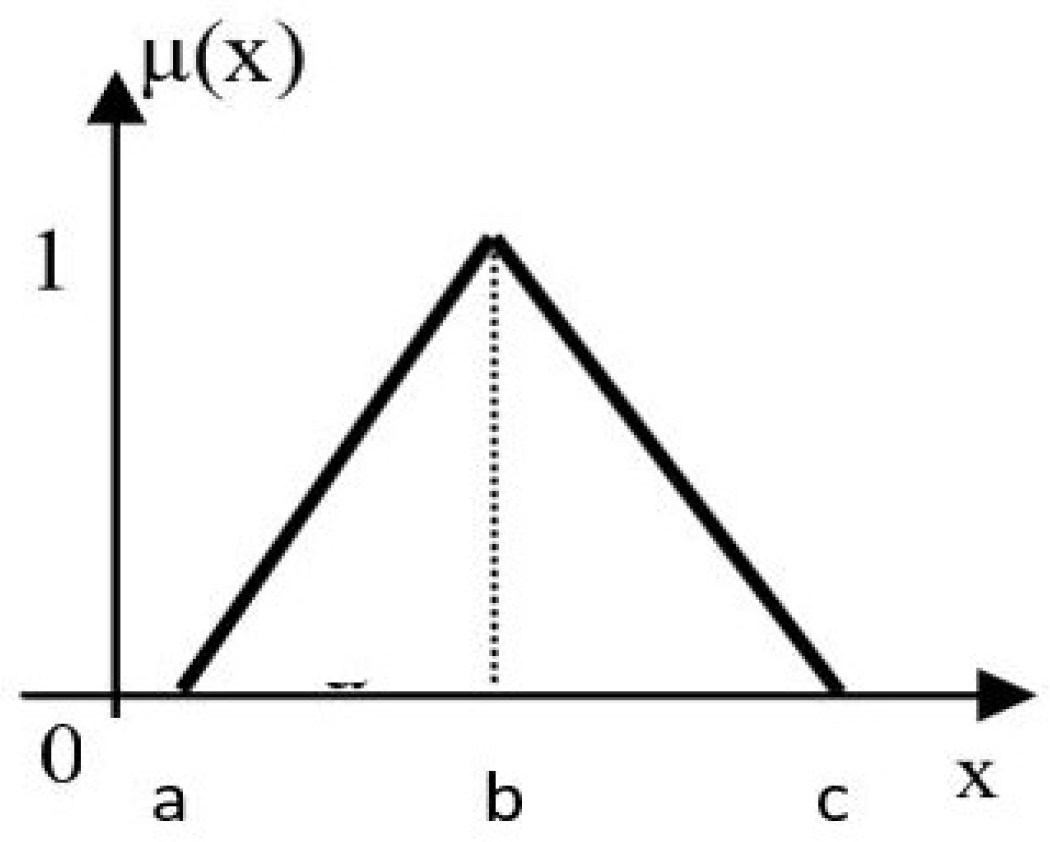
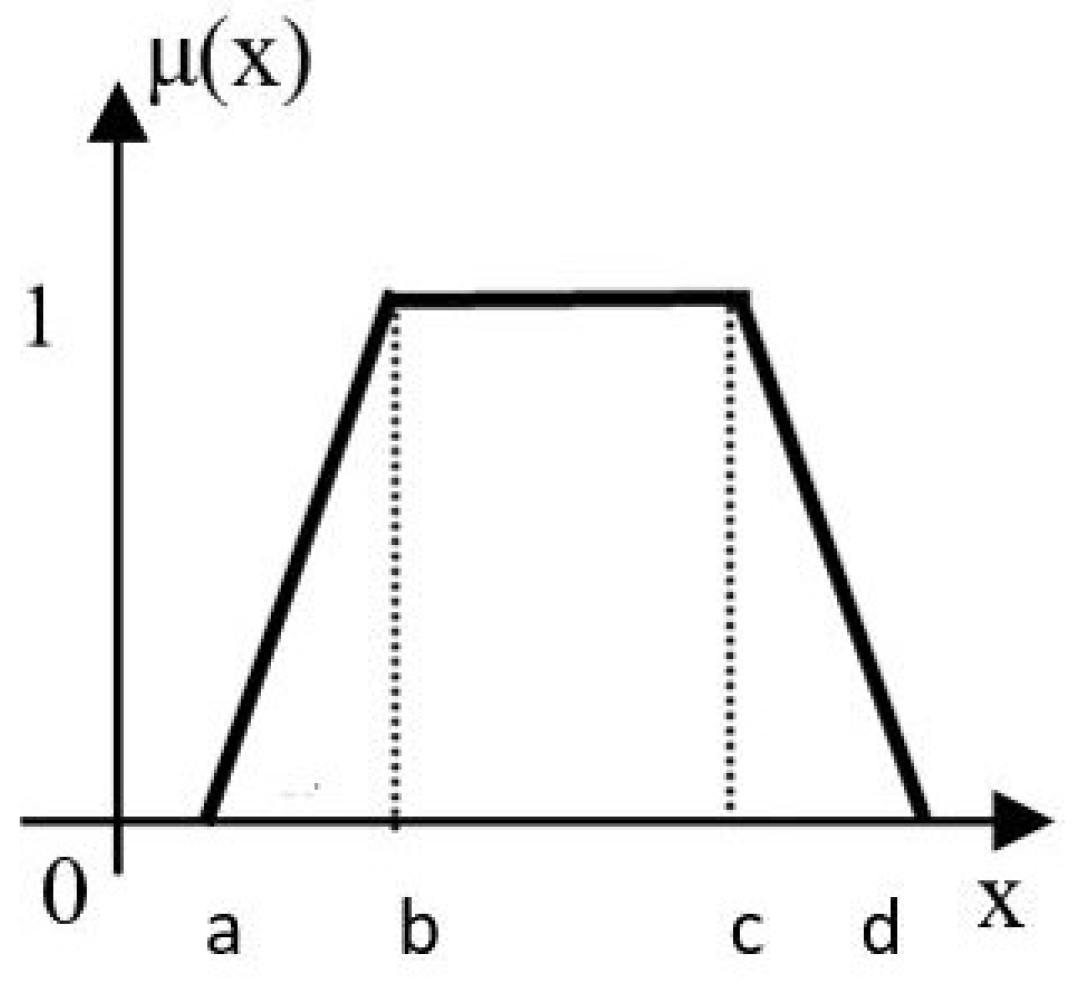
However, in real-world scenarios, it is difficult to predict supply and demand quantities “a priori” as they are inextricably linked by the season and by the trends, prevailing by consumers and the financial circumstances of each corporation. Equivalent situations unfold with the prices of transportation which usually depend on factors such as fluctuating fuel prices, the weather, dynamic market conditions and varying transportation routes. To handle with these uncertainties, researchers have turned to fuzzy logic, a mathematical framework that allows for the representation of vagueness and ambiguity in decision-making processes. Going into further detail, fuzzy set theory provides a robust foundation for modeling and analyzing problems with imprecise information, emerging as a promising avenue to optimize transportation problems.
A fuzzy transportation problem (FTP) is a variation of the traditional transportation problem in which the transportation cost, supply and demand are fuzzy quantities [
4]. There is some research that has relied on fuzzy environments, proving that the fuzzy decision-making method is becoming paramount. The inspirers of the idea of decision-making in fuzzy environments were Bellman and Zadeh in 1970 [
5]. Following their study, new findings emerged, with the most recent studies being noteworthy of mention. Chanas et al., in 1996, introduced the concept of an optimal solution for the TP with fuzzy coefficients represented as fuzzy numbers and developed an algorithm to attain an optimal solution [
6]. Ahmed, Khan and Uddin presented a new algorithm for finding an initial basic feasible solution of the TP when the transportation matrix contains both fuzzy and crisp numbers [
7]. Another intriguing respective was offered by Chakraborty and Chakraborty in 2009 [
8]. Their method was based on the minimization of transportation cost as well as time of transportation when the demand, supply and shipping cost per unit of the quantities are fuzzy. Basirzadeh, two years later, introduced an approach for solving a wide range of transportation problems by transforming fuzzy quantities into crisp values using their new method [
4]. During the same year, Nagoor Gani et al. suggested their individual version for solving the fuzzy transportation problem, utilizing the simplex algorithm [
9]. Shanmugasundaram also worked on fuzzy exact algorithms. He successfully developed the fuzzy version of Vogel’s and MODI methods for obtaining a fuzzy initial basic solution and fuzzy optimal solution, respectively [
10]. Balasubramanian and Subramanian formulated an alternative method for dealing with a special type of FTP, in which the cost is depicted as triangular fuzzy number. In their research, they utilized ranking methods for numbers to evaluate the fuzzy objective values of the objective function and determine the optimal alternative [
11]. Pandian and Natarajan introduced a novel algorithm known as the fuzzy zero point method for finding a fuzzy optimal solution for the FTP, where the transportation cost, supply and demand are represented by trapezoidal fuzzy numbers [
12]. Gani and Razak formulated a two-stage-cost-minimizing FTP, where supply and demand are trapezoidal fuzzy numbers, while the costs remain crisp [
13]. Malini and Kennedy introduced a method for solving the FTP by utilizing octagonal fuzzy numbers [
14]. Ekanayake and Ekanayake based their research on Yager’s robust ranking method [
15]. They proposed an alternative algorithm for finding an initial basic solution to the fuzzy triangular and trapezoidal transportation problem [
15].
In the literature, there are many other surveys consisted of problems which are solved by various methods via generalized trapezoidal fuzzy numbers. Specifically, generalized fuzzy numbers extend the concept of classical fuzzy numbers by introducing additional parameters to provide a more versatile representation of uncertainty. Kaur and Kuman proposed a new approach for solving the FTP using generalized fuzzy numbers, which had not been applied till that point [
16]. Building upon the concept of Kaur and Kuman, Ali Ebrahimnejad strived to diminish the computational complexity of the existing method. The technique applied in his study was simpler, computationally efficient and novel compared to the proposed method by Kaur and Kuman [
17]. Chen contributed to the previously mentioned research by proposing the concept of generalized fuzzy numbers when there are no prescribed limits on the membership function to the normal form [
18].
FTP approximation is a crucial aspect in the realm of computational intelligence algorithms. Various optimization techniques including metaheuristic algorithms and mathematical programming approaches have been adapted or developed to handle fuzzy transportation problems effectively. Lin solved the transportation problem with fuzzy coefficients using genetic algorithms (GA) [
19]. Halder and Jana emphasized on four-dimensional multi-item TP through GA and particle swarm optimization (PSO) [
20]. New approaches in metaheuristics to solve the fixed TP in a fuzzy environment were developed by Sadeghi-Moghaddamm et al. [
21]. Gupta et al. design a hybrid GA-PSO algorithm to solve the traveling salesman problem (TSP) [
22]. Last but not least, Singh and Singh, in 2021, suggested an extension of PSO for solving the FTP [
23]. Their research, though, focused on solutions presented in a crisp form from fuzzy sets. All the abovementioned techniques, achieved satisfactory results in optimizing some instances of the fuzzy transportation problem. However, they were applied to a rather small set of instances with more less-similar characteristics. So, it is obvious that a more generic optimization algorithm should be designed and applied to optimize all the above fuzzy transportation instances, achieving results comparable or even better to the ones found so far.
Motivated by the aforementioned applications of metaheuristic algorithms, this study focuses on the effective application of PSO to solve the FTP. Twenty-eight distinct instances are tacked using ten well-established methods found in the existing literature. The spotlight will be on the trigonometric acceleration coefficients-PSO (TrigAC-PSO) algorithm, a variation of the classical PSO algorithm, introduced by Aroniadi and Beligiannis, in 2023 [
24]. Extensive experimentation was carried out to assess the stability and the performance of the proposed algorithm in navigating transportation problems with fuzzy costs.
Furthermore, various particle configurations were examined to evaluate TrigAC-PSO’s capacity to achieve optimal results, demonstrating its superior performance.
The contribution of this paper is as follows:
According to our knowledge, PSO has already been applied for solving the FTP. However, the conducted experiments lack depth in their data analysis, as they predominantly focus on individual instances of the problem rather than a diverse range of scenarios. Introducing a novel approach, TrigAC-PSO is applied for the first time for solving the FTP, highlighting exceptional performance across a comprehensive set of instances;
Nevertheless, the selected problem instances encompass various types of fuzzy numbers such as triangular and trapezoidal fuzzy sets. Moreover, the fuzzy numbers extend beyond conventional representations, encompassing both classic fuzzy numbers and fuzzy generalized numbers, thereby adding depth and complexity to this study. It is the first time that fuzzy generalized numbers are applied to a particle swarm optimization variation;
The evaluation of results, from each method, is not based entirely on their attainment of the optimal solution. Instead, this study estimates the method’s performance according to the degree of membership in which their solutions approach optimality as determined by membership functions. Once more, the TrigAC-PSO method demonstrates remarkable completeness against other methods.
The remainder of this paper is organized as follows:
Section 2 presents the mathematical formulation of the TP. Definitions for fuzzy logic and fuzzy numbers are briefly described in
Section 3.
Section 4 presents the FTP. PSO as well as TrigAC-PSO are represented in detail in
Section 5. An extensive and intriguing study case is conducted in
Section 6, solving the FTP by using the TrigAC-PSO algorithm. Subsequently, a comparative analysis is presented, comparing results obtained by the application of TrigAC-PSO against well-established methods documented in the respective literature. Lastly, conclusive remarks and future recommendations are presented in
Section 7.
5. Particle Swarm Optimization (PSO)
The particle swarm optimization (PSO) algorithm stands out as a contemporary and innovative heuristic approach, gaining widespread popularity over the years due to its straightforward implementation and ability to yield satisfactory solutions [
26]. The PSO algorithm is inspired by the collective behavior of animals from studying their interactions to function, resulting in a strong approach that handles optimization challenges in various applications [
27].
In the PSO framework, every potential solution is represented as a particle, and the complete set of particles constitutes the algorithm’s population, known as swarm. The optimization process relies heavily on collaboration and exchange of information, with the particles improving their effectiveness through active cooperation within the swarm. Sharing information within the swarm, particles are empowered to consistently enhance their performance, striving towards optimal efficiency. In finer detail, each particle modifies its movement according to its own experience and its neighboring particle’s experience.
A particle is defined by three essential parameters:
Position, which indicates its location in the search space;
Velocity, which dictates the direction and extent of particle movement;
Its previous best position, which operates as a memory mechanism for the positions that the particle has already “visited”.
Consequently, in an
n-dimensional search space, each particle of the swarm is represented by
, and the equation of its position is as follows:
where
is its current position;
is its previous position;
is the velocity in the current iteration .
In sequence, the particle’s velocity is represented as , and its expression is determined by the following equation:
where represents the velocity of the particle in the current iteration, while is the velocity in the previous iteration;
denotes the inertia weight, balancing global and local exploitation by incorporating the memory of the previous particles’ direction to prevent major changes in suggested directions;
and are variables, randomly generated from uniform distribution, in the range ;
and are defined as acceleration coefficients, impacting the efficiency of the PSO method. More precisely, signifies the particle’s confidence in itself, while expresses the particle’s confidence in the swarm;
denotes the best position of the particle up to iteration , while is the finest position of the entire swarm up to the same iteration;
The term is known as the cognitive component, acting as a form of memory storing the particle’s best previous positions. The cognitive component reflects the tendency of the particles to return to their best positions;
The term is known as the social component. In this context, particles follow the guidance of the swarm’s best position, incorporating knowledge acquired from the swarm.
The acceleration coefficients and , along with random variables and significantly influence the evolution of the cognitive and social components, determining the velocity value, which is crucial for the search direction of the particles and the convergence of the algorithm. Furthermore, inertia weight plays a key role in the process of providing balance between exploration and exploitation. Periodically, several variations have been developed and introduced, successfully attaining a dynamic approach to the optimal solution by striking a balance between algorithm’s exploration and exploitation searches.
In our previous research [
24], we introduced two new variations. They succeeded in finding the optimal solution under extensive experimental analysis and testing of different combinations of values for variables
,
and
.
Trigonometric Acceleration Coefficient–Particle Swarm Optimization (TrigAC-PSO)
Trigonometric acceleration coefficient–particle swarm optimization (TrigAC-PSO), has been proven to be the variant yielding the most favorable outcomes in solving the transportation problem [
24]. In fact, the TrigAC-PSO variation underwent testing across a set of 32 instances, and the outcomes were compared with widely recognized exact methods and some preceding variations of the PSO algorithm. In comparison to all other methods, the TrigAC-PSO variation achieved the best results [
24].
In TrigAC-PSO, initially, each particle is guided by the collective knowledge and experience acquired by the swarm, were the value of significantly exceeds the value of . Subsequently, leveraging the learning mechanism, each particle formulates its unique strategy and accumulates individual experience, with the value of decreasing while the value of increases (refer to Equations (11) and (12)). The adjustment of and continues until both parameters are equalized to 2 in the algorithm’s last generation.
The subsequent equations are employed to compute the cognitive and social acceleration parameters [
24]:
In the initial iteration, the personal acceleration value , is set to 0.5, while the social acceleration value , is set to 3.5;
In the last iteration of the algorithm, both the personal and social acceleration values are adjusted to 2;
The inertia weight (
w) is dynamic and depends on the current iteration
and the maximum number of iterations
and is defined by the following equation:
6. Case Studies and Experimental Results
In this section, the TrigAC-PSO algorithm will be utilized to solve the fuzzy transportation problem. A total of twenty-eight numerical examples will be resolved with results derived from four other established methods. To ensure a thorough investigation, the numerical examples encompass both triangular and trapezoidal fuzzy numbers. Moreover, the inclusion of generalized fuzzy numbers in our domain adds a distinctive dimension, making the application of our variation particularly intriguing in this context.
Initially, the problems will be evaluated in comparison to methods whose reliability has remained consistent over the years. In this context, the TrigAC-PSO algorithm will be assessed alongside the northwest method, the least-cost method, Vogel’s approximation method and the maximum supply with minimum cost method (MOMC) which was introduced in 2015 by Giancarlo de Franca Aguiar et al. [
28]. Their classification technique showed a spectacular computation advantage characterized by a higher processing speed and less use of memory. Both MOMC and the previously mentioned methods have been employed in attempting to solve the fuzzy transportation problem. This poses a challenge for us, as we strive to optimize the values of the given problems using TrigAC-PSO.
At this stage, it would be beneficial to make a reference to the initialization process. In the initial steps of Algorithm 1, two vectors, namely and , are created as input (line 1 and 2). Subsequently, the variables and are calculated, representing the values of the parameters and , respectively. Then, a matrix is generated containing random Monte Carlo real numbers (line 7). Line 10 rounds the elements of the candidate solution matrix to the nearest integer, as the commodity quantities must be non-negative integers. The subsequent lines of the algorithm commence a process of realignment and redistribution of matrix to align with the specified supply and demand amounts. In lines 11 and 12, the sum of all elements in each row of matrix L is stored in vector , and similarly, the sum of all elements in each column is stored in vector . Then, two new vectors, and , are created by subtracting from and from , respectively. Following this, for each cell in the final matrix, any discrepancies are identified and adjusted accordingly, ensuring that the excess amounts in vectors s and d are zeroed out.
The output of Algorithm 1 is a matrix comprising the initial solution, known as an initial basic feasible solution (IBFS). Subsequently, the PSO algorithm is employed to find the particle achieving the optimal position and its corresponding optimal transportation cost. The supply and demand values are crisp values, whereas transportation cost is depicted using fuzzy sets. However, the expanded positions of the particles, while adhering to demand and supply constraints, exhibited negative or fractional values. Such values are incompatible with the nature of the solution, which necessitates quantities represented solely by positive integers. Consequently, necessary adjustments were implemented to ensure the integrity of the particle’s positions. These sub-algorithms were presented in 2023 by Aroniadi and Beligiannis [
24]. To derive the final solution, fuzzy operations outlined in
Table 1 will be applied, culminating in the representation of the final iteration cost as a fuzzy number.
| Algorithm 1: Initialization algorithm |
 |
The entire algorithmic approach is implemented utilizing MATLAB R2021b. TrigAC-PSO was tested on a set of different dimensional problems, both triangular and trapezoidal fuzzy sets as classical and generalized fuzzy numbers.
Table 2 presents the 28 test instances that are examined in our research [
15,
17,
25,
29,
30,
31,
32,
33,
34,
35,
36,
37,
38,
39].
In
Table 3 and
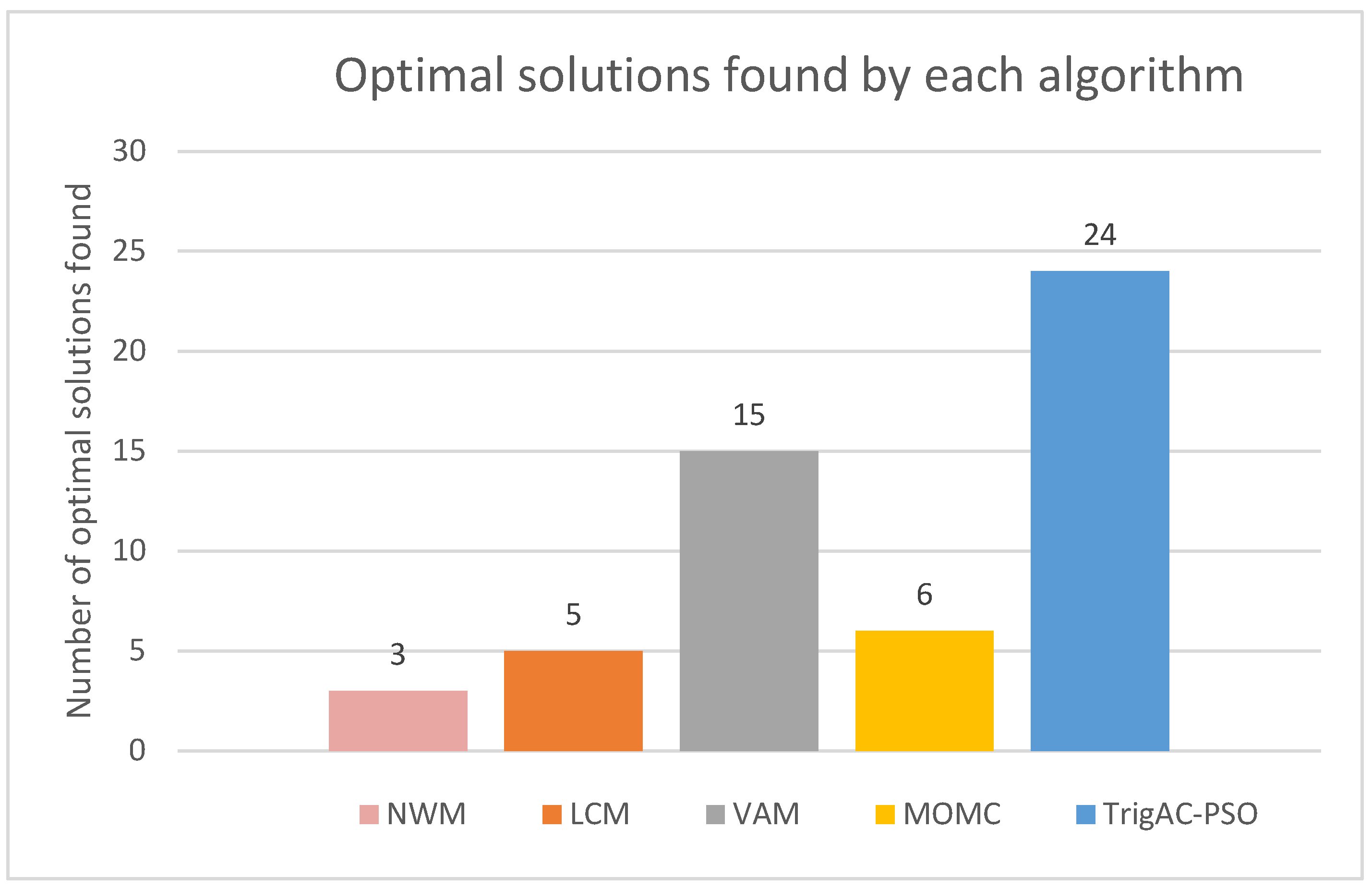
Figure 3, provided below, the performance of both exact methods and the Trig-PSO approach across 20 Monte Carlo runs is showcased. In every cell, the best value of each method is depicted using bold for the cases where the algorithms achieved the optimal solution. The last column provides the optimal solution for each numerical instance. The values highlighted in bold correspond to the optimal ones.
As illustrated, the NW method attains optimal solutions in 3 out of 28 test instances (10.71%). LCM achieved the optimal solution in 5 out of 28 instances (17.86%). VAM surpasses the previous methods, securing optimal solution in 15 out of 28 instances (53.57%). Despite being introduced later than the preceding methods, MOMC fell short of exceeding Vogel’s method, as it succeeded in identifying the optimal solution in six instances (21.43%). Notably, the TrigAC-PSO method emerges as the most efficient, achieving optimal results in 24 out of 28 instances (81.71%).
The deviation measurement quantifies the extent of variation between observed values and expected or target values. It provides a numerical representation of how much individual data values differ from the average or desired outcome and comprises a metric of each algorithm’s stability. Deviation is given by the following formula:
where
is the current solution.
Based on the data presented in
Table 4, it is apparent that VAM, MOMC and TrigAC-PSO appear to be more efficient than the other methods. Therefore, the solutions achieved by NWC differ from the optimal solution by 27.3%, the results of LCM by 10.12% and MOMC by 7.5%. Vogel’s approximation method presented higher levels of efficiency since the average of the export solutions differ from the optimal solutions by 2.7%. The TrigAC-PSO method is now highlighted as the most efficient method, surpassing all other methods, with a percentage close to zero. This indicates its remarkable stability and accuracy in predicting the optimal value with near-perfect precision.
In Boolean (classical) logic, transportation costs are represented as precise, fixed values. In fuzzy logic, transportation costs, as supply and demand quantities, are represented as approximate values, allowing for gradual transitions between costs and shipments.
The pivotal aspect of our study was the visual representation of the final solution using fuzzy numbers. In classical logic, a solution is deemed optimal only if its value aligns precisely with that of the optimal solution. However, the scientific quandary arises: How equitable is it to discard other solutions even when their deviation from the optimal one is infinitesimal?
This quandary sparked our original concept, i.e., to represent the costs incurred by exact methods using fuzzy sets and to ascertain the degree of truth inherent in each algorithm’s solution belonging to this set. Consequently, every solution is now endowed with its unique value, irrespective of its optimality status. The binary classification of classical logic, where 0 signifies non-optimality and 1 denotes optimality, is supplanted by a continuum with the interval , wherein each number signifies the solution’s degree of belongingness to the fuzzy set. In this study, the Gaussian membership function will be employed to ascertain the truthfulness of each solution.
The Gaussian membership function is defined by a bell-shaped curve characterized by its mean
and standard deviation
. The function assigns a degree of membership to each element in a fuzzy set, based on its proximity to the mean. Mathematically, the Gaussian membership function is given by the formula:
where
The following table (
Table 5) shows the degree of truth for each solution of the 28 problems.
We notice that among the methods that were unable to precisely identify the optimal solution, they achieved values that were remarkably close to the optimal cost. The degree of truth studies how closely the solution obtained by each method approaches our optimal solution offering a clearer perspective. When the degree of truth is 1, the NWM solutions exhibited optimality with a degree of truth of 0.6061 (equivalent to 60.61% optimality). In contrast, both LCM and MOMC attained optimality with a substantially higher degree, scoring 0.8261 (82.61% optimality) and 0.8546 (85.46% optimality), respectively, surpassing the NWM. While VAM succeeded in discovering the optimal solution in half of the instances, its remaining solutions were notably proximal, as VAM achieved the optimal with degree of truth as high as 0.9638 (96.38%). Yet again, TrigAC-PSO stands out significantly, having achieved the optimal solution in 24 out of 28 problems. However, in instances where TrigAC-PSO did not achieve the desired results, its attained solution diverged slightly from the optimal one, as indicated by the Gaussian membership function. TrigAC-PSO’s precision is evident, reaching the optimal solution with a remarkable truth score of 0.9991 (99.91% optimality).
The selection of these methods was deliberate, guided by two principal factors. Firstly, they were chosen because they have been established for years, verifying their reliability. Secondly, our intention was to demonstrate a compelling narrative: Despite their perceived obsolescence and occasional failure to attain optimality, these methods possess the potential for resurgence and redemption through fuzzy sets, transcending the boundaries of classical logic to reclaim their erstwhile prominence.
Upon culmination of the exhaustive comparative analysis involving the aforementioned methods, it became apparent that TrigAC-PSO appeared as the best choice, distinguishing itself as the quintessential option. In a quest to examine further its rustiness and precision, TrigAC-PSO underwent additional tests against contemporaneous methods introduced concurrently. Firstly, the proposed algorithm is tested on twelve instances, from
Table 2, against the algorithm introduced by Ekanayake and Ekanayake, in 2023 [
15]. This algorithm was based on Yager’s robust ranking method [
16].
But how is a ranking function defined?
An efficient approach for comparing fuzzy numbers is via the use of the racking function
where
is a set of fuzzy numbers defined on a set of real numbers, which convents a fuzzy number into a crisp value, under specific circumstances [
16].
The following table (
Table 6) gives the formulae of the ranking functions, which have been applied in this manuscript.
The subsequent table (
Table 7) presents the outcomes of the solutions derived from both TrigAC-PSO and the research conducted by Ekanayake and Ekanayake [
15].
Once more, TrigAC-PSO algorithm stands out by attaining the optimal solution with a membership degree of 1, demonstrating its superiority. Similarly, the method of Ekanayake and Ekanayake yields impressive outcomes, with an aggregated membership degree reaching 0.9995.
At this juncture, it is intriguing to delve into the realm of generalized fuzzy numbers, where the application of a metaheuristic approach to the FTP marks a pioneering endeavor. Five problems, from
Table 2, will be subjected to comparison against TrigAC-PSO, shedding light on the algorithm’s adaptability and efficacy in undertaking challenges modeled by fuzzy generalized numbers [
16,
17,
30,
39].
The ensuing table (
Table 8) illustrates the outcomes generated by four distinct methods applied to five of the aforementioned problem sets. These solutions are depicted as fuzzy numbers, subsequently subjected to defuzzification through the ranking function (
Table 6). This process facilitates an in-depth analysis of the deviation from the optimal values, as shown in
Table 9, thus enhancing comprehension for the reader.
Upon reviewing the table above, the following conclusions can be drawn:
Ebrahimnejad’s approach as well as Thota and Raja’s approach exhibited zero deviation from the optimal solution, establishing them as the preferred methods for solving the TP involving fuzzy generalized numbers;
TrigAC-PSO’s performance in this scenario was exceptional, yet again. This method almost reached an ultimate solution with a deviation rate of 1.71%;
Kaur and Kuman’s method demonstrated commendable efficiency with a deviation from the optimum standing at 2.89%;
Conversely, the outcomes derived from Mathur’s method exhibited a substantial deviation from the optimal solution, amounting to 20.54%.
Based on these assessments, it is apparent that our method, the TrigAC-PSO algorithm, ensures maximum accuracy, completeness and stability, adeptly handling both the classical TP and the more intricate FTP with remarkable proficiency.
Metaheuristic algorithms consistently emerge as optimal solutions for optimization problems with the PSO algorithm standing out as particularly advantageous. In our innovative variation, TrigAC-PSO, we have methodically designed the cognitive and social component to align with our philosophy, prioritizing the particle’s assimilation of swarm behavior and collective experience to follow its own decision-making process. Additionally, the inertia weight
intricately intertwines with the number of iterations outlined in our algorithm. The remaining consideration is to assess whether the number of particles, comprising our swarm, influences the evolution and quality of our solutions. The solutions for 28 problems were found using 20, 35 and 50 particles, generated by Algorithm 1. These solutions are summarized in the table below (
Table 10). The highlighted indications show the cases where the method failed to identify the optimal solution but achieved a value very close to it.
A brief examination reveals minimal deviation among solutions, often rendering them almost identical. However, a more thorough examination was deemed necessary. Each of the 28 problems was subjected to runs with varying numbers of particles and 20 tests conducted for each instance.
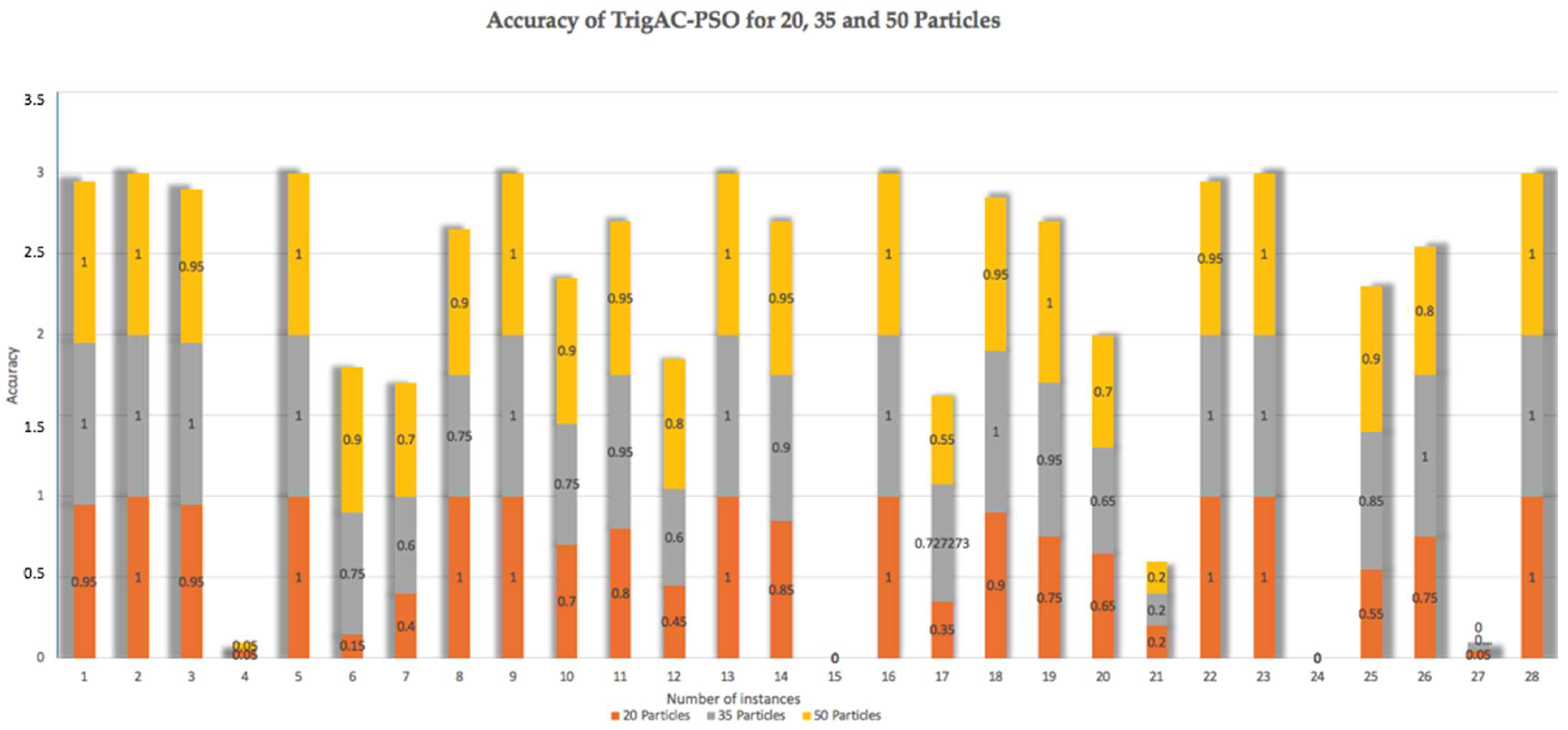
Table 11 expands the accuracy rate of each algorithm for 20, 35 and 50 particles. The accuracy rate is commonly defined based on the following relationship:
where
is the total number of runs where an optimal solution was found and
is the number of runs in general. In our scenario, the experiments were carried out for 20 runs.
The data represented in
Table 11 indicate that the algorithm achieves an accuracy rate of 66.07% for 20 particles. For 35 particles, the algorithm’s accuracy rate improves to 74.03%. Furthermore, solutions obtained using 50 particles exhibit even higher accuracy, reaching 75.54%. This pattern indicates that as the number of particles increases, there is enhanced interaction and information exchange within the swarm, resulting in higher solution accuracy rates.
Figure 4 also reveals the high levels of accuracy.
In the following table (
Table 12), the most important statistical measures for 20 independent runs are represented for 20, 35 and 50 particles, respectively.
The experimental findings highlight the remarkable stability of our proposed algorithm in solving the FTP. Across all scenarios, the mean values closely approximate the optimal solution, regardless of whether 20, 35 or 50 particles are utilized. This emphasizes not only the efficiency but also the robustness of the TrigAC-PSO method. Notably, the CV value, a crucial metric for measuring an algorithm’s stability, remains consistently low. Specifically, for 20 particles, the mean CV is 1.82%, reducing to 1.53% for 35 particles and further decreasing to 0.91% for 50 particles. This tendency suggests that increasing the number of particles improves algorithm’s stability. The consistently low CV values affirm the reliability of our algorithm, establishing it as a robust competitor among established methods.