Article

Bond Properties of Glass-Fiber-Reinforced Polymer Hybrid Rebar in Reinforced Concrete with Respect to Bond Length

Department of Civil Engineering, Kangwon National University, 346 Jungang-ro, Samcheok-si 25913, Republic of Korea
*
Authors to whom correspondence should be addressed.
Appl. Sci. 2024, 14(11), 4576; https://doi.org/10.3390/app14114576
Submission received: 25 April 2024 / Revised: 20 May 2024 / Accepted: 23 May 2024 / Published: 27 May 2024
(This article belongs to the Special Issue High-Reliability Structures and Materials in Civil Engineering)

Abstract

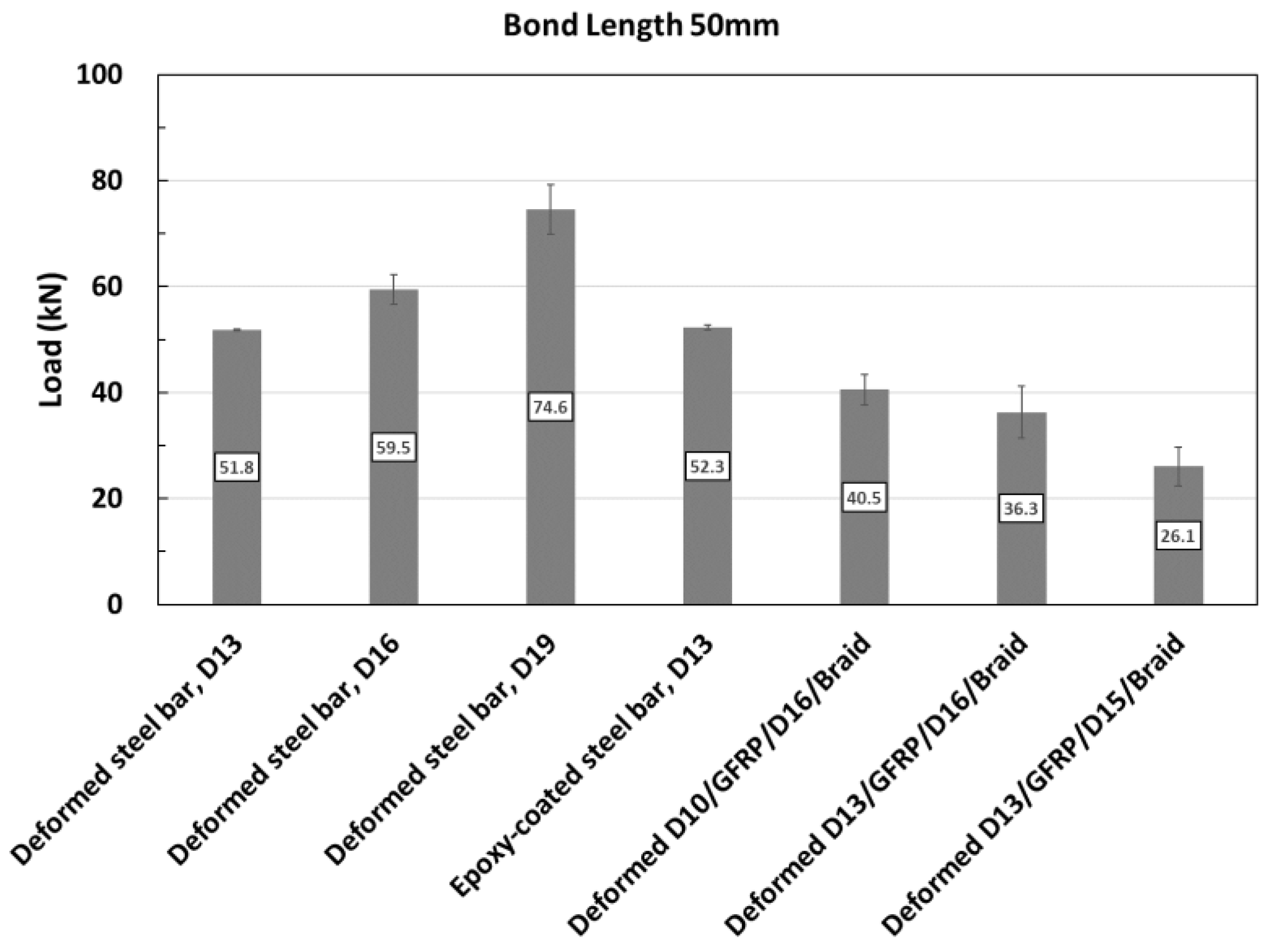
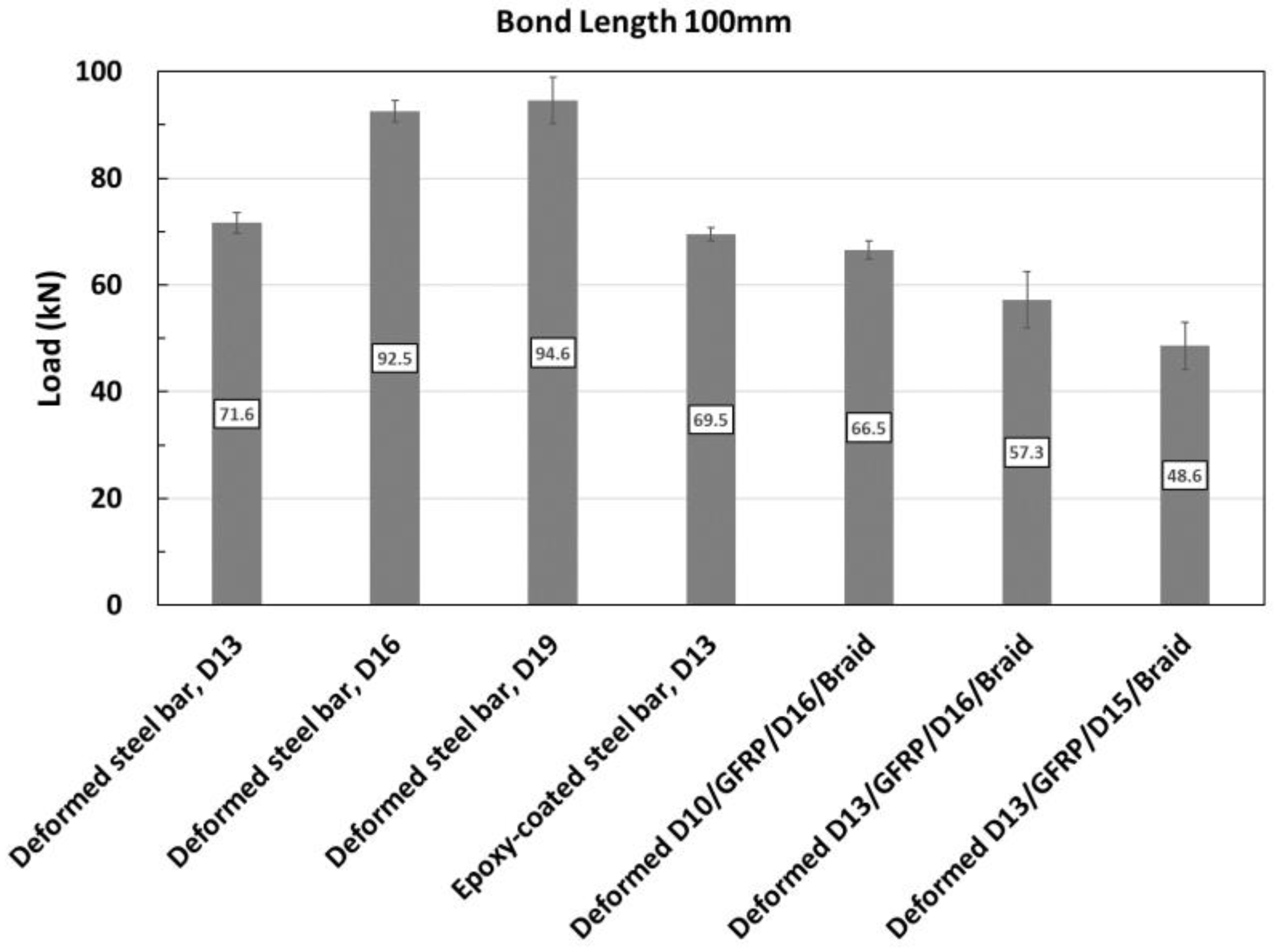
Preventing rebar corrosion in reinforced concrete (RC) structures has been actively researched worldwide. One of the most powerful solutions is the use of fiber-reinforced polymer (FRP) rebars. However, there are limitations in the mechanical design and construction of FRP rebars because their tensile characteristics are extremely different from those of conventional rebars and they have a different modulus of elasticity. FRP rebars are relatively cost-efficient when fabricated with glass fibers, but they are still costly compared to conventional rebars. Therefore, hybrid rebars fabricated by covering conventional rebars with glass FRP (GFRP) materials were developed in this study. GFRP hybrid rebars have increased durability in marine environments while maintaining the same mechanical properties as conventional rebars. As the difference in rebar diameter of the bonded area decreased, the tensile strength of the concrete increased. As a result, pull-out failure or tensile failure caused by the yielding of the rebars occurred in small-diameter rebars. The experimental results showed that the maximum load for the D13 deformed steel bar was 52.2 kN at a bond length of 50 mm and 76.1 kN at 100 mm, while for the D19 deformed steel bar, it was 65.3 kN at 50 mm and 103.7 kN at 100 mm. The bond properties of hybrid GFRB rebars were found to be lower than those of deformed steel bars. These properties were improved greatly by increasing the thickness of the GFRP materials on the surface of the deformed steel bars, highlighting a path toward high-performance, corrosion-resistant concrete.
Keywords: reinforced concrete; corrosion resistance; glass-fiber-reinforced polymer; hybrid GFRP rebar; concrete polymer bonding reinforced concrete; corrosion resistance; glass-fiber-reinforced polymer; hybrid GFRP rebar; concrete polymer bonding