Article

The Squat One Repetition Maximum May Not Be the Best Indicator for Speed-Related Sports Performance Improvement in Elite Male Rugby Athletes

1
Team 42 Training Center Daegu, Daegu 41596, Republic of Korea
2
Department of Physical Education, Dong-A University, Busan 49315, Republic of Korea
3
Department of Physical Education and Sport Sciences, National Taiwan Normal University, Taipei 106, Taiwan
4
Department of Kinesiology, Inha University, Incheon 22212, Republic of Korea
*
Author to whom correspondence should be addressed.
Appl. Sci. 2024, 14(1), 31; https://doi.org/10.3390/app14010031
Submission received: 23 November 2023 / Revised: 18 December 2023 / Accepted: 19 December 2023 / Published: 20 December 2023
(This article belongs to the Special Issue Exercise Physiology and Biomechanics in Human Health)

Abstract

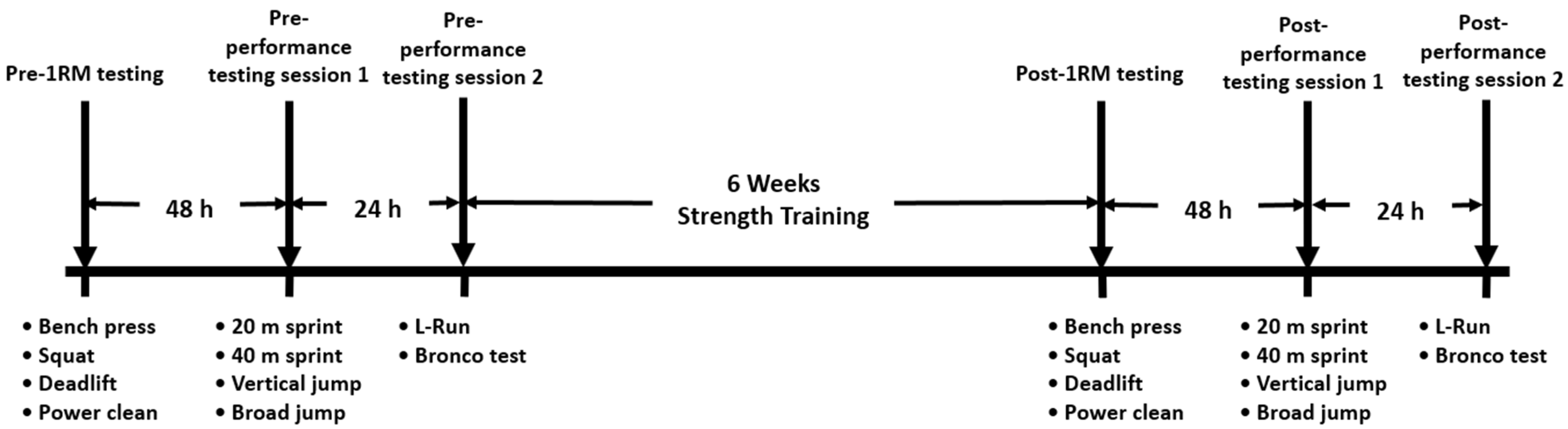
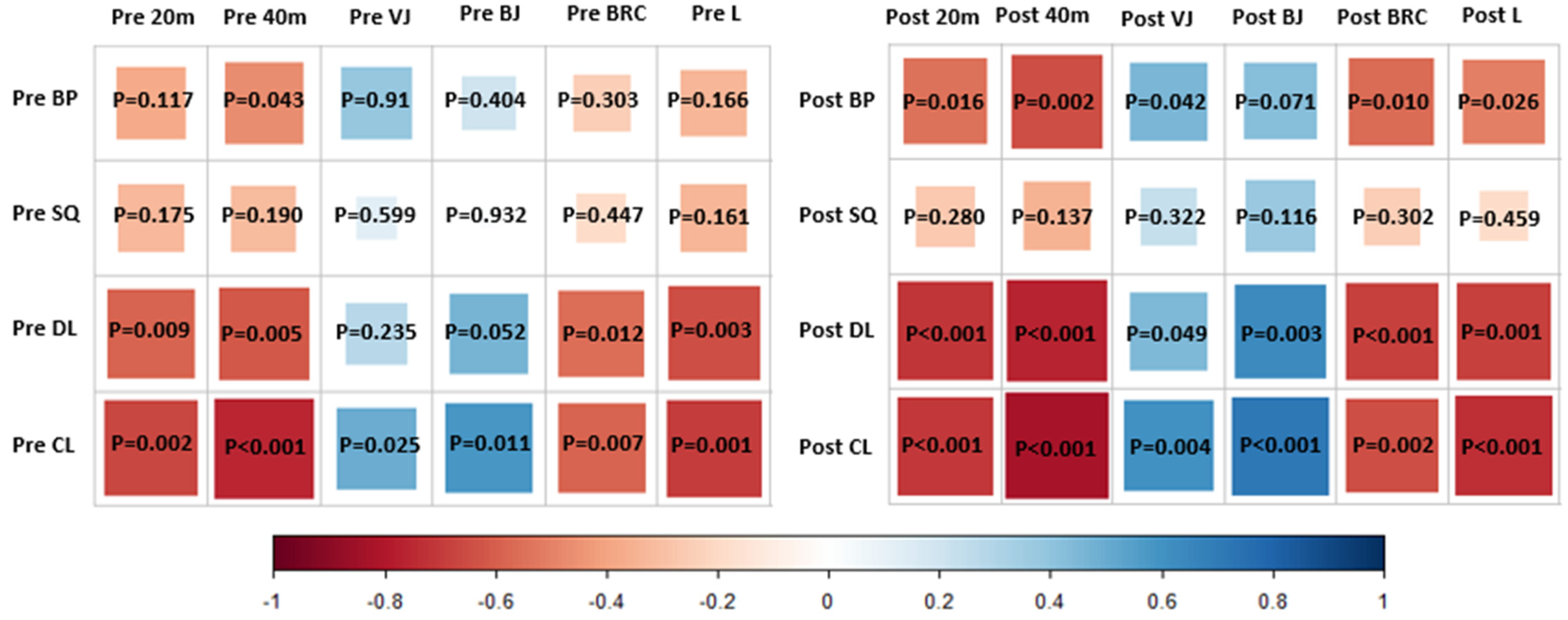
In the strength and conditioning field, a variety of training exercises are being applied to improve speed-related performance, but there is a lack of traditional strength training guides that can be used for training effectiveness. The aim of this study was to assess the impact of a six-week traditional strength training program on elite rugby players and explore the relationships between the one repetition maximum (1RM) of traditional strength exercises and athletic performance. Twenty elite rugby players (age = 30.5 ± 1.5 years, mass = 96.7 ± 16.6 kg, height = 179.3 ± 6.0 cm) completed the strength training program, and 1RM values for bench press, squat, deadlift, and power clean, along with athletic performance metrics (20 m and 40 m sprints, vertical jump, broad jump, Bronco test, L-run), were measured before and after the training period. Medium effect sizes were observed in the deadlift (p = 0.04, d = 0.49) and bench press (p = 0.019, d = 0.57) 1RM, while the squat exhibited a very large effect size (p < 0.001, d = 2.08). Both before and after training, greater power clean 1RM demonstrated a strong correlation with each athletic performance test. However, bench press 1RM, both pre-and post-training, did not significantly associate with functional performances (p > 0.05). Notably, power clean 1RM showed the strongest correlation with athletic performance; despite being the most significant improvement in squat 1RM after the six-week training period, it was not associated with athletic performance outcomes in rugby players. This study underscores the varied impact of specific strength exercises on athletic performance, emphasizing the distinct role of power clean 1RM in predicting speed-related performance in male rugby players.
Keywords: bench press; power clean; rugby conditioning; strengthening; athletic training; strength assessment bench press; power clean; rugby conditioning; strengthening; athletic training; strength assessment