Article

The Downside of Upkeep: Analysing Railway Infrastructure Maintenance Impact on Train Operations in Sweden


by
Daria Ivina
1,2,* and
Carl-William Palmqvist
1,2
1
Department of Technology and Society, Faculty of Engineering, LTH, Lund University, 221 00 Lund, Sweden
2
K2 Swedish Knowledge Centre for Public Transport, 222 36 Lund, Sweden
*
Author to whom correspondence should be addressed.
Appl. Sci. 2024, 14(1), 125; https://doi.org/10.3390/app14010125
Submission received: 27 October 2023 / Revised: 27 November 2023 / Accepted: 14 December 2023 / Published: 22 December 2023
(This article belongs to the Special Issue Railway Structure and Track Engineering)

Abstract

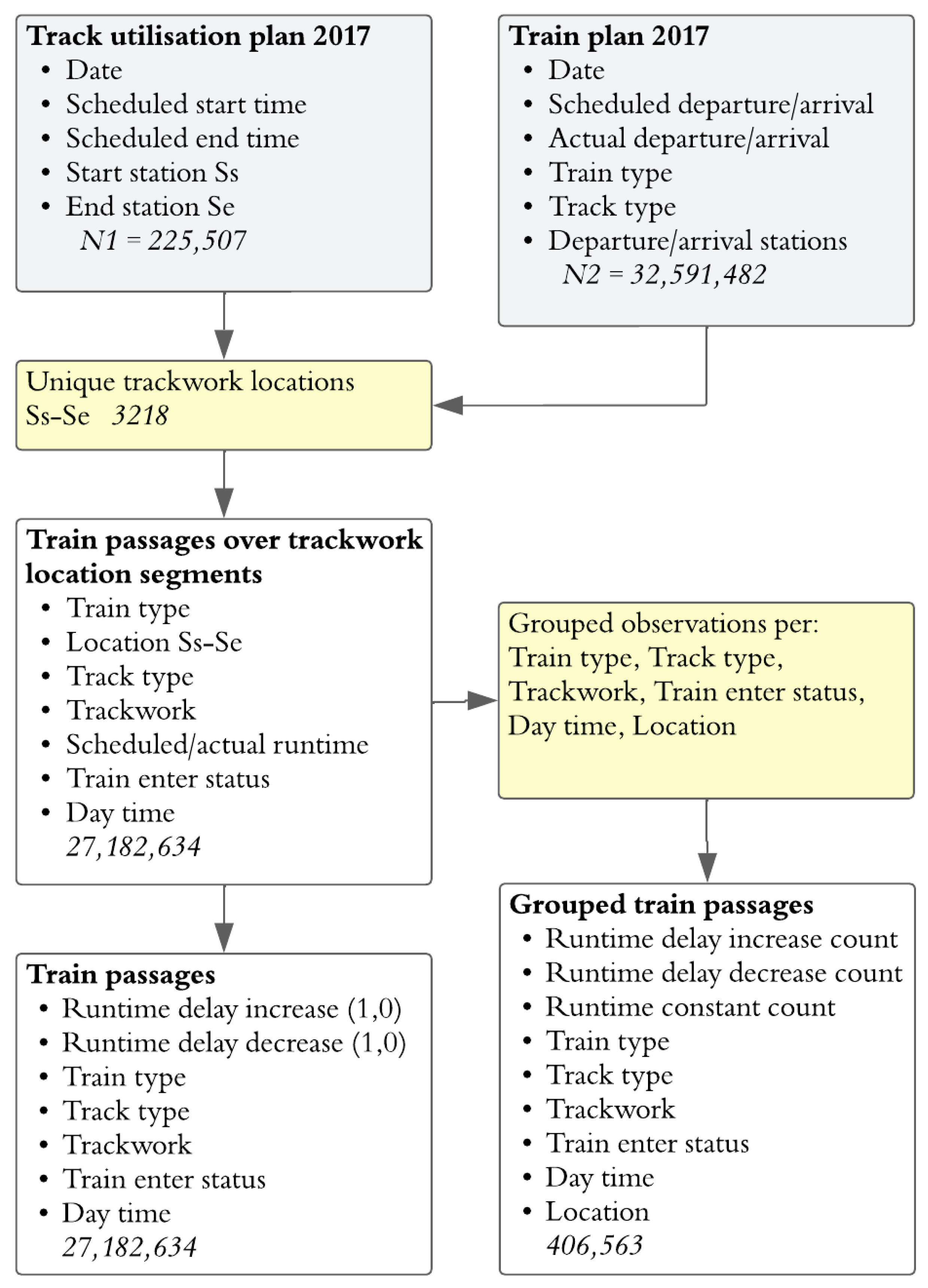
Efficient and seamless railway operations depend on the systematic and well-coordinated maintenance of both rolling stock and infrastructure. However, track maintenance, or ‘trackwork’, can cause substantial delays if not properly aligned with train schedules. This study comprehensively investigates how trackwork influences train operations in Sweden. It involves an in-depth analysis of an extensive dataset comprising over 225,000 recorded instances of planned trackwork and approximately 32.5 million train passages throughout the year 2017. Multiple logistic and negative binomial regression models showed that train running time delay occurrence is higher in the sections with scheduled trackwork. Trains passing through trackwork are 1.43 times more likely to experience delays compared to trains that do not pass through scheduled trackwork. The likelihood of an opportunity for the train delay recovery passing the section with scheduled trackwork is reduced by 11%. Additionally, the frequency of train delay increase is 16% higher, and delayed recovery is 4% lower in relation to trackwork. With the number of trackwork set to increase over the coming years, these results bring attention to train scheduling and the performance of trackwork.
Keywords: railway infrastructure maintenance; train delays analysis; trackwork scheduling; Swedish railway system; regression analysis railway infrastructure maintenance; train delays analysis; trackwork scheduling; Swedish railway system; regression analysis