


Abstract
The OPF problem has significant importance in a power system’s operation, planning, economic scheduling, and security. Today’s electricity grid is rapidly evolving, with increased penetration of renewable power sources (RPSs). Conventional optimal power flow (OPF) has non-linear constraints that make it a highly non-linear, non-convex optimization problem. This complex problem escalates further with the integration of renewable energy resource (RES), which are generally intermittent in nature. This study suggests a new and effective improved optimizer via a TFWO algorithm (turbulent flow of water-based optimization), namely the ITFWO algorithm, to solve non-linear and non-convex OPF problems in energy networks with integrated solar photovoltaic (PV) and wind turbine (WT) units (being environmentally friendly and clean in nature). OPF in the energy networks is an optimization problem proposed to discover the optimal settings of an energy network. The OPF modeling contains the forecasted electric energy of WT and PV by considering the voltage value at PV and WT buses as decision parameters. Forecasting the active energy of PV and WT units has been founded on the real-time measurements of solar irradiance and wind speed. Eight scenarios are analyzed on the IEEE 30-bus test system in order to determine a cost-effective schedule for thermal power plants with different objectives that reflect fuel cost minimization, voltage profile improvement, emission gases, power loss reduction, and fuel cost minimization with consideration of the valve point effect of generation units. In addition, a carbon tax is considered in the goal function in the examined cases in order to investigate its effect on generator scheduling. A comparison of the simulation results with other recently published algorithms for solving OPF problems is made to illustrate the effectiveness and validity of the proposed ITFWO algorithm. Simulation results show that the improved turbulent flow of water-based optimization algorithm provides an effective and robust high-quality solution of the various optimal power-flow problems. Moreover, results obtained using the proposed ITFWO algorithm are either better than, or comparable to, those obtained using other techniques reported in the literature. The utility of solar and wind energy in scheduling problems has been proposed in this work.
1. Introduction
1.1. Motivation
The optimal power flow (OPF) is an optimization method to minimize a specific optimization benchmark while satisfying security, physical and feasibility limits. The various OPF problems have been broadly applied in recent studies, and have served as a multi-model, non-linear, and non-convex optimization problem [1,2]. In the last two decades, various OPF objective functions had a grandness due to the quick adoption of divided power resources in an energy network [3]. The accretion of divided and periodic renewable power sources (RPSs), as with wind energy (WE) and photovoltaic (PV) systems, into modern energy networks has generated novel types of problems for managing and operating the energy network [4,5]. Optimizing the various OPF problems has become more intricate with the enormous incorporation of RPSs that constrain volatile dynamics for the energy network due to their uncertainty [6,7].
Conventional search approaches, such as quadratic programming (QP) [8], and non-linear programming (NLP) [9,10,11] presented great convergence trends in optimizing the objective functions of the different OPF problems; however, these methods apply theoretical hypotheses not suitable for real-world problems, as they have non-smooth and non-differentiable objective functions [12,13,14]. In addition, the preceding methods sometimes fail to show the main trends of the objective function as a convex OPF function [12]. Therefore, metaheuristics have been applied to dominate the above-mentioned weaknesses [12,15].
1.2. Literature Review
The following algorithms have been successfully applied to optimize various OPF problems: manta ray foraging optimizer (MRFO) [3], grey wolf optimization (GWO) [16,17], a parallel genetic algorithm (GA) (EPGA) [18], multi-objective electromagnetism-like algorithm (MOELA) [19], a distributionally robust approach for OPF [20], a combination firefly-bat algorithm (HFBA-COFS) [21], social spider optimization (SSO) [22], solving OPF by GA and teaching-learning-based optimization (TLBO) (G-TLBO) [23], a bacterial foraging algorithm (BFA) [24], various differential evolution (DE) algorithms [25,26,27,28,29,30,31], Harris hawks optimization (HHO) [32], cuckoo search algorithm (ECSA) [33,34], chaotic invasive weed optimization algorithms (CIWOs) [35], multi-objective dynamic OPF (MODOPF) [36], salp swarm algorithm (SSA) [37], TLBO with Lévy mutation (LTLBO) [38], voltage stability constrained OPF (VSC-OPF) [39], considering effects of solar position [40], the hybridization of PSO with GWO, namely a PSO-GWO algorithm [41], symbiotic organisms search (SOS) [42], artificial bee colony (ABC) algorithms [43,44,45], group search optimization (GSO) [46,47], a new combine algorithm, SFLA-PSO [48], a colliding bodies optimization (CBO) [49], tunicate swarm algorithm (TSA) [50], a modified hybrid PSO [51] and GSA with chaotic maps (CPSOGSA) [52], sine-cosine algorithms (SCAs) [53,54], chaotic bonobo optimizer (CBO) [55], a honey bee mating optimization (HBMO) [56], a heap-based optimization (HBO) [57], slime mold algorithm (SMA) [58], mayfly algorithm (MA) [59], BAT search algorithm [60], moth swarm algorithms (MSA) [61,62], bird swarm algorithm (BSA) [63], a new evolutionary algorithm (EA) [64], etc.
1.3. Contribution and Paper Organization
In 2021, Ghasemi et al. [65] introduced the TFWO algorithm, which is inspired by the formula of turbulent fluctuations in water flow in nature. The recent research has demonstrated that TFWO can be effectively used to find optimal solutions to a variety of optimization problems. For example, TFWOs were used for optimal reactive power distribution (ORPD) in [66]. The chaotic TFWO (CTFWO) was introduced in [67] as a means of reducing voltage deviation (VD) and real power loss. The TFWO model has been successfully used to solve problems related to unit commitment model integration with electric vehicles in [68]. An estimation of the correlation parameter of the Kriging method, enhancing the accuracy of the Kriging surrogate modeling (KSM) used to approximate the complex and implicit performance functions in [69]. To solve short-term hydrothermal scheduling, the authors of [70,71] have proposed quasi-oppositional TFWO (QOTFWO). The cascading nature of hydro plants, valve-point loading (VPL), and multiple fuel sources have been assumed in their modeling. Through a comprehensive comparison of three robust performance and fast convergence algorithms, ref. [72] proved that the TFWO can optimize an isolated hybrid microgrid. The TFWO also have been applied for proportional integral derivative (PID) controller to ensure reliable operation of active foil bearings [73], and optimal allocation of shunt compensators in distribution systems [74]. Based on the results of [74], the TFWO algorithm was found to be effective in reducing power loss, enhancing the voltage profile, and determining the type, size, and location of the reactive power compensators (RPCs).
In different patterns of partial shading, TFWO was shown to be capable of maximizing duty cycle of DC/DC converters to achieve global optimal power [75]. In [76], the performance of the TFWO was compared and validated against seven well-known algorithms. As a result of optimizing photovoltaic models, the TFWO were able to provide the minimum fuel cost and significant robust solutions to the ELD problem over all networks tested in [77,78]. It was demonstrated in [77,78] that the estimated power-voltage (P-V) and current-voltage (I-V) curves achieved by the TFWO were very close to the experimental data.
It has been demonstrated in recent research that TFWO can be effective in solving real-world problems. It is worth noting that, due to its non-convex and non-linear nature, the OPF problems can be extremely challenging. The robustness and convergence speed of existing algorithms, such as turbulent water flow (TFWO), need to be improved in order to tackle such a complex problem. An innovative and successful improvement of the TFWO (ITFWO) approach is presented in this paper to address a variety of OPF problems encountered in hybrid power systems. To demonstrate the algorithm’s ability to solve OPF problems, this paper compares the developed algorithm with existing state-of-the-art methods.
This paper highlights the following points:
- Enhancing the TFWO algorithm’s convergence speed, exploration capabilities, and exploitation capabilities.
- The original TFWO algorithm has been improved by the addition of an enhanced operator to update the population, which increases the local search capability of the algorithm.
- The proposed improved algorithm is successfully applied to solve the non-convex and non-linear OPF problems considering different objective functions.
- The magnitude of the voltage at the WT and PV buses is considered a decision variable, while the forecasts of the WT and PV power generation are considered dependent variables.
2. Problem Formulation
OPF combining the uncertainties of PV and WT units has been formulated in this [79]:
where: the objective function (F) to be solved; x indicates vector of decision parameters as Equation (5), output active power (PGi) excluding at the slack bus (i = 1: NG, the number of units), generator voltages including PV and WT (VGi; i = 1: NG), tap settings of transformer (Ti) (i = 1: NT, the number of regulating transformer), and (QCi) (i = 1: NC, the number of VAR compensators) is the shunt VAR compensations [79]:
Here, y shows the resultant of dependent decision parameters including of voltages at load bus (VLi; i = 1: NL, the size of load buses), slack bus power (PG1), output reactive power of any generator (QGi), and loads of transmission line (Sli) (i = 1: NTL, the size of transmission lines).
2.1. Constraints
The basic OPF Equation (2) indicates the equality constraints [79].
NB: the size of busses; Pi: active power; Gij: the real section of bus admittance matrix; δij: the voltage angle between i and j; Bij: the imaginary section of bus admittance matrix.
Qi: reactive power injected at bus i.
The inequality limits, i.e., Equation (3), includes the voltage magnitude limits, the generating units’ reactive power constraints, and power flow limits of the branches, which are expressed as follows [79]:
Equation (4) shows the area of feasible search space for any OPF function including the following limits:
2.2. Objective Functions
The principal optimization objective F has contemplated in the objective functions is the fuel cost of the energy units (Fcost). The cost of any generator is shown as a second-class optimization problem of the generation power of any unit (PG):
where ai, bi and ci show the cost factors of the ith generator.
To decrease active loss (Ploss) in the energy network OPF function for optimization has showed:
The OPF function to optimize the voltage deviations (VD) is as follows:
where Vi indicates the voltage value of the ith bus, and Viref has been contemplated as 1 p.u.
In this study, the emission level of the two significant pollutants, sulfur oxides (SOx) and nitrogen oxides (NOx), are considered to be minimized [80]:
where ξi (ton/h), γi (ton/h MW2), βi (ton/h MW), αi (ton/h), and θi (1/MW) are pollution factors of ith unit.
So, the main function is considered as follows:
where λQ, λV, λP, and λS show the penalty coefficients; and xlim shows a variable as an auxiliary variable:
2.3. Modelling of RPSs
2.3.1. Modelling of WT Units
The generation power of a WT unit at wind speed v, is modeled as follows [79]:
where vco is cut-out wind speed, vci is cut-in wind speed; vn is nominal wind speed; and Pwtn, is the nominal generation active energy of the wind turbine.
The non-linear characteristics of wind speed in a predefined process at a special locality have been shown via Weibull PDF:
The CDF (cumulative distribution function) for the Weibull dispersion (WD) is:
where fv(v) describes Weibull PDF of v; k and C are the shape and scale parameters of WD; r is a haphazard value uniformly generated on 0 and 1.
The active power of the WT unit has been modeled via the probability of any feasible state for that time interval [79]:
where fν(νgt) is the probability of v for state g during the special space t; PWTg is the out active power of WT computed by (22) for v = ; is the gth state of v at the tth time space.
2.3.2. Modelling of PV Units
The active energy provided of a PV generator is associate on the solar irradiancy [79]:
where Rc is a particular irradiancy point; Sstc is the solar irradiancy at test states; S is the solar irradiancy on the PV surface (W/m2); Ppvn is the nominal active power of the PV generator.
Beta PDF role of S (fs(S)) has been proposed to formulate the dynamic nature of solar irradiancy [79,81]:
where represents Gamma role; α, β indicates its shape variables.
The forecasted active power of PV (PPVg) at the tth time interval and the gth state of solar irradiancy (Sgt) has been calculated as follows [79]:
3. The Proposed Improved Optimizer
3.1. The Basic TFWO
3.1.1. Formation of Whirlpools
Firstly, the particle (X) of TFWO (Np: the size of swarm) is distributed similarly between NWh swarms, and then the best population of the any swarm or whirlpool (Wh) has been defined as the center of the swarm and its cavity that pulls the particles based on their spaces to the whirlpool.
3.1.2. Pulling the Objects
In a whirlpool the objects are whirling with their angle (δ) circa their whirlpool’s center, the novel location (Xinew) of the ith object is gone as same as Whj −∆Xi, and method to it. In addition, at any generation is modifying: :
where is Wh with an up cost of and Whf is Wh with a minimum cost of , respectively.
3.1.3. Centrifugal Force (FEi)
FEi is formulated according to , and if FEi is more than the random number r, FEi is executed for the elected kth dimension randomly as Equation (34):
3.1.4. Interplay between the Swarms
Whirlpools (swarms) displace and interact together. To the determined ∆Whj, the nearest swarm is determined according to its cost and the minimum value of Equation (35) and based on the Equations (36) and (37) and according to the amount of δj, change of the whirlpool’s location is determined as follows.
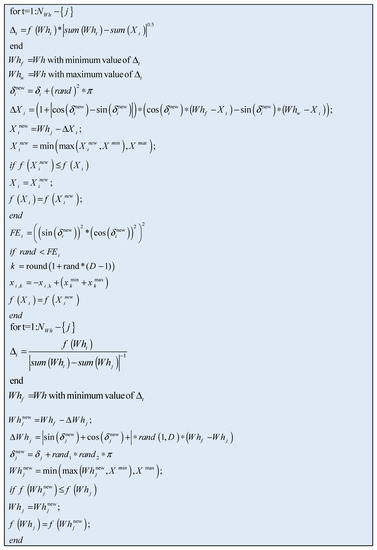
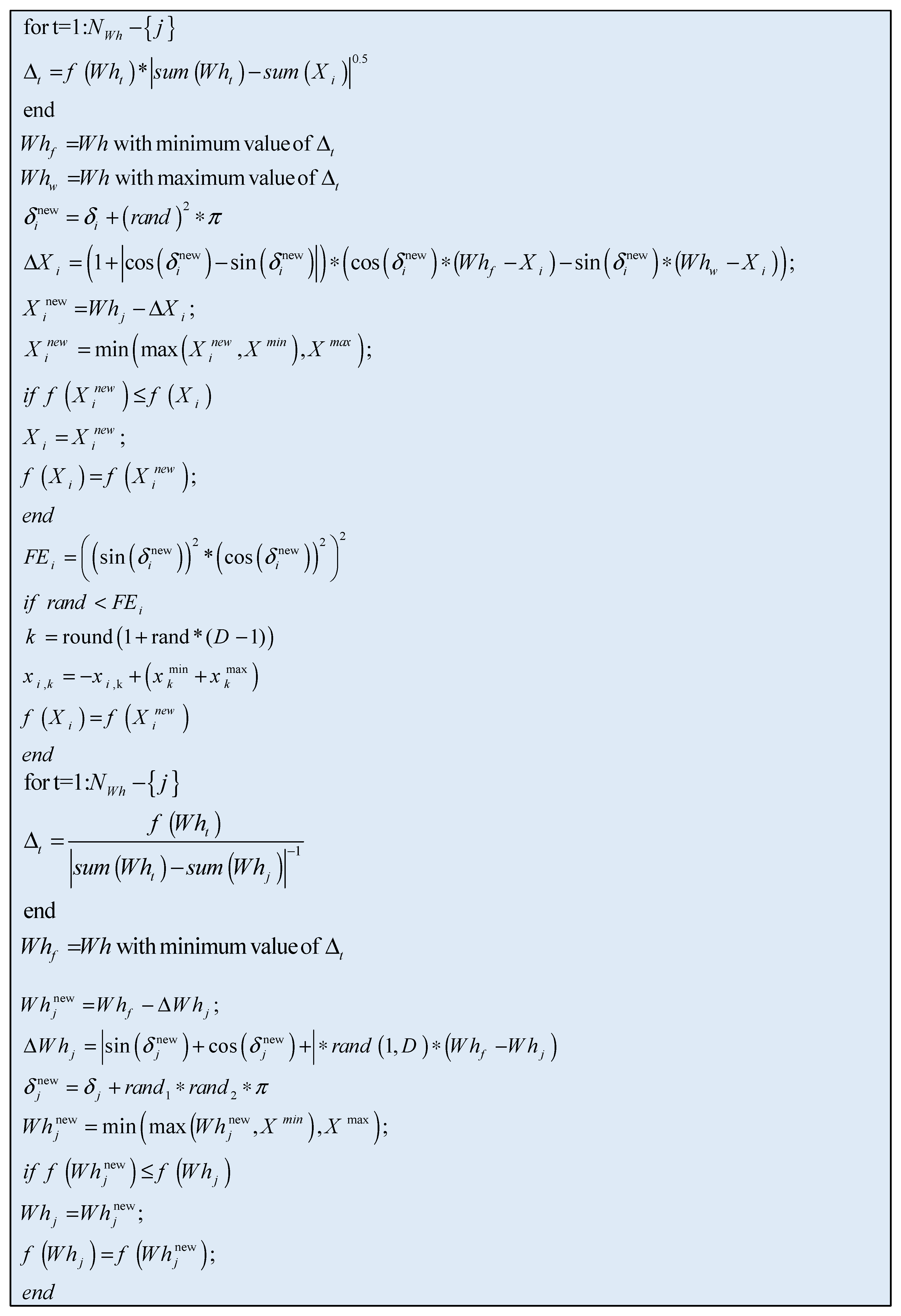
Optimization process of TFWO has been given in Figure 1.
Figure 1.
Optimization process of TFWO.
3.2. Improved TFWO (ITFWO)
In this paper is proposed a novel ITFWO in optimizing very complex real-world problems. Equation (38) shows the new learning and effective search in the proposed ITFWO optimizer. In Equation (38), local and global searches are integrated, similar to the original algorithm, and also separated from each other, which makes the population move towards the global optimum with different equations of motion and with different accelerations, and the search range of the population effectively increases. This new equation makes the proposed algorithm much better at searching both locally and globally. As a result, the proposed algorithm can solve more problems.
4. ITFWO for Various OPF Problems
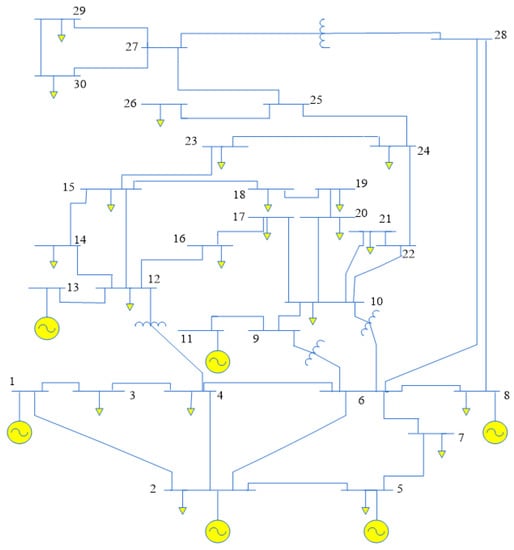
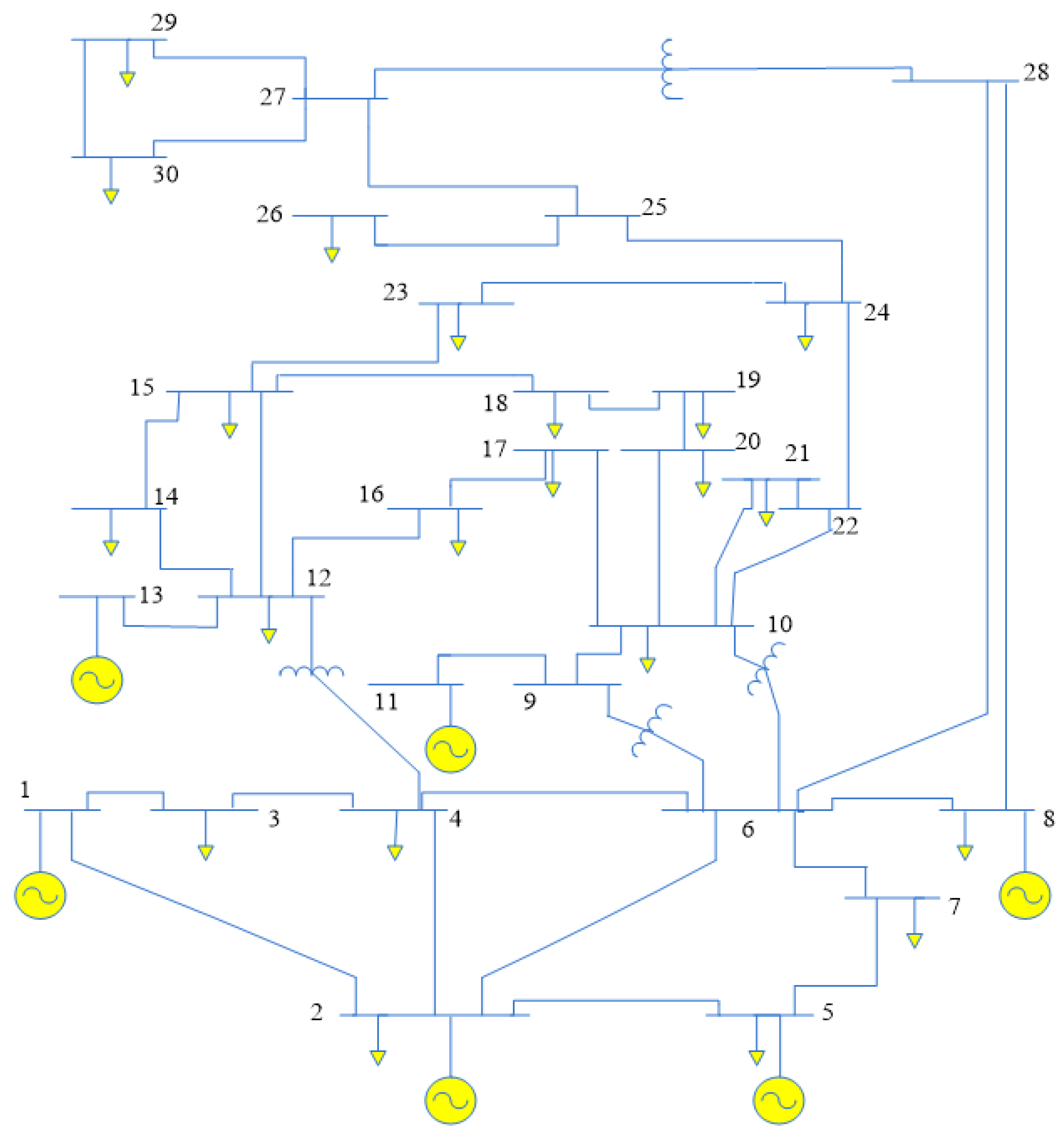
The TFWO and ITFWO are used on the IEEE 30 bus test system to optimize eight various types of OPF problem, the generation size is 400 for two algorithms TFWO (with NWh = 3 and Npop = 45) and ITFWO (with NWh = 3 and Npop = 45). Test network information shown in [80], as shown in Figure 2 and also in Table 1.
Figure 2.
The IEEE 30-bus system.
Table 1.
ITFWO’s simulation optimal results.
4.1. Basic OPF Solutions
Table 1 shows ITFWO’s simulation optimal results for six types of basic OPF without RPSs.
4.1.1. Type 1: Total Fuel Cost
This type of OPF has been given in Equation (40):
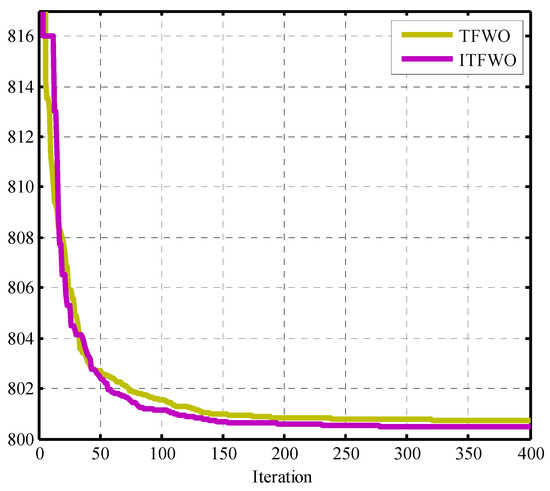
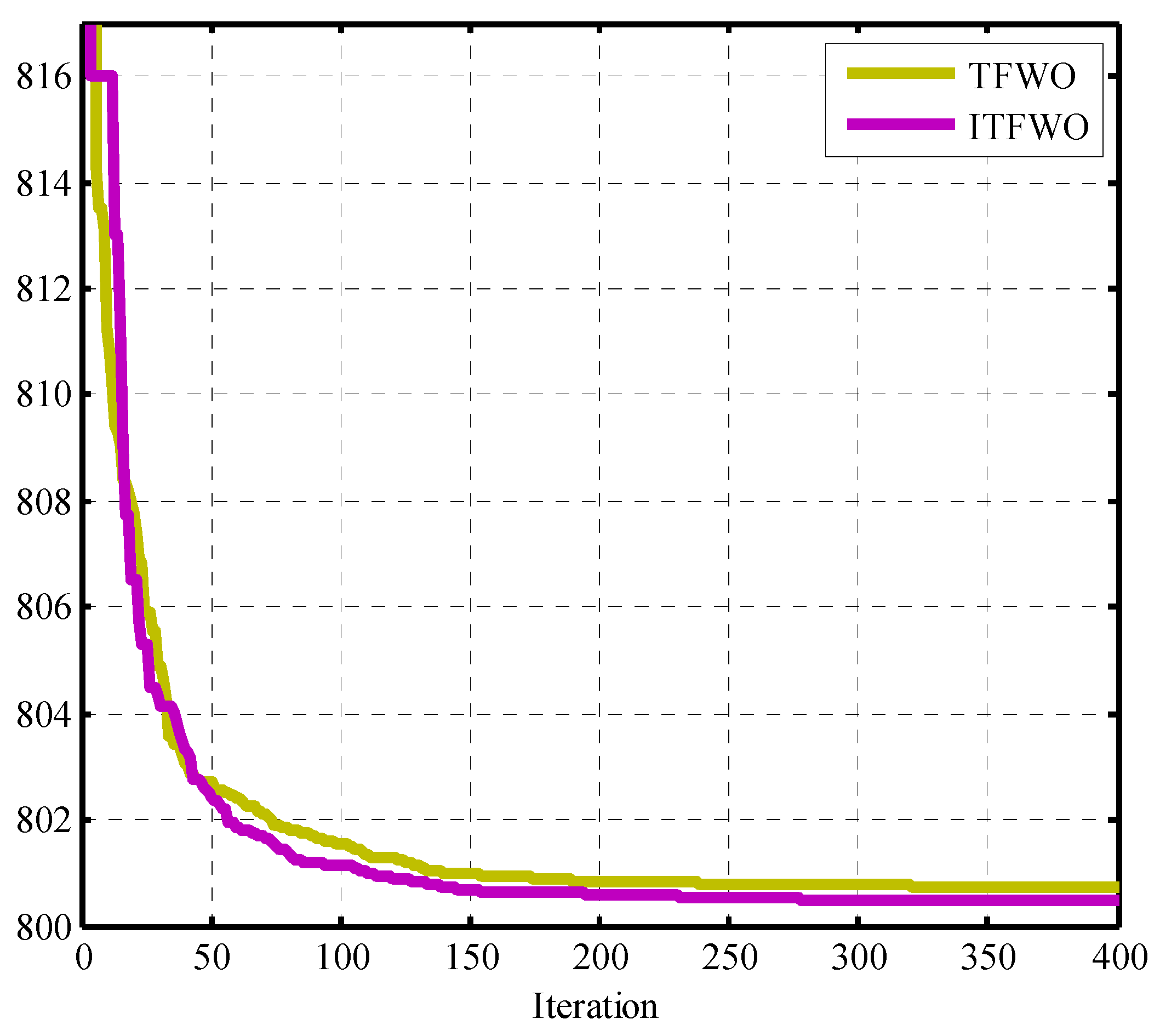
Optimization results has been given in Table 1, the illustrate that the objective function by ITFWO is 800.4787 ($/h) that is better in comparison to the recent methods in the papers in Table 2 such as MICA-TLA [82], MGBICA [83], SFLA-SA [84], HFAJAYA [85], TS [86], MSA [80], IEP [87], SKH [88], MRFO [89], GWO [56], ARCBBO [90], MHBMO [29], PSOGSA [91], ABC [92], MFO [80], AGSO [51], FA [85], DE [93], JAYA [94], EP [95], PPSOGSA [96], AO [97], MPSO-SFLA [48], FPA [90] and TFWO. The convergence trends of the algorithms for this type have been given in Figure 3.
Table 2.
The optimal results for Type 1.
Figure 3.
Optimization process for Type 1.
4.1.2. Type 2: Including the Power Loss and the Fuel Cost
For this type of OPF problem, the network losses and the fuel cost are considered as the objective function, Equations (16) and (17), as given in Equation (44):
where, the amount of has been choosen 40 [80].
The achieved optimal variables by ITFWO has been given in Table 1. In addition, the optimization processes of the problem have been given in Figure 4. The achieved best objective functions by ITFWO are 859.0009 ($/h) and 4.5297 (MW). By testing the simulation optimal results in Table 3, the amount of the optimization function that has been achieved via ITFWO is better in comparison to the other methods.
Figure 4.
Optimization process for Type 2.
Table 3.
The optimization results for Type 2.
4.1.3. Type 3: Including the Voltage Deviation (V.D.) and Fuel Cost
In this type of OPF problems has been considered and V.D. in order to increase service and security indexes at buses as follows:
where, the amount of has been choosen 100 [80].
The best setting for control parameters has been achieved by ITFWO has been given in Table 1. Moreover, the simulation solutions of the methods have been given in Table 4, ITFWO has significantly decreased this multiobjective OPF. In addition, the optimization processes of the problem with the studied methods have been in Figure 5.
Table 4.
The optimization results for Type 3.
Figure 5.
Optimization process for Type 3.
4.1.4. Type 4: Piecewise OPF Problem
The fuel cost features for the network generators linked at first and second buses are modeled via a piecewise OPF problem because of various fuel types shown by:
where ai,k, ci,k, bi,k, are factors for the objective function of ith unit for kth fuel type; nf is the number of fuel types for ith generator.
The OPF problem for this type is modeled via Equation (44).
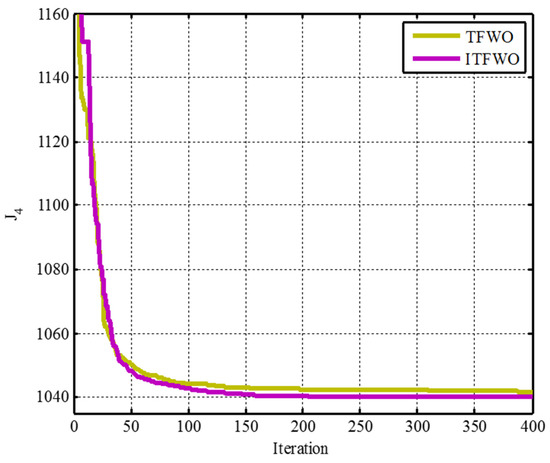
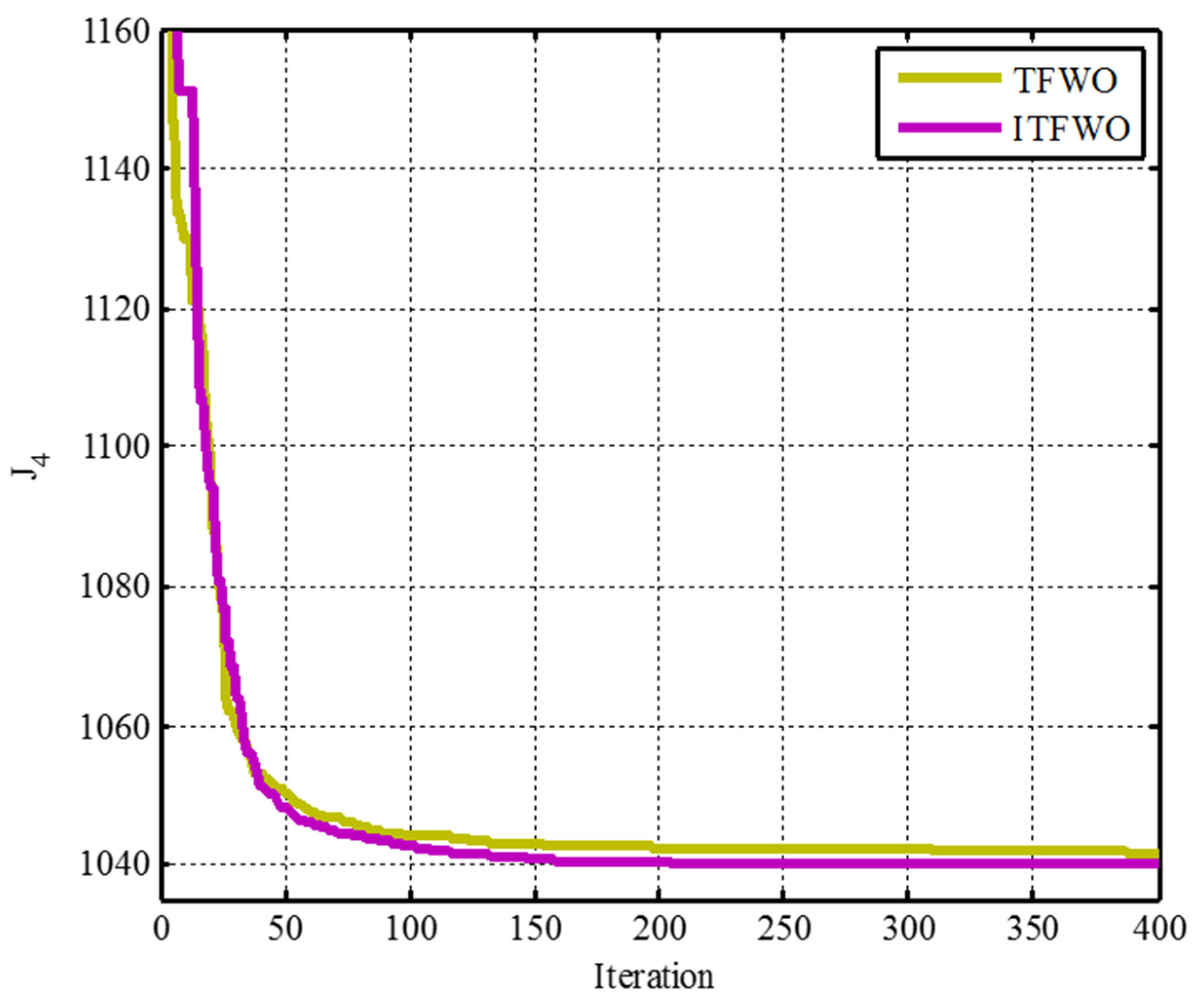
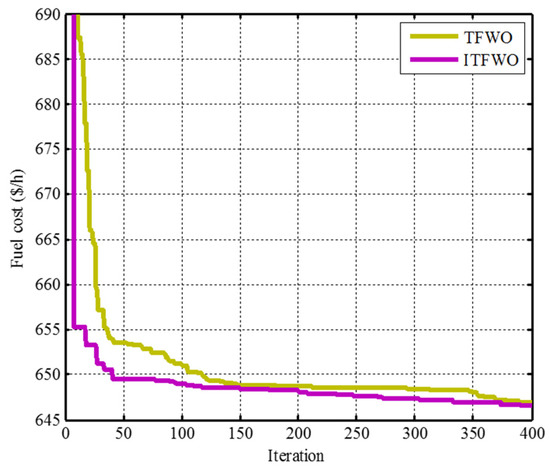
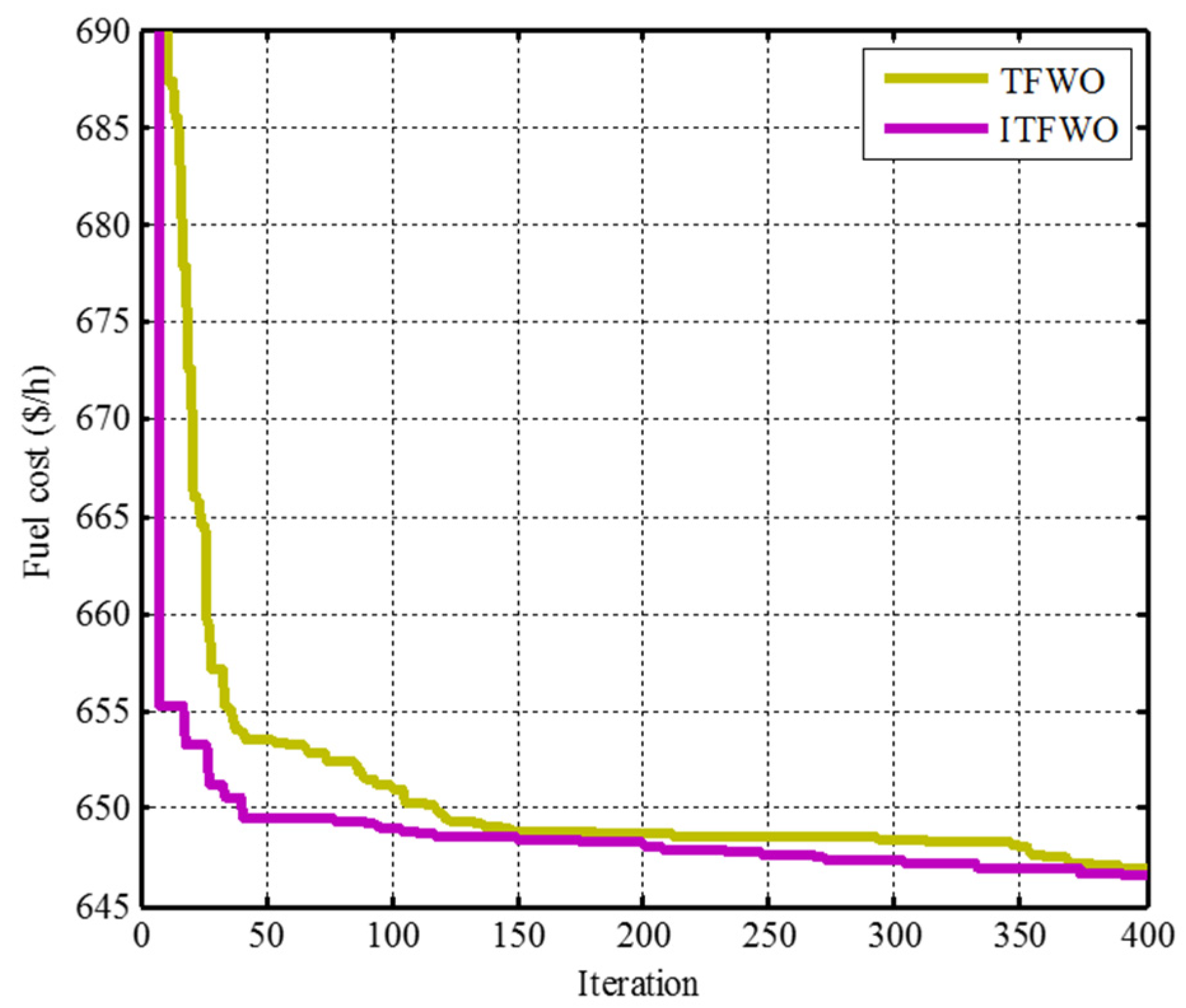
Optimization results are in Table 1, which indicate that the objective function via the ITFWO is 646.4799 ($/h). The best objective function achieved by ITFWO is compared to the optimal solutions achieved via optimization methods in Table 5 such as IEP [87], LTLBO [38], FPA [80], MFO [80], SSA [105], SSO [22], MSA [80], MDE [93], GABC [106] and TFWO, and shows that ITFWO has the lowest objective function in comparison to the other methods. The convergence trends of the problem are given in Figure 6.
Table 5.
The optimization results for Type 4.
Figure 6.
Optimization process for Type 4.
4.1.5. Type 5: OPF Considering VPEs
In this situation, we included valve point loading effects (VPEs) on the generator’s cost function by adding a sine part to the objective function of the units:
where ei and fi are VPEs cost factors of ith unit.
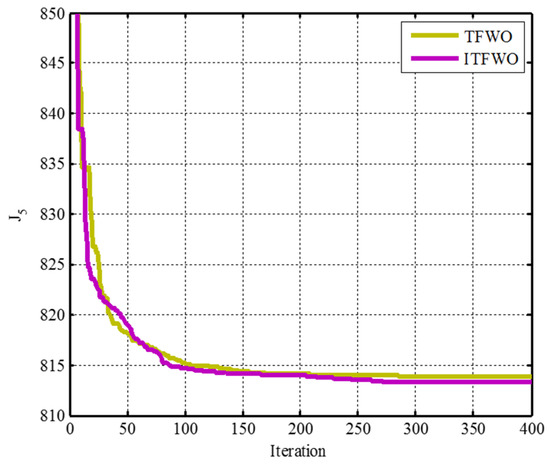
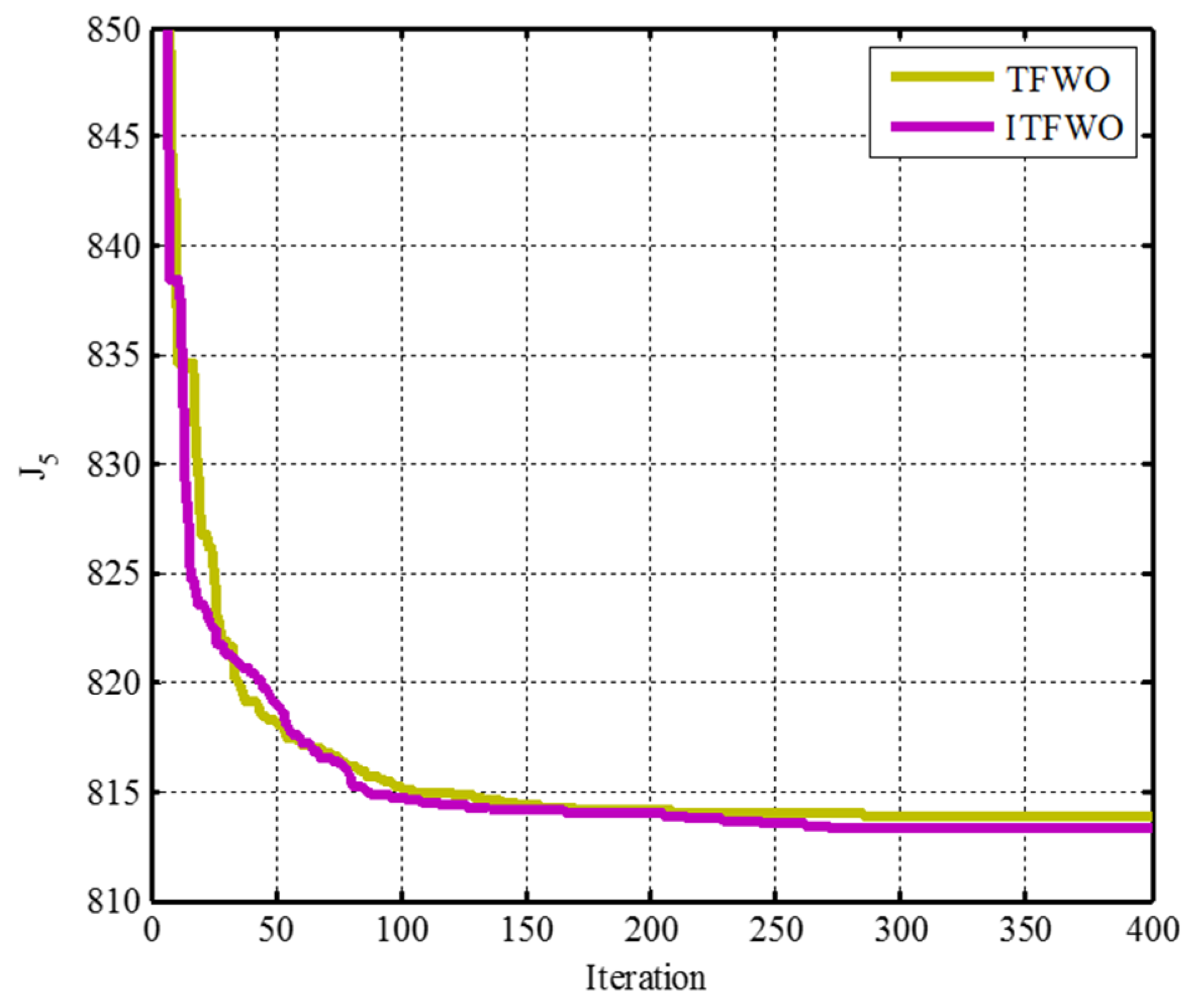
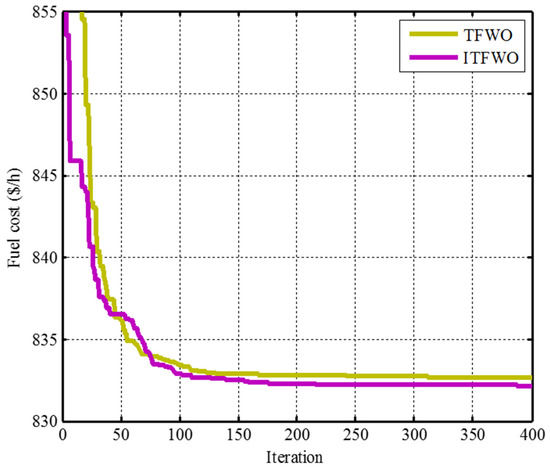
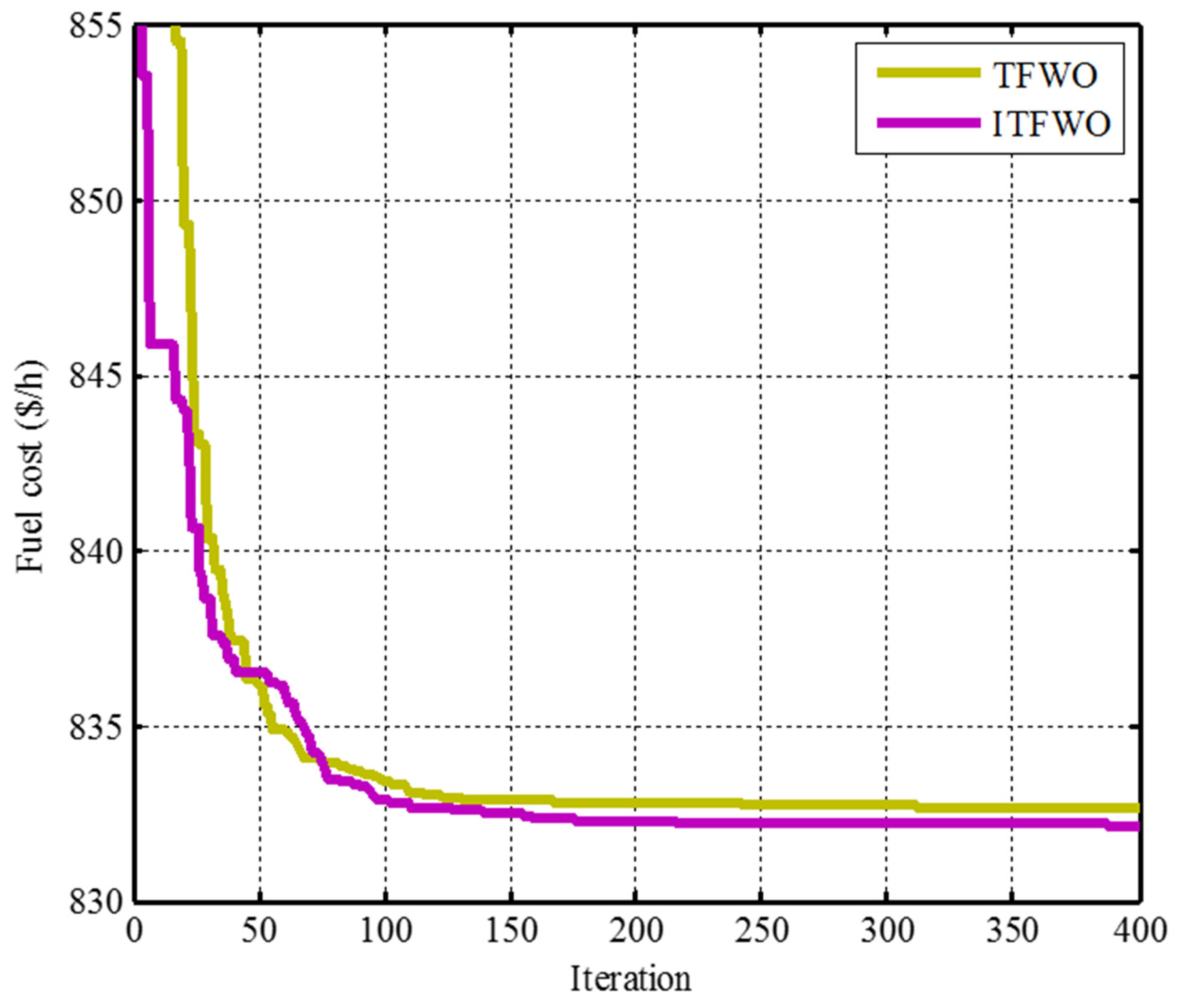
The achieved optimal variables by ITFWO has been given in Table 1. Table 6 shows the comparison of the ITFWO with recent modern methods. Based on Table 6, the optimum objective function has been achieved by ITFWO is 832.1611 ($/h) which is better compared to solutions of existing methods. The convergence trends of the objective function are shown in Figure 7.
Table 6.
The simulation solutions for Type 5.
Figure 7.
Optimization process for Type 5.
4.1.6. Type 6: Considering the Losses, Voltage Deviation, Emissions and Fuel Cost
In this type, two main kinds of emission gases, SOX and NOX, have been considered, and the OPF function is determined via Equation (46) to optimize and V.D., emission, and .
The amount of weights have been chosen as in [80] with = 22, = 21, and = 19.
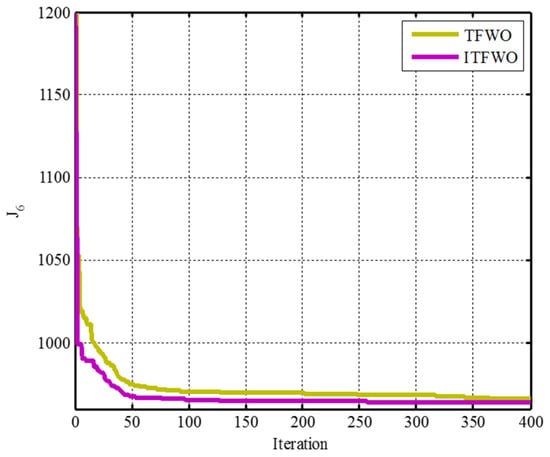
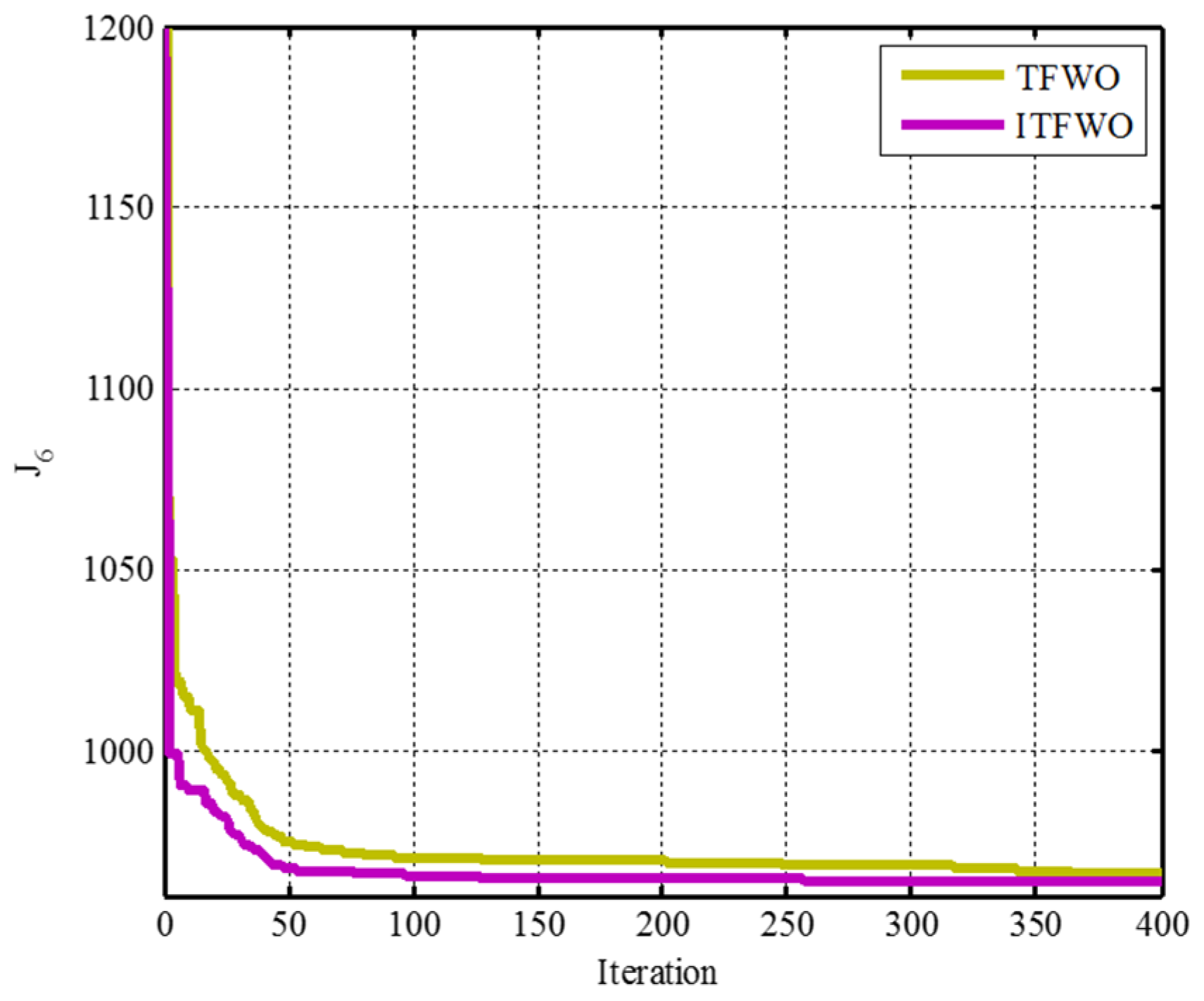
The best setting for control parameters that has been achieved by ITFWO has been given in Table 1. Moreover, the minimal objective function has been achieved by ITFWO compared to the optimal solutions achieved by optimization methods in Table 7; it can be seen that the optimum solution is 964.2606, which is suitable and better in comparison than the achieved optimal solutions in the recent papers. Furthermore, the convergence trends of the problem via the studied methods are given in Figure 8.
Table 7.
The optimization results for Type 6.
Figure 8.
Optimization process for Type 6.
4.2. OPF with PV and WT Units
4.2.1. Type 7: Considering the Total Cost
The optimization function is to optimize the total generation cost determined by Equation (47) as follows:
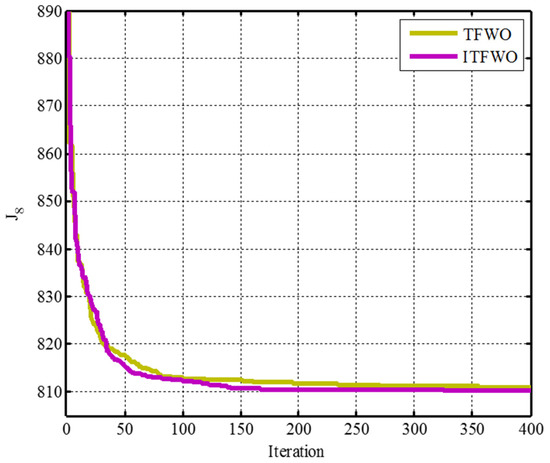
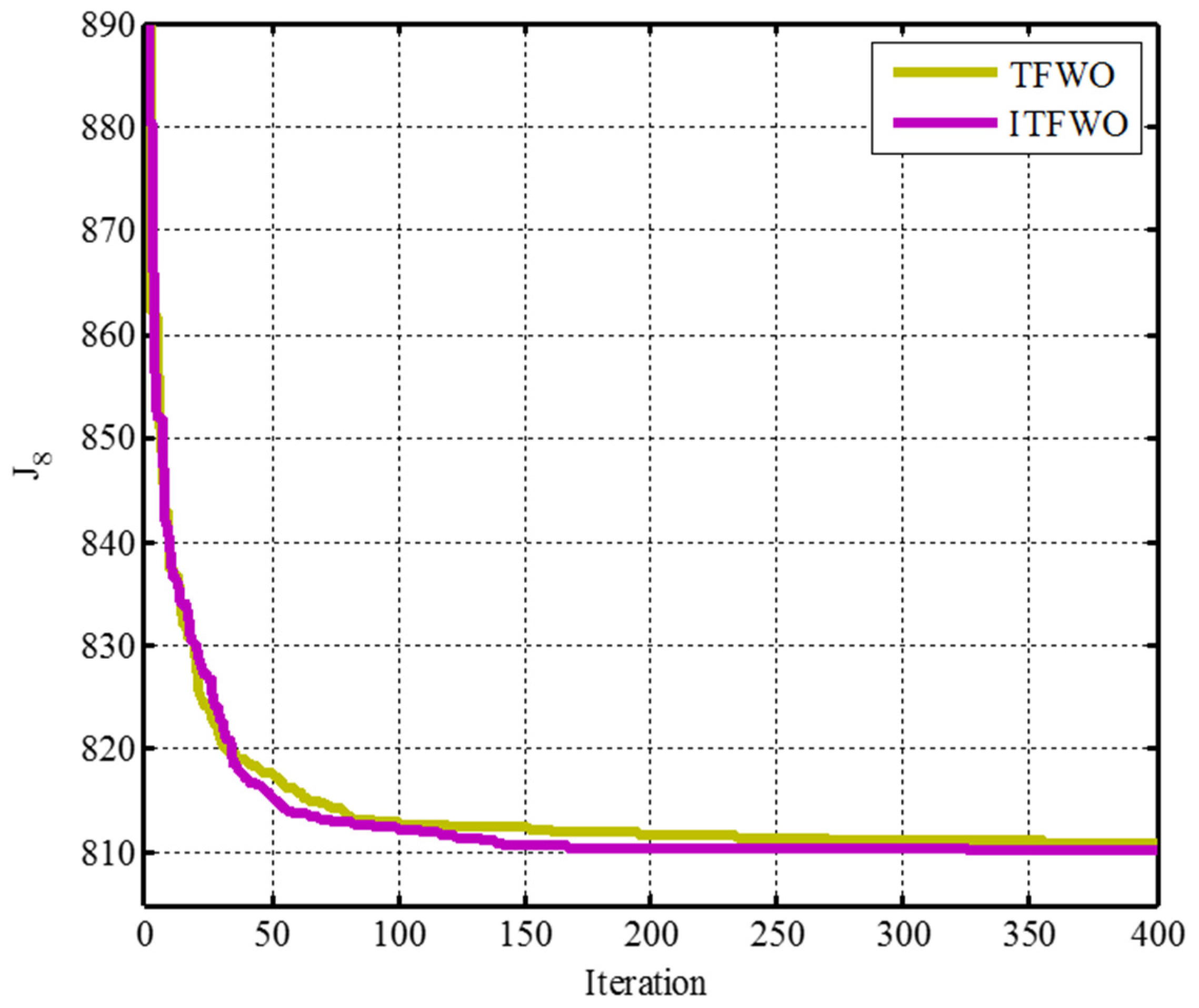
The best setting for control parameters that achieved by ITFWO are given in Table 8, with the highly minimized power generation cost in Type 7 compared to the basic TFWO. Furthermore, the convergence trends of the problem via the studied methods are shown in Figure 9.
Table 8.
The optimization results for Type 7.
Figure 9.
Optimization process for Type 7.
4.2.2. Type 8: Considering the Total Cost with Carbon Tax
Carbon tax (Ctax) has been imposed on any unit amount of liberated greenhouse gases for modelling investment in greener kinds of power such as solar and wind. The evolutionary function of emissions has been modeled in [27]:
Ctax had been considered to be $20 per tonne in [27].
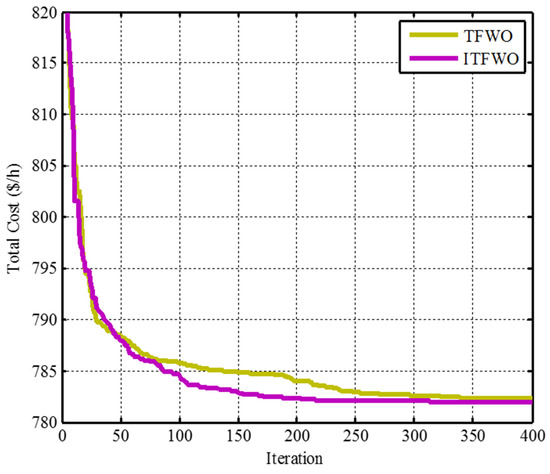
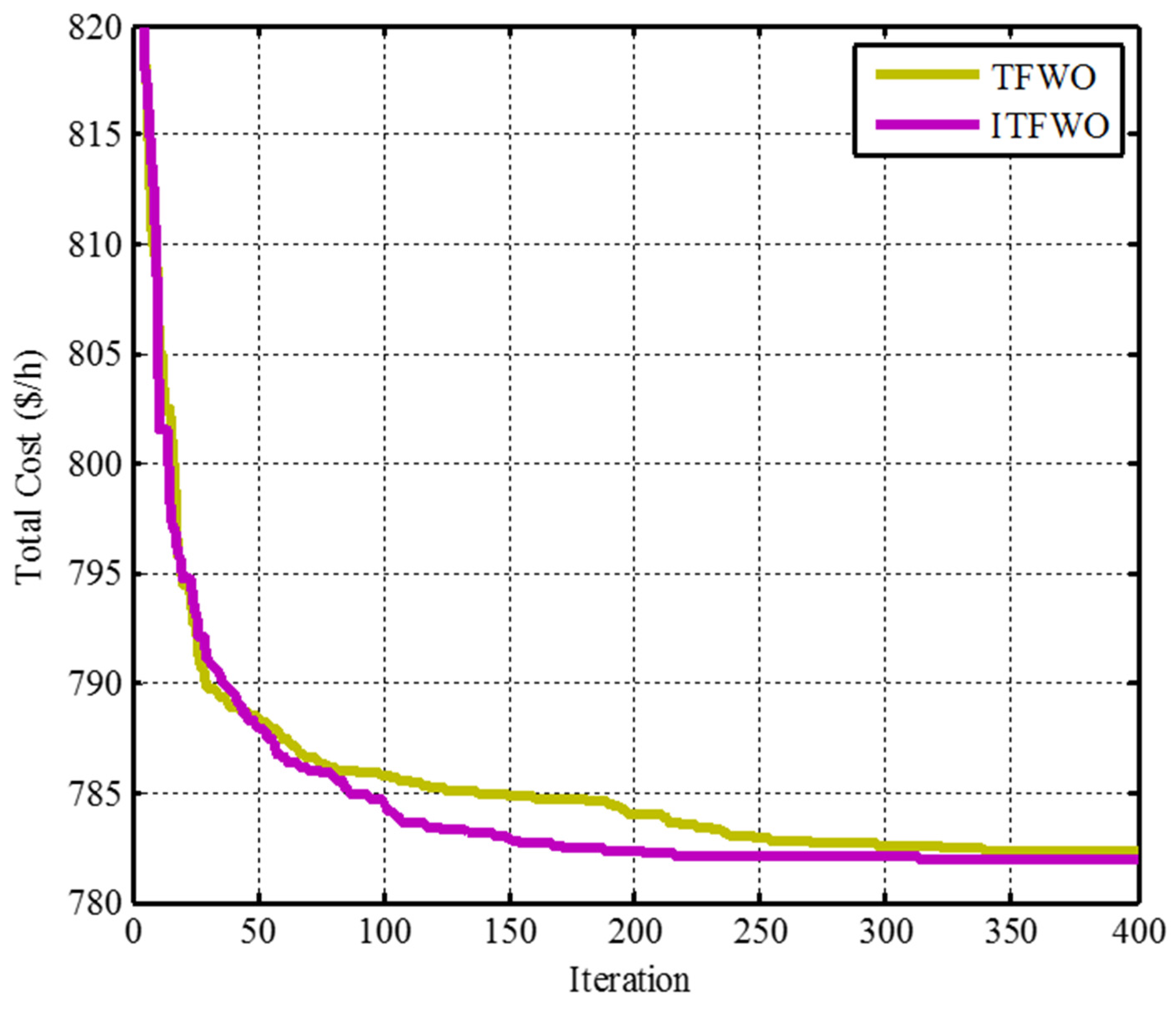
According to the optimal results shown in Table 9, it is clear that the ITFWO achieves highly stable and quality optimal results in comparison with TFWO.
Table 9.
The optimization results for Type 8.
Furthermore, the convergence trends of the problem via the studied methods are shown in Figure 10.
Figure 10.
Optimization process for Type 8.
4.3. Discussions
This part illustrates the optimal results of the studied methods achieved for various OPF problems to indicate ITFWO’s effectiveness, such as indexes Time (simulation time) Max (maximum), Mean (average), Min (minimum), and standard deviation (Std.) of the various problems shown in Table 10 for the eight types. According to Table 10, the optimal solutions of ITFWO are more suitable than the optimal solutions of the basic TFWO. These comparisons show the optimization power of ITFWO to optimize the various complex OPF problems; ITFWO is also able to discover a near-optimum solution in an adequate running time. The effectiveness and importance of any algorithm should decide on three terms: solution quality, computational efficiency, and robustness. The obtained values of the objective function for each case are shown in the summarized result. The best values of the objective functions are achieved for the majority of test cases and compared to existing techniques. The obtained values of the objective function are superior to the recent technique as well as previous techniques, and even obtained cost is better than for hybrid and developed based techniques; the comparisons are shown in Table 2, Table 3, Table 4, Table 5, Table 6, Table 7, Table 8 and Table 9. The results of the proposed approach are very competitive compared with notable results from previous research. So, from the comparisons, ITFWO is superior in terms of solution quality. In comparison with TFWO, a convergence characteristic of ITFWO that it is smoother and achieved convergence in fewer generations. The Std. results of Table 2, Table 3, Table 4, Table 5, Table 6, Table 7, Table 8, Table 9 and Table 10 show the enhanced ability of ITFWO to achieve superior quality solutions, in a computationally efficient and robust way. Furthermore, the proposed ITFWO provided a suitable balance between exploration and exploitation in the search space, which has led to finding the global optima in the presence of a large number of local optimum solutions. In summary, the improved mechanism of the proposed ITFWO has many advantages over the other methods—such as faster convergence characteristics, a lower standard deviation and simpler implementation.
Table 10.
The optimal solutions to show the optimization power of the TFWO and ITFWO algorithms.
5. Conclusions
This study suggested a novel modified ITFWO algorithm for optimizing various complex OPF problems such as piecewise quadratic and quadratic objective functions, total cost while considering emissions, and losses and valve point effects in the IEEE 30-bus network with PV and WT units while satisfying security, physical and feasibility limits. Firstly, the various complex OPF problems have been illustrated as real-world optimization problems with different limits in a typical network. OPF with the various complex cost functions has been efficiently solved through the proposed ITFWO method whose computational efficiency, robustness and applicability have been also evidenced. ITFWO has efficiently fulfilled the objective to discover near-global optimal or optimum solutions of the non-linear test functions of the typical power network more effectively than previous optimal solutions and confirms the optimization power of the ITFWO method in comparison with the other optimization techniques based on the result quality for the various complex OPF problems. An equation of this nature cannot be solved using conventional methods, such as the equal consumed energy increase ratio law, when the constraint is complex and the cost function is not convex. In terms of solving such problems, the proposed ITFWO provides a feasible and effective reference scheme. It is found that the proposed ITFWO provides the lowest minimum of total cost among all the heuristic optimization techniques and confirms its capability in yielding a suitable balance between exploitation and exploration with better performance in terms of efficiency and robustness.
It has been found that the proposed ITFWO algorithm performs better than the other algorithms. This algorithm beats the original TFWO and a lot of other optimization algorithms in recent papers. In light of the ITFWO’s success in solving various OPF problems, it should also be applicable to other optimization problems. As part of our future studies, we will use the proposed algorithm to solve problems related to micro-grid power dispatch, global optimization of overcurrent relays, and dust control systems. Furthermore, ITFWO can solve complex hydrothermal scheduling, dynamic OPF, and optimal reactive power dispatch (ORPD). The author is particularly interested in the field of intelligent control of industrial dust in environmental protection, which is one of the areas of future research he plans to pursue.
Funding
This research is supported by the Deanship of Scientific Research at Majmaah University under Project Number No. R-2023-336.
Institutional Review Board Statement
Not applicable.
Informed Consent Statement
Not applicable.
Data Availability Statement
Not applicable.
Acknowledgments
The author would like to thank the Deanship of Scientific Research at Majmaah University for supporting this work under Project Number No. R-2023-336.
Conflicts of Interest
The author declares no conflict of interest.
References
- Sarhan, S.; El-Sehiemy, R.; Abaza, A.; Gafar, M. Turbulent Flow of Water-Based Optimization for Solving Multi-Objective Technical and Economic Aspects of Optimal Power Flow Problems. Mathematics 2022, 10, 2106. [Google Scholar] [CrossRef] [Scilit]
- Suresh, G.; Prasad, D.; Gopila, M. An efficient approach based power flow management in smart grid system with hybrid renewable energy sources. Renew. Energy Focus 2021, 39, 110–122. [Google Scholar]
- Kahraman, H.T.; Akbel, M.; Duman, S. Optimization of optimal power flow problem using multi-objective manta ray foraging optimizer. Appl. Soft Comput. 2022, 116, 108334. [Google Scholar] [CrossRef] [Scilit]
- Ngoko, B.O.; Sugihara, H.; Funaki, T. Optimal power flow considering line-conductor temperature limits under high penetration of intermittent renewable energy sources. Int. J. Electr. Power Energy Syst. 2018, 101, 255–267. [Google Scholar] [CrossRef] [Scilit]
- Wang, M.; Yang, M.; Fang, Z.; Wang, M.; Wu, Q. A Practical Feeder Planning Model for Urban Distribution System. IEEE Trans. Power Syst. 2022, 38, 1297–1308. [Google Scholar] [CrossRef] [Scilit]
- Morshed, M.J.; Hmida, J.B.; Fekih, A. A probabilistic multi-objective approach for power flow optimization in hybrid wind-PV-PEV systems. Appl. Energy 2018, 211, 1136–1149. [Google Scholar] [CrossRef] [Scilit]
- Shi, L.; Wang, C.; Yao, L.; Ni, Y.; Bazargan, M. Optimal power flow solution incorporating wind power. IEEE Syst. J. 2011, 6, 233–241. [Google Scholar] [CrossRef] [Scilit]
- Momoh, J.A.; Adapa, R.; El-Hawary, M.E. A review of selected optimal power flow literature to 1993. I. Nonlinear and quadratic programming approaches. IEEE Trans. Power Syst. 1999, 14, 96–104. [Google Scholar] [CrossRef] [Scilit]
- Pourakbari-Kasmaei, M.; Mantovani, J.R.S. Logically constrained optimal power flow: Solver-based mixed-integer nonlinear programming model. Int. J. Electr. Power Energy Syst. 2018, 97, 240–249. [Google Scholar] [CrossRef] [Scilit]
- Cheng, F.; Liang, H.; Niu, B.; Zhao, N.; Zhao, X. Adaptive Neural Self-Triggered Bipartite Secure Control for Nonlinear MASs Subject to DoS Attacks. Inf. Sci. 2023, 631, 256–270. [Google Scholar] [CrossRef] [Scilit]
- Tang, F.; Wang, H.; Chang, X.-H.; Zhang, L.; Alharbi, K.H. Dynamic event-triggered control for discrete-time nonlinear Markov jump systems using policy iteration-based adaptive dynamic programming. Nonlinear Anal. Hybrid Syst. 2023, 49, 101338. [Google Scholar] [CrossRef] [Scilit]
- Ben Hmida, J.; Javad Morshed, M.; Lee, J.; Chambers, T. Hybrid imperialist competitive and grey wolf algorithm to solve multiobjective optimal power flow with wind and solar units. Energies 2018, 11, 2891. [Google Scholar] [CrossRef] [Scilit]
- Cheng, Y.; Niu, B.; Zhao, X.; Zong, G.; Ahmad, A.M. Event-triggered adaptive decentralised control of interconnected nonlinear systems with Bouc-Wen hysteresis input. Int. J. Syst. Sci. 2023, 1–14. [Google Scholar] [CrossRef] [Scilit]
- Zhang, H.; Zhao, X.; Zong, G.; Xu, N. Fully distributed consensus of switched heterogeneous nonlinear multi-agent systems with bouc-wen hysteresis input. IEEE Trans. Netw. Sci. Eng. 2022, 9, 4198–4208. [Google Scholar] [CrossRef] [Scilit]
- Boussaïd, I.; Lepagnot, J.; Siarry, P. A survey on optimization metaheuristics. Inf. Sci. 2013, 237, 82–117. [Google Scholar] [CrossRef] [Scilit]
- Abdo, M.; Kamel, S.; Ebeed, M.; Yu, J.; Jurado, F. Solving non-smooth optimal power flow problems using a developed grey wolf optimizer. Energies 2018, 11, 1692. [Google Scholar] [CrossRef] [Scilit]
- Khan, I.U.; Javaid, N.; Gamage, K.A.A.; Taylor, C.J.; Baig, S.; Ma, X. Heuristic algorithm based optimal power flow model incorporating stochastic renewable energy sources. IEEE Access 2020, 8, 148622–148643. [Google Scholar] [CrossRef] [Scilit]
- Mahdad, B.; Srairi, K.; Bouktir, T. Optimal power flow for large-scale power system with shunt FACTS using efficient parallel GA. Int. J. Electr. Power Energy Syst. 2010, 32, 507–517. [Google Scholar] [CrossRef] [Scilit]
- Jeddi, B.; Einaddin, A.H.; Kazemzadeh, R. Optimal power flow problem considering the cost, loss, and emission by multi-objective electromagnetism-like algorithm. In Proceedings of the 2016 6th Conference on Thermal Power Plants (CTPP), Tehran, Iran, 19–20 January 2016. [Google Scholar] [CrossRef] [Scilit]
- Li, P.; Yang, M.; Wu, Q. Confidence interval based distributionally robust real-time economic dispatch approach considering wind power accommodation risk. IEEE Trans. Sustain. Energy 2020, 12, 58–69. [Google Scholar] [CrossRef] [Scilit]
- Chen, G.; Qian, J.; Zhang, Z.; Sun, Z. Multi-objective optimal power flow based on hybrid firefly-bat algorithm and constraints-prior object-fuzzy sorting strategy. IEEE Access 2019, 7, 139726–139745. [Google Scholar] [CrossRef] [Scilit]
- Nguyen, T.T. A high performance social spider optimization algorithm for optimal power flow solution with single objective optimization. Energy 2019, 171, 218–240. [Google Scholar] [CrossRef] [Scilit]
- Güçyetmez, M.; Çam, E. A new hybrid algorithm with genetic-teaching learning optimization (G-TLBO) technique for optimizing of power flow in wind-thermal power systems. Electr. Eng. 2016, 98, 145–157. [Google Scholar] [CrossRef] [Scilit]
- Panda, A.; Tripathy, M.; Barisal, A.K.; Prakash, T. A modified bacteria foraging based optimal power flow framework for Hydro-Thermal-Wind generation system in the presence of STATCOM. Energy 2017, 124, 720–740. [Google Scholar] [CrossRef] [Scilit]
- Varadarajan, M.; Swarup, K.S. Solving multi-objective optimal power flow using differential evolution. IET Gener. Transm. Distrib. 2008, 2, 720. [Google Scholar] [CrossRef] [Scilit]
- Basu, M. Multi-objective optimal power flow with FACTS devices. Energy Convers. Manag. 2011, 52, 903–910. [Google Scholar] [CrossRef] [Scilit]
- Biswas, P.P.; Suganthan, P.N.; Amaratunga, G.A.J. Optimal power flow solutions incorporating stochastic wind and solar power. Energy Convers. Manag. 2017, 148, 1194–1207. [Google Scholar] [CrossRef] [Scilit]
- Duman, S.; Rivera, S.; Li, J.; Wu, L. Optimal power flow of power systems with controllable wind-photovoltaic energy systems via differential evolutionary particle swarm optimization. Int. Trans. Electr. Energy Syst. 2020, 30, e12270. [Google Scholar] [CrossRef] [Scilit]
- El-Fergany, A.A.; Hasanien, H.M. Single and Multi-objective Optimal Power Flow Using Grey Wolf Optimizer and Differential Evolution Algorithms. Electr. Power Components Syst. 2015, 43, 1548–1559. [Google Scholar] [CrossRef] [Scilit]
- Li, S.; Gong, W.; Wang, L.; Yan, X.; Hu, C. Optimal power flow by means of improved adaptive differential evolution. Energy 2020, 198, 117314. [Google Scholar] [CrossRef] [Scilit]
- Duman, S.; Akbel, M.; Kahraman, H.T. Development of the multi-objective adaptive guided differential evolution and optimization of the MO-ACOPF for wind/PV/tidal energy sources. Appl. Soft Comput. 2021, 112, 107814. [Google Scholar] [CrossRef] [Scilit]
- Islam, M.Z.; Wahab, N.I.A.; Veerasamy, V.; Hizam, H.; Mailah, N.F.; Guerrero, J.M.; Mohd Nasir, M.N. A Harris Hawks optimization based single-and multi-objective optimal power flow considering environmental emission. Sustainability 2020, 12, 5248. [Google Scholar] [CrossRef] [Scilit]
- Pham, L.H.; Dinh, B.H.; Nguyen, T.T. Optimal power flow for an integrated wind-solar-hydro-thermal power system considering uncertainty of wind speed and solar radiation. Neural Comput. Appl. 2022, 34, 10655–10689. [Google Scholar] [CrossRef] [Scilit]
- Sarda, J.; Pandya, K.; Lee, K.Y. Hybrid cross entropy—Cuckoo search algorithm for solving optimal power flow with renewable generators and controllable loads. Optim. Control Appl. Methods 2021, 44, 508–532. [Google Scholar] [CrossRef] [Scilit]
- Ghasemi, M.; Ghavidel, S.; Akbari, E.; Vahed, A.A. Solving non-linear, non-smooth and non-convex optimal power flow problems using chaotic invasive weed optimization algorithms based on chaos. Energy 2014, 73, 340–353. [Google Scholar] [CrossRef] [Scilit]
- Ma, R.; Li, X.; Luo, Y.; Wu, X.; Jiang, F. Multi-objective dynamic optimal power flow of wind integrated power systems considering demand response. CSEE J. Power Energy Syst. 2019, 5, 466–473. [Google Scholar] [CrossRef] [Scilit]
- El-sattar, S.A.; Kamel, S.; Ebeed, M.; Jurado, F. An improved version of salp swarm algorithm for solving optimal power flow problem. Soft Comput. 2021, 25, 4027–4052. [Google Scholar] [CrossRef] [Scilit]
- Ghasemi, M.; Ghavidel, S.; Gitizadeh, M.; Akbari, E. An improved teaching–learning-based optimization algorithm using Lévy mutation strategy for non-smooth optimal power flow. Int. J. Electr. Power Energy Syst. 2015, 65, 375–384. [Google Scholar] [CrossRef] [Scilit]
- Kyomugisha, R.; Muriithi, C.M.; Edimu, M. Multiobjective optimal power flow for static voltage stability margin improvement. Heliyon 2021, 7, e08631. [Google Scholar] [CrossRef] [Scilit]
- Si, Z.; Yang, M.; Yu, Y.; Ding, T. Photovoltaic power forecast based on satellite images considering effects of solar position. Appl. Energy 2021, 302, 117514. [Google Scholar] [CrossRef] [Scilit]
- Riaz, M.; Hanif, A.; Hussain, S.J.; Memon, M.I.; Ali, M.U.; Zafar, A. An optimization-based strategy for solving optimal power flow problems in a power system integrated with stochastic solar and wind power energy. Appl. Sci. 2021, 11, 6883. [Google Scholar] [CrossRef] [Scilit]
- Duman, S.; Li, J.; Wu, L. AC optimal power flow with thermal–wind–solar–tidal systems using the symbiotic organisms search algorithm. IET Renew. Power Gener. 2021, 15, 278–296. [Google Scholar] [CrossRef] [Scilit]
- Khorsandi, A.; Hosseinian, S.H.; Ghazanfari, A. Modified artificial bee colony algorithm based on fuzzy multi-objective technique for optimal power flow problem. Electr. Power Syst. Res. 2013, 95, 206–213. [Google Scholar] [CrossRef] [Scilit]
- He, X.; Wang, W.; Jiang, J.; Xu, L. An Improved Artificial Bee Colony Algorithm and Its Application to Multi-Objective Optimal Power Flow. Energies 2015, 8, 2412–2437. [Google Scholar] [CrossRef] [Scilit]
- Ayan, K.; Kılıç, U.; Baraklı, B. Chaotic artificial bee colony algorithm based solution of security and transient stability constrained optimal power flow. Int. J. Electr. Power Energy Syst. 2015, 64, 136–147. [Google Scholar] [CrossRef] [Scilit]
- Daryani, N.; Hagh, M.T.; Teimourzadeh, S. Adaptive group search optimization algorithm for multi-objective optimal power flow problem. Appl. Soft Comput. 2016, 38, 1012–1024. [Google Scholar] [CrossRef] [Scilit]
- Salkuti, S.R. Optimal power flow using multi-objective glowworm swarm optimization algorithm in a wind energy integrated power system. Int. J. Green Energy 2019, 16, 1547–1561. [Google Scholar] [CrossRef] [Scilit]
- Narimani, M.R.; Azizipanah-Abarghooee, R.; Zoghdar-Moghadam-Shahrekohne, B.; Gholami, K. A novel approach to multi-objective optimal power flow by a new hybrid optimization algorithm considering generator constraints and multi-fuel type. Energy 2013, 49, 119–136. [Google Scholar] [CrossRef] [Scilit]
- Bouchekara, H.R.E.H.; Chaib, A.E.; Abido, M.A.; El-Sehiemy, R.A. Optimal power flow using an Improved Colliding Bodies Optimization algorithm. Appl. Soft Comput. 2016, 42, 119–131. [Google Scholar] [CrossRef] [Scilit]
- El-Sehiemy, R.A. A novel single/multi-objective frameworks for techno-economic operation in power systems using tunicate swarm optimization technique. J. Ambient Intell. Humaniz. Comput. 2022, 13, 1073–1091. [Google Scholar] [CrossRef] [Scilit]
- Hazra, J.; Sinha, A.K. A multi-objective optimal power flow using particle swarm optimization. Eur. Trans. Electr. Power 2011, 21, 1028–1045. [Google Scholar] [CrossRef] [Scilit]
- Duman, S.; Li, J.; Wu, L.; Guvenc, U. Optimal power flow with stochastic wind power and FACTS devices: A modified hybrid PSOGSA with chaotic maps approach. Neural Comput. Appl. 2020, 32, 8463–8492. [Google Scholar] [CrossRef] [Scilit]
- Dasgupta, K.; Roy, P.K.; Mukherjee, V. Power flow based hydro-thermal-wind scheduling of hybrid power system using sine cosine algorithm. Electr. Power Syst. Res. 2020, 178, 106018. [Google Scholar] [CrossRef] [Scilit]
- Attia, A.-F.; El Sehiemy, R.A.; Hasanien, H.M. Optimal power flow solution in power systems using a novel Sine-Cosine algorithm. Int. J. Electr. Power Energy Syst. 2018, 99, 331–343. [Google Scholar] [CrossRef] [Scilit]
- Hassan, M.H.; Elsayed, S.K.; Kamel, S.; Rahmann, C.; Taha, I.B.M. Developing chaotic Bonobo optimizer for optimal power flow analysis considering stochastic renewable energy resources. Int. J. Energy Res. 2022, 46, 11291–11325. [Google Scholar] [CrossRef] [Scilit]
- Niknam, T.; Narimani, M.R.; Aghaei, J.; Tabatabaei, S.; Nayeripour, M. Modified Honey Bee Mating Optimisation to solve dynamic optimal power flow considering generator constraints. IET Gener. Transm. Distrib. 2011, 5, 989. [Google Scholar] [CrossRef] [Scilit]
- Shaheen, A.M.; El-Sehiemy, R.A.; Hasanien, H.M.; Ginidi, A.R. An improved heap optimization algorithm for efficient energy management based optimal power flow model. Energy 2022, 250, 123795. [Google Scholar] [CrossRef] [Scilit]
- Mouassa, S.; Althobaiti, A.; Jurado, F.; Ghoneim, S.S.M. Novel Design of Slim Mould Optimizer for the Solution of Optimal Power Flow Problems Incorporating Intermittent Sources: A Case Study of Algerian Electricity Grid. IEEE Access 2022, 10, 22646–22661. [Google Scholar] [CrossRef] [Scilit]
- Kyomugisha, R.; Muriithi, C.M.; Nyakoe, G.N. Performance of Various Voltage Stability Indices in a Stochastic Multiobjective Optimal Power Flow Using Mayfly Algorithm. J. Electr. Comput. Eng. 2022, 2022, 7456333. [Google Scholar] [CrossRef] [Scilit]
- Venkateswara Rao, B.; Nagesh Kumar, G.V. Optimal power flow by BAT search algorithm for generation reallocation with unified power flow controller. Int. J. Electr. Power Energy Syst. 2015, 68, 81–88. [Google Scholar] [CrossRef] [Scilit]
- Duman, S.; Wu, L.; Li, J. Moth swarm algorithm based approach for the ACOPF considering wind and tidal energy. In Proceedings of the International Conference on Artificial Intelligence and Applied Mathematics in Engineering, Antalya, Turkey, 20–22 April 2022; Springer: Berlin/Heidelberg, Germany, 2019; pp. 830–843. [Google Scholar]
- Elattar, E.E. Optimal power flow of a power system incorporating stochastic wind power based on modified moth swarm algorithm. IEEE Access 2019, 7, 89581–89593. [Google Scholar] [CrossRef] [Scilit]
- Ahmad, M.; Javaid, N.; Niaz, I.A.; Almogren, A.; Radwan, A. A Bio-Inspired Heuristic Algorithm for Solving Optimal Power Flow Problem in Hybrid Power System. IEEE Access 2021, 9, 159809–159826. [Google Scholar] [CrossRef] [Scilit]
- Avvari, R.K.; DM, V.K. A Novel Hybrid Multi-Objective Evolutionary Algorithm for Optimal Power Flow in Wind, PV, and PEV Systems. J. Oper. Autom. Power Eng. 2022, 11, 130–143. [Google Scholar]
- Ghasemi, M.; Davoudkhani, I.F.; Akbari, E.; Rahimnejad, A.; Ghavidel, S.; Li, L. A novel and effective optimization algorithm for global optimization and its engineering applications: Turbulent Flow of Water-based Optimization (TFWO). Eng. Appl. Artif. Intell. 2020, 92, 103666. [Google Scholar] [CrossRef] [Scilit]
- Naderipour, A.; Davoudkhani, I.F.; Abdul-Malek, Z. New modified algorithm: θ-turbulent flow of water-based optimization. Environ. Sci. Pollut. Res. 2021, 1–15. [Google Scholar] [CrossRef] [Scilit]
- Abd-El Wahab, A.M.; Kamel, S.; Hassan, M.H.; Mosaad, M.I.; AbdulFattah, T.A. Optimal Reactive Power Dispatch Using a Chaotic Turbulent Flow of Water-Based Optimization Algorithm. Mathematics 2022, 10, 346. [Google Scholar] [CrossRef] [Scilit]
- Gnanaprakasam, C.N.; Brindha, G.; Gnanasoundharam, J.; Devi, E.A. An efficient MFM-TFWO approach for unit commitment with uncertainty of DGs in electric vehicle parking lots. J. Intell. Fuzzy Syst. 2022, 43, 7485–7510. [Google Scholar] [CrossRef] [Scilit]
- Hu, C.; Qi, X.; Lei, R.; Li, J. Slope reliability evaluation using an improved Kriging active learning method with various active learning functions. Arab. J. Geosci. 2022, 15, 1059. [Google Scholar] [CrossRef] [Scilit]
- Sakthivel, V.P.; Thirumal, K.; Sathya, P.D. Quasi-oppositional turbulent water flow-based optimization for cascaded short term hydrothermal scheduling with valve-point effects and multiple fuels. Energy 2022, 251, 123905. [Google Scholar] [CrossRef] [Scilit]
- Sakthivel, V.P.; Thirumal, K.; Sathya, P.D. Short term scheduling of hydrothermal power systems with photovoltaic and pumped storage plants using quasi-oppositional turbulent water flow optimization. Renew. Energy 2022, 191, 459–492. [Google Scholar] [CrossRef] [Scilit]
- Sallam, M.E.; Attia, M.A.; Abdelaziz, A.Y.; Sameh, M.A.; Yakout, A.H. Optimal Sizing of Different Energy Sources in an Isolated Hybrid Microgrid Using Turbulent Flow Water-Based Optimization Algorithm. IEEE Access 2022, 10, 61922–61936. [Google Scholar] [CrossRef] [Scilit]
- Witanowski, Ł.; Breńkacz, Ł.; Szewczuk-Krypa, N.; Dorosińska-Komor, M.; Puchalski, B. Comparable analysis of PID controller settings in order to ensure reliable operation of active foil bearings. Eksploat. Niezawodn. 2022, 24, 377–385. [Google Scholar] [CrossRef] [Scilit]
- Eid, A.; Kamel, S. Optimal allocation of shunt compensators in distribution systems using turbulent flow of waterbased optimization Algorithm. In Proceedings of the 2020 IEEE Electric Power and Energy Conference (EPEC), Edmonton, AB, Canada, 9–10 November 2020; pp. 1–5. [Google Scholar]
- Nasri, S.; Nowdeh, S.A.; Davoudkhani, I.F.; Moghaddam, M.J.H.; Kalam, A.; Shahrokhi, S.; Zand, M. Maximum Power point tracking of Photovoltaic Renewable Energy System using a New method based on turbulent flow of water-based optimization (TFWO) under Partial shading conditions. In Fundamentals and Innovations in Solar Energy; Springer: Berlin/Heidelberg, Germany, 2021; pp. 285–310. [Google Scholar]
- Deb, S.; Houssein, E.H.; Said, M.; Abdelminaam, D.S. Performance of turbulent flow of water optimization on economic load dispatch problem. IEEE Access 2021, 9, 77882–77893. [Google Scholar] [CrossRef] [Scilit]
- Said, M.; Shaheen, A.M.; Ginidi, A.R.; El-Sehiemy, R.A.; Mahmoud, K.; Lehtonen, M.; Darwish, M.M.F. Estimating parameters of photovoltaic models using accurate turbulent flow of water optimizer. Processes 2021, 9, 627. [Google Scholar] [CrossRef] [Scilit]
- Abdelminaam, D.S.; Said, M.; Houssein, E.H. Turbulent flow of water-based optimization using new objective function for parameter extraction of six photovoltaic models. IEEE Access 2021, 9, 35382–35398. [Google Scholar] [CrossRef] [Scilit]
- Alanazi, M.; Alanazi, A.; Abdelaziz, A.Y.; Siano, P. Power Flow Optimization by Integrating Novel Metaheuristic Algorithms and Adopting Renewables to Improve Power System Operation. Appl. Sci. 2023, 13, 527. [Google Scholar] [CrossRef] [Scilit]
- Tan, J.; Liu, L.; Li, F.; Chen, Z.; Chen, G.Y.; Fang, F.; Guo, J.; He, M.; Zhou, X. Screening of endocrine disrupting potential of surface waters via an affinity-based biosensor in a rural community in the Yellow River Basin, China. Environ. Sci. Technol. 2022, 56, 14350–14360. [Google Scholar] [CrossRef] [Scilit]
- Ghasemi, M.; Ghavidel, S.; Rahmani, S.; Roosta, A.; Falah, H. A novel hybrid algorithm of imperialist competitive algorithm and teaching learning algorithm for optimal power flow problem with non-smooth cost functions. Eng. Appl. Artif. Intell. 2014, 29, 54–69. [Google Scholar] [CrossRef] [Scilit]
- Ghasemi, M.; Ghavidel, S.; Ghanbarian, M.M.; Gitizadeh, M. Multi-objective optimal electric power planning in the power system using Gaussian bare-bones imperialist competitive algorithm. Inf. Sci. 2015, 294, 286–304. [Google Scholar] [CrossRef] [Scilit]
- Niknam, T.; Narimani, M.R.; Jabbari, M.; Malekpour, A.R. A modified shuffle frog leaping algorithm for multi-objective optimal power flow. Energy 2011, 36, 6420–6432. [Google Scholar] [CrossRef] [Scilit]
- Alghamdi, A.S. A Hybrid Firefly—JAYA Algorithm for the Optimal Power Flow Problem Considering Wind and Solar Power Generations. Appl. Sci. 2022, 12, 7193. [Google Scholar] [CrossRef] [Scilit]
- Abido, M.A. Optimal Power Flow Using Tabu Search Algorithm. Electr. Power Components Syst. 2002, 30, 469–483. [Google Scholar] [CrossRef] [Scilit]
- Ongsakul, W.; Tantimaporn, T. Optimal Power Flow by Improved Evolutionary Programming. Electr. Power Components Syst. 2006, 34, 79–95. [Google Scholar] [CrossRef] [Scilit]
- Pulluri, H.; Naresh, R.; Sharma, V. A solution network based on stud krill herd algorithm for optimal power flow problems. Soft Comput. 2018, 22, 159–176. [Google Scholar] [CrossRef] [Scilit]
- Guvenc, U.; Bakir, H.; Duman, S.; Ozkaya, B. Optimal Power Flow Using Manta Ray Foraging Optimization. In Proceedings of the the International Conference on Artificial Intelligence and Applied Mathematics in Engineering, Antalya, Turkey, 18–20 April 2020; Springer International Publishing: Berlin/Heidelberg, Germany, 2020; pp. 136–149. [Google Scholar]
- Ramesh Kumar, A.; Premalatha, L. Optimal power flow for a deregulated power system using adaptive real coded biogeography-based optimization. Int. J. Electr. Power Energy Syst. 2015, 73, 393–399. [Google Scholar] [CrossRef] [Scilit]
- Radosavljević, J.; Klimenta, D.; Jevtić, M.; Arsić, N. Optimal Power Flow Using a Hybrid Optimization Algorithm of Particle Swarm Optimization and Gravitational Search Algorithm. Electr. Power Components Syst. 2015, 43, 1958–1970. [Google Scholar] [CrossRef] [Scilit]
- Abaci, K.; Yamacli, V. Differential search algorithm for solving multi-objective optimal power flow problem. Int. J. Electr. Power Energy Syst. 2016, 79, 1–10. [Google Scholar] [CrossRef] [Scilit]
- Sayah, S.; Zehar, K. Modified differential evolution algorithm for optimal power flow with non-smooth cost functions. Energy Convers. Manag. 2008, 49, 3036–3042. [Google Scholar] [CrossRef] [Scilit]
- Warid, W.; Hizam, H.; Mariun, N.; Abdul-Wahab, N.I. Optimal power flow using the Jaya algorithm. Energies 2016, 9, 678. [Google Scholar] [CrossRef] [Scilit]
- Sood, Y. Evolutionary programming based optimal power flow and its validation for deregulated power system analysis. Int. J. Electr. Power Energy Syst. 2007, 29, 65–75. [Google Scholar] [CrossRef] [Scilit]
- Ullah, Z.; Wang, S.; Radosavljević, J.; Lai, J. A solution to the optimal power flow problem considering WT and PV generation. IEEE Access 2019, 7, 46763–46772. [Google Scholar] [CrossRef] [Scilit]
- Khamees, A.K.; Abdelaziz, A.Y.; Eskaros, M.R.; El-Shahat, A.; Attia, M.A. Optimal Power Flow Solution of Wind-Integrated Power System Using Novel Metaheuristic Method. Energies 2021, 14, 6117. [Google Scholar] [CrossRef] [Scilit]
- Warid, W.; Hizam, H.; Mariun, N.; Abdul Wahab, N.I. A novel quasi-oppositional modified Jaya algorithm for multi-objective optimal power flow solution. Appl. Soft Comput. 2018, 65, 360–373. [Google Scholar] [CrossRef] [Scilit]
- Ghoneim, S.S.M.; Kotb, M.F.; Hasanien, H.M.; Alharthi, M.M.; El-Fergany, A.A. Cost Minimizations and Performance Enhancements of Power Systems Using Spherical Prune Differential Evolution Algorithm Including Modal Analysis. Sustainability 2021, 13, 8113. [Google Scholar] [CrossRef] [Scilit]
- Herbadji, O.; Slimani, L.; Bouktir, T. Optimal power flow with four conflicting objective functions using multiobjective ant lion algorithm: A case study of the algerian electrical network. Iran. J. Electr. Electron. Eng. 2019, 15, 94–113. [Google Scholar] [CrossRef] [Scilit]
- Bentouati, B.; Khelifi, A.; Shaheen, A.M.; El-Sehiemy, R.A. An enhanced moth-swarm algorithm for efficient energy management based multi dimensions OPF problem. J. Ambient Intell. Humaniz. Comput. 2020, 12, 9499–9519. [Google Scholar] [CrossRef] [Scilit]
- El Sehiemy, R.A.; Selim, F.; Bentouati, B.; Abido, M.A. A novel multi-objective hybrid particle swarm and salp optimization algorithm for technical-economical-environmental operation in power systems. Energy 2020, 193, 116817. [Google Scholar] [CrossRef] [Scilit]
- Shilaja, C.; Ravi, K. Optimal power flow using hybrid DA-APSO algorithm in renewable energy resources. Energy Procedia 2017, 117, 1085–1092. [Google Scholar] [CrossRef] [Scilit]
- Ghasemi, M.; Ghavidel, S.; Ghanbarian, M.M.; Gharibzadeh, M.; Azizi Vahed, A. Multi-objective optimal power flow considering the cost, emission, voltage deviation and power losses using multi-objective modified imperialist competitive algorithm. Energy 2014, 78, 276–289. [Google Scholar] [CrossRef] [Scilit]
- Jebaraj, L.; Sakthivel, S. A new swarm intelligence optimization approach to solve power flow optimization problem incorporating conflicting and fuel cost based objective functions. e-Prime-Advances Electr. Eng. Electron. Energy 2022, 2, 100031. [Google Scholar] [CrossRef] [Scilit]
- Roy, R.; Jadhav, H.T. Optimal power flow solution of power system incorporating stochastic wind power using Gbest guided artificial bee colony algorithm. Int. J. Electr. Power Energy Syst. 2015, 64, 562–578. [Google Scholar] [CrossRef] [Scilit]
- Biswas, P.P.; Suganthan, P.N.; Mallipeddi, R.; Amaratunga, G.A.J. Optimal power flow solutions using differential evolution algorithm integrated with effective constraint handling techniques. Eng. Appl. Artif. Intell. 2018, 68, 81–100. [Google Scholar] [CrossRef] [Scilit]
- Ouafa, H.; Linda, S.; Tarek, B. Multi-objective optimal power flow considering the fuel cost, emission, voltage deviation and power losses using Multi-Objective Dragonfly algorithm. In Proceedings of the International Conference on Recent Advances in Electrical Systems, Hammamet, Tunusia, 22–24 December 2017. [Google Scholar]
- Gupta, S.; Kumar, N.; Srivastava, L.; Malik, H.; Pliego Marugán, A.; Garc’ia Márquez, F.P. A Hybrid Jaya--Powell’s Pattern Search Algorithm for Multi-Objective Optimal Power Flow Incorporating Distributed Generation. Energies 2021, 14, 2831. [Google Scholar] [CrossRef] [Scilit]

Disclaimer/Publisher’s Note: The statements, opinions and data contained in all publications are solely those of the individual author(s) and contributor(s) and not of MDPI and/or the editor(s). MDPI and/or the editor(s) disclaim responsibility for any injury to people or property resulting from any ideas, methods, instructions or products referred to in the content. |
© 2023 by the author. Licensee MDPI, Basel, Switzerland. This article is an open access article distributed under the terms and conditions of the Creative Commons Attribution (CC BY) license (https://creativecommons.org/licenses/by/4.0/).