Monitoring of Engineered Stones Used in Artwork Reproductions: Mechanical Characterization by Laser Vibrometry


Abstract
1. Introduction
2. Materials and Methods
2.1. Theoretical Considerations
2.2. Experimental Technique
2.2.1. Materials
2.2.2. Experimental Protocol
2.2.3. Bulk Wave Velocities and Young’s Modulus Measurements
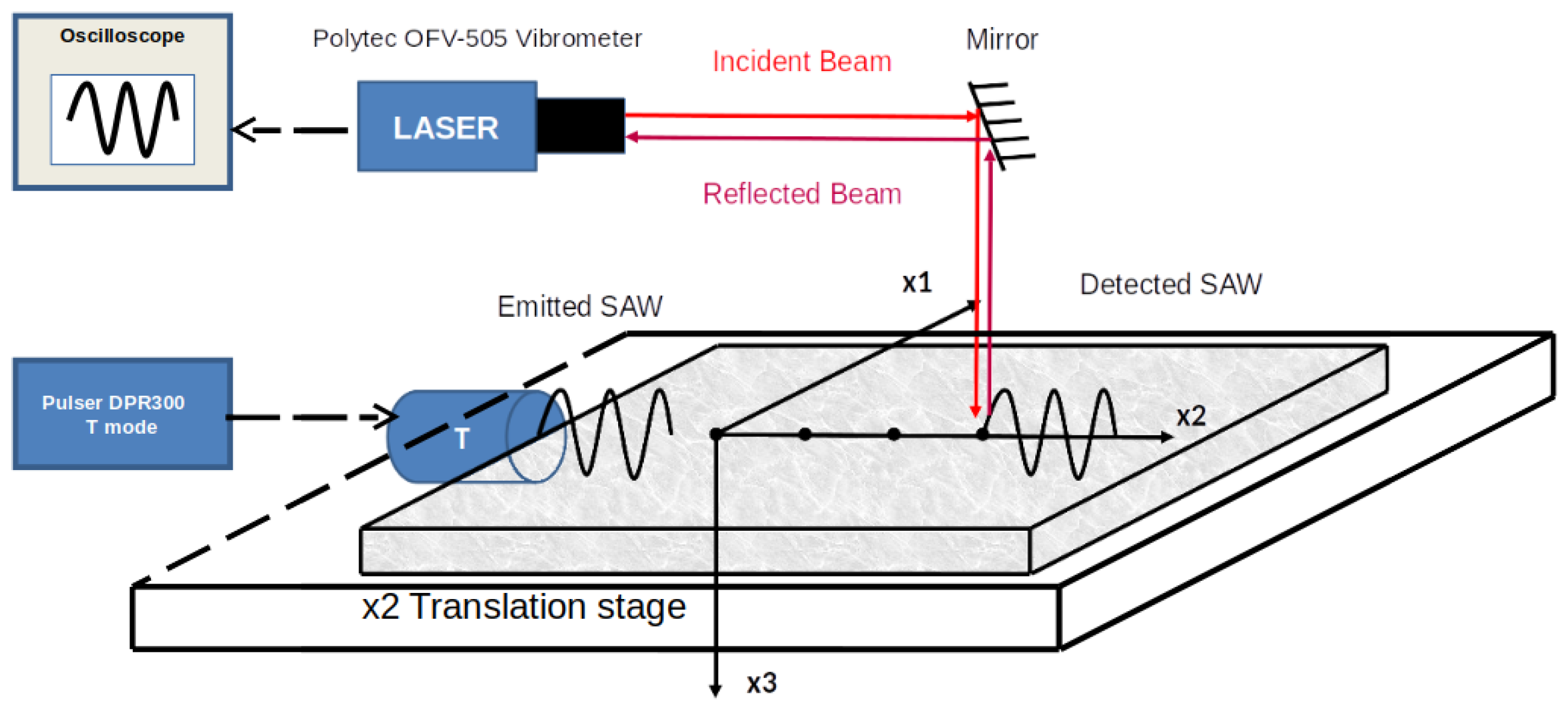
2.2.4. Rayleigh Wave Detection and Monitoring
3. Results
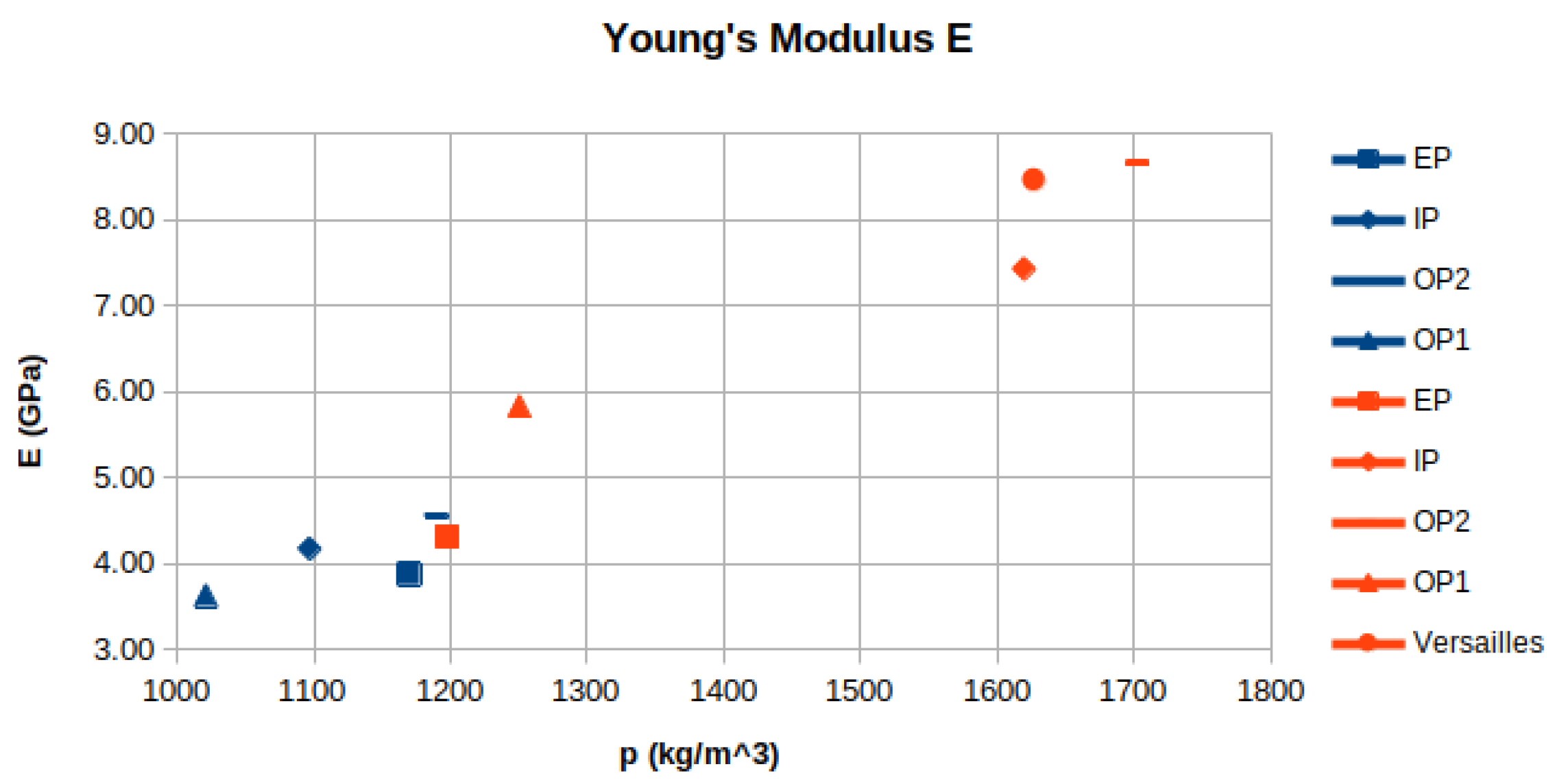
3.1. Bulk Wave Velocities and Young’s Modulus Measurements
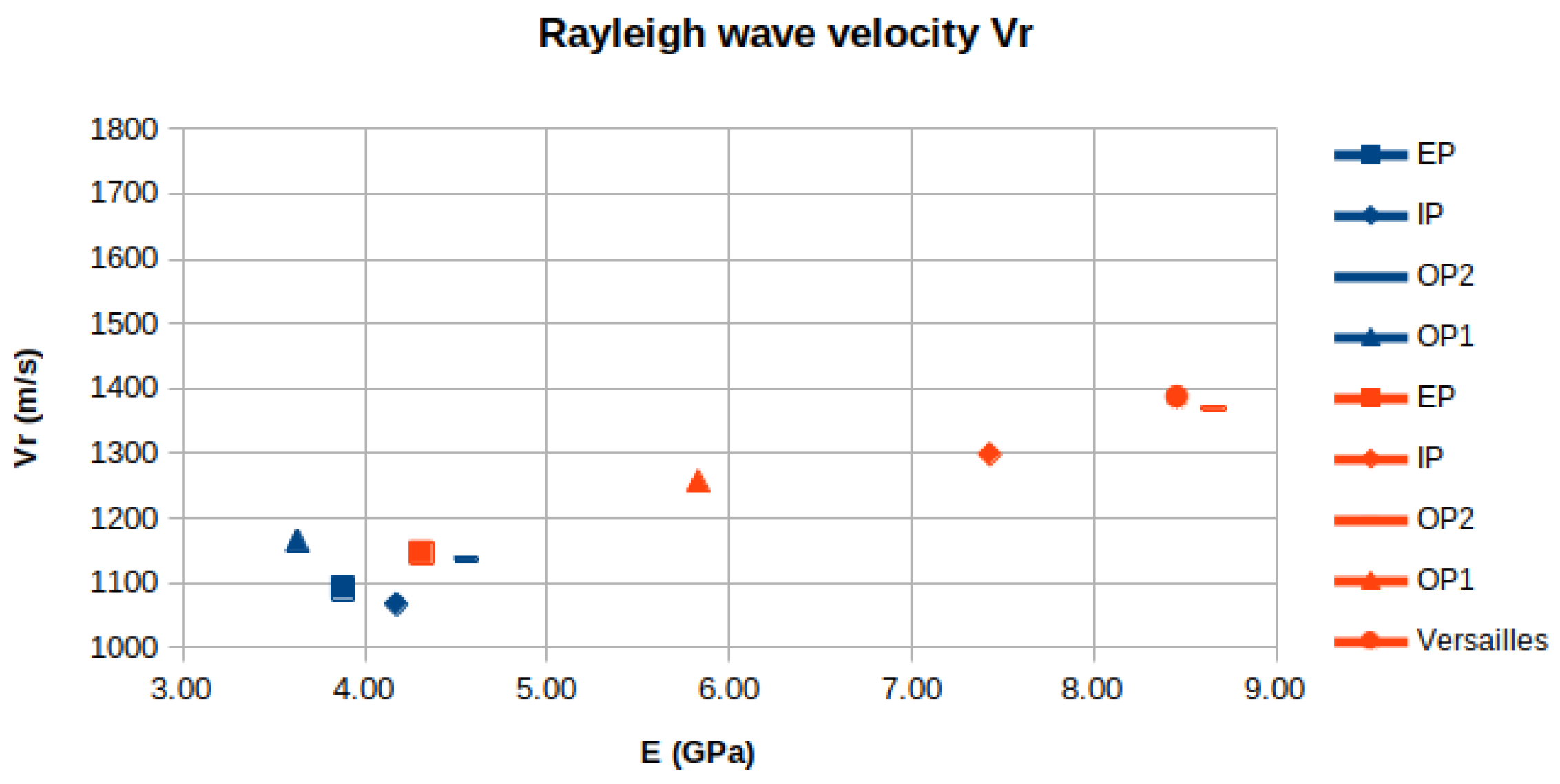
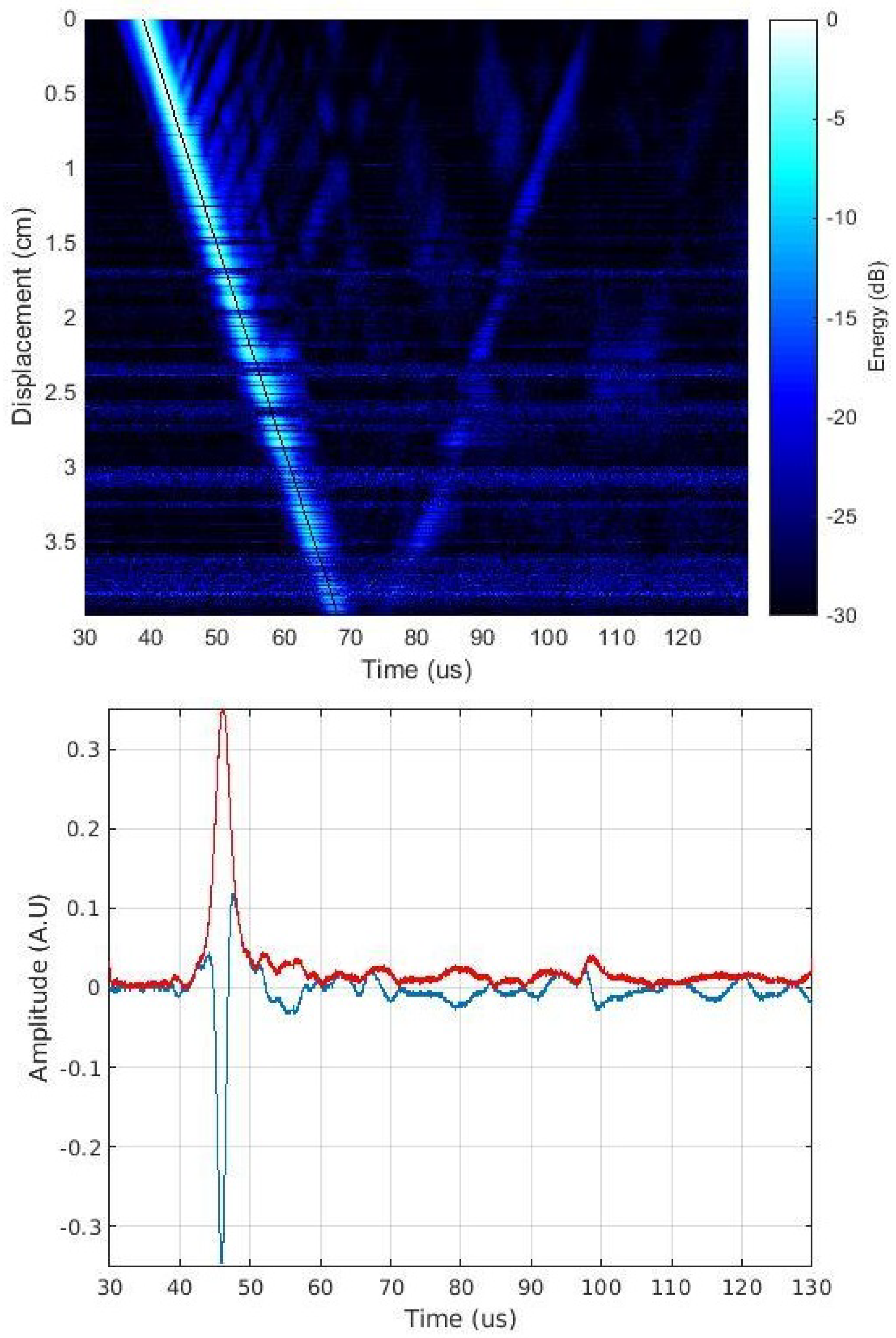
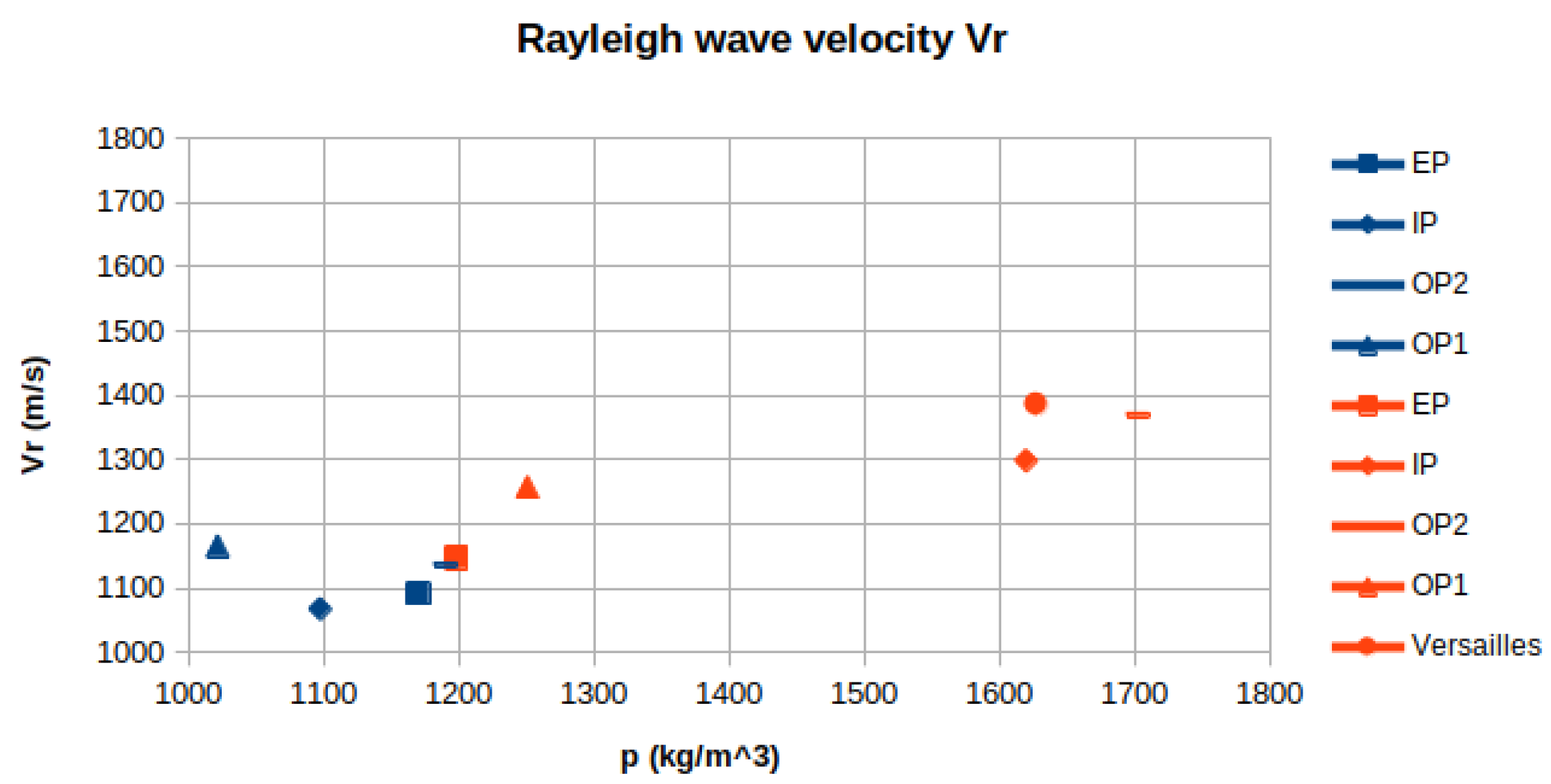
3.2. Rayleigh Wave Detection and Monitoring
4. Discussion
5. Conclusions
Author Contributions
Funding
Institutional Review Board Statement
Informed Consent Statement
Data Availability Statement
Acknowledgments
Conflicts of Interest
References
- Arciniegas, A.; Martinez, L.; Briand, A.; Prieto, S.; Serfaty, S.; Wilkie-Chancellier, N. Experimental ultrasonic characterization of polyester-based materials for cultural heritage applications. Ultrasonics 2017, 81, 127–134. [Google Scholar] [CrossRef] [Scilit] [PubMed]
- Chawla, K.K. Composite Materials; Springer International Publishing: Cham, Switzerland, 2012. [Google Scholar] [CrossRef] [Scilit]
- Mavko, G.; Mukerji, T.; Dvorkin, J. The Rock Physics Handbook: Tools for Seismic Analysis of Porous Media; Cambridge University Press: Cambridge, MA, USA, 2009. [Google Scholar]
- Borsellino, C.; Calabrese, L.; Bella, G.D. Effects of powder concentration and type of resin on the performance of marble composite structures. Constr. Build. Mater. 2009, 23, 1915–1921. [Google Scholar] [CrossRef] [Scilit]
- dos Santos, J.P.L.; Rosa, L.G.; Amaral, P.M. Temperature effects on mechanical behaviour of engineered stones. Constr. Build. Mater. 2011, 25, 171–174. [Google Scholar] [CrossRef] [Scilit]
- Oral, I. Ultrasonic properties of epoxy resin/marble waste powder composites. Polym. Compos. 2015, 36, 584–590. [Google Scholar] [CrossRef] [Scilit]
- Fiore, V.; Di Bella, G.; Scalici, T.; Valenza, A. Effect of plasma treatment on mechanical and thermal properties of marble powder/epoxy composites. Polym. Compos. 2016, 39, 309–317. [Google Scholar] [CrossRef] [Scilit]
- Ribeiro, C.E.G.; Rodriguez, R.J.S.; de Carvalho, E.A. Microstructure and mechanical properties of artificial marble. Constr. Build. Mater. 2017, 149, 149–155. [Google Scholar] [CrossRef] [Scilit]
- Thakur, A.K.; Pappu, A.; Thakur, V.K. Resource efficiency impact on marble waste recycling towards sustainable green construction materials. Curr. Opin. Green Sustain. Chem. 2018, 13, 91–101. [Google Scholar] [CrossRef] [Scilit]
- Nayak, S.K.; Satapathy, A. Development and characterization of polymer-based composites filled with micro-sized waste marble dust. Polym. Polym. Compos. 2020, 29, 497–508. [Google Scholar] [CrossRef] [Scilit]
- Krautkrämer, J. Ultrasonic Testing of Materials; Springer: Berlin/Heidelberg, Germany, 1990; p. 677. [Google Scholar]
- Bucur, V.; Rocaboy, F. Surface wave propagation in wood: Prospective method for the determination of wood off-diagonal terms of stiffness matrix. Ultrasonics 1988, 26, 344–347. [Google Scholar] [CrossRef] [Scilit]
- Arciniegas, A.; Prieto, F.; Brancheriau, L.; Lasaygues, P. Literature review of acoustic and ultrasonic tomography in standing trees. Trees 2014, 28, 1559–1567. [Google Scholar] [CrossRef] [Scilit]
- Dayal, V. An automated simultaneous measurement of thickness and wave velocity by ultrasound. Exp. Mech. 1992, 32, 197–202. [Google Scholar] [CrossRef] [Scilit]
- Wilkie-Chancellier, N.; Martinez, L.; Serfaty, S.; Griesmar, P.; Caplain, E.; Huérou, J.Y.L.; Gindre, M. Lamb mode reflections at the end of a plate loaded by a viscoelastic material. Ultrasonics 2006, 44, e863–e868. [Google Scholar] [CrossRef] [Scilit]
- Hung, B.N.; Goldstein, A. Acoustic parameters of commercial plastics. IEEE Trans. Sonics Ultrason. 1983, 30, 249–254. [Google Scholar] [CrossRef] [Scilit]
- Hsu, D.K.; Hughes, M.S. Simultaneous ultrasonic velocity and sample thickness measurement and application in composites. J. Acoust. Soc. Am. 1992, 92, 669–675. [Google Scholar] [CrossRef] [Scilit]
- Arciniegas, A.; Achdjian, H.; Bustillo, J.; Meulen, F.V.; Fortineau, J. Experimental Simultaneous Measurement of Ultrasonic Properties and Thickness for Defect Detection in Curved Polymer Samples. J. Nondestruct. Eval. 2017, 36, 46. [Google Scholar] [CrossRef] [Scilit]
- Adler, L.; Nagy, P.B. Measurements of acoustic surface waves on fluid-filled porous rocks. J. Geophys. Res. Solid Earth 1994, 99, 17863–17869. [Google Scholar] [CrossRef] [Scilit]
- Bucur, V.; Rasolofosaon, P.N.J. Dynamic elastic anisotropy and nonlinearity in wood and rock. Ultrasonics 1998, 36, 813–824. [Google Scholar] [CrossRef] [Scilit]
- Orta, A.H.; Kersemans, M.; Abeele, K.V.D. On the Identification of Orthotropic Elastic Stiffness Using 3D Guided Wavefield Data. Sensors 2022, 22, 5314. [Google Scholar] [CrossRef] [Scilit]
- Golub, M.V.; Doroshenko, O.V.; Arsenov, M.A.; Eremin, A.A.; Gu, Y.; Bareiko, I.A. Improved Unsupervised Learning Method for Material-Properties Identification Based on Mode Separation of Ultrasonic Guided Waves. Computation 2022, 10, 93. [Google Scholar] [CrossRef] [Scilit]
- Royer, D.; Valier-Brasier, T. Elastic Waves in Solids 1; Wiley: Hoboken, NJ, USA, 2022. [Google Scholar] [CrossRef] [Scilit]
- Hughes, M.S.; Hsu, D.K. An automated algorithm for simultaneously producing velocity and thickness images. Ultrasonics 1994, 32, 31–37. [Google Scholar] [CrossRef] [Scilit]
- Bouzzit, A.; Martinez, L.; Arciniegas, A.; Hebaz, S.E.; Wilkie-Chancellier, N. Rayleigh wave interaction with a spherical ball in contact with a plane surface. In Proceedings of the 2022 IEEE International Ultrasonics Symposium (IUS), Venice, Italy, 10–13 October 2022. [Google Scholar] [CrossRef] [Scilit]
- Ashby, M.F. Materials Selection in Mechanical Design; Elsevier: Amsterdam, The Netherlands, 2005; p. 602. [Google Scholar] [CrossRef] [Scilit]
- Li, M.; Feng, Z. Accurate Young’s modulus measurement based on Rayleigh wave velocity and empirical Poisson’s ratio. Rev. Sci. Instruments 2016, 87, 75111. [Google Scholar] [CrossRef] [Scilit] [PubMed]




| Sample | Type | Proportions with Filler |
|---|---|---|
| OP1 | Orthophtalic Polyester POLIPLAST P 374/2 | <30% Slate 1 |
| OP2 | Orthophtalic Polyester Synolite 0328-A-1 | 50% Marble |
| IP | Isophtalic Polyester CRYSTIC® GELCOAT 997SMK | 50% Marble |
| EP | Epoxy ALCHEMIIX® EP 5241 | 50% Marble |
| Sample | (m·s−1) | (m·s−1) | (m·s−1) | Average (m·s−1) |
|---|---|---|---|---|
| OP1 | 2255 | 2243 | 2198 | 2231 ± 30 |
| OP2 | 2459 | 2458 | 2313 | 2411 ± 84 |
| IP | 2442 | 2396 | 2401 | 2413 ± 25 |
| EP | 2427 | 2342 | 2521 | 2430 ± 90 |
| Sample | (m·s−1) | (m·s−1) | (m·s−1) | Average (m·s−1) |
|---|---|---|---|---|
| OP1 | 2577 | 2566 | 2405 | 2516 ± 96 |
| OP2 | 2722 | 2680 | 2479 | 2627 ± 130 |
| IP | 2582 | 2596 | 2417 | 2532 ± 100 |
| EP | 2154 | 2096 | 2195 | 2149 ± 41 |
| Pure | Composite | |||
|---|---|---|---|---|
| Sample | (kg·m−3) | (GPa) | (kg·m−3) | (GPa) |
| OP1 | 1021 ± 50 | 3.63 ± 0.16 | 1251 ± 63 | 5.83 ± 0.89 |
| OP2 | 1190 ± 68 | 4.55 ± 0.54 | 1702 ± 50 | 8.66 ± 1.04 |
| IP | 1097 ± 60 | 4.17 ± 0.26 | 1620 ± 99 | 7.43 ± 0.82 |
| EP | 1170 ± 63 | 3.88 ± 0.67 | 1198 ± 54 | 4.31 ± 0.46 |
| Pure | Composite | |
|---|---|---|
| Sample | (m·s−1) | (m·s−1) |
| OP1 | 1140 ± 80 | 1258 ± 80 |
| OP2 | 1140 ± 80 | 1383 ± 80 |
| IP | 1075 ± 80 | 1305 ± 80 |
| EP | 1103 ± 80 | 1145 ± 80 |
Disclaimer/Publisher’s Note: The statements, opinions and data contained in all publications are solely those of the individual author(s) and contributor(s) and not of MDPI and/or the editor(s). MDPI and/or the editor(s) disclaim responsibility for any injury to people or property resulting from any ideas, methods, instructions or products referred to in the content. |
© 2023 by the authors. Licensee MDPI, Basel, Switzerland. This article is an open access article distributed under the terms and conditions of the Creative Commons Attribution (CC BY) license (https://creativecommons.org/licenses/by/4.0/).
Share and Cite
Arciniegas, A.; Martinez, L.; Serfaty, S.; Wilkie-Chancellier, N. Monitoring of Engineered Stones Used in Artwork Reproductions: Mechanical Characterization by Laser Vibrometry. Appl. Sci. 2023, 13, 2266. https://doi.org/10.3390/app13042266
Arciniegas A, Martinez L, Serfaty S, Wilkie-Chancellier N. Monitoring of Engineered Stones Used in Artwork Reproductions: Mechanical Characterization by Laser Vibrometry. Applied Sciences. 2023; 13(4):2266. https://doi.org/10.3390/app13042266
Chicago/Turabian StyleArciniegas, Andres, Loïc Martinez, Stéphane Serfaty, and Nicolas Wilkie-Chancellier. 2023. "Monitoring of Engineered Stones Used in Artwork Reproductions: Mechanical Characterization by Laser Vibrometry" Applied Sciences 13, no. 4: 2266. https://doi.org/10.3390/app13042266
APA StyleArciniegas, A., Martinez, L., Serfaty, S., & Wilkie-Chancellier, N. (2023). Monitoring of Engineered Stones Used in Artwork Reproductions: Mechanical Characterization by Laser Vibrometry. Applied Sciences, 13(4), 2266. https://doi.org/10.3390/app13042266