Article

Three-Dimensional Velocity Field Interpolation Based on Attention Mechanism

1
School of Resources and Environment, University of Electronic Science and Technology of China, Chengdu 611731, China
2
Center for information Geoscience, University of Electronic Science and Technology of China, Chengdu 611731, China
3
Research Institute of Petroleum Exploration and Development-Northwest (NWGI), PetroChina, Lanzhou 730020, China
*
Author to whom correspondence should be addressed.
Appl. Sci. 2023, 13(24), 13045; https://doi.org/10.3390/app132413045
Submission received: 30 September 2023 / Revised: 4 December 2023 / Accepted: 5 December 2023 / Published: 7 December 2023

Abstract

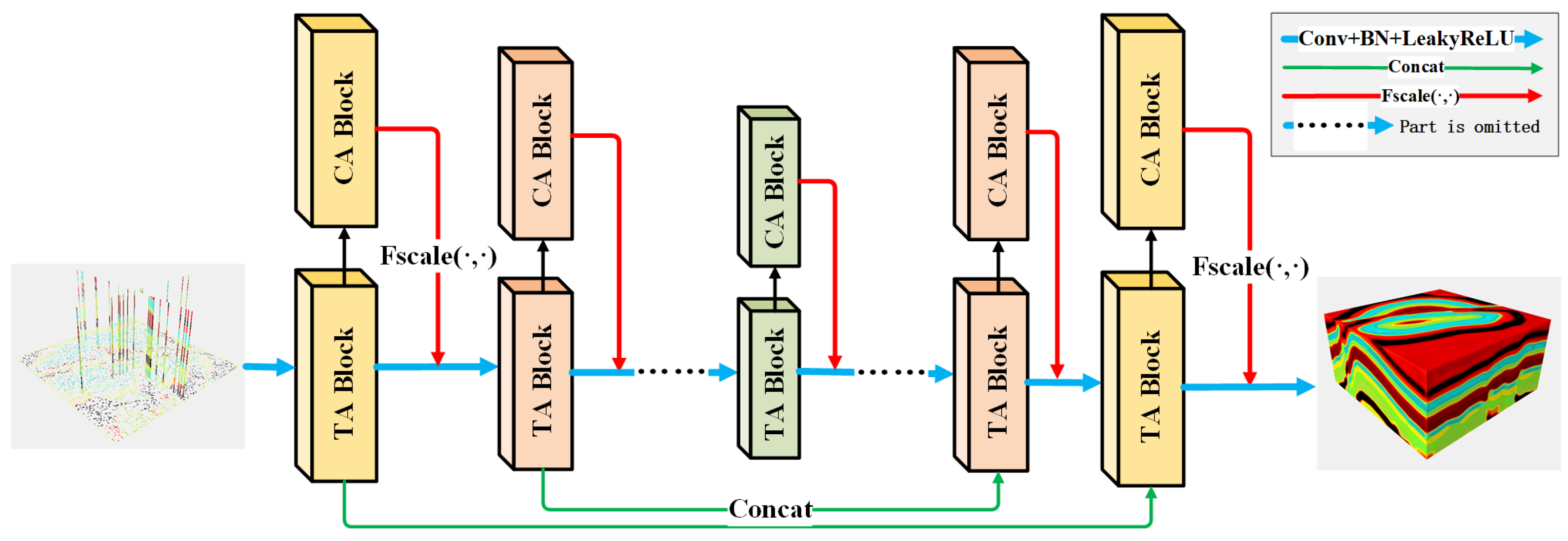
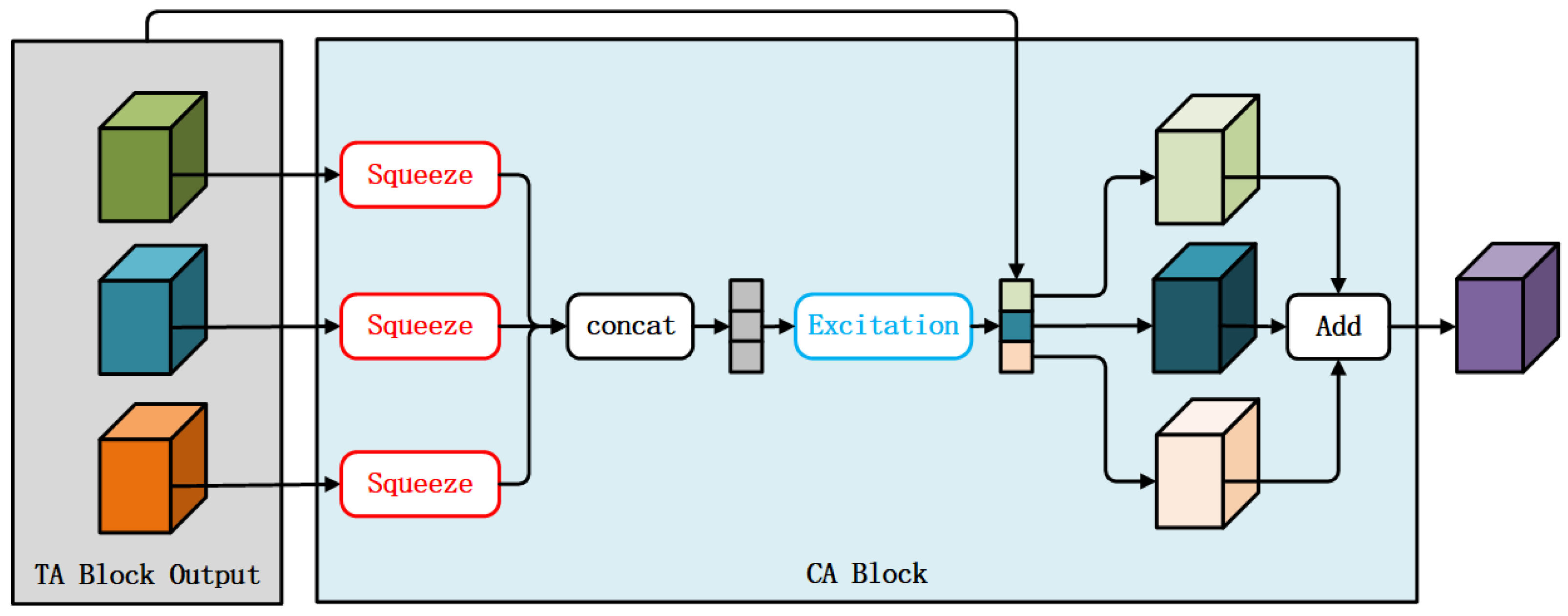
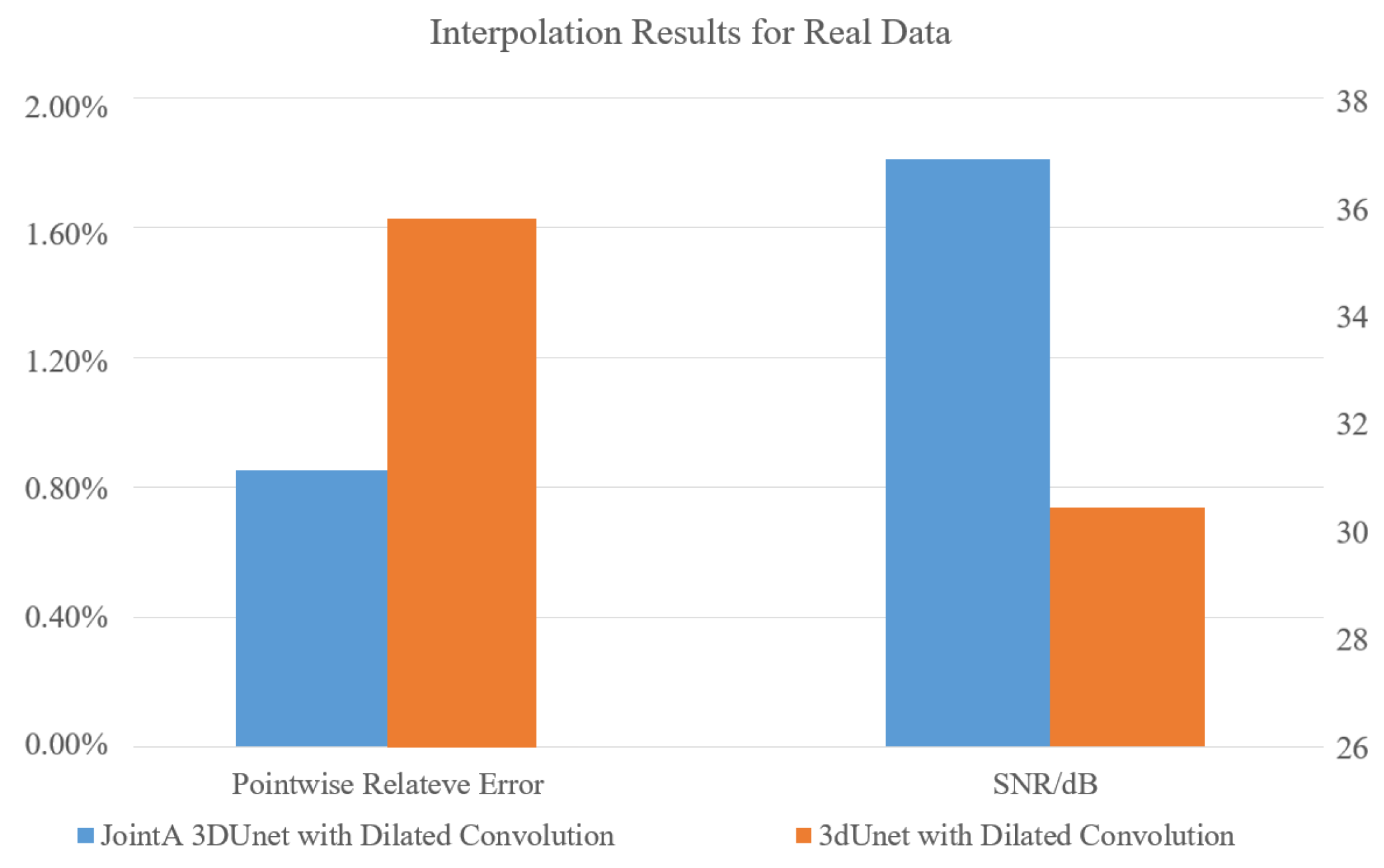
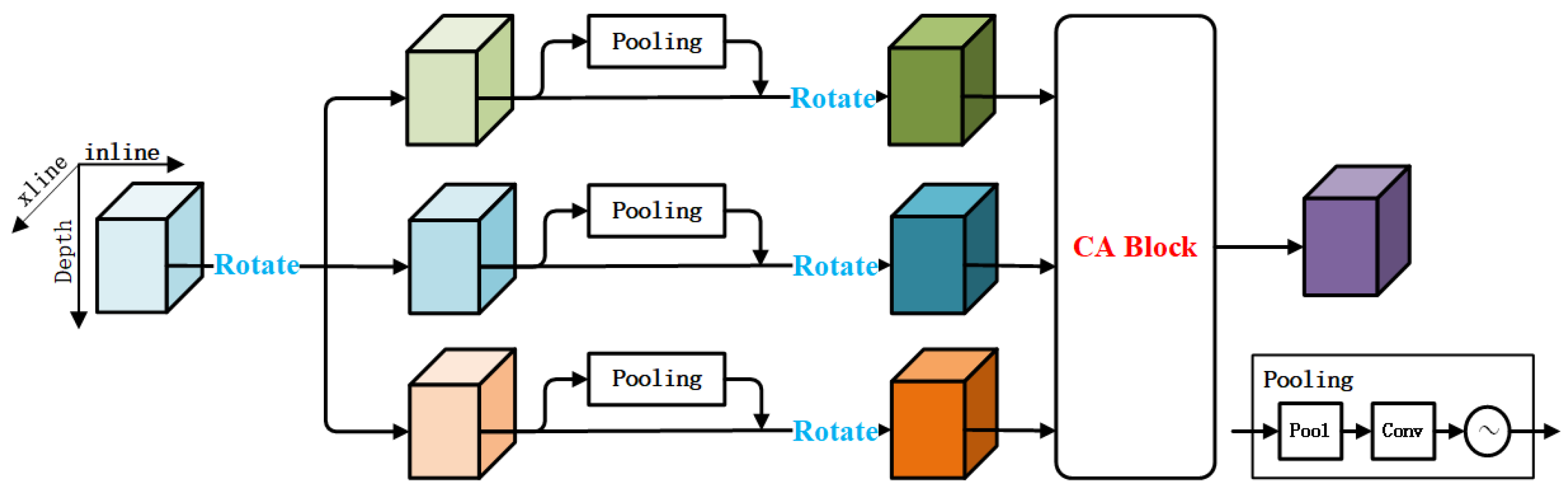
The establishment of a three-dimensional velocity field is an essential step in seismic exploration, playing a crucial role in understanding complex underground geological structures. Accurate 3D velocity fields are significant for seismic imaging, observation system design, precise positioning of underground geological targets, structural interpretation, and reservoir prediction. Therefore, obtaining an accurate 3D velocity field is a focus and challenge in this field of study. To achieve intelligent interpolation of the 3D velocity field more accurately, we have built a network model based on the attention mechanism, JointA 3DUnet. Based on the traditional U-Net, we have added triple attention blocks and channel attention blocks to enhance dimension information interaction, while adapting to the different changes of geoscience data in horizontal and vertical directions. Moreover, the network also incorporates dilated convolution to enlarge the receptive field. During the training process, we introduced transfer learning to further enhance the network’s performance for interpolation tasks. At the same time, our method is a deep learning interpolation algorithm based on an unsupervised model. It does not require a training set and learns information solely from the input data, automatically interpolating the missing velocity data at the missing positions. We tested our method on both synthetic and real data. The results show that, compared with traditional intelligent interpolation methods, our approach can effectively interpolate the three-dimensional velocity field. The SNR increased to 36.22 dB, and the pointwise relative error decreased to 0.89%.
Keywords: three-dimensional interpolation; attention mechanism; transfer learning; dilated convolution three-dimensional interpolation; attention mechanism; transfer learning; dilated convolution