Article

Statistical Validation of a Physical Prime Random Number Generator Based on Quantum Noise †

by
Maurício J. Ferreira
1,2,
Nuno A. Silva
1,*,
Armando N. Pinto
1,2 and
Nelson J. Muga
1
1
Instituto de Telecomunicações, Campus Universitário de Santiago, University of Aveiro, 3810-193 Aveiro, Portugal
2
Department of Electronics, Telecommunications and Informatics, University of Aveiro, 3810-193 Aveiro, Portugal
*
Author to whom correspondence should be addressed.
This paper is an extended version of our paper published in Ferreira, M.J.; Carvalho, A.; Silva, N.A.; Pinto, A.N.; Muga, N.J. Probable Prime Generation from a Quantum Randomness 442 Source. In Proceedings of the 2023 23rd International Conference on Transparent Optical Networks (ICTON), Bucharest, Romania, 2–6 July 2023; pp. 1–4.
Appl. Sci. 2023, 13(23), 12619; https://doi.org/10.3390/app132312619
Submission received: 27 October 2023 / Revised: 17 November 2023 / Accepted: 20 November 2023 / Published: 23 November 2023
(This article belongs to the Section Optics and Lasers)

Abstract

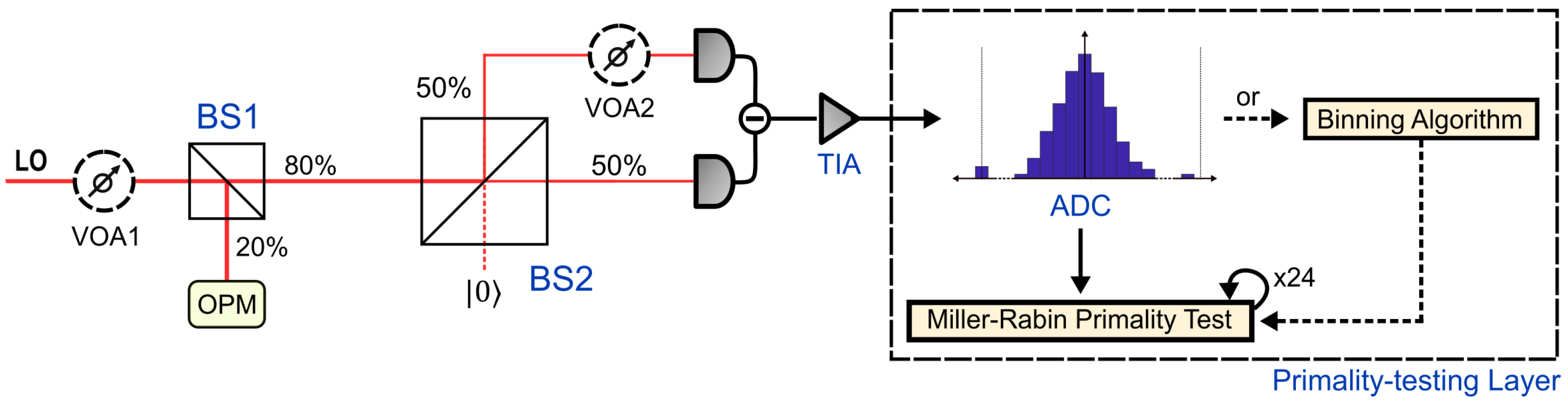
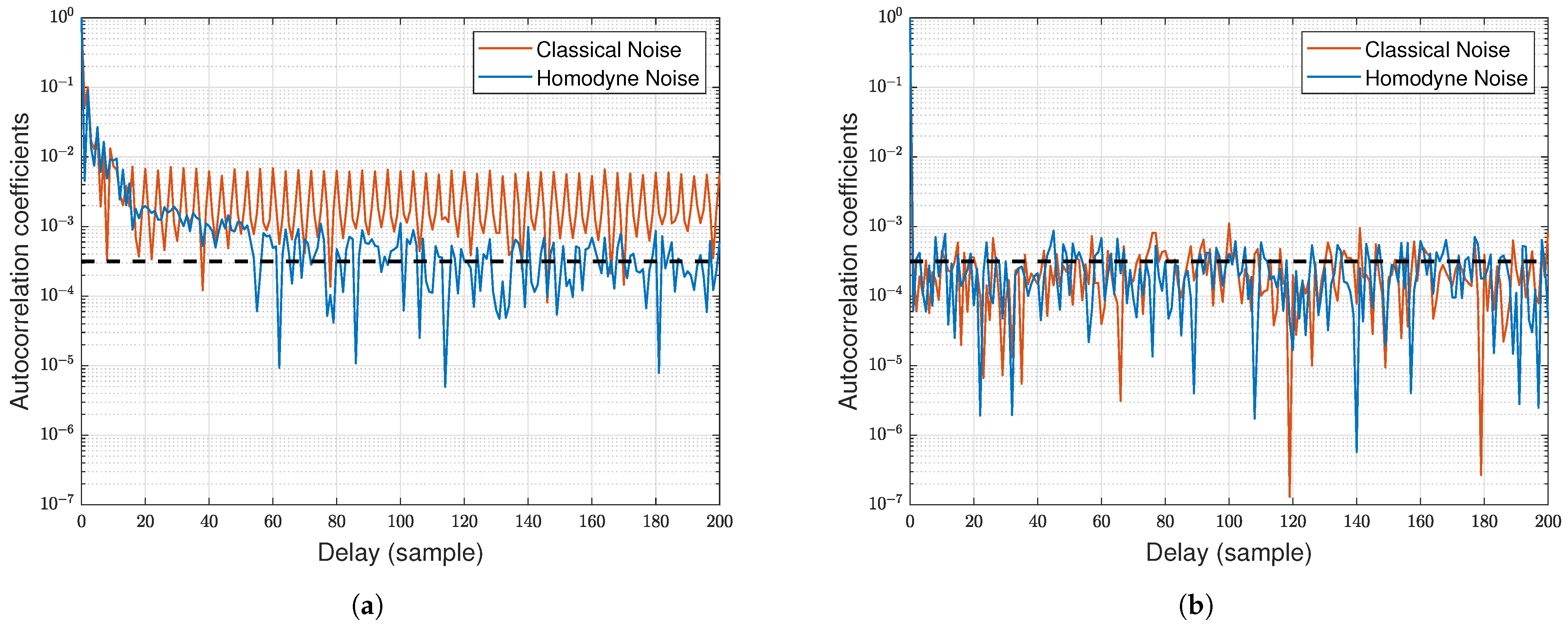
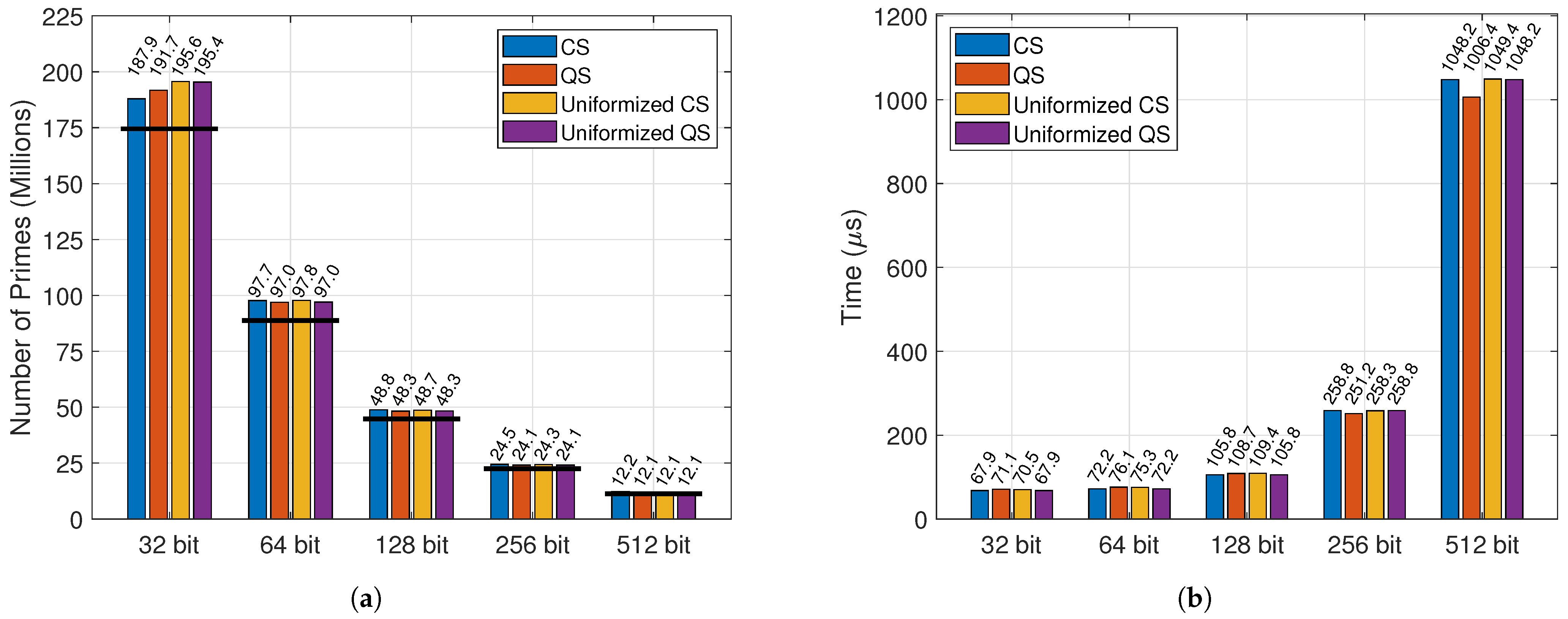
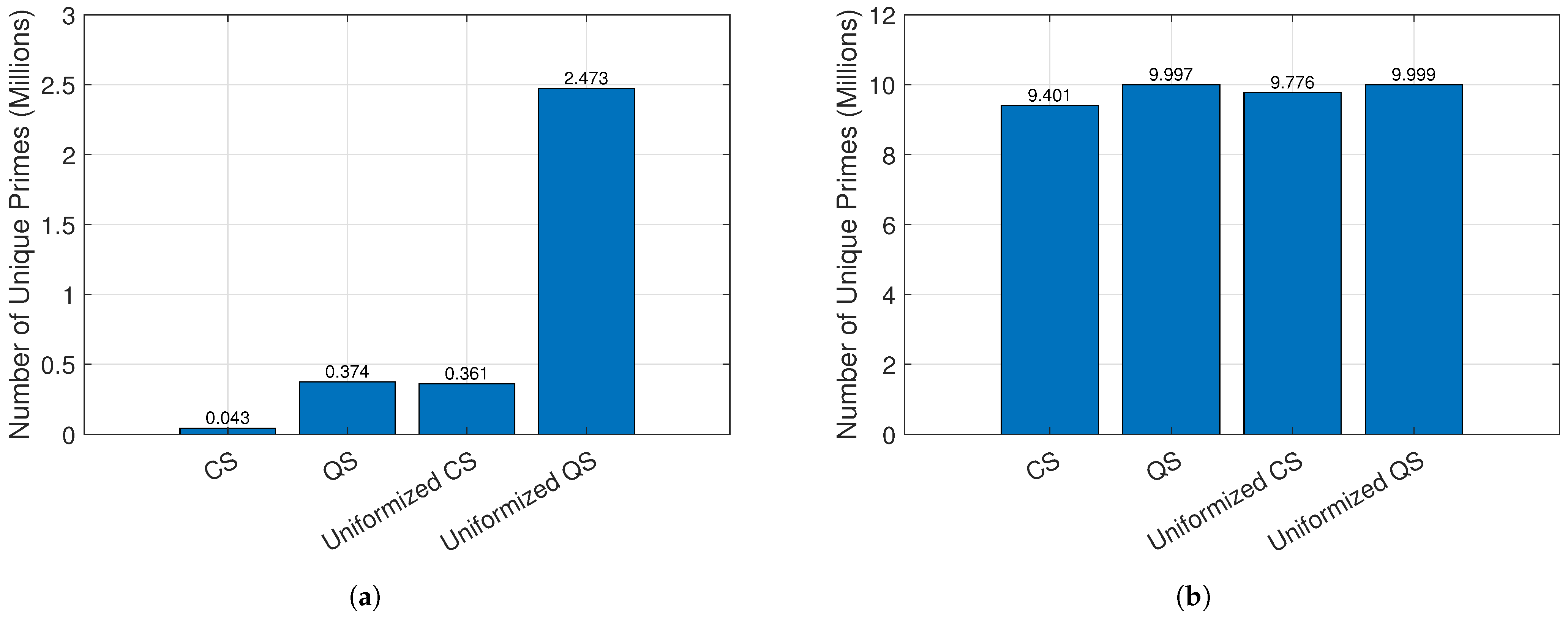
Random prime numbers are an essential resource for many asymmetric cryptographic protocols. However, despite the emerging popularity of quantum random number generators (QRNGs) as sources of secure randomness, physical prime number generators have not yet been explored. In this work, we experimentally implement and characterize a vacuum-based probabilistic prime number generation scheme with an error probability of 3.5×10¹⁵. By removing the quantum source (QS), an additional scheme based on electronic noise is derived, and a comparative analysis for increasing prime lengths is made. We observed that the QS significantly outperforms the classical scheme for small prime generation, where increases up to 585.0% in the diversity of unique primes obtained are seen. Moreover, we propose a length-agnostic statistical test for prime number sequences and apply it to the output of the uniformized randomness source, which was successful in revealing underlying biases in the output prime distributions. The resultant sequences were subsequently submitted to the NIST statistical test suite, where the quantum and classical sources passed, respectively, 86.96% and 45.34% of the total test set applied.
Keywords: random number generation; probable prime numbers; vacuum fluctuations; electronic noise; Miller–Rabin probability test random number generation; probable prime numbers; vacuum fluctuations; electronic noise; Miller–Rabin probability test