




Parametrical Assessment of Polyacrylamide Polymer Membrane Used for CO2 Post-Combustion Capture


Abstract
1. Introduction
1.1. Background
1.2. Study Progress
1.3. Purpose and Novelty of the Current Paper
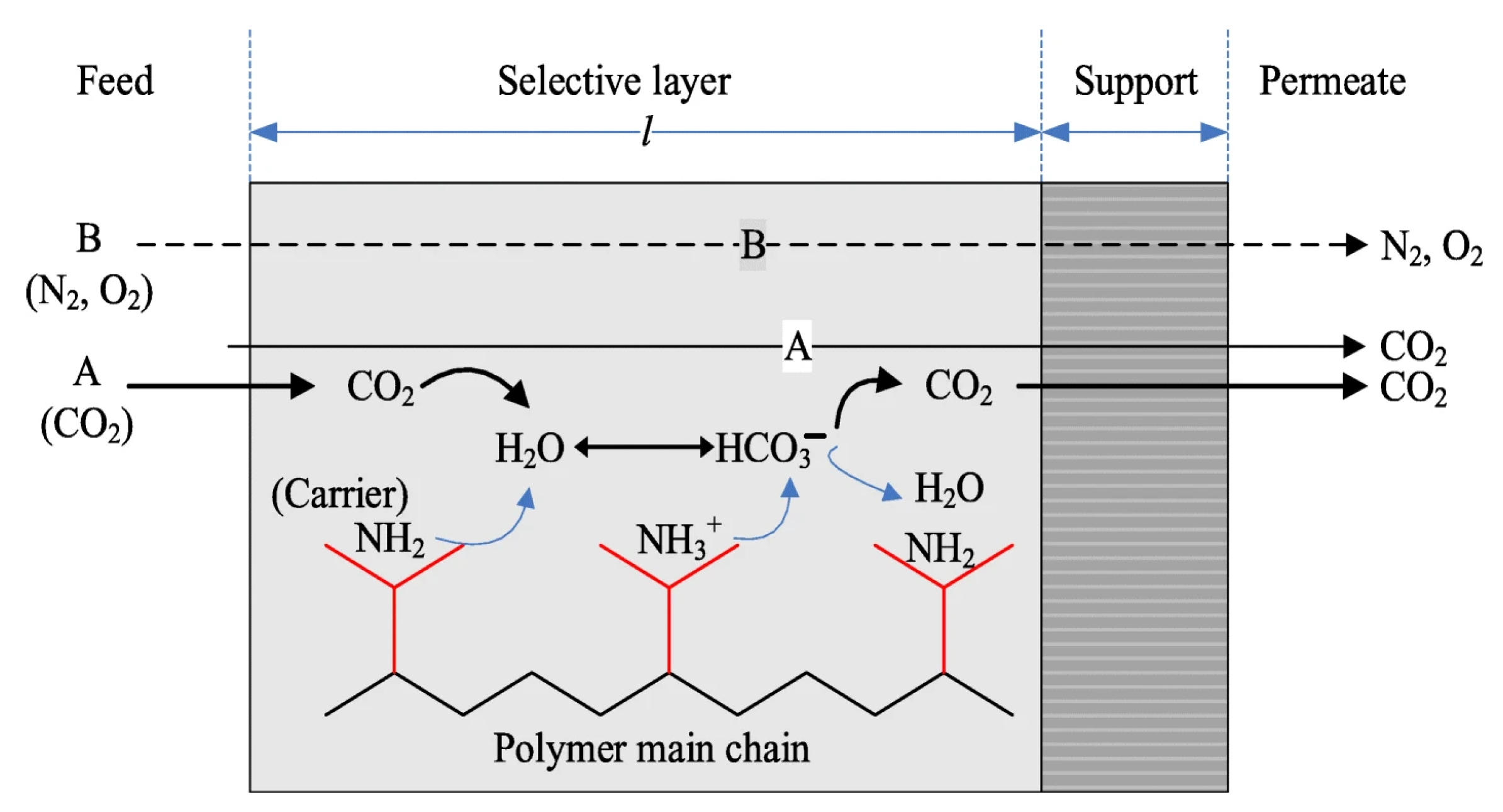
2. Membrane Gas Separation Standards
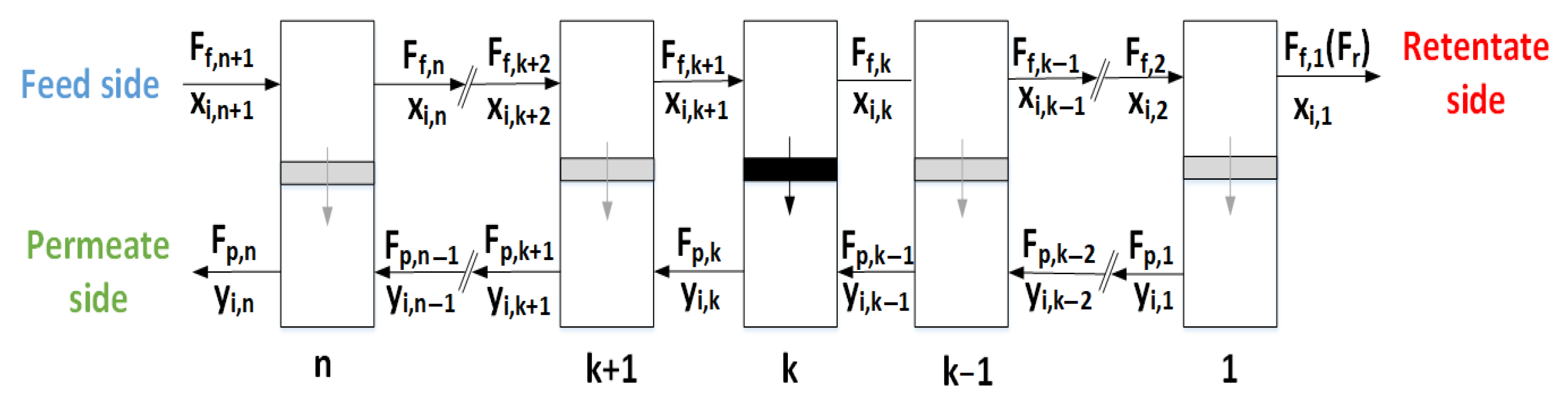
3. Membrane Mathematical Model
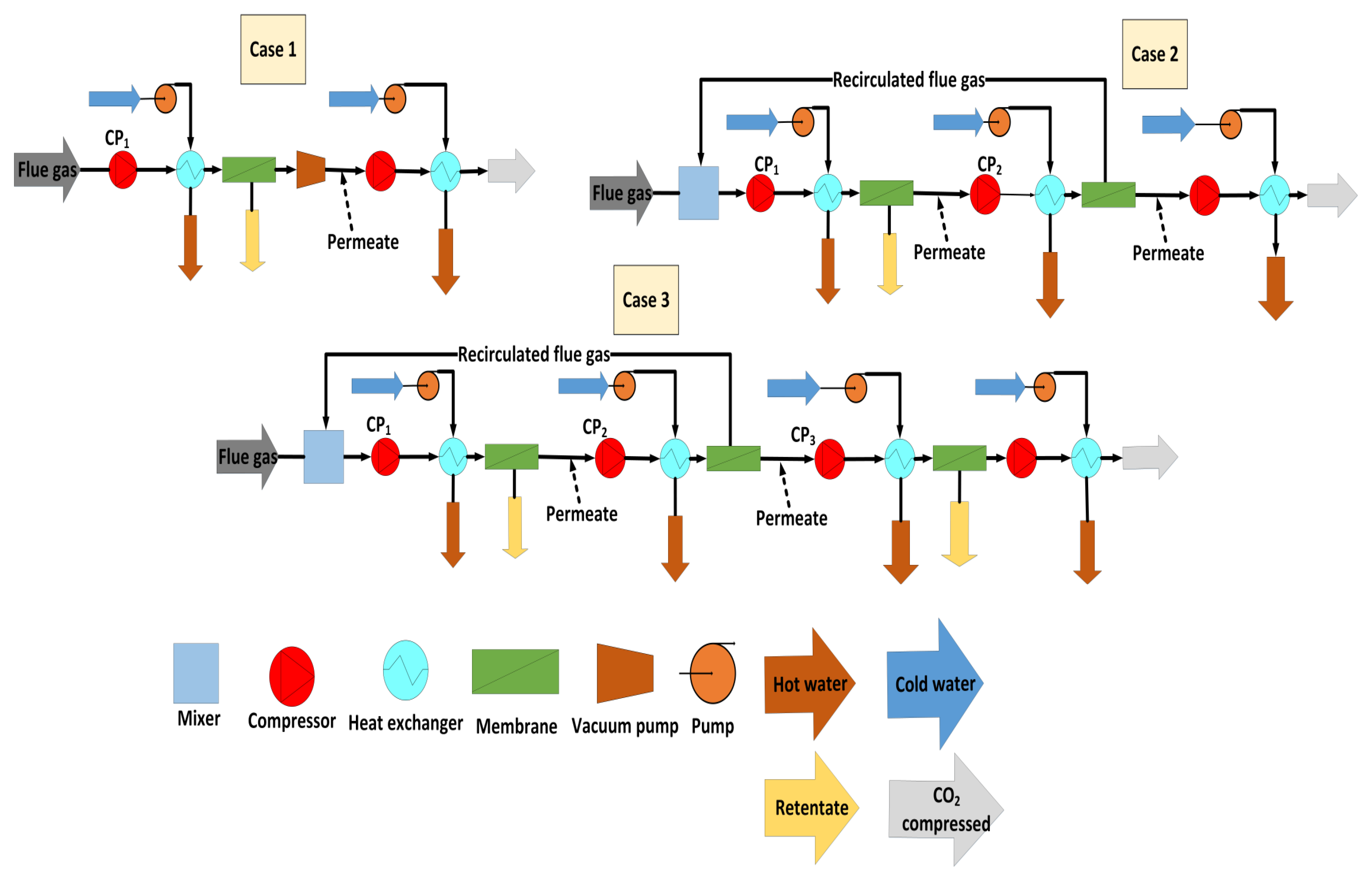
4. Process Description
- Case 1: One stage of a membrane with compression and vacuum pump units;
- Case 2: Two stages of a membrane with a compression unit before each membrane module;
- Case 3: Three stages of a membrane with several compression units.
5. Economical Assessment
6. Results and Discussions
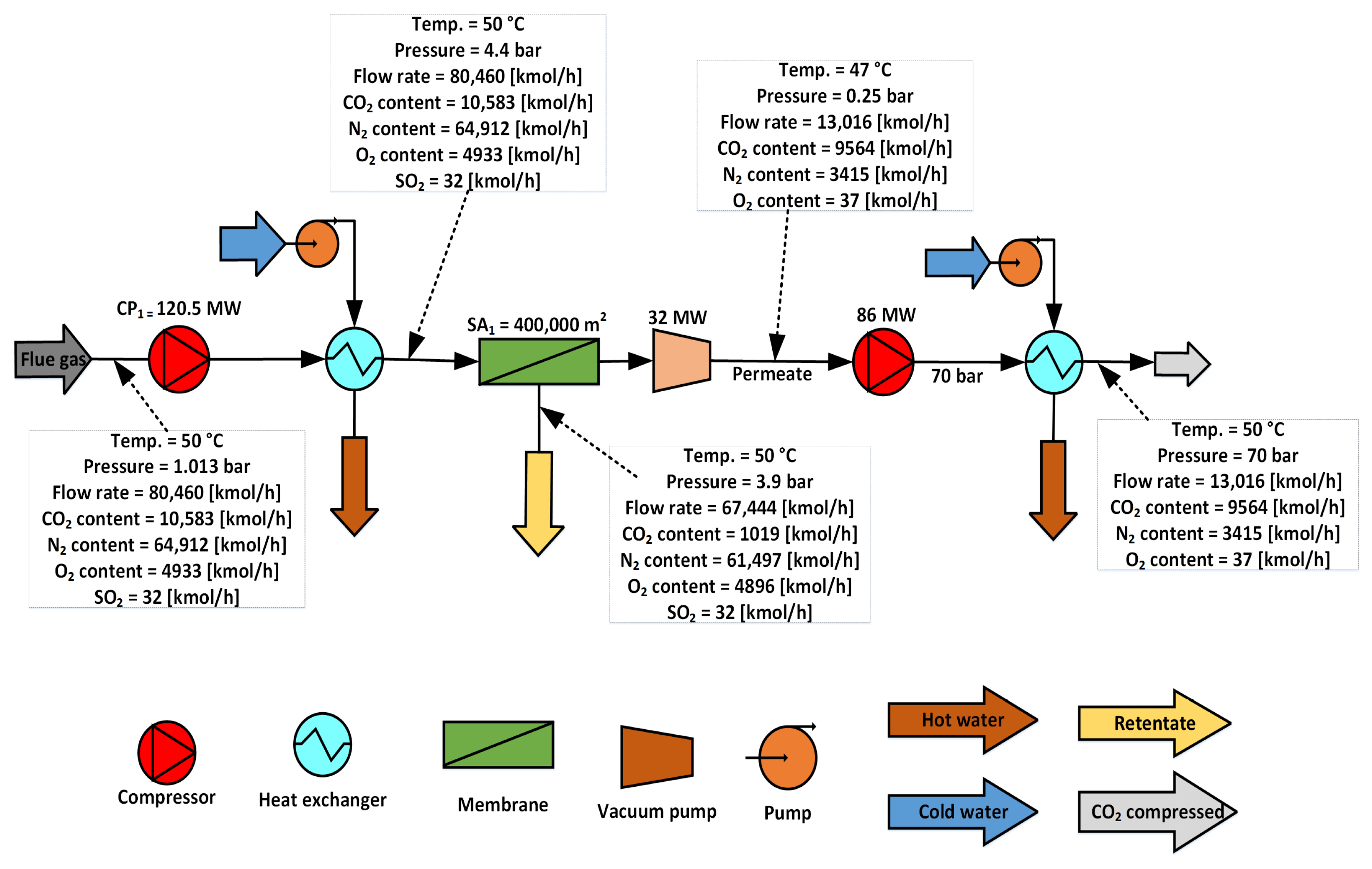
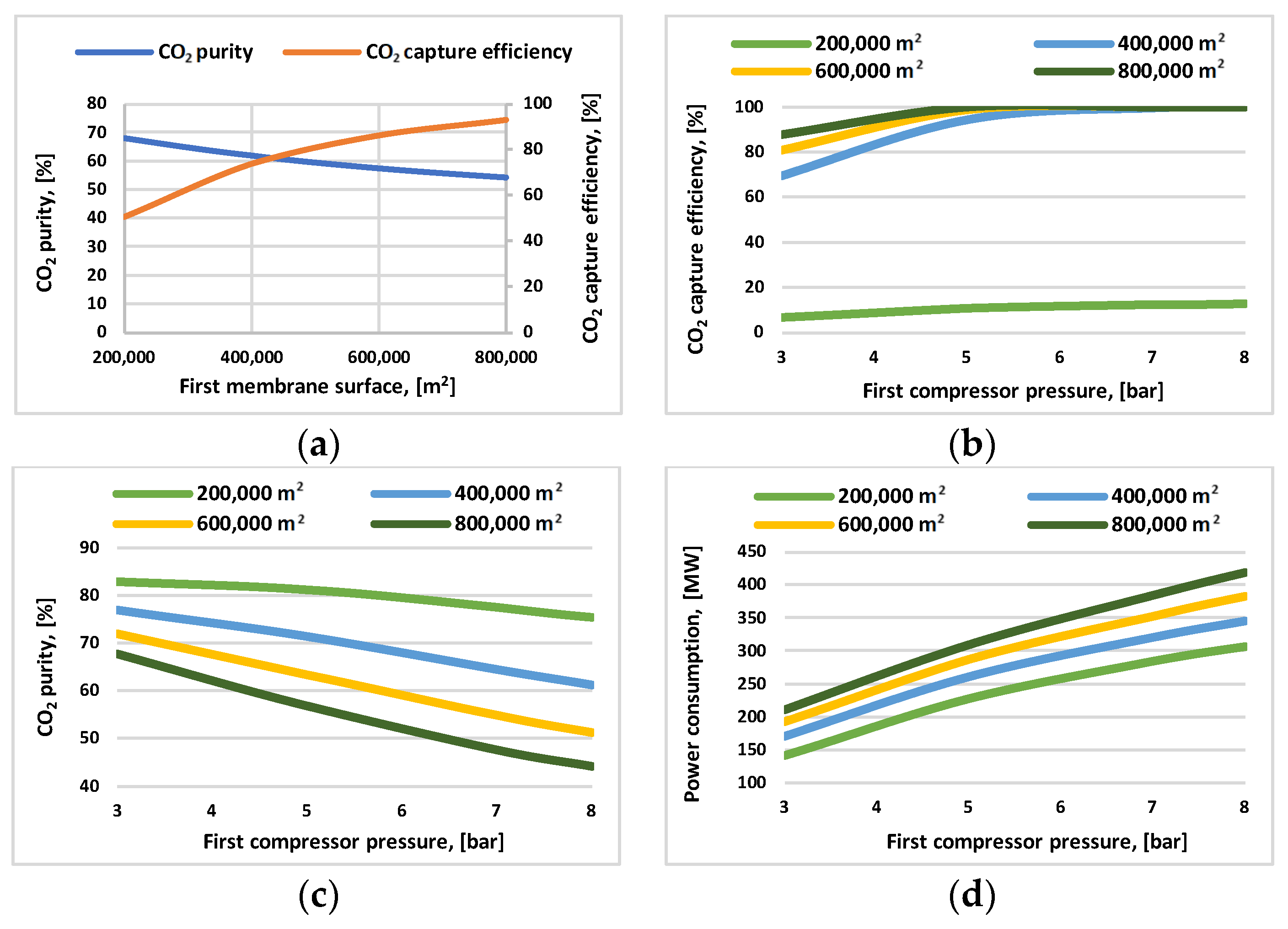
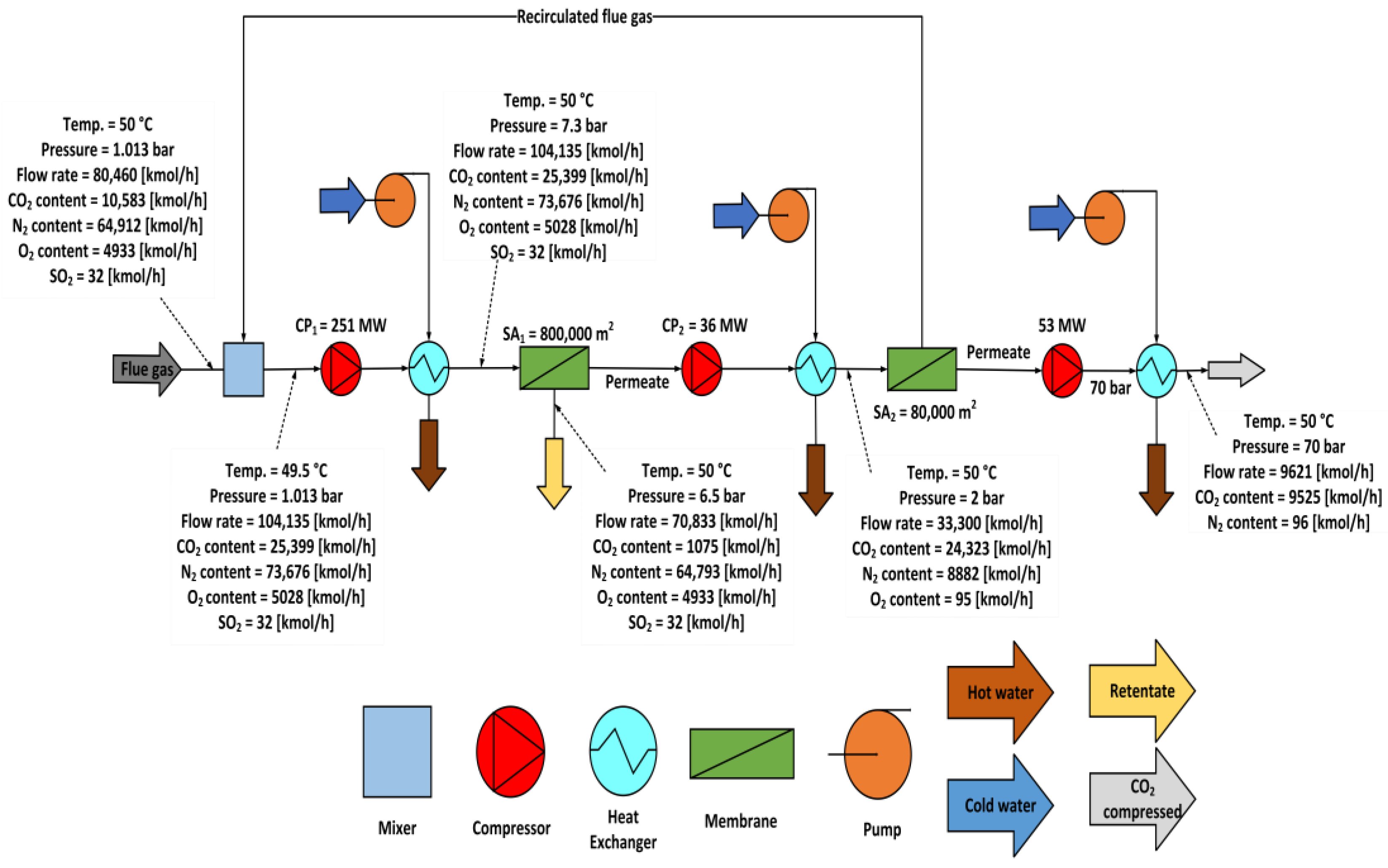
6.1. One-Membrane Stage Design Technical Analysis
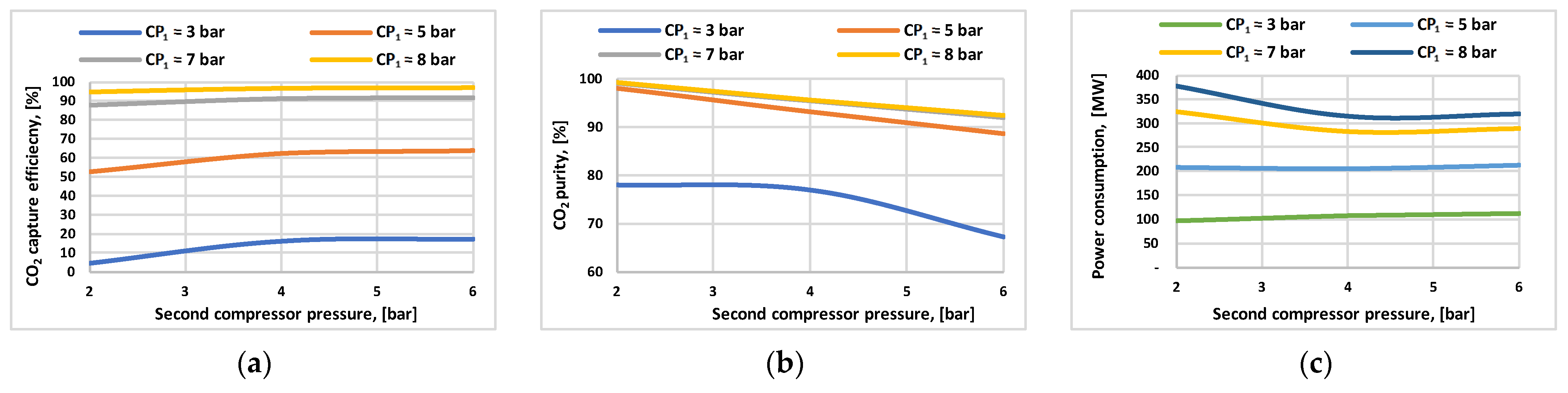
6.2. Two-Membrane Stages Design Technical Analysis
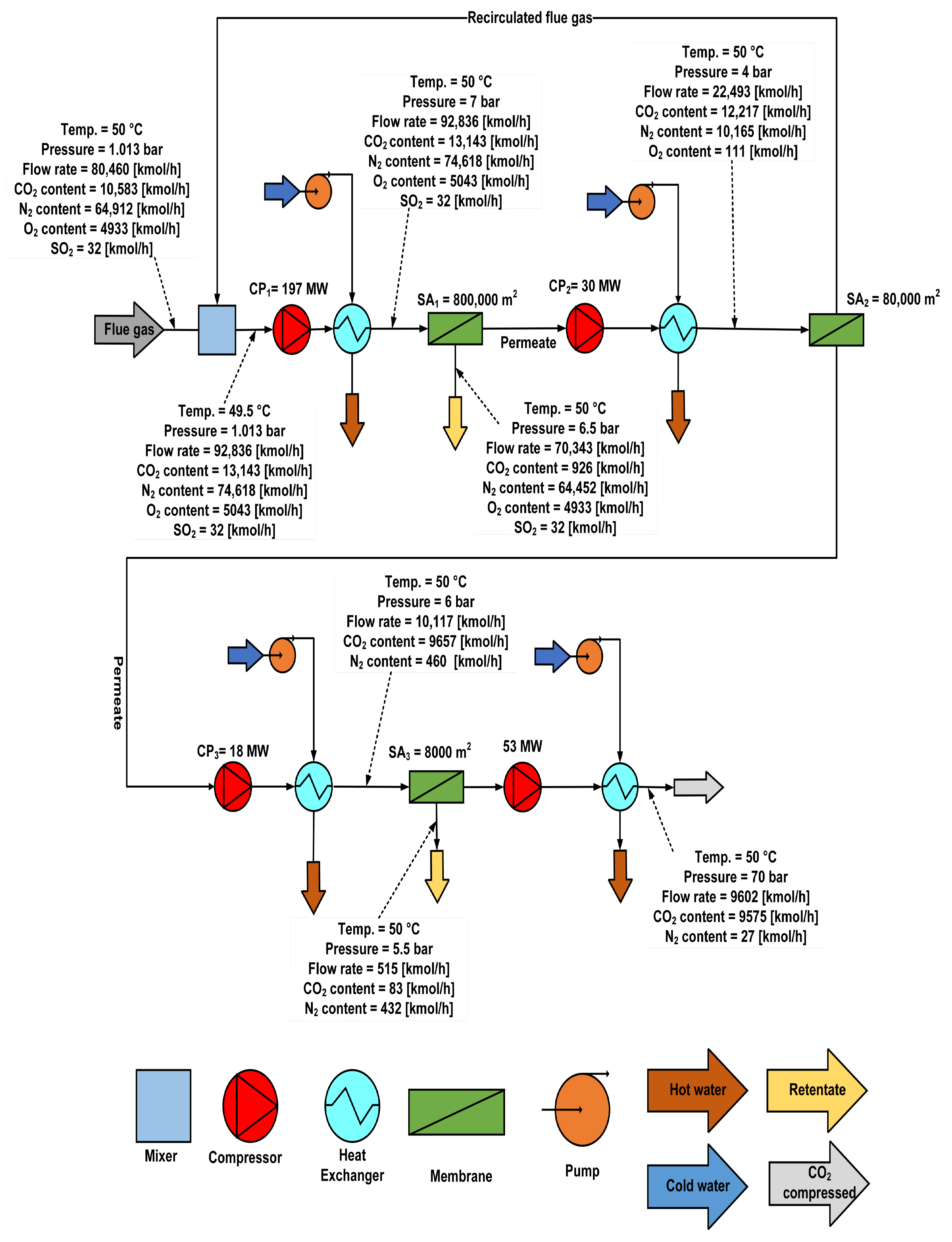
6.3. Three Membrane Stages Design Technical Analysis
6.4. Sensitive Analysis of Membrane Multi Stages’ Effect on CO2 Purity
6.5. Effect of CO2 Permeance on Membrane Process Performance
6.6. Effect of Higher CO2 Purity Necessity on Total Power Consumption
6.7. Comparison between the Optimum Results Obtained from Each Case Simulated
6.8. Techno-Economic Assessment of Each Case’s Optimum Results
6.9. Comparison between Our Optimum Results with Others from the Literature
7. Conclusions
Author Contributions
Funding
Institutional Review Board Statement
Informed Consent Statement
Data Availability Statement
Conflicts of Interest
Abbreviations
| CCUS | Carbon capture and utilizations and storage |
| CFPP | Coal-fired power plant |
| Gas flow via membrane | |
| Diffusion coefficient | |
| Flue gas driving force | |
| Law constant | |
| Gas solubility | |
| Gas partial pressure | |
| Components permeability | |
| Membrane thickness | |
| Low/high-pressure part | |
| Component mole fraction on feed stream | |
| Component mole fraction in the permeate stream | |
| Diffusion coefficient of Fickian diffusion | |
| Carrier-mediated diffusion | |
| Flow rate of the feed side at the kth phase | |
| Flow rate of the permeate side at the kth phase | |
| Total electricity needed for accessories | |
| Levelized cost of electricity | |
| Specific primary energy consumption for carbon dioxide avoided | |
| CCS | Carbon capture system |
| CP1 | First compressor pressure |
| CP2 | Second compressor pressure |
| CP3 | Third compressor pressure |
| MSA1 | First membrane area |
| MSA2 | Second membrane area |
| MSA3 | Third membrane area |
| Carbon dioxide released without CCS | |
| Carbon dioxide released with CCS | |
| CO2 removal price | |
| CO2 avoided price | |
| Net present value | |
| Substitution cost for a year | |
| Reimbursement loan for a year | |
| True investment for a year | |
| Recoup average | |
| Profitability index | |
| Recoup investment |
References
- Cao, Y.; Li, X.; Yan, H.; Kuang, S. China’s efforts to peak carbon emissions: Targets and practice. Chin. J. Urban Environ. Stud. 2021, 9, 2150004. [Google Scholar] [CrossRef] [Scilit]
- Wang, X.; Song, C. Carbon capture from flue gas and the atmosphere: A perspective. Front. Energy Res. 2020, 8, 560849. [Google Scholar] [CrossRef] [Scilit]
- Masson-Delmotte, V. Global Warming of 1.5 °C: An IPCC Special Report on Impacts of Global Warming of 1.5 °C above Pre-Industrial Levels and Related Global Greenhouse Gas Emission Pathways, in the Contex of Strengthening the Global Response to the Thereat of Blimate Change, Sustainable Development, and Efforts to Eradicate Poverty; Cambridge University Press: Cambridge, UK, 2018. [Google Scholar]
- International Energy Agency. Global Energy & CO2 Status Report. Available online: https://www.iea.org/reports/global-energy-and-CO2-status-report-2019/emissions (accessed on 24 October 2022).
- Akpan, P.U.; Fuls, W.F. Cycling of coal fired power plants: A generic CO2 emissions factor model for predicting CO2 emissions. Energy 2021, 214, 119026. [Google Scholar] [CrossRef] [Scilit]
- Cheng, Z.; Li, S.; Liu, Y.; Zhang, Y.; Ling, Z.; Yang, M.; Jiang, L.; Song, Y. Post-combustion CO2 capture and separation in flue gas based on hydrate technology: A review. Renew. Sustain. Energy Rev. 2022, 154, 111806. [Google Scholar] [CrossRef] [Scilit]
- Damartzis, T.; Asimakopoulou, A.; Koutsonikolas, D.; Skevis, G.; Georgopoulou, C.; Dimopoulos, G.; Nikolopoulos, L.; Bougiouris, K.; Richter, H.; Lubenau, U.; et al. Solvents for Membrane-Based Post-Combustion CO2 Capture for Potential Application in the Marine Environment. Appl. Sci. 2022, 12, 6100. [Google Scholar] [CrossRef] [Scilit]
- Alabid, M.; Dinca, C. Parametrization Study for Optimal Pre-Combustion Integration of Membrane Processes in BIGCC. Sustainability 2022, 14, 16604. [Google Scholar] [CrossRef] [Scilit]
- Satar, H.A.; Ahmed, A.A.; Yousif, E.; Ahmed, D.S.; Alotibi, M.F.; El-Hiti, G.A. Synthesis of novel heteroatom-doped porous-organic polymers as environmentally efficient media for carbon dioxide storage. Appl. Sci. 2019, 9, 4314. [Google Scholar] [CrossRef] [Scilit]
- He, T.; Liu, Z.; Son, H.; Gundersen, T.; Lin, W. Comparative analysis of cryogenic distillation and chemical absorption for carbon capture in integrated natural gas liquefaction processes. J. Clean. Prod. 2023, 383, 135264. [Google Scholar] [CrossRef] [Scilit]
- Madejski, P.; Chmiel, K.; Subramanian, N.; Kuś, T. Methods and techniques for CO2 capture: Review of potential solutions and applications in modern energy technologies. Energies 2022, 15, 887. [Google Scholar] [CrossRef] [Scilit]
- Fu, L.; Ren, Z.; Si, W.; Ma, Q.; Huang, W.; Liao, K.; Huang, Z.; Wang, Y.; Li, J.; Xu, P. Research progress on CO2 capture and utilization technology. J. CO2 Util. 2022, 66, 102260. [Google Scholar] [CrossRef] [Scilit]
- Cheng, J.; Cheng, X.; Wang, Z.; Hussain, M.B.; Wang, M. Multifunctional carbon aerogels from typha orientalis for applications in adsorption: Hydrogen storage, CO2 capture and VOCs removal. Energy 2023, 263, 125984. [Google Scholar] [CrossRef] [Scilit]
- Zhang, M.; Deng, L.; Xiang, D.; Cao, B.; Hosseini, S.S.; Li, P. Approaches to suppress CO2-induced plasticization of polyimide membranes in gas separation applications. Processes 2019, 7, 51. [Google Scholar] [CrossRef] [Scilit]
- Choi, J.; Cho, H.; Yun, S.; Jang, M.G.; Oh, S.Y.; Binns, M.; Kim, J.K. Process design and optimization of MEA-based CO2 capture processes for non-power industries. Energy 2019, 185, 971–980. [Google Scholar] [CrossRef] [Scilit]
- Leonzio, G.; Fennell, P.S.; Shah, N. Analysis of technologies for carbon dioxide capture from the air. Appl. Sci. 2022, 12, 8321. [Google Scholar] [CrossRef] [Scilit]
- Freeman, B.; Hao, P.; Baker, R.; Kniep, J.; Chen, E.; Ding, J.; Zhang, Y.; Rochelle, G.T. Hybrid membrane-absorption CO2 capture process. Energy Procedia 2014, 63, 605–613. [Google Scholar] [CrossRef] [Scilit]
- Dai, Y.; Niu, Z.; Luo, W.; Wang, Y.; Mu, P.; Li, J. A review on the recent advances in composite membranes for CO2 capture processes. Sep. Purif. Technol. 2022, 307, 122752. [Google Scholar] [CrossRef] [Scilit]
- Kim, T.J.; Vrålstad, H.; Sandru, M.; Hägg, M.B. Separation performance of PVAm composite membrane for CO2 capture at various pH levels. J. Membr. Sci. 2013, 428, 218–224. [Google Scholar] [CrossRef] [Scilit]
- White, L.S.; Wei, X.; Pande, S.; Wu, T.; Merkel, T.C. Extended flue gas trials with a membrane-based pilot plant at a one-ton-per-day carbon capture rate. J. Membr. Sci. 2015, 496, 48–57. [Google Scholar] [CrossRef] [Scilit]
- Han, Y.; Wu, D.; Ho, W.W. Nanotube-reinforced facilitated transport membrane for CO2/N2 separation with vacuum operation. J. Membr. Sci. 2018, 567, 261–271. [Google Scholar] [CrossRef] [Scilit]
- Chen, G.; Wang, T.; Zhang, G.; Liu, G.; Jin, W. Membrane materials targeting carbon capture and utilization. Adv. Membr. 2022, 2, 100025. [Google Scholar] [CrossRef] [Scilit]
- Lee, S.; Binns, M.; Lee, J.H.; Moon, J.H.; Yeo, J.G.; Yeo, Y.K.; Lee, Y.M.; Kim, J.K. Membrane separation process for CO2 capture from mixed gases using TR and XTR hollow fiber membranes: Process modeling and experiments. J. Membr. Sci. 2017, 541, 224–234. [Google Scholar] [CrossRef] [Scilit]
- Robeson, L.M. The upper bound revisited. J. Membr. Sci. 2008, 320, 390–400. [Google Scholar] [CrossRef] [Scilit]
- Da Conceicao, M.; Nemetz, L.; Rivero, J.; Hornbostel, K.; Lipscomb, G. Gas Separation Membrane Module Modeling: A Comprehensive Review. Membranes 2023, 13, 639. [Google Scholar] [CrossRef] [Scilit] [PubMed]
- Hoek, E.M.; Tarabara, V.V. (Eds.) Encyclopedia of Membrane Science and Technology; Wiley: Hoboken, NJ, USA, 2013. [Google Scholar]
- He, X.; Hägg, M.B. Hollow fiber carbon membranes: Investigations for CO2 capture. J. Membr. Sci. 2011, 378, 1–9. [Google Scholar] [CrossRef] [Scilit]
- Sandru, M.; Haukebø, S.H.; Hägg, M.B. Composite hollow fiber membranes for CO2 capture. J. Membr. Sci. 2010, 346, 172–186. [Google Scholar] [CrossRef] [Scilit]
- Fu, Q.; Halim, A.; Kim, J.; Scofield, J.M.; Gurr, P.A.; Kentish, S.E.; Qiao, G.G. Highly permeable membrane materials for CO2 capture. J. Mater. Chem. A 2013, 1, 13769–13778. [Google Scholar] [CrossRef] [Scilit]
- Han, Y.; Ho, W.W. Recent advances in polymeric membranes for CO2 capture. Chin. J. Chem. Eng. 2018, 26, 2238–2254. [Google Scholar] [CrossRef] [Scilit]
- He, X.; Hägg, M.B. Membranes for environmentally friendly energy processes. Membranes 2012, 2, 706–726. [Google Scholar] [CrossRef] [Scilit]
- Ramasubramanian, K.; Verweij, H.; Ho, W.W. Membrane processes for carbon capture from coal-fired power plant flue gas: A modeling and cost study. J. Membr. Sci. 2012, 421, 299–310. [Google Scholar] [CrossRef] [Scilit]
- Li, Q.; Wu, H.; Wang, Z.; Wang, J. Analysis and optimal design of membrane processes for flue gas CO2 capture. Sep. Purif. Technol. 2022, 298, 121584. [Google Scholar] [CrossRef] [Scilit]
- Shao, P.; Dal-Cin, M.M.; Guiver, M.D.; Kumar, A. Simulation of membrane-based CO2 capture in a coal-fired power plant. J. Membr. Sci. 2013, 427, 451–459. [Google Scholar] [CrossRef] [Scilit]
- Li, H.; Wang, F.; Li, S.; Yu, M. Two-stage membrane-based process utilizing highly CO2-selective membranes for cost and energy efficient carbon capture from coal flue gas: A process simulation study. J. Membr. Sci. 2023, 669, 121259. [Google Scholar] [CrossRef] [Scilit]
- Asadi, J.; Kazempoor, P. Techno-economic analysis of membrane-based processes for flexible CO2 capturing from power plants. Energy Convers. Manag. 2021, 246, 114633. [Google Scholar] [CrossRef] [Scilit]
- Chiwaye, N.; Majozi, T.; Daramola, M.O. On optimisation of N2 and CO2-selective hybrid membrane process systems for post-combustion CO2 capture from coal-fired power plants. J. Membr. Sci. 2021, 638, 119691. [Google Scholar] [CrossRef] [Scilit]
- Sandru, M.; Kim, T.J.; Capala, W.; Huijbers, M.; Hägg, M.B. Pilot scale testing of polymeric membranes for CO2 capture from coal fired power plants. Energy Procedia 2013, 37, 6473–6480. [Google Scholar] [CrossRef] [Scilit]
- He, X. A review of material development in the field of carbon capture and the application of membrane-based processes in power plants and energy-intensive industries. Energy Sustain. Soc. 2018, 8, 34. [Google Scholar] [CrossRef] [Scilit]
- Sulaiman, D.P.; Suhaimi, H.; Shamsuddin, N. Estimating glucose diffusion coefficient of membranes for tissue engineering applications using Fick’s First Law. IOP Conf. Ser. Mater. Sci. Eng. 2020, 991, 012103. [Google Scholar] [CrossRef] [Scilit]
- Qazi, S.; Gómez-Coma, L.; Albo, J.; Druon-Bocquet, S.; Irabien, A.; Sanchez-Marcano, J. CO2 capture in a hollow fiber membrane contactor coupled with ionic liquid: Influence of membrane wetting and process parameters. Sep. Purif. Technol. 2020, 233, 115986. [Google Scholar] [CrossRef] [Scilit]
- He, X.; Chen, D.; Liang, Z.; Yang, F. Insight and comparison of energy-efficient membrane processes for CO2 capture from flue gases in power plant and energy-intensive industry. Carbon Capture Sci. Technol. 2022, 2, 100020. [Google Scholar] [CrossRef] [Scilit]
- Fu, H.; Xue, K.; Li, Z.; Zhang, H.; Gao, D.; Chen, H. Study on the performance of CO2 capture from flue gas with ceramic and PTFE membrane contactors. Energy 2023, 263, 125677. [Google Scholar] [CrossRef] [Scilit]
- Ozkan, M.; Akhavi, A.A.; Coley, W.C.; Shang, R.; Ma, Y. Progress in carbon dioxide capture materials for deep decarbonization. Chem 2022, 8, 141–173. [Google Scholar] [CrossRef] [Scilit]
- Ramírez-Santos, Á.A.; Bozorg, M.; Addis, B.; Piccialli, V.; Castel, C.; Favre, E. Optimization of multistage membrane gas separation processes. Example of application to CO2 capture from blast furnace gas. J. Membr. Sci. 2018, 566, 346–366. [Google Scholar] [CrossRef] [Scilit]
- Ni, Z.; Cao, Y.; Zhang, X.; Zhang, N.; Xiao, W.; Bao, J.; He, G. Synchronous Design of Membrane Material and Process for Pre-Combustion CO2 Capture: A Superstructure Method Integrating Membrane Type Selection. Membranes 2023, 13, 318. [Google Scholar] [CrossRef] [Scilit] [PubMed]
- Xu, J.; Wang, Z.; Qiao, Z.; Wu, H.; Dong, S.; Zhao, S.; Wang, J. Post-combustion CO2 capture with membrane process: Practical membrane performance and appropriate pressure. J. Membr. Sci. 2019, 581, 195–213. [Google Scholar] [CrossRef] [Scilit]
- Pan, C.Y.; Habgood, H.W. Gas separation by permeation part I. Calculation methods and parametric analysis. Can. J. Chem. Eng. 1978, 56, 197–209. [Google Scholar] [CrossRef] [Scilit]
- Pan, C.Y.; Habgood, H.W. Gas separation by permeation Part II: Effect of permeate pressure drop and choice of permeate pressure. Can. J. Chem. Eng. 1978, 56, 210–217. [Google Scholar] [CrossRef] [Scilit]
- Coker, D.T.; Freeman, B.D.; Fleming, G.K. Modeling multicomponent gas separation using hollow-fiber membrane contactors. AIChE J. 1998, 44, 1289–1302. [Google Scholar] [CrossRef] [Scilit]
- Chiwaye, N.; Majozi, T.; Daramola, M.O. Optimisation of post-combustion carbon dioxide capture by use of a fixed site carrier membrane. Int. J. Greenh. Gas Control 2021, 104, 103182. [Google Scholar] [CrossRef] [Scilit]
- Taifan, G.S.; Maravelias, C.T. Generalized optimization-based synthesis of membrane systems for multicomponent gas mixture separation. Chem. Eng. Sci. 2022, 252, 117482. [Google Scholar] [CrossRef] [Scilit]
- Qi, D.; Liu, Y.; Liu, Y.; Liu, Z.; Luo, Y.; Xu, H.; Zhou, X.; Zhang, J.; Yang, H.; Wang, W.; et al. Polymeric membranes with selective solution-diffusion for intercepting volatile organic compounds during solar-driven water remediation. Adv. Mater. 2020, 32, 2004401. [Google Scholar] [CrossRef] [Scilit]
- Asadi, J.; Kazempoor, P. Sustainability Enhancement of Fossil-Fueled Power Plants by Optimal Design and Operation of Membrane-Based CO2 Capture Process. Atmosphere 2022, 13, 1620. [Google Scholar] [CrossRef] [Scilit]
- Hägg, M.B.; Lindbråthen, A.; He, X.; Nodeland, S.G.; Cantero, T. Pilot demonstration-reporting on CO2 capture from a cement plant using hollow fiber process. Energy Procedia 2017, 114, 6150–6165. [Google Scholar] [CrossRef] [Scilit]
- Dinca, C.; Badea, A.A.; Apostol, T.; Lazaroiu, G. GHG emissions evaluation from fossil fuel with CCS. Environ. Eng. Manag. J. 2009, 8, 81–89. [Google Scholar] [CrossRef] [Scilit]
- Cormos, C.C.; Petrescu, L.; Cormos, A.M.; Dinca, C. Assessment of Hybrid Solvent—Membrane Configurations for Post-Combustion CO2 Capture for Super-Critical Power Plants. Energies 2021, 14, 5017. [Google Scholar] [CrossRef] [Scilit]
- Alabid, M.; Cormos, C.C.; Dinca, C. Critical Assessment of Membrane Technology Integration in a Coal-Fired Power Plant. Membranes 2022, 12, 904. [Google Scholar] [CrossRef] [Scilit]
- CO2 Hybrid Project. Available online: http://CO2hybrid.upb.ro/index_ro.html (accessed on 1 August 2022).
- Luis, P.; Van Gerven, T.; Van der Bruggen, B. Recent developments in membrane-based technologies for CO2 capture. Prog. Energy Combust. Sci. 2012, 38, 419–448. [Google Scholar] [CrossRef] [Scilit]
- Signorini, V.; Giacinti Baschetti, M.; Pizzi, D.; Merlo, L. Permeation of Ternary Mixture Containing H2S, CO2 and CH4 in Aquivion® Perfluorosulfonic Acid (PFSA) Ionomer Membranes. Membranes 2022, 12, 1034. [Google Scholar] [CrossRef] [Scilit]
- Ren, L.X.; Chang, F.L.; Kang, D.Y.; Chen, C.L. Hybrid membrane process for post-combustion CO2 capture from coal-fired power plant. J. Membr. Sci. 2020, 603, 118001. [Google Scholar] [CrossRef] [Scilit]
- Zhao, L.; Riensche, E.; Blum, L.; Stolten, D. Multi-stage gas separation membrane processes used in post-combustion capture: Energetic and economic analyses. J. Membr. Sci. 2010, 359, 160–172. [Google Scholar] [CrossRef] [Scilit]
- He, X.; Hägg, M.B. Energy efficient process for CO2 capture from flue gas with novel fixed-site-carrier membranes. Energy Procedia 2014, 63, 174–185. [Google Scholar] [CrossRef] [Scilit]
- Cormos, A.M.; Dinca, C.; Cormos, C.C. Energy efficiency improvements of post-combustion CO2 capture based on reactive gas–liquid absorption applied for super-critical circulating fluidized bed combustion (CFBC) power plants. Clean Technol. Environ. Policy 2018, 20, 1311–1321. [Google Scholar] [CrossRef]
- Chemengonline. 2022. Available online: https://www.chemengonline.com/pci-home (accessed on 1 June 2022).
- Trading Economics. Available online: https://tradingeconomics.com/commodity/carbon (accessed on 27 October 2022).
- Cormos, C.-C.; Dinca, C. Techno-economic and environmental implications of decarbonization process applied for Romanian fossil-based power generation sector. Energy 2020, 220, 119734. [Google Scholar] [CrossRef] [Scilit]
- He, X.; Fu, C.; Hägg, M.B. Membrane system design and process feasibility analysis for CO2 capture from flue gas with a fixed-site-carrier membrane. Chem. Eng. J. 2015, 268, 1–9. [Google Scholar] [CrossRef] [Scilit]
- Hussain, A.; Farrukh, S.; Minhas, F.T. Two-stage membrane system for post-combustion CO2 capture application. Energy Fuels 2015, 29, 6664–6669. [Google Scholar] [CrossRef] [Scilit]
- He, X.; Lie, J.A.; Sheridan, E.; Hägg, M.B. CO2 capture by hollow fibre carbon membranes: Experiments and process simulations. Energy Procedia 2009, 1, 261–268. [Google Scholar] [CrossRef] [Scilit]

| Lignite Detail | Value (%) |
|---|---|
| Carbon | 72.3 |
| Ash | 13.89 |
| Oxygen | 7.45 |
| Hydrogen | 4.11 |
| Nitrogen | 1.69 |
| Sulfur | 0.56 |
| Agent | Unit | Rate |
|---|---|---|
| Stream temperature | °C | 560 |
| Stream pressure | bar | 170 |
| Low-pressure efficiency of the turbine | % | 87.8 |
| Medium-pressure efficiency of the turbine | % | 91.6 |
| High-pressure efficiency of the turbine | % | 84.9 |
| Pressure of the condenser | bar | 0.05 |
| Temperature of water inside the condenser | °C | 9.5 |
| Efficiency of the combustion operation | % | 91 |
| Steam flux | kg/s | 254.03 |
| Efficiency of the plant | % | 41.63 |
| Flue gas before introducing to the membrane process | ||
| Pressure | bar | 1.013 |
| Temperature | °C | 50 |
| Flux | kmol/h | 80,460 |
| Flue gas fraction | %mole | |
| Carbon dioxide | 13.12 | |
| Nitrogen | 80.80 | |
| Oxygen | 6.05 | |
| Sulfur dioxide | 0.03 |
| Factor | Unit | Rate |
|---|---|---|
| Membrane module | - | Spiral wound [58] |
| Flue gas flow | - | Counter-current [58] |
| Permeability of CO2 | GPU | 3000 [59] |
| CO2/N2 Selectivity | - | 50 [59] |
| Compressors and vacuums’ efficiency | % | 90 [58] |
| Water pump efficiency | % | 90 [58] |
| Variance of the membrane variables simulated | ||
| Pressure of first compressor (CP1) | bar | 3–8 |
| Area of first membrane (MSA1) | m2 | 200,000–800,000 |
| Pressure of second compressor (CP2) | bar | 2–6 (case 2) |
| Area of second membrane (MSA2) | m2 | 80,000 |
| Pressure of third compressor (CP3) | bar | 2–6 (case 3) |
| Area of third membrane (MSA3) | m2 | 8000–40,000 |
| Factor | Unit | Rate |
|---|---|---|
| Project duration | years | 25 |
| Cost of electricity | EUR/MWh | 160 [66] |
| Carbon dioxide tariff | EUR/t | 80 [67] |
| Availability index | % | 85 [66] |
| Recoup average | % | 8 [66] |
| Membrane module charge | EUR/m2 | 40 [66] |
| Pump cost | EUR/kW | 1350 [66] |
| Compressor cost | EUR/kW | 1800 [66] |
| Membrane substitution charge | EUR/m2 | 10 [55] |
| Employee fees | EUR/y | 98,550 [66] |
| Carbon dioxide captured compressor cost | million EUR | 11.7 [66] |
| Carbon dioxide captured refrigerant cost | million EUR | 0.87 [66] |
| 300 GPU | 1000 GPU | 3000 GPU | |||||||||||
|---|---|---|---|---|---|---|---|---|---|---|---|---|---|
| MAS1 | m2 | 400,000 | 800,000 | 400,000 | 800,000 | 400,000 | 800,000 | ||||||
| CP1 | bar | 3 | 7 | 3 | 7 | 3 | 7 | 3 | 7 | 3 | 7 | 3 | 7 |
| CO2 capture rate | % | 26 | 65 | 45 | 89 | 50 | 93 | 73 | 99.7 | 70 | 99.5 | 88 | 99.9 |
| Power needed | MW | 130 | 286 | 171 | 370 | 153 | 314 | 197 | 383 | 171 | 321 | 211 | 385 |
| CO2 purity | % | 57 | 56 | 53.2 | 46 | 71 | 64 | 64 | 48 | 77 | 65 | 68 | 48 |
| 300 GPU | 1000 GPU | 3000 GPU | |||||||||||
|---|---|---|---|---|---|---|---|---|---|---|---|---|---|
| MAS1 | m2 | 400,000 | 800,000 | 400,000 | 800,000 | 400,000 | 800,000 | ||||||
| CP1 | bar | 3 | 7 | 3 | 7 | 3 | 7 | 3 | 7 | 3 | 7 | 3 | 7 |
| CO2 capture rate | % | 6 | 24 | 9 | 32 | 8 | 56 | 14 | 77 | 9 | 72 | 16 | 91 |
| Power needed | MW | 96 | 213 | 103 | 262 | 98 | 236 | 106 | 284 | 99 | 246 | 108 | 284 |
| CO2 purity | % | 58 | 88 | 67 | 92 | 63 | 94 | 75 | 96 | 65 | 94 | 77 | 96 |
| 300 GPU | 1000 GPU | 3000 GPU | |||||||||||
|---|---|---|---|---|---|---|---|---|---|---|---|---|---|
| MAS1 | m2 | 400,000 | 800,000 | 400,000 | 800,000 | 400,000 | 800,000 | ||||||
| CP1 | bar | 3 | 7 | 3 | 7 | 3 | 7 | 3 | 7 | 3 | 7 | 3 | 7 |
| CO2 capture rate | % | 4.5 | 10 | 6 | 11 | 8 | 38 | 13 | 40 | 9 | 72 | 16 | 90 |
| Power needed | MW | 95 | 212 | 101 | 255 | 97 | 234 | 109 | 275 | 98 | 257 | 109 | 298 |
| CO2 purity | % | 88.9 | 98.5 | 93.1 | 99.1 | 91.7 | 99.7 | 95.7 | 99.8 | 91.6 | 99.5 | 95.5 | 99.7 |
| Cases | - | Case 1 | Case 2 | Case 3 |
|---|---|---|---|---|
| First membrane surface | m2 | 400,000 | 800,000 | 800,000 |
| First and second compressor pressure | bar | 4.4; n.a. | 7.3; 2 | 7; 4 |
| CO2 capture rate | % | 90.3 | 90.0 | 90.7 |
| Power needed | MW | 238.5 | 340.6 | 298.3 |
| CO2 purity | % | 73.3 | 99.1 | 99.7 |
| CO2 recovered/membrane surface | kmol/(h·m2) | 0.0239 | 0.0157 | 0.0120 |
| Parameters | Case 1 | Case 2 | Case 3 |
|---|---|---|---|
| Fuel feedstock, (t/h) | 151.33 | 151.33 | 151.33 |
| Net power generated, (kW) | 370,092 | 259,380 | 301,690 |
| Net power plant efficiency, (%) | 31.29 | 22.66 | 26.23 |
| Capital costs per net electrical capacity, (EUR/kWh) | 5059.88 | 7351.85 | 6234.34 |
| CO2 emission factor, (kg/MWh) | 101.18 | 133.95 | 120.68 |
| CO2 captured, (kg/MWh) | 941.9 | 1306.33 | 1123.44 |
| Power consumption of membrane plant, (kWe) | 238,500 | 340,562.40 | 298,302.24 |
| Membrane power consumption, (kWh/tCO2) | 684.18 | 972.66 | 855.74 |
| LCOE_tax, (EUR/kWh) | 0.109 | 0.1572 | 0.1338 |
| SPECCA, (MJth/kg) | 7.31 | 10.68 | 12.45 |
| SEPCCA, (MJel/kg) | 1.89 | 2.81 | 2.78 |
| CO2 avoided cost (EUR/t) | 52.16 | 134.40 | 93.83 |
| CO2 captured cost (EUR/t) | 35.44 | 62.47 | 51.82 |
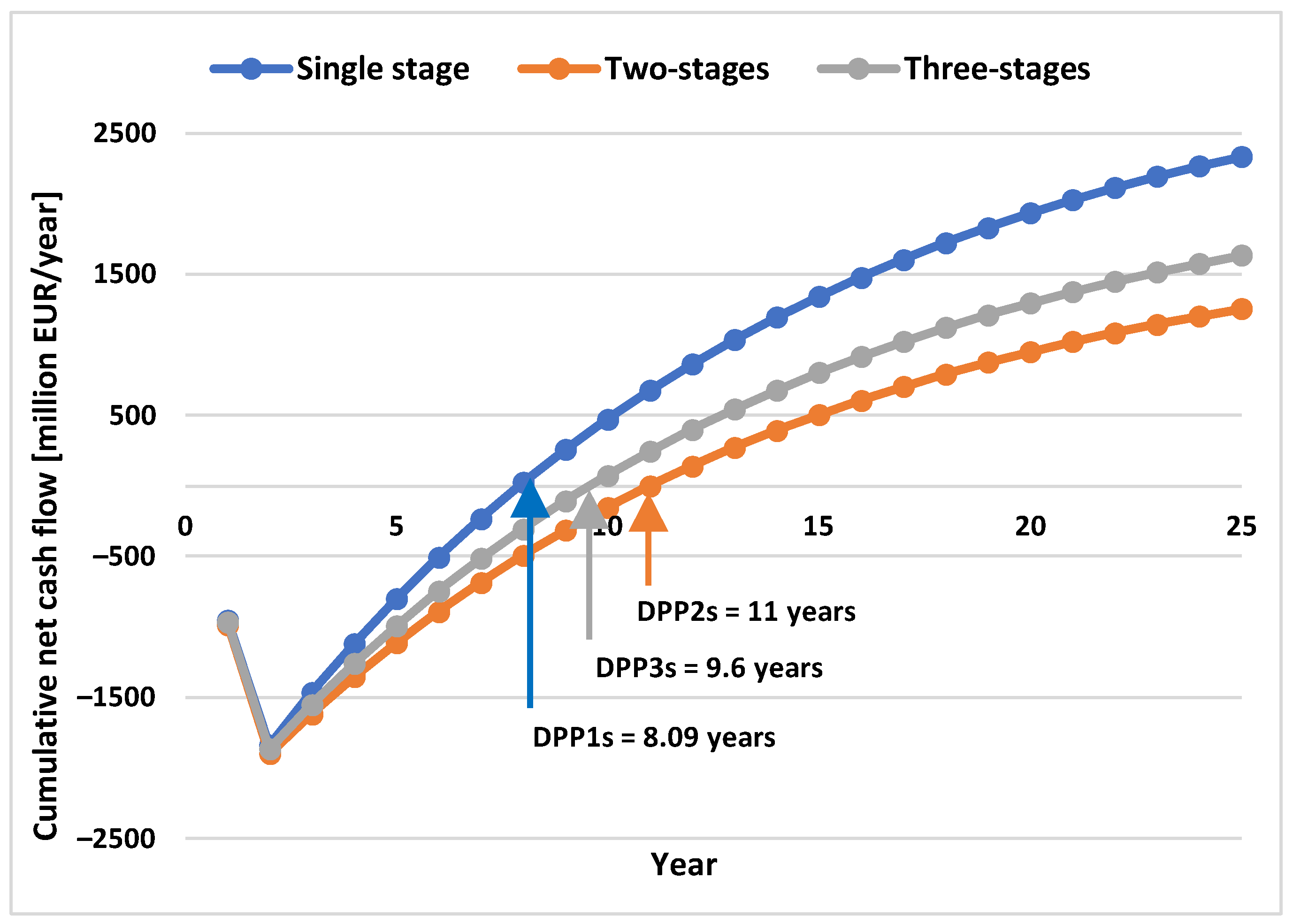
| Indicator | Unit | Case 1 | Case 2 | Case 3 |
|---|---|---|---|---|
| NPV | million EUR | 2197.7 | 1251.9 | 1630.8 |
| IRR | % | 19.92 | 14.85 | 16.86 |
| DPP | year | 8.09 | 11.0 | 9.6 |
| PI | - | 2.17 | 1.64 | 1.84 |
| Parameters | Present Work Optimum Scores | Literature Papers | ||
|---|---|---|---|---|
| [69] | [70] | [71] | ||
| Flue gas flux, (kmol/h) | 80,460 | 18,260 | 52,623.6 | 53,520 |
| CO2 stream before membrane, (kmol/h) | 10,583 | 2355.5 | 7051.5 | 6690 |
| Membrane units’ number | 3 | 2 | 2 | 2 |
| Total membrane area, (×103 m2) | 888 | 679 | 643 | 16,200 |
| CO2 permeability, (GPU) | 3000 | 740 | 370 | 270 |
| CO2/N2 selectivity | 150 | 135 | 200 | 34 |
| CO2 removal rate, (%) | 90.7 | 80.3 | 96.5 | 67 |
| CO2 stream captured, (kmol/h) | 9598.8 | 1884.4 | 6804.7 | 4482.2 |
| Membrane power needed, (MW) | 298.3 | 23.7 | n.a. | 137 |
| CO2 purity, (%) | 99.7 | 95.1 | 89.6 | 88 |
| LCOE_tax, (EUR/kWh) | 0.1338 | n.a. | n.a. | n.a. |
| SPECCA, (MJth/kg) | 12.45 | n.a. | n.a. | n.a. |
| SEPCCA, (MJel/kg) | 2.78 | n.a. | n.a. | n.a. |
| CO2 avoided cost (EUR/t) | 93.83 | n.a. | n.a. | 197 |
| CO2 captured cost (EUR/t) | 51.82 | 47.87 | 20.40 | n.a. |
Disclaimer/Publisher’s Note: The statements, opinions and data contained in all publications are solely those of the individual author(s) and contributor(s) and not of MDPI and/or the editor(s). MDPI and/or the editor(s) disclaim responsibility for any injury to people or property resulting from any ideas, methods, instructions or products referred to in the content. |
© 2023 by the authors. Licensee MDPI, Basel, Switzerland. This article is an open access article distributed under the terms and conditions of the Creative Commons Attribution (CC BY) license (https://creativecommons.org/licenses/by/4.0/).
Share and Cite
Alabid, M.; Dinca, C. Parametrical Assessment of Polyacrylamide Polymer Membrane Used for CO2 Post-Combustion Capture. Appl. Sci. 2023, 13, 11333. https://doi.org/10.3390/app132011333
Alabid M, Dinca C. Parametrical Assessment of Polyacrylamide Polymer Membrane Used for CO2 Post-Combustion Capture. Applied Sciences. 2023; 13(20):11333. https://doi.org/10.3390/app132011333
Chicago/Turabian StyleAlabid, Maytham, and Cristian Dinca. 2023. "Parametrical Assessment of Polyacrylamide Polymer Membrane Used for CO2 Post-Combustion Capture" Applied Sciences 13, no. 20: 11333. https://doi.org/10.3390/app132011333
APA StyleAlabid, M., & Dinca, C. (2023). Parametrical Assessment of Polyacrylamide Polymer Membrane Used for CO2 Post-Combustion Capture. Applied Sciences, 13(20), 11333. https://doi.org/10.3390/app132011333

