Article

2D-Unitary ESPRIT Based Multi-Target Joint Range and Velocity Estimation Algorithm for FMCW Radar


1
Science and Technology on MicroSystem Laboratory, Shanghai Institute of Microsystem and Information Technology, Chinese Academy of Sciences, Shanghai 201899, China
2
University of Chinese Academy of Sciences, Beijing 100049, China
*
Author to whom correspondence should be addressed.
Appl. Sci. 2023, 13(18), 10448; https://doi.org/10.3390/app131810448
Submission received: 15 August 2023 / Revised: 14 September 2023 / Accepted: 15 September 2023 / Published: 19 September 2023
(This article belongs to the Section Electrical, Electronics and Communications Engineering)

Abstract

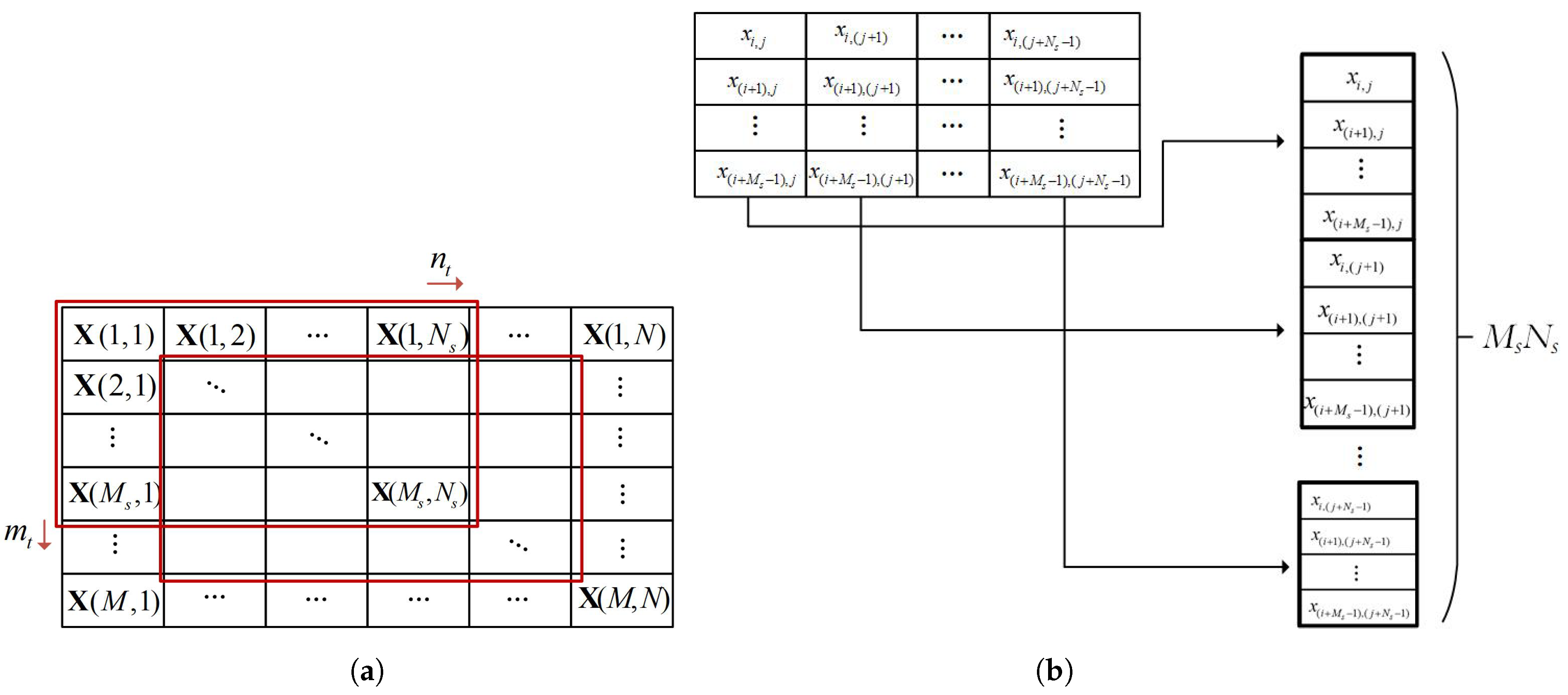
Millimeter-wave FMCW radar has been widely used in joint range-velocity estimation of multiple targets. However, most existing algorithms are unable to estimate the range-velocity information with high accuracy simultaneously and fail to discriminate the targets with either closely spaced ranges or closely spaced velocities in the 2D range-Doppler spectrum. In order to deal with these problems, this paper proposes a 2D-Unitary ESPRIT-based joint range and velocity estimation algorithm of multiple targets for FMCW radar. Firstly, The 1D-IF signal is constructed into a 2D virtual array signal, the virtual array signals are preprocessed by a 2D-spatial smoothing technique to generate a new matrix signal. Then, according to the 2D-Unitary ESPRIT algorithm, the 2D real-valued information of the target parameters is obtained from this matrix signal, and then a new complex-value matrix is constructed. Finally, the eigenvalue decomposition of this new complex-value matrix is performed, and the range-velocity estimates of multiple targets are, respectively, calculated from the real and imaginary parts of the eigenvalues, and paired automatically. The simulation results illustrate that the proposed algorithm not only provides highly accurate range-velocity estimates but also has high-resolution performance and achieves automatic pairing of the range-velocity estimates in multi-target scenarios, thus effectively improving the multi-target joint range and velocity estimation performance of FMCW radar.
Keywords: FMCW radar; spatial smoothing technique; 2D-Unitary ESPRIT algorithm; joint range and velocity estimation FMCW radar; spatial smoothing technique; 2D-Unitary ESPRIT algorithm; joint range and velocity estimation