Article

Optimized Implementation of Argon2 Utilizing the Graphics Processing Unit

Division of IT Convergence Engineering, Hansung University, Seoul 02876, Republic of Korea
*
Author to whom correspondence should be addressed.
Appl. Sci. 2023, 13(16), 9295; https://doi.org/10.3390/app13169295
Submission received: 25 July 2023 / Revised: 10 August 2023 / Accepted: 15 August 2023 / Published: 16 August 2023
(This article belongs to the Special Issue Information Security and Cryptography)

Abstract

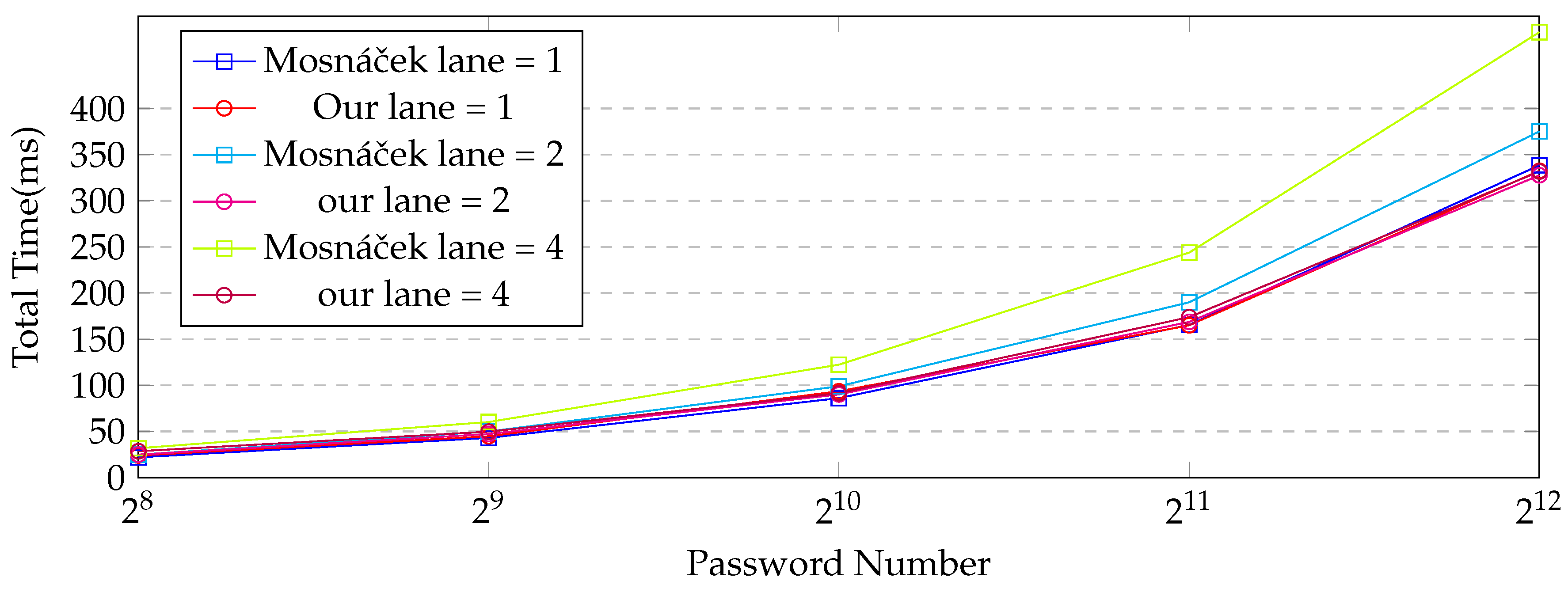
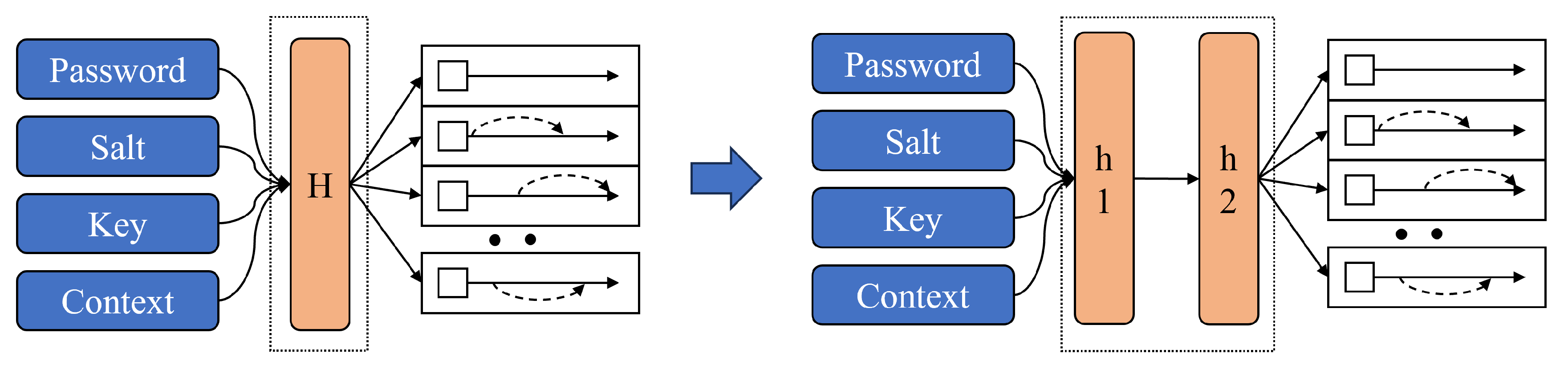
In modern information technology systems, secure storage and transmission of personal and sensitive data are recognized as important tasks. These requirements are achieved through secure and robust encryption methods. Argon2 is an advanced cryptographic algorithm that emerged as the winner in the Password Hashing Competition (PHC), offering a concrete and secure measure. Argon2 also provides a secure mechanism against side-channel attacks and cracking attacks using parallel processing (e.g., GPU). In this paper, we analyze the existing GPU-based implementation of the Argon2 algorithm and further optimize the implementation by improving the performance of the hashing function during the computation process. The proposed method focuses on enhancing performance by distributing tasks between CPU and GPU units, reducing the data transfer cost for efficient GPU-based parallel processing. By shifting several stages from the CPU to the GPU, the data transfer cost is significantly reduced, resulting in faster processing times, particularly when handling a larger number of passwords and higher levels of parallelism. Additionally, we optimize the utilization of the GPU’s shared memory, which enhances memory access speed, especially in the computation of the hash value generation process. Furthermore, we leverage the parallel processing capabilities of the GPU to perform efficient brute-force attacks. By computing the H function on the GPU, the proposed implementation can generate initial blocks for multiple inputs in a single operation, making brute-force attacks in an efficient way. The proposed implementation outperforms existing methods, especially when processing a larger number of passwords and operating at higher levels of parallelism.
Keywords: Argon2; password hash function; GPU; optimized implementation; cracking Argon2; password hash function; GPU; optimized implementation; cracking