Article

Designing a Business Intelligence and Analytics Maturity Model for Higher Education: A Design Science Approach


1
Department of Information Sciences and Technology, CIES-ISCTE—Centre for Research and Studies in Sociology, ISCTE—Instituto Universitário de Lisboa, 1649-026 Lisbon, Portugal
2
Department of Computer Science, Norges Teknisk-Naturvitenskapelige Universitet (NTNU), 7034 Trondheim, Norway
*
Author to whom correspondence should be addressed.
Appl. Sci. 2022, 12(9), 4625; https://doi.org/10.3390/app12094625
Submission received: 24 March 2022 / Revised: 25 April 2022 / Accepted: 2 May 2022 / Published: 4 May 2022
(This article belongs to the Section Computing and Artificial Intelligence)

Abstract

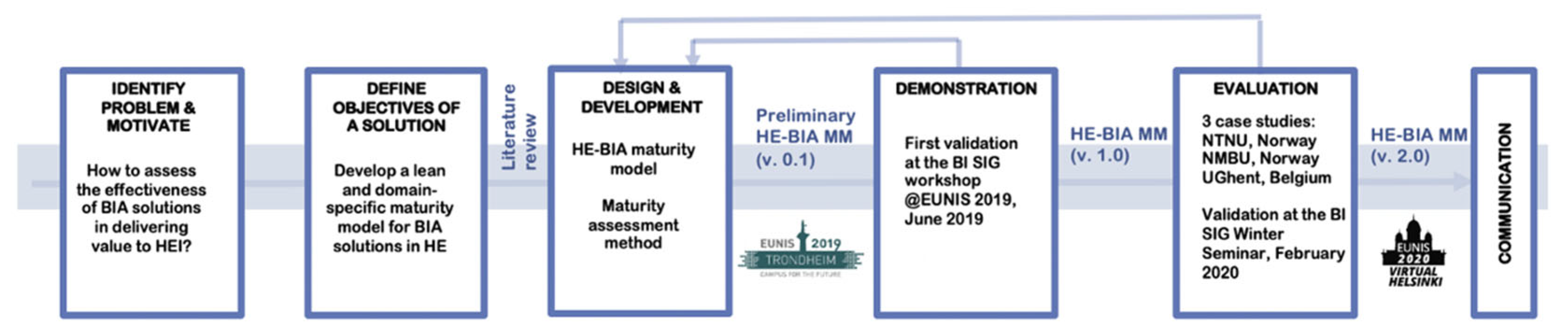
Business Intelligence and Analytics (BIA) systems play an essential role in organizations, providing actionable insights that enable business users to make more informed, data-driven decisions. However, many Higher Education (HE) institutions do not have accessible and usable models to guide them through the incremental development of BIA solutions to realize the full potential value of BIA. The situation is becoming ever more acute as HE operates today in a complex and dynamic environment brought forward by globalization and the rapid development of information technologies. This paper proposes a domain-specific BIA maturity model (MM) for HE–the HE-BIA Maturity Model. Following a design science approach, this paper details the design, development, and evaluation of two artifacts: the MM and the maturity assessment method. The evaluation phase comprised three case studies with universities from different countries and two workshops with practitioners from more than ten countries. HE institutions reported that the assessment with the HE-BIA model was (i) useful and adequate for their needs; (ii) and contributed to a better understanding of the current status of their BIA landscape, making it explicit that a BIA program is a technology endeavor as well as an organizational development.
Keywords: maturity models; business intelligence; analytics; higher education; design science research maturity models; business intelligence; analytics; higher education; design science research