Article

MFDGCN: Multi-Stage Spatio-Temporal Fusion Diffusion Graph Convolutional Network for Traffic Prediction

1
Department of Computer Information Engineering, Cheongju University, Cheongju 28503, Korea
2
Division of Software Convergence, Cheongju University, Cheongju 28503, Korea
*
Author to whom correspondence should be addressed.
Appl. Sci. 2022, 12(5), 2688; https://doi.org/10.3390/app12052688
Submission received: 3 February 2022 / Revised: 1 March 2022 / Accepted: 2 March 2022 / Published: 4 March 2022
(This article belongs to the Special Issue Biomedical Signal Processing, Data Mining and Artificial Intelligence)

Abstract

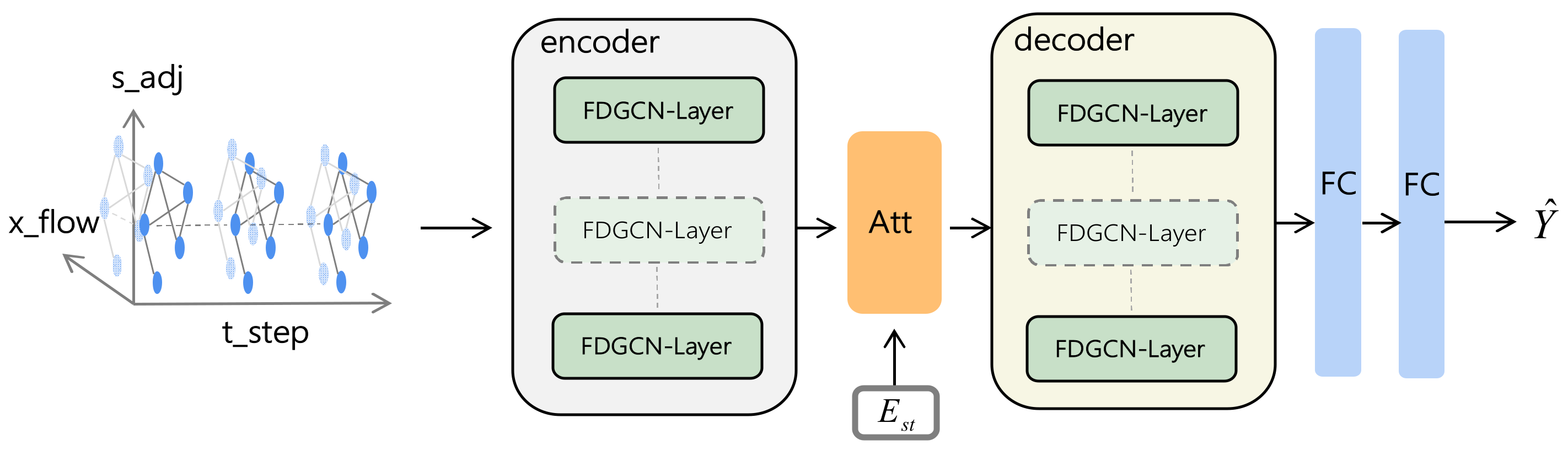
Traffic prediction is a popular research topic in the field of Intelligent Transportation System (ITS), as it can allocate resources more reasonably, relieve traffic congestion, and improve road traffic efficiency. Graph neural networks are widely used in traffic prediction because they are good at dealing with complex nonlinear structures. Existing traffic prediction studies use distance-based graphs to represent spatial relationships, which ignores the deep connections between non-adjacent spatio-temporal information. The use of a simple approach to fuse spatio-temporal information is not conducive to obtaining long-term deep spatio-temporal dependencies. Therefore, we propose a new deep learning model Multi-Stage Spatio-Temporal Fusion Diffusion Graph Convolutional Network (MFDGCN). It generates multiple static and dynamic spatio-temporal association graphs to enhance features and adopts the multi-stage hybrid spatio-temporal fusion method. This promotes the effective fusion of a spatio-temporal multimodal and uses the diffuse convolution method to model the graph structure and time series in traffic prediction, respectively. The model can better predict both long and short-term traffic simultaneously. We evaluated MFDGCN using real road network traffic data and it shows good performance.
Keywords: traffic prediction; spatio-temporal prediction; graph convolutional network; temporal convolutional network; multi-head attention traffic prediction; spatio-temporal prediction; graph convolutional network; temporal convolutional network; multi-head attention