Abstract
Motion planning is widely applied to industrial robots, medical robots, bionic robots, and smart vehicles. Most work environments of robots are not static, which leads to difficulties for robot motion planning. We present a dynamic Gaussian local planner (DGLP) method to solve motion planning problems in dynamic environments. In a dynamic environment, dynamic obstacles sometimes make part of the global path invalid, so the local invalid path needs to be local re-planned online. Compared with the node sampling-based methods building large-scale random trees or roadmaps, the Gaussian random path sampling (GRPS) module integrated in the DGLP directly samples smooth random paths discretized into sparse nodes to improve the local path re-planning efficiency. We also provide the path end orientation constraint (PEOC) method for the local re-planning paths in order to merge them smoothly into the global paths. In the robot experiments, the average planning time of the DGLP is 0.04s, which is at least 92.31% faster than the test methods, and its comprehensive evaluation scores, which consider the consuming time, path quality, and success rate of local re-planning, are at least 44.92% higher than the test methods. The results demonstrate that the proposed DGLP method is able to efficiently provide high-quality local re-planning paths in dynamic environments.
1. Introduction
An autonomous robot system usually needs to consider mechanical design [1], visual perception [2], kinematics [3], dynamics [4], motion planning and control [5], etc. Motion planning is an essential tool for autonomous robots, as it enables the description and execution of motion as high-level goals rather than lower-level primitives [6]. It is a fundamental task for motion planning to provide a collision-free path guiding a robot from an initial node to a goal region in an environment full of obstacles [7]. For example, spray-painting robots based on vision guidance have to follow reasonable paths given by motion planning for spraying [8]. Sometimes robots face more difficult situations, such as performing tasks in dynamic environments, which involves dynamic motion planning problems. For solving these problems, various methods have been developed, of which graph-based and sampling-based methods are the most effective and popular.
For low-dimensional motion planning, such as path planning of smart vehicles, graph-based methods (e.g., A* [9] and Dijkstra [10] methods) always rapidly provide high-quality feasible paths. The feasible paths refer to collision-free paths and the high-quality paths are the low-cost paths. However, motion planning is a PSPACE-hard problem [11], with complexity growing with the number of a robot’s degrees of freedom (DoF). The graph-based methods are no longer applicable due to the excessive computational resources they require in 6 DoF, 7 DoF, and even higher DoF cases.
Sampling-based motion planning methods, which randomly sample valid robot configurations and form graphs of valid motions to find collision-free paths, can avoid the explicit construction of planning scenarios by random sampling and collision detection. Because of high-planning efficiency, they are suitable for solving both low- and high-dimensional motion planning problems [12,13]. In a dynamic environment, dynamic obstacles sometimes make part of the global path invalid, so the invalid partial path needs to be local re-planned online [14]. Sampling-based methods with anytime technology, such as informed anytime fast marching tree (IAFMT*) [15] and informed rapidly exploring random trees (informed RRT*) [16], find multiple feasible paths in the allowed time. The * indicates that the methods are asymptotically optimal (AO) methods. However, these methods only solve static motion planning problems because the algorithms will not return solutions until all of the allowed time runs out. Methods based on probabilistic roadmaps, such as probabilistic roadmaps (PRM) [17] and its variants [18,19], usually build probabilistic roadmaps offline and plan feasible paths online. If environments change, the probabilistic roadmaps have to be rebuilt offline, so these methods are unsuitable for solving dynamic motion planning problems. Offline motion planning refers to robot paths or trajectory planning when movement ceases. Methods based on random trees without anytime technology, such as rapidly exploring random trees (RRT) [20] and its variants [21,22], can be directly run online and can be used for motion planning in dynamic environments. However, there is strong randomness for the paths planned by these methods, so the path quality is not stable. Compared with these methods, some asymptotically optimal methods, such as fast marching trees (FMT*) [23] and variants [24,25], can give high-quality paths in online local re-planning; however, their planning efficiency needs to be further improved. A summary of sampling-based methods is presented in Table 1.
Table 1.
A summary of sampling-based methods.
Most sampling-based methods construct probabilistic roadmaps or random trees by sampling many random nodes in configuration-spaces (C-spaces) to find feasible paths. In order to obtain high-quality paths, even optimal paths, the probabilistic roadmaps or random trees have to be further expanded by adding random sampling nodes. For global motion planning that allows offline planning, these sampling-based methods perform well. However, for local motion re-planning that has to perform efficient online planning, it is difficult for the methods based on random node sampling to balance planning efficiency and quality. This paper presents a new sampling-based method for local motion re-planning, namely, dynamic Gaussian local planner (DGLP), to fast search for high-quality smooth local paths in dynamic environments. Different from the traditional methods based on random node sampling, the DGLP utilizes our Gaussian random path sampling (GRPS) method to define a probability distribution over random paths and samples finite random paths represented by sparse nodes to improve the planning efficiency of high-quality paths. The high-quality collision-free local paths, replacing invalid partial paths, can be selected quickly using the lazy collision detection technique from the sampling paths. We also provide the path end orientation constraint (PEOC) method for smoothly merging the local re-planning paths into global paths. The paper evaluates the performance of the DGLP in simulations and experiments and the results show that the proposed method, DGLP, can perform re-planning local high-quality paths efficiently.
Note that the proposed method does not consider task constraints (e.g., an end effector maintains contact with a plane), and the DGLP samples only in a C-space, not in an implicit space which is a subset of a C-space and consists of all configurations satisfying the constraint.
Our contribution can be summarized as follows.
- This paper presents a sampling-based local re-planning method, namely, DGLP, which can fast converge to high-quality solutions in dynamic environments.
- We provide the GRPS and PEOC methods to generate candidates for high-quality local paths and smoothly merge local paths into global paths, respectively.
- The paper evaluates the performance of DGLP via simulations and experiments.
2. Dynamic Gaussian Local Planner
The DGLP is described in the pseudo code from Algorithm 1.
| Algorithm 1 DGLP | |
| Require: Query (, ), (, ), Path sample count , Node count , Amplitude factor | |
| 1 | ; |
| 2 | |
| 3 | |
| 4 | |
| 5 | If then |
| 6 | return failed |
| 7 | return |
2.1. Overview
Some notions have to be introduced in Algorithm 1. The and are the initial node and the goal node of a local re-planning path . The and are the velocities at the and . The is the number of random sampling paths in local motion re-planning. Every sampling path is represented by discrete nodes, including and . The fluctuation amplitude of the random paths is controlled by the . The is the set of the random paths, including . The be the cost set of the local paths. Generally, the path cost is the path length. In addition, the is the high-quality local re-planning path with orientation constraints at the end, which can be smoothly merged into the global path.
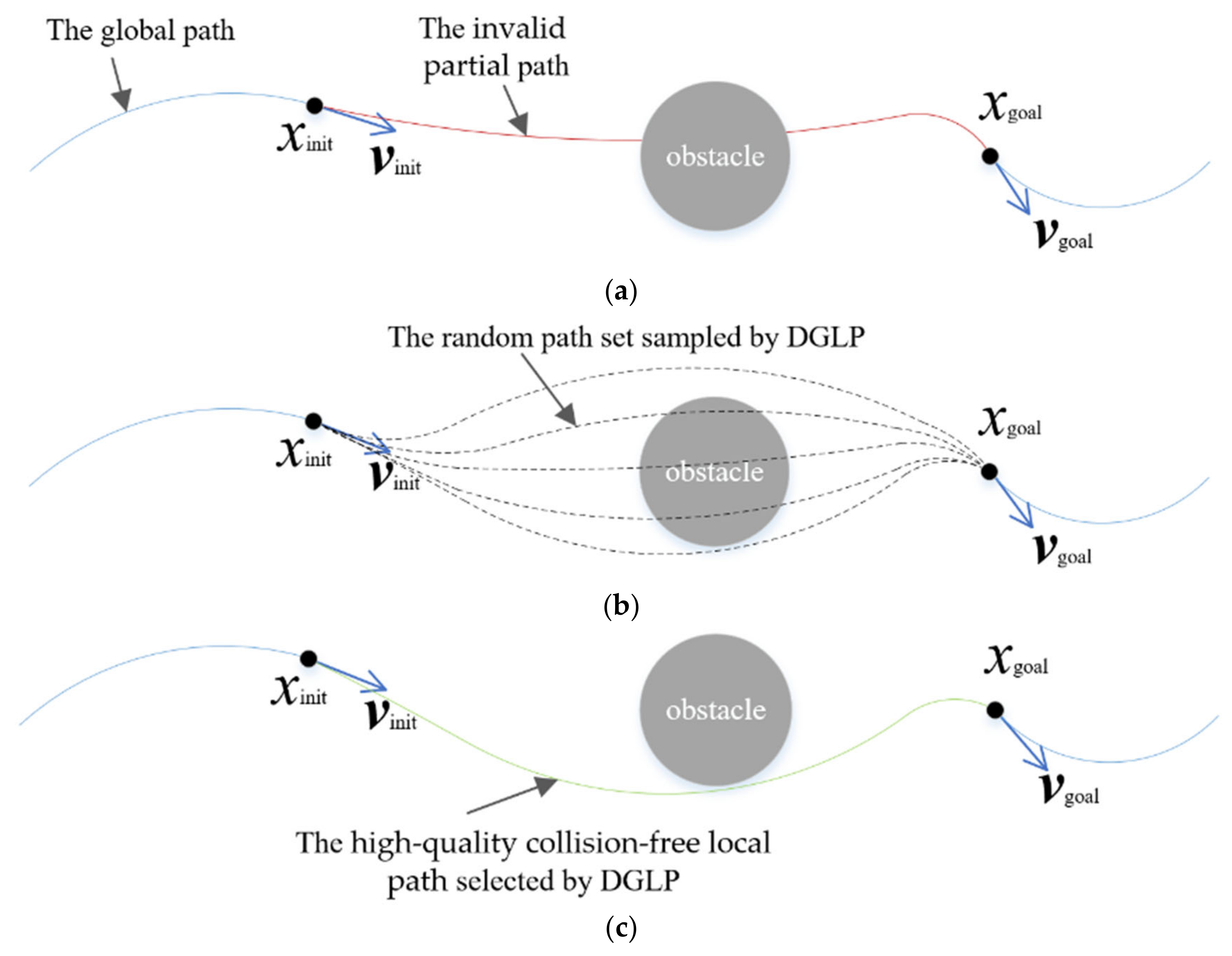
The DGLP is presented in Algorithm 1 and Figure 1. As a dynamic obstacle invalidates a part of the global path, as shown in Figure 1a, the function initializes the set . The function samples random paths with the end orientation constraints at both the and by the GRPS and EPOC methods, which returns the set , as shown in Figure 1b. The function calculates all path costs in the and enters them into the . The function selects the high-quality collision-free local path . from the via lazy collision detection [26], as shown in Figure 1c. Note that the outputs of the DGLP are robot geometric paths that do not involve time information, velocity constraints, and acceleration constraints. The geometric paths must be post-processed to add the time information and the constraints. We use the Time Parameterization module of MoveIt! to automatically add the time stamps, velocity constraints, and acceleration constraints for the geometric paths to ensure robot safety.
Figure 1.
The DGLP plans the local path. The and are the initial node and the goal node of the local re-planning. The and are the velocities at the and . Dashed curves represent a set of random paths. (a) A part of the global path is invalid because of the dynamic obstacle. (b) The DGLP samples random paths that satisfy the path end orientation constraints. (c) The DGLP selects the high-quality collision-free local path from the random path set.
2.2. Gaussian Random Path Sampling (GRPS)
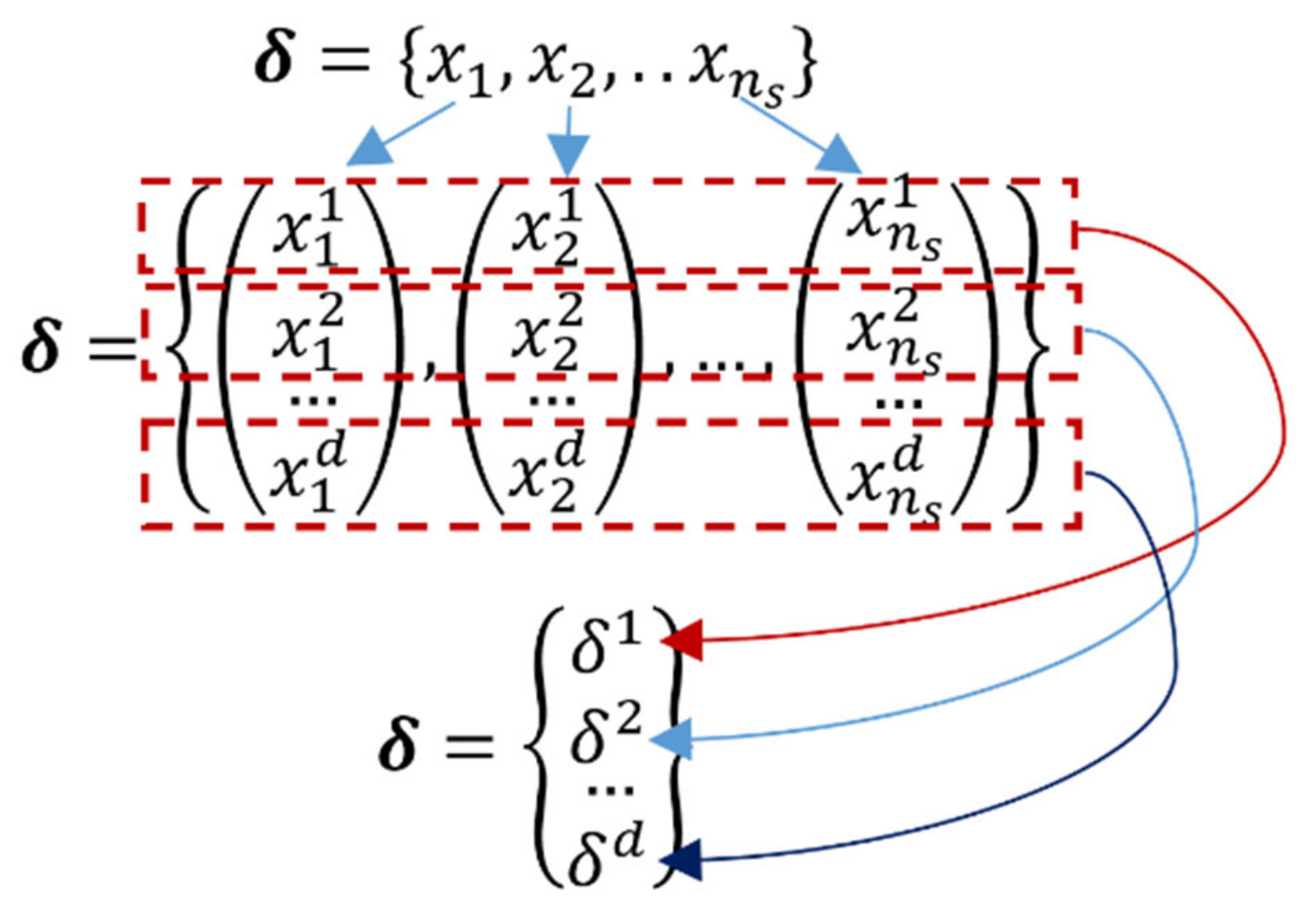
The function in Algorithm 1 is based on the GRPS method. For a d Dof robot, it has d-dimensional C-space. The C-space and robot workspace can be transformed into each other. The paths for the robot in the C-space can be planned by sampling-based methods. In d-dimensional C-space, let be a local path represented by discrete nodes , i.e., . Each d-dimensional node consists of d 1-dimensional node component , i.e., . The local path component of the j’th dimension is . The intuitive relationship is illustrated in Figure 2. In this paper, the non-bold symbols represent variables , , or , and the bold italicized symbols are variables or .
Figure 2.
The relationship between the path node , path node component , local path , and local path component .
The DGLP employs the Gaussian process model to randomly generate the local path component . The Gaussian process model is determined by a mean function and a kernel function , where is path node index. In order to ensure the smoothness of random paths, we set the mean function to 0 and select the Squared Exponential (SE) kernel function as the kernel function . The SE kernel function is
The can affect the fluctuation amplitude of random paths. The is determined by the sampling range and the amplitude factor , i.e., in the DGLP. The controls the complexity of random paths.
Let a random path be a Gaussian process, where denotes the path node corresponding to the index . The random path is described as
The path probability distribution based on the Gaussian process regression model is
and are a node index set and a given path node set. and are a node index set and path node set of a random path. Note that the is equivalent to the in Algorithm 1. The noise variance is represented by , and in this paper. is a kernel matrix of and . is a kernel matrix of . is a kernel matrix of . , , and can be calculated by the SE kernel function.
Based on the singular value decomposition (SVD) of in (3), a Gaussian process can generate a random sampling path , i.e., the local path component , from
where the elements of the are Gaussian random variables, the is the singular value matrix of , and the is the left singular value matrix of .
2.3. Path End Orientation Constraint (EPOC)
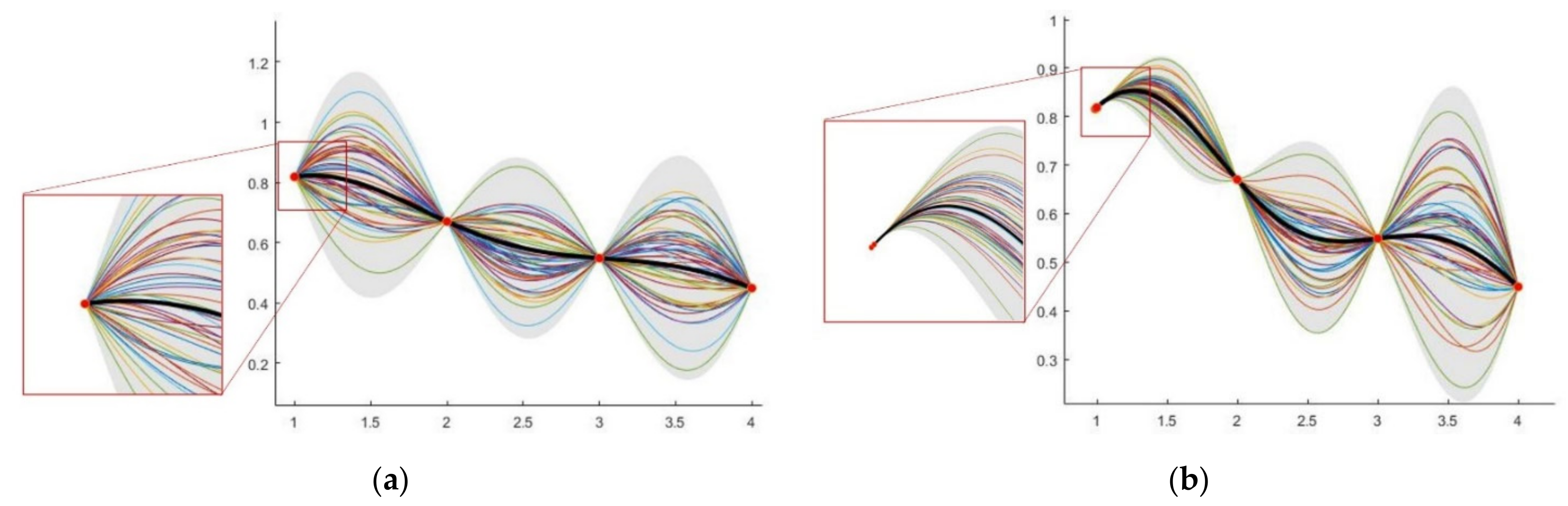
The function in Algorithm 1 is also based on the EPOC method. As shown in Figure 3a, because of the randomness of the local re-planning paths sampled from the GRPS method, the end orientation of the local paths is also random. We can use the EPOC method to control the end orientation of the local paths, as illustrated in Figure 3b.
Figure 3.
The local paths sampled from the GRPS method, where the red points are waypoints, color curves represent random paths, and the shadow is the sampling range of 99.74% random paths. (a) The local paths without end orientation constraint. (b) The local paths based on the EPOC method.
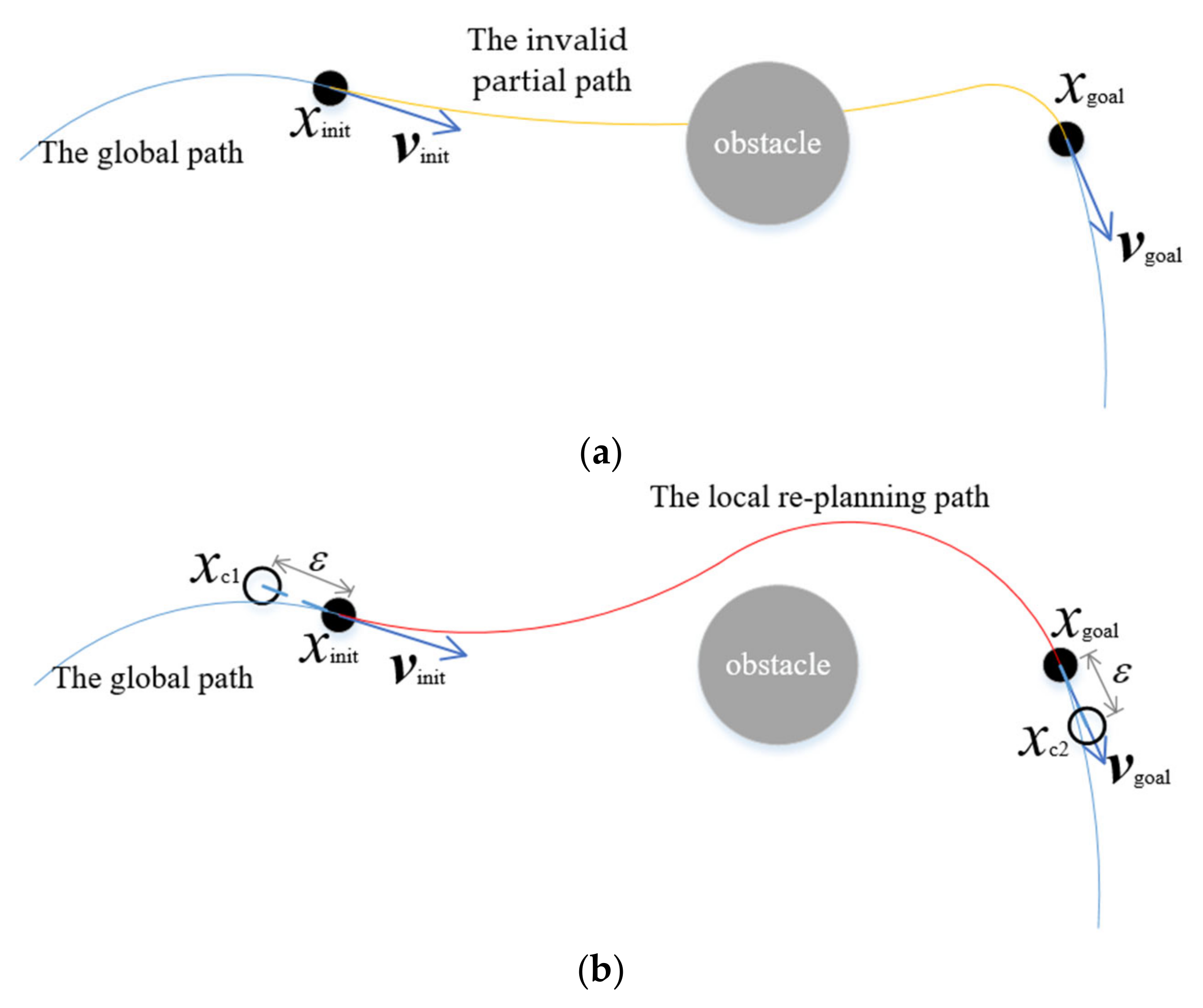
The EPOC method is shown in Figure 4. In order to obtain the local path satisfying the constraint, we add an orientation constraint node at the distance from the initial node on the line of the . In addition, we add another orientation constraint node in the same way. As goes to zero, based on the four nodes , , , and , the GRPS can sample local paths with the path end orientation constraint.
Figure 4.
The GRPS provides the local re-planning path based on the EPOC method. As the , the and are the control nodes of the path end orientation constraint. (a) The partial path is invalid due to an environmental change. (b) The local re-planning path with the end orientation constraint replaces the invalid path and smoothly merges into the global path.
3. Experiments
3.1. Simulations
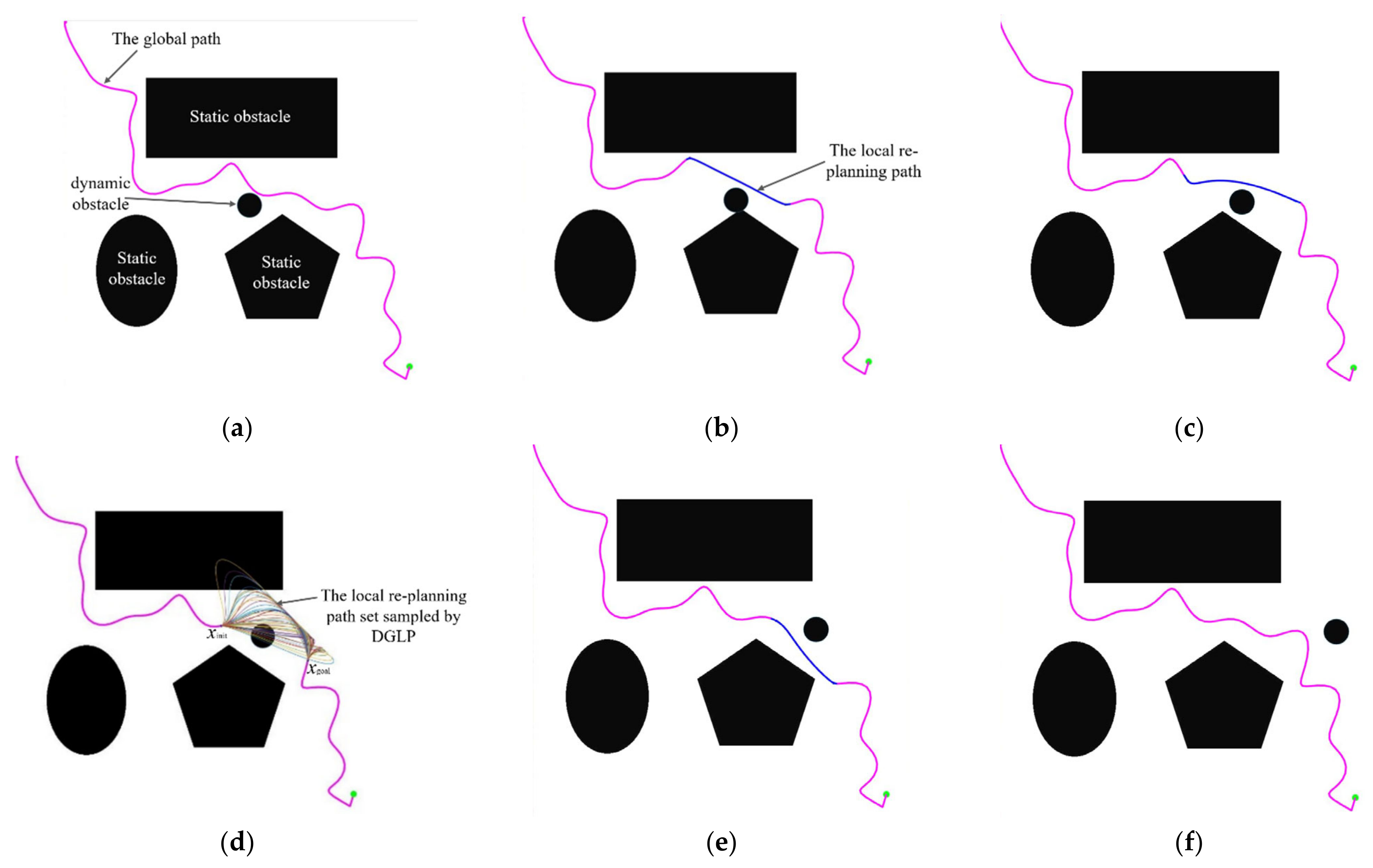
In order to evaluate the performance of the DGPL, we provide a 2-dimensional dynamic local path re-planning simulation. The simulation is run on the Matlab 2016b (Northeastern University, Shenyang, China) and a computer with a 3.7 GHz Intel Core i7-8700K CPU and 16 GB RAM. The DGPL parameters , , and are 100, 10, and 0.9, respectively. As shown in Figure 5, the dynamic obstacle moves from left to right in the environment, and as the dynamic obstacle touches the given global path, the partial invalid paths are replaced by the local re-planning paths provided online by the DGPL method.
Figure 5.
The DGLP re-plans the local paths online in a dynamic environment. (a) The dynamic obstacle is moving from left to right in the environment. (b) The dynamic obstacle invalidates a part of the global path and the DGLP provides a local re-planning path online. (c) As the movement of the obstacle, the previous local path collides with the obstacle, and a new feasible local path is quickly generated by the DGLP. (d) The DGLP samples 100 alternate local paths to select a high-quality collision-free local path. (e) The local re-planning path from the DGPL is smooth and its ends all satisfy orientation constraints to merge into the global path smoothly. (f) The dynamic obstacle no longer collides with the global path, and thus the global path returns to the original state.
As shown in Figure 5b–e, the DGPL can re-plan the local paths online for the partial invalid paths as the environment changes and the average planning time is 0.002 s. Because the SE kernel function is employed in the Gaussian process model, the local re-planning paths are smooth naturally. The local re-planning paths are also merged into the global path smoothly since the EPOC method constrains the orientation of both ends of the local path. As shown in Figure 5d,e, the 100 local re-planning paths from the DGPL are all smooth and their ends are added with orientation constraints, so as to merge into the global path smoothly. In addition, the length of the local re-planning paths from the DGPL is reasonable, which indicates that the DGPL performs well in local path planning quality.
As shown in Figure 5d, if the obstacle is too close to the initial and goal nodes of local re-planning, most of the random path candidates will collide with it, which leads to reduction of local re-planning efficiency and success rate. To avoid the case and guarantee the planning effect, the initial and goal nodes of local re-planning should be located far away from the obstacle.
3.2. Robot Experiments
We provide the robot simulations and experiments on a 6-DOF manipulator to evaluate the performance of the DGLP by comparing it with the sampling-based algorithms, i.e., RRT and FMT*. All algorithms are run on the Open Motion Planning Library (OMPL) [27], the Robot Operating System (ROS), the MoveIt, and a computer with a 2.3-GHz Intel Core i7-3610QE CPU and 8 GB RAM. The position precision and orientation precision are set to 0.001 m and 0.001 rad, respectively. The default OMPL settings are employed for RRT and FMT* in the OMPL. The DGLP parameters , , and are 1000, 10, and 0.9, respectively. All algorithms run 10 times for the local motion re-planning of the manipulator in the robot simulations and experiments. At the beginning of movement of the manipulator, the obstacle is placed about 10 cm in front of the elbow joint of the initial position of the manipulator as soon as possible.
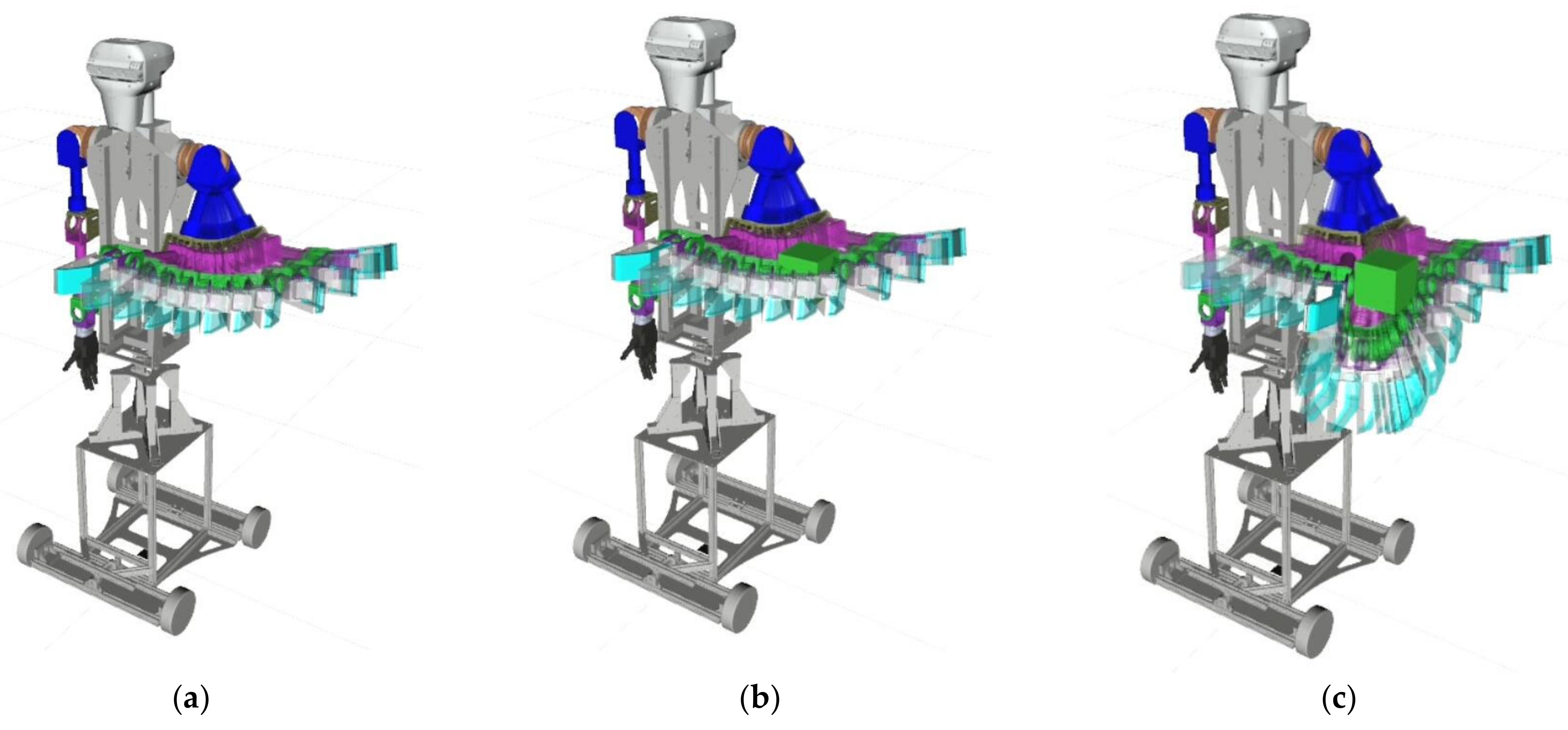
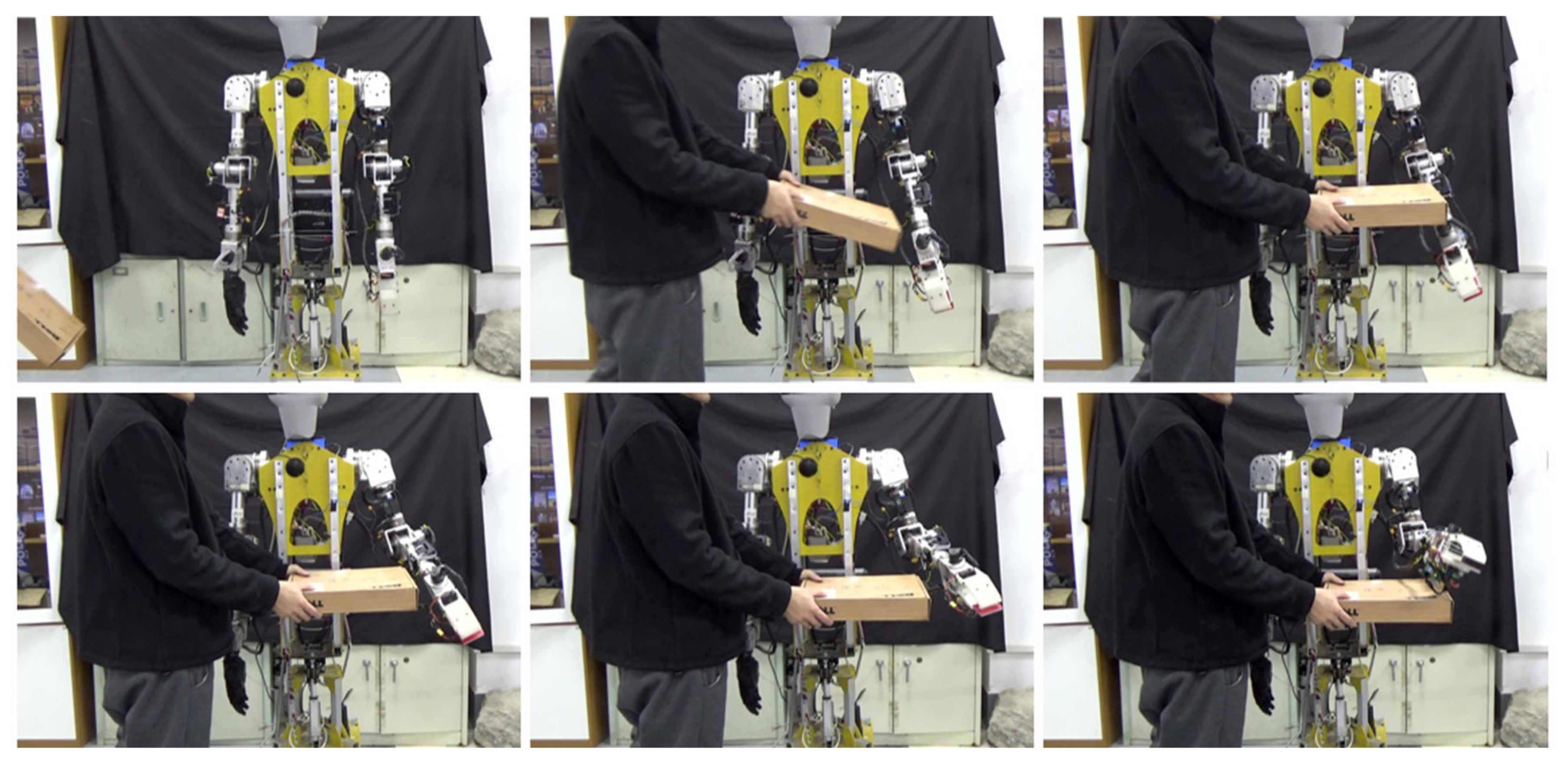
We provide the same global path for all algorithms respectively in the simulations and experiments. After the manipulator starts to move, we add an obstacle in the environment to invalidate part of the global path. Every algorithm has to re-plan a local path as soon as possible to guide the manipulator clear of the obstacle in the dynamic environment. The robot simulation and experiment are shown in Figure 6 and Figure 7, respectively.
Figure 6.
The DGLP provides local re-planning path during the robot simulation. (a) The global path of the manipulator. (b) The partial invalid path because of the environmental change. (c) The local path is planned by the DGLP and merged into the global path.
Figure 7.
Based on the DGLP method, the manipulator avoids dynamic obstacle online in the robot experiment.
Table 2 shows the results of the robot simulations and experiments, where Avg. time is the average time of local re-planning and Avg. path cost is the average path length of the manipulator end effector. In terms of local re-planning efficiency, the DGLP is more outstanding than RRT and FMT*. The average local planning time of the DGLP in the simulation is 0.03 s, which is 97.12% and 93.02% faster than RRT and FMT*, respectively. In the experiment, the average time of the DGLP is 95.56% and 92.31% faster than RRT and FMT*, respectively. By directly sampling local re-planning paths with sparse nodes via the GRPS method, instead of building large-scale random trees, such as RRT and FMT*, the DGLP can rapidly provide feasible local paths, in addition, the lazy collision detection technique further improves the efficiency of local path re-planning. For local re-planning quality, both in the simulation and experiment, the average path costs of FMT* are minimal since FMT* is an asymptotically optimal method that is good at finding high-quality paths, even the optimal paths. The average path costs of the DGLP in the simulation and experiment are 6.89% and 4.85% higher than FMT*, which means that the DGLP has the ability to plan high-quality local paths. The DGLP based on the random sampling paths is able to conveniently sort sampling path candidates by path cost, so as to quickly select the feasible local path with the highest quality from the candidates. Compared with AO methods based on random trees, such as FMT*, although the DGLP cannot give the optimal path, it can output high-quality collision-free paths more quickly, which is especially important in dynamic environments, since there is not enough time and computational resources to plan the optimal path. Regarding the success rate of local re-planning, the DGLP performs very well. Its overall success rate in the simulation and experiment is 90%.
Table 2.
The experimental results for dynamic local path re-planning.
In dynamic environments, it is of the greatest importance for a motion planning method to provide a collide-free path as soon as possible. Then, it should ensure the local path quality and planning success rate. We use the weighted stacking method to comprehensively evaluate the performance of each method. The weighted stacking equation is
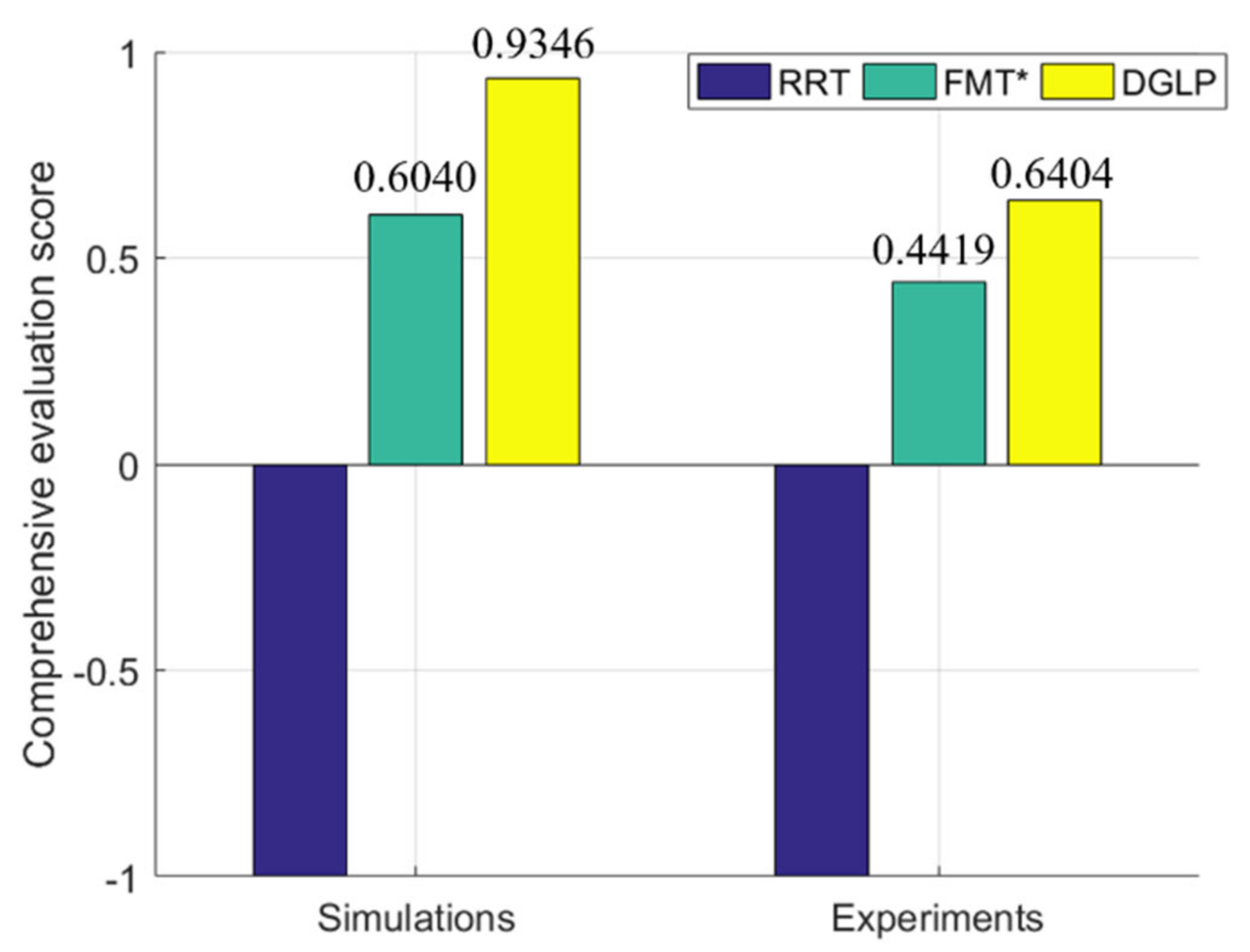
where is the comprehensive evaluation score, the and are the normalized values of the planning success rate, computing time, and path cost, respectively, and , , and are the weighting factors. We set due to the computing efficiency priority principle, and set . According to Table 2 and Equation (5), we calculate the comprehensive evaluation scores of the methods, as shown in Figure 8. In all groups of comprehensive evaluation scores, the DGLP scores the highest and its scores are at least 44.92% higher than RRT and FMT*, which demonstrates that the DGLP can well balance the efficiency and quality of the local path re-planning.
Figure 8.
The comprehensive evaluation scores of the methods in the robot simulations and experiments. The comprehensive evaluation scores calculated by the normalized values in Table 2 and the weighted stacking Equation (5).
The ability of the DGLP to provide high-quality local re-planning paths smoothly and efficiently in dynamic environments has been tested by the simulations and experiments. The proposed method can be applied to motion planning for indoor service robots and smart vehicles which are often faced with unexpected situations in dynamic environments, and need to temporarily alter the original planning paths. The DGLP is able to fast plan collision-free local paths with high-quality for the robots in unexpected situations. The proposed method should be used with an offline planning method, i.e., the offline planning method gives a global path, and if part of the global path is invalid, the DGLP outputs the local re-planning paths online to replace the invalid partial path.
4. Conclusions and Future Work
In this paper, we propose a sampling-based method, the DGLP method, which can solve motion planning problems in dynamic environments. We also provide the GRPS and PEOC methods to sample smooth random paths and merge them smoothly into global paths for local motion re-planning. The random sampling paths based on Gaussian process can be represented by sparse nodes and the DGLP employs the lazy collision detection technique, so as to improve the local path re-planning efficiency. The results of the simulations and experiments show that the DGLP method can search for high-quality smooth local paths efficiently to replace the local invalid paths, and merge the local paths into the global paths smoothly.
In future work, we will extend DGLP by introducing the GPU-based parallel computing technique to further improve its real-time motion planning capacity.
Author Contributions
Methodology, J.X. and J.Q.; Software, X.H. and Y.H.; Investigation, H.T.; Writing—original draft, J.X.; Funding acquisition, J.X. and Z.W. All authors have read and agreed to the published version of the manuscript.
Funding
This research was funded by National Natural Science Foundation of China grant number 51975386 and 61573249, Fundamental Research Funds of Liaoning Education Department grant number LJKQZ20222327. The APC was funded by Research Capacity Development Foundation for Young Teachers of Shenyang University of Technology grant number QNPY202209-19.
Institutional Review Board Statement
Not applicable.
Informed Consent Statement
Not applicable.
Data Availability Statement
Not applicable.
Conflicts of Interest
The authors declare no conflict of interest.
References
- Jiang, J.F.; Xi, F.F.; Bi, Y.B. Design and Analysis of a Robotic End-Effector for Automated Hi-Lok Nut Installation. Coatings 2022, 12, 904. [Google Scholar] [CrossRef]
- Song, K.; Wang, J.; Bao, Y.; Huang, L.; Yan, Y. A Novel Visible-Depth-Thermal Image Dataset of Salient Object Detection for Robotic Visual Perception. IEEE ASME Trans. Mechatron. 2022, 1–12. [Google Scholar] [CrossRef]
- Liu, Y.Y.; Xi, J.L.; Bai, H.F.; Wang, Z.N.; Sun, L.L. A general robot inverse kinematics solution method based on improved PSO algorithm. IEEE Access 2021, 9, 32341–32350. [Google Scholar]
- Golluccio, G.; Gillini, G.; Marino, A.; Antonelli, G. Robot Dynamics Identification: A Reproducible Comparison With Experiments on the Kinova Jaco. IEEE Robot. Autom. Mag. 2021, 28, 128–140. [Google Scholar] [CrossRef]
- Zhang, L.; Zhang, H.Y.; Xiao, N.; Zhang, T.W.; Bian, G.B. Gait planning and control method for humanoid robot using im-proved target positioning. Sci. China Inf. Sci. 2020, 63, 170210. [Google Scholar] [CrossRef]
- Garrett, C.R.; Chitnis, R.; Holladay, R.; Kim, B.; Silver, T.; Karelbling, L.P.; Lozano-Perez, T. Integrated task and motion plan-ning. Annu. Rev. Control Robot. Auton. Syst. 2021, 4, 265–293. [Google Scholar] [CrossRef]
- Cheon, H.; Kim, B.K. Online Bidirectional Trajectory Planning for Mobile Robots in State-Time Space. IEEE Trans. Ind. Electron. 2019, 66, 4555–4565. [Google Scholar] [CrossRef]
- Chen, W.; Liu, H.; Tang, Y.; Liu, J. Trajectory Optimization of Electrostatic Spray Painting Robots on Curved Surface. Coatings 2017, 7, 155. [Google Scholar] [CrossRef]
- Dang, C.C.; Ahn, H.; Lee, D.S.; Lee, S.C. Improved analytic expansions in hybrid A-star path planning for non-holonomic ro-bots. Appl. Sci. 2022, 12, 5999. [Google Scholar] [CrossRef]
- Alshammrei, S.; Boubaker, S.; Kolsi, L. Improved Dijkstra Algorithm for Mobile Robot Path Planning and Obstacle Avoidance. Comput. Mater. Contin. 2022, 72, 5939–5954. [Google Scholar] [CrossRef]
- Kingston, Z.; Moll, M.; Kavraki, L.E. Sampling-Based Methods for Motion Planning with Constraints. Annu. Rev. Control. Robot. Auton. Syst. 2018, 1, 159–185. [Google Scholar] [CrossRef]
- Salzman, O. Sampling-based robot motion planning. Commun. ACM 2019, 62, 54–63. [Google Scholar] [CrossRef]
- Lai, T.; Morere, P.; Ramos, F.; Francis, G. Bayesian Local Sampling-Based Planning. IEEE Robot. Autom. Lett. 2020, 5, 1954–1961. [Google Scholar] [CrossRef]
- Deng, H.; Xia, Z.Y.; Xiong, J. Robotic Manipulation Planning using Dynamic RRT. In Proceedings of the IEEE International Conference on Real-Time Computing and Robotics, Angkor Wat, Cambodia, 6–9 June 2016. [Google Scholar]
- Xu, J.; Song, K.; Zhang, D.; Dong, H.; Yan, Y.; Meng, Q. Informed Anytime Fast Marching Tree for Asymptotically Optimal Motion Planning. IEEE Trans. Ind. Electron. 2021, 68, 5068–5077. [Google Scholar] [CrossRef]
- Gammell, J.D.; Barfoot, T.D.; Srinivasa, S.S. Informed Sampling for Asymptotically Optimal Path Planning. IEEE Trans. Robot. 2018, 34, 966–984. [Google Scholar] [CrossRef]
- Kavraki, L.E.; Svestka, P.; Latombe, J.C.; Overmars, M.H. Probabilistic roadmaps for path planning in high-dimensional con-figuration spaces. IEEE Trans. Robot. Autom. 1996, 12, 566–580. [Google Scholar] [CrossRef]
- Francis, A.; Faust, A.; Chiang, H.-T.L.; Hsu, J.; Kew, J.C.; Fiser, M.; Lee, T.-W.E. Long-Range Indoor Navigation With PRM-RL. IEEE Trans. Robot. 2020, 36, 1115–1134. [Google Scholar] [CrossRef]
- Alarabi, S.; Luo, C.M.; Santora, M.A. PRM Approach to Path Planning with Obstacle Avoidance of an Autonomous Robot. In Proceedings of the IEEE International Conference on Automation Robotics and Applications, Electra Network, Prague, Czech Republic, 18–20 February 2022. [Google Scholar]
- LaValle, S.M.; Kuffner, J.J. Randomized Kinodynamic Planning. Int. J. Robot. Res. 2001, 20, 378–400. [Google Scholar] [CrossRef]
- Yu, Z.H.; Xiang, L.Y. NPQ-RRT*: An Improved RRT* Approach to Hybrid Path Planning. Complexity 2021, 2021, 6633878. [Google Scholar] [CrossRef]
- Kang, J.-G.; Lim, D.-W.; Choi, Y.-S.; Jang, W.-J.; Jung, J.-W. Improved RRT-Connect Algorithm Based on Triangular Inequality for Robot Path Planning. Sensors 2021, 21, 333. [Google Scholar] [CrossRef] [PubMed]
- Janson, L.; Schmerling, E.; Clark, A.; Pavone, M. Fast marching tree: A fast marching sampling-based method for optimal mo-tion planning many dimensions. Int. J. Robot. Res. 2015, 34, 883–921. [Google Scholar]
- Starek, J.A.; Gomez, J.V.; Schmerling, E.; Janson, L.; Moreno, L.; Pavone, M. An Asymptotically-Optimal Sampling-Based Algo-rithm for Bi-Directional Motion Planning. In Proceedings of the IEEE/RSJ International Conference on Intelligent Robots and Systems, Hamburg, Germany, 28 September–2 October 2015. [Google Scholar]
- Wu, Z.; Chen, Y.; Liang, J.; He, B.; Wang, Y. ST-FMT*: A Fast Optimal Global Motion Planning for Mobile Robot. IEEE Trans. Ind. Electron. 2022, 69, 3854–3864. [Google Scholar] [CrossRef]
- Chen, Y.; He, Z.; Li, S. Horizon-based lazy optimal RRT for fast, efficient replanning in dynamic environment. Auton. Robot. 2019, 43, 2271–2292. [Google Scholar] [CrossRef]
- Sucan, I.A.; Moll, M.; Kavraki, L.E. The Open Motion Planning Library. IEEE Robot. Autom. Mag. 2012, 19, 72–82. [Google Scholar] [CrossRef]
Publisher’s Note: MDPI stays neutral with regard to jurisdictional claims in published maps and institutional affiliations. |
© 2022 by the authors. Licensee MDPI, Basel, Switzerland. This article is an open access article distributed under the terms and conditions of the Creative Commons Attribution (CC BY) license (https://creativecommons.org/licenses/by/4.0/).