Review

Creep Behavior of Rocks and Its Application to the Long-Term Stability of Deep Rock Tunnels
Department of Hydraulic Engineering, College of Hydraulic and Environmental Engineering, China Three Gorges University, Yichang 443002, China
*
Author to whom correspondence should be addressed.
Appl. Sci. 2022, 12(17), 8451; https://doi.org/10.3390/app12178451
Submission received: 1 June 2022 / Revised: 5 August 2022 / Accepted: 22 August 2022 / Published: 24 August 2022
(This article belongs to the Section Civil Engineering)

Abstract

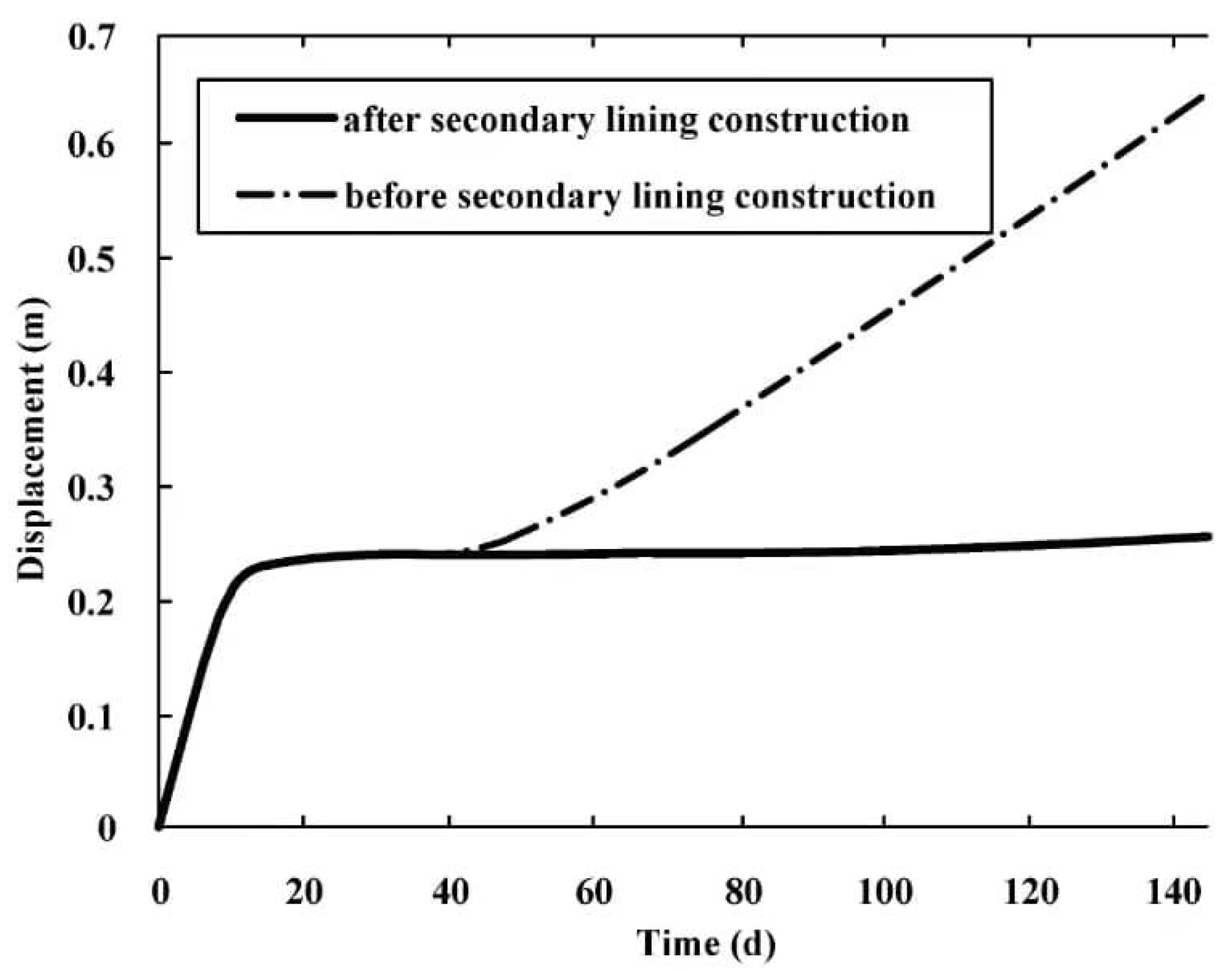
Since underground structures such as tunnels are inevitably surrounded by rocks, their long-term safety and stability are primarily governed by the comportment of these materials. Being able to express the time-dependent behavior of rocks, creep is one of the most interesting mechanical properties considered in the study of tunnels. Based on relevant research efforts, this article aims to provide a comprehensive review of pertinent information on rock creep and its potential influencing factors. It also presents the latest progress in constitutive models of rock creep and discusses their applicability to the long-term stability of deep underground structures. The results show that rock creep is significantly influenced by various potential factors both external and internal. These are mainly hydraulic pressure, stress level, water content, temperature, damage, and time-to-failure. For instance, the creep lifetime of andesite is drastically reduced by the presence of water. It is about 180 times shorter in wet conditions than in dry conditions, under the same stress conditions. By the combined influence of high stresses, high pressures, and high temperatures, creep rupture occurs in a semi-brittle manner for most types of hard rocks. The characteristics and installation period of the lining structures also have a strong influence on the evolution of creep in the rocks surrounding the underground structures. It is suggested that despite the colossal research efforts already made in this area, more accurate creep constitutive models are still needed for more adequate applications to the long-term stability of deep rock tunnels. Accordingly, key perspectives for future investigations are highlighted. This work can serve as a good reference in the establishment of new constitutive models of rock creep aimed at improving their accuracy, and facilitate appropriate actions to predict the long-term stability of deep tunnels in realistic situations.
Keywords: rock creep; deep tunnels; creep constitutive models; long-term stability of tunnels rock creep; deep tunnels; creep constitutive models; long-term stability of tunnels