Phenolic Compounds, Antioxidant Activity, Ascorbic Acid, and Sugars in Honey from Ingenious Hail Province of Saudi Arabia
 , ,
, ,
Abstract
1. Introduction
2. Materials and Methods
2.1. Chemicals
2.2. Samples
2.3. Sugar Analysis by HPLC-Refractive Index Detector (RID)
2.4. Total Phenolic Content (TPC)
2.5. Phenolic Compound Analysis by HPLC-DAD
2.6. HPLC Analysis of Vitamin C
2.7. DPPH Radical Scavenging Assay
2.8. Statistical Analysis
3. Results and Discussion
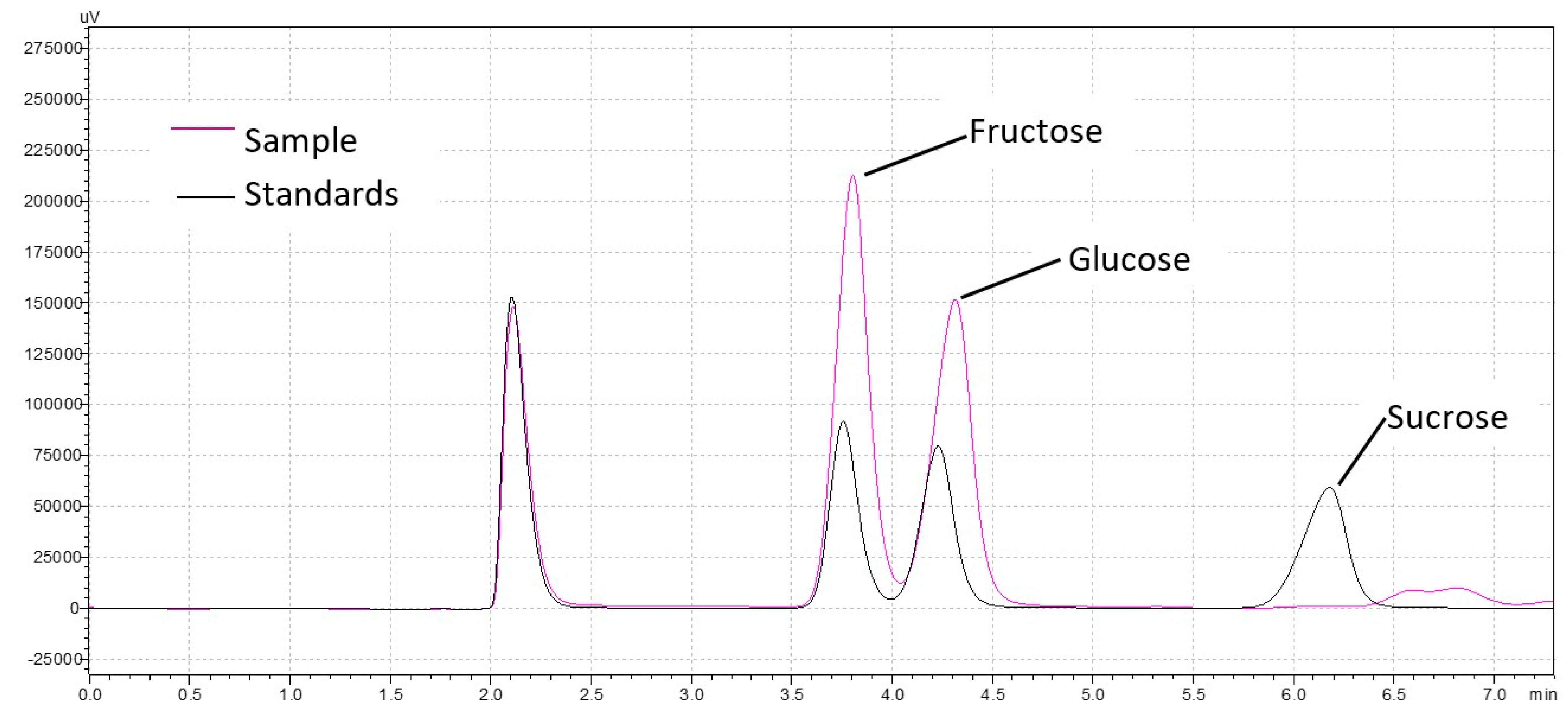
3.1. Sugar Analysis by HPLC-Refractive Index Detector (RID)
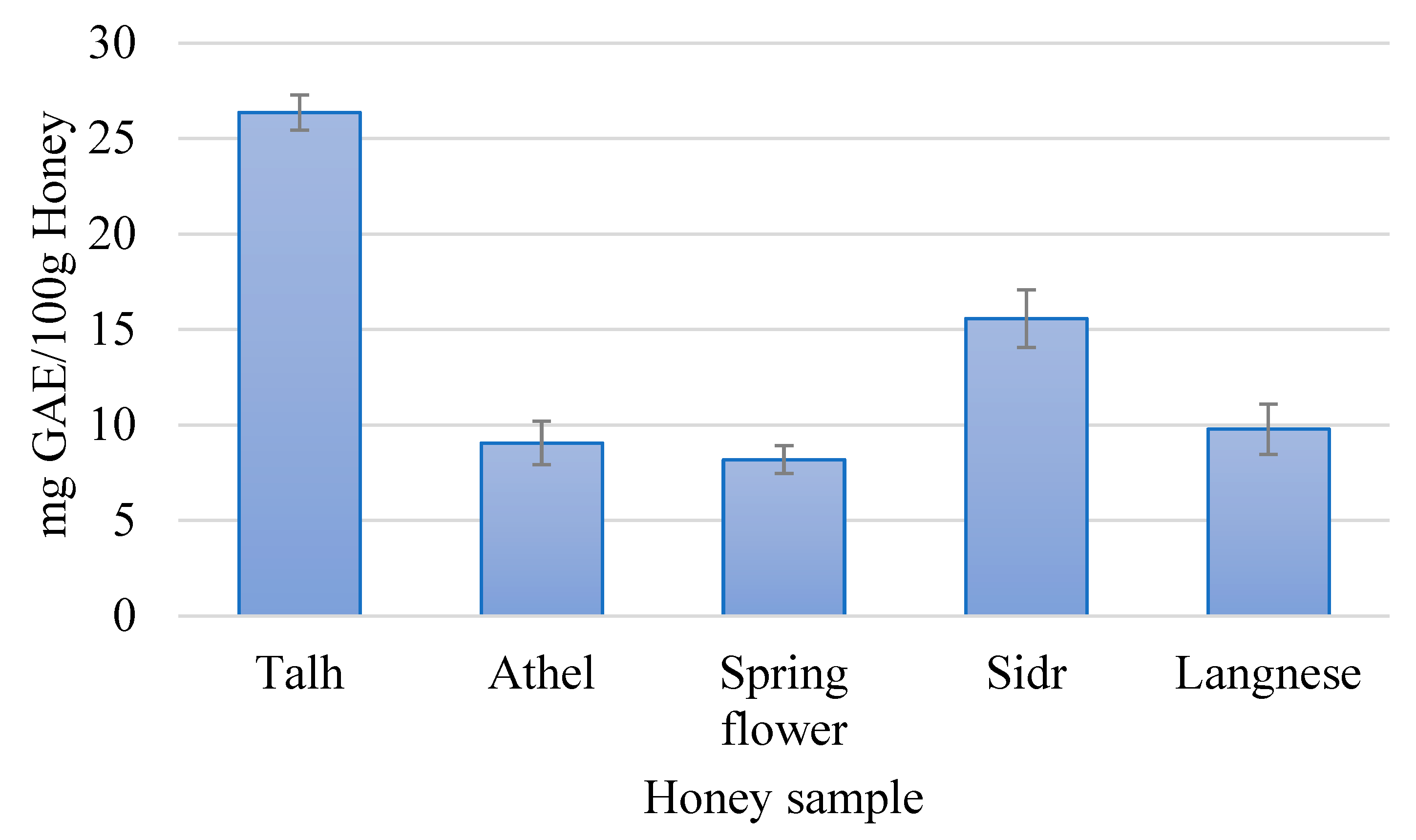
3.2. Total Phenolic Content (TPC)
3.3. Phenolic Compounds Analysis by HPLC-DAD
3.4. Vitamin C Analysis by HPLC
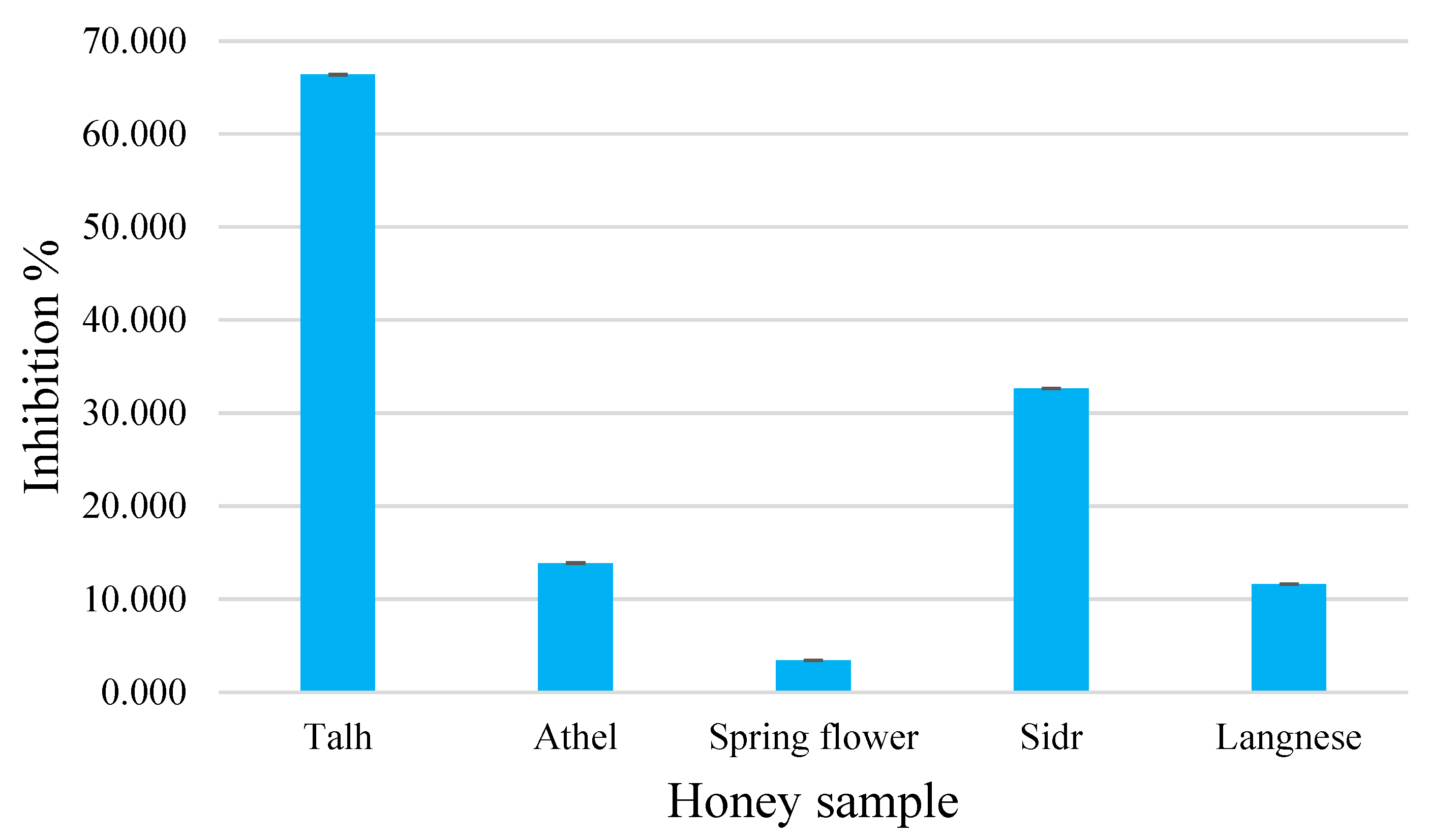
3.5. DPPH Radical Scavenging Assay
4. Conclusions
Author Contributions
Funding
Institutional Review Board Statement
Informed Consent Statement
Data Availability Statement
Acknowledgments
Conflicts of Interest
References
- Viuda-Martos, M.; Ruiz-Navajas, Y.; Fernández-López, J.; Pérez-Álvarez, J.A. Functional properties of honey, propolis, and royal jelly. J. Food Sci. 2008, 73, 117–124. [Google Scholar] [CrossRef] [Scilit] [PubMed]
- Crane, E. Honey: A Comprehensive Survey; (No. SF 539. H66); Morrison and Gibb Ltd.: London, UK, 1975. [Google Scholar]
- Crane, E. The World History of Beekeeping and Honey Hunting, 1st ed.; Routledge: New York, NY, USA, 1999. [Google Scholar] [CrossRef] [Scilit]
- Jones, R. Honey and healing through the ages. J. ApiProd. ApiMed. Sci. 2001, 1, 2–5. [Google Scholar] [CrossRef] [Scilit]
- Purbafrani, A.; Ghazizade Hashemi, S.A.; Bayyenat, S.; Taghizade Moghaddam, H.; Saeidi, M. The benefits of honey in Holy Quran. Int. J. Pediatr. 2014, 2, 67–73. [Google Scholar]
- Sepehr, S. The most important medicinal uses of honey, and its side effects in the book of the Canon by Avicenna, and in the modern medical literature: A comparative study. J. ApiProd. ApiMed. Sci. 2010, 2, 43. [Google Scholar]
- Oddo, L.P.; Piro, R.; Bruneau, É.; Guyot-Declerck, C.; Ivanov, T.; Piskulová, J.; Flamini, C.; Lheritier, J.; Morlot, M.; Russmann, H.; et al. Main European unifloral honeys: Descriptive sheets. Apidologie 2004, 35 (Suppl. S1), S38–S81. [Google Scholar] [CrossRef] [Scilit]
- Almeida, A.M.M.; Oliveira, M.B.S.; da Costa, J.G.; Valentim, I.B.; Goulart, M.O. Antioxidant capacity, physicochemical and floral characterization of honeys from the northeast of Brazil. Rev. Virtua Quim. 2016, 8, 57–77. [Google Scholar] [CrossRef] [Scilit]
- Kukurova, K.; Karovièová, J.; Kohajdova, Z.; Bilikova, K. Authentication of honey by multivariate analysis of its physico—Chemical parameters. J. Food Nutr. Res. 2008, 47, 170–180. [Google Scholar]
- El Sohaimy, S.A.; Masry, S.H.D.; Shehata, M.G. Physicochemical characteristics of honey from different origins. Ann. Agric. Sci. 2015, 60, 279–287. [Google Scholar] [CrossRef] [Scilit]
- Ansari, M.J.; Al-Ghamdi, A.; Nuru, A.; Khan, K.A.; Alattal, Y. Geographical distribution and molecular detection of Nosema ceranae from indigenous honey bees of Saudi Arabia. Saudi J. Biol. Sci. 2017, 24, 983–991. [Google Scholar] [CrossRef] [Scilit]
- FAOSTAT-Food and Agriculture Data. Available online: http://www.fao.org/faostat/en/#data (accessed on 9 April 2022).
- Majtan, J.; Sojka, M.; Palenikova, H.; Bucekova, M.; Majtan, V. Vitamin C enhances the antibacterial activity of honey against planktonic and biofilm-embedded bacteria. Molecules 2020, 25, 992. [Google Scholar] [CrossRef] [Scilit]
- Uran, H.; Aksu, F.; Dülger Altiner, D. A research on the chemical and microbiological qualities of honeys sold in Istanbul. Food Sci. Technol. 2017, 37, 30–33. [Google Scholar] [CrossRef] [Scilit]
- Amiry, S.; Esmaiili, M.; Alizadeh, M. Classification of adulterated honeys by multivariate analysis. Food Chem. 2017, 224, 390–397. [Google Scholar] [CrossRef] [Scilit] [PubMed]
- Nayik, G.A.; Nanda, V. Physico-chemical, enzymatic, mineral and colour characterization of three different varieties of honeys from Kashmir valley of India with a multivariate approach. Pol. J. Food Nutr. Sci. 2015, 65, 101–108. [Google Scholar] [CrossRef] [Scilit]
- Almeida-Muradian, L.B.; Stramm, K.M.; Horita, A.; Barth, O.M.; da Silva de Freitas, A.; Estevinho, L.M. Comparative study of the physicochemical and palynological characteristics of honey from M elipona subnitida and A pis mellifera. Int. J. Food Sci. Technol. 2013, 48, 1698–1706. [Google Scholar] [CrossRef] [Scilit]
- Al-Ghamdi, A.A.; Ansari, M.J. Biological and therapeutic roles of Saudi Arabian honey: A comparative review. J. King Saud Univ.—Sci. 2021, 33, 101329. [Google Scholar] [CrossRef] [Scilit]
- Meda, A.; Lamien, C.E.; Romito, M.; Millogo, J.; Nacoulma, O.G. Determination of the total phenolic, flavonoid and proline contents in Burkina Fasan honey, as well as their radical scavenging activity. Food Chem. 2005, 91, 571–577. [Google Scholar] [CrossRef] [Scilit]
- Eteraf-Oskouei, T.; Najafi, M. Traditional and modern uses of natural honey in human diseases: A review. Iran. J. Basic Med. Sci. 2013, 16, 731–742. [Google Scholar]
- Alzahrani, H.A.; Boukraa, L.; Bellik, Y.; Abdellah, F.; Bakhotmah, B.A.; Kolayli, S.; Sahin, H. Evaluation of the antioxidant activity of three varieties of honey from different botanical and geographical origins. Glob. J. Health Sci. 2012, 4, 191–196. [Google Scholar] [CrossRef] [Scilit]
- Council-European. Council Directive 2001/110/EC of 20 December 2001 relating to honey. Off. J. Eur. Communities L 2002, 10, 47–52. [Google Scholar]
- Cianciosi, D.; Forbes-Hernández, T.Y.; Afrin, S.; Gasparrini, M.; Reboredo-Rodriguez, P.; Manna, P.P.; Battino, M. Phenolic compounds in honey and their associated health benefits: A review. Molecules 2018, 23, 2322. [Google Scholar] [CrossRef] [Scilit]
- Ghramh, H.A.; Khan, K.A.; Ahmed, Z.; Ansari, M.J. Quality evaluation of Saudi honey harvested from the Asir province by using high-performance liquid chromatography (HPLC). Saudi J. Biol. Sci. 2020, 27, 2097–2105. [Google Scholar] [CrossRef] [Scilit] [PubMed]
- Al-Mosa, A.A.A.; Brima, E.I.; Mohammed, M.E.A. Antioxidant vitamins in honey samples from different floral origins and altitudes in Asir Region at the South-Western Part of Saudi Arabia. Curr. Nutr. Food Sci. 2019, 15, 296–304. [Google Scholar] [CrossRef] [Scilit]
- Ahamed, M.M.E.; Alaergani, W.; Suleiman, M.H.A.; Al-Gramah, H.A. Hydrogen peroxide and dicarbonyl compounds concentration in honey samples from different botanical origins and altitudes in the South of Saudi Arabia. Curr. Res. Nutr. Food Sci. J. 2019, 1, 150–160. [Google Scholar]
- Al-Hindi Rashad, R.; Shehata, A. Evaluation of antioxidant and antibacterial activities and essential elements content of locally produced honey in Saudi Arabia. Life Sci. J. 2014, 11, 175–185. [Google Scholar]
- AOAC. Official Methods of Analysis, 19th ed.; Association of Official Analytical Chemists: Washington, DC, USA, 2012. [Google Scholar]
- Silici, S.; Sagdic, O.; Ekici, L. Total phenolic content, antiradical, antioxidant and antimicrobial activities of Rhododendron honeys. Food Chem. 2010, 121, 238–243. [Google Scholar] [CrossRef] [Scilit]
- Liang, Y.; Cao, W.; Chen, W.-J.; Xiao, X.-H.; Zheng, J.-B. Simultaneous determination of four phenolic components in citrus honey by high performance liquid chromatography using electrochemical detection. Food Chem. 2009, 114, 1537–1541. [Google Scholar] [CrossRef] [Scilit]
- Perna, A.; Intaglietta, I.; Simonetti, A.; Gambacorta, E. A comparative study on phenolic profile, vitamin C content and antioxidant activity of Italian honeys of different botanical origin. Int. J. Food Sci. Technol. 2013, 48, 1899–1908. [Google Scholar] [CrossRef] [Scilit]
- Rizzolo, A.; Brambilla, A.; Valsecchi, S.; Eccher-Zerbini, P. Evaluation of sampling and extraction procedures for the analysis of ascorbic acid from pear fruit tissue. Food Chem. 2002, 77, 257–262. [Google Scholar] [CrossRef] [Scilit]
- Aljadi, A.M.; Kamaruddin, M.Y. Evaluation of the phenolic contents and antioxidant capacities of two Malaysian floral honeys. Food Chem. 2004, 85, 513–518. [Google Scholar] [CrossRef] [Scilit]
- Sokal, R.R.; Rohlf, J.B. Biometry. In The Principles and Practice of Statistics in Biological Research; W.H. Freeman and Company: San Francisco, CA, USA, 2000. [Google Scholar]
- León-Ruiz, V.; Vera, S.; González-Porto, A.V.; Andrés, M.P.S. Vitamin C and sugar levels as simple markers for discriminating Spanish honey sources. J. Food Sci. 2011, 76, C356–C361. [Google Scholar] [CrossRef] [Scilit]
- Yaoa, L.; Jiang, Y.; Singanusong, R.; Datta, N.; Raymont, K. Phenolic acids in Australian Melaleuca, Guioa, Lophostemon, Banksia and Helianthus honeys and their potential for floral authentication. Food Res. Int. 2005, 38, 651–658. [Google Scholar] [CrossRef] [Scilit]
- Sobrino-Gregorio, L.; Vargas, M.; Chiralt, A.; Escriche, I. Thermal properties of honey as affected by the addition of sugar syrup. J. Food Eng. 2017, 213, 69–75. [Google Scholar] [CrossRef] [Scilit]
- Kuś, P.M.; Congiu, F.; Teper, D.; Sroka, Z.; Jerković, I.; Tuberoso, C.I.G. Antioxidant activity, color characteristics, total phenol content and general HPLC fingerprints of six Polish unifloral honey types. LWT—Food Sci. Technol. 2014, 55, 124–130. [Google Scholar] [CrossRef] [Scilit]
- Alvarez-Suarez, J.M.; Tulipani, S.; Díaz, D.; Estevez, Y.; Romandini, S.; Giampieri, F.; Damiani, E.; Astolfi, P.; Bompadre, S.; Battino, M. Antioxidant and antimicrobial capacity of several monofloral Cuban honeys and their correlation with color, polyphenol content and other chemical compounds. Food Chem. Toxicol. 2010, 48, 2490–2499. [Google Scholar] [CrossRef] [Scilit] [PubMed]
- Pichichero, E.; Canuti, L.; Canini, A. Characterisation of the phenolic and flavonoid fractions and antioxidant power of Italian honeys of different botanical origin. J. Sci. Food Agric. 2009, 89, 609–616. [Google Scholar] [CrossRef] [Scilit]
- Salonen, A.; Virjamo, V.; Tammela, P.; Fauch, L.; Julkunen-Tiitto, R. Screening bioactivity and bioactive constituents of Nordic unifloral honeys. Food Chem. 2017, 237, 214–224. [Google Scholar] [CrossRef] [Scilit]
- Alqarni Abdulaziz, S.; Owayss, A.A.; Mahmoud, A.A. Physicochemical characteristics, total phenols and pigments of national and international honeys in Saudi Arabia. Arab. J. Chem. 2016, 9, 114–120. [Google Scholar] [CrossRef] [Scilit]
- Al-Mamary, M.; Al-Meeri, A.; Al-Habori, M. Antioxidant activities and total phenolics of different types of honey. Nutr. Res. 2002, 22, 1041–1047. [Google Scholar] [CrossRef] [Scilit]
- Andrade, P.; Ferreres, F.; Amaral, M.T. Analysis of honey phenolic acids by HPLC, its application to honey botanical characterization. J. Liq. Chromatogr. Relat. Technol. 1997, 20, 2281–2288. [Google Scholar] [CrossRef] [Scilit]
- Burya, D.; Gevrenova, R.; Ankla, E.M. Analysis of phenolic acids in honeys of different floral origin by solidphase extraction and high performance liquid chromatography. Phytochem. Anal. Int. J. Plant Chem. Biochem. Tech. 2007, 18, 24–32. [Google Scholar]
- Yao, L.; Jiang, Y.; Singanusong, R.; Datta, N.; Raymont, K. Phenolic acids and abscisic acid in Australian Eucalyptus honeys and their potential for floral authentication. Food Chem. 2004, 86, 169–177. [Google Scholar] [CrossRef] [Scilit]
- Cheung, Y.; Meenu, M.; Yu, X.; Xu, B. Phenolic acids and flavonoids profiles of commercial honey from different floral sources and geographic sources. Int. J. Food Prop. 2019, 22, 290–308. [Google Scholar] [CrossRef] [Scilit]
- Ciulu, M.; Solinas, S.; Floris, I. RP-HPLC determination of water-soluble vitamins in honey. Talanta 2011, 83, 924–929. [Google Scholar] [CrossRef] [Scilit]
- Ghedolf, N.; Wang, X.H.; Engeseth, N.J. Identification and quantification of antioxidant components of honey from various floral sources. J. Agric. Food Chem. 2002, 50, 5870–5877. [Google Scholar]
- Bonta, V.; Al Marghitas, L.; Bobis, O.; Margaoan, R.; Barnutiu Land Dezmirean, D.S. Quantitative determination of vitamin C in honey and bee pollen using HPLC-DAD method. Bull. UASVM Anim. Sci. Biotechnol. 2013, 70, 31–36. [Google Scholar]
- Dżugan, M.; Tomczyk, M.; Sowa, P.; Grabek-Lejko, D. Antioxidant activity as biomarker of honey variety. Molecules 2018, 23, 2069. [Google Scholar] [CrossRef] [Scilit] [PubMed]
- Oryan, A.; Alemzadeh, E.; Moshiri, A. Biological properties and therapeutic activities of honey in wound healing: A narrative review and meta-analysis. J. Tissue Viability 2016, 25, 98–118. [Google Scholar] [CrossRef] [Scilit] [PubMed]
- De Sousa, J.M.B.; de Souza, E.L.; Marques, G.; Benassi, M.T.; Gullón, B.; Pintado, M.M.; Magnani, M. Sugar profile, physicochemical and sensory aspects of monofloral honeys produced by different stingless bee species in Brazilian semi-arid region. LWT—Food Sci. Technol. 2016, 65, 645–651. [Google Scholar] [CrossRef] [Scilit]
- Biluca, F.C.; Braghini, F.; Gonzaga, L.V.; Costa, A.C.O.; Fett, R. Physicochemical profiles, minerals and bioactive compounds of stingless bee honey (Meliponinae). J. Food Compos. Anal. 2016, 50, 61–69. [Google Scholar] [CrossRef] [Scilit]
- Das, A.; Datta, S.; Mukherjee, S.; Bose, S.; Ghosh, S.; Dhar, P. Evaluation of antioxidative, antibacterial and probiotic growth stimulatory activities of Sesamum indicum honey containing phenolic compounds and lignans. Food Sci. Technol. 2015, 61, 244–250. [Google Scholar] [CrossRef] [Scilit]
- Bueno-Costa, F.M.; Zambiazi, R.C.; Bohmer, B.W.; Chaves, F.C.; Silva, W.P. Antibacterial and antioxidant activity of honeys from the state of Rio Grande do Sul, Brazil. Food Sci. Technol. 2016, 65, 333–340. [Google Scholar] [CrossRef] [Scilit]
- Moniruzzaman, M.; Khalil, M.I.; Sulaiman, S.A.; Gan, S.H. Physicochemical and antioxidant properties of Malaysian honeys produced by Apis cerana, Apis dorsata and Apis mellifera. BMC Complement. Altern. Med. 2013, 13, 43. [Google Scholar] [CrossRef] [Scilit] [PubMed]
- Gašić, U.; Kečkeš, S.; Dabić, D.; Trifković, J.; Milojković-Opsenica, D.; Natić, M.; Tešić, Ž. Phenolic profile and antioxidant activity of Serbian polyfloral honeys. Food Chem. 2014, 145, 599–607. [Google Scholar] [CrossRef] [Scilit] [PubMed]
- Zawawi, N.; Chong, P.J.; Mohd Tom, N.N.; Saiful Anuar, N.S.; Mohammad, S.M.; Ismail, N.; Jusoh, A.Z. Establishing relationship between vitamins, total phenolic and total flavonoid content and antioxidant activities in various honey types. Molecules 2021, 26, 4399. [Google Scholar] [CrossRef] [Scilit]


| Sample/Sugars | Fructose (g/100 g) | Glucose (g/100 g) | Sucrose (g/100 g) |
|---|---|---|---|
| Talh | 28.35 ± 0.87 a | 20.21 ± 0.2 b | ND |
| Athel | 35.93 ± 0.94 a | 32.28 ± 0.58 b | ND |
| Spring flower | 36.40 ± 1.92 a | 27.15 ± 1.57 b | ND |
| Sidr | 37.81 ± 2.45 a | 25.41 ± 1.2 b | ND |
| Langnese | 37.41 ± 1.46 a | 31.49 ± 1.34 b | ND |
| Phenolic Compounds/Samples | Talh | Athel | Spring Flower | Sidr | Langnese |
|---|---|---|---|---|---|
| Gallic acid | 1.08 ± 0.67 a | 0.81 ± 0.65 a | 0.97 ± 0.61 a | ND | ND |
| Catechin | 1.14 ± 0.93 | ND | ND | ND | ND |
| Chlorogenic acid | ND | ND | ND | ND | ND |
| Tannic acid | 1.09 ± 0.53 b | ND | ND | 1.26 ± 0.35 b | ND |
| Salicylic acid | ND | ND | 3.1 ± 0.91 c | 4.19 ± 0.17 c | 1.44 ± 0.13 c |
| Quercetin | 0.34 ± 0.14 d | 0.28 ± 0.05 d | 2.68 ± 1.17 d | 0.46 ± 0.11 d | 0.31 ± 0.02 d |
| Honey Sample | Vitamin C (mg/100 g) |
|---|---|
| Talh | 1.4 ± 0.11 a |
| Athel | 0.32 ± 0.05 a |
| Spring flower | 0.25 ± 0.11 a |
| Sidr | 2.59 ± 1.03 a |
| Langnese | 1.35 ± 0.31 a |
Publisher’s Note: MDPI stays neutral with regard to jurisdictional claims in published maps and institutional affiliations. |
© 2022 by the authors. Licensee MDPI, Basel, Switzerland. This article is an open access article distributed under the terms and conditions of the Creative Commons Attribution (CC BY) license (https://creativecommons.org/licenses/by/4.0/).
Share and Cite
Alshammari, G.M.; Ahmed, M.A.; Alsulami, T.; Hakeem, M.J.; Ibraheem, M.A.; Al-Nouri, D.M. Phenolic Compounds, Antioxidant Activity, Ascorbic Acid, and Sugars in Honey from Ingenious Hail Province of Saudi Arabia. Appl. Sci. 2022, 12, 8334. https://doi.org/10.3390/app12168334
Alshammari GM, Ahmed MA, Alsulami T, Hakeem MJ, Ibraheem MA, Al-Nouri DM. Phenolic Compounds, Antioxidant Activity, Ascorbic Acid, and Sugars in Honey from Ingenious Hail Province of Saudi Arabia. Applied Sciences. 2022; 12(16):8334. https://doi.org/10.3390/app12168334
Chicago/Turabian StyleAlshammari, Ghedeir Muslem, Mohammed Asif Ahmed, Tawfiq Alsulami, Mohammed Jamal Hakeem, Mohamed Abdrabo Ibraheem, and Doha M. Al-Nouri. 2022. "Phenolic Compounds, Antioxidant Activity, Ascorbic Acid, and Sugars in Honey from Ingenious Hail Province of Saudi Arabia" Applied Sciences 12, no. 16: 8334. https://doi.org/10.3390/app12168334
APA StyleAlshammari, G. M., Ahmed, M. A., Alsulami, T., Hakeem, M. J., Ibraheem, M. A., & Al-Nouri, D. M. (2022). Phenolic Compounds, Antioxidant Activity, Ascorbic Acid, and Sugars in Honey from Ingenious Hail Province of Saudi Arabia. Applied Sciences, 12(16), 8334. https://doi.org/10.3390/app12168334