Article

Physical Computing Strategy to Support Students’ Coding Literacy: An Educational Experiment with Arduino Boards

General Research Service Center, Graduate Institute of Technological and Vocational Education, National Pingtung University of Science and Technology, Pingtung 912, Taiwan
*
Author to whom correspondence should be addressed.
Appl. Sci. 2021, 11(4), 1830; https://doi.org/10.3390/app11041830

Submission received: 18 January 2021 / Revised: 13 February 2021 / Accepted: 15 February 2021 / Published: 19 February 2021

Abstract

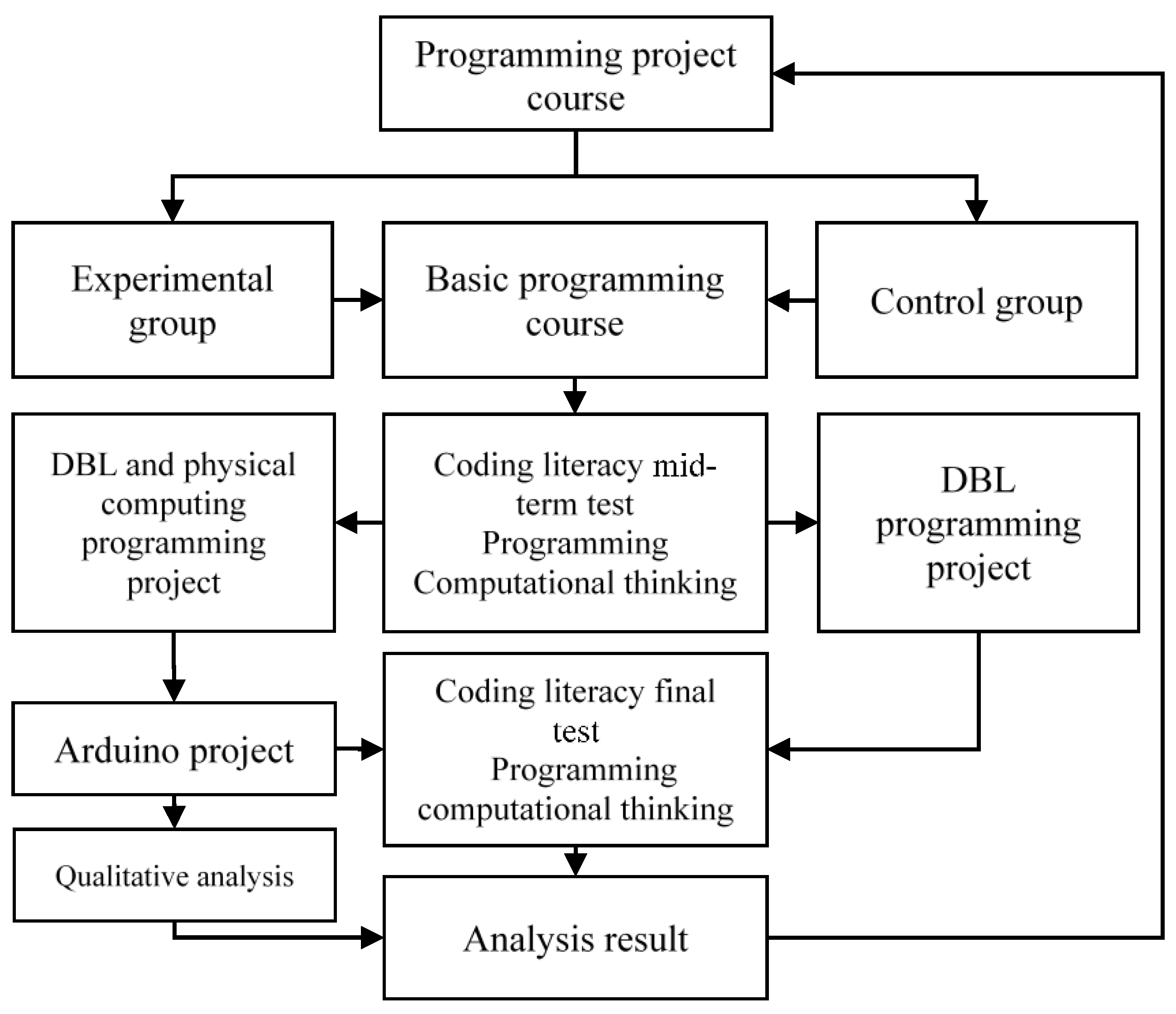
The purpose of this study is to explore the influence of introduction of the physical computing strategy of Arduino Boards in a program design course on coding literacy and the effectiveness of the application in technical high school students. This study selected two classes of twelfth-grade students enrolled in a program design course at a technical high school in Southern Taiwan as the samples. One class was the control group (43 students), and the other was the experimental group (42 students). During the 18-week course, the control group carried out a DBL (design-based learning) programming project, and the experimental group carried out the DBL programming project using the physical computing strategy of Arduino boards. Pre- and posttests and a questionnaire survey were carried out, while ANCOVA (analysis of covariance) was used for evaluation purposes. In the course, students in the experimental group were randomly selected for semi-structured interviews to understand their learning status and to perform qualitative analysis and summarization. This study proposed the physical computing strategy of Arduino boards, featuring staged teaching content, practical teaching activities, and real themes and problem-solving tasks. The results show that the coding literacy of students in the different teaching strategy groups was significantly improved. However, in the Arduino course on DBL programming, the students in the experimental group had a significantly higher learning efficiency in coding literacy than those in the control group. Moreover, according to the qualitative analysis using student interviews, Arduino boards were found to improve students’ motivation to learn coding and to aid in systematically guiding students toward improving their coding literacy by combining their learning with DBL theory. Thus, Arduino technology can be effectively used to improve students’ programming abilities and their operational thinking in practically applying programming theories.
Keywords: DBL; Arduino; coding literacy; physical computing; education reform DBL; Arduino; coding literacy; physical computing; education reform