


Abstract
Background: Consistent evidence suggests that exercise improves cognition and decision making, with preliminary evidence suggesting that brain-derived neurotrophic factors (BDNFs) may mediate these effects on high-intensity interval activities, such as in football playing. We conducted a systematic review of studies on football players or football task interventions that evaluated the causality of exercise or its relationship with changes in the basal BDNF level. Methods: The search was conducted in PubMed, SPORTDiscus, Cochrane, and FECYT (Web of Sciences, CCC, DIIDW, KJD, MEDLINE, RSCI, and SCIELO) according to the guidelines for performing systematic reviews in the sport sciences field. Results: From the 44 studies initially identified, seven studies were fully reviewed, and their outcome measures were extracted and analysed. In the scientific study of football, the studies published thus far have explored the relationship of serum BDNF levels and other cognitive function factors with the genetic expression of polymorphisms, the anthropometric and fitness conditions, the acute exercise effect of the match, and the typical actions of the match such as heading. Conclusions: The heterogeneity of designs and variables evaluated in studies related to BDNF exercise or interaction and football playing does not allow us to conclusively determine that there is a relationship with the cause or effect of genetic, anthropometric, or conditional factors that derive from an increase in BDNF due to actions during the playing of football.
1. Introduction
Brain-derived neurotrophic factor (BDNF) is a highly expressed protein molecule that is synthesised in neurons [1]. It has been used as a reliable marker of brain function, cognitive function, and memory; more recently, evidence suggests a role in glucose homeostasis and lipid metabolism [2]. Studies in healthy people and those with pathologies have shown that BDNF seems to promote neurogenesis, synaptic plasticity, and neuroprotection due to its immunomodulatory action [3]. Specifically, sport and exercise science research has shown that this member of the family of neurotrophins responds to physical activity [1].
The release of BDNF into the bloodstream could lead to some neuro- and immuno-protective effects, such as neurodegeneration inhibition, hippocampal neural plasticity, neurogenesis, axonal growth, and synaptogenesis [4,5]. Low basal BDNF levels have been associated with long-time exercise training and physically trained athletes [6,7]. However, some questions around the discussion of the role of BNDF in physiological cascade events during exercise remain unanswered. Moderate intensity, aerobic exercise could increase basal and post-exercise BNDF levels [8]. During acute aerobic exercise activity, basal BNDF levels increase and upregulate cellular processing of BDNF (e.g., synthesis, release, absorption, and degradation) in well trained, healthy men. In addition, BDNF can be released due to the activity of reactive oxygen species resulting from mitochondrial activity in neurons [9], calcium increase in neurons [10], and lactate synthesis [11]. Subsequently, an increased amount of BDNFs could be released into the bloodstream and absorbed more efficiently by central and peripheral tissues, provoking a cascade of neurotrophic and neuroprotective effects [12].
Nerve growth factor (NGF) and BDNF are members of the neurotrophin family that are reliable markers of brain damage when released into the circulation. Blows/contusions to the head or ball-striking with the head are relevant to increased NGF and BDNF [13]. By considering other reference biomarkers (blood or lactate), the information on the relevance of BNDF on executive functions or neuropsychological responses would be much more complete; however, its influence on attention/concentration, arousal, or decision-making processes is widely assumed [14].
High-intensity training can activate higher BDNF production in the brain than continuous exercise and could increase brain H2O2 and TNF-a levels [15,16]. Acute high-intensity exercise also leads to an increase in circulating endocannabinoids [17], crucial in sport-related recovery [18], and an increase in BDNF [17]. In this sense, football playing is characterised by intermittent, repetitive, and high-intensity actions [19]. In addition, actions, such as accelerations and decelerations, as well as peak speed and repeated sprint ability are crucial for performance [20,21]. The role of these movements should be explored in future studies regarding the potential differences in BDNF release rates due to the intensity and number of actions.
Although evidence of the effect of intense exercise on serum BDNF level has recently been shown [17], information regarding how this neurotrophin acts in athletes who regularly perform high-intensity actions is limited. In addition, in competitive sports, it is necessary to consider other factors, such as the stressful effects of competition and injury potential, among other factors that could influence the behaviour of serum BDNF level. Some cognitive (e.g., anger expression and mental fatigue) and behavioural (e.g., coping skills, competitive anxiety, and mental toughness) characteristics of football players [22,23] could also influence changes in serum BDNF level [24]. The available evidence indicates that exercise is an effective strategy for enhancing BDNF activity, with promising preliminary evidence in high-intensity exercise [1]; however, there is a lack of data available regarding football playing. Consequently, in this systematic review, we aimed to describe the current knowledge regarding the acute and long-term effects of football playing on serum BDNF level.
2. Materials and Methods
2.1. Design
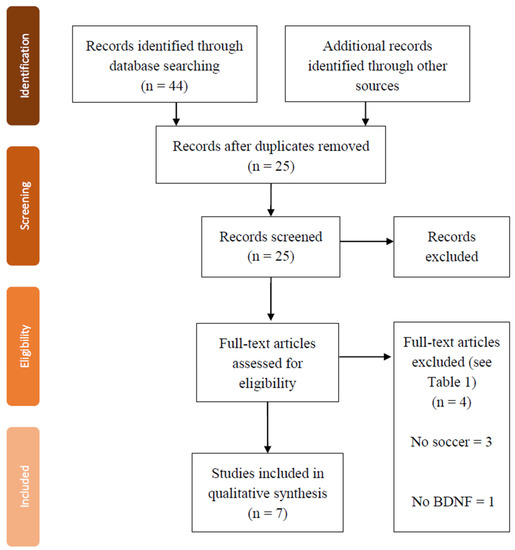
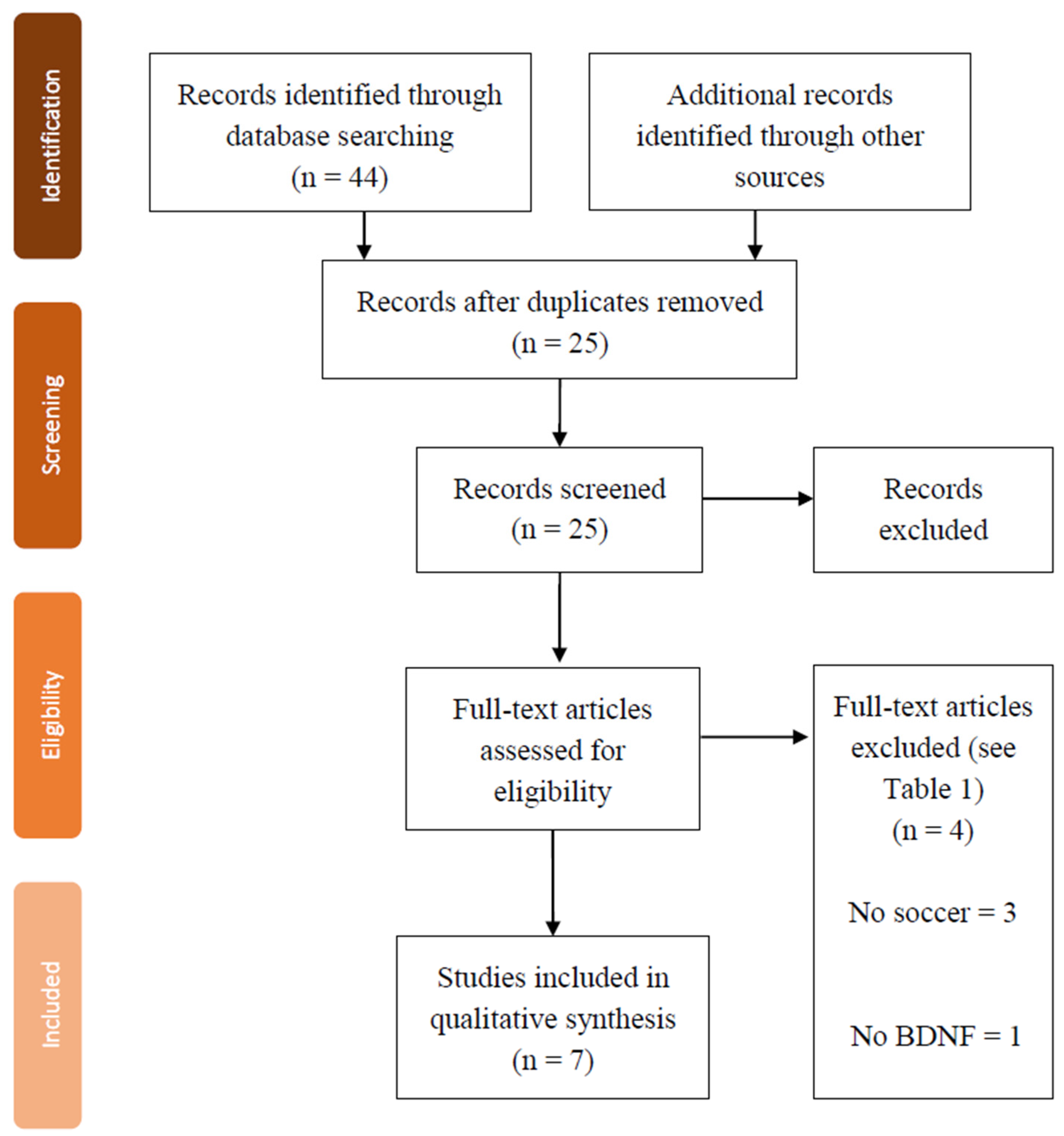
This systematic review was reported following the Preferred Reporting Items for Systematic Reviews and Meta-Analyses (PRISMA) guidelines [25] and the guideline for performing systematic reviews in sport sciences [26]. After conducting the search, the studies were classified by year, identifying those that met the inclusion criteria for final consideration and extraction (see Figure 1). Two authors independently reviewed the manuscripts based on risk of bias. The systematic review was conducted considering previously established guidelines, taking into consideration the delimitation of the research question, identification of relevant evidence, evaluation of the quality of the studies, summary of the results, and their interpretation [27].
Figure 1.
Flow diagram of the study, see Table 1.
2.2. Eligibility Criteria
The title, abstract, and reference list of each paper were screened to locate potentially relevant studies. Additionally, the authors reviewed, in detail, the full version of the included studies to identify papers that met the selection criteria. An additional search within the reference lists of the included studies was conducted to retrieve further relevant studies. The inclusion and exclusion criteria are detailed in Table 1.
Table 1.
Inclusion and exclusion criteria.
2.3. Information Sources and Search
PubMed, SPORTDiscus, Cochrane, and FECYT (Web of Sciences, CCC, DIIDW, KJD, MEDLINE, RSCI, and SCIELO), were searched for relevant publications before 24 November 2021. Keywords and synonyms were entered as various combinations in the title and abstract, or keywords based on other previously published reviews and meta-analyses on BDNF and exercise [28,29]. The selection was determined based on PRISMA’s PICOS considering population (soccer OR football) AND outcome (BDNF OR “brain-derived neurotrophic factor” OR neurotrophin). Additionally, the reference lists of the retrieved studies were manually searched by two authors (M.R.-G. and D.R.-V.) to identify potential eligible studies not captured by the electronic searches. Possible errata were explored for each included study. Inconsistencies between the examinations and the selection of studies were resolved by consensus between the authors.
2.4. Data Extraction
Data extraction was prepared in a Microsoft Excel sheet (Microsoft Corporation, Redmond, WA, USA) following the Cochrane Consumers and Communication Review Group’s data extraction template [30]. An Excel sheet was used to assess inclusion requirements and subsequently tested for all selected studies. The full text was screened, and articles were excluded due to the population not following inclusion criteria (e.g., Australian football and rugby). All records were stored in the sheet.
2.5. Data Items
Study data were extracted following specific guidelines for systematic reviews and meta-analyses on the effects of exercise on BDNF and executive function [31]. The following information was extracted from the included original studies: aim, sample characteristics, study design, methodological key information, output variables, and main outcomes.
2.6. Methodological Assessment
The methodological assessment process was performed using an adapted version of the STROBE assessment criteria [32], looking at studies eligible for inclusion. Each article was assessed based on 10 specific criteria (see Table 1). Any disagreement was discussed and solved by a consensus decision. Each item was evaluated using numerical characterisation (1 = completed and 2 = non-completed). As suggested by O’Reilly et al. [32], each study rating was qualitatively interpreted using the following law: a study had a risk of bias or low quality with a lower punctuation than 7 points, while those studies with greater punctuations (i.e., ≥7) were considered to be low risk of bias or high-quality studies.
3. Results
3.1. Study Identification and Selection
The results of the database search identified a total of 44 titles. These studies were exported to reference manager software (EndNoteTM X9, Clarivate Analytics, Philadelphia, PA, USA). Duplicates (19 references) were subsequently removed either automatically or manually. The remaining 25 articles were screened for their relevance based on titles and abstracts, resulting in the removal of a further 14 studies. Following the screening procedure, 11 papers were selected for in-depth reading and analysis. After reading full texts and removing four studies that did not meet the population required characteristics, seven studies were included in the qualitative synthesis (Figure 1).
3.2. Methodological Quality
The overall methodological quality scores of the studies can be found in Table 2, which were evaluated by two authors individually. Overall, three studies had scores of 10 points assigned for the 10 items evaluated, two studies scored 9 points, one study scored 8 points, and one study scored 7 points.
Table 2.
Methodological assessment of the included studies.
3.3. Characteristics of Individual Studies
Details of the characteristics of the studies that reported BDNF in football are summarized in Table 3. A total of 946 football players of different levels participated in the studies (25 college, 34 master, 16 adolescent, and 864 professional/elite players) and 42 persons were assigned to control groups. Four studies also used a cross-sectional and comparative design, one study used a counterbalanced crossover intervention on a longitudinal follow-up, and one study used a quasi-experimental approach.
Table 3.
Characteristics of studies based on sample, design, and outcomes.
In addition, studies explored the association of serum BDNF level or polymorphisms expression with physical or technical testing (n = 3), memory or cognitive function (n = 3), and environmental conditions (e.g., temperature) (n = 1). Physical tests performed were countermovement jump (n = 1), heading (n = 2), agility test (n= 1), and sprints (n = 1). Among the cognitive tests were Stroop (n = 3) and Sternberg (n = 1). The polymorphisms, genes, and blood level biomarkers were: ACTN3 (n = 1), Val66Met (n = 1), PPARA (n = 1), NOS3 (n = 1), IGF-1 (n = 2), plasma fTRP (n = 1), AGT and NGF (n = 2).
3.4. Main Outcomes of Studies
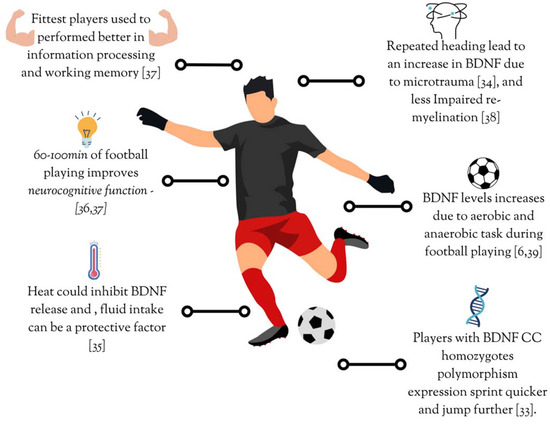
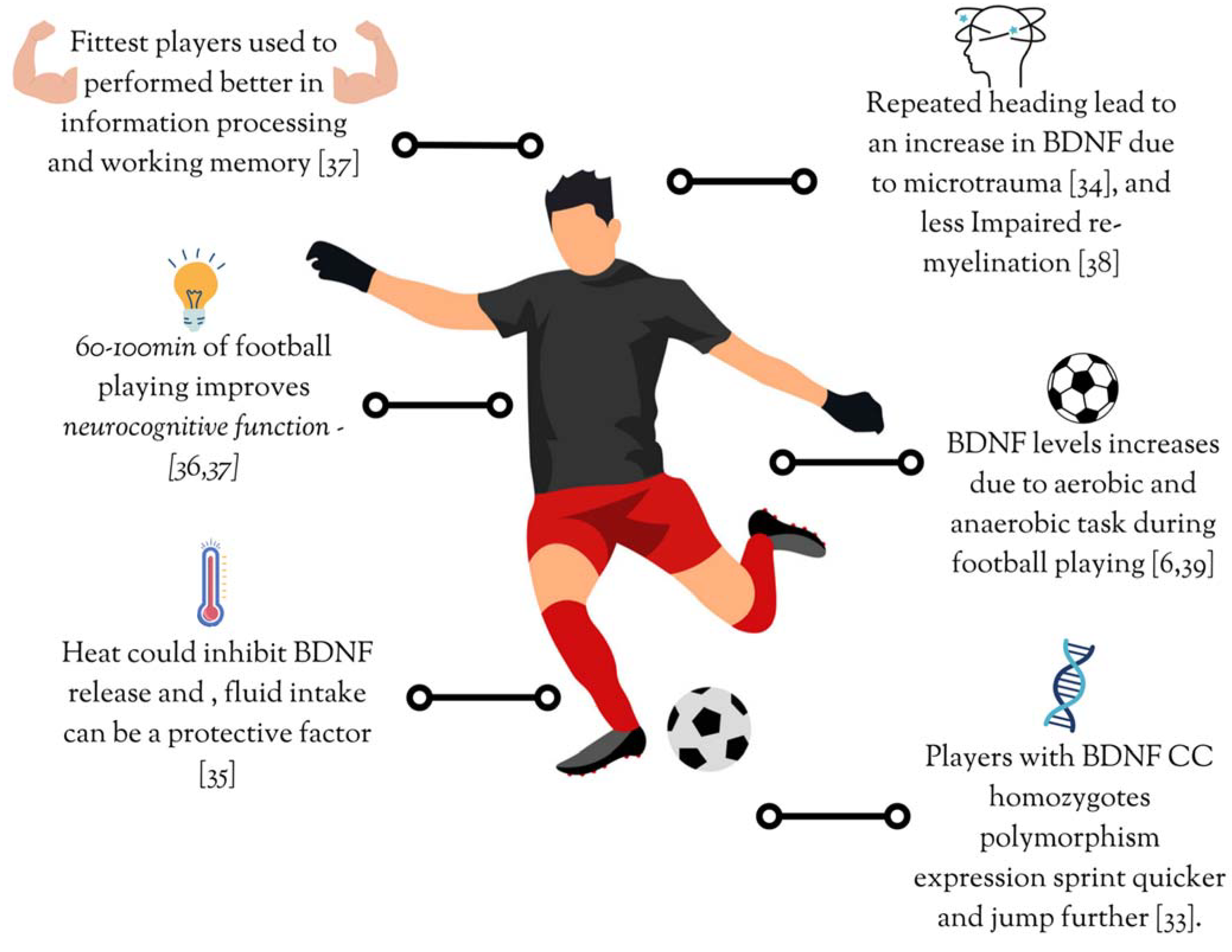
Figure 2 shows a summary of results of the seven studies included in this systematic review, highlighting the most relevant outcomes of each investigation. The results of cross-sectional studies showed that 60 and 100 min of football playing acutely increased BDNF, NGF, and IGF-1 levels [36,37,38,39]. In addition, aerobic (e.g., shuttle run) and anaerobic (e.g., Rast Test) tasks provoked an increase in serum BDNF level. The players with BDNF CC homozygote polymorphism expression could sprint faster and jump farther than the players who were A and T allele carriers [33].
Figure 2.
Main outcomes of studies analysing the effects of football playing on brain-derived neurotrophic factor levels [6,33–39].
Football activity has been shown to improve neurocognitive functions (e.g., Stroop test scores) [37,38,39] and memory performance [6,37]. The higher the serum BDNF level identified, the better the memory was [6]. Finally, repeated heading leading to microtrauma provoked an increase in serum BDNF level [34] and less impaired remyelination [38]. In addition, exercise activity in the heat has been shown to provoke lower BDNF release and better cognitive function scores [35].
4. Discussion
In this systematic review, we examined studies on football players or football task interventions that evaluated the causality of exercise or its relationship with changes in basal BDNF level. Few studies showed the effect of a football match on BDNF concentrations [36,37]. On the one hand, one study found a significant increase in serum BDNF level after a 90 min match in 15-year-old adolescents [39]. On the other hand, after a 60 min football match, it was reported that the BDNF level was not altered in 12-year-old adolescents [37]. Other studies have been conducted with football players as subjects, which evaluated the responses of their neurotrophic factor to different types of training [6,35], the effect of frequent heading [34], as well as the influence of polymorphism on expression [33,38].
BDNF concentrations increase immediately after physical aerobic, anaerobic, and high-intensity exercise [35,39]. Some meta-analyses have reported that this response is conditioned by factors, such as the duration and intensity of the efforts, the type of exercise, frequency, and duration of the intervention, as well as gender [40,41]. Exercise intensity must be at least 65% of VO2max to show a linear relationship with BDNF concentration [41]. The BDNF level can increase by around 60% in the blood at the peripheral level as an acute response and there is a greater release in activities that exceed 30 min [40].
The physical fitness of the participants has also been found to affect the release of BDNF, although the results were different. In 12-year-olds with high fitness, no change in serum BDNF levels was observed [37]. The physical and physiological adaptations generated by training programs can also affect BDNF responses [8]. Interestingly, in some studies, lower concentrations of BDNF have been observed in football players [6] or adults who perform more physical activities than sedentary adults [7]. Low concentrations of this neurotrophic factor have been found in football players; an inverse correlation was even found between VO2max and BDNF, i.e., BDNF levels were higher in those with a low cardiorespiratory capacity [6]. When a sample of non-athletic men was analysed, it was found that those people who presented a vigorous level of physical activity had low BDNF levels [7].
BDNF contributes to an improvement in cognitive responses; in football players, it has been evaluated using a memory test and information processing and the domain of inhibitory control. The evidence suggests that there is better performance in the Stroop Colour Word test [36]. The physical fitness of adolescent football players can also be considered to be a factor that modulates these cognitive responses after a match [37]. A study indicated that environmental conditions could affect the release of neurotransmitters, and therefore could influence cognitive functions [35]. It has also been concluded that the immediate effects of BDNF release after anaerobic training on master football players did not seem to imply memory capacity [6]. Indeed, the outcomes of this review suggest that football playing improves neurocognitive function [38,39]. The fittest players performed better in information processing and working memory tasks [36], suggesting a role of BDNF release in cognitive function during these sporting activities.
It has been reported that both aerobic and resistance exercises trigger the peripheral release of BDNF [40]; however, it has been found that transient increases in peripheral BDNF are more prone with aerobic exercise than with resistance exercise [12]. Little evidence has evaluated changes in BDNF in high-intensity activities [2]. However, in male adults (not football players), it has been shown that the execution of short series of high-intensity exercises (90% HRmax) alternated with similar periods of rest (1:1) can lead to a greater release of serum BDNF than continuous high-intensity exercise (70% HRmax) [16]. During a protocol of 1 min of effort at 100% VO2peak and 1 min of rest (1:1), a significant increase in BDNF level was observed immediately at the end of the exercise, although it decreased 60 min later [15].
During anaerobic exercises of high intensity, BDNF can be released to counteract the lack of oxygenation in the brain. Between 70 and 80% of the surrounding BDNF is contributed by the brain [42]. Likewise, it has been stated that lactate can promote the release of BDNF [43], and therefore BDNF concentration increases after high-intensity exercise, even after maintaining its level in post-exercise rest periods [14]. Serum BDNF levels after physical efforts may decrease due to their use in lipid metabolism that occurs at the peripheral level [42].
Another factor that can modulate BDNF secretion is hydration status and neuromuscular fatigue [35]. On the one hand, serum BDNF levels increased in a small group of young football and rugby players, who ran for 60 min at 75% of the heart rate reserve in a thermoneutral environment (18 °C), as well as in a high-temperature environment (32 °C), drinking water or sports drinks for hydration. On the other hand, when this same group was prohibited hydration in a high-temperature environment (32 °C), serum BDNF levels decreased immediately after the run [35]. Coaches and athletes should address that heat could inhibit BDNF release and that fluid intake can be a protective factor [37]; therefore, hydration protocols should be defined during training and competition to allow regular acute BDNF responses.
BDNF polymorphisms have been evaluated [33,38]. Considering the implications of gene expression on BDNF release levels, two studies in football players suggested that players with BDNF CC homozygote polymorphism expression sprinted quicker and jumped farther [33]. A study assessed BDNF (rs6265) CC (also known as Val 66 Met) and its relationship with physical tests, and found that the homozygous BDNF (CC) was associated with faster running speed and jumping capacity [33]. In contrast, in a recent study, the Val 66 Met gene was shown to be associated with poor motor performance in basketball players [44].
In another study, the relationship between BDNF Val 66 Met polymorphism with repeated heading was explored, and showed that players with Met (+) showed an association between high exposure to heading and low radial diffusivity [38], which indicated an affectation in the myelination of the axons, which could be reflected even in functional tests [38]. A previous systematic review has also shown that this polymorphism (BDNF Val 66 Met) could affect the release and concentration of BDNF [40]. Although it has been known that BDNF stimulates myelination, a high frequency of heading can affect it [38].
Given the characteristics of football, players have frequent contacts between the ball and their heads. Although this area has not been as well addressed in studies and the conclusions are not precise, an association has been reported between head butting and structural level affectations determined by neuroimaging techniques, as well as in the release or restrictions of neurotransmitters [13]. Repeated heading can cause increases in serum BDNF associated with microtrauma [34]. Increased peripheral BDNF and NGF levels have been associated with the recovery of possible damage generated by trauma in the central nervous system caused by contact with the ball [13,34]. Considering these results, soccer players should be monitored for the amount and severity of headings they perform during training to avoid microtrauma and subsequent inhibition of BDNF release. These actions should be considered, especially in young populations and masters, who have fewer protective factors.
Finally, from a cognitive and decision-making point of view during the match, adequate levels of BDNF in soccer players could provoke a better predisposition to avoid aggressive and anger misexpression and emotion control [22,23]. In addition, players may have better coping skills and preferable management of competitive anxiety [22,23]. Understanding the influence of changes in BDNF level on the cognition and behaviour of football players is critical [24], particularly during sessions of learning new technical, tactical, and behavioural skills, as well as during the sensitive stages of the development of young players.
Guidelines for Future Research
There is clearly a lack of evidence regarding the study of the effects of football competition or training on the expression of BDNF. The heterogeneity of the few studies analysed in this review does not allow for definitive conclusions regarding the impact of football playing on the expression of this neurotrophic factor. Consequently, it is difficult to understand the effects that the habitual practice of football (training or competition) can generate at the neurophysiological level.
Considering that this systematic review has presented the evidence described so far on this topic, this information can serve as a basic guide for future approaches to research problems. Future studies should focus on understanding the physiological cascade of BDNF expression in high-intensity sports, such as team sports. Additionally, understanding the relationship between players’ external and internal loads and the physiological and cognitive behaviour of BDNF is critical to guide practical interventions.
The absence of longitudinal studies on this topic limits the comprehension of the chronic effects associated with football on BDNF concentrations at the peripheral and brain levels. In addition, it is necessary to determine its influence on cognitive tasks, and its practical implications in the field. It is also crucial to explore the effects of the different types of football training tasks (e.g., multitasking, analytic, and global) on the release of BDNF. These studies must consider differences by sex, competitive level (e.g., professionals or amateur), age (e.g., master, elite, or youth), environmental conditions (e.g., heat or cold), and other contextual factors (e.g., public presence, pressure due to elimination, stress and anxiety, programming phase, or load balanced recovery) that could influence the release of BDNF at the acute level, and also its long-term implications.
More evidence is needed regarding the effects that exposure to highly stressful settings may have at cognitive (e.g., mental fatigue, sleep disorders), physical (e.g., trauma injuries, repetitive mechanical injuries, concussion), emotional (e.g., sports-related anxiety), and physiological (e.g., heat stress) levels on the dynamics of BDNF release in athletes.
It is key to understand the physiological dynamics of the release of BDNF in high-impact activities, high metabolic load, and the high-load intensity characteristics of football. Finally, the interrelation between the neurophysiological behaviour of BDNF and the genetic expression of the specific polymorphism related to this neurotrophin, anthropometric factors, and other structural and functional factors that may specifically influence football players, must be established.
5. Conclusions
Although interest in studying the effects of physical exercise on the acute release of BDNF and its chronic implications is growing, this is a grey area in team sports science knowledge. Likewise, the heterogeneity of designs and variables evaluated in studies related to the effects of football-playing on BDNF expression does not allow to conclude with certainty the interrelation and its impact on cognitive and neurophysiological function. Based on the evidence published thus far, this review provides a series of considerations for the design of future research in the field of sports science performance analysis in sport and sports medicine, specifically in football.
Author Contributions
Conceptualization, R.G.-V. and D.R.-V.; methodology, M.R.-G., J.P.-O. and D.R.-V.; software, M.R.-G. and D.R.-V.; validation, R.G.-V., A.U.-R., J.G.-H. and D.R.-V.; formal analysis, A.U.-R., J.P.-O., J.G.-H. and D.R.-V.; investigation, R.G.-V., A.U.-R. and D.R.-V.; resources, R.G.-V., J.P.-O., J.G.-H. and D.R.-V.; data curation, M.R.-G. and D.R.-V.; writing—original draft preparation, A.U.-R., M.R.-G. and D.R.-V.; writing—review and editing, all authors; visualization, D.R.-V.; supervision, R.G.-V., J.P.-O., J.G.-H. and D.R.-V.; project administration, R.G.-V., J.P.-O. and D.R.-V.; funding acquisition, R.G.-V. and D.R.-V. All authors have read and agreed to the published version of the manuscript.
Funding
This research received no external funding. The Vice-Rectory of the Universidad Nacional de Costa Rica provided support for the APC.
Institutional Review Board Statement
Not applicable.
Informed Consent Statement
Not applicable.
Conflicts of Interest
The authors declare no conflict of interest.
References
- Szuhany, K.L.; Bugatti, M.; Otto, M.W. A Meta-Analytic Review of the Effects of Exercise on Brain-Derived Neurotrophic Factor. J. Psychiatr. Res. 2015, 60, 56–64. [Google Scholar] [CrossRef] [Scilit]
- Jiménez-Maldonado, A.; Rentería, I.; García-Suárez, P.C.; Moncada-Jiménez, J.; Freire-Royes, L.F. The Impact of High-Intensity Interval Train. on Brain Derived Neurotrophic Factor in Brain: A Mini-Review. Front. Neurosci. 2018, 12, 1–9. [Google Scholar] [CrossRef] [Scilit]
- Bathina, S.; Das, U.N. Brain-Derived Neurotrophic Factor and Its Clinical Implications. Arch. Med. Sci. 2015, 11, 1164–1178. [Google Scholar] [CrossRef] [Scilit]
- Fernandes, J.; Arida, R.M.; Gomez-Pinilla, F. Physical Exercise as an Epigenetic Modulator of Brain Plasticity and Cognition. Neurosci. Biobehav. Rev. 2017, 80, 443–456. [Google Scholar] [CrossRef] [Scilit]
- Tapia-Arancibia, L.; Aliaga, E.; Silhol, M.; Arancibia, S. New Insights into Brain BDNF Function in Normal Aging and Alzheimer Disease. Brain Res. Rev. 2008, 59, 201–220. [Google Scholar] [CrossRef] [Scilit] [PubMed]
- Babaei, P.; Damirchi, A.; Mehdipoor, M.; Tehrani, B.S. Long Term Habitual Exercise Is Associated with Lower Resting Level of Serum BDNF. Neurosci. Lett. 2014, 566, 304–308. [Google Scholar] [CrossRef] [Scilit]
- Nofuji, Y.; Suwa, M.; Moriyama, Y.; Nakano, H.; Ichimiya, A.; Nishichi, R.; Sasaki, H.; Radak, Z.; Kumagai, S. Decreased Serum Brain-Derived Neurotrophic Factor in Trained Men. Neurosci. Lett. 2008, 437, 29–32. [Google Scholar] [CrossRef] [Scilit] [PubMed]
- Zoladz, J.A.; Pilc, A.; Majerczak, J.; Grandys, M.; Zapart-Bukowska, J.; Duda, K. Endurance Training Increases Plasma Brain-Derived Neurotrophic Factor Concentration in Young Healthy Men. J. Physiol. Pharmacol. 2008, 59 (Suppl. 7), 119–132. [Google Scholar]
- Radak, Z.; Suzuki, K.; Higuchi, M.; Balogh, L.; Boldogh, I.; Koltai, E. Physical Exercise, Reactive Oxygen Species and Neuroprotection. Free Radic. Biol. Med. 2016, 98, 187–196. [Google Scholar] [CrossRef] [Scilit] [PubMed]
- Kahlert, S.; Zündorf, G.; Reiser, G. Glutamate-Mediated Influx of Extracellular Ca2+ Is Coupled with Reactive Oxygen Species Generation in Cultured Hippocampal Neurons but Not in Astrocytes. J. Neurosci. Res. 2005, 79, 262–271. [Google Scholar] [CrossRef] [Scilit] [PubMed]
- Bergersen, L.H. Lactate Transport and Signaling in the Brain: Potential Therapeutic Targets and Roles in Body—Brain Interaction. J. Cereb. Blood Flow Metab. 2015, 35, 176–185. [Google Scholar] [CrossRef] [Scilit] [PubMed]
- Knaepen, K.; Goekint, M.; Heyman, E.M.; Meeusen, R. Neuroplasticity—Exercise-Induced Response of Peripheral Brain-Derived Neurotrophic Factor: A Systematic Review of Experimental Studies in Human Subjects. Sports Med. 2010, 40, 765–801. [Google Scholar] [CrossRef] [Scilit] [PubMed]
- Rodrigues, A.C.; Lasmar, R.P.; Caramelli, P. Effects of Soccer Heading on Brain Structure and Function. Front Neurol. 2016, 7, 38. [Google Scholar] [CrossRef] [Scilit]
- Hashimoto, T.; Fukui, K.; Takeuchi, H.; Yokota, S.; Kikuchi, Y.; Tomita, H.; Taki, Y.; Kawashima, R. Effects of the BDNF Val66Met Polymorphism on Gray Matter Volume in Typically Developing Children and Adolescents. Cerebral Cortex 2016, 26, 1795–1803. [Google Scholar] [CrossRef] [Scilit]
- Cabral-Santos, C.; Castrillón, C.I.M.; Miranda, R.A.T.; Monteiro, P.A.; Inoue, D.S.; Campos, E.Z.; Hofmann, P.; Lira, F.S. Inflammatory Cytokines and BDNF Response to High-Intensity Intermittent Exercise: Effect the Exercise Volume. Front. Physiol. 2016, 7, 1–8. [Google Scholar] [CrossRef] [Scilit]
- Saucedo Marquez, C.M.; Vanaudenaerde, B.; Troosters, T.; Wenderoth, N. High-Intensity Interval Training Evokes Larger Serum BDNF Levels Compared with Intense Continuous Exercise. J. Appl. Physiol. 2015, 119, 1363–1373. [Google Scholar] [CrossRef] [Scilit] [PubMed]
- Heyman, E.; Gamelin, F.-X.; Goekint, M.; Piscitelli, F.; Roelands, B.; Leclair, E.; Di Marzo, V.; Meeusen, R. Intense Exercise Increases Circulating Endocannabinoid and BDNF Levels in Humans—Possible Implications for Reward and Depression. Psychoneuroendocrinology 2012, 37, 844–851. [Google Scholar] [CrossRef] [Scilit] [PubMed]
- Rojas-Valverde, D. Potential Role of Cannabidiol (CBD) on Sport Recovery: A Narrative Review. Front. Physiol. 2021, 12, 722550. [Google Scholar] [CrossRef] [Scilit]
- Iaia, F.M.; Ermanno, R.; Bangsbo, J. High-Intensity Training in Football. Int. J. Sports Physiol. Perform. 2009, 4, 291–306. [Google Scholar] [CrossRef] [Scilit]
- Schimpchen, J.; Gopaladesikan, S.; Meyer, T. The Intermittent Nature of Player Physical Output in Professional Football Matches: An Analysis of Sequences of Peak Intensity and Associated Fatigue Responses. Eur. J. Sport Sci. 2021, 21, 793–802. [Google Scholar] [CrossRef] [Scilit]
- Oliva-Lozano, J.M.; Rojas-Valverde, D.; Gómez-Carmona, C.D.; Fortes, V.; Pino-Ortega, J. Impact of Contextual Variables on The Representative External Load Profile of Spanish Professional Soccer Match-Play: A Full Season Study. Eur. J. Sport Sci. 2020, 21, 497–506. [Google Scholar] [CrossRef] [Scilit] [PubMed]
- Junge, A.; Dvorak, J.; Rösch, D.; Graf-Baumann, T.; Chomiak, J.; Peterson, L. Psychological and Sport-Specific Characteristics of Football Players. Am. J. Sports Med. 2000, 28, S22–S28. [Google Scholar] [CrossRef] [Scilit]
- Terpstra, A.R.; Vasquez, B.P.; Colella, B.; Tartaglia, M.C.; Tator, C.H.; Mikulis, D.; Davis, K.D.; Wennberg, R.; Green, R.E.A. Comprehensive Neuropsychiatric and Cognitive Characterization of Former Professional Football Players: Implications for Neurorehabilitation. Front. Neurol. 2019, 10, 712. [Google Scholar] [CrossRef] [Scilit] [PubMed]
- Piepmeier, A.T.; Etnier, J.L. Brain-Derived Neurotrophic Factor (BDNF) as a Potential Mechanism of the Effects of Acute Exercise on Cognitive Performance. J. Sport Health Sci. 2015, 4, 14–23. [Google Scholar] [CrossRef] [Scilit]
- Page, M.J.; McKenzie, J.E.; Bossuyt, P.M.; Boutron, I.; Hoffmann, T.C.; Mulrow, C.D.; Shamseer, L.; Tetzlaff, J.M.; Akl, E.A.; Brennan, S.E.; et al. The PRISMA 2020 Statement: An Updated Guideline for Reporting Systematic Reviews. BMJ 2021, 372, n71. [Google Scholar] [CrossRef] [Scilit]
- Rico-González, M.; Pino-Ortega, J.; Clemente, F.; Los Arcos, A. Guidelines for Performing Systematic Reviews in Sports Science. Biol. Sport 2022, 39, 463–471. [Google Scholar] [CrossRef] [Scilit]
- Khan, K.S.; Kunz, R.; Kleijnen, J.; Antes, G. Five Steps to Conducting a Systematic Review. J. R. Soc. Med. 2003, 96, 118–121. [Google Scholar] [CrossRef] [Scilit]
- Fernández-Rodríguez, R.; Álvarez-Bueno, C.; Martínez-Ortega, I.A.; Martínez-Vizcaíno, V.; Mesas, A.E.; Notario-Pacheco, B. Immediate Effect of High-Intensity Exercise on Brain-Derived Neurotrophic Factor in Healthy Young Adults: A Systematic Review and Meta-Analysis. J. Sport Health Sci. 2021, in press. [Google Scholar] [CrossRef] [Scilit]
- de Azevedo, K.P.M.; de Oliveira, V.H.; de Medeiros, G.C.B.S.; de Sousa Mata, Á.N.; García, D.Á.; Martínez, D.G.; Leitão, J.C.; Knackfuss, M.I.; Piuvezam, G. The Effects of Exercise on BDNF Levels in Adolescents: A Systematic Review with Meta-Analysis. Int. J. Environ. Res. Public Health 2020, 17, 6056. [Google Scholar] [CrossRef] [Scilit]
- Prictor, M.; Hill, S. Cochrane Consumers and Communication Review Group: Leading the Field on Health Communication Evidence. J. Evid.-Based Med. 2013, 6, 216–220. [Google Scholar] [CrossRef] [Scilit] [PubMed]
- de Azevedo, K.P.M.; de Oliveira Segundo, V.H.; de Medeiros, G.C.B.S.; de Sousa Mata, Á.N.; García, D.Á.; de Carvalho Leitão, J.C.G.; Knackfuss, M.I.; Piuvezam, G. Effects of Exercise on the Levels of BDNF and Executive Function in Adolescents. Medicine 2019, 98, e16445. [Google Scholar] [CrossRef] [Scilit]
- O’Reilly, M.; Caulfield, B.; Ward, T.; Johnston, W.; Doherty, C. Wearable Inertial Sensor Systems for Lower Limb Exercise Detection and Evaluation: A Systematic Review. Sports Med. 2018, 48, 1221–1246. [Google Scholar] [CrossRef] [Scilit]
- Murtagh, C.F.; Brownlee, T.E.; Rienzi, E.; Roquero, S.; Moreno, S.; Huertas, G.; Lugioratto, G.; Baumert, P.; Turner, D.C.; Lee, D.; et al. The Genetic Profile of Elite Youth Soccer Players and Its Association with Power and Speed Depends on Maturity Status. PLoS ONE 2020, 15, e0234458. [Google Scholar] [CrossRef] [Scilit]
- Bamaç, B.; Tamer, G.S.; Colak, T.; Colak, E.; Seyrek, E.; Duman, C.; Colak, S.; Ozbek, A. Effects of repeatedly heading a soccer ball on serum levels of two neurotrophic factors of brain tissue, BDNF and NGF, in professional soccer players. Biol. Sport 2011, 28, 177–181. [Google Scholar] [CrossRef] [Scilit]
- Roh, H.-T.; So, W.-Y.; Cho, S.-Y.; Suh, S.-H. Effects of Fluid Ingestion on Brain-Derived Neurotrophic Factor and Cognition during Exercise in the Heat. J. Hum. Kinet. 2017, 58, 73–86. [Google Scholar] [CrossRef] [Scilit]
- Yang, J.S.; Yoo, S.H.; Cho, S.Y.; Roh, H.T. Effects of Acute Soccer Game on Serum Levels of Neurotrophins and Neurocognitive Functions in Male Adolescents. J. Life Sci. 2012, 22, 1444–1450. [Google Scholar] [CrossRef] [Scilit]
- Williams, R.A.; Cooper, S.B.; Dring, K.J.; Hatch, L.; Morris, J.G.; Sunderland, C.; Nevill, M.E. Effect of Football Activity and Physical Fitness on Information Processing, Inhibitory Control and Working Memory in Adolescents. BMC Public Health 2020, 20, 1398. [Google Scholar] [CrossRef] [Scilit] [PubMed]
- Hunter, L.E.; Freudenberg-Hua, Y.; Davies, P.; Kim, M.; Fleysher, R.; Stewart, W.F.; Lipton, R.B.; Lipton, M.L. BDNF Val66Met Positive Players Demonstrate Diffusion Tensor Imaging Consistent with Impaired Myelination Associated with High Levels of Soccer Heading: Indication of a Potential Gene-Environment Interaction Mechanism. Front. Neurol. 2019, 10, 1297. [Google Scholar] [CrossRef] [Scilit]
- Yang, C.; Li, Y.; Du, M.; Chen, Z. Recent Advances in Ultrasound-Triggered Therapy. J. Drug Target 2019, 27, 33–50. [Google Scholar] [CrossRef] [Scilit]
- Dinoff, A.; Herrmann, N.; Swardfager, W.; Lanctôt, K.L. The Effect of Acute Exercise on Blood Concentrations of Brain-Derived Neurotrophic Factor in Healthy Adults: A Meta-Analysis. Eur. J. Neurosci. 2017, 46, 1635–1646. [Google Scholar] [CrossRef] [Scilit]
- Feter, N.; Alt, R.; Dias, M.G.; Rombaldi, A.J. How Do Different Physical Exercise Parameters Modulate Brain-Derived Neurotrophic Factor in Healthy and Non-Healthy Adults? A Systematic Review, Meta-Analysis and Meta-Regression. Sci. Sports 2019, 34, 293–304. [Google Scholar] [CrossRef] [Scilit]
- Rasmussen, P.; Brassard, P.; Adser, H.; Pedersen, M.V.; Leick, L.; Hart, E.; Secher, N.H.; Pedersen, B.K.; Pilegaard, H. Evidence for a Release of Brain-Derived Neurotrophic Factor from the Brain during Exercise. Exp. Physiol. 2009, 94, 1062–1069. [Google Scholar] [CrossRef] [Scilit] [PubMed]
- Schiffer, T.; Schulte, S.; Sperlich, B.; Achtzehn, S.; Fricke, H.; Strüder, H.K. Lactate Infusion at Rest Increases BDNF Blood Concentration in Humans. Neurosci. Lett. 2011, 488, 234–237. [Google Scholar] [CrossRef] [Scilit] [PubMed]
- Deveci, S.Ş.; Matur, Z.; Kesim, Y.Y.; Senturk, G.G.; Sargın-Kurt, G.G.; Ugur, S.A.; Öge, A.E. Effect of the Brain-Derived Neurotrophic Factor Gene Val66Met Polymorphism on Sensory-Motor Integration during a Complex Motor Learning Exercise. Brain Res. 2020, 1732, 146652. [Google Scholar] [CrossRef] [Scilit]

Publisher’s Note: MDPI stays neutral with regard to jurisdictional claims in published maps and institutional affiliations. |
© 2021 by the authors. Licensee MDPI, Basel, Switzerland. This article is an open access article distributed under the terms and conditions of the Creative Commons Attribution (CC BY) license (https://creativecommons.org/licenses/by/4.0/).