Article

Campus City Project: Challenge Living Lab for Smart Cities

by
José I. Huertas
1,*,
Jürgen Mahlknecht
1,
Jorge de J. Lozoya-Santos
1,
Sergio Uribe
1,
Enrique A. López-Guajardo
1,* and
Ricardo A. Ramirez-Mendoza
1,2
1
Escuela de Ingeniería y Ciencias, Tecnologico de Monterrey, Ave. Eugenio Garza Sada 2501, Monterrey 64849, Nuevo León, Mexico
2
Laboratory of Machine Vision and Intelligent System, Jiangxi University of Science and Technology, No. 86, Hongqi Avenue, Zhanggong District, Ganzhou City 341000, China
*
Authors to whom correspondence should be addressed.
Appl. Sci. 2021, 11(23), 11085; https://doi.org/10.3390/app112311085
Submission received: 31 August 2021 / Revised: 18 October 2021 / Accepted: 28 October 2021 / Published: 23 November 2021
(This article belongs to the Special Issue Advances on Smart Cities and Smart Buildings)

Abstract

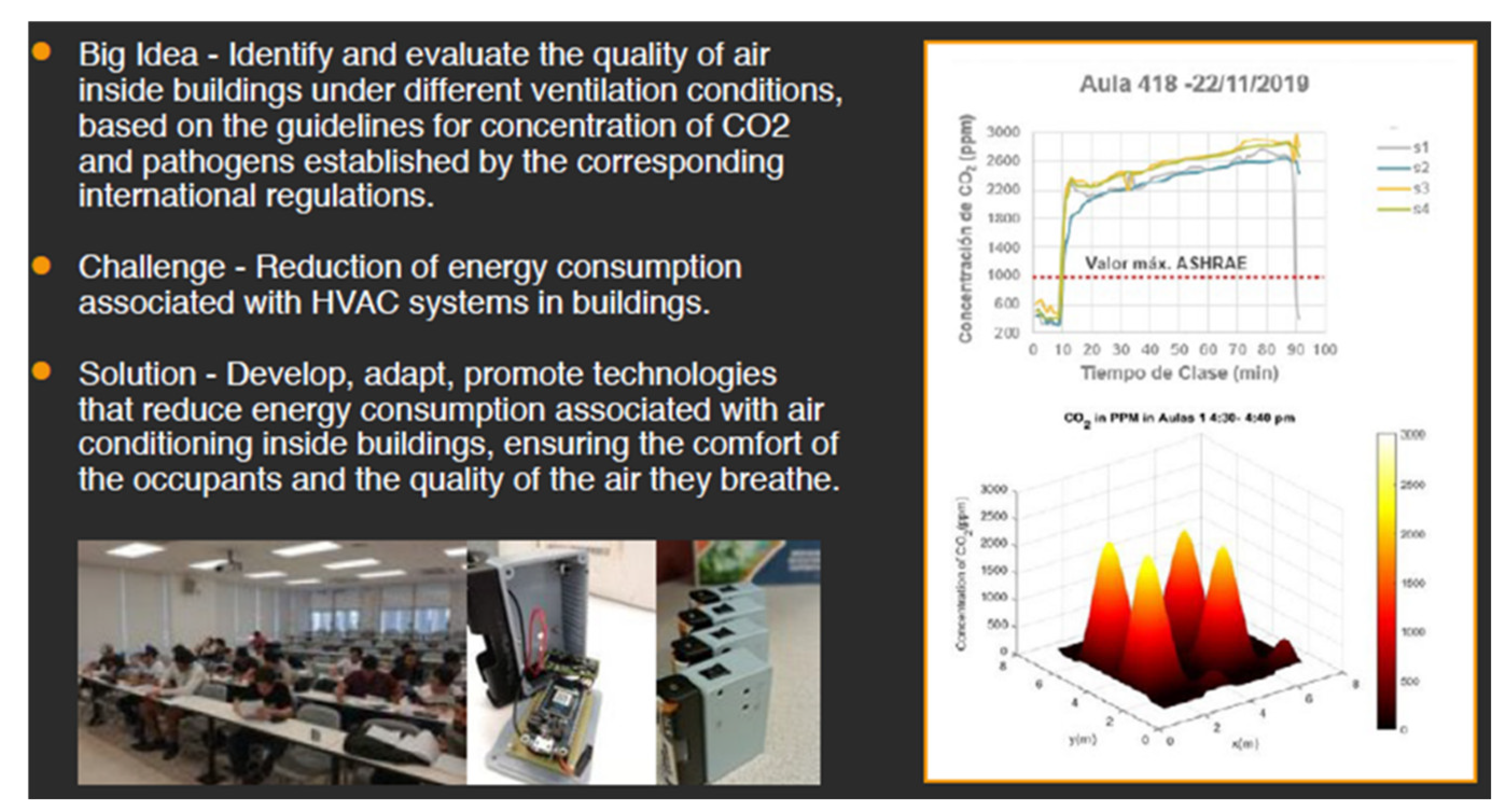
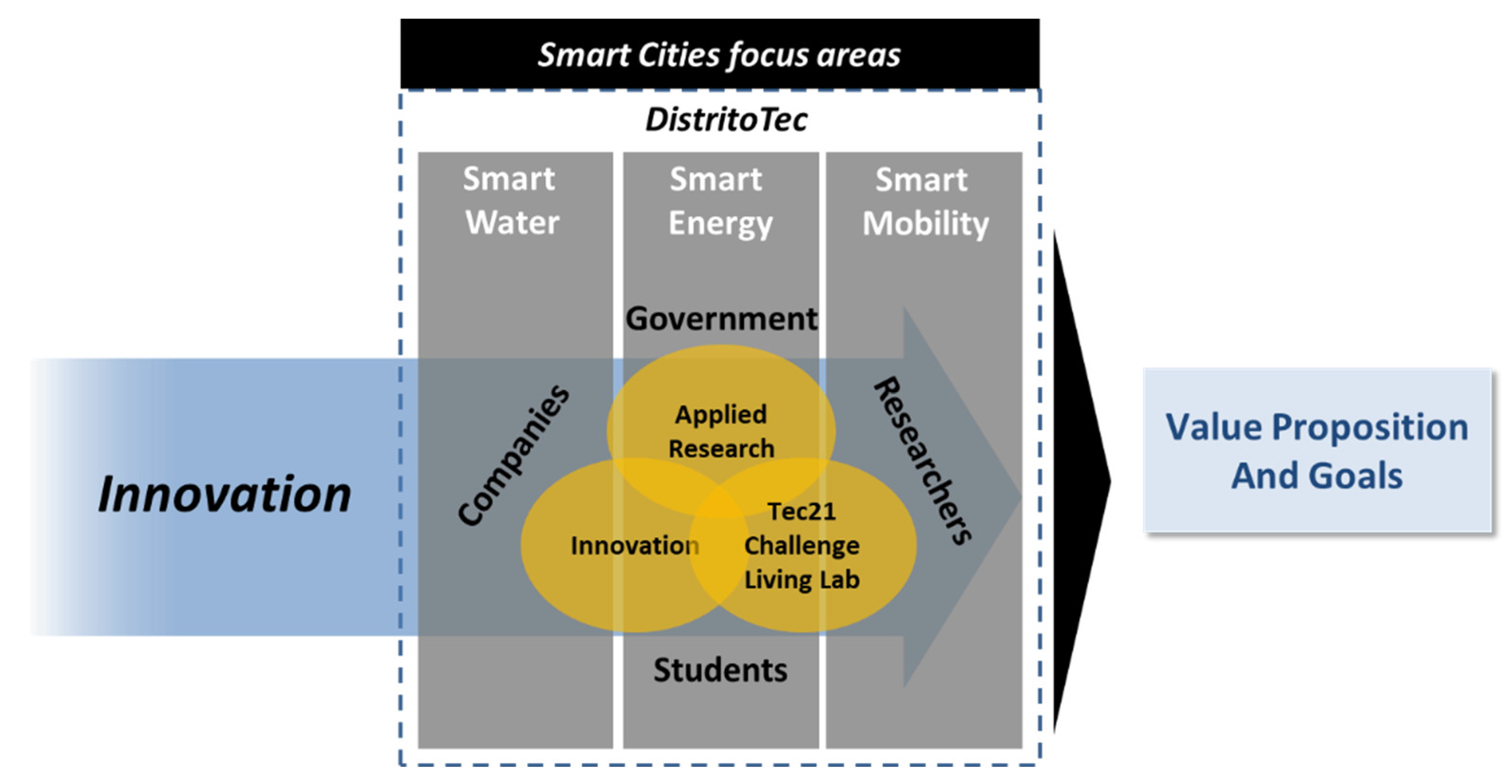
This work presents the Campus City initiative followed by the Challenge Living Lab platform to promote research, innovation, and entrepreneurship with the intention to create urban infrastructure and creative talent (human resources) that solves different community, industrial and government Pain Points within a Smart City ecosystem. The main contribution of this work is to present a working model and the open innovation ecosystem used in Tecnologico de Monterrey that could be used as both, a learning mechanism as well as a base model for scaling it up into a Smart Campus and Smart City. Moreover, this work presents the Smart Energy challenge as an example of a pedagogic opportunity for the development of competencies. This included the pedagogic design of the challenge, the methodology followed by the students and the results. Finally, a discussion on the findings and learnings of the model and challenge implementation. Results showed that Campus City initiative and the Challenge Living Lab allows the identification of highly relevant and meaningful challenges while providing a pedagogic framework in which students are highly motivated, engaged, and prepared to tackle different problems that involve government, community, industry, and academia.
Keywords: smart water/energy/mobility; open innovation; challenge living lab; smart city; challenge-based learning smart water/energy/mobility; open innovation; challenge living lab; smart city; challenge-based learning