Article

Building a Reputation Attack Detector for Effective Trust Evaluation in a Cloud Services Environment
by
Salah T. Alshammari
* and
Khalid Alsubhi
Department of Computer Science, College of Computing and Information Technology, King Abdulaziz University, Jeddah 21589, Saudi Arabia
*
Author to whom correspondence should be addressed.
Appl. Sci. 2021, 11(18), 8496; https://doi.org/10.3390/app11188496
Submission received: 1 August 2021 / Revised: 28 August 2021 / Accepted: 1 September 2021 / Published: 13 September 2021

Abstract

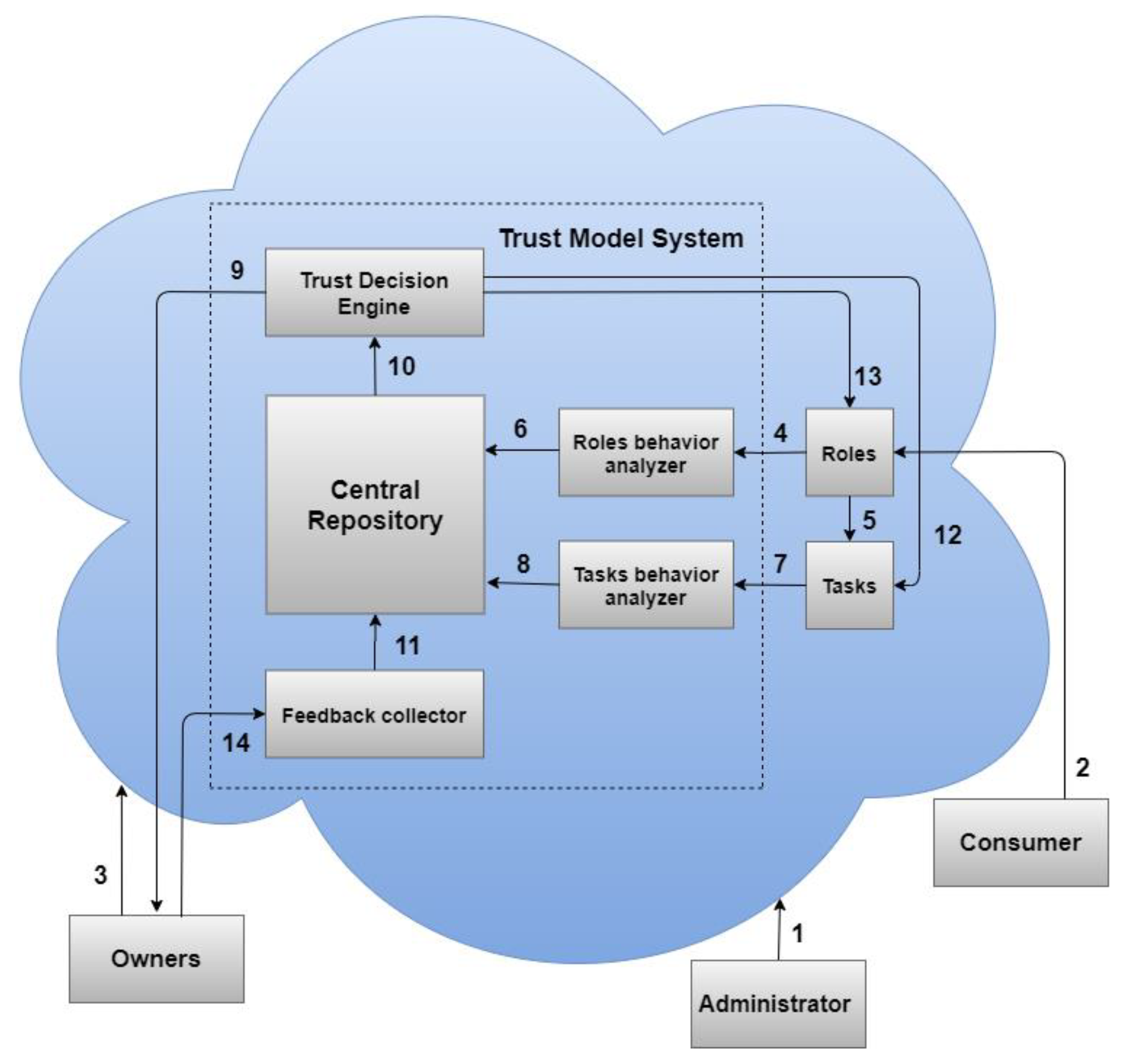
Cloud computing is a widely used technology that has changed the way people and organizations store and access information. This technology is versatile, and extensive amounts of data can be stored in the cloud. Businesses can access various services over the cloud without having to install applications. However, cloud computing services are provided over a public domain, which means that both trusted and non-trusted users can access the services. Although there are a number of advantages to cloud computing services, especially for business owners, various challenges are posed in terms of the privacy and security of information and online services. A threat that is widely faced in the cloud environment is the on/off attack, in which entities exhibit proper behavior for a given time period to develop a positive reputation and gather trust, after which they exhibit deception. Another threat often faced by trust management services is a collusion attack, which is also known as collusive malicious feedback behavior. This is carried out when a group of people work together to make false recommendations with the intention of damaging the reputation of another party, which is referred to as a slandering attack, or to enhance their own reputation, which is referred to as a self-promoting attack. In this paper, a viable solution is provided with the given trust model for preventing these attacks. This method works by providing effective security to cloud services by identifying malicious and inappropriate behaviors through the application of trust algorithms that can identify on/off attacks and collusion attacks by applying different security criteria. Finally, the results show that the proposed trust model system can provide high security by decreasing security risk and improving the quality of decisions of data owners and cloud operators.
Keywords: trust model; reputation attacks; cloud computing; on/off attack; collusion attack; cloud services trust model; reputation attacks; cloud computing; on/off attack; collusion attack; cloud services