Comprehensive Review and Future Research Directions on Dynamic Faceted Search
 , ,
, , 
Abstract
1. Introduction
2. Preliminary Study
2.1. Search Engines
2.2. Search Directories
2.3. Form-Based Search
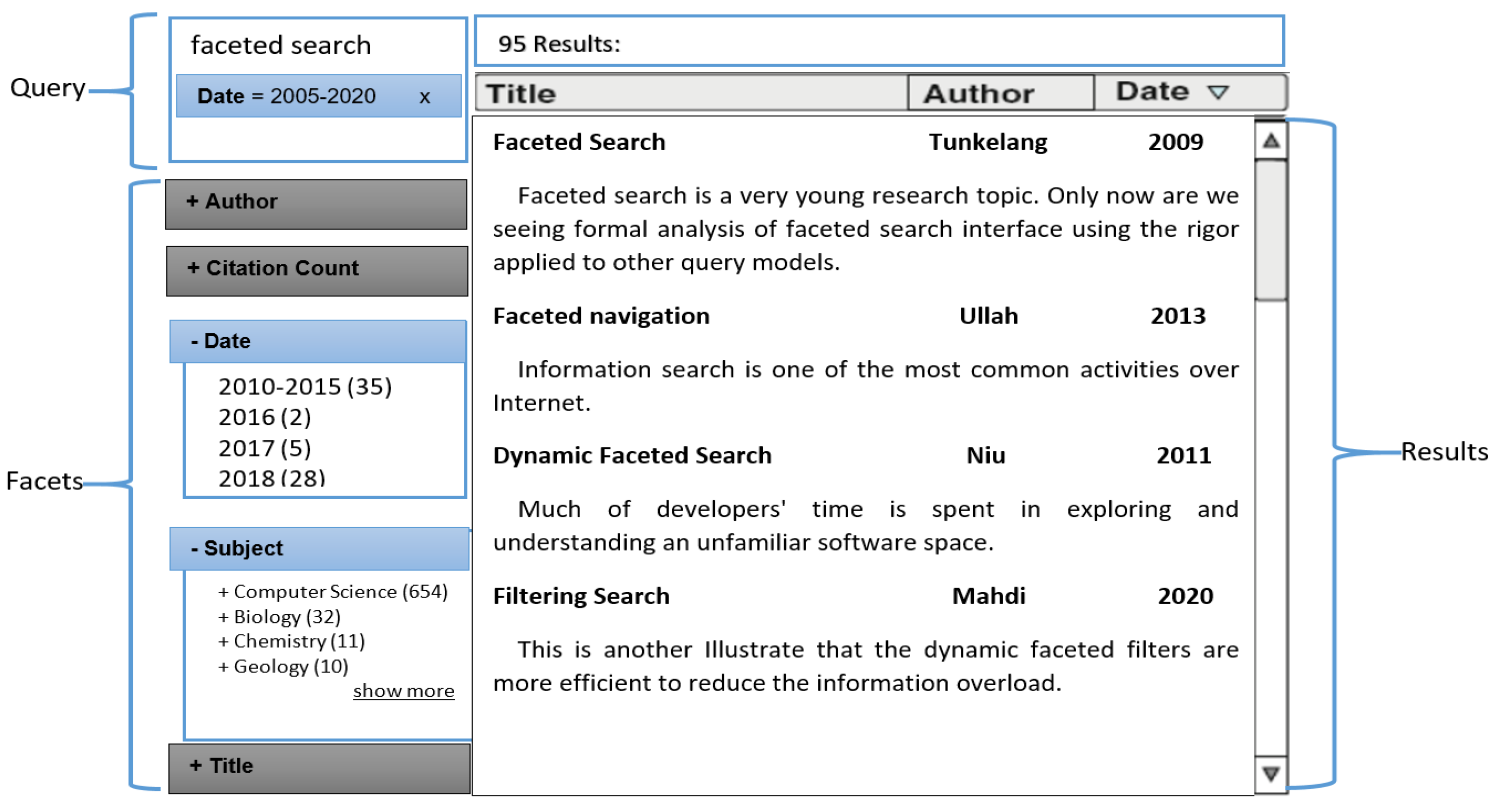
2.4. Faceted Search
2.5. Research Questions
- RQ1.
- What does the existing research literature reveal about the faceted search approach of web search service providers?
- RQ2.
- What are the primary aims, vision, and trends for faceted search, and what research can be highlighted in this area?
- RQ3.
- What are the existing gaps for research prospects in the faceted search approach for web search services?
- RQ4.
- What are the existing motivations for usage, concerns, challenges, and recommendations to enhance the faceted approach of web search service providers?
- RQ5.
- What are the points of interest, such as the architecture, applications, issues, research questions, motivations, recommendation criteria, and open challenges, in using faceted search?
3. Theoretical Foundations
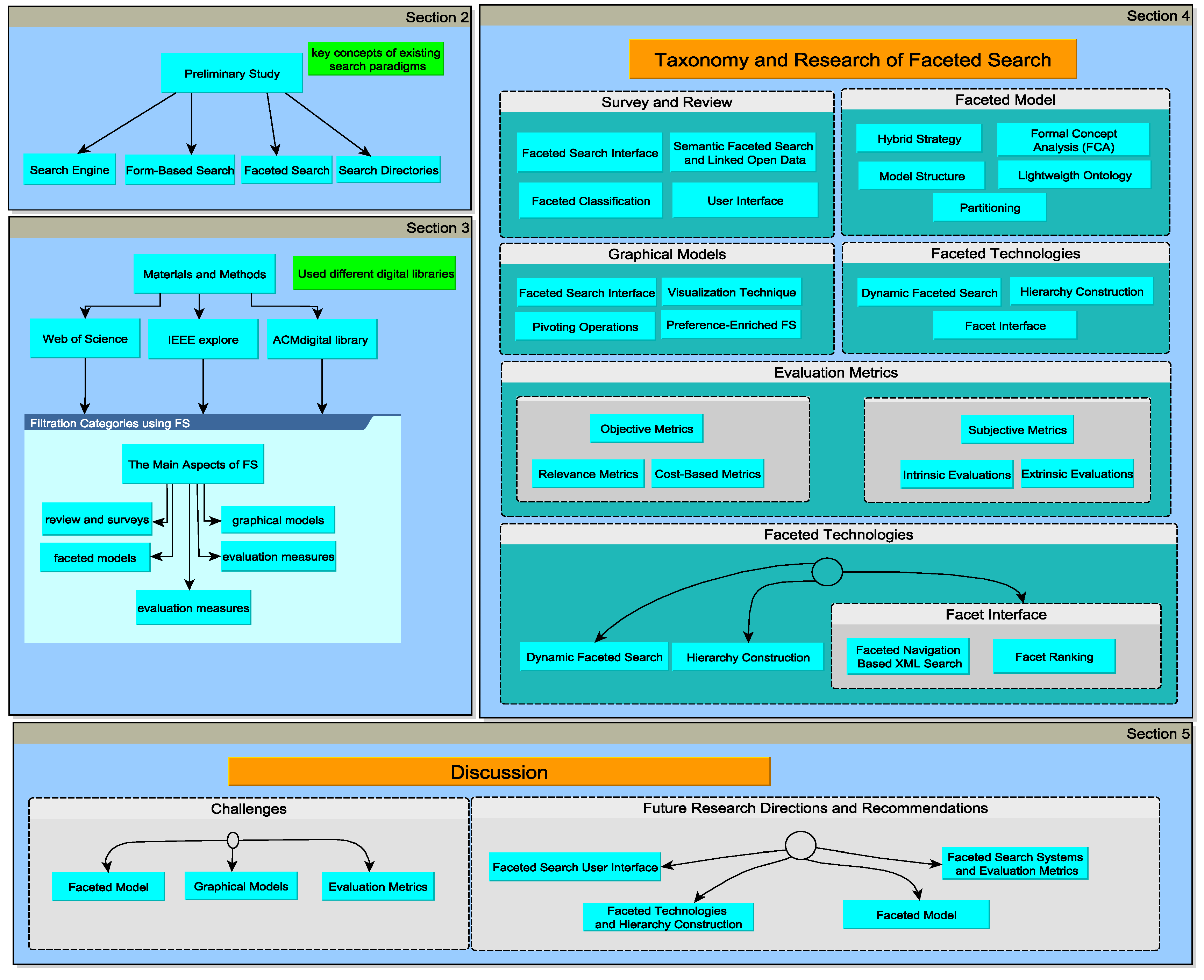
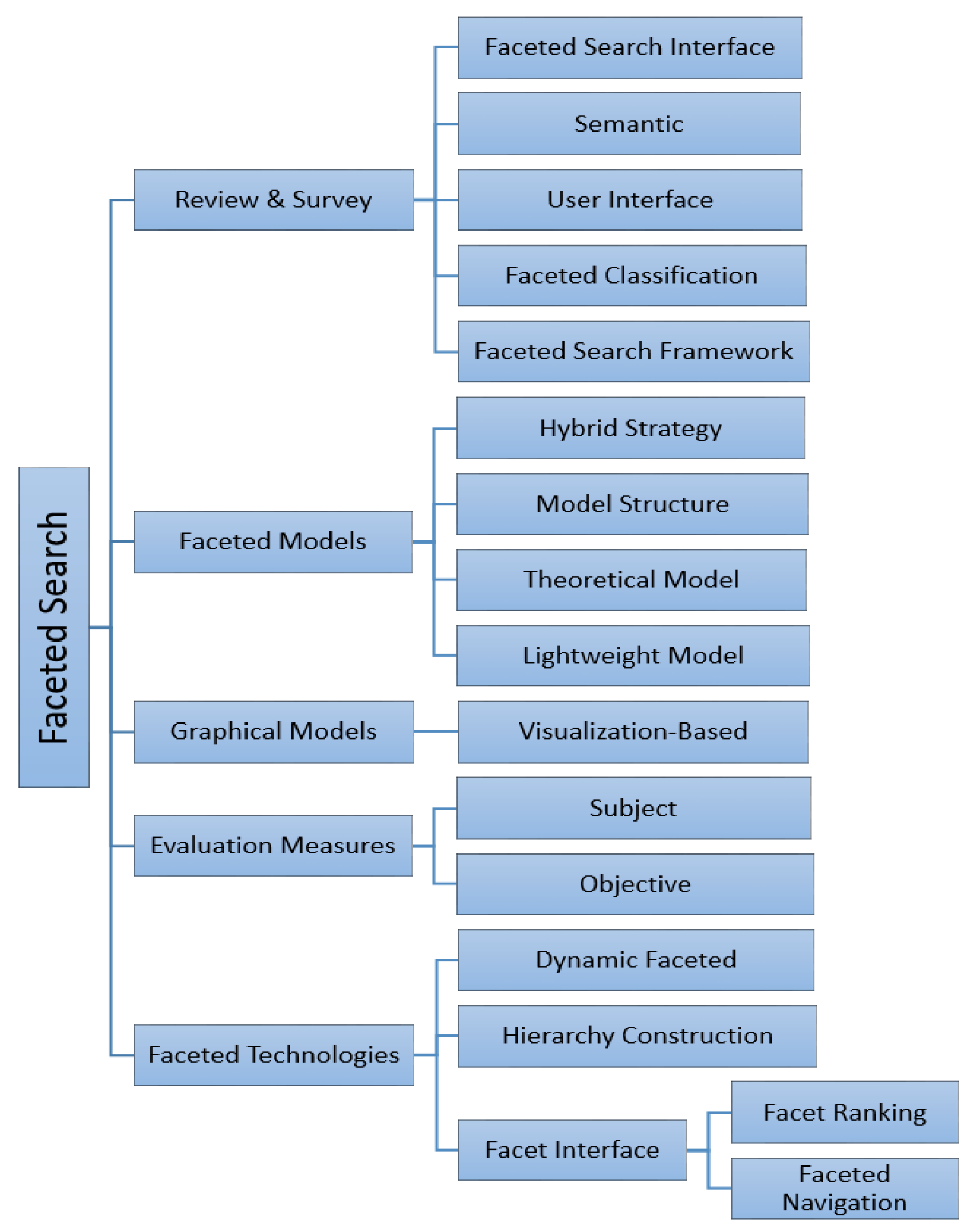
- Review and survey: The current state-of-the-art of faceted search and its applications are well described and summarized in the recently published survey and review articles and the technological challenges and concerns of faceted search;
- Faceted technologies: We focus on the fundamental idea of FS, which is to solicit and capture keywords supplied by a user from which to prune out branches of the hierarchy irrelevant to the user’s informational need. A taxonomy can serve as more than a means to representing knowledge: its organization of information can also enable us to make information accessible and findable [8];
- Evaluation measures: To evaluate exploratory search systems, we must target the longer-term effect on the user of using this cognitive prosthetic and the current task performance. Evaluation metrics facilitate the incremental improvement of search technologies by assessing system performance and reducing comparisons between experimental systems. Process-specific measures of learning, mental transformation, confidence, engagement, and affect are essential and result in relevance and utility across multiple query iterations and search sessions [6,22].
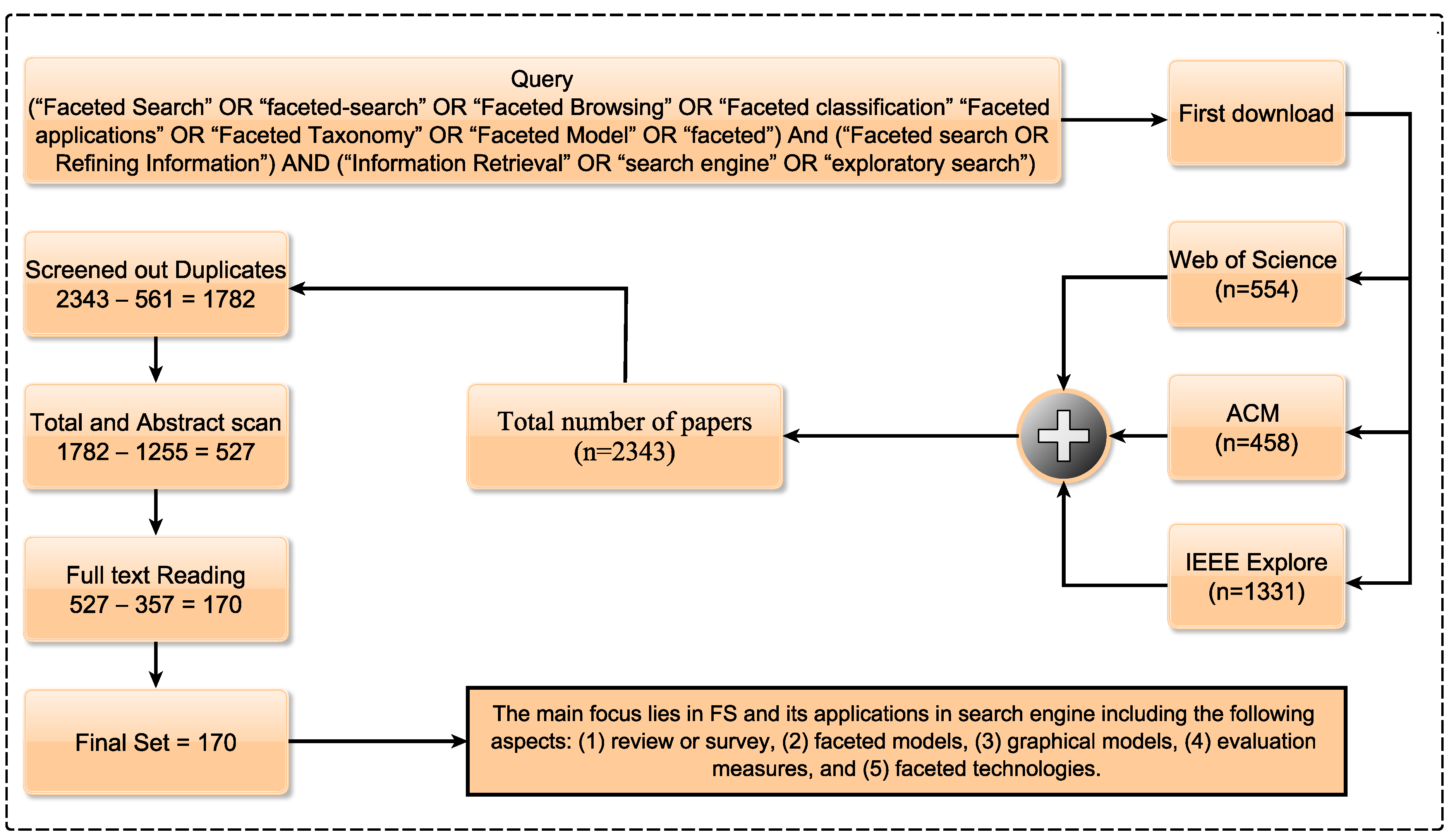
4. Materials and Methods
5. Taxonomy and Research of Faceted Search
- RQ1.
- What does the existing research literature reveal about the faceted search approach of web search service providers?
5.1. Survey and Review
- FS interface: The papers in this subcategory investigated the framework or the platform model based on the prototype that will be developed. One paper [25] dissected the behavioral characteristics of ES and identified six tasks, namely: knowledge acquisition, comparison, planning, finding, answering, and navigating questions. These comparisons helped in evaluating the compatibility of this report and discovery on various sorting experiments;
- Semantic FS and linked open data: The papers in this subcategory surveyed the most recent studies concerning RDF/S datasets and elaborated on the interaction of session-based approaches for ES. Three papers [26,27,28] focused on several aspects of these datasets, including the assumed target user, the configuration of the underlying information structure, and the generality and features of the browsing structure. The article [29] developed several evaluation models that adopted a user-centered ES method. The complexities and obstacles in ES were also discussed, as seen by the lack of strategies for evaluating ES models. One paper [30] proposed a comprehensive tutorial. This new information visualization mechanism can help users create informed design considerations about integrating information visualization into their interactive information search;
- User interface: The papers under this category presented an improved user interface design for FS. Among the collected research articles, two papers [31,32] reviewed the concept of ES and its primary theoretical grounds and explained such a complex concept by demonstrating the context of its problem and its search procedure. They also predicted the direction of advancements in the ES area depending on the social state of information search. The authors of [9,33,34,35,36] studied the development of new decision support tools and explored the visual knowledge system. The main contribution of these studies was to find out how a system can achieve the intended enhancement based on the survey that was performed on the projects by using meta requirements. The authors argued that enterprise users in petroleum manufacturing, for instance, can help explore the SE results related to word repetition filters. Other collected studies presented an overview of FS. The research in the library of “future-generation” catalogs that combine FS outcomes was later evaluated based on the questions of what is known by now regarding FS and the way to design improved research for FS in library catalogs [37,38,39,40,41];
- Faceted classification: These analyzed the interface that enables faster and easier access to the required information. The articles [42,43] discussed six main facets of searches: query sessions, space, user attitude, technical requirements, space of contents, and user racial background. They also presented an interface that enables smoother access to the required information, which illustrates the motivations and needs for FS. The lack of all organizations can further summarize the result of faster and easier access to all sorts of information;
- Faceted search framework: The papers in this subcategory investigated visualizing browsing and refining search results to allow users to build complex search queries visually. This proposed FS can also solve the problem of lexical uncertainty in current search engines and result in greater user interest [44,45].
- RQ2.
- What are the primary aims, vision, and trends for faceted search, and what research can be highlighted in this area?
5.2. Faceted Model
5.3. Graphical Models
5.4. Evaluation Metrics
- RQ3.
- What are the existing gaps for research prospects in the faceted search approach of web search services?
5.4.1. Objective Metrics
- Relevance metrics: In FS, the matching between data items and facet terms in many cases is predetermined. Only a tiny number of FS systems support the automatic classification of search results based on facet terms [22,110]. Therefore, the relevant metrics of FS results are always high. However, the community of information retrieval has introduced several metrics to describe FS’s binary and graded relevance. For binary relevance, the E-measure with their macro and micro forms, the F-measure, precision, and recall are considered primary metrics. For instance, the authors of [111,112] employed micro-F1, macro-precision, and macro-recall to evaluate the results of the deep classifier in FS. Moreover, Gomadam used precision and recall to measure the search process of FS. Meanwhile, the rank-biased precision [113], normalized discounted cumulative gain [114], mean reciprocal rank [115], binary preference [116], and mean average precision [117] are considered as the main graded relevance metrics [118,119,120]. Alternatively, [76,121,122,123] exploited normalized discounted cumulative gain to rank the output of their facet discovery algorithms.
- Cost-based metrics: These are used to investigate the time consumption and memory usage of the FS system. In this regard, one paper [124] calculated the completion time of retrieval tasks to describe the efficiency of FS in mobile devices. Furthermore, [125] applied two cost-based metrics: the time spent on calculating the number of attribute–value pairs of facet terms and the memory usage in the index storing process [126,127,128].
5.4.2. Subjective Metrics
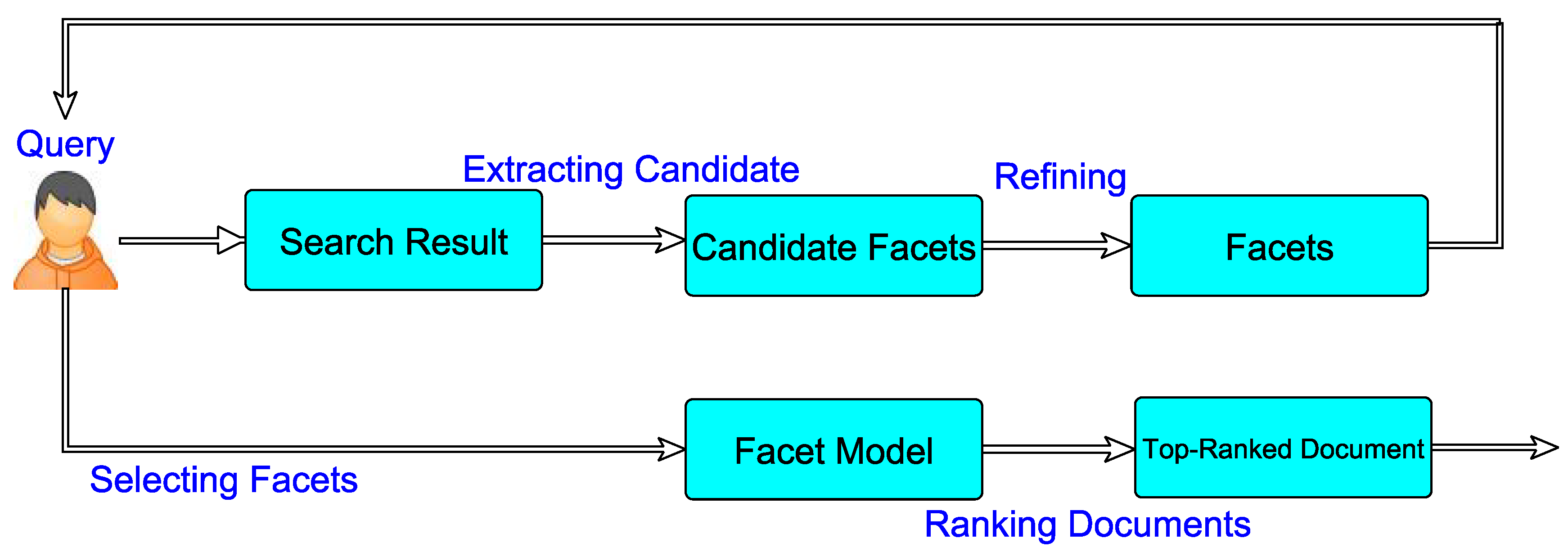
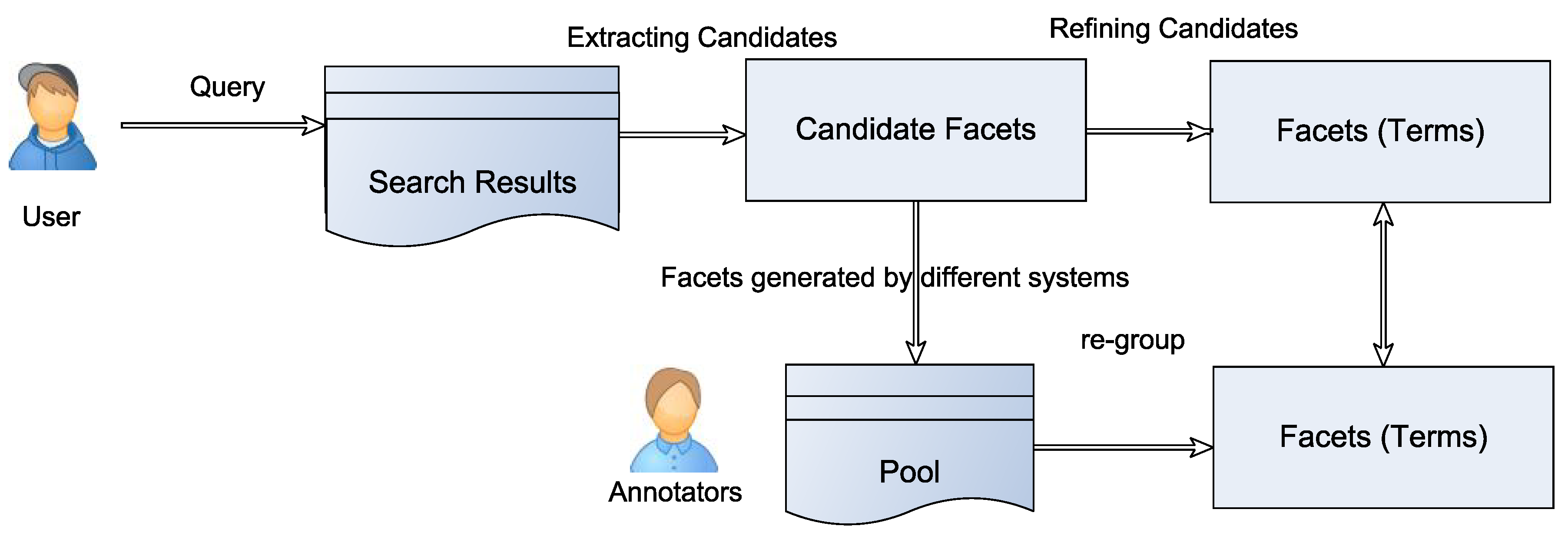
- Intrinsic evaluations: Standard query facets are built by human annotators and used as the ground truth to compare with facets produced by separate schemes [136,137]. Usually, facet annotation is performed by first pooling facets produced by the separate schemes [138,139]. Annotators are then asked to group or regroup terms into preferred query facets in the pool and to offer scores for each of the query facets [140,141], as can be seen in Figure 7.
- Extrinsic evaluation: This is a system based on an interactive search task that incorporates FS [142,143]. The general extrinsic evaluation steps for a faceted search system are as follows: (1) evaluate a system based on an interactive search task that incorporates FS; (2) the gain can be measured by the improvement of the reranked results; (3) the cost can be measured by the time spent by the users giving facet feedback; (4) based on the user model, we can estimate the time cost for the user, as can be seen in Figure 8.
5.5. Faceted Technologies
5.5.1. Dynamic Faceted Search
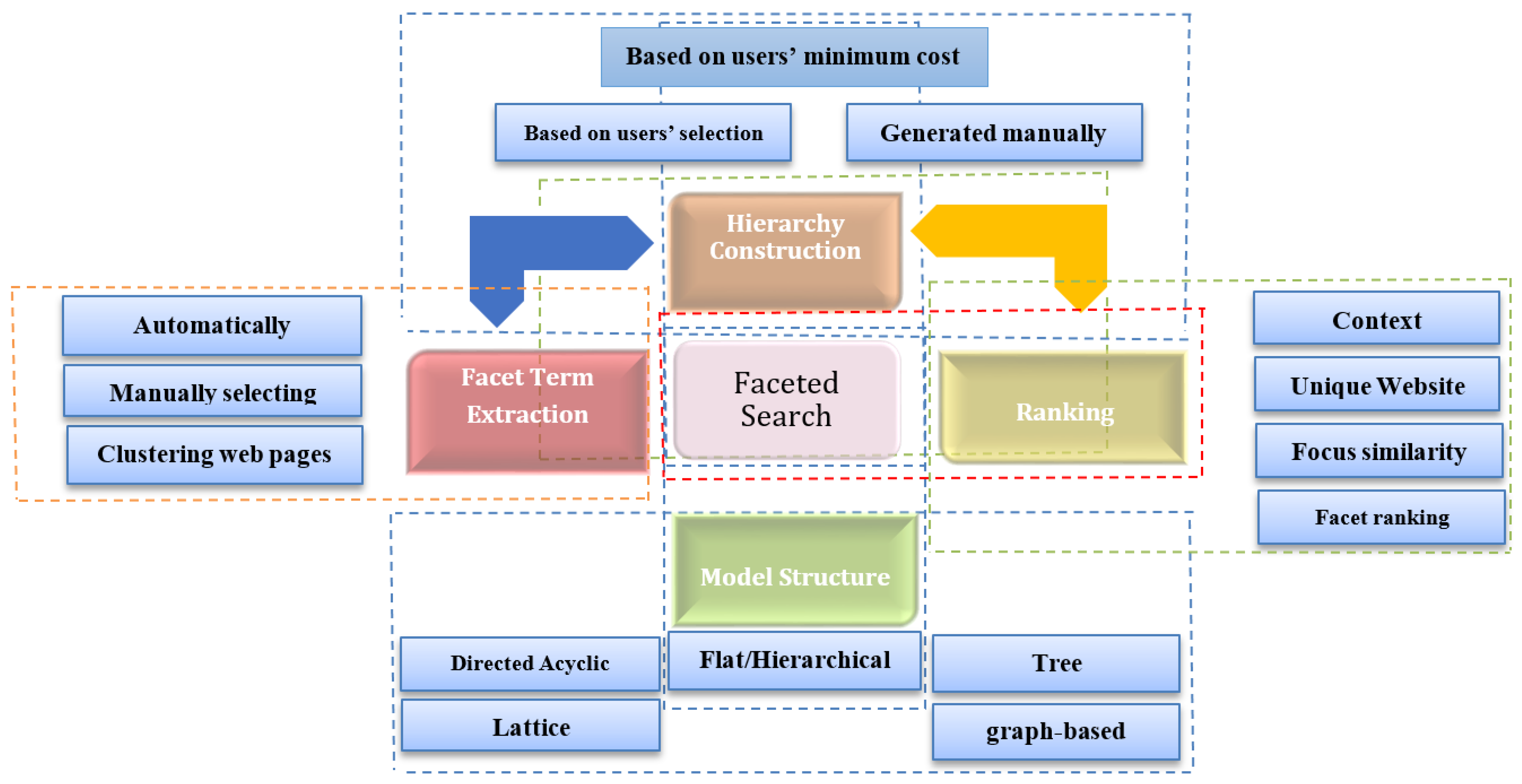
5.5.2. Hierarchy Construction
5.5.3. Facet Interface
- Facet ranking: If too many facets or facet terms exist, or the user interface has limited space to show most of them, only certain facets or terms are required. This needs a classification of the facets and conditions to select the most significant facets. The literature recognized two main types of facet ratings autonomous facets and the corresponding facets. The leading e-commerce sites (Amazon, eBay) use the FS of structured data, which typically shows all aspects of the present search result collection that are relevant. When too many attributes exist for one facet, the most common is displayed to the user, and the remainder is hidden with a “more” button. The first FS introductory version describes facets of an app with a user interface perspective. Standings in combination with a faced interface could be applied [162,163]. The autonomous fact-based evaluation techniques are primarily dependent on the identification ability of facet-based frequencies [164,165,166,167].
- Faceted navigation-based XML search: For many applications, XML is now the conventional data format, and accurate recovery techniques are desired. Generally, there are approximately two types of recall methods, notably path-based methods and search for keywords, and they do not work if users do not need any tangible data. This is to increase XML data recovery effectiveness [185].
6. Discussion
- RQ4.
- What are the existing motivations for usage, concerns, challenges, and recommendations to enhance the use of the faceted approach of web search service providers?
6.1. Challenges
6.1.1. Faceted Model
6.1.2. Graphical Models
6.1.3. Evaluation Metrics
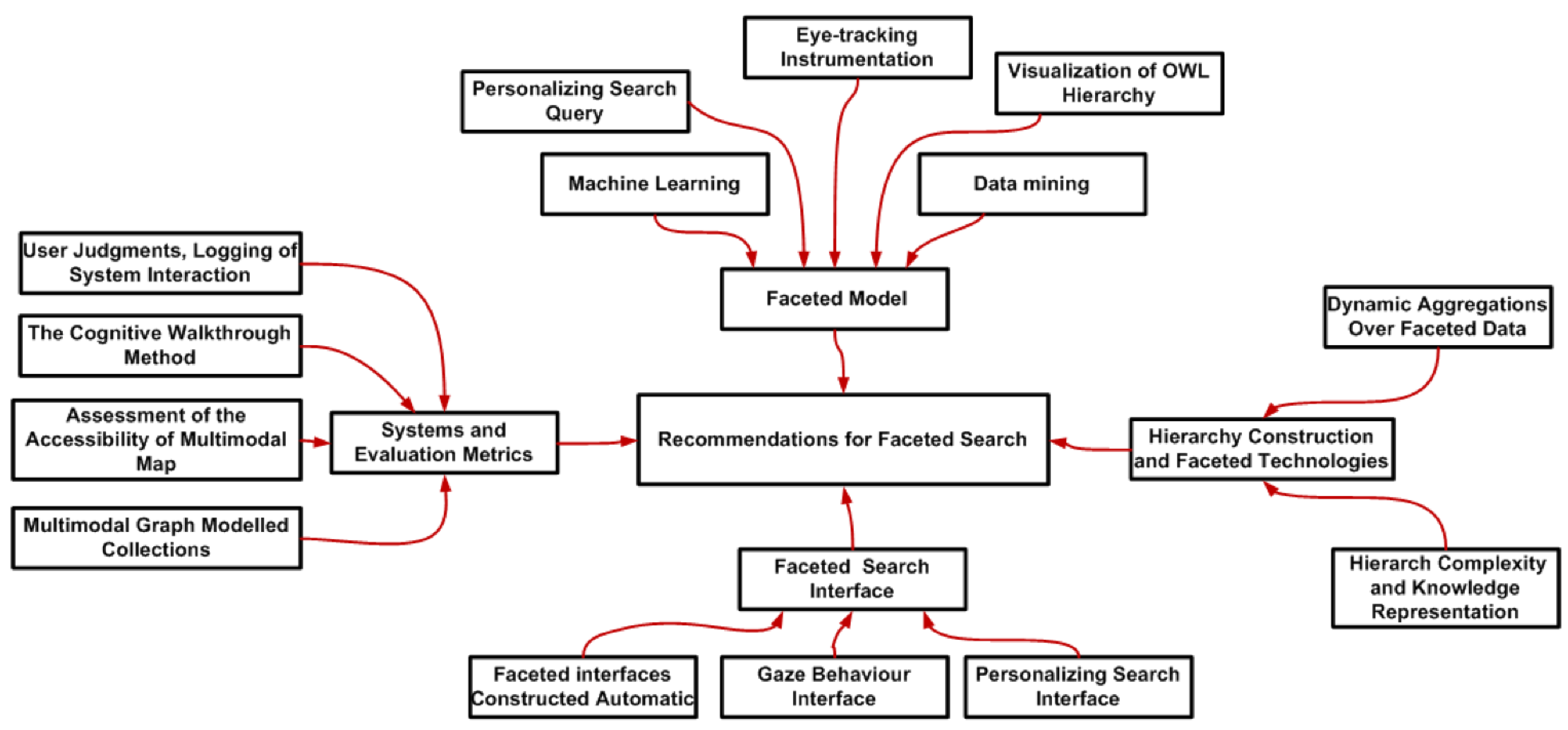
6.2. Future Research Directions and Recommendations
6.2.1. Faceted Search User Interface
6.2.2. Faceted Model
6.2.3. Faceted Search Systems and Evaluation Metrics
- RQ5.
- What are the points of interest, such as the architecture, applications, issues, research questions, motivations, recommendation criteria, and open challenges, in using faceted search?
6.2.4. Faceted Technologies and Hierarchy Construction
7. Conclusions
Author Contributions
Funding
Institutional Review Board Statement
Informed Consent Statement
Data Availability Statement
Acknowledgments
Conflicts of Interest
References
- Nargesian, F.; Pu, K.Q.; Zhu, E.; Bashardoost, B.G.; Miller, R.J. Organizing Data Lakes for Navigation. In Proceedings of the 2020 ACM SIGMOD International Conference on Management of Data, Portland, OR, USA, 14–19 June 2020; pp. 1939–1950. [Google Scholar]
- Jo, Y.; Wi, J.; Kim, M.; Lee, J.Y. Flexible Fashion Product Retrieval Using Multimodality-Based Deep Learning. Appl. Sci. 2020, 10, 1569. [Google Scholar] [CrossRef]
- Xu, J.; Croft, W.B. Quary Expansion Using Local and Global Document Analysis. SIGIR Forum 2017, 51, 168–175. [Google Scholar] [CrossRef]
- Sacco, G.M. SAES: An Introduction to Self-Adapting Exploratory Structures. Future Internet 2019, 11, 54. [Google Scholar] [CrossRef]
- Langville, A.N.; Meyer, C.D. Google’s PageRank and Beyond: The Science of Search Engine Rankings; Princeton University Press: Princeton, NJ, USA, 2011. [Google Scholar]
- White, R.W.; Roth, R.A. Exploratory Search: Beyond the Query-Response Paradigm; Synthesis Lectures on Information Concepts, Retrieval & Services; Morgan and Claypool Publishers: San Rafael, CA, USA, 2009; Volume 3. [Google Scholar]
- Marchionini, G. Exploratory search: From finding to understanding. Commun. ACM 2006, 49, 41–46. [Google Scholar] [CrossRef]
- Tunkelang, D. Faceted Search; Synthesis Lectures on Information Concepts, Retrieval, and Services; Morgan & Claypool Publishers: San Rafael, CA, USA, 2009; Volume 1, pp. 1–80. [Google Scholar]
- Mahdi, M.N.; Ahmad, A.R.; Ismail, R.; Natiq, H.; Mohammed, M.A. Solution for Information Overload Using Faceted Search—A Review. IEEE Access 2020, 8, 119554–119585. [Google Scholar] [CrossRef]
- Wang, M.; Li, D. An empirical investigation of the continuance intention using the bullet curtain: Synchronicity vs information overload. Chin. Manag. Stud. 2019, 13, 235–254. [Google Scholar] [CrossRef]
- Büttcher, S.; Clarke, C.L.; Cormack, G.V. Information Retrieval: Implementing and Evaluating Search Engines; Mit Press: Cambridge, MA, USA, 2016. [Google Scholar]
- Singer, G.; Danilov, D.; Norbisrath, U. Complex search: Aggregation, discovery, and synthesis. Proc. Est. Acad. Sci. 2012, 61, 89. [Google Scholar] [CrossRef]
- Nightingale, A. A guide to systematic literature reviews. Surgery (Oxford) 2009, 27, 381–384. [Google Scholar] [CrossRef]
- Munn, Z.; Peters, M.D.; Stern, C.; Tufanaru, C.; McArthur, A.; Aromataris, E. Systematic review or scoping review? Guidance for authors when choosing between a systematic or scoping review approach. BMC Med. Res. Methodol. 2018, 18, 143. [Google Scholar] [CrossRef]
- Okoli, C. A guide to conducting a standalone systematic literature review. Commun. Assoc. Inf. Syst. 2015, 37, 43. [Google Scholar] [CrossRef]
- Pollitt, A.S. A common query interface using MenUSE—A MeNU-based user search engine. Int. Online Inf. Meet. 1988, 12, 444–457. [Google Scholar]
- Mahdi, M.N.; Ahmad, A.R.; Ismail, R. Improving faceted search results for web-based information exploration. Int. J. Adv. Sci. Eng. Inf. Technol. 2020, 10, 1143–1152. [Google Scholar] [CrossRef]
- Capra, R.; Marchionini, G. Faceted Browsing, Dynamic Interfaces, and Exploratory Search: Experiences and Challenges. In Proceedings of the Workshop on Human-Computer Interaction and Information Retrieval, Cambridge, MA, USA, 23 October 2007; pp. 7–9. [Google Scholar]
- Yee, K.-P.; Swearingen, K.; Li, K.; Hearst, M. Faceted metadata for image search and browsing. In Proceedings of the SIGCHI Conference on Human Factors in Computing Systems, Lauderdale, FL, USA, 5–10 April 2003; pp. 401–408. [Google Scholar]
- Zhang, J.; Marchionini, G. Evaluation and evolution of a browse and search interface: Relation Browser++. In Proceedings of the 2005 National Conference on Digital Government Research, Atlanta, GA, USA, 15–18 May 2005; pp. 179–188. [Google Scholar]
- Capra, R.G.; Marchionini, G. The relation browser tool for faceted exploratory search. In Proceedings of the 8th ACM/IEEE-CS Joint Conference on Digital Libraries, Pittsburgh, PA, USA, 16–20 June 2008; p. 420. [Google Scholar]
- White, R.W.; Marchionini, G.; Muresan, G. Evaluating exploratory search systems: Introduction to special topic issue of information processing and management. Inf. Process. Manag. 2008, 44, 433–436. [Google Scholar] [CrossRef]
- Vickery, B. Faceted classification for the web. Axiomathes 2008, 18, 145–160. [Google Scholar] [CrossRef]
- Zheng, B.; Zhang, W.; Feng, X.F.B. A survey of faceted search. J. web Eng. 2013, 12, 41–64. [Google Scholar]
- Athukorala, K.; Głowacka, D.; Jacucci, G.; Oulasvirta, A.; Vreeken, J. Is exploratory search different? A comparison of information search behavior for exploratory and lookup tasks. J. Assoc. Inf. Sci. Technol. 2016, 67, 2635–2651. [Google Scholar] [CrossRef]
- Tzitzikas, Y.; Manolis, N.; Papadakos, P. Faceted exploration of RDF/S datasets: A survey. J. Intell. Inf. Syst. 2017, 48, 329–364. [Google Scholar] [CrossRef]
- Jacksi, K.; Dimililer, N.; Zeebaree, S.R. A survey of exploratory search systems based on LOD resources. In Proceedings of the 5th International Conference on Computing and Informatics (ICOCI), Istanbul, Turkey, 11–13 August 2015; pp. 501–509. [Google Scholar]
- Palagi, E.; Gandon, F.; Giboin, A.; Troncy, R. A Survey of Definitions and Models of Exploratory Search. In Proceedings of the 2017 ACM Workshop on Exploratory Search and Interactive Data Analytics, Limassol, Cyprus, 13 March 2017; pp. 3–8. [Google Scholar]
- Hoeber, O. Information Visualization for Interactive Information Retrieval. In Proceedings of the 2018 Conference on Human Information Interaction & Retrieval, New Brunswick, NJ, USA, 11–15 March 2018; pp. 371–374. [Google Scholar]
- Marie, N.; Gandon, F. Survey of linked data based exploration systems. In Proceedings of the IESD 2014—Intelligent Exploitation of Semantic Data, Riva del Garda, Italy, 19–23 October 2014. [Google Scholar]
- Jiang, T. Exploratory search: A critical analysis of the theoretical foundations, system features, and research trends. In Library and Information Sciences; Springer: Berlin/Heidelberg, Germany, 2014; pp. 79–103. [Google Scholar]
- Zheng, G.; Vaishnavi, V. A multidimensional and visual exploration approach to project prioritization and selection. In Proceedings of the AMCIS 2009 Proceedings, San Francisco, CA, USA, 6–9 August 2009; p. 129. [Google Scholar]
- Cleverley, P.H.; Burnett, S.; Muir, L. Exploratory information searching in the enterprise: A study of user satisfaction and task performance. J. Assoc. Inf. Sci. Technol. 2017, 68, 77–96. [Google Scholar] [CrossRef]
- Fagan, J.C. Usability studies of faceted browsing: A literature review. Inf. Technol. Libr. 2010, 29, 58–66. [Google Scholar] [CrossRef]
- Mahdi, M.N.; Ahmad, A.R.; Ismail, R.; Subhi, M. Review of Techniques in Faceted Search Applications. In Proceedings of the 2020 International Symposium on Networks, Computers and Communications (ISNCC), Montreal, QC, Canada, 20–22 October 2020; pp. 1–5. [Google Scholar]
- Kules, B.; Capra, R.; Banta, M.; Sierra, T. What do exploratory searchers look at in a faceted search interface? In Proceedings of the 9th ACM/IEEE-CS Joint Conference on Digital Libraries, Austin, TX, USA, 14–19 June 2009; pp. 313–322. [Google Scholar]
- Tzitzikas, Y.; Analyti, A. Faceted taxonomy-based information management. In Proceedings of the 18th International Workshop on Database and Expert Systems Applications (DEXA 2007), Regensburg, Germany, 3–7 September 2007; pp. 207–211. [Google Scholar]
- Perugini, S. Supporting multiple paths to objects in information hierarchies: Faceted classification, faceted search, and symbolic links. Inf. Process. Manag. 2010, 46, 22–43. [Google Scholar] [CrossRef]
- Kehrer, J.; Hauser, H. Visualization and visual analysis of multifaceted scientific data: A survey. IEEE Trans. Vis. Comput. Graph. 2013, 19, 495–513. [Google Scholar] [CrossRef]
- Polowinski, J. Widgets for faceted browsing. In Symposium on Human Interface; Springer: Berlin/Heidelberg, Germany, 2009; pp. 601–610. [Google Scholar]
- Mahdi, M.N.; Ahmad, A.R.; Ismail, R.; Subhi, M.A.; Abdulrazzaq, M.M.; Qassim, Q.S. Information Overload: The Effects of Large Amounts of Information. In Proceedings of the 2020 1st Information Technology to Enhance e-Learning and Other Application (IT-ELA), Baghdad, Iraq, 12–13 July 2020; pp. 154–159. [Google Scholar]
- Pass, G.; Chowdhury, A.; Torgeson, C. A picture of search. In Proceedings of the 1st International Conference on Scalable Information Systems, Hong Kong, China, 30 May–1 June 2006; p. 1. [Google Scholar]
- Dumais, S. Faceted search. In Encyclopedia of Database Systems; Springer: Boston, MA, USA, 2009; pp. 1103–1109. [Google Scholar]
- Mahdi, M.N.; Ahmad, A.R.; Ismail, R.; Subhi, M.A. Improving Big Data Technologies with Visual Faceted Search. In Proceedings of the 2020 8th International Conference on Information Technology and Multimedia (ICIMU), Beijing, China, 4–6 December 2021; pp. 44–49. [Google Scholar]
- Mahdi, M.N.; Ahmad, A.R.; Subhi, M.A.; Ismail, R.; Qassim, Q.S. Visualization in Faceted Search Engine-A Review. In Proceedings of the 2020 IEEE Conference on Big Data and Analytics (ICBDA), Kota Kinabalu, Malaysia, 17–19 November 2020; pp. 84–89. [Google Scholar]
- Herceg, P.M.; Allison, T.B.; Belvin, R.S.; Tzoukermann, E. Collaborative exploratory search for information filtering and large-scale information triage. J. Assoc. Inf. Sci. Technol. 2018, 69, 395–409. [Google Scholar] [CrossRef]
- Sarkas, N.; Bansal, N.; Das, G.; Koudas, N. Measure-driven keyword-query expansion. Proc. Vldb Endow. 2009, 2, 121–132. [Google Scholar] [CrossRef]
- Liberman, S.; Lempel, R. Approximately optimal facet value selection. Sci. Comput. Program. 2014, 94, 18–31. [Google Scholar] [CrossRef]
- Wille, R. Restructuring lattice theory: An approach based on hierarchies of concepts. In Proceedings of the International Conference on Formal Concept Analysis, Frankfurt, Germany, 25–28 June 2009; pp. 314–339. [Google Scholar]
- Giunchiglia, F.; Marchese, M.; Zaihrayeu, I. Encoding classifications into lightweight ontologies. In Journal on Data Semantics VIII; Springer: Berlin/Heidelberg, Germany, 2007; pp. 57–81. [Google Scholar]
- Robinson, A.C.; Quinn, S.D. A brute force method for spatially-enhanced multivariate facet analysis. Comput. Environ. Urban Syst. 2018, 69, 28–38. [Google Scholar] [CrossRef]
- Sabetghadam, S.; Lupu, M.; Bierig, R.; Rauber, A. A faceted approach to reachability analysis of graph modelled collections. Int. J. Multimed. Inf. Retr. 2018, 7, 157–1718. [Google Scholar] [CrossRef]
- Niu, X.; Fan, X.; Zhang, T. Understanding Faceted Search from Data Science and Human Factor Perspectives. Acm Trans. Inf. Syst. (TOIS) 2019, 37, 14. [Google Scholar] [CrossRef]
- Wei, B.; Liu, J.; Ma, J.; Zheng, Q.; Zhang, W.; Feng, B. DFT-extractor: A system to extract domain-specific faceted taxonomies from wikipedia. In Proceedings of the 22nd International Conference on World Wide Web, Rio de Janeiro, Brazil, 13–17 May 2013; pp. 277–280. [Google Scholar]
- Katayama, T.; Kawashima, S.; Okamoto, S.; Moriya, Y.; Chiba, H.; Naito, Y.; Fujisawa, T.; Mori, H.; Takagi, T. TogoGenome/TogoStanza: Modularized Semantic web genome database. Database 2019, 2019, bay132. [Google Scholar] [CrossRef]
- Chantamunee, S.; Fung, C.C.; Wong, K.W.; Dumkeaw, C. Knowledge discovery from thai research articles by solr-based faceted search. In Proceedings of the International Conference on Computing and Information Technology, Amman, Jordan, 11–12 July 2018; pp. 337–346. [Google Scholar]
- de Campos, L.M.; Fernández-Luna, J.M.; Huete, J.F.; Redondo-Expósito, L. Automatic construction of multi-faceted user profiles using text clustering and its application to expert recommendation and filtering problems. Knowl. Based Syst. 2020, 190, 105337. [Google Scholar] [CrossRef]
- Bogaard, T.; Hollink, L.; Wielemaker, J.; Hardman, L.; Ossenbruggen, J.V. Searching for old news: User interests and behavior within a national collection. In Proceedings of the 2019 Conference on Human Information Interaction and Retrieval, Scotland, UK, 10–14 March 2019; pp. 113–121. [Google Scholar]
- Le, T.K.; Ninh, V.T.; Dang-Nguyen, D.T.; Tran, M.T.; Zhou, L.; Redondo, P.; Smyth, S.; Gurrin, C. LifeSeeker: Interactive Lifelog Search Engine at LSC 2019. In Proceedings of the ACM Workshop on Lifelog Search Challenge, Ottawa, ON, Canada, 10–13 June 2019; pp. 37–40. [Google Scholar]
- Harris, D.R. Modeling Integration and Reuse of Heterogeneous Terminologies in Faceted Browsing Systems. In Proceedings of the 2016 IEEE 17th International Conference on Information Reuse and Integration (IRI), Pittsburgh, PA, USA, 28–30 July 2016; pp. 58–66. [Google Scholar]
- Dou, Z.; Jiang, Z.; Hu, S.; Wen, J.-R.; Song, R. Automatically mining facets for queries from their search results. IEEE Trans. Knowl. Data Eng. 2016, 28, 385–397. [Google Scholar] [CrossRef]
- Tzitzikas, Y.; Armenatzoglou, N.; Papadakos, P. FleXplorer: A framework for providing faceted and dynamic taxonomy-based information exploration. In Proceedings of the 2008 19th International Workshop on Database and Expert Systems Applications, Turin, Italy, 1–5 September 2008; pp. 392–396. [Google Scholar]
- Harris, D.R. Modeling reusable and interoperable faceted browsing systems with category theory. In Proceedings of the 2015 IEEE International Conference on Information Reuse and Integration (IRI), San Francisco, CA, USA, 13–15 August 2015; pp. 388–395. [Google Scholar]
- Miotto, R.; Jiang, S.; Weng, C. eTACTS: A method for dynamically filtering clinical trial search results. J. Biomed. Inform. 2013, 46, 1060–1067. [Google Scholar] [CrossRef][Green Version]
- Lee, B.; Smith, G.; Robertson, G.G.; Czerwinski, M.; Tan, D.S. FacetLens: Exposing trends and relationships to support sensemaking within faceted datasets. In Proceedings of the SIGCHI Conference on Human Factors in Computing Systems, Boston, MA, USA, 4–9 April 2009; pp. 1293–1302. [Google Scholar]
- Henry, M.J.; Hampton, S.; Endert, A.; Roberts, I.; Payne, D. Multifacet: A faceted interface for browsing large multimedia collections. In Proceedings of the 2013 IEEE International Symposium on Multimedia, Anaheim, CA, USA, 9–11 December 2013; pp. 347–350. [Google Scholar]
- Kokolaki, A.; Tzitzikas, Y. Facetize: An Interactive Tool for Cleaning and Transforming Datasets for Facilitating Exploratory Search. arXiv 2018, arXiv:1812.10734. [Google Scholar]
- Dachselt, R.; Frisch, M.; Weiland, M. FacetZoom: A continuous multi-scale widget for navigating hierarchical metadata. In Proceedings of the SIGCHI Conference on Human Factors in Computing Systems, Florence, Italy, 5–10 April 2008; pp. 1353–1356. [Google Scholar]
- Zong, N.; Kim, H.-G.; Nam, S. Constructing faceted taxonomy for heterogeneous entities based on object properties in linked data. Data Knowl. Eng. 2017, 112, 79–93. [Google Scholar] [CrossRef]
- Mauro, N.; Ardissono, L.; Hu, Z.F. Multi-faceted Trust-based Collaborative Filtering. In Proceedings of the 27th ACM Conference on User Modeling, Adaptation and Personalization, Larnaca, Cyprus, 9–12 June 2019; pp. 216–224. [Google Scholar]
- Rohatgi, S.; Karishma, Z.; Chhay, J.; Keesara, S.R.R.; Wu, J.; Caragea, C.; Giles, C.L. Covidseer: Extending the CORD-19 dataset. In Proceedings of the ACM Symposium on Document Engineering 2020, Virtual Event, 29 September–1 October 2020; pp. 1–4. [Google Scholar]
- Qian, K.; Danilevsky, M.; Katsis, Y.; Kawas, B.; Oduor, E.; Popa, L.; Li, Y. XNLP: A Living Survey for XAI Research in Natural Language Processing. In Proceedings of the 26th International Conference on Intelligent User Interfaces, College Station, TX, USA, 13–17 April 2021; pp. 78–80. [Google Scholar]
- Trottnow, J.; Greenly, W.; Shaw, C.; Hudson, S.; Helzle, V.; Vera, H.; Ring, D. Sauce: Asset libraries of the future. In Proceedings of the Digital Production Symposium, Virtual, 11–13 August 2020; pp. 1–5. [Google Scholar]
- Cao, R.; Lee, R.K.-W.; Hoang, T.-A. DeepHate: Hate speech detection via multi-faceted text representations. In Proceedings of the 12th ACM Conference on Web Science, Southampton, UK, 6–10 July 2020; pp. 11–20. [Google Scholar]
- Lee, B.C.; Weld, D.S. Newspaper navigator: Open faceted search for 1.5 million images. In Proceedings of the Adjunct Publication of the 33rd Annual ACM Symposium on User Interface Software and Technology, Virtual, 20–23 October 2020; pp. 120–122. [Google Scholar]
- Manioudakis, K.; Tzitzikas, Y. Faceted Search with Object Ranking and Answer Size Constraints. Acm Trans. Inf. Syst. (TOIS) 2020, 39, 1–33. [Google Scholar] [CrossRef]
- Sánchez-Cervantes, J.L.; Colombo-Mendoza, L.O.; Alor-Hernández, G.; García-Alcaráz, J.L.; Álvarez-Rodríguez, J.M.; Rodríguez-González, A. LINDASearch: A faceted search system for linked open datasets. Wirel. Netw. 2020, 26, 5645–5663. [Google Scholar] [CrossRef]
- Stadler, C.; Bin, S.; Wenige, L.; Bühmann, L.; Lehmann, J. Schema-agnostic SPARQL-driven faceted search benchmark generation. J. Web Semant. 2020, 65, 100614. [Google Scholar] [CrossRef]
- Papadakos, P.; Tzitzikas, Y. Hippalus: Preference-enriched Faceted Exploration. In Proceedings of the EDBT/ICDT Workshops, Athens, Greece, 24–28 March 2014. [Google Scholar]
- Duan, L.; Li, W.; Tsang, I.W.-H.; Xu, D. Improving web image search by bag-based reranking. IEEE Trans. Image Process. 2011, 20, 3280–3290. [Google Scholar] [CrossRef]
- Fergus, R.; Fei-Fei, L.; Perona, P.; Zisserman, A. Learning object categories from Google’s image search. In Proceedings of the Tenth IEEE International Conference on Computer Vision (ICCV’05), Beijing, China, 17–21 October 2005. [Google Scholar]
- Bredin, H.; Roy, A.; Le, V.-B.; Barras, C. Person instance graphs for mono-, cross-and multi-modal person recognition in multimedia data: Application to speaker identification in TV broadcast. Int. J. Multimed. Inf. Retr. 2014, 3, 161–175. [Google Scholar] [CrossRef]
- Dix, A. Introduction to information visualisation. In Promise Winter School; Springer: Berlin/Heidelberg, Germany, 2012; pp. 1–27. [Google Scholar]
- Simonini, G.; Zhu, S. Big data exploration with faceted browsing. In Proceedings of the 2015 International Conference on High Performance Computing & Simulation (HPCS), Amsterdam, The Netherlands, 20–24 July 2015; pp. 541–544. [Google Scholar]
- Seifert, C.; Jurgovsky, J.; Granitzer, M. FacetScape: A visualization for exploring the search space. In Proceedings of the 2014 18th International Conference on Information Visualisation (IV), Paris, France, 16–18 July 2014; pp. 94–101. [Google Scholar]
- Kucher, K.; Kerren, A. Text visualization techniques: Taxonomy, visual survey, and community insights. In Proceedings of the 2015 IEEE Pacific Visualization Symposium (PacificVis), Hangzhou, China, 14–17 April 2015; pp. 117–121. [Google Scholar]
- Kajiyama, T. Evaluation of Improved Botanical Search Application for Elementary School Students. In Proceedings of the 2020 14th International Conference on Ubiquitous Information Management and Communication (IMCOM), Taichung, Taiwan, 3–5 January 2020; pp. 1–5. [Google Scholar]
- Dornauer, V.; Jahn, F.; Hoeffner, K.; Winter, A.; Ammenwerth, E. Use of Natural Language Processing for Precise Retrieval of Key Elements of Health IT Evaluation Studies. In The Importance of Health Informatics in Public Health during a Pandemic; IOS Press: Amsterdam, The Netherlands, 2020; pp. 95–98. [Google Scholar]
- Rauch, M.; Klieber, W.; Wozelka, R.; Singh, S.; Sabol, V. Knowminer search-a multi-visualisation collaborative approach to search result analysis. In Proceedings of the 2015 19th International Conference on Information Visualisation, Barcelona, Spain, 22–24 July 2015; pp. 379–385. [Google Scholar]
- Dörk, M.; Riche, N.H.; Ramos, G.; Dumais, S. Pivotpaths: Strolling through faceted information spaces. IEEE Trans. Vis. Comput. Graph. 2012, 18, 2709–2718. [Google Scholar] [CrossRef] [PubMed]
- Luo, Y.; Qin, X.; Chai, C.; Tang, N.; Li, G.; Li, W. Steerable self-driving data visualization. IEEE Trans. Knowl. Data Eng. 2020. [Google Scholar] [CrossRef]
- Sonntag, D.; Profitlich, H.-J. An architecture of open-source tools to combine textual information extraction, faceted search and information visualisation. Artif. Intell. Med. 2019, 93, 13–28. [Google Scholar] [CrossRef]
- Mauro, N.; Ardissono, L.; Lucenteforte, M. Faceted search of heterogeneous geographic information for dynamic map projection. Inf. Process. Manag. 2020, 57, 102257. [Google Scholar] [CrossRef]
- Tran, L.-D.; Nguyen, M.-D.; Binh, N.T.; Lee, H.; Gurrin, C. Myscéal: An Experimental Interactive Lifelog Retrieval System for LSC’20. In Proceedings of the Third Annual Workshop on Lifelog Search Challenge, Dublin, Ireland, 9 June 2020; pp. 23–28. [Google Scholar]
- Chen, C.; Feng, S.; Xing, Z.; Liu, L.; Zhao, S.; Wang, J. Gallery DC: Design Search and Knowledge Discovery through Auto-created GUI Component Gallery. Proc. ACM Hum. Comput. Interact. 2019, 3, 1–22. [Google Scholar] [CrossRef]
- Heim, P.; Ziegler, J. Faceted visual exploration of semantic data. In Workshop on Human-Computer Interaction and Visualization; Springer: Berlin/Heidelberg, Germany, 2009; pp. 58–75. [Google Scholar]
- Lionakis, P.; Tzitzikas, Y. Pfsgeo: Preference-enriched faceted search for geographical data. In OTM Confederated International Conferences on the Move to Meaningful Internet Systems; Springer: Cham, Switzerland, 2017; pp. 125–143. [Google Scholar]
- Huynh, D.F.; Karger, D. Parallax and companion: Set-based browsing for the data web. In Proceedings of the WWW Conference, Madrid, Spain, 8–12 May 2009. [Google Scholar]
- Metwally, A.; Pan, J.-Y.; Doan, M.; Faloutsos, C. Scalable community discovery from multi-faceted graphs. In Proceedings of the 2015 IEEE International Conference on Big Data (Big Data), Santa Clara, CA, USA, 29 October–1 November 2015; pp. 1053–1062. [Google Scholar]
- Milne, D.N.; Witten, I.H. A link-based visual search engine for Wikipedia. In Proceedings of the 11th Annual International ACM/IEEE Joint Conference on Digital Libraries, Ottawa, ON, Canada, 13–17 June 2011; pp. 223–226. [Google Scholar]
- Dörk, M.; Carpendale, S.; Collins, C.; Williamson, C. VisGets: Coordinated visualizations for web-based information exploration and discovery. IEEE Trans. Vis. Comput. Graph. 2008, 14, 1205–1212. [Google Scholar] [CrossRef]
- Keck, M.; Herrmann, M.; Both, A.; Henkens, D.; Groh, R. Exploring Similarity. In Proceedings of the International Conference on Human Interface and the Management of Information, Las Vegas, NV, USA, 15–20 July 2014; pp. 160–171. [Google Scholar]
- Heim, P.; Ertl, T.; Ziegler, J. Facet graphs: Complex semantic querying made easy. In The Semantic Web: Research and Applications, Extended Semantic Web Conference; Springer: Berlin/Heidelberg, Germany, 2010; pp. 288–302. [Google Scholar]
- Kairam, S.; Riche, N.H.; Drucker, S.; Fernandez, R.; Heer, J. Refinery: Visual exploration of large, heterogeneous networks through associative browsing. Comput. Graph. Forum 2015, 34, 301–310. [Google Scholar] [CrossRef]
- Tschinkel, G.; Hafner, R.; Hasitschka, P.; Sabol, V. Using Micro-Visualisations to Support Faceted Filtering of Recommender Results. In Proceedings of the 2016 20th International Conference Information Visualisation (IV), Lisbon, Portugal, 19–22 July 2016; pp. 318–323. [Google Scholar]
- Wongsuphasawat, K.; Moritz, D.; Anand, A.; Mackinlay, J.; Howe, B.; Heer, J. Voyager: Exploratory analysis via faceted browsing of visualization recommendations. IEEE Trans. Vis. Comput. Graph. 2015, 22, 649–658. [Google Scholar] [CrossRef] [PubMed]
- Narvala, H.; McDonald, G.; Ounis, I. Receptor: A Platform for Exploring Latent Relations in Sensitive Documents. In Proceedings of the 43rd International ACM SIGIR Conference on Research and Development in Information Retrieval, Xi’an, China, 25–30 July 2020; pp. 2161–2164. [Google Scholar]
- Mauro, N.; Izzi, G.; Pellegrino, M.; Ardissono, L.; Gr, C.; Lucenteforte, M.; Segnan, M. Faceted Exploration of Cultural Heritage. In Proceedings of the Adjunct Publication of the 28th ACM Conference on User Modeling, Adaptation and Personalization, Genoa, Italy, 12–18 July 2020; pp. 340–346. [Google Scholar]
- Heidari, G.; Ramadan, A.; Stocker, M.; Auer, S. Demonstration of Faceted Search on Scholarly Knowledge Graphs. In Proceedings of the Web Conference 2021, New York, NY, USA, 19–23 April 2021; pp. 685–686. [Google Scholar]
- Kelly, D. Methods for evaluating interactive information retrieval systems with users. Found. Trends Inf. Retr. 2009, 3, 1–224. [Google Scholar] [CrossRef]
- Xing, D.; Xue, G.-R.; Yang, Q.; Yu, Y. Deep classifier: Automatically categorizing search results into large-scale hierarchies. In Proceedings of the 2008 International Conference on Web Search and Data Mining, Palo Alto, CA, USA, 11–12 February 2008; pp. 139–148. [Google Scholar]
- Yogesh, Y.; Bhatia, K.K.; Duhan, N.; Shalu, S. Faceted Search on Amazon Data using Naïve Bayes Approach. In Proceedings of the 2021 International Conference on Computing, Communication, and Intelligent Systems (ICCCIS), Greater Noida, India, 19–20 February 2021; pp. 119–124. [Google Scholar]
- Moffat, A.; Zobel, J. Rank-biased precision for measurement of retrieval effectiveness. ACM Trans. Inf. Syst. (TOIS) 2008, 27, 1–27. [Google Scholar] [CrossRef]
- Järvelin, K.; Kekäläinen, J. Cumulated gain-based evaluation of IR techniques. ACM Trans. Inf. Syst. (TOIS) 2002, 20, 422–446. [Google Scholar] [CrossRef]
- Voorhees, E.M. The TREC-8 question answering track report. In Trec; Citeseer: Princeton, NJ USA, 1999; pp. 77–82. [Google Scholar]
- Buckley, C.; Voorhees, E.M. Retrieval evaluation with incomplete information. In Proceedings of the 27th Annual International ACM SIGIR Conference on Research and Development in Information Retrieval, Sheffield, UK, 25–29 July 2004; pp. 25–32. [Google Scholar]
- Buckley, C.; Voorhees, E.M. Evaluating evaluation measure stability. In ACM SIGIR Forum; ACM: New York, NY, USA, 2017; pp. 235–242. [Google Scholar]
- Liu, X.; Zhai, C.; Han, W.; Gungor, O. Numerical facet range partition: Evaluation metric and methods. In Proceedings of the 26th International Conference on World Wide Web Companion, Perth, Australia, 3–7 April 2017; pp. 662–671. [Google Scholar]
- Schuth, A.; Marx, M. Evaluation methods for rankings of facetvalues for faceted search. In Proceedings of the International Conference of the Cross-Language Evaluation Forum for European Languages, Amsterdam, The Netherlands, 19–22 September 2011; pp. 131–136. [Google Scholar]
- Chantamunee, S.; Wong, K.W.; Fung, C.C. An exploration of user-facet interaction in collaborative-based personalized multiple facet selection. Knowl. Based Syst. 2020, 209, 106444. [Google Scholar] [CrossRef]
- Pound, J.; Paparizos, S.; Tsaparas, P. Facet discovery for structured web search: A query-log mining approach. In Proceedings of the 2011 ACM SIGMOD International Conference on Management of Data, Athens, Greece, 12–16 June 2011; pp. 169–180. [Google Scholar]
- Clarke, C.L.; Craswell, N.; Soboroff, I. Overview of the trec 2009 web track. In Proceedings of the Eighteenth Text REtrieval Conference, TREC 2009, Gaithersburg, MD, USA, 17–20 November 2009. [Google Scholar]
- Micinski, K.; Darais, D.; Gilray, T. Abstracting Faceted Execution. In Proceedings of the 2020 IEEE 33rd Computer Security Foundations Symposium (CSF), Boston, MA, USA, 22–26 June 2020; pp. 184–198. [Google Scholar]
- Karlson, A.K.; Robertson, G.G.; Robbins, D.C.; Czerwinski, M.P.; Smith, G.R. FaThumb: A facet-based interface for mobile search. In Proceedings of the SIGCHI conference on Human Factors in Computing Systems, Montreal, QC, Canada, 22–27 April 2006; pp. 711–720. [Google Scholar]
- Dash, D.; Rao, J.; Megiddo, N.; Ailamaki, A.; Lohman, G. Dynamic faceted search for discovery-driven analysis. In Proceedings of the 17th ACM Conference on Information and Knowledge Management, Napa Valley, CA, USA, 26–30 October 2008; pp. 3–12. [Google Scholar]
- O’brien, H.L.; Toms, E.G. Examining the generalizability of the User Engagement Scale (UES) in exploratory search. Inf. Process. Manag. 2013, 49, 1092–1107. [Google Scholar] [CrossRef]
- Kong, W.; Allan, J. Extending faceted search to the general web. In Proceedings of the 23rd ACM International Conference on Conference on Information and Knowledge Management, Shanghai, China, 3–7 November 2014; pp. 839–848. [Google Scholar]
- Aso, T.; Amagasa, T.; Kitagawa, H. Relation-oriented faceted search method for knowledge bases. In Proceedings of the 22nd International Conference on Information Integration and Web-Based Applications & Services, Chiang Mai, Thailand, 30 November–2 December 2020; pp. 192–199. [Google Scholar]
- Li, C.; Yan, N.; Roy, S.B.; Lisham, L.; Das, G. Facetedpedia: Dynamic generation of query-dependent faceted interfaces for wikipedia. In Proceedings of the 19th International Conference on World Wide Web, Raleigh, NC, USA, 26–30 April 2010; pp. 651–660. [Google Scholar]
- Hearst, M.A. Clustering versus faceted categories for information exploration. Commun. ACM 2006, 49, 59–61. [Google Scholar] [CrossRef]
- Bartolini, I. A multi-faceted browsing interface for digital photo collections. In Proceedings of the 2009 Seventh International Workshop on Content-Based Multimedia Indexing, Dublin, Ireland, 4–6 September 2009; pp. 237–242. [Google Scholar]
- Smith, G.; Czerwinski, M.; Meyers, B.; Robbins, D.; Robertson, G.; Tan, D.S. FacetMap: A scalable search and browse visualization. IEEE Trans. Vis. Comput. Graph. 2006, 12, 797–804. [Google Scholar] [CrossRef] [PubMed]
- Sánchez-Cervantes, J.L.; Alor-Hernández, G.; Paredes-Valverde, M.A.; Rodríguez-Mazahua, L.; Valencia-García, R. NaLa-Search: A multimodal, interaction-based architecture for faceted search on linked open data. J. Inf. Sci. 2020. [Google Scholar] [CrossRef]
- Huang, K.; Chen, J.; Liu, C.; Zhang, L. A Comparative Study of the Relationship between the Subjective Difficulty, Objective Difficulty of Search Tasks and Search Behaviors. In Proceedings of the ACM/IEEE Joint Conference on Digital Libraries in 2020, Virtual, 1–5 August 2020; pp. 421–424. [Google Scholar]
- Shukla, S.; Hoeber, O. Visually Linked Keywords to Support Exploratory Browsing. In Proceedings of the 2021 Conference on Human Information Interaction and Retrieval, Canberra, ACT, Australia, 14–19 March 2021; pp. 273–277. [Google Scholar]
- Niu, X.; Hemminger, B. Analyzing the interaction patterns in a faceted search interface. J. Assoc. Inf. Sci. Technol. 2015, 66, 1030–1047. [Google Scholar] [CrossRef]
- Zhang, X.; Liu, J.; Li, Y.; Zhang, Y. How usable are operational digital libraries: A usability evaluation of system interactions. In Proceedings of the 1st ACM SIGCHI Symposium on Engineering Interactive Computing Systems, Pittsburgh, PA, USA, 15–17 July 2009; pp. 177–186. [Google Scholar]
- Jansen, B.J.; Spink, A. How are we searching the World Wide web? A comparison of nine search engine transaction logs. Inf. Process. Manag. 2006, 42, 248–263. [Google Scholar] [CrossRef]
- Heuwing, B.; Mandl, T.; Womser-Hacker, C. Evaluating a tool for the exploratory analysis of usability information using a cognitive walkthrough method. In Proceedings of the 5th Information Interaction in Context Symposium, Regensburg, Germany, 26–30 August 2014; pp. 243–246. [Google Scholar]
- Hughes-Morgan, K.; Wilson, M.L. Information vs. interaction: Examining different interaction models over consistent metadata. In Proceedings of the 4th Information Interaction in Context Symposium, Nijmegen, The Netherlands, 21–24 August 2012; pp. 72–81. [Google Scholar]
- Tsakonas, G.; Papatheodorou, C. Exploring usefulness and usability in the evaluation of open access digital libraries. Inf. Process. Manag. 2008, 44, 1234–1250. [Google Scholar] [CrossRef]
- Hwang, Y. Measuring information behavior performance inside a company: A case study. Inf. Res. 2011, 16, 12–16. [Google Scholar]
- Kong, W.; Allan, J. Extracting query facets from search results. In Proceedings of the 36th International ACM SIGIR Conference on Research and Development in Information Retrieval, Dublin, Ireland, 28 July–1 August 2013; pp. 93–102. [Google Scholar]
- Liu, T.-Y. Learning to rank for information retrieval. Found. Trends Inf. Retr. 2009, 3, 225–331. [Google Scholar] [CrossRef]
- Grotov, A.; de Rijke, M. Online Learning to Rank for Information Retrieval. In Proceedings of the 39th International ACM SIGIR Conference on Research and Development in Information Retrieval, Pisa, Italy, 17–21 July 2016. [Google Scholar]
- Afeefi, A. NavAS: Navigation Approaches for Answer Sets. In Proceedings of the 2019 IEEE Jordan International Joint Conference on Electrical Engineering and Information Technology (JEEIT), Amman, Jordan, 9–11 April 2019; pp. 79–84. [Google Scholar]
- Greiner-Petter, A.; Schubotz, M.; Müller, F.; Breitinger, C.; Cohl, H.; Aizawa, A.; Gipp, B. Discovering Mathematical Objects of Interest—A Study of Mathematical Notations. In Proceedings of the Web Conference 2020, Taipei, Taiwan, 20–24 April 2020; pp. 1445–1456. [Google Scholar]
- Ben-Yitzhak, O.; Golb, N.; Har’El, N.; Lempel, R.; Neumann, A.; Ofek-Koifman, S.; Sheinwald, D.; Shekita, E.; Sznajder, B.; Yogev, S. Beyond basic faceted search. In Proceedings of the 2008 International Conference on Web Search and Data Mining, Palo Alto, CA, USA, 11–12 February 2008; pp. 33–44. [Google Scholar]
- Roy, S.B.; Wang, H.; Nambiar, U.; Das, G.; Mohania, M. Dynacet: Building dynamic faceted search systems over databases. In Proceedings of the 2009 IEEE 25th International Conference on Data Engineering, Shanghai, China, 29 March–2 April 2009; pp. 1463–1466. [Google Scholar]
- Vandic, D.; Aanen, S.; Frasincar, F.; Kaymak, U. Dynamic Facet Ordering for Faceted Product Search Engines. IEEE Trans. Knowl. Data Eng. 2017, 29, 1004–1016. [Google Scholar] [CrossRef]
- Stefaner, M.; Urban, T.; Seefelder, M. Elastic lists for facet browsing and resource analysis in the enterprise. In Proceedings of the 2008 19th International Workshop on Database and Expert Systems Applications, Turin, Italy, 1–5 September 2008; pp. 397–401. [Google Scholar]
- Kim, H.-J.; Zhu, Y.; Kim, W.; Sun, T. Dynamic faceted navigation in decision making using Semantic web technology. Decis. Support Syst. 2014, 61, 59–68. [Google Scholar] [CrossRef]
- Sacco, G.M. Research results in dynamic taxonomy and faceted search systems. In Proceedings of the 18th International Workshop on Database and Expert Systems Applications (DEXA 2007), Regensburg, Germany, 3–7 September 2007; pp. 201–206. [Google Scholar]
- Luca, E.W.D.; Nürnberger, A. Supporting information retrieval on mobile devices. In Proceedings of the 7th International Conference on Human Computer Interaction with Mobile Devices & Services, Salzburg, Austria, 19–22 September 2005; pp. 347–348. [Google Scholar]
- Gollub, T.; Hutans, L.; Jami, T.A.; Stein, B. Exploratory Search Pipes with Scoped Facets. In Proceedings of the 2019 ACM SIGIR International Conference on Theory of Information Retrieval, Santa Clara, CA, USA, 2–5 October 2019; pp. 245–248. [Google Scholar]
- Ramya, R.; Raju, N.; Sejal, N.; Venugopal, K.; Iyengar, S.; Patnaik, L. Automatic Extraction of Facets for User Queries [AEFUQ]. In Proceedings of the 2019 Fifteenth International Conference on Information Processing (ICINPRO), Bengaluru, India, 20–22 December 2019; pp. 1–6. [Google Scholar]
- Niu, N.; Mahmoud, A.; Yang, X. Faceted navigation for software exploration. In Proceedings of the 2011 IEEE 19th International Conference on Program Comprehension, Kingston, ON, Canada, 22–24 June 2011; pp. 193–196. [Google Scholar]
- Xu, B.; Zhuge, H. Automatic faceted navigation. Future Gener. Comput. Syst. 2014, 32, 187–197. [Google Scholar] [CrossRef]
- Charleer, S.; Klerkx, J.; Duval, E.; Laet, T.D.; Verbert, K. Faceted search on coordinated tablets and tabletop: A comparison. In Proceedings of the 8th ACM SIGCHI Symposium on Engineering Interactive Computing Systems, Brussels, Belgium, 21–24 June 2016; pp. 165–170. [Google Scholar]
- Hearst, M. Design recommendations for hierarchical faceted search interfaces. In ACM SIGIR Workshop on Faceted Search; ACM: New York, NY, USA, 2006; pp. 1–5. [Google Scholar]
- Wu, H.; Zubair, M.; Maly, K. Collaborative classification of growing collections with evolving facets. In Proceedings of the Eighteenth Conference on Hypertext and Hypermedia, Manchester, UK, 10–12 September 2007; pp. 167–170. [Google Scholar]
- Siddiqui, T.; Ren, X.; Parameswaran, A.; Han, J. FacetGist: Collective Extraction of Document Facets in Large Technical Corpora. In Proceedings of the 25th ACM International on Conference on Information and Knowledge Management, Indianapolis, IN, USA, 24–28 October 2016; pp. 871–880. [Google Scholar]
- Chaudhuri, S.; Das, G.; Hristidis, V.; Weikum, G. Probabilistic information retrieval approach for ranking of database query results. ACM Trans. Database Syst. (TODS) 2006, 31, 1134–1168. [Google Scholar] [CrossRef]
- Hristidis, V.; Hwang, H.; Papakonstantinou, Y. Authority-based keyword search in databases. ACM Trans. Database Syst. (TODS) 2008, 33, 1–40. [Google Scholar] [CrossRef]
- Dakka, W.; Ipeirotis, P.G.; Wood, K.R. Automatic construction of multifaceted browsing interfaces. In Proceedings of the 14th ACM International Conference on Information and Knowledge Management, Las Vegas, CA, USA, 24–27 August 2005; pp. 768–775. [Google Scholar]
- Koren, J.; Zhang, Y.; Liu, X. Personalized interactive faceted search. In Proceedings of the 17th International Conference on World Wide Web, Beijing, China, 21–25 April 2008; pp. 477–486. [Google Scholar]
- Wagner, A.; Ladwig, G.; Tran, T. Browsing-oriented semantic faceted search. In Proceedings of the Database and Expert Systems Applications, Toulouse, France, 29 August–2 September 2011; pp. 303–319. [Google Scholar]
- Gomadam, K.; Ranabahu, A.; Nagarajan, M.; Sheth, A.P.; Verma, K. A faceted classification based approach to search and rank web apis. In Proceedings of the 2008 IEEE International Conference on Web Services, Beijing, China, 23–26 September 2008; pp. 177–184. [Google Scholar]
- Grineva, M.; Grinev, M.; Lizorkin, D.; Boldakov, A.; Turdakov, D.; Sysoev, A.; Kiyko, A. Blognoon: Exploring a topic in the blogosphere. In Proceedings of the 20th International Conference Companion on World Wide Web, Hyderabad, India, 28 March–1 April 2011. [Google Scholar]
- Gabrilovich, E.; Markovitch, S. Wikipedia-based semantic interpretation for natural language processing. J. Artif. Intell. Res. 2009, 34, 443–498. [Google Scholar] [CrossRef]
- Wang, H.; Liu, Q.; Xue, G.-R.; Yu, Y.; Zhang, L.; Pan, Y. Dataplorer: A scalable search engine for the data web. In Proceedings of the 18th International Conference on World Wide Web, Madrid, Spain, 20–24 April 2009; pp. 1079–1080. [Google Scholar]
- Glowacka, D.; Ruotsalo, T.; Konuyshkova, K.; Kaski, S.; Jacucci, G. Directing exploratory search: Reinforcement learning from user interactions with keywords. In Proceedings of the 2013 International Conference on Intelligent User Interfaces, Santa Monica, CA, USA, 19–22 March 2013; pp. 117–128. [Google Scholar]
- Kern, D.; van Hoek, W.; Hienert, D. Evaluation of a search interface for preference-based ranking: Measuring user satisfaction and system performance. In Proceedings of the 10th Nordic Conference on Human-Computer Interaction, Oslo, Norway, 29 September–3 October 2018; pp. 184–194. [Google Scholar]
- Kong, W. Extending Faceted Search to the Open-Domain Web; University of Massachusetts Libraries: Amherst, MA, USA, 2016. [Google Scholar]
- Liu, K.; Tan, H.B.K. Faceted bug report search with topic model. In Proceedings of the 2014 IEEE 38th Annual Computer Software and Applications Conference, Vasteras, Sweden, 21–25 July 2014; pp. 123–128. [Google Scholar]
- Van Zwol, R.; Sigurbjornsson, B.; Adapala, R.; Garcia Pueyo, L.; Katiyar, A.; Kurapati, K.; Muralidharan, M.; Muthu, S.; Murdock, V.; Ng, P.; et al. Faceted exploration of image search results. In Proceedings of the 19th International Conference on World Wide Web, Raleigh, NC, USA, 26–30 April 2010; pp. 961–970. [Google Scholar]
- Bonino, D.; Corno, F.; Farinetti, L. Faset: A set theory model for faceted search. In Proceedings of the 2009 IEEE/WIC/ACM International Joint Conference on web Intelligence and Intelligent Agent Technology, Milan, Italy, 15–18 September 2009; pp. 474–481. [Google Scholar]
- Kohno, I.; Miyazaki, Y.; Hara, M.; Ikegami, T. InfoCruise: Information Navigation Presenting a Focus Facet Based on Context. In Proceedings of the First International Conference on Advances in Computer-Human Interaction, Martinique, France, 10–15 February 2008; pp. 45–52. [Google Scholar]
- Tzitzikas, Y.; Dimitrakis, E. Preference-enriched Faceted Search for Voting Aid Applications. IEEE Trans. Emerg. Top. Comput. 2016, 7, 218–229. [Google Scholar] [CrossRef]
- Zwol, R.V.; Pueyo, L.G.; Muralidharan, M.; Sigurbjornsson, B. Ranking entity facets based on user click feedback. In Proceedings of the 2010 IEEE Fourth International Conference on Semantic Computing, Pittsburgh, PA, USA, 22–24 September 2010; pp. 192–199. [Google Scholar]
- Kitsos, I.; Magoutis, K.; Tzitzikas, Y. Scalable entity-based summarization of web search results using MapReduce. Distrib. Parallel Databases 2014, 32, 405–446. [Google Scholar] [CrossRef]
- Friedrich, J.; Lindemann, C.; Petrifke, M. Utilizing query facets for search result navigation. In Proceedings of the 2015 26th International Workshop on Database and Expert Systems Applications (DEXA), Valencia, Spain, 1–4 September 2015; pp. 271–275. [Google Scholar]
- Ravana, S.D.; Samimi, P.; Ashtyani, P.D. Exploring relevance assessment using crowdsourcing for faceted and ambiguous queries. In Proceedings of the 2014 Science and Information Conference, London, UK, 27–29 August 2014; pp. 771–776. [Google Scholar]
- Wu, S.; Huang, C.; Li, L.; Crestani, F. Fusion-based methods for result diversification in web search. Inf. Fusion 2019, 45, 16–26. [Google Scholar] [CrossRef]
- Komamizu, T.; Amagasa, T.; Kitagawa, H. Faceted navigation framework for XML data. Int. J. Web Inf. Syst. 2012, 8, 348–370. [Google Scholar] [CrossRef]
- Amagasa, T.; Ishii, N.; Yoshie, T.; Tatebe, O.; Sato, M.; Kitagawa, H. A faceted-navigation system for QCDml ensemble XML data. In Proceedings of the 2010 International Conference on P2P, Parallel, Grid, Cloud and Internet Computing, Fukuoka, Japan, 4–6 November 2010; pp. 132–139. [Google Scholar]
- Komamizu, T.; Amagasa, T.; Kitagawa, H. Facet-value extraction scheme from textual contents in XML data. Int. J. Web Inf. Syst. 2015, 11, 270–290. [Google Scholar] [CrossRef]
- Matthes, F.; Neubert, C.; Steinhoff, A. Multi-faceted context-dependent knowledge organisation with TACKO. In Proceedings of the 12th International Conference on Knowledge Management and Knowledge Technologies, Graz, Austria, 5–7 September 2012; p. 9. [Google Scholar]
- Tzitzikas, Y. Evolution of faceted taxonomies and CTCA expressions. Knowl. Inf. Syst. 2007, 13, 337–365. [Google Scholar] [CrossRef]
- Al-Aqrabi, H.; Liu, L.; Hill, R.; Cui, L.; Li, J. Faceted Search in Business Intelligence on the Cloud. In Proceedings of the 2013 IEEE International Conference on Green Computing and Communications and IEEE Internet of Things and IEEE Cyber, Physical and Social Computing, Beijing, China, 20–23 August 2013; pp. 842–849. [Google Scholar]
- Bergamaschi, S.; Simonini, G.; Zhu, S. Enhancing big data exploration with faceted browsing. In Classification, (Big) Data Analysis and Statistical Learning; Springer: Berlin/Heidelberg, Germany, 2018; pp. 13–21. [Google Scholar]
- Harris, D.R.; Kavuluru, R.; Jaromczyk, J.W.; Johnson, T.R. Rapid and reusable text visualization and exploration development with delve. AMIA Summits Transl. Sci. Proc. 2017, 2017, 139. [Google Scholar] [PubMed]
- Viegas, F.B.; Wattenberg, M.; Feinberg, J. Participatory visualization with wordle. IEEE Trans. Vis. Comput. Graph. 2009, 15, 1137–1144. [Google Scholar] [CrossRef]
- Ham, F.V.; Wattenberg, M.; Viégas, F.B. Mapping text with phrase nets. IEEE Trans. Vis. Comput. Graph. 2009, 15, 1169–1176. [Google Scholar]
- Wattenberg, M.; Viégas, F.B. The word tree, an interactive visual concordance. IEEE Trans. Vis. Comput. Graph. 2008, 14, 1221–1228. [Google Scholar] [CrossRef]
- Catarci, T.; Kimani, S. Human-computer interaction view on information retrieval evaluation. In Promise Winter School; Springer: Berlin/Heidelberg, Germany, 2012; pp. 48–75. [Google Scholar]






| Criteria | Faceted Search | Search Engine | Search Directories | Form-Based Search |
|---|---|---|---|---|
| Search Interface | It uses dynamic and multidimensional taxonomies to satisfy various search needs [19]. | Crawlers visit a website, read the information on that site and the meta tags and download documents. Then, the crawler returns all the information to a central repository of the SE, which indexes the data, for example Google. | A directory offers a hierarchical representation of hyperlinks to web pages and presentations, broken down into topics and subtopics. | It provides multiple query options. |
| Support Previous Knowledge | Handles uncertainty in the search and the possible lack of knowledge [7]. | It searches documents for specific keywords and returns a list of documents. | Human editors commonly review and classify the web pages and presentations, which are added to the directory. | Similar to FS. |
| Discovery Function | (1) It refines search results using different facets; (2) the number of data items in each category can be used in the next navigation. | The SE allows the user to ask for content that meets specific criteria and retrieve a list of references that match these criteria. | Web directories collect different resources. | Similar to SE. |
| Diversification of Search Results | It uses only a small number of facet terms. | The user enters search words into the SE interface, which is typically a web page with an input box. | Although many web directories offer a search functionality of some kind, search directories are fundamentally different from SEs in two ways. | Similar to SE. |
| Ranking | It supports facet and searches result in rankings. | It applies and parses the search request into a form that the SE can understand. The SE then executes the search operation on index files. The SE interface returns the search results to the user after ranking. | Most directories are edited by humans, and their corresponding URLs are manually gathered by crawlers, but submitted by site owners. | Similar to SE |
| Main Advantage of FS amongst Other Types | (1) It guides potentially interesting subsets of the document collection; (2) it explores items of interest within a vast data repository; (3) it provides access to unstructured data whilst maintaining the refining capability of faceted navigation. | It forces the user to browse through long lists. Such a method is ineffective when searchers are unable to define their search precisely. | (1) Lists in web directories are sometimes outdated if humans were unable to edit and verify them for a certain amount of time; (2) the unavailability of crawlers indicates that the URL must be manually submitted to the search directory for users to discover the site, for example Google Directory. | It is slow because users have to write their search queries and know how to use search operators. |
| Ref | Time | Model | Data | Main Concepts | Structure | Ranking | Improvement, A: Advantages, D: Drawbacks |
|---|---|---|---|---|---|---|---|
| [46] | 2017 | ES strategy | Web pages | Automatically selecting | Facet extraction Form-based search | None | Presented an ES approach that enables users to differentiate all data efficiently. A: minimizes the large and overwhelming datasets into small and precise information that is in line with the user’s interest. D: more tests are needed. |
| [47] | 2009 | Driven and domain-neutral approach | Real datasets comprising blog posts | Manually selecting attributes from the database | Keyword search | Relevance to a search query | Modern searching approaches that are similar to FS, which allows progressive improvements for query keywords. A: enables enhanced data analysis and searching models. D: manual browsing is the only option to obtain results without assistive query features. |
| [51] | 2018 | Distinguishes the facet combinations on spatial bases through combining, partitioning | Text mining | Automatically select based on information extraction results | Based on users’ selection | None | The combinations of facets to consequently enhance ordinary FS through understanding the analysis, which has important footprints in spatial capacity. A: it has been upgraded to a geo-visual analytics system by using an easier and simpler user interface. D: not possible to locate an advanced type for exploring the FS literature. |
| [52] | 2018 | Astera | Joining the attributes of several formats using the FS formulation | Graph model and semantic links to the collection, ImageCLEF from Wikipedia | It can solely be a representation of data if inherent features are not used | Hybrid ranking method | Focused on the reachability analysis of the collections of multimodal graphs. A: how different facets and the types of links affect the reachability of adequate information objects. D: requires increasing the semantic and similarity links’ effects to enhance the graph reachability. |
| [53] | 2019 | Random Forest (RF) approach | Text mining | Query formulation extraction results | Use nodes to automatically generate queries to the users | Relevance to a search query keyword search | The interactions of users in real time was investigated from the perspective of both human factors and data science, respectively. A: the results in this work are relevant in understanding the searchers in order to present or improve a practical model of FS. D: a high-quality facet was selected while only one university library was considered. |
| [55] | 2019 | TogoGenome | Genome database | Semantic web-based | Keyword searches | None | Presented a semantic FS approach by gene functional annotation, taxonomy, phenotypes, and environment based on the related anthologies. A: Each module in the pages is separately served as TogoStanza, which is a generic framework for rendering an information block as IFRAME/web components. D: users cannot edit and test these queries for similar purposes with ease. |
| [56] | 2019 | FS system for Thai research articles | knowledge extraction from facets and two-level FS | The FS system was constructed based on the Apache Solr SE | Knowledge discovery tool | Real-time metadata | Provided the approach to the design and implementation of a knowledge discovery tool in terms of FS. A: system design for FS is explained together with data preparation. D: needs to work on manually extracting the metadata from all the datasets. |
| [57] | 2019 | Content-based recommendation | Records collected of Parliamentary Proceedings | Profile-based expert recommendation and document filtering | Representing profiles based on different information sources and expert finding | Recommendation | Provided text clustering to automatically build compound profiles of experts to properly reflect the topics in which they are usually interested. A: represented using multifaceted profiles. D: tackling the problem of how recommendations and filtering problems would be affected when experts are represented by temporary profiles. |
| [58] | 2019 | Combines full-text search with facets | Metadata-based clustering | Modeling user interests to identify the user interests and investigate the relation between them | Search behavior is related to specific parts within the collection | Reranking of the results by time | Improved system support or refine recommendations in interactive IR. A: a typical digital library with a richly annotated historical newspaper collection and an FS interface. D: requires further exploration of the users interested in specific parts of the collection to use different search techniques. |
| [59] | 2019 | Utilizes the bag-of-words model to transform visual feature into a vector representation | Multimedia databases from the LSC dataset | FS lifelog system to a VR-platform | Extracting visual features from the image was performed | Ranked list of images | Provided a LifeSeeker interactive lifelog SE. A: helps solve the lexical gap between novice users and the concept annotation tools employed for annotating the collection. D: enhances the free-text search system. |
| [60] | 2016 | Category-theoretic model | Database schemas | Automatically selecting | Natural hierarchical relationships, form-based search | How many occurrences | Illustrated and enforced the fact that facets browsing can be modeled by category theory to enhance the development of interfaces to integrate several facets of browsing approaches. A: describing the terminologies to expand the approach can be utilized to integrate the facets. D: recommended to further investigate the visualization impact in FS models such as DELVE because several parts can be affected by that interaction. |
| [61] | 2018 | QDMiner | Build two datasets from scratch | Dynamically mine the query text by categorizing and extracting repeatable texts and repeat at the top results | Presents two models, the context similarity model to arrange the query facets and the website model | None | Issues related to identifying the query facets. These facets are found in different categories and groups of texts and phrases describing and summarizing the query context. A: finding enhanced query facets is demonstrated by designing the fine-grained parity between the repeated lists. D: requires further exploration on the output to improve the facets and enhance the query extraction. |
| [62] | 2008 | FleXplorer | Web page | Automatically select based on the information extraction result | Subject hierarchy | Preferences for prestige, results’ selection, and workload usage | Proposes an authoritative approach that obtains the faceted materialized taxonomies. A: enables better control over terms’ taxonomies, objects, and facets’ description, e.g., modification and deletion. D: expands the FleXplorer, which is able to act as a mediator to manage the information remotely. |
| [63] | 2015 | The theoretical bases category is used for FS | Text mining | Automatically select based on information extraction results | Uses nodes to automatically generate queries to the users | None | Directed towards the complexity of the structure among the morphism categories. A: utilizes the abstract directories to produce the algorithms, which are a model that can be applied repeatedly. D: it requires containing faceted ES phase models. Filters such as zoom, filter, and overview will be implemented. |
| [64] | 2014 | eTACTS | Data from the pool of participants | Few facets were used to index the resulting trials whereby each describes a unique feature of the query text; this enables a user to choose the facets to filter and minimize the number of results | Arranged and reordered them based on the initial search rank | Top ranked by conventional SEs | It digs out the consecutive tags of eligibility obtained from the free-text clinical trials to be utilized in indexing them. A: (1) frequently minimizes the SE results from more than a thousand trials to approximately ten; (2) describes trials that are randomly not top ranked by typical SEs; (3) obtained a higher number of perfect trials than conventional SEs. D: (1) assessment of the users mentioned by this work is focused on showing the effectiveness of an easy case study; (2) user assessment is focused on a singular medical condition, which describes the search of the user. |
| [65] | 2009 | FacetLens | The orientation that links both the dataset and the facets | Pivot operations to enable users to have easy navigation of the facet dataset by utilizing the relationships that link the items | Metadata structure | Rank criterion | Define the interactive visualization algorithm’s efficiency in upholding the understanding of the datasets within the facets. A: facet relationships can be improved and made clearer to enhance the directivity by exploiting the coloring and animation, timing, etc. D: requires more accurate features that contribute to enhancing the FacetLens user experience. |
| [66] | 2013 | MultiFacet | An interface of faceted browsing to uphold several types of data | Developed an FS system, to expand the current system of faceted browsing | The approach builds facets for graphics using computer visual techniques | None | Features of MultiFacet provide glimpses at the multimedia without defining the type of media. A: (1) an approach that enables facets’ integration from texts, graphics, etc.; (2) graphical facets are constructed using low-level visual attributes of these graphics. D: requires embedding users to study to indicate the efficiency of the MultiFacet interface. |
| [67] | 2018 | Facetize | Linked data, publishing method that facilitates data linking | Contributes to users with no specific technical background to purify the datasets and transform them into easily explorable data | Features of the approach in the context of the verbal communication system and also emerging | Ranked based on reference focused objects | Structure and the flow of facetizing an editor that enables users to change the datasets, either static or dynamic, to the extent of it being fully explored automatically or manually. A: various tasks are supported by features such as data deletion, editing, visibility, selection, etc., which provides users a friendly interface. D: approaches to anticipate the lost data are not available. |
| [68] | 2008 | FacetZoom | Continuous and discrete datasets | FacetZoom, a unique widget that the joins the browsing of facets with the expandable user interface | Hierarchical facets are space-filling widgets to enable quick traversal in all stages and maintain the context | None | The space-structuring widgets and data are applied and sampled, respectively, using the two prototypes. A: multilateral and enables static search and browsing features in the diversity of application settings. D: needs to differentiate between the performance of all widgets to different techniques. |
| [69] | 2017 | Object property framework | Datasets of DBpedia, LOD, and YAGO2 | Proposed techniques of purifying the subtaxonomy while upholding two experiments to enforce the outstanding performance in terms of effectiveness and efficiency | Inheritance Richness (IR) to intrude the subtaxonomy structure | None | Establishes a faceted taxonomy to arrange the heterogeneous facilities, allow the different categories of facilities using the subtaxonomies, and uphold the FS navigation for related information applications. A: framework in which the facets are described using an object feature to extract the relevant data; also contributes to creating the concept taxonomy-generation algorithm. D: (1) several legacies exist in subtaxonomies; (2) it is difficult to realize and understand the concept hierarchies; (3) the identification of entities and its mapping should be realized in generating the taxonomies. |
| [70] | 2019 | Multifaceted Trust Model | (1) Yelp, (2) LibraryThing | Yelp, Booking, Expedia, and LibraryThing provided by social networks | Finding general classes of data in order to create models applicable to different case studies | None | Multifaceted trust model to integrate local trust, represented by social links, with various types of global trust evidence provided by social networks. A: integrated into collaborative filtering; the resulting system was tested on two public datasets. D: need to evaluate the model on different datasets. |
| [71] | 2020 | COVIDSeer | CORD-19 Dataset | Uses CeKE-TA, which uses only the title and abstract | Uses a combination of title, abstract, and available full-texts | None | Built and integrated a filtering mechanism for further accessing the results of a query of interest. A: Allows users to select filters from one or multiple categories; the intersection of all is presented in the search results. D: implements author name disambiguation so as to correctly associate every author to his/her research paper. |
| [72] | 2021 | XNLP | Metadata structure | Interactive browser-based system embodying a living survey | Keyword search matches | None | Interactive browser-based system embodying a living survey of recent research in the field of Explainable AI (XAI) within the domain of Natural Language Processing (NLP). D: aware of other papers that should be included. |
| [73] | 2020 | SAUCE | Lexical Database | Allows artists to find different types of assets in different ways depending on personal preference | Indexing of text and language structures | None | Discusses some of the requirements of modern asset storage systems for VFX and animation. A: introduces two systems that were built to address these challenges as part of the collaborative EU funded “SAUCE” project; DNEG’s search and retrieval framework and Foundry’s back-end asset storage. |
| [74] | 2020 | DeepHate | Latent representations | Deep learning model that combines multifaceted text representations such as word embeddings | Real-world datasets | None | Deep learning framework known as DeepHate, which utilizes multifaceted text representations for automatic hate speech detection. A: evaluated DeepHate on three publicly available real-world datasets; extensive experiments showed that DeepHate outperformed the state-of-the-art baselines. D: incorporating nontextual features into the DeepHate model and improving the posts’ sentiment and topic representations with more advanced techniques. |
| [75] | 2020 | Newspaper Navigator | Examples of searching | Open faceted search, which empowers users to specify their own facets in an open domain fashion | Users need to knowhow to define and refine facets | None | Walks through examples of searching with Newspaper Navigator and highlights the facet learning and exploration affordances. D: Facet categories must be predefined and may not align with the facets that a user desires during the search process. |
| [1] | 2020 | Data lake organization | Proposes an approximate algorithm | For the data lake organization problem | Structures optimized for dataset discovery | Participants’ rankings | Probabilistic model of how users interact with an organization; proposes an approximate algorithm for the data lake organization problem. D: plans to compare organizations with existing taxonomies and to provide techniques for metadata enrichment. |
| [76] | 2020 | Simulation-based evaluation | Size and the granularity of the sought object ranking | Extension of the model with two parameters that enable specifying the desired answer | Structured query | The Smartfsrank ranking | Extended model for FS that aims at improving the exploration experience of the users. Proposed two parameters that specify the desired properties of the returned answers. Investigated indexes and algorithms for scalability, i.e., for enabling faceted search with automated ranking over very big datasets. |
| [77] | 2020 | LINDASearch | Open Linked datasets | Semantic search, faceted navigation, data unification, discovering, and generation of search recommendations over the information contained | Semantic Web | Key ranking techniques | Linked data principles and practices to be adopted by an increasing number of data providers, which leads to the creation of a global data space on the web. LINDASearch is a system for semantic search, faceted navigation, data unification, discovering, and generation of search recommendation over the information contained in the Open Linked datasets available in the web of data. Limitations to search through datasets from multiple domains. |
| [78] | 2020 | SPARQL engines | RDF dataset | Presents a schema-agnostic faceted browsing benchmark generation framework for RDF data and SPARQL engines | Similarity-based | None | Framework comes with an intermediate domain-specific language. Thereby, the approach is SPARQL-driven, which means that every faceted search information need is intentionally expressed as a single SPARQL query. Presented a schema-agnostic faceted search benchmark generation framework for triple stores. Comparison of the generated benchmarks with existing SPARQL-driven benchmarks in order to provide a bigger picture such as by means of assessing the similarities and differences of benchmarks w.r.t. the SPARQL language features used. |
| [79] | 2014 | Hippalus | Small dataset | Described and evaluated Hippalus, a system that offers exploratory search enriched with preferences | Faceted and dynamic taxonomies | Preference-ranked list | Hippalus supports the very popular interaction model of Faceted and Dynamic Taxonomies (FDT), enriched with user actions, which allow the users to express their preferences. The Hippalus system demonstrates the feasibility of this extension. |
| Ref | Model | Framework | Data Collection | Faceted Used | Ranking | Improvement, A: Advantages, D: Drawbacks |
|---|---|---|---|---|---|---|
| [89] | Knowminer search | FS model, extended by interactive visualizations that allow users to analyze various elements of the consequence set | Presents a visually supported FS interface; Apache Lucene SE is the backend of the search solution | Allows functionality for organizing interesting portfolio search outcomes and promotes social characteristics for rating and boosting SE outcomes | None | Search interface allows both search kinds. An FS interface allows the search outcome set to be effectively narrowed down. A: the visualization of entities and records in distinct situations: (i) the geo-visualization shows the distribution of extracted geo-references; (ii) the display of trends and correlations between facets; (iii) the visualization of graphs allows the exploration of relations between entities and records; (iv) the data landscape provides an overview of the search result set’s topical structure. D: need to extend portfolio features, for instance by automatically applying portfolio suggestions for SE results, offering sophisticated search using a portfolio as a query seed. |
| [90] | PivotPaths | Showcases PivotPaths, as an interactive visualization to search the resources of faceted data | Selected the Internet Movie Database’s top-grossing films and retrieved film information from the Rotten Tomatoes film rating page | Interface was intended to allow big collections to be traversed casually in an aesthetically pleasing way, encouraging exploration | Showcases a visualization canvas that reorders facet values and spatial data resources | Supports pivoting operations as lightweight techniques of interaction that trigger gradual transitions between views A: shared the results of the iterative design-and-evaluation method, which included semistructured interviews and the implementation proposed for a big academic publication database. D: improves the experience of strolling and obtains clearer knowledge of how exploratory and casual navigation styles can be supported. |
| [91] | DEEPEYE | Based on visualization by examples, automatically recommends and generates visualizations | Visualization use cases and real- world datasets | Provides keyword searches and FS | Graph-based approach | Presented visualization recognition techniques to decide which visualizations are meaningful and visualization ranking techniques to rank the visualizations. A: gives the user the keyword search and allows click-based FS. D: difficult to steer; has keyword search and FS. |
| [92] | Versatile timeline tool | Allows the user to explore relations between laboratory values and a multitude of diagnoses | Clinical research database | Developed a user interface for FS based on the Solr SE | None | Presented an integrated decision support system FS and information visualization based on textual information extraction. A: the use case of mammography featured an adapted FS application on the results of an adapted information extraction pipeline. D: required more user control of the information extraction process. |
| [93] | FS information exploration model | Geographical knowledge of semantic representation for the exploration of IR from heterogeneous data | Noisy datasets; data exploration issparse | Supports faceted exploration; model based on transparency sliders | Ranked list | FS supporting a flexible visualization of heterogeneous geographic data. A: graphical representation of the search context using alternative types of widget that support interactive data visualization. D: model only supports the specification of hard visualization constraints on facet values. |
| [94] | The Lifelog Search Challenge (LSC) | Interactive retrieval from multimodal lifelogs | LSC’20 datasets; the metadata provided can be split into four categories: location, time, activities, and visual concepts | Searching system ranging from faceted windows in virtual reality | Ranking documents based on visual features | Built to address three crucial challenges, which are accurate searching, fast processing, and straightforward. A: supports querying sequential moments and visualizing the movements between them on the map. This map can work as a filtering option also. D: need to utilize all given elements in the dataset;, visual similarity retrieving is also intriguing. |
| [95] | Online communities | Online communities’ GUI designers | Automated GUI exploration to collect data | The component height and width in a scatter plot | Ranking mechanism based on time | GUI designers share their design artwork and learn from each other. A: designers collect, analyze, search, summarize, and compare GUI designs on a massive scale. D: requires the crowdsourcing method to filter out apps with low-quality UI design. |
| [96] | Facet graphs | Achieves related semantic data’s graph-based structure | Consists of a group of nodes that are marked by semantic nodes’ relationships | FS and combines it with a visualization | None | Technique and instrument, which enables people to more effectively access and explore Semantic Web information, leveraging semantic data’s particular features. A: the strategy uses the FS idea and combines it with a visualization that takes advantage of the graph-based structure of related semantic data. D: integration of suitable zooming functionality in conjunction with a focus and context method to encourage users to maintain an overview even when using huge facet sizes in a single graph. |
| [97] | PFSgeo | Geographical map input to imply that focus is restricted; preferences are defend | Geographical data | Preference-enriched FS for geographical data | Ranking of spatial data | ES process, in particular the Preference-enriched FS (PFS) process. A: enhanced to explore datasets that also contain geographical information. D: tiny dataset of 20 hotels only. |
| [98] | Based browsing paradigm and a web browser extension companion | Users traverse graph-based data | Data web | Typical FS interface such as Internet catalog browsing | None | It is necessary to update the web browsing paradigm of one web page at a time because the typical unit of web information to interact with will no longer be an entire web page. A: lower data bits and countless data bits. D: needs to formulate complex structured queries. |
| [99] | NeSim | Multifaceted graph, graph-clustering algorithms | Facet is a group of features that emulate the relationships among the nodes in a specific context | Google Publisher Dataset | None | Optimizations to improve the scalability, efficiency, and quality of the clusters. A: addresses the problem of finding communities from multifaceted graphs. D: finding subgraphs with specific link topologies; the problem of merging results from several community discovery algorithms on a single graph. |
| [100] | Hōpara | Information visualization | Wikipedia web site | Facets of visualization | The total strength ranks them | To make it simpler to explore Wikipedia. A: abstracting from the content of the document and enabling users to navigate the resource at a greater level. D: cannot provide conclusive, objective evidence of the usefulness of Hōpara; only the subjective emotions of customers about it. |
| [101] | VisGets | Visualization of data widgets that manipulate a web query | Web browser | Coordinated opinions can provide a deeper understanding of the dimensions of these facets | Ranking mechanism based on relevancy | Researched how coordinated visualizations could improve the search and exploration of WWW information by facilitating the formulation of these kinds of queries. A: provides visual overviews of web assets to the information seeker and provides a means of visually filtering the data and facilitating the development of dynamic SE queries combining filters from more than one data dimension. D: to know more about the potential role of interactive visualizations in searching for data, considers additional data spaces and formats beyond RSS as fresh VisGets kinds. |
| [102] | Visual search interfaces, information visualization | Fuzzy filtering idea proved convenient to solve comparative tasks, but also confused some searchers who tried to fix a search assignment | Financial products dataset | Feature used to reduce the result set was the facet filter, whereas less frequently, the fuzzy filter was used | None | Presented an interface notion that enables multiple product search, analysis, and comparison approaches beginning with a single product or summarizing the entire information set. A: the idea is based on two methods of visualization that enable multidimensional information to be represented across a set of parallel axes: parallel coordinates and parallel sets. D: needed for each axis to spread junctions; class internal rearrangement of these positions based on the zoom level, filters, attribute value, and adjacent axis could assist with decreasing visual clutter and increasing the precision of the filter. |
| [103] | Facet graphs | Enables individuals to access data contained in the Semantic Web in accordance with their semantics | Uses football field examples | Facets are represented as a node graph visualization and can be added and removed interactively by the users | None | Tools are described as something that, according to their semantic descriptions, enables people to access data stored in the web. A: challenges include massive data volumes, massive semantic relationships within the data, and highly complex search queries. D: appropriate zooming functionality must be integrated with conjunction with a focus and context method to encourage users to maintain an overview even when using huge facet sizes in a single graph. |
| [104] | Refinery | Interactive visualization system described by associative browsing attributes taken from ES | Visualizes query nodes that are within the results subgraph, gives explanatory context, and facilitates serendipitous discovery | Presents the outcomes of research conducted by 12 scholarly scientists using the conference publishing data browser system | Ranked by overall relevance | Examines associative browsing as a strategy for bottom-up exploration of large, heterogeneous networks. A: these guidelines motivate the refinery’s query model, which allows users to simply and expressively construct queries using heterogeneous sets of nodes. D: nothing is collection-specific in strategy; in almost every collection, you need to use two categories: time and phrases. |
| [105] | Multiple view faceted interface micro visualizations | A novel version of the RD instrument was launched to explore and analyze recommended outcomes | Provided visual representation for FS using streamlined, data type-specific micro visualization representations | Micro visualization filters were used; for comparison, the equivalent text-based faced descriptors were displayed | Provides transparency on the impact of specific topical interests on recommendations’ ranking | Consists of one primary visualization for information exploration and several miniaturized visualizations displaying the filters. A: the goal is to decrease user load and to optimize screen area usage. D: in the long run, micro visualizations need to be interactive, as well as ways to realize an optimized version of the RD for tiny screen mobile devices. |
| [106] | Graphs selected | Manual chart construction with interactive navigation of a variety of automatically generated visualizations | IMDB and Rotten Tomatoes | Mixed-initiative scheme supporting the FS of suggested graphs selected on the basis of statistical and perceptual measures | Various rankings of relevance based on statistical measures | Visualization tools require manual view specification: analysts must choose data variables and then choose which transformations and visual encoding to use. A: explore models of probabilistic recommendations that can learn better ranking features over time D: supplement manual chart building with interactive navigation of a gallery of visualizations generated automatically. |
| [107] | Receptor | Graph search functionalities by automatically translating the text query into nodes | A system to assist sensitivity reviewers by searching large collections to find latent relations | Faceted search with various search filters such as document creation date, authors, and origins. | None | Is a new solution that aims to provide sensitivity reviewers with the ability to explore a collection of documents to discover latent relations between entities and events that can be a reliable indicator of sensitive information. |
| [108] | Map-based faceted exploration model | Map-based faceted exploration model | Shared data for user collaboration | Faceted exploration model | Ranked-list visualization | Model is based on interactive widgets, which support information exploration at two granularity levels, i.e., by projecting a map on specific data categories and/or according to specific attributes of items. D: Depending on their roles, users might need to access different, long-lasting custom views of shared information space in some scenarios. |
| [109] | FS | Retrieves data from a scholarly knowledge graph, which can be compared and filtered to satisfy user information needs better | Google Scholar | Dynamic facets, which means facets are not fixed and will change according to the content of a comparison | None | Implemented an FS system over a scholarly knowledge graph. The system provides the opportunity to save these configurations and the subset of retrieved data as a new comparison to the database, with a permanent URL that can be shared with other researchers and users. Federated knowledge graphs to improve dynamic FS further. For instance, it is intended to use GeoNames to enable spatial filtering on scholarly knowledge. |
Publisher’s Note: MDPI stays neutral with regard to jurisdictional claims in published maps and institutional affiliations. |
© 2021 by the authors. Licensee MDPI, Basel, Switzerland. This article is an open access article distributed under the terms and conditions of the Creative Commons Attribution (CC BY) license (https://creativecommons.org/licenses/by/4.0/).
Share and Cite
Mahdi, M.N.; Ahmad, A.R.; Natiq, H.; Subhi, M.A.; Qassim, Q.S. Comprehensive Review and Future Research Directions on Dynamic Faceted Search. Appl. Sci. 2021, 11, 8113. https://doi.org/10.3390/app11178113
Mahdi MN, Ahmad AR, Natiq H, Subhi MA, Qassim QS. Comprehensive Review and Future Research Directions on Dynamic Faceted Search. Applied Sciences. 2021; 11(17):8113. https://doi.org/10.3390/app11178113
Chicago/Turabian StyleMahdi, Mohammed Najah, Abdul Rahim Ahmad, Hayder Natiq, Mohammed Ahmed Subhi, and Qais Saif Qassim. 2021. "Comprehensive Review and Future Research Directions on Dynamic Faceted Search" Applied Sciences 11, no. 17: 8113. https://doi.org/10.3390/app11178113
APA StyleMahdi, M. N., Ahmad, A. R., Natiq, H., Subhi, M. A., & Qassim, Q. S. (2021). Comprehensive Review and Future Research Directions on Dynamic Faceted Search. Applied Sciences, 11(17), 8113. https://doi.org/10.3390/app11178113