Article

The Impact of Pressure on the Fingerprint Impression: Presentation Attack Detection Scheme

University Group for ID Technologies (GUTI), University Carlos III of Madrid (UC3M), Av. de la Universidad 30, Leganés, 28911 Madrid, Spain
*
Author to whom correspondence should be addressed.
Appl. Sci. 2021, 11(17), 7883; https://doi.org/10.3390/app11177883
Submission received: 4 July 2021 / Revised: 5 August 2021 / Accepted: 19 August 2021 / Published: 26 August 2021

Abstract

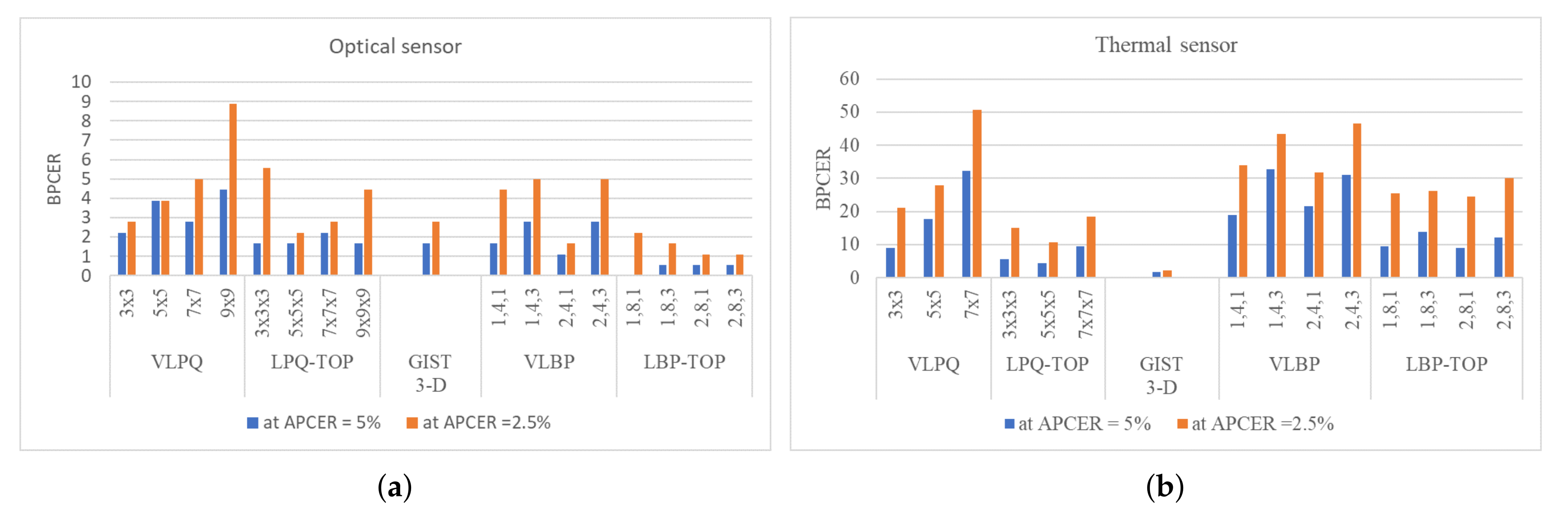
Fingerprint recognition systems have been widely deployed in authentication and verification applications, ranging from personal smartphones to border control systems. Recently, the biometric society has raised concerns about presentation attacks that aim to manipulate the biometric system’s final decision by presenting artificial fingerprint traits to the sensor. In this paper, we propose a presentation attack detection scheme that exploits the natural fingerprint phenomena, and analyzes the dynamic variation of a fingerprint’s impression when the user applies additional pressure during the presentation. For that purpose, we collected a novel dynamic dataset with an instructed acquisition scenario. Two sensing technologies are used in the data collection, thermal and optical. Additionally, we collected attack presentations using seven presentation attack instrument species considering the same acquisition circumstances. The proposed mechanism is evaluated following the directives of the standard ISO/IEC 30107. The comparison between ordinary and pressure presentations shows higher accuracy and generalizability for the latter. The proposed approach demonstrates efficient capability of detecting presentation attacks with low bona fide presentation classification error rate (BPCER) where BPCER is 0% for an optical sensor and 1.66% for a thermal sensor at 5% attack presentation classification error rate (APCER) for both.
Keywords: fingerprint; presentation attack; presentation attack detection; anti-spoofing fingerprint; presentation attack; presentation attack detection; anti-spoofing