


Abstract
In this study, three different hardening accelerating admixtures (sodium carbonate, lithium carbonate and a blend of sodium and lithium carbonates) were employed to prepare calcium sulphoaluminate cement-based mortars. The workability, setting times, entrapped air, elasto-mechanical properties such as compressive strength and dynamic modulus of elasticity, free shrinkage, water absorption and carbonation rate were measured and mercury intrusion porosimetry were also performed. Experimental results show that a mixture of lithium carbonate and sodium carbonate acts as a hardening accelerating admixture, improving the early-age strength and promoting a remarkable pore structure refinement. Finally, sodium carbonate also reduces the water absorption, the carbonation rate and the shrinkage of mortars without affecting the setting times and the workability.
1. Introduction
During the last years, the construction sector has been looking for some solutions able to reduce the environmental impacts typical of building materials, particularly related to the use of Portland cement, which requires a considerable amount of raw non-renewable natural resources and a great energy input during the clinker production [1].
Several strategies have been proposed by different authors [2,3] aimed at improving the sustainability of cementitious materials: reduction of the greenhouse gases emission by using alternative fuels [4,5], replacement of Portland cement (OPC) clinker with low-carbon supplementary cementitious materials (SCM) [6,7,8], utilization of wastes [9,10] and development of alternative binders (such as alkali-activated materials) [11,12].
One of the most interesting and simple ways to reduce the environmental impact of mortars and concretes is using calcium sulphoaluminate cement (CSA) as a partial replacement of ordinary Portland cement [13]. For this reason, ternary mixtures of OPC, CSA and calcium sulphate (gypsum, anhydrite or hemihydrate) were largely investigated and properties like rapid setting times, fast strength development and low shrinkage have been appreciated [14,15,16]. However, some aspects of CSA cement, i.e., the effect of admixtures, have not been exhaustively investigated yet.
Most studies about admixtures in calcium sulphoaluminate cements deal with the influence of superplasticizers [17,18,19,20,21], shrinkage reducing admixtures [22,23,24] and retarders [16,18,25,26,27] but only a few papers focus on the use of hardening accelerating admixtures. Perà et al. [28] highlighted the feasibility of using lithium chloride and lithium carbonate to accelerate the hydration of CSA-based mixtures thanks to the formation of Li-rich aluminum hydroxides. Cau Dit Coumes et al. also investigated the influence of Li-based admixtures (alone [29] or in combination with sodium borate [30]) on the hydration of CSA cements, confirming that the acceleration effect is related to the very rapid precipitation of amorphous Li-containing Al(OH)3. However, there is a lack of knowledge regarding the physico-mechanical properties and durability issues of CSA-based mortars and concretes manufactured using Li-based hardening accelerating admixtures. On the other hand, to date, no experimental data have been published concerning the use of sodium-based accelerators in CSA-based mixtures.
For the abovementioned reasons, the purpose of the present work is to evaluate the influence of hardening accelerating admixtures based on sodium and lithium carbonate on the rheological, physical, elasto-mechanical properties of mortars manufactured with calcium sulphoaluminate cement.
2. Materials and Methods
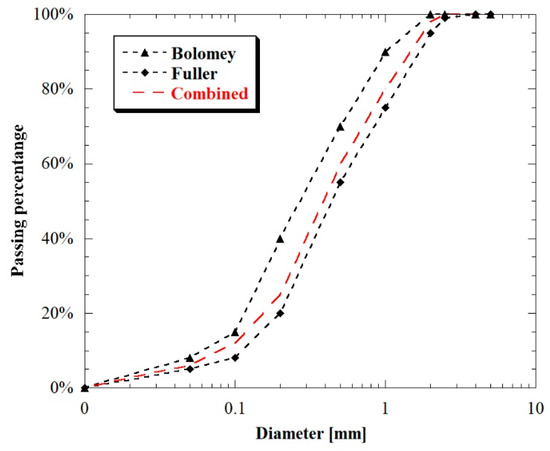
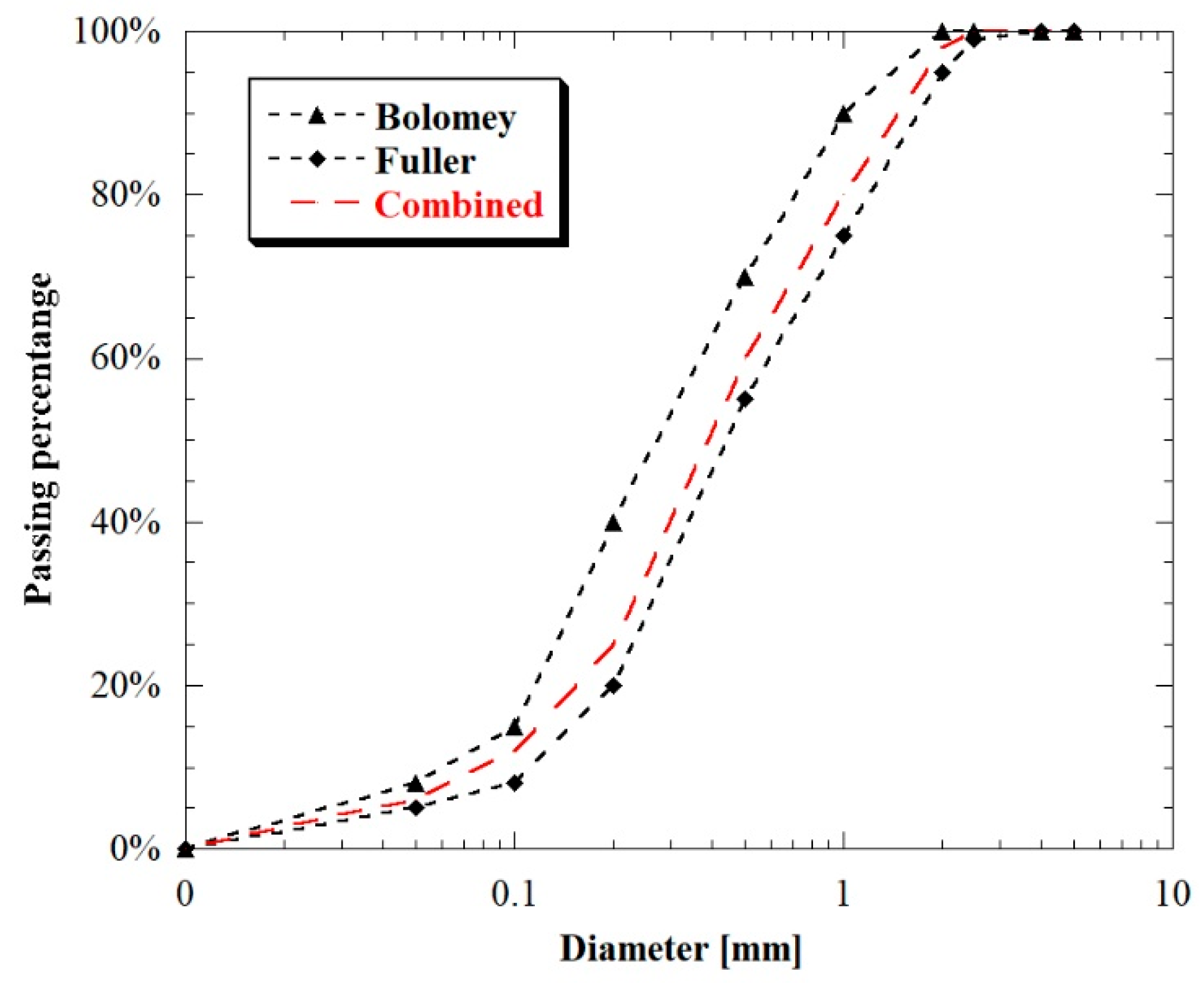
Three different mortars based on calcium sulphoaluminate were investigated as reported in Table 1 in accordance with a previous work [31]. In particular, a traditional mortar (hereafter referred to as TM) containing CSA clinker, Portland cement (OPC, according to EN 197-1) and technical grade anhydrite (CS) was produced. Additionally, two sustainable CSA-based mortars (hereafter referred to as SM 1 and SM 2, respectively) in which OPC is totally replaced by supplementary cementitious materials (SCMs, ground granulated blast furnace slag (GGBFS) according to EN 1516-7 and low calcium fly ash (FA) according to EN 450-1) and hydrated lime CL-90S class (CH, according to EN 459-1) were manufactured. Physical properties of the binders and the supplementary cementitious materials used are reported in Table 2. A set retarding admixture (0.8 wt.% mass of binder) based on tartaric acid (TA) was used to delay the initial set of mortars [26]. Lithium carbonate (LC) and sodium carbonate (SC) were also added to the mix as hardening accelerating admixtures up to 4% by binder mass in accordance with [32]. Finally, a natural siliceous sand with a maximum size equal to 2.5 mm was used (Figure 1).
Table 1.
Composition of mortars (TM: traditional CSA-based mortar, SM: sustainable CSA-based mortars, SC: sodium carbonate, LC: lithium carbonate).
Table 2.
Physical properties of binders.
Figure 1.
Granulometry of aggregates.
The water/binder ratio and binder/sand ratio were kept constant at 0.53 and 3.0, respectively.
The workability test by flow table described in EN 1015-3 was conducted on all the fresh mortars over time. In particular, the consistency was measured after the mixing procedure and the pot-life, corresponding to the time during which workability by flow table is higher than 140 mm, was also determined. Furthermore, fresh mortar specific mass and entrapped air were also measured in accordance with EN 1015-6 and EN 1015-7, respectively.
The mixtures were molded into 40 mm × 40 mm × 160 mm specimens, demolded after 24 h and cured in a climatic chamber at 20 °C and 60% R.H. until tests (Table 3) in order to optimize the strength development in accordance with findings of Coppola et al. [33] concerning the curing condition of CSA-based mixtures. Specific mass at hardened state, determined by weighing the specimen before mechanical test, and compressive strength were measured at 1, 7, 28, 120 and 150 days according to EN 1015-11 and drying shrinkage was evaluated in accordance with EN 12617-4 up to 150 days. Furthermore, dynamic modulus of elasticity (Ed) was measured by means of Ultrasonic Digital Indicator Tester at 1, 7, 28, 120 and 150 days (EN 12504-4). Then, pore size distribution and density of the specimens were determined by means of mercury intrusion porosimetry (MIP) using Thermo Pascal 140 and 440. The MIP mortar samples (three specimens for each mortars) were dried in oven at 40 °C for 24 h and tested after 28 days from casting. Approximately 1 g of mortar was first intruded to a mercury pressure, PHg, of 395 kPa on the Pascal 140, then the sample was moved to the Pascal 440 and intruded to 200 MPa. Moreover, the depth of natural carbonation (specimens stored in air) was measured by a colorimetric test using phenolphthalein as pH indicator, according to EN 14630 up to 150 days. Finally, the capillary water absorption coefficient (AC) was estimated in accordance with EN 13057.
Table 3.
Specimens manufactured for each mortar.
3. Results
3.1. Fresh Properties
The addition of lithium carbonate and sodium carbonate does not produce any abnormal air entrapment or variation in specific mass at fresh state (Table 4). Moreover, results show that the addition of LC and SC has different effects on mortar consistency. In particular, a small increase in workability was observed in mortars manufactured with sodium carbonate admixtures or SC–LC blends while no variations on workability were detected by using LC regardless of the binder used.
Table 4.
Properties of mortars at fresh and hardened state.
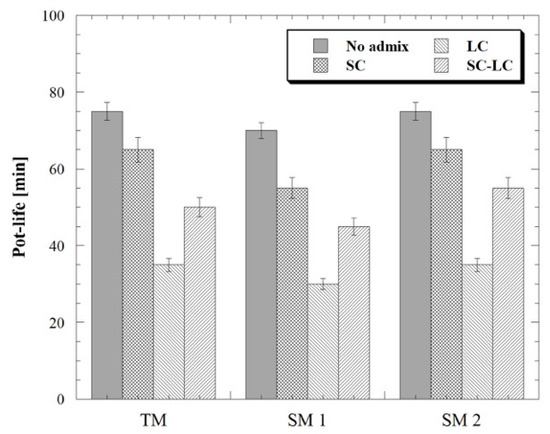
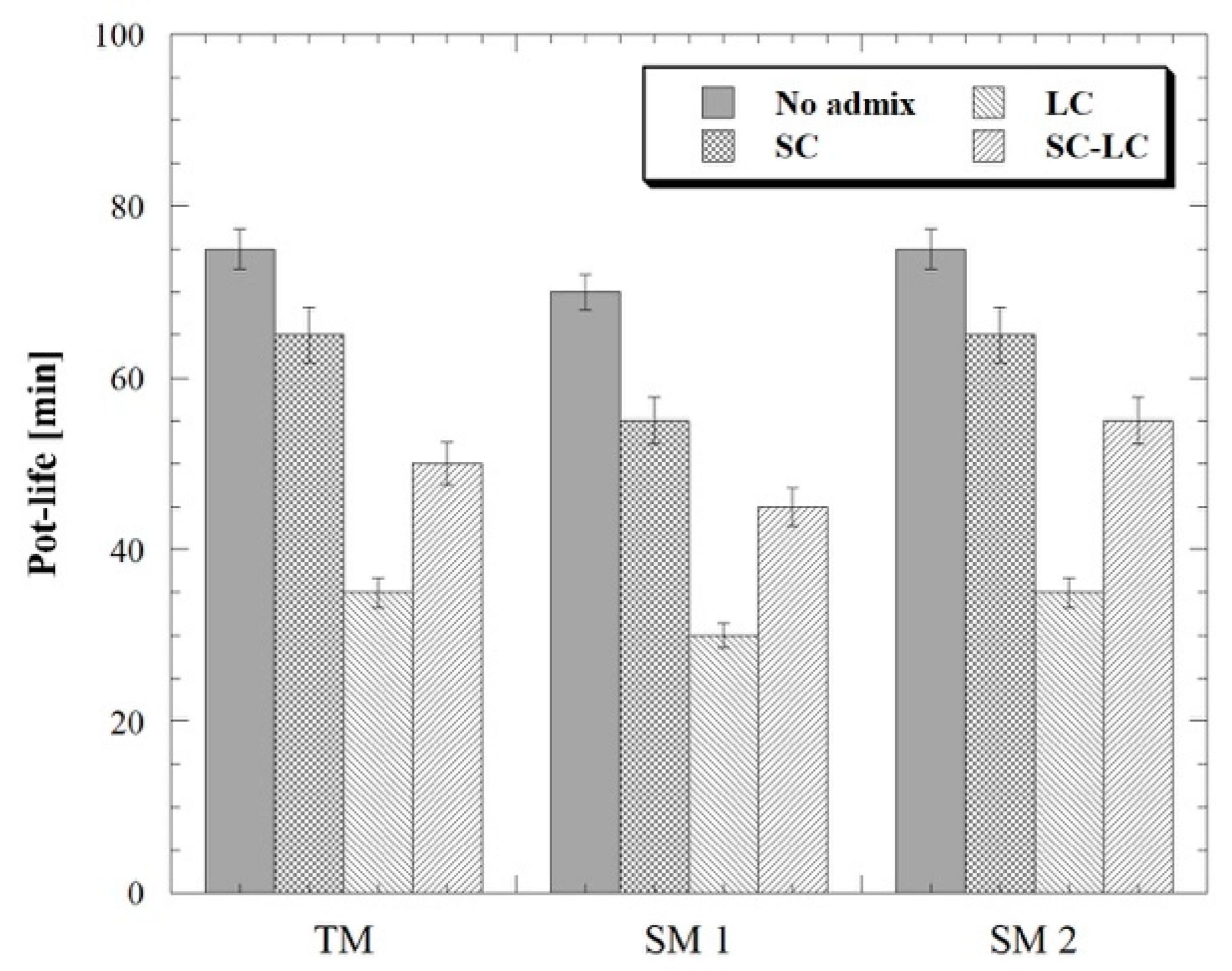
Lithium carbonate caused a sharp reduction in pot-life of mortars, independently of the binder used (Figure 2). In particular, LC seems to completely neutralize the retarding effect promoted by tartaric acid [26], decreasing the pot-life of the mixtures to a value close to 30 min. On the contrary, mortars containing SC showed a very slight decrease in pot-life. Finally, the combination of SC and LC determined a reduction of pot-life approximately equal to 30%, independent of the binder.
Figure 2.
Pot-life of fresh mixtures.
3.2. Mercury Intrusion
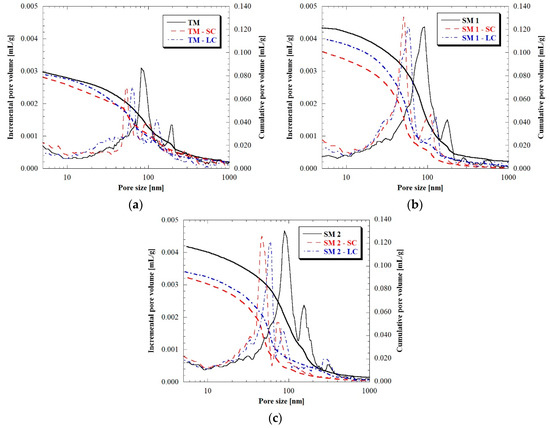
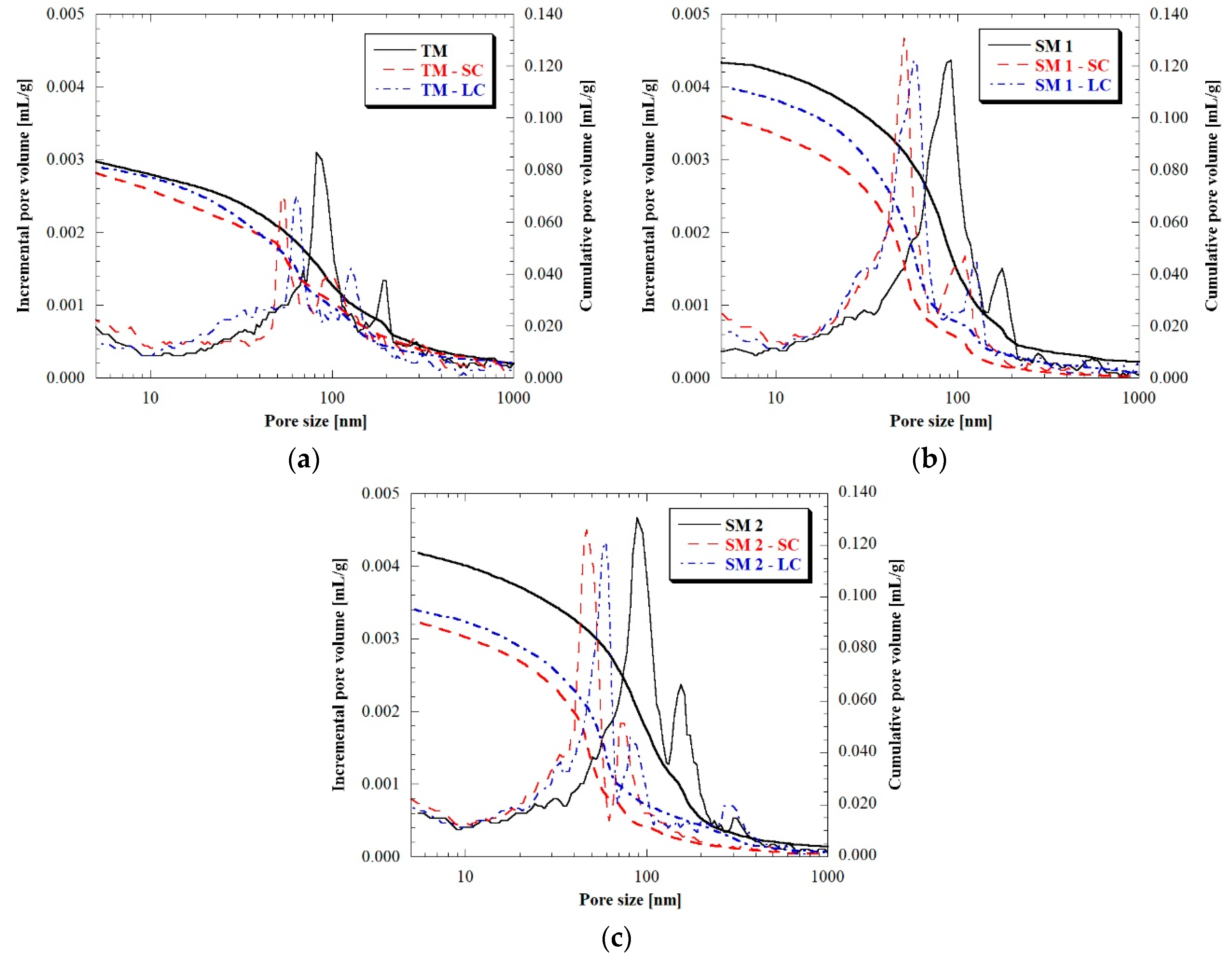
The average results of mercury intrusion porosimetry (MIP) are reported in Figure 3. According to results reported by Bernardo et al. [34], the distribution of pore size is bimodal for all the CSA-based mixtures with the first threshold close to 100–200 nm while the second threshold pore size is in the range of 50–90 nm.
Figure 3.
Intruded Hg volume vs. pore size for mortar TM (a), SM1 (b) and SM2 (c) with different admixtures (cumulative values in thick line).
The total replacement of Portland cement with supplementary cementitious materials strongly influences the total porosity with negligible changes in the average pore size. In particular, for mortars manufactured without hardening accelerating admixtures, the porosity varied from 18.5% for TM to 23.9% and 23.6%, respectively, for SM1 and SM2, whereas the first and second threshold pore radius are close to 200 nm and 90 nm, respectively. The addition of SC and LC admixtures determines a pore structure refinement for all mixes with a reduction of the total porosity and a shift both in the first threshold pore size from 200 nm to 150 nm (LC) or 100 nm (SC) and in the second threshold pore radius from 90 to 60 nm (LC) or 50 nm (SC). In particular, the effectiveness of sodium carbonate (SC) in pore structure refinement is higher than that of lithium carbonate (LC).
3.3. Elasto-Mechanical Properties
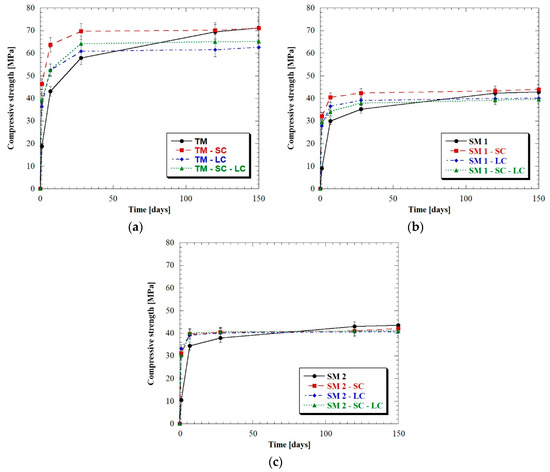
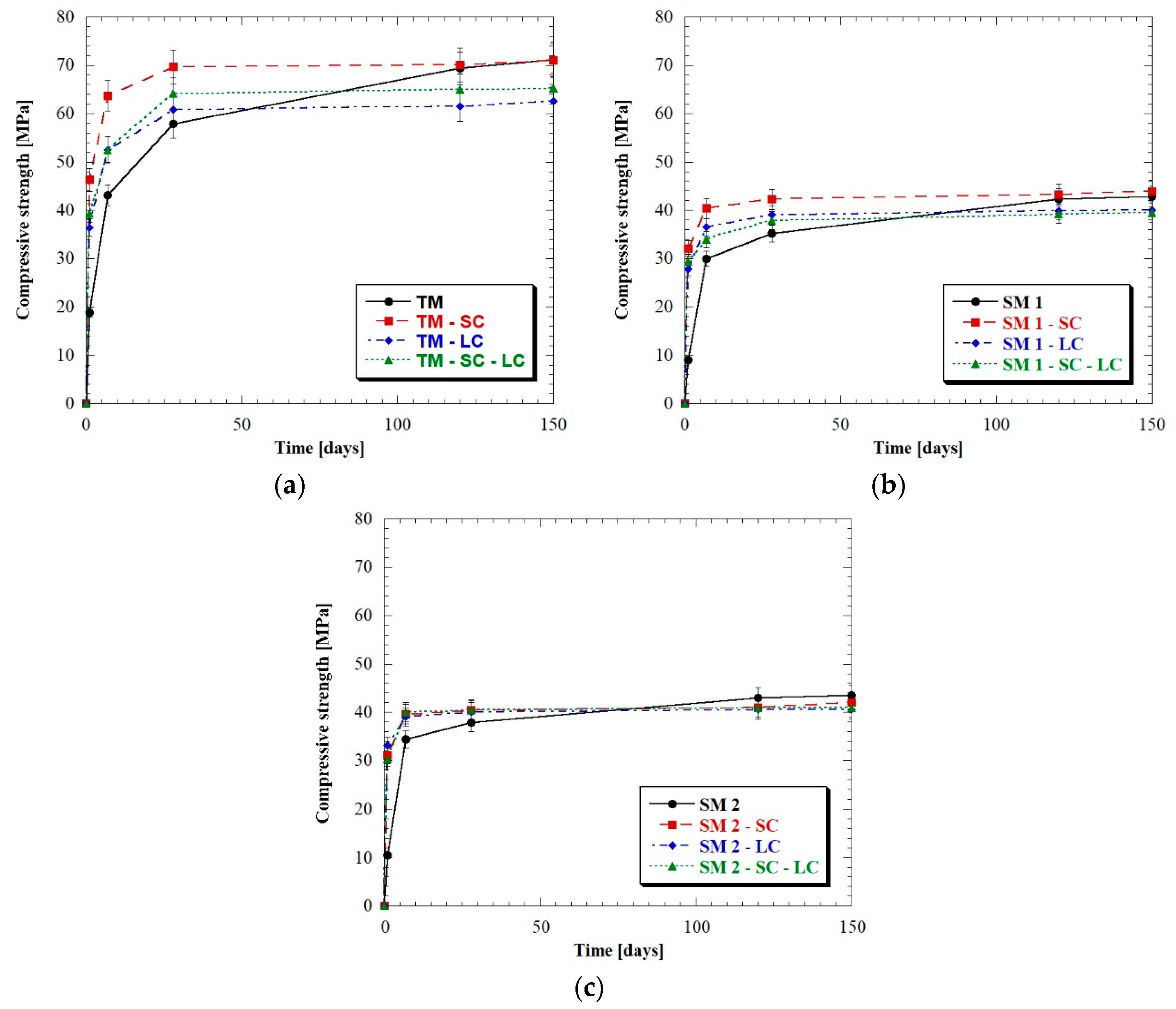
In Figure 4 are reported the compressive strength developments of mortars manufactured with different hardening accelerating admixtures. Results indicated that lithium carbonate and sodium carbonate affect the elasto-mechanical properties of both TM and SM. The compressive strength at early ages (24 h and 7 days) is strongly improved by the addition of SC and LC admixtures. In particular, compressive strength approximately doubled with respect to the reference mortars manufactured without hardening accelerating admixtures, regardless the nature of alkaline ions (Li or Na) present in the admixtures. Sodium carbonate promotes the formation of gyrolite which is responsible for the acceleration of setting times as reported by Reddy et al. [35] and the improvement of compressive strength at early ages [36]. On the other hand, lithium carbonate addition is responsible for the precipitation of lithium aluminate hydrate LiAl2(OH)7·2H2O which serves as nucleation site for aluminum hydroxide precipitation that accelerates the whole hydration process and promotes the production of ettringite, the main hydration product of CSA cements [29,30,37].
Figure 4.
Compressive strength development of mortar (a) TM, (b) SM1 and (c) SM2 with different admixtures.
However, at long ages, compressive strength of SM1 and SM2 mortars produced with or without hardening accelerating admixtures was similar. In detail, SM1 and SM2 mortars were characterized by compressive strength value close to 40 MPa after 150 days similarly with [26]. On the contrary, the addition of sodium carbonate on TM mortar did not produce variations on compressive strength after 120 and 150 days while the use of lithium carbonate, alone or in combination with sodium carbonate, caused strength losses at long ages approximately equal to 10%.
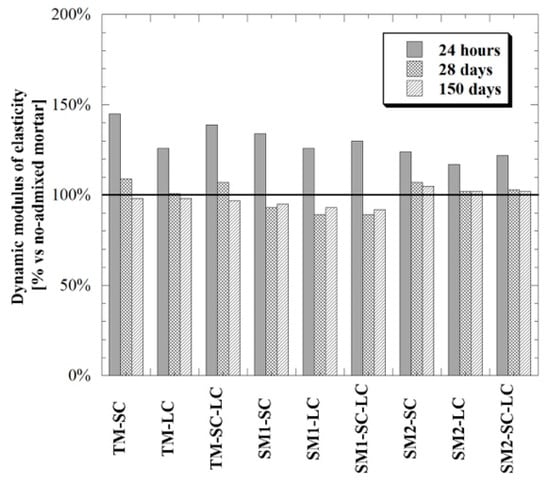
Figure 5 reports the dynamic modulus of elasticity of mortars after 24 h, 28 days and 150 days normalized respect to the mortars manufactured without admixtures. The role of hardening accelerating admixtures is evident also in the elastic modulus development. Similar to compressive strength, the addition of SC and/or LC on TM, SM1 and SM2 strongly increases the dynamic modulus of elasticity at 24 h with growing close to 20–40% respect to no-admixed mortars. However, this effect disappears already after 28 days when elastic modulus results quite similar (90–110%) to that of mortars manufactured without hardening accelerating admixtures.
Figure 5.
Elastic modulus of mortars with different admixtures normalized respect to mortars manufactured without admixtures.
3.4. Free Shrinkage
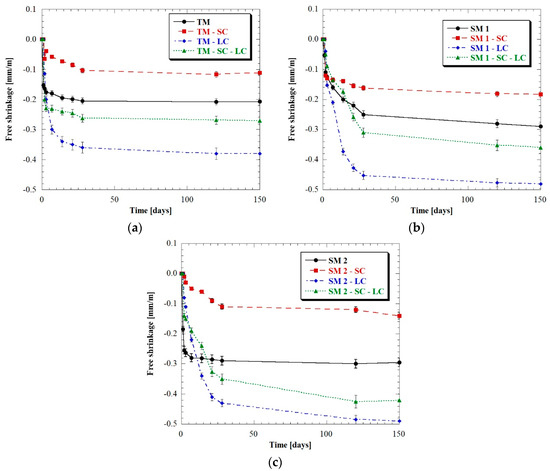
Free shrinkage of traditional and sustainable mortars is shown in Figure 6. The addition of hardening accelerating admixtures strongly influenced the shrinkage of CSA-based mortars. The use of LC, alone or with SC, increased the free shrinkage of both TM and SMs up to 100%. In particular, traditional mortar without admixtures was characterized by shrinkage equal to 200 μm/m after 150 days while TM–LC and TM–SC–LC reached values close to 380 and 280 μm/m, respectively. Also, mortars were influenced by the lithium-based admixtures, reaching shrinkage ranging from 350 to 450 μm/m. On the contrary, the addition of SC allows to reduce by half the shrinkage of CSA-based mortars, regardless of the binder probably due to the greater amount of ettringite produced during hydration as reported by Li et al. [38].
Figure 6.
Free shrinkage of mortar (a) TM, (b) SM1 and (c) SM2 with different admixtures.
3.5. Water Absorption
Capillary water absorption coefficient (AC) of mortars was strongly influenced by the addition of sodium carbonate and the binder used (Table 5). The total substitution of Portland cement with supplementary cementitious materials and hydrated lime increased the capillary water absorption coefficient by about 220% due to the higher total porosity of sustainable mixtures SM respect to traditional mortar TM. Moreover, the use of SC admixture allows to obtain a less porous binder matrix characterized by a lower water absorption coefficient (−25%) respect to those of LC-based or no-admixed mortars, regardless of the binder used.
Table 5.
Capillary water absorption coefficient (AC) of mortars with different admixtures.
3.6. Carbonation
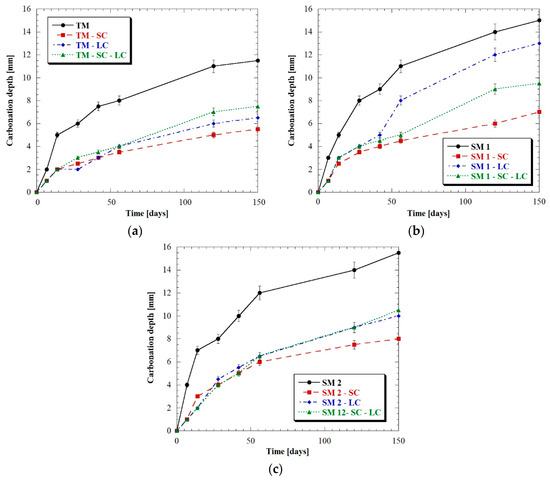
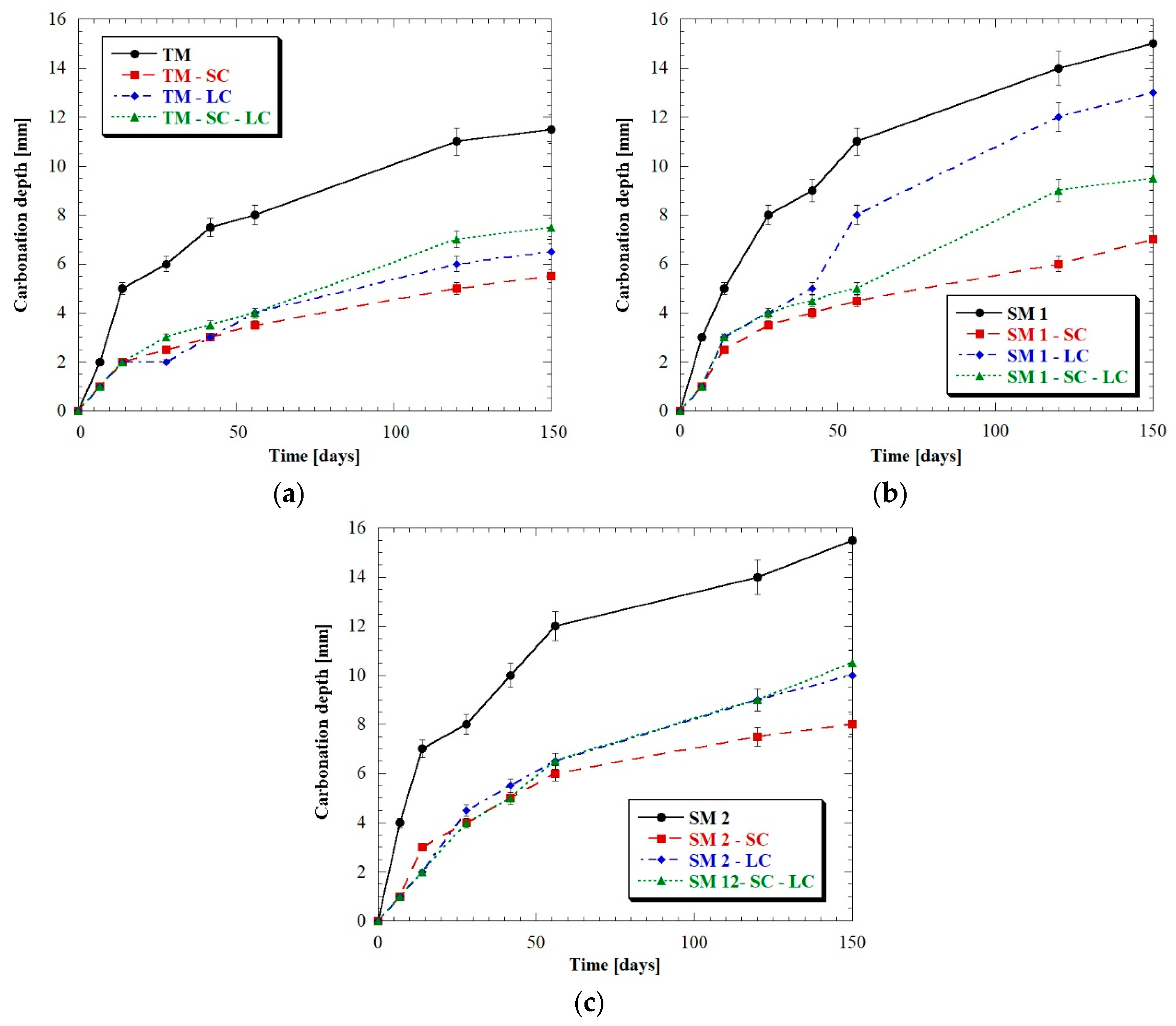
Figure 7 shows the natural carbonation depth of mortars over time. TM mortars (containing OPC) were characterized by lower carbonation than SM mortars (containing SCMs) due to their lower porosity and the remarkable CO2 buffer capacity of portlandite deriving from the OPC hydration. In particular, after 150 days, the TM reached carbonation depth close to 11 mm while SM were characterized by a carbonation depth higher than 14 mm.
Figure 7.
Carbonation of mortar (a) TM, (b) SM1 and (c) SM2 with different admixtures.
A beneficial effect against the carbonation is given by the addition of hardening accelerating admixtures. In fact, lithium carbonate and sodium carbonate promote the pore structure refinement and consequently reduce carbon dioxide penetration both in case of mortars containing OPC and SCM-based mortars. The most significant reduction in carbonation depth can be observed in mortars containing SC where a reduction of about 60% respect to mortar without admixtures can be found. On the contrary, accordingly with the MIP measurements, the addition of LC or blends SC–LC led to lower benefits, in the order of 30–40% reduction of the CO2 penetration depth.
Nevertheless, although the admixtures of lithium carbonate and sodium carbonate give a beneficial effect on carbonation of CSA-based mortars, these systems are still characterized by a very high value of carbonation with respect to traditional mortars manufactured with Portland cement in which the carbonation depth is generally lower than 1 mm after 150 days.
4. Conclusions
In this paper, the influence of lithium carbonate and sodium carbonate in CSA-based mortars manufactured with SCMs replacing OPC was investigated in terms of fresh properties, mechanical strength, water absorption, free shrinkage and natural carbonation. The following conclusions were made according to the results of the present paper:
- SC and LC act as accelerator admixtures in CSA-based mortars independent of the nature of the binder employed, promoting a remarkable pore structure refinement and an improvement in elasto-mechanical properties at early age, especially by using SC;
- LC strongly reduces the workability and the pot life of mortars, compromising the possible utilization in the construction site. On the contrary, SC ensures a workability and a pot life similar to mortars manufactured without hardening accelerating admixtures;
- The SC-based mortars were characterized by a less porous binder matrix and a lower water absorption coefficient (−25%) with respect to those of LC-based or no-admixed mortars, regardless of the binder used;
- The use of LC, alone or with SC, increased the free shrinkage of both TM and SMs up to 100% while the addition of SC reduced the shrinkage up to 50%;
- A 60% reduction in carbonation depth can be observed in mortars containing SC respect to mortar without admixtures while the addition of LC or blends SC–LC led to lower benefits, ranging from 30% to 40%;
- The SC is the most suitable additive because increased the compressive strength, reduced the shrinkage, reduced the water adsorption coefficient and reduced the carbonation depth of CSA-based mortars.
Author Contributions
All the authors contributed in equal part to conceptualization of the research, carrying out of tests and writing of the paper. All authors have read and agreed to the published version of the manuscript.
Funding
This research received no external funding.
Acknowledgments
The authors would like to acknowledge Raffaele Cioffi (University Parthenope of Naples) for the support in the experimental tests to determine the porosity of the mortar and Eng. Dalila Quartararo for carrying out the elasto-mechanical tests and carbonation measurements.
Conflicts of Interest
The authors declare no conflict of interest.
References
- Barcelo, L.; Kline, J.; Walenta, G.; Gartner, E. Cement and carbon emissions. Mater. Struct. 2014, 47, 1055–1065. [Google Scholar] [CrossRef] [Scilit]
- Schneider, M.; Romer, M.; Tschudin, M.; Bolio, H. Sustainable cement production-present and future. Cem. Concr. Res. 2011, 41, 642–650. [Google Scholar] [CrossRef] [Scilit]
- Coppola, L.; Coffetti, D.; Crotti, E.; Gazzaniga, G.; Pastore, T. An Empathetic Added Sustainability Index (EASI) for cementitious based construction materials. J. Clean. Prod. 2019, 220, 475–482. [Google Scholar] [CrossRef] [Scilit]
- Rahman, A.; Rasul, M.G.; Khan, M.M.K.; Sharma, S. Recent development on the uses of alternative fuels in cement manufacturing process. Fuel 2015, 145, 84–99. [Google Scholar] [CrossRef] [Scilit]
- Horsley, C.; Emmert, M.H.; Sakulich, A. Influence of alternative fuels on trace element content of ordinary portland cement. Fuel 2016, 184, 481–489. [Google Scholar] [CrossRef] [Scilit]
- Miller, S.A. Supplementary cementitious materials to mitigate greenhouse gas emissions from concrete: Can there be too much of a good thing? J. Clean. Prod. 2018, 178, 587–598. [Google Scholar] [CrossRef] [Scilit]
- Coppola, L.; Coffetti, D.; Crotti, E. Plain and ultrafine fly ashes mortars for environmentally friendly construction materials. Sustainability 2018, 10, 874. [Google Scholar] [CrossRef] [Scilit]
- Candamano, S.; De Luca, P.; Frontera, P.; Crea, F. Production of Geopolymeric Mortars Containing Forest Biomass Ash as Partial Replacement of Metakaolin. Environments 2017, 4, 74. [Google Scholar] [CrossRef] [Scilit]
- Mobili, A.; Giosuè, C.; Corinaldesi, V.; Tittarelli, F. Bricks and Concrete Wastes as Coarse and Fine Aggregates in Sustainable Mortars. Adv. Mater. Sci. Eng. 2018, 2018, 8676708. [Google Scholar] [CrossRef] [Scilit]
- Coppola, L.; Lorenzi, S.; Marcassoli, P.; Marchese, G. Concrete production by using cast iron industry by-products|Impiego di sottoprodotti dell’industria siderurgica nel confezionamento di calcestruzzo per opere in c.a. e c.a.p. Ind. Ital. Cem. 2007, 77, 748. [Google Scholar]
- Carabba, L.; Manzi, S.; Rambaldi, E.; Ridolfi, G.; Bignozzi, M.C. High-temperature behaviour of alkali-activated composites based on fly ash and recycled refractory particles. J. Ceram. Sci. Technol. 2017, 8, 4416. [Google Scholar]
- Coppola, L.; Coffetti, D.; Crotti, E. Pre-packed alkali activated cement-free mortars for repair of existing masonry buildings and concrete structures. Constr. Build. Mater. 2018, 173, 111–117. [Google Scholar] [CrossRef] [Scilit]
- Marroccoli, M.; Montagnaro, F.; Telesca, A.; Valenti, G.L. Environmental implications of the manufacture of calcium sulfoaluminate-based cements. In Proceedings of the Second International Conference on Sustainable Construction Materials and Technologies, Ancona, Italy, 28–30 June 2010; Volume 1, pp. 625–635. [Google Scholar]
- Coppola, L.; Coffetti, D.; Crotti, E.; Pastore, T. CSA-based Portland-free binders to manufacture sustainable concretes for jointless slabs on ground. Constr. Build. Mater. 2018, 187, 691–698. [Google Scholar] [CrossRef] [Scilit]
- Telesca, A.; Marroccoli, M.; Pace, M.L.; Tomasulo, M.; Valenti, G.L.; Monteiro, P.J.M. A hydration study of various calcium sulfoaluminate cements. Cem. Concr. Compos. 2014, 53, 224–232. [Google Scholar] [CrossRef] [Scilit]
- Pelletier, L.; Winnefeld, F.; Lothenbach, B. The ternary system Portland cement-calcium sulphoaluminate clinker-anhydrite: Hydration mechanism and mortar properties. Cem. Concr. Compos. 2010, 32, 497–507. [Google Scholar] [CrossRef] [Scilit]
- Tian, H.; Kong, X.; Cui, Y.; Wang, Q.; Wang, D. Effects of polycarboxylate superplasticizers on fluidity and early hydration in sulfoaluminate cement system. Constr. Build. Mater. 2019, 228. [Google Scholar] [CrossRef] [Scilit]
- Zhang, G.; Li, G.; Li, Y. Effects of superplasticizers and retarders on the fluidity and strength of sulphoaluminate cement. Constr. Build. Mater. 2016, 126, 44–54. [Google Scholar] [CrossRef] [Scilit]
- García-Maté, M.; Santacruz, I.; De La Torre, Á.G.; León-Reina, L.; Aranda, M.A.G. Rheological and hydration characterization of calcium sulfoaluminate cement pastes. Cem. Concr. Compos. 2012, 34, 684–691. [Google Scholar] [CrossRef] [Scilit]
- Ma, B.; Ma, M.; Shen, X.; Li, X.; Wu, X. Compatibility between a polycarboxylate superplasticizer and the belite-rich sulfoaluminate cement: Setting time and the hydration properties. Constr. Build. Mater. 2014, 51, 47–54. [Google Scholar] [CrossRef] [Scilit]
- Tan, H.; Guo, Y.; Zou, F.; Jian, S.; Ma, B.; Zhi, Z. Effect of borax on rheology of calcium sulphoaluminate cement paste in the presence of polycarboxylate superplasticizer. Constr. Build. Mater. 2017, 139, 277–285. [Google Scholar] [CrossRef] [Scilit]
- Mehdipour, I.; Khayat, K.H. Effect of shrinkage reducing admixture on early expansion and strength evolution of calcium sulfoaluminate blended cement. Cem. Concr. Compos. 2018, 92, 82–91. [Google Scholar] [CrossRef] [Scilit]
- Mehdipour, I.; Khayat, K.H. Enhancing the performance of calcium sulfoaluminate blended cements with shrinkage reducing admixture or lightweight sand. Cem. Concr. Compos. 2018, 87, 29–43. [Google Scholar] [CrossRef] [Scilit]
- Ambroise, J.; Georgin, J.F.; Peysson, S.; Péra, J. Influence of polyether polyol on the hydration and engineering properties of calcium sulfoaluminate cement. Cem. Concr. Compos. 2009, 31, 474–482. [Google Scholar] [CrossRef] [Scilit]
- Zajac, M.; Skocek, J.; Bullerjahn, F.; Ben Haha, M. Effect of retarders on the early hydration of calcium-sulpho-aluminate (CSA) type cements. Cem. Concr. Res. 2016, 84, 62–75. [Google Scholar] [CrossRef] [Scilit]
- Coppola, L.; Coffetti, D.; Crotti, E. Use of tartaric acid for the production of sustainable Portland-free CSA-based mortars. Constr. Build. Mater. 2018, 171, 243–249. [Google Scholar] [CrossRef] [Scilit]
- Velazco, G.; Almanza, J.M.; Cortés, D.A.; Escobedo, J.C. Effect of citric acid and the hemihydrate amount on the properties of a calcium sulphoaluminate cement. Mater. Constr. 2014, 64, 1–8. [Google Scholar] [CrossRef] [Scilit]
- Péra, J.; Ambroise, J. New applications of calcium sulfoaluminate cement. Cem. Concr. Res. 2004, 34, 671–676. [Google Scholar] [CrossRef] [Scilit]
- Cau Dit Coumes, C.; Dhoury, M.; Champenois, J.B.; Mercier, C.; Damidot, D. Physico-chemical mechanisms involved in the acceleration of the hydration of calcium sulfoaluminate cement by lithium ions. Cem. Concr. Res. 2017, 96, 42–51. [Google Scholar] [CrossRef] [Scilit]
- Cau Dit Coumes, C.; Dhoury, M.; Champenois, J.B.; Mercier, C.; Damidot, D. Combined effects of lithium and borate ions on the hydration of calcium sulfoaluminate cement. Cem. Concr. Res. 2017, 97, 50–60. [Google Scholar] [CrossRef] [Scilit]
- Coppola, L.; Coffetti, D.; Crotti, E. CSA-Based Mortars Manufactured with Tartaric Acid-Based Retarder. Spec. Publ. 2018, 329, 373–388. [Google Scholar]
- Wang, Y.; He, F.; Wang, J.; Hu, Q. Comparison of effects of sodium bicarbonate and sodium carbonate on the hydration and properties of Portland cement paste. Materials 2019, 12, 1033. [Google Scholar] [CrossRef] [Scilit] [PubMed]
- Coppola, L.; Coffetti, D.; Crotti, E. Environmentally friendly concretes manufactured with CSA cement. Spec. Publ. 2018, 326, 51. [Google Scholar]
- Bernardo, G.; Telesca, A.; Valenti, G.L. A porosimetric study of calcium sulfoaluminate cement pastes cured at early ages. Cem. Concr. Res. 2006, 36, 1042–1047. [Google Scholar] [CrossRef] [Scilit]
- Venkateswara Reddy, V.; Sudarsana Rao, H.; Jayaveera, K.N. Influence of strong alkaline substances (sodium carbonate and sodium bicarbonate) in mixing water on strength and setting properties of concrete. Indian J. Eng. Mater. Sci. 2006, 13, 123–128. [Google Scholar]
- Eisinas, A.; Baltakys, K.; Siauciunas, R. The effect of gyrolite additive on the hydration properties of Portland cement. Cem. Concr. Res. 2012, 42, 27–38. [Google Scholar] [CrossRef] [Scilit]
- Zhang, Y.; Wang, Y.; Li, T.; Xiong, Z.; Sun, Y. Effects of lithium carbonate on performances of sulphoaluminate cement-based dual liquid high water material and its mechanisms. Constr. Build. Mater. 2018, 161, 374–380. [Google Scholar] [CrossRef] [Scilit]
- Li, G.; Zhang, J.; Song, Z.; Shi, C.; Zhang, A. Improvement of workability and early strength of calcium sulphoaluminate cement at various temperature by chemical admixtures. Constr. Build. Mater. 2018, 160, 427–439. [Google Scholar] [CrossRef] [Scilit]

© 2019 by the authors. Licensee MDPI, Basel, Switzerland. This article is an open access article distributed under the terms and conditions of the Creative Commons Attribution (CC BY) license (http://creativecommons.org/licenses/by/4.0/).