1. Introduction
Indonesia’s cosmetics industry has expanded substantially, supported by rising consumer awareness of health and personal care, demographic growth, changing lifestyles, and the influence of social media on beauty trends (
Rocca et al., 2022;
Turcu & Brancu, 2023). In 2022, the national cosmetics market was valued at approximately USD 8.46 billion, making the industry an important component of industrial recovery and economic activity (
Euromonitor International, 2022). Continued market growth has created opportunities not only for cosmetics manufacturers but also for upstream firms supplying active ingredients, functional materials, fragrances, colors, and other formulation inputs.
Growth has been accompanied by substantial supply-side vulnerability. Industry data used in this study indicate that approximately 70% of cosmetic raw materials are imported, while domestic sources account for about 30% of supply. The reported value of cosmetic raw material imports reached approximately IDR 21.04 trillion in 2022. Import dependence exposes firms to exchange-rate volatility, international logistics costs, trade restrictions, geopolitical uncertainty, and disruptions in global supply chains. For raw material suppliers, the ability to maintain inventory, secure alternative sources, exchange technical information, and sustain customer relationships directly affects the continuity of downstream cosmetics production.
These conditions make business resilience a strategic priority. Business resilience refers to a firm’s capacity to withstand disruption, maintain essential activities, adapt to changed conditions, recover operations, and develop new responses when established routines are no longer sufficient (
Aldianto et al., 2021;
Nguyen et al., 2023). In supply-dependent industries, resilience extends beyond returning to a pre-disruption state. It requires firms to reorganize resources, diversify supply options, preserve information flows, coordinate with partners, and revise strategic decisions as market and regulatory conditions evolve.
Although resilience research has grown, prior studies have commonly examined finished consumer products, retailing, manufacturing, hospitality, or start-ups (
Chowdhury et al., 2020;
Jukka, 2023). The upstream cosmetic raw materials sector has received less attention even though it combines technical product knowledge, global sourcing, regulatory compliance, customer collaboration, and rapid adaptation to changing product trends. The resilience of upstream suppliers therefore affects both firm continuity and the competitiveness of the wider cosmetics value chain.
One mechanism through which firms may develop resilience is specialization strategy. Specialization concentrates resources, expertise, relationships, and operational capabilities on particular products, technologies, services, or customer segments. A focused position can foster deeper technical knowledge, stronger reputations, more integrated supply arrangements, and differentiated services that are difficult to imitate (
Di Cataldo et al., 2022;
Ferreira et al., 2021;
Pinto et al., 2024). In the cosmetic raw materials industry, specialization may involve distinctive ingredients, high-quality technical support, secure supply arrangements, and product solutions tailored to specific formulation needs.
The effectiveness of specialization, however, is shaped by the administrative and regulatory environment. Government support for technology, local raw materials, market development, and regulatory compliance can strengthen firms’ capacity to adapt and invest. At the same time, standardized, administratively burdensome, or weakly coordinated policies may restrict flexibility and reduce the returns from highly focused strategies.
Research on policy design emphasizes that effectiveness depends on the fit among policy goals, instruments, implementation capacity, and target-group conditions (
Mukherjee et al., 2021;
van Geet et al., 2019). In the Indonesian context, formal policy programs may not always translate into effective operational support for firms. Their effectiveness can depend on implementation capacity, inter-institutional coordination, and alignment with the specific conditions of target organizations (
Rufini et al., 2026).
Government policy may therefore perform a dual role. It may directly strengthen resilience by improving access to technology, market information, institutional guidance, and regulatory certainty.
It may also condition the effectiveness of specialization strategy. Policies aligned with specialized business needs may reinforce focused capabilities, whereas generalized or compliance-intensive interventions may weaken their marginal contribution to resilience.
Existing evidence provides important but fragmented insights into the policy–resilience relationship. Research on smart specialization has largely emphasized regional innovation systems, governance arrangements, and the role of public authorities, whereas resilience studies have commonly examined government intervention as an external influence on firms’ ability to withstand and recover from disruption (
Di Cataldo et al., 2022;
Nguyen et al., 2023;
Pinto et al., 2024). Other studies indicate that government support may operate alongside firm-specific technological and organizational capabilities, but such evidence emerges from substantially different industrial and institutional settings (
Zhao et al., 2024).
Consequently, it remains unclear whether government policy can directly strengthen business resilience while simultaneously altering the contribution of firm-level specialization to resilience in an upstream, import-dependent industry. Addressing this distinction is important because the direct effect of policy and its contingent effect on firm-specific strategic capabilities need not operate in the same direction.
This gap is particularly relevant to Indonesia’s cosmetic raw-materials industry, which combines substantial import dependence with technical and regulatory complexity. In this industry, technical complexity arises from the need to manage ingredient-specific functionality, formulation compatibility, quality and safety requirements, regulatory restrictions, and technical information exchange between raw-material suppliers and cosmetics manufacturers (
Badan Pengawas Obat dan Makanan Republik Indonesia, 2025;
Rocca et al., 2022).
Accordingly, the aim of this study is to examine how Specialization Strategy and Government Policy are associated with Business Resilience among cosmetic raw-material suppliers in Indonesia and to determine whether Government Policy changes the strength of the relationship between Specialization Strategy and Business Resilience. More specifically, the study has three objectives: (1) to examine the relationship between Specialization Strategy and Business Resilience; (2) to assess the direct association between Government Policy and Business Resilience; and (3) to test whether Government Policy moderates the relationship between Specialization Strategy and Business Resilience.
Correspondingly, the study addresses the following research questions:
RQ1. What is the relationship between Specialization Strategy and Business Resilience among cosmetic raw-material suppliers in Indonesia?
RQ2. What is the relationship between Government Policy and Business Resilience among cosmetic raw-material suppliers in Indonesia?
RQ3. Does Government Policy moderate the relationship between Specialization Strategy and Business Resilience among cosmetic raw-material suppliers in Indonesia?
The study contributes by extending resilience research to an understudied upstream industry, explaining specialization as a firm-level resilience capability, and demonstrating that policy support can have both enabling and constraining consequences. This dual role is directly relevant to administrative science and industrial policy in emerging economies, where firms differ in scale, technological readiness, market position, and regulatory exposure.
2. Theoretical Framework
To maintain alignment with the study objectives and research questions, the theoretical framework develops the specialization–resilience relationship (H1), the direct role of Government Policy (H2), and the moderating role of Government Policy (H3) sequentially.
2.1. Strategic Management and Business Resilience
Strategic management explains how firms establish long-term direction, allocate resources, respond to environmental conditions, and develop advantages that support continuity (
Mintzberg, 1994;
Porter, 1980;
Sinnaiah et al., 2023). It provides an appropriate domain for studying resilience because organizational responses to disruption depend on both prior strategic preparation and subsequent adaptation.
Resilience theory originated in the study of systems that retain essential functions under disturbance and was later extended to organizations. In a business context, resilience encompasses resistance, adaptation, recovery, learning, and renewal. Firms are resilient when they can protect critical operations, adjust processes, reconfigure resources, and emerge with capabilities suited to altered conditions (
Nguyen et al., 2023).
For cosmetic raw-material suppliers, resilience may be reflected in multiple sourcing options, durable customer contracts, organized inventory systems, product-information exchange, and timely supplier involvement in product development (
Abeysekara et al., 2019). These capabilities can help firms maintain continuity and adapt to supply, market, and regulatory disruptions. Resilience is therefore treated in this study not simply as recovery after a single crisis but as a configuration of organizational capabilities that supports continuity, adaptation, and resource reorganization under changing conditions.
Indonesia’s cosmetic raw-material sector operates within an industrial and regulatory environment that simultaneously promotes domestic capability development and imposes product-specific compliance requirements. At the national level, the National Industrial Development Master Plan 2015–2035 identifies pharmaceuticals, cosmetics, and medical devices as a priority industrial group, reflecting the government’s broader objective of strengthening domestic industrial capabilities and upstream linkages (
Government of Indonesia, 2015).
At the sectoral level, cosmetic ingredients are subject to technical requirements established by the Indonesian Food and Drug Authority (BPOM), including rules concerning the use and restriction of particular ingredients (
Badan Pengawas Obat dan Makanan Republik Indonesia, 2025). These arrangements create both opportunities and administrative demands for raw-material suppliers, especially those managing imported ingredients, local-material substitution, technical documentation, and changes in regulatory requirements. The Indonesian policy environment is therefore not merely a background condition but an important part of the operating context in which supplier specialization and business resilience develop.
2.2. Resource-Based View and Specialization Strategy
The Resource-Based View (RBV) proposes that differences in resources and capabilities help explain differences in firm strategy and performance (
J. Barney, 1991;
J. B. Barney et al., 2011,
2021). Resources that are valuable, rare, difficult to imitate, and difficult to substitute can form the basis of sustained advantage. The perspective is rooted in Penrose’s view of the firm as a collection of productive resources whose effective deployment supports growth (
Penrose, 1995).
The RBV is relevant to resilience because firms do not respond to disruption in identical ways. Their responses depend on knowledge, skills, supplier networks, technological capability, managerial experience, reputation, routines, and the capacity to recombine resources. Dynamic capabilities extend this reasoning by emphasizing organizational processes for integrating and reconfiguring resources as environments change (
Eisenhardt & Martin, 2000).
Specialization strategy represents a focused configuration of these resources. Rather than distributing attention across unrelated products or segments, specialized firms concentrate expertise and investment in areas where they can develop differentiated value. In this study, specialization strategy comprises supply-chain integration and specialty-product positioning. Supply-chain integration captures coordination, innovative and high-quality distribution, customer supply security, and service commitment. Specialty-product positioning captures reputation, value relative to quality, and customer reliance on the firm’s offerings.
Specialization can be expressed through different forms of strategic focus, including concentration on particular products, technologies, customer segments, processes, or positions within a value chain (
Porter, 1980). The present study does not treat Supply Chain and Specialty Product as an exhaustive representation of all possible dimensions of specialization. Rather, these two dimensions reflect the forms of specialization most directly relevant to the operational context examined here.
For cosmetic raw-material suppliers, specialization is manifested not only through differentiated and technically specific product offerings but also through the ability to coordinate reliable supply arrangements, maintain service commitment, and support customers whose production depends on the availability and suitability of particular ingredients.
Accordingly, Specialization Strategy is operationalized in this study as a context-specific combination of supply-chain integration and specialty-product positioning. Other forms of specialization, such as geographic, customer-segment, or process specialization, remain outside the scope of the present measurement model and may be examined in future research.
These attributes can strengthen resilience in several ways. Integrated supply systems improve information availability and reduce operational uncertainty. Product expertise helps firms evaluate alternatives when particular materials become unavailable. Strong reputations and customer reliance stabilize commercial relationships during disruptions. Specialized knowledge also supports faster responses to technical and regulatory change. Prior research similarly indicates that focused strategies and well-organized capabilities can strengthen adaptability and performance (
Jukka, 2023;
Pinto et al., 2024).
The RBV, however, does not imply that specialization is universally resilience-enhancing. Concentrating knowledge, relationships, and operational resources can deepen expertise and improve coordination, but the same resource specificity may also create dependence on a narrow range of products, suppliers, technologies, or organizational routines.
Dynamic-capability reasoning therefore qualifies a purely static RBV interpretation: specialized resources are most valuable for resilience when firms remain capable of recombining and reconfiguring them as external conditions change (
J. Barney, 1991;
Eisenhardt & Martin, 2000). This tension is particularly relevant to import-dependent raw-material suppliers.
Deep technical specialization may accelerate problem solving and resource substitution, whereas excessive specificity may reduce flexibility when established sources or technologies become unavailable. Thus, the resilience value of specialization depends not only on the depth of firm-specific capabilities but also on the firm’s ability to adapt and reconfigure those capabilities under changing conditions.
H1. Specialization Strategy has a positive and significant effect on Business Resilience among cosmetic raw material suppliers in Indonesia.
2.3. Government Policy as Administrative and Industrial Support
Government policy comprises regulations, programs, incentives, administrative actions, and institutional interventions intended to influence economic and social outcomes (
Mukherjee et al., 2021). In industrial settings, policy can shape technology adoption, local resource development, market access, compliance standards, trade activities, and investment. The Market-Based View complements the RBV by explaining how competition, demand, regulation, and other external forces influence firm strategy and performance (
Porter, 1980;
Tarihoran et al., 2023).
In this study, government policy is represented by technology support and broader market and industry support. Technology support concerns assistance for technological development and implementation. The second dimension covers efforts to reduce import dependence, promote local raw materials, and facilitate market research. These policies may improve operational efficiency, information exchange, product development, sourcing alternatives, and market access.
Supportive policy can strengthen resilience by reducing resource constraints and improving firms’ capacity to anticipate and respond to disruption. Government responses during crisis periods have been shown to affect firms’ ability to maintain operations and recover (
Nguyen et al., 2023). Subsidies and institutional support can also reinforce resilience when they develop technological capability and responsible business practices (
Zhao et al., 2024). Policy is therefore not merely background regulation; it can serve as an administrative mechanism that shapes access to technology, markets, information, and institutional certainty.
The existing evidence nevertheless requires careful interpretation because the relevant studies differ substantially in their levels of analysis, institutional contexts, and empirical designs.
Nguyen et al. (
2023), for example, examine firm-level resilience in the context of government responses to the COVID-19 shock, whereas
Zhao et al. (
2024) analyze evidence from listed Chinese electric-vehicle firms receiving government subsidies.
Pinto et al. (
2024), in contrast, examine the role of public authorities and innovation intermediaries within a regional smart-specialization context.
These studies collectively indicate that public intervention can influence organizational and economic resilience, but they do not establish that policy instruments produce equivalent outcomes across industries, institutional settings, or firm types. In particular, policy effectiveness may depend on the fit between support instruments and firms’ technologies, strategic positions, resource constraints, and implementation environments. This variation provides a stronger basis for examining Government Policy both as a direct factor associated with Business Resilience and as a potential boundary condition for firm-specific strategic capabilities.
H2. Government Policy has a positive and significant effect on Business Resilience among cosmetic raw material suppliers in Indonesia.
2.4. The Moderating Role of Government Policy
Government Policy may change the strength of the relationship between Specialization Strategy and Business Resilience through two competing mechanisms. An enabling mechanism arises when public support complements firm-specific capabilities. Targeted technology assistance, predictable regulation, market facilitation, and support for local-material development may allow specialized firms to deploy their knowledge and supply-chain relationships more effectively. From this perspective, stronger policy support may increase the resilience benefits associated with specialization.
A constraining mechanism is also plausible. Standardized programs may not correspond to the technical requirements of suppliers operating in narrow product segments, while compliance obligations can absorb managerial resources and reduce strategic flexibility. Broadly available policy support may also substitute for some advantages generated by firm-specific capabilities, thereby reducing the marginal contribution of specialization. Moreover, fragmented implementation or weak alignment between policy instruments and firm characteristics may prevent formally supportive programs from reinforcing specialized capabilities (
Mukherjee et al., 2021;
Rufini et al., 2026;
van Geet et al., 2019).
These competing mechanisms suggest that a uniformly positive moderating effect cannot be assumed a priori. Instead, the theoretical reasoning indicates that Government Policy conditions the relationship between Specialization Strategy and Business Resilience, while the direction of this moderating effect may depend on the degree of alignment between policy instruments and firm-specific strategic and operational needs.
H3. Government Policy significantly moderates the relationship between Specialization Strategy and Business Resilience among cosmetic raw-material suppliers in Indonesia.
2.5. Conceptual Model
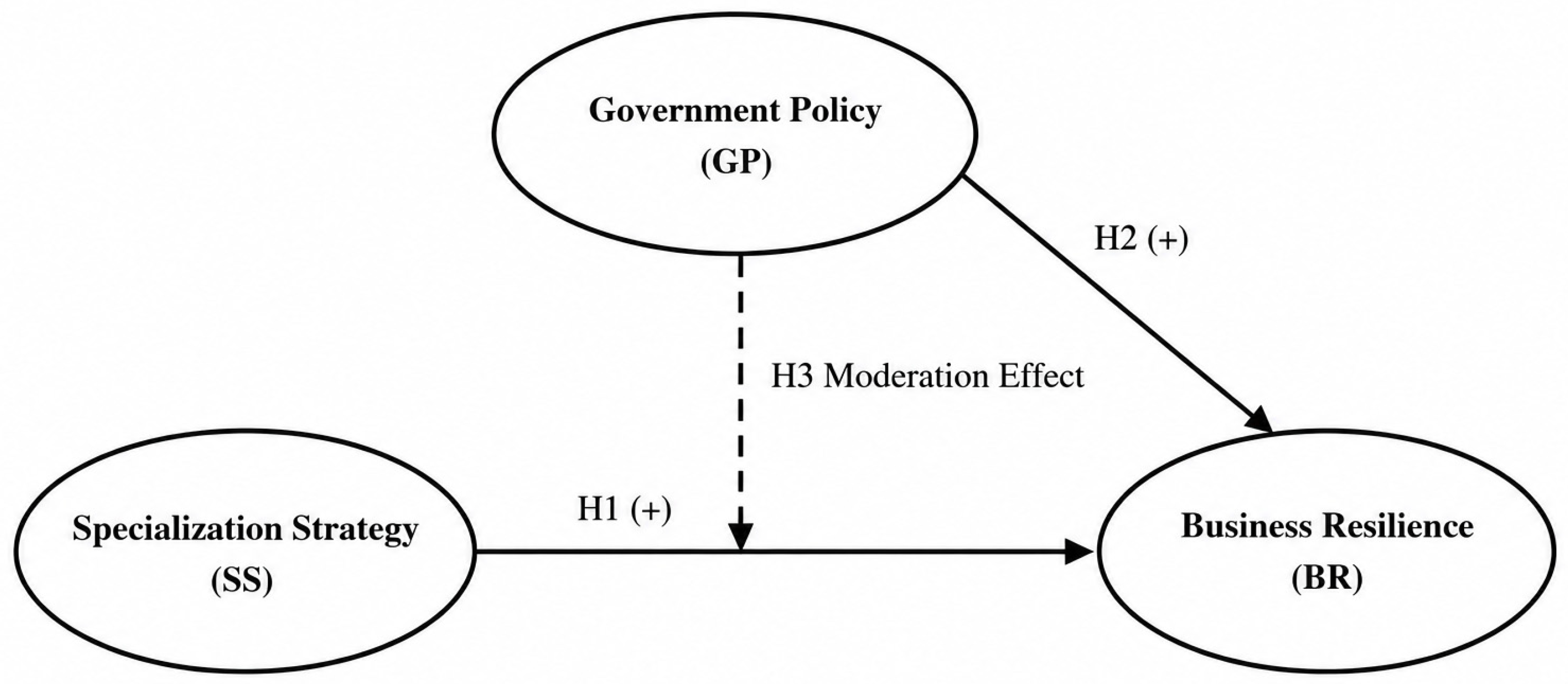
Figure 1 presents the conceptual model, which includes the direct effects of Specialization Strategy and Government Policy on Business Resilience and the moderating effect of Government Policy on the Specialization Strategy–Business Resilience relationship.
3. Materials and Methods
3.1. Research Design
The study employed a quantitative explanatory design using cross-sectional survey data to examine the relationships among Specialization Strategy, Government Policy, and Business Resilience. Cross-sectional designs are suitable for examining theoretically specified associations among organizational constructs at a defined point in time, but they do not establish temporal ordering or causal change across periods (
Maier et al., 2023).
This qualification is particularly important for Business Resilience. Organizational resilience is inherently dynamic because it involves capabilities associated with anticipating disruption, coping with adverse events, adapting organizational responses, and learning over time (
Duchek et al., 2020). Accordingly, the present study does not measure the longitudinal evolution of resilience before, during, and after a specific disruption. Instead, it captures respondents’ assessments of resilience-related organizational capabilities—including sourcing alternatives, contractual continuity, inventory management, information exchange, and supplier collaboration—at the time of the survey. The estimated structural relationships should therefore be interpreted as cross-sectional associations consistent with the proposed theoretical framework rather than as evidence of temporal causality.
The unit of analysis was the firm, whereas the unit of observation was one knowledgeable key informant representing each participating company. The use of key informants is appropriate in organizational research when respondents occupy positions that provide access to reliable information about firm-level strategies, activities, and interorganizational conditions (
Kumar et al., 1993). Eligible informants included owners, directors, senior managers, and managers directly involved in strategic or operational decision-making, procurement, supply-chain management, product development, or raw-material operations. Respondents were required to have sufficient knowledge of their firm’s strategy, operations, supply relationships, and external policy environment.
3.2. Population, Sampling, and Data Collection
The target population comprised a relatively specialized and narrowly defined group of firms operating in Indonesia that supplied raw materials or formulation-related inputs to the cosmetics industry, including general ingredients, specialty ingredients, active ingredients, fragrances, and formulation-support materials.
Although relevant industry associations exist, their membership lists did not constitute a complete national sampling frame of eligible cosmetic raw-material suppliers. Restricting recruitment to association members would therefore have excluded potentially eligible non-member firms. Consequently, probability-based sampling could not be implemented, and potential participating firms were identified through multiple industry-based sources, including industry associations, supplier directories, professional networks, and industry exhibitions.
A non-probability purposive sampling strategy was employed because the study required participating firms and respondents to possess characteristics directly relevant to the research questions. Purposive sampling enables researchers to deliberately select cases that are expected to provide relevant and information-rich evidence based on predefined eligibility criteria (
Campbell et al., 2020). At the firm level, eligibility required that the organization: (1) operate in Indonesia; (2) supply raw materials or formulation-related inputs to cosmetics manufacturers; and (3) be actively engaged in sourcing, distribution, technical support, or other raw-material-related business activities at the time of data collection.
At the respondent level, one knowledgeable key informant represented each eligible firm. Eligible informants included owners, directors, senior managers, and managers whose responsibilities involved strategic or operational decision-making, procurement, supply-chain management, product development, technical activities, or raw-material operations. Consistent with key-informant methodology, respondents were required to possess sufficient knowledge of their firms’ strategies, operations, supply relationships, and external policy environment (
Kumar et al., 1993). Accordingly, each valid questionnaire represented one firm-level observation.
The complete survey instrument comprised 37 items. A total of 189 questionnaires collected in 2025 met the eligibility and completeness requirements and were retained for analysis, representing 189 participating firms. Because purposive non-probability sampling was used, the findings should be interpreted as evidence from the participating firms rather than as statistically representative estimates of all cosmetic raw-material suppliers in Indonesia.
Sample adequacy was additionally evaluated using statistical power and PLS-SEM-specific sensitivity criteria rather than relying solely on a numerical rule of thumb. For the focal structural equation predicting Business Resilience from Specialization Strategy, Government Policy, and their interaction, a multiple-regression sensitivity analysis with three predictors, α = 0.05, and power = 0.80 indicated that the achieved sample of 189 observations could detect an effect of approximately f2 = 0.059 or larger.
This value lies between Cohen’s conventional small (f
2 = 0.02) and medium (f
2 = 0.15) benchmarks. As an additional PLS-SEM-specific sensitivity check, the inverse-square-root method of
Kock and Hadaya (
2018) indicated that
n = 189 corresponds to approximately 80% power for standardized path coefficients of about |β| = 0.181 or larger. Thus, the achieved sample provides adequate sensitivity for effects above these thresholds, although very small effects may remain undetected (
Faul et al., 2009;
Kock & Hadaya, 2018).
3.3. Measures
The present article focuses on 17 items measuring Specialization Strategy, Government Policy, and Business Resilience. All items used a six-point Likert scale ranging from 1 = strongly disagree to 6 = strongly agree. A six-point scale was used to reduce neutral responding and encourage directional assessments. The measures were adapted from prior literature and contextualized for Indonesia’s cosmetic raw materials industry (
Brennan & Rakhmatullin, 2015;
Nguyen et al., 2023;
Paredes et al., 2023;
Pinto et al., 2024;
Rocca et al., 2022;
Zhu et al., 2025). The measurement model was hierarchical.
Specialization Strategy was represented by Supply Chain and Specialty Product dimensions; Government Policy by Technology Support and Marketing Support; and Business Resilience by Reengineering and Collaboration.
Table 1,
Table 2 and
Table 3 list the focal items and their operational content. Because all focal constructs were measured using the same questionnaire completed by one key informant from each participating firm at a single point in time, the study was potentially susceptible to common-method variance.
This risk was assessed using a full-collinearity diagnostic following
Kock (
2015). Standardized construct scores from the complete six-construct model were used, with each construct regressed on the remaining constructs to obtain its full-collinearity variance inflation factor (VIF). A VIF value below 3.3 was used as the conservative diagnostic criterion for assessing potential common-method bias.
3.4. Data Analysis
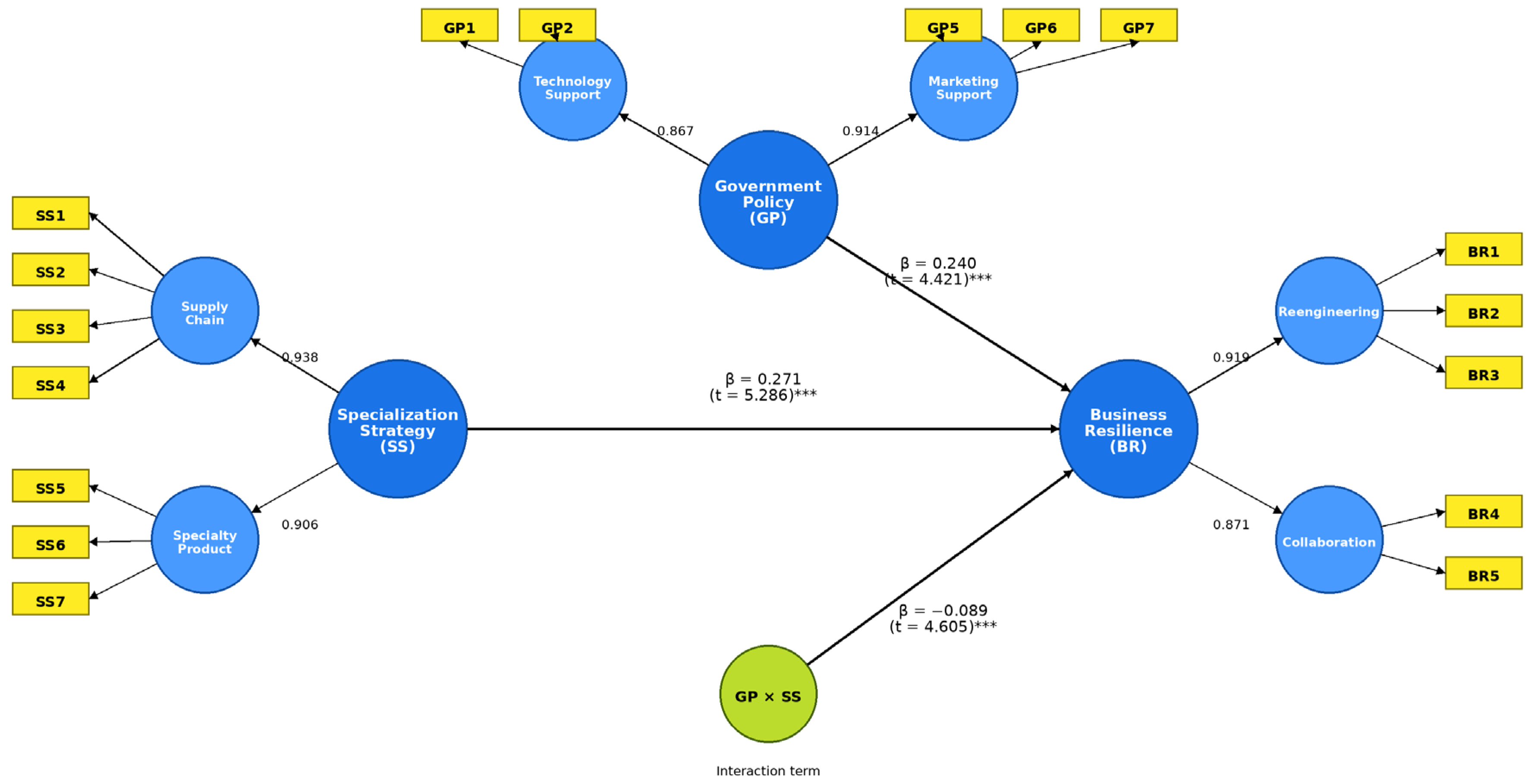
Partial least squares structural equation modeling (PLS-SEM) was conducted using SmartPLS 4. The hierarchical constructs were specified using the repeated-indicator approach, whereby the manifest indicators of each lower-order component were simultaneously assigned to the corresponding higher-order construct. Specifically, Specialization Strategy comprised Supply Chain (SS1–SS4) and Specialty Product (SS5–SS7), Government Policy comprised Technology Support (GP1–GP2) and Marketing Support (GP5–GP7), and Business Resilience comprised Reengineering (BR1–BR3) and Collaboration (BR4–BR5).
The hierarchical measurement model was evaluated using indicator loadings, Cronbach’s alpha, rho_A, composite reliability, average variance extracted (AVE), the Fornell–Larcker criterion, and the heterotrait–monotrait ratio (HTMT). Reliability values above 0.70 and AVE values above 0.50 were treated as acceptable. Discriminant validity was assessed using the Fornell–Larcker criterion and an HTMT threshold of 0.90 (
Hair et al., 2019).
The structural analysis assessed the focal direct paths from Specialization Strategy and Government Policy to Business Resilience and the interaction term Government Policy × Specialization Strategy. The moderating effect of Government Policy was estimated using the two-stage approach in SmartPLS 4. The interaction term was constructed as the standardized product of the standardized construct scores of Government Policy and Specialization Strategy. The focal relationships reported in this article were estimated within the complete structural model, although only the policy–specialization–resilience relationships are examined here.
Statistical inference was based on 5000 bootstrap subsamples using percentile bootstrap confidence intervals, a two-tailed test, and a significance level of 0.05. Standardized results were reported throughout the analysis. Bootstrapping was used to obtain standard errors, t-statistics, p-values, and 95% confidence intervals. Inner VIF values were examined to assess structural collinearity.
Potential common-method bias was additionally assessed using the full-collinearity VIF diagnostic proposed by
Kock (
2015). Each standardized construct score in the complete six-construct model was regressed on the remaining construct scores, and the resulting full-collinearity VIF values were evaluated against the conservative threshold of 3.3.
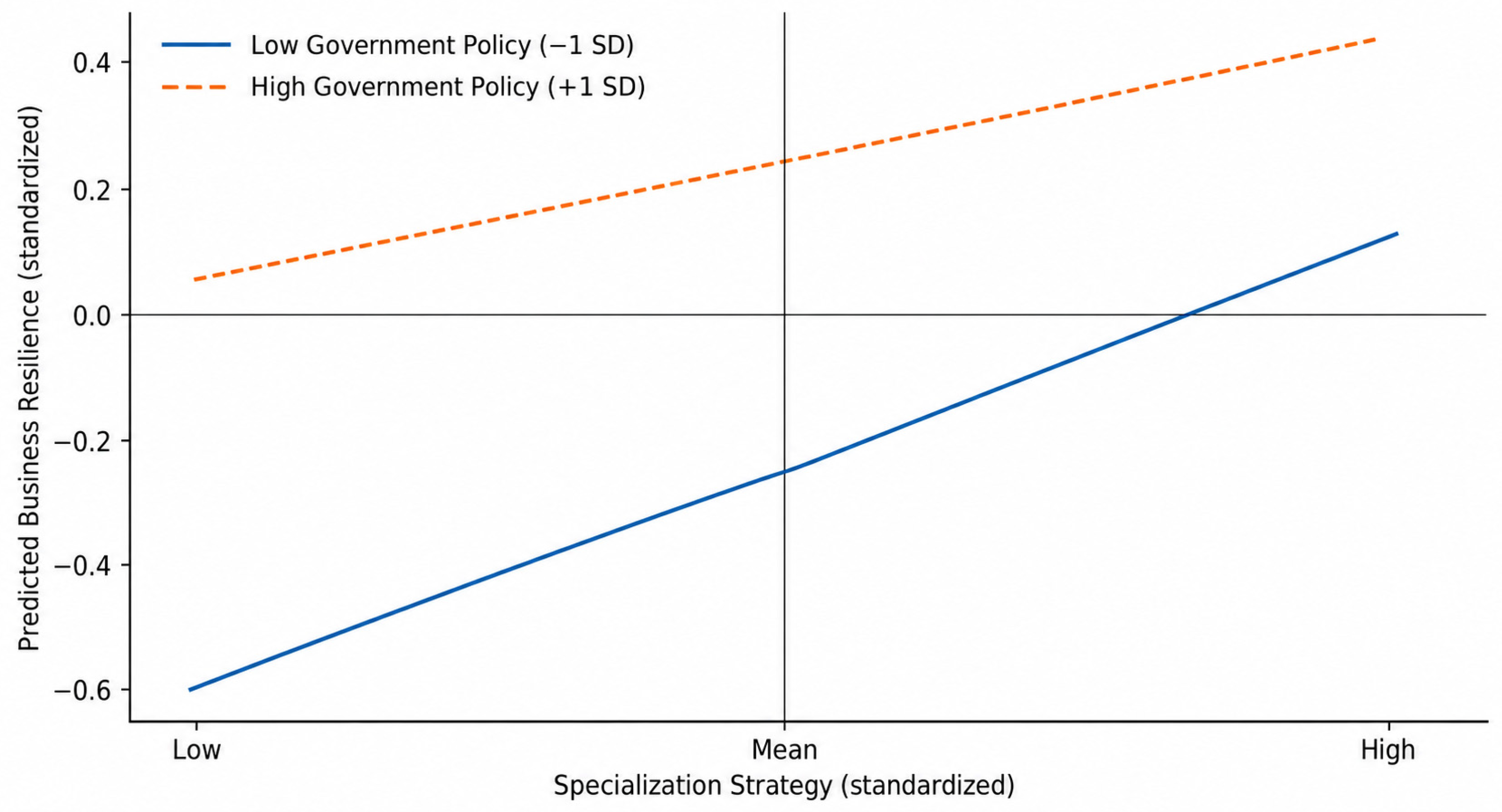
To interpret the moderating effect, conditional effects of Specialization Strategy on Business Resilience were examined at low (−1 SD), mean, and high (+1 SD) levels of Government Policy. Conditional effects were evaluated using their bootstrapped standard errors, t-statistics, p-values, and 95% confidence intervals. A graphical representation was used to illustrate the conditional relationship across levels of Government Policy.
5. Discussion
5.1. Specialization Strategy and Business Resilience
The positive effect of Specialization Strategy on Business Resilience indicates that focused capabilities improve firms’ capacity to manage disruption. Specialized suppliers develop deeper technical expertise, clearer product positioning, stronger customer relationships, and more integrated supply arrangements. These capabilities are particularly valuable when imported materials become unavailable, prices change rapidly, or regulatory requirements shift.
From the RBV, specialization is a mechanism for concentrating valuable and difficult-to-replicate resources (
J. Barney, 1991;
J. B. Barney et al., 2021). Technical product knowledge, formulation support, supplier relationships, regulatory expertise, and service routines become more effective when organized around a coherent strategic focus. Specialization can also speed adaptation because firms serving defined product categories or customer segments can identify substitutes, communicate technical changes, and coordinate supply responses more efficiently.
The finding is consistent with evidence that strategy–capability alignment contributes to adaptability and performance (
Jukka, 2023;
Pinto et al., 2024). In an import-dependent upstream industry, specialization is not merely a differentiation choice; it is an operational and informational capability that helps firms preserve continuity under uncertainty.
5.2. The Positive Direct Role of Government Policy
Government Policy had a positive direct effect on Business Resilience. This result indicates that administrative and industrial support can help firms prepare for and respond to supply, market, technological, and regulatory pressures. Technology programs may improve operational efficiency, inventory coordination, information exchange, and product development. Support for local materials and import reduction may broaden sourcing options, while market-research assistance may help firms identify customers, suppliers, and emerging opportunities.
The result is consistent with research showing that government responses and institutional support affect firms’ capacity to maintain operations and recover from disruption (
Nguyen et al., 2023;
Zhao et al., 2024). It also confirms that policy is not merely a passive environmental factor. It can function as an administrative resource that improves access to technology, market intelligence, and institutional certainty.
This role is especially relevant in an emerging economy. Firms in technically demanding and import-dependent industries may lack the resources to develop local materials, acquire specialized technology, or access international markets independently. Well-designed policy can reduce these constraints and support broader industrial resilience.
5.3. The Negative Moderating Role of Government Policy
The most distinctive finding is that Government Policy negatively moderated the relationship between Specialization Strategy and Business Resilience. Although policy directly supported resilience, higher perceived policy support reduced the marginal contribution of specialization. The finding therefore rejects a simple assumption of policy–strategy synergy.
Several mechanisms may explain this result. First, standardized programs may address broad industrial needs rather than the technical requirements of specialized suppliers. Firms operating in narrow product categories may need specific testing, registration, technology, or market support that general programs do not provide. Second, regulation and inspection can increase administrative costs and reduce the flexibility on which specialized firms depend. Third, broadly available policy support may substitute for capabilities that previously differentiated specialized firms, thereby reducing the relative advantage of their focused resources. Fourth, policy effects can vary across firms of different sizes, ownership structures, technological readiness, and market positions.
These mechanisms are interpretive rather than separately tested in the structural model. This interpretation is consistent with policy-design research showing that policy effectiveness depends on alignment among policy objectives, instruments, implementation capacity, and target-group conditions (
Mukherjee et al., 2021;
van Geet et al., 2019). Evidence from Indonesian innovation governance similarly indicates that fragmented coordination and misaligned priorities can prevent formal programs from translating into effective outcomes (
Rufini et al., 2026). In the present setting, policy support may improve general resilience conditions while reducing the additional benefit that firms derive from specialization when policy instruments are uniform, compliance-intensive, or weakly aligned with firm characteristics.
The negative interaction should not be interpreted as evidence that government policy is detrimental overall. Rather, it reveals two analytically distinct mechanisms. Policy improves the general conditions for resilience, but poorly aligned intervention can weaken the returns from firm-specific strategic capability. A policy may therefore be beneficial on average while constraining the effectiveness of specialization for particular firms.
5.4. Theoretical Contributions
The study contributes to the RBV by demonstrating that the value of a firm-level capability is contingent on external administrative conditions. Specialization organizes knowledge, relationships, and operational resources, but its contribution to resilience changes with the policy environment. Internal capabilities therefore do not operate independently of regulation and public support.
The findings also connect strategic management with administrative science. Government policy affects business resilience through both a direct enabling mechanism and a moderating mechanism. Distinguishing these roles offers a more precise explanation than treating policy support as uniformly beneficial. It shows that public intervention and private strategy can have simultaneous enabling and constraining consequences.
The study further extends resilience research to the upstream cosmetic raw materials industry. Resilience in this context is shaped by specialized product knowledge, supply-chain integration, customer collaboration, technology support, and regulatory fit. This industrial setting demonstrates how resilience emerges from the configuration of internal capability and external governance rather than from either domain alone.
5.5. Policy and Managerial Implications
Policymakers should avoid treating cosmetic raw material suppliers as a homogeneous group. Policy design should account for differences in firm size, ownership, product specialization, technological readiness, import dependence, and position in the supply chain. Technology support should be tailored to operational needs such as digital inventory management, supplier information exchange, traceability, technical testing, formulation support, and market intelligence.
Programs supporting local raw materials should combine import-reduction objectives with quality, safety, technological feasibility, and environmental considerations. Market-support programs should move beyond general trade promotion toward sector-specific exhibitions, technical matchmaking, research partnerships, and targeted international market information. Regulation and inspection should protect safety and quality while avoiding unnecessary duplication and sudden changes that absorb resources needed for specialization.
Cross-institutional coordination is also important. Government agencies, research institutions, industry associations, and firms should align program objectives, implementation schedules, and feedback mechanisms. Integrated planning and adaptive institutional arrangements can reduce the implementation gaps observed in other Indonesian policy contexts (
Rufini et al., 2026).
Managers should continue strengthening internal expertise, diversified supply options, customer collaboration, and differentiated products rather than relying exclusively on policy support. They should also develop regulatory intelligence, participate in industry consultation, and preserve flexibility within specialization. Focus should deepen competence without creating rigidity or dependence on a single product, supplier, or policy program.
5.6. Implications for Industrial Continuity and Administrative Resilience
Firm-level resilience has broader implications for industrial continuity and economic development. Resilient raw-material suppliers can reduce disruptions in downstream cosmetics production, preserve upstream–downstream linkages, and support domestic value creation in an import-dependent economy. The findings therefore suggest that administrative capacity and policy design matter not only for individual firms but also for the resilience of the wider industrial ecosystem.
The empirical findings point more directly to the importance of aligning public support with firms’ specialization and resilience capabilities. Technology support, local-material initiatives, import-reduction measures, and market assistance may strengthen firms’ general adaptive capacity, but their effectiveness depends on how well policy instruments correspond to firms’ technologies, product positions, supply arrangements, and operating conditions. Administrative resilience therefore requires not only the provision of support but also the capacity to adapt policy instruments to heterogeneous firm needs.
For policymakers, this implies that differentiated and responsive policy design may be more effective than uniform intervention. For firms, the findings reinforce the importance of maintaining specialized knowledge, integrated supply arrangements, diversified sourcing options, and collaborative relationships while preserving sufficient flexibility to respond to changes in the policy environment. Digitalization, sustainability, and green innovation remain potentially relevant extensions, but because they were not measured in the present study, their relationships with specialization, government policy, and business resilience should be examined directly in future research.
6. Conclusions
This study examined the role of Government Policy in the relationship between Specialization Strategy and Business Resilience among cosmetic raw material suppliers in Indonesia. Specialization Strategy had a positive and significant effect on Business Resilience, indicating that focused products, integrated supply capabilities, service quality, and specialized market positioning strengthen firms’ capacity to withstand and adapt to disruption.
Government Policy also had a positive and significant direct association with Business Resilience. Technology support, local-material initiatives, import-reduction support, and market assistance were associated with stronger adaptive capacity. Government Policy also significantly moderated the relationship between Specialization Strategy and Business Resilience, supporting H3. The negative interaction indicates that stronger perceived policy support weakened, but did not reverse, the positive relationship between Specialization Strategy and Business Resilience.
The negative interaction indicates a dual policy role. Government Policy was directly associated with higher Business Resilience, while higher perceived policy support reduced the marginal resilience benefit associated with Specialization Strategy. The conditional-effect analysis further showed that specialization remained positively associated with resilience even at high levels of Government Policy, indicating attenuation rather than reversal. These findings suggest that policy instruments may be less complementary to firm-specific specialization when they are standardized, administratively demanding, or insufficiently aligned with firms’ technologies, products, scale, and operating conditions.
The central implication is that effective industrial policy requires more than the presence of general support. Policy instruments should be adaptive, differentiated, consistent, and designed through consultation with affected firms and industry institutions. Such alignment is necessary to strengthen business resilience without reducing the strategic flexibility of specialized suppliers.
Limitations and Future Research
The cross-sectional design captures relationships at one point in time and does not establish temporal causality. Longitudinal research could examine how changes in policy and specialization affect resilience before, during, and after disruption. The study is also confined to one industry and country, so transferability to other settings should be assessed cautiously.
A further limitation concerns the use of single-informant, self-reported survey data. Although a full-collinearity assessment was conducted, the Business Resilience construct exceeded the conservative VIF criterion of 3.3. Common-method variance therefore cannot be completely excluded as an alternative influence on the observed relationships. Future studies could reduce this concern through multi-informant designs, temporally separated measurements, or the inclusion of an appropriate marker variable.
The sample included firms of different sizes and ownership structures, but subgroup differences were not tested in the focal analysis. Future studies could compare small and large firms, domestic and foreign-investment firms, and suppliers with different levels of import dependence. Additional research should also examine digital capability, policy implementation quality, regulatory burden, green innovation, local sourcing, and supply-chain flexibility as mediators or moderators.
Although the conditional-effect analysis strengthens the interpretation of the moderation finding, the cross-sectional design does not establish how the interaction between policy conditions and specialization evolves over time. Longitudinal research could examine whether the moderating role of Government Policy changes before, during, and after major supply, regulatory, or market disruptions.