1. Introduction
Consumption of health-oriented foods and beverages has increased considerably in recent years as consumers place greater emphasis on maintaining and improving their health (
Grunert et al., 2012). This trend accelerated during the COVID-19 pandemic, when heightened health consciousness substantially shifted consumer preferences toward products perceived as healthier (
Jaeger et al., 2021;
Sheth, 2020). Consequently, consumers increasingly evaluate products not only on the basis of their objective nutritional value but also through health-related associations created by marketing communication (
Hong et al., 2022). These symbolic associations may shape consumers’ perceptions of a product’s healthfulness and influence their consumption behaviour, particularly when objective product attributes are difficult to verify (
Natour et al., 2023;
Tudoran et al., 2009).
In the marketing communication literature, these perceptions are conceptualized as perceived health image, referring to consumers’ subjective beliefs that a product possesses health-related attributes. As an extrinsic cue, perceived health image helps consumers simplify product evaluation, especially when objective quality is difficult to verify (
Grandi et al., 2023;
Yusri et al., 2025). Under such conditions, consumers frequently rely on heuristic processing, allowing symbolic cues to influence product evaluations before more systematic assessments take place (
Radiatul et al., 2025). Favourable health-related perceptions may therefore extend beyond health evaluations and shape broader judgements of product quality, reflecting the health halo effect, whereby favourable impressions of one attribute are transferred to broader product evaluations (
Noor et al., 2023;
Nicolau et al., 2020). Although previous studies consistently show that perception-based cues influence consumer evaluations and decisions under uncertainty (
Anwar & Andrean, 2021;
Dwiarta & Ardiansyah, 2021), limited attention has been given to the evaluative mechanism through which perceived health image is translated into consumption decisions via perceived product quality.
Perceived product quality is one of the most influential determinants of consumer decision-making because it reflects consumers’ overall judgement of a product’s excellence and expected performance. Rather than being formed solely from objective product attributes, quality evaluations may also be shaped by symbolic perceptions, including health-related cues. This suggests that consumers may transfer favourable health images into broader quality evaluations before making consumption decisions. Accordingly, understanding the role of perceived product quality is essential for explaining how the symbolic perceived health image is translated into behavioural outcomes. However, previous studies have examined perceived health image, perceived product quality, and consumption decisions from different perspectives, leaving a limited understanding of how these constructs are theoretically connected within a single evaluative mechanism.
As shown in
Table 1, previous studies have recognized the importance of health-related perceptions and perceived product quality in shaping consumer behaviour. Research on health-related perceptions has primarily examined how perceived healthiness influences consumers’ evaluations and behavioural responses (
Plasek et al., 2020;
Michel et al., 2021), whereas studies on perceived product quality have largely treated quality as an independent determinant of consumption decisions (
Konuk, 2019). Although these studies provide valuable insights into the individual relationships among the constructs, they offer a limited explanation of how perceived product quality functions as the evaluative mechanism linking perceived health image to consumption decisions. This unresolved mechanism is the focus of the present study.
The Indonesian market provides a particularly relevant context for examining this issue because health-related product beliefs are strongly reinforced through subjective norms and social interactions (
Christian et al., 2025). Consumers’ perceptions are frequently shaped by family members, peers, and broader social discourse rather than by formal marketing communication alone (
Christian et al., 2025). Within this context, Bear Brand sterilized milk provides a theoretically relevant case because its health-related reputation is largely driven by consumer beliefs and social discourse rather than explicit medical or nutritional claims (
Chandra, 2021). Although the product is marketed simply as sterilized milk, many Indonesian consumers associate it with post-illness recovery and improved health.
Unlike products examined in many previous health halo studies, in which health perceptions are primarily activated through formal nutrition labels or explicit health claims, Bear Brand is widely perceived as a recovery-supportive product despite the absence of direct therapeutic positioning. This context is theoretically important because it enables the health halo effect to be examined under conditions in which consumers rely primarily on socially constructed health associations rather than objectively verifiable therapeutic claims. Accordingly, Bear Brand provides an appropriate context for explaining how perceived health image is translated into product quality evaluations before influencing consumption decisions. Understanding the extent to which socially constructed perceived health image influences product quality evaluations and consumption decisions contributes not only to the health halo literature but also to responsible health communication and ethical marketing practice.
Based on these arguments, this study examines how perceived health image functions as an indirect marketing communication mechanism that influences consumption decisions both directly and indirectly through perceived product quality. While previous studies have examined perception-based cues and perceived product quality in consumer behaviour, limited attention has been devoted to explaining the mediating role of perceived product quality in translating perceived health image into consumption decisions, particularly in emerging markets such as Indonesia. This study, therefore, moves beyond establishing the existence of these relationships by evaluating their practical significance in a context where health-related perceptions are primarily socially constructed. Assessing the strength of both the direct and indirect relationships provides a clearer understanding of the extent to which symbolic health-related perceptions shape consumer decision-making through product quality evaluations. Accordingly, this study investigates the health halo effect in the context of Bear Brand to provide empirical evidence of how symbolic health-related perceptions are translated into product quality evaluations and consumption decisions.
Accordingly, this study addresses the following research questions:
RQ1: To what extent does perceived health image contribute to consumers’ consumption decisions?
RQ2: To what extent does perceived health image shape consumers’ evaluations of product quality?
RQ3: To what extent do perceived product quality evaluations influence consumption decisions?
RQ4: To what extent does perceived product quality mediate the relationship between perceived health image and consumption decisions?
To address the proposed research questions, this study investigates consumers of Bear Brand sterilized milk in Indonesia using a PLS-SEM approach.
2. Literature Review
2.1. Theoretical Foundation
The health halo effect refers to a cognitive bias whereby consumers generalize a positive attribute of a product and infer broader benefits beyond what can be objectively verified (
Noor et al., 2023). In food marketing, this effect has frequently been observed for products bearing nutrient, organic, or sustainability claims, which enhance perceived healthiness and positively influence consumer evaluations despite limited changes in objective product attributes (
Nicolau et al., 2020). More importantly, the health halo effect operates through heuristic processing, allowing favourable health-related cues to be generalized into broader evaluations of product quality before objective verification occurs.
Current studies further suggest that health-related perceptions can also emerge from symbolic cues, such as packaging elements, terminology, and brand associations, that activate health-related schemas in consumers’ minds (
Küst, 2019;
Bullock et al., 2020). In the context of Bear Brand sterilized milk, such perceptions may be reinforced through symbolic cues, including the ‘sterilized milk’ designation, white packaging associated with purity and cleanliness, and long-standing consumer beliefs regarding health and recovery benefits (
Wright, 2023).
Beyond the health halo effect, Cue Utilization Theory provides an additional explanation for how consumers evaluate product quality under uncertainty. The theory posits that when objective product information is incomplete or difficult to evaluate, consumers rely on available intrinsic and extrinsic cues to infer product attributes (
Olson & Jacoby, 1972). Cue Utilization Theory further conceptualizes products as bundles of cues that signal underlying quality attributes, particularly in situations of information asymmetry and cognitive limitation (
Herbes et al., 2020). Recent applications in food marketing show that consumers systematically utilize visual, textual, and structural cues, including colour, labels, and packaging design, to simplify complex product evaluations and form quality judgements (
Dörnyei et al., 2022). Accordingly, perceived health image may function as an extrinsic cue that assists consumers in evaluating product quality when objective quality attributes are difficult to verify.
Similarly, Signalling Theory argues that market signals help reduce information asymmetry between firms and consumers by providing observable indicators of otherwise unobservable product attributes (
Spence, 1978). Because consumers are often unable to verify product quality directly before consumption, they rely on credible signals when forming product evaluations. Recent research in marketing and consumer behaviour suggests that branding elements, packaging design, and health-related associations function as important market signals that shape perceived product quality and consumer trust under conditions of uncertainty (
Connelly et al., 2011;
Lanchimba et al., 2021). Previous studies further indicate that stronger perceived signals are associated with more favourable consumer attitudes and purchase intentions during the consumption decision process (
Connelly et al., 2011). Within the context of Bear Brand, consumers’ beliefs regarding the product’s health-supportive properties may therefore operate as quality signals that influence subsequent product evaluations.
Taken together, these three theoretical perspectives provide complementary explanations for the proposed research model. The Health Halo Effect explains why consumers generalize favourable health-related impressions into broader product evaluations through heuristic processing. Cue Utilization Theory complements this perspective by explaining how consumers rely on available extrinsic cues when objective product quality is difficult to evaluate. Signalling Theory further explains why these symbolic health-related cues are interpreted as credible indicators of underlying product quality under conditions of information asymmetry. Collectively, these theories suggest that perceived health image influences consumer behaviour through a sequential evaluative mechanism in which health-related perceptions are generalized, interpreted as quality signals, and translated into consumption decisions through perceived product quality. These complementary theoretical perspectives therefore provide the conceptual foundation for examining both the proposed relationships and the strength of the evaluative mechanism underlying the health halo effect in the context of Bear Brand sterilized milk.
2.2. Consumption Decision
Consumption decision represents consumers’ final evaluative process of selecting, committing to, and ultimately carrying through a decision to consume a particular product (
F. Zhang et al., 2023). Within consumer decision-making theory, this construct extends beyond product selection by incorporating decision commitment and behavioural follow-through, thereby representing consumers’ final evaluative commitment toward actual product consumption (
X. Zhang et al., 2023). Although conceptually related to purchase intention and behavioural intention, these constructs capture different stages of consumer behaviour. Purchase intention reflects consumers’ willingness or likelihood to purchase a product, whereas behavioural intention represents a broader motivational tendency to perform a particular behaviour (
Ajzen, 2020). However, favourable intentions do not necessarily translate into realized behaviour, a phenomenon widely recognized as the intention-behaviour gap (
Sheeran, 2002). This gap suggests that intention-based constructs primarily capture consumers’ motivational readiness rather than the behavioural outcome itself. More importantly, purchase-oriented constructs explain consumers’ purchasing motivation, whereas consumption decisions capture consumers’ actual decisions to consume a product.
This distinction becomes particularly relevant in household consumption contexts, where purchasing decisions are often made collectively, and family members assume different decision-making roles rather than acting as independent consumers (
Chikweche et al., 2012;
Thomson et al., 2007). Furthermore, households frequently function as collective consumption units in which purchasing and consumption activities may be undertaken by different individuals depending on the roles they assume within the family (
Lien et al., 2018). Consequently, consumption decision provides a more appropriate behavioural outcome than purchase-oriented constructs because it reflects consumers’ final decision to consume a product irrespective of who performs the purchasing activity.
Viewed through a theoretical lens, consumption decision is conceptualized as a multidimensional construct comprising selection, decision commitment, and behavioural follow-through, adapted from previous studies (
Lee & Hare, 2023;
Sofi et al., 2020;
X. Zhang et al., 2023). Selection represents consumers’ choice among available alternatives, decision commitment reflects the firmness and confidence associated with the selected option, and behavioural follow-through captures the extent to which consumers ultimately carry out their consumption decision (
Shuai et al., 2023;
Valkov & Stancheva, 2023). Rather than representing independent dimensions, these components collectively capture the progression of consumer decision-making from evaluative selection, through commitment to the chosen option, to realized consumption behaviour. Accordingly, this multidimensional conceptualisation provides a more comprehensive representation of consumer decision-making by integrating cognitive evaluation with behavioural execution, thereby distinguishing consumption decision from intention-based constructs.
Consumption decision is operationalised through indicators representing selection, decision commitment, and behavioural follow-through, which collectively capture consumers’ progression from evaluation to realized consumption behaviour and remain consistent with contemporary consumer decision-making theory (
Ajzen, 2020;
Qazzafi, 2019). In the context of Bear Brand sterilized milk, this behavioural outcome represents consumers’ ultimate decision to consume the product after evaluating health-related and quality-related perceptions. The construct is particularly appropriate because Bear Brand is a well-established household product with which consumers are generally familiar and for which they have accumulated prior consumption experience. Furthermore, sterilized milk is commonly consumed within household settings, where product acquisition and product consumption may not necessarily be performed by the same individual. Therefore, evaluating consumption decision enables this study to examine a behavioural outcome that extends beyond purchasing motivation, providing a more appropriate basis for assessing the relative magnitude of Perceived Health Image and Perceived Product Quality. Thus, employing consumption decision as the dependent construct enables the present study not only to examine whether Perceived Health Image contributes to consumers’ realized consumption decisions but also to evaluate the relative magnitude of Perceived Health Image and Perceived Product Quality in shaping those decisions.
2.3. Perceived Health Image
Perceived health image refers to consumers’ overall perception that a product possesses health-related attributes and provides health-related benefits (
Yusri et al., 2025). Such perceptions are formed not only through objectively verifiable product characteristics but also through marketing communication and the symbolic meanings associated with the product (
Küst, 2019). In the context of Bear Brand sterilized milk, consumers’ evaluations are frequently shaped by subjective interpretations of health-related cues rather than by complete knowledge of the product’s nutritional characteristics. Accordingly, perceived health image is conceptualized as a perception-based evaluation that enables consumers to infer a product’s healthiness under conditions of limited information.
In this study, perceived health image is conceptualized as a multidimensional construct comprising perceived health attributes, expected health benefits, and symbolic health value, adapted from previous studies (
Plasek et al., 2020;
Michel et al., 2021). Perceived health attributes represent consumers’ beliefs regarding the health-related characteristics of a product, whereas expected health benefits reflect consumers’ expectations that consuming the product will contribute to health and well-being. Symbolic health value refers to the meaning attached to the product as a representation of a healthy lifestyle and concern for personal and family well-being (
F. Zhang et al., 2023;
Yeo & Oh, 2025). Collectively, these dimensions indicate that perceived health image extends beyond objective product information by capturing consumers’ subjective interpretations of the health-related meanings associated with a product.
Although perceived health image is conceptually associated with perceived product quality and trust, these constructs represent different stages of consumer evaluation. Perceived health image reflects consumers’ heuristic perception and symbolic interpretation of a product’s health-related characteristics, whereas perceived product quality represents consumers’ evaluation of the product’s overall excellence, performance, and reliability. In contrast, trust reflects consumers’ confidence in the dependability of a product or brand under conditions of uncertainty. Hence, perceived health image is conceptualized in this study as a health-related heuristic cue rather than an assessment of product quality or trustworthiness. This distinction establishes clearer conceptual boundaries between the three constructs while recognizing that health-related perceptions may subsequently influence consumers’ quality evaluations and behavioural responses.
Conceptually, perceived health image functions as a heuristic cue that facilitates product evaluation when consumers possess incomplete information regarding objective product attributes (
Suhud & Surianto, 2018;
Plasek et al., 2020;
Yeo & Oh, 2025). Rather than conducting extensive cognitive evaluations, consumers tend to rely on salient health-related cues to form rapid inferences about a product’s desirability and suitability. Such heuristic processing may also reduce consumers’ perceived uncertainty during product evaluation, although risk perception is treated in this study as an underlying theoretical mechanism rather than as an independent construct. Accordingly, perceived health image is expected to positively influence consumers’ consumption decisions and to constitute one of the key perceptual determinants whose relative contribution is evaluated in the present study.
H1. Perceived Health Image has a positive effect on Consumption Decision.
2.4. Perceived Product Quality
Perceived product quality refers to consumers’ overall evaluative judgement of a product’s excellence, performance, and consistency based on their interpretation of available product information rather than solely on objectively verifiable product characteristics (
Teleaba & Popescu, 2020). Within consumer behaviour research, product quality is widely recognized as a subjective evaluation constructed through consumers’ interpretation of intrinsic and extrinsic product cues during the product evaluation process (
Agyekum et al., 2015;
Vantamay, 2007;
Le et al., 2026). In the context of Bear Brand sterilized milk, consumers’ quality evaluations are unlikely to rely exclusively on objective nutritional information because consumers frequently possess incomplete knowledge of the product’s functional attributes. Instead, they evaluate product quality by integrating available information with their existing perceptions of the product. Accordingly, perceived product quality is conceptualized in this study as consumers’ evaluative assessment of a product’s overall quality, which develops through perceptual interpretation rather than objective verification alone.
In this study, perceived product quality is conceptualized as a multidimensional construct comprising performance, consistency, and excellence, adapted from previous studies (
Agyekum et al., 2015;
Le et al., 2026). Performance reflects consumers’ evaluation of the product’s ability to deliver its expected functional benefits, consistency represents consumers’ perception that the product maintains stable quality across repeated consumption experiences, and excellence captures consumers’ overall judgement that the product performs better than available alternatives. Collectively, these dimensions indicate that perceived product quality represents consumers’ comprehensive evaluative judgement of product performance and superiority rather than a single assessment of functional attributes.
Although perceived product quality is conceptually associated with Perceived Health Image, the two constructs represent different stages of consumer evaluation. Perceived Health Image reflects consumers’ heuristic perception and symbolic interpretation of a product’s health-related characteristics, whereas Perceived Product Quality represents consumers’ evaluative judgement of the product’s overall excellence, performance, and consistency after those health-related cues have been interpreted. Therefore, Perceived Health Image functions as an initial perceptual inference that enables consumers to form health-related impressions under limited information conditions, whereas Perceived Product Quality represents a subsequent evaluative assessment through which consumers judge the overall quality of the product. This distinction establishes clearer conceptual boundaries between the two constructs while recognizing that health-related perceptions may subsequently shape consumers’ evaluations of product quality.
From the standpoint of theory, Perceived Product Quality develops through consumers’ interpretation of product-related cues during the evaluation process. According to Cue Utilization Theory, consumers rely on salient cues to infer product characteristics before forming broader evaluations of overall product quality. Likewise, the Health Halo Effect suggests that favourable health-related perceptions may generate positive inferences that subsequently influence consumers’ evaluations of product quality by shaping how available product information is interpreted. Because perceived product quality represents consumers’ overall evaluation of a product’s excellence, favourable quality evaluations are expected to increase consumers’ confidence in selecting and consuming the product (
Surianto et al., 2024). Accordingly, consumers who perceive Bear Brand as having a favourable health image are expected to evaluate its product quality more positively, while more favourable quality evaluations are expected to contribute positively to consumers’ consumption decisions.
H2. Perceived Health Image has a positive effect on Perceived Product Quality.
H3. Perceived Product Quality has a positive effect on Consumption Decision.
2.5. The Mediating Role of Perceived Product Quality
While Perceived Health Image is expected to contribute directly to consumers’ Consumption Decisions, its influence is also expected to operate indirectly through Perceived Product Quality as an intermediate evaluative mechanism. From the perspective of Cue Utilization Theory, consumers initially rely on salient cues, such as health-related perceptions, to form rapid heuristic inferences before developing broader evaluations of product quality. Similarly, dual-process theories of decision-making suggest that heuristic judgements are subsequently refined through more systematic evaluative processes before behavioural decisions are made (
Mir-Artigues, 2022;
Zhao et al., 2025). Empirical studies have likewise shown that consumers frequently translate initial perceptual cues into behavioural outcomes through intermediate product evaluations rather than through direct heuristic processing alone (
Paul et al., 2016;
Konuk, 2019).
Although Perceived Product Quality could theoretically be conceptualized as an antecedent, a moderator, or an outcome, these alternative specifications do not fully capture the sequential perceptual process proposed by Cue Utilization Theory and the Health Halo Effect. In the present study, consumers are expected to first develop health-related perceptions from available product cues and then translate those perceptions into broader evaluations of product quality, which subsequently contribute to their consumption decisions. This sequential ordering is consistent with the consumer evaluation process, in which perceptions generally precede evaluative judgements, while behavioural decisions represent the final outcome of decision-making. Therefore, positioning Perceived Product Quality as an intervening evaluative mechanism provides a more theoretically coherent explanation of how heuristic health-related perceptions are transformed into behavioural outcomes.
In the context of Bear Brand sterilized milk, consumers frequently develop favourable health-related perceptions through marketing communication and broader social discourse before forming judgements of the product’s overall quality. Rather than assuming that health-related perceptions are translated directly into consumption decisions, the proposed model argues that these perceptions are partially transformed into behavioural outcomes through consumers’ evaluations of product quality. This sequential evaluative process is consistent with previous studies demonstrating that favourable quality evaluations constitute an important mechanism through which consumers’ perceptions are translated into behavioural outcomes, including actual consumption behaviour (
Rosillo-Díaz et al., 2020;
Konuk, 2019;
Paul et al., 2016). Consequently, the present study examines not only the direct contribution of Perceived Health Image to Consumption Decision but also the extent to which Perceived Product Quality explains this relationship, thereby enabling the relative contribution of the direct and indirect perceptual pathways to be evaluated.
H4. Perceived Product Quality positively mediates the relationship between Perceived Health Image and Consumption Decision.
2.6. Research Framework and Instrument
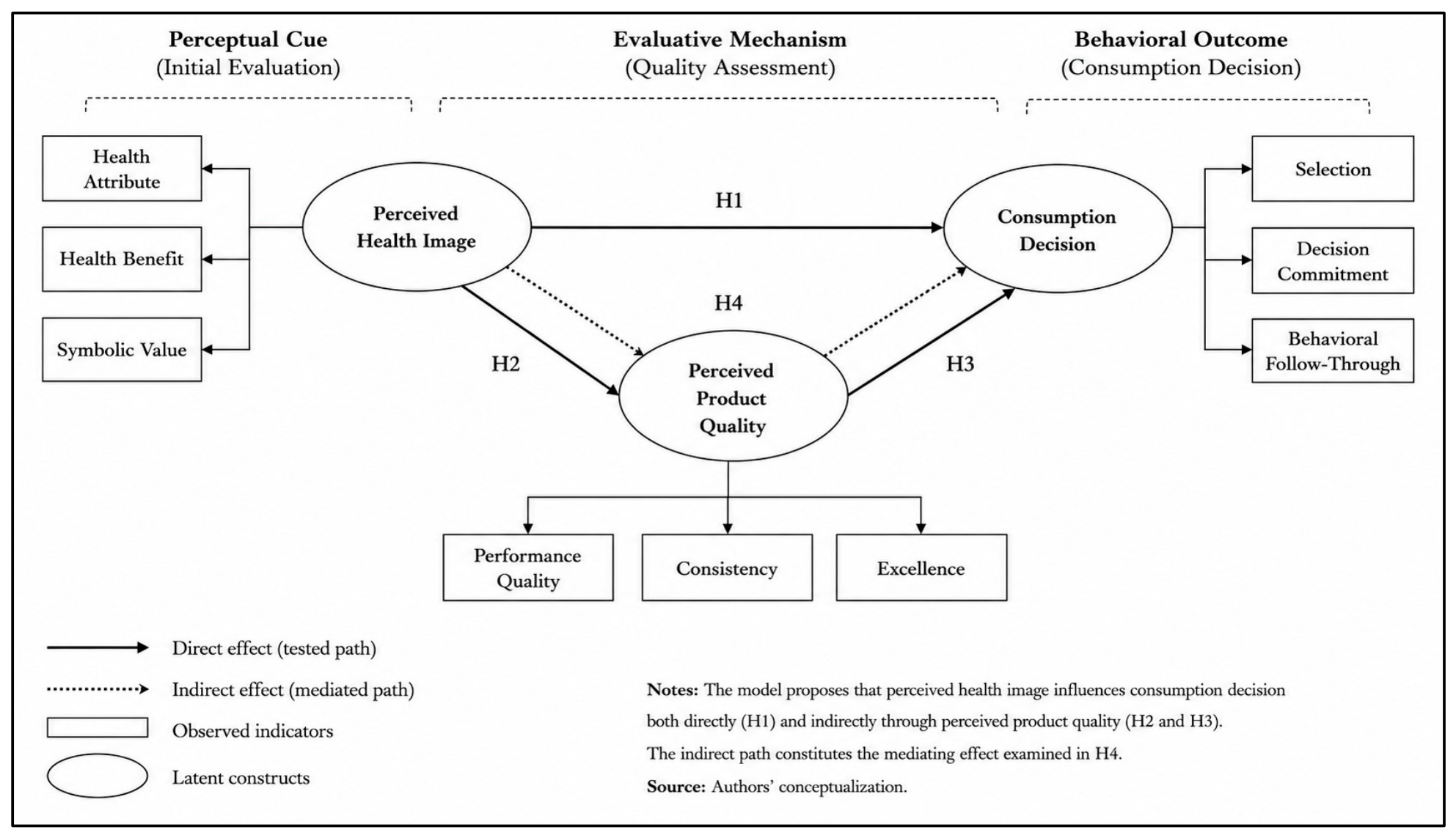
Building upon Cue Utilization Theory and the Health Halo Effect, the proposed conceptual framework explains consumption decisions as a sequential perceptual process through which consumers interpret health-related cues before forming broader evaluations of product quality and ultimately deciding whether to consume the product. Within this framework, Perceived Health Image represents consumers’ initial heuristic perception, which directly contributes to Consumption Decision while also shaping subsequent evaluations of Perceived Product Quality. Consistent with the theoretical arguments developed in the preceding sections, the proposed model examines both the direct influence of health-related perceptions on Consumption Decision and the indirect evaluative pathway through Perceived Product Quality.
Figure 1 displays a parsimonious, theory-driven conceptual framework derived from Cue Utilization Theory and the Health Halo Effect. Rather than incorporating multiple contextual variables, the framework intentionally focuses on the sequential perceptual mechanism through which Perceived Health Image influences Perceived Product Quality and, ultimately, Consumption Decision. This parsimonious structure enables the present study to evaluate the relative contribution of the direct and indirect perceptual pathways while maintaining theoretical coherence with the proposed consumer evaluation process. Thus, the framework is designed to examine not only whether health-related perceptions influence consumers’ consumption decisions but also how product quality evaluations contribute to this decision-making process.
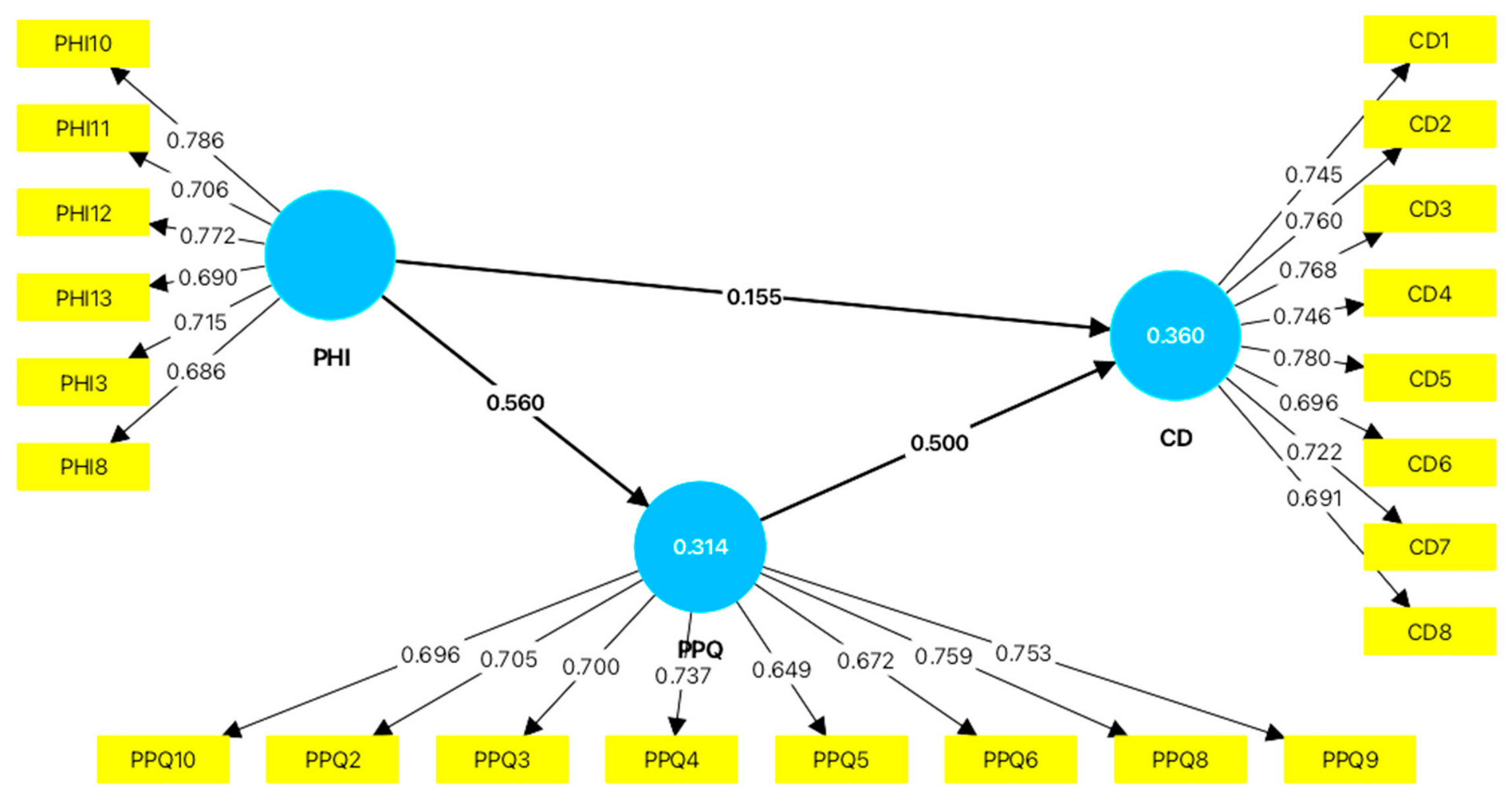
Figure 2 shows the structural model used to estimate the magnitude of the proposed direct and indirect relationships among the latent constructs. The structural model indicates that Perceived Health Image positively contributes to Consumption Decision (β = 0.155) and more strongly contributes to Perceived Product Quality (β = 0.560). In turn, Perceived Product Quality positively contributes to Consumption Decision (β = 0.500), suggesting that consumers’ quality evaluations constitute a substantial explanatory mechanism linking health-related perceptions with consumption behaviour.
Moreover, the coefficient of determination (R2) further indicates the explanatory capability of the proposed model. Perceived Health Image explained 31.4% of the variance in Perceived Product Quality (R2 = 0.314), whereas Perceived Health Image and Perceived Product Quality jointly explained 36.0% of the variance in Consumption Decision (R2 = 0.360). These findings indicate moderate explanatory power and are consistent with the study’s objective of evaluating the relative contributions of health-related perceptions and product quality evaluations in explaining consumers’ consumption decisions.
3. Research Design and Methods
This study employed a quantitative research design to examine the relative contribution of Perceived Health Image and Perceived Product Quality in explaining consumers’ Consumption Decisions regarding Bear Brand sterilized milk. In addition to examining the direct relationships among the constructs, the study evaluated the indirect explanatory role of Perceived Product Quality in the relationship between Perceived Health Image and Consumption Decision. Data were collected using a cross-sectional survey and analyzed through Partial Least Squares Structural Equation Modelling (PLS-SEM). PLS-SEM was considered appropriate because the present study emphasizes prediction and variance explanation by estimating the magnitude of both direct and indirect effects among latent constructs rather than reproducing covariance structures (
Sarstedt et al., 2021). Furthermore, PLS-SEM enables the simultaneous estimation of direct and indirect relationships while maintaining a predictive and variance-based analytical orientation (
Sarstedt et al., 2021).
The study used a purposive sampling technique to recruit respondents capable of providing meaningful evaluations of Bear Brand sterilized milk. To ensure the behavioural relevance of the data, respondents were required to meet two screening criteria: (1) familiarity with Bear Brand sterilized milk; (2) consumption of the product at least once within the previous twelve months. Respondents were screened based on previous consumption experience rather than purchasing experience because the study investigates Consumption Decision, which does not necessarily require consumers to be responsible for product acquisition. These criteria were established because the dependent construct examined in this study reflects realized consumption behaviour rather than purchase intention. Data were collected through an anonymous online questionnaire administered in March 2026. A total of 275 responses were initially obtained, of which 75 were excluded after applying the predefined screening criteria, resulting in 200 valid responses for subsequent analysis. The final sample exceeded the recommended minimum sample size for estimating a PLS-SEM model of moderate complexity (
Sarstedt et al., 2021), with individual consumers serving as the unit of analysis. An a priori statistical power analysis using G*Power 3.1 further confirmed that the final sample size exceeded the minimum number of observations required to detect the anticipated effect sizes.
The measurement instrument was developed by adapting previously validated scales to the context of sterilized milk consumption while preserving the conceptual definitions of each construct. All measurement items employed a five-point Likert scale ranging from 1 (‘strongly disagree’) to 5 (‘strongly agree’). The items were contextually refined to reflect consumers’ evaluations of sterilized milk products. Perceived Product Quality was measured using indicators reflecting consumers’ evaluations of product performance, consistency, and overall excellence, whereas Consumption Decision was operationalised as a multidimensional construct comprising selection, decision commitment, and behavioural follow-through.
The questionnaire was developed and administered in Bahasa Indonesia to ensure that respondents fully understood each statement and could accurately express their evaluations. Data were collected through an online questionnaire using Google Forms, which was considered appropriate for the target respondents who were familiar with digital platforms. Participation was entirely voluntary, and no financial or non-financial incentives were provided, thereby minimizing the likelihood of response bias associated with external rewards.
Prior to the main survey, the questionnaire was pilot-tested with 50 respondents to assess item clarity and the preliminary psychometric properties of the measurement instrument. The preliminary questionnaire consisted of 14 items measuring Perceived Health Image, 10 items measuring Perceived Product Quality, and 9 items measuring Consumption Decision. Preliminary item validity was assessed using Pearson’s two-tailed bivariate correlations between individual items and their respective construct scores, whereas internal consistency was evaluated using Cronbach’s alpha in IBM SPSS Statistics 28.0. The pilot results indicated that all measurement items were significantly correlated with their respective construct scores (p < 0.01), and all constructs demonstrated satisfactory internal consistency (Perceived Health Image α = 0.907; Perceived Product Quality α = 0.861; Consumption Decision α = 0.914). The questionnaire was retained without substantive modification for the main survey.
Since all constructs were measured using a single self-administered questionnaire, common method bias was assessed prior to structural model evaluation. Following the recommendation of
Kock (
2015), full collinearity variance inflation factors (VIFs) were examined to determine whether common method bias was likely to threaten the validity of the findings.
The data were analyzed using SmartPLS 4 following the recommended two-stage PLS-SEM procedure (
Sarstedt et al., 2021). The first stage involved assessing the measurement model by examining indicator reliability, internal consistency reliability, convergent validity, and discriminant validity using outer loadings, composite reliability, average variance extracted (AVE), and the heterotrait-monotrait ratio (HTMT). The second stage involved assessing the structural model by estimating both the statistical significance and relative magnitude of the hypothesized relationships through path coefficients, coefficients of determination (R
2), effect sizes (f
2), predictive relevance (Q
2), and bootstrapping procedures. In addition to hypothesis testing, the structural analysis emphasized the relative contribution of the direct and indirect effects among the proposed constructs. The mediating role of Perceived Product Quality was assessed by estimating the indirect effect of Perceived Health Image on Consumption Decision in accordance with the PLS-SEM mediation procedures recommended by
Sarstedt et al. (
2021).
4. Results
4.1. Participants
Section 4 presents the empirical findings of the study. The analysis begins with the demographic characteristics of the respondents, followed by the assessment of the measurement model, structural model, and hypothesis testing.
Table 2 presents the demographic profile of the respondents. The gender distribution was relatively balanced, with 51.5% male and 48.5% female respondents. Most respondents (79.0%) were aged 25 years or younger, indicating that the sample primarily represents younger consumers familiar with Bear Brand sterilized milk. Although this demographic profile reflects the study context, the findings should be interpreted with caution when generalizing to older consumer populations.
The respondent profile shows a relatively balanced gender distribution, with 103 male respondents (51.5%) and 97 female respondents (48.5%). In terms of occupational status, almost half of the respondents were employed (48.5%), followed by unemployed respondents (35.0%) and self-employed respondents (15.5%). Most respondents were unmarried (86.0%), indicating that the sample mainly consisted of younger consumers who were not household heads. Based on the screening questions, 200 out of 275 respondents had consumed the product within the past year. As shown in
Table 2, the largest group of respondents reported consuming Bear Brand within the previous six months (40.5%). This indicates that most respondents were active consumers, making their evaluations relevant for examining consumption decisions.
Table 2 further shows that respondents assumed different roles in the consumption process. While 66.5% reported purchasing and consuming Bear Brand themselves, 31.5% consumed the product after it had been purchased by another household member, and an additional 2.0% consumed the product through workplace provision or other arrangements. These findings indicate that approximately one-third of respondents consumed the product without personally purchasing it, supporting the household consumption context underlying the present study. Consequently, Consumption Decision was considered a more appropriate behavioural outcome than purchase-oriented constructs because product acquisition and product consumption were not always undertaken by the same individual.
Following the demographic analysis, the measurement model was evaluated to examine indicator reliability, internal consistency reliability, convergent validity, discriminant validity, and common method bias prior to assessing the structural model.
4.2. Validity and Reliability Tests
The measurement model was assessed by examining indicator reliability, internal consistency reliability, convergent validity, discriminant validity, and collinearity diagnostics. Indicator reliability was evaluated using outer loadings. As presented in
Table 3, all indicators exceeded the minimum acceptable loading of 0.60, with loadings ranging from 0.686 to 0.786 for Perceived Health Image, from 0.649 to 0.759 for Perceived Product Quality, and from 0.686 to 0.780 for Consumption Decision. Although several indicators exhibited loadings slightly below the recommended value of 0.700 (ranging from 0.649 to 0.696), they were retained because all constructs satisfied the recommended criteria for composite reliability and convergent validity while preserving the theoretical representation of each construct. The relatively balanced loading values across indicators indicate that each construct was represented by multiple items with comparable contributions, suggesting that no single indicator disproportionately dominated the measurement of the latent variables.
Moreover, the internal consistency reliability was assessed using Cronbach’s alpha and composite reliability. Cronbach’s alpha values ranged from 0.821 for Perceived Health Image to 0.881 for Consumption Decision, whereas composite reliability values ranged from 0.870 to 0.906. All values exceeded the recommended threshold of 0.700, indicating satisfactory internal consistency reliability across all constructs.
In terms of convergent validity, it was evaluated using the Average Variance Extracted (AVE). The AVE values for Perceived Health Image (0.528), Perceived Product Quality (0.504), and Consumption Decision (0.546) all exceeded the recommended minimum threshold of 0.50. These findings indicate that the indicators share substantially more variance with their intended construct than with measurement error, thereby supporting the convergent validity of the latent variables. Although the AVE values for Perceived Product Quality and Perceived Health Image were relatively close to the recommended threshold, they remained within the acceptable range for convergent validity. In addition, there was no indicator with composite reliability scores above 0.95, indicating a consistency and no redundant indicators. While all measurement items remained after the pilot test, some indicators whose outer loadings were inadequate were deleted in order to fulfil the requirements for indicator reliability and convergent validity. The model included six indicators for Perceived Health Image, eight for Perceived Product Quality, and eight for Consumption Decision, while keeping the same item codes for transparency. The measurement model fulfilled the required standards for indicator reliability, internal consistency reliability, and convergent validity.
Furthermore, the discriminant validity was subsequently assessed using the Fornell–Larcker criterion, the heterotrait–monotrait ratio (HTMT), and indicator cross-loadings, whereas collinearity was examined using variance inflation factor (VIF) values. The results of these additional assessments are presented in
Table 4 and
Table 5 and further confirm the adequacy of the measurement model prior to evaluating the structural relationships.
Table 5 presents the discriminant validity assessment using the Fornell–Larcker criterion. Although Perceived Product Quality exhibited the strongest correlation with Consumption Decision (r = 0.586), the correlation remained substantially lower than the corresponding square root of AVE, suggesting that the two constructs are empirically related while maintaining adequate conceptual distinctiveness. These findings indicate that each construct shares more variance with its own indicators than with other latent constructs, thereby confirming satisfactory discriminant validity.
Table 6 reports the inner Variance Inflation Factor (VIF) values used to assess multicollinearity among predictor constructs. All structural relationships produced VIF values ranging from 1.000 to 1.458, which are well below the recommended threshold of 3.3. These findings indicate that multicollinearity is not a concern in the structural model, suggesting that each predictor contributes unique explanatory information without causing substantial redundancy.
The predictive relevance of the structural model was further evaluated using Stone–Geisser’s Q
2 obtained through the blindfolding procedure. As presented in
Table 7, Perceived Product Quality (Q
2 = 0.152) and Consumption Decision (Q
2 = 0.185) both exhibited positive Q
2 values exceeding the recommended threshold of zero, indicating that the proposed model possesses satisfactory predictive relevance. According to established guidelines, both endogenous constructs demonstrate a moderate level of predictive relevance, suggesting that the model has an acceptable capability to predict consumers’ evaluations of product quality and subsequent consumption decisions. In addition, the R
2 values of 0.314 for Perceived Product Quality and 0.360 for Consumption Decision indicate that the proposed model explains approximately 31.4% and 36.0% of the variance in the respective endogenous constructs. Together with the positive Q
2 values, these findings suggest that the model demonstrates not only satisfactory explanatory power but also acceptable predictive capability.
4.3. Hypothesis Testing
The proposed hypotheses were technically tested through bootstrapping analysis, and the results are presented in
Table 8. All hypotheses were supported. The relationship between Perceived Health Image and Consumption Decision was positive and significant (β = 0.155, t = 2.320,
p = 0.020), indicating that Perceived Health Image has a direct effect on Consumption Decision. Therefore, H1 is supported.
As shown in
Table 8, a strong positive relationship was also identified between Perceived Health Image and Perceived Product Quality (β = 0.560, t = 11.109,
p < 0.001). This finding indicates that Perceived Health Image has a strong positive effect on Perceived Product Quality; therefore, H2 is supported. In addition, Perceived Product Quality has a significant positive effect on Consumption Decision (β = 0.500, t = 7.335,
p < 0.001), indicating that consumers who perceive product quality to be high are more likely to make consumption decisions. Therefore, H3 is supported.
To further complement the hypothesis testing results, effect sizes (f
2) were examined to evaluate the practical contribution of each structural relationship. As shown in
Table 8, Perceived Health Image exerted a large effect on Perceived Product Quality (f
2 = 0.458), indicating that health-related perceptions substantially contribute to consumers’ evaluations of product quality. Perceived Product Quality, in turn, demonstrated a medium effect on Consumption Decision (f
2 = 0.268), suggesting that consumers’ quality evaluations play an important role in shaping their consumption behaviour. In contrast, the direct effect of Perceived Health Image on Consumption Decision exhibited only a small effect size (f
2 = 0.026), despite being statistically significant. These findings indicate that health-related perceptions influence consumption decisions primarily by enhancing consumers’ evaluations of product quality rather than through a strong direct behavioural effect. In addition, the indirect effect of Perceived Health Image on Consumption Decision through Perceived Product Quality was positive and significant (β = 0.280, t = 6.228,
p < 0.001). This result indicates that Perceived Health Image indirectly influences Consumption Decision through Perceived Product Quality. Therefore, H4 is supported.
5. Discussion
5.1. Theoretical Implications
The empirical findings show that Perceived Health Image significantly influences consumers’ Consumption Decision, indicating that favourable health-related perceptions encourage consumers to choose Bear Brand milk. However, the relatively modest magnitude of the direct effect suggests that health-related perceptions alone are insufficient to generate strong behavioural commitment. Instead, consumers appear to rely on health image primarily as an initial heuristic cue before making more comprehensive product evaluations. This finding is consistent with previous studies demonstrating that health-related perceptions positively influence consumer responses (
Plasek et al., 2020;
Michel et al., 2021). Nevertheless, the present findings further indicate that the influence of health image is limited when consumers have the opportunity to evaluate other product-related attributes. Theoretically, these findings support the Health Halo Effect by confirming that favourable health-related perceptions shape consumers’ initial evaluations. They also complement Cue Utilization Theory by suggesting that health image functions as an extrinsic cue during the early stage of decision-making, while Signalling Theory explains why consumers interpret health-related information as a credible signal of product quality rather than as sufficient justification for consumption decisions.
The findings further reveal that Perceived Health Image exerts a strong positive influence on Perceived Product Quality, suggesting that consumers transfer favourable health-related impressions into broader evaluations of product quality. In other words, products perceived as healthier are also perceived as more reliable, safer, and of higher overall quality. This finding is consistent with previous studies on the Health Halo Effect, which reported that positive health-related attributes generate favourable evaluations extending beyond health perceptions alone (
Konuk, 2019;
Rather, 2020;
Valkov & Stancheva, 2023). The present study confirms these findings in the context of sterilized milk products in Indonesia. Theoretically, the findings reinforce the Health Halo Effect by demonstrating that positive health perceptions extend into overall product evaluations. They also provide empirical support for Cue Utilization Theory, indicating that consumers rely on health image as an extrinsic quality cue when intrinsic product quality cannot be directly assessed before purchase. Furthermore, the findings are consistent with Signalling Theory, as consumers interpret favourable health-related information as a credible signal of superior product quality.
The results also demonstrate that Perceived Product Quality has the strongest direct influence on Consumption Decision among all structural relationships examined. This finding indicates that although health-related perceptions attract consumers’ attention, their final consumption decisions depend primarily on evaluative judgements regarding product quality, reliability, and overall performance. The result is consistent with previous studies suggesting that perceived quality is one of the strongest predictors of consumer purchasing behaviour because consumers seek products capable of consistently delivering superior value and performance. Theoretically, these findings complement Cue Utilization Theory by demonstrating that consumers eventually move beyond heuristic cues toward more comprehensive quality evaluations before making behavioural decisions. At the same time, the findings support Signalling Theory because consumers’ evaluations of quality are influenced by the interpretation of observable signals that reduce uncertainty regarding product performance. Consequently, perceived product quality represents the evaluative stage that directly drives consumption decisions.
The mediation analysis further demonstrates that Perceived Product Quality significantly mediates the relationship between Perceived Health Image and Consumption Decision. This finding suggests that consumers do not directly translate favourable health-related perceptions into purchasing behaviour. Instead, health image first shapes consumers’ perceptions of product quality, which subsequently becomes the immediate basis for consumption decisions. The result is consistent with previous studies arguing that consumer responses to health-related products are often influenced indirectly through cognitive evaluations rather than through heuristic impressions alone. Rather than proposing a new theoretical framework, the present study empirically validates the sequential cognitive mechanism linking heuristic processing with evaluative processing. Specifically, the Health Halo Effect explains the formation of favourable health-related impressions, Cue Utilization Theory explains how these impressions are utilized as informational cues during product evaluation, and Signalling Theory explains why these cues are interpreted as credible indicators of underlying product quality. Collectively, the findings demonstrate that these three theoretical perspectives operate in a complementary sequence to explain how symbolic health perceptions ultimately influence consumption decisions.
The structural model also demonstrates moderate explanatory power. Perceived Health Image explains 31.4% of the variance in Perceived Product Quality, while Perceived Health Image and Perceived Product Quality jointly explain 36.0% of the variance in Consumption Decision. These findings indicate that health-related perceptions and quality evaluations are important determinants of consumer behaviour, although they do not fully explain consumption decisions. This result is consistent with previous consumer behaviour studies showing that purchasing decisions are inherently multidimensional and influenced by various cognitive and contextual factors beyond product perceptions alone. Accordingly, future studies should incorporate additional variables, such as price perception, brand trust, health consciousness, product familiarity, or sensory evaluation, to improve the explanatory capability of the proposed model and to further examine the boundary conditions under which health-related perceptions exert stronger or weaker effects.
The findings should also be interpreted in light of the study’s sample characteristics, as the respondents were predominantly consumers below the age of 25 years. Younger consumers are generally more exposed to digital marketing communication and online health-related information, potentially making them more responsive to health-related product cues than older consumer segments. Consequently, the present findings primarily reflect the cognitive evaluations and consumption decisions of younger consumers. Future research should therefore validate the proposed model using more diverse demographic groups to examine whether the observed relationships remain consistent across different age groups, educational backgrounds, and levels of health consciousness.
This study demonstrates that consumer decision-making for health-positioned products involves both heuristic and evaluative cognitive processes rather than favourable health perceptions alone. Health-related perceptions encourage positive initial evaluations, but consumers subsequently translate these impressions into assessments of product quality before making consumption decisions. This is generally consistent with previous literature on health-related consumer behaviour while providing empirical validation of the cognitive mechanism underlying these relationships. Rather than extending the Health Halo Effect into a new theoretical framework, the study contributes by integrating the complementary explanatory roles of the Health Halo Effect, Cue Utilization Theory, and Signalling Theory within a single empirical model. The findings therefore suggest that companies should not rely exclusively on symbolic health positioning but should simultaneously maintain consistently high product quality because consumers ultimately base their behavioural decisions on evaluative quality judgements.
5.2. Managerial Implications
From a managerial perspective, the findings suggest that health-related brand positioning alone is insufficient to drive consumers’ consumption decisions. Although consumers respond positively to favourable health-related perceptions, these perceptions primarily function as an initial heuristic cue that attracts attention rather than as the final determinant of behaviour. Consequently, managers should avoid relying exclusively on symbolic health claims or wellness-oriented branding to encourage product consumption. On the other hand, health-related communication should be strategically designed to strengthen consumers’ perceptions of product quality. The findings demonstrate that consumers first interpret health-related information as an indication of superior quality before translating these evaluations into actual consumption decisions. Accordingly, marketing communications should integrate health-related claims with tangible evidence of product quality, such as nutritional composition, manufacturing standards, product safety certifications, quality control processes, and scientific or clinical support where appropriate. By reinforcing symbolic health positioning and objective quality attributes simultaneously, firms can increase the credibility of their health-related messages and strengthen consumers’ evaluative judgements.
Sterilized milk brands need to translate these objective indicators of quality into tangible features within the packaging and communication efforts. Certifications for quality and food safety indicators should be located at the front of the pack to make it easier for consumers to identify them when making their purchasing decisions, whereas the detailed information about the sterilization process, production specifications, and nutritional composition could be conveyed through an easily readable and structured layout at the side or back of the pack. Finally, the use of packaging materials and design cues that denote purity and cleanliness can enhance consumers’ perceptions of quality without contradicting the health-focused nature of the brand positioning strategy.
For Bear Brand, the findings suggest that managers should recognize that consumers naturally develop favourable health-related perceptions even in the absence of explicit health claims. Rather than introducing stronger health-related messages, the company should maintain communications that reinforce product purity, hygiene, safety, and manufacturing excellence, as these attributes appear to contribute to consumers’ perceptions of healthiness. At the same time, such communications should consistently strengthen consumers’ perceptions of product quality by emphasizing objective quality cues, such as sterilization processes, quality assurance practices, product consistency, and manufacturing standards. This approach is more consistent with the present findings, which indicate that favourable health-related perceptions influence consumption decisions primarily because they enhance perceived product quality rather than because they directly motivate purchasing behaviour.
To sum up, managers need to recognize that consumers’ favourable health-related perceptions often develop through accumulated experiences, brand reputation, and shared social beliefs, particularly within households where Bear Brand has long been associated with health and recovery. These established perceptions naturally create expectations regarding product quality. If consumers perceive inconsistencies between these health-related perceptions and their actual product experience, the credibility of the brand may gradually decline, leading to lower perceived product quality and weaker consumption intentions. Therefore, managers should continuously invest in product quality, quality assurance, and consistent product performance to ensure that consumers’ favourable health-related perceptions remain supported by their actual consumption experiences.
5.3. Research Limitations and Future Research
This study has several limitations that should be acknowledged. The sample was predominantly composed of young consumers, which may limit the generalisability of the findings to broader consumer populations with different demographic characteristics and purchasing behaviours. Due to the high concentration of participants in the sample among those who were 25 years old or younger, the findings may also reveal the influence of age on the information processing process. Younger people tend to use heuristics, symbolic associations, and perceptions of product healthiness in their product evaluation processes, while older people might put more emphasis on their experience of consumption and quality-related information. Hence, the halo effect revealed in the present study is likely to be stronger among younger people than among older ones.
Although the proposed model explains a moderate proportion of the variance in Consumption Decision, other psychological, social, and marketing-related factors may also contribute to consumers’ consumption behaviour but were beyond the scope of the present study. Third, the cross-sectional design limits the ability to draw causal inferences regarding the temporal development of consumers’ health-related perceptions and product evaluations.
Future research is therefore encouraged to replicate the proposed model using more diverse demographic groups and different product categories to examine the generalisability of the findings. It is also suggested that future research needs to perform multi-group analysis depending on consumers’ age to find out whether there are differences in heuristic information processing and the mediation of perceived product quality. Comparative analyses across age groups or health-conscious consumer segments may also provide a deeper understanding of how health-related perceptions influence consumption decisions. Moreover, longitudinal or experimental research designs are recommended to provide stronger evidence regarding the causal relationships among Perceived Health Image, Perceived Product Quality, and Consumption Decision. Future studies could also extend the model by incorporating additional explanatory variables, such as health consciousness, brand trust, perceived risk, or nutrition knowledge, to improve the predictive power of the model and provide a more comprehensive explanation of consumer decision-making.
6. Conclusions
This study examined the relationships among Perceived Health Image, Perceived Product Quality, and Consumption Decision in the context of Bear Brand sterilized milk in Indonesia. The findings demonstrate that Perceived Health Image positively influences Consumption Decision both directly and indirectly through Perceived Product Quality. However, the stronger indirect effect indicates that consumers do not rely solely on favourable health-related perceptions when making consumption decisions. Instead, health-related perceptions primarily function as an initial heuristic cue that shapes subsequent evaluations of product quality, which ultimately becomes the more immediate driver of consumption behaviour.
The study also contributes to the consumer behaviour literature by empirically validating the cognitive mechanism underlying the relationship between health-related perceptions and consumption decisions. Rather than proposing a new theoretical framework, the findings demonstrate how the Health Halo Effect, Cue Utilization Theory, and Signalling Theory jointly explain the sequential process through which favourable health-related perceptions are transformed into evaluative judgements before influencing consumer behaviour. This integrated perspective offers a more comprehensive understanding of decision-making for health-positioned products, particularly those whose favourable health image has developed through consumers’ experiences, brand reputation, and shared social beliefs.
From a practical perspective, the findings suggest that managers should recognize that favourable health-related perceptions alone are insufficient to sustain consumption behaviour. Instead, these perceptions should be consistently reinforced by superior product quality, reliable product performance, and credible quality signals that confirm consumers’ expectations. Overall, this study highlights that consumers ultimately base their consumption decisions not only on favourable health-related perceptions but also on their confidence that these perceptions are supported by genuine product quality.
Author Contributions
Conceptualization, S.S.; methodology, S.S., U.S., and S.A.; validation, U.S.; formal analysis, S.S., U.S., and S.A.; investigation, U.S. and S.A.; resources, S.S. and S.A.; data curation, S.S. and U.S.; writing—original draft preparation, S.S.; writing—review and editing, S.S., U.S., and S.A.; visualization, S.S. and S.A.; supervision, U.S. and S.A.; project administration, S.S. All authors have read and agreed to the published version of the manuscript.
Funding
This research received no external funding.
Institutional Review Board Statement
The study was conducted in accordance with the Declaration of Helsinki, and approved by the Ethics Committee of Universitas Bunda Mulia (protocol code No.012/Dir.SDM&PEN.01/v/2026 and 13 May 2026).
Informed Consent Statement
Informed consent was obtained from all subjects involved in the study.
Data Availability Statement
The original contributions presented in this study are included in the article. Further inquiries can be directed to the corresponding author.
Acknowledgments
The authors express their appreciation and gratitude to the University of Bunda Mulia (UBM), especially the Centre for Research and Community Service (Pusat Penelitian dan Pengabdian Masyarakat; P3M), University of Bunda Mulia, Jakarta, Indonesia. During the preparation of this manuscript, the authors used ChatGPT 4 solely to improve the readability and language of the text. After using this tool, the authors carefully reviewed and edited the manuscript as necessary and take full responsibility for the content of the published article. In addition, the authors gratefully acknowledge Berto Usman for reviewing the statistical analyses and for proofreading the manuscript to ensure the accuracy and clarity of the academic language.
Conflicts of Interest
The authors declare no conflicts of interest.
References
- Agyekum, C. K., Haifeng, H., & Agyeiwaa, A. (2015). Consumer perception of product quality. Microeconomics and Macroeconomics, 3(2), 25–29. [Google Scholar] [CrossRef]
- Ajzen, I. (2020). The theory of planned behaviour: Frequently asked questions. Human Behaviour and Emerging Technologies, 2(4), 314–324. [Google Scholar] [CrossRef] [Scilit]
- Anwar, M., & Andrean, D. (2021). The effect of perceived quality, brand image, and price perception on purchase decision. In Proceedings of the 4th international conference on sustainable innovation 2020—Accounting and management (ICoSIAMS 2020), Yogyakarta, Indonesia, 13–14 October 2020 (pp. 78–82). Atlantis Press. [Google Scholar] [CrossRef] [Scilit]
- Bullock, K., Lahne, J., & Pope, L. (2020). Investigating the role of health halos and reactance in ice cream choice. Food Quality and Preference, 80, 103826. [Google Scholar] [CrossRef] [Scilit]
- Chandra, E. (2021, August 25). Panic buying during pandemic and its relevance of the perception on the efficacy of” bear brand” milk. Tarumanagara International Conference on the Applications of Social Sciences and Humanities (TICASH 2021), Jakarta, Indonesia. [Google Scholar] [CrossRef] [Scilit]
- Chikweche, T., Stanton, J., & Fletcher, R. (2012). Family purchase decision making at the bottom of the pyramid. Journal of Consumer Marketing, 29(3), 202–213. [Google Scholar] [CrossRef] [Scilit]
- Christian, M., Pardede, R., Purwanto, E., Sander, O. A., & Marina, D. V. (2025). Electric vehicles and the climate-conscious youth: Behavioural pathways to sustainable urban mobility. In IOP conference series: Earth and environmental science (Vol. 1564, p. 012084). IOP Publishing. [Google Scholar] [CrossRef] [Scilit]
- Connelly, B. L., Certo, S. T., Ireland, R. D., & Reutzel, C. R. (2011). Signaling theory: A review and assessment. Journal of Management, 37(1), 39–67. [Google Scholar] [CrossRef] [Scilit]
- Dörnyei, K. R., Bauer, A. S., Krauter, V., & Herbes, C. (2022). (Not) communicating the environmental friendliness of food packaging to consumers—An attribute-and cue-based concept and its application. Foods, 11(9), 1371. [Google Scholar] [CrossRef] [Scilit] [PubMed]
- Dwiarta, I. M. B., & Ardiansyah, R. W. (2021). The effect of price perception, quality perception, and location on purchase decision. International Journal of Economics, Business and Accounting Research (IJEBAR), 5(2), 222–230. [Google Scholar] [CrossRef]
- Grandi, B., Cardinali, M. G., & Graziano, S. (2023). Food package and healthy products: The role of brand package color, claim and nutrition label. In Colloquium on European research in retailing (p. 54). University of Portsmouth. [Google Scholar]
- Grunert, K. G., Wills, J., Celemín, L. F., Lähteenmäki, L., Scholderer, J., & genannt Bonsmann, S. S. (2012). Socio-demographic and attitudinal determinants of nutrition knowledge of food shoppers in six European countries. Food Quality and Preference, 26(2), 166–177. [Google Scholar] [CrossRef] [Scilit]
- Herbes, C., Beuthner, C., & Ramme, I. (2020). How green is your packaging—A comparative international study of cues consumers use to recognize environmentally friendly packaging. International Journal of Consumer Studies, 44(3), 258–271. [Google Scholar] [CrossRef] [Scilit]
- Hong, X., Li, C., Wang, L., Gao, Z., Wang, M., Zhang, H., & Monahan, F. J. (2022). The effects of nutrition and health claim information on consumers’ sensory preferences and willingness to pay. Foods, 11(21), 3460. [Google Scholar] [CrossRef] [Scilit] [PubMed]
- Jaeger, S. R., Vidal, L., Ares, G., Chheang, S. L., & Spinelli, S. (2021). Healthier eating: COVID-19 disruption as a catalyst for positive change. Food Quality and Preference, 92, 104220. [Google Scholar] [CrossRef] [Scilit] [PubMed]
- Kock, N. (2015). Common method bias in PLS-SEM: A full collinearity assessment approach. International Journal of e-Collaboration, 11(4), 1–10. [Google Scholar] [CrossRef] [Scilit]
- Konuk, F. A. (2019). The influence of perceived food quality, price fairness, perceived value and satisfaction on customers’ revisit and word-of-mouth intentions towards organic food restaurants. Journal of Retailing and Consumer Services, 50, 103–110. [Google Scholar] [CrossRef] [Scilit]
- Küst, P. (2019). The impact of the organic label halo effect on consumers’ quality perceptions, value-in-use and well-being. Junior Management Science, 4(2), 241–264. [Google Scholar] [CrossRef]
- Lanchimba, C., Welsh, D. H., Fadairo, M., & Silva, V. L. D. (2021). The impact of franchisor signaling on entrepreneurship in emerging markets. Journal of Business Research, 131, 337–348. [Google Scholar] [CrossRef] [Scilit]
- Le, N., Nguyen, T. T., & Nguyen, H. T. L. (2026). Barriers and motivators of globalization for buying behaviour of imported Chinese domestic home appliances: The roles of brand image, product judgement, perceived product quality and endorser’s credibility. Journal of Retailing and Consumer Services, 88, 104498. [Google Scholar] [CrossRef] [Scilit]
- Lee, D. G., & Hare, T. A. (2023). Value certainty and choice confidence are multidimensional constructs that guide decision-making. Cognitive, Affective, & Behavioural Neuroscience, 23(3), 503–521. [Google Scholar] [CrossRef] [Scilit] [PubMed]
- Lien, N. H., Westberg, K., Stavros, C., & Robinson, L. J. (2018). Family decision-making in an emerging market: Tensions with tradition. Journal of Business Research, 86, 479–489. [Google Scholar] [CrossRef] [Scilit]
- Michel, F., Hartmann, C., & Siegrist, M. (2021). Consumers’ associations, perceptions and acceptance of meat and plant-based meat alternatives. Food Quality and Preference, 87, 104063. [Google Scholar] [CrossRef] [Scilit]
- Mir-Artigues, P. (2022). Combining preferences and heuristics in analysing consumer behaviour. Evolutionary and Institutional Economics Review, 19(2), 523–543. [Google Scholar] [CrossRef] [Scilit]
- Natour, N. O. A., Alshawish, E., & Alawi, L. (2023). Role of health belief model and health consciousness in explaining behavioural intention to use restaurants and practicing healthy diet. Nutrition & Food Science, 53(6), 977–985. [Google Scholar] [CrossRef] [Scilit]
- Nicolau, J. L., Mellinas, J. P., & Martín-Fuentes, E. (2020). The halo effect: A longitudinal approach. Annals of Tourism Research, 83, 102938. [Google Scholar] [CrossRef] [Scilit]
- Noor, N., Beram, S., Yuet, F. K. C., Gengatharan, K., & Rasidi, M. S. M. (2023). Bias, halo effect and horn effect: A systematic literature review. International Journal of Academic Research in Business and Social Sciences, 13(3), 1116–1140. [Google Scholar] [CrossRef] [Scilit] [PubMed]
- Olson, J. C., & Jacoby, J. (1972). Cue utilization in the quality perception process. In ACR special volumes. Association for Consumer Research (ACR). [Google Scholar]
- Paul, J., Modi, A., & Patel, J. (2016). Predicting green product consumption using theory of planned behaviour and reasoned action. Journal of Retailing and Consumer Services, 29, 123–134. [Google Scholar] [CrossRef] [Scilit]
- Plasek, B., Lakner, Z., & Temesi, Á. (2020). Factors that influence the perceived healthiness of food. Nutrients, 12(6), 1881. [Google Scholar] [CrossRef] [Scilit] [PubMed]
- Qazzafi, S. H. E. I. K. H. (2019). Consumer buying decision process toward products. International Journal of Scientific Research and Engineering Development, 2(5), 130–134. [Google Scholar]
- Radiatul, A. K., Budiyanto, V., Anatasia, V., & Nisrina, A. (2025). A comparative analysis of five classification models for customer churn prediction and analysis within a telecommunications operator context. In Proceedings of the 2025 international conference on informatics, multimedia, cyber and information system (ICIMCIS), Jakarta, Indonesia, 3–4 December 2025 (pp. 1286–1291). IEEE. [Google Scholar] [CrossRef] [Scilit]
- Rather, R. A. (2020). Customer experience and engagement in tourism destinations: The experiential marketing perspective. Journal of Travel & Tourism Marketing, 37(1), 15–32. [Google Scholar] [CrossRef] [Scilit]
- Rosillo-Díaz, E., Blanco-Encomienda, F. J., & Crespo-Almendros, E. (2020). A cross-cultural analysis of perceived product quality, perceived risk and purchase intention in e-commerce platforms. Journal of Enterprise Information Management, 33(1), 139–160. [Google Scholar] [CrossRef] [Scilit]
- Sarstedt, M., Ringle, C. M., & Hair, J. F. (2021). Partial least squares structural equation modeling. In Handbook of market research (pp. 587–632). Springer. [Google Scholar] [CrossRef] [Scilit]
- Sheeran, P. (2002). Intention—Behaviour relations: A conceptual and empirical review. European Review of Social Psychology, 12(1), 1–36. [Google Scholar] [CrossRef] [Scilit]
- Sheth, J. (2020). Impact of COVID-19 on consumer behaviour: Will the old habits return or die? Journal of Business Research, 117, 280–283. [Google Scholar] [CrossRef] [Scilit] [PubMed]
- Shuai, Q., Li, Z., & Zhang, Y. (2023). E-commerce consumption principles. In E-commerce industry chain: Theory and practice (pp. 259–281). Springer Nature. [Google Scholar] [CrossRef] [Scilit]
- Sofi, S. A., Mir, F. A., & Baba, M. M. (2020). Cognition and affect in consumer decision making: Conceptualization and validation of added constructs in modified instrument. Future Business Journal, 6(1), 31. [Google Scholar] [CrossRef] [Scilit]
- Spence, M. (1978). Job market signaling. In Uncertainty in economics (pp. 281–306). Academic Press. [Google Scholar] [CrossRef] [Scilit]
- Suhud, U., & Surianto, S. (2018). Testing the customers’ purchase intention of an artificial sweetener product: Do brand image have an effect? Journal of Marketing Research and Case Studies, 2018, 557730. [Google Scholar] [CrossRef] [Scilit]
- Surianto, S., Yulita, H., Wijaya, B., & Ibrahim, A. A. (2024). Social media marketing and product quality on purchase intention of all-you-can-eat restaurant. Jurnal E-Bis, 8(2), 466–478. [Google Scholar] [CrossRef] [Scilit]
- Teleaba, F., & Popescu, S. (2020). The role of product perceived quality in building customer behavioural loyalty across retail channels. In The international symposium for production research (pp. 625–640). Springer. [Google Scholar] [CrossRef] [Scilit]
- Thomson, E. S., Laing, A. W., & McKee, L. (2007). Family purchase decision making: Exploring child influence behaviour. Journal of Consumer Behaviour: An International Research Review, 6(4), 182–202. [Google Scholar] [CrossRef] [Scilit]
- Tudoran, A., Olsen, S. O., & Dopico, D. C. (2009). The effect of health benefit information on consumers’ health value, attitudes and intentions. Appetite, 52(3), 568–579. [Google Scholar] [CrossRef] [Scilit] [PubMed]
- Valkov, A., & Stancheva, L. (2023). Problem solving approach on consumer decision analysis. Journal of Management Sciences and Applications, 2(1), 5–21. [Google Scholar]
- Vantamay, S. (2007). Understanding of perceived product quality: Reviews and recommendations. BU Academic Review, 6(1), 110–117. [Google Scholar]
- Wright, W. (2023). Psychologically pure colors. In Encyclopedia of color science and technology (pp. 1350–1353). Springer. [Google Scholar] [CrossRef] [Scilit]
- Yeo, G., & Oh, J. (2025). Perceptions regarding healthy eating based on concept mapping. Nutrients, 17(18), 2941. [Google Scholar] [CrossRef] [Scilit] [PubMed]
- Yusri, H., Ou, S. J. L., Yang, D., Ting, M., Liew, W. L., Rebello, S. A., Khoo, C. M., Tai, E. S., & Liu, M. H. (2025). Acceptance and feasibility of novel staple foods among individuals with type 2 diabetes in Singapore: A mixed methods study. Frontiers in Nutrition, 12, 1594890. [Google Scholar] [CrossRef] [Scilit] [PubMed]
- Zhang, F., Zhang, L., Guo, Y., & Zhang, H. (2023). A study on female consumers’ perceptions of the health value of visual elements of weight loss health product packaging. Sustainability, 15(18), 13624. [Google Scholar] [CrossRef] [Scilit]
- Zhang, X., Li, Y., Dong, S., Di, C., & Ding, M. (2023). The influence of user cognition on consumption decision-making from the perspective of bounded rationality. Displays, 77, 102392. [Google Scholar] [CrossRef] [Scilit]
- Zhao, N., Sun, Y., Shi, M., & Chen, Y. (2025). The impact of emotion valence and scarcity on the price-quality effect. Scientific Reports, 15(1), 12712. [Google Scholar] [CrossRef] [Scilit] [PubMed]
| Disclaimer/Publisher’s Note: The statements, opinions and data contained in all publications are solely those of the individual author(s) and contributor(s) and not of MDPI and/or the editor(s). MDPI and/or the editor(s) disclaim responsibility for any injury to people or property resulting from any ideas, methods, instructions or products referred to in the content. |