Article

AI-Enabled Leadership and Innovation Variance


1
Department of Management & International Business, Pompea College of Business, University of New Haven, West Haven, CT 06516, USA
2
Department of Management, Assumption University, Worcester, MA 01609, USA
*
Author to whom correspondence should be addressed.
Adm. Sci. 2026, 16(6), 263; https://doi.org/10.3390/admsci16060263
Submission received: 2 May 2026 / Revised: 27 May 2026 / Accepted: 28 May 2026 / Published: 30 May 2026

Abstract

Artificial intelligence (AI) is increasingly embedded in managerial decision-making, yet innovation research has not fully explained how AI-enabled decision environments condition the influence of CEO traits on innovation strategy and outcomes. This conceptual paper examines CEO self-monitoring—leaders’ tendency to adapt behavior to social cues, manage impressions, and respond to external evaluation—as a trait that shapes innovation in AI-enabled decision environments. The problem addressed is that existing research often treats CEO traits, innovation, and AI-enabled decision-making separately, leaving underdeveloped how AI amplifies the leadership conditions under which innovation strategies and outcomes vary. Drawing on upper-echelons theory, self-monitoring research, the ability–motivation–opportunity framework, and the AI-enabled decision-making literature, we develop propositions explaining how AI-enabled decision environments condition the relationship between CEO self-monitoring and innovation-strategy volatility, innovation-strategy alignment, innovation-outcome quality, and innovation-outcome variability. The framework suggests that high self-monitoring CEOs may recalibrate innovation priorities more frequently while keeping innovation activity closer to recognizable industry norms. It further proposes that self-monitoring may improve innovation-outcome quality by mobilizing employees toward visible, high-potential initiatives, but it may also widen innovation-outcome variability through high-visibility, high-uncertainty innovation bets. AI-enabled decision environments are theorized to amplify these relationships by increasing algorithmic visibility, feedback velocity, and signal density. This paper concludes that AI should be understood not as an autonomous engine of innovation performance but as a contextual amplifier of leadership-driven innovation variance.

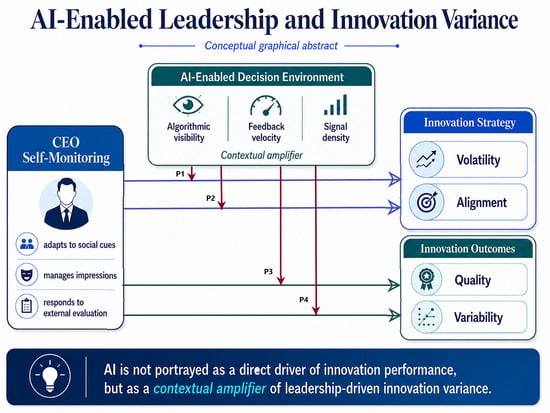
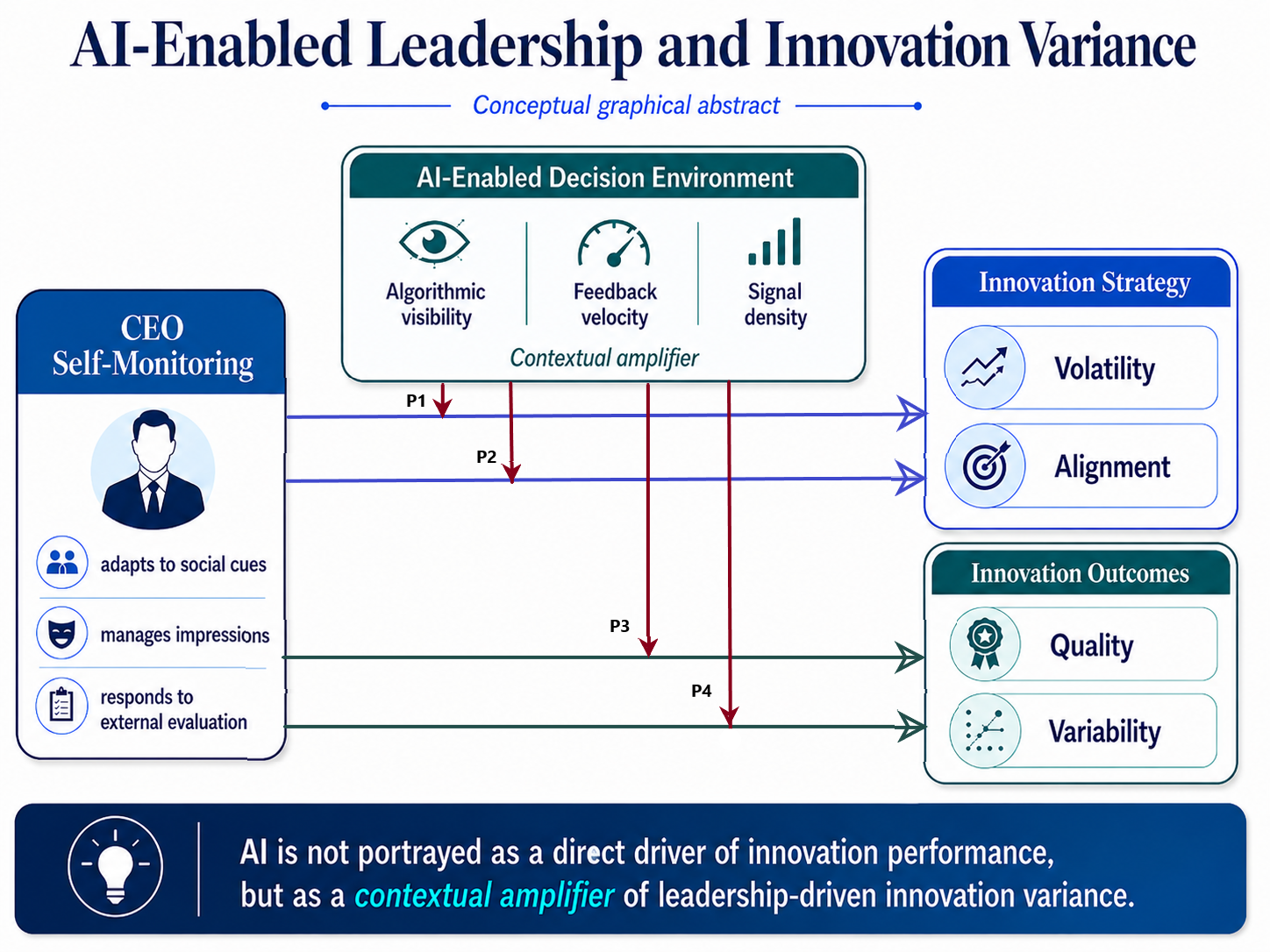
Graphical Abstract

1. Introduction

Chief executive officers (CEOs) imprint their idiosyncratic attributes on firms’ strategies, cultures, learning routines, and innovation trajectories, thereby shaping organizational effectiveness (Hambrick & Mason, 1984; Finkelstein & Hambrick, 1996; Chatterjee & Hambrick, 2007; Harrison et al., 2020). This insight is especially consequential in innovation-intensive settings, where executives must interpret ambiguous technological signals, mobilize knowledge resources, and decide when to conform to or depart from prevailing industry trajectories. However, the growing diffusion of artificial intelligence (AI) into managerial work reshapes—rather than replaces—this classic upper-echelons logic by altering the informational and evaluative conditions under which executive discretion is exercised. AI systems increasingly support search, prediction, evaluation, benchmarking, coordination, and decision support, altering how leaders encounter information and how quickly strategic choices become visible, comparable, and contestable (Shrestha et al., 2019; Kellogg et al., 2020; Raisch & Krakowski, 2021; Puranam, 2021; Csaszar et al., 2024). Accordingly, the key question is not simply whether CEOs matter for innovation but how CEO traits matter when innovation decisions are made in AI-enabled decision environments characterized by amplified information, accelerated feedback, and heightened comparability.
This paper focuses on CEO self-monitoring, a personality trait capturing the tendency to adapt one’s expressive behavior to social and situational cues (Snyder, 1974; Snyder & Gangestad, 1986; Gangestad & Snyder, 2000). High self-monitors are often described as social chameleons: They scan audiences carefully, adjust behavior to fit expectations, and manage impressions strategically. These features make self-monitoring particularly relevant to innovation leadership because innovation decisions are not merely technical choices (Lei et al., 2023); they are also visible signals to investors, employees, boards, partners, and competitors about the firm’s competence, legitimacy, and future direction (Chen et al., 2022). Recent meta-analytic evidence further confirms that self-monitoring is consequential for leadership emergence and effectiveness across contexts (Lei et al., 2023; Vlas et al., 2024). Prior leadership and social network research shows that high self-monitors are skilled at brokerage, adaptation, and strategic self-presentation (Mehra et al., 2001; Day & Schleicher, 2006; H. Oh & Kilduff, 2008; Sasovova et al., 2010; Kudret et al., 2019). Recent empirical work has examined the baseline relationship between CEO self-monitoring, innovation strategy, and innovation effectiveness over time (Vlas & Masoud, in press). The present article extends that logic by theorizing how AI-enabled decision environments condition these relationships.
We argue that AI should be conceptualized as a contextual moderator that conditions—rather than mediates—the relationship between CEO traits and innovation outcomes by shaping the informational, temporal, and evaluative environment of decision-making. Prior research on AI and organizing suggests that algorithms alter managerial decision structures by expanding the set of alternatives considered, increasing decision speed, improving replicability, and reshaping the division of labor between human judgment and machine recommendations (López-Solís et al., 2025; Shrestha et al., 2019; Raisch & Krakowski, 2021; Puranam, 2021; Vlas & Vlas, 2025). Research on algorithmic management further shows that algorithmic systems make behavior more visible, measurable, and subject to comparison and control (Kellogg et al., 2020). Recent work on AI and strategic decision-making similarly suggests that AI can augment the search, representation, and evaluation processes through which decision-makers generate and assess strategic options (Csaszar et al., 2024). These insights position AI-enabled decision environments as contexts characterized by increased visibility, faster feedback cycles, and denser informational signals.
This argument advances scholars’ understanding by shifting attention from average innovation performance to the risk–return distribution of innovation. Existing innovation research has long recognized that innovation involves uncertainty, recombination, and uneven payoffs (Rothaermel & Hess, 2007; Kaplan & Vakili, 2015; Yayavaram & Chen, 2015). However, less is known about how executive traits shape both strategic movement and performance dispersion. We propose that CEO self-monitoring constitutes a trait-based mechanism that simultaneously drives adaptive recalibration (volatility) and conformity to evaluative benchmarks (alignment), thereby shaping the distribution—not just the mean—of innovation outcomes. Under AI-enabled decision conditions, this duality becomes more consequential because AI increases the visibility of deviations, accelerates strategic feedback, and expands the informational basis for opportunity selection.
To explain how CEO self-monitoring travels through the organization, we draw on the ability–motivation–opportunity (AMO) framework. AMO logic suggests that organizational effectiveness depends on whether employees have the ability, motivation, and opportunity to contribute to firm goals (Appelbaum et al., 2000; Jiang et al., 2012). In innovation contexts, high self-monitoring CEOs may use people systems to support visible capability building, recognition, cross-functional coordination, and rapid knowledge recombination. AI can strengthen these channels by supporting skill identification, knowledge search, resource allocation, project evaluation, and coordination across distributed teams (Benbya et al., 2021; Raisch & Krakowski, 2021). Thus, AI does not independently determine innovation outcomes but amplifies the organizational pathways through which leadership traits translate into performance (Lei et al., 2023).
Accordingly, this paper asks the following: How do AI-enabled decision environments condition the relationship between CEO self-monitoring and innovation-strategy volatility, innovation-strategy alignment, innovation-outcome quality, and innovation-outcome variability? We answer this question by developing a conceptual framework that links upper-echelons theory, self-monitoring research, AMO logic, and AI-enabled decision-making. The central contribution is a trait-to-variance perspective: CEO self-monitoring is theorized not only as a predictor of innovation emphasis but as a leadership trait that shapes how firms move, align, and vary in their innovation trajectories. AI-enabled decision environments are positioned as contextual amplifiers because they increase the visibility, speed, and density of evaluative signals surrounding innovation decisions.

2. Conceptual Development Approach

This paper is designed as a conceptual theory-building article rather than an empirical test of hypothesized relationships. Its objective is to develop a theoretically grounded framework explaining how CEO self-monitoring may shape the distribution of innovation strategies and innovation outcomes under AI-enabled decision conditions. Following guidance for conceptual articles, the purpose is not to summarize all prior research exhaustively, but to integrate selected bodies of the literature in order to clarify constructs, specify relationships, and derive theoretically meaningful propositions (Cornelissen, 2017; Jaakkola, 2020).
The conceptual development follows a staged theory-building logic rather than a simple aggregation of literature. Upper-echelons theory establishes the level of analysis: CEO attributes can shape firm-level strategic choices because executives influence attention, interpretation, and resource allocation (Hambrick & Mason, 1984; Finkelstein & Hambrick, 1996; Chatterjee & Hambrick, 2007; Harrison et al., 2020). Self-monitoring theory specifies the relevant executive attribute: High self-monitoring CEOs are especially attentive to social cues, audience expectations, and impression-management opportunities (Snyder, 1974; Snyder & Gangestad, 1986; Gangestad & Snyder, 2000; Day & Schleicher, 2006). AMO logic then explains how this trait can travel through the organization by shaping employees’ ability, motivation, and opportunity to contribute to innovation (Appelbaum et al., 2000; Jiang et al., 2012). Finally, AI-enabled decision-making identifies the contextual conditions that make these trait effects more consequential by increasing the visibility, speed, and density of evaluative signals surrounding innovation decisions (Bavafa & Jónasson, 2021; Shrestha et al., 2019; Kellogg et al., 2020; Raisch & Krakowski, 2021; Puranam, 2021; Benbya et al., 2021; Csaszar et al., 2024).
This logic clarifies our paper’s theoretical contribution. We do not argue simply that CEO traits, AMO systems, AI, and innovation are related. Rather, we develop a trait-to-variance perspective in which CEO self-monitoring shapes both strategic movement and outcome dispersion. The novelty lies in explaining why the same leadership trait may simultaneously increase innovation-strategy volatility, support innovation-strategy alignment, improve innovation-outcome quality, and widen innovation-outcome variability. AI-enabled decision environments are theorized as contextual amplifiers because they make the cues to which high self-monitoring CEOs attend more visible, faster, and more abundant (Shrestha et al., 2019; Kellogg et al., 2020; Raisch & Krakowski, 2021; Puranam, 2021; Benbya et al., 2021; Csaszar et al., 2024).

3. Theoretical Framework

3.1. Self-Monitoring, Leadership, and Innovation

Self-monitoring denotes a stable individual difference in expressive self-control and strategic self-presentation (Snyder, 1974). High self-monitors attend closely to social and situational cues and adjust their behavior accordingly, whereas low self-monitors place greater emphasis on internal consistency and behavioral authenticity (Snyder & Gangestad, 1986; Gangestad & Snyder, 2000; Day & Schleicher, 2006). This distinction is consequential for leadership because CEOs must interpret expectations from boards, investors, employees, alliance partners, regulators, and competitors while projecting coherence, competence, and strategic direction (Aabo et al., 2024; Lei et al., 2023). It also aligns with research connecting self-monitoring to authenticity, well-being, and broader personality meta-traits, reinforcing its relevance as a stable leadership-relevant trait rather than merely a behavioral style (Chen et al., 2022). High self-monitors are especially likely to treat social information as strategically meaningful, adapt behavior to audiences, occupy brokerage positions, and navigate social networks in ways that increase access to information and influence (Aabo et al., 2024; Mehra et al., 2001; H. Oh & Kilduff, 2008; Sasovova et al., 2010). This logic is directly relevant to innovation because innovation requires diverse information, knowledge recombination, and support for uncertain initiatives (Laursen & Salter, 2006; Rothaermel & Hess, 2007). High self-monitoring leaders are therefore well positioned to detect emerging expectations, interpret reputational signals, and mobilize coalitions around innovation initiatives that appear timely, legitimate, or status-enhancing, whereas low self-monitors tend to privilege authenticity and behavioral consistency (Vlas & Vlas, 2025).
Yet the same adaptive capacity that makes high self-monitors effective can also generate inconsistency. Because high self-monitors are responsive to changing external cues (Aabo et al., 2024), they may recalibrate strategic priorities more frequently than leaders who are less sensitive to audience expectations. High self-monitoring managers may also be especially attentive to emotional and interpersonal cues that shape coordination and support for change. In innovation settings, such recalibration can be productive when it allows the firm to respond quickly to technological shifts, but it can also create volatility when innovation agendas are repeatedly adjusted to preserve image or legitimacy. Thus, self-monitoring should be theorized as a double-edged leadership trait: it supports responsiveness, brokerage, and social influence, but it can also increase strategic movement and expose the organization to wider performance swings.
The CEO role magnifies these effects because CEOs occupy the strategic apex of the organization and influence attention, resource allocation, and organizational priorities (Hambrick & Mason, 1984; Finkelstein & Hambrick, 1996). Innovation-intensive firms are especially sensitive to this imprinting because innovation decisions involve ambiguity, delayed outcomes, and substantial discretion (Lei et al., 2023). CEOs influence which technological opportunities are pursued, how resources are committed, when projects are abandoned, and how innovation narratives are communicated to internal and external audiences (Bauwens et al., 2024; Chen et al., 2022; Garg & Eisenhardt, 2017; W. Y. Oh & Barker, 2018). Recent evidence further supports the relevance of CEO self-monitoring for corporate entrepreneurship by showing that self-monitoring can shape entrepreneurial activity through the CEO–top-management-team interface (Chen et al., 2022). This suggests that self-monitoring does not remain confined to the individual CEO; it travels through executive interaction, coordination, and organizational attention.
This framework, therefore, treats CEO self-monitoring as a leadership trait with distributional implications for innovation. Rather than predicting only more or less innovation, self-monitoring may shape how innovation strategies move, how closely they align with peer expectations, and how widely innovation outcomes vary under evaluative pressure.

3.2. Self-Monitoring CEOs as AMO Catalysts for Innovation Effectiveness

Upper-echelons research establishes that CEOs influence firm outcomes, but it often leaves underspecified how executive traits travel through the organization (Hambrick & Mason, 1984; Finkelstein & Hambrick, 1996; Chatterjee & Hambrick, 2007; Harrison et al., 2020). We address this issue by using AMO as a transmission framework. In this manuscript, AMO does not operate as one undifferentiated mechanism. It operates through three distinct but mutually reinforcing pathways: an ability pathway, a motivation pathway, and an opportunity pathway (Appelbaum et al., 2000; Jiang et al., 2012). The ability pathway concerns how CEOs shape the knowledge and skill base available for innovation. The motivation pathway concerns how CEOs make innovation effort visible, valued, and worth pursuing. The opportunity pathway concerns how CEOs create structures through which employees can participate in idea generation, recombination, evaluation, and implementation. This distinction is important because CEO self-monitoring may affect each pathway differently.
Through the ability pathway, high self-monitoring CEOs may support innovation by investing in visible capability-building initiatives, cross-functional learning, technical training, and knowledge-recombination routines. Because such CEOs are attentive to external evaluation, they may recognize the reputational value of appearing technologically capable and future-oriented (Gangestad & Snyder, 2000; Fuglestad & Snyder, 2010; Day & Schleicher, 2006; Lei et al., 2023). These investments can strengthen the organization’s capacity to identify, absorb, and redeploy knowledge in support of innovation.
Through the motivation pathway, high self-monitoring CEOs may connect innovation work to recognition, visibility, and status. Innovation requires discretionary effort because employees must experiment, share incomplete ideas, tolerate uncertainty, and persist despite delayed outcomes (Bauwens et al., 2024; López-Solís et al., 2025). Leaders who are attentive to image and external evaluation may use symbolic and material incentives to make innovation participation more visible and valued. This can motivate employees to contribute to innovation, but it may also encourage risk-taking when highly visible innovation success becomes a source of status for the firm and its leadership (Sasovova et al., 2010).
Through the opportunity pathway, high self-monitoring CEOs may create organizational structures that allow ideas, knowledge, and resources to move across boundaries. Prior research links self-monitoring to brokerage and network positioning, suggesting that high self-monitors are attentive to the value of connecting otherwise disconnected actors (Bauwens et al., 2024; Mehra et al., 2001; H. Oh & Kilduff, 2008; Sasovova et al., 2010). At the organizational level, this orientation may translate into cross-functional teams, project review routines, executive interfaces, and coordination mechanisms that allow employees to influence innovation decisions and participate in implementation.
AI-enabled decision environments can amplify these three AMO pathways in different ways. For ability, AI systems can support knowledge search, skill identification, pattern recognition, and expertise redeployment (Benbya et al., 2021; Raisch & Krakowski, 2021). For motivation, AI-enabled dashboards and performance systems can make innovation contributions more visible, measurable, and comparable (Kellogg et al., 2020; López-Figueroa et al., 2025). For opportunity, AI-supported coordination tools can facilitate project matching, resource allocation, and cross-functional collaboration (Shrestha et al., 2019; Puranam, 2021; Csaszar et al., 2024). Thus, AMO is treated as the organizational transmission mechanism through which CEO self-monitoring affects innovation, while AI-enabled decision environments strengthen or intensify the operation of these pathways.

3.3. AI-Enabled Organizational Context

Artificial intelligence is not treated as a homogeneous technology or as a universal driver of innovation performance. Rather, we conceptualize AI-enabled decision environments as organizational contexts in which different AI applications reshape the informational and evaluative conditions surrounding executive decision-making. These applications include predictive analytics that estimate future market, technological, or project outcomes; algorithmic recommendation systems that rank alternatives or suggest courses of action; generative AI tools that support search, synthesis, scenario generation, and communication; digital dashboards that make performance indicators visible (López-Figueroa et al., 2025); algorithmic monitoring systems that track activity, deviations, and outcomes across organizational units. These applications differ in their technical architecture and organizational use, but they share a common implication for executive decision-making: they can make innovation choices more visible, feedback more immediate, and strategic signals more abundant (Shrestha et al., 2019; Kellogg et al., 2020; Raisch & Krakowski, 2021; Puranam, 2021; Benbya et al., 2021; Csaszar et al., 2024).
This distinction is important because AI influences executive decision-making only under specific organizational conditions. AI-enabled systems are more likely to shape CEO attention and innovation choices when they are integrated into strategic-planning routines, R&D portfolio reviews, competitive-intelligence processes, board reporting, and resource-allocation systems (Chen et al., 2022). Their influence also depends on data quality, analytics maturity, managerial interpretive capacity, governance safeguards, and the extent to which executives rely on AI outputs when evaluating innovation opportunities. Thus, AI-enabled decision environments should not be equated with mere adoption of AI tools. They refer to organizational decision contexts in which AI-generated information becomes consequential for how leaders interpret signals, justify choices, compare alternatives, and evaluate innovation trajectories (Shrestha et al., 2019; Raisch & Krakowski, 2021; Puranam, 2021; Benbya et al., 2021; Csaszar et al., 2024).
First, AI increases algorithmic visibility by making organizational actions, performance indicators, and strategic deviations more observable and comparable. Research on algorithmic management shows that digital systems extend managerial control by enabling continuous data collection, monitoring, evaluation, and comparison across individuals, teams, and organizational units (Kellogg et al., 2020). Although much of this work examines work settings, the underlying logic also applies to strategic decision contexts: Algorithmic systems make behavior more measurable and expose decisions to ongoing evaluation. In innovation contexts, dashboards, benchmarking systems, predictive models, and performance analytics can make R&D investments, project trajectories, and innovation outputs more visible relative to peer firms and industry norms (López-Figueroa et al., 2025). This increased visibility heightens the reputational stakes of innovation decisions, especially for CEOs who are attentive to external evaluation.
Second, AI increases feedback velocity by reducing the lag between strategic action and evaluative response. Traditional innovation decisions often unfold under delayed feedback: Firms invest in projects long before performance consequences become clear. AI-enabled systems compress this temporal distance by providing more immediate information about customer responses, technological trends, competitor actions, employee behavior, and project performance (Vlas & Vlas, 2025). Shrestha et al. (2019) identify decision speed as a central dimension through which AI alters organizational decision-making, while Raisch and Krakowski (2021) emphasize that AI systems can augment managers’ capacity to act on rapidly changing information. In innovation settings, faster feedback may support adaptation and learning, but it may also encourage frequent recalibration when leaders interpret emerging signals as requiring visible strategic adjustment.
Third, AI increases signal density by expanding the volume, granularity, and diversity of information available to decision-makers. AI systems can aggregate structured and unstructured data from markets, customers, employees, scientific domains, competitors, and digital platforms (López-Figueroa et al., 2025). This allows executives to encounter more signals about emerging opportunities, threats, stakeholder expectations, and performance deviations. Benbya et al. (2021) argue that AI has broad implications for how organizations generate, process, and use information, particularly in knowledge-intensive and digitally mediated environments. For innovation decision-making, higher signal density can improve opportunity recognition and resource allocation, but it can also increase interpretive complexity by exposing decision-makers to more cues, comparisons, and possible courses of action.
The three mechanisms proposed here—algorithmic visibility, feedback velocity, and signal density—may be activated differently across AI applications. Predictive AI is especially relevant to feedback velocity and signal density because it can update forecasts, identify weak signals, and support earlier evaluation of project trajectories (Shrestha et al., 2019; Raisch & Krakowski, 2021). Generative AI is especially relevant to signal density because it can synthesize large bodies of textual, technological, and market information, thereby expanding the range of alternatives considered by decision-makers (Benbya et al., 2021; Csaszar et al., 2024). Algorithmic monitoring and dashboards are especially relevant to algorithmic visibility because they make performance indicators, deviations, and peer comparisons more observable, measurable, and subject to managerial comparison (Kellogg et al., 2020). These distinctions clarify that AI-enabled decision environments do not operate through a single technological pathway. Rather, they alter the decision context through multiple, partially overlapping mechanisms that may amplify the behavioral expression of CEO self-monitoring.
Appendix A Table A1 summarizes the construct boundaries and illustrative operationalizations. Appendix A Table A2 links each proposition to the AI mechanism most relevant to its theoretical logic. Figure 1 below presents a simplified theory-building model. Together, the tables and the figure clarify that AI-enabled decision environments are treated as contextual conditions, not as direct performance drivers.

4. Proposition Development

4.1. CEO Self-Monitoring and Innovation Strategy: Effects on Volatility and Alignment

Chief executives operate within structural, institutional, and competitive constraints, but they retain meaningful discretion over strategic attention, resource allocation, and organizational priorities (Hambrick & Mason, 1984; Finkelstein & Hambrick, 1996; Wangrow et al., 2015). This discretion is especially consequential in innovation contexts, where managers must interpret ambiguous technological signals, commit resources under uncertainty, and decide when to continue, redirect, or abandon innovation initiatives (López-Solís et al., 2025). Upper-echelons research shows that executive characteristics shape how leaders perceive opportunities and threats and how those perceptions translate into firm-level strategic choices (Chatterjee & Hambrick, 2007; Nadkarni & Herrmann, 2010). Because executives also scan their environments for strategically relevant information and social cues (Daft et al., 1988), the CEO’s sensitivity to external evaluation becomes particularly important in innovation settings. For CEOs high in self-monitoring, these choices are filtered through heightened sensitivity to social cues, reputational stakes, and external evaluation.
Self-monitoring combines expressive adaptability with a concern for social approval and status (Gangestad & Snyder, 2000; Fuglestad & Snyder, 2010; Day & Schleicher, 2006). In innovation strategy, this means that high self-monitoring CEOs are likely to monitor whether current innovation commitments are perceived as timely, legitimate, and strategically impressive (Vlas & Vlas, 2025). This logic is consistent with impression-management research, which shows that individuals and leaders use self-presentation, coalition building, and image-management tactics to influence how their actions are interpreted by important audiences (Bolino et al., 2016). When external audiences reward novelty, technological boldness, or visible adaptation, such CEOs may increase innovation emphasis to signal leadership quality and future orientation (Lei et al., 2023). When innovation becomes part of the firm’s projected identity, leaders may also use innovation commitments to manage discrepancies between internal actions and external images of the organization. When external signals suggest that novelty is risky, misaligned, or poorly rewarded, they may redirect or temper innovation activity. Thus, self-monitoring can generate movement in innovation strategy because the CEO is not only responding to technological opportunities but also to the changing reputational meaning attached to those opportunities.

4.1.1. CEO Self-Monitoring and Innovation-Strategy Volatility

Innovation-strategy volatility refers to the extent to which a firm’s innovation emphasis shifts over time. Conceptually, volatility captures temporal movement in innovation strategy: the degree to which firms alternate between stronger and weaker innovation commitments or redirect innovation activity across periods. Innovation research has long recognized that firms must recombine knowledge and adapt to changing technological conditions, but such adaptation can also produce uneven strategic movement when leaders repeatedly adjust priorities in response to shifting cues (Kaplan & Vakili, 2015; Yayavaram & Chen, 2015).
High self-monitoring CEOs are particularly likely to produce such volatility because they are attentive to how strategic actions are interpreted by relevant audiences (Vlas & Masoud, in press). Their sensitivity to evaluation encourages continual scanning of stakeholder expectations and industry signals. As a result, they may intensify innovation activity when innovation enhances perceived competence, legitimacy, or status, and reduce or redirect innovation emphasis when continued commitment appears less reputationally beneficial. This argument is consistent with work showing that high self-monitors are especially responsive to evaluative contexts and may alter behavior when social accountability or impression concerns are salient. This does not imply erratic behavior in a purely irrational sense. Rather, volatility reflects impression-sensitive recalibration: the adjustment of innovation priorities as the perceived social and strategic payoff of innovation changes.
This logic is consistent with research showing that self-monitoring is associated with behavioral adaptability, social responsiveness, and strategic self-presentation (Day & Schleicher, 2006; H. Oh & Kilduff, 2008; Sasovova et al., 2010; Kudret et al., 2019). It also aligns with the broader upper-echelons view that executives’ cognitive and social orientations influence organizational action (Hambrick & Mason, 1984; Chatterjee & Hambrick, 2007). Because innovation decisions are often highly visible to stakeholders and are evaluated as signals of organizational accountability, leadership quality, and strategic direction (Zuraik & Kelly, 2019), high self-monitoring CEOs are especially likely to recalibrate innovation priorities when evaluative cues shift. In innovation settings, where strategic commitments are highly visible and uncertain, such responsiveness is likely to appear as greater year-to-year movement in innovation strategy.
AI-enabled decision environments are expected to strengthen this relationship. As discussed earlier, AI-enabled systems increase feedback velocity by reducing the lag between action and evaluation. They provide leaders with more frequent information about market reactions, competitor behavior, technological developments, project performance, and stakeholder sentiment (Shrestha et al., 2019; Raisch & Krakowski, 2021; Puranam, 2021). For high self-monitoring CEOs, faster feedback increases the number of occasions on which innovation strategy may appear to require adjustment. AI-enabled systems also increase signal density by expanding the quantity and granularity of cues available to decision-makers. The more cues a high self-monitoring CEO encounters, the more likely an innovation strategy becomes subject to repeated recalibration.
Therefore, AI-enabled decision environments do not mediate the relationship between CEO self-monitoring and innovation-strategy volatility. Rather, they amplify the conditions under which self-monitoring is expressed. By making external signals more immediate, abundant, and actionable, AI-enabled environments strengthen the association between CEO self-monitoring and innovation-strategy volatility.
Proposition 1. 
In AI-enabled decision environments, CEO self-monitoring is more strongly associated with innovation-strategy volatility.

4.1.2. CEO Self-Monitoring and Innovation-Strategy Alignment

Innovation-strategy alignment refers to the degree to which a firm’s innovation activity remains close to prevailing industry norms or peer trajectories. Whereas volatility captures temporal movement, alignment captures spatial positioning: how closely the firm’s innovation strategy resembles recognizable patterns within its competitive environment. This distinction is important because firms can be simultaneously adaptive and conforming. A firm may adjust innovation priorities frequently while still remaining within the boundaries of what external audiences view as legitimate, comparable, or strategically acceptable.
High self-monitoring CEOs are likely to promote such alignment because they are highly attentive to external expectations and social evaluation (Vlas & Masoud, in press). Their environmental scanning is not limited to identifying technological opportunities; it also involves detecting what kinds of innovation behavior are likely to be interpreted as credible, legitimate, and status-enhancing. CEO scanning research shows that executives attend to environmental characteristics and use external information to shape strategic responses (Daft et al., 1988). Industry norms and peer behavior provide important reference points in this process. When innovation strategies deviate sharply from recognizable trajectories, they may create reputational uncertainty, invite stakeholder skepticism, or make the firm more difficult to evaluate (López-Solís et al., 2025). High self-monitoring CEOs, who are motivated to manage impressions and preserve favorable evaluations, are therefore likely to position innovation activity closer to industry expectations.
This does not mean that high self-monitoring CEOs avoid innovation or reject novelty. Rather, they are likely to pursue innovation in ways that remain socially intelligible. Their innovation strategies may emphasize recognizable technological domains, accepted industry priorities, or innovation trajectories that stakeholders can interpret as credible. In this sense, self-monitoring supports alignment because it encourages CEOs to balance novelty with legitimacy. Prior research on self-monitoring and brokerage suggests that high self-monitors are skilled at navigating social expectations and adjusting behavior to fit audience demands (Mehra et al., 2001; H. Oh & Kilduff, 2008; Sasovova et al., 2010). Work on strategic imitation and R&D investment also suggests that CEOs use peer behavior and external ties as reference points when making innovation-related decisions (W. Y. Oh & Barker, 2018). In the CEO context, this adaptive orientation can translate into innovation strategies that remain closer to industry norms.
AI-enabled decision environments should strengthen this alignment effect by increasing algorithmic visibility. AI-enabled dashboards, benchmarking tools, predictive analytics, and competitive intelligence systems make peer behavior and industry trajectories more visible and comparable (Sacavém et al., 2025). Research on algorithmic management shows that digital systems can make behavior more observable, measurable, and subject to evaluation (Kellogg et al., 2020), while research on AI-enabled decision-making emphasizes how AI expands comparison across alternatives and supports more explicit evaluation of strategic options (Shrestha et al., 2019; Raisch & Krakowski, 2021). In innovation contexts, these tools clarify where the focal firm stands relative to competitors, industry benchmarks, and expected trajectories (López-Figueroa et al., 2025).
For high self-monitoring CEOs, this visibility increases the salience of deviation from industry norms. When AI systems make peer comparisons more accessible, departures from the industry average become easier to detect and harder to justify. This increases reputational exposure and strengthens the incentive to keep the innovation strategy within recognizable boundaries. Low self-monitoring CEOs, by contrast, are less likely to adjust innovation strategy in response to external comparison because they place greater weight on internal consistency than on audience approval. This contrast is consistent with self-discrepancy and self-monitoring research showing that low self-monitors are more likely to privilege internal consistency over audience adaptation (Gonnerman et al., 2000; Day & Schleicher, 2006). Thus, AI-enabled decision environments should magnify the difference between high and low self-monitoring CEOs in the degree of innovation-strategy alignment they promote.
Proposition 2. 
In AI-enabled decision environments, CEO self-monitoring is more strongly associated with innovation-strategy alignment.

4.2. CEO Self-Monitoring and Innovation Outcomes: Effects on Quality and Variability

The preceding propositions explain how AI-enabled decision environments condition the relationship between CEO self-monitoring and innovation strategy by intensifying both temporal movement and spatial positioning. We now turn from innovation strategy to innovation outcomes. This distinction is important because innovation strategy concerns how firms allocate attention and resources, whereas innovation outcomes concern the value and dispersion of what those efforts ultimately produce. In innovation-intensive settings, outcomes are rarely uniform. Some projects generate valuable knowledge, technological influence, or market recognition, while others produce limited impact or fail to diffuse (Rothaermel & Hess, 2007; Kaplan & Vakili, 2015; Yayavaram & Chen, 2015). Accordingly, we distinguish between innovation-outcome quality, which captures the average value or influence of innovation outputs, and innovation-outcome variability, which captures dispersion in innovation performance relative to peers or industry norms.

4.2.1. CEO Self-Monitoring and Innovation-Outcome Quality

Innovation-outcome quality refers to the extent to which a firm’s innovation outputs are valuable, influential, or recognized by relevant audiences. In patent-based innovation research, forward citations are commonly used as an indicator of technological influence because they capture the extent to which subsequent inventions build upon a focal firm’s prior knowledge (Rothaermel & Hess, 2007; Yayavaram & Chen, 2015). Conceptually, however, the quality construct is broader than citations alone. It reflects the firm’s ability to generate innovations that are not merely numerous but meaningful, useful, and influential within a technological or competitive domain.
CEO self-monitoring is likely to be positively associated with innovation-outcome quality because high self-monitoring CEOs are especially attentive to reputational payoffs and external evaluation (Vlas & Masoud, in press). Self-monitoring combines sensitivity to social cues with motivation to construct favorable impressions (Gangestad & Snyder, 2000; Fuglestad & Snyder, 2010). Because status-seeking and self-presentation motives can shape how leaders select and promote visible accomplishments (Bedeian & Day, 2004; Highhouse et al., 2016), high self-monitoring CEOs are likely to evaluate innovation opportunities partly through their reputational payoff (Vlas & Vlas, 2025). In innovation contexts, this means that high self-monitoring CEOs are likely to favor initiatives that can signal technological sophistication, strategic relevance, and leadership competence (Bauwens et al., 2024; Lei et al., 2023). They may therefore direct attention and resources toward innovation projects with stronger prospects for external recognition, stakeholder approval, or industry influence.
This effect is reinforced by the social and informational advantages associated with high self-monitoring. Prior research links self-monitoring to brokerage, network position, and adaptive social behavior (Mehra et al., 2001; H. Oh & Kilduff, 2008; Sasovova et al., 2010). These advantages can improve access to diverse knowledge and external signals, both of which are important for identifying promising innovation opportunities. High self-monitors’ tendency toward proactive sensemaking and social adjustment can help them recognize when emerging opportunities are likely to become valuable or visible to relevant audiences (Bauwens et al., 2024). At the CEO level, self-monitoring may also improve the leader’s capacity to mobilize top-management teams, build coalitions around promising initiatives, and align organizational attention with opportunities that appear both technically and reputationally valuable. Recent evidence that CEO self-monitoring supports corporate entrepreneurship through the CEO–top-management team interface is consistent with this logic (Chen et al., 2022).
AI-enabled decision environments are expected to strengthen the relationship between CEO self-monitoring and innovation-outcome quality. AI systems increase signal density by expanding the amount and granularity of information available about technologies, markets, competitors, customers, and project performance (Csaszar et al., 2024). They can support opportunity recognition, project evaluation, resource allocation, and knowledge recombination (Shrestha et al., 2019; Benbya et al., 2021; Raisch & Krakowski, 2021; Puranam, 2021). For high self-monitoring CEOs, who are already motivated to identify and support visible, reputation-enhancing opportunities, these systems provide more refined inputs for selecting projects with higher expected impact. AI-enabled environments, therefore, amplify the tendency of high self-monitoring CEOs to direct organizational attention toward innovation initiatives with stronger quality potential.
By contrast, low self-monitoring CEOs are less likely to adjust innovation priorities in response to changing external cues or reputational signals. Their emphasis on internal consistency may support persistence, but it may also reduce responsiveness when technological opportunities shift or when existing projects lose relevance. Research on self-monitoring and political behavior suggests that lower adaptability can make leaders less responsive to changing social and organizational conditions (Kudret et al., 2019). As a result, firms led by low self-monitoring CEOs may be less likely to redirect resources toward emerging high-impact innovation opportunities, particularly in environments where timely interpretation of external signals is critical.
Proposition 3. 
In AI-enabled decision environments, CEO self-monitoring is more strongly associated with innovation-outcome quality.

4.2.2. CEO Self-Monitoring and Innovation-Outcome Variability

Innovation-outcome variability refers to the extent to which a firm’s innovation performance deviates from peer or industry norms. Whereas innovation-outcome quality captures average influence or value, variability captures dispersion. This distinction is central to the conceptual contribution of our paper. Innovation does not generate uniform returns. It often produces a risk–return distribution in which firms experience both unusually strong outcomes and pronounced underperformance. Therefore, understanding innovation requires attention not only to whether outcomes improve on average, but also to whether leadership traits widen or narrow the distribution of possible outcomes (Vlas & Masoud, in press). This conceptualization is consistent with research that treats innovation performance as uneven across firms and sensitive to deviation from peer or industry benchmarks.
CEO self-monitoring is likely to increase innovation-outcome variability because high self-monitoring CEOs are especially responsive to opportunities that carry reputational significance. When innovation opportunities are perceived as highly visible or status-enhancing, high self-monitoring CEOs may be more willing to mobilize resources aggressively, sponsor ambitious projects, and frame innovation bets as evidence of strategic leadership (Bauwens et al., 2024). Because self-monitoring is associated with sensitivity to audience scrutiny and perceived effort in organizational positions, high self-monitoring CEOs are especially likely to treat high-visibility innovation opportunities as reputationally consequential. Such initiatives may produce outsized successes when the leader correctly interprets emerging opportunities and mobilizes the organization effectively. However, they may also generate more pronounced failures when reputationally attractive projects prove technically weak, poorly timed, or misaligned with organizational capabilities.
This variability logic reflects the double-edged nature of self-monitoring. High self-monitoring CEOs are adaptive, socially perceptive, and skilled at coalition-building, but these same tendencies may heighten responsiveness to external signals that are ambiguous, noisy, or transient. In innovation settings, where feedback is uncertain and delayed, such impression-sensitive recalibration may push firms toward projects with greater upside potential but also greater downside risk, especially when image concerns shape organizational behavior under evaluation (Bolino et al., 2016). Network and brokerage research reinforces this logic: High self-monitors often occupy positions that expose them to diverse information and enable them to bridge disconnected actors, improving access to novel knowledge and opportunities for recombination (Mehra et al., 2001; H. Oh & Kilduff, 2008; Sasovova et al., 2010). Yet recombination is inherently uncertain. Combining knowledge across domains can produce breakthroughs, but it can also generate coordination difficulties, misfit, or failed integration (Kaplan & Vakili, 2015). Thus, the same social and cognitive flexibility that helps high self-monitoring CEOs identify promising opportunities may also widen the range of innovation outcomes.
AI-enabled decision environments are expected to strengthen the relationship between CEO self-monitoring and innovation-outcome variability. AI increases feedback velocity, allowing firms to identify early signals of success or failure more quickly. It also increases signal density, exposing decision-makers to a broader set of opportunities, threats, and comparisons. Finally, algorithmic visibility makes exceptional success and visible underperformance more salient relative to peers and benchmarks. For high self-monitoring CEOs, these conditions increase the appeal of high-visibility innovation bets and intensify responsiveness to signals that appear to indicate reputational opportunity or threat. As a result, AI-enabled environments may amplify both the upside and downside consequences of self-monitoring-driven innovation choices. By contrast, low self-monitoring CEOs’ emphasis on consistency and self-congruence may keep innovation outcomes closer to peer norms, limiting both upside and downside dispersion (Gonnerman et al., 2000; Day & Schleicher, 2006).
Proposition 4. 
In AI-enabled decision environments, CEO self-monitoring is more strongly associated with innovation-outcome variability.

5. Discussion

This paper develops a conceptual framework explaining how AI-enabled decision environments condition the relationship between CEO self-monitoring and innovation strategy and outcomes. The framework’s central claim is not that high self-monitoring CEOs are uniformly better innovators. Rather, CEO self-monitoring is theorized as a distributional leadership trait: It may increase strategic movement while also supporting conformity to recognizable industry trajectories, and it may improve innovation quality while also widening innovation-outcome dispersion (Gangestad & Snyder, 2000; Day & Schleicher, 2006; Chen et al., 2022; Lei et al., 2023; Vlas & Masoud, in press). AI-enabled decision environments intensify this logic by making innovation decisions more visible, feedback more immediate, and strategic signals more abundant (Shrestha et al., 2019; Kellogg et al., 2020; Raisch & Krakowski, 2021; Puranam, 2021; Benbya et al., 2021; Csaszar et al., 2024). Thus, AI does not simply strengthen positive leadership effects; it can amplify both the adaptive and problematic consequences of impression-sensitive executive behavior.
The darker side of CEO self-monitoring is central to this argument. High self-monitoring CEOs may be effective at scanning external audiences, mobilizing coalitions, and framing innovation initiatives, but the same orientation can encourage symbolic innovation, superficial conformity, image-driven pivots, and opportunistic responses to visible benchmarks (Bedeian & Day, 2004; Bolino et al., 2016; Highhouse et al., 2016; Kudret et al., 2019). Under AI-enabled conditions, these risks may become stronger because dashboards, peer comparisons, and rapid feedback can make reputational threats more salient (Kellogg et al., 2020; Raisch & Krakowski, 2021; Puranam, 2021; López-Solís et al., 2025). Consequently, self-monitoring may support innovation when evaluative cues reflect meaningful technological opportunities, but it may become harmful when leaders respond primarily to reputational noise, short-term visibility, or benchmark pressure.
The framework extends the behavioral strategy view that chief executives, through their personal dispositions, shape firm-level innovation and organizational effectiveness (Hambrick & Mason, 1984; Finkelstein & Hambrick, 1996; Chatterjee & Hambrick, 2007; Nadkarni & Herrmann, 2010; Harrison et al., 2020). However, rather than treating CEO influence as a simple directional effect, we theorize self-monitoring as a trait-to-variance mechanism (Bavafa & Jónasson, 2021). High self-monitoring CEOs are attentive to social cues, reputational expectations, and audience evaluations (Gangestad & Snyder, 2000; Fuglestad & Snyder, 2010; Day & Schleicher, 2006; Kudret et al., 2019). This framework also extends recent work on innovation-intensive environments by specifying how CEO traits shape not only performance heterogeneity but also the distribution of innovation strategies and outcomes under AI-enabled decision conditions (Vlas et al., 2024). In innovation settings, this attentiveness may produce a distinctive combination of strategic movement and strategic conformity: firms may recalibrate innovation priorities more frequently while still remaining close to recognizable industry trajectories.
AI-enabled systems may improve opportunity recognition, resource allocation, and coordination, but they may also intensify evaluative pressure and make organizational actions more visible, comparable, and contestable (Csaszar et al., 2024). In this sense, AI is not theorized here as a direct source of innovation performance. Instead, it is conceptualized as a contextual condition that shapes how leadership traits are expressed. The central implication is that AI-enabled decision environments can amplify the distributional consequences of CEO self-monitoring: stronger upside potential may coexist with higher volatility, stronger alignment, and wider performance dispersion.
These arguments require empirical examination. The framework should therefore be interpreted as a theory-building platform that identifies testable relationships, construct boundaries, and contextual contingencies for future research, rather than as evidence that CEO self-monitoring or AI-enabled decision environments produce the proposed outcomes in all firms. The framework’s main conclusion is that AI-enabled innovation contexts do not eliminate the importance of executive traits; they may make such traits more consequential. When AI increases visibility, accelerates feedback, and multiplies strategic signals, CEOs who are highly responsive to social evaluation may adjust innovation strategies more frequently, align more closely with industry expectations, and pursue innovation initiatives with greater reputational salience. This has an important implication: AI-enabled decision systems may improve innovation governance only when organizations also manage the leadership behaviors that such systems amplify. The conceptual contribution is therefore not that AI improves or worsens innovation, but that AI changes the conditions under which CEO self-monitoring shapes the risk–return distribution of innovation.
The following subsections elaborate on the theoretical, managerial, policy, and governance implications of the framework, as well as the boundary conditions and future research directions.

5.1. Implications for Theory, Practice, and Policy

5.1.1. Theoretical Contributions

This paper makes four theoretical contributions. First, it advances a trait-to-variance perspective on innovation. Prior innovation research has shown that innovation outcomes are uneven because they depend on uncertainty, recombination, technological complexity, and knowledge coupling (Bavafa & Jónasson, 2021; Rothaermel & Hess, 2007; Kaplan & Vakili, 2015; Yayavaram & Chen, 2015). We extend this work by explaining how CEO self-monitoring may shape not only average innovation performance but also innovation-strategy volatility, innovation-strategy alignment, innovation-outcome quality, and innovation-outcome variability under AI-enabled decision conditions, thereby extending upper-echelons and behavioral strategy research on executive discretion and firm outcomes (Hambrick & Mason, 1984; Finkelstein & Hambrick, 1996; Chatterjee & Hambrick, 2007; Harrison et al., 2020).
Second, this paper clarifies how one leadership trait can generate apparently paradoxical strategic effects. High self-monitoring CEOs are especially responsive to evaluative cues and impression-management opportunities (Snyder & Gangestad, 1986; Gangestad & Snyder, 2000; Fuglestad & Snyder, 2010; Kudret et al., 2019). This responsiveness may produce both innovation-strategy volatility and innovation-strategy alignment, showing how the same CEO trait can support adaptation and legitimacy.
Third, this paper contributes to AI and organization theory by positioning AI-enabled decision environments as contextual amplifiers of executive traits. Existing AI research has emphasized decision speed, automation, augmentation, monitoring, and human–AI collaboration (Shrestha et al., 2019; Kellogg et al., 2020; Raisch & Krakowski, 2021; Puranam, 2021; Benbya et al., 2021). We extend this conversation by theorizing how algorithmic visibility, feedback velocity, and signal density condition the expression of CEO self-monitoring and make innovation choices more observable relative to peers and benchmarks.
Fourth, this paper contributes to AMO and strategic HRM perspectives by explaining how CEO self-monitoring can travel through organizational systems. AMO logic emphasizes that organizational outcomes depend on employees’ ability, motivation, and opportunity to contribute (Appelbaum et al., 2000; Jiang et al., 2012). In our framework, high self-monitoring CEOs influence capability development, motivational systems, and participation structures, helping explain how CEO-level traits may translate into both higher innovation quality and greater innovation variability.

5.1.2. Managerial, Policy, and Governance Implications

For executives, senior HR leaders, innovation managers, boards, and governance actors, the framework suggests that AI-enabled decision systems should be governed as behavioral infrastructures rather than neutral information tools. AI tools shape what becomes visible, comparable, and actionable, thereby influencing how innovation opportunities are interpreted, prioritized, and evaluated (Shrestha et al., 2019; Kellogg et al., 2020; Puranam, 2021). In firms led by high self-monitoring CEOs, dashboards, benchmarking systems, and AI-supported portfolio tools should therefore be paired with deliberative review routines that distinguish meaningful strategic signals from reputational noise (Day & Schleicher, 2006; Bolino et al., 2016; Chen et al., 2022).
A central managerial implication is that innovation governance should prevent visibility from becoming a substitute for substance. Practical safeguards include staged R&D portfolio reviews, explicit criteria for continuing, reallocating, or abandoning projects, independent technical review of high-visibility innovation bets, and documentation of how AI-generated recommendations are interpreted. These routines can reduce symbolic innovation, premature pivots, superficial benchmark-following, and image-driven recalibration while preserving the adaptive benefits of external scanning and rapid feedback (Kaplan & Vakili, 2015; Yayavaram & Chen, 2015; Raisch & Krakowski, 2021; Csaszar et al., 2024). In firms led by high self-monitoring CEOs, such guardrails may be especially important because impression-management motives can increase responsiveness to external expectations (Bolino et al., 2016; Fuglestad & Snyder, 2010).
Organizations should also distribute innovation decision authority across cross-functional teams, technical experts, top-management teams, and governance committees rather than relying solely on the CEO’s interpretation of AI-generated signals. CEO self-monitoring may support coalition-building and adaptive communication, but innovation decisions also require technical judgment, organizational memory, and market evidence. Cross-functional structures can widen decision bandwidth and reduce single-point vulnerability, ensuring that innovation tempo is governed by strategic fit and technical feasibility rather than primarily by the CEO’s image calculus. This logic is consistent with the idea that CEO traits shape innovation through the CEO–TMT interface and broader organizational systems (Chen et al., 2022; Garg & Eisenhardt, 2017).
For boards and policymakers, the implication is not to prescribe innovation strategy, but to strengthen transparency, accountability, and human oversight when AI systems inform high-stakes innovation decisions. Boards should clarify how AI tools inform innovation choices, who has the authority to act on AI-generated recommendations, and how innovation dashboards are used in CEO evaluation (Shrestha et al., 2019; Puranam, 2021; Raisch & Krakowski, 2021; Csaszar et al., 2024). Compensation and evaluation systems should also avoid over-weighting short-term visible indicators such as project announcements, rapid pivots, patent counts, or short-term market reactions. Longer-horizon review cycles, multi-year innovation milestones, and balanced innovation portfolios can help ensure that AI-enabled visibility supports durable capability building rather than symbolic innovation activity (Kellogg et al., 2020; López-Figueroa et al., 2025; López-Solís et al., 2025).

5.2. Boundary Conditions and Future Research

Several boundary conditions qualify the framework. CEO self-monitoring is most likely to support innovation when evaluative cues are informative, innovation opportunities are visible but technically grounded, and governance systems encourage interpretation rather than reflexive adjustment (Day & Schleicher, 2006; Chen et al., 2022; Lei et al., 2023). It may become harmful when reputational pressure is high, innovation outcomes are ambiguous, board oversight is weak, or organizational culture rewards visible innovation signals more than durable capability building (Bolino et al., 2016; Highhouse et al., 2016; Kudret et al., 2019). AI-enabled decision environments may similarly weaken rather than strengthen innovation when data quality is poor, analytics are weakly governed, or decision-makers treat algorithmic outputs as substitutes for technical judgment (Kellogg et al., 2020; Raisch & Krakowski, 2021; Puranam, 2021; Benbya et al., 2021). These risks are likely to vary by context. The proposed relationships may be stronger in innovation-intensive industries where technological uncertainty is high, external evaluation is salient, and CEOs have substantial discretion, and weaker in highly regulated or low-discretion sectors where innovation choices are constrained by compliance requirements, capital intensity, or institutional norms (Laursen & Salter, 2006; Rothaermel & Hess, 2007; Wangrow et al., 2015). Cross-national research could further examine how cultural and governance systems alter the relationship between self-monitoring, AI-enabled visibility, and innovation decisions.
Future research should also examine alternative leadership traits and organizational mechanisms. Narcissism, regulatory focus, hubris, perfectionism, humility, and temporal orientation may each shape how CEOs interpret AI-generated signals and innovation benchmarks. Research on CEO narcissism, CEO hubris, regulatory focus, and self-oriented perfectionism suggests that executive traits can influence strategy, innovation, and resilience in distinct ways (Chatterjee & Hambrick, 2007; Tang et al., 2015; Vlas & Vlas, 2025; Wang et al., 2023). A comparative personality portfolio approach could clarify whether AI amplifies all leadership traits equally or especially strengthens traits linked to social evaluation, responsiveness, and impression management. Future work could also examine mechanisms beyond AMO, including top-management team dynamics, board monitoring, organizational attention, alliance networks, and innovation governance routines. Prior research on board innovation, CEO–board relationships, board diversity, and CEO–TMT interfaces suggests that governance and executive-team structures may moderate or transmit the effects of CEO traits on innovation (Chen et al., 2022; Garg & Eisenhardt, 2017; Semadeni & Krause, 2020).
Future empirical tests should address measurement, endogeneity, and ethical implications. CEO self-monitoring may influence innovation strategy, but innovative firms may also select or retain CEOs with stronger impression-management and external-facing capabilities; AI adoption may likewise be endogenous to innovation strategy, firm resources, or governance sophistication. Longitudinal designs, lagged independent variables, CEO and firm fixed effects, matched samples, and instrumental-variable approaches are theoretically justified, and quasi-experimental settings around CEO transitions or AI-system implementation could help address these concerns (Wangrow et al., 2015; Chen et al., 2022; Aabo et al., 2024). Researchers could also examine CEO letters and other executive communications using impression-management and sentiment analytic approaches. Finally, future research should explore the normative and ethical implications of AI-amplified leadership effects. AI-enabled systems may encourage accountability by making strategic choices more visible and comparable, but they may also increase conformity pressure, short-term responsiveness, and symbolic innovation, especially when high self-monitoring CEOs respond strongly to audience expectations and social comparison (Gangestad & Snyder, 2000; Bolino et al., 2016; Kudret et al., 2019). A central future question is how organizations can design AI-enabled decision systems that support responsible innovation without amplifying impression-driven volatility.

6. Conclusions

This paper offers a conceptual framework for understanding CEO self-monitoring as a leadership trait with distributional implications for innovation in AI-enabled decision environments. Rather than assuming that such CEOs simply produce more or better innovation, the framework suggests that their attentiveness to evaluation, legitimacy, and visibility may shape how firms adjust innovation strategies and how innovation outcomes vary. The central contribution is to position AI not as an autonomous source of innovation performance but as a context that may make executive traits more consequential for the risk–return profile of innovation. Because this paper is conceptual, its propositions should be read as theoretically grounded expectations for future empirical testing.
Future research should empirically test the proposed relationships across industries with different levels of technological uncertainty, regulatory constraint, and AI adoption. Scholars could also explore how boards, top management teams, and innovation-governance routines preserve the adaptive benefits of CEO self-monitoring while limiting symbolic or high-variance innovation behavior.

Author Contributions

Conceptualization, C.O.V.; investigation, Y.M.; writing—original draft, C.O.V.; writing—review and editing, Y.M. and C.F.; visualization, C.F.; supervision, C.O.V. All authors have read and agreed to the published version of the manuscript.

Funding

This research received no external funding.

Institutional Review Board Statement

Not applicable.

Informed Consent Statement

Not applicable.

Data Availability Statement

No new data were created or analyzed in this study. Data sharing is not applicable to this article.

Conflicts of Interest

The authors declare no conflicts of interest.

Abbreviations

The following abbreviations are used in this manuscript:
AIArtificial Intelligence
CEOChief Executive Officer
AMOAbility–Motivation–Opportunity Framework
R&DResearch and Development
HRHuman Resources
TMTTop Management Team

Appendix A

Table A1. Core constructs, conceptual boundaries, and illustrative operationalizations.
ConstructConceptual DefinitionBoundary DistinctionIllustrative Operationalization for Future Empirical Research
CEO self-monitoringThe CEO’s tendency to attend to social cues, adapt behavior to audience expectations, and manage impressions under evaluative conditions.Focal executive trait; not an organizational capability or AI-related construct.Survey-based self-monitoring scale; archival indicators of impression-management behavior; linguistic markers in CEO communications.
AMO pathwaysOrganizational mechanisms through which CEO orientations shape employees’ ability, motivation, and opportunity to contribute to innovation.Mechanism linking CEO trait to organizational innovation systems; not treated as a moderator in this framework.Human-capital development practices, innovation incentives, cross-functional participation structures, project-access systems.
AI-enabled decision environmentsOrganizational contexts in which AI tools shape the visibility, speed, and density of information used in managerial decision-making.Contextual moderator; not a direct performance driver or mediator of CEO traits.AI-supported dashboards, predictive analytics, generative AI tools, algorithmic monitoring systems, innovation portfolio analytics.
Algorithmic visibilityThe extent to which AI-enabled systems make actions, deviations, benchmarks, and performance indicators observable and comparable.One dimension of AI-enabled context; distinct from feedback speed and signal volume.Use of dashboards, benchmarking systems, automated monitoring tools, peer-comparison analytics.
Feedback velocityThe speed with which AI-enabled systems provide evaluative information after strategic or innovation-related action.Temporal dimension of AI-enabled context; distinct from visibility and signal density.Frequency of dashboard updates, real-time project metrics, rapid market-sensing systems.
Signal densityThe volume, granularity, and diversity of information available to decision-makers through AI-enabled systems.Informational complexity dimension; distinct from visibility and speed.Number and diversity of data inputs, use of unstructured-data analytics, predictive intelligence breadth.
Innovation-strategy volatilityTemporal movement in a firm’s innovation strategy across periods.Strategy-level construct; captures change over time, not dispersion of outcomes.Year-to-year changes in R&D intensity, patent-domain shifts, changes in innovation portfolio emphasis.
Innovation-strategy alignmentThe degree to which a firm’s innovation strategy remains close to peer or industry trajectories.Strategy-level construct; captures spatial positioning relative to norms, not temporal movement.Distance from industry-average patent portfolios, R&D allocation similarity, technological-domain similarity.
Innovation-outcome qualityThe average value, influence, or recognition of a firm’s innovation outputs.Outcome-level construct; captures central tendency or value, not dispersion.Forward patent citations, breakthrough patents, expert evaluations, innovation awards, new-product impact.
Innovation-outcome variabilityDispersion in innovation outcomes relative to the firm’s own history or peer/industry norms.Outcome-level construct; captures spread of outcomes, not temporal strategy change.Variance in patent citations, deviation from industry innovation performance, dispersion in new-product success.
Table A2. Propositions and AI mechanisms.
PropositionInnovation DimensionPrimary AI MechanismTheoretical Function
Proposition 1Innovation-strategy volatilityFeedback velocity and signal densityMore frequent and abundant cues increase recalibration
Proposition 2Innovation-strategy alignmentAlgorithmic visibilityPeer comparisons and benchmarks increase conformity pressure
Proposition 3Innovation-outcome qualitySignal density and AI-supported evaluationBetter information improves opportunity selection and resourcing
Proposition 4Innovation-outcome variabilityAlgorithmic visibility, feedback velocity, and signal densityAI amplifies both upside scaling and downside exposure

References

  1. Aabo, T., Pantzalis, C., Park, J. C., Trigeorgis, L., & Wulff, J. N. (2024). CEO personality traits, strategic flexibility, and firm dynamics. Journal of Corporate Finance, 84, 102524. [Google Scholar] [CrossRef]
  2. Appelbaum, E., Bailey, T., Berg, P., & Kalleberg, A. L. (2000). Manufacturing advantage: Why high-performance work systems pay off. Cornell University Press. [Google Scholar]
  3. Bauwens, R., Audenaert, M., & Decramer, A. (2024). Performance management systems, innovative work behavior and the role of transformational leadership: An experimental approach. Journal of Organizational Effectiveness: People and Performance, 11(1), 178–195. [Google Scholar] [CrossRef]
  4. Bavafa, H., & Jónasson, J. O. (2021). The variance learning curve. Management Science, 67(5), 3104–3116. [Google Scholar] [CrossRef]
  5. Bedeian, A. G., & Day, D. V. (2004). Can chameleons lead? The Leadership Quarterly, 15(5), 687–718. [Google Scholar] [CrossRef]
  6. Benbya, H., Pachidi, S., & Jarvenpaa, S. L. (2021). Artificial intelligence in organizations: Implications for information systems research. Journal of the Association for Information Systems, 22(2), 281–303. [Google Scholar] [CrossRef]
  7. Bolino, M., Long, D., & Turnley, W. (2016). Impression management in organizations: Critical questions, answers, and areas for future research. Annual Review of Organizational Psychology and Organizational Behavior, 3, 377–406. [Google Scholar] [CrossRef]
  8. Chatterjee, A., & Hambrick, D. C. (2007). It’s all about me: Narcissistic chief executive officers and their effects on company strategy and performance. Administrative Science Quarterly, 52(3), 351–386. [Google Scholar] [CrossRef]
  9. Chen, J., Simsek, Z., Liao, Y., & Kwan, H. K. (2022). CEO self-monitoring and corporate entrepreneurship: A moderated mediation model of the CEO–TMT interface. Journal of Management, 48(8), 2197–2222. [Google Scholar] [CrossRef]
  10. Cornelissen, J. (2017). From the editors: Developing propositions, a process model or a typology? Addressing the challenges of writing theory without a boilerplate. Academy of Management Review, 42(1), 1–9. [Google Scholar] [CrossRef]
  11. Csaszar, F. A., Ketkar, H., & Kim, H. (2024). Artificial intelligence and strategic decision-making: Evidence from entrepreneurs and investors. Strategy Science, 9(4), 322–345. [Google Scholar] [CrossRef]
  12. Daft, R. L., Sormunen, J., & Parks, D. (1988). Chief executive scanning, environmental characteristics, and company performance: An empirical study. Strategic Management Journal, 9(2), 123–139. [Google Scholar] [CrossRef]
  13. Day, D. V., & Schleicher, D. J. (2006). Self-monitoring at work: A motive-based perspective. Journal of Personality, 74(3), 685–714. [Google Scholar] [CrossRef] [PubMed]
  14. Finkelstein, S., & Hambrick, D. C. (1996). Strategic leadership: Top executives and their effects on organizations. West Publishing. [Google Scholar]
  15. Fuglestad, P. T., & Snyder, M. (2010). Status and the motivational foundations of self-monitoring. Social and Personality Psychology Compass, 4(11), 1031–1041. [Google Scholar] [CrossRef]
  16. Gangestad, S. W., & Snyder, M. (2000). Self-monitoring: Appraisal and reappraisal. Psychological Bulletin, 126(4), 530–555. [Google Scholar] [CrossRef]
  17. Garg, S., & Eisenhardt, K. M. (2017). Unpacking the CEO–board relationship: How strategy making happens in entrepreneurial firms. Academy of Management Journal, 60(5), 1828–1858. [Google Scholar] [CrossRef]
  18. Gonnerman, M. E., Parker, C. P., Lavine, H., Huffman, M. J., & Lishner, D. (2000). The relationship between self-discrepancies and affective states: The moderating roles of self-monitoring and standpoints on the self. Personality and Social Psychology Bulletin, 26(7), 810–819. [Google Scholar] [CrossRef]
  19. Hambrick, D. C., & Mason, P. A. (1984). Upper echelons: The organization as a reflection of its top managers. Academy of Management Review, 9(2), 193–206. [Google Scholar] [CrossRef]
  20. Harrison, J. S., Thurgood, G. R., Boivie, S., & Pfarrer, M. D. (2020). Perception is reality: How CEOs’ observed personality influences market perceptions of firm risk and shareholder returns. Academy of Management Journal, 63(4), 1166–1195. [Google Scholar] [CrossRef]
  21. Highhouse, S., Brooks, M. E., & Wang, Y. (2016). Status seeking and manipulative self-presentation. International Journal of Selection and Assessment, 24(4), 352–361. [Google Scholar] [CrossRef]
  22. Jaakkola, E. (2020). Designing conceptual articles: Four approaches. AMS Review, 10, 18–26. [Google Scholar] [CrossRef]
  23. Jiang, K., Lepak, D. P., Hu, J., & Baer, J. C. (2012). How does human resource management influence organizational outcomes? A meta-analytic investigation of mediating mechanisms. Academy of Management Journal, 55(6), 1264–1294. [Google Scholar] [CrossRef]
  24. Kaplan, S., & Vakili, K. (2015). The double-edged sword of recombination in breakthrough innovation. Strategic Management Journal, 36(10), 1435–1457. [Google Scholar] [CrossRef]
  25. Kellogg, K. C., Valentine, M. A., & Christin, A. (2020). Algorithms at work: The new contested terrain of control. Academy of Management Annals, 14(1), 366–410. [Google Scholar] [CrossRef]
  26. Kudret, S., Erdoğan, B., & Bauer, T. N. (2019). Self-monitoring personality trait at work: An integrative narrative review and future research directions. Journal of Organizational Behavior, 40(2), 193–208. [Google Scholar] [CrossRef]
  27. Laursen, K., & Salter, A. (2006). Open for innovation: The role of openness in explaining innovation performance among UK manufacturing firms. Strategic Management Journal, 27(2), 131–150. [Google Scholar] [CrossRef]
  28. Lei, L., Wang, C., & Pinto, J. (2023). Do chameleons lead better? A meta-analysis of the self-monitoring and leadership relationship. Personality and Social Psychology Bulletin, 51(7), 1139–1158. [Google Scholar] [CrossRef] [PubMed]
  29. López-Figueroa, J. C., Ochoa-Jiménez, S., Palafox-Soto, M. O., & Hernandez Munoz, D. S. (2025). Digital leadership: A systematic literature review. Administrative Sciences, 15(4), 129. [Google Scholar] [CrossRef]
  30. López-Solís, O., Luzuriaga-Jaramillo, A., Bedoya-Jara, M., Naranjo-Santamaría, J., Bonilla-Jurado, D., & Acosta-Vargas, P. (2025). Effect of generative artificial intelligence on strategic decision-making in entrepreneurial business initiatives: A systematic literature review. Administrative Sciences, 15(2), 66. [Google Scholar] [CrossRef]
  31. Mehra, A., Kilduff, M., & Brass, D. J. (2001). The social networks of high and low self-monitors: Implications for workplace performance. Administrative Science Quarterly, 46(1), 121–146. [Google Scholar] [CrossRef]
  32. Nadkarni, S., & Herrmann, P. (2010). CEO personality, strategic flexibility, and firm performance: The case of the Indian business process outsourcing industry. Academy of Management Journal, 53(5), 1050–1073. [Google Scholar] [CrossRef]
  33. Oh, H., & Kilduff, M. (2008). The ripple effect of personality on social structure: Self-monitoring origins of network brokerage. Journal of Applied Psychology, 93(5), 1155–1164. [Google Scholar] [CrossRef]
  34. Oh, W. Y., & Barker, V. L. (2018). Not all ties are equal: CEO outside directorships and strategic imitation in R&D investment. Journal of Management, 44(4), 1312–1337. [Google Scholar]
  35. Puranam, P. (2021). Human–AI collaborative decision-making as an organization design problem. Journal of Organization Design, 10, 75–80. [Google Scholar] [CrossRef]
  36. Raisch, S., & Krakowski, S. (2021). Artificial intelligence and management: The automation–augmentation paradox. Academy of Management Review, 46(1), 192–210. [Google Scholar] [CrossRef]
  37. Rothaermel, F. T., & Hess, A. M. (2007). Building dynamic capabilities: Innovation driven by individual, firm, and network level effects. Organization Science, 18(6), 898–921. [Google Scholar] [CrossRef]
  38. Sacavém, A., de Bem Machado, A., dos Santos, J. R., Palma-Moreira, A., Belchior-Rocha, H., & Au-Yong-Oliveira, M. (2025). Leading in the digital age: The role of leadership in organizational digital transformation. Administrative Sciences, 15(2), 43. [Google Scholar] [CrossRef]
  39. Sasovova, Z., Mehra, A., Borgatti, S. P., & Schippers, M. C. (2010). Network churn: The effects of self-monitoring personality on brokerage dynamics. Administrative Science Quarterly, 55(4), 639–670. [Google Scholar] [CrossRef]
  40. Semadeni, M., & Krause, R. (2020). Innovation in the boardroom. Academy of Management Perspectives, 34(2), 240–251. [Google Scholar] [CrossRef]
  41. Shrestha, Y. R., Ben-Menahem, S. M., & von Krogh, G. (2019). Organizational decision-making structures in the age of artificial intelligence. California Management Review, 61(4), 66–83. [Google Scholar] [CrossRef]
  42. Snyder, M. (1974). Self-monitoring of expressive behavior. Journal of Personality and Social Psychology, 30(4), 526–545. [Google Scholar] [CrossRef]
  43. Snyder, M., & Gangestad, S. (1986). On the nature of self-monitoring: Matters of assessment, matters of validity. Journal of Personality and Social Psychology, 51(1), 125–139. [Google Scholar] [CrossRef] [PubMed]
  44. Tang, Y., Li, J., & Yang, H. (2015). What I see, what I do: How executive hubris affects firm innovation. Journal of Management, 41(6), 1698–1723. [Google Scholar] [CrossRef]
  45. Vlas, C. O., de Góes, B. B., Vlas, R. E., & See, E. (2024). Competing in innovation-intensive environments: The role of soft power, learning, and CEO heuristics. Administrative Sciences, 14(8), 169. [Google Scholar] [CrossRef]
  46. Vlas, C. O., & Masoud, Y. (in press). CEO self-monitoring, innovation strategy, and effectiveness: A 20-year panel study. Journal of Organizational Effectiveness: People and Performance.
  47. Vlas, C. O., & Vlas, R. E. (2025). Of rollercoasters and resilience: The role of CEOs’ biases and heuristics for large firms’ technological innovation. International Journal of Applied Management and Technology, 24(1), 3. [Google Scholar]
  48. Wang, Q., Wu, Q., Xie, L., & Zhang, X. (2023). CEO self-oriented perfectionism, strategic decision comprehensiveness and firm resilience. Management Decision, 61(11), 3343–3360. [Google Scholar] [CrossRef]
  49. Wangrow, D. B., Schepker, D. J., & Barker, V. L. (2015). Managerial discretion: An empirical review and focus on future research directions. Journal of Management, 41(1), 99–135. [Google Scholar] [CrossRef]
  50. Yayavaram, S., & Chen, W. R. (2015). Changes in firm knowledge couplings and firm innovation performance: The moderating role of technological complexity. Strategic Management Journal, 36(3), 377–396. [Google Scholar] [CrossRef]
  51. Zuraik, A., & Kelly, L. (2019). The role of CEO transformational leadership and innovation climate in exploration and exploitation. European Journal of Innovation Management, 22(1), 84–104. [Google Scholar] [CrossRef]
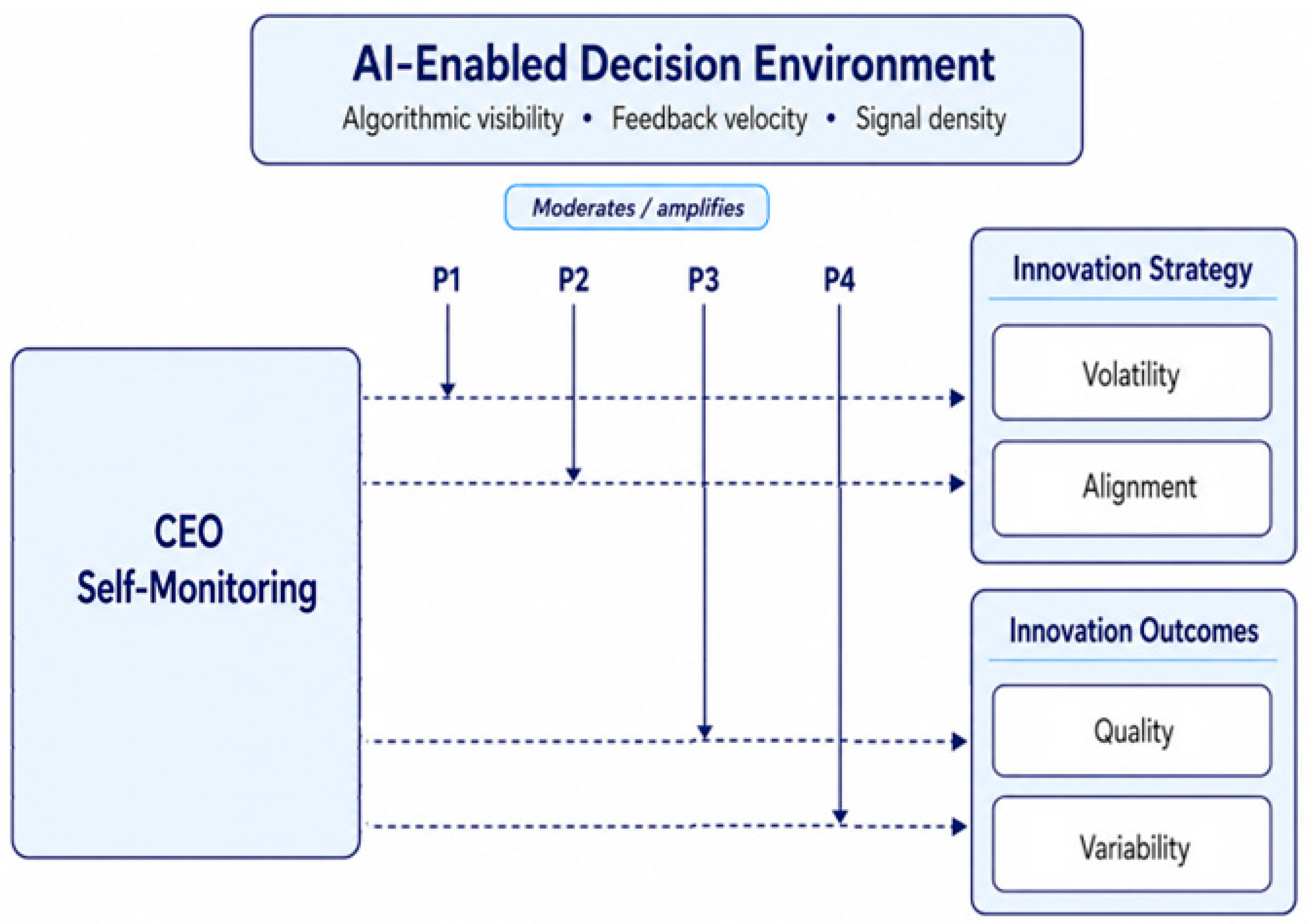
Figure 1. Conceptual framework. CEO self-monitoring is the focal antecedent; AI-enabled decision environments represent the contextual moderator; and innovation-strategy volatility, innovation-strategy alignment, innovation-outcome quality, and innovation-outcome variability represent the focal innovation dimensions.
Admsci 16 00263 g001
Disclaimer/Publisher’s Note: The statements, opinions and data contained in all publications are solely those of the individual author(s) and contributor(s) and not of MDPI and/or the editor(s). MDPI and/or the editor(s) disclaim responsibility for any injury to people or property resulting from any ideas, methods, instructions or products referred to in the content.