Systematic Review

AI-Driven Demand Planning: A Systematic Review of Adoption, Barriers and Strategic Implications


Department of Agribusiness and Supply Chain Management, Agricultural University of Athens, 322 00 Thiva, Greece
*
Author to whom correspondence should be addressed.
Adm. Sci. 2026, 16(6), 260; https://doi.org/10.3390/admsci16060260
Submission received: 22 April 2026 / Revised: 26 May 2026 / Accepted: 27 May 2026 / Published: 29 May 2026

Abstract

Agri-food organisations face a deepening governance challenge: managing demand un-certainty, supply chain volatility, and food waste under tight operational margins and in-creasing sustainability pressures. While artificial intelligence (AI) offers transformative potential for logistics and operations management, the organisational dimensions of its adoption, including strategic alignment, human capital development, and change management, remain insufficiently synthesised in the literature. This study investigates AI-driven demand planning as a management and organisational innovation, presenting a systematic review of 37 peer-reviewed studies (2015–2025) following the PRISMA protocol. Thematic synthesis across four analytical pillars, such as forecasting model applications, inventory and waste management practices, strategic impacts and resilience, and methodological overviews, reveals that advanced AI tools can reduce the mean absolute percentage error (MAPE) by 20–40% over traditional statistical methods in empirical case studies, with direct consequences for logistics performance, food waste reduction, and inventory governance. Critically, the review identifies persistent organisational barriers, particularly for SMEs: data governance deficiencies, high costs of technology adoption, workforce skill gaps, and the need for structured change management to institutionalise AI-based planning systems. The findings demonstrate that AI integration in agri-food supply chains constitutes a fundamental organisational transformation, requiring aligned strategies in innovation management, human resource development, supply chain governance, and sustainable business development. This review contributes to the administrative and management sciences by providing a structured, evidence-based framework for managers, policymakers, and practitioners navigating the organisational transition towards AI-enabled agri-food operations.

1. Introduction

Accurate demand forecasting is a strategic cornerstone for successful business operations in the agri-food sector, as it directly impacts supply chain efficiency, food waste reduction, and customer satisfaction. Currently, the global agri-food industry is navigating an era of unprecedented volatility fuelled by climate change, geopolitical instability, and shifting consumer preferences. Global shocks, ranging from the COVID-19 pandemic and the war in Ukraine to specific agricultural crises like avian influenza, have underscored the inherent limitations of traditional models in predicting price inflation and supply chain risks (Meister & Yu, 2025). The forecasting challenge is particularly acute in this sector due to the perishable nature of agricultural products, production seasonality, sensitivity to weather conditions, and shifting costs of raw materials. These factors often render conventional statistical techniques and manual estimations insufficient, resulting in significant discrepancies between forecasted and actual demand. Such disparities carry severe implications; the FAO (2020) estimates that 14% of food produced globally is lost before consumption, with inadequate demand management identified as a primary cause.
Inaccurate forecasting serves as a primary driver of food waste, leading to substantial economic losses and environmental degradation (Vlachos & Reddy, 2025). This is critical for products with fixed shelf lives where minor disruptions can lead to total loss, as demand must align with supply that is often constrained by biological and physical variables such as crop yields or raw material availability (Ahumada & Villalobos, 2009). Furthermore, because agri-food companies typically operate on thin profit margins, effective demand management is essential, as even minor fluctuations can significantly impact profitability. Modern trends add further complexity, including the demand for supply chain transparency, the digitalisation of processes, and the increasing preference for local and sustainable products (Notarnicola et al., 2017). To address these limitations, the industry is undergoing a paradigm shift toward “Supply Chain 4.0”, characterised by the integration of artificial intelligence (AI) and machine learning (ML) to identify complex, non-linear patterns within vast datasets (Baryannis et al., 2019).
Broad systematic literature reviews confirm that advanced AI and machine learning architectures inherently drive significant performance leaps over traditional statistical baselines by capturing complex, non-linear patterns (Khedr & Sultan, 2024; Walter et al., 2025). Within this established paradigm, localised empirical case studies report mean absolute percentage error (MAPE) reductions in the specific range of 20–40% (Miguéis et al., 2022; Punia et al., 2020). Large corporations like Walmart and Nestlé have already experimented with ML algorithms to evaluate sales data and external factors, yet despite this technical superiority, practical adoption remains uneven across the industry (Walter et al., 2025). Research indicates that the use of these cutting-edge technologies in the specialised agri-food sector is still more limited than in other industries, with adoption appearing slower among small and medium-sized enterprises (SMEs) (Nikolopoulos et al., 2021; Punia et al., 2020). These organisations face persistent barriers, including data governance deficiencies, high technology costs, and a lack of specialised workforce skills. Moreover, recent studies emphasise that successful implementation is not purely an algorithmic task but a socio-technical transformation involving risk prediction and organisational resilience (Zogaan et al., 2025). These organisational frictions (data governance, adoption cost, and workforce capability) constitute the central managerial focus of this review and are systematically developed through the TOE analytical lens (Section 2.2), mapped to thematic findings in Section 4.3 and Table 4, and translated into differentiated SME strategies in Section 5.3.
Among the methodological reviews identified through our PRISMA screening process (n = 6, Pillar 4), three orientations are discernible. General supply-chain reviews such as Khedr and Sultan (2024) and Vlachos and Reddy (2025) provide broad methodological coverage of ML and DL applications, with agri-food specificity treated as one application area among many; notably, Vlachos and Reddy (2025) conclude with an explicit future research agenda emphasising managerial and implementation dimensions still requiring synthesis. Sector-specific reviews such as Serrano-Torres et al. (2025) on dairy and Saha et al. (2025) on food-industry automation deliver valuable sectoral depth, but each addresses a particular subdomain or function rather than demand planning as an integrated organisational process. The review most proximate to the present study, Walter et al. (2025), synthesises AI in demand planning across supply chains and itself identifies organisational adoption, human capital, and governance as areas requiring further investigation. What none of these reviews provides is an integrated synthesis that simultaneously engages with (i) agri-food sectoral specificity, (ii) demand planning as the focal process, and (iii) the organisational, human-resource, and governance dimensions of adoption, particularly within SMEs. The present review is positioned at this intersection.
The primary aim of this work is to conduct a systematic literature review (SLR) following the Preferred Reporting Items for Systematic Reviews and Meta-Analyses (PRISMA) 2020 protocol to synthesise current knowledge on AI-driven demand planning within the agri-food industry (Page et al., 2021). Specifically, the review is guided by an overarching research question, how can agri-food enterprises, and particularly SMEs, institutionalise AI-driven demand planning as an organisational capability rather than as a purely technical adoption, which is decomposed into five sub-questions detailed in Section 3.1. This study evaluates dominant AI methodologies, such as hybrid models integrating intelligent optimisation (Wang et al., 2025), identifies primary barriers to adoption, and explores strategic outcomes by analysing 37 peer-reviewed articles published between 2015 and 2025. By utilising the Technology–Organisation–Environment (TOE) framework, the study provides a holistic lens to categorise technical performance alongside the socio-technical barriers that influence agricultural enterprises (Tornatzky et al., 1990). Ultimately, addressing these challenges requires creating more effective demand planning techniques that align AI tools with organisational goals, environmental responsibility, and long-term economic sustainability. From a management and administrative research perspective, this review contributes (i) an integrated organisational–technical framework for AI adoption in agri-food, (ii) a TOE-anchored synthesis of barriers and facilitators with SME-differentiated strategic implications (Section 5.3), and (iii) a phased maturity roadmap (Table 5) that operationalises the evidence base for practitioners and policymakers. The methodological rigour of PRISMA 2020, the analytical structure of the TOE framework, and the resulting management and administrative contributions are integrated across the manuscript: PRISMA governs the evidence base (Section 3.1), TOE organises its synthesis (Section 4 and Table 4), and the managerial implications are developed in Section 5.3 and Section 5.4.

2. Theoretical Framework

2.1. Demand Planning and the Transition to AI-Driven Analytics in Agri-Food

Demand planning represents a fundamental operational cornerstone for agri-food organisations, facilitating the synchronisation of supply chain activities through the creation of reliable demand forecasts (Brau et al., 2023). In this sector, the process is uniquely fraught with complexity due to high product perishability, biological production cycles, and extreme sensitivity to exogenous environmental variables such as weather patterns (Panda & Mohanty, 2023). Traditional forecasting models, primarily linear approaches like moving averages or exponential smoothing, often fail to mitigate the “Bullwhip Effect”, a phenomenon where small shifts in consumer demand result in magnified oscillations upstream, leading to excessive inventory or critical stock-outs (Sarıcıoğlu et al., 2024).
The inadequacy of conventional methods in the face of modern volatility has catalysed a paradigm shift toward “Supply Chain 4.0”. This transition involves moving from “descriptive” analytics (analysing historical events) toward “predictive” and “prescriptive” analytics, which utilise AI and ML to optimise responses in real-time. Unlike traditional time-series models, AI-driven architectures, specifically long short-term memory (LSTM) and gated recurrent units (GRUs), are capable of identifying complex, non-linear patterns and temporal dependencies (Meister & Yu, 2025; Zogaan et al., 2025). Furthermore, these advanced models can integrate “Internet Big Data”, including search engine indices and social media trends, to serve as early indicators of shifting consumer preferences (Rui & Li, 2024). This shift is not merely a technical upgrade but a strategic necessity; by aligning supply with volatile demand, AI-driven models mitigate food waste and enhance organisational resilience, positioning demand planning as a core component of sustainable corporate governance (Borucka, 2023; Ntai et al., 2025). Beyond its technical implications, this transition reframes demand planning as a managerial capability with direct consequences for executive decision-making, supply chain governance, and organisational sustainability, dimensions that are introduced analytically through the TOE framework in Section 2.2 and developed in the synthesis and discussion that follow.

2.2. The Technology–Organisation–Environment (TOE) Framework

To analyse the adoption of AI-driven innovations beyond their technical performance, this study utilised the TOE framework. Originally proposed by Tornatzky et al. (1990), the framework posits that the institutionalisation of technological innovation is influenced by three distinct contexts:
  • Technological Context: This encompasses both internal and external technologies available to the firm. For agri-food enterprises, this involves the perceived complexity of deep learning architectures and their compatibility with existing legacy systems (Meister & Yu, 2025). A critical factor here is the “relative advantage” provided by hybrid models that integrate climate data or price promotions to refine forecasts for commodities where traditional models underperform (Wang et al., 2025).
  • Organisational Context: This refers to internal characteristics such as firm size, managerial structure, and resource availability. Research indicates that successful AI adoption is frequently hampered by data governance deficiencies and a lack of specialised human capital (Singh et al., 2024). Furthermore, the concept of “human-guided learning” emphasises that the transition requires structured change management, where human judgment is integrated into algorithmic training to ensure that results remain contextualised and reliable (Brau et al., 2023).
  • Environmental Context: This involves the external arena, including market volatility driven by geopolitical conflicts, climate change, and biological risks like avian influenza (Meister & Yu, 2025). Regulatory pressures and the global mandate to reduce food waste serve as significant environmental drivers, pushing firms towards high-precision forecasting tools as a means of ensuring economic and environmental sustainability (Borucka, 2023; Ntai et al., 2025).
By utilising the TOE framework, this review moves beyond a purely technical assessment. It provides a holistic lens to categorise the socio-technical barriers, such as high adoption costs and data scarcity, that often prevent SMEs from achieving the same level of AI maturity as larger corporations (Anastasiadis et al., 2022; Singh et al., 2024). Rather than operating as a descriptive taxonomy for sorting isolated variables, the TOE framework is deployed here as the explanatory structure guiding the thematic synthesis of this review. The analytical value of the framework emerges from the systemic intersections between its three contexts. The complexity and opacity of deep learning models (Technological) do not act in isolation; they intersect with the resource scarcities and data-governance deficits typical of agri-food SMEs (Organisational), producing the institutional resistance and managerial override of algorithmic outputs documented in the corpus (Brau et al., 2023; Jauhar et al., 2025; Walter et al., 2025). These internal tensions are simultaneously intensified by environmental pressures e.g., global supply chain disruptions, market volatility, and mandates for food waste reduction (Sarıcıoğlu et al., 2024; Zogaan et al., 2025), which raise the urgency of adoption while compounding its difficulty. By treating these three contexts as interdependent and mutually reinforcing rather than as parallel categories, TOE functions as the interpretive engine of this study, explaining why technically superior forecasting algorithms frequently encounter institutional resistance, operational bottlenecks, or adoption failure during real-world deployment. This mechanism is operationalised empirically in the TOE mapping of synthesis findings (Table 4) and in the differentiated SME strategies developed in Section 5.3.
An AI model, however technically advanced, remains a latent technological asset until it is institutionalised into corporate routines. Drawing on dynamic capabilities theory (Teece, 2018) and the TOE framework, three administrative translation phases convert AI’s technical capabilities into an organisational capability. First, data-governance mobilisation consolidates fragmented operational data into a continuous, auditable corporate asset (Khedr & Sultan, 2024; Walter et al., 2025). Second, process-routine integration embeds predictive outputs into replenishment, procurement, and inventory workflows rather than confining them to IT infrastructures (Dellino et al., 2018). Third, human-algorithmic fusion combines explainable AI and human-guided learning to convert algorithmic outputs into trusted, socially legitimate managerial actions (Brau et al., 2023; Jahin et al., 2025; Jauhar et al., 2025). The administrative value of AI in demand planning is therefore contingent not on algorithmic sophistication but on the organisation’s capacity to traverse these three phases, a logic that frames the empirical synthesis and is operationalised in the maturity roadmap presented in Section 5.4.

3. Materials and Methods

3.1. Research Design, Objectives, and Search Strategy

To ensure a rigorous and transparent synthesis of existing knowledge, this study follows the SLR methodology in accordance with the PRISMA 2020 protocol. The primary objective is to investigate the transition of demand planning from traditional statistical frameworks towards AI-driven architectures within the agri-food sector. To guide this inquiry, five main research questions (RQs) were formulated:
  • RQ1: To what extent does the implementation of ML and deep learning (DL) algorithms improve demand forecasting accuracy compared to traditional statistical methods in the agri-food sector?
  • RQ2: What are the critical factors (e.g., weather conditions, consumer trends) that, when analysed by AI, contribute most significantly to reducing forecasting errors?
  • RQ3: How does improved AI forecasting accuracy translate into measurable operational benefits, such as food waste reduction and inventory optimisation?
  • RQ4: What are the primary barriers (e.g., cost, lack of expertise) and facilitators affecting the adoption of AI systems for demand planning in agri-food enterprises?
  • RQ5: How does the adoption of AI alter the strategic approach of agri-food companies regarding supply chain governance and resilience?
The search strategy was executed primarily via the Scopus database, selected for its comprehensive coverage of management and technological journals. The search focused on peer-reviewed articles published between January 2015 and August 2025. Specific keywords were derived directly from the research questions to ensure domain-specific relevance (Table 1a).
In fact, the primary search term combined the three research pillars with Boolean operators: (“Artificial Intelligence” OR “Machine Learning”) AND (“Demand Forecasting” OR “Inventory Management”) AND (“Agri-food” OR “Food Supply Chain” OR “Supply Chain Management”). The results of this first search were 911 publications. The final database search query was executed and last updated on 31 August 2025. To refine the initial 911 records fetched from Scopus, strict electronic limits and database filters were systematically applied. The search parameters were explicitly restricted to document types categorised as peer-reviewed journal articles or full conference proceedings, thereby automatically filtering out textbook chapters, book series, editorial notes, conference abstracts, short commentaries, and grey literature. Language limitations were locked exclusively to English. Notably, no pre-applied disciplinary or subject-area filters (for example, limiting results strictly to ‘Agricultural Sciences’ or ‘Computer Science’) were used within the Scopus interface; this deliberate choice ensured that highly relevant cross-disciplinary papers spanning operations research, administrative governance, and data engineering were not prematurely lost. Disciplinary boundaries were instead enforced manually during subsequent human screening phases.
To guarantee an objective, reproducible selection process, the inclusion and exclusion criteria were operationalised through a rigid, multi-dimensional eligibility matrix (Table 1b). Two investigators independently evaluated every record against these parameters, utilising a standardised digital screening checklist to minimise selection bias and subjective misinterpretations.
During the manual title and abstract screening phase (n = 370), studies were excluded (n = 69) if they failed to address predictive intelligence or targeted an irrelevant industry sector. At the subsequent detailed abstract and full-text eligibility stages (n = 301 and n = 158, respectively), the screening authors cross-examined the underlying methodologies to verify that the algorithm was being applied to solve an operational demand or inventory problem rather than an isolated biological, chemical, or macro-economic phenomenon. Boundary classification disagreements were resolved by checking for the presence of cross-cutting operational performance metrics (e.g., service levels, inventory holding costs, food waste volume, or forecasting error indices like MAPE, MAE, or RMSE) as defined by the inclusion criteria in Table 1b.
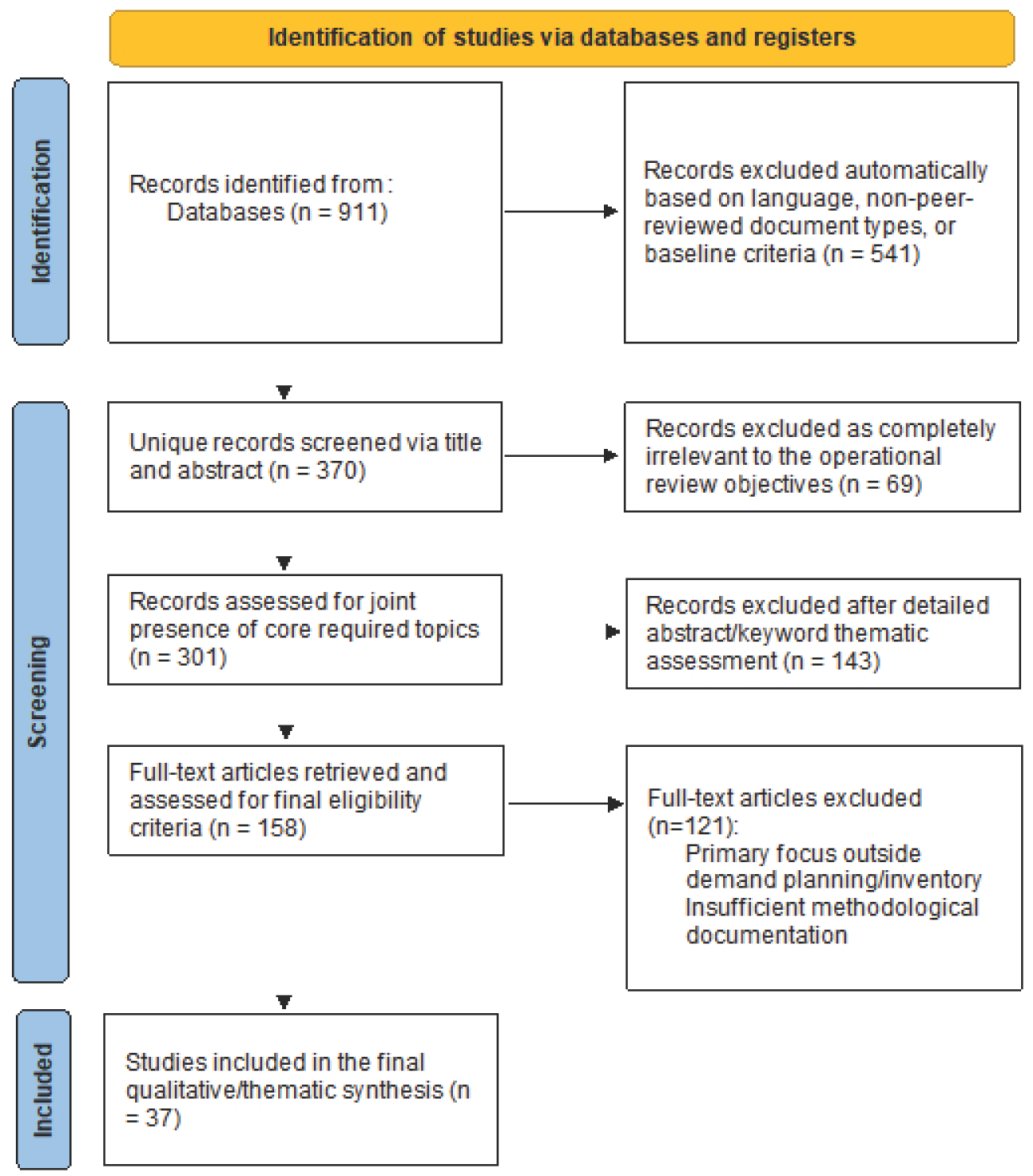
The study selection workflow was executed across four distinct, mutually exclusive phases, as mapped out linearly in the PRISMA flow diagram (Figure 1):
  • Identification: The initial keyword queries across the Scopus database retrieved 911 records. During a preliminary baseline filtering phase, 541 records were automatically excluded because they were published in a non-English language, represented non-peer-reviewed document types (e.g., books, book chapters, editorials, or conference abstracts), or failed to match basic disciplinary constraints. This left 370 unique records for human screening.
  • Screening: The remaining 370 records underwent a rigorous title and abstract screening. During this phase, 69 records were removed as completely irrelevant to the operational objectives of the review, leaving 301 records to proceed to the eligibility stage.
  • Eligibility: The abstracts and keyword distributions of these 301 records were evaluated more closely to check for the presence of the required topics. At this step, 143 articles were excluded as irrelevant because they did not explicitly link AI tool functionalities with agri-food demand scenarios. This left 158 full-text articles to be comprehensively retrieved and assessed for final inclusion.
Included: A meticulous full-text review of the 158 articles led to the final exclusion of 121 studies. The explicit grounds for exclusion were tightly documented: the primary focus was completely outside demand forecasting or inventory management (e.g., dealing purely with chemical food safety testing, molecular crop breeding, or consumer barcode traceability), or the underlying methodology was insufficiently documented to allow for replication.
Ultimately, 37 articles met all strict thematic and methodological inclusion criteria and were integrated into the final analytical synthesis (Page et al., 2021). Articles that focused solely on the abstract mathematical performance of algorithms without any practical application, on general supply chain logistics without an explicit forecasting link, or on economic macro-analysis without empirical substance were excluded to maintain the review’s core socio-technical focus.

3.2. Data Extraction, Analysis, and Thematic Synthesis

Data extraction was performed using a standardised tool to record key metadata for each study, including authors, year, country of origin, algorithm type, and main findings. A statistical description of the sample revealed a significant and rapid surge in academic interest: over 70% of the relevant research has been published in the last two years (12 articles in 2024 and 14 in 2025), underscoring the cutting-edge and developing nature of this field. The research is spread across interdisciplinary journals, notably the International Journal of Production Research, Sustainability, IEEE Access, and Annals of Operations Research.
To ensure that this systematic synthesis aligns with the administrative scope of this study, the subsequent analytical pillars evaluate the technical capabilities of AI not merely as isolated computational metrics, but as active instruments of managerial governance. Within administrative science, demand forecasting models serve as mechanisms to reduce bounded rationality and optimise resource allocation. Consequently, the findings compiled across the included studies were analysed through the lens of how these technologies reshape operational workflows, alter managerial decision-making structures, and establish new protocols for organisational control across the agri-food supply chain.
The synthesis of the extracted data was conducted using an inductive (bottom-up) thematic synthesis approach, utilising the TOE framework as the primary analytical lens. Each article was initially coded across five main axes: algorithm type, application domain, data sources, agri-food subsector, and study type. Recurring patterns led to the grouping of articles into four distinct thematic pillars:
Each study was assigned to a primary pillar on the basis of its dominant research objective and principal contribution: Pillar 1 for studies whose central aim was algorithmic development or comparison; Pillar 2 for studies foregrounding inventory or waste-management outcomes; Pillar 3 for studies whose primary analytical level was strategic or organisational; and Pillar 4 for methodological reviews. Studies addressing more than one theme were assigned to the pillar matching their dominant contribution, with secondary themes acknowledged narratively in the synthesis (Section 4.3) where relevant, rather than through multiple-pillar assignment, to preserve the mutual exclusivity required for the pillar-distribution statistics. This multi-dimensional evaluation allowed for a holistic assessment of AI adoption, moving beyond purely technical performance metrics (e.g., MAE and RMSE) to address the socio-technical, organisational, and environmental factors influencing the agri-food sector (Ntai et al., 2025; Singh et al., 2024).
Quality appraisal was conducted as a narrative assessment against three criteria derived from the eligibility framework (Table 1b): methodological and algorithmic clarity, data-source transparency, and empirical robustness. Studies were retained where the cited evidence permitted independent interpretation of methods, data, and results; studies failing on any criterion were excluded during the eligibility stage rather than scored separately. No formal, validated risk-of-bias tool was applied as no domain-specific instrument currently exists for systematic reviews of AI adoption in operations and management contexts; this approach is consistent with established practice in management and operations SLRs and is acknowledged as a limitation in Section 5.3. The certainty of evidence is therefore discussed qualitatively in the synthesis: higher confidence is attached to the consistent quantitative findings on forecasting accuracy gains (Pillar 1), while findings on strategic and organisational impacts (Pillar 3) are characterised as emerging evidence requiring further longitudinal validation. As this research is a systematic review of previously published, peer-reviewed studies and does not involve primary data collection, formal ethical approval was not required. All secondary data sources have been rigorously cited to respect intellectual property rights and ensure academic integrity. To support the principles of open science and replicability, the full screening records and data matrix generated for this study are available from the corresponding author upon reasonable request.

4. Results

4.1. Characteristics of Included Studies

The systematic review of the 37 selected studies reveals that AI-driven demand planning is not a standalone technical upgrade but a fundamental shift in agri-food supply chain governance. The synthesis below categorises the literature into four thematic pillars, emphasising how these technologies redefine administrative decision-making and organisational resilience. The reviewed literature (2015–2025) indicates a significant acceleration in AI adoption research, particularly after 2020, driven by global supply chain shocks. When evaluated through the lens of organisational adoption literature, the choice between traditional ML, DL, and hybrid modelling is not a neutral technical selection; it is a critical driver of administrative friction and implementation risk. Grounded in Rogers’ (2003) diffusion of innovations and socio-technical systems theory, the adoption viability of these algorithms depends heavily on their perceived complexity and compatibility with existing corporate structures. Standard ML architectures (e.g., random forest, gradient Boosting), while data-dependent, feature lower complexity and higher compatibility, allowing them to be integrated into traditional ERP frameworks with minimal organisational disruption. Conversely, DL configurations (e.g., LSTM networks) introduce severe administrative hurdles due to their ‘black-box’ nature. This lack of algorithmic explainability clashes with basic management control systems, creating data-governance opacity and triggering active workforce resistance from practitioners who refuse to delegate critical supply chain decisions to uninterpretable models. Furthermore, while hybrid architectures optimise statistical precision, they drastically escalate systemic complexity and computational overhead. From an administrative perspective, managing these multi-layered systems requires advanced capabilities, specialised engineering roles, and continuous maintenance protocols, assets that are scarce in resource-constrained enterprises. Consequently, the literature demonstrates an inverse relationship between raw mathematical accuracy and ease of corporate institutionalisation, requiring management to balance technical optimisation with operational readiness.
Table 2a,b provide a structured overview of the characteristics and operational focus of the technical studies (Pillars 1 and 2) and strategic/review studies (Pillars 3 and 4) analysed in this review, respectively.

4.2. Thematic Analysis Results

The inductive coding of all 37 studies revealed four distinct yet interconnected thematic pillars. These pillars represent a logical progression from technical algorithmic development to practical application, strategic evaluation, and methodological foundation.

4.2.1. Pillar 1: Core Forecasting Models (n = 16, 43.2%)

This pillar comprises studies primarily focused on developing, comparing, or optimising AI algorithms for demand forecasting, with technical accuracy as the central objective. Key methodological approaches include:
  • Comparative algorithmic studies: Direct benchmarking of AI against conventional methods. Meister and Yu (2025) demonstrated LSTM superiority over ARIMAX for egg price forecasting, achieving a MAPE reduction from 15–25% to 5–10%. Nasseri et al. (2023) compared tree-based ensembles (random forest, XGBoost) with LSTM networks in retail demand prediction, finding ensemble methods more robust for stable demand patterns. The evaluation of core forecasting models reveals that the transition to machine learning algorithms yields substantial accuracy gains. Specifically, targeted empirical configurations observed a 20–40% mean absolute percentage error (MAPE) reduction over classical time-series baselines, a trend prominently documented in the empirical frameworks of Miguéis et al. (2022) and Punia et al. (2020).
  • Hybrid model architectures: Integration of multiple techniques for enhanced performance. Abed (2024) hybridised CatBoost with the dingo optimisation algorithm, achieving superior convergence rates. Wang et al. (2025) developed a hybrid model combining variational mode decomposition with intelligent optimisation for vegetable price prediction.
  • Novel architectural proposals: Irhuma et al. (2025) introduced quantum convolutional neural networks (QCNNs) for supply chain demand forecasting, while Jahin et al. (2025) proposed the multi-channel data fusion network (MCDFN) with explainable AI capabilities.
  • Specialised problem formulations: Singh et al. (2024) addressed intermittent demand occurrence using machine learning classifiers. Borucka (2023) focused exclusively on seasonal forecasting methods for agricultural products.
Product coverage in this pillar spans livestock feed (Rui & Li, 2024), dairy products (Punia et al., 2020), vegetables (Wang et al., 2025), and general food industry applications (Saha et al., 2025).

4.2.2. Pillar 2: Inventory and Waste Management Applications (n = 9, 24.3%)

This pillar operationalises forecasting accuracy into tangible supply chain benefits, particularly waste reduction and inventory optimisation. Central themes include:
  • Inventory optimisation: Bouazizi et al. (2024) applied data science technologies for Supply Chain 4.0 inventory optimisation, while Priore et al. (2019) developed machine learning systems for dynamic replenishment policy selection. Kumar et al. (2024) implemented data-driven rational allocation for FMCG supply chains.
  • Perishable goods management: Chołodowicz and Orłowski (2024) employed neural network control for perishable inventory with fixed shelf-life products. Selukar et al. (2022) applied deep reinforcement learning for sustainable inventory control of multiple perishable goods.
  • Food waste reduction: This represents the most significant operational benefit. Seyam et al. (2025) developed a stacking ensemble model explicitly designed for preventative food waste reduction. Olawale et al. (2025) demonstrated sustainable farming applications minimising food waste through machine learning. Dellino et al. (2018) created a decision support system for fresh food supply chain management with demonstrated waste reduction outcomes. Furthermore, addressing demand uncertainty is vital for mitigating downstream food waste and enhancing logistics sustainability across corporate and hospitality supply networks (Karra et al., 2026).
Miguéis et al. (2022) exemplified cross-pillar relevance: while primarily a forecasting model development (Pillar 1), the study explicitly targeted fresh fish waste reduction (Pillar 2 objective), demonstrating how technical advancement translates to operational sustainability.

4.2.3. Pillar 3: Strategic Impacts and Resilience (n = 6, 16.2%)

This pillar adopts a holistic managerial perspective, examining how AI transforms organisational strategy and supply chain resilience. Strategic dimensions identified:
  • Resilience enhancement: Jauhar et al. (2025) employed explainable artificial intelligence (XAI) to improve perishable product supply chain resilience through customer characteristic leverage. Zogaan et al. (2025) utilised deep learning for risk prediction and resilience enhancement in critical industries.
  • Bullwhip effect mitigation: Taha Kandil (2025) conducted a social network analysis-based review of AI applications for alleviating supply chain bullwhip effects. Sarıcıoğlu et al. (2024) analysed one-step and multi-step forecasting strategies specifically designed to mitigate this systemic distortion.
  • Global food security: Pandey and Mishra (2024) examined how AI contributes to sustainable agriculture and global food security objectives, elevating the discussion from firm-level optimisation to societal impact.
  • Strategic supply chain management: Syahputra et al. (2025) investigated AI applications for strategic supply chain demand prediction.

4.2.4. Pillar 4: Methodological Reviews and Systematic Analyses (n = 6, 16.2%)

This foundational pillar comprises SLRs and methodological studies essential for knowledge synthesis and research gap identification. Review scope varies by focus:
  • Broad scope reviews: Walter et al. (2025) conducted a systematic literature review specifically on AI applications in demand planning for supply chains. Vlachos and Reddy (2025) provided a comprehensive machine learning in supply chain management review with a future research agenda.
  • Targeted domain reviews: Khedr and Sultan (2024) focused on deep learning and machine learning techniques for supply chain enhancement. Saha et al. (2025) examined AI vision and machine learning for food industry automation.
  • Sector-specific analyses: Serrano-Torres et al. (2025) delivered a systematic review on dairy supply chain transformation through AI. Albayrak Ünal et al. (2023) reviewed AI applications specifically in inventory management.

4.3. Mapping of Findings to Research Questions

The thematic categorisation reveals that Pillar 1 studies provide the technical foundation addressing RQ1 and RQ2, while Pillar 2 translates these advances into operational outcomes for RQ3. Pillar 3 elevates the analysis to strategic organisational impact for RQ5, and Pillar 4 reviews, synthesises barriers, and facilitators relevant to RQ4 (Table 3). This interconnected structure demonstrates that AI-driven demand planning in agri-food supply chains constitutes a mature technical field with established operational applications, currently transitioning towards strategic organisational integration.

4.4. Mapping Thematic Findings to the TOE Framework

To ground the thematic analysis within the study’s theoretical framework, the key findings from the four pillars were systematically mapped to the TOE dimensions (Table 4). This cross-examination demonstrates that AI-driven demand planning is not merely a technical upgrade, but an intersectional organisational transition.
  • Technological Dimension: Focuses heavily on algorithmic capability, data ingestion limits, and system architecture transparency across Pillars 1 and 2.
  • Organisational Dimension: Captures internal operational barriers, resource scarcities, change management friction, and the strategic alignment challenges highlighted in Pillar 3.
  • Environmental Dimension: Reflects external market dynamics, data sharing security across multi-tier networks, and supply chain vulnerability pressures evaluated in Pillar 4.
These links between organisational governance, dynamic capabilities, and managerial transformation are advanced as evidence-informed interpretive propositions rather than as confirmed empirical generalisations, in keeping with the narrative quality appraisal approach described in Section 3.2 and the heterogeneity of the underlying corpus. Their empirical validation across diverse agri-food contexts is identified as a priority for future research.

5. Discussion

The systematic review of the 37 selected studies reveals a rapidly maturing research field at the intersection of artificial intelligence and agri-food supply chain management. The thematic analysis demonstrates a logical progression from technical algorithmic development towards operational implementation and strategic organisational transformation. While the dominance of Pillar 1 (Core Forecasting Models, 43.2%) indicates that foundational technical capabilities are well-established, the growing representation of Pillar 2 (Inventory and Waste Management, 24.3%) and Pillar 3 (Strategic Impacts, 16.2%) signals a critical shift towards operationalising these advances for tangible organisational benefits.

5.1. Interpretation of Thematic Pillars

The concentration of literature in Pillar 1 exposes a deeper critical tension within the discipline: while ML and DL methods have demonstrably surpassed traditional forecasting approaches in empirical accuracy, high mathematical performance does not automatically guarantee operational integration. Significant MAPE reductions, reported within the 20–40% range in foundational empirical evaluations (Miguéis et al., 2022; Punia et al., 2020), represent a paradigm shift in information management rather than a simple incremental upgrade. This trend is exemplified by Nasseri et al. (2023), who demonstrated the high accuracy of tree-based ensembles in retail environments, and Meister and Yu (2025), whose LSTM-based models outperformed traditional benchmarks in agricultural price forecasting. From an administrative standpoint, these algorithms function as high-order organisational resources that enable “precision governance”. The move towards hybrid models, such as the VMD-based intelligent optimisation developed by Wang et al. (2025), suggests that innovation is trending towards greater methodological complexity to handle the specific volatility and biological constraints of food systems, testing the limits of traditional managerial oversight.
The prominence of Pillar 2 underscores a critical reality in administrative science: raw forecasting accuracy remains purely theoretical unless it serves as the operational fuel for sustainable development. The 15–20% inventory cost reduction explicitly documented in the empirical data of Kumar et al. (2024) and the stacking ensemble models of Seyam et al. (2025) provides the precise ROI justification necessary to overcome managerial resistance. This is supported by Dellino et al. (2018), who developed decision support systems for the fresh food supply chain with proven waste reduction outcomes, and Selukar et al. (2022), whose deep reinforcement learning approach achieved sustainable inventory control for perishables. In the context of administrative sciences, this represents the “operationalisation of sustainability”. By explicitly targeting waste through advanced modelling, as seen in the stacking ensemble models of Seyam et al. (2025), AI-driven planning forces firms to align logistical operations with environmental governance goals, effectively institutionalising the circular economy within the daily mechanics of the supply chain.
The emergence of Pillar 3 signifies a critical shift from localised, firm-level optimisation to a broader investigation of how predictive tools transform high-level dynamic capabilities. Within the agri-food sector, AI-driven demand planning provides the cognitive infrastructure for firms to sense market disruptions, seize operational opportunities through enhanced visibility, and reconfigure supply chain resources under extreme uncertainty. Research by Khedr and Sultan (2024) and Olawale et al. (2025) reinforces this, highlighting how AI techniques bolster broader supply chain resilience and global food security. However, this strategic evolution suggests that AI is far from a “plug-and-play” tool. It acts as a catalyst for a qualitative upgrade in organisational capability, transitioning management from a reactive to a predictive stance. This shift necessitates a sceptical re-evaluation of traditional governance. Sustaining this transformation requires deliberate investment in leadership and change management to mitigate systemic distortions, such as the bullwhip effect (Sarıcıoğlu et al., 2024), and to overcome ingrained organisational inertia.
Finally, the analytical patterns in Pillar 4 provide the essential evidence-based scaffolding for field development, exposing the friction between technical speed and administrative oversight. Methodological reviews, such as the work by Albayrak Ünal et al. (2023) on AI in inventory management, help consolidate fragmented technical knowledge. The high volume of recent publications, with nearly 70% appearing after 2023, indicates a state of “innovation velocity” that poses significant governance challenges. For administrators, this necessitates continuous knowledge synthesis and the development of robust internal data governance frameworks. Consequently, a holistic investigation of demand forecasting dynamics is crucial for maintaining competitive advantage in an increasingly digital and volatile global food market.

5.2. Agri-Food Specificity vs. Broader Supply Chain Literature

The findings of this review reveal both convergence with and divergence from the general supply chain AI literature, highlighting that technical capability must always bend to sectoral realities. While the technical superiority of AI models aligns with cross-sectoral trends in manufacturing and retail (Nasseri et al., 2023), the biological constraints of the agri-food sector create a distinctive implementation urgency that is missing from traditional supply chain literature.
Unlike general manufacturing, where safety stocks can buffer forecast errors, the perishability inherent in agri-food systems makes accuracy failures significantly costlier and more environmentally damaging (Selukar et al., 2022; Seyam et al., 2025). Consequently, the integration of sustainability metrics, specifically the explicit targeting of food waste reduction, is more pronounced in this sector than in generic supply chain studies. This reflects the unique position of agri-food organisations at the intersection of economic performance and environmental governance (Pandey & Mishra, 2024). Furthermore, the strategic emphasis on resilience observed in recent studies (Sarıcıoğlu et al., 2024; Zogaan et al., 2025) suggests a lasting influence of global supply chain shocks on research priorities. The framing of AI-driven demand planning as a tool for global food security remains a relatively distinctive feature of agri-food applications, elevating the technology from a firm-level efficiency tool to a strategic asset for societal stability.

5.3. Theoretical Contributions and Implementation Challenges

This review makes three distinct contributions to management and organisational theory, specifically tailored to the governance challenges of the agri-food sector, while simultaneously identifying the structural “frictions” that hinder AI institutionalisation. Unlike large agri-food corporations that can internalise data infrastructure and dedicated analytics teams, SMEs require adoption pathways that work around resource constraints while exploiting the structural features of the agri-food sector. Three differentiated, evidence-based strategies emerged from the reviewed literature. First, under the Environmental dimension of the TOE framework, SMEs should externalise digital capacity to producer cooperatives, PDO/PGI consortia, and sector platforms rather than attempting individual-firm adoption. Cooperatives are a dominant organisational form in European agri-food (notably in dairy, wine, and fresh produce), enabling small operators to share data assets, training resources, and forecasting tools that no single SME could sustain, an approach evidenced in the dairy-sector transformation reviewed by Serrano-Torres et al. (2025) and aligned with the food-security collective frame of Pandey and Mishra (2024). Second, under the Technological dimension, SMEs should sequence AI investment by perishability priority, concentrating initial deployment on highly perishable product lines (fresh produce, dairy, fish) where the waste-reduction ROI is most immediate and most easily justified to non-technical owner-managers; this is supported by documented operational gains in fresh-fish forecasting under censored data (Miguéis et al., 2022), perishable DSS implementation (Dellino et al., 2018), preventative waste-reduction stacking ensembles (Seyam et al., 2025), and DRL for multi-perishable inventory (Selukar et al., 2022). Third, under the Organisational dimension, agri-food SMEs should institutionalise human-guided learning that explicitly integrates owner-manager tacit knowledge of seasonality, local markets, and product idiosyncrasies with sparse-data-tolerant models, a configuration validated by Brau et al. (2023) and feasible even for firms without modern IT systems (Borucka, 2023; Nebri et al., 2024).
This study operationalises AI adoption as a structured organisational innovation process. Utilising the TOE framework (Tornatzky et al., 1990), we provide a roadmap to identify barriers such as leadership readiness and workforce skill gaps. For SMEs, the evidence suggests that investment in human capital and human–AI collaboration protocols is a functional precondition for realising AI’s value (Walter et al., 2025). Second, it contributes to the theory of dynamic capabilities (Teece, 2018) by framing AI-driven demand planning as a strategic asset for resilience. Beyond incremental efficiency, AI enables firms to sense disruptions and reconfigure resources under uncertainty. This elevates forecasting from a technical task to a high-level administrative capability that mitigates systemic risks, such as the bullwhip effect (Sarıcıoğlu et al., 2024; Taha Kandil, 2025). Third, the review provides a holistic governance model for sustainable development. By linking accuracy to a 15–20% reduction in inventory costs and measurable waste mitigation (Kumar et al., 2024), it offers a blueprint for “purpose-driven management” that aligns logistical operations with global food security objectives (Pandey & Mishra, 2024).
Despite these contributions, several critical challenges transcend algorithmic performance. Data governance remains a primary bottleneck; the fragmented digital ecosystems and “data silos” in agri-food hinder the scalability of deep learning solutions, leading to “garbage-in, garbage-out” scenarios (Khedr & Sultan, 2024; Walter et al., 2025). Furthermore, the “black-box” problem creates a trust gap. Scepticism towards non-interpretable autonomous systems often leads to the “overriding” of accurate forecasts with biased human judgment (Albayrak Ünal et al., 2023). This underscores the need for XAI as a governance requirement for accountability. Additionally, a significant workforce skill gap exists; without “bridge personnel” to translate AI outputs into strategy, technical gains remain trapped in pilot phases (Pandey & Mishra, 2024; Walter et al., 2025). Finally, this review acknowledges its own methodological limits. The focus on English-language literature may overlook innovations in emerging markets. Moreover, the “innovation velocity” in this field is such that technical benchmarks, even those from recent studies such as Nasseri et al. (2023), are constantly surpassed by newer hybrid architectures.
The operational manifestation of these three barriers differs sharply with organisational scale. Data silos in large corporations are typically inter-departmental, rooted in institutionalised functional boundaries and legacy ERP architectures; in agri-food SMEs, they more often reflect the absence of centralised data infrastructure altogether, with operational records remaining fragmented or manual (Khedr & Sultan, 2024; Walter et al., 2025). Black-box opacity poses, for large firms, a compliance and accountability risk managed through dedicated legal and data-science functions, whereas for SMEs, it produces an acute trust deficit that frequently leads to outright rejection of algorithmic outputs, as managers lack the in-house technical capacity to interrogate model behaviour (Brau et al., 2023; Jauhar et al., 2025). Workforce skill gaps in large enterprises are addressed through structured upskilling budgets and competitive recruitment; SMEs cannot match this and rely instead on generalist staff already operating at capacity (Anastasiadis et al., 2022, 2025; Singh et al., 2024). These data governance deficiencies reflect broader, systemic traceability and structural challenges characteristic of the emergent agri-food sector (Anastasiadis et al., 2025). These contrasts reinforce the differentiated SME strategies developed in Section 5.3.

5.4. Maturity Roadmap for AI-Driven Demand Planning

To translate the systematic findings into an actionable framework for practitioners, Table 5 presents a sequential 5-phase maturity roadmap. This roadmap guides organisations from legacy baseline systems towards highly resilient, autonomous, and collaborative forecasting ecosystems.

6. Conclusions

This systematic review of 37 studies demonstrates that AI-driven demand planning has transitioned from a technical forecasting enhancement to an emerging strategic capability for agri-food organisations. Synthesis of the current literature confirms that ML and DL architectures consistently outperform traditional statistical methods, offering a 20–40% improvement in accuracy (Miguéis et al., 2022; Punia et al., 2020). This technical superiority provides the necessary foundation for “precision governance”, enabling firms to mitigate the bullwhip effect and enhance systemic resilience (Sarıcıoğlu et al., 2024; Zogaan et al., 2025).

6.1. Key Contribution

From an administrative perspective, the findings highlight that the value of AI is not solely derived from algorithmic complexity but from its operational integration. Efficient demand planning serves as a primary driver for institutionalising sustainability, with documented evidence linking predictive precision to a 15–20% reduction in inventory costs and significant food waste mitigation (Kumar et al., 2024; Seyam et al., 2025). Thus, AI acts as a decision support system (DSS) that aligns logistical execution with broader corporate social responsibility (CSR) and global food security objectives (Pandey & Mishra, 2024). However, the transition to AI-driven planning faces significant organisational frictions. The review identifies a “digital divide”, particularly among SMEs, where data silos and a shortage of specialised human capital hinder scalable adoption (Walter et al., 2025). Successful institutionalisation requires a shift towards XAI to foster managerial trust and a deliberate investment in change management to bridge the technical-managerial skill gap (Jauhar et al., 2025; Walter et al., 2025).
Taken together, the reviewed literature indicates that AI-driven demand planning demonstrates clear potential to develop into an emerging strategic capability for agri-food enterprises navigating volatile markets. Given the heterogeneity of the 37 included studies and the narrative quality appraisal applied (Section 3.2), this transition from operational optimisation tool to formalised strategic capability should be interpreted as a contextual and emerging trend rather than as a universal empirical regularity. Realising these broader strategic benefits depends on a shift in future research from algorithmic refinement towards longitudinal studies of the socio-technical dimensions of AI adoption; in particular, how human–AI collaboration protocols can bridge organisational gaps and support administrative decision-making in multi-echelon supply chains.

6.2. Study Limitations

Three additional methodological boundaries warrant explicit acknowledgement. First, the search relies on a single bibliographic database (Scopus); although broad in multidisciplinary coverage, this choice may under-represent studies indexed exclusively in Web of Science, IEEE Xplore, or sectoral repositories. Second, the synthesis is susceptible to publication bias, since peer-reviewed venues disproportionately publish successful AI implementations relative to failed or inconclusive ones, which may inflate the apparent effectiveness of the technologies reviewed. Third, as noted in Section 3.2, no formal validated risk-of-bias tool was applied (a constraint reflecting the absence of a domain-specific instrument for AI-adoption SLRs in management and operations), which means that individual studies were not formally weighted by methodological quality in the synthesis. These boundaries, together with those already noted (English-only literature, innovation velocity, exclusion of grey literature), provide concrete directions for future review research.

Author Contributions

Conceptualisation, A.K. (Anteo Korcari) and F.A.; methodology, A.K. (Anteo Korcari); software, M.S.; validation, A.K. (Anteo Korcari), M.S. and A.K. (Antonia Koumpoti); formal analysis, A.K. (Anteo Korcari); investigation, M.S.; resources, A.K. (Anteo Korcari) and M.S.; data curation, A.K. (Anteo Korcari); writing—original draft preparation, A.K. (Anteo Korcari); writing—review and editing, A.K. (Anteo Korcari), M.S. and A.K. (Antonia Koumpoti); supervision, F.A. All authors have read and agreed to the published version of the manuscript.

Funding

This research received no external funding.

Institutional Review Board Statement

Not applicable.

Informed Consent Statement

Not applicable.

Data Availability Statement

The data presented in this study are available on reasonable request from the corresponding author.

Acknowledgments

AI was utilised during the manuscript editing and revision stages to improve language flow and text clarity.

Conflicts of Interest

The authors declare no conflicts of interest.

Abbreviations

The following abbreviations are used in this manuscript:
AIArtificial Intelligence
ANNArtificial Neural Network
ARIMAAutoRegressive Integrated Moving Average
ARIMAXAutoRegressive Integrated Moving Average with Explanatory Variables
CNNConvolutional Neural Network
CSRCorporate Social Responsibility
DLDeep Learning
DRLDeep Reinforcement Learning
DSSDecision Support System
FAOFood and Agriculture Organisation (of the United Nations)
FMCGFast-Moving Consumer Goods
GRUGated Recurrent Unit
ITInformation Technology
LSTMLong Short-Term Memory
MAEMean Absolute Error
MAPEMean Absolute Percentage Error
MCDFNMulti-Channel Data Fusion Network
MLMachine Learning
PRISMAPreferred Reporting Items for Systematic Reviews and Meta-Analyses
QCNNQuantum Convolutional Neural Network
RMSERoot Mean Square Error
ROIReturn on Investment
RQResearch Question
SCMSupply Chain Management
SLRSystematic Literature Review
SMEsSmall and Medium-sized Enterprises
SVRSupport Vector Regression
TOETechnology–Organisation–Environment (Framework)
VMDVariational Mode Decomposition
XAIExplainable Artificial Intelligence

References

  1. Abed, A. M. (2024). Accelerate demand forecasting by hybridizing CatBoost with the dingo optimization algorithm to support supply chain conceptual framework precisely. Frontiers in Sustainability, 5, 1388771. [Google Scholar] [CrossRef]
  2. Ahumada, O., & Villalobos, J. R. (2009). Application of planning models in the agri-food supply chain: A review. European Journal of Operational Research, 196(1), 1–20. [Google Scholar] [CrossRef]
  3. Albayrak Ünal, Ö., Erkayman, B., & Usanmaz, B. (2023). Applications of artificial intelligence in inventory management: A systematic review of the literature. Archives of Computational Methods in Engineering, 30, 2605–2625. [Google Scholar] [CrossRef]
  4. Anastasiadis, F., Apostolidou, I., & Tsolakis, N. (2025). Challenges and opportunities of supply chain traceability: Insights from emergent agri-food sector. Supply Chain Management: An International Journal, 30(1), 106–126. [Google Scholar] [CrossRef]
  5. Anastasiadis, F., Manikas, I., Apostolidou, I., & Wahbeh, S. (2022). The role of traceability in end-to-end circular agri-food supply chains. Industrial Marketing Management, 104, 196–211. [Google Scholar] [CrossRef]
  6. Baryannis, G., Validi, S., Dani, S., & Antoniou, G. (2019). Supply chain risk management and artificial intelligence: State of the art and future research directions. International Journal of Production Research, 57(7), 2179–2202. [Google Scholar] [CrossRef]
  7. Borucka, A. (2023). Seasonal methods of demand forecasting in the supply chain as support for the company’s sustainable growth. Sustainability, 15(9), 7399. [Google Scholar] [CrossRef]
  8. Bouazizi, E., Khedr, A., Elfaioumy, S., & Belal, M. (2024). Inventory optimization using data science technologies for supply chain 4.0. The International Arab Journal of Information Technology, 21(6), 996–1005. [Google Scholar] [CrossRef]
  9. Brau, R., Aloysius, J., & Siemsen, E. (2023). Demand planning for the digital supply chain: How to integrate human judgment and predictive analytics. Journal of Operations Management, 69(6), 965–982. [Google Scholar] [CrossRef]
  10. Chołodowicz, E., & Orłowski, P. (2024). Neural network control of perishable inventory with fixed shelf life products and fuzzy order refinement under time-varying uncertain demand. Energies, 17(4), 849. [Google Scholar] [CrossRef]
  11. Dellino, G., Laudadio, T., Mari, R., Mastronardi, N., & Meloni, C. (2018). A reliable decision support system for fresh food supply chain management. International Journal of Production Research, 56(4), 1458–1485. [Google Scholar] [CrossRef]
  12. FAO. (2020). The state of food and agriculture 2020. FAO. [Google Scholar] [CrossRef]
  13. Fatorachian, H., & Shokri, A. (2025). Waste generation patterns and mitigation strategies in cold chains. Journal of Environmental Management, 380, 125108. [Google Scholar] [CrossRef] [PubMed]
  14. Goel, L., Nandal, N., Gupta, S., Karanam, M., Prasanna Yeluri, L., Pandey, A. K., Rozhdestvenskiy, O. I., & Grabovy, P. (2024). Revealing the dynamics of demand forecasting in supply chain management: A holistic investigation. Cogent Engineering, 11(1), 2368104. [Google Scholar] [CrossRef]
  15. Irhuma, M., Alzubi, A., Öz, T., & Iyiola, K. (2025). Migrative armadillo optimization enabled a one-dimensional quantum convolutional neural network for supply chain demand forecasting. PLoS ONE, 20(3), e0318851. [Google Scholar] [CrossRef]
  16. Jahin, M. A., Shahriar, A., & Amin, M. A. (2025). MCDFN: Supply chain demand forecasting via an explainable multi-channel data fusion network model. Evolutionary Intelligence, 18(3), 66. [Google Scholar] [CrossRef]
  17. Jauhar, S. K., Harinath, S., Krishnaswamy, V., & Paul, S. K. (2025). Explainable artificial intelligence to improve the resilience of perishable product supply chains by leveraging customer characteristics. Annals of Operations Research, 354(1), 103–142. [Google Scholar] [CrossRef]
  18. Karra, M., Koumpoti, A., Saridi, M., & Anastasiadis, F. (2026). Downstream food waste in restaurant supply chains: Behavioural drivers and implications for sustainable logistics in a mediterranean context. Logistics, 10(5), 115. [Google Scholar] [CrossRef]
  19. Khedr, A. M., & Sultan, S. R. (2024). Enhancing supply chain management with deep learning and machine learning techniques: A review. Journal of Open Innovation: Technology, Market, and Complexity, 10(4), 100379. [Google Scholar] [CrossRef]
  20. Kumar, D., Soni, G., Ramtiyal, B., & Vijayvargy, L. (2024). Data-driven approach for rational allocation of inventory in a FMCG supply chain. International Journal of System Assurance Engineering and Management, 1–14. [Google Scholar] [CrossRef]
  21. Meister, S., & Yu, X. (2025). Forecasting egg price inflation in Germany with machine learning: A comparative study with ARIMAX and LSTM. Q Open, 5(2), qoaf015. [Google Scholar] [CrossRef]
  22. Miguéis, V. L., Pereira, A., Pereira, J., & Figueira, G. (2022). Reducing fresh fish waste while ensuring availability: Demand forecast using censored data and machine learning. Journal of Cleaner Production, 359, 131852. [Google Scholar] [CrossRef]
  23. Nasseri, M., Falatouri, T., Brandtner, P., & Darbanian, F. (2023). Applying machine learning in retail demand prediction—A comparison of tree-based ensembles and long short-term memory-based deep learning. Applied Sciences, 13(19), 11112. [Google Scholar] [CrossRef]
  24. Nassibi, N., Fasihuddin, H., & Hsairi, L. (2023). Demand forecasting models for food industry by utilizing machine learning approaches. International Journal of Advanced Computer Science and Applications, 14(3), 892–898. [Google Scholar] [CrossRef]
  25. Nebri, M. A., Moussaid, A., & Bouikhalene, B. (2024). Forecasting livestock feed sales using machine learning techniques: An analysis of the Moroccan market. Indonesian Journal of Electrical Engineering and Computer Science, 35(2), 1139. [Google Scholar] [CrossRef]
  26. Nikolopoulos, K., Punia, S., Schäfers, A., Tsinopoulos, C., & Vasilakis, C. (2021). Forecasting and planning during a pandemic: COVID-19 growth rates, supply chain disruptions, and governmental decisions. European Journal of Operational Research, 290(1), 99–115. [Google Scholar] [CrossRef] [PubMed]
  27. Notarnicola, B., Tassielli, G., Renzulli, P. A., Castellani, V., & Sala, S. (2017). Environmental impacts of food consumption in Europe. Journal of Cleaner Production, 140, 753–765. [Google Scholar] [CrossRef]
  28. Ntai, S., Kontopanou, M., & Anastasiadis, F. (2025). Leveraging household food waste consumer behaviour to optimise logistics. Logistics, 9(3), 126. [Google Scholar] [CrossRef]
  29. Olawale, R. A., Olawumi, M. A., & Oladapo, B. I. (2025). Sustainable farming with machine learning solutions for minimizing food waste. Journal of Stored Products Research, 112, 102611. [Google Scholar] [CrossRef]
  30. Page, M. J., McKenzie, J. E., Bossuyt, P. M., Boutron, I., Hoffmann, T. C., Mulrow, C. D., Shamseer, L., Tetzlaff, J. M., Akl, E. A., Brennan, S. E., Chou, R., Glanville, J., Grimshaw, J. M., Hróbjartsson, A., Lalu, M. M., Li, T., Loder, E. W., Mayo-Wilson, E., McDonald, S., … Moher, D. (2021). The PRISMA 2020 statement: An updated guideline for reporting systematic reviews. BMJ, 372, n71. [Google Scholar] [CrossRef]
  31. Panda, S. K., & Mohanty, S. N. (2023). Time series forecasting and modeling of food demand supply chain based on regressors analysis. IEEE Access, 11, 42679–42700. [Google Scholar] [CrossRef]
  32. Pandey, D. K., & Mishra, R. (2024). Towards sustainable agriculture: Harnessing AI for global food security. Artificial Intelligence in Agriculture, 12, 72–84. [Google Scholar] [CrossRef]
  33. Priore, P., Ponte, B., Rosillo, R., & De La Fuente, D. (2019). Applying machine learning to the dynamic selection of replenishment policies in fast-changing supply chain environments. International Journal of Production Research, 57(11), 3663–3677. [Google Scholar] [CrossRef]
  34. Punia, S., Nikolopoulos, K., Singh, S. P., Madaan, J. K., & Litsiou, K. (2020). Deep learning with long short-term memory networks and random forests for demand forecasting in multi-channel retail. International Journal of Production Research, 58(16), 4964–4979. [Google Scholar] [CrossRef]
  35. Rogers, E. M. (2003). Diffusion of innovations (5th ed.). Free Press. [Google Scholar]
  36. Rui, G., & Li, M. (2024). Utilizing internet big data and machine learning for product demand forecasting and analysis of its economic benefits. Tehnički vjesnik, 31(4), 1385–1394. [Google Scholar] [CrossRef]
  37. Saha, D., Padhiary, M., & Chandrakar, N. (2025). AI vision and machine learning for enhanced automation in food industry: A systematic review. Food and Humanity, 4, 100587. [Google Scholar] [CrossRef]
  38. Sarıcıoğlu, A., Erol Genevois, M., & Cedolin, M. (2024). Analyzing one-step and multi-step forecasting to mitigate the bullwhip effect and improve supply chain performance. IEEE Access, 12, 180161–180174. [Google Scholar] [CrossRef]
  39. Selukar, M., Jain, P., & Kumar, T. (2022). Inventory control of multiple perishable goods using deep reinforcement learning for sustainable environment. Sustainable Energy Technologies and Assessments, 52, 102038. [Google Scholar] [CrossRef]
  40. Serrano-Torres, G. J., López-Naranjo, A. L., Larrea-Cuadrado, P. L., & Mazón-Fierro, G. (2025). Transformation of the dairy supply chain through artificial intelligence: A systematic review. Sustainability, 17(3), 982. [Google Scholar] [CrossRef]
  41. Seyam, A., Mathew, S. S., Du, B., Barachi, M. E., & Shen, J. (2025). A stacking ensemble model for food demand forecasting: A preventative approach to food waste reduction. Cleaner Logistics and Supply Chain, 15, 100225. [Google Scholar] [CrossRef]
  42. Singh, A. K., Simha, J. B., & Agarwal, R. (2024). Prediction of intermittent demand occurrence using machine learning. EAI Endorsed Transactions on Internet of Things, 10. [Google Scholar] [CrossRef]
  43. Souichirou, N. (2015). Application of big data technology in support of food manufacturers’ commodity demand forecasting. NEC Technical Journal, 10(1), 90–93. [Google Scholar]
  44. Syahputra, R. A., Kasmawati, K., & Sentia, P. D. (2025). The application of artificial neural network (ANN) with Backpropagation algorithm to predict supply chain demand. Journal of Optimization in Industrial Engineering, 38(1). [Google Scholar] [CrossRef]
  45. Taha Kandil, T. (2025). Artificial intelligence (AI) and alleviating supply chain bullwhip effects: Social network analysis-based review. Journal of Global Operations and Strategic Sourcing, 18(1), 5–35. [Google Scholar] [CrossRef]
  46. Teece, D. J. (2018). Dynamic capabilities as (workable) management systems theory. Journal of Management & Organization, 24(3), 359–368. [Google Scholar] [CrossRef]
  47. Tornatzky, L. G., Fleischer, M., & Chakrabarti, A. K. (1990). The processes of technological Innovation Issues in organization and management series. Lexington Books. [Google Scholar]
  48. Vlachos, I., & Reddy, P. G. (2025). Machine learning in supply chain management: Systematic literature review and future research agenda. International Journal of Production Research, 63(16), 5987–6016. [Google Scholar] [CrossRef]
  49. Walter, A., Ahsan, K., & Rahman, S. (2025). Application of artificial intelligence in demand planning for supply chains: A systematic literature review. The International Journal of Logistics Management, 36(3), 672–719. [Google Scholar] [CrossRef]
  50. Wang, G., Xu, S., Chen, Z., & Li, Y. (2025). A hybrid model integrating variational mode decomposition and intelligent optimization for vegetable price prediction. Agriculture, 15(9), 919. [Google Scholar] [CrossRef]
  51. Zogaan, W. A., Ajabnoor, N., & Salamai, A. A. (2025). Leveraging deep learning for risk prediction and resilience in supply chains: Insights from critical industries. Journal of Big Data, 12(1), 94. [Google Scholar] [CrossRef]
Figure 1. PRISMA 2020 flow diagram of the study selection process.
Admsci 16 00260 g001
Table 1. (a) Research Questions and Associated Keywords. (b) Eligibility Criteria Matrix for Study Selection.
(a)(b)
Research QuestionAssociated KeywordsCriterionInclusion Criteria (Must Meet All)Exclusion Criteria (Exclude If Any Apply)
RQ1: Accuracy Comparison“Forecast Accuracy”, “Machine Learning”, “Predictive Analytics”, “Demand Forecasting”Study Type & QualityPeer-reviewed journal articles or full conference proceedings papers.
Contains explicit methodological and empirical documentation.
Books, book chapters, editorials, industry reports, or grey literature.
Systematic reviews (except where retained for context/mapping under Pillar 4).
RQ2: Critical Factors“Predictive Analytics”, “Artificial Intelligence”, “Key Factors”, “Data Analysis”Language & PeriodPublished in English.
Published between 1 January 2015, and 30 August 2025.
Published in any language other than English.
Published outside the designated 2015–2025 window.
RQ3: Operational Benefits“Inventory Management”, “Inventory Optimisation”, “Food Supply Chain”, “Food Waste”Core TechnologyClear application, deployment, or comparative evaluation of AI, ML, or DL models.Exclusive reliance on traditional linear or statistical methods (e.g., basic ARIMA, simple moving averages) without an AI/ML component.
RQ4: Adoption Barriers“Technology Adoption”, “Implementation Challenges”, “Agrifood”, “Agribusiness”Operational DomainDirect focus on demand forecasting, predictive demand planning, or automated inventory optimisation.Core focus entirely outside demand/inventory logistics (e.g., computer vision for field weed detection, robotic tractor harvesting, or molecular crop breeding).
RQ5: Strategic Impact“Strategic Management”, “Food Supply Chain”, “Artificial Intelligence”, “Decision Making”Sector ContextExplicit focus on the agri-food supply chain, agricultural commodities, or highly perishable retail items.General supply chain models or manufacturing frameworks with no empirical adjustments for agri-food properties (e.g., shelf-life, seasonality).
Table 2. (a) Characteristics and operational focus of technical studies (Pillars 1 & 2). (b) Characteristics and Operational Focus of Strategic and Review Studies (Pillars 3 & 4).
(a)
(Author, Year)AI/ML MethodologyOperational FocusKey Findings & Administrative Implications
(Souichirou, 2015)Big Data AnalyticsDemand ForecastingEarly evidence of using high-volume data to automate supply chain optimisation and reduce disposal losses.
(Dellino et al., 2018)Decision Support SystemsFresh Food ManagementIntegration of forecasting and optimisation models helps managers handle the high perishability of fresh produce.
(Priore et al., 2019)Machine LearningReplenishment PoliciesProves that dynamic ML-based selection of replenishment policies outperforms static rules in fast-changing environments.
(Miguéis et al., 2022)Censored Data & MLFresh Fish WasteIncorporating censored data into ML models significantly improves availability while reducing perishability waste.
(Selukar et al., 2022)Deep Reinforcement Learning (DRL)Perishable InventoryDRL provides superior inventory control for multiple perishable goods compared to traditional heuristics.
(Borucka, 2023)Seasonal ARIMA/MLSustainable GrowthAI helps companies without modern IT systems extract value from sparse historical sales data to support sustainability.
(Brau et al., 2023)Human-Guided LearningDemand PlanningAccuracy improves when algorithms integrate human judgment; “black box” models are less effective without oversight.
(Nasseri et al., 2023)Tree-Based Ensembles & LSTMRetail DemandComparative analysis shows that ensemble models often outperform single DL models in complex retail environments.
(Nassibi et al., 2023)Various ML ApproachesFood Industry RetailConfirms that ML models significantly outperform traditional statistical methods specifically in food-related retail.
(Panda & Mohanty, 2023)Regressor AnalysisFood DemandRobust time-series modelling stabilises the supply chain by aligning production directly with fluctuating demand.
(Abed, 2024)CatBoost & OptimisationConceptual SC FrameworkHybridising nature-inspired algorithms with boosting techniques accelerates forecasting speed and precision.
(Bouazizi et al., 2024)ML/Big DataSupply Chain 4.0Accurate forecasting is the foundational step for inventory optimisation and cost minimisation in the digital era.
(Chołodowicz & Orłowski, 2024)Neural Network & Fuzzy LogicPerishable InventoryHybrid control systems effectively handle “fuzzy” order uncertainty for products with fixed shelf lives.
(Goel et al., 2024)Machine LearningSCM DynamicsInvestigates the ripple effects of forecasting accuracy on overall supply chain performance and stability.
(Kumar et al., 2024)Data-Driven AnalysisFMCG InventoryRational inventory allocation based on data-driven insights ensures service levels while minimising holding costs.
(Nebri et al., 2024)Gradient BoostingLivestock Feed SalesAchieved high precision (MAE: 0.0203) by integrating climate and exogenous data into sales prediction models.
(Rui & Li, 2024)Internet Big Data/MLProduct DemandLeveraging external web trends and search indices creates measurable economic benefits through demand alignment.
(Singh et al., 2024)ML ClassificationIntermittent DemandSpecialised ML models better predict “lumpy” or intermittent demand occurrences than standard regressions.
(Fatorachian & Shokri, 2025)Pattern RecognitionCold Chain WasteIdentifies specific waste generation patterns, suggesting AI-driven mitigation in temperature-controlled logistics.
(Irhuma et al., 2025)Quantum CNNDemand ForecastingEmerging quantum-enabled neural networks offer new frontiers for processing high-dimensional supply chain data.
(Jahin et al., 2025)Multi-channel Data FusionExplainable ForecastingFusing multiple data streams (internal/external) via XAI increases trust and transparency in automated systems.
(Meister & Yu, 2025)LSTM vs. ARIMAXPrice InflationDeep learning (LSTM) proves more resilient than traditional models for forecasting agricultural price spikes and volatility.
(Olawale et al., 2025)ML SolutionsSustainable FarmingML is critical for minimising post-harvest losses and optimising resource allocation to reduce total food waste.
(Seyam et al., 2025)Stacking EnsembleFood Waste ReductionA preventative approach using ensemble models provides a more robust defence against waste in fresh supply chains.
(Wang et al., 2025)VMD & OptimisationPrice PredictionHybrid models are superior for predicting volatile prices in agricultural commodities (e.g., vegetables).
(b)
(Author, Year)AI/ML MethodologyOperational FocusKey Findings & Administrative Implications
(Albayrak Ünal et al., 2023)Systematic ReviewSCM LiteratureMaps the research landscape, highlighting the lack of integrated organisational frameworks in AI adoption.
(Khedr & Sultan, 2024)DL & ML ReviewSCM EnhancementSystematic review confirms that DL/ML integration is the primary driver for modernising supply chain resilience.
(Pandey & Mishra, 2024)General AI/ReviewSustainable AgricultureAI is no longer optional; it is a critical tool for global food security and sustainable agricultural scaling.
(Sarıcıoğlu et al., 2024)Multi-Step ForecastingBullwhip MitigationAdvanced forecasting techniques effectively reduce the amplification of demand variations as they move upstream.
(Jauhar et al., 2025)Explainable AI (XAI) & SVRResilience & GoodsXAI enhances transparency, allowing managers to understand the "why" behind predictions and risk factors.
(Saha et al., 2025)AI Vision/MLAutomation ReviewSystematic review highlighting the role of vision systems and ML in quality control and automated processing.
(Serrano-Torres et al., 2025)Systematic AI ReviewDairy Supply ChainAI transformation in dairy focuses on managing biological variability and critical shelf-life constraints.
(Syahputra et al., 2025)ANN & BackpropagationSupply Chain DemandNeural networks with backpropagation effectively predict fluctuations to support strategic logistics planning.
(Taha Kandil, 2025)Social Network AnalysisBullwhip EffectsAI mitigates bullwhip effects by analysing the social and informational network structures of the supply chain partners.
(Vlachos & Reddy, 2025)Systematic ReviewML in SCMProvides a future research agenda; notes that ML is moving from an "experimental" to a "foundational" tool.
(Walter et al., 2025)Systematic ReviewDemand PlanningComprehensive analysis shows AI’s role in shifting demand planning from reactive to proactive strategic management.
(Zogaan et al., 2025)Deep LearningRisk & ResilienceDeep learning is identified as a critical tool for predicting supply chain disruptions and organisational risks.
Table 3. Summary of evidence addressing research questions (RQ1–RQ5).
Research QuestionPrimary PillarSupporting StudiesKey Finding
RQ1: AI accuracy vs. traditional methodsPillar 1(Abed, 2024; Bouazizi et al., 2024; Irhuma et al., 2025; Jahin et al., 2025; Khedr & Sultan, 2024; Meister & Yu, 2025; Rui & Li, 2024; Saha et al., 2025; Singh et al., 2024; Wang et al., 2025)AI methods (ML/DL) reduce MAPE by 20–40% compared to exponential smoothing, ARIMA, and moving averages.
RQ2: Critical predictive factorsPillar 1(Abed, 2024; Khedr & Sultan, 2024; Meister & Yu, 2025; Saha et al., 2025; Sarıcıoğlu et al., 2024; Selukar et al., 2022; Singh et al., 2024)External variables (weather, seasonality, promotions, macroeconomic indicators) are essential; multi-factor models outperform univariate approaches.
RQ3: Operational benefits of accuracyPillar 2(Ahumada & Villalobos, 2009; Chołodowicz & Orłowski, 2024; Jauhar et al., 2025; Kumar et al., 2024; Olawale et al., 2025; Seyam et al., 2025; Zogaan et al., 2025)Direct correlation: 1% accuracy improvement → measurable waste reduction; 15–20% inventory cost reduction; optimised perishable goods management.
RQ4: Adoption barriers and facilitatorsPillar 4 & Pillar 3(Nasseri et al., 2023; Nikolopoulos et al., 2021; Syahputra et al., 2025; Tornatzky et al., 1990)Primary barriers: data quality/availability, implementation cost, skill shortages, organisational resistance. Key facilitators: management commitment, clear ROI demonstration.
RQ5: Strategic supply chain transformationPillar 3(Albayrak Ünal et al., 2023; Borucka, 2023; Nasseri et al., 2023; Syahputra et al., 2025; Taha Kandil, 2025)AI enables a shift from reactive to predictive management; enhances resilience; mitigates systemic risks (bullwhip effect); supports global food security objectives.
Table 4. TOE framework mapping of systematic review findings.
TOE DimensionRelevant PillarsCore Thematic Focus AreasStrategic & Operational Insights
Technological (T)Pillar 1, Pillar 2Algorithmic accuracy, machine learning model selection, inventory optimisation capabilities.Highlighted the transition from legacy statistical models to predictive AI. Emphasises the need for data readiness and model explainability to prevent “black box” operational distrust.
Organisational (O)Pillar 3, Pillar 2Skills deficits, cost of implementation, cultural resistance, governance, and waste tracking.Identifies human-centric barriers as primary points of failure. Successful AI adoption demands deliberate workforce upskilling and a shift towards data-driven organisational cultures rather than pure technological acquisition.
Environmental (E)Pillar 4, Pillar 3Market volatility, multi-tier supply chain visibility, data security, and systemic resilience.Illustrates how external disruptions (e.g., market shocks, regulatory changes) act as primary drivers for AI integration. Stresses the necessity of collaborative, secure data-sharing ecosystems among external supply chain partners.
Table 5. Sequential maturity roadmap for AI-driven demand planning adoption.
PhaseMaturity LevelCore Technical RequirementsKey Organisational FocusMetric/Target Outcomes
1FoundationalClean, centralised ERP data; baseline statistical models (e.g., Moving Average, ARIMA).Overcoming data silos; establishing baseline data governance and cloud readiness.Elimination of manual spreadsheet errors; reliable historical data logging.
2EmergingIntroduction of basic machine learning algorithms (e.g., random forests, linear regressions); internal historical data ingestion.Upskilling existing inventory personnel; overcoming initial cultural resistance to algorithmic tools.Measurable reduction in basic MAPE compared to legacy statistical baselines.
3EstablishedDeep learning integration (e.g., LSTM, neural networks); inclusion of external features (weather, regional economic indicators).Cross-functional alignment between logistics, sales, and IT; data pooling in collaborative supply networks.Optimised safety stock levels; dynamic adjustments to regional market volatility.
4AdvancedReal-time data streams; fully automated inventory optimisation feedback loops; prescriptive analytics engines.Shifting management from reactive firefighting to proactive, algorithmic-driven decision support.Real-time supply chain transparency; automated replenishment execution for stable product lines.
5CognitiveExplainable AI (XAI) architectures; strategic multi-scenario simulations; full AI-human collaborative ecosystems.Continuous strategic learning; human exception-handling for extreme black-swan market disruptions.Maximum supply chain resilience; minimised food waste; optimised strategic margin protection.
Disclaimer/Publisher’s Note: The statements, opinions and data contained in all publications are solely those of the individual author(s) and contributor(s) and not of MDPI and/or the editor(s). MDPI and/or the editor(s) disclaim responsibility for any injury to people or property resulting from any ideas, methods, instructions or products referred to in the content.