AI-Driven Demand Planning: A Systematic Review of Adoption, Barriers and Strategic Implications


Abstract
1. Introduction
2. Theoretical Framework
2.1. Demand Planning and the Transition to AI-Driven Analytics in Agri-Food
2.2. The Technology–Organisation–Environment (TOE) Framework
- Technological Context: This encompasses both internal and external technologies available to the firm. For agri-food enterprises, this involves the perceived complexity of deep learning architectures and their compatibility with existing legacy systems (Meister & Yu, 2025). A critical factor here is the “relative advantage” provided by hybrid models that integrate climate data or price promotions to refine forecasts for commodities where traditional models underperform (Wang et al., 2025).
- Organisational Context: This refers to internal characteristics such as firm size, managerial structure, and resource availability. Research indicates that successful AI adoption is frequently hampered by data governance deficiencies and a lack of specialised human capital (Singh et al., 2024). Furthermore, the concept of “human-guided learning” emphasises that the transition requires structured change management, where human judgment is integrated into algorithmic training to ensure that results remain contextualised and reliable (Brau et al., 2023).
- Environmental Context: This involves the external arena, including market volatility driven by geopolitical conflicts, climate change, and biological risks like avian influenza (Meister & Yu, 2025). Regulatory pressures and the global mandate to reduce food waste serve as significant environmental drivers, pushing firms towards high-precision forecasting tools as a means of ensuring economic and environmental sustainability (Borucka, 2023; Ntai et al., 2025).
3. Materials and Methods
3.1. Research Design, Objectives, and Search Strategy
- RQ1: To what extent does the implementation of ML and deep learning (DL) algorithms improve demand forecasting accuracy compared to traditional statistical methods in the agri-food sector?
- RQ2: What are the critical factors (e.g., weather conditions, consumer trends) that, when analysed by AI, contribute most significantly to reducing forecasting errors?
- RQ3: How does improved AI forecasting accuracy translate into measurable operational benefits, such as food waste reduction and inventory optimisation?
- RQ4: What are the primary barriers (e.g., cost, lack of expertise) and facilitators affecting the adoption of AI systems for demand planning in agri-food enterprises?
- RQ5: How does the adoption of AI alter the strategic approach of agri-food companies regarding supply chain governance and resilience?
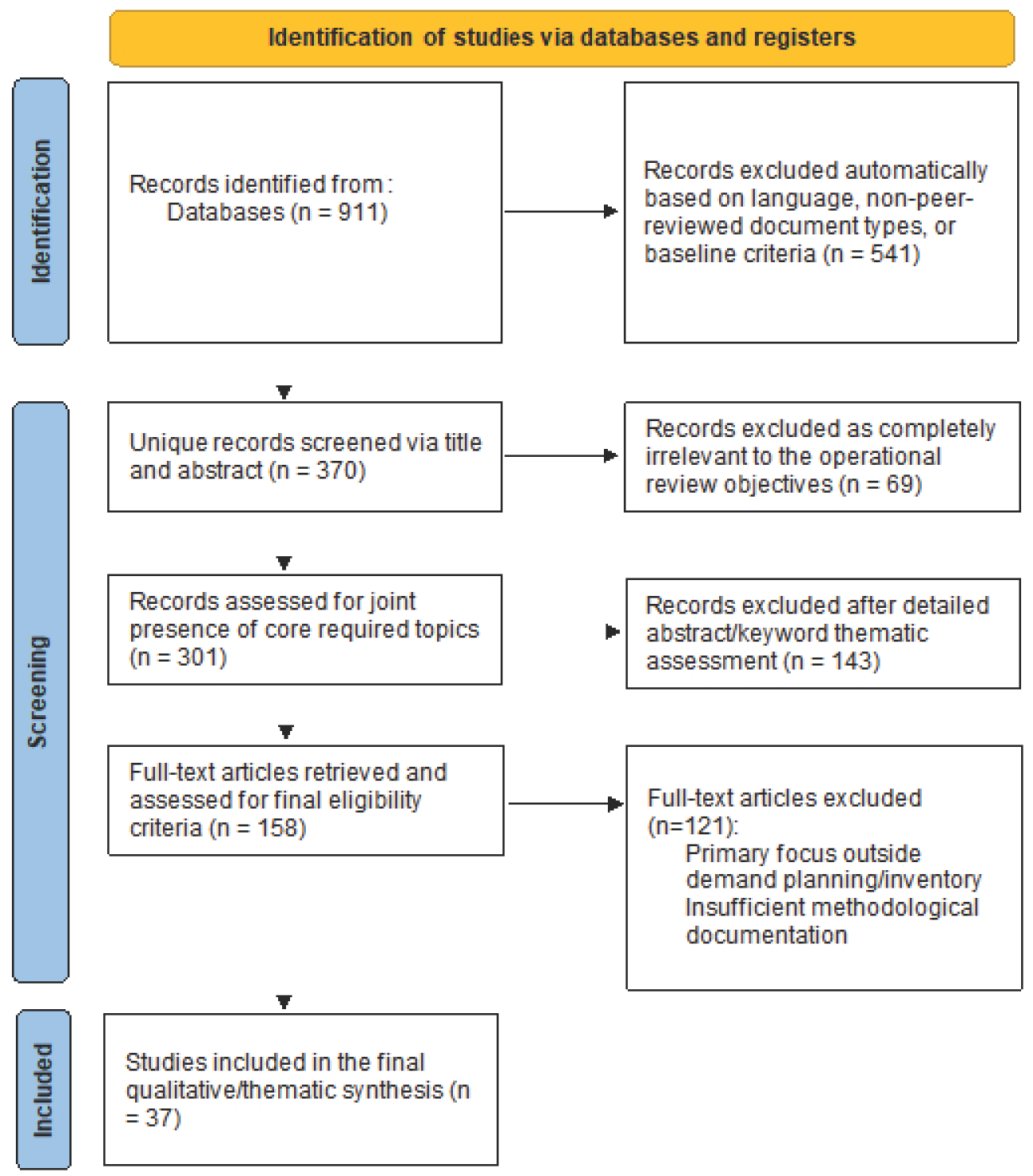
- Identification: The initial keyword queries across the Scopus database retrieved 911 records. During a preliminary baseline filtering phase, 541 records were automatically excluded because they were published in a non-English language, represented non-peer-reviewed document types (e.g., books, book chapters, editorials, or conference abstracts), or failed to match basic disciplinary constraints. This left 370 unique records for human screening.
- Screening: The remaining 370 records underwent a rigorous title and abstract screening. During this phase, 69 records were removed as completely irrelevant to the operational objectives of the review, leaving 301 records to proceed to the eligibility stage.
- Eligibility: The abstracts and keyword distributions of these 301 records were evaluated more closely to check for the presence of the required topics. At this step, 143 articles were excluded as irrelevant because they did not explicitly link AI tool functionalities with agri-food demand scenarios. This left 158 full-text articles to be comprehensively retrieved and assessed for final inclusion.
3.2. Data Extraction, Analysis, and Thematic Synthesis
- Pillar 1—Core Forecasting Models (16 articles, 43.2%): Focused on the development, comparison, and optimisation of algorithms, specifically ML and DL (Rui & Li, 2024; Singh et al., 2024).
- Pillar 2—Applications in Inventory and Waste Management (9 articles, 24.3%): Focused on practical applications for waste reduction, shelf-life monitoring, and inventory optimisation (Miguéis et al., 2022; Selukar et al., 2022; Seyam et al., 2025).
- Pillar 3—Strategic Impact and Resilience (6 articles, 16.2%): Focused on the organisational and strategic dimensions of AI adoption, risk prediction, and supply chain resilience (Sarıcıoğlu et al., 2024; Zogaan et al., 2025).
- Pillar 4—Methodological Overviews and Systematic Reviews (6 articles, 16.2%): Focused on synthetic studies and field mapping (Saha et al., 2025; Serrano-Torres et al., 2025; Walter et al., 2025).
4. Results
4.1. Characteristics of Included Studies
4.2. Thematic Analysis Results
4.2.1. Pillar 1: Core Forecasting Models (n = 16, 43.2%)
- Comparative algorithmic studies: Direct benchmarking of AI against conventional methods. Meister and Yu (2025) demonstrated LSTM superiority over ARIMAX for egg price forecasting, achieving a MAPE reduction from 15–25% to 5–10%. Nasseri et al. (2023) compared tree-based ensembles (random forest, XGBoost) with LSTM networks in retail demand prediction, finding ensemble methods more robust for stable demand patterns. The evaluation of core forecasting models reveals that the transition to machine learning algorithms yields substantial accuracy gains. Specifically, targeted empirical configurations observed a 20–40% mean absolute percentage error (MAPE) reduction over classical time-series baselines, a trend prominently documented in the empirical frameworks of Miguéis et al. (2022) and Punia et al. (2020).
- Hybrid model architectures: Integration of multiple techniques for enhanced performance. Abed (2024) hybridised CatBoost with the dingo optimisation algorithm, achieving superior convergence rates. Wang et al. (2025) developed a hybrid model combining variational mode decomposition with intelligent optimisation for vegetable price prediction.
- Novel architectural proposals: Irhuma et al. (2025) introduced quantum convolutional neural networks (QCNNs) for supply chain demand forecasting, while Jahin et al. (2025) proposed the multi-channel data fusion network (MCDFN) with explainable AI capabilities.
- Specialised problem formulations: Singh et al. (2024) addressed intermittent demand occurrence using machine learning classifiers. Borucka (2023) focused exclusively on seasonal forecasting methods for agricultural products.
4.2.2. Pillar 2: Inventory and Waste Management Applications (n = 9, 24.3%)
- Inventory optimisation: Bouazizi et al. (2024) applied data science technologies for Supply Chain 4.0 inventory optimisation, while Priore et al. (2019) developed machine learning systems for dynamic replenishment policy selection. Kumar et al. (2024) implemented data-driven rational allocation for FMCG supply chains.
- Perishable goods management: Chołodowicz and Orłowski (2024) employed neural network control for perishable inventory with fixed shelf-life products. Selukar et al. (2022) applied deep reinforcement learning for sustainable inventory control of multiple perishable goods.
- Food waste reduction: This represents the most significant operational benefit. Seyam et al. (2025) developed a stacking ensemble model explicitly designed for preventative food waste reduction. Olawale et al. (2025) demonstrated sustainable farming applications minimising food waste through machine learning. Dellino et al. (2018) created a decision support system for fresh food supply chain management with demonstrated waste reduction outcomes. Furthermore, addressing demand uncertainty is vital for mitigating downstream food waste and enhancing logistics sustainability across corporate and hospitality supply networks (Karra et al., 2026).
4.2.3. Pillar 3: Strategic Impacts and Resilience (n = 6, 16.2%)
- Resilience enhancement: Jauhar et al. (2025) employed explainable artificial intelligence (XAI) to improve perishable product supply chain resilience through customer characteristic leverage. Zogaan et al. (2025) utilised deep learning for risk prediction and resilience enhancement in critical industries.
- Bullwhip effect mitigation: Taha Kandil (2025) conducted a social network analysis-based review of AI applications for alleviating supply chain bullwhip effects. Sarıcıoğlu et al. (2024) analysed one-step and multi-step forecasting strategies specifically designed to mitigate this systemic distortion.
- Global food security: Pandey and Mishra (2024) examined how AI contributes to sustainable agriculture and global food security objectives, elevating the discussion from firm-level optimisation to societal impact.
- Strategic supply chain management: Syahputra et al. (2025) investigated AI applications for strategic supply chain demand prediction.
4.2.4. Pillar 4: Methodological Reviews and Systematic Analyses (n = 6, 16.2%)
- Broad scope reviews: Walter et al. (2025) conducted a systematic literature review specifically on AI applications in demand planning for supply chains. Vlachos and Reddy (2025) provided a comprehensive machine learning in supply chain management review with a future research agenda.
- Targeted domain reviews: Khedr and Sultan (2024) focused on deep learning and machine learning techniques for supply chain enhancement. Saha et al. (2025) examined AI vision and machine learning for food industry automation.
- Sector-specific analyses: Serrano-Torres et al. (2025) delivered a systematic review on dairy supply chain transformation through AI. Albayrak Ünal et al. (2023) reviewed AI applications specifically in inventory management.
4.3. Mapping of Findings to Research Questions
4.4. Mapping Thematic Findings to the TOE Framework
- Technological Dimension: Focuses heavily on algorithmic capability, data ingestion limits, and system architecture transparency across Pillars 1 and 2.
- Organisational Dimension: Captures internal operational barriers, resource scarcities, change management friction, and the strategic alignment challenges highlighted in Pillar 3.
- Environmental Dimension: Reflects external market dynamics, data sharing security across multi-tier networks, and supply chain vulnerability pressures evaluated in Pillar 4.
5. Discussion
5.1. Interpretation of Thematic Pillars
5.2. Agri-Food Specificity vs. Broader Supply Chain Literature
5.3. Theoretical Contributions and Implementation Challenges
5.4. Maturity Roadmap for AI-Driven Demand Planning
6. Conclusions
6.1. Key Contribution
6.2. Study Limitations
Author Contributions
Funding
Institutional Review Board Statement
Informed Consent Statement
Data Availability Statement
Acknowledgments
Conflicts of Interest
Abbreviations
| AI | Artificial Intelligence |
| ANN | Artificial Neural Network |
| ARIMA | AutoRegressive Integrated Moving Average |
| ARIMAX | AutoRegressive Integrated Moving Average with Explanatory Variables |
| CNN | Convolutional Neural Network |
| CSR | Corporate Social Responsibility |
| DL | Deep Learning |
| DRL | Deep Reinforcement Learning |
| DSS | Decision Support System |
| FAO | Food and Agriculture Organisation (of the United Nations) |
| FMCG | Fast-Moving Consumer Goods |
| GRU | Gated Recurrent Unit |
| IT | Information Technology |
| LSTM | Long Short-Term Memory |
| MAE | Mean Absolute Error |
| MAPE | Mean Absolute Percentage Error |
| MCDFN | Multi-Channel Data Fusion Network |
| ML | Machine Learning |
| PRISMA | Preferred Reporting Items for Systematic Reviews and Meta-Analyses |
| QCNN | Quantum Convolutional Neural Network |
| RMSE | Root Mean Square Error |
| ROI | Return on Investment |
| RQ | Research Question |
| SCM | Supply Chain Management |
| SLR | Systematic Literature Review |
| SMEs | Small and Medium-sized Enterprises |
| SVR | Support Vector Regression |
| TOE | Technology–Organisation–Environment (Framework) |
| VMD | Variational Mode Decomposition |
| XAI | Explainable Artificial Intelligence |
References
- Abed, A. M. (2024). Accelerate demand forecasting by hybridizing CatBoost with the dingo optimization algorithm to support supply chain conceptual framework precisely. Frontiers in Sustainability, 5, 1388771. [Google Scholar] [CrossRef]
- Ahumada, O., & Villalobos, J. R. (2009). Application of planning models in the agri-food supply chain: A review. European Journal of Operational Research, 196(1), 1–20. [Google Scholar] [CrossRef]
- Albayrak Ünal, Ö., Erkayman, B., & Usanmaz, B. (2023). Applications of artificial intelligence in inventory management: A systematic review of the literature. Archives of Computational Methods in Engineering, 30, 2605–2625. [Google Scholar] [CrossRef]
- Anastasiadis, F., Apostolidou, I., & Tsolakis, N. (2025). Challenges and opportunities of supply chain traceability: Insights from emergent agri-food sector. Supply Chain Management: An International Journal, 30(1), 106–126. [Google Scholar] [CrossRef]
- Anastasiadis, F., Manikas, I., Apostolidou, I., & Wahbeh, S. (2022). The role of traceability in end-to-end circular agri-food supply chains. Industrial Marketing Management, 104, 196–211. [Google Scholar] [CrossRef]
- Baryannis, G., Validi, S., Dani, S., & Antoniou, G. (2019). Supply chain risk management and artificial intelligence: State of the art and future research directions. International Journal of Production Research, 57(7), 2179–2202. [Google Scholar] [CrossRef]
- Borucka, A. (2023). Seasonal methods of demand forecasting in the supply chain as support for the company’s sustainable growth. Sustainability, 15(9), 7399. [Google Scholar] [CrossRef]
- Bouazizi, E., Khedr, A., Elfaioumy, S., & Belal, M. (2024). Inventory optimization using data science technologies for supply chain 4.0. The International Arab Journal of Information Technology, 21(6), 996–1005. [Google Scholar] [CrossRef]
- Brau, R., Aloysius, J., & Siemsen, E. (2023). Demand planning for the digital supply chain: How to integrate human judgment and predictive analytics. Journal of Operations Management, 69(6), 965–982. [Google Scholar] [CrossRef]
- Chołodowicz, E., & Orłowski, P. (2024). Neural network control of perishable inventory with fixed shelf life products and fuzzy order refinement under time-varying uncertain demand. Energies, 17(4), 849. [Google Scholar] [CrossRef]
- Dellino, G., Laudadio, T., Mari, R., Mastronardi, N., & Meloni, C. (2018). A reliable decision support system for fresh food supply chain management. International Journal of Production Research, 56(4), 1458–1485. [Google Scholar] [CrossRef]
- FAO. (2020). The state of food and agriculture 2020. FAO. [Google Scholar] [CrossRef]
- Fatorachian, H., & Shokri, A. (2025). Waste generation patterns and mitigation strategies in cold chains. Journal of Environmental Management, 380, 125108. [Google Scholar] [CrossRef] [PubMed]
- Goel, L., Nandal, N., Gupta, S., Karanam, M., Prasanna Yeluri, L., Pandey, A. K., Rozhdestvenskiy, O. I., & Grabovy, P. (2024). Revealing the dynamics of demand forecasting in supply chain management: A holistic investigation. Cogent Engineering, 11(1), 2368104. [Google Scholar] [CrossRef]
- Irhuma, M., Alzubi, A., Öz, T., & Iyiola, K. (2025). Migrative armadillo optimization enabled a one-dimensional quantum convolutional neural network for supply chain demand forecasting. PLoS ONE, 20(3), e0318851. [Google Scholar] [CrossRef]
- Jahin, M. A., Shahriar, A., & Amin, M. A. (2025). MCDFN: Supply chain demand forecasting via an explainable multi-channel data fusion network model. Evolutionary Intelligence, 18(3), 66. [Google Scholar] [CrossRef]
- Jauhar, S. K., Harinath, S., Krishnaswamy, V., & Paul, S. K. (2025). Explainable artificial intelligence to improve the resilience of perishable product supply chains by leveraging customer characteristics. Annals of Operations Research, 354(1), 103–142. [Google Scholar] [CrossRef]
- Karra, M., Koumpoti, A., Saridi, M., & Anastasiadis, F. (2026). Downstream food waste in restaurant supply chains: Behavioural drivers and implications for sustainable logistics in a mediterranean context. Logistics, 10(5), 115. [Google Scholar] [CrossRef]
- Khedr, A. M., & Sultan, S. R. (2024). Enhancing supply chain management with deep learning and machine learning techniques: A review. Journal of Open Innovation: Technology, Market, and Complexity, 10(4), 100379. [Google Scholar] [CrossRef]
- Kumar, D., Soni, G., Ramtiyal, B., & Vijayvargy, L. (2024). Data-driven approach for rational allocation of inventory in a FMCG supply chain. International Journal of System Assurance Engineering and Management, 1–14. [Google Scholar] [CrossRef]
- Meister, S., & Yu, X. (2025). Forecasting egg price inflation in Germany with machine learning: A comparative study with ARIMAX and LSTM. Q Open, 5(2), qoaf015. [Google Scholar] [CrossRef]
- Miguéis, V. L., Pereira, A., Pereira, J., & Figueira, G. (2022). Reducing fresh fish waste while ensuring availability: Demand forecast using censored data and machine learning. Journal of Cleaner Production, 359, 131852. [Google Scholar] [CrossRef]
- Nasseri, M., Falatouri, T., Brandtner, P., & Darbanian, F. (2023). Applying machine learning in retail demand prediction—A comparison of tree-based ensembles and long short-term memory-based deep learning. Applied Sciences, 13(19), 11112. [Google Scholar] [CrossRef]
- Nassibi, N., Fasihuddin, H., & Hsairi, L. (2023). Demand forecasting models for food industry by utilizing machine learning approaches. International Journal of Advanced Computer Science and Applications, 14(3), 892–898. [Google Scholar] [CrossRef]
- Nebri, M. A., Moussaid, A., & Bouikhalene, B. (2024). Forecasting livestock feed sales using machine learning techniques: An analysis of the Moroccan market. Indonesian Journal of Electrical Engineering and Computer Science, 35(2), 1139. [Google Scholar] [CrossRef]
- Nikolopoulos, K., Punia, S., Schäfers, A., Tsinopoulos, C., & Vasilakis, C. (2021). Forecasting and planning during a pandemic: COVID-19 growth rates, supply chain disruptions, and governmental decisions. European Journal of Operational Research, 290(1), 99–115. [Google Scholar] [CrossRef] [PubMed]
- Notarnicola, B., Tassielli, G., Renzulli, P. A., Castellani, V., & Sala, S. (2017). Environmental impacts of food consumption in Europe. Journal of Cleaner Production, 140, 753–765. [Google Scholar] [CrossRef]
- Ntai, S., Kontopanou, M., & Anastasiadis, F. (2025). Leveraging household food waste consumer behaviour to optimise logistics. Logistics, 9(3), 126. [Google Scholar] [CrossRef]
- Olawale, R. A., Olawumi, M. A., & Oladapo, B. I. (2025). Sustainable farming with machine learning solutions for minimizing food waste. Journal of Stored Products Research, 112, 102611. [Google Scholar] [CrossRef]
- Page, M. J., McKenzie, J. E., Bossuyt, P. M., Boutron, I., Hoffmann, T. C., Mulrow, C. D., Shamseer, L., Tetzlaff, J. M., Akl, E. A., Brennan, S. E., Chou, R., Glanville, J., Grimshaw, J. M., Hróbjartsson, A., Lalu, M. M., Li, T., Loder, E. W., Mayo-Wilson, E., McDonald, S., … Moher, D. (2021). The PRISMA 2020 statement: An updated guideline for reporting systematic reviews. BMJ, 372, n71. [Google Scholar] [CrossRef]
- Panda, S. K., & Mohanty, S. N. (2023). Time series forecasting and modeling of food demand supply chain based on regressors analysis. IEEE Access, 11, 42679–42700. [Google Scholar] [CrossRef]
- Pandey, D. K., & Mishra, R. (2024). Towards sustainable agriculture: Harnessing AI for global food security. Artificial Intelligence in Agriculture, 12, 72–84. [Google Scholar] [CrossRef]
- Priore, P., Ponte, B., Rosillo, R., & De La Fuente, D. (2019). Applying machine learning to the dynamic selection of replenishment policies in fast-changing supply chain environments. International Journal of Production Research, 57(11), 3663–3677. [Google Scholar] [CrossRef]
- Punia, S., Nikolopoulos, K., Singh, S. P., Madaan, J. K., & Litsiou, K. (2020). Deep learning with long short-term memory networks and random forests for demand forecasting in multi-channel retail. International Journal of Production Research, 58(16), 4964–4979. [Google Scholar] [CrossRef]
- Rogers, E. M. (2003). Diffusion of innovations (5th ed.). Free Press. [Google Scholar]
- Rui, G., & Li, M. (2024). Utilizing internet big data and machine learning for product demand forecasting and analysis of its economic benefits. Tehnički vjesnik, 31(4), 1385–1394. [Google Scholar] [CrossRef]
- Saha, D., Padhiary, M., & Chandrakar, N. (2025). AI vision and machine learning for enhanced automation in food industry: A systematic review. Food and Humanity, 4, 100587. [Google Scholar] [CrossRef]
- Sarıcıoğlu, A., Erol Genevois, M., & Cedolin, M. (2024). Analyzing one-step and multi-step forecasting to mitigate the bullwhip effect and improve supply chain performance. IEEE Access, 12, 180161–180174. [Google Scholar] [CrossRef]
- Selukar, M., Jain, P., & Kumar, T. (2022). Inventory control of multiple perishable goods using deep reinforcement learning for sustainable environment. Sustainable Energy Technologies and Assessments, 52, 102038. [Google Scholar] [CrossRef]
- Serrano-Torres, G. J., López-Naranjo, A. L., Larrea-Cuadrado, P. L., & Mazón-Fierro, G. (2025). Transformation of the dairy supply chain through artificial intelligence: A systematic review. Sustainability, 17(3), 982. [Google Scholar] [CrossRef]
- Seyam, A., Mathew, S. S., Du, B., Barachi, M. E., & Shen, J. (2025). A stacking ensemble model for food demand forecasting: A preventative approach to food waste reduction. Cleaner Logistics and Supply Chain, 15, 100225. [Google Scholar] [CrossRef]
- Singh, A. K., Simha, J. B., & Agarwal, R. (2024). Prediction of intermittent demand occurrence using machine learning. EAI Endorsed Transactions on Internet of Things, 10. [Google Scholar] [CrossRef]
- Souichirou, N. (2015). Application of big data technology in support of food manufacturers’ commodity demand forecasting. NEC Technical Journal, 10(1), 90–93. [Google Scholar]
- Syahputra, R. A., Kasmawati, K., & Sentia, P. D. (2025). The application of artificial neural network (ANN) with Backpropagation algorithm to predict supply chain demand. Journal of Optimization in Industrial Engineering, 38(1). [Google Scholar] [CrossRef]
- Taha Kandil, T. (2025). Artificial intelligence (AI) and alleviating supply chain bullwhip effects: Social network analysis-based review. Journal of Global Operations and Strategic Sourcing, 18(1), 5–35. [Google Scholar] [CrossRef]
- Teece, D. J. (2018). Dynamic capabilities as (workable) management systems theory. Journal of Management & Organization, 24(3), 359–368. [Google Scholar] [CrossRef]
- Tornatzky, L. G., Fleischer, M., & Chakrabarti, A. K. (1990). The processes of technological Innovation Issues in organization and management series. Lexington Books. [Google Scholar]
- Vlachos, I., & Reddy, P. G. (2025). Machine learning in supply chain management: Systematic literature review and future research agenda. International Journal of Production Research, 63(16), 5987–6016. [Google Scholar] [CrossRef]
- Walter, A., Ahsan, K., & Rahman, S. (2025). Application of artificial intelligence in demand planning for supply chains: A systematic literature review. The International Journal of Logistics Management, 36(3), 672–719. [Google Scholar] [CrossRef]
- Wang, G., Xu, S., Chen, Z., & Li, Y. (2025). A hybrid model integrating variational mode decomposition and intelligent optimization for vegetable price prediction. Agriculture, 15(9), 919. [Google Scholar] [CrossRef]
- Zogaan, W. A., Ajabnoor, N., & Salamai, A. A. (2025). Leveraging deep learning for risk prediction and resilience in supply chains: Insights from critical industries. Journal of Big Data, 12(1), 94. [Google Scholar] [CrossRef]


| (a) | (b) | |||
|---|---|---|---|---|
| Research Question | Associated Keywords | Criterion | Inclusion Criteria (Must Meet All) | Exclusion Criteria (Exclude If Any Apply) |
| RQ1: Accuracy Comparison | “Forecast Accuracy”, “Machine Learning”, “Predictive Analytics”, “Demand Forecasting” | Study Type & Quality | Peer-reviewed journal articles or full conference proceedings papers. Contains explicit methodological and empirical documentation. | Books, book chapters, editorials, industry reports, or grey literature. Systematic reviews (except where retained for context/mapping under Pillar 4). |
| RQ2: Critical Factors | “Predictive Analytics”, “Artificial Intelligence”, “Key Factors”, “Data Analysis” | Language & Period | Published in English. Published between 1 January 2015, and 30 August 2025. | Published in any language other than English. Published outside the designated 2015–2025 window. |
| RQ3: Operational Benefits | “Inventory Management”, “Inventory Optimisation”, “Food Supply Chain”, “Food Waste” | Core Technology | Clear application, deployment, or comparative evaluation of AI, ML, or DL models. | Exclusive reliance on traditional linear or statistical methods (e.g., basic ARIMA, simple moving averages) without an AI/ML component. |
| RQ4: Adoption Barriers | “Technology Adoption”, “Implementation Challenges”, “Agrifood”, “Agribusiness” | Operational Domain | Direct focus on demand forecasting, predictive demand planning, or automated inventory optimisation. | Core focus entirely outside demand/inventory logistics (e.g., computer vision for field weed detection, robotic tractor harvesting, or molecular crop breeding). |
| RQ5: Strategic Impact | “Strategic Management”, “Food Supply Chain”, “Artificial Intelligence”, “Decision Making” | Sector Context | Explicit focus on the agri-food supply chain, agricultural commodities, or highly perishable retail items. | General supply chain models or manufacturing frameworks with no empirical adjustments for agri-food properties (e.g., shelf-life, seasonality). |
| (a) | |||
| (Author, Year) | AI/ML Methodology | Operational Focus | Key Findings & Administrative Implications |
| (Souichirou, 2015) | Big Data Analytics | Demand Forecasting | Early evidence of using high-volume data to automate supply chain optimisation and reduce disposal losses. |
| (Dellino et al., 2018) | Decision Support Systems | Fresh Food Management | Integration of forecasting and optimisation models helps managers handle the high perishability of fresh produce. |
| (Priore et al., 2019) | Machine Learning | Replenishment Policies | Proves that dynamic ML-based selection of replenishment policies outperforms static rules in fast-changing environments. |
| (Miguéis et al., 2022) | Censored Data & ML | Fresh Fish Waste | Incorporating censored data into ML models significantly improves availability while reducing perishability waste. |
| (Selukar et al., 2022) | Deep Reinforcement Learning (DRL) | Perishable Inventory | DRL provides superior inventory control for multiple perishable goods compared to traditional heuristics. |
| (Borucka, 2023) | Seasonal ARIMA/ML | Sustainable Growth | AI helps companies without modern IT systems extract value from sparse historical sales data to support sustainability. |
| (Brau et al., 2023) | Human-Guided Learning | Demand Planning | Accuracy improves when algorithms integrate human judgment; “black box” models are less effective without oversight. |
| (Nasseri et al., 2023) | Tree-Based Ensembles & LSTM | Retail Demand | Comparative analysis shows that ensemble models often outperform single DL models in complex retail environments. |
| (Nassibi et al., 2023) | Various ML Approaches | Food Industry Retail | Confirms that ML models significantly outperform traditional statistical methods specifically in food-related retail. |
| (Panda & Mohanty, 2023) | Regressor Analysis | Food Demand | Robust time-series modelling stabilises the supply chain by aligning production directly with fluctuating demand. |
| (Abed, 2024) | CatBoost & Optimisation | Conceptual SC Framework | Hybridising nature-inspired algorithms with boosting techniques accelerates forecasting speed and precision. |
| (Bouazizi et al., 2024) | ML/Big Data | Supply Chain 4.0 | Accurate forecasting is the foundational step for inventory optimisation and cost minimisation in the digital era. |
| (Chołodowicz & Orłowski, 2024) | Neural Network & Fuzzy Logic | Perishable Inventory | Hybrid control systems effectively handle “fuzzy” order uncertainty for products with fixed shelf lives. |
| (Goel et al., 2024) | Machine Learning | SCM Dynamics | Investigates the ripple effects of forecasting accuracy on overall supply chain performance and stability. |
| (Kumar et al., 2024) | Data-Driven Analysis | FMCG Inventory | Rational inventory allocation based on data-driven insights ensures service levels while minimising holding costs. |
| (Nebri et al., 2024) | Gradient Boosting | Livestock Feed Sales | Achieved high precision (MAE: 0.0203) by integrating climate and exogenous data into sales prediction models. |
| (Rui & Li, 2024) | Internet Big Data/ML | Product Demand | Leveraging external web trends and search indices creates measurable economic benefits through demand alignment. |
| (Singh et al., 2024) | ML Classification | Intermittent Demand | Specialised ML models better predict “lumpy” or intermittent demand occurrences than standard regressions. |
| (Fatorachian & Shokri, 2025) | Pattern Recognition | Cold Chain Waste | Identifies specific waste generation patterns, suggesting AI-driven mitigation in temperature-controlled logistics. |
| (Irhuma et al., 2025) | Quantum CNN | Demand Forecasting | Emerging quantum-enabled neural networks offer new frontiers for processing high-dimensional supply chain data. |
| (Jahin et al., 2025) | Multi-channel Data Fusion | Explainable Forecasting | Fusing multiple data streams (internal/external) via XAI increases trust and transparency in automated systems. |
| (Meister & Yu, 2025) | LSTM vs. ARIMAX | Price Inflation | Deep learning (LSTM) proves more resilient than traditional models for forecasting agricultural price spikes and volatility. |
| (Olawale et al., 2025) | ML Solutions | Sustainable Farming | ML is critical for minimising post-harvest losses and optimising resource allocation to reduce total food waste. |
| (Seyam et al., 2025) | Stacking Ensemble | Food Waste Reduction | A preventative approach using ensemble models provides a more robust defence against waste in fresh supply chains. |
| (Wang et al., 2025) | VMD & Optimisation | Price Prediction | Hybrid models are superior for predicting volatile prices in agricultural commodities (e.g., vegetables). |
| (b) | |||
| (Author, Year) | AI/ML Methodology | Operational Focus | Key Findings & Administrative Implications |
| (Albayrak Ünal et al., 2023) | Systematic Review | SCM Literature | Maps the research landscape, highlighting the lack of integrated organisational frameworks in AI adoption. |
| (Khedr & Sultan, 2024) | DL & ML Review | SCM Enhancement | Systematic review confirms that DL/ML integration is the primary driver for modernising supply chain resilience. |
| (Pandey & Mishra, 2024) | General AI/Review | Sustainable Agriculture | AI is no longer optional; it is a critical tool for global food security and sustainable agricultural scaling. |
| (Sarıcıoğlu et al., 2024) | Multi-Step Forecasting | Bullwhip Mitigation | Advanced forecasting techniques effectively reduce the amplification of demand variations as they move upstream. |
| (Jauhar et al., 2025) | Explainable AI (XAI) & SVR | Resilience & Goods | XAI enhances transparency, allowing managers to understand the "why" behind predictions and risk factors. |
| (Saha et al., 2025) | AI Vision/ML | Automation Review | Systematic review highlighting the role of vision systems and ML in quality control and automated processing. |
| (Serrano-Torres et al., 2025) | Systematic AI Review | Dairy Supply Chain | AI transformation in dairy focuses on managing biological variability and critical shelf-life constraints. |
| (Syahputra et al., 2025) | ANN & Backpropagation | Supply Chain Demand | Neural networks with backpropagation effectively predict fluctuations to support strategic logistics planning. |
| (Taha Kandil, 2025) | Social Network Analysis | Bullwhip Effects | AI mitigates bullwhip effects by analysing the social and informational network structures of the supply chain partners. |
| (Vlachos & Reddy, 2025) | Systematic Review | ML in SCM | Provides a future research agenda; notes that ML is moving from an "experimental" to a "foundational" tool. |
| (Walter et al., 2025) | Systematic Review | Demand Planning | Comprehensive analysis shows AI’s role in shifting demand planning from reactive to proactive strategic management. |
| (Zogaan et al., 2025) | Deep Learning | Risk & Resilience | Deep learning is identified as a critical tool for predicting supply chain disruptions and organisational risks. |
| Research Question | Primary Pillar | Supporting Studies | Key Finding |
|---|---|---|---|
| RQ1: AI accuracy vs. traditional methods | Pillar 1 | (Abed, 2024; Bouazizi et al., 2024; Irhuma et al., 2025; Jahin et al., 2025; Khedr & Sultan, 2024; Meister & Yu, 2025; Rui & Li, 2024; Saha et al., 2025; Singh et al., 2024; Wang et al., 2025) | AI methods (ML/DL) reduce MAPE by 20–40% compared to exponential smoothing, ARIMA, and moving averages. |
| RQ2: Critical predictive factors | Pillar 1 | (Abed, 2024; Khedr & Sultan, 2024; Meister & Yu, 2025; Saha et al., 2025; Sarıcıoğlu et al., 2024; Selukar et al., 2022; Singh et al., 2024) | External variables (weather, seasonality, promotions, macroeconomic indicators) are essential; multi-factor models outperform univariate approaches. |
| RQ3: Operational benefits of accuracy | Pillar 2 | (Ahumada & Villalobos, 2009; Chołodowicz & Orłowski, 2024; Jauhar et al., 2025; Kumar et al., 2024; Olawale et al., 2025; Seyam et al., 2025; Zogaan et al., 2025) | Direct correlation: 1% accuracy improvement → measurable waste reduction; 15–20% inventory cost reduction; optimised perishable goods management. |
| RQ4: Adoption barriers and facilitators | Pillar 4 & Pillar 3 | (Nasseri et al., 2023; Nikolopoulos et al., 2021; Syahputra et al., 2025; Tornatzky et al., 1990) | Primary barriers: data quality/availability, implementation cost, skill shortages, organisational resistance. Key facilitators: management commitment, clear ROI demonstration. |
| RQ5: Strategic supply chain transformation | Pillar 3 | (Albayrak Ünal et al., 2023; Borucka, 2023; Nasseri et al., 2023; Syahputra et al., 2025; Taha Kandil, 2025) | AI enables a shift from reactive to predictive management; enhances resilience; mitigates systemic risks (bullwhip effect); supports global food security objectives. |
| TOE Dimension | Relevant Pillars | Core Thematic Focus Areas | Strategic & Operational Insights |
|---|---|---|---|
| Technological (T) | Pillar 1, Pillar 2 | Algorithmic accuracy, machine learning model selection, inventory optimisation capabilities. | Highlighted the transition from legacy statistical models to predictive AI. Emphasises the need for data readiness and model explainability to prevent “black box” operational distrust. |
| Organisational (O) | Pillar 3, Pillar 2 | Skills deficits, cost of implementation, cultural resistance, governance, and waste tracking. | Identifies human-centric barriers as primary points of failure. Successful AI adoption demands deliberate workforce upskilling and a shift towards data-driven organisational cultures rather than pure technological acquisition. |
| Environmental (E) | Pillar 4, Pillar 3 | Market volatility, multi-tier supply chain visibility, data security, and systemic resilience. | Illustrates how external disruptions (e.g., market shocks, regulatory changes) act as primary drivers for AI integration. Stresses the necessity of collaborative, secure data-sharing ecosystems among external supply chain partners. |
| Phase | Maturity Level | Core Technical Requirements | Key Organisational Focus | Metric/Target Outcomes |
|---|---|---|---|---|
| 1 | Foundational | Clean, centralised ERP data; baseline statistical models (e.g., Moving Average, ARIMA). | Overcoming data silos; establishing baseline data governance and cloud readiness. | Elimination of manual spreadsheet errors; reliable historical data logging. |
| 2 | Emerging | Introduction of basic machine learning algorithms (e.g., random forests, linear regressions); internal historical data ingestion. | Upskilling existing inventory personnel; overcoming initial cultural resistance to algorithmic tools. | Measurable reduction in basic MAPE compared to legacy statistical baselines. |
| 3 | Established | Deep learning integration (e.g., LSTM, neural networks); inclusion of external features (weather, regional economic indicators). | Cross-functional alignment between logistics, sales, and IT; data pooling in collaborative supply networks. | Optimised safety stock levels; dynamic adjustments to regional market volatility. |
| 4 | Advanced | Real-time data streams; fully automated inventory optimisation feedback loops; prescriptive analytics engines. | Shifting management from reactive firefighting to proactive, algorithmic-driven decision support. | Real-time supply chain transparency; automated replenishment execution for stable product lines. |
| 5 | Cognitive | Explainable AI (XAI) architectures; strategic multi-scenario simulations; full AI-human collaborative ecosystems. | Continuous strategic learning; human exception-handling for extreme black-swan market disruptions. | Maximum supply chain resilience; minimised food waste; optimised strategic margin protection. |
Disclaimer/Publisher’s Note: The statements, opinions and data contained in all publications are solely those of the individual author(s) and contributor(s) and not of MDPI and/or the editor(s). MDPI and/or the editor(s) disclaim responsibility for any injury to people or property resulting from any ideas, methods, instructions or products referred to in the content. |
© 2026 by the authors. Licensee MDPI, Basel, Switzerland. This article is an open access article distributed under the terms and conditions of the Creative Commons Attribution (CC BY) license.
Share and Cite
Korcari, A.; Saridi, M.; Koumpoti, A.; Anastasiadis, F. AI-Driven Demand Planning: A Systematic Review of Adoption, Barriers and Strategic Implications. Adm. Sci. 2026, 16, 260. https://doi.org/10.3390/admsci16060260
Korcari A, Saridi M, Koumpoti A, Anastasiadis F. AI-Driven Demand Planning: A Systematic Review of Adoption, Barriers and Strategic Implications. Administrative Sciences. 2026; 16(6):260. https://doi.org/10.3390/admsci16060260
Chicago/Turabian StyleKorcari, Anteo, Marina Saridi, Antonia Koumpoti, and Foivos Anastasiadis. 2026. "AI-Driven Demand Planning: A Systematic Review of Adoption, Barriers and Strategic Implications" Administrative Sciences 16, no. 6: 260. https://doi.org/10.3390/admsci16060260
APA StyleKorcari, A., Saridi, M., Koumpoti, A., & Anastasiadis, F. (2026). AI-Driven Demand Planning: A Systematic Review of Adoption, Barriers and Strategic Implications. Administrative Sciences, 16(6), 260. https://doi.org/10.3390/admsci16060260