Article

Building Corporate Brand Identity in Exponential Organizations: The Role of a Massive Transformative Purpose


by
Francesco Derchi
1,*,
Nicoletta Buratti
2 and
Francesco Vitellaro
3
1
Les Roches Global Hospitality Education, Bluche, Rte des Moulinettes 2, 3975 Crans-Montana, Switzerland
2
Department of Economics and Business Studies, University of Genoa, Via Vivaldi 5, 16126 Genoa, Italy
3
Engreen s.r.l., Via Elio Vittorini, 103, 00144 Roma, Italy
*
Author to whom correspondence should be addressed.
Adm. Sci. 2026, 16(6), 245; https://doi.org/10.3390/admsci16060245
Submission received: 10 March 2026 / Revised: 1 May 2026 / Accepted: 9 May 2026 / Published: 22 May 2026

Abstract

This study investigates the role of the Massive Transformative Purpose (MTP) in shaping corporate brand identity and guiding brand management strategies in Exponential Organizations (ExOs). It examines how the MTP aligns internal and external brand dimensions, enhances stakeholder engagement, and drives societal impact, positioning it as a central element in ExO brand management. This study employs a qualitative multiple-case study methodology focusing on two ExOs: Airbnb, a digital-native hospitality company, and Mylia, a transformative learning enterprise. Semi-structured interviews with senior executives were triangulated with internal and external data to examine how the MTP drives strategy, culture, and stakeholder engagement. This allowed the application of the Corporate Brand Identity Matrix for exploring the different corporate brand identities and the relative nuances. The findings show that the MTP is essential to shaping ExOs’ corporate brand identity. It unifies organizational purpose, culture, and strategy, creating a cohesive identity that resonates both internally and externally. Embedding the MTP into daily practices fosters alignment, guides decision-making, strengthens stakeholder relationships, and shapes value propositions that distinguish ExOs while addressing stakeholder needs. The research bridges gaps in the literature on corporate brand identity, organizational purpose, and the unique characteristics of ExOs. It introduces the MTP Management Model, which integrates ExO-specific attributes to provide deeper insights into how these organizations align operational structures and brand identity with their transformative purpose. While the multiple-case study approach offers in-depth insights, the findings are context-specific and may not be fully generalizable across industries. The MTP Management Model provides a clear framework to integrate essential attributes, ensuring organizational coherence, effective communication, and enhanced competitiveness.

1. Introduction

The relationship between corporate identity and purpose exerts a significant and far-reaching influence (Balmer & Wilson, 1998). In recent years, purpose has evolved from a peripheral notion into a central element of both brand and corporate brand identity (de Chernatony, 2006; Balmer, 2013; Greyser & Urde, 2019), becoming a genuine managerial priority (Greyser & Urde, 2019). From Bartlett and Ghoshal’s (1994) idea that defines purpose and not strategy as the reason an organization exists, corporate purpose studies have meaningfully expanded in the last decade (Reyes & Kleiner, 1990; George et al., 2023; Tafuro & Piccaluga, 2026). A clearly defined purpose not only shapes organizational identity, culture, and stakeholder perceptions (Hollensbe et al., 2014; Mayer, 2021) but also serves as a guiding force that supports the brand’s long-term direction and sustainability (Keller, 2023). Integrating purpose into the broader construct of brand identity is essential to ensuring coherent communication and amplifying organizational impact (Annweiler, 2018).
Balmer (1998) defines Corporate Identity as “the aggregate of messages and experiences received about an organization’s products and services by an individual, group or groups over a period of time” (Balmer, 1998). Given its strategic importance (Abratt & Mingione, 2017), Corporate Identity is considered to be a main concern of senior management, who should approach it in a continuous sequence (Balmer, 2017), leveraging a holistic approach (Balmer et al., 2009; Urde, 2016), with the goal to engage multiple stakeholders and the relative attributed identities in perpetual interaction (Balmer, 2011; Urde, 2022). Corporate brand identity is defined as “a distillation of corporate identity” (Balmer, 2010, p. 186) and the foundational construct for its development (Abratt & Mingione, 2017). The “Corporate Brand Identity Matrix” (Urde, 2013) is used for identifying and aligning a corporate brand’s identity. Challenges in this space are related to managing corporate identity congruence (Flint et al., 2018; Signori & Flint, 2020), to avoid discrepancies between corporate talk and action like in the case of greenwashing (Vollero & Siano, 2024), as well as to effectively combine branding with ESG management (Mingione et al., 2025).
Purpose is defined as the “concrete goal that goes beyond profit maximization” (Henderson & Van den Steen, 2015, p. 327), taking the distance from strategy as “the reason an organisation exists” (Bartlett & Ghoshal, 1994, p. 88). Beyond its internal influence, purpose also plays a crucial role in shaping stakeholder relationships. As consumers increasingly prioritize functional and social value (Henderson, 2021; Gray et al., 2024), organizations that articulate a credible and authentic purpose can strengthen trust and reinforce commitments to social and environmental responsibility (Cullinan et al., 2021; Lückenbach et al., 2022).
In doing so, they cultivate loyalty and foster deeper community engagement (Calder, 2022). This evolution underscores how brand identity has gained renewed relevance in the digital age (Ballester et al., 2025), particularly among born-digital enterprises that leverage digital platforms to co-create value and enhance customer experiences through purpose-driven (Mingione & Abratt, 2020) and purpose-driving strategies (Gray et al., 2024).
Within this context, Exponential Organizations (ExOs) represent a distinctive and rapidly evolving category of digital enterprises whose influence far exceeds that of traditional firms (Kristóf & Nagpal, 2024). Their exceptional growth trajectory is primarily attributed to their foundational reliance on the Massive Transformative Purpose (MTP) (Ismail et al., 2014; Derchi, 2025), which encapsulates the organization’s raison d’être and guides both its innovation and societal contribution. The MTP embodies the essence of purpose, propelling exponential growth while advancing a global mission. As such, it becomes a defining component of ExOs’ identity, positioning them as catalysts for systemic change and enabling them to pursue aspirational goals that transcend conventional business boundaries. By embedding the MTP into their core strategic and cultural framework, ExOs develop a brand identity that resonates authentically with stakeholders and the broader community, thereby reinforcing credibility and legitimacy (Derchi, 2025).
While the recent literature indicates that purpose-driven branding is a consumer value and a brand equity enhancer (Hajdas & Kłeczek, 2021; Williams et al., 2022; Gonçalves Filho et al., 2024; Henning & Kirchgeorg, 2026), the specific impact and transformative effect of the MTP on brand identity remain an emerging area warranting further exploration. Consequently, this paper addresses this gap by exploring the following research questions:
  • How do ExOs construct their corporate brand identity by leveraging their MTP?
  • How does the MTP influence and shape the corporate brand identity of ExOs?
To answer, the authors will apply the Corporate Brand Identity Matrix (CBIM) (Urde, 2022) to some ExOs in order to explore the different corporate identities and relative nuances.
This study aims to contribute to the body of knowledge on the MTP’s role in corporate brand identity formation and to advance our understanding of ExOs and their characteristics. The paper begins by reviewing the literature on ExOs, corporate brand identity, and the MTP concept, establishing the study’s theoretical foundations. Methodologically, it adopts a multiple-case study approach, providing comparative insights into two ExOs: Airbnb and Mylia. The results demonstrate the MTP as a central driver in aligning the internal and external dimensions of corporate brand identity, extending Urde’s (2016) Corporate Brand Identity Matrix to incorporate ExO-specific attributes such as Leveraged Assets and Staff On Demand. The discussion highlights the theoretical contributions of the MTP Management Model and its implications for understanding ExOs’ brand strategies. Finally, the paper offers managerial recommendations for leveraging the MTP to align strategic, competitive, and communicative dimensions.

2. Literature Review

2.1. Corporate Identity, Corporate Purpose, and Corporate Brand Identity

Gartenberg and Serafeim (2023) consider corporate identity and purpose as intangible organizational concepts as well as part of the softer aspects of management (Henderson, 2021). The fundamental focus for these concepts is that identity is dedicated to “who” the firm is, while purpose is dedicated to “why” the organization exists (Gartenberg & Serafeim, 2023).
While the ability to distinguish one from the other, in practical terms, can sometimes be considered challenging (Pratt, 2016), scholars believe corporate purpose and corporate identity to be, at the same time, distinct and highly related (Gartenberg & Serafeim, 2023). A purpose-driven organization (Gartenberg, 2022) is seen as being able to foster a strong identity and member identification (Henderson & Van den Steen, 2015), while the opposite happens in the case of firms where purpose is not present (Gartenberg & Serafeim, 2023).
At the same time, there are also some converging aspects between Corporate Identity and Purpose that are worth mentioning. Purpose is considered part of the “quintessence of a corporation” (Balmer, 2008, p. 9), together with its values and standards. For this reason, it is the way a corporation expresses it that allows identification and differentiation from another entities. A second element of convergence, according to Balmer (2017), relates to corporate identity management and some key questions the senior team should ask. “What is the organization’s purpose?” (Balmer, 2017, p. 1475) connects corporate identity and purpose unequivocally. Finally, the role of purpose as part of the corporate identity of an organization is also confirmed by the International Corporate Identity Groups statement. The Strathclyde Statement on corporate identity (Balmer, 2001a) represents the perspective of a group of academics and practitioners discussing corporate identity as the foundation for corporate marketing and reputation. According to the statement (Balmer, 2001a), “[e]very organization has an identity … (which is) a strategic issue” (p. 291) for its leadership team. Accordingly, by effectively managing corporate identity, firms can “generate a sense of direction and purpose” (Balmer, 2001a, p. 291).
Finally, building corporate identity or strategic corporate identity management “underpins corporate brand management” (Balmer, 1995, p. 24). The topic emerged within the corporate brand orientation field (Balmer, 2022), referring to organizations whose brand acts as a “centripetal force that informs and guides the organisation” (Balmer, 2013, p. 733). The brand here is seen as a cornerstone for guiding the organization as well as a strategic resource for the firm (Urde, 2016). Accordingly, the corporate brand allows it to lead and influence the firms’ philosophy and strategy, as well as the organizations’ purpose and the corporate brand promise (Balmer, 2013; Urde, 2022).
Being relevant at both the product and corporate brand level (Keller & Richey, 2006), nevertheless, the corporate brand can differentiate between product brands because it can involve a much broader range of associations (Keller, 2023), typically related to the culture (Alvesson & Berg, 1992, Jo Hatch & Schultz, 1997), people (Balmer & Thomson, 2009), and impact (Gartenberg et al., 2019). While corporate brand identity is often viewed through a marketing lens, it finds its legal significance in the concept of goodwill. Here, the corporation’s legal personality allows this identity to be framed as a tangible asset to be valued, protected, and defended as needed (McCarthy & Schneider, 1995).
Finally, more recent studies explore corporate identity building in digital environments (Balmer, 2023), from social media (Mingione & Abratt, 2020), to virtual spaces (Cuomo et al., 2021), to sensorial (Zha et al., 2025) and multi-channel settings (Amoako et al., 2026). Given the exponential speed of changes in the market (Petitimbert, 2024), new brand challenges involve dealing with co-creation dynamics (Serasvuo et al., 2022), and adopting new measurement standards (Jun & Lee, 2025), as well as facing new risks like “digital hijacking” (Balmer, 2023).
To conclude, we have found evidence of a connection between topics: in their studies on purpose-driven brand identity, Henning and Kirchgeorg (2026) consider brand identity as an essential component for leading purpose-driven strategies.
The concepts of corporate identity, corporate brand identity, and corporate purpose are detailed in Table 1.

2.2. The Exponential Organizations

ExOs are a modern phenomenon with transformative potential, emerging from the digital revolution. Introduced by Ismail et al. (2014), the concept stems from research on high-growth firms, often called the “Unicorn Club” (Lee, 2013), that achieve exceptional scalability and market impact (Kuratko et al., 2020). ExOs outperform traditional firms by leveraging digital technologies through organizational models that enable exponential performance (Kristóf & Nagpal, 2024). Companies such as Airbnb, Google, and Xiaomi (Zhang & Chun, 2023) exemplify the success of this new breed of digital enterprise.
The ExO model (Ismail et al., 2018) comprises three core components: the Massive Transformative Purpose (MTP), and the S.C.A.L.E. and I.D.E.A.S. frameworks. The MTP represents the organization’s raison d’être, providing direction and motivation toward ambitious, impactful goals. It acts as a unifying engine, aligning collective action with broader societal purpose.
The S.C.A.L.E. framework defines five attributes that drive exponential growth through data and platform use. ‘Staff on Demand’ and ‘Leveraged Assets’ access external resources without ownership, reducing costs and increasing agility. ‘Community and Crowd’ generate collective intelligence, ‘Algorithms’ enable automation, and ‘Engagement’ builds loyalty and strengthens ecosystem connections. Together, these pillars foster purpose-driven communities and personalized value creation.
The I.D.E.A.S. framework governs data management and decision-making for agility. ‘Interfaces’ and ‘Social Technologies’ enhance connectivity with external stakeholders, ‘Dashboards’ support real-time insights, ‘Experimentation’ drives innovation, and ‘Autonomy’ empowers decentralized teams to act swiftly and creatively.
ExOs also draw on diffusion-of-innovation principles, using network externalities (Bonaccorsi & Rossi, 2003) and organizational culture to sustain innovation and growth (Baum & Haveman, 2020). Since its introduction, the global practitioner community has advanced both theoretical and practical applications (Allen, 2020), while scholars have analyzed organizational models (Pompa, 2019; Marchese et al., 2020) and implementation processes (Díaz-Piloneta et al., 2021). The evidence shows that ExOs outperform traditional competitors in profitability, revenue growth, shareholder returns, and asset turnover.
Finally, Exponential Transformation or ExT (Ismail et al., 2018) is the name of the sprint methodology to allow an organization to implement ExO principles and attributes in order to benefit from the described perspective (Díaz-Piloneta et al., 2021).
In Table 2, we have collected examples of MTP statements.
When exploring the application of these topics of study towards digital native firms, we found evidence of some connection between subjects. Mingione and Abratt (2020) propose to include unicorns and digital native startups as corporate brands for further studies, while, for Urde, there is no methodological difference between new brands like Spotify or Airbnb and more established firms (Urde, 2016).
Despite growing academic attention, little research has explored how the MTP interacts with corporate brand identity to influence ExO performance. As the model’s cornerstone, the MTP aligns organizational values, shapes internal culture, and guides external perceptions, representing a vital yet underexamined source of competitive advantage in the digital era.

2.3. The MTP and Corporate Brand Identity

The MTP is the ExO’s foundational definer, embodying unique and specific qualities that capitalize on the exponential acceleration of technology (Ismail et al., 2014). The MTP is central to an ExO’s brand core, influencing profoundly the internal and external dimensions of the organization as well as its competitive advantage (Derchi, 2025).
The purpose is classified as Massive when it has global reach and aligns with a new or pre-existing abundance (Ismail et al., 2018). This is the case for Google and the abundance of information it aims at organizing (Schmidt & Rosenberg, 2014). The Transformative dimension pertains to an aspirational and inspirational goal that seeks to transcend present constraints towards positive global change. In the case of Waze (Hind & Gekker, 2014), it is the ultimate hypothetical moment in time when the traffic is finally defeated. This highlights ExOs’ interconnectedness with society, acknowledging that their success is deeply intertwined with the broader community’s well-being. Lastly, the purposeful aspect mandates the MTP to articulate the organization’s raison d’être (Ismail et al., 2018). The MTP is a cultural foundation that generates substantial value within and beyond organizational boundaries (Dimitrov, 2022).
Finally, the Massive Transformative Purpose is defined as the Exponential Organization’s intangible asset, providing identity and a sense of direction. The MTP inspires and challenges the organization by impacting, at the same time, the firm’s culture and its internal dimension, the brand, and its external activities, as well as the ExO’s competitive strategy (Derchi, 2025). This perspective aligns with Urde’s (2022) idea that managing the corporate brand requires an inside-out, outside-in, or hybrid approach.
While the “Massive Transformative Purpose” concept is considered to be still emerging (Dimitrov, 2022), it is often included in broader arguments when it comes to purpose-driven strategies (Derchi, 2025). However, the purpose-driven organizations potential is recognized (Gray et al., 2024), but a specific focus towards the MTP and ExO is needed. Previous studies frame the MTP at the crossroad of brand and corporate purpose, providing the exponential ambition (Derchi, 2025). Furthermore, there is also evidence of the MTP acting as a guiding principle in the ethical adoption of algorithms, ensuring consistency between the foundational purpose and algorithmic decision making (Derchi & De Stefano, 2026). From a managerial standpoint, the MTP is used, in fact, for enforcing the company’s identity, the internal engagement, and the relations with various stakeholders, and to push strategic innovation (Derchi, 2025).
Like the brand purpose, the MTP is a pivotal anchor that encapsulates an organization’s core values and ambitious vision. By positioning the organization as a transformative societal agent, the MTP enhances stakeholders’ authenticity and credibility, fostering a brand identity that profoundly resonates with internal and external audiences. This dual alignment of purpose and identity enables organizations to stand out in the competitive and socially conscious marketplace. The two concepts, MTP and Corporate Brand Identity are explored and explained in Table 3.
While significant progress has been made in understanding the broader concept of brand purpose (France et al., 2024; Gray et al., 2024), the academic exploration of the specific role of the MTP remains nascent.
This gap in the literature represents a significant opportunity to explore how ExOs leverage their MTP to construct distinctive, purpose-driven identities.

2.4. The Corporate Brand Identity Matrix

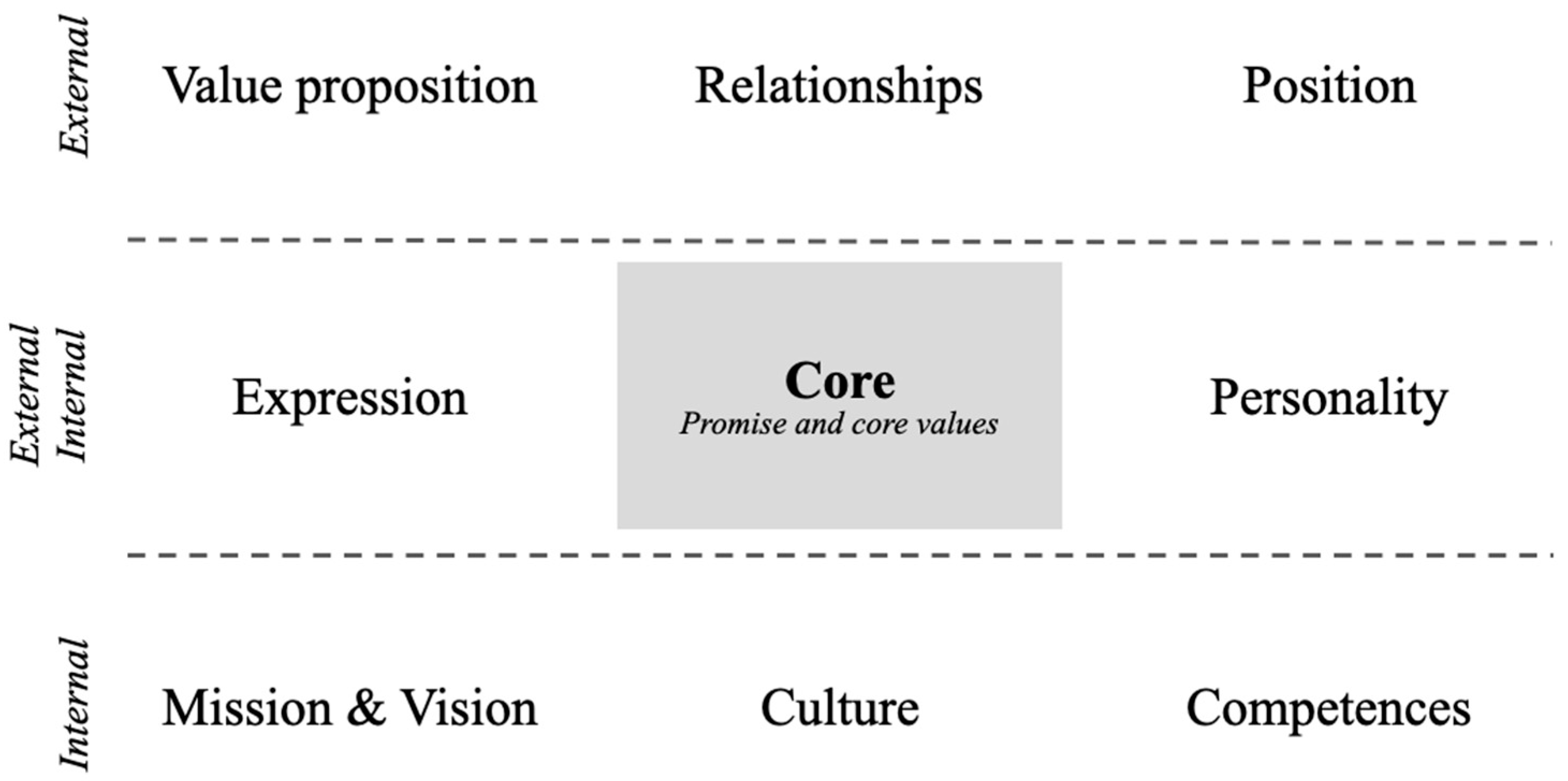
The CBIM offers a robust framework for analyzing the nine core dimensions of corporate brand identity, divided between internal (Mission and Vision, Culture, and Competencies), external (Value Proposition, Relationships, and Position), and combined (Expression, Core, and Personality). Urde (2016) emphasizes the centrality of the “brand core”, a foundational element influencing all dimensions. The CBIM is both an analytical framework and an operational tool, enabling an effective alignment between the internal and external brand dimensions.
The brand core encapsulates an organization’s fundamental values and societal contributions, mirroring the MTP’s role in ExOs as the central, transformative anchor that aligns organizational purpose with broader societal goals.
This parallelism makes the CBIM uniquely suited to analyzing ExOs, enabling an in-depth exploration of how the MTP integrates to shape the corporate brand identity. By situating the MTP within the brand core, the CBIM provides a structured approach to understanding how the transformative purpose influences and aligns with the brand’s different identity dimensions. Its holistic design captures the interconnections among these elements, offering a robust framework for understanding how ExOs leverage the MTP to enhance corporate purpose, solidify brand identity, and guide strategic direction. This framework also enables a nuanced assessment of how ExOs achieve internal and external cohesion while differentiating themselves, offering critical insights into the MTP’s role in their branding strategies.
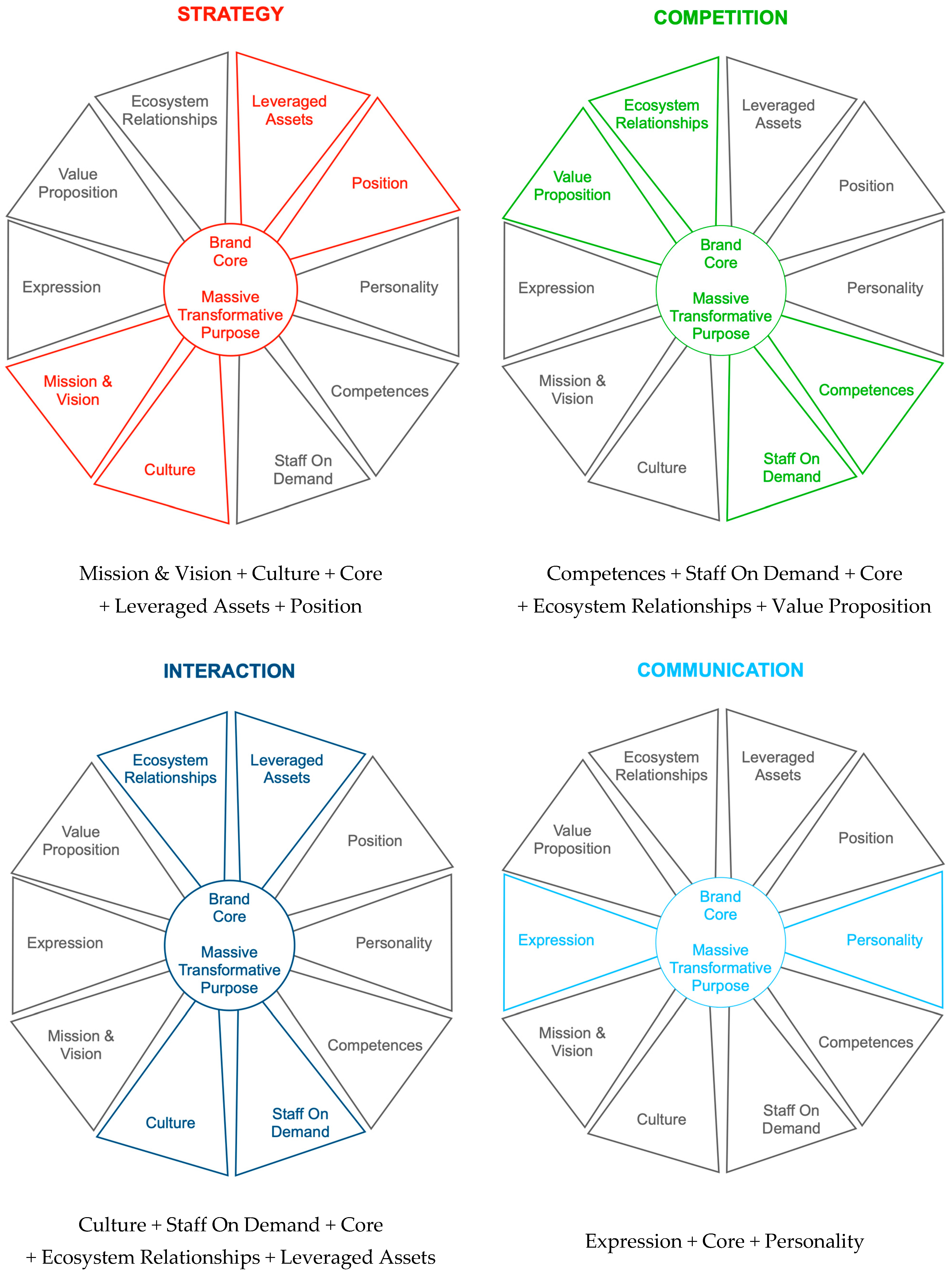
Finally, Urde’s (2013) model clarifies four fundamental firm dynamics, involving distinct dimensions and fulfilling specific goals. In this framework, the Brand Core serves as the central reference for decision-making by connecting (i) with Mission and Vision and Position in the strategy diagonal; (ii) Competencies and Value Proposition in the competition diagonal; (iii) Culture and Relationships through the interaction vertical; and (iv) Personality and Expression within the communication horizontal. The analysis of these four dynamics highlights the pivotal role of the Brand Core (MTP) in shaping the brand identity of the selected case studies. It is a critical framework for understanding how the MTP integrates diverse brand identity elements, fosters coherence across organizational dimensions, and directs its strategic trajectory.

3. Methodology

3.1. Research Design

To examine the dynamics of corporate brand identity and purpose, this study employs a multiple-case study design. A detailed, context-rich exploration of phenomena requires a qualitative approach, while case study research allows the capturing of the authenticity of business identity (Balmer, 2001b; Urde, 2016). Furthermore, qualitative research is well-suited to investigating the “softer aspects of management”, such as corporate purpose (Henderson, 2021).
To study the influence of purpose on corporate brand identity, we employed Urde’s (2013) Corporate Brand Identity Matrix (CBIM) (Figure 1).

3.2. Multiple-Case Study Analysis: Airbnb and Mylia

Following the maximum variation sampling strategy (Patton, 1990), we selected two prominent and internationally recognized ExOs for in-depth analysis: Airbnb and Mylia. They represent the two possible perspectives of being an ExO. Airbnb is a Unicorn Club member (Lee, 2013), a digital-native firm founded in 2007. Conversely, Mylia is a digitally transformative organization established in 2018 by Adecco Formazione, following an ExO Transformation Sprint (Ismail et al., 2018; Derchi, 2022).
Both firms possess an impactful MTP. Airbnb’s “Belong Anywhere” addresses the universal human need for belonging, fostering a sense of inclusion that enhances its cultural identity and strengthens its competitive position. Mylia’s “Advancing Humanity” emphasizes societal progress through education, positioning Mylia as a pioneer within Italy’s training market.
Finally, from the analysis of several publicly available sources like organizations websites, digital press, and various academic articles, both organizations demonstrate the essential ExO attributes (Table 4 and Table 5).
Our analysis offers the opportunity to explore diverse organizational contexts. Airbnb illustrates the transformative power of platform-based business models in hospitality, while Mylia demonstrates how ExO principles can effectively adapt to more traditional firms. These contrasts provide valuable insights, offering complementary perspectives on how the MTP shapes the corporate brand identity.
To explore the cases, we employed a semi-structured interview approach, leveraging Urde’s “guiding identity questions” (Appendix A Table A1) to gather rich, nuanced data, enabling the collection of focused and open-ended insights (Rowley, 2012). This approach facilitated an in-depth examination of all CBIM’s dimensions and the MTP’s critical role in brand identity management.
A rigorous, methodologically robust approach was adopted to ensure the systematic identification, engagement, and analysis of both firm executives (Table 6).
Two in-depth interviews were conducted for Airbnb between April 2021 and March 2022. Interviewee (I) 1A played a pivotal role in defining Airbnb’s corporate purpose and managing the Airbnb community, bringing a unique perspective on the organization’s identity and stakeholder engagement. I2A provided strategic insights into regional operations and the implementation of the MTP. In Mylia’s case, five interviews were organized between April and May 2021, including four leadership team members leading strategy and corporate branding, and a Project Manager overseeing R&D and Innovation.
Microsoft Teams interviews ensured consistent reach over a geographically dispersed team and allowed recordings for rigorous analysis. Transcripts are available for complete transparency. In order to address theoretical saturation and to ensure a thick description of the two cases, secondary sources have been added to the process. This is in line with Urde’s recommendations over CBIM analysis practices (2013). Multi-source data, including internal documents, corporate reports, and online media platforms, provided nuanced insights into strategy. Once all secondary data have been added to the analysis, no other themes emerged, and the project was considered adequate. This practice is line with Bouncken et al. (2026). Taguette software version 1.4.1 ensured transparent, replicable coding. Finally, this coding framework allowed for the identification of key MTP branding themes, aligning the findings with Urde’s (2022) dynamics: strategy, competition, interaction, and communication.

4. Results

The analysis reveals the MTP is central to corporate brand identity.
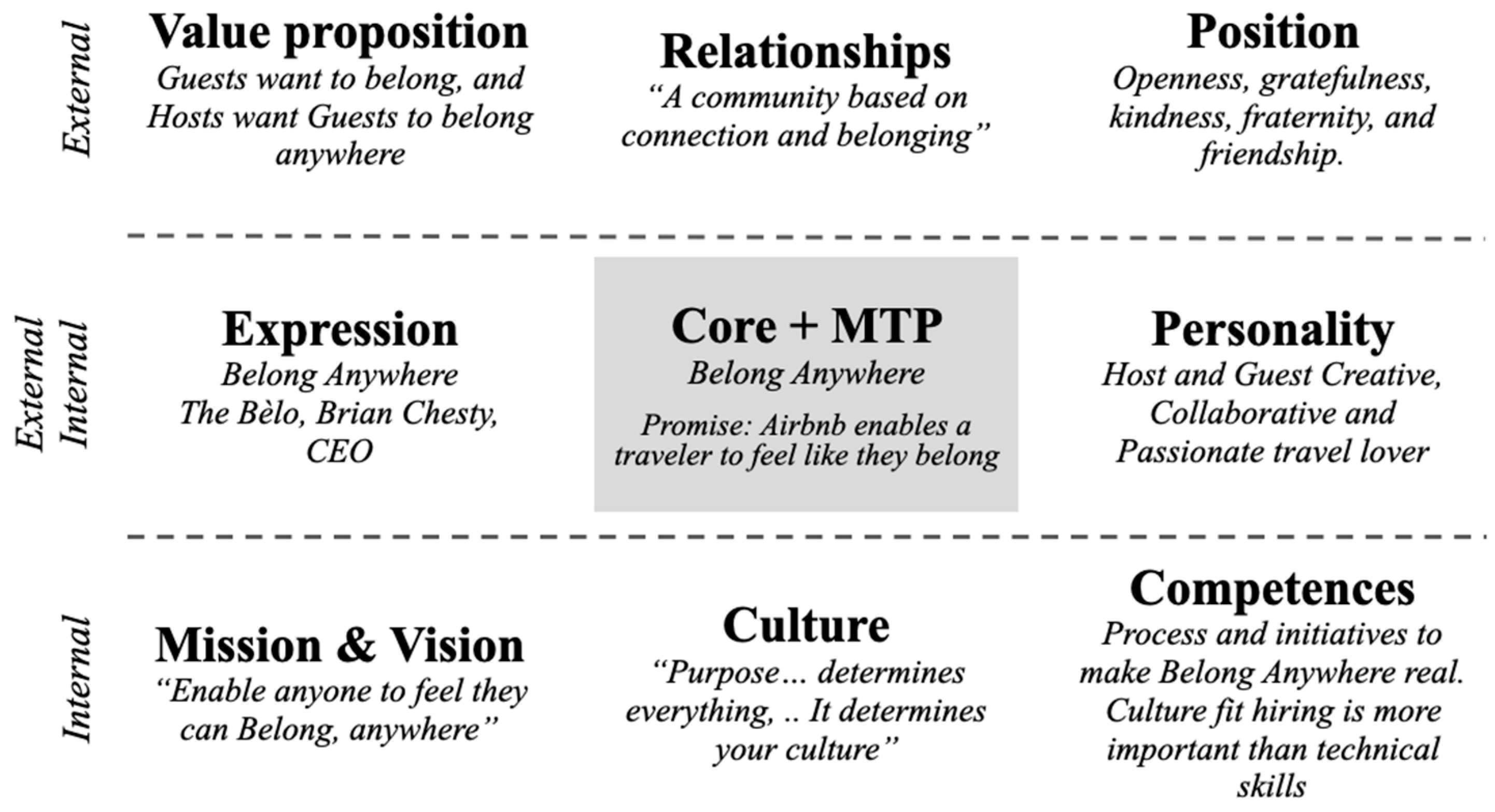
In Figure 2, Airbnb’s corporate brand identity is analyzed. The MTP, “Belong Anywhere,” is the core of its brand, rooted in the 2012 global audit initiative to identify the company’s purpose. Interviewees confirmed the MTP as shaper of the company’s foundation, to “enable travellers to feel like they belong.”. This purpose is reflected in values like “Be a Host” and “Champion the Mission.” An internal survey found that 83% of cases fit the statement “I feel a sense of belonging at Airbnb.”
The interviews revealed the MTP’s strong influence on Airbnb’s Personality and Expression dimensions. Participants described Personality as mirroring the values and traits of Airbnb’s employees, closely aligned with the ethos of co-founders Joe Gebbia, Brian Chesky, and Nate Blecharczyk—the first hosts and living embodiments of the organization’s purpose. In particular, Chesky, the CEO, emerged as a key figure who exemplifies the MTP’s spirit through his nomadic lifestyle (Abril, 2022). Airbnb is thus perceived as an MTP-driven entity defined by creativity, collaboration, and passion. These traits, consistently mentioned across interviews, are evident in daily operations and interactions.
The Expression dimension also stems directly from the MTP. Respondents identified three main insights. First, the MTP is frequently used as an advertising claim, as seen in the 2015 “ManKind” campaign. Second, the “Bélo” logo launched in 2014 symbolizes “Belonging,” visually capturing the company’s purpose. Third, Chesky’s public presence and communication style act as a vital channel for embodying and conveying the MTP, creating a coherent narrative for stakeholders.
The findings underline the MTP’s centrality in shaping Airbnb’s internal identity dimensions. I1A reflected on the fluidity between MTP and Mission & Vision, observing the following: “Other companies call these things … vision, purpose, or why …. It is interchangeable. People debate the differences between missions and visions while getting on and executing it.” This demonstrates how the MTP serves as a practical and communicative shortcut, integrating and clarifying the organization’s core purpose. Interviewees also stressed that the MTP influences Airbnb’s Culture, shaping staff attitudes and behaviors. I1A remarked, “Purpose determines your culture”: the MTP acts as the guiding force behind internal dynamics.
This alignment was evident in a 2013 decision when Airbnb faced a subpoena from the New York City Attorney General requesting host information. I1A recalled, “There is no way that we can follow and agree with the subpoena … we need to be a host to our hosts in New York. We had to help, stand by, support, nurture, and … create a safe space for the defendant.” The MTP thus dictates responses in times of crisis.
A strong connection also emerged between the MTP and Airbnb’s hiring practices, highlighting the Competencies dimension as central to having a competitive advantage (Urde, 2013). I1A explained: “Airbnb trains 10% of employees to conduct culture interviews of potential recruits … ensuring alignment between candidate’s values and company’s core values … you might be the best engineer in the world, you will not be hired if you do not pass two culture interviews.” This alignment between purpose and personal values exemplifies how Airbnb embeds its MTP into processes, ensuring consistency across organizational dimensions.
Regarding the external identity dimensions, participants consistently emphasized the MTP’s role in defining Airbnb’s Value Proposition. For I2A, the MTP encourages travelers to “learn about the culture … off the beaten track” and “travel and feel like a local … like you belong in the place you are visiting.” For hosts, it enables personalized and meaningful guest experiences: “Hosts want to make their guests feel very much at home … and have personalised interactions to make them feel like a local,” I2A noted. The alignment between hosts and guests reinforces the MTP’s centrality in shaping Airbnb’s Value Proposition.
On the Relationship dimension, interviewees described the tools and initiatives designed to strengthen stakeholder connections. I1A explained: “There was a platform app and (web)site where hosts could meet, in groups, local or international …, and meet face-to-face, offline and online … in each other’s houses or a bar, like meetups.” This illustrates how Airbnb fosters collaboration and community-building to align its ecosystem with its broader purpose.
The MTP also proved central to Airbnb’s Position and stakeholder perception. Initially created for internal use, “Belong Anywhere” was not meant to serve as a tagline. I1A stated, “It was simply intended to be memorable, one of the key criteria I have for a good purpose.” Later, it was adopted as a communication payoff to forge emotional bonds with travelers. Its integration into campaigns reinforced values such as openness, gratitude, and friendship, resonating deeply with stakeholders. Interviewees highlighted that “Belong Anywhere” became a cornerstone of Airbnb’s communication, anchoring campaigns and strengthening its identity as a symbol of trust, inclusivity, and exploration. Chesky captured this essence during the “ManKind” campaign: “(Airbnb) … does more than give you a place to sleep—it changes how you experience the world. … Because when we trust in the kindness of our fellow man, we discover that the world is not such a scary place after all.” In response, hosts and guests internalized the MTP, connecting emotionally with its message. One Greek host, for instance, painted “belong anywhere” on a bedroom wall—the ultimate symbol of a purpose-driven stay.
Overall, these findings demonstrate how the MTP shapes Airbnb’s external brand dimensions, creating a cohesive identity that resonates with both travelers and hosts while fostering genuine community connections.
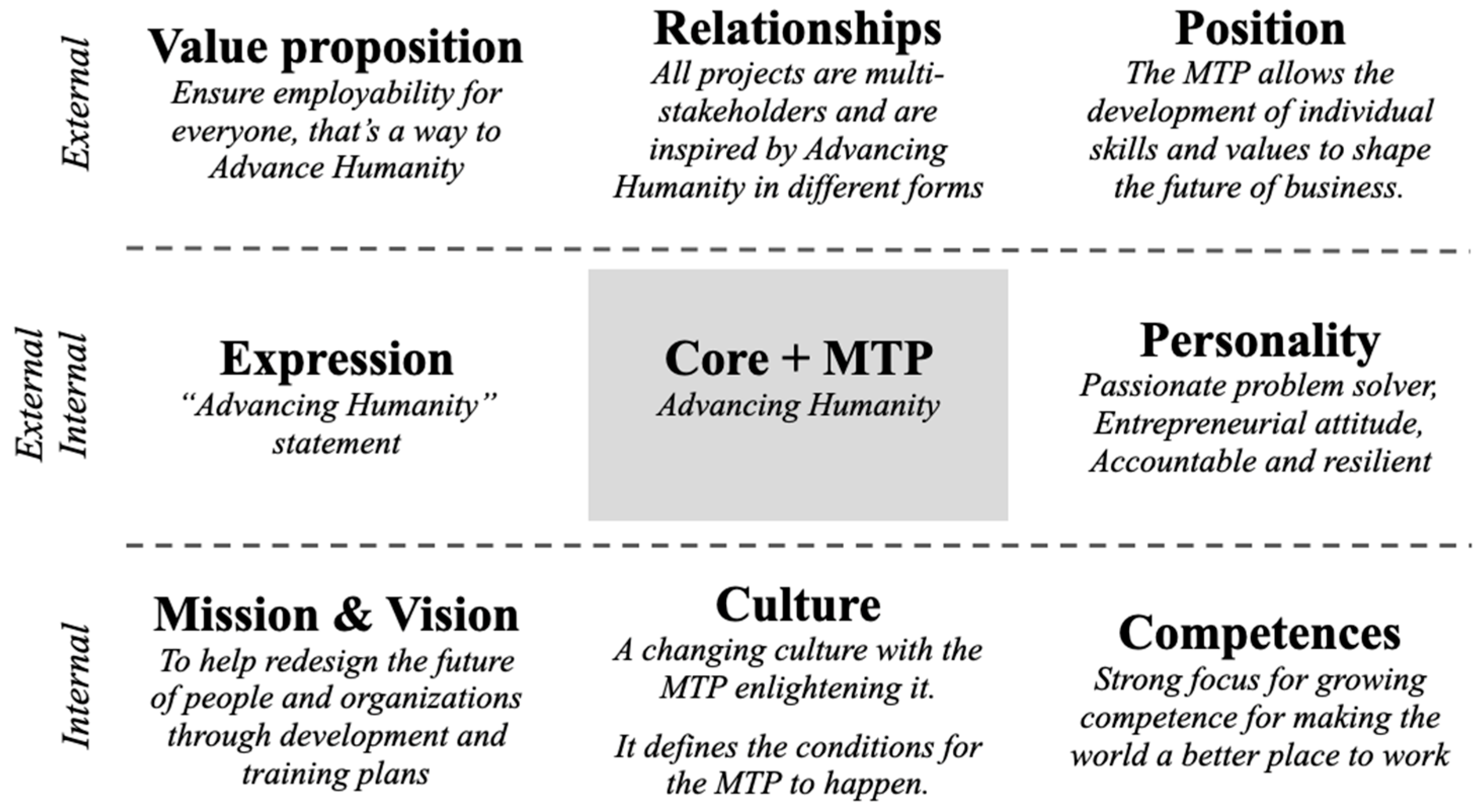
In the second case, Mylia’s MTP, “Advancing Humanity”, emerges as the central component of its Brand Core (Figure 3). Mylia’s transformation involved an established firm realigning with exponential principles. Interviewees consistently stressed the MTP’s pivotal role in this process, shaping and integrating the dimensions of corporate brand identity. I3M described the MTP as “the main inspiring source for the organisation,” guiding Mylia’s strategic direction and defining its identity. Similarly, I5M stated, “We believe in Advancing Humanity … it provides great sap to us.” The MTP thus serves as the organization’s source of vitality. From inception, one of Mylia’s core pillars has been developing competencies aligned with “Advancing Humanity,” orienting skills and goals toward transformation. As I3M explained, “[w]e changed our organisation, and created a new path dedicated to improving skills to perform specific new activities.” This approach is evident in roles such as the Green Learning Designer, aligned with Mylia’s forward-looking objectives.
The MTP also shapes Mylia’s Personality, influencing employees’ attitudes and identity. For I4M, “[t]he MTP is a challenge … a work in progress.” I3M illustrated this during the COVID-19 pandemic, when (everybody) “worked at their best … trying any possibility to grow … to deliver the best solution for our clients. (Implementing) … a lot of new initiatives that we did not believe were possible.” This is reflected in Mylia’s Mission: “(To) Help redesign the future of people and organisations through development and training paths.” Although the Vision statement is not explicit, I3M clarified, “… with Mylia, we wanted to position in the market with a specific proposal … and with our vision … we launched Mylia to achieve … the purpose.
The MTP’s role extends to the Value Proposition. “Advancing Humanity” appears consistently across brand materials, placed beside the Mylia logo. To strengthen employability, Mylia developed a proprietary framework for future-proof skills, explicitly linked to the “Human-centred” pillar guiding the company’s approach. As I5M noted, “[w]e work with people … for other people …. And every case is a new case.” This philosophy energizes the organization and underpins its achievements, such as the Prodotto Formativo 2021 award for its Change Academy initiative.
The analysis also highlights the MTP’s influence on Relationships and Culture. Acting as a guiding principle, the MTP shapes relationships with clients, partners, vendors, and others involved in Mylia’s development. While Urde’s (2013) model may not fully capture this dynamic, our findings identify the MTP as a forward-looking driver of third-party engagement. I3M described the shift from Adecco Formazione to Mylia: “Before, AF was a provider … Now, companies can find in Mylia a co-builder of their future … more than a partner. A company able to empower a client regarding the future.”
Moreover, the MTP serves as both a decision-making guide and a catalyst for cultural transformation, fostering coherence and openness to change. For I2M, “[t]he MTP is a guide for us … when we talk about culture.” This became clear as the company embraced new standards and an internal awareness of change. I5M observed, “… with our actions, we feel we can impact someone”; Mylia’s Position thus reflects the MTP’s ultimate goal. Aligning culture with this new model was essential, as team collaboration and a holistic approach to growth were identified as key to advancing humanity. The MTP functions as “a guide … for making this change effective,” as confirmed by I2M.
Finally, the MTP also influences the Competencies dimension. I3M explained that “(we) moved from a bureaucratic approach to customer-oriented: customer satisfaction is essential … managing and satisfying all the different stakeholders, from staff on demand to leveraged assets … All of this is possible if you re-skill your competencies.”

5. Discussion

Our findings confirm that the MTP is the driving force behind the formation of corporate brand identity across the four CBIM dynamics, ensuring coherence and alignment within ExOs. In the strategy dynamic, the MTP connects Mission, Vision, and Position: Airbnb’s “Belong Anywhere” conveys a sense of belonging and trust. At the same time, Mylia’s “Advancing Humanity” links societal progress with sustainable growth. In the competition dynamic, the MTP guides competencies and value creation, while Airbnb cultivates a purpose-driven workforce, and Mylia aligns expertise with social impact and employability. Through the interaction dynamic, the MTP shapes culture and relationships, as Airbnb fosters inclusivity through global host networks and Mylia promotes collaboration and shared value creation. In the communication dynamic, the MTP defines brand expression and personality, reflected in Airbnb’s “Bélo” and Mylia’s “Human-centered” approach. Therefore, the MTP acts as the strategic and cultural backbone of ExOs, embedding purpose across all brand dimensions and sustaining authenticity and long-term impact.
While these results underscore the MTP’s central role in shaping ExOs’ corporate brand identity, other elements should also be considered to capture the full complexity of this construct within such organizations. Two core ExO attributes (i.e., ‘Leveraged Assets’ and ‘Staff on Demand’) should be recognized as integral components of corporate brand identity. These elements, which distinguish ExOs from traditional firms, warrant inclusion alongside the CBIM’s nine dimensions to reflect how ExOs define and manage brand identity accurately.
This view aligns with Urde’s (2013) CBI model, which links brand to organizational signals. The managerial literature consistently supports the idea that the organization itself forms an essential part of the corporate brand (Balmer, 1995, 2017; Urde, 2013; Urde & Greyser, 2016). Three arguments reinforce this connection.
First, incorporating ‘Leveraged Assets’ and ‘Staff on Demand’ captures ExOs’ inherent strategic design. These attributes enable firms to exploit the abundant information, data, and resources (Ismail et al., 2018). ‘Leveraged Assets’ reflect the use of external opportunities to expand offerings, contributing to the external brand dimension. Conversely, ‘Staff on Demand’ strengthens internal capabilities by integrating external expertise. Together, they connect organizational processes with internal and external identity components, directly influencing brand perception (Ismail et al., 2018).
Second, these attributes support strategic alignment within the corporate brand. For Balmer (2017), corporate brand identity represents a “distillation” of the overall corporate identity, requiring consistency across internal and external resources. ‘Staff on Demand’ and ‘Leveraged Assets’ exemplify this by fostering collaboration across teams and networks, shaping both Experience/Image and Reputation. Airbnb illustrates this alignment: its brand experience depends on the diversity and quality of properties—its ‘Leveraged Assets’, from Alpine chalets to Tuscan villas offering immersive hosting. This diversity enhances value and authenticity while reinforcing reputation. During the COVID-19 pandemic, Airbnb’s adaptability, supported by its diverse listings, strengthened its image as a flexible, resilient brand (Airbnb, 2021), demonstrating how external resources sustain the brand promise.
Finally, ExOs differ from traditional firms in how they engage with ‘Staff on Demand’ and ‘Leveraged Assets’ communities. They adopt inclusive language that conveys unity and a shared purpose, fostering engagement across all stakeholders (Urde, 2013). Chesky (2015) encapsulated this ethos by defining Airbnb as “a new kind of economy not powered by machines, but by people,” integrating employees, hosts, and collaborators into a collective identity. This inclusive stance was further expressed at the World@Bélo event: “We are not in the business of spaces. We are in the business of belonging. Houses do not create belonging; people do.” Such framing aligns Airbnb’s identity with its purpose, reinforcing a cohesive, purpose-driven culture.
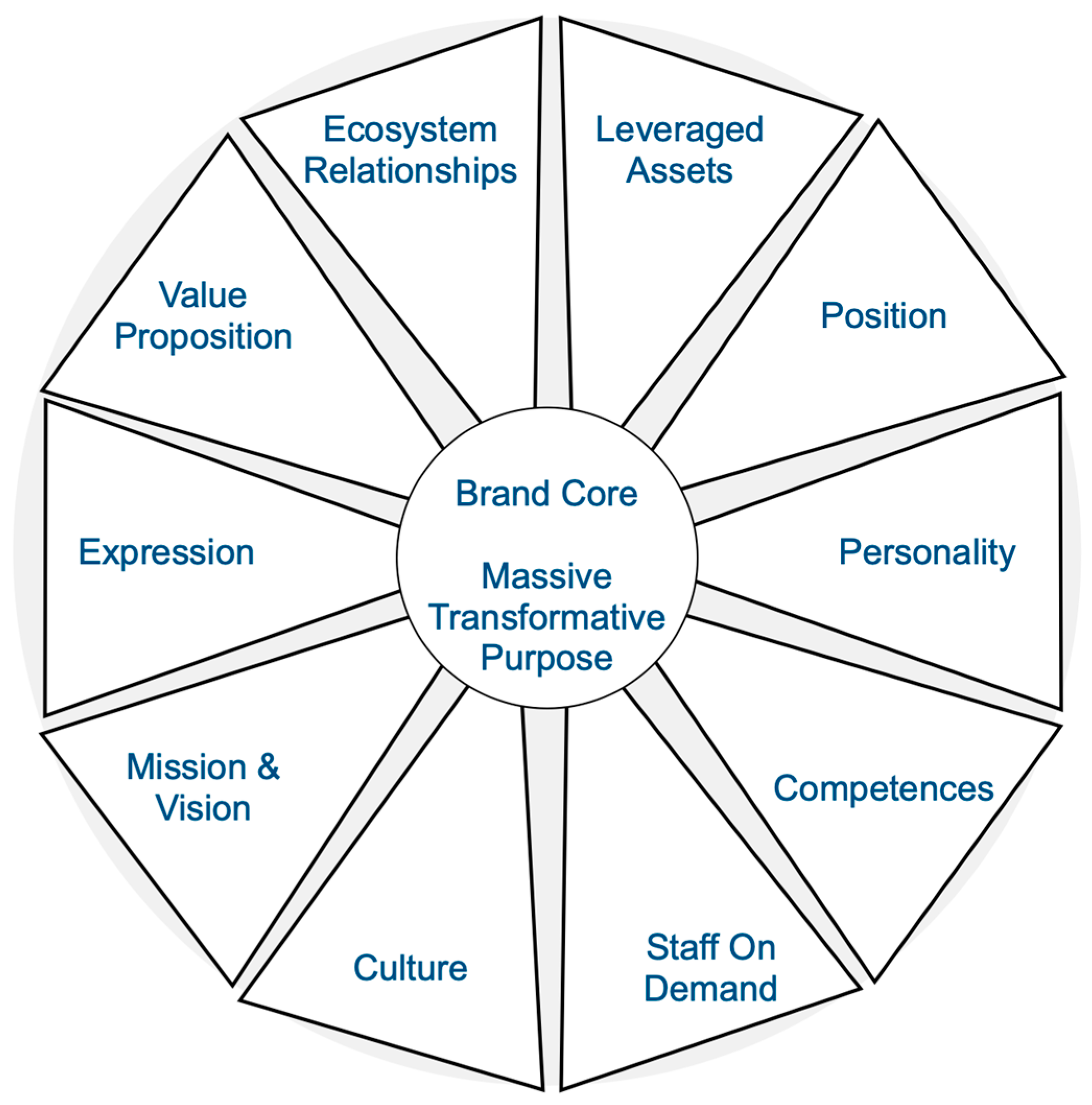
Building on these insights, we propose extending Urde’s (2013) CBIM by adding two dimensions—‘Staff on Demand’ and ‘Leveraged Assets’—to create a more accurate representation of ExOs’ corporate brand identity. The revised framework, the MTP Management Model (Figure 4), positions the MTP at the core, illustrating how purpose harmonizes and influences both internal and external brand dimensions within ExOs.
Moreover, the MTP Management Model is instrumental in defining the various management dynamics (Table 7 and Figure 5), paralleling the approach of the original CBIM while accounting for the distinctive features of ExOs.

6. Conclusions

6.1. Theoretical Contribution

This study significantly contributes to our understanding of how ExOs construct their corporate brand identity through the MTP. While further exploration in this field is needed (Dimitrov, 2022), this research provides empirical validation for the MTP concept, addressing a notable research gap (Bansal et al., 2012). Additionally, this work contributes to the growing literature on corporate brand identity and its interplay with purpose (Gray et al., 2024) by drawing a parallel between purpose management literature (Gummesson, 2005; Urde & Greyser, 2016) and the MTP as conceptualized for ExOs (Ismail et al., 2018).
The findings demonstrate that the MTP is pivotal in constructing the ExO’s corporate brand identity, acting as a unifying framework for all nine original dimensions of Urde’s (2022) CBIM. Furthermore, the research highlights that the MTP extends beyond these dimensions, influencing two critical ExO attributes—‘Leveraged Assets’ and ‘Staff On Demand’. Central to the ExOs operational model, they are currently absent from Urde’s CBIM. Accordingly, we propose an extended theoretical framework, the MTP Management Model, which incorporates these attributes to reflect the unique organizational characteristics of ExOs. This extension underscores the ExOs distinctiveness and highlights how they leverage the MTP to build and manage their corporate brand identity.
Finally, this work contributes to corporate brand identity discussions, highlighting the critical role of orchestration and alignment (Cullinan et al., 2021). It offers insights into purpose-driven branding (Hajdas & Kłeczek, 2021), extending how the MTP functions within digital-native organizations (Mingione & Abratt, 2020). This research deepens the conceptualization of corporate brand identity in emerging forms.

6.2. Managerial Implications

The study provides critical managerial implications, establishing the MTP’s central role for an ExO’s corporate brand identity. The MTP definition is a strategic imperative reflecting core values and aligning with mission, vision, and organizational objectives. The MTP is essential for cultivating a supportive culture, attracting leveraged assets and staff on demand, and establishing meaningful ecosystem relationships.
The proposed MTP Management Model offers a practical, ExO-specific framework. By integrating the distinctive attributes of ‘Leveraged Assets’ and ‘Staff on Demand’ into the brand identity structure, the model enables managers to sustain purpose-driven coherence. The MTP must govern an ExO’s strategy: the new Strategy Dynamic harmonizes ‘Mission and Vision’, ‘Culture’, ‘Core’, ‘Leveraged Assets’, and ‘Position’. In the Competition Dynamic, the MTP aligns ‘Competencies’, ‘Staff on Demand’, ‘Core’, ‘Relationships’, and ‘Value Proposition’ for coherence.
Furthermore, stakeholder engagement hinges on the MTP’s capacity to unify ‘Culture’, ‘Staff on Demand’, ‘Core’, ‘Ecosystem Relationships’, and ‘Leveraged Assets’, ensuring coherent internal/external interactions. The MTP constitutes the foundation for consistent alignment among Personality, Expression, and Brand Core in communication, which the new Communication Dynamic can refine.
Applying this model enhances organizational coherence, strengthens relationships, and ensures the MTP drives strategic decisions, maximizing ExOs’ transformative potential.

6.3. Limitations and Future Directions

This study presents several methodological limitations that suggest promising directions for future research. First, the analysis relies on two case studies within distinct, yet narrow, industry contexts. While this allows for a context-rich, in-depth exploration, it limits the generalizability of findings. Future studies should expand the organizational and sectoral scope to test the framework’s applicability across a broader range of ExOs. Second, the research captures the MTP’s role at a single point in time. Longitudinal designs would offer valuable insights into how the MTP evolves in response to strategic, market, or societal changes. Third, the inductive approach, while suitable for exploratory theory-building, limits hypothesis testing and generalization. Subsequent studies could employ deductive methods (Bryman, 2016) to validate emerging propositions or adopt abductive strategies (Dubois & Gadde, 2002), as seen in corporate brand identity research (Urde & Greyser, 2016), to refine theory iteratively.
A further limitation concerns the reliance on self-reported organizational narratives. Although this study used triangulation—combining interviews, internal documents, and public sources—it remains possible that the accounts reflect aspirational portrayals rather than embedded practices. Declaring a prosocial purpose does not ensure authenticity unless supported by consistent values, behaviors, and strategic choices (Vredenburg et al., 2020). This is particularly relevant for ExOs, where the MTP serves both as a strategic orientation and a symbolic branding tool. Such duality raises the risk of “purpose-washing,” echoing concerns similar to greenwashing. Future research should adopt a more critical stance to assess whether and how the MTP is genuinely integrated into structures and everyday practices. Including diverse stakeholder perspectives—employees, partners, and customers—would enrich our understanding and provide a more accurate assessment. Examining the perceived authenticity and resonance of purpose-driven narratives could further clarify the MTP’s credibility in shaping corporate brand identity. Finally, future empirical analyses could explore the MTP’s tangible effects on performance, determining the extent to which it influences brand strength and organizational outcomes.

Author Contributions

Conceptualization, F.D., N.B. and F.V.; methodology, software, validation, formal analysis, investigation, resources, data curation, visualization and project administration, F.D.; writing—original draft preparation, F.D.; writing—review and editing, F.D. and F.V.; supervision, N.B.; All authors have read and agreed to the published version of the manuscript.

Funding

This research received no external funding.

Institutional Review Board Statement

Ethical review and approval were waived for this study. The study is exempt from formal IRB review under Article 2, Paragraph 1 of the Swiss Human Research Act (HRA), as it does not involve medical research on human diseases or biology. While the study is non-medical, it aligns with the Declaration of Helsinki (2024 Revision) regarding scientific integrity and informed consent. Finally, exemption is further justified by the use of publicly available secondary data and non-interventional professional interviews where participants acted in their official capacities, meeting international criteria for low-risk organizational research (GDPR Recital 14; 45 CFR 46.104(d)).

Informed Consent Statement

Informed consent was obtained from all subjects involved in the study.

Data Availability Statement

The data that support the findings of this study are available on request from the corresponding author. The data are not publicly available due to privacy restrictions.

Conflicts of Interest

Author Francesco Vitellaro was employed by the company Engreen s.r.l. The remaining authors declare that the research was conducted in the absence of any commercial or financial relationships that could be construed as a potential conflict of interest.

Appendix A

Table A1. Guiding Identity Questions for the CBIM. Source: (Urde, 2013, p. 754).
DimensionsGuiding Questions
CoreWhat do we promise, and what are the core values that sum up what our brand stands for?
ExpressionWhat is unique or special about the way we communicate and express ourselves making it possible to recognize us at a distance?
PersonalityWhat combination of human characteristics or qualities forms our corporate character?
Value PropositionWhat are our key offerings and how do we want them to appeal to customers and non- customer stakeholders?
RelationshipsWhat should be the nature of our relationships with key customers and non- customer stakeholders?
PositionWhat is our intended position in the market, and in the hearts and minds of key customers and non-customer stakeholders?
Mission & VisionWhat engages us, beyond the aim of making money (mission)?
What is our direction and inspiration (vision)?
CultureWhat are our attitudes and how do we work and behave?
CompetencesWhat are we particularly good at, and what makes us better than the competition?

References

  1. Aaker, D. A. (2004). Leveraging the corporate brand. California Management Review, 46(3), 6–26. [Google Scholar] [CrossRef]
  2. Abratt, R., & Mingione, M. (2017). Corporate identity, strategy and change. Journal of Brand Management, 24(2), 129–139. [Google Scholar] [CrossRef]
  3. Abril, D. (2022, May 18). Future of work: ‘The office as we know it is over,’ Airbnb CEO says. The Washington Post. Available online: https://www.washingtonpost.com/technology/2022/05/18/airbnb-remote-work/ (accessed on 24 July 2025).
  4. Adecco Formazione. (2020, April 17). Adecco—Mylia advancing humanity 3 corsi online gratuiti. ASFOR—Associazione Italiana per la Formazione Manageriale. Available online: https://www.asfor.it/it/notizie/dalla-comunita-asfor/4226-adecco-mylia-advancing-humanity-3-corsi-online-gratuiti (accessed on 25 April 2026).
  5. Airbnb. (2021, December 8). What makes Airbnb, Airbnb. Airbnb Newsroom. Available online: https://news.airbnb.com/what-makes-airbnb-airbnb/ (accessed on 6 March 2023).
  6. Airbnb. (2024, February 13). Airbnb Q4 2023 and full-year financial results. Airbnb Newsroom. Available online: https://news.airbnb.com/airbnb-q4-2023-and-full-year-financial-results/ (accessed on 6 March 2024).
  7. Airbnb. (2026). Professional photography for listings. Available online: https://it.airbnb.ch/help/article/297 (accessed on 25 April 2026).
  8. Allen, K. (2020, October 16). Exponential organisations 2nd edition: Your chance to participate. PR Newswire. Available online: https://www.prnewswire.com/news-releases/exponential-organizations-2nd-edition--your-chance-to-participate-301153953.html (accessed on 24 July 2025).
  9. Alvesson, M., & Berg, P. O. (1992). Corporate culture and organizational symbolism. De Gruyter. [Google Scholar]
  10. Amoako, G. K., Kwasi Acquah, I. S., Abubakari, A., & Benewaa Gabrah, A. Y. (2026). The role of effective channel management on brand identity in a B2B setting from an emerging market perspective. Journal of Business-to-Business Marketing, 33(1), 45–72. [Google Scholar] [CrossRef]
  11. Annweiler, B. (2018). Purpose is at the core of branding. Journal of Brand Strategy, 7(3), 214–224. [Google Scholar] [CrossRef]
  12. Anspach, R. R. (1983). Shaping your bank’s corporate identity. Bank Marketing, 15(10), 20–30. [Google Scholar]
  13. Bagnato, S., Barreca, A., Costantini, R., Quintiliani, F., & Ronsivalle, G. B. (2022). Mapping organisational complexity: A network-based approach to behaviour through machine learning tools. Journal of Business and Social Science Review, 3(1), 1–20. [Google Scholar]
  14. Ballester, E., Ruiz, C., Rubio, N., & Veloutsou, C. (2025). We match! Building online brand engagement behaviours through emotional and rational processes. Journal of Retailing and Consumer Services, 82, 104146. [Google Scholar] [CrossRef]
  15. Balmer, J. M. T. (1995). Corporate branding and connoisseurship. Journal of General Management, 21(1), 24–46. [Google Scholar] [CrossRef]
  16. Balmer, J. M. T. (1998). Corporate identity and the advent of corporate marketing. Journal of Marketing Management, 14(8), 963–996. [Google Scholar] [CrossRef]
  17. Balmer, J. M. T. (2001a). Corporate identity, corporate branding and corporate marketing—Seeing through the fog. European Journal of Marketing, 35(3–4), 248–291. [Google Scholar] [CrossRef]
  18. Balmer, J. M. T. (2001b). The three virtues and seven deadly sins of corporate brand management. Journal of General Management, 27(1), 1–17. [Google Scholar] [CrossRef]
  19. Balmer, J. M. T. (2008). Identity based views of the corporation: Insights from corporate identity, organisational identity, social identity, visual identity, corporate brand identity and corporate image. European Journal of Marketing, 42(9–10), 879–906. [Google Scholar] [CrossRef]
  20. Balmer, J. M. T. (2010). Explicating corporate brands and their management: Reflections and directions from 1995. Journal of Brand Management, 18(3), 180–196. [Google Scholar] [CrossRef]
  21. Balmer, J. M. T. (2011). Corporate marketing myopia and the inexorable rise of a corporate marketing logic: Perspectives from identity-based views of the firm. European Journal of Marketing, 45(9–10), 1329–1352. [Google Scholar] [CrossRef]
  22. Balmer, J. M. T. (2013). Corporate brand orientation: What is it? What of it? Journal of Brand Management, 20, 723–741. [Google Scholar] [CrossRef]
  23. Balmer, J. M. T. (2017). The corporate identity, total corporate communications, stakeholders’ attributed identities, identifications and behaviours continuum. European Journal of Marketing, 51(9–10), 1472–1502. [Google Scholar] [CrossRef]
  24. Balmer, J. M. T. (2022). Managerial corporate brand orientation: Explication, significance, and antecedents. Journal of Brand Management, 29(1), 1–12. [Google Scholar] [CrossRef]
  25. Balmer, J. M. T. (2023). Digital corporate communication and brand communication. In Handbook on digital corporate communication (pp. 34–50). Edward Elgar Publishing. [Google Scholar]
  26. Balmer, J. M. T., Stuart, H., & Greyser, S. A. (2009). Aligning identity and strategy: Corporate branding at British Airways in the late 20th century. California Management Review, 51(3), 6–23. [Google Scholar] [CrossRef]
  27. Balmer, J. M. T., & Thomson, I. (2009). The shared management and ownership of corporate brands: The case of Hilton. Journal of General Management, 34(4), 15–37. [Google Scholar] [CrossRef]
  28. Balmer, J. M. T., & Wilson, A. (1998). Corporate identity: There is more to it than meets the eye. International Studies of Management & Organization, 28(3), 12–31. [Google Scholar]
  29. Bansal, P., Bertels, S., Ewart, T., Macconnachie, P., & O’brien, J. (2012). Bridging the research-practice gap. Academy of Management Perspectives, 26, 73–92. [Google Scholar] [CrossRef]
  30. Bartlett, C. A., & Ghoshal, S. (1994). Changing the role of top management: Beyond strategy to purpose. Harvard Business Review, 72(6), 79–88. [Google Scholar]
  31. Baum, J. A. C., & Haveman, H. A. (2020). Editors’ comments: The future of organisational theory. Academy of Management Review, 45(2), 268–272. [Google Scholar] [CrossRef]
  32. Baumgarth, C., Merrilees, B., & Urde, M. (2013). Brand orientation: Past, present, and future. Journal of marketing management, 29(9–10), 973–980. [Google Scholar] [CrossRef]
  33. Bhattacharya, C. B., Sen, S., Edinger-Schons, L. M., & Neureiter, M. (2023). Corporate purpose and employee sustainability behaviors. Journal of Business Ethics, 183(4), 963–981. [Google Scholar] [CrossRef]
  34. Bonaccorsi, A., & Rossi, C. (2003). Why open source software can succeed. Research Policy, 32(7), 1243–1258. [Google Scholar] [CrossRef]
  35. Boswijk, A. (2017). Transforming business value through digitalized networks: A case study on the value drivers of Airbnb. Journal of Creating Value, 3(1), 104–114. [Google Scholar] [CrossRef]
  36. Bouncken, R. B., Czakon, W., & Schmitt, F. (2026). Purposeful sampling and saturation in qualitative research methodologies: Recommendations and review. Review of Managerial Science, 20(2), 579–615. [Google Scholar] [CrossRef]
  37. Bromley, D. B. (1993). Reputation, image and impression management. John Wiley & Sons Ltd. [Google Scholar]
  38. Brown, T. J. (1998). Corporate associations in marketing: Antecedents and consequences. Corporate Reputation Review, 1(3), 215–233. [Google Scholar] [CrossRef]
  39. Bryman, A. (2016). Social research methods (5th ed.). Oxford University Press. [Google Scholar]
  40. Calder, B. J. (2022). Customer interaction strategy, brand purpose and brand communities. Journal of Service Management, 33(4/5), 747–757. [Google Scholar] [CrossRef]
  41. Chesky, B. (2015, July 12). A great new year. Medium. Available online: https://medium.com/@bchesky/a-great-new-year-650331381a41 (accessed on 24 July 2025).
  42. Clegg, S., Cunha, M. P. E., Rego, A., & Santos, F. (2021). Open purpose: Embracing organizations as expressive systems. Organization Theory, 2(4), 26317877211054860. [Google Scholar] [CrossRef]
  43. Cullinan, J. A., Abratt, R., & Mingione, M. (2021). Challenges of corporate brand building and management in a state-owned enterprise. Journal of Product & Brand Management, 30(2), 293–305. [Google Scholar]
  44. Cuomo, M. T., Genoino, C., Tortora, D., & Giordano, A. (2021). Corporate brand identity: Virtual space. In Building corporate identity, image and reputation in the digital era (pp. 169–180). Routledge. [Google Scholar]
  45. de Chernatony, L. (2006). From brand vision to brand evaluation. Butterworth-Heinemann. [Google Scholar]
  46. Derchi, F. (2022). Tales from the disruption world. Impresa Progetto—Electronic Journal of Management, 1, 1–25. [Google Scholar]
  47. Derchi, F. (2025). From buzzword to framework: A systematic review of the massive transformative purpose concept. Administrative Sciences, 15(12), 472. [Google Scholar] [CrossRef]
  48. Derchi, F., & De Stefano, R. M. (2026). How brand purpose drives the ethical design and implementation of algorithms: The hospitality industry scenario. Integrating business and AI. Routledge. [Google Scholar]
  49. Dimitrov, K. (2022). Organisational leadership through the massive transformative purpose. Economic Alternatives, 28(2), 318–344. [Google Scholar]
  50. Díaz-Piloneta, M., Ortega-Fernandez, F., Moran-Palacios, H., & Rodriguez-Montequin, V. (2021). Monitoring the implementation of exponential organizations through the assessment of their project portfolio: Case study. Sustainability, 13(2), 464. [Google Scholar] [CrossRef]
  51. Dowling, G. R. (1994). Corporate reputations. Kogan-Page. [Google Scholar]
  52. Drucker, P. F. (1974). Management: Tasks, responsibilities, practices. Harper & Row. [Google Scholar]
  53. Dubois, A., & Gadde, L. E. (2002). Systematic combining: An abductive approach to case research. Journal of Business Research, 55(7), 553–560. [Google Scholar] [CrossRef]
  54. Flint, D. J., Signori, P., & Golicic, S. L. (2018). Corporate identity congruence: A meanings-based analysis. Journal of Business Research, 86, 68–82. [Google Scholar] [CrossRef]
  55. France, C., Gonzalez-Arcos, C. F., O’rourke, A. M., Spry, A., & Bruce, B. (2024). Brand purpose: A literature review and BEING implementation framework. Journal of Product & Brand Management, 33(7), 929–945. [Google Scholar] [CrossRef]
  56. Gartenberg, C. (2022). Purpose-driven companies and sustainability. In Handbook on the business of sustainability (pp. 24–42). Edward Elgar Publishing. [Google Scholar]
  57. Gartenberg, C., Prat, A., & Serafeim, G. (2019). Corporate purpose and financial performance. Organization Science, 30(1), 1–18. [Google Scholar] [CrossRef]
  58. Gartenberg, C., & Serafeim, G. (2023). Corporate purpose in public and private firms. Management Science, 69(9), 5087–5111. [Google Scholar] [CrossRef]
  59. George, G., Haas, M. R., McGahan, A. M., Schillebeeckx, S. J., & Tracey, P. (2023). Purpose in the for-profit firm: A review and framework for management research. Journal of Management, 49(6), 1841–1869. [Google Scholar] [CrossRef]
  60. GeoSmartCampus. (n.d.). Mylia. Available online: https://www.geosmartcampus.it/it/mylia/ (accessed on 8 May 2026).
  61. Gonçalves Filho, C., Chinelato, F. B., & Prado, F. V. (2024). The grounded theory approach to brand purpose equity drivers: The practitioner’s perspective. Journal of Marketing Analytics, 13(1), 53–68. [Google Scholar] [CrossRef]
  62. Gray, H., Dolan, R., Wilkie, D. C. H., Conduit, J., & Burgess, A. (2024). Social purpose branding approaches: A typology of how brands engage with a social purpose. European Journal of Marketing, 58(5), 1207–1240. [Google Scholar] [CrossRef]
  63. Greyser, S. A., & Urde, M. (2019). What does your corporate brand stand for? Harvard Business Review, 1(2), 82–89. [Google Scholar]
  64. Gummesson, E. (2005). Qualitative research in marketing. European Journal of Marketing, 39(3/4), 309–327. [Google Scholar] [CrossRef]
  65. Hajdas, M., & Kłeczek, R. (2021). The real purpose of purpose-driven branding: Consumer empowerment and social transformations. Journal of Brand Management, 28(4), 359–373. [Google Scholar] [CrossRef]
  66. Henderson, R. M. (2021). Innovation in the 21st century: Architectural change, purpose, and the challenges of our time. Management Science, 67(9), 5479–5488. [Google Scholar] [CrossRef]
  67. Henderson, R. M., & Van den Steen, E. (2015). Why do firms have “Purpose”? The firm’s role as carrier of identity and reputation. American Economic Review, 105(5), 326–330. [Google Scholar] [CrossRef]
  68. Henning, E., & Kirchgeorg, M. (2026). Purpose-driven brand identity: Unveiling the link between brand purpose and brand identity. Journal of Product & Brand Management, 35(4), 532–547. [Google Scholar]
  69. Hill, D. (2015, August 20). The secret of Airbnb’s pricing algorithm. IEEE Spectrum. Available online: http://spectrum.ieee.org/computing/software/the-secret-of-airbnbs-pricing-algorithm (accessed on 24 July 2025).
  70. Hind, S., & Gekker, A. (2014). ‘Outsmarting traffic, together’: Driving as social navigation. Exchanges: The Interdisciplinary Research Journal, 1(2), 165–180. [Google Scholar] [CrossRef]
  71. Hollensbe, E., Wookey, C., Hickey, L., George, G., & Nichols, C. V. (2014). Organizations with purpose. Academy of Management Journal, 57(5), 1227–1234. [Google Scholar] [CrossRef]
  72. Ismail, S., Lapierre, M., & Palao, F. (2018). Exponential transformation: The ultimate playbook to evolve your business and change the world for the better. Diversion Books. [Google Scholar]
  73. Ismail, S., Malone, M. S., & van Geest, Y. (2014). Exponential organizations: Why new organizations are ten times better, faster, and cheaper than yours (and what to do about it). Diversion Books. [Google Scholar]
  74. Jo Hatch, M., & Schultz, M. (1997). Relations between organizational culture, identity and image. European Journal of Marketing, 31(5–6), 356–365. [Google Scholar] [CrossRef]
  75. Jun, Y., & Lee, H. (2025). Measuring brand personality in the digital age: A review, theoretical reconceptualization, and research agenda. Journal of Marketing Communications, 31(8), 925–958. [Google Scholar] [CrossRef]
  76. Keller, K. L. (2023). Looking forward, looking back: Developing a narrative of the past, present and future of a brand. Journal of Brand Management, 30(1), 1–8. [Google Scholar] [CrossRef]
  77. Keller, K. L., & Richey, K. (2006). The importance of corporate brand personality traits to a successful 21st century business. Journal of Brand management, 14(1), 74–81. [Google Scholar] [CrossRef]
  78. Kershaw, D. (2012). Company law in context: Text and materials. Oxford University Press. [Google Scholar]
  79. Kristóf, P., & Nagpal, C. (2024). How exponential organizations outcompete (d) their traditional counterparts (in the past eight years)? International Journal of Organizational Analysis, 32(10), 2668–2682. [Google Scholar] [CrossRef]
  80. Kuratko, D. F., Holt, H. L., & Neubert, E. (2020). Blitzscaling: The good, the bad, and the ugly. Business Horizons, 63(1), 109–119. [Google Scholar] [CrossRef]
  81. Lee, A. (2013, November 2). Welcome to the unicorn club: Learning from billion-dollar startups. TechCrunch. Available online: https://techcrunch.com/2013/11/02/welcome-to-the-unicorn-club/ (accessed on 24 July 2025).
  82. Levitt, T. (1960). Marketing myopia. Harvard Business Review, 38(4), 45–56. [Google Scholar]
  83. Logan, G. M. (1984). Loyalty and a sense of purpose. California Management Review, 27(1), 149–156. [Google Scholar] [CrossRef]
  84. Lückenbach, F., Schmidt, H. J., & Henseler, J. (2022). Building brand meaning in social entrepreneurship organizations: The social impact brand model. Journal of Brand Management, 30, 207–226. [Google Scholar] [CrossRef]
  85. Marchese, S., Gastaldi, L., & Corso, M. (2020, September 20–22). Taming VUCA with exponential organizational models: A literature review. 21st International Continuous Innovation Network (CINet) Conference: Practicing Continuous Innovation in Digital Ecosystems (pp. 466–479), Milan, Italy. [Google Scholar]
  86. Mayer, C. (2021). The future of the corporation and the economics of purpose. Journal of Management Studies, 58(3), 887–901. [Google Scholar] [CrossRef]
  87. Mayer, C. (2022). What is wrong with corporate law? The purpose of law and the law of purpose. Annual Review of Law and Social Science, 18, 283–296. [Google Scholar] [CrossRef]
  88. McCarthy, M. G., & Schneider, D. K. (1995). Market perception of goodwill: Some empirical evidence. Accounting and Business Research, 26(1), 69–81. [Google Scholar] [CrossRef]
  89. Mingione, M., & Abratt, R. (2020). Building a corporate brand in the digital age: Imperatives for transforming born-digital startups into successful corporate brands. Journal of Marketing Management, 36(11–12), 981–1008. [Google Scholar] [CrossRef]
  90. Mingione, M., Laviola, F., Anjomrouz, E., & Esposito de Falco, S. (2025). Environmental, social and governance (ESG) performance: Does it pay back in terms of corporate brand value? Sinergie Italian Journal of Management, 43(2), 67–97. [Google Scholar] [CrossRef]
  91. Ocasio, W., Kraatz, M., & Chandler, D. (2023). Making sense of corporate purpose. Strategy Science, 8(2), 123–138. [Google Scholar] [CrossRef]
  92. Oskam, J., & Boswijk, A. (2016). Airbnb: The future of networked hospitality businesses. Journal of Tourism Futures, 2(1), 22–42. [Google Scholar] [CrossRef]
  93. Patton, M. Q. (1990). Qualitative evaluation and research methods. Sage Publications. [Google Scholar]
  94. Petitimbert, J. P. (2024). Brand identity in the digital age: Complexity and contradiction. Revista Acta Semiotica, 4(7), 19–33. [Google Scholar] [CrossRef]
  95. Pompa, L. (2019). Exponential atlases: A metaphysical approach to organizational rapid growth. International Journal of Business and Management, 14(4), 143–156. [Google Scholar] [CrossRef]
  96. Pratt, M. G. (2016). Hybrid and multiple organizational identities. In The Oxford handbook of organizational identity (pp. 106–120). Oxford University Press. [Google Scholar]
  97. Prattico, K., Derchi, F., & de Stefano, R. M. (2025, June 22–25). Massive transformative purpose and nuances of corporate purpose as leverage for value re-generation: RePlanet case study. EURAM 2025 (European Academy of Management), Florence, Italy. [Google Scholar]
  98. Quadrifor. (n.d.). Società di formazione. Dettaglio. Quadrifor. Available online: https://www.quadrifor.it/It/Le-sfide-del-mondo-della-formazione-nel-2022 (accessed on 25 April 2026).
  99. Reyes, J. R., & Kleiner, B. H. (1990). How to establish an organisational purpose. Management Decision, 28(7). [Google Scholar] [CrossRef]
  100. Riley, J. W. (1963). The corporation and its publics. essays on the corporate image. John Wiley & Sons. [Google Scholar]
  101. Rowley, J. (2012). Conducting research interviews. Management Research Review, 35(3–4), 260–271. [Google Scholar] [CrossRef]
  102. Schmidt, E., & Rosenberg, J. (2014). How Google works. Grand Central Publishing. [Google Scholar]
  103. Sciascia, G. (2022, July 26). Progettare una didattica innovativa: Al via il progetto encore. FBK Magazine. Available online: https://magazine.fbk.eu/it/news/progettare-una-didattica-innovativa-al-via-il-progetto-encore/ (accessed on 24 July 2025).
  104. Serasvuo, S., Rindell, A., & Kovalchuk, M. (2022). Toward a conceptual understanding of co-creation in branding. Journal of Business Research, 139, 543–563. [Google Scholar] [CrossRef]
  105. Signori, P., & Flint, D. J. (2020). Revealing the unique blend of meanings in corporate identity: An application of the semiotic square. Journal of Marketing Theory and Practice, 28(1), 26–42. [Google Scholar] [CrossRef]
  106. Tafuro, M., & Piccaluga, A. (2026). Bridging the understanding of corporate purpose with its effectiveness: A systematic literature review and research directions. Journal of Management & Organization, 32, 356–389. [Google Scholar]
  107. Urde, M. (2013). The corporate brand identity matrix. Journal of Brand Management, 20(9), 742–761. [Google Scholar] [CrossRef]
  108. Urde, M. (2016). The brand core and its management over time. Journal of Product & Brand Management, 25(1), 26–42. [Google Scholar] [CrossRef]
  109. Urde, M. (2022). Welcome to the Matrix*: How to find and use your corporate brand’s core identity. In The routledge companion to corporate branding (pp. 59–82). Routledge. [Google Scholar]
  110. Urde, M., & Greyser, S. A. (2016). The corporate brand identity and reputation matrix: The case of the Nobel Prize. Journal of Brand Management, 23(1), 89–117. [Google Scholar] [CrossRef]
  111. Van Riel, C. B., & Balmer, J. M. T. (1997). Corporate identity: The concept, its measurement and management. European Journal of Marketing, 31(5–6), 340–355. [Google Scholar] [CrossRef]
  112. Vollero, A., & Siano, A. (2024). Strategic communication and greenwashing. Theoretical reflections and managerial implications. Sinergie Italian Journal of Management, 42, 181–199. [Google Scholar] [CrossRef]
  113. Vredenburg, J., Kapitan, S., Spry, A., & Kemper, J. A. (2020). Brands taking a stand: Authentic brand activism or woke washing? Journal of Public Policy & Marketing, 39(4), 444–460. [Google Scholar] [CrossRef]
  114. Williams, P., Escalas, J. E., & Morningstar, A. (2022). Conceptualizing brand purpose and considering its implications for consumer eudaimonic well-being. Journal of Consumer Psychology, 32(4), 699–723. [Google Scholar] [CrossRef]
  115. Zha, D., Foroudi, P., Melewar, T. C., & Jin, Z. (2025). Examining the impact of sensory brand experience on brand loyalty. Corporate Reputation Review, 28(1), 14–42. [Google Scholar] [CrossRef]
  116. Zhang, X., & Chun, D. (2023). Business model innovation of exponential organizations: The case of Xiaomi. Sustainability, 15(7), 5738. [Google Scholar] [CrossRef]
Figure 1. Corporate Brand Identity Matrix (CBIM) model. Source: Urde (2013).
Admsci 16 00245 g001
Figure 2. CBIM of Airbnb. Source: Authors’ elaboration.
Admsci 16 00245 g002
Figure 3. CBIM of Mylia. Source: Authors’ elaboration.
Admsci 16 00245 g003
Figure 4. The MTP Management Model. Source: Authors’ elaboration.
Admsci 16 00245 g004
Figure 5. The dynamics of the MTP Management Model. Source: Authors’ elaboration.
Admsci 16 00245 g005
Table 1. Comparing corporate identity, corporate brand identity, and corporate purpose.
AspectCorporate IdentityCorporate Brand IdentityCorporate Purpose
Historical Roots
  • Many companies have a wrong and too-narrow business definition (Levitt, 1960)
  • Business purpose among the most important cause of business failure (Drucker, 1974)
  • It is very important for firms to develop a “Sense of Purpose” (Logan, 1984)
Juridical FrameworkThe legal theory of the corporation. Organizations have specific identity treats, a tangible essence, and a legal corporate personality, independent from their members (Kershaw, 2012).The concept of “Goodwill” and the legal personality of the corporation (McCarthy & Schneider, 1995)
  • Social and civil parts have become firm constituents (Clegg et al., 2021)
  • Corporations should be legally bound through their purpose (Mayer, 2022).
Definition“Corporate Identity is formed by the aggregate of messages and experiences received about an organisation’s products and services by an individual, group or groups over a period of time” (Balmer, 1998)
  • “Corporate Brand Identity is the bedrock of the management and overall long-term building of such a brand” (Urde, 2013, p. 742)
  • “The statement that defines the purpose of the company beyond profits, guiding strategy and stakeholder relations” (Derchi, 2025)
Key Question“What we really are?” (Balmer et al., 2009)“What does the brand stand for?” (Gartenberg & Serafeim, 2023)“Why does the organization exist?” (Gartenberg & Serafeim, 2023)
FocusPresentPast/PresentPast/Present/Future
Management Goal(s)“To establish a favourable reputation with an organizations’ stakeholders which it is hoped will be translated … into a propensity to buy that organization’s products and services, to work for or to invest in the organization (Van Riel & Balmer, 1997)“The formulation of a strategic intent; how management wants the corporate brand to be perceived by internal and external stakeholders” (Urde, 2013, p. 746)
Key Management Challenges
  • To define the institution’s distinguishing and differentiating traits
  • To understand the changes in the competitive and business environment
  • To understand corporate image and reputation among customers, employees, shareholders, and other key stakeholder groups (Balmer, 2017)
  • Maintaining relevance (Aaker, 2004)
  • Lack of agreed framework to define and to manage the corporate brand identity (Urde, 2013)
Source: Author’s elaboration.
Table 2. Examples of Massive Transformative Purpose statements.
CompanyCountryIndustryMassive Transformative PurposeSource
AirbnbUSAHospitalityBelong anywhere(Derchi, 2022, p. 10)
BlablacarFranceTransportationPeople-powered transport(Ismail et al., 2014, p. 208)
GoogleUSAInternetOrganize the world’s information(Ismail et al., 2014, p. 62)
ReplanetItalyEnergyEnabling regeneration(Prattico et al., 2025, p. 28)
WazeUSAAutomotiveOutsmarting traffic, together(Ismail et al., 2018, p. 44)
Source: Author’s elaboration.
Table 3. Comparing Massive Transformative Purpose and Corporate Brand Identity.
Massive Transformative Purpose Corporate Brand Identity
“The Massive Transformative Purpose is an intangible asset of an Exponential Organisation. As part of the company’s brand core, it provides identity and sense of direction, inspiring and challenging the organisation by simultaneously impacting the firm’s culture and its internal dimension, the brand and its external activities, and the ExO’s competitive strategy” (Derchi, 2025)Definition“All corporate brands have is a unique identity core, defined or not. Finding the core and using it is an opportunity to communicate and position the corporate brand” (Urde, 2022, p. 55)
“The MTP can be understood and considered as part of the brand core, the central component of corporate brand identity” (Derchi, 2025, p. 16)Brand Core“In a coherent corporate brand identity, the core reflects all elements, and every element reflects the core” (Urde & Greyser, 2016, p. 99)
“The MTP provides the organisation’s identity” (Derchi, 2025, p. 18)Identity Provider“A clear corporate identity provides direction and purpose” (Greyser & Urde, 2019, p. 5)
The north star for the ExO and for its community (Ismail et al., 2018)Focus“Corporate identity … serves as north star” (Greyser & Urde, 2019, p. 5)
“Exponential ambition as distinctive feature” (Derchi, 2025, p. 17)Objective“to create value and meaning” (Baumgarth et al., 2013, p. 973)
The MTP impacts the ExOs competitive strategy (Derchi, 2025)Identity-Based PositioningCorporate Brand Identity is “critical to competitive strategy” (Greyser & Urde, 2019, p. 5)
Source: Author elaboration.
Table 4. ExO model of Airbnb.
MTP: “Belong Anywhere”
Staff On
Demand
Airbnb maintains zero asset ownership, instead empowering its host network by connecting them with support services. This allows for enhanced flexibility and scalability without the fixed costs of traditional property or staffing models. An example is their freelance photographers’ marketplace (Airbnb, 2026).InterfacesAirbnb utilizes an intuitive platform enabling users to search, book, and communicate with hosts. Interfaces streamline the process by filtering results based on user preferences (Oskam & Boswijk, 2016).
Community & CrowdAirbnb functions as a “community based on connection and belonging” (Airbnb, 2021). Its success relies on matching hosts and travelers, incentivizing active participation through ratings, reviews, and experience sharing. This creates trust and reliability (Boswijk, 2017).DashboardThe platform provides hosts with comprehensive dashboards to manage bookings and monitor performance metrics (e.g., occupancy/earnings). Guests also benefit from tools that simplify travel planning, enhancing the overall user experience (Boswijk, 2017).
Algorithms Airbnb utilizes advanced algorithms to personalize user experiences and recommend bookings. Dynamic pricing also helps hosts optimize their strategies (Hill, 2015).ExperimentationAirbnb encourages team experimentation, continuously testing new features like split payments and long-term stays. Rapid iterations and user feedback drive ongoing improvements (Boswijk, 2017).
Leveraged
Assets
Airbnb facilitates and leverages external host properties, avoiding ownership costs while capitalizing on over 7.7 million global listings (Airbnb, 2024).AutonomyAutonomy is fundamental; a strong culture allows independence (Chesky, 2015). Airbnb’s decentralized model grants hosts autonomy over pricing, rules, and experiences, promoting flexibility and localization (Boswijk, 2017).
EngagementAirbnb fosters high user engagement through the “Superhost” program and personalized host–guest interactions (Boswijk, 2017).Social
Technologies
Social Technologies are implemented to enable P2P networks. Integrated communication tools foster the trust and connection essential to the Airbnb experience (Oskam & Boswijk, 2016).
Source: Authors’ elaboration.
Table 5. ExO model of Mylia.
MTP: “Advancing Humanity”
Staff On DemandMylia uses a flexible workforce model, leveraging external experts (trainers, and consultants) to deliver bespoke programs. This facilitates rapid scaling and efficient adaptation to changing client needs (Quadrifor, n.d.).InterfacesMylia utilizes user-friendly digital interfaces (platforms/apps) that facilitate course access, progress tracking, and personalized recommendations. These interfaces ensure smooth user experiences for both learners and corporate clients, maximizing impact through dedicated layouts (Bagnato et al., 2022).
Community & CrowdMylia fosters a strong community of learners and partners, utilizing a crowd-based ecosystem to co-create solutions. This engagement drives innovation and relevance, enhancing peer-to-peer learning (Derchi, 2022).DashboardMylia provides clients and learners with advanced dashboards for monitoring learning outcomes, engagement, and skill progress. These tools facilitate tracking training ROI and personal development (Bagnato et al., 2022).
Algorithms Mylia integrates data analytics and AI-driven algorithms to personalize learning paths, recommend courses, and evaluate progress. This data-informed approach ensures participants acquire skills aligned with professional goals and market demand (Bagnato et al., 2022)ExperimentationMylia embraces continuous experimentation, piloting innovative methods like VR training and AI tutors. Feedback informs program refinement, with these techniques used to design the Management Practices Board (Bagnato et al., 2022).
Leveraged AssetsMylia designs its competitive offering by teaming up with aligned partners. Leveraging external assets maximizes operational efficiency and resource allocation, delivering updated, high-quality training solutions (e.g., data science tools) (Geosmartcampus, n.d.).AutonomyMylia focuses on improving autonomy at all levels, linking team independence to customer focus and solutions for advancing humanity. For example, the ExO Sprint improved staff autonomy for user insights and prototyping (Derchi, 2022).
EngagementMylia employs engagement strategies like gamified modules and recognition systems to boost user motivation and participation. This dynamic environment drives higher completion rates (Sciascia, 2022).Social TechnologiesMylia leverages collaborative tools (virtual communities/forums) to encourage interaction among learners, trainers, and experts. These social technologies facilitate knowledge exchange and foster a sense of belonging (Adecco Formazione, 2020).
Source: Authors’ elaboration.
Table 6. Interview profile detail.
FirmCodeRole of IntervieweeDateDuration
AirbnbJulian Castelar (1A)Head of Community,
Executive Team Member
9 April 20211 h 50′
Aidan Vance (2A)Country Manager17 March 20220 h 37′
MyliaBeatrice Conti (1M)Leadership Team Member,
Head of the Mylia Digital Learning Offering
19 March 20210 h 55′
Adriano Ferrero (2M)Leadership Team Member,
Business Scouting Member
24 March 20211 h 20′
Marco Valenti (3M)Leadership Team Member,
Director
25 March 20211 h 50′
Luca Sterling (4M)Head of Sales and Innovation2 April 20211 h 30′
Emilio Daolio (5M)Product Manager7 April 20211 h 42′
Source: Authors’ elaboration.
Table 7. The dynamics of the MTP Management Model.
DynamicDimensions
Strategy DiagonalMission and Vision + Culture + Core + Leveraged Assets + Position
Competition DiagonalCompetences + Staff On Demand + Core + Ecosystem
Relationships + Value Proposition
Interaction VerticalCulture + Staff On Demand + Core + Ecosystem
Relationships + Leveraged Assets
Communication HorizontalExpression + Core + Personality
Source: Authors’ elaboration.
Disclaimer/Publisher’s Note: The statements, opinions and data contained in all publications are solely those of the individual author(s) and contributor(s) and not of MDPI and/or the editor(s). MDPI and/or the editor(s) disclaim responsibility for any injury to people or property resulting from any ideas, methods, instructions or products referred to in the content.