Building Corporate Brand Identity in Exponential Organizations: The Role of a Massive Transformative Purpose


Abstract
1. Introduction
- How do ExOs construct their corporate brand identity by leveraging their MTP?
- How does the MTP influence and shape the corporate brand identity of ExOs?
2. Literature Review
2.1. Corporate Identity, Corporate Purpose, and Corporate Brand Identity
2.2. The Exponential Organizations
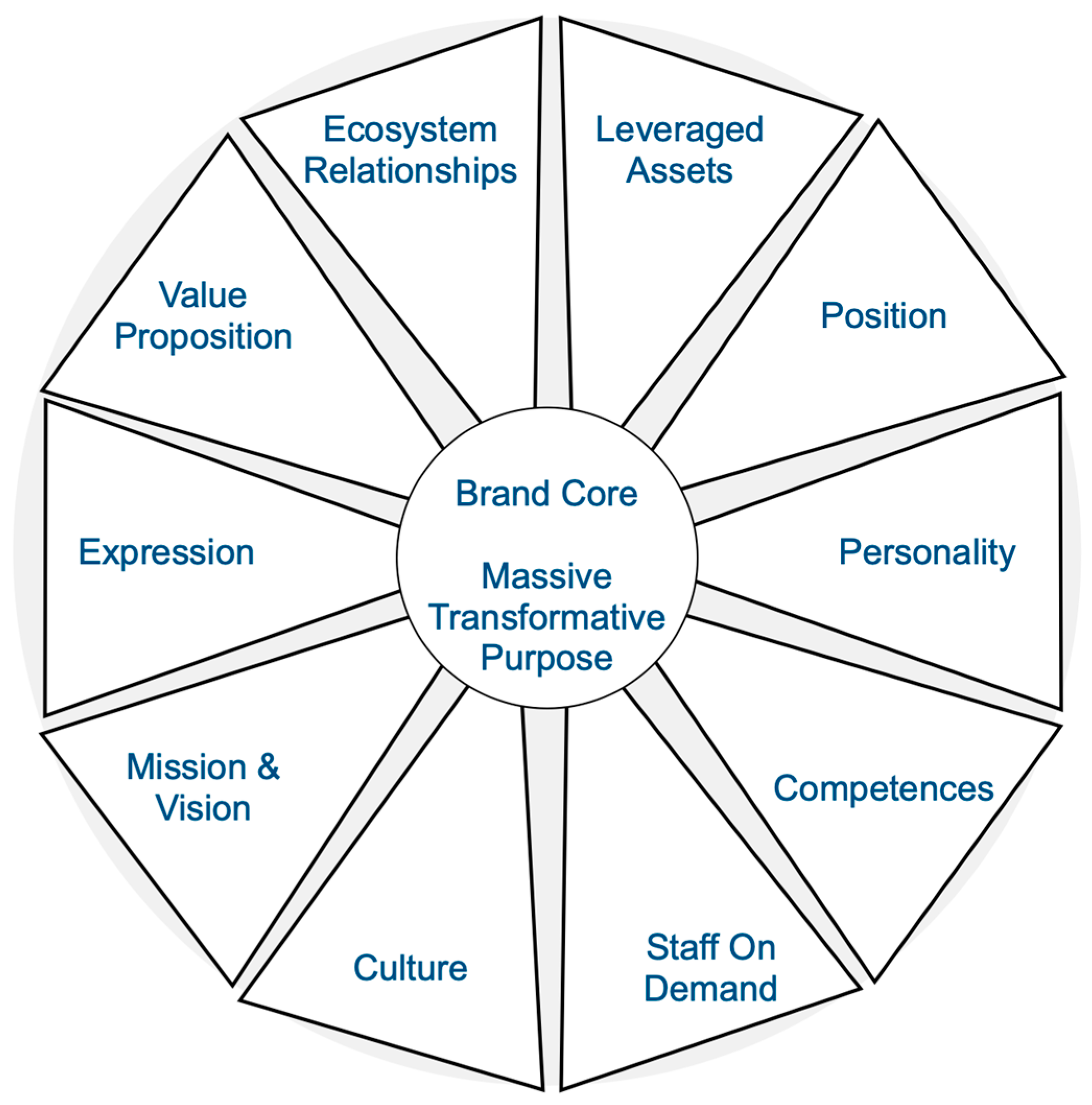
2.3. The MTP and Corporate Brand Identity
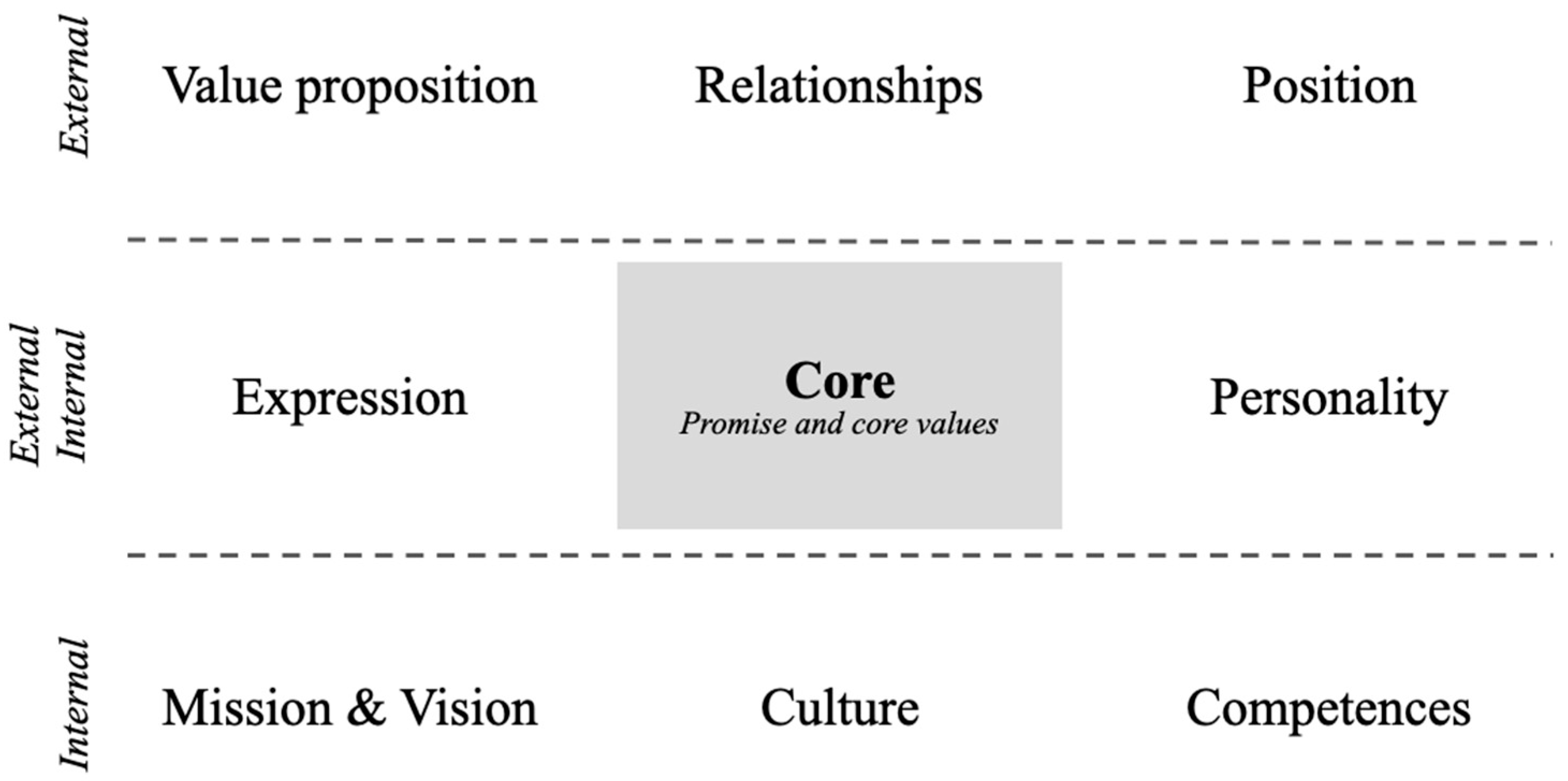
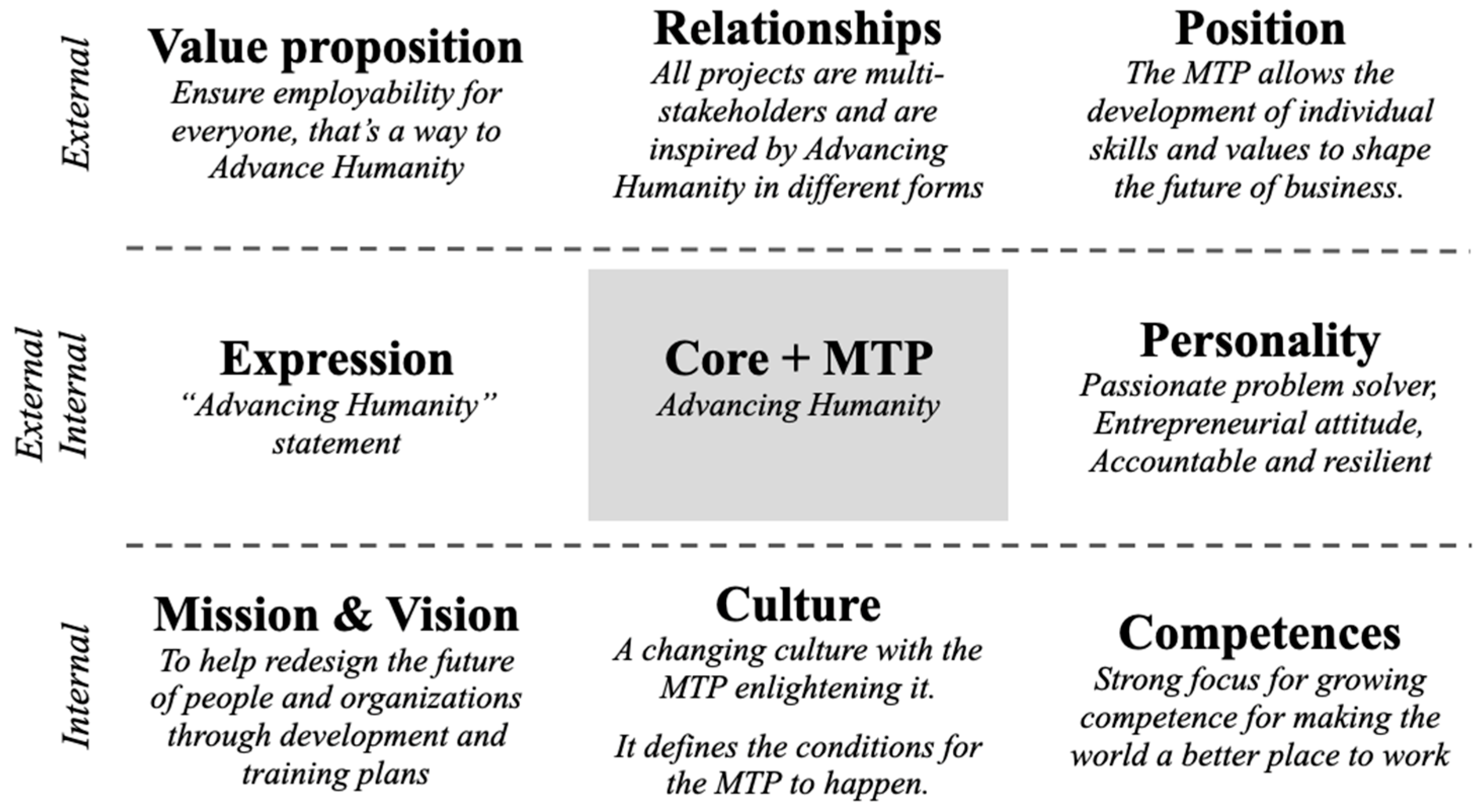
2.4. The Corporate Brand Identity Matrix
3. Methodology
3.1. Research Design
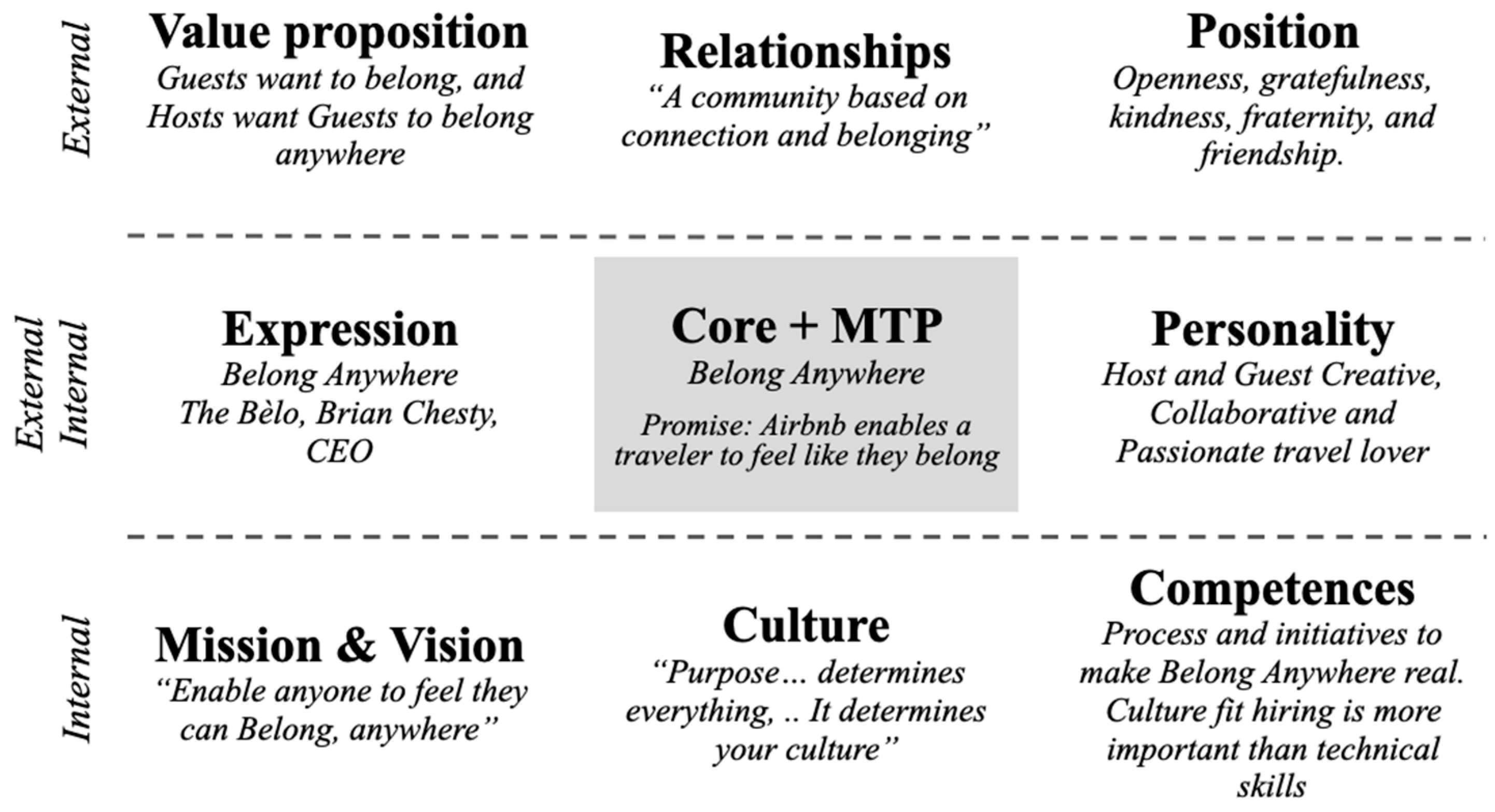
3.2. Multiple-Case Study Analysis: Airbnb and Mylia
4. Results
5. Discussion
6. Conclusions
6.1. Theoretical Contribution
6.2. Managerial Implications
6.3. Limitations and Future Directions
Author Contributions
Funding
Institutional Review Board Statement
Informed Consent Statement
Data Availability Statement
Conflicts of Interest
Appendix A

| Dimensions | Guiding Questions |
|---|---|
| Core | What do we promise, and what are the core values that sum up what our brand stands for? |
| Expression | What is unique or special about the way we communicate and express ourselves making it possible to recognize us at a distance? |
| Personality | What combination of human characteristics or qualities forms our corporate character? |
| Value Proposition | What are our key offerings and how do we want them to appeal to customers and non- customer stakeholders? |
| Relationships | What should be the nature of our relationships with key customers and non- customer stakeholders? |
| Position | What is our intended position in the market, and in the hearts and minds of key customers and non-customer stakeholders? |
| Mission & Vision | What engages us, beyond the aim of making money (mission)? What is our direction and inspiration (vision)? |
| Culture | What are our attitudes and how do we work and behave? |
| Competences | What are we particularly good at, and what makes us better than the competition? |
References
- Aaker, D. A. (2004). Leveraging the corporate brand. California Management Review, 46(3), 6–26. [Google Scholar] [CrossRef] [Scilit]
- Abratt, R., & Mingione, M. (2017). Corporate identity, strategy and change. Journal of Brand Management, 24(2), 129–139. [Google Scholar] [CrossRef] [Scilit]
- Abril, D. (2022, May 18). Future of work: ‘The office as we know it is over,’ Airbnb CEO says. The Washington Post. Available online: https://www.washingtonpost.com/technology/2022/05/18/airbnb-remote-work/ (accessed on 24 July 2025).
- Adecco Formazione. (2020, April 17). Adecco—Mylia advancing humanity 3 corsi online gratuiti. ASFOR—Associazione Italiana per la Formazione Manageriale. Available online: https://www.asfor.it/it/notizie/dalla-comunita-asfor/4226-adecco-mylia-advancing-humanity-3-corsi-online-gratuiti (accessed on 25 April 2026).
- Airbnb. (2021, December 8). What makes Airbnb, Airbnb. Airbnb Newsroom. Available online: https://news.airbnb.com/what-makes-airbnb-airbnb/ (accessed on 6 March 2023).
- Airbnb. (2024, February 13). Airbnb Q4 2023 and full-year financial results. Airbnb Newsroom. Available online: https://news.airbnb.com/airbnb-q4-2023-and-full-year-financial-results/ (accessed on 6 March 2024).
- Airbnb. (2026). Professional photography for listings. Available online: https://it.airbnb.ch/help/article/297 (accessed on 25 April 2026).
- Allen, K. (2020, October 16). Exponential organisations 2nd edition: Your chance to participate. PR Newswire. Available online: https://www.prnewswire.com/news-releases/exponential-organizations-2nd-edition--your-chance-to-participate-301153953.html (accessed on 24 July 2025).
- Alvesson, M., & Berg, P. O. (1992). Corporate culture and organizational symbolism. De Gruyter. [Google Scholar]
- Amoako, G. K., Kwasi Acquah, I. S., Abubakari, A., & Benewaa Gabrah, A. Y. (2026). The role of effective channel management on brand identity in a B2B setting from an emerging market perspective. Journal of Business-to-Business Marketing, 33(1), 45–72. [Google Scholar] [CrossRef] [Scilit]
- Annweiler, B. (2018). Purpose is at the core of branding. Journal of Brand Strategy, 7(3), 214–224. [Google Scholar] [CrossRef] [Scilit]
- Anspach, R. R. (1983). Shaping your bank’s corporate identity. Bank Marketing, 15(10), 20–30. [Google Scholar]
- Bagnato, S., Barreca, A., Costantini, R., Quintiliani, F., & Ronsivalle, G. B. (2022). Mapping organisational complexity: A network-based approach to behaviour through machine learning tools. Journal of Business and Social Science Review, 3(1), 1–20. [Google Scholar]
- Ballester, E., Ruiz, C., Rubio, N., & Veloutsou, C. (2025). We match! Building online brand engagement behaviours through emotional and rational processes. Journal of Retailing and Consumer Services, 82, 104146. [Google Scholar] [CrossRef] [Scilit]
- Balmer, J. M. T. (1995). Corporate branding and connoisseurship. Journal of General Management, 21(1), 24–46. [Google Scholar] [CrossRef] [Scilit]
- Balmer, J. M. T. (1998). Corporate identity and the advent of corporate marketing. Journal of Marketing Management, 14(8), 963–996. [Google Scholar] [CrossRef] [Scilit]
- Balmer, J. M. T. (2001a). Corporate identity, corporate branding and corporate marketing—Seeing through the fog. European Journal of Marketing, 35(3–4), 248–291. [Google Scholar] [CrossRef] [Scilit]
- Balmer, J. M. T. (2001b). The three virtues and seven deadly sins of corporate brand management. Journal of General Management, 27(1), 1–17. [Google Scholar] [CrossRef] [Scilit]
- Balmer, J. M. T. (2008). Identity based views of the corporation: Insights from corporate identity, organisational identity, social identity, visual identity, corporate brand identity and corporate image. European Journal of Marketing, 42(9–10), 879–906. [Google Scholar] [CrossRef] [Scilit]
- Balmer, J. M. T. (2010). Explicating corporate brands and their management: Reflections and directions from 1995. Journal of Brand Management, 18(3), 180–196. [Google Scholar] [CrossRef] [Scilit]
- Balmer, J. M. T. (2011). Corporate marketing myopia and the inexorable rise of a corporate marketing logic: Perspectives from identity-based views of the firm. European Journal of Marketing, 45(9–10), 1329–1352. [Google Scholar] [CrossRef] [Scilit]
- Balmer, J. M. T. (2013). Corporate brand orientation: What is it? What of it? Journal of Brand Management, 20, 723–741. [Google Scholar] [CrossRef] [Scilit]
- Balmer, J. M. T. (2017). The corporate identity, total corporate communications, stakeholders’ attributed identities, identifications and behaviours continuum. European Journal of Marketing, 51(9–10), 1472–1502. [Google Scholar] [CrossRef] [Scilit]
- Balmer, J. M. T. (2022). Managerial corporate brand orientation: Explication, significance, and antecedents. Journal of Brand Management, 29(1), 1–12. [Google Scholar] [CrossRef] [Scilit]
- Balmer, J. M. T. (2023). Digital corporate communication and brand communication. In Handbook on digital corporate communication (pp. 34–50). Edward Elgar Publishing. [Google Scholar]
- Balmer, J. M. T., Stuart, H., & Greyser, S. A. (2009). Aligning identity and strategy: Corporate branding at British Airways in the late 20th century. California Management Review, 51(3), 6–23. [Google Scholar] [CrossRef] [Scilit]
- Balmer, J. M. T., & Thomson, I. (2009). The shared management and ownership of corporate brands: The case of Hilton. Journal of General Management, 34(4), 15–37. [Google Scholar] [CrossRef] [Scilit]
- Balmer, J. M. T., & Wilson, A. (1998). Corporate identity: There is more to it than meets the eye. International Studies of Management & Organization, 28(3), 12–31. [Google Scholar]
- Bansal, P., Bertels, S., Ewart, T., Macconnachie, P., & O’brien, J. (2012). Bridging the research-practice gap. Academy of Management Perspectives, 26, 73–92. [Google Scholar] [CrossRef] [Scilit]
- Bartlett, C. A., & Ghoshal, S. (1994). Changing the role of top management: Beyond strategy to purpose. Harvard Business Review, 72(6), 79–88. [Google Scholar]
- Baum, J. A. C., & Haveman, H. A. (2020). Editors’ comments: The future of organisational theory. Academy of Management Review, 45(2), 268–272. [Google Scholar] [CrossRef] [Scilit]
- Baumgarth, C., Merrilees, B., & Urde, M. (2013). Brand orientation: Past, present, and future. Journal of marketing management, 29(9–10), 973–980. [Google Scholar] [CrossRef] [Scilit]
- Bhattacharya, C. B., Sen, S., Edinger-Schons, L. M., & Neureiter, M. (2023). Corporate purpose and employee sustainability behaviors. Journal of Business Ethics, 183(4), 963–981. [Google Scholar] [CrossRef] [Scilit]
- Bonaccorsi, A., & Rossi, C. (2003). Why open source software can succeed. Research Policy, 32(7), 1243–1258. [Google Scholar] [CrossRef] [Scilit]
- Boswijk, A. (2017). Transforming business value through digitalized networks: A case study on the value drivers of Airbnb. Journal of Creating Value, 3(1), 104–114. [Google Scholar] [CrossRef] [Scilit]
- Bouncken, R. B., Czakon, W., & Schmitt, F. (2026). Purposeful sampling and saturation in qualitative research methodologies: Recommendations and review. Review of Managerial Science, 20(2), 579–615. [Google Scholar] [CrossRef] [Scilit]
- Bromley, D. B. (1993). Reputation, image and impression management. John Wiley & Sons Ltd. [Google Scholar]
- Brown, T. J. (1998). Corporate associations in marketing: Antecedents and consequences. Corporate Reputation Review, 1(3), 215–233. [Google Scholar] [CrossRef] [Scilit]
- Bryman, A. (2016). Social research methods (5th ed.). Oxford University Press. [Google Scholar]
- Calder, B. J. (2022). Customer interaction strategy, brand purpose and brand communities. Journal of Service Management, 33(4/5), 747–757. [Google Scholar] [CrossRef] [Scilit]
- Chesky, B. (2015, July 12). A great new year. Medium. Available online: https://medium.com/@bchesky/a-great-new-year-650331381a41 (accessed on 24 July 2025).
- Clegg, S., Cunha, M. P. E., Rego, A., & Santos, F. (2021). Open purpose: Embracing organizations as expressive systems. Organization Theory, 2(4), 26317877211054860. [Google Scholar] [CrossRef] [Scilit]
- Cullinan, J. A., Abratt, R., & Mingione, M. (2021). Challenges of corporate brand building and management in a state-owned enterprise. Journal of Product & Brand Management, 30(2), 293–305. [Google Scholar]
- Cuomo, M. T., Genoino, C., Tortora, D., & Giordano, A. (2021). Corporate brand identity: Virtual space. In Building corporate identity, image and reputation in the digital era (pp. 169–180). Routledge. [Google Scholar]
- de Chernatony, L. (2006). From brand vision to brand evaluation. Butterworth-Heinemann. [Google Scholar]
- Derchi, F. (2022). Tales from the disruption world. Impresa Progetto—Electronic Journal of Management, 1, 1–25. [Google Scholar]
- Derchi, F. (2025). From buzzword to framework: A systematic review of the massive transformative purpose concept. Administrative Sciences, 15(12), 472. [Google Scholar] [CrossRef] [Scilit]
- Derchi, F., & De Stefano, R. M. (2026). How brand purpose drives the ethical design and implementation of algorithms: The hospitality industry scenario. Integrating business and AI. Routledge. [Google Scholar]
- Dimitrov, K. (2022). Organisational leadership through the massive transformative purpose. Economic Alternatives, 28(2), 318–344. [Google Scholar]
- Díaz-Piloneta, M., Ortega-Fernandez, F., Moran-Palacios, H., & Rodriguez-Montequin, V. (2021). Monitoring the implementation of exponential organizations through the assessment of their project portfolio: Case study. Sustainability, 13(2), 464. [Google Scholar] [CrossRef] [Scilit]
- Dowling, G. R. (1994). Corporate reputations. Kogan-Page. [Google Scholar]
- Drucker, P. F. (1974). Management: Tasks, responsibilities, practices. Harper & Row. [Google Scholar]
- Dubois, A., & Gadde, L. E. (2002). Systematic combining: An abductive approach to case research. Journal of Business Research, 55(7), 553–560. [Google Scholar] [CrossRef] [Scilit]
- Flint, D. J., Signori, P., & Golicic, S. L. (2018). Corporate identity congruence: A meanings-based analysis. Journal of Business Research, 86, 68–82. [Google Scholar] [CrossRef] [Scilit]
- France, C., Gonzalez-Arcos, C. F., O’rourke, A. M., Spry, A., & Bruce, B. (2024). Brand purpose: A literature review and BEING implementation framework. Journal of Product & Brand Management, 33(7), 929–945. [Google Scholar] [CrossRef] [Scilit]
- Gartenberg, C. (2022). Purpose-driven companies and sustainability. In Handbook on the business of sustainability (pp. 24–42). Edward Elgar Publishing. [Google Scholar]
- Gartenberg, C., Prat, A., & Serafeim, G. (2019). Corporate purpose and financial performance. Organization Science, 30(1), 1–18. [Google Scholar] [CrossRef] [Scilit]
- Gartenberg, C., & Serafeim, G. (2023). Corporate purpose in public and private firms. Management Science, 69(9), 5087–5111. [Google Scholar] [CrossRef] [Scilit]
- George, G., Haas, M. R., McGahan, A. M., Schillebeeckx, S. J., & Tracey, P. (2023). Purpose in the for-profit firm: A review and framework for management research. Journal of Management, 49(6), 1841–1869. [Google Scholar] [CrossRef] [Scilit]
- GeoSmartCampus. (n.d.). Mylia. Available online: https://www.geosmartcampus.it/it/mylia/ (accessed on 8 May 2026).
- Gonçalves Filho, C., Chinelato, F. B., & Prado, F. V. (2024). The grounded theory approach to brand purpose equity drivers: The practitioner’s perspective. Journal of Marketing Analytics, 13(1), 53–68. [Google Scholar] [CrossRef] [Scilit]
- Gray, H., Dolan, R., Wilkie, D. C. H., Conduit, J., & Burgess, A. (2024). Social purpose branding approaches: A typology of how brands engage with a social purpose. European Journal of Marketing, 58(5), 1207–1240. [Google Scholar] [CrossRef] [Scilit]
- Greyser, S. A., & Urde, M. (2019). What does your corporate brand stand for? Harvard Business Review, 1(2), 82–89. [Google Scholar]
- Gummesson, E. (2005). Qualitative research in marketing. European Journal of Marketing, 39(3/4), 309–327. [Google Scholar] [CrossRef] [Scilit]
- Hajdas, M., & Kłeczek, R. (2021). The real purpose of purpose-driven branding: Consumer empowerment and social transformations. Journal of Brand Management, 28(4), 359–373. [Google Scholar] [CrossRef] [Scilit]
- Henderson, R. M. (2021). Innovation in the 21st century: Architectural change, purpose, and the challenges of our time. Management Science, 67(9), 5479–5488. [Google Scholar] [CrossRef] [Scilit]
- Henderson, R. M., & Van den Steen, E. (2015). Why do firms have “Purpose”? The firm’s role as carrier of identity and reputation. American Economic Review, 105(5), 326–330. [Google Scholar] [CrossRef] [Scilit]
- Henning, E., & Kirchgeorg, M. (2026). Purpose-driven brand identity: Unveiling the link between brand purpose and brand identity. Journal of Product & Brand Management, 35(4), 532–547. [Google Scholar]
- Hill, D. (2015, August 20). The secret of Airbnb’s pricing algorithm. IEEE Spectrum. Available online: http://spectrum.ieee.org/computing/software/the-secret-of-airbnbs-pricing-algorithm (accessed on 24 July 2025).
- Hind, S., & Gekker, A. (2014). ‘Outsmarting traffic, together’: Driving as social navigation. Exchanges: The Interdisciplinary Research Journal, 1(2), 165–180. [Google Scholar] [CrossRef] [Scilit]
- Hollensbe, E., Wookey, C., Hickey, L., George, G., & Nichols, C. V. (2014). Organizations with purpose. Academy of Management Journal, 57(5), 1227–1234. [Google Scholar] [CrossRef] [Scilit]
- Ismail, S., Lapierre, M., & Palao, F. (2018). Exponential transformation: The ultimate playbook to evolve your business and change the world for the better. Diversion Books. [Google Scholar]
- Ismail, S., Malone, M. S., & van Geest, Y. (2014). Exponential organizations: Why new organizations are ten times better, faster, and cheaper than yours (and what to do about it). Diversion Books. [Google Scholar]
- Jo Hatch, M., & Schultz, M. (1997). Relations between organizational culture, identity and image. European Journal of Marketing, 31(5–6), 356–365. [Google Scholar] [CrossRef] [Scilit]
- Jun, Y., & Lee, H. (2025). Measuring brand personality in the digital age: A review, theoretical reconceptualization, and research agenda. Journal of Marketing Communications, 31(8), 925–958. [Google Scholar] [CrossRef] [Scilit]
- Keller, K. L. (2023). Looking forward, looking back: Developing a narrative of the past, present and future of a brand. Journal of Brand Management, 30(1), 1–8. [Google Scholar] [CrossRef] [Scilit]
- Keller, K. L., & Richey, K. (2006). The importance of corporate brand personality traits to a successful 21st century business. Journal of Brand management, 14(1), 74–81. [Google Scholar] [CrossRef] [Scilit]
- Kershaw, D. (2012). Company law in context: Text and materials. Oxford University Press. [Google Scholar]
- Kristóf, P., & Nagpal, C. (2024). How exponential organizations outcompete (d) their traditional counterparts (in the past eight years)? International Journal of Organizational Analysis, 32(10), 2668–2682. [Google Scholar] [CrossRef] [Scilit]
- Kuratko, D. F., Holt, H. L., & Neubert, E. (2020). Blitzscaling: The good, the bad, and the ugly. Business Horizons, 63(1), 109–119. [Google Scholar] [CrossRef] [Scilit]
- Lee, A. (2013, November 2). Welcome to the unicorn club: Learning from billion-dollar startups. TechCrunch. Available online: https://techcrunch.com/2013/11/02/welcome-to-the-unicorn-club/ (accessed on 24 July 2025).
- Levitt, T. (1960). Marketing myopia. Harvard Business Review, 38(4), 45–56. [Google Scholar]
- Logan, G. M. (1984). Loyalty and a sense of purpose. California Management Review, 27(1), 149–156. [Google Scholar] [CrossRef] [Scilit]
- Lückenbach, F., Schmidt, H. J., & Henseler, J. (2022). Building brand meaning in social entrepreneurship organizations: The social impact brand model. Journal of Brand Management, 30, 207–226. [Google Scholar] [CrossRef] [Scilit]
- Marchese, S., Gastaldi, L., & Corso, M. (2020, September 20–22). Taming VUCA with exponential organizational models: A literature review. 21st International Continuous Innovation Network (CINet) Conference: Practicing Continuous Innovation in Digital Ecosystems (pp. 466–479), Milan, Italy. [Google Scholar]
- Mayer, C. (2021). The future of the corporation and the economics of purpose. Journal of Management Studies, 58(3), 887–901. [Google Scholar] [CrossRef] [Scilit]
- Mayer, C. (2022). What is wrong with corporate law? The purpose of law and the law of purpose. Annual Review of Law and Social Science, 18, 283–296. [Google Scholar] [CrossRef] [Scilit]
- McCarthy, M. G., & Schneider, D. K. (1995). Market perception of goodwill: Some empirical evidence. Accounting and Business Research, 26(1), 69–81. [Google Scholar] [CrossRef] [Scilit]
- Mingione, M., & Abratt, R. (2020). Building a corporate brand in the digital age: Imperatives for transforming born-digital startups into successful corporate brands. Journal of Marketing Management, 36(11–12), 981–1008. [Google Scholar] [CrossRef] [Scilit]
- Mingione, M., Laviola, F., Anjomrouz, E., & Esposito de Falco, S. (2025). Environmental, social and governance (ESG) performance: Does it pay back in terms of corporate brand value? Sinergie Italian Journal of Management, 43(2), 67–97. [Google Scholar] [CrossRef] [Scilit]
- Ocasio, W., Kraatz, M., & Chandler, D. (2023). Making sense of corporate purpose. Strategy Science, 8(2), 123–138. [Google Scholar] [CrossRef] [Scilit]
- Oskam, J., & Boswijk, A. (2016). Airbnb: The future of networked hospitality businesses. Journal of Tourism Futures, 2(1), 22–42. [Google Scholar] [CrossRef] [Scilit]
- Patton, M. Q. (1990). Qualitative evaluation and research methods. Sage Publications. [Google Scholar]
- Petitimbert, J. P. (2024). Brand identity in the digital age: Complexity and contradiction. Revista Acta Semiotica, 4(7), 19–33. [Google Scholar] [CrossRef] [Scilit]
- Pompa, L. (2019). Exponential atlases: A metaphysical approach to organizational rapid growth. International Journal of Business and Management, 14(4), 143–156. [Google Scholar] [CrossRef] [Scilit]
- Pratt, M. G. (2016). Hybrid and multiple organizational identities. In The Oxford handbook of organizational identity (pp. 106–120). Oxford University Press. [Google Scholar]
- Prattico, K., Derchi, F., & de Stefano, R. M. (2025, June 22–25). Massive transformative purpose and nuances of corporate purpose as leverage for value re-generation: RePlanet case study. EURAM 2025 (European Academy of Management), Florence, Italy. [Google Scholar]
- Quadrifor. (n.d.). Società di formazione. Dettaglio. Quadrifor. Available online: https://www.quadrifor.it/It/Le-sfide-del-mondo-della-formazione-nel-2022 (accessed on 25 April 2026).
- Reyes, J. R., & Kleiner, B. H. (1990). How to establish an organisational purpose. Management Decision, 28(7). [Google Scholar] [CrossRef] [Scilit]
- Riley, J. W. (1963). The corporation and its publics. essays on the corporate image. John Wiley & Sons. [Google Scholar]
- Rowley, J. (2012). Conducting research interviews. Management Research Review, 35(3–4), 260–271. [Google Scholar] [CrossRef] [Scilit]
- Schmidt, E., & Rosenberg, J. (2014). How Google works. Grand Central Publishing. [Google Scholar]
- Sciascia, G. (2022, July 26). Progettare una didattica innovativa: Al via il progetto encore. FBK Magazine. Available online: https://magazine.fbk.eu/it/news/progettare-una-didattica-innovativa-al-via-il-progetto-encore/ (accessed on 24 July 2025).
- Serasvuo, S., Rindell, A., & Kovalchuk, M. (2022). Toward a conceptual understanding of co-creation in branding. Journal of Business Research, 139, 543–563. [Google Scholar] [CrossRef] [Scilit]
- Signori, P., & Flint, D. J. (2020). Revealing the unique blend of meanings in corporate identity: An application of the semiotic square. Journal of Marketing Theory and Practice, 28(1), 26–42. [Google Scholar] [CrossRef] [Scilit]
- Tafuro, M., & Piccaluga, A. (2026). Bridging the understanding of corporate purpose with its effectiveness: A systematic literature review and research directions. Journal of Management & Organization, 32, 356–389. [Google Scholar]
- Urde, M. (2013). The corporate brand identity matrix. Journal of Brand Management, 20(9), 742–761. [Google Scholar] [CrossRef] [Scilit]
- Urde, M. (2016). The brand core and its management over time. Journal of Product & Brand Management, 25(1), 26–42. [Google Scholar] [CrossRef] [Scilit]
- Urde, M. (2022). Welcome to the Matrix*: How to find and use your corporate brand’s core identity. In The routledge companion to corporate branding (pp. 59–82). Routledge. [Google Scholar]
- Urde, M., & Greyser, S. A. (2016). The corporate brand identity and reputation matrix: The case of the Nobel Prize. Journal of Brand Management, 23(1), 89–117. [Google Scholar] [CrossRef] [Scilit]
- Van Riel, C. B., & Balmer, J. M. T. (1997). Corporate identity: The concept, its measurement and management. European Journal of Marketing, 31(5–6), 340–355. [Google Scholar] [CrossRef] [Scilit]
- Vollero, A., & Siano, A. (2024). Strategic communication and greenwashing. Theoretical reflections and managerial implications. Sinergie Italian Journal of Management, 42, 181–199. [Google Scholar] [CrossRef] [Scilit]
- Vredenburg, J., Kapitan, S., Spry, A., & Kemper, J. A. (2020). Brands taking a stand: Authentic brand activism or woke washing? Journal of Public Policy & Marketing, 39(4), 444–460. [Google Scholar] [CrossRef] [Scilit]
- Williams, P., Escalas, J. E., & Morningstar, A. (2022). Conceptualizing brand purpose and considering its implications for consumer eudaimonic well-being. Journal of Consumer Psychology, 32(4), 699–723. [Google Scholar] [CrossRef] [Scilit]
- Zha, D., Foroudi, P., Melewar, T. C., & Jin, Z. (2025). Examining the impact of sensory brand experience on brand loyalty. Corporate Reputation Review, 28(1), 14–42. [Google Scholar] [CrossRef] [Scilit]
- Zhang, X., & Chun, D. (2023). Business model innovation of exponential organizations: The case of Xiaomi. Sustainability, 15(7), 5738. [Google Scholar] [CrossRef] [Scilit]




| Aspect | Corporate Identity | Corporate Brand Identity | Corporate Purpose |
| Historical Roots |
|
|
|
| Juridical Framework | The legal theory of the corporation. Organizations have specific identity treats, a tangible essence, and a legal corporate personality, independent from their members (Kershaw, 2012). | The concept of “Goodwill” and the legal personality of the corporation (McCarthy & Schneider, 1995) |
|
| Definition | “Corporate Identity is formed by the aggregate of messages and experiences received about an organisation’s products and services by an individual, group or groups over a period of time” (Balmer, 1998) |
|
|
| Key Question | “What we really are?” (Balmer et al., 2009) | “What does the brand stand for?” (Gartenberg & Serafeim, 2023) | “Why does the organization exist?” (Gartenberg & Serafeim, 2023) |
| Focus | Present | Past/Present | Past/Present/Future |
| Management Goal(s) | “To establish a favourable reputation with an organizations’ stakeholders which it is hoped will be translated … into a propensity to buy that organization’s products and services, to work for or to invest in the organization (Van Riel & Balmer, 1997) | “The formulation of a strategic intent; how management wants the corporate brand to be perceived by internal and external stakeholders” (Urde, 2013, p. 746) |
|
| Key Management Challenges |
|
|
|
| Company | Country | Industry | Massive Transformative Purpose | Source |
|---|---|---|---|---|
| Airbnb | USA | Hospitality | Belong anywhere | (Derchi, 2022, p. 10) |
| Blablacar | France | Transportation | People-powered transport | (Ismail et al., 2014, p. 208) |
| USA | Internet | Organize the world’s information | (Ismail et al., 2014, p. 62) | |
| Replanet | Italy | Energy | Enabling regeneration | (Prattico et al., 2025, p. 28) |
| Waze | USA | Automotive | Outsmarting traffic, together | (Ismail et al., 2018, p. 44) |
| Massive Transformative Purpose | Corporate Brand Identity | |
|---|---|---|
| “The Massive Transformative Purpose is an intangible asset of an Exponential Organisation. As part of the company’s brand core, it provides identity and sense of direction, inspiring and challenging the organisation by simultaneously impacting the firm’s culture and its internal dimension, the brand and its external activities, and the ExO’s competitive strategy” (Derchi, 2025) | Definition | “All corporate brands have is a unique identity core, defined or not. Finding the core and using it is an opportunity to communicate and position the corporate brand” (Urde, 2022, p. 55) |
| “The MTP can be understood and considered as part of the brand core, the central component of corporate brand identity” (Derchi, 2025, p. 16) | Brand Core | “In a coherent corporate brand identity, the core reflects all elements, and every element reflects the core” (Urde & Greyser, 2016, p. 99) |
| “The MTP provides the organisation’s identity” (Derchi, 2025, p. 18) | Identity Provider | “A clear corporate identity provides direction and purpose” (Greyser & Urde, 2019, p. 5) |
| The north star for the ExO and for its community (Ismail et al., 2018) | Focus | “Corporate identity … serves as north star” (Greyser & Urde, 2019, p. 5) |
| “Exponential ambition as distinctive feature” (Derchi, 2025, p. 17) | Objective | “to create value and meaning” (Baumgarth et al., 2013, p. 973) |
| The MTP impacts the ExOs competitive strategy (Derchi, 2025) | Identity-Based Positioning | Corporate Brand Identity is “critical to competitive strategy” (Greyser & Urde, 2019, p. 5) |
| MTP: “Belong Anywhere” | |||
|---|---|---|---|
| Staff On Demand | Airbnb maintains zero asset ownership, instead empowering its host network by connecting them with support services. This allows for enhanced flexibility and scalability without the fixed costs of traditional property or staffing models. An example is their freelance photographers’ marketplace (Airbnb, 2026). | Interfaces | Airbnb utilizes an intuitive platform enabling users to search, book, and communicate with hosts. Interfaces streamline the process by filtering results based on user preferences (Oskam & Boswijk, 2016). |
| Community & Crowd | Airbnb functions as a “community based on connection and belonging” (Airbnb, 2021). Its success relies on matching hosts and travelers, incentivizing active participation through ratings, reviews, and experience sharing. This creates trust and reliability (Boswijk, 2017). | Dashboard | The platform provides hosts with comprehensive dashboards to manage bookings and monitor performance metrics (e.g., occupancy/earnings). Guests also benefit from tools that simplify travel planning, enhancing the overall user experience (Boswijk, 2017). |
| Algorithms | Airbnb utilizes advanced algorithms to personalize user experiences and recommend bookings. Dynamic pricing also helps hosts optimize their strategies (Hill, 2015). | Experimentation | Airbnb encourages team experimentation, continuously testing new features like split payments and long-term stays. Rapid iterations and user feedback drive ongoing improvements (Boswijk, 2017). |
| Leveraged Assets | Airbnb facilitates and leverages external host properties, avoiding ownership costs while capitalizing on over 7.7 million global listings (Airbnb, 2024). | Autonomy | Autonomy is fundamental; a strong culture allows independence (Chesky, 2015). Airbnb’s decentralized model grants hosts autonomy over pricing, rules, and experiences, promoting flexibility and localization (Boswijk, 2017). |
| Engagement | Airbnb fosters high user engagement through the “Superhost” program and personalized host–guest interactions (Boswijk, 2017). | Social Technologies | Social Technologies are implemented to enable P2P networks. Integrated communication tools foster the trust and connection essential to the Airbnb experience (Oskam & Boswijk, 2016). |
| MTP: “Advancing Humanity” | |||
|---|---|---|---|
| Staff On Demand | Mylia uses a flexible workforce model, leveraging external experts (trainers, and consultants) to deliver bespoke programs. This facilitates rapid scaling and efficient adaptation to changing client needs (Quadrifor, n.d.). | Interfaces | Mylia utilizes user-friendly digital interfaces (platforms/apps) that facilitate course access, progress tracking, and personalized recommendations. These interfaces ensure smooth user experiences for both learners and corporate clients, maximizing impact through dedicated layouts (Bagnato et al., 2022). |
| Community & Crowd | Mylia fosters a strong community of learners and partners, utilizing a crowd-based ecosystem to co-create solutions. This engagement drives innovation and relevance, enhancing peer-to-peer learning (Derchi, 2022). | Dashboard | Mylia provides clients and learners with advanced dashboards for monitoring learning outcomes, engagement, and skill progress. These tools facilitate tracking training ROI and personal development (Bagnato et al., 2022). |
| Algorithms | Mylia integrates data analytics and AI-driven algorithms to personalize learning paths, recommend courses, and evaluate progress. This data-informed approach ensures participants acquire skills aligned with professional goals and market demand (Bagnato et al., 2022) | Experimentation | Mylia embraces continuous experimentation, piloting innovative methods like VR training and AI tutors. Feedback informs program refinement, with these techniques used to design the Management Practices Board (Bagnato et al., 2022). |
| Leveraged Assets | Mylia designs its competitive offering by teaming up with aligned partners. Leveraging external assets maximizes operational efficiency and resource allocation, delivering updated, high-quality training solutions (e.g., data science tools) (Geosmartcampus, n.d.). | Autonomy | Mylia focuses on improving autonomy at all levels, linking team independence to customer focus and solutions for advancing humanity. For example, the ExO Sprint improved staff autonomy for user insights and prototyping (Derchi, 2022). |
| Engagement | Mylia employs engagement strategies like gamified modules and recognition systems to boost user motivation and participation. This dynamic environment drives higher completion rates (Sciascia, 2022). | Social Technologies | Mylia leverages collaborative tools (virtual communities/forums) to encourage interaction among learners, trainers, and experts. These social technologies facilitate knowledge exchange and foster a sense of belonging (Adecco Formazione, 2020). |
| Firm | Code | Role of Interviewee | Date | Duration |
|---|---|---|---|---|
| Airbnb | Julian Castelar (1A) | Head of Community, Executive Team Member | 9 April 2021 | 1 h 50′ |
| Aidan Vance (2A) | Country Manager | 17 March 2022 | 0 h 37′ | |
| Mylia | Beatrice Conti (1M) | Leadership Team Member, Head of the Mylia Digital Learning Offering | 19 March 2021 | 0 h 55′ |
| Adriano Ferrero (2M) | Leadership Team Member, Business Scouting Member | 24 March 2021 | 1 h 20′ | |
| Marco Valenti (3M) | Leadership Team Member, Director | 25 March 2021 | 1 h 50′ | |
| Luca Sterling (4M) | Head of Sales and Innovation | 2 April 2021 | 1 h 30′ | |
| Emilio Daolio (5M) | Product Manager | 7 April 2021 | 1 h 42′ |
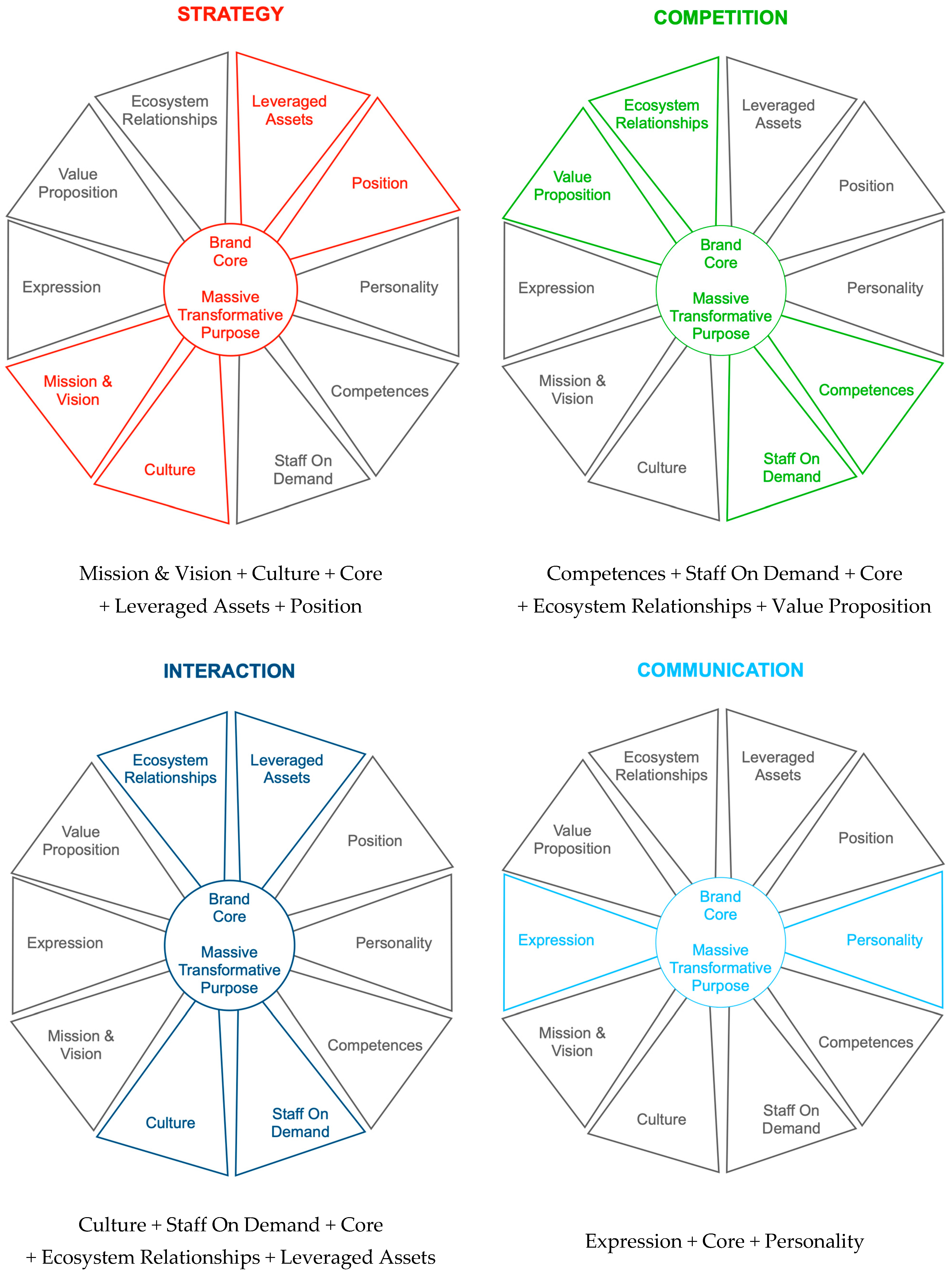
| Dynamic | Dimensions |
|---|---|
| Strategy Diagonal | Mission and Vision + Culture + Core + Leveraged Assets + Position |
| Competition Diagonal | Competences + Staff On Demand + Core + Ecosystem Relationships + Value Proposition |
| Interaction Vertical | Culture + Staff On Demand + Core + Ecosystem Relationships + Leveraged Assets |
| Communication Horizontal | Expression + Core + Personality |
Disclaimer/Publisher’s Note: The statements, opinions and data contained in all publications are solely those of the individual author(s) and contributor(s) and not of MDPI and/or the editor(s). MDPI and/or the editor(s) disclaim responsibility for any injury to people or property resulting from any ideas, methods, instructions or products referred to in the content. |
© 2026 by the authors. Licensee MDPI, Basel, Switzerland. This article is an open access article distributed under the terms and conditions of the Creative Commons Attribution (CC BY) license.
Share and Cite
Derchi, F.; Buratti, N.; Vitellaro, F. Building Corporate Brand Identity in Exponential Organizations: The Role of a Massive Transformative Purpose. Adm. Sci. 2026, 16, 245. https://doi.org/10.3390/admsci16060245
Derchi F, Buratti N, Vitellaro F. Building Corporate Brand Identity in Exponential Organizations: The Role of a Massive Transformative Purpose. Administrative Sciences. 2026; 16(6):245. https://doi.org/10.3390/admsci16060245
Chicago/Turabian StyleDerchi, Francesco, Nicoletta Buratti, and Francesco Vitellaro. 2026. "Building Corporate Brand Identity in Exponential Organizations: The Role of a Massive Transformative Purpose" Administrative Sciences 16, no. 6: 245. https://doi.org/10.3390/admsci16060245
APA StyleDerchi, F., Buratti, N., & Vitellaro, F. (2026). Building Corporate Brand Identity in Exponential Organizations: The Role of a Massive Transformative Purpose. Administrative Sciences, 16(6), 245. https://doi.org/10.3390/admsci16060245