1. Introduction
The rapid advancement of artificial intelligence (AI) has fundamentally transformed how organizations approach decision-making, strategy, and innovation (
Ozturk, 2024;
Ullah et al., 2026). As AI systems become increasingly embedded in organizational processes, they are no longer confined to decision support but are progressively assuming autonomous and agentic roles within organizational infrastructures, reshaping how decisions are generated, evaluated, and executed (
Zhang et al., 2025;
Fontanelli et al., 2025;
Pelayo-Díaz et al., 2026). Within this context, Artificial Intelligence Leadership is not only a mechanism for coordinating technological and human inputs, but also a structuring force through which decision-making authority is increasingly delegated to AI-enabled systems, raising questions about the extent to which innovation processes remain under human control (
Zhang et al., 2025;
Fang et al., 2026;
Cheng et al., 2026).
Existing research predominantly conceptualizes AI-enabled leadership as a complementary mechanism that enhances innovation outcomes by strengthening human capabilities, improving problem-solving processes, and expanding creative potential (
Wang et al., 2024;
Lei et al., 2025;
M. A. Shahzad et al., 2025). Within this stream of research, innovation is generally understood as a socio-technical process in which human and technological resources interact synergistically under leadership coordination (
Helmi et al., 2024;
Yan et al., 2026). Accordingly, prior studies emphasize the importance of human-centered capabilities, including autonomy, creativity, adaptability, and critical thinking, as central drivers of innovation performance (
Chen et al., 2024;
Otache et al., 2025). In this dominant perspective, AI is primarily treated as a supportive and augmentative resource that strengthens and amplifies human involvement in innovation processes (
Wang et al., 2024;
Meier et al., 2026).
Despite these contributions, existing studies remain limited in several important respects. Prior research predominantly examines AI as a capability-enhancing mechanism and rarely investigates whether AI-driven leadership may simultaneously strengthen innovation outputs while weakening human capabilities (
Sahoo et al., 2026). The literature also generally assumes that innovation outcomes continue to depend on human capability development, without explicitly testing whether innovation activity may become structurally decoupled from human agency in AI-enabled systems (
Haq et al., 2025). In addition, empirical studies provide limited evidence on how AI leadership shapes the allocation and utilization of human capabilities within innovation processes, particularly in terms of input substitution, delegated decision-making authority, and system-level output generation in organizational contexts characterized by increasing AI autonomy (
Ke & Luo, 2026). As a result, the governance implications of AI-driven innovation systems remain insufficiently understood.
However, the governance implications of AI-driven organizational systems extend beyond questions of technological efficiency and innovation performance. In particular, it remains unclear how different inputs contribute to innovation outputs and whether observed innovation outputs increasingly reflect autonomous system-level generation mechanisms operating with reduced human involvement (
Subash et al., 2024;
Drydakis, 2026). A key unresolved issue therefore concerns the conditions under which AI-driven systems generate innovation outputs independently of human capability engagement. This raises the possibility that AI-enabled innovation systems may progressively prioritize autonomous output generation over human capability engagement and oversight, thereby creating forms of organizational dependency on AI-driven decision architectures (
Kong & Xu, 2026).
Understanding this relationship is critical, as organizations increasingly rely on AI systems not only to support but also to shape core innovation processes. If human capabilities are not integrated into AI-driven environments, this may lead to forms of misalignment between technological systems and human potential. Such conditions may contribute to the erosion of human agency and critical capabilities, weaken organizational contestability and psychological safety, and create broader risks related to control, accountability, and long-term system adaptability (
Butlewski, 2026). This raises a central organizational and governance issue concerning the extent to which human capability development remains relevant in AI-driven innovation systems. The problem can be understood through the lens of an innovation production function, particularly in terms of input substitution and AI-driven output generation (
Sun & Huang, 2026;
Calvino & Fontanelli, 2026).
These governance and input-substitution dynamics further suggest that innovation outputs may become structurally decoupled from human capability inputs, particularly in AI-driven systems characterized by delegated decision-making authority. However, existing research does not explicitly examine whether AI-driven leadership leads to a decoupling between human capability development and innovation outcomes, particularly in terms of input substitution and AI-driven system-level output generation (
Wei & Xia, 2026;
Loaiza, 2026). Accordingly, the aim of this study is to examine the direct and indirect relationships between Artificial Intelligence Leadership, Human Capabilities, and Innovation Activity. More specifically, the study provides an empirical examination of how AI-driven leadership can generate innovation outcomes while simultaneously displacing human capabilities from the core innovation process and reducing their functional role in innovation output generation.
The study addresses the following research question: Does Artificial Intelligence Leadership create innovation systems that are decoupled from human agency, and what governance implications emerge from such configurations? To address this question, a structural model is developed and empirically tested using data collected from 3079 respondents across multiple industries and regions. The findings provide evidence that diverges from dominant expectations. While Artificial Intelligence Leadership significantly increases innovation activity, it also exerts a negative effect on human capabilities, and these capabilities do not exhibit a significant relationship with innovation outcomes. The findings indicate a structural shift in the innovation production process, where output generation becomes less dependent on human capabilities and increasingly driven by AI-enabled systems operating with delegated decision-making authority. AI-driven leadership is associated with a form of misalignment in which human capabilities are not effectively integrated into innovation processes. This shift results in innovation systems where outputs are generated independently of human capability engagement, raising critical concerns for governance, control, and long-term organizational resilience.
This study advances the existing literature by challenging the dominant assumption that AI-driven innovation systems necessarily operate through human–AI complementarity. The study provides empirical evidence that innovation outputs may emerge independently of human capability development within AI-enabled organizational systems, suggesting that innovation processes can become increasingly detached from direct human capability engagement. The research additionally introduces a governance-oriented perspective on AI leadership by examining how delegated decision-making authority reshapes the relationship between human inputs, technological systems, and innovation outcomes. In doing so, the study extends current debates on AI-enabled innovation beyond efficiency and performance considerations toward broader questions of organizational control, human agency, and long-term system resilience.
In doing so, it reframes the debate from whether AI enhances innovation to how leadership shapes the allocation, substitution, and displacement of human and technological inputs, thereby opening new avenues for research on human–AI complementarity, system-level outcomes, and resource utilization in contemporary organizational settings. In this sense, the study contributes to the literature on technological change and organizational governance by examining how leadership shapes the relationship between AI-driven innovation systems and the role of human agency within them.
2. Literature Review and Hypothesis Development
The rapid diffusion of artificial intelligence across organizational contexts has intensified scholarly attention to the role of leadership in shaping innovation processes and outcomes (
An et al., 2024). Within this stream, Artificial Intelligence Leadership is typically conceptualized as a mechanism through which organizations align technological capabilities with strategic objectives, thereby shaping how innovation processes are structured and increasingly delegated to AI-enabled systems (
Yu & Xu, 2026). Existing research largely adopts an optimistic perspective, suggesting that AI-enabled leadership facilitates knowledge recombination, accelerates problem-solving, and expands the scope of innovation activities (
Brynjolfsson & McAfee, 2014;
Redaputri et al., 2026). By leveraging data-driven insights and predictive analytics, leaders are increasingly able to identify emerging opportunities and support the development of new products, services, and processes (
Calik & Cetinguc, 2026).
Research emphasizing the systemic transformation effects of digital technologies and artificial intelligence in organizational systems is consistent with this view (
Acemoglu & Restrepo, 2020;
Ryberg, 2026;
Breau & Marchand, 2026). In this sense, AI becomes embedded within the core of organizational innovation systems, positioning leadership as a key driver of technologically enabled innovation outcomes (
Dai & Zhang, 2026;
Vafaei-Zadeh et al., 2025). From an organizational and governance perspective, this positioning implies that AI-enabled leadership may influence not only the level of innovation output, but also the degree to which innovation processes are driven by AI-enabled systems and delegated decision architectures. This raises important questions regarding the relative contribution of technological systems and human agency to innovation outcomes (
G. Park et al., 2026;
M. J. Park, 2026).
Building on these arguments, AI leadership can be expected to exert a direct positive effect on innovation activity (
F. Shahzad et al., 2026). The integration of AI into leadership practices enhances the capacity for rapid experimentation, informed decision-making, and systematic opportunity recognition, all of which are essential components of innovation processes (
Li et al., 2026;
Lin et al., 2026). From a system-level perspective, the following hypotheses examine how technological and human inputs jointly shape innovation outputs and the relative role of human and AI-driven processes.
H1: Artificial Intelligence Leadership positively influences Innovation Activity by enabling AI-driven and system-level innovation processes with reduced reliance on human agency.
At the same time, a parallel stream of research emphasizes the importance of human-centered capabilities—such as autonomy, critical thinking, and creativity—as foundational elements of innovation (
Nonaka & Takeuchi, 1995;
Amabile, 1996). These capabilities enable individuals to generate novel ideas, challenge existing assumptions, and engage in exploratory problem-solving (
Alshuaibi et al., 2024;
Cheng et al., 2026). However, the increasing reliance on AI systems may alter the role of these capabilities within organizational contexts. As decision-making becomes increasingly automated and guided by algorithmic outputs, human agency within organizational processes may gradually weaken. Employees may become increasingly reliant on AI-generated recommendations, reducing independent judgment in decision-making activities (
Gao & Wan, 2026). In such contexts, AI systems do not merely support decisions but increasingly structure and constrain how decisions are made, reinforcing dependence on AI-driven outputs.
Recent studies on automation and AI-driven organizational systems suggest that advanced technologies can substitute for certain cognitive and analytical functions traditionally performed by humans (
Acemoglu & Restrepo, 2020;
Ryberg, 2026;
Breau & Marchand, 2026). In leadership contexts, this substitution effect may manifest through the prioritization of data-driven decision-making over human intuition and creativity (
Hao et al., 2026). As a result, AI-driven leadership may structurally erode human agency and reduce the active role of human capabilities, particularly when organizational practices emphasize standardization and system-driven decision structures over autonomy and critical reflection (
Le et al., 2025). In such contexts, the increasing reliance on AI may shift the balance from human-centered capability development toward AI-driven decision-making, potentially altering the role of human capabilities within innovation processes.
H2: Artificial Intelligence Leadership negatively influences Human Capabilities by eroding human agency in innovation processes.
Despite these concerns, the dominant view in the innovation literature maintains that human capabilities are traditionally considered central to innovation processes (
Yang & Wang, 2026). Creativity, domain expertise, and critical evaluation are widely regarded as key drivers of both incremental and radical innovation (
Amabile, 1996). Human actors are typically understood to play a crucial role in interpreting information, generating original ideas, and integrating diverse knowledge sources (
Tang et al., 2025). Even in technologically advanced environments, innovation is often conceptualized as a socio-technical process in which human and technological elements interact synergistically (
Rauner & Stummer, 2025). Accordingly, higher levels of human capabilities are expected to contribute positively to innovation activity. From a socio-technical and organizational perspective, innovation is closely linked to how human and technological systems interact making it essential to understand how AI-driven leadership influences not only the volume and nature of innovation outputs. Individuals who possess greater autonomy, creativity, and critical thinking skills are more likely to engage in idea generation, experimentation, and collaborative exploration (
Giotopoulos et al., 2026). This assumption reflects the traditionally emphasized importance of human agency in shaping innovation outcomes (
Vuong & Bui, 2026).
H3: Human Capabilities positively influence Innovation Activity through their contribution to knowledge creation and problem-solving.
Building on these relationships, prior research frequently assumes that the impact of leadership on innovation is mediated by human capabilities (
Mustafa et al., 2026). Leadership practices are expected to influence how individuals think, act, and engage with innovation processes, thereby indirectly shaping innovation outcomes through their effects on human potential. Within this framework, AI leadership would enhance or constrain innovation depending on its ability to support or undermine human capabilities (
Gazi et al., 2025). However, the coexistence of AI-driven leadership and human-centered capabilities raises the possibility of misalignment and structural decoupling between AI-driven systems and human capabilities.
While AI leadership may enhance innovation through AI-driven decision structures and delegated authority, it may simultaneously weaken the human capabilities that are traditionally considered essential for innovation. This creates a potential indirect pathway in which the negative effect of AI leadership on human capabilities does not necessarily constrain innovation activity (
Tran et al., 2025). This potential divergence suggests that innovation systems may operate under conditions of misalignment, where AI-driven systems autonomously generate observable outputs, while human capabilities are not fully utilized as productive resources within the innovation process (
Wadho & Chaudhry, 2024).
H4: Artificial Intelligence Leadership has a negative indirect effect on Innovation Activity through Human Capabilities, reflecting potential misalignment between AI-driven systems and human agency.
AI Leadership, Agentic Systems, and Governance Risk
The increasing integration of artificial intelligence into organizational systems has led to the emergence of agentic AI, in which technological systems no longer function solely as tools supporting human decision-making, but increasingly operate as autonomous or semi-autonomous actors within decision structures (
Giannitsas et al., 2026). In such configurations, AI systems are capable of generating, evaluating, and executing decisions with limited or no direct human intervention, effectively transforming the role of leadership from decision-making to the design and oversight of system architectures. This shift redefines Artificial Intelligence Leadership as a governance mechanism that shapes not only how decisions are made, but also who or what is making them, reflecting broader transformations associated with algorithmic authority and automated decision-making systems (
Bostrom, 2014;
Luengo Vera et al., 2026).
The rise in agentic AI systems introduces a fundamental challenge of accountability. As decision-making authority becomes distributed across human and technological actors, it becomes increasingly unclear where responsibility resides when outcomes are generated by AI-driven systems (
Mansouri et al., 2025). Traditional models of managerial accountability assume identifiable human decision-makers; however, in AI-enabled environments, decisions may emerge from complex interactions between algorithms, data inputs, and system-level processes. This creates a condition in which accountability becomes structurally obscured and difficult to attribute, raising critical governance concerns regarding responsibility for errors, unintended consequences, and innovation outcomes generated without direct human control, consistent with critiques of algorithmic opacity and the “black box” nature of AI systems (
Pasquale, 2015;
Goldsmith & Yang, 2026).
Closely related to accountability is the issue of contestability, referring to the extent to which decisions generated by AI systems can be questioned, challenged, or overridden by human actors. In highly automated environments, decision processes may become opaque, reducing the ability of individuals to critically evaluate or contest AI-generated outputs. As AI systems increasingly structure and constrain decision-making processes, human actors may experience reduced capacity to intervene, leading to a form of system-level procedural closure in which innovation outcomes are accepted without meaningful scrutiny. This dynamic reflects broader concerns regarding the social consequences of automated decision systems and the marginalization of human judgment (
Zuboff, 2019;
Herrera & Calderón, 2026).
Taken together, these developments indicate that AI-driven leadership is not only a driver of innovation processes, but also a source of governance risk. When innovation systems operate through delegated decision-making structures and reduced human intervention, organizations may achieve high levels of output while simultaneously weakening mechanisms of control, accountability, and critical oversight. This creates conditions for misaligned innovation, where system-level performance is maintained or enhanced, but without corresponding human engagement or governance safeguards (
Liu et al., 2026;
Saeed & Prybutok, 2026). Understanding this transformation is essential for interpreting how AI leadership reshapes the relationship between technological systems, human agency, and innovation outcomes, particularly in contexts where innovation outputs may emerge independently of human capability engagement and outside traditional governance controls.
3. Methodology
The empirical data were collected through an online survey administered via the Prolific platform over a twelve-month period, from March 2025 to March 2026. This platform was selected due to its established reliability in providing high-quality, diverse, and pre-screened respondent pools suitable for behavioral and organizational research. The study adopts a cross-sectional, explanatory research design aimed at examining causal relationships between artificial intelligence leadership, human capabilities, and innovation activity. To ensure the validity and relevance of the sample, a multi-stage screening procedure was implemented prior to questionnaire completion. Participation was restricted to respondents employed in organizations where artificial intelligence tools or systems are actively used in daily business operations, thereby ensuring that all participants had direct exposure to AI-enabled work environments. Additionally, only individuals currently employed, either full-time or part-time, were included in the final sample to maintain consistency in organizational experience.
Further screening criteria were applied to ensure an adequate level of familiarity with AI usage within the organization. Respondents were required to demonstrate at least a moderate understanding of how AI systems are integrated into work processes, thereby reducing the risk of uninformed or speculative responses. In addition, the sample was limited to individuals who are at least occasionally involved in decision-making, problem-solving, or innovation-related tasks, ensuring that responses reflect meaningful engagement with organizational processes relevant to the study. This screening strategy allowed for the exclusion of low-quality or non-relevant responses and ensured that the final dataset reflects informed perceptions of AI-supported organizational environments and their implications for innovation-related outcomes.
The empirical analysis is based on a large and structurally diverse sample of 3079 respondents, providing a robust foundation for examining the relationships between AI leadership, human capabilities, and innovation outcomes. The gender distribution is relatively balanced, with 51.9% male and 48.1% female participants, reducing the likelihood of gender-based bias and enhancing the generalizability of the findings. In terms of age, the sample is dominated by economically active cohorts, with the largest proportion of respondents aged 31–40 years (28.2%), followed by 18–30 years (22.5%) and 41–50 years (20.5%). This distribution indicates a concentration of participants in mid-career stages, which is particularly relevant for studying leadership dynamics and innovation processes. However, a minor irregularity is observed in the age variable, where 5.0% of responses fall into an undefined category (“6”), suggesting a minor coding inconsistency that does not affect the overall distribution or subsequent analysis; this does not substantially affect the overall distribution but should be acknowledged for transparency.
The educational structure of the sample is notably high, with 40.3% of respondents holding a master’s degree and 19.2% a doctoral degree, while 32.2% have completed a bachelor’s degree. This indicates that over 90% of participants possess tertiary education, supporting the assumption that respondents are capable of engaging with complex organizational and technological constructs such as AI-driven leadership and innovation systems. The employment structure further reinforces this interpretation, as the majority of participants occupy knowledge-intensive roles, including specialists or professionals (40.3%) and middle management (23.3%), while entry-level employees account for 24.5% and senior management for 11.9%. This distribution ensures that the sample captures both operational and strategic perspectives within organizations.
Sectoral representation is heterogeneous, with the largest share coming from IT and software (23.5%), followed by manufacturing (13.4%), finance and banking (13.9%), marketing and media (12.9%), consulting (10.4%), and tourism and hospitality (10.5%), alongside 15.3% from other industries. Such diversity enhances the external validity of the study by encompassing multiple innovation contexts, from technology-intensive environments to service-oriented sectors. Similarly, firm size distribution is balanced across small, medium, and large enterprises, with 32.2% of respondents working in firms employing 50–249 employees, 29.4% in firms with 10–49 employees, 19.5% in large organizations (250+), and 18.9% in micro-enterprises (<10). This spread allows for the examination of AI leadership across different organizational scales.
Geographically, the sample demonstrates strong international coverage, including respondents from Western Europe (11.5%), Eastern Europe and the Balkans (9.5%), North America (10.8%), Latin America (9.1%), the United Kingdom and Ireland (7.5%), Nordic countries (10.1%), Southern Europe (10.1%), the Middle East and North Africa (10.4%), South and Southeast Asia (10.0%), and Australia and New Zealand (11.0%). The relatively even distribution across regions reduces geographic bias and supports the cross-contextual relevance of the findings, particularly important for a phenomenon such as AI leadership, which operates within globally interconnected innovation systems. Work experience is well distributed, with the largest group having 5–10 years of experience (26.3%), followed by 1–3 years (23.4%), more than 10 years (20.4%), and 3–5 years (20.1%), while only 9.9% report less than one year of experience. This indicates that the majority of respondents possess sufficient professional exposure to evaluate leadership practices and innovation processes. Finally, the frequency of AI tool usage confirms the relevance of the sample for the research context: 35.2% of respondents report daily use of AI, 30.6% weekly use, and 24.7% occasional use, while only 9.5% report never using AI. This distribution suggests that the sample is strongly embedded in AI-enabled work environments, making it appropriate for investigating the dynamics of AI leadership and its potential misalignment with human capabilities.
The sample structure reflects a highly educated, professionally active, and globally distributed population with substantial exposure to artificial intelligence in organizational settings. This composition provides a credible empirical basis for testing the proposed structural model and supports the validity of conclusions regarding the interplay between AI leadership, human capabilities, and innovation outcomes.
A structured questionnaire was designed to examine how Artificial Intelligence Leadership influences Human Capabilities and Innovation Activity within AI-enabled organizational contexts. The instrument was developed using a deductive approach grounded in prior literature on technological change, human agency, and innovation performance (e.g.,
Brynjolfsson & McAfee, 2014;
Meyer & Rowan, 1977), as well as more recent research addressing AI-enabled organizational transformation. An initial pool of 35 items was generated to capture multiple dimensions of AI-supported work environments and innovation processes. The item development process combined theoretical grounding with contextual adaptation to reflect contemporary AI-driven organizational practices. Subsequently, the questionnaire underwent a refinement phase aimed at improving clarity, eliminating redundancy, and ensuring content validity.
Following this process, a total of 25 items were retained for analysis. All items were measured using a five-point Likert scale ranging from 1 (“strongly disagree”) to 5 (“strongly agree”), which is widely applied in studies examining organizational behavior, technological adoption, and innovation-related perceptions. This scaling approach enables the reliable quantification of latent variables and supports the application of multivariate statistical techniques. To reduce the risk of common method bias, procedural remedies were applied, including the use of clear item wording, assured anonymity of responses, and separation of measurement of predictor and criterion variables within the questionnaire structure. The final instrument captures both technological and human dimensions of organizational functioning, as well as their implications for innovation-related outcomes. Such operationalization is consistent with prior research emphasizing the interaction between technological systems and human agency as a key determinant of organizational efficiency and performance in digitally transformed environments.
The data were analyzed using a multistep approach combining exploratory and confirmatory techniques in order to ensure the robustness and validity of the measurement and structural models. All statistical analyses were conducted using IBM SPSS Statistics (version 27) and IBM SPSS AMOS (version 27). In the first stage, exploratory factor analysis (EFA) was performed to examine the underlying structure of the measurement instrument and to assess the dimensionality of the data. Prior to extraction, sampling adequacy and factorability were evaluated using the Kaiser–Meyer–Olkin (KMO) measure and Bartlett’s Test of Sphericity. Factor extraction was conducted using the maximum likelihood method, as it allows for statistical testing and is consistent with subsequent confirmatory procedures. An oblique rotation (direct oblimin) was applied, given the theoretical expectation that the underlying dimensions are correlated.
Following the exploratory phase, confirmatory factor analysis (CFA) was employed to validate the measurement model. The CFA assessed the relationships between observed indicators and their corresponding latent variables, as well as the overall fit of the model to the data. Model fit was evaluated using multiple indices, including the chi-square statistic (χ2), the normed chi-square (χ2/df), goodness-of-fit indices (GFI, AGFI), incremental fit indices (CFI, TLI, IFI, NFI), and the root mean square error of approximation (RMSEA) with confidence intervals and PCLOSE values. This combination of indices provides a comprehensive assessment of model adequacy, balancing absolute, incremental, and parsimonious fit.
Construct reliability and convergent validity were assessed using composite reliability (CR) and average variance extracted (AVE). CR values above 0.70 were considered indicative of satisfactory internal consistency, while AVE values exceeding 0.50 confirmed that the constructs explain a sufficient proportion of variance in their indicators. Discriminant validity was evaluated using the Fornell–Larcker criterion, by comparing the square roots of AVE with inter-construct correlations, as well as the heterotrait–monotrait ratio (HTMT), with values below 0.85 indicating adequate discriminant validity. In the final stage, structural equation modeling (SEM) was applied to test the hypothesized relationships among the variables. The structural model was estimated using the maximum likelihood method, allowing for the simultaneous assessment of direct and indirect effects. Path coefficients were evaluated based on their standardized estimates, critical ratios (C.R.), and significance levels (p-values). Mediation effects were examined through the estimation of indirect paths, enabling the identification of underlying transmission mechanisms between variables.
From an organizational and governance perspective, the modeling strategy allows for the interpretation of innovation-related outcomes as indicators of system-level organizational performance, where technological inputs (AI integration) and human agency jointly shape innovation outcomes. The model can be interpreted as a conceptual innovation production function, in which artificial intelligence represents a technological input and human capabilities represent a form of human agency influencing system-level outcomes. In this context, the structural relationships capture not only behavioral dynamics but also the allocation and configuration of resources within AI-enabled organizational environments. The explanatory power of the model is assessed using the coefficient of determination (R2) for endogenous variables, providing a direct measure of how interactions between technological systems and human capabilities account for variation in innovation outcomes. This approach ensures a rigorous evaluation of both measurement and structural relationships while situating the findings within a broader governance framework of AI-driven organizational systems.
4. Results
The Kaiser–Meyer–Olkin (KMO) value of 0.958 indicates excellent sampling adequacy, far exceeding the recommended threshold of 0.60, and confirms that the data are highly suitable for factor analysis. Bartlett’s Test of Sphericity is statistically significant (χ2 = 52,138.681; df = 300; p < 0.001), rejecting the null hypothesis that the correlation matrix is an identity matrix. Together, these results demonstrate that the variables are sufficiently intercorrelated and that factor analysis is both appropriate and methodologically justified.
The results presented in
Table 1 indicate a clear four-factor solution, with all retained factors exceeding the Kaiser criterion (eigenvalue > 1). The first factor accounts for 35.81% of the total variance, followed by the second (17.56%), third (10.25%), and fourth factor (6.52%). Cumulatively, the four factors explain 70.14% of the total variance, which exceeds the commonly accepted threshold of 60% in social sciences, indicating strong explanatory power of the measurement model. The substantial contribution of the first two factors suggests a dominant underlying structure, while the additional factors capture meaningful but more specific dimensions of the constructs. The rotated solution further confirms a stable and interpretable factor structure, supporting the adequacy of the measurement model for subsequent confirmatory and structural analyses.
The oblimin-rotated pattern matrix presented in
Table 2 reveals a clear and theoretically consistent four-factor structure, corresponding to AI Leadership (AIL), AI Intensity/Usage (AIU), Human Capabilities (HC), and Innovation Activity (IA). The results demonstrate strong convergent validity, as all items load highly on their intended constructs, while cross-loadings remain negligible, supporting discriminant validity. Items associated with AI Leadership (AI Decision, AI Encouragement, AI Strategy, AI Insights, AI Promotion, AI Experimentation, and AI Influence) exhibit high loadings on the first factor, ranging from 0.790 to 0.826. These consistently strong coefficients indicate a well-defined latent construct capturing the strategic and operational role of leadership in integrating AI into organizational processes. Cross-loadings for these items are close to zero, confirming that AI Leadership is empirically distinct from the other dimensions. The second factor, AI Intensity/Usage, is defined by Process Integration, Decision Support, Task Reliance, System Integration, and AI Diffusion, all of which demonstrate very high loadings between 0.838 and 0.873. This suggests a particularly robust and internally consistent construct reflecting the extent to which AI is embedded in everyday work processes and organizational systems. The absence of meaningful cross-loadings further reinforces the independence of this dimension.
Human Capabilities, represented by Decision Autonomy, Critical Thinking, Creative Freedom, AI Challenge, Independent Judgment, Human Expertise, and Human Value, load strongly on the third factor, with coefficients ranging from 0.780 to 0.803. These results confirm that the construct captures a coherent set of human-centered competencies, including cognitive autonomy, creativity, and the ability to critically engage with AI outputs. Again, cross-loadings are minimal, supporting the distinctiveness of this factor. The fourth factor, Innovation Activity, includes Idea Generation, Solution Experimentation, Product Development, Innovation Routine, Team Collaboration, and AI Ideation, with loadings ranging from −0.718 to −0.767. Although these loadings are negative, their magnitude is high and consistent, which is not problematic in oblique rotation, as factor polarity is arbitrary and does not affect interpretation. The uniformity of these loadings indicates a stable construct capturing the intensity and regularity of innovation processes within organizations.
Overall, as shown in
Table 2, the pattern matrix confirms a clean and interpretable factor structure with strong loadings on intended constructs and negligible cross-loadings. The use of oblimin rotation allows for correlations among factors, which is theoretically appropriate given the interrelated nature of leadership, technology use, human capabilities, and innovation. These findings provide strong empirical support for the validity and reliability of the measurement model, justifying its application in subsequent confirmatory factor analysis and structural equation modeling.
The measurement model demonstrates excellent fit to the data across multiple indices. The chi-square statistic is significant (χ2 = 316.820; df = 269; p = 0.024), which is expected given the large sample size; therefore, greater emphasis is placed on relative and incremental fit indices. The normed chi-square (CMIN/DF = 1.178) is well below the recommended threshold of 3, indicating a very good fit. Absolute fit indices confirm model adequacy, with a very low RMR value (0.005) and high goodness-of-fit values (GFI = 0.992; AGFI = 0.990), all exceeding recommended thresholds. Incremental fit indices are exceptionally strong, including NFI = 0.994, TLI = 0.999, IFI = 0.999, and CFI = 0.999, indicating an excellent fit relative to the null model. The RMSEA value is extremely low (RMSEA = 0.008), with a narrow confidence interval (0.003–0.011) and PCLOSE = 1.000, confirming a close fit in the population. Parsimony-adjusted indices (PNFI = 0.891; PCFI = 0.896) indicate a well-balanced model in terms of fit and complexity. Information criteria (AIC = 428.820; ECVI = 0.139) are substantially lower compared to the independence model, supporting model parsimony and generalizability. High Hoelter indices (2995 at the 0.05 level and 3167 at the 0.01 level) further confirm the stability and robustness of the model. These results provide strong empirical support for the validity of the measurement model and justify its use in subsequent structural equation modeling.
The results presented in
Table 3 indicate strong internal consistency and convergent validity across all constructs. Composite reliability (CR) values range from 0.887 to 0.933, exceeding the recommended threshold of 0.70, which confirms high reliability of the latent constructs. The highest reliability is observed for AI Leadership and AI Intensity, reflecting particularly stable and coherent measurement structures.
Average Variance Extracted (AVE) values range from 0.565 to 0.736, all above the recommended threshold of 0.50, indicating that each construct explains more than half of the variance of its indicators. AI Intensity demonstrates the strongest convergent validity (AVE = 0.736), while Innovation Activity, although slightly lower (AVE = 0.565), still meets acceptable criteria. These findings confirm that the measurement model satisfies established standards for reliability and convergent validity, supporting the adequacy of the constructs for subsequent structural analysis. The results presented in
Table 4 indicate that discriminant validity is established according to the Fornell–Larcker criterion. The square roots of average variance extracted for all constructs (ranging from 0.752 to 0.858) exceed the corresponding inter-construct correlations, demonstrating that each construct shares more variance with its own indicators than with other constructs.
The findings reported in
Table 5 further confirm discriminant validity using the heterotrait–monotrait ratio. All values are well below the conservative threshold of 0.85, with the highest value observed between Artificial Intelligence Leadership and Innovation Activity (0.748), which remains within acceptable limits. Lower values across other construct pairs further support the distinctiveness of the constructs. These results provide strong evidence that the measurement model satisfies rigorous criteria for discriminant validity, confirming that Artificial Intelligence Leadership, Artificial Intelligence Intensity/Usage, Human Capabilities, and Innovation Activity represent empirically distinct dimensions.
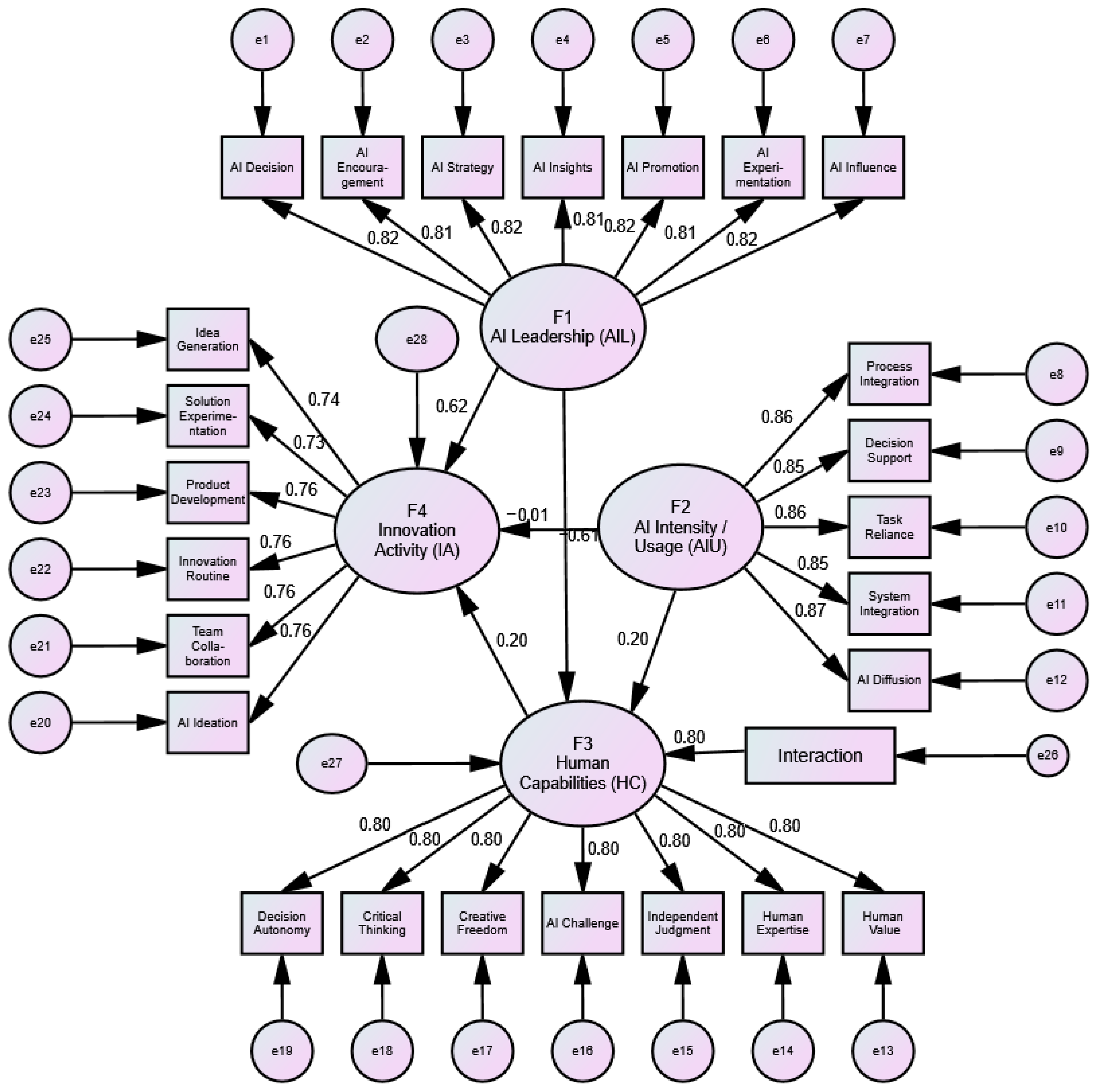
The structural model demonstrates excellent fit to the data. The chi-square value is low relative to the degrees of freedom (χ
2 = 316.823; df = 270;
p = 0.026), with a normed chi-square of 1.173, indicating a very good fit. Incremental fit indices are exceptionally high (CFI = 0.999; TLI = 0.999; IFI = 0.999), well above recommended thresholds. Absolute fit indices also confirm adequacy (RMR = 0.005; GFI = 0.992; AGFI = 0.990). The RMSEA value is extremely low (0.008; PCLOSE = 1.000), indicating a close fit in the population. These results indicate that the structural model fits the data very well and supports further interpretation of the hypothesized relationships. From an economic perspective, this strong model fit supports the interpretation of the estimated relationships as reflecting underlying efficiency dynamics in the innovation production process. As shown in
Figure 1, the structural model reveals a differentiated pattern of relationships between artificial intelligence leadership, human capabilities, and innovation activity.
Table 6 presents the results of the structural model analysis. The findings indicate that Artificial Intelligence Leadership has a strong and statistically significant positive effect on Innovation Activity (β = 0.616,
p < 0.001), thereby supporting H1. This result suggests that the integration of artificial intelligence into leadership practices substantially enhances innovation processes and outcomes, indicating increased output, not necessarily efficiency within organizations. At the same time, Artificial Intelligence Leadership exerts a significant negative effect on Human Capabilities (β = −0.568,
p < 0.001), confirming H2. This finding implies that increased reliance on AI-driven leadership is associated with a reduction in employees’ autonomy, critical thinking, and creative engagement, reflecting a decline in the effective utilization of human agency. In contrast, the effect of Human Capabilities on Innovation Activity is not statistically significant (β = 0.011,
p = 0.616), leading to the rejection of H3. This result indicates that, within the tested model, human capabilities do not play a direct role in explaining innovation outcomes. Overall, the results reveal a pattern in which Artificial Intelligence Leadership simultaneously strengthens innovation activity while diminishing human capabilities, indicating a shift in the innovation production function toward technology-driven efficiency with limited contribution of human agency.
Table 7 presents the results of the mediation analysis. The findings indicate that the indirect effect of Artificial Intelligence Leadership on Innovation Activity through Human Capabilities is negligible and not statistically supported (indirect effect = −0.006). Although Artificial Intelligence Leadership significantly reduces Human Capabilities and exhibits a strong direct positive effect on Innovation Activity, the non-significant relationship between Human Capabilities and Innovation Activity prevents the establishment of a meaningful mediation pathway. Consequently, H4 is not supported, as Human Capabilities do not mediate the relationship between Artificial Intelligence Leadership and Innovation Activity. This result suggests that the influence of AI leadership on innovation operates primarily through a direct pathway, suggesting a misalignment between technological inputs and human agency rather than through changes in human capabilities.
As shown in
Table 8, the model demonstrates a moderate level of explanatory power for the endogenous constructs. Specifically, approximately 40% of the variance in F3 is explained by its predictors, while 38% of the variance in F4 is accounted for by the model. These findings indicate that the proposed model captures a substantial portion of variance in innovation-related outcomes, which is particularly relevant given the complexity of AI-driven organizational environments. According to commonly accepted thresholds in structural equation modeling, R
2 values within this range suggest meaningful explanatory capacity.
At the same time, the remaining unexplained variance points to the presence of additional factors not included in the model, reinforcing the notion that innovation efficiency is influenced by a broader set of technological, human, and organizational conditions. This further supports the interpretation that innovation outcomes are driven primarily by AI-enabled efficiency and reduced dependence on the effective contribution of human agency.
5. Discussion
The findings provide a nuanced perspective on the relationship between artificial intelligence leadership, human capabilities, and innovation activity, moving beyond dominant assumptions of straightforward complementarity. This pattern should not be interpreted as a simple efficiency gain, but rather as an early signal of the displacement of human agency and a process of capability atrophy within AI-driven innovation systems. It also indicates a parallel cultural shift within organizations, where increasing reliance on AI-driven systems may normalize algorithmic authority, reinforce compliance-oriented behaviors, and gradually erode critical and autonomous forms of human engagement in innovation processes. This shift also reshapes the culture of work, affecting how status, belonging, and professional competence are defined, particularly in environments where AI-generated metrics increasingly outweigh human judgment, potentially undermining psychological safety and reducing the perceived value of human expertise. The empirical results support the direct positive effect of Artificial Intelligence Leadership on innovation activity (H1) and confirm its negative impact on human capabilities (H2), while the expected contribution of human capabilities to innovation activity is not supported (H3), and no evidence of a mediation mechanism is found (H4). From a system-level and governance perspective, the results indicate that innovation outputs may be increasingly generated within a decoupled innovation system, where AI-enabled processes operate independently of human capability engagement. These findings are particularly relevant in the context of agentic AI systems, where decision-making authority is increasingly embedded within autonomous technological infrastructures.
While Artificial Intelligence Leadership demonstrates a strong and statistically significant positive effect on innovation activity, it simultaneously exerts a substantial negative influence on human capabilities. At the same time, human capabilities do not exhibit a significant direct effect on innovation activity. This configuration does not support a mediation mechanism and calls for a more careful interpretation of how technological and human inputs are currently combined within organizational production systems. The results instead point to a form of input misalignment between human capabilities and AI-driven innovation processes. This configuration can be conceptualized as innovation under misalignment, where innovation metrics improve while organizational intelligence and human judgment are progressively weakened.
In this sense, innovation appears to be increasingly generated within a decoupled innovation system, where AI-enabled processes operate without meaningful integration of human autonomy, critical thinking, and creativity. The findings empirically demonstrate a configuration consistent with runaway technological optimization, where innovation outputs are generated through delegated autonomy at speed, without proportional human agency involvement. This pattern reflects a structural decoupling in the innovation system, where technological inputs drive output generation while human agency is progressively detached from the production of innovation outcomes. This finding challenges the widely held assumption that AI adoption naturally enhances human-centered innovation (
Nonaka & Takeuchi, 1995;
Amabile, 1996).
Instead, the findings suggest that leadership practices may prioritize system-level output, speed, and data-driven decision-making. This may reinforce technology-dominant innovation configurations characterized by increasing decoupling from human agency. This interpretation aligns with the broader debate on augmentation versus substitution in AI-enabled organizations (
Brynjolfsson & McAfee, 2014;
Acemoglu & Restrepo, 2020). While much of the literature emphasizes the augmentative role of AI in expanding human capabilities, the present findings suggest that leadership practices may, in effect, facilitate a decoupling dynamic, where AI systems assume a central role in generating innovation outputs independently of human agency. Importantly, this should not be interpreted as a technological inevitability, but rather as a consequence of organizational choices regarding the allocation and integration of resources.
From a theoretical standpoint, the results can be further interpreted through the lens of institutional decoupling (
Meyer & Rowan, 1977). Organizations may continue to emphasize the importance of human capabilities at a symbolic level, while operationally relying on AI-driven systems to produce innovation outcomes. This creates a structural decoupling between formally endorsed human-centered values and AI-driven production practices, where human agency is recognized but not efficiently incorporated into value creation processes. Such a configuration reflects not the absence of human capabilities, but their inefficient deployment within AI-driven systems.
Importantly, the absence of a significant relationship between human capabilities and innovation activity should not be interpreted as evidence that human contributions are obsolete. Rather, it indicates that current organizational configurations may fail to translate human potential into measurable outputs, particularly in environments where AI systems dominate idea generation, evaluation, and implementation processes. Human capabilities—such as critical reflection, contextual judgment, and creative synthesis—may remain essential for complex and non-routine innovation, even if their contribution is not immediately captured in system-level performance indicators within AI-driven environments.
From a managerial perspective, the findings highlight a critical trade-off: organizations may increase innovation outputs through AI-driven leadership while simultaneously reinforcing a decoupled configuration in which human agency is progressively marginalized. This decoupling may not generate immediate declines in observable performance, but it raises important concerns regarding long-term system-level outcome dynamics, including reduced adaptability, diminished exploratory capacity, and potential path dependency. Over time, excessive reliance on AI-driven processes may lead to optimization without diversification, limiting the scope for transformative innovation. While such systems may increase speed and short-term output, they may also become fast but brittle, with reduced capacity for learning, adaptation, and effective recovery following failure or disruption. This dynamic may further contribute to forms of runaway optimization, in which AI-driven systems continuously refine outputs according to internally defined performance criteria, without adequate alignment with broader organizational or human-centered objectives. In such conditions, innovation processes become shaped by delegated autonomy, where decision-making authority is systematically transferred to AI systems, reducing the scope for human intervention and strategic redirection. This configuration ultimately reflects a condition of human–AI misalignment, in which technological systems operate according to optimization logics that are not fully aligned with human judgment, organizational values, or long-term innovation priorities.
The study, therefore, contributes to the literature by shifting the focus from whether AI enhances innovation to how leadership shapes the allocation and interaction of technological and human inputs. Taken together, the findings suggest that AI-driven leadership reconfigures the innovation system by enabling decoupled output generation while simultaneously weakening the role of human agency in innovation processes. The results suggest that the key issue is not the presence of AI itself, but the extent to which leadership practices enable meaningful integration between human and AI systems while preventing structural decoupling. In this sense, Artificial Intelligence Leadership emerges not only as a driver of innovation, but also as a potential source of governance risk when human capabilities are not effectively integrated. This study advances a process-based understanding of AI-driven innovation by demonstrating that leadership can enable the emergence of autonomous innovation configuration in which outputs are generated independently of human agency. In doing so, it reframes artificial intelligence leadership from a coordination mechanism to a governance structure that shapes the distribution of decision authority, the degree of system autonomy, and the alignment between technological processes and human judgment.
This configuration indicates that innovation may increasingly occur without active human agency, as leadership practices enable the emergence of semi-autonomous or agentic systems capable of generating, evaluating, and implementing innovation processes. In such environments, Artificial Intelligence Leadership does not merely coordinate human and technological inputs, but actively facilitates the delegation of decision-making authority to AI-driven systems that structure task allocation, define performance metrics, and implicitly determine what constitutes valuable work and who is recognized as a capable contributor. As AI-driven processes increasingly dominate innovation activities, critical questions emerge regarding decision rights and escalation: who retains the authority to override system-generated outputs, and under what conditions can innovation processes be halted or redirected? The erosion of human capabilities further affects organizational voice and dissent, reducing the likelihood that individuals will challenge or question AI-generated decisions, and potentially weakening the capacity for early error detection within innovation processes. As a result, innovation outcomes are not only decoupled from human capabilities, but are increasingly produced through system-level processes characterized by reduced human intervention and heightened algorithmic autonomy.
The findings call for a more balanced approach to AI-driven innovation, one that moves beyond efficiency-oriented implementation toward models of human–AI complementarity. Future research should further examine the conditions under which human agency can be more effectively integrated into AI-driven production systems, particularly in contexts requiring creativity, strategic judgment, and adaptive problem-solving. These findings contribute to the emerging literature on AI-driven organizational systems and governance by suggesting that AI-driven leadership may enable innovation outcomes through decoupled system-level processes, even in the absence of active human capability engagement, but potentially at the cost of long-term adaptability, controllability, and organizational governance stability. The emergence of structural decoupling raises fundamental governance challenges, particularly in relation to accountability. In such conditions, critical questions emerge: who is responsible when AI-driven innovation outcomes cause harm or fail, and who retains the authority to contest or intervene in system-generated decisions? In such configurations, the capacity for contestability is reduced, limiting the ability of individuals to critically evaluate, challenge, or override AI-generated decisions, thereby reinforcing system-level autonomy. This reflects the absence of clear accountability routing, underdeveloped contestability pathways, limited auditability, and a reduced capacity to review, correct, and repair AI-driven decisions within organizational processes.
This also reflects a broader governance deficit characterized by limited oversight, reduced managerial control, and increasingly invisible decision processes embedded within AI-driven systems. As decision-making becomes internalized within algorithmic infrastructures, the visibility of how outcomes are produced is diminished, constraining the ability of organizations to monitor, interpret, intervene in, and effectively repair innovation processes when failures or unintended outcomes occur. Such conditions further amplify the risks associated with autonomous system operation, as decisions may be executed without transparent justification or effective human supervision, consistent with concerns regarding algorithmic opacity and accountability gaps in AI-driven environments (
Pasquale, 2015;
Goldsmith & Yang, 2026;
Mansouri et al., 2025). This configuration ultimately represents a form of governance failure, in which organizations deploy increasingly autonomous innovation systems without establishing corresponding mechanisms of oversight, control, and accountability capable of governing them.
Consequently, Artificial Intelligence Leadership must be understood not only as a driver of innovation, but as a governance mechanism responsible for maintaining control, ensuring accountability, and preserving meaningful human oversight in increasingly agentic organizational systems. Ultimately, the key challenge is no longer whether organizations adopt artificial intelligence, but whether they retain meaningful human control over innovation systems that are increasingly capable of operating without them.
6. Governance Implications: A Diagnostic Framework for Human–AI Alignment
The findings indicate that AI-driven innovation systems may operate under conditions of structural decoupling, in which innovation outputs are generated independently of human agency. This raises the need for a systematic approach to diagnosing the degree of alignment between human capabilities and AI-enabled processes. To address this issue, the study proposes a diagnostic framework conceptualized as an AI–Human Alignment Index, designed to assess the extent to which innovation systems remain governed, controllable, and meaningfully integrated with human agency. The AI–Human Alignment Index is structured around three core dimensions conceptually derived from the interpretation of the empirical findings and their theoretical implications, rather than representing directly measured constructs. The first dimension, Human Agency Integration, refers to the extent to which human actors are actively involved in decision-making, evaluation, and innovation processes. Low levels of integration indicate that innovation processes are increasingly decoupled from human capabilities, while higher levels suggest meaningful engagement and oversight.
The second dimension, Decision-Making Authority Distribution, captures the degree to which decision-making authority is delegated to AI systems. In highly agentic environments, decision authority becomes concentrated within algorithmic systems, reducing human control and increasing system autonomy. Balanced configurations are characterized by shared or conditional delegation, where human actors retain the ability to intervene and redirect decision processes. The third dimension, Governance Visibility and Control, reflects the extent to which decision processes remain transparent, observable, and contestable. Low visibility environments are characterized by opaque, internally executed algorithmic processes, limiting the ability of organizations to monitor and challenge decisions. High visibility environments, by contrast, enable traceability, interpretability, and effective oversight of AI-driven decisions. Taken together, these dimensions allow organizations to diagnose whether their innovation systems operate under conditions of alignment, partial decoupling, or full structural decoupling. In particular, configurations characterized by high innovation outputs combined with low human agency integration and high levels of delegated autonomy may be identified as instances of innovation under misalignment, representing a critical governance risk profile.
To enhance operational applicability, each dimension of the AI–Human Alignment Index can be assessed using observable indicators and structured diagnostic items measured on Likert-type scales (1 = strongly disagree; 5 = strongly agree). Human Agency Integration may be evaluated through items such as: “Employees are actively involved in key decision-making processes,” “Team members can critically challenge AI-generated recommendations,” and “Innovation tasks require human judgment and autonomy.” Decision-Making Authority Distribution may be assessed using items such as: “Decisions are frequently executed automatically by AI systems,” “Human override of AI decisions is possible and regularly used,” and “AI-generated recommendations are followed without modification.” Governance Visibility and Control can be measured through items such as: “AI decision processes are transparent and explainable,” “We can trace how AI-generated outcomes are produced,” and “There are formal mechanisms to review and contest AI decisions.” These indicators enable organizations to quantify alignment levels across dimensions and compare configurations over time. This set of indicators can be conceptualized as the AI–Human Alignment Diagnostic Scale (AI-HADS), providing a structured instrument for assessing alignment across organizational contexts.
From a managerial perspective, the index can be applied as a periodic diagnostic tool (e.g., quarterly or biannual assessment). Scores for each dimension can be averaged to produce a profile of the organization’s innovation system. To provide an overall alignment assessment, dimension scores can be aggregated into a composite index by calculating the mean value across all three dimensions. Lower composite scores indicate increasing levels of structural decoupling, while higher scores reflect stronger alignment between human agency and AI-driven processes. High-risk configurations are identified when Human Agency Integration scores are low (e.g., below 3), Decision-Making Authority Distribution reflects high AI dominance (e.g., above 4), and Governance Visibility and Control scores are low (e.g., below 3). When such configurations are accompanied by high levels of innovation output, they signal a condition of innovation under misalignment, where performance gains may mask underlying capability erosion. In such cases, organizations should implement corrective actions, including increasing human involvement in decision loops, introducing mandatory human validation checkpoints, and strengthening transparency and audit mechanisms. Balanced configurations are characterized by moderate delegation, active human participation, and high transparency, indicating a more controllable and sustainable innovation system.
Systems characterized by low human agency integration, high delegated autonomy, and low governance visibility represent high-risk configurations associated with systemic governance failure. Conversely, systems that maintain human involvement, balanced authority distribution, and high transparency are more likely to achieve sustainable and controllable innovation outcomes. This framework contributes by translating the abstract notion of human–AI misalignment into an operationalizable diagnostic tool grounded in empirical findings that can be applied across organizational contexts. It enables managers and researchers to move beyond binary assumptions of AI adoption and instead evaluate how innovation systems are structured, governed, and controlled in practice. In doing so, it provides a foundation for future research on governance mechanisms capable of restoring alignment between human agency and increasingly autonomous AI-driven systems. The diagnostic dimensions and their corresponding levels of alignment are summarized in
Table 9. The framework represents a conceptual abstraction of the relationships identified in the structural model. It does not constitute an empirically tested measurement model, but rather a theoretically informed interpretation of the SEM results. The AI–Human Alignment Index operationalizes the patterns of decoupling, delegated autonomy, and reduced human agency identified in the analysis, translating them into a diagnostic tool for assessing governance configurations in AI-driven innovation systems.
The AI–Human Alignment Index presented in
Table 9 provides a structured interpretation of how different configurations of human agency, decision authority, and governance visibility shape the functioning of AI-driven innovation systems. The three dimensions are analytically distinct but jointly define the extent to which innovation processes remain aligned with human agency or become structurally decoupled. Low levels of human agency integration combined with high levels of delegated autonomy and low governance visibility indicate a fully decoupled system, in which innovation outputs are generated independently of human control. Moderate configurations reflect partial decoupling, where human actors retain limited oversight or intervention capacity. High alignment configurations, by contrast, represent systems in which human and AI inputs are meaningfully integrated, with clear governance mechanisms ensuring transparency, controllability, and accountability. In this sense, the table does not represent fixed categories, but a continuum of governance conditions through which AI-driven innovation systems can be assessed. This diagnostic structure enables the identification of governance risk profiles across AI-driven innovation systems, distinguishing between aligned, transitional, and fully decoupled system configurations. In this sense, the framework provides a practical basis for assessing not only the presence of AI in organizations, but the extent to which it remains governable. Future research may further validate the AI–Human Alignment Diagnostic Scale (AI-HADS) using confirmatory factor analysis and structural equation modeling across different organizational and industry contexts.
The index also enables the identification of early warning signals of misalignment. Key red flags include: (1) increasing reliance on AI-generated decisions without human validation, (2) declining employee engagement in innovation-related activities, (3) reduced frequency of human intervention or override in decision processes, and (4) limited understanding among employees of how AI-generated outcomes are produced. Additional indicators include the normalization of opaque decision-making, reduced diversity of ideas in innovation processes, and a perception that human input has minimal impact on final outcomes. These patterns signal the onset of runaway technological optimization, where innovation outputs are driven primarily by autonomous system processes with limited human oversight. Early detection of these signals is critical to prevent the consolidation of fully decoupled and potentially ungovernable innovation systems. In this condition, system performance may continue to improve according to internal efficiency metrics, while alignment with human judgment, organizational values, and long-term adaptability progressively deteriorates.
To complement the diagnostic function of the AI–Human Alignment Index, organizations should establish a governance protocol for AI-intensive innovation systems. Such a protocol may include minimum thresholds for human decision autonomy and critical engagement, ensuring that human actors remain actively involved in key stages of innovation processes. In addition, organizations may define specific governance roles, such as human capability stewards responsible for monitoring capability development and erosion, and AI innovation review boards tasked with evaluating high-impact AI-generated decisions. Clear escalation and override mechanisms should also be implemented, specifying the conditions under which AI-generated outputs can be challenged, reviewed, or overridden, particularly in cases where system outputs conflict with human judgment or where early signals of capability atrophy are detected.
7. Limitations and Future Research
Despite its contributions, this study is subject to several limitations that should be considered when interpreting the findings. The cross-sectional design limits the ability to capture the dynamic evolution of AI-driven innovation systems over time. The identified decoupling between human capabilities and innovation outcomes reflects a structural configuration observed at a specific point, but does not allow for an assessment of how such configurations develop, stabilize, or potentially reverse in longitudinal contexts. The study relies on perceptual measures of artificial intelligence leadership, human capabilities, and innovation activity. While this approach is appropriate for capturing organizational-level phenomena, it may not fully reflect the underlying technical characteristics of AI systems. In particular, the degree of actual system autonomy and algorithmic decision-making cannot be directly observed, but is inferred from respondents’ perceptions of AI integration.
The model represents a simplified structural representation of the innovation process, focusing on leadership, human capabilities, and innovation outcomes. It does not explicitly incorporate governance mechanisms such as accountability structures, transparency practices, or formal control systems, which may play a critical role in shaping alignment or decoupling between human and AI-driven processes. Although the sample is large and internationally diverse, it is based on self-reported data collected through an online platform, which may introduce response bias, subjective evaluation effects, and potential common method bias. In addition, the cross-sectional design limits causal inference and internal validity, as the observed relationships reflect a single point in time. Differences in technological maturity, governance frameworks, organizational structures, and broader institutional or regulatory contexts are not explicitly controlled for and may influence the generalizability of the findings across organizational environments.
These limitations point to several directions for future research. Longitudinal studies are needed to examine how decoupled innovation configurations evolve over time and whether governance interventions can restore alignment between human agency and AI-driven processes. Future research should incorporate objective indicators of system autonomy and decision architectures, enabling a more precise assessment of the extent to which innovation processes are governed by AI systems. In addition, integrating explicit governance variables—such as accountability mechanisms, transparency, and contestability—would provide a more comprehensive understanding of how organizations can manage the risks associated with increasingly autonomous innovation environments. In this sense, the limitations further reinforce the need for a governance-oriented research agenda capable of addressing the risks of increasing system autonomy.
8. Conclusions
The findings indicate a structural reconfiguration of innovation processes under artificial intelligence leadership. While AI-driven leadership enhances innovation activity, it simultaneously reduces human capabilities, with no evidence that these capabilities contribute directly to innovation outcomes within the observed model. This pattern reflects the emergence of structural decoupling in innovation processes in which outputs are increasingly generated independently of human agency. Innovation processes are increasingly shifting toward system-level autonomy with reduced reliance on balanced human–AI complementarities. In this context, Artificial Intelligence Leadership does not simply support organizational performance, but facilitates the delegation of decision-making authority to AI-driven systems, enabling forms of innovation that operate beyond direct human control. This shift raises critical governance concerns, as outputs may continue to be generated while mechanisms of oversight, accountability, and human intervention are progressively weakened.
The contribution of this study lies in demonstrating that the impact of artificial intelligence on innovation depends on how leadership structures the distribution of decision authority and the integration of human agency. Artificial Intelligence Leadership, therefore, emerges as a governance structure that determines whether innovation remains controllable, contestable, and aligned with human judgment. When such governance conditions are not maintained, increasing autonomy may lead to human–AI misalignment and reduced organizational control. From a practical perspective, the findings highlight the need to move beyond implementation-focused approaches toward governance-oriented models of AI integration. This includes preserving meaningful human involvement in decision processes, ensuring transparency and contestability of AI-generated outputs, and preventing excessive and uncontrolled delegation of authority to autonomous systems. Without such mechanisms, organizations risk developing innovation processes that are operationally effective but strategically ungovernable.
At a broader level, the results suggest that the central challenge of AI-driven innovation is no longer technological capability, but the capacity to govern increasingly autonomous systems. Short-term performance gains may coexist with long-term risks related to loss of control, reduced adaptability, and systemic misalignment between technological processes and organizational objectives. Ultimately, the key challenge is no longer whether organizations adopt artificial intelligence, but whether they retain meaningful and effective human control over systems that are increasingly capable of operating without them.