1. Introduction
Higher education is changing as a result of the quick growth of artificial intelligence (AI) and digital technologies, especially in the area of entrepreneurship education (
Bergmann et al., 2018;
Bikse et al., 2021). Curricula are progressively incorporating digital IT systems to facilitate data-driven decision-making, business modeling, and practical learning (
Bygstad et al., 2022;
Rof et al., 2020;
Zhang, 2021). Universities are under increasing pressure to provide students with the digital competences and entrepreneurial skills needed in a data-driven economy as entrepreneurial activity becomes increasingly technology-intensive (
Garcez et al., 2022;
Mavlutova et al., 2020).
Digital technologies, from AI-embedded and completely AI-driven platforms to template-based company planning software, are now frequently used in entrepreneurship education. Business strategies, market assessments, and financial predictions can be generated automatically by AI-driven systems, greatly lowering the amount of work that users must do. Fully automated systems, however, might restrict active learning and the growth of analytical and strategic abilities in educational settings. AI-embedded systems, which support learning while preserving user engagement, provide a more balanced approach by combining automated analytics with structured user input. From the standpoint of IT systems, these tools operate as socio-technical systems where successful human–AI interaction is necessary for learning results (
Iwu et al., 2021;
Zdolsek Draksler & Sirec, 2021).
Digital technologies are increasingly being integrated into business education; however, their impact on entrepreneurial intention—particularly with regard to gender disparities—remains underexplored. Entrepreneurial intention is widely recognized as a key antecedent of entrepreneurial behavior and is influenced by factors such as attitudes toward entrepreneurship, subjective norms, and perceived behavioral control (
Cera et al., 2020;
Hattab, 2014;
Martínez-Gregorio et al., 2021;
Reissová et al., 2020;
X. H. Wang et al., 2023). Previous studies show that these parameters are significantly influenced by gender, with women frequently expressing lower perceived behavioral control in technology-related and entrepreneurial areas despite having similar levels of competence and education (
Duffy et al., 2016;
Sweida & Sherman, 2020;
Vamvaka et al., 2020). This brings up significant issues regarding how inclusive digital entrepreneurship education is and how much different learner groups are supported by IT systems (
Silesky-Gonzalez et al., 2025).
This study aims to contribute to the ongoing discussions on the digital transformation of entrepreneurship education by exploring the use of digital tools in entrepreneurship education and examining the gender gap in their effectiveness in fostering students’ entrepreneurial intentions.
This study examines how students’ entrepreneurial intention is affected by KABADA (Knowledge Alliance of Business Idea Assessment: Digital Approach), an AI-embedded digital business modeling tool. The study examines effects of digital tool usage on entrepreneurial intention in male and female students using data from pre and post surveys of entrepreneurship workshop participants as well as structural equation modeling.
The positive impact of using this digital tool on entrepreneurial intention in entrepreneurship education workshops has already been found by the authors in their previous studies using a quasi-experimental design (
Spilbergs et al., 2026;
Lesinskis et al., 2023). In these studies, participants who studied the same content but without a digital tool were used as a control group, and the impact was tested with ordinal logistic regression (OLR) analysis, Wilcoxon–Mann–Whitney test and Brunner–Munzel test.
Therefore, in the current study, changing the focus, the authors decided to use a one-group pretest–posttest study to investigate gender differences in the effect of an entrepreneurship education workshop with a digital tool on entrepreneurial intention. Thus, gender-based variations in these effects are given a particular attention in this research. By showing how the design and pedagogical use of AI-supported IT systems can improve entrepreneurial self-efficacy and encourage more inclusive entrepreneurship education, the findings add to the body of knowledge on digital transformation in education.
2. Theoretical Framework
Digital tools powered by artificial intelligence (AI) and data analytics are changing entrepreneurship education in a number of ways (
Cruz-Cardenas et al., 2022;
Aditya et al., 2021). Students may test business methods in risk-free settings thanks to virtual simulation games and mixed-reality environments, which improve experiential learning (
Rodriguez-Abitia & Bribiesca-Correa, 2021). Personalized learning experiences are provided by AI-powered chatbots and recommendation engines, which walk students through difficult entrepreneurship ideas and provide them immediate feedback. Furthermore, social networks, MOOCs, and online platforms increase options for collaboration, allowing students to interact with international startup groups, exchange ideas, and improve their startup concepts (
Akour & Alenezi, 2022;
Alenezi, 2021;
Alshammary & Alhalafawy, 2023;
Khan et al., 2021;
Wegner et al., 2023).
For thorough company planning, a number of digital tools are available; however, the majority of these tools are not free, and many of them can be costly, ranging from basic plans to premium versions. Bizplan, BizPlanBuilder, Cuttles, Business Plan, Pro, Business Sorter, and other programs are among the most often used ones (
Lesinskis et al., 2023).
This study employs comparative analysis to classify the most popular business plan creation digital tools into three groups according to the degree of AI integration: (1) Non-AI tools, which generate content using predefined templates and manual input; (2) AI-embedded tools, which offer users both flexibility and efficiency by combining AI-assisted automation with manual customization; and (3) AI-driven tools, which use advanced natural language processing, machine learning, and predictive analytics to automatically generate business plans and market insights. By utilizing data-driven recommendations, AI-driven solutions offer organized company planning, boosting entrepreneurial intention and enhancing decision-making effectiveness. In the meantime, hybrid models provide users authority over the creation of venture strategies while enabling them to improve AI-generated recommendations (
Schiavone et al., 2023,
Wut et al., 2025).
Making strategic decisions based on trustworthy data is essential to long-term success in a world driven by AI and digital transformation, guaranteeing startup position as a leader (
Galovski, 2025;
Mirali et al., 2025;
Rohaetin, 2020).
As an example, Venturekit is an AI-powered tool that can create thorough business plans on its own for specific companies by creating comprehensive documents that include executive summaries, SWOT analysis, financial predictions, marketing strategies, and more utilizing cutting-edge AI algorithms, such as the most recent GPT-4 language models.
Venturekit’s main functionality is essentially powered by AI, in contrast to tools that are only AI-embedded, where AI capabilities are supplemental. The platform’s AI algorithm analyses user-inputted core company data to produce a comprehensive, well-organized business plan. This method greatly cuts down on the time and effort usually needed for company planning, making it accessible even to students who have never written one before (
Venturekit, n.d.).
Based on an analysis of previous studies (
Surugiu et al., 2024;
Sirghi et al., 2024;
Jebbor et al., 2026), although AI-driven digital tools such as Venturekit are easy to use, the authors conclude that, for student entrepreneurship training, AI-embedded digital tools are more beneficial. These tools not only provide data analytics but also enable students to further develop their knowledge and skills in business plan writing.
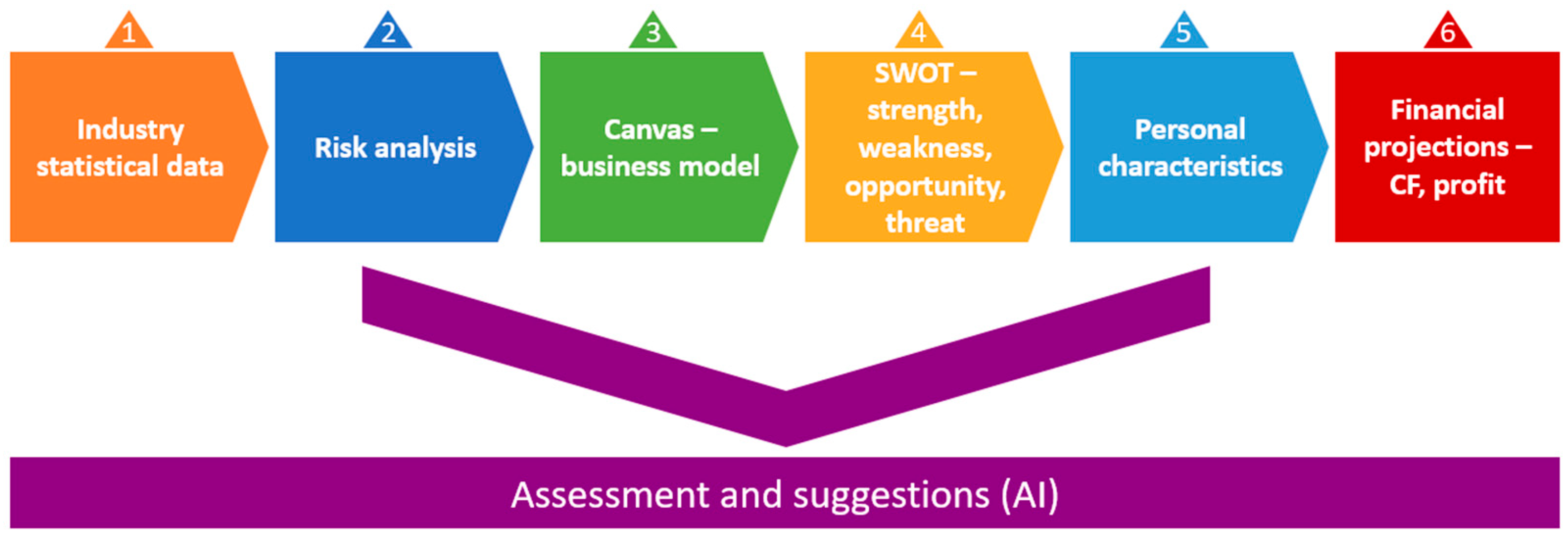
The authors employed their own developed KABADA tool, a structured web-based solution, to conduct further investigations within the framework of this study. KABADA, which stands for Knowledge Alliance for Business Idea Assessment: A Digital Approach, was developed within the framework of the EU Erasmus+ project and is intended for students and other users to create their own business plans in a digital environment (see
Figure 1).
This tool is based on theoretical research, relevant statistics, and artificial intelligence insights and helps potential entrepreneurs understand the current state of their business idea, considering the opportunities and obstacles that lie ahead (
Mavlutova et al., 2025).
AI algorithms are incorporated into the system based on the business plans made on the KABADA platform. These algorithms guarantee the gathering, organizing, and processing of data from earlier business plans in order to provide KABADA users with this data in an organized manner. As a result, when students are working on business ideas, the AI system provides guidance for decision-making.
The KABADA tool is also associated with the use of big data; it collects a huge number of business plans containing detailed information about business models, financial assumptions and forecasts, then systematically analyzes and interprets them and provides users with recommendations based on the analysis results.
KABADA employs the business statistics of the user’s selected industry and country, thus offering comparison of country-level indicators with industry trends across the EU, obtaining data from Eurostat’s Structural Business Statistics. Furthermore, KABADA assesses the various risks at the macro, industry and company levels, employing PESTE (Political, Economic, Social, Technological, Environmental Factors) and Michael Porter’s Five Forces analysis. The business model was developed using Osterwalder’s Business Canvas, SWOT (Strengths, Weaknesses, Opportunities, Threats) analysis to generate assumptions for the development of the overall strategy. When creating a business model and SWOT analysis, KABADA provides a choice from a set of predefined options. This is followed by personal characteristics block and financial forecast blocks, which are related to the previously-created business model Canvas.
In recent years, the number of female-led businesses in the entrepreneurial ecosystem has increased, fostering innovation and economic progress. Research has demonstrated that identical business ideas presented by male and female entrepreneurs are assessed differently by investors, and women face more scrutiny and skepticism (
Carvalho et al., 2021). Fostering a more equitable funding environment requires actions that support gender-inclusive investment practices and educational programs that aim to increase women’s financial literacy (
Vamvaka et al., 2020).
According to several studies, the number of male entrepreneurs is almost twice as high as that of female entrepreneurs, despite the fact that female entrepreneurs are more likely to engage in entrepreneurship and have greater levels of self-efficacy and entrepreneurship education, according to a number of studies. Studies show that entrepreneurial intention is significantly more influenced by gender than by age or academic background (
Voda & Florea, 2019;
R. Wang & Liu, 2024).
Recent research also reveals that women are underrepresented in information technology (IT) and related industries such as founding financial startups in the digital age, despite years of studying IT and related fields at universities.
In a world where demand for IT services and applications is rising, it is crucial to educate women as technology professionals and entrepreneurs through the use of STEM and IT, particularly in startups. The respondents included in the study represent Generation Z (born between 1995 and 2012). According to
Iftode (
2019), Generation Z possesses several characteristics not characteristic to previous generations—the ability to operate in both the real and virtual worlds, and good ability to quickly obtain and distribute information and communicate through social media. They are aware of the introduction of technology and robotization in the work environment as well as the need to learn throughout life and to change profession or workplace from time to time (
Schawbel, 2014).
Lukic and Lazarevic (
2023)’s research revealed that one-third of Generation Z expects the latest technologies and work tools in the workplace.
Based on research findings on Generation Z, it is assumed that digital tools can positively influence the antecedents of Ajzen’s TPB, especially perceived behavioral control, and thus increase entrepreneurial intention.
3. Materials and Methods
During the study, 10 entrepreneurship workshops were conducted and relevant data were collected. Each workshop lasted three hours and included the development of a business plan, analysis of it and discussion of business planning issues. The workshops involved the digital tool KABADA. The workshop participants were bachelor’s or master’s students from Central and Eastern European (CEE) and Southern European (SE) countries. The sample was obtained using convenience sampling. In this one-group pretest–posttest study, participants completed questionnaires (pre-workshop and post-workshop groups), and analyses focused on group-level comparisons rather than individual changes. This approach allowed the inclusion of all available observations, including those from participants who completed only one of the two surveys. Therefore, the study follows a pre–post repeated cross-sectional design, examining differences between the two measurement points at the group level. The questions were designed to provide information about the participants’ entrepreneurial intention, attitude towards entrepreneurship, and entrepreneurial knowledge, among other things. Responses were provided on a seven-point Likert scale. The data were cleaned and filtered; duplicates and responses with missing values were removed. A total of 440 responses were obtained: 248 before the workshop and 192 after.
Table 1 shows the distribution of respondents by several demographic variables, revealing only slight differences between the groups.
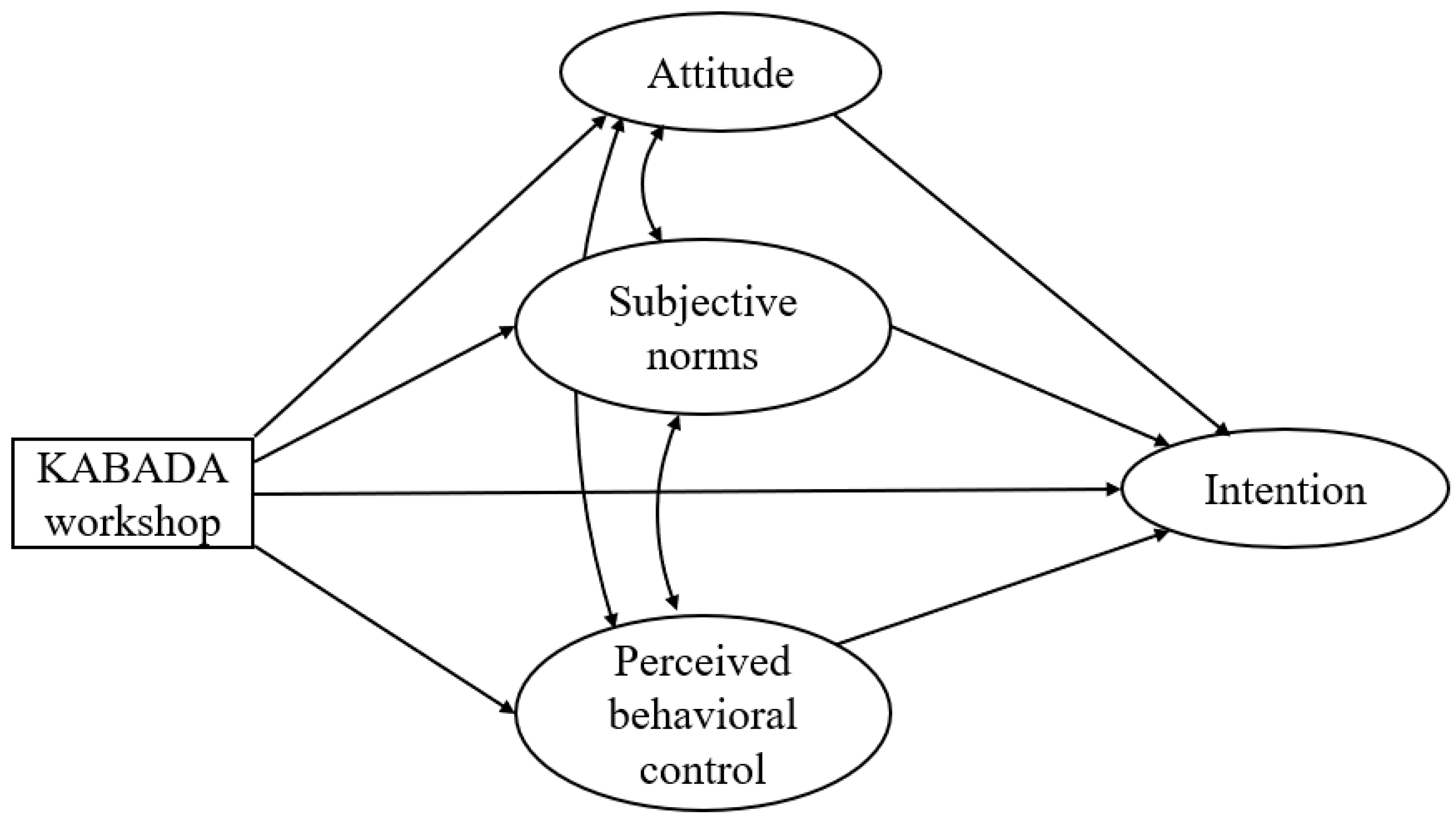
The theoretical research model used for the analysis is presented in
Figure 2. It is based on Ajzen’s Theory of Planned Behavior (
Ajzen, 1991), with the addition of a variable
Kabada workshop indicating the measurement time point (pre-workshop vs. post-workshop).
Attitude towards entrepreneurship, subjective norms, perceived behavioral control, and entrepreneurial intention are latent variables that correspond to concepts in Ajzen’s theory. In the model, attitude, subjective norms and perceived behavioral control are allowed to correlate, indicating possible common causes not included in the model. Covariate adjustment was not performed due to the absence of significant differences in participant characteristics between groups.
Questions and statements corresponding to latent variables are provided below.
Attitude towards entrepreneurship:
What are your feelings when you imagine that you could be an entrepreneur?
A1. I am interested;
A2. I feel strong;
A3. I feel inspired.
Subjective norms:
N1. Entrepreneurs are respected and highly valued in society;
N2. Many people consider entrepreneurship to be a good career path;
N3. Entrepreneurship is a socially significant activity.
Perceived behavioral control:
C1. Please make a self-assessment! My knowledge of entrepreneurship is:
C2. Starting an entrepreneurship would be easy for me;
C3. If I start my own entrepreneurship project, I would have a high probability of succeeding.
Entrepreneurial intention:
I1. How high is your intention to become an entrepreneur?
I2. Do you agree that entrepreneurship could fulfill your life?
I3. I am considering starting or participating in entrepreneurship within the next 5 years.
The analysis was performed using R, version 4.4.2 (
R Core Team, 2024); structural equation modeling and confirmatory factor analysis was performed using library
lavaan, version 0.6-20 (
Rosseel, 2012). As an estimator, a maximum likelihood estimator with robust (Huber–White) standard errors and scaled test statistics was selected.
4. Results
Initially, a confirmatory factor analysis (CFA) model was estimated, and the reliability of the questionnaire was assessed using Cronbach’s alpha and composite reliability. Convergent validity was assessed using average variance extracted. The standardized loadings of the latent variables and the reliability measures are presented in
Table 2.
For two of the variables (attitude and intention) all the reliability measures exceed the recommended cut-off values: Cronbach’s alpha and composite reliability are above 0.7; average variance extracted is above 0.5 (
Cheung et al., 2024;
Fornell & Larcker, 1981). For perceived behavioral control, average variance extracted is below the recommended cut-off value; other measures are within the recommended values. For subjective norms, all the measures are below the recommended cut-off values. This suggests that this construct may not be measured adequately. An attempt was made to improve the measurement model, resulting in the removal of one of the original observed variables corresponding to subjective norms. This resulted in the model presented above. No further improvements to the reliability of this construct were found. However, as subjective norms are a crucial part of Ajzen’s Theory of Planned Behavior, the reliability measures were close to the recommended values and standardized loadings are sufficiently large, it was decided to retain this measurement model.
Consequently, a structural equation model was estimated and tested. The model characteristics and fit indices are presented in
Table 4. The model fit for the data is average. χ
2 is statistically significant; however, such a result is expected when working with larger sample sizes. Two of the indices (SRMR and CFI) fall within the recommended cut-off values; the other two (RMSEA and TLI) do not.
There are several possible reasons for the relatively low model fit indices. One possible source is model misspecification, such as omitted paths or correlations and cross-loadings. Another possible source is issues with the measurement model, such as low reliability or validity. This is consistent with possible reliability issues for subjective norms. Data-related problems, such as violation of normality, could also impact model fit.
Modification indices were used to identify possible misspecifications to improve the model fit. However, no theoretically justifiable paths (correlations or cross-loadings) were suggested. Suggested cut-off values for fit indices should be treated as rough guidelines. As the fit indices are relatively close to the cut-off values and no better-fitting alternative models were found, the decision was made to retain this model.
The path coefficients of the structural equation model, including unstandardized coefficients, their standard errors and
p-values, and standardized coefficients, are presented in
Table 5.
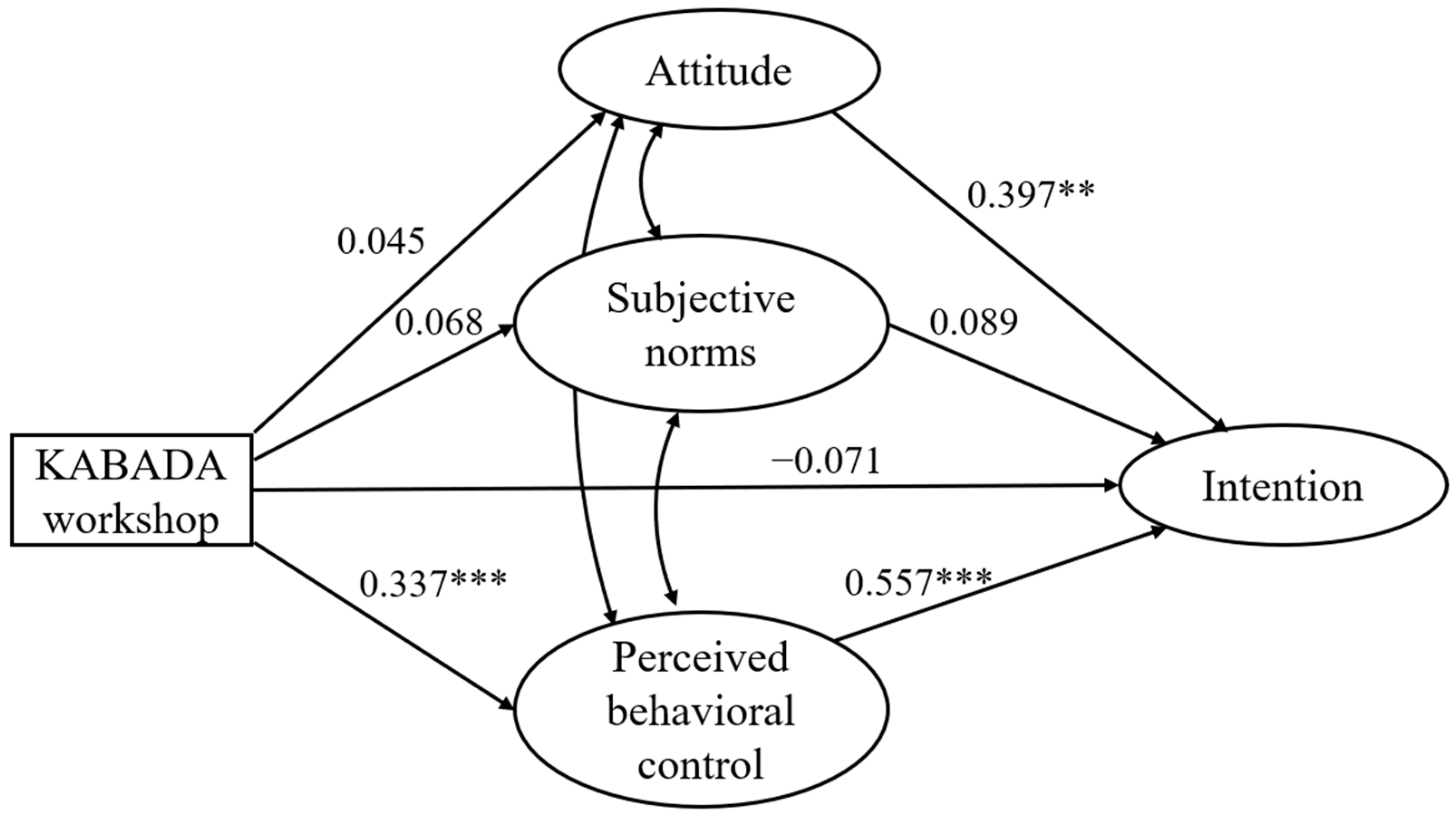
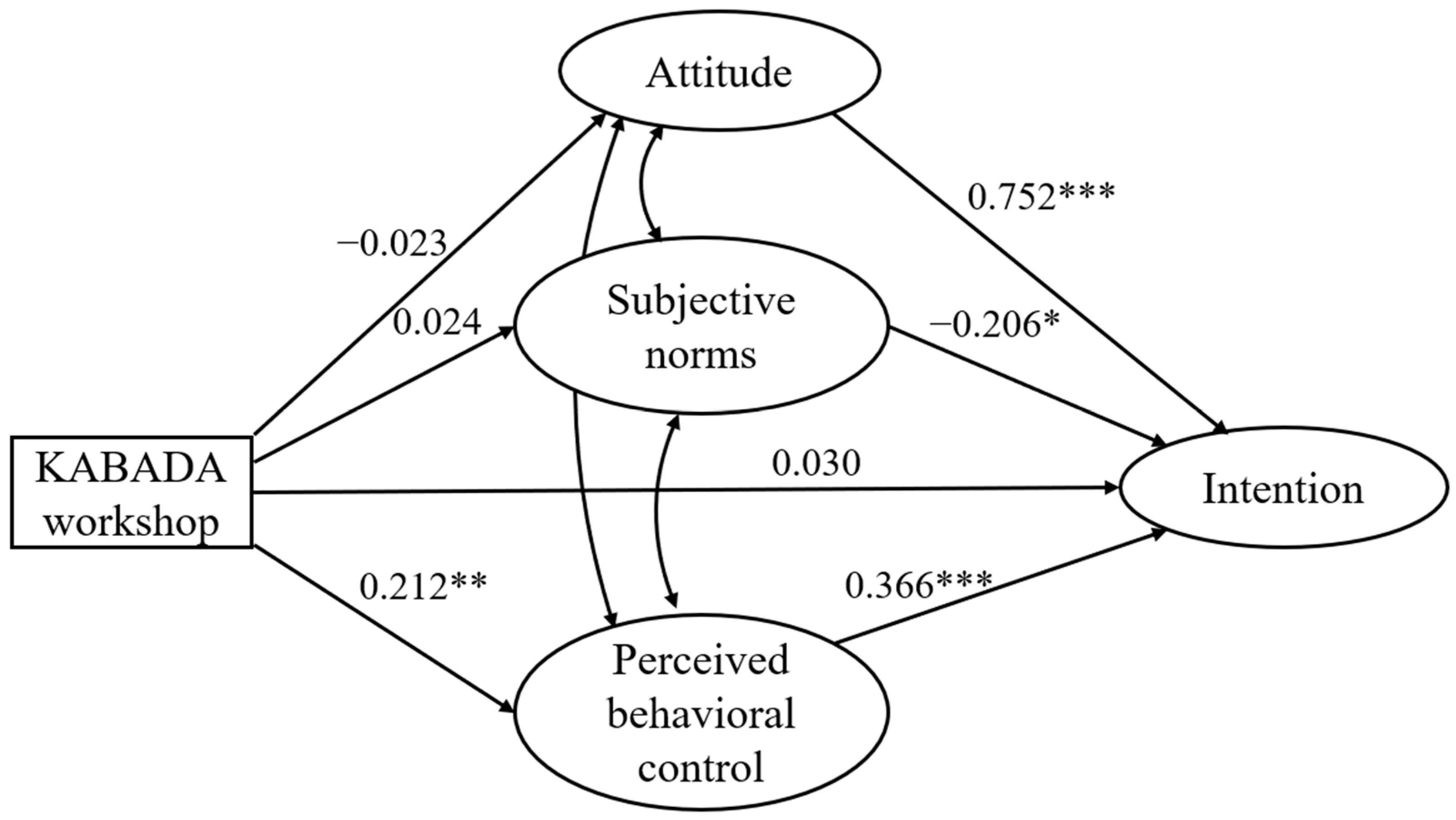
The structural model, with corresponding path coefficients, is presented in
Figure 3. For this and subsequent figures, star notation indicates the significance level of the path coefficient (*—significant at α = 0.05, **—significant at α = 0.01, ***—significant at α = 0.001). Workshop participation has a statistically significant effect on perceived behavioral control; however, it does not have a significant effect on the other variables (attitude, subjective norms and intention). Intention is statistically significantly affected by both attitude and perceived behavioral control; however, the effect of subjective norms on intention is not statistically significant.
Additionally, the overall effect of the workshop on intention was calculated; the results are presented in
Table 6. The total effect of KABADA workshop on intention is statistically significant, primarily as an indirect effect through perceived behavioral control. As the direct effect is not statistically significant, this is a case of full mediation, as workshop influences intention only through a mediator (perceived behavioral control).
Consequently, multiple group analysis was performed using an equivalent model, with the responses divided into groups according to the gender of the participants. Confirmatory factor analysis models with and without fixed parameter loading values were compared using a likelihood-ratio test. The corresponding p-value was 0.263, which confirms weak invariance. When a similar analysis was performed, but with the intercepts fixed, strong invariance was not confirmed (p = 0.002).
Model fit indices for the multigroup model are presented in
Table 7. Unstandardized loadings were fixed between the groups. As with the simple model, the multigroup model has an average fit for data.
Path coefficients for the female group are presented in
Table 8 and
Figure 4. The total effect of the workshop on entrepreneurial intention is calculated and presented in
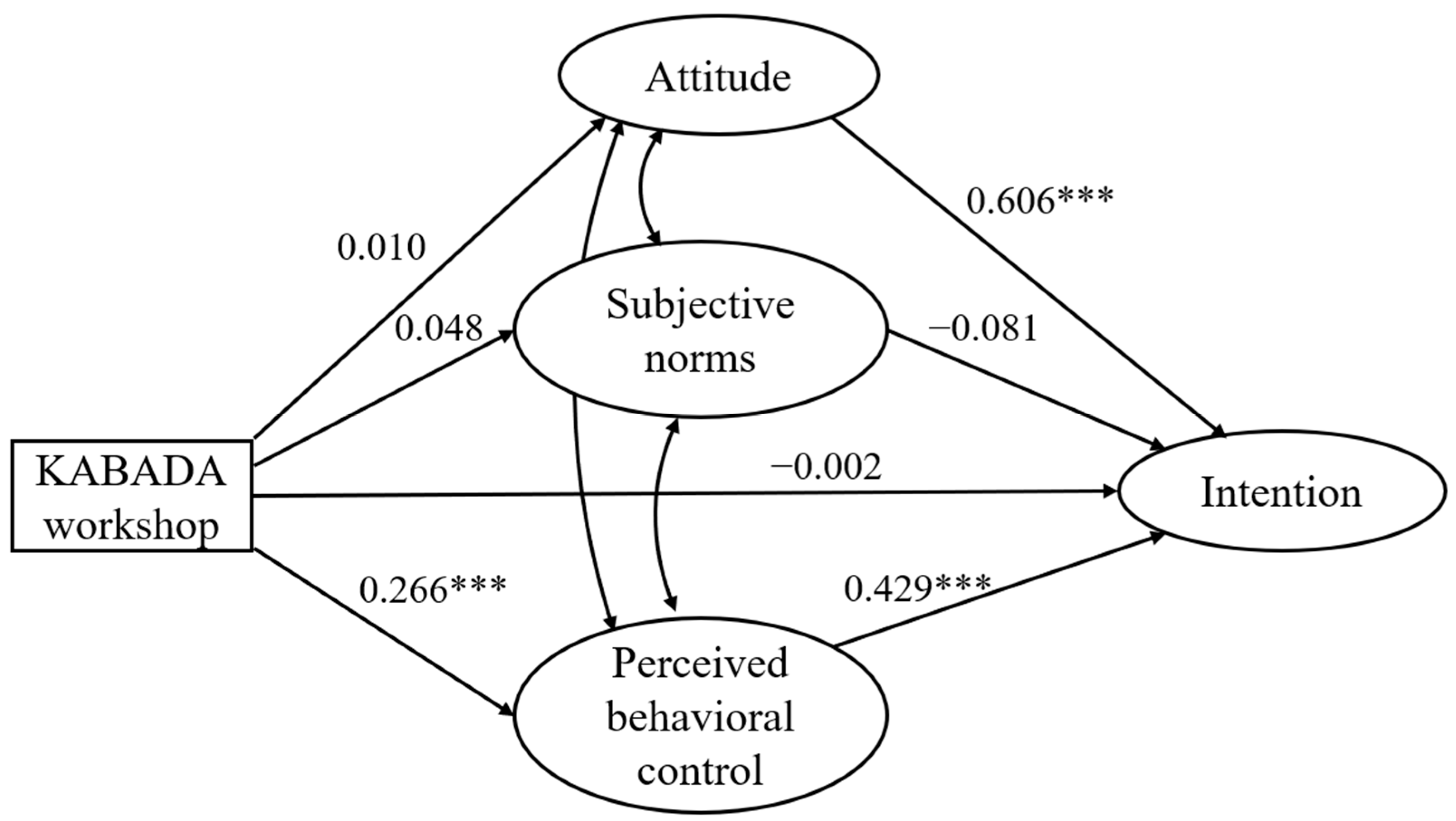
Table 9. Path coefficients for the male group are presented in
Table 10 and
Figure 5 and the total effect of the workshop on intention is presented in
Table 11.
The effect of the workshop on intention, mediated by perceived behavioral control, is statistically significant for both groups. Although the analysis revealed weak measurement invariance across gender, strong invariance was not supported. Exploratory comparisons suggest that the total effect for female participants is borderline significant (p = 0.059), whereas for male participants it is not significant (p = 0.252). However, these results do not provide convincing evidence for differential effects on entrepreneurial intention in workshops depending on gender.
For the male group, the main factor affecting entrepreneurial intention is attitude towards entrepreneurship; however, for the female group, perceived behavioral control is the main factor affecting intention, with attitude playing a smaller role. As the workshop has a significant effect only on perceived behavioral control and therefore the main effect of the workshop on intention is its mediating effect through perceived behavioral control, the workshop’s effect on intention is more pronounced in the female group compared to the male group.
5. Discussion
The results of this study demonstrate that the integration of AI-enabled digital tools into business education, through structured learning interventions, could enhance entrepreneurial intention. The findings indicate that participation in the KABADA workshop had a statistically significant positive overall effect on entrepreneurial intention, primarily mediated by perceived behavioral control. These results corroborate prior research identifying perceived behavioral control as a key determinant of entrepreneurial intention and a principal mechanism through which education influences entrepreneurial outcomes (
Vamvaka et al., 2020;
Voda & Florea, 2019).
The findings underscore the value of AI-embedded, rather than fully AI-driven, technologies in educational settings from an information systems perspective. While fully automated AI systems are capable of generating business plans efficiently, they may reduce opportunities for active learning and skill development. This study demonstrates that the design of KABADA—integrating data analytics, AI-supported recommendations, and user-driven decision-making—enhances students’ confidence in their entrepreneurial abilities. These findings are consistent with prior research indicating that AI literacy and human–AI interaction can improve learning outcomes and employability (
Lesinskis et al., 2025;
Wut et al., 2025).
Multi-group analysis reveals significant gender disparities in the factors influencing entrepreneurial intention. Perceived behavioral control emerges as the primary driver for female students, whereas attitude toward entrepreneurship is more influential among male students. These findings are consistent with prior research (e.g.,
Carvalho et al., 2021), which suggests that women face greater challenges related to self-confidence, risk perception, and access to resources in entrepreneurial and technology-intensive contexts. Notably, the results indicate that AI-embedded digital tools may help mitigate these disparities by enhancing female participants’ perceived behavioral control.
Overall, by showing how well-designed AI-supported IT systems might increase entrepreneurial self-efficacy and encourage more inclusive learning outcomes, the study contributes to the body of knowledge on digital transformation in higher education. According to
Cruz-Cardenas et al. (
2022) and
Lesinskis et al. (
2023), the results highlight the necessity for entrepreneurship education to shift from tool adoption to pedagogically informed system design that takes behavioral and gender-related aspects into account.
Several limitations of this study should be acknowledged. First, the absence of a control group precludes causal inference regarding the factors driving changes in entrepreneurial intention and the specific contribution of digital tools. Second, due to practical constraints, the study captures only short-term—potentially transient—effects on entrepreneurial intention, rather than assessing whether these effects persist over time and translate into actual entrepreneurial behavior. Finally, limitations in the measurement model, particularly the low reliability of the subjective norms construct, restrict the strength of the conclusions that can be drawn. Future research should employ more robust and validated measurement scales to address these issues.
The authors acknowledge concern regarding the limitations of the measurement model, particularly in relation to the construct of subjective norms. Reliability and validity metrics for this construct remain below commonly recommended thresholds. In light of this, the results associated with subjective norms are interpreted with caution, and no strong causal claims are made based on this variable. Nevertheless, the construct was retained due to its theoretical relevance within the chosen research framework and its importance in prior literature. The authors recognize that the current operationalization may not fully capture the complexity of subjective norms, and therefore consider this issue an important avenue for further research. Future studies should focus on refining the measurement of this construct, potentially by developing more robust indicators or employing alternative methodological approaches to enhance its reliability and validity.
6. Conclusions
This study examined the use of AI-embedded digital tools in entrepreneurship education, with particular emphasis on their effects on students’ entrepreneurial intention and gender-related disparities. The results indicate that the use of the KABADA digital business modeling tool has a positive and statistically significant effect on entrepreneurial intention, primarily mediated by perceived behavioral control. However, the magnitude of this effect is modest. Nonetheless, the findings suggest that IT solutions that support guided decision-making, data analytics, and structured engagement can enhance students’ confidence in their entrepreneurial capabilities.
From an information systems perspective, the study highlights the importance of designing AI-supported educational platforms that balance automation with active user engagement. While fully automated AI-driven solutions may be efficient, AI-embedded systems are better suited to educational contexts where reflective learning and skill development are essential. Overall, the findings underscore the need to integrate AI-supported, pedagogically informed digital tools into entrepreneurship education in order to foster inclusive, data-driven, and future-oriented learning environments.
The results further indicate that the mechanisms influencing entrepreneurial intention vary significantly by gender. For male students, attitudes toward entrepreneurship play a more prominent role, whereas for female students, perceived behavioral control is the most influential factor. These findings suggest that, particularly in technology-intensive learning environments, AI-embedded instructional tools can help reduce gender-related barriers by enhancing entrepreneurial self-efficacy.
Based on these results, the authors recommend integrating AI-powered business modeling tools into educational curricula, while simultaneously equipping students with the skills and competencies required to navigate a rapidly evolving business environment. The study demonstrates that digital tools, including those powered by AI, play a significant role in entrepreneurship education by enhancing students’ overall knowledge and, in particular, their entrepreneurial intention. Consequently, entrepreneurship education must continue to evolve by leveraging advances in digital technologies to better prepare students for the challenges and opportunities of a data-driven economy.