Article

Exploring CSR-Related Entrepreneurial Human Capital: The Association Between Transformational Leadership and Entrepreneurial Competencies in Higher Education Institutions

by
Fabricio Miguel Moreno-Menéndez
1,
Saúl Nilo Astuñaupa-Flores
2,
Yamill Alam Barrionuevo-Inca-Roca
2,
Casio Aurelio Torres-López
1,
Jorge Vladimir Pachas-Huaytan
1,
Javier Amador Navarro-Veliz
1,
Vicente González-Prida
3,*,
Angela María Rivera-Paucarpura
1 and
Julima Gisella Chuquin-Berrios
1
1
Faculty of Administrative and Accounting Sciences, Universidad Peruana Los Andes, Huancayo 12001, Junín, Peru
2
Faculty of Administrative Sciences, Universidad Nacional del Centro del Perú, Huancayo 12006, Junín, Peru
3
Department of Industrial Management, University of Seville, 41092 Seville, Spain
*
Author to whom correspondence should be addressed.
Adm. Sci. 2026, 16(5), 221; https://doi.org/10.3390/admsci16050221
Submission received: 1 March 2026 / Revised: 10 April 2026 / Accepted: 30 April 2026 / Published: 7 May 2026

Abstract

Corporate social responsibility (CSR) has increasingly become a strategic and governance-relevant domain that depends on internal capability development to translate stakeholder and sustainability expectations into credible action. In emerging economies, higher education institutions (HEIs) are key arenas where future managers and intrapreneurs acquire human-capital foundations relevant to CSR-related strategy implementation. This exploratory study examines whether students’ self-reported transformational leadership (TL) is associated with entrepreneurial competencies (EC) that are relevant for responsible value creation and stakeholder-oriented execution. Using a quantitative, cross-sectional correlational design, we surveyed 207 senior undergraduate students from business-related programs in a private HEI in Peru. TL was measured using the MLQ-5X (transformational subscale), and EC were assessed through a content-validated and reliability-tested eight-dimension scale (networking, problem solving, achievement orientation, risk taking, teamwork, creativity, autonomy, and initiative). Given distributional characteristics, Spearman’s rho was used for hypothesis testing. Because the design was intentionally limited to first-order associations, no control variables or multivariate models were incorporated. Results show a strong, positive association between TL and overall EC (ρ = 0.822, p < 0.001), with statistically significant positive relationships across all EC dimensions (ρ = 0.709–0.807). These findings are consistent with a microfoundational view of CSR, indicating that leadership-related developmental behaviors are systematically aligned with competence bundles that may support CSR-related strategy enactment under stakeholder complexity and sustainability constraints. The study does not measure CSR outcomes or CSR communication directly; rather, it provides capability-level evidence with implications for HEI curricula and leadership development aimed at preparing graduates for responsible innovation and stakeholder-sensitive decision-making in emerging-economy contexts.

1. Introduction

Corporate social responsibility (CSR) has increasingly become a strategic and governance-relevant domain that shapes how organizations create value while responding to stakeholder expectations and environmental constraints. Contemporary CSR debates increasingly emphasize integration—how CSR connects business strategy, stakeholder relationships, and broader sustainability challenges—rather than isolated philanthropic initiatives (Aguinis & Glavas, 2012). A related tension is whether CSR becomes a substantive practice or remains largely symbolic signaling, because the same rhetoric may either reshape organizational routines or merely signal conformity to external expectations. From a governance perspective, stakeholder-oriented approaches argue that firms are embedded in a constellation of legitimate interests and obligations that extend beyond shareholders, implying that strategic decisions must be evaluated through a multi-stakeholder lens (Donaldson & Preston, 1995). This shift raises a practical question that is still under-explored in many contexts: what individual-level capabilities are required to enact CSR strategies that are credible, innovative, and stakeholder-attentive? Accordingly, this study positions leadership-driven competence development as an internal prerequisite for CSR strategies that integrate business priorities with stakeholder and environmental constraints.
A growing body of research suggests that CSR outcomes cannot be fully understood only at the organizational level; they also depend on “microfoundations”—the perceptions, motives, values, and behaviors of individuals who translate CSR intentions into daily decisions (Aguinis & Glavas, 2012; Gond et al., 2017). Leadership is central within this microfoundational view because it shapes norms, sensemaking, and the willingness to pursue change under uncertainty. In particular, the concept of responsible leadership frames leadership as a relational practice oriented toward building and sustaining ethically grounded relationships with multiple stakeholders (Maak & Pless, 2006). This perspective is highly compatible with CSR’s stakeholder and environmental concerns: if CSR is partly a leadership-and-relationships problem, then understanding which leadership capacities support CSR-relevant action becomes a priority. Within higher education, this matters because CSR-related values are not necessarily transmitted by generic business instruction; explicit ethics and CSR teaching can strengthen students’ orientation toward CSR and responsible leadership (Rodríguez-Gómez et al., 2022).
At the same time, CSR increasingly requires an entrepreneurial logic. Implementing CSR in non-trivial ways often involves opportunity recognition, innovation, stakeholder engagement, and the redesign of processes or business models—activities that resemble entrepreneurial action inside and outside established organizations, including the capacity to map stakeholder impacts, negotiate trade-offs, and sustain legitimacy under scrutiny. The sustainable entrepreneurship literature makes this point explicitly: entrepreneurship can be a mechanism for developing innovations that contribute to environmental and social goals while maintaining economic viability (Schaltegger & Wagner, 2011). Yet there is a persistent tension in the field: entrepreneurship is frequently portrayed as growth-driven and potentially unsustainable, while sustainability requires constraint awareness, longer time horizons, and stakeholder-sensitive trade-offs. Bridging these two logics, therefore, depends on developing competencies that enable individuals to integrate entrepreneurial action with sustainability-oriented judgment (Lans et al., 2014).
This brings higher education into the discussion. Universities—especially business-related programs—are training grounds for future managers, intrapreneurs, and entrepreneurs who will shape CSR practices and stakeholder relationships. A competence-based approach is particularly relevant here because it focuses on what individuals can actually do in complex, real-world settings. Entrepreneurial competencies have been conceptualized as multidimensional capabilities that support effective entrepreneurial action, including opportunity-related, relational, conceptual, organizing, and commitment competencies (Man et al., 2002). Reviews in entrepreneurship education continue to emphasize competence development, mindset, self-efficacy, and ecosystem support as central themes in HEI research (Anubhav et al., 2024). In Latin America, evidence from five universities in Colombia, Ecuador, Mexico, and Peru suggests that entrepreneurship education does not translate mechanically into entrepreneurial intention, underscoring the need to examine complementary developmental mechanisms (Montes et al., 2023). Recent Peruvian studies likewise show that curriculum relevance, teaching-team competence, problem solving, entrepreneurial self-efficacy, and institutional support are salient antecedents of entrepreneurial mindset and entrepreneurial culture among university students (De la Gala-Velásquez et al., 2024; Vera et al., 2024). However, there remains limited empirical clarity—especially in emerging-economy contexts—about how leadership-related capacities among students relate to the development of entrepreneurial competencies that are relevant for CSR-related strategies (Gómez Vallejo & Satizábal Parra, 2011).
Transformational leadership provides a promising, but not unproblematic, lens for examining this relationship. Transformational leadership is typically associated with inspiring a shared vision, stimulating new ways of thinking, and supporting individual development—features that plausibly foster initiative, creativity, and collaborative behavior. Evidence from large-scale research shows that transformational leadership tends to be positively related to a wide range of performance-relevant outcomes (Judge & Piccolo, 2004), and integrative reviews position it as a central leadership approach in contemporary organizational scholarship (Avolio et al., 2009). Importantly for CSR, empirical work has linked transformational leadership to CSR-related organizational processes and outcomes, including innovation pathways in which CSR plays a mediating role (Khan et al., 2018), as well as sustainability-related behaviors in environmental domains (Li et al., 2020). Recent student-centered evidence from Mexico likewise suggests that transformational teacher leadership can foster intrapreneurial competencies, although available studies remain context-specific and methodologically heterogeneous (Santamaria-Velasco et al., 2024). These streams suggest a plausible mechanism: transformational leadership capacities may help individuals develop entrepreneurial competencies that support CSR implementation, stakeholder engagement, and sustainability-oriented innovation.
Still, there are conceptual and empirical reasons to be cautious. First, CSR is contested in both theory and practice: it may reflect substantive stakeholder value creation, but it can also become symbolic, compliance-driven, or decoupled from core decisions (Aguinis & Glavas, 2012). Second, entrepreneurship and sustainability do not automatically align; developing entrepreneurial competencies without explicit responsibility and stakeholder orientation could, in principle, reinforce purely growth-centric or short-term behaviors (Lans et al., 2014; Schaltegger & Wagner, 2011). Third, leadership–competence relationships are often studied using cross-sectional self-report designs, which can inflate associations and cannot establish causal direction. For these reasons, empirical evidence should be framed carefully as associational, while still offering practical value as a first step toward building stronger explanatory models and longitudinal tests.
Against this backdrop, the present study examines the relationship between transformational leadership and entrepreneurial competencies in a higher-education setting within an emerging Latin American economy. Using a quantitative, non-experimental, cross-sectional, correlational design, we analyze survey data from 207 senior undergraduate students enrolled in business-related programs. Entrepreneurial competencies are operationalized across eight dimensions (network building, problem solving, achievement orientation, risk taking, teamwork, creativity, autonomy, and initiative), reflecting a competence-based view relevant to both entrepreneurship education and CSR-related action. The results indicate a strong positive association between transformational leadership and overall entrepreneurial competencies (Spearman’s rho = 0.822, p < 0.001), with statistically significant positive relationships across all competency dimensions. These findings contribute to CSR scholarship by providing micro-level evidence consistent with the view that leadership capacities are part of the capability base through which CSR-related strategies may be supported, particularly in contexts where institutions face resource constraints and stakeholder demands are complex. The article is therefore positioned as exploratory first-order evidence rather than as a confirmatory test of a validated structural model or of TL’s unique net effect once rival antecedents are controlled. The paper proceeds as follows: the next section develops the theoretical rationale and hypotheses; subsequent sections describe methods, present results, and discuss implications for CSR-relevant competence development in higher education and for future research.

2. Theoretical Framework

2.1. Corporate Social Responsibility as Strategy and a Contested Concept

Corporate social responsibility (CSR) is widely treated as a broad “umbrella” concept covering organizational policies and actions that address social and environmental concerns alongside economic objectives. However, CSR is also an essentially plural and contested construct, both theoretically and empirically: scholars differ on whether CSR should be understood primarily as an instrumental approach to wealth creation, an integrative response to societal demands, a political stance regarding corporate power, or an ethical commitment grounded in moral duties (Garriga & Melé, 2004). This theoretical pluralism matters because the same observed CSR practice may reflect different underlying logics (e.g., strategic differentiation vs. legitimacy-seeking vs. ethical obligation), which in turn affects how CSR is designed, implemented, and evaluated (Aguinis & Glavas, 2012). Stakeholder theory provides a central lens for connecting CSR with organizational strategy, emphasizing that organizations create and capture value through managing relationships with multiple stakeholders rather than focusing narrowly on shareholders (Donaldson & Preston, 1995). From this viewpoint, CSR becomes a set of managerial commitments and practices that can strengthen stakeholder trust, improve long-term organizational resilience, and reduce exposure to reputational and operational risks. Yet, stakeholder-based CSR remains conceptually ambidextrous: it can be framed normatively (“organizations ought to serve stakeholders”) or instrumentally (“stakeholder management improves performance”). This ambiguity is not a weakness to hide; it is a theoretical feature that needs to be acknowledged and handled explicitly when building causal arguments (Donaldson & Preston, 1995; Garriga & Melé, 2004). For the purposes of this study, CSR is treated as a strategic orientation that requires internal capabilities: organizations enact CSR through people, routines, and decision processes that translate stakeholder and environmental insights into managerial choices and day-to-day practices (Aguinis & Glavas, 2012). In higher education, socially responsible university activities also shape how students perceive institutional reputation and stakeholder management, reinforcing the strategic relevance of responsibility-oriented practices in HEIs (Azizi & Sassen, 2023).

2.2. Microfoundations of CSR and the Centrality of People

A critical development in CSR scholarship is the shift from macro-only explanations (institutions, governance, external pressures) to microfoundations, which examine how CSR is enabled—or undermined—by individual-level cognitions, motivations, values, and behaviors. In practice, CSR depends on employees and managers interpreting CSR signals, judging authenticity, allocating effort, and engaging (or disengaging) from CSR-related initiatives. The “micro-CSR” perspective, therefore, argues that CSR outcomes are partially a function of psychological processes and human agency inside organizations (Gond et al., 2017). This microfoundational view is especially relevant for contexts where formal CSR systems may be underdeveloped, inconsistently enforced, or resource-constrained (a common reality in many emerging-economy organizations). In such contexts, leadership behaviors and employee competencies are not peripheral—they can be the main transmission mechanism through which CSR intentions become credible and actionable. The implication for theory-building is direct: if CSR strategies require internal enactment, then leadership styles that shape employee motivation and competence development become plausible antecedents of CSR effectiveness (Gond et al., 2017).

2.3. Responsible Leadership as a Bridge Between CSR Intent and CSR Execution

Responsible leadership theory helps connect CSR aspirations with implementation by framing leadership as a relational, stakeholder-oriented practice. Rather than focusing only on leader–follower dyads, responsible leadership emphasizes the leader’s role in balancing stakeholder claims, fostering ethical deliberation, and aligning organizational actions with broader societal and environmental responsibilities (Maak & Pless, 2006). In CSR terms, responsible leadership is not merely about “being inspirational”; it is about building legitimacy and trust through decisions that can be publicly justified to diverse audiences—employees, communities, regulators, and other stakeholders. This perspective matters for the present research because it highlights a mechanism often overlooked in narrow CSR-performance models: CSR strategy is not only a matter of policy design; it is also a matter of capability building—developing the human and relational capacities that allow organizations to sense stakeholder expectations, innovate responsibly, and adapt practices under constraints. Leadership thus becomes a key lever through which CSR-relevant capabilities can be cultivated.

2.4. Transformational Leadership: Evidence, Utility, and Controversies

Transformational leadership (TL) is among the most influential leadership theories in organizational research, typically defined as a pattern of leader behaviors that elevates followers’ motivation and performance by articulating a compelling vision, acting as a role model, providing individualized support, and stimulating new ways of thinking (Avolio et al., 2009). Meta-analytic evidence suggests TL is positively associated with a broad set of outcomes, including attitudinal and performance-related indicators (Judge & Piccolo, 2004). However, the TL literature contains serious—and highly relevant—controversies. Critics argue that charismatic-transformational leadership research sometimes suffers from conceptual ambiguity (what exactly is the construct?), operational confounds (measures that mix leadership behaviors with their outcomes), and insufficient discriminant validity versus other leadership constructs (van Knippenberg & Sitkin, 2013). Given these critiques, it is important to acknowledge them explicitly and interpret results cautiously. Accordingly, in this study, TL is not treated as a universally beneficial construct or a sufficient explanation for positive outcomes. It is treated more narrowly as a development-oriented leadership approach: a set of behaviors that may plausibly contribute to employee growth, learning, and competence development. This is also consistent with experimental and longitudinal work showing that transformational leadership training and behaviors can foster follower development and subsequent performance outcomes (Dvir et al., 2002). A recent review focused on university students also suggests that empirical work on transformational leadership in higher education remains comparatively limited and methodologically fragmented, especially in Latin American settings (Quiñones Gonzales & Espíritu-Alvarez, 2023). At the same time, the conceptual critique implies that measurement and model interpretation must be cautious, transparent, and modest in causal language—especially in cross-sectional designs (van Knippenberg & Sitkin, 2013).

2.5. Entrepreneurial Competencies as CSR-Relevant Capabilities

Entrepreneurial competencies (EC) refer to the underlying knowledge, skills, and behavioral capabilities that enable individuals to identify opportunities, mobilize resources, solve problems, innovate, and execute initiatives under uncertainty. The competency-based view of entrepreneurship emphasizes that entrepreneurial effectiveness is not only a function of traits or intentions but of learnable, developable competence bundles (Man et al., 2002; Mitchelmore & Rowley, 2010; Morris et al., 2013). Importantly, entrepreneurial competencies can be interpreted as CSR-relevant in at least three ways. First, CSR strategies increasingly require opportunity recognition and innovation—e.g., creating products/services and internal practices that reduce negative impacts and create stakeholder value. Second, CSR implementation is inherently relational; it requires stakeholder engagement, coalition building, and trust repair—all of which overlap with relationship- and networking-oriented competencies. Third, CSR often involves operating under constraints and ambiguity (conflicting stakeholder demands, limited budgets, institutional complexity), which makes problem-solving, initiative, and adaptive execution particularly valuable (Morris et al., 2013). This logic aligns with the sustainable entrepreneurship literature, which frames entrepreneurship as a mechanism for generating economic gains while simultaneously preserving nature, life support, and community, thereby linking “what is to be sustained” with “what is to be developed” (Shepherd & Patzelt, 2011). Similarly, sustainable entrepreneurship and sustainability innovation research highlights that responsibility orientation and innovation are intertwined, and that organizations need capabilities to move from intentions to implemented sustainability actions (Schaltegger & Wagner, 2011). In education and professional development contexts, competence frameworks for sustainable entrepreneurship explicitly include integrated skill sets that connect value creation with societal/environmental responsibility (Lans et al., 2014).

2.6. Linking Transformational Leadership to Entrepreneurial Competencies in a CSR Context

The theoretical link between TL and EC rests on a capability-development argument: transformational leaders can create psychological and social conditions that facilitate competence growth—by encouraging autonomy and initiative, legitimizing experimentation and learning from failure, stimulating creativity and reframing problems, and providing individualized support that helps followers stretch beyond routine performance (Avolio et al., 2009; Dvir et al., 2002). These mechanisms are conceptually consistent with entrepreneurial competence development, which depends on self-directed behavior, adaptive problem-solving, and proactive engagement in uncertain tasks (Man et al., 2002; Morris et al., 2013). In CSR terms, this relationship is not just “leadership improves entrepreneurship.” The more strategic claim is that TL may help cultivate the human capital needed to enact forward-looking CSR strategies—strategies that connect internal business priorities with stakeholder and environmental expectations. Still, theoretical rigor requires acknowledging plausible counterarguments: TL’s benefits may depend on measurement validity, organizational context, and whether “CSR-like” initiatives are substantive rather than symbolic (van Knippenberg & Sitkin, 2013; Aguinis & Glavas, 2012). Although TL and EC are theoretically compatible, they are not identical constructs. TL captures perceived developmental leadership behaviors, whereas EC captures self-perceived competence bundles for entrepreneurial action. Their positive association is therefore theoretically plausible, but the constructs may still exhibit empirical proximity in self-report designs. This makes discriminant validity an important issue for future research and warrants cautious interpretation of large correlations in the present study.

2.7. Research Hypotheses

Building on the capability-development logic linking transformational leadership (TL) to competence growth, and consistent with prior scholarship connecting TL to developmental outcomes (Avolio et al., 2009; Dvir et al., 2002) and entrepreneurial competencies (EC) to effective entrepreneurial action (Man et al., 2002; Morris et al., 2013), we expect that students who report higher TL behaviors will also report stronger entrepreneurial competencies. We therefore test the following hypotheses:
H1. 
Transformational leadership is positively associated with overall entrepreneurial competencies.
H1a–H1h. 
Transformational leadership is positively associated with each of the following dimensions: (a) networking, (b) problem solving, (c) achievement orientation, (d) risk taking, (e) teamwork, (f) creativity, (g) autonomy, and (h) initiative.

3. Materials and Methods

3.1. Study Design and Setting

This study employed a quantitative, cross-sectional, non-experimental, descriptive–correlational design. The empirical setting was Universidad Peruana Los Andes, a private university in Peru (an emerging-economy context). The design was intentionally exploratory and limited to zero-order associations: the objective was to estimate whether TL and EC covary at the student level, not to establish causal direction, isolate unique effects through control variables, or validate a full measurement model. Accordingly, the study does not assess CSR outcomes directly and should be interpreted as capability-level evidence relevant to CSR-related strategy implementation. A consistency matrix linking the research problem, objective, hypothesis, and variables is provided in Appendix A.2 (Table A2).

3.2. Population, Sampling, and Participants

The reference population comprised 14,002 enrolled students across all academic programs (academic term 2024-II). The target population for this study focused on senior undergraduate students (8th–10th academic cycles) from business-related programs in the Faculty of Administrative and Accounting Sciences (N = 450). The official enrollment list of eligible students served as the sampling frame, and a simple random sample was drawn from that list. A finite-population sample-size formula was applied to determine the minimum sample size required for the target population. Using a 95% confidence level (Z = 1.96), a 5% margin of error (e = 0.05), and maximum variance (p = 0.5), the required sample size was n = 207.49, which was rounded to 207:
n = ( Z 2 · p · ( 1 p ) · N )   /   ( e 2 · ( N 1 ) + Z 2 · p · ( 1 p ) )
where n is the required sample size, N is the target population size, Z is the standard normal value associated with the desired confidence level, p is the expected proportion (with p·(1 − p) representing maximum variance when p = 0.5), and e is the margin of error. The achieved sample included students from two programs (Business Administration and Systems; Accounting and Finance) across the 8th, 9th, and 10th cycles (see Table 1 for the distribution). Eligibility criteria were as follows:
  • Inclusion criteria: (i) enrollment in the specified cycles and programs; (ii) voluntary agreement to participate and signed informed consent; and (iii) complete responses to both instruments.
  • Exclusion criteria: (i) not enrolled in the target cycles/programs; (ii) no informed consent; or (iii) incomplete questionnaires.

3.3. Measures and Operationalization

Data were collected using a structured, self-administered questionnaire composed of two scales: transformational leadership and entrepreneurial competencies. A detailed mapping of constructs, dimensions, indicators, and item numbering is provided in Appendix A (Table A1). Transformational leadership was measured using the Multifactor Leadership Questionnaire (MLQ-5X) item set adapted to the Spanish educational context (Moreno-Casado et al., 2021). The adaptation comprises 34 items and eight leadership dimensions: idealized influence (behavior), idealized influence (attributed), inspirational motivation, intellectual stimulation, individualized consideration, contingent reward, management-by-exception (active), and passive leadership. In line with the full-range leadership model, the focal transformational leadership score was operationalized using the five transformational subdimensions (items 1–20 in the administered questionnaire); transactional and passive leadership items (items 21–34) were retained for completeness but were not part of the focal transformational leadership composite. Entrepreneurial competencies were assessed using a 40-item scale developed in the underlying thesis, drawing on entrepreneurial competency frameworks (Man et al., 2002; Mitchelmore & Rowley, 2010) and adapted to the educational context. The scale comprised eight dimensions: networking (items 1–5), problem solving (items 6–10), achievement orientation (items 11–15), risk taking (items 16–20), teamwork (items 21–25), creativity (items 26–30), autonomy (items 31–35), and initiative (items 36–40). Dimension-level and overall scores were computed by summing item responses. The questionnaire structure and scoring rules are summarized in Appendix A.3, while the full English translation of the entrepreneurial competencies questionnaire is provided in Supplementary Material S1. Both instruments underwent content validation through expert judgment. Inter-rater agreement among experts was assessed using Kendall’s coefficient of concordance (W), showing high agreement for transformational leadership (W = 0.947) and entrepreneurial competencies (W = 0.944). Internal consistency reliability was assessed using Cronbach’s alpha, indicating high reliability for the full leadership questionnaire (α = 0.945; 34 items) and entrepreneurial competencies (α = 0.940; 40 items). These indicators provide preliminary evidence of content adequacy and internal consistency, but they do not establish factorial validity or discriminant validity. In particular, the entrepreneurial competencies scale is a thesis-derived, context-adapted instrument rather than a previously widely validated scale; consequently, the present study should be read as relying on a preliminary measurement model, and future studies should use CFA or SEM-based validation. Thus, the present study offers transparent use of a context-specific preliminary instrument rather than confirmatory psychometric validation; stronger claims about factorial structure and construct distinctiveness should await dedicated validation studies.

3.4. Data Collection, Ethics, and Transparency

Data were collected using a voluntary, anonymous survey administered to eligible students. Prior to participation, students received information about the study’s purpose, confidentiality protections, and the right to withdraw without penalty. Only fully completed questionnaires were retained for analysis to avoid listwise missingness in composite scoring. The study involved human participants and was conducted with strict confidentiality. Informed consent was obtained from all participants. The research team followed the institution’s Code of Ethics and the regulations of its Research Ethics Committee, as well as applicable norms for the protection of human subjects. To enable replication and reuse while protecting participant privacy, the anonymized dataset (item-level responses), the codebook (variable definitions and scoring rules), and the analysis materials (SPSS syntax and/or processing steps) are available from the corresponding author upon reasonable request. Any information that could identify individual participants is not shared. No generative AI tools were used for data collection or statistical analysis. During manuscript preparation, a generative AI tool was used to support English drafting and language refinement under the authors’ supervision; the authors reviewed and edited the output and took full responsibility for the final content.

3.5. Statistical Analysis

Data were transferred to Microsoft Excel and IBM SPSS (v27) for processing and analysis. Because the objective was exploratory and the analytical model was intentionally restricted to first-order associations, no control variables, subgroup analyses, robustness checks, or multivariate models were incorporated into the statistical strategy. The original design was not implemented as a covariate-rich survey for adjusted modelling; accordingly, the statistical plan was limited to descriptive summaries and zero-order correlations. The analysis proceeded in the following steps:
  • Compute composite scores for transformational leadership and entrepreneurial competencies, as well as dimension-level scores (Appendix A.3).
  • Produce descriptive statistics (frequency and percentage distributions) for overall variables and their dimensions.
  • Assess normality using the Kolmogorov–Smirnov test (given n > 50) and select an appropriate correlation approach.
  • Test hypotheses using Spearman’s rank correlation (ρ), with statistical significance evaluated at p = 0.05. For reference, Spearman’s ρ can be expressed (without ties) as:
ρ = 1 ( 6 · Σ d i 2 )   /   ( n · ( n 2 1 ) )
where di is the difference between paired ranks and n is the number of paired observations. In practice, SPSS computes Spearman’s ρ while accounting for tied ranks. Approximate confidence intervals for key correlations were computed using Fisher’s z transformation. For descriptive reporting only, composite scores were also grouped into low, moderate, and high levels using equal-interval cut-off points anchored to the theoretical score range. This rule was retained as a transparent, non-sample-dependent heuristic; all hypothesis tests relied exclusively on continuous composite scores. Because both predictor and outcome variables were collected using a single self-report questionnaire at one point in time, common method variance (CMV) may inflate observed associations (Podsakoff et al., 2003). In addition to procedural safeguards (anonymity, voluntary participation, and clear instructions), we interpret the findings as associational evidence and discuss CMV-related threats in the limitations section. Post hoc statistical diagnostics (e.g., Harman’s single-factor test) were not performed; therefore, common method variance cannot be ruled out, and results are interpreted cautiously.

4. Results

4.1. Sample Characteristics

A total of 207 senior undergraduate students from two business-related programs participated in the study. The sample included students enrolled in upper-division semesters (8th to 10th) in Management & Information Systems and Accounting & Finance programs (Table 1).

4.2. Descriptive Results for the Main Constructs

Most participants reported moderate levels of both transformational leadership and entrepreneurial competencies (Table 2). Specifically, transformational leadership was predominantly rated as moderate (82%), while entrepreneurial competencies were also largely rated at a moderate level (81%). These categories are reported only as coarse descriptive summaries; they do not enter the hypothesis tests and should not be treated as substantive thresholds.

4.3. Descriptive Results for Entrepreneurial Competency Dimensions

Across all entrepreneurial competency dimensions, the most frequent category was moderate, indicating an overall pattern of intermediate self-perceived capability levels in networking, problem solving, achievement orientation, risk taking, teamwork, creativity, autonomy, and initiative (Table 3). Again, these categories are heuristic descriptive aids rather than inferential groupings.

4.4. Normality Assessment and Choice of Correlation Approach

Normality was examined using the Kolmogorov–Smirnov test (Table 4). Transformational leadership scores did not meet the normality assumption (p = 0.001), whereas entrepreneurial competencies did (p = 0.072). Given the ordinal nature of the measures and the lack of normality in at least one variable, Spearman’s rank-order correlation (ρ) was used for hypothesis testing.

4.5. Correlation Results

Transformational leadership was positively and strongly associated with overall entrepreneurial competencies (ρ = 0.822, p < 0.001; Table 5; approximate 95% CI: 0.772–0.862). Consistently, transformational leadership also showed statistically significant positive correlations with each entrepreneurial competency dimension, with coefficients ranging from ρ = 0.709 (initiative) to ρ = 0.807 (achievement orientation), all at p < 0.001. Following conventional effect-size heuristics, these coefficients are large in magnitude. The overall coefficient implies a high level of shared rank-order variation (ρ2 ≈ 0.676), which is informative descriptively but should not be interpreted as explained variance in a causal or multivariate sense. No adjusted or multivariate models were estimated in this exploratory design; thus, these coefficients should not be interpreted as the unique contribution of TL once rival antecedents are taken into account.
Overall, the results indicate that higher self-reported transformational leadership is systematically associated with higher self-reported entrepreneurial competencies, both globally and across specific competency dimensions. Given the single-source, self-report survey design, the magnitude of the observed correlations may be partly influenced by common method variance, response tendencies, or conceptual proximity between constructs. The unusually large overall coefficient, therefore, warrants cautious interpretation: it may reflect substantive capability alignment, but also possible inflation due to measurement overlap or common response style. Accordingly, these results are interpreted as associational evidence, and procedural safeguards and additional diagnostics are described in Section 3.4, while additional considerations related to common method variance are discussed in Section 5.5.

5. Discussion

5.1. Summary and Interpretation of the Main Findings

This study examined the association between students’ self-reported transformational leadership and entrepreneurial competencies within a higher-education context in an emerging economy. The results show (i) predominantly mid-level perceptions in both constructs and (ii) a strong, positive, statistically significant relationship between transformational leadership and overall entrepreneurial competencies. Dimension-level analyses indicate that transformational leadership is positively and significantly associated with each entrepreneurial competency domain (e.g., networking, problem solving, achievement orientation, risk taking, teamwork, creativity, autonomy, and initiative), suggesting a consistent pattern rather than an isolated effect. A cautious interpretation is that students who report stronger transformational leadership behaviors—such as articulating a motivating vision, stimulating new ways of thinking, and attending to individual development—also tend to report stronger entrepreneurial competencies. Importantly, this pattern does not establish causality or developmental influence; it supports only the plausibility of a shared capability set (or mutually reinforcing perception pattern) linking leadership and entrepreneurship-related competencies.

5.2. Contribution to Leadership and Entrepreneurship Competency Research

From a leadership perspective, the findings align with the core premise of transformational leadership theory: by shaping meaning, motivation, and cognitive framing, transformational leadership can enable adaptive and proactive behaviors (Bass & Riggio, 2006; Avolio et al., 2009). From an entrepreneurship-competency perspective, the results are also consistent with the view that entrepreneurial competencies involve integrated behavioral repertoires—problem solving, opportunity-oriented initiative, networking, and goal commitment—rather than a single trait (Man et al., 2002; Mitchelmore & Rowley, 2010). One plausible mechanism is that transformational leadership behaviors—particularly inspirational motivation and intellectual stimulation—are naturally compatible with entrepreneurial action. Vision-oriented leadership may reinforce achievement orientation and persistence; intellectual stimulation may foster creativity and problem reframing; individualized consideration may support autonomy development through feedback and mentoring-like behaviors. The strong and broadly consistent associations across competency dimensions support this “capability alignment” explanation rather than a narrow, dimension-specific link. Recent higher-education research in Peru and Mexico similarly suggests that curriculum design, teaching-team competence, institutional support, and transformational teacher leadership can shape entrepreneurship-related outcomes among university students (De la Gala-Velásquez et al., 2024; Santamaria-Velasco et al., 2024; Vera et al., 2024). Our results are compatible with this broader pattern, but they do not imply that TL is the only or unique driver of EC. That said, an informed skeptic will immediately raise a measurement concern: when both constructs are measured via self-report at the same time, correlations can be inflated by common method variance, social desirability, or a general positive self-view (Podsakoff et al., 2003). Another issue is conceptual overlap: some items in leadership and entrepreneurial competency scales may indirectly tap similar underlying dispositions (e.g., proactivity, confidence, agency). Conceptually, TL refers to perceived leadership behaviors, whereas EC refers to self-perceived capability bundles; nevertheless, discriminant validity remains to be established empirically. Therefore, a key theoretical implication is not merely that “transformational leadership matters,” but that future work should more rigorously establish discriminant validity and test alternative explanations (e.g., a third variable such as self-efficacy, proactive personality, or learning orientation).

5.3. Relevance for CSR: Developing “Responsible” Entrepreneurial Capacity

These results provide capability-level evidence consistent with micro-CSR arguments: leadership development is systematically associated with competence bundles that are often required when organizations attempt to implement CSR strategies under stakeholder complexity. Entrepreneurial competencies (e.g., problem solving, networking, and initiative) can be enabling conditions for CSR-oriented innovation—especially when organizations face complex stakeholder expectations and sustainability trade-offs (Aguinis & Glavas, 2012; Schaltegger & Wagner, 2011). However, a critical caveat is necessary: entrepreneurial competence alone does not guarantee responsible outcomes. Therefore, this research is positioned at the capability-input level: we provide evidence on human-capital conditions that may enable future CSR strategies, while acknowledging that CSR strategy design and CSR communication outcomes were not directly measured in this study. Entrepreneurship can be used to create value or to externalize costs more efficiently. Therefore, the CSR contribution of this study is not the claim that transformational leadership “creates CSR,” but rather that the leadership–competency linkage observed here may be leveraged by higher-education institutions to strengthen the human-capital foundations that CSR strategies require—provided that entrepreneurship education explicitly integrates stakeholder reasoning, ethical decision-making, and sustainability constraints. In other words, the practical question for CSR is: how do institutions cultivate graduates who can both perform (entrepreneurial competence) and choose responsibly (stakeholder and sustainability orientation)? The present findings support targeting leadership development as one lever—yet future models should directly incorporate CSR-related values and stakeholder logic as mediators/moderators rather than assuming them.

5.4. Practical Implications for Universities and Business Schools

If the goal is to increase students’ readiness to design and implement socially responsible initiatives—within firms, public organizations, or new ventures—then leadership development should be treated as more than a “soft skill add-on.” Based on the observed associations, universities could implement integrated interventions that build transformational leadership behaviors alongside entrepreneurial competency practice, for example:
  • Challenge-based team projects with real stakeholders (public agencies, SMEs, NGOs, or cooperatives), where students must articulate a vision, manage collaboration, and deliver assessable outcomes such as a market-access plan, a waste-reduction proposal, or a stakeholder map for a local microenterprise.
  • Structured reflection and feedback loops (peer and instructor feedback) to strengthen individualized consideration and learning from failure—particularly relevant to risk taking and problem solving in contexts of resource scarcity and uncertainty.
  • CSR-embedded entrepreneurship modules, where opportunity recognition is constrained by environmental and social criteria (e.g., stakeholder impact mapping and sustainability constraints), making “responsible innovation” explicit rather than optional; in emerging-economy settings, these can include family-business formalization clinics, local supply-chain inclusion projects, or social-innovation sprints with municipalities and NGOs.
Because most students in the sample are not at extreme levels, there is substantial “developmental headroom.” In practical terms, that is good news: institutional interventions are more likely to show measurable improvement when baseline levels are moderate rather than already high.

5.5. Limitations and Robustness Considerations

Several limitations temper interpretation. First, the design is cross-sectional and correlational; causal direction cannot be inferred. It is plausible that entrepreneurial competence builds leadership confidence, that leadership behaviors foster entrepreneurial competencies, or that both develop together due to a third factor (e.g., self-efficacy, prior work experience, socioeconomic context, or educational quality). Second, the study relies on self-reported measures collected at a single time point, which may inflate relationships through common method variance and social desirability (Podsakoff et al., 2003). The overall coefficient (ρ = 0.822) is unusually high for self-report psychological constructs and may reflect not only substantive alignment between TL and EC but also shared response patterns or conceptual proximity. No post hoc statistical CMV diagnostic (e.g., Harman’s single-factor test or marker-variable approach) was performed, so this threat cannot be ruled out. Third, the context is institutionally specific; external validity to other universities, disciplines, or countries requires replication. More specifically, because the original study was not designed as a covariate-rich or psychometric-validation exercise, it does not provide adjusted regression/SEM estimates, subgroup robustness checks, CFA-based factorial validation, or statistical CMV diagnostics. These omissions do not negate the descriptive association reported here, but they substantially narrow the strength of permissible inference. In addition, alternative explanations cannot be ruled out. Variables such as entrepreneurial self-efficacy, prior work or entrepreneurial experience, proactive personality, academic performance, socioeconomic background, or exposure to entrepreneurship education may partially account for the observed associations. Because these potential confounders were not explicitly incorporated into the original analytical plan, no regression-based or structural tests of the unique contribution of transformational leadership were estimated. Finally, very high internal consistency values—while reassuring—can sometimes indicate item redundancy or overly homogeneous item content. Future work should complement reliability with stronger evidence of construct validity (e.g., confirmatory factor analysis, discriminant validity tests, and measurement invariance across subgroups).

5.6. Directions for Future Research

Future studies can strengthen both rigor and CSR relevance in at least five ways. First, separate measurement validation from theory testing: the EC scale should be examined through EFA/CFA, discriminant validity tests, and, where possible, multi-sample validation before being embedded in explanatory models. Second, adopt longitudinal designs to test developmental sequencing (does leadership precede competence growth or vice versa?). Third, collect and model theoretically relevant covariates—such as gender, academic performance, work experience, institutional support, and exposure to entrepreneurship education—and estimate adjusted regression or SEM models. Fourth, use multi-source measurement (peer/instructor ratings, behavioral tasks, project outcomes) and explicit CMV diagnostics to reduce self-report bias. Fifth, explicitly integrate CSR-related outcomes (e.g., responsible innovation intentions, stakeholder engagement quality, sustainability-oriented opportunity recognition, or the credibility of CSR communication) to move from “capability correlation” to “CSR-relevant capability pathways”.
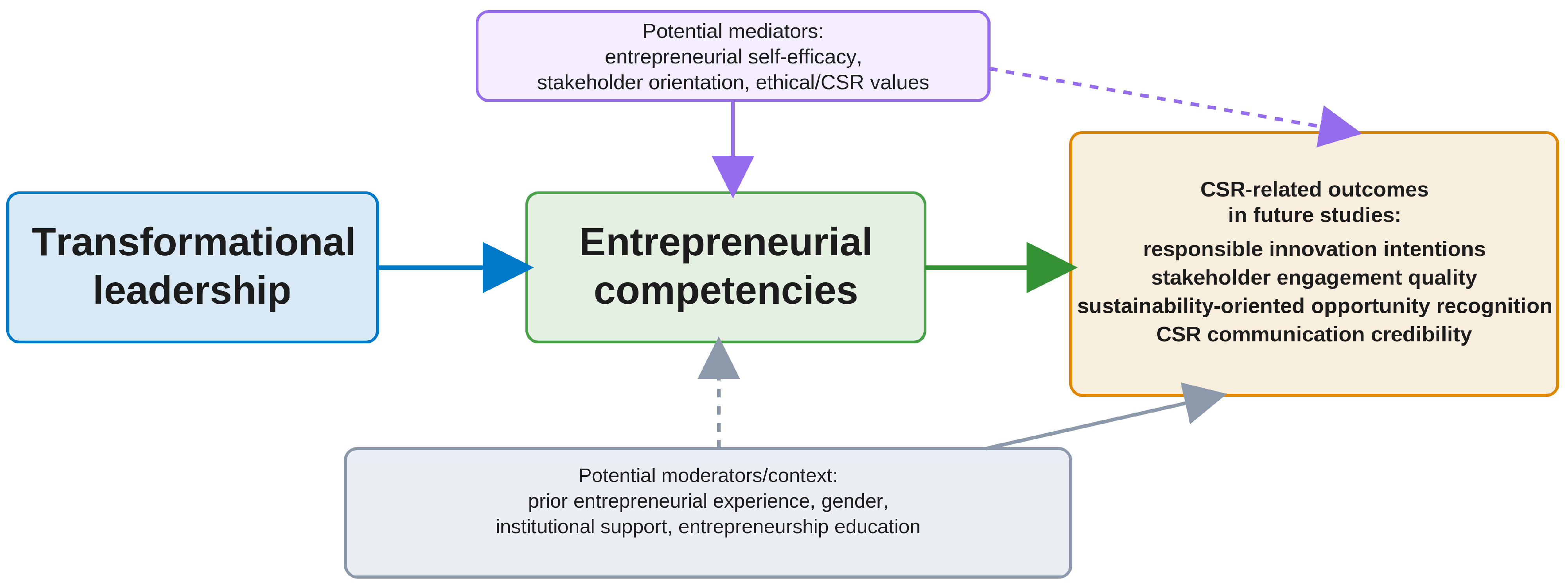
Figure 1 summarizes a parsimonious agenda for future work: transformational leadership may relate to entrepreneurial competencies directly, but also indirectly through self-efficacy and stakeholder/ethical orientation, while contextual variables shape whether these competencies translate into CSR-related outcomes. A necessary preliminary step, however, is to validate the measurement structure and construct distinctiveness of TL and EC in HEI samples before moving to confirmatory multivariate or SEM tests. Taken together, the study provides initial evidence that transformational leadership is associated with a broad set of entrepreneurial competencies in a higher-education setting. For the future of CSR, the actionable insight is that leadership development may be a scalable educational lever—yet its CSR value depends on explicitly embedding responsible, stakeholder-informed decision-making into entrepreneurship training rather than assuming that competence will automatically translate into responsible practice.

6. Conclusions

From a theoretical standpoint, the findings are consistent with the view that leadership styles oriented toward inspiration, intellectual stimulation, and individualized development are aligned with competence bundles that support entrepreneurial action. In the context of CSR, the key implication is not that transformational leadership causes CSR, but that leadership-related capabilities may form part of the microfoundational conditions through which organizations build the human capital needed to support future-facing CSR-related strategies—strategies that connect business priorities with stakeholder expectations and environmental constraints. Entrepreneurial competencies may contribute to CSR implementation by enabling proactive problem solving, stakeholder engagement, and responsible innovation, provided that these competencies are explicitly integrated with ethical reasoning and stakeholder-oriented decision-making. Practically, the results suggest that universities and business schools may benefit from treating leadership development as a capability-building lever rather than a purely interpersonal soft skill. Educational interventions that combine leadership practice (vision articulation, team mobilization, individualized feedback) with entrepreneurship training embedded in CSR constraints (stakeholder impact mapping, sustainability criteria, and responsible opportunity recognition) are likely to be more effective than entrepreneurship education that focuses narrowly on venture creation. Because most participants reported moderate levels in both constructs, there appears to be substantial scope for structured development initiatives with measurable improvement potential. At the same time, the evidence remains exploratory: the study is based on a cross-sectional single-source design, no control-based multivariate models or statistical CMV diagnostics were incorporated, and no direct CSR outcomes were measured. The article should therefore be read as first-order associational evidence rather than as a confirmatory test of unique effects or of a validated structural model. In conclusion, the study contributes capability-level evidence relevant to how CSR-related strategies may be supported by leadership-driven human capital development, while future research should use stronger measurement validation, multi-source designs, covariate-rich models, and CSR-specific outcomes to test whether these capability alignments translate into stakeholder-valued implementation.


Supplementary Materials

The following supporting information can be downloaded at: https://www.mdpi.com/article/10.3390/admsci16050221/s1, Supplementary Material S1, English translation of the entrepreneurial competencies questionnaire.

Author Contributions

Conceptualization, F.M.M.-M. and V.G.-P.; methodology, F.M.M.-M., S.N.A.-F. and Y.A.B.-I.-R.; formal analysis, F.M.M.-M. and C.A.T.-L.; investigation, J.V.P.-H., J.A.N.-V., A.M.R.-P. and J.G.C.-B.; data curation, F.M.M.-M. and J.V.P.-H.; writing—original draft preparation, F.M.M.-M. and V.G.-P.; writing—review and editing, V.G.-P., S.N.A.-F. and Y.A.B.-I.-R.; visualization, C.A.T.-L. and A.M.R.-P.; supervision, V.G.-P.; project administration, F.M.M.-M. All authors have read and agreed to the published version of the manuscript.

Funding

This research received no external funding.

Institutional Review Board Statement

The study was conducted in accordance with the Declaration of Helsinki and approved by the Research Ethics Committee of the Dirección de la Unidad de Investigación—Facultad de Ciencias Administrativas y Contables, Universidad Peruana Los Andes (INFORME N°0279/2025-GSVV-CE-DUI-FCAC; Oficio N°0401/2025-FMMM-PCE-DUI-FCAC-UPLA; date of approval: 16 August 2025).

Informed Consent Statement

Informed consent was obtained from all subjects involved in the study.

Data Availability Statement

The data supporting the findings of this study are available from the corresponding author upon reasonable request.

Acknowledgments

Statistical analyses were conducted using IBM SPSS Statistics (Version 27; IBM Corp., Armonk, NY, USA). During manuscript preparation, a language-editing tool (Trinka AI, https://www.trinka.ai/, institutional license, University of Seville) was used for grammar and clarity checks. The authors reviewed and edited all outputs and take full responsibility for the final content.

Conflicts of Interest

The authors declare no conflicts of interest.

Abbreviations

The following abbreviations are used in this manuscript:
CIConfidence interval
CMVCommon method variance
CSRCorporate social responsibility
ECEntrepreneurial competencies
HEIHigher education institution
K–SKolmogorov–Smirnov
MLQ-5XMultifactor Leadership Questionnaire (Form 5X)
SPSSStatistical Package for the Social Sciences
TLTransformational leadership

Appendix A

Appendix A.1. Measurement Operationalization

Table A1 provides the operationalization of the two focal constructs—transformational leadership and entrepreneurial competencies—including dimension structure, indicative indicators, and item numbering as administered in the survey. This mapping supports transparency and replication, and complements the instrument descriptions provided in Section 3.
Table A1. Construct operationalization and measurement mapping.
ConstructConceptual DefinitionMeasurement InstrumentDimensionIndicative IndicatorsItems
Transformational leadershipA leadership style that motivates followers beyond self-interest through inspiration, intellectual stimulation, idealized influence, and individualized consideration.MLQ-5X adapted to the Spanish educational context (Moreno-Casado et al., 2021); self-report.Idealized influence (behavior)Change-oriented role modeling; ethical conduct; collective purpose1–4
Idealized influence (attributed)Confidence and trust; perceived leader integrity; admiration5–8
Inspirational motivationEnthusiasm; communicating an appealing vision; optimism9–12
Intellectual stimulationEncouraging creativity; reframing problems; questioning assumptions13–16
Individualized considerationIndividual support; mentoring; attention to personal development17–20
Entrepreneurial competenciesA set of capabilities (knowledge, skills, attitudes) that enable effective entrepreneurial action, including opportunity-related, self-regulatory, and social competences.Entrepreneurial Competencies Scale (40 items) developed in the underlying thesis; self-report.NetworkingBuilding relationships; communication; seeking advice; resource mobilization1–5
Problem solvingProblem identification; solution generation; decision-making under constraints6–10
Achievement orientationGoal setting; striving for excellence; persistence; performance focus11–15
Risk takingHandling uncertainty; calculated risk; learning from failure16–20
TeamworkCollaboration; coordination; conflict management; shared responsibility21–25
CreativityIdea generation; innovation; flexibility; experimenting with alternatives26–30
AutonomySelf-direction; self-management; independent execution; initiative in tasks31–35
InitiativeProactivity; starting actions; opportunity pursuit; taking ownership36–40
Note: The MLQ-5X is a proprietary instrument; item wording is not reproduced in this manuscript. The instrument is available from the rights holder under license.

Appendix A.2. Consistency Matrix

Table A2. Consistency matrix linking the research problem, objective, hypothesis, and variables.
Research ProblemGeneral ObjectiveGeneral HypothesisIndependent VariableDependent Variable
What is the relationship between students’ self-reported transformational leadership behaviors and entrepreneurial competencies in higher education in an emerging-economy context?To determine the relationship between students’ self-reported transformational leadership behaviors and entrepreneurial competencies in higher education in an emerging-economy context.Transformational leadership is positively associated with entrepreneurial competencies among higher-education students.Transformational leadershipEntrepreneurial competencies

Appendix A.3. Score Computation and Descriptive Classification

Appendix A.3 summarizes the response format and the computation of composite scores used in the analyses. The questionnaire employed a five-point Likert response scale (higher values indicate stronger endorsement). Composite scores were computed as follows:
  • Transformational leadership (TL): computed as the sum of items 1–20 (transformational subdimensions); subdimension scores were computed as sums within each subdimension (Appendix A).
  • Entrepreneurial competencies (EC): computed as the sum of items 1–40; dimension scores were computed as sums within each dimension (Appendix A).
  • Complete-case analysis was applied: only fully completed questionnaires were retained to avoid missingness in composite scoring.
  • For descriptive reporting only, composite scores were also grouped into low, moderate, and high levels using equal-interval cut-off points anchored to the theoretical score range. This simple rule was retained as a transparent, non-sample-dependent descriptive heuristic; all hypothesis tests relied on continuous composite scores.
Because the MLQ-5X is a proprietary instrument, its full item wording is not reproduced in the manuscript; interested researchers may obtain the instrument from the rights holder. To keep the main manuscript concise, the English translation of the entrepreneurial competencies questionnaire has been moved to Supplementary Material S1.

References

  1. Aguinis, H., & Glavas, A. (2012). What we know and don’t know about corporate social responsibility: A review and research agenda. Journal of Management, 38(4), 932–968. [Google Scholar] [CrossRef]
  2. Anubhav, K., Dwivedi, A. K., & Aashish, K. (2024). Entrepreneurship education in higher education (2002–2022): A technology-empowered systematic literature review. The International Journal of Management Education, 22(3), 100993. [Google Scholar] [CrossRef]
  3. Avolio, B. J., Walumbwa, F. O., & Weber, T. J. (2009). Leadership: Current theories, research, and future directions. Annual Review of Psychology, 60, 421–449. [Google Scholar] [CrossRef] [PubMed]
  4. Azizi, L., & Sassen, R. (2023). How universities’ social responsibility activities influence students’ perceptions of reputation. Journal of Cleaner Production, 417, 137963. [Google Scholar] [CrossRef]
  5. Bass, B. M., & Riggio, R. E. (2006). Transformational leadership (2nd ed.). Lawrence Erlbaum Associates. [Google Scholar]
  6. De la Gala-Velásquez, B., Hurtado-Palomino, A., Monrroy-Villena, A. A., & Gomez-Villegas, O. I. (2024). Roots of the entrepreneurial mindset in university students. The International Journal of Management Education, 22(3), 101049. [Google Scholar] [CrossRef]
  7. Donaldson, T., & Preston, L. E. (1995). The stakeholder theory of the corporation: Concepts, evidence, and implications. Academy of Management Review, 20(1), 65–91. [Google Scholar] [CrossRef]
  8. Dvir, T., Eden, D., Avolio, B. J., & Shamir, B. (2002). Impact of transformational leadership on follower development and performance: A field experiment. Academy of Management Journal, 45(4), 735–744. [Google Scholar] [CrossRef]
  9. Garriga, E., & Melé, D. (2004). Corporate social responsibility theories: Mapping the territory. Journal of Business Ethics, 53(1–2), 51–71. [Google Scholar] [CrossRef]
  10. Gond, J.-P., El Akremi, A., Swaen, V., & Babu, N. (2017). The psychological microfoundations of corporate social responsibility: A person-centric systematic review. Journal of Organizational Behavior, 38(2), 225–246. [Google Scholar] [CrossRef]
  11. Gómez Vallejo, M. d. P., & Satizábal Parra, K. (2011). Educación emprendedora: Fortalecimiento de competencias laborales desde el aula. Criterio Libre, 9(14), 109–128. [Google Scholar]
  12. Judge, T. A., & Piccolo, R. F. (2004). Transformational and transactional leadership: A meta-analytic test of their relative validity. Journal of Applied Psychology, 89(5), 755–768. [Google Scholar] [CrossRef]
  13. Khan, N. A., Ali, S., Olya, H., & Zulqarnain, S. (2018). Transformational leadership, corporate social responsibility, organizational innovation, and organizational performance: Symmetrical and asymmetrical analytical approaches. Corporate Social Responsibility and Environmental Management, 25, 1270–1283. [Google Scholar] [CrossRef]
  14. Lans, T., Blok, V., & Wesselink, R. (2014). Learning apart and together: Towards an integrated competence framework for sustainable entrepreneurship in higher education. Journal of Cleaner Production, 62, 37–47. [Google Scholar] [CrossRef]
  15. Li, Z., Xue, J., Li, R., Chen, H., & Wang, T. (2020). Environmentally specific transformational leadership and employee’s pro-environmental behavior: The mediating roles of environmental passion and autonomous motivation. Frontiers in Psychology, 11, 1408. [Google Scholar] [CrossRef] [PubMed]
  16. Maak, T., & Pless, N. M. (2006). Responsible leadership in a stakeholder society: A relational perspective. Journal of Business Ethics, 66(1), 99–115. [Google Scholar] [CrossRef]
  17. Man, T. W. Y., Lau, T., & Chan, K. F. (2002). The competitiveness of small and medium enterprises: A conceptualization with focus on entrepreneurial competencies. Journal of Business Venturing, 17(2), 123–142. [Google Scholar] [CrossRef]
  18. Mitchelmore, S., & Rowley, J. (2010). Entrepreneurial competencies: A literature review and development agenda. International Journal of Entrepreneurial Behavior & Research, 16(2), 92–111. [Google Scholar] [CrossRef]
  19. Montes, J., Ávila, L., Hernández, D., Apodaca, L., Zamora-Bosa, S., & Cordova-Buiza, F. (2023). Impact of entrepreneurship education on the entrepreneurial intention of university students in Latin America. Cogent Business & Management, 10, 2282793. [Google Scholar] [CrossRef]
  20. Moreno-Casado, H., Leo, F. M., López-Gajardo, M. A., García-Calvo, T., Cuevas, R., & Sánchez-Oliva, D. (2021). Adaptation and validation of the MLQ-5X leadership scale to the Spanish educational context. Anales de Psicología/Annals of Psychology, 37(2), 311–322. [Google Scholar] [CrossRef]
  21. Morris, M. H., Webb, J. W., Fu, J., & Singhal, S. (2013). A competency-based perspective on entrepreneurship education: Conceptual and empirical insights. Journal of Small Business Management, 51(3), 352–369. [Google Scholar] [CrossRef]
  22. Podsakoff, P. M., MacKenzie, S. B., Lee, J.-Y., & Podsakoff, N. P. (2003). Common method biases in behavioral research: A critical review of the literature and recommended remedies. Journal of Applied Psychology, 88(5), 879–903. [Google Scholar] [CrossRef]
  23. Quiñones Gonzales, L. G., & Espíritu-Alvarez, F. J. (2023). A review of empirical research on transformational leadership in university students (2014–2023). Propósitos y Representaciones, 11(3), e1871. [Google Scholar]
  24. Rodríguez-Gómez, S., López-Pérez, M. V., Garde-Sánchez, R., & Arco-Castro, L. (2022). Increasing the commitment of students toward corporate social responsibility through higher education instruction. The International Journal of Management Education, 20(3), 100710. [Google Scholar] [CrossRef]
  25. Santamaria-Velasco, C. A., Montiel-Méndez, O. J., & Montañez-Moya, G. S. (2024). Transformational leadership and entrepreneurship in students: A path to sustainable educational development. Scientia et PRAXIS, 4(08), 90–119. [Google Scholar] [CrossRef]
  26. Schaltegger, S., & Wagner, M. (2011). Sustainable entrepreneurship and sustainability innovation: Categories and interactions. Business Strategy and the Environment, 20(4), 222–237. [Google Scholar] [CrossRef]
  27. Shepherd, D. A., & Patzelt, H. (2011). The new field of sustainable entrepreneurship: Studying entrepreneurial action linking “what is to be sustained” with “what is to be developed”. Entrepreneurship Theory and Practice, 35(1), 137–163. [Google Scholar] [CrossRef]
  28. van Knippenberg, D., & Sitkin, S. B. (2013). A critical assessment of charismatic–transformational leadership research: Back to the drawing board? The Academy of Management Annals, 7(1), 1–60. [Google Scholar] [CrossRef]
  29. Vera, K. J. C., Velita, J. J. A., Martinez, T. A., & Ferrer, R. M. (2024). Determinant factors of entrepreneurial culture in university students: An analysis from the theory of planned behavior at a Peruvian university. Sustainability, 16(23), 10693. [Google Scholar] [CrossRef]
Figure 1. Future research model linking transformational leadership, entrepreneurial competencies, mediating mechanisms, contextual moderators, and CSR-related outcomes.
Admsci 16 00221 g001
Table 1. Sample distribution by program and academic semester (n = 207).
ProgramAcademic Semestern
Management & Information Systems8th50
9th38
10th31
Accounting & Finance8th24
9th26
10th38
Total 207
Table 2. Self-reported levels of transformational leadership and entrepreneurial competencies (n = 207).
LevelTransformational Leadership, n (%)Entrepreneurial Competencies, n (%)
Low14 (7%)12 (6%)
Moderate171 (82%)168 (81%)
High22 (11%)27 (13%)
Total207 (100%)207 (100%)
Note: Low/Moderate/High levels were defined using equal-interval cut-off points based on the theoretical score range and are reported only as heuristic descriptive categories; they were not used in hypothesis testing or substantive inference.
Table 3. Self-reported levels of entrepreneurial competency dimensions (n = 207).
DimensionLow, n (%)Moderate, n (%)High, n (%)
Networking29 (14%)143 (69%)35 (17%)
Problem Solving45 (22%)136 (66%)26 (13%)
Achievement Orientation28 (14%)154 (74%)25 (12%)
Risk Taking42 (20%)136 (66%)29 (14%)
Teamwork34 (16%)142 (69%)31 (15%)
Creativity31 (15%)143 (69%)33 (16%)
Autonomy33 (16%)138 (67%)36 (17%)
Initiative40 (19%)134 (65%)33 (16%)
Note: Low/Moderate/High levels were defined using equal-interval cut-off points based on the theoretical score range and are reported only as heuristic descriptive categories; they were not used in hypothesis testing or substantive inference.
Table 4. Kolmogorov–Smirnov normality test results (n = 207).
VariableStatisticdfp-Value
Transformational Leadership0.0852070.001
Entrepreneurial Competencies0.0592070.072
Table 5. Spearman correlations between transformational leadership and entrepreneurial competencies (n = 207).
AssociationSpearman’s ρp-Value
Transformational Leadership ↔ Entrepreneurial Competencies (overall)0.822<0.001
Transformational Leadership ↔ Networking0.729<0.001
Transformational Leadership ↔ Problem Solving0.726<0.001
Transformational Leadership ↔ Achievement Orientation0.807<0.001
Transformational Leadership ↔ Risk Taking0.723<0.001
Transformational Leadership ↔ Teamwork0.729<0.001
Transformational Leadership ↔ Creativity0.731<0.001
Transformational Leadership ↔ Autonomy0.724<0.001
Transformational Leadership ↔ Initiative0.709<0.001
Note: Confidence intervals for Spearman’s ρ were estimated using Fisher’s z transformation; this approximation may be conservative when tied ranks are present.
Disclaimer/Publisher’s Note: The statements, opinions and data contained in all publications are solely those of the individual author(s) and contributor(s) and not of MDPI and/or the editor(s). MDPI and/or the editor(s) disclaim responsibility for any injury to people or property resulting from any ideas, methods, instructions or products referred to in the content.