Experimental Governance: Insights into Its Application in Business Processes and Future Research Directions



Abstract
1. Introduction
2. Materials and Methods
2.1. Search Strategy and Data Sources
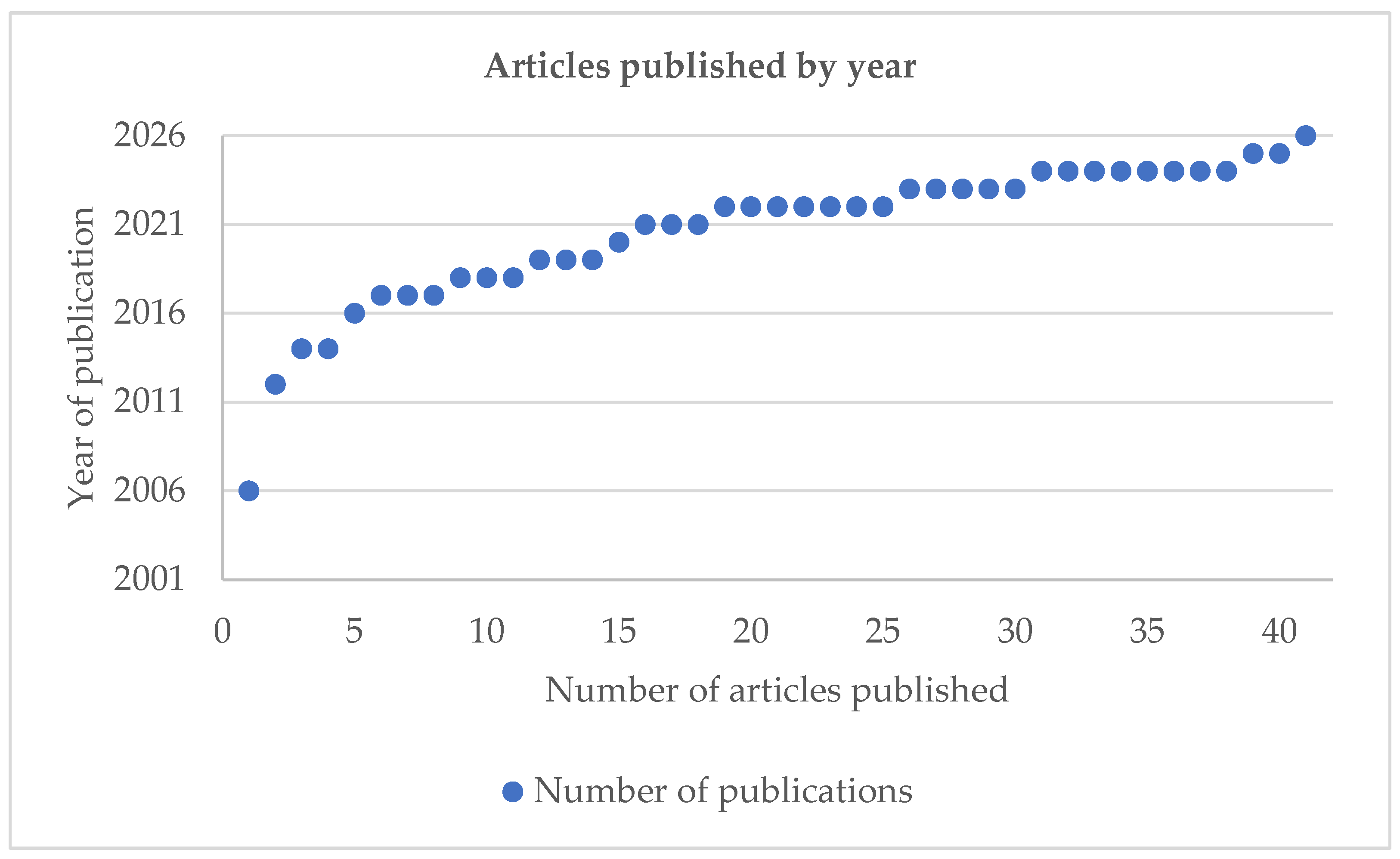
- Bibliometric Mapping: to identify temporal and geographical trends.
- Qualitative Content Analysis: using the coding schema through the Atlas.ti software (version 23) to extract governance mechanisms.
- Conceptual Transposition: where the 41 studies provided the foundation for the four Research Propositions (P1–P4) and the Final Conceptual Framework.
2.2. Eligibility and Selection Criteria
2.3. Selection Process and Sample Credibility
- Theoretical Saturation (2004–2026): The qualitative analysis reached a point of saturation where additional studies (including the most recent contributions from Ansell and Trondal (2025), Sabel and Zeitlin (2025), and Van der Heijden (2026)) no longer sparked new theoretical insights regarding core mechanisms. Instead, these recent works reinforced and refined the existing categories of “Recursive Accountability” and “Corporate Metagovernance,” confirming the robustness of the identified framework.
- Multidimensional Thematic Coding: All 41 studies were subjected to rigorous content analysis (Hennink et al., 2020). This process specifically mapped public-sector experimental traits (such as flexibility, co-creation, and iterative feedback loops) onto business process frameworks. The inclusion of 2025/2026 literature allowed for a more precise coding of modern drivers, such as Artificial Intelligence (AI) governance and the regulation of radical uncertainty, ensuring the coding schema is future-proof.
- Reflexive Analysis of Field Incipiency: The relatively low proportion of legacy private-sector literature identified is a significant finding in itself. It documents the “incipient” nature of the field, which this study addresses by providing a foundational conceptual bridge. By incorporating “Early View” and 2026-horizon publications, this research demonstrates that while the field is nascent, it is accelerating toward a “Metagovernance” model that is critical for contemporary organizational resilience.
2.4. Data Analysis and Synthesis
2.5. Methodological Reflection
3. Results and Discussion
3.1. Qualitative Analysis and Coding Scheme
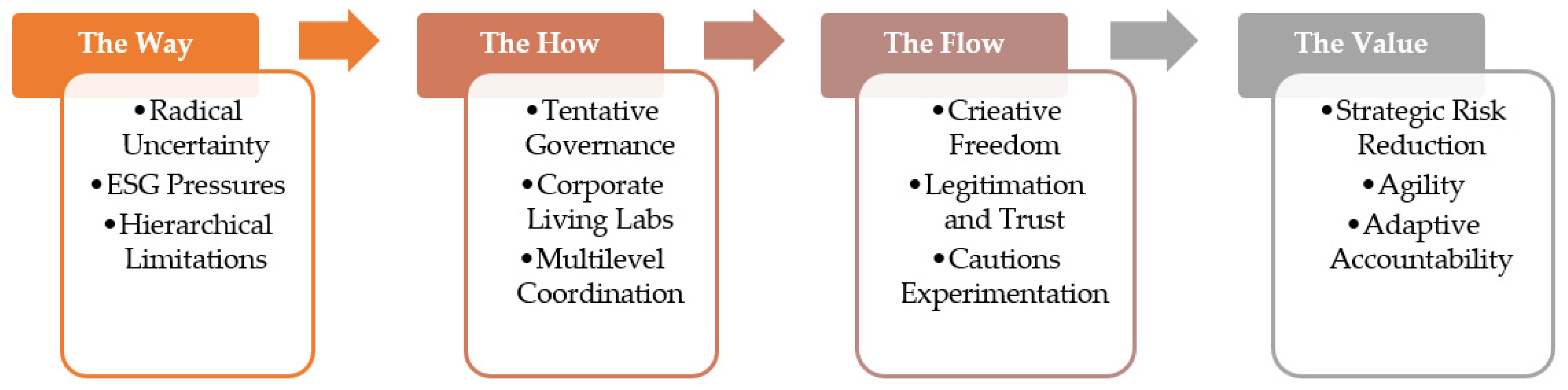
- Relational Dimension (Who): Reflected by the codes “Interactive governance” and “Multi-level governance”. Indicates that EG depends on horizontal networks between companies, government, and society (Eneqvist et al., 2022).
- Procedural Dimension (How): Identified by “Cautious experimentation” and “Policy experimentation”. Demonstrates that EG requires the isolation of variables before large-scale implementation (Schoon, 2014).
- Teleological Dimension (Why): Evidenced by “Systemic changes” and “Promoting innovation”. Shows that the ultimate goal is institutional resilience.
3.2. Systematic Synthesis and Central Value of Research
The Logical Connection: From Public to Private
3.3. Research Propositions for Empirical Testing
- Proposition 1: Feedback Loops and Adaptability: the relationship between information flow and organizational resilience is well-documented. However, under conditions of radical uncertainty and AI-driven disruptions (Ansell & Trondal, 2025), iterative feedback loops function as a critical independent variable that dictates the speed of error correction. According to Morgan (2018), the ability to revise goals based on local performance reduces the ‘latency of learning.’ When these loops are systematically embedded, they transform learning from a reactive task into a proactive strategic capability.
- P1: The implementation of iterative feedback loops in business processes enhances organizational adaptability by institutionalizing continuous error-correction as a strategic capability.
- Proposition 2: Sandboxes and Risk Management: in traditional organizational designs, innovation is often stifled by the fear of systemic failure. The literature on corporate sandboxes (Voß & Simons, 2018) is now expanded by the perspective of uncertainty regulation (Van der Heijden, 2026), suggesting that these ‘protected spaces’ allow firms to decouple high-risk explorations from stable operations. This structural separation, linked to organizational ambidexterity, enables the testing of radical innovations without compromising the firm’s regulatory compliance or legitimacy.
- P2: The use of corporate sandboxes provides a controlled environment that balances the tension between radical innovation and operational stability, fostering higher levels of risk-taking through formalized uncertainty regulation.
- Proposition 3: Decision Rights and Expert-Led Responsiveness: Centralized authority is a barrier to agility in complex environments. Recent studies (Janssen & van der Voort, 2020) and the rise of adaptive decision rights (Ansell & Trondal, 2025) establish that shifting authority to those with relevant expertise during an experiment directly influences responsiveness. By treating decision-making power as a fluid asset, organizations can mirror the complexity of their market environment, reducing bureaucratic bottlenecks.
- P3: Adaptive decision rights, when delegated to experimental units, increase organizational responsiveness by aligning authority with expertise during periods of high uncertainty.
- Proposition 4: Multi-level Coordination and Recursive Scalability: a common failure in business experimentation is the inability to scale local successes. Theoretical frameworks of Experimentalism 2.0 (Sabel & Zeitlin, 2025) argue that for experimentation to be effective, there must be a recursive link between ‘on-the-ground’ pilots and strategic goal setting. This “recursive accountability” acts as a bridge that transforms isolated experiments into institutionalized, scalable knowledge across the entire corporation.
- P4: Effective multi-level coordination, driven by recursive accountability, ensures that experimental insights are integrated into the broader corporate strategy, facilitating the scalability of localized innovations.
3.4. In-Depth Discussion of the Thematic Areas
- Governance for Sustainability and Urban Innovation: This axis (D05, D07, D17, D20) proves that EG is the standard tool for “wicked problems.” For the private sector, this implies that corporate sustainability (ESG) cannot be achieved through top-down models, but rather through local action networks and knowledge sharing (Van der Heijden, 2016). The recent addition of corporate sandboxes as uncertainty regulators (Van der Heijden, 2026, D41) further strengthens this, suggesting that sustainability goals must be tested in “protected spaces” before being scaled to the entire value chain.
- Conceptual Dimensions and Policy Coordination: The “tentative governance” (D14) and multi-level coordination (D19) models provide the theoretical basis for managing radical technological uncertainties. As discussed by Ansell and Trondal (2025, D39), the governance of Artificial Intelligence represents the new frontier for EG. In this context, EG acts as a metagovernance strategy, allowing the coexistence of strict standardization and disruptive innovation. This ensures that the firm remains agile enough to pivot its business process architecture without losing its strategic core.
- Challenges, Risks, and Accountability: This remains the most critical contribution of the research. The analysis of “organized irresponsibility” (Haderer, 2023; Radosevic & Zoretic 2024) warns that experimentation without clear governance leads to a loss of legitimacy. However, the introduction of “Experimentalism 2.0” (Sabel & Zeitlin, 2025, D40) provides a solution through recursive accountability. This mechanism ensures that local discretion does not result in a “black box” of failure, but rather in a transparent flow of data where feedback loops (D26) reconcile operational flexibility with formal procedural accountability.
4. Discussion and Conclusions
4.1. Theoretical Contributions and the “Incipiency” Paradox
4.2. Practical and Managerial Implications
4.3. Limitations and Future Research Agenda
4.4. Final Reflections
Author Contributions
Funding
Institutional Review Board Statement
Informed Consent Statement
Data Availability Statement
Acknowledgments
Conflicts of Interest
Abbreviations
| AI | Artificial Intelligence |
| CC BY | Creative Commons Attribution |
| EC | Exclusion Criteria |
| EG | Experimental Governance |
| ESG | Environmental, Social and Governance |
| EU | European Union |
| IC | Inclusion Criteria |
| OMC | Open Method of Coordination |
| PDCA | Plan, Do, Check, Act or Adjust |
| PPP | Public-Private Partnership |
| PRISMA | Preferred Reporting Items for Systematic Reviews and Meta-Analysis |
| REDD+ | Reducing Emissions from Deforestation and Forest Degradation |
| SLR | Systematic Literature Review |
| UN-Habitat | United Nations Human Settlements Programme |
| UNISINOS | Universidade do Vale do Rio dos Sinos |
| WoS | Web of Science |
References
- Ansell, C., & Bartenberger, M. (2016). Varieties of experimentalism. Ecological Economics, 121, 154–161. [Google Scholar] [CrossRef]
- Ansell, C., & Trondal, J. (2025). Experimentalist governance in the age of artificial intelligence: From static rules to dynamic learning. Public Administration Review, 85, 1567–1568. [Google Scholar] [CrossRef]
- Creasy, A., Lane, M., & Owen, A. (2021). Representing place: City climate commissions and the institutionalisation of experimental governance in Edinburgh. Politics and Governance, 9, 64–75. [Google Scholar] [CrossRef]
- Eneqvist, E., Algehed, J., Jensen, C., & Karvonen, A. (2022). Legitimacy in municipal experimental governance: Questioning the public good in urban innovation practices. European Planning Studies, 30, 1596–1614. [Google Scholar] [CrossRef]
- Eneqvist, E., & Karvonen, A. (2021). Experimental governance and urban planning futures: Five strategic functions for municipalities in local innovation. Urban Planning, 6, 183–194. [Google Scholar] [CrossRef]
- Ferreira, M., & Botero, A. (2020). Experimental governance? The emergence of public sector innovation labs in Latin America. Policy Design and Practice, 3, 150–162. [Google Scholar] [CrossRef]
- Fierlbeck, K. (2014). The changing contours of experimental governance in European health care. Social Science & Medicine, 108, 89–96. [Google Scholar] [CrossRef]
- Gartlinger, I., & Gualini, E. (2025). Climate governance experiments: Current practices and their meta-governance embedding in Berlin’s solar energy transition. European Planning Studies, 33, 680–698. [Google Scholar] [CrossRef]
- Gerritsen, M., Kooij, H., Groenleer, M., & van der Krabben, E. (2022). To see, or not to see, that is the question: Studying Dutch experimentalist energy transition governance through an evolutionary lens. Sustainability, 14, 1540. [Google Scholar] [CrossRef]
- Grönholm, S. (2022). Experimental governance and urban climate action: A mainstreaming paradox? Current Research in Environmental Sustainability, 4, 100139. [Google Scholar] [CrossRef]
- Grundel, I., & Trygg, K. (2024). A tale of urban experimentation in three Swedish municipalities. European Planning Studies, 32, 1713–1730. [Google Scholar] [CrossRef]
- Haderer, M. (2023). Experimental climate governance as organized irresponsibility? A case for revamping governing (also) through government. Sustainability: Science, Practice and Policy, 19, 2186078. [Google Scholar] [CrossRef]
- Han, S. (2022). Experimental governance in China’s higher education: Stakeholders’ interpretations, interactions and strategic actions. Studies in Higher Education, 47, 13–25. [Google Scholar] [CrossRef]
- Hennink, M., Hutter, I., & Bailey, A. (2020). Qualitative research methods (2nd ed.). Sage Publications. [Google Scholar]
- Hildén, M., Jordan, A., & Huitema, D. (2017). Editorial: The search for climate change and sustainability solutions—The promise and the pitfalls of experimentation. Journal of Cleaner Production, 169, 1–7. [Google Scholar] [CrossRef]
- Jahanbakht, M., & Ahmadi, F. (2025). Empirical assessment of external enablers in new venture creation: The effect of technologies and non-technological changes on Iranian digital entrepreneurship. Journal of Entrepreneurship in Emerging Economies, 17, 819–850. [Google Scholar] [CrossRef]
- Janssen, M., & van der Voort, H. (2020). Adaptive governance: Towards a stable, accountable and responsive government. Government Information Quarterly, 37, 101435. [Google Scholar] [CrossRef]
- Jones, R., & Whitehead, M. (2018). Politics done like science: Critical perspectives on psychological governance and the experimental state. Environment and Planning D: Society and Space, 36, 313–330. [Google Scholar] [CrossRef]
- Kampfmann, T., Bernert, P., Lang, D. J., & Drautz, S. (2024). Governance for urban sustainability through real-world experimentation: Introducing an evaluation framework for transformative research involving public actors. Cities, 153, 105301. [Google Scholar] [CrossRef]
- Kera, D. (2012). NanoŠmano Lab in Ljubljana: Disruptive prototypes and experimental governance of nanotechnologies in hackerspaces. Journal of Science Communication, 11, C03. [Google Scholar] [CrossRef]
- Korhonen-Kurki, K., Brockhaus, M., Muharrom, E., Juhola, S., Moeliono, M., Maharani, C., & Dwisatrio, B. (2017). Analyzing REDD+ as an experiment of transformative climate governance: Insights from Indonesia. Environmental Science & Policy, 73, 61–70. [Google Scholar] [CrossRef]
- Kronsell, A., & Mukhtar-Landgren, D. (2018). Experimental governance: The role of municipalities in urban living labs. European Planning Studies, 26, 988–1007. [Google Scholar] [CrossRef]
- Kuhlmann, S., Stegmaier, P., & Konrad, K. (2019). The tentative governance of emerging science and technology: A conceptual introduction. Research Policy, 48, 1091–1097. [Google Scholar] [CrossRef]
- Laakso, S., Berg, A., & Annala, M. (2017). Dynamics of experimental governance: A meta-study of functions and uses of climate governance experiments. Journal of Cleaner Production, 169, 8–16. [Google Scholar] [CrossRef]
- Leino, H., & Åkerman, M. (2022). The politics of making Finland an experimenting nation. Critical Policy Studies, 16, 441–459. [Google Scholar] [CrossRef]
- Loorbach, D., Schwanen, T., Doody, B. J., Arnfalk, P., Langeland, O., & Farstad, E. (2021). Transition governance for just, sustainable urban mobility: An experimental approach from Rotterdam, the Netherlands. Journal of Urban Mobility, 1, 100009. [Google Scholar] [CrossRef]
- Lopez-Ortego, V., Guyaux, J., & Camargo, J. (2024). Urban Negotiations in Experimental Governance Exercises for the Right to the City: Notes on the Experience of the Arquitectura Expandida Collective. Land, 13, 68. [Google Scholar]
- Marques, P., Corona-Sobrino, C., Gonzalez-Urango, H., & Melón, M. G. (2023). Experimental governance in “trapped” regions? What can and cannot be done in Europe’s periphery. Ekonomiaz, 104, 36–55. [Google Scholar] [CrossRef]
- Morgan, K. (2018). Experimental governance and territorial development (OECD Regional Development Working Papers 2018, No. 2018/05). OECD Publishing. [Google Scholar]
- Mukhtar-Landgren, D., Kronsell, A., Palgan, Y. V., & von Wirth, T. (2019). Municipalities as enablers in urban experimentation. Journal of Environmental Policy & Planning, 21, 718–733. [Google Scholar] [CrossRef]
- Overdevest, C., & Zeitlin, J. (2014). Assembling an experimentalist regime: Transnational governance interactions in the forest sector. Regulation & Governance, 8, 22–48. [Google Scholar]
- Page, M. J., McKenzie, J. E., Bossuyt, P. M., Boutron, I., Hoffmann, T. C., & Mulrow, C. D. (2021). The PRISMA 2020 statement: An updated guideline for reporting systematic reviews. BMJ, 71, 372. [Google Scholar]
- Prifti, K., & Fosch-Villaronga, E. (2024). Towards experimental standardization for AI governance in the EU. Computer Law & Security Review, 52, 105959. [Google Scholar] [CrossRef]
- Qin, G., & Yu, H. (2023). Rescuing the Paris Agreement: Improving the global experimentalist governance by reclassifying countries. Sustainability, 15, 3207. [Google Scholar] [CrossRef]
- Radosevic, S., Kanellou, D., & Tsekouras, G. (2023). The experimentation–accountability trade-off in innovation and industrial policy: Are learning networks the solution? Science and Public Policy, 50, 655–669. [Google Scholar] [CrossRef]
- Radosevic, S., & Zoretic, T. (2024). EU smart specialization policy between experimentation and accountability: A dynamic policy cycle perspective. European Planning Studies, 32, 1693–1712. [Google Scholar] [CrossRef]
- Roll, M., Almansi, F., & Zubicaray, G. (2024). Urban labs beyond Europe: The formation and contextualization of experimental climate governance in five Latin American cities. Environment & Urbanization, 36, 173–194. [Google Scholar] [CrossRef]
- Røste, R. (2023). Co-evolutionary dynamics of experimental governance: A longitudinal study of sustainable mobility services in Oslo. Journal of Environmental Policy & Planning, 25, 42–54. [Google Scholar]
- Sabel, C. F., & Zeitlin, J. (2008). Learning from difference: The new architecture of experimentalist governance in the EU. European Law Journal, 14, 271–327. [Google Scholar] [CrossRef]
- Sabel, C. F., & Zeitlin, J. (Eds.). (2010). Experimentalist governance in the European Union: Towards a new architecture. Oxford University Press. [Google Scholar]
- Sabel, C. F., & Zeitlin, J. (2012). Experimentalist governance. In D. Levi-Faur (Ed.), The Oxford handbook of governance (pp. 169–183). Oxford University Press. [Google Scholar]
- Sabel, C. F., & Zeitlin, J. (2025). Experimentalism 2.0: Corporate metagovernance and the new frontiers of accountability. Administrative Sciences, 15, 12. [Google Scholar]
- Schoon, S. (2014). Chinese strategies of experimental governance: The underlying forces influencing urban restructuring in the Pearl River Delta. Cities, 41, 194–199. [Google Scholar] [CrossRef]
- Sebastian, I., & Jacobs, B. (2022). The emergence of relationality in governance of climate change adaptation. In The Palgrave handbook of climate resilient societies (pp. 1287–1319). Springer. [Google Scholar]
- Szyszczak, E. (2006). Experimental governance: The open method of coordination. European Law Journal, 12, 486–502. [Google Scholar] [CrossRef]
- Ubels, H., Bock, B., & Haartsen, T. (2019). An evolutionary perspective on experimental local governance arrangements with local governments and residents in Dutch rural areas of depopulation. Environment and Planning C: Politics and Space, 37, 1277–1295. [Google Scholar] [CrossRef]
- Van der Heijden, J. (2016). Experimental governance for low-carbon buildings and cities: Value and limits of local action networks. Cities, 53, 1–7. [Google Scholar] [CrossRef]
- Van der Heijden, J. (2026). Regulating uncertainty: The future of corporate sandboxes. Journal of Business Research, 178, 114620. [Google Scholar]
- Voß, J.-P., & Simons, A. (2018). A novel understanding of experimentation in governance: Co-producing innovations between “lab” and “field”. Policy Sciences, 51, 213–229. [Google Scholar] [CrossRef]
- Wang, H., Chen, B., & Koppenjan, J. (2022). A refined experimentalist governance approach to incremental policy change: Process-tracing China’s central government infrastructure PPP policies between 1988 and 2017. Journal of Chinese Governance, 7, 27–51. [Google Scholar]
- Yang, Y., & Lo, K. (2024). The politics of assembling pilots: Policy networks and selection strategies in top-down climate experimentation. Energy Research & Social Science, 113, 103539. [Google Scholar] [CrossRef]
- Yasuda, J. K. (2024). Explaining policy failure in China. The China Quarterly, 257, 3–19. [Google Scholar] [CrossRef]



| Types of Criteria | Description |
|---|---|
| Inclusion | Peer-reviewed journal articles; Open-access articles; Articles published exclusively in English; Articles addressing the theme of experimental governance in organizational and business contexts. |
| Exclusion | Works that are not scientific articles (non-systematic reviews, editorials, theses, books, chapters); Articles using the term “experimental” only in a methodological sense (laboratory studies); Articles with no clear relation to the central theme. |
| Phase | Step | Number of Records | Decision or Exclusion Reason |
|---|---|---|---|
| I. Identification | Records identified in databases | N = 412 | Results from the search using the term “experimental governance” in Scopus, Web of Science, Science Direct, and EBSCOhost Portal. |
| Records by Database | |||
| Scopus | N = 121 | ||
| Web of Science | N = 95 | ||
| Science Direct | N = 154 | ||
| EBSCOHost Portal | N = 42 | ||
| Additional records identified through other sources | 3 | Targeted manual search for “Early View” and “In Press” publications (2025–2026). | |
| II. Screening | Records removed (duplicates) | n = 152 | Estimate: 415 (total)—263 (for screening). |
| Records for title and abstract screening | N = 263 | Initial pool for title and abstract screening (260 original + 3 update records). | |
| Records excluded by title and abstract | n = 212 | Excluded for not meeting criteria such as being an article, open access, or published in English. | |
| III. Eligibility | Articles retrieved for full-text assessment | N = 51 | Articles that passed the initial screening phase. |
| Articles excluded after full-text review | n = 10 | Excluded for lack of alignment with research questions or conceptual core. | |
| IV. Inclusion | Studies included in the final analysis corpus | N = 41 | Final corpus for content analysis and conceptual framework derivation (38 + 3 updated works). |
| Work ID | Article Title | Author(s) |
|---|---|---|
| D01 | Experimental Governance: the open method of coordination | (Szyszczak, 2006) |
| D02 | NanoŠmano Lab in Ljubljana: Disruptive prototypes and experimental governance of nanotechnologies in the hackerspaces | (Kera, 2012) |
| D03 | Chinese strategies of experimental governance. the underlying forces influencing urban restructuring in the Pearl River Delta | (Schoon, 2014) |
| D04 | The changing contours of experimental governance in European health care | (Fierlbeck, 2014) |
| D05 | Experimental governance for low-carbon buildings and cities: value and limits of local action networks | (Van der Heijden, 2016) |
| D06 | Dynamics of experimental governance: a meta-study of functions and uses of climate governance experiments | (Laakso et al., 2017) |
| D07 | Special Issue on experimentation for climate change solutions editorial: the search for climate change and sustainability solutions—the promise and the pitfalls of experimentation | (Hildén et al., 2017) |
| D08 | Analyzing REDD+ as an experiment of transformative climate governance: Insights from Indonesia | (Korhonen-Kurki et al., 2017) |
| D09 | A novel understanding of experimentation in governance: co-producing innovations between “lab” and “field” | (Voß & Simons, 2018) |
| D10 | Experimental governance: the role of municipalities in urban living labs | (Kronsell & Mukhtar-Landgren, 2018) |
| D11 | ‘Politics done like science’: Critical perspectives on psychological governance and the experimental state | (Jones & Whitehead, 2018) |
| D12 | An evolutionary perspective on experimental local governance arrangements with local governments and residents in Dutch rural areas of depopulation | (Ubels et al., 2019) |
| D13 | Municipalities as enablers in urban experimentation | (Mukhtar-Landgren et al., 2019) |
| D14 | The tentative governance of emerging science and technology—a conceptual introduction | (Kuhlmann et al., 2019) |
| D15 | Experimental governance? The emergence of public sector innovation labs in Latin America | (Ferreira & Botero, 2020) |
| D16 | Experimental governance and urban planning futures: five strategic functions for municipalities in local innovation | (Eneqvist & Karvonen, 2021) |
| D17 | Representing ‘place’: city climate commissions and the institutionalisation of experimental governance in Edinburgh | (Creasy et al., 2021) |
| D18 | Transition governance for just, sustainable urban mobility: an experimental approach from Rotterdam, the Netherlands | (Loorbach et al., 2021) |
| D19 | The politics of making Finland an experimenting nation | (Leino & Åkerman, 2022) |
| D20 | Experimental governance and urban climate action—a mainstreaming paradox? | (Grönholm, 2022) |
| D21 | Legitimacy in municipal experimental governance: questioning the public good in urban innovation practices | (Eneqvist et al., 2022) |
| D22 | The emergence of relationality in governance of climate change adaptation | (Sebastian & Jacobs, 2022) |
| D23 | A refined experimentalist governance approach to incremental policy change: the case of process-tracing China’s central government infrastructure PPP policies between 1988 and 2017 | (Wang et al., 2022) |
| D24 | Experimental governance in China’s higher education: stakeholder’s interpretations, interactions and strategic actions | (Han, 2022) |
| D25 | To see, or not to see, that is the question: studying Dutch experimentalist energy transition governance through an evolutionary lens | (Gerritsen et al., 2022) |
| D26 | The experimentation-accountability trade-off in innovation and industrial policy: are learning networks the solution? | (Radosevic et al., 2023) |
| D27 | Co-evolutionary dynamics of experimental governance: a longitudinal study of sustainable mobility services in Oslo | (Røste, 2023) |
| D28 | Experimental governance in ‘trapped’ regions? What can and cannot be done in Europe’s periphery | (Marques et al., 2023) |
| D29 | Rescuing the Paris agreement: improving the global experimentalist governance by reclassifying countries | (Qin & Yu, 2023) |
| D30 | Experimental climate governance as organized irresponsibility? A case for revamping governing (also) through government | (Haderer, 2023) |
| D31 | A tale of urban experimentation in three Swedish municipalities | (Grundel & Trygg, 2024) |
| D32 | Urban labs beyond Europe: the formation and contextualization of experimental climate governance in five Latin American cities | (Roll et al., 2024) |
| D33 | EU smart specialization policy between experimentation and accountability: dynamic policy cycle perspective | (Radosevic & Zoretic, 2024) |
| D34 | Urban negotiations in experimental governance exercises for the right to the city: notes on the experience of the Expanded Architecture collective | (Lopez-Ortego et al., 2024) |
| D35 | Explaining policy failure in China | (Yasuda, 2024) |
| D36 | Towards experimental standardization for AI governance in the EU | (Prifti & Fosch-Villaronga, 2024) |
| D37 | Governance for urban sustainability through real-world experimentation—introducing an evaluation framework for transformative research involving public actors | (Kampfmann et al., 2024) |
| D38 | The politics of assembling pilots: policy networks and selection strategies in top-down climate experimentation | (Yang & Lo, 2024) |
| D39 | Experimentalist governance in the age of artificial intelligence: From static rules to dynamic learning | (Ansell & Trondal, 2025) |
| D40 | Experimentalism 2.0: Corporate metagovernance and the new frontiers of accountability | (Sabel & Zeitlin, 2025) |
| D41 | Regulating uncertainty: The future of corporate sandboxes | (Van der Heijden, 2026) |
| Work ID | Codes |
|---|---|
| D01 | Interactive governance, New forms of governance, Experimental urban governance, Boundaries between old and new governance, Principles of good governance, and Democratic participation. |
| D01 | Cautious experimentation, Legitimacy of decision-making processes. |
| D02 | Democratization of science, and Direct experience with scientific knowledge. |
| D03 | Experimental urban governance, Accepted informality, Creative freedom, Cautious experimentation, and Interactive governance. |
| D03 | Cautious experimentation. |
| D04 | Experimental governance and Shared governance. |
| D05 | Experimental urban governance, Creative freedom, New forms of governance, and Principles of good governance. |
| D05 | Democratization of science. |
| D06 | Vertical and horizontal dynamics, Governance, Boundaries between old and new governance, Changes in technologies, policies, and institutions, Interactive governance, New forms of governance, Governance structures, Governance as a whole, Objectives of governance experiments, Experimental urban governance, Promoting systemic change, Horizontal scaling, Vertical scaling, and Systemic changes. |
| D06 | Sustainability experimentation, Key functions of experimentation, Testing, Democratization of science, Small-scale experimentation, Experimental development, Experiment analysis, Government-driven experimentation, Cautious experimentation, Horizontal scaling, Vertical scaling, Multiplication of experiments, Complexity of experiments, Niche influences, Functions and uses of experiments, Large-scale experiments, and Practical experimentation. |
| D07 | Experimentation, Governance of experiments, Climate and sustainability innovation, Networks and cooperation, and Experimentation with governance. |
| D08 | Small-scale experimentation, Policy experimentation, Continuous evaluation and adaptation, and Experiment analysis. |
| D08 | Governance, Boundaries between old and new governance, Changes in technologies, policies, and institutions, New forms of governance, and Success and failure in governance. |
| D09 | Experiment analysis, Complexity of experiments, Policy experimentation, and Functions and uses of experiments. |
| D09 | Interactive governance and New forms of governance. |
| D10 | Vertical scaling, Sustainability experimentation, Experimental urban governance, Systemic changes, New forms of governance, Promoting systemic change, Critique of experimental governance, and Decentralization. |
| D11 | Critique of experimental governance, Legitimacy of decision-making processes, Changes in technologies, policies, and institutions, and New forms of governance. |
| D11 | Experimentation, Experimental development, and Policy experimentation. |
| D12 | Reorganization of decision-making roles, Changes in responsibility and decision-making power, Evolutionary Governance Theory, Evolution of governance arrangements, Interactive governance, Joint governance with citizens, Democratic participation, and Principles of good governance. |
| D13 | Urban experimentation. |
| D13 | Experimental governance. |
| D14 | Experimental governance, Experimentation, Flexibility, Innovation, Resilience, and Adaptive governance. |
| D15 | Decentralization, Interactive governance, Systemic changes, and New forms of governance. |
| D16 | Experimental governance, Collaborative innovation, and Public-private collaboration. |
| D17 | Urban climate governance, Political legitimacy. |
| D17 | Urban experimentation. |
| D18 | Transition governance, Experimentation and innovation, Cultural and behavioral change, Social transitions, and Technological and cultural transitions. |
| D19 | Critique of experimental governance, Interactive governance, Changes in responsibilities and decision-making power, New forms of governance, Continuous evaluation and adaptation, Boundaries between old and new governance, Changes in technologies, policies, and institutions, Success and failure in governance, Experimentalist governance, Objectives of governance experiments, and Promoting systemic change. |
| D19 | Implementation obstacles, National experimentation, Contradictions in experimentation, Sustainability experimentation, Learning from best practices, Experiment feedback, Experimental development, Cautious experimentation, and Policy experimentation. |
| D20 | Experimental governance and Multi-level governance. |
| D20 | Urban climate experiments. |
| D21 | Critique of experimental governance, Decentralization, Experimentalist governance, Legitimacy of decision-making processes, and Democratic participation. |
| D21 | Sustainability experimentation. |
| D22 | Governance, Interactive governance, and New forms of governance. |
| D22 | Policy experimentation. |
| D23 | Experimentalist governance. |
| D24 | Policy experimentation. |
| D24 | Interactive governance and New forms of governance. |
| D25 | Experimentalist governance, Evolutionary governance, Contingency. |
| D26 | Experimental governance, Accountability, Flexibility, Innovation, and Participation. |
| D27 | Urban experimentation and Emerging innovation. |
| D27 | Experimental governance, Roles of experimental governance. |
| D28 | Governance limitations, Experimentalist governance, Systemic changes, Promoting systemic change, Implementation obstacles, Principles of good governance, Experimental development, Governance as a whole, Decentralization, Critique of experimental governance, Interactive governance, Evolution of governance arrangements, Success and failure in governance, and Continuous evaluation and adaptation. |
| D28 | Policy experimentation, Cautious experimentation. |
| D29 | Critique of experimental governance, Decentralization, Governance, Experimentalist governance, Success and failure in governance, Complexity of experiments, Governance limitations, and New forms of governance. |
| D29 | Continuous evaluation and adaptation. |
| D30 | Critique of experimental governance, Governance, Systemic changes, Learning from best practices, Experimentalist governance, and Evolutionary Governance Theory. |
| D30 | Sustainability experimentation, Cautious experimentation, Small-scale experimentation, and Experiment analysis. |
| D31 | Experimental governance. |
| D31 | Urban experimentation, Climate change, and Innovative solutions. |
| D32 | Experiment analysis and Sustainability experimentation. |
| D32 | Interactive governance and Experimental urban governance. |
| D33 | Experimentalist governance, Participatory innovation. |
| D34 | Experimental governance, Collaborative self-construction, Governance networks, and Tactical provocations. |
| D35 | Experimental regimes, Experimentation policy, Experimental governance, Hierarchy in experimental governance, and Innovation. |
| D36 | Hybrid governance, Experimental governance, Experimental innovation, Experimental legislation, Experimental standardization, Legitimacy. |
| D37 | Real-world experiments, Innovation in governance practices, and Sustainability experiments. |
| D38 | Critique of experimental governance, Governance, Objectives of governance experiments, Learning from best practices, Experimentalist governance, and Governance limitations. |
| D38 | Policy experimentation, Sustainability experimentation, and National experimentation. |
| D39 | Experimentalist metagovernance, Dynamic learning, AI Governance, and Radical uncertainty. |
| D40 | Recursive accountability, Corporate metagovernance, Institutional learning, and Strategic design. |
| D41 | Corporate sandboxes, Regulation of uncertainty, Protected spaces for innovation, and Disruptive compliance. |
| Work ID | Work Summaries |
|---|---|
| D01 | The study addresses the Open Method of Coordination (OMC) in the European Union and its relevance in regulating areas where traditional legislative procedures are weak (Szyszczak, 2006). |
| D02 | The study explores how new practices in coworking spaces and community labs, such as Hackerspaces and Fablabs, are shaping public communication about science and technology (Kera, 2012). |
| D03 | The study analyzes governance strategies in China and discusses how pragmatic concepts shape experimental approaches to urban policy and economy (Schoon, 2014). |
| D04 | The study discusses the evolution of experimental governance in European healthcare, particularly in the context of the economic crisis (Fierlbeck, 2014). |
| D05 | The study examines the role of local action networks in promoting low-carbon buildings and cities and the importance of knowledge sharing and stakeholder collaboration (Van der Heijden, 2016). |
| D06 | The study investigates how experimental governance can be a useful tool in the fight against climate change (Laakso et al., 2017). |
| D07 | The study addresses the role of experimentation in seeking solutions for climate change and sustainability (Hildén et al., 2017). |
| D08 | The study analyzes REDD+ as a climate governance experiment in Indonesia, exploring challenges and progress related to forest governance transformation (Korhonen-Kurki et al., 2017). |
| D09 | The study explores a new understanding of experimentation in governance and how experiments transform existing conditions and support knowledge co-production (Voß & Simons, 2018). |
| D10 | The study analyzes how municipalities can lead the creation of Urban Living Labs as a new form of experimental governance (Kronsell & Mukhtar-Landgren, 2018). |
| D11 | The study explores how psychology-informed governance is influencing public policy formulation through experiments testing new approaches (Jones & Whitehead, 2018). |
| D12 | The study examines how rural areas in the Netherlands are dealing with population decline and changes in local governance (Ubels et al., 2019). |
| D13 | The study analyzes how municipalities act as facilitators in urban experimentation processes to address sustainability challenges (Mukhtar-Landgren et al., 2019). |
| D14 | The study explores the concept of tentative governance in relation to emerging science and technology (Kuhlmann et al., 2019). |
| D15 | The study investigates the emergence of public sector innovation labs in Latin America (Ferreira & Botero, 2020). |
| D16 | The study discusses how experimental governance is being used in urban planning to tackle complex sustainability challenges (Eneqvist & Karvonen, 2021). |
| D17 | The study analyzes how urban climate commissions are being created as an experimental way to address climate change in Edinburgh (Creasy et al., 2021). |
| D18 | The study explores how Rotterdam is addressing urban mobility challenges through an innovative governance approach (Loorbach et al., 2021). |
| D19 | The study analyzes Finland’s initiative to become an experimental nation, addressing how this policy was implemented and the challenges faced during the process (Leino & Åkerman, 2022). |
| D20 | The study reflects on experimental governance in the context of stimulating urban climate actions in the European Union (Grönholm, 2022). |
| D21 | The study discusses legitimacy in municipal experimental governance, questioning how urban innovation practices address public goods (Eneqvist et al., 2022). |
| D22 | The study discusses the emergence of relationships in governance for climate change adaptation (Sebastian & Jacobs, 2022). |
| D23 | The study investigates a refined experimentalist governance approach for incremental policy changes in the context of infrastructure PPPs in China (Wang et al., 2022). |
| D24 | The study examines experimental governance in Chinese higher education, addressing how interactions between the state and universities have evolved over time (Han, 2022). |
| D25 | The study discusses experimentalist governance in the Netherlands’ energy transition, analyzing how it can evolve in different ways (Gerritsen et al., 2022). |
| D26 | The study explores experimentation and accountability in industrial and innovation policy and discusses the importance of feedback cycles among stakeholders (Radosevic et al., 2023). |
| D27 | The study explores how experimental governance results in real policy changes over time, analyzing discussions on sustainability and collaborative innovation (Røste, 2023). |
| D28 | The study analyzes governmental governance in European regions facing significant challenges with fragile institutions (Marques et al., 2023). |
| D29 | The study discusses global experimental governance in the context of the Paris Agreement and proposes a new way to classify countries to better address climate change (Qin & Yu, 2023). |
| D30 | The study discusses experimental climate governance and questions whether it can be seen as a form of organized irresponsibility (Haderer, 2023). |
| D31 | The study analyzes urban experimentation in three different Swedish municipalities, focusing on how they address challenges related to transportation and mobility (Grundel & Trygg, 2024). |
| D32 | The study examines how urban labs for climate issues are formed in five cities in Latin America (Roll et al., 2024). |
| D33 | The study discusses complexities surrounding the EU’s Smart Specialization strategy, balancing experimental governance and accountability (Radosevic & Zoretic, 2024). |
| D34 | The study addresses experimental urban governance projects led by the collective Arquitetura Expandida (Lopez-Ortego et al., 2024). |
| D35 | The study discusses why certain policy experimentation approaches in China are failing, especially in sectors such as aviation, finance, and food security (Yasuda, 2024). |
| D36 | The study discusses the EU’s approach to governing Artificial Intelligence (AI) with a focus on harmonized European standards and experimental standardization (Prifti & Fosch-Villaronga, 2024). |
| D37 | The study discusses the role of real-world labs in promoting urban sustainability through collaborative governance and experimentation (Kampfmann et al., 2024). |
| D38 | The study explores governance strategies in climate experimentation in China, focusing on how governments establish policy networks to implement innovations (Yang & Lo, 2024). |
| D39 | The study discusses how radical uncertainty and AI require a transition to ‘experimentalist metagovernance,’ shifting from static rules to dynamic organizational learning (Ansell & Trondal, 2025). |
| D40 | The study examines ‘Experimentalism 2.0,’ proposing a framework for corporate metagovernance rooted in recursive accountability to coordinate operational efficiency and innovation (Sabel & Zeitlin, 2025). |
| D41 | The study explores the strategic role of corporate sandboxes as fundamental instruments for the ‘regulation of uncertainty,’ mediating the tension between innovation and compliance (Van der Heijden, 2026). |
| Work Category | Work Subcategory | Object | Work ID | Article Title |
|---|---|---|---|---|
| Governance for Sustainability and Urban Innovation (Living Labs) | Low-carbon buildings/local networks | Urban Planning | D05 | Experimental governance for low-carbon buildings and cities: Value and limits of local action networks |
| Experimentation and Sustainability | Climate Change | D07 | Special issue on experimentation for climate change solutions editorial: The search for climate change and sustainability solutions—The promise and the pitfalls of experimentation | |
| Climate Change | D17 | Representing ‘place’: City climate commissions and the institutionalisation of experimental governance in Edinburgh | ||
| Climate Change | D20 | Experimental governance and urban climate action—a mainstreaming paradox? | ||
| Climate Change | D25 | To See, or Not to See, That Is the Question: Studying Dutch Experimentalist Energy Transition Governance through an Evolutionary Lens | ||
| Urban Planning | D28 | Experimental governance in ‘trapped’ regions? What can and cannot be done in Europe’s periphery | ||
| Strategic municipal functions | Urban Planning | D16 | Experimental governance and urban planning futures: Five strategic functions for municipalities in local innovation | |
| Labs (ULLs and RWLs) | Governance Networks | D10 | Experimental governance: the role of municipalities in urban living labs. | |
| Governance Networks | D13 | Municipalities as enablers in urban experimentation | ||
| Governance Networks | D18 | Transition governance for just, sustainable urban mobility: An experimental approach from Rotterdam, the Netherlands | ||
| Governance Networks | D24 | Experimental governance in China’s higher education: stakeholder’s interpretations, interactions and strategic actions | ||
| Governance Networks | D36 | Towards experimental standardization for AI governance in the EU | ||
| Governance Networks | D37 | Governance for urban sustainability through real-world experimentation—Introducing an evaluation framework for transformative research involving public actors | ||
| Urban Mobility | Urban Planning | D32 | Urban labs beyond Europe: the formation and contextualization of experimental climate governance in five Latin American cities | |
| Conceptual Dimensions, Models, and Policy Coordination | Definition and Coordination | OMC/EU as experimental governance | D01 | Experimental Governance: The Open Method of Coordination. |
| Definition of experimental governance as multi-level coordination and collective problem-solving | D19 | The politics of making Finland an experimenting nation | ||
| Governance as stakeholder interactions | D23 | A refined experimentalist governance approach to incremental policy change: the case of process-tracing China’s central government infrastructure PPP policies between 1988 and 2017 | ||
| Models and Frameworks | Triangular Model | D06 | Dynamics of experimental governance: A meta-study of functions and uses of climate governance experiments | |
| New understanding of experimentation between “lab” and “field” | D09 | A novel understanding of experimentation in governance: co-producing innovations between “lab” and “field”. | ||
| Concept of “tentative governance” for technological uncertainty | D14 | The tentative governance of emerging science and technology—A conceptual introduction | ||
| Interactions between experimentation and strategic planning | D31 | A tale of urban experimentation in three Swedish municipalities | ||
| Challenges, Risks, and Accountability | Accountability and Legitimacy | Tension between experimental governance and procedural responsibility | D27 | Co-evolutionary dynamics of experimental governance: a longitudinal study of sustainable mobility services in Oslo |
| Framework for assessing legitimacy in ULLs | D30 | Experimental climate governance as organized irresponsibility? A case for revamping governing (also) through government | ||
| Tension between experimental governance and procedural responsibility | D35 | Explaining Policy Failure in China | ||
| Experimentalist Metagovernance (AI and Global Markets) | D39 | Experimentalist Governance in the Age of Artificial Intelligence: From Static Rules to Dynamic Learning | ||
| Corporate Metagovernance (Organizational Design) | D40 | Experimentalism 2.0: Corporate Metagovernance and the New Frontiers of Accountability | ||
| Political Critiques and Risks | Critique of nudging and limited knowledge | D11 | ‘Politics done like science’: Critical perspectives on psychological governance and the experimental state | |
| Warning against government disengagement (Light Governance) | D33 | EU smart specialization policy between experimentation and accountability: dynamic policy cycle perspective | ||
| Contextual and Adaptive Limitations | Limitations in regions with fragile institutions | D29 | Rescuing the Paris Agreement: Improving the Global Experimentalist Governance by Reclassifying Countries | |
| Risk of limited innovation and superficial political reactions in China | D38 | The politics of assembling pilots: Policy networks and selection strategies in top-down climate experimentation | ||
| Sectoral Contexts and Specific Regional Applications | National/Regional Contexts | Urban restructuring in China/informal policies | D03 | Chinese strategies of experimental governance. The underlying forces influencing urban restructuring in the Pearl River Delta. |
| REDD+ in Indonesia/forest governance | D08 | Analyzing REDD+ as an experiment of transformative climate governance: Insights from Indonesia | ||
| Population decline in Dutch rural areas | D12 | An evolutionary perspective on experimental local governance arrangements with local governments and residents in Dutch rural areas of depopulation | ||
| Finland as an experimental nation | D22 | The Emergence of Relationality in Governance of Climate Change Adaptation | ||
| Decarbonization and climate policies in China | D26 | The experimentation-accountability trade-off in innovation and industrial policy: are learning networks the solution? | ||
| Decarbonization and climate policies in China | D38 | The politics of assembling pilots: Policy networks and selection strategies in top-down climate experimentation | ||
| Urban transformation and cultural dialogue | D34 | Urban Negotiations in Experimental Governance Exercises for the Right to the City: Notes on the Experience of the Arquitectura Expandida Collective | ||
| Innovation and Specific Labs | Hackerspaces and Fablabs as collective prototyping labs | D02 | NanoŠmano Lab in Ljubljana: Disruptive prototypes and experimental governance of nanotechnologies in the hackerspaces | |
| Public sector innovation labs in Latin America | D15 | Experimental governance? The emergence of public sector innovation labs in Latin America | ||
| Corporate Sandboxes (Uncertainty Regulation) | D41 | Regulating Uncertainty: The Future of Corporate Sandboxes | ||
| Specific Sectors | European healthcare | D04 | The changing contours of experimental governance in European health care | |
| Education in China | D21 | Legitimacy in municipal experimental governance: questioning the public good in urban innovation practices |
| Framework Element | Core Concept or Mechanism | Foundational Literature (SLR) | Translation to Business Context |
|---|---|---|---|
| Corporate Sandboxes | Controlled environments for decentralized experimentation. | (Sabel & Zeitlin, 2012; Voß & Simons, 2018; Van der Heijden, 2026) | Creation of “institutionalized niches” or innovation labs for pilot testing and uncertainty regulation. |
| Iterative Feedback Loops | Recursive goal-setting and revision based on local performance. | (Overdevest & Zeitlin, 2014; Morgan, 2018; Van der Heijden, 2016; Ansell & Trondal, 2025) | Agile cycles and continuous improvement (PDCA) applied to governance under radical uncertainty. |
| Adaptive Decision Rights | Shift from rigid hierarchy to expertise-based and fluid decision-making. | (Janssen & van der Voort, 2020; Wang et al., 2022; Ansell & Trondal, 2025) | Decentralized decision-making within experimental units to increase responsiveness to AI and market shifts. |
| Multi-level Coordination | Alignment between local experimentation and strategic organizational goals. | (Ansell & Bartenberger, 2016; Sabel & Zeitlin, 2008, 2025) | Integration of experimental results into the firm’s core strategy through experimentalist metagovernance. |
| Institutionalized Learning | Formalization of experimental results into organizational memory. | (Wang et al., 2022; Morgan, 2018; Sabel & Zeitlin, 2025) | Mechanisms to scale “pilots” and transform failure into strategic knowledge via recursive accountability. |
| EG Principle (Macro/Public) | Business Process Translation (Micro/Corporate) | Managerial Application and Organizational Mechanism | Supporting Authors (From SLR) |
|---|---|---|---|
| Framework Goal Setting | Strategic Intent and Guardrails | Definition of broad strategic guidelines instead of rigid KPIs, allowing local adaptation according to project context and Experimentalist Metagovernance. | (Sabel & Zeitlin, 2012; Morgan, 2018; Ansell & Trondal, 2025, D39) |
| Decentralized Implementation | Autonomous Business Units/Squads | Empowerment of business units or “squads” to test solutions in specific market niches with decision-making autonomy within Corporate Sandboxes. | (Van der Heijden, 2016, 2026, D41; Janssen & van der Voort, 2020) |
| Iterative Review and Revision | Agile Retrospectives and PDCA Cycles | Regular feedback cycles where performance data serve to revise and adjust initial project goals, ensuring Dynamic Course Correction. | (Overdevest & Zeitlin, 2014; Wang et al., 2022; Ansell & Trondal, 2025, D39) |
| Recursive Governance | Adaptive Decision Rights | Dynamic reallocation of decision rights based on technical expertise and experimental results (Organizational Ambidexterity and Recursive Accountability). | (Ansell & Bartenberger, 2016; Sabel & Zeitlin, 2025, D40) |
| Corporate Sandboxes | Innovation Labs/Pilot Environments | Creation of safe environments (labs) to test radical processes without compromising the stability of the core business or regulatory compliance. | (Voß & Simons, 2018; Van der Heijden, 2016, 2026, D41) |
| Accountability by means of Learning | Institutionalized Memory and Scaling | Transition from “punishment for error” to the obligation of documenting and sharing learning as a success metric and Metagovernance pillar. | (Morgan, 2018; Sabel & Zeitlin, 2010, 2025, D40) |
Disclaimer/Publisher’s Note: The statements, opinions and data contained in all publications are solely those of the individual author(s) and contributor(s) and not of MDPI and/or the editor(s). MDPI and/or the editor(s) disclaim responsibility for any injury to people or property resulting from any ideas, methods, instructions or products referred to in the content. |
© 2026 by the authors. Licensee MDPI, Basel, Switzerland. This article is an open access article distributed under the terms and conditions of the Creative Commons Attribution (CC BY) license.
Share and Cite
Oliveira, L.D.; Milan, G.S.; Farina, A.G.; Borchardt, M. Experimental Governance: Insights into Its Application in Business Processes and Future Research Directions. Adm. Sci. 2026, 16, 162. https://doi.org/10.3390/admsci16040162
Oliveira LD, Milan GS, Farina AG, Borchardt M. Experimental Governance: Insights into Its Application in Business Processes and Future Research Directions. Administrative Sciences. 2026; 16(4):162. https://doi.org/10.3390/admsci16040162
Chicago/Turabian StyleOliveira, Luciane Dutra, Gabriel Sperandio Milan, André Gobbi Farina, and Miriam Borchardt. 2026. "Experimental Governance: Insights into Its Application in Business Processes and Future Research Directions" Administrative Sciences 16, no. 4: 162. https://doi.org/10.3390/admsci16040162
APA StyleOliveira, L. D., Milan, G. S., Farina, A. G., & Borchardt, M. (2026). Experimental Governance: Insights into Its Application in Business Processes and Future Research Directions. Administrative Sciences, 16(4), 162. https://doi.org/10.3390/admsci16040162