Digitalization and Employee Health and Well-Being During COVID-19

Abstract
1. Introduction
2. COVID-19 and Employee Health and Well-Being
3. Workplace Digitalization, COVID-19, and Employees’ Health and Well-Being
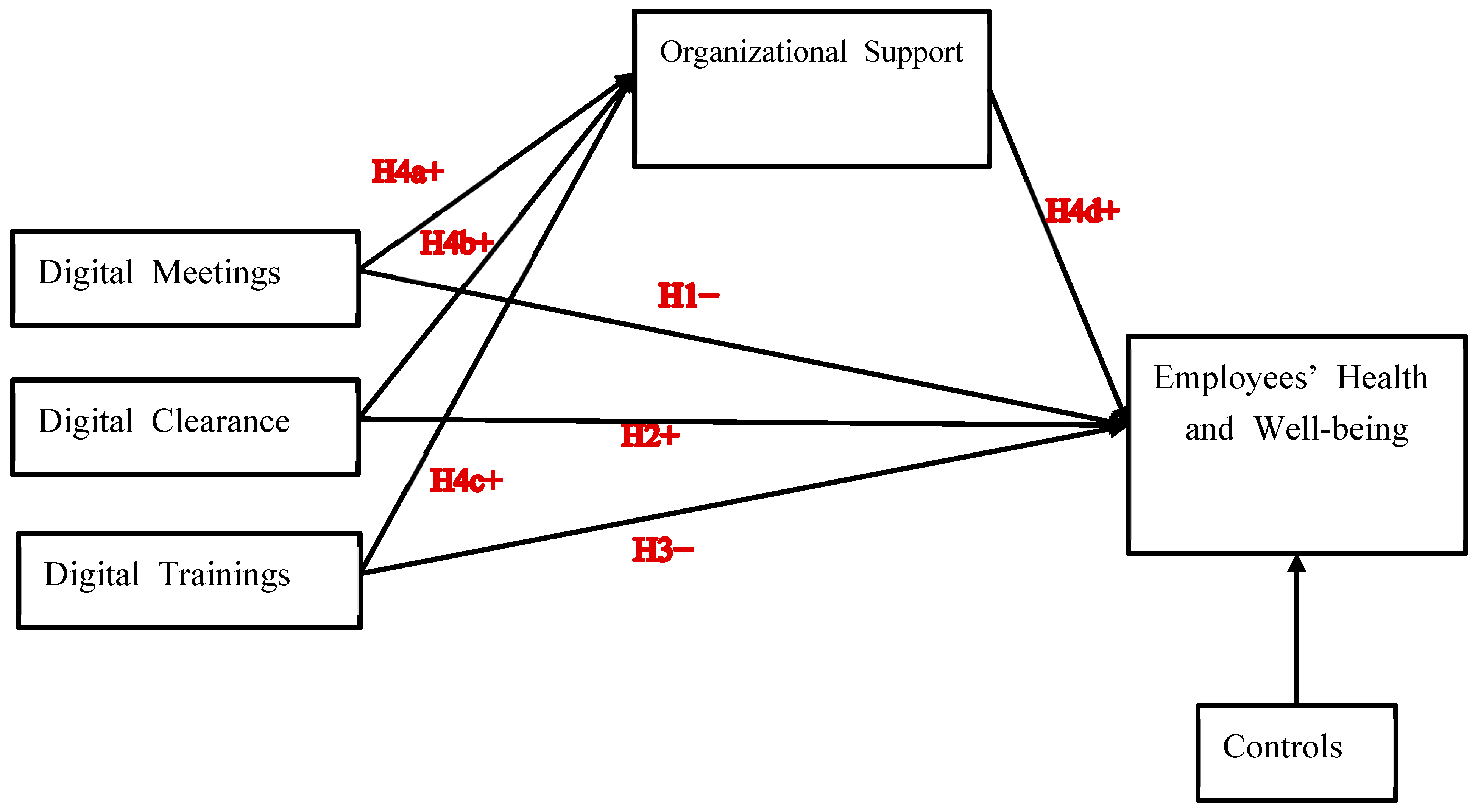
3.1. Digital Meetings
3.2. Digital Clearance
3.3. Digital Training
3.4. Organizational Support as a Mediator
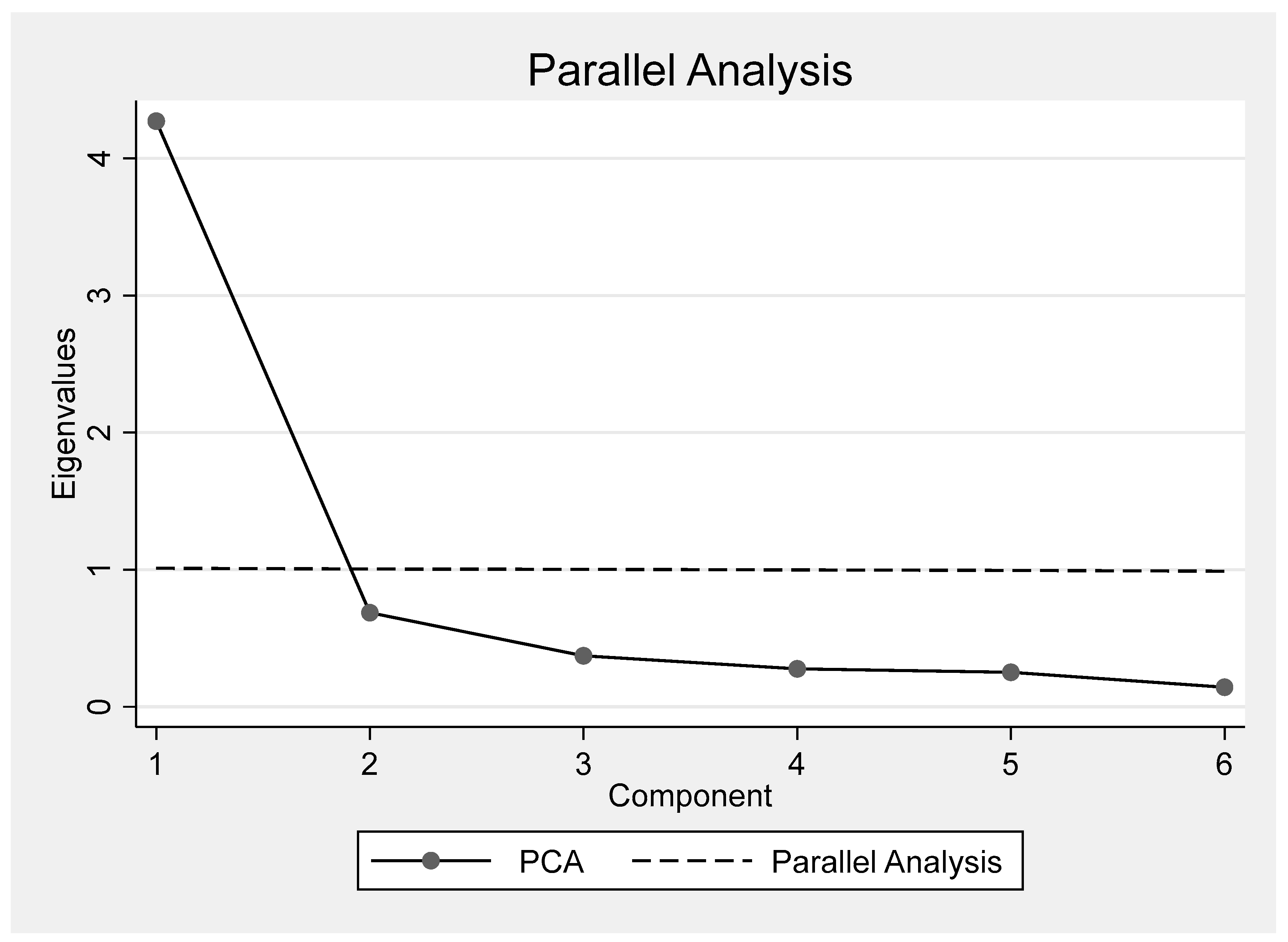
4. Data and Methodology
4.1. Data
4.2. Variables
4.3. Estimation Strategy
5. Findings
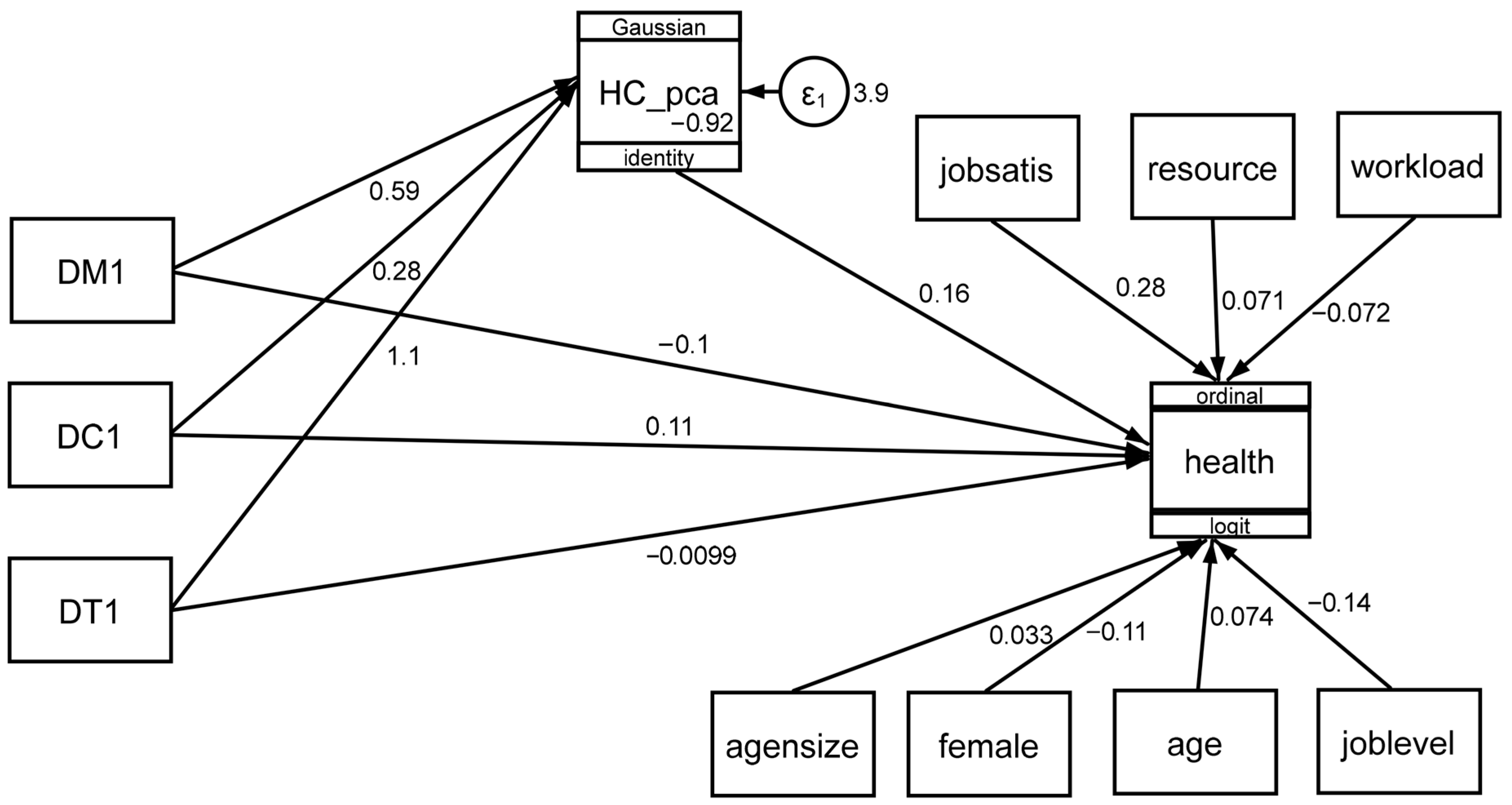
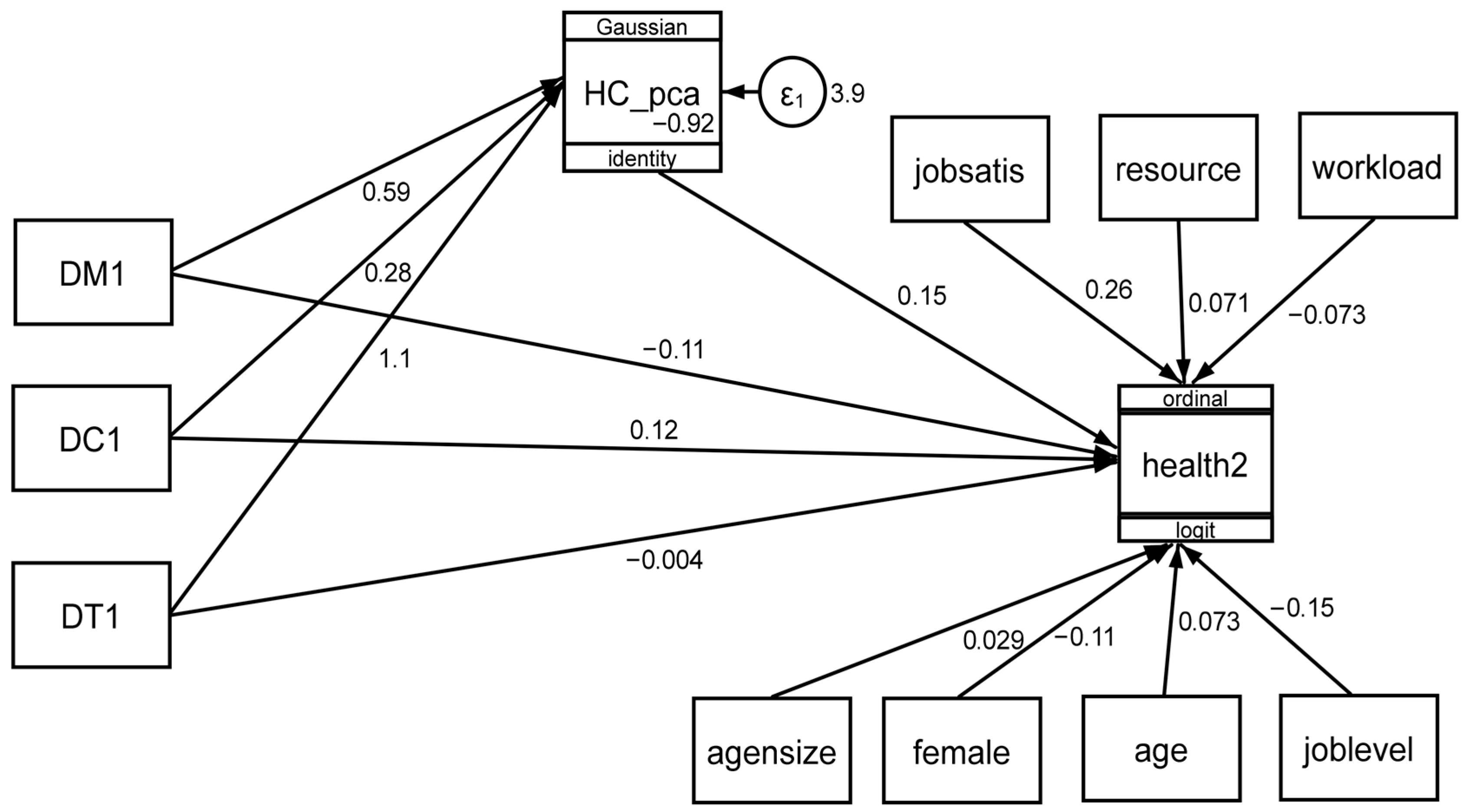
5.1. Ordinal Generalized Structural Equation Modeling (GSEM)
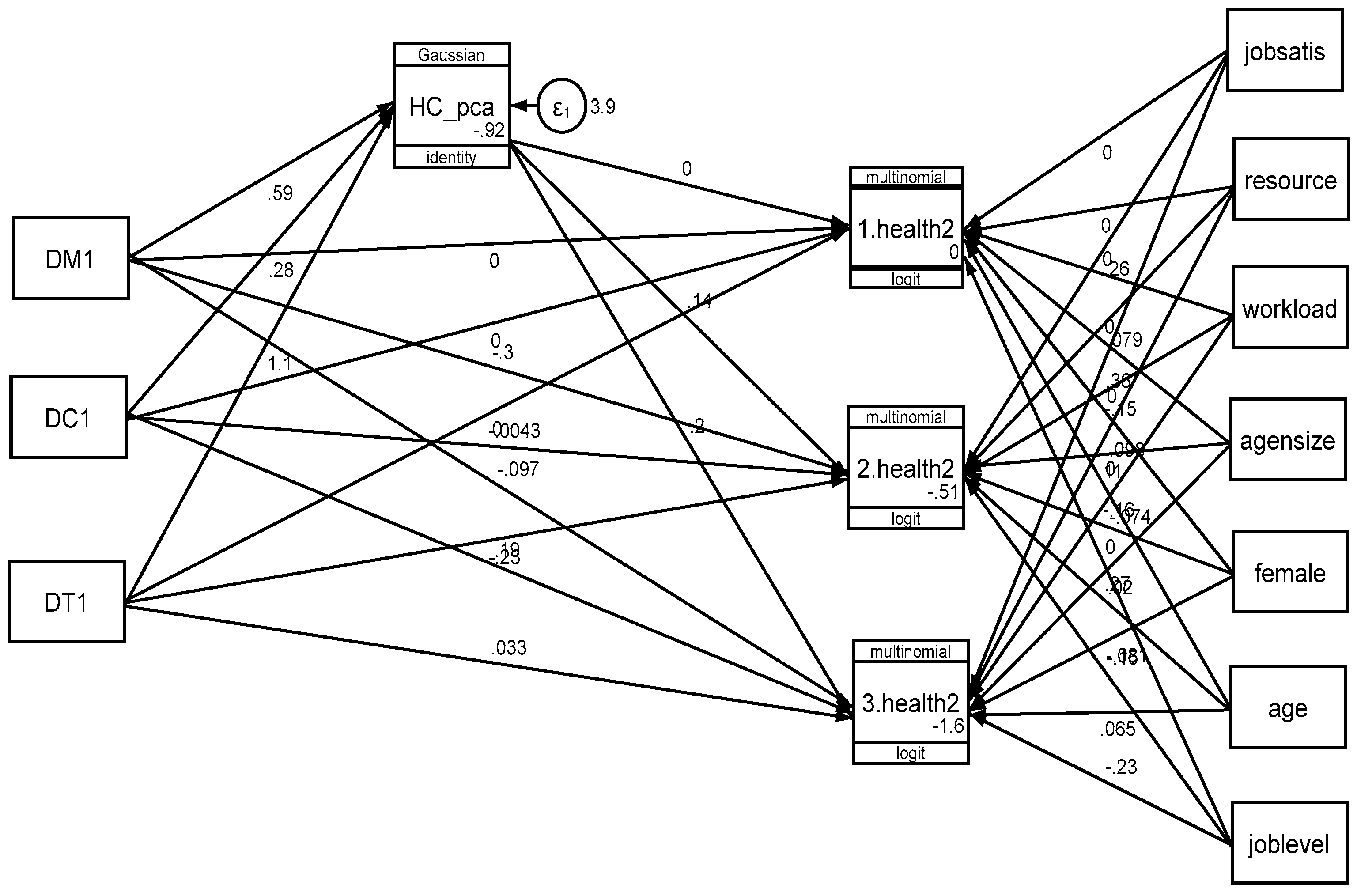
5.2. Multinomial Generalized Structural Equation Modeling (GSEM)
5.3. Post Hoc Tests
6. Discussion
6.1. Policy Recommendations
- 1.
- Mental health should be a key part of teleworking policies
- 2.
- Telework policies should prioritize work–life balance (WLB)
- 3.
- A digital-first approach to prepare for future pandemics
6.2. Limitations and Future Research
7. Conclusions
Author Contributions
Funding
Institutional Review Board Statement
Informed Consent Statement
Data Availability Statement
Conflicts of Interest
Appendix A
| Dependent variable | (from 1 = very negative change to 5 = very positive change) |
| Employee Health & Well-being | Has there been a change in your general health and wellbeing since COVID-19 (27 February 2020)? |
| Independent variable | (Binary: 1 = Yes, 0 = No) |
| Digital Meeting (DM) | My work group implemented more frequent use of digital platforms for meetings during COVID-19 |
| Digital Clearance (DC) | My workgroup streamlined clearance processes(e.g., removing one or more steps in the approval process) |
| Digital Training (DT) | My workgroup increased access to online wellbeing platforms and wellbeing training during COVID-19 |
| Mediator variable | (From 1 = strongly disagree to 5 = strongly agree) |
| Organizational Support of Health & Well-being | (1) I am satisfied with the policies/practices in place to help me manage my health and wellbeing |
| (2) My agency does a good job of communicating what it can offer me in terms of health and wellbeing. | |
| (3) My agency does a good job of promoting health and wellbeing | |
| (4) I think my agency cares about my health and wellbeing. | |
| (5) I believe my immediate supervisor cares about my health and wellbeing. | |
| (6) I am satisfied with my agency’s efforts to maintain a safe environment at work. | |
| Scale Reliability coefficient from the Cronbach’s alpha = 0.9159 | |
| Control variables | |
| Job Satisfaction | Overall, I am satisfied with my job. (From 1 = strongly disagree to 5 = strongly agree) |
| Resources | My workgroup has the tools and resources we need to perform well (From 1 = strongly disagree to 5 = strongly agree) |
| Workload | What best describes your current workload? (1) Below capacity—not enough work. (2) Slightly below capacity—available for more work. (3) At capacity—about the right amount of work to do. (4) Slightly above capacity—lots of work to do. (5) Well above capacity—too much work |
| Agency Size | By number of Employees: 1 = Small (less than 251 employees), 2 = Medium (251–1000), 3 = Large (Over 1000). |
| Gender | Respondent’s gender: Male = 0; Female = 1 |
| Age | Respondent’s age: 1= Under 40 years old; 2 = Between 40 and 54 years old; 3 = 55 years or older |
| Level of Job Classification | 1 = APS 1–6; 2 = Executive Level (EL) 1–2; 3 = Senior Executive Service (SES). |
| DV1 (Original) | Freq. | Percent | DV2 (Collapsed) | Freq. | Percent |
|---|---|---|---|---|---|
| 1. very negative | 2787 | 2.85 | 1. negative | 30,730 | 31.44 |
| 2. negative | 27,943 | 28.59 | |||
| 3. no change | 46,254 | 47.33 | 2. no change | 46,254 | 47.33 |
| 4. positive | 16,851 | 17.24 | 3. positive | 20,742 | 21.22 |
| 5. very positive | 3891 | 3.98 | |||
| Total | 97,726 | 100.00 | Total | 97,726 | 100.00 |
| IV | DV: Health & Well-Being | Coef. | Bootstrap se | z | P > |z| | [95% CI] | |
|---|---|---|---|---|---|---|---|
| Digital Meeting (DM) | Level 2 | 0.0848 | 0.0040 | 21.29 | 0.000 | 0.0770 | 0.0926 |
| Level 3 | 0.1209 | 0.0054 | 22.59 | 0.000 | 0.1104 | 0.1313 | |
| Digital Clearance (DC) | Level 2 | 0.0400 | 0.0028 | 14.39 | 0.000 | 0.0346 | 0.0455 |
| Level 3 | 0.0570 | 0.0038 | 14.89 | 0.000 | 0.0495 | 0.0646 | |
| Digital Training (DT) | Level 2 | 0.1533 | 0.0053 | 29.02 | 0.000 | 0.1429 | 0.1637 |
| Level 3 | 0.2186 | 0.0068 | 32.07 | 0.000 | 0.2053 | 0.2320 | |

References
- Andersen, K. N., Lee, J., & Henriksen, H. Z. (2020). Digital sclerosis? Wind of change for government and the employees. Digital Government: Research and Practice, 1, 9. [Google Scholar] [CrossRef]
- Aristovnik, A., Kovač, P., Murko, E., Ravšelj, D., Umek, L., Bohatá, M., Hirsch, B., Schäfer, F.-S., & Tomaževič, N. (2021). The use of ICT by local general administrative authorities during COVID-19 for a sustainable future: Comparing five European countries. Sustainability, 13(21), 11765. [Google Scholar] [CrossRef]
- Aroles, J., Cecez-Kecmanovic, D., Dale, K., Kingma, S. F., & Mitev, N. (2021). New ways of working (NWW): Workplace transformation in the digital age. Information and Organization, 31(4), 100378. [Google Scholar] [CrossRef]
- Australian Public Service Commission. (2021, February 25). APS employee census 2020. Australian Public Service Commission, Australian Government. Available online: https://www.apsc.gov.au/initiatives-and-programs/workforce-information/aps-employee-census-2020 (accessed on 15 October 2022).
- Bakker, A. B., & Demerouti, E. (2007). The job demands-resources model: State of the art. Journal of Managerial Psychology, 22(3), 309–328. [Google Scholar] [CrossRef]
- Bakker, A. B., & Demerouti, E. (2017). Job demands–resources theory: Taking stock and looking forward. Journal of Occupational Health Psychology, 22(3), 273. [Google Scholar] [CrossRef] [PubMed]
- Bakker, A. B., Demerouti, E., & Sanz-Vergel, A. I. (2014). Burnout and work engagement: The JD–R approach. Annual Review of Organizational Psychology and Organizational Behavior, 1(2014), 389–411. [Google Scholar] [CrossRef]
- Baron, R. M., & Kenny, D. A. (1986). The moderator–mediator variable distinction in social psychological research: Conceptual, strategic, and statistical considerations. Journal of Personality and Social Psychology, 51(6), 1173. [Google Scholar] [CrossRef]
- Beckel, J. L., & Fisher, G. G. (2022). Telework and worker health and well-being: A review and recommendations for research and practice. International Journal of Environmental Research and Public Health, 19(7), 3879. [Google Scholar] [CrossRef]
- Bennett, L. (2017). Social media, academics’ identity work and the good teacher. International Journal for Academic Development, 22(3), 245–256. [Google Scholar] [CrossRef]
- Berry, S., Trochmann, M. B., & Millesen, J. L. (2024). Putting the humanity back into public human resources management: A narrative inquiry analysis of public service in the time of COVID-19. Review of Public Personnel Administration, 44(1), 8–31. [Google Scholar] [CrossRef]
- Beyea, D., Lim, C., Lover, A., Foxman, M., Ratan, R., & Leith, A. (2025). Zoom fatigue in review: A meta-analytical examination of videoconferencing fatigue’s antecedents. Computers in Human Behavior Reports, 17, 100571. [Google Scholar] [CrossRef]
- Bi, F., Luo, D., Huang, Y., Chen, X., Zhang, D., & Xiao, S. (2021). The relationship between social support and suicidal ideation among newly diagnosed people living with HIV: The mediating role of HIV-related stress. Psychology, Health & Medicine, 26(6), 724–734. [Google Scholar]
- Bilotta, I., Cheng, S., Davenport, M. K., & King, E. (2021). Using the job demands-resources model to understand and address employee well-being during the COVID-19 pandemic. Industrial and Organizational Psychology, 14(1–2), 267–273. [Google Scholar] [CrossRef]
- Bloomberg, J. (2018, April 29). Digitization, digitalization, and digital transformation: Confuse them at your peril. Available online: https://www.forbes.com/sites/jasonbloomberg/2018/04/29/digitization-digitalization-and-digital-transformation-confuse-them-at-your-peril/ (accessed on 15 October 2022).
- Bordi, L., Okkonen, J., Mäkiniemi, J.-P., & Heikkilä-Tammi, K. (2018). Communication in the digital work environment: Implications for wellbeing at work. Nordic Journal of Working Life Studies, 8(S3), 29–48. [Google Scholar] [CrossRef]
- Boulet, M., & Parent-Lamarche, A. (2022). Paradoxical effects of teleworking on workers’ well-being in the COVID-19 context: A comparison between different public administrations and the private sector. Public Personnel Management, 51(4), 430–457. [Google Scholar] [CrossRef]
- Bregenzer, A., & Jimenez, P. (2021). Risk factors and leadership in a digitalized working world and their effects on employees’ stress and resources: Web-based questionnaire study. Journal of Medical Internet Research, 23(3), e24906. [Google Scholar] [CrossRef] [PubMed]
- Bregenzer, A., Wagner-Hartl, V., & Jiménez, P. (2019). Who uses apps in health promotion? A target group analysis of leaders. Health Informatics Journal, 25(3), 1038–1052. [Google Scholar] [CrossRef] [PubMed]
- Budai, B. B., Csuhai, S., & Tózsa, I. (2023). Digital competence development in public administration higher education. Sustainability, 15(16), 12462. [Google Scholar] [CrossRef]
- Cain, M. (2021). Structural equation modeling using Stata. Journal of Behavioral Data Science, 1(2), 156–177. [Google Scholar] [CrossRef]
- Champagne, E., Choinière, O., & Granja, A. D. (2023). Government of Canada’s teleworking and hybrid policies in the aftermath of the COVID-19 pandemic. Canadian Public Administration, 66(2), 158–175. [Google Scholar] [CrossRef]
- Chang, S. J., Van Witteloostuijn, A., & Eden, L. (2010). From the editors: Common method variance in international business research. Journal of International Business Studies, 41(2), 178–184. [Google Scholar] [CrossRef]
- Chung, H., & Van der Lippe, T. (2020). Flexible working, work–life balance, and gender equality: Introduction. Social Indicators Research, 151(2), 365–381. [Google Scholar]
- Colley, L. (2014). Understanding ageing public sector workforces: Demographic challenge or a consequence of public employment policy design? Public Management Review, 16(7), 1030–1052. [Google Scholar]
- Dauth, W., Findeisen, S., Südekum, J., & Woessner, N. (2017, September 20). German robots-the impact of industrial robots on workers. CEPR Discussion Paper No. DP12306. Available online: https://ssrn.com/abstract=3039031 (accessed on 15 October 2022).
- Day, A., Scott, N., & Kevin Kelloway, E. (2010). Information and communication technology: Implications for job stress and employee well-being. In New developments in theoretical and conceptual approaches to job stress (pp. 317–350). Emerald Group Publishing Limited. [Google Scholar]
- Demerouti, E., & Bakker, A. B. (2023). Job demands-resources theory in times of crises: New propositions. Organizational Psychology Review, 13(3), 209–236. [Google Scholar] [CrossRef]
- Di Loreto, M., Suzuki, K., & Demircioglu, M. A. (2025). Demographic shifts and digital innovation in the public sector. Springer. [Google Scholar]
- Doberstein, C., & Charbonneau, É. (2022). Alienation in pandemic-induced telework in the public sector. Public Personnel Management, 51(4), 491–515. [Google Scholar] [CrossRef]
- Dolan, E., Kosasi, S., & Sari, S. N. (2022). Implementation of competence-based human resources management in the digital era. Startupreneur Bisnis Digital (SABDA Journal), 1(2), 167–175. [Google Scholar] [CrossRef]
- Duque, L., Costa, R., Dias, Á., Pereira, L., Santos, J., & António, N. (2020). New ways of working and the physical environment to improve employee engagement. Sustainability, 12(17), 6759. [Google Scholar] [CrossRef]
- Eisenberger, R., Huntington, R., Hutchison, S., & Sowa, D. (1986). Perceived organizational support. Journal of Applied Psychology, 71(3), 500–507. [Google Scholar] [CrossRef]
- Ervasti, J., Aalto, V., Pentti, J., Oksanen, T., Kivimäki, M., & Vahtera, J. (2022). Association of changes in work due to COVID-19 pandemic with psychosocial work environment and employee health: A cohort study of 24 299 Finnish public sector employees. Occupational and Environmental Medicine, 79(4), 233–241. [Google Scholar] [CrossRef] [PubMed]
- Faragher, E. B., Cass, M., & Cooper, C. L. (2005). The relationship between job satisfaction and health: A meta-analysis. Occupational and Environmental Medicine, 62(2), 105–112. [Google Scholar] [CrossRef]
- Fauville, G., Luo, M., Queiroz, A. C. M., Lee, A., Bailenson, J. N., & Hancock, J. (2023). Video-conferencing usage dynamics and nonverbal mechanisms exacerbate Zoom fatigue, particularly for women. Computers in Human Behavior Reports, 10, 100271. [Google Scholar] [CrossRef]
- Gaspar, T., Jesus, S., Farias, A. R., & Matos, M. G. (2024). Healthy work environment ecosystems for teleworking and hybrid working. Procedia Computer Science, 239, 1132–1140. [Google Scholar] [CrossRef]
- Grant, A. M., Christianson, M. K., & Price, R. H. (2007). Happiness, health, or relationships? Managerial practices and employee well-being tradeoffs. Academy of Management Perspectives, 21(3), 51–63. [Google Scholar] [CrossRef]
- Guler, M. A., Guler, K., Gulec, M. G., & Ozdoglar, E. (2021). Working from home during a pandemic: Investigation of the impact of COVID-19 on employee health and productivity. Journal of Occupational and Environmental Medicine, 63(9), 731–741. [Google Scholar] [CrossRef]
- Ha, H., Raghavan, A., & Demircioglu, M. A. (2024). COVID-19 and employee productivity in the public sector. Asia Pacific Journal of Public Administration, 46(1), 66–89. [Google Scholar] [CrossRef]
- Hair, J. F., Black, W. C., Babin, B. J., & Anderson, R. E. (2014). Multivariate data analysis. Pearson Education Limited. [Google Scholar]
- Hamouche, S. (2023). COVID-19 and employees’ mental health: Stressors, moderators and agenda for organizational actions. Emerald Open Research, 1(2), 15. [Google Scholar] [CrossRef]
- Hayes, A. F. (2013). Mediation analysis. In Introduction to mediation, moderation, and conditional process analysis: A regression-based approach (pp. 83–204). Guilford Press. [Google Scholar]
- Horii, M., & Sakurai, Y. (2020). The future of work in Japan: Accelerating automation after COVID-19. McKinsey Insights. [Google Scholar]
- Howarth, A., Quesada, J., Silva, J., Judycki, S., & Mills, P. R. (2018). The impact of digital health interventions on health-related outcomes in the workplace: A systematic review. Digital Health, 4, 2055207618770861. [Google Scholar] [CrossRef]
- Hülsheger, U. R., Alberts, H. J., Feinholdt, A., & Lang, J. W. (2013). Benefits of mindfulness at work: The role of mindfulness in emotion regulation, emotional exhaustion, and job satisfaction. Journal of Applied Psychology, 98(2), 310. [Google Scholar] [CrossRef] [PubMed]
- ILO. (2020, July 21). Teleworking during the COVID-19 pandemic and beyond: A practical guide. Available online: https://www.ilo.org/wcmsp5/groups/public/---ed_protect/---protrav/---travail/documents/instructionalmaterial/wcms_751232.pdf (accessed on 15 October 2022).
- Ingusci, E., Signore, F., Giancaspro, M. L., Manuti, A., Molino, M., Russo, V., Zito, M., & Cortese, C. G. (2021). Workload, techno overload, and behavioral stress during COVID-19 emergency: The role of job crafting in remote workers. Frontiers in Psychology, 12, 655148. [Google Scholar] [CrossRef] [PubMed]
- Jiménez, P., Winkler, B., & Bregenzer, A. (2017). Developing sustainable workplaces with leadership: Feedback about organizational working conditions to support leaders in health-promoting behavior. Sustainability, 9(11), 1944. [Google Scholar] [CrossRef]
- Johnson, A., Dey, S., Nguyen, H., Groth, M., Joyce, S., Tan, L., Glozier, N., & Harvey, S. B. (2020). A review and agenda for examining how technology-driven changes at work will impact workplace mental health and employee well-being. Australian Journal of Management, 45(3), 402–424. [Google Scholar] [CrossRef]
- Juchnowicz, M., & Kinowska, H. (2021). Employee well-being and digital work during the COVID-19 pandemic. Information, 12(8), 293. [Google Scholar] [CrossRef]
- Kabasakal, E., Özpulat, F., Akca, A., & Özcebe, L. H. (2021). Mental health status of health sector and community services employees during the COVID-19 pandemic. International Archives of Occupational and Environmental Health, 94(6), 1249–1262. [Google Scholar] [CrossRef]
- Karatepe, O. M. (2015). Do personal resources mediate the effect of perceived organizational support on emotional exhaustion and job outcomes? International Journal of Contemporary Hospitality Management, 27(1), 4–26. [Google Scholar] [CrossRef]
- Kim, T., Mullins, L. B., & Yoon, T. (2021). Supervision of telework: A key to organizational performance. The American Review of Public Administration, 51(4), 263–277. [Google Scholar] [CrossRef]
- Kline, R. B. (2015). The mediation myth. Basic and Applied Social Psychology, 37(4), 202–213. [Google Scholar] [CrossRef]
- Kreiss, D., & Brennen, J. S. (2016). Normative models of digital journalism. In The SAGE handbook of digital journalism (pp. 299–314). SAGE Publications Ltd. [Google Scholar]
- Long, J. S. (1997). Regression models for categorical and limited dependent variables. Sage Publications, Inc. [Google Scholar]
- Long, J. S., & Freese, J. (2006). Regression models for categorical dependent variables using Stata (Vol. 7). Stata Press. [Google Scholar]
- Lopes, A. S., Sargento, A., & Farto, J. (2023). Training in digital skills—The perspective of workers in public sector. Sustainability, 15(13), 10577. [Google Scholar] [CrossRef]
- Lunde, L. K., Fløvik, L., Christensen, J. O., Johannessen, H. A., Finne, L. B., Jørgensen, I. L., Mohr, B., & Vleeshouwers, J. (2022). The relationship between telework from home and employee health: A systematic review. BMC Public Health, 22(1), 47. [Google Scholar]
- MacKinnon, D. P., Fairchild, A. J., & Fritz, M. S. (2007). Mediation analysis. Annual Review of Psychology, 58(1), 593–614. [Google Scholar] [CrossRef]
- Maron, J., De Matos, E. G., Piontek, D., Kraus, L., & Pogarell, O. (2019). Exploring socio-economic inequalities in the use of medicines: Is the relation mediated by health status? Public Health, 169, 1–9. [Google Scholar] [CrossRef]
- Matthews, R. A., Pineault, L., & Hong, Y. H. (2022). Normalizing the use of single-item measures: Validation of the single-item compendium for organizational psychology. Journal of Business and Psychology, 37(4), 639–673. [Google Scholar]
- McEwan, A. M. (2016). Smart working: Creating the next wave. Routledge. [Google Scholar]
- Mele, V., Bellé, N., & Cucciniello, M. (2021). Thanks, but no thanks: Preferences towards teleworking colleagues in public organizations. Journal of Public Administration Research and Theory, 31(4), 790–805. [Google Scholar] [CrossRef]
- Melo, T. A. D., & Demo, G. (2024). Home sweet home? The mediating role of human resource management practices in the relationship between leadership and quality of life in teleworking in the public sector. Sustainability, 16(12), 5006. [Google Scholar] [CrossRef]
- Milton, K., Clemes, S., & Bull, F. (2013). Can a single question provide an accurate measure of physical activity? British Journal of Sports Medicine, 47(1), 44–48. [Google Scholar] [CrossRef]
- Moller, S., Yavorsky, J. E., Ruppanner, L., & Dippong, J. (2024). Remote work penalties: Work location and career rewards. Social Currents, 11(6), 493–514. [Google Scholar] [CrossRef]
- Mourão, L., da Silva Abbad, G., & Legentil, J. (2021). E-leadership: Lessons learned from teleworking in the COVID-19 pandemic. In Leadership in a changing world—A multidimensional perspective. IntechOpen. [Google Scholar]
- O’Connor, R. C., Wetherall, K., Cleare, S., McClelland, H., Melson, A. J., Niedzwiedz, C. L., O’Carroll, R. E., O’Connor, D. B., Platt, S., Scowcroft, E., Watson, B., Zortea, T., Ferguson, E., & Robb, K. A. (2021). Mental health and well-being during the COVID-19 pandemic: Longitudinal analyses of adults in the UK COVID-19 mental health & wellbeing study. The British Journal of Psychiatry, 218(6), 326–333. [Google Scholar]
- Ortiz-Lozano, J. M., Martínez-Morán, P. C., & de Nicolás, V. L. (2022). Teleworking in the public administration: An analysis based on Spanish civil servants’ perspectives during the pandemic. Sage Open, 12(1), 21582440221079843. [Google Scholar] [CrossRef]
- Parent-Lamarche, A., & Boulet, M. (2021). Employee well-being in the COVID-19 pandemic: The moderating role of teleworking during the first lockdown in the province of Quebec, Canada. Work, 70(3), 763–775. [Google Scholar] [CrossRef] [PubMed]
- Parkin, A. K., Zadow, A. J., Potter, R. E., Afsharian, A., Dollard, M. F., Pignata, S., Bakker, A. B., & Lushington, K. (2023). The role of psychosocial safety climate on flexible work from home digital job demands and work-life conflict. Industrial Health, 61(5), 307–319. [Google Scholar] [CrossRef] [PubMed]
- Perrot, B., Sébille, V., & Blanchin, M. (2024, November 15). Estimating longitudinal partial credit models and accounting for lack of measurement invariance using generalized structural equation modeling in Stata. Available online: https://hal.science/hal-04785827v1 (accessed on 15 October 2025).
- Pfaffinger, K. F., Reif, J. A., Spieß, E., & Berger, R. (2020). Anxiety in a digitalised work environment. Gruppe. Interaktion. Organisation. Zeitschrift für Angewandte Organisationspsychologie (GIO), 51(1), 25–35. [Google Scholar] [CrossRef]
- Pfeffer, J. (1992). Managing with power: Politics and influence in organizations. Harvard Business Press. [Google Scholar]
- Podsakoff, P. M., MacKenzie, S. B., Lee, J. Y., & Podsakoff, N. P. (2003). Common method biases in behavioral research: A critical review of the literature and recommended remedies. Journal of Applied Psychology, 88(5), 879–903. [Google Scholar] [CrossRef]
- Podsakoff, P. M., MacKenzie, S. B., & Podsakoff, N. P. (2012). Sources of method bias in social science research and recommendations on how to control it. Annual Review of Psychology, 63(1), 539–569. [Google Scholar] [CrossRef]
- Potter, R. E., Zadow, A., Dollard, M., Pignata, S., & Lushington, K. (2022). Digital communication, health & wellbeing in universities: A double-edged sword. Journal of Higher Education Policy and Management, 44(1), 72–89. [Google Scholar]
- Prime, H., Wade, M., & Browne, D. T. (2020). Risk and resilience in family well-being during the COVID-19 pandemic. American Psychologist, 75(5), 631–643. [Google Scholar] [CrossRef]
- Puddister, K., & Small, T. A. (2020). Trial by Zoom? The response to COVID-19 by Canada’s courts. Canadian Journal of Political Science/Revue Canadienne de Science Politique, 53(2), 373–377. [Google Scholar] [CrossRef]
- Quan, Y., & Wang, C. (2025). Collapsing or not? A practical guide to handling sparse responses for polytomous items. Methodology, 21(1), 46–73. [Google Scholar] [CrossRef]
- Raghavan, A., Demircioglu, M. A., & Orazgaliyev, S. (2021). COVID-19 and the new normal of organizations and employees: An overview. Sustainability, 13(21), 11942. [Google Scholar] [CrossRef]
- Rainey, H. G., Fernandez, S., & Malatesta, D. (2021). Understanding and managing public organizations (6th ed.). Wiley. [Google Scholar]
- Rhoades, L., & Eisenberger, R. (2002). Perceived organizational support: A review of the literature. Journal of Applied Psychology, 87(4), 698–714. [Google Scholar] [CrossRef]
- Rice, B., Martin, N., Fieger, P., & Hussain, T. (2022). Older healthcare workers’ satisfaction: Managing the interaction of age, job security expectations and autonomy. Employee Relations: The International Journal, 44(2), 319–334. [Google Scholar] [CrossRef]
- Ríos Villacorta, M. A., Ramos Farroñán, E. V., Arbulú Ballesteros, M. A., Otiniano León, M. Y., Bravo Jaico, J. L., Suysuy Chambergo, E. J., Reyes-Pérez, M. D., Ganoza-Ubillús, L. M., & Alarcón García, R. E. (2024). Human-centric telework and sustainable well-being: Evidence from Peru’s public sector. Sustainability, 16(22), 9713. [Google Scholar] [CrossRef]
- Roczniewska, M., Smoktunowicz, E., Calcagni, C. C., von Thiele Schwarz, U., Hasson, H., & Richter, A. (2022). Beyond the individual: A systematic review of the effects of unit-level demands and resources on employee productivity, health, and well-being. Journal of Occupational Health Psychology, 27(2), 240–257. [Google Scholar]
- Roszkowska, E. (2025). Improving survey data interpretation: A novel approach to analyze single-item ordinal responses with non-response categories. Information, 16(7), 546. [Google Scholar] [CrossRef]
- Salanova, M., Llorens, S., & Ventura, M. (2014). Technostress: The dark side of technologies. In The impact of ICT on quality of working life (pp. 87–103). Springer. [Google Scholar]
- Satuf, C., Monteiro, S., Pereira, H., Esgalhado, G., Marina Afonso, R., & Loureiro, M. (2018). The protective effect of job satisfaction in health, happiness, well-being and self-esteem. International Journal of Occupational Safety Ergonomics, 24(2), 181–189. [Google Scholar] [CrossRef] [PubMed]
- Sibley, C. G., Greaves, L. M., Satherley, N., Wilson, M. S., Overall, N. C., Lee, C. H. J., Milojev, P., Bulbulia, J., Osborne, D., Milfont, T. L., Houkamau, C. A., Duck, I. M., Vickers-Jones, R., & Barlow, F. K. (2020). Effects of the COVID-19 pandemic and nationwide lockdown on trust, attitudes toward government, and well-being. American Psychologist, 75(5), 618–630. [Google Scholar] [CrossRef] [PubMed]
- Solopi, M., & Qutieshat, A. (2023). Digital transformation in the public sector during the COVID-19 pandemic and how it was impacted by leadership: Literature review. International Journal of Applied Research in Business and Management, 4(2), 84–93. [Google Scholar] [CrossRef]
- Song, J., Howe, E., Oltmanns, J. R., & Fisher, A. J. (2023). Examining the concurrent and predictive validity of single items in ecological momentary assessments. Assessment, 30(5), 1662–1671. [Google Scholar]
- Spector, P. E., Rosen, C. C., Richardson, H. A., Williams, L. J., & Johnson, R. E. (2019). A new perspective on method variance: A measure-centric approach. Journal of Management, 45(3), 855–880. [Google Scholar] [CrossRef]
- Standaert, W., Thunus, S., & Schoenaers, F. (2023). Virtual meetings and wellbeing: Insights from the COVID-19 pandemic. Information Technology & People, 36(5), 1766–1789. [Google Scholar]
- StataCorp. (2025). Stata 19 structural equation modeling reference manual. Stata Press. [Google Scholar]
- Steijn, B., & Giauque, D. (2021). Public sector employee well-being. In Managing for public service performance (pp. 221–238). Oxford University Press. [Google Scholar]
- Subramaniam, R., Singh, S. P., Padmanabhan, P., Gulyás, B., Palakkeel, P., & Sreedharan, R. (2021). Positive and negative impacts of COVID-19 in digital transformation. Sustainability, 13(16), 9470. [Google Scholar] [CrossRef]
- Todisco, L., Tomo, A., Canonico, P., & Mangia, G. (2023). The bright and dark side of smart working in the public sector: Employees’ experiences before and during COVID-19. Management Decision, 61(13), 85–102. [Google Scholar] [CrossRef]
- Varotsis, N. (2022). Exploring the influence of telework on work performance in public services: Experiences during the COVID-19 pandemic. Digital Policy, Regulation and Governance, 24(5), 401–417. [Google Scholar] [CrossRef]
- Vogel, R., & Hattke, F. (2018). How is the use of performance information related to performance of public sector professionals? Evidence from the field of academic research. Public Performance & Management Review, 41(2), 390–414. [Google Scholar] [CrossRef]
- Williams, L. J., & McGonagle, A. K. (2016). Four research designs and a comprehensive analysis strategy for investigating common method variance with self-report measures using latent variables. Journal of Business and Psychology, 31(3), 339–359. [Google Scholar] [CrossRef]
- Wooldridge, J. M. (2010). Econometric analysis of cross section and panel data. MIT Press. [Google Scholar]
- Xiao, Y., Becerik-Gerber, B., Lucas, G., & Roll, S. C. (2021). Impacts of working from home during COVID-19 pandemic on physical and mental well-being of office workstation users. Journal of Occupational and Environmental Medicine, 63(3), 181–190. [Google Scholar] [CrossRef] [PubMed]
- Zhong, Y., Li, Y., Ding, J., & Liao, Y. (2021). Risk management: Exploring emerging Human Resource issues during the COVID-19 pandemic. Journal of Risk and Financial Management, 14(5), 228. [Google Scholar] [CrossRef]


| Variable | Mean | Std. Dev. | Min | Max | VIF |
|---|---|---|---|---|---|
| Health and Well-being (DV1) | 2.90 | 0.85 | 1.00 | 5.00 | |
| Health and Well-being (DV2) * | 1.89 | 0.72 | 1.00 | 3.00 | |
| Digital Meeting (DM) | 0.86 | 0.34 | 0.00 | 1.00 | 1.07 |
| Digital Clearance (DC) | 0.17 | 0.37 | 0.00 | 1.00 | 1.05 |
| Digital Training (DT) | 0.34 | 0.47 | 0.00 | 1.00 | 1.14 |
| Organizational Support (HC:PCA) | 0.00 | 2.07 | −7.34 | 3.14 | 1.56 |
| HC1 | 3.76 | 0.90 | 1.00 | 5.00 | |
| HC2 | 3.77 | 0.90 | 1.00 | 5.00 | |
| HC3 | 3.74 | 0.93 | 1.00 | 5.00 | |
| HC4 | 3.58 | 1.04 | 1.00 | 5.00 | |
| HC5 | 4.15 | 0.91 | 1.00 | 5.00 | |
| HC6 | 3.89 | 0.90 | 1.00 | 5.00 | |
| Job Satisfaction | 3.82 | 0.92 | 1.00 | 5.00 | 1.51 |
| Resources | 3.59 | 1.01 | 1.00 | 5.00 | 1.36 |
| Workload | 3.68 | 0.93 | 1.00 | 5.00 | 1.1 |
| Agency Size ** | 1.02 | ||||
| 1_Small | 0.04 | 0.20 | 0.00 | 1.00 | |
| 2_Med | 0.09 | 0.29 | 0.00 | 1.00 | |
| 3_Large | 0.87 | 0.34 | 0.00 | 1.00 | |
| Female *** | 0.62 | 0.49 | 0.00 | 1.00 | 1.03 |
| Age | 1.02 | ||||
| <40 | 0.38 | 0.49 | 0.00 | 1.00 | |
| 40–54 | 0.44 | 0.50 | 0.00 | 1.00 | |
| >=55 | 0.17 | 0.38 | 0.00 | 1.00 | |
| Level of Job | 1.11 | ||||
| 1_APS 1–6 | 0.67 | 0.47 | 0.00 | 1.00 | |
| 2_EL 1–2 | 0.31 | 0.46 | 0.00 | 1.00 | |
| 3_SES | 0.02 | 0.16 | 0.00 | 1.00 |
| (1) | (2) | (3) | (4) | (5) | (6) | (7) | (8) | (9) | (10) | (11) | (12) | (13) | |
|---|---|---|---|---|---|---|---|---|---|---|---|---|---|
| Health and Well-being (DV1) (1) | 1 | ||||||||||||
| Health and Well-being (DV2) (2) | 0.958 * | 1 | |||||||||||
| Digital Meeting (DM) (3) | 0.018 * | 0.012 * | 1 | ||||||||||
| Digital Clearance (DC) (4) | 0.054 * | 0.053 * | 0.032 * | 1 | |||||||||
| Digital Training (DT) (5) | 0.071 * | 0.064 * | 0.174 * | 0.159 * | 1 | ||||||||
| Organizational Support (HC:PCA) (6) | 0.243 * | 0.221 * | 0.143 * | 0.093 * | 0.271 * | 1 | |||||||
| Job Satisfaction (7) | 0.222 * | 0.203 * | 0.113 * | 0.079 * | 0.166 * | 0.529 * | 1 | ||||||
| Resources (8) | 0.164 * | 0.154 * | 0.048 * | 0.095 * | 0.135 * | 0.431 * | 0.427 * | 1 | |||||
| Workload (9) | −0.051 * | −0.055 * | 0.077 * | −0.052 * | −0.010 * | −0.080 * | 0.026 * | −0.170 * | 1 | ||||
| Agency Size (10) | 0.003 | 0.003 | −0.076 * | 0.059 * | −0.069 * | −0.050 * | −0.017 * | 0.003 | −0.032 * | 1 | |||
| Female (11) | −0.005 | −0.010 * | −0.012 * | 0.065 * | 0.092 * | 0.030 * | 0.048 * | 0.040 * | −0.001 | 0.004 | 1 | ||
| Age (12) | 0.017 * | 0.020 * | −0.024 * | 0.014 * | 0.045 * | 0.012 * | −0.007 * | −0.027 * | 0.036 * | 0.038 * | −0.020 * | 1 | |
| Level of Job (13) | −0.024 * | −0.027 * | 0.156 * | −0.080 * | 0.022 * | 0.060 * | 0.095 * | −0.038 * | 0.214 * | −0.082 * | −0.104 * | 0.083 * | 1 |
| Health & Well-Being (5 Levels) | Health & Well-Being (3 Levels) | |||||||||
|---|---|---|---|---|---|---|---|---|---|---|
| Coef. | S.E. | P > |Z| | [95% CI] | Coef. | S.E. | P > |Z| | [95% CI] | |||
| Health & Well-being (N) | ||||||||||
| Digital Meeting (DM) | −0.102 *** | 0.018 | 0.000 | −0.137 | −0.066 | −0.107 *** | 0.018 | 0.000 | −0.143 | −0.072 |
| Digital Clearance (DC) | 0.114 *** | 0.017 | 0.000 | 0.081 | 0.147 | 0.120 *** | 0.017 | 0.000 | 0.088 | 0.153 |
| Digital Training (DT) | −0.010 | 0.014 | 0.462 | −0.036 | 0.017 | −0.004 | 0.014 | 0.770 | −0.031 | 0.023 |
| Organizational Support (HC:PCA) | 0.164 *** | 0.004 | 0.000 | 0.156 | 0.171 | 0.146 *** | 0.004 | 0.000 | 0.139 | 0.154 |
| Job Satisfaction | 0.284 *** | 0.008 | 0.000 | 0.268 | 0.301 | 0.260 *** | 0.008 | 0.000 | 0.244 | 0.277 |
| Resources | 0.071 *** | 0.007 | 0.000 | 0.057 | 0.085 | 0.071 *** | 0.007 | 0.000 | 0.057 | 0.085 |
| Workload | −0.072 *** | 0.007 | 0.000 | −0.086 | −0.059 | −0.073 *** | 0.007 | 0.000 | −0.086 | −0.059 |
| Agency Size | 0.033 * | 0.013 | 0.010 | 0.008 | 0.058 | 0.029 * | 0.013 | 0.025 | 0.004 | 0.055 |
| Female | −0.108 *** | 0.013 | 0.000 | −0.132 | −0.083 | −0.114 *** | 0.013 | 0.000 | −0.139 | −0.089 |
| Age | 0.074 *** | 0.008 | 0.000 | 0.058 | 0.091 | 0.073 *** | 0.008 | 0.000 | 0.057 | 0.090 |
| Level of Job | −0.145 *** | 0.012 | 0.000 | −0.168 | −0.121 | −0.146 *** | 0.012 | 0.000 | −0.170 | −0.123 |
| Organizational Support (HC:PCA) (n) | ||||||||||
| Digital Meeting (DM) | 0.592 *** | 0.018 | 0.000 | 0.556 | 0.628 | 0.592 *** | 0.018 | 0.000 | 0.556 | 0.628 |
| Digital Clearance (DC) | 0.279 *** | 0.017 | 0.000 | 0.246 | 0.313 | 0.279 *** | 0.017 | 0.000 | 0.246 | 0.313 |
| Digital Training (DT) | 1.071 *** | 0.013 | 0.000 | 1.044 | 1.097 | 1.071 *** | 0.013 | 0.000 | 1.044 | 1.097 |
| _cons | −0.924 *** | 0.017 | 0.000 | −0.958 | −0.891 | −0.924 *** | 0.017 | 0.000 | −0.958 | −0.891 |
| cut1 | −2.707 | 0.064 | −2.832 | −2.582 | 0.054 | 0.062 | −0.067 | 0.176 | ||
| cut2 | 0.174 | 0.062 | 0.053 | 0.294 | 2.259 | 0.062 | 2.136 | 2.381 | ||
| cut3 | 2.384 | 0.062 | 2.263 | 2.506 | ||||||
| cut4 | 4.291 | 0.064 | 4.166 | 4.416 | ||||||
| var(e.HC_pca) | 3.907 | 0.017 | 3.873 | 3.941 | 3.907 | 0.017 | 3.873 | 3.941 | ||
| Health & Well-Being (3 Levels) | |||||
|---|---|---|---|---|---|
| Coef. | S.E. | P > |Z| | [95% CI] | ||
| 1. Health & Well-being (N) | (base outcome) | ||||
| 2. Health & Well-being (N) | |||||
| Digital Meeting (DM) | −0.300 *** | 0.023 | 0.000 | −0.346 | −0.255 |
| Digital Clearance (DC) | −0.004 | 0.021 | 0.843 | −0.046 | 0.038 |
| Digital Training (DT) | −0.231 *** | 0.017 | 0.000 | −0.265 | −0.197 |
| Organizational Support (HC:PCA) | 0.143 *** | 0.005 | 0.000 | 0.134 | 0.152 |
| Job Satisfaction | 0.262 *** | 0.010 | 0.000 | 0.242 | 0.281 |
| Resources | 0.079 *** | 0.009 | 0.000 | 0.062 | 0.096 |
| Workload | −0.150 *** | 0.008 | 0.000 | −0.167 | −0.134 |
| Agency Size | 0.105 *** | 0.016 | 0.000 | 0.074 | 0.137 |
| Female | −0.163 *** | 0.016 | 0.000 | −0.194 | −0.132 |
| Age | 0.271 *** | 0.011 | 0.000 | 0.250 | 0.292 |
| Level of Job | −0.081 *** | 0.015 | 0.000 | −0.110 | −0.051 |
| _cons | −0.514 *** | 0.076 | 0.000 | −0.662 | −0.365 |
| 3. Health & Well-being (N) | |||||
| Digital Meeting (DM) | −0.097 ** | 0.030 | 0.001 | −0.156 | −0.039 |
| Digital Clearance (DC) | 0.193 *** | 0.025 | 0.000 | 0.144 | 0.241 |
| Digital Training (DT) | 0.033 | 0.020 | 0.106 | −0.007 | 0.073 |
| Organizational Support (HC:PCA) | 0.204 *** | 0.006 | 0.000 | 0.193 | 0.216 |
| Job Satisfaction | 0.360 *** | 0.013 | 0.000 | 0.334 | 0.386 |
| Resources | 0.098 *** | 0.011 | 0.000 | 0.077 | 0.120 |
| Workload | −0.074 *** | 0.011 | 0.000 | −0.095 | −0.053 |
| Agency Size | 0.020 | 0.019 | 0.291 | −0.017 | 0.058 |
| Female | −0.146 *** | 0.019 | 0.000 | −0.184 | −0.108 |
| Age | 0.065 *** | 0.013 | 0.000 | 0.039 | 0.091 |
| Level of Job | −0.232 *** | 0.019 | 0.000 | −0.268 | −0.195 |
| _cons | −1.590 *** | 0.095 | 0.000 | −1.775 | −1.405 |
| Organizational Support (HC:PCA) (n) | |||||
| Digital Meeting (DM) | 0.592 *** | 0.018 | 0.000 | 0.556 | 0.628 |
| Digital Clearance (DC) | 0.279 *** | 0.017 | 0.000 | 0.246 | 0.313 |
| Digital Training (DT) | 1.071 *** | 0.013 | 0.000 | 1.044 | 1.097 |
| _cons | −0.924 *** | 0.017 | 0.000 | −0.958 | −0.891 |
| Var (e.HC_pca) | 3.907 | 0.017 | 3.873 | 3.941 | |
| 2. Health & Well-Being | 3. Health & Well-Being | |||
|---|---|---|---|---|
| Direct Effect | Indirect Effect+ | Direct Effect | Indirect Effect+ | |
| Digital Meeting (DM) | −0.300 *** | 0.085 *** | −0.097 ** | 0.121 *** |
| Digital Clearance (DC) | −0.004 | 0.040 *** | 0.193 *** | 0.057 *** |
| Digital Training (DT) | −0.231 *** | 0.153 *** | 0.033 | 0.218 *** |
Disclaimer/Publisher’s Note: The statements, opinions and data contained in all publications are solely those of the individual author(s) and contributor(s) and not of MDPI and/or the editor(s). MDPI and/or the editor(s) disclaim responsibility for any injury to people or property resulting from any ideas, methods, instructions or products referred to in the content. |
© 2026 by the authors. Licensee MDPI, Basel, Switzerland. This article is an open access article distributed under the terms and conditions of the Creative Commons Attribution (CC BY) license.
Share and Cite
Ha, H.; Raghavan, A.; Demircioglu, M.A.; Hur, H. Digitalization and Employee Health and Well-Being During COVID-19. Adm. Sci. 2026, 16, 156. https://doi.org/10.3390/admsci16030156
Ha H, Raghavan A, Demircioglu MA, Hur H. Digitalization and Employee Health and Well-Being During COVID-19. Administrative Sciences. 2026; 16(3):156. https://doi.org/10.3390/admsci16030156
Chicago/Turabian StyleHa, Hyesong, Aarthi Raghavan, Mehmet Akif Demircioglu, and Hyunkang Hur. 2026. "Digitalization and Employee Health and Well-Being During COVID-19" Administrative Sciences 16, no. 3: 156. https://doi.org/10.3390/admsci16030156
APA StyleHa, H., Raghavan, A., Demircioglu, M. A., & Hur, H. (2026). Digitalization and Employee Health and Well-Being During COVID-19. Administrative Sciences, 16(3), 156. https://doi.org/10.3390/admsci16030156