

Value Co-Creation Roadmapping with Stakeholders for Creating Innovative Technologies


Abstract
1. Introduction
2. Theoretical Background
2.1. Value Co-Creation
2.2. Roadmap and Roadmapping
2.3. Collaboration Platform
3. Methods
3.1. Research Design and Context
3.2. Participants and Recruitment
3.3. Workshop Protocol (W1–W7)
- W1 Market/Policy.Inputs: Environmental scanning notes and policy materials.Activities and tools: Driver brainstorming, clustering, card-sorting and voting to produce a weighted driver list with short rationales.Outputs: Ranked market/policy drivers and assumptions to be validated.
- W2 Value Proposition.Inputs: W1 drivers.Activities and tools: Value web mapping and desirability/feasibility/viability checks in shared spreadsheets.Outputs: Co-created value matrix linking stakeholder needs/offers to drivers.
- W3 Service.Inputs: Value matrix.Activities and tools: Service ideation and a service × driver linking grid with impact–uncertainty ratings.Outputs: Shortlisted service concepts with impact ranks and dependency notes.
- W4 Product.Inputs: Service shortlist.Activities and tools: Feature extraction and a product × service linking grid to translate services into product features/sets.Outputs: Product feature sets and inter-feature dependencies.
- W5 Technology.Inputs: Product feature sets.Activities and tools: Capability mapping and a technology × product grid with maturity/TRL annotations.Outputs: Required technology capabilities, maturity gaps, and preliminary TRL targets.
- W6 Research and Partners.Inputs: Capability gaps and partnership needs.Activities and tools: Resource/skills/partner canvas; scan for coopetition opportunities (complementary rivals).Outputs: Research themes, competencies, potential partners/consortia, and boundary conditions for collaboration. Decisions and rationales from this face-to-face session were captured in shared Google Docs/Sheets and summarized by facilitators, then consolidated in SharpCloud to maintain traceability to earlier workshop outputs.
- W7 Charting and Integration.Inputs: Artefacts from W1–W6.Activities and tools: Milestone layering, inter-layer linking, and capture of risks/assumptions.Outputs: An initial multi-layer roadmap (market/policy → service → product → technology → research) and a prioritized action list (owners/tentative timelines), with wrap-up/appraisal confirmations and outstanding items for follow-up.
3.4. Data Sources and Instruments
- (1)
- Data sources
- Workshop artefacts and working files produced and iteratively revised during the seven workshops (e.g., canvases, matrices, prioritization lists, and roadmap drafts created in shared workspaces).
- Facilitator/researcher notes documenting key decisions, assumptions, disagreements, and follow-up actions.
- Platform-based process records that supported continuity between sessions, including online meeting records and follow-up clarification messages exchanged through communication and collaboration channels (e.g., Zoom/Skype, LINE/Slack, and a closed Facebook group).
- The consolidated roadmap model maintained in SharpCloud, which served as the integrative repository for multi-layer roadmap elements and versioned updates.
- Wrap-up/appraisal note from W7 (including confirmations, action items, and outstanding issues).
- (2)
- Instruments and templates (see Table 1)
- (3)
- Traceability, inclusion/exclusion, and anonymization
3.5. Data Analysis
- (1)
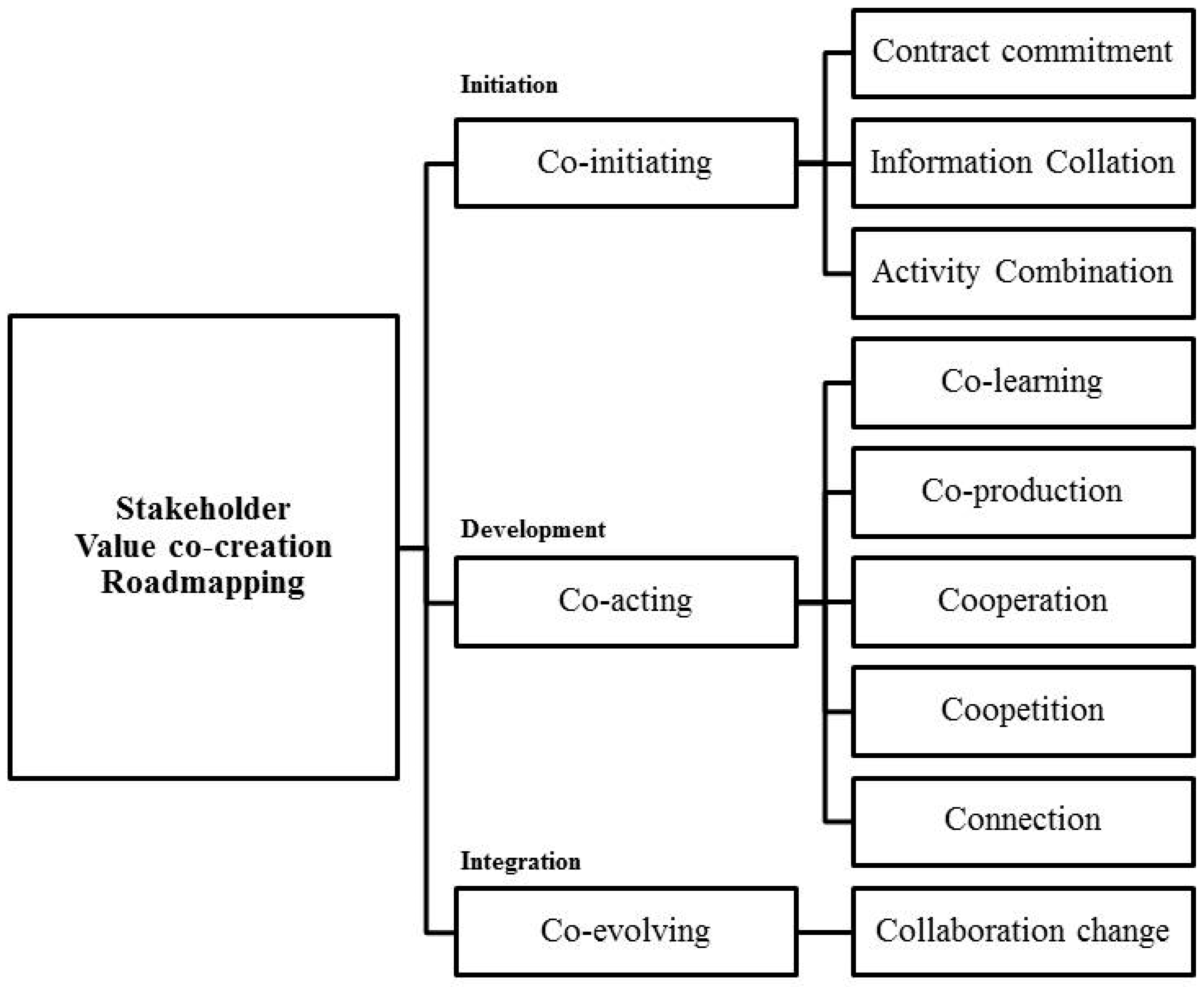
- Contract commitment—Agreeing on scope, roles, and decision rules to initiate joint work.
- (2)
- Collation—Pooling and organizing dispersed information and evidence.
- (3)
- Combination—Recombining resources to generate new options or configurations.
- (4)
- Co-learning—Updating shared understanding through reciprocal sense-making.
- (5)
- Co-production—Jointly producing artefacts (e.g., linking grids, canvases) that encode decisions.
- (6)
- Cooperation—Aligning tasks and hand-offs to progress work across layers.
- (7)
- Coopetition—Leveraging complementary rivals for capability or market access under clear boundaries.
- (8)
- Connection—Bridging organizational and digital boundaries via sustained human–digital interaction.
- (9)
- Collaboration change—Adapting governance, cadence, and artefacts as the process evolves.
4. Value Co-Creation Roadmapping with Stakeholders for Creating Innovative Technologies
4.1. Concept
4.2. Implementation
- (1)
- Discuss market/policy: External markets, social drivers, and internal business strategy drivers are identified, categorized, and prioritized for key market segments. The business strategy is reviewed.
- (2)
- Discuss value proposition: Value proposition among the stakeholders is defined, including the value proposition offered to the customer and the value the customer expects to receive.
- (3)
- Discuss service: Service solution concepts are defined. Potential service solutions, functions, and attributes are identified and prioritized with respect to how strongly they address the drivers.
- (4)
- Discuss product: Product concepts are defined. Potential product features, functions, and attributes are identified and prioritized concerning how strongly they address the services.
- (5)
- Discuss technology: Technology capabilities are identified. Potential technological solutions for developing product features are identified and prioritized.
- (6)
- Discuss research: Knowledge sources and strategic partners are identified. Necessary R&D, knowledge sources, and potential partners for R&D coopetition—R&D activities can be carried out in cooperation with a competitor (Bengtsson & Kock, 2000; Gnyawali & Park, 2011) and collaborations are identified.
- (7)
- Charting: Linkages among milestones, services, products, technologies, and partners are drawn. Initial roadmap linking markets, services, products, technologies, and resources is developed based on outputs from the previous six workshops. A decision is made, and actions are agreed upon.
5. Example Application: Stakeholder VCC Roadmapping for Creating Innovative Technologies in the Technology-Oriented Organization
5.1. Research Target
5.2. Procedure
5.2.1. Initiation
5.2.2. Development
5.2.3. Integration: Idea Convergence and Charting
5.2.4. Evaluation and Follow-Up
6. Results
6.1. Traceable Workshop Outputs Across Roadmap Layers (W1–W7)
- W1 (Market/policy layer): Ranked drivers and shared assumptions.Stakeholders identified and prioritized market/policy drivers relevant to assisted living/aging society innovation. The output consisted of a ranked driver list with brief rationales and assumptions, which served as the baseline reference for later cross-layer linking.
- W2 (Value layer feeding service): Co-created value matrix.Stakeholders co-developed a value matrix that linked key stakeholder needs, expected benefits, and constraints to the prioritized drivers. This artefact clarified “what value means” across heterogeneous actors and informed the subsequent service concept ideation and screening.
- W3 (Service layer): Service concepts and impact–uncertainty ratings.Candidate service concepts were generated, refined, and rated using a service × driver grid. The resulting ratings and discussion notes provided traceability for why specific services were prioritized under high-impact and/or high-uncertainty drivers.
- W4 (Product layer): Product feature sets via service–product links.Stakeholders translated prioritized services into product feature sets and dependencies, documented through product × service links. This created a traceable rationale for which product features were considered necessary (or optional) to deliver the selected services.
- W5 (Technology layer): Technology capabilities, dependencies, and TRL gaps.Technology options were linked to product features using technology × product links, and gaps were documented in terms of capability readiness and TRL constraints. This artefact clarified feasibility conditions and highlighted where additional R&D or external collaboration would be required.
- W6 (Research/partner layer): Research themes and partner options.Stakeholders consolidated technology gaps into research themes, discussed resourcing implications, and identified potential partner roles (e.g., knowledge holders, implementation partners, complementary technology providers). Output was captured in shared canvases and reflected in the emerging roadmap structure.
- W7 (Integration): Integrated multi-layer roadmap with milestones and cross-layer dependencies.Outputs from W1–W6 were integrated into a consolidated multi-layer roadmap (maintained in SharpCloud), including milestones, ownership considerations, and explicit cross-layer dependencies. This integration preserved traceability by linking roadmap elements back to earlier workshop artefacts and linking grids.
6.2. Observed Stakeholder VCC Activities During Roadmapping (9 Activities Across 3 Themes)
- Co-initiating (establishing readiness and shared working conditions).
- Contract commitment: Stakeholders aligned on scope boundaries, decision rules, workshop cadence, and participation expectations. Evidence is reflected in stable process conventions that were reused across sessions and referenced when resolving disagreements.
- Information collation: Stakeholders brought in and consolidated relevant information (e.g., policy drivers, domain constraints, and contextual assumptions) that later shaped prioritization and feasibility judgments. These inputs were carried forward as annotated assumptions in the shared artefacts.
- Activity combination: Stakeholders combined complementary tasks (e.g., framing drivers while clarifying “value”, or linking services while documenting dependencies) to maintain momentum and reduce hand-off loss between stages.
- Co-acting (jointly producing and refining roadmap content).
- 4.
- Co-learning: Stakeholders negotiated shared meanings (e.g., what counts as impact, feasibility, readiness, or value) and adjusted evaluations accordingly. This is evidenced by revisions to definitions/criteria and corresponding changes in ratings within linking grids.
- 5.
- Co-production: Stakeholders jointly created and iteratively revised artefacts (value matrix, linking grids, roadmap elements) in shared documents and SharpCloud. Evidence includes versioned changes and documented rationales that connect edits to stage objectives.
- 6.
- Cooperation: Stakeholders coordinated roles and contributions to move from ideas to structured options (services/products/technologies), reflected in converging selections and documented agreements on dependencies and ownership considerations.
- 7.
- Coopetition: Stakeholders faced overlapping interests and potential tensions (e.g., alternative solution pathways or partner roles) and negotiated acceptable trade-offs. Evidence is reflected in recorded alternatives, boundary conditions for collaboration, and partner option discussions that influenced research themes and integration choices.
- 8.
- Connection: Stakeholders maintained continuity between workshops through familiar communication and collaboration channels, enabling clarification, follow-up edits, and consolidation. Evidence is shown in asynchronous revisions and the incorporation of between-session clarifications into the artefact trail.
- Co-evolving (integrating outputs and embedding the roadmap in ongoing planning).
- 9.
- Collaboration change (creative-to-planning integration): Stakeholders translated creative workshop outputs into an integrated, actionable roadmap, making inter-layer dependencies explicit and preparing the roadmap for continued review and updating. Evidence is reflected in the final integrated roadmap structure, milestones, and traceable links back to earlier artefacts.
6.3. Wrap-Up Workshop Findings (Implementation-Oriented Observations)
- (1)
- Organization: The need for visible senior sponsorship and an enabling culture that legitimizes cross-unit collaboration.
- (2)
- Facilitator: The importance of active synthesis, cadence management, and psychological safety to support productive negotiation.
- (3)
- Participants: The need for a purposeful mix of roles and willingness to engage in iterative refinement (including basic digital readiness for e-collaboration).
- (4)
- Collaboration platforms and tools: The value of combining familiar, low-friction communication tools (for continuity) with a single integrative repository (for cross-layer traceability and version control).
7. Discussion
7.1. Answering the RQ: How Stakeholders Co-Create Value During Roadmapping
- (1)
- Structured sense-making through staged templates.Stakeholders co-create value by progressively translating broad drivers into actionable options (services–products–technologies) through workshop-specific templates (e.g., ranked driver list, value matrix, and linking grids). These templates reduce ambiguity and make assumptions explicit, allowing heterogeneous actors to compare alternatives and converge on priorities without requiring full consensus on every premise.
- (2)
- Artefact-mediated negotiation that makes decisions durable and traceable.Value co-creation occurs through iterative proposing, challenging, revising, and validating intermediate artefacts. The key “co-creation moments” are evidenced by changes in the artefact trail—revised ratings in linking grids, edits to definitions/criteria, documented dependencies, and the consolidation of alternatives into an integrated roadmap. In this way, knowledge is not only exchanged but also encoded into objects that can be revisited, audited, and reused.
- (3)
- Continuity via hybrid collaboration that sustains engagement between sessions.Stakeholders co-create value by maintaining momentum across workshops through a hybrid arrangement: synchronous meetings (online and face-to-face) combined with asynchronous clarification and revision. Familiar communication channels support coordination and follow-up, while the integrative repository (SharpCloud) preserves cross-layer alignment and traceability. This continuity is critical for moving from creative ideation to planning commitments.
7.2. Theoretical Implications: Operationalizing S-D Logic in Roadmapping
7.3. Managerial Implications: Designing Roadmapping for Implementability
- (1)
- Deliberately design for traceability (not only participation).Adopt an artefact-per-workshop logic—driver list, value matrix, linking grids, and an integration chart—so each workshop produces a clear output that can be validated and carried forward. Traceability reduces later disputes about “why this choice was made.”
- (2)
- Use purposeful stakeholder mix and facilitation to manage power asymmetries.Include actors who collectively cover policy, delivery, technology, and user perspectives. Facilitation can explicitly surface disagreements and document boundary conditions alongside agreements, preventing dominance by a single expert group.
- (3)
- Blend online and face-to-face strategically.Online workshops are effective for structured elicitation and ranking tasks; face-to-face sessions can be reserved for integration, negotiation of resourcing/partnerships, and final consolidation. The key is a stable workflow that supports between-session refinement.
- (4)
- Secure sponsorship and plan the refresh cadence early.Visible sponsorship legitimizes participation and resource commitments. Establishing a refresh trigger (e.g., quarterly review or milestone-based updates) may help embed the roadmap into ongoing planning rather than treating it as a one-off deliverable.
7.4. Limitations and Future Research
8. Conclusions
Author Contributions
Funding
Institutional Review Board Statement
Informed Consent Statement
Data Availability Statement
Conflicts of Interest
References
- Albors-Garrigos, J., Peiro-Signes, A., & Igartua Lopez, J. I. (2025). Innovation management techniques—A review from a stakeholder’s focus perspective. International Journal of Innovation Management, 29, 2550011. [Google Scholar] [CrossRef]
- Alegre, J., Sengupta, K., & Lapiedra, R. (2013). Knowledge management and the innovation performance in a high-tech SMEs industry. International Small Business Journal, 31(4), 454–470. [Google Scholar] [CrossRef]
- Beirão, G., Patrício, L., & Fisk, R. P. (2016). Value cocreation in service ecosystems: Investigating health care at the micro, meso, and macro levels. Journal of Service Management, 28(2), 227–249. [Google Scholar]
- Bengtsson, M., & Kock, S. (2000). “Coopetition” in business networks—To cooperate and compete simultaneously. Industrial Marketing Management, 29(5), 411–426. [Google Scholar] [CrossRef]
- Boling, E. C., Holan, E., Horbatt, B., Hough, M., Jean-Louis, J., Khurana, C., Krinsky, H., & Spiezio, C. (2014). Using online tools for communication and collaboration: Understanding educators’ experiences in an online course. Internet and Higher Education, 23, 48–55. [Google Scholar] [CrossRef][Green Version]
- Botti, A., Grimaldi, M., & Vesci, M. (2018). Customer value co-creation in a service-dominant logic perspective: Some steps toward the development of a measurement scale. In B. Sergio, P. Marco, & P. Francesco (Eds.), Social dynamics in a systems perspective. Springer International Publishing. [Google Scholar]
- Bouncken, R. B., Pesch, R., & Reuschl, A. (2016). Copoiesis: Mutual knowledge creation in alliances. Journal of Innovation & Knowledge, 1(1), 44–50. [Google Scholar] [CrossRef]
- Braun, E. L., Pereira, G. M., Sellitto, M. A., & Borchardt, M. (2015). Value co-creation in maintenance services: Case study in the mechanical industry. Business Process Management Journal, 23(5), 984–999. [Google Scholar]
- Carayannis, E., Meissner, D., & Sokolov, A. (2016). Key features of roadmapping for company and policy strategy making. Technological Forecasting & Social Change, 110, 106–108. [Google Scholar]
- Choi, S., & Ko, I. (2012). Leveraging electronic collaboration to promote interorganizational learning. International Journal of Information Management, 32(6), 550–559. [Google Scholar] [CrossRef]
- Cuhls, K., Vries, M. D., Li, H., & Li, L. (2015). Roadmapping comparing cases in China and Germany. Technological Forecasting & Social Change, 101, 238–250. [Google Scholar]
- Dibley, A., & Clark, M. (2011). Value co-creation in strategic partnerships: An outsourcing perspective. In E. Gummesson, C. Mele, & F. Polese (Eds.), Service-dominant logic, network & system theory and service science: Integrating three perspectives for a new service agenda. Giannini Editore. [Google Scholar]
- Eisenhardt, K. M., & Graebner, M. (2007). Theory building from cases: Opportunities and challenges. Academy of Management Journal, 50(1), 25–32. [Google Scholar] [CrossRef]
- Fu, W., Wang, Q., & Zhao, X. (2017). The influence of platform service innovation on value co-creation activities and the network effect. Journal of Service Management, 28(2), 348–388. [Google Scholar] [CrossRef]
- Galvagno, M., & Dalli, D. (2014). Theory of value co-creation: A systematic literature review. Managing Service Quality: An International Journal, 24(6), 643–683. [Google Scholar] [CrossRef]
- Gerdsri, N. (2013). Implementing technology roadmapping in an organization. In M. Moehrle, R. Isenmann, & R. Phaal (Eds.), Technology roadmapping for strategy and innovation: Charting the route to success. Springer. [Google Scholar]
- Gerdsri, N., Assakul, P., & Vatananan, R. S. (2010). An activity guideline for technology roadmapping implementation. Technology Analysis and Strategic Management, 22(2), 229–242. [Google Scholar] [CrossRef]
- Gerdsri, N., Kongthon, A., & Vatananan, R. (2013). Mapping the knowledge evolution and professional network in the field of technology roadmapping: A bibliometric analysis. Technology Analysis & Strategic Management, 25(4), 403–422. [Google Scholar] [CrossRef]
- Gerdsri, N., Vatananan, R. S., & Dansamasatid, S. (2009). Dealing with the dynamics of technology roadmapping implementation: A case study. Technological Forecasting & Social Change, 76(1), 50–60. [Google Scholar]
- Gnyawali, D. R., & Park, B.-J. R. (2011). Co-opetition between giants: Collaboration with competitors for technological innovation. Research Policy, 40(5), 650–663. [Google Scholar] [CrossRef]
- Ho, J.-Y., & O’Sullivan, E. (2017). Strategic standardisation of smart systems: A roadmapping process in support of innovation. Technological Forecasting & Social Change, 115, 301–312. [Google Scholar]
- Ilevbare, I. M., Probert, D., & Phaal, R. (2014). Towards risk-aware roadmapping: Influencing factors and practical measures. Technovation, 34(8), 399–409. [Google Scholar] [CrossRef]
- Jonas, J. M., & Roth, A. (2017). Stakeholder integration in service innovation—An exploratory case study in the healthcare industry. International Journal of Technology Management, 73, 91–113. [Google Scholar] [CrossRef]
- Kandampully, J., Bilgihan, A., & Zhang, T. C. (2016). Developing a people-technology hybrids model to unleash innovation and creativity: The new hospitality frontier. Journal of Hospitality and Tourism Management, 29, 154–164. [Google Scholar] [CrossRef]
- Kazadi, K., Lievens, A., & Mahr, D. (2016). Stakeholder co-creation during the innovation process: Identifying capabilities for knowledge creation among multiple stakeholders. Journal of Business Research, 69(2), 525–540. [Google Scholar] [CrossRef]
- Keller, J., & von der Gracht, H. A. (2014). The influence of information and communication technology (ICT) on future foresight processes—Results from a Delphi survey. Technological Forecasting & Social Change, 85, 81–92. [Google Scholar]
- Kerr, C., Farrukh, C., Phaal, R., & Probert, D. (2013). Key principles for developing industrially relevant strategic technology management toolkits. Technological Forecasting & Social Change, 80(6), 1050–1070. [Google Scholar]
- Kerr, C., Phaal, R., & Probert, D. (2012). Addressing the cognitive and social influence inhibitors during the ideation stages of technology roadmapping workshops. International Journal of Innovation and Technology Management, 9(6), 1250046. [Google Scholar] [CrossRef]
- Kerr, C., Phaal, R., & Thams, K. (2017). Customising and deploying roadmapping in an organisational setting: The LEGO Group experience. Journal of Engineering and Technology Management, 52, 48–60. [Google Scholar]
- Lee, J.-H., Kim, H.-I., & Phaal, R. (2012). An analysis of factors improving technology roadmap credibility: A communications theory assessment of roadmapping processes. Technological Forecasting & Social Change, 79(2), 263–280. [Google Scholar]
- Li, X., Zhou, Y., Xue, L., & Huang, L. (2016). Roadmapping for industrial emergence and innovation gaps to catch-up: A patent-based analysis of OLED industry in China. International Journal of Technology Management, 72, 105–143. [Google Scholar]
- Linnenluecke, M. K., Verreynne, M.-L., Scheepers, M. J. D. V., & Venter, C. (2017). A review of collaborative planning approaches for transformative change towards a sustainable future. Journal of Cleaner Production, 142, 3212–3224. [Google Scholar] [CrossRef]
- Ma, T., Liu, S., & Nakamori, Y. (2006). Roadmapping as a way of knowledge management for supporting scientific research in academia. System Research and Behavior Science, 23(6), 743–755. [Google Scholar]
- Ma, T., Yan, J., Nakamori, Y., & Wierzbicki, A. P. (2007). Creativity support for roadmapping. In Creative environments. Springer. [Google Scholar]
- Mačiulienė, M., & Skaržauskienė, A. (2016). Evaluation of co-creation perspective in networked collaboration platforms. Journal of Business Research, 69(11), 4826–4830. [Google Scholar] [CrossRef]
- McColl-Kennedy, J. R., Vargo, S. L., Dagger, T. S., Sweeney, J. C., & Kasteren, Y. V. (2012). Health care customer value cocreation practice styles. Journal of Service Research, 15(4), 370–389. [Google Scholar] [CrossRef]
- Merrilees, B., Miller, D., & Yakimova, R. (2017). The role of staff engagement in facilitating staff-led value co-creation. Journal of Service Management, 28(2), 250–264. [Google Scholar] [CrossRef]
- Munkvold, B. E. (2018). International journal of e-collaboration. Available online: https://www.igi-global.com/journal/international-journal-collaboration-ijec/1090 (accessed on 29 December 2025).
- Nardelli, G., & Broumels, M. (2017). Managing innovation process through value co-creation: A process case from business-to-business service practise. International Journal of Innovation Management, 22(3), 1850030. [Google Scholar]
- Nie, Y., Shirahada, K., & Kosaka, M. (2013). Value co-creation oriented leadership for promoting service-centric business. Intercultural Communication Studies, 12, 216–228. [Google Scholar]
- Ostrom, A. L., Parasuraman, A. P., Bowen, D. E., Patrício, L., & Voss, C. (2015). Service research priorities in a rapidly changing context. Journal of Service Research, 19(2), 127–159. [Google Scholar] [CrossRef]
- Pera, R., Occhiocupo, N., & Clarke, J. (2016). Motives and resources for value co-creation in a multi-stakeholder ecosystem: A managerial perspective. Journal of Business Research, 69(10), 4033–4041. [Google Scholar]
- Phaal, R. (2018). Roadmapping. Available online: https://www.cambridgeroadmapping.net/roadmapping/ (accessed on 29 December 2025).
- Phaal, R., Farrukh, C., Mills, J. F., & Probert, D. R. (2003, July 24). Customizing the technology roadmapping approach. PICMET’03, Portland International Conference on Management of Engineering and Technology Technology Management for Reshaping the World, Portland, OR, USA. [Google Scholar]
- Phaal, R., Farrukh, C., & Probert, D. (2001). T-plan the fast start to technology roadmapping planning your route to success. Institute for Manufacturing, University of Cambridge. [Google Scholar]
- Phaal, R., Farrukh, C. J. P., & Probert, D. R. (2005, July 31–August 4). Developing a technology roadmapping system. A Unifying Discipline for Melting the Boundaries Technology Management (pp. 99–111), Portland, OR, USA. [Google Scholar]
- Plé, L. (2016). Studying customers’ resource integration by service employees in interactional value co-creation. Journal of Service Marketing, 30(2), 152–164. [Google Scholar]
- Polese, F., Botti, A., Grimaldi, M., Monda, A., & Vesci, M. (2018). Social innovation in smart tourism ecosystems: How technology and institutions shape sustainable value co-creation. Sustainability, 10(1), 140. [Google Scholar] [CrossRef]
- Raford, N. (2015). Online foresight platforms: Evidence for their impact on scenario planning & strategic foresight. Technological Forecasting & Social Change, 97, 65–76. [Google Scholar]
- Rahman, M. M., Toufiq, A., & Shirahada, K. (2017). Value co-creation in archival resources: Exploring the feature of national archives of bangladesh (NAB)’s open access project. International Journal of Library and Information Services, 6(2), 37–56. [Google Scholar]
- Rohrbeck, R., Thom, N., & Arnold, H. (2015). IT tools for foresight: The integrated insight and response system of deutsche telekom innovation laboratories. Technological Forecasting & Social Change, 97, 115–126. [Google Scholar]
- Romero, D., & Molina, A. (2011). Collaborative networked organisations and customer communities: Value co-creation and co-innovation in the networking era. Production Planning & Control, 22(5–6), 447–472. [Google Scholar]
- Stephen, S. P., Quan Anh, N., Outi, N., & Gillian, S.-M. (2016). Social media and value co-creation in multi-stakeholder systems: A resource integration approach. Industrial Marketing Management, 54, 44–55. [Google Scholar]
- Sukholthaman, P., & Shirahada, K. (2016). Knowledge based service provision for the enhancement of municipal solid waste management system [Unpublished doctoral dissertation, Japan Advanced Institute of Science and Technology]. [Google Scholar]
- Tommasetti, A., Troisi, O., & Vesci, M. (2017). Measuring customer value co-creation behavior: Developing a conceptual model based on service-dominant logic. Journal of Service Theory and Practice, 27(5), 930–950. [Google Scholar] [CrossRef]
- Vargo, S. L., & Lusch, R. F. (2004). Evolving to a new dominant logic for marketing. Journal of Marketing, 68(1), 18–27. [Google Scholar]
- Vargo, S. L., & Lusch, R. F. (2008). Service-dominant logic: Continuing the evolution. Journal of the Academy Marketing Science, 36(1), 1–10. [Google Scholar]
- Vargo, S. L., Maglio, P. P., & Akaka, M. A. (2008). On value and value co-creation: A service systems and service logic perspective. European Management Journal, 26(3), 145–152. [Google Scholar] [CrossRef]
- Vatananan, R., & Gerdsri, N. (2012). The current state of technology roadmapping (TRM) research and practice. International Journal of Innovation and Technology Management, 9(4), 1250032. [Google Scholar] [CrossRef]
- Wong, T. Y. T., Peko, G., Sundaram, D., & Piramuthu, S. (2016). Mobile environments and innovation co-creation processes & ecosystems. Information & Management, 53(3), 336–344. [Google Scholar] [CrossRef]
- Yan, J., Kobayashi, T., & Nakamori, Y. (2005, November 14–17). Study on a roadmapping process model as a way to support technology creation in university setting. The First World Congress of the International Federation for Systems Research: The New Roles of Systems Sciences For a Knowledge-Based Society, Kobe, Japan. [Google Scholar]
- Yip, M. H., Phaal, R., & Probert, D. R. (2012, February 8–10). Value co-creation in early stage new product-service system development. ServDes. 2012 Third Nordic Conference on Service Design and Service Innovation (pp. 287–298), Espoo, Finland. [Google Scholar]
- Yonghee, C., Seong-Pil, Y., & Karp-Soo, K. (2016). An industrial technology roadmap for supporting public R&D planning. Technological Forecasting & Social Change, 107, 1–12. [Google Scholar]
- Yoon, J., Kim, Y. J., Vonortas, N. S., & Han, S. W. (2017). A moderated mediation model of technology roadmapping and innovation: The roles of corporate foresight and organizational support. Journal of Engineering and Technology Management, 52, 61–73. [Google Scholar] [CrossRef]
- Yu, C.-H., Tsai, C.-C., Wang, Y., Lai, K.-K., & Tajvidi, M. (2018). Towards building a value co-creation circle in social commerce. Computers in Human Behavior, 108, 105476. [Google Scholar] [CrossRef]

| Workshop Topics | Activities | Collaboration Tools | Instrument/ Template Used | Data Captured | Outputs |
|---|---|---|---|---|---|
| W1: Market/policy |
|
|
|
|
|
| W2: Value proposition |
|
|
|
|
|
| W3: Service |
|
|
|
|
|
| W4: Product |
|
|
|
|
|
| W5: Technology |
|
|
|
|
|
| W6: Research |
|
|
|
|
|
| W7: Charting |
|
|
|
|
|
| Theme | Activity | Artefact Evidence | Recap-Note Excerpt | Example Output/W# |
|---|---|---|---|---|
| Co-initiation |
|
|
|
|
|
|
|
| |
|
|
|
| |
| Co-acting |
|
|
|
|
|
|
|
| |
|
|
|
| |
|
|
|
| |
|
|
|
| |
| Co-evolving |
|
|
|
|
| 9C Activity | Theory Linkage (S-D Logic/VCC/Stakeholder-Integration/Coopetition) | Primary Workshop(s) | Products/Informs | Roadmap Layer(s) |
|---|---|---|---|---|
| Shared purpose, role clarity, decision rules enabling resource integration | W1, W7 | Scope, governance, cadence | All layers |
| Resource integration via information pooling and evidence consolidation | W1–W3 | Ranked drivers, evidence base | Market/policy |
| Re-bundling resources to generate options/configurations | W3–W4 | Service, product link sets | Service, product |
| Reciprocal sense-making and knowledge updating | W2–W6 | Revised assumptions/ratings | All layers |
| Joint artefact creation encoding decisions (grids/canvases) | W3–W5 | Linking grids, feature sets | Service, product, tech |
| Task alignment and hand-offs across actors | W3–W7 | Validated cross-links | All layers |
| Complementary rivalry for capability/market access under clear boundaries | W6 | Partner/consortium options | Research/partners |
| Human–digital boundary spanning via persistent collaboration channels | W1–W7 | Traceable records, continuity | All layers |
| Adaptive governance and refresh cycles | W7 | Action list, refresh plan | Integration timeline |
Disclaimer/Publisher’s Note: The statements, opinions and data contained in all publications are solely those of the individual author(s) and contributor(s) and not of MDPI and/or the editor(s). MDPI and/or the editor(s) disclaim responsibility for any injury to people or property resulting from any ideas, methods, instructions or products referred to in the content. |
© 2026 by the authors. Licensee MDPI, Basel, Switzerland. This article is an open access article distributed under the terms and conditions of the Creative Commons Attribution (CC BY) license.
Share and Cite
Ateetanan, P.; Supnithi, T.; Shirahada, K.; Usanavasin, S. Value Co-Creation Roadmapping with Stakeholders for Creating Innovative Technologies. Adm. Sci. 2026, 16, 155. https://doi.org/10.3390/admsci16030155
Ateetanan P, Supnithi T, Shirahada K, Usanavasin S. Value Co-Creation Roadmapping with Stakeholders for Creating Innovative Technologies. Administrative Sciences. 2026; 16(3):155. https://doi.org/10.3390/admsci16030155
Chicago/Turabian StyleAteetanan, Pornprom, Thepchai Supnithi, Kunio Shirahada, and Sasiporn Usanavasin. 2026. "Value Co-Creation Roadmapping with Stakeholders for Creating Innovative Technologies" Administrative Sciences 16, no. 3: 155. https://doi.org/10.3390/admsci16030155
APA StyleAteetanan, P., Supnithi, T., Shirahada, K., & Usanavasin, S. (2026). Value Co-Creation Roadmapping with Stakeholders for Creating Innovative Technologies. Administrative Sciences, 16(3), 155. https://doi.org/10.3390/admsci16030155

