Complex Thinking as Cognitive Competence in Local Public Leadership: A Descriptive Study of Public Servants in the Philippines

 ,
,  ,
,  ,
, 
Abstract
1. Introduction
2. Theoretical Framework
2.1. Complexity and Decision Making in the Public Sector
2.2. Complex Thinking as an Integrated Cognitive Competence and Its Measurement
2.3. Analytical Skills and Decision-Making Competencies in Contemporary Bureaucracies
2.4. Local Governance in the Philippines as an Environment of Institutional Complexity
3. Materials and Methods
3.1. Population and Sample
3.2. Instrument
3.3. Procedure and Data Preparation
- is the percentage obtained in the category.
- is the sum of the scores obtained in the items of that category.
- n is the number of items that compose the category.
- k is the maximum value of the Likert scale used (5).
- k × n represents the maximum possible score for the category.
3.4. Ethical Considerations
3.5. Data Analysis
4. Results
4.1. Differences Between Groups
4.2. Correlation Between Dimensions
5. Discussion
Theoretical and Practical Implications
6. Conclusions
Author Contributions
Funding
Institutional Review Board Statement
Informed Consent Statement
Data Availability Statement
Acknowledgments
Conflicts of Interest
References
- Abinales, P. N., & Amoroso, D. J. (2017). State and society in the Philippines (2nd ed.). Rowman & Littlefield. [Google Scholar]
- Alon-Barkat, S., & Busuioc, M. (2023). Human–AI interactions in public sector decision making: “Automation bias” and “selective adherence” to algorithmic advice. Journal of Public Administration Research and Theory, 33(1), 153–169. [Google Scholar] [CrossRef] [Scilit]
- Belle, N., Cantarelli, P., & Wang, S. Y. (2024). The management of bias and noise in public sector decision-making: Experimental evidence from healthcare. Public Management Review, 26(11), 3246–3269. [Google Scholar] [CrossRef] [Scilit]
- Bonoan, C. R., & Dressel, B. (2026). Constitutional change and oligarchic politics in the Philippines, 1987–2024. Journal of Current Southeast Asian Affairs, 45(1), 171–197. [Google Scholar] [CrossRef] [Scilit]
- Brenton, S., Baekkeskov, E., & Hannah, A. (2023). Policy capacity: Evolving theory and missing links. Policy Studies, 44(3), 297–315. [Google Scholar] [CrossRef] [Scilit]
- Cantarelli, P., Belle, N., & Hall, J. L. (2023). Information use in public administration and policy decision-making: A research synthesis. Public Administration Review, 83(6), 1667–1685. [Google Scholar] [CrossRef] [Scilit]
- Cowell, N. H., Kirk, A., Murdock, H. E., Sudall, E., & de Nazelle, A. (2025). Structured decision making: A tool for systems insights into the barriers, synergies and co-benefits for urban air quality action. Urban Transitions, 1, 100005. [Google Scholar] [CrossRef] [Scilit]
- Dawson, C., Julku, H., Pihlajamäki, M. R., Kaakinen, J. K., Schooler, J. W., & Simola, J. (2024). Evidence-based scientific thinking and decision-making in everyday life. Cognitive Research: Principles and Implications, 9, 50. [Google Scholar] [CrossRef] [Scilit] [PubMed]
- Frisk, J. E., & Bannister, F. (2022). Applying design thinking to the decision-making process: A field study in Swedish local authorities. Management Decision, 60(1), 66–85. [Google Scholar] [CrossRef] [Scilit]
- Gatmaytan, D. (2022). The Philippines’ authoritarian constitution. Philippine Law Journal, 95, 529–564. [Google Scholar]
- Gerrits, L. (2012). Punching clouds: An introduction to the complexity of public decision-making. Emergent Publications. [Google Scholar]
- Habibi, R., Ramsay, A., Zach, M., Javad, B., & Khan, Z. (2025). A systems thinking approach to inclusive governance. Discover Global Society, 3(1), 169. [Google Scholar] [CrossRef] [Scilit]
- Hutchcroft, P. D. (1998). Booty capitalism: The politics of banking in the Philippines. Cornell University Press. [Google Scholar]
- Hutchcroft, P. D., & Gera, W. (2022). Strong-arming, weak steering: Central-local relations in the Philippines in the era of the pandemic. Philippine Political Science Journal, 43(2), 123–167. [Google Scholar] [CrossRef] [Scilit]
- Hynes, W., Lees, M., & Müller, J.-M. (Eds.). (2020). Systemic thinking for policy making: The potential of systems analysis for addressing global policy challenges in the 21st century. OECD Publishing. [Google Scholar] [CrossRef] [Scilit]
- Juco, M. N., Maddawin, R. B., & Manasan, R. G. (2024). An assessment of the local government units’ functional assignments under a decentralized regime. PIDS Discussion Paper Series No. 2024-40. Philippine Institute for Development Studies. [Google Scholar] [CrossRef] [Scilit]
- Kasuya, Y. (2008). Presidential bandwagon: Parties and party systems in the Philippines. Keio University Press. [Google Scholar]
- Kawanaka, T. (2010). Interaction of powers in the Philippine presidential system. IDE Discussion Paper No. 233. Institute of Developing Economies. [Google Scholar]
- Källström, L., Icon, C., Lausten, A., & Haak, M. (2025). Using design thinking in policy practice to revitalize collaboration and solve wicked problems. Policy Design and Practice, 8(4), 408–426. [Google Scholar] [CrossRef] [Scilit]
- Kerr, R. (2025). Applying systems thinking and participatory design to policy development. Policy Studies Journal. Advance online publication. [Google Scholar] [CrossRef] [Scilit]
- Legaspi, P. E. (2001). The changing role of local government under a decentralized state: Some cases in Philippine local governance. Public Management Review, 3(1), 131–139. [Google Scholar] [CrossRef]
- Levy, K., Chasalow, K. E., & Riley, S. (2021). Algorithms and decision-making in the public sector. Annual Review of Law and Social Science, 17, 309–334. [Google Scholar] [CrossRef] [Scilit]
- Liu, B. (2023). The effect of psychological bias on public officials’ attitudes towards the implementation of policy instruments: Evidence from survey experiments. Journal of Public Policy, 43(2), 261–283. [Google Scholar] [CrossRef] [Scilit]
- McCoy, A. W. (Ed.). (1993). An anarchy of families: State and family in the Philippines. University of Wisconsin Press. [Google Scholar]
- Migone, A., & Howlett, M. (2023). Assessing policy analytical capacity in contemporary governments: New measures and metrics. Australian Journal of Public Administration, 82(1), 3–25. [Google Scholar] [CrossRef] [Scilit]
- Morçöl, G. (2012). A complexity theory for public policy. Routledge. [Google Scholar] [CrossRef] [Scilit]
- Nguyen, L.-K.-N., Kumar, C., Jiang, B., & Zimmermann, N. (2023). Implementation of systems thinking in public policy: A systematic review. Systems, 11(2), 64. [Google Scholar] [CrossRef] [Scilit]
- Nisperos, G. A., Cabanizas, T. G. G., Bulario, J. S., Cadiz, J. M. S., Lastino, J. B. P., & Siscar, J. A. A. (2024). Implications of the Mandanas-Garcia ruling on local health systems. Acta Medica Philippina, 58(13), 8–14. [Google Scholar] [CrossRef] [Scilit]
- OECD. (2024). Developing skills for digital government: A review of good practices across OECD governments. OECD Social, Employment and Migration Working Papers No. 303. OECD Publishing. [Google Scholar] [CrossRef] [Scilit]
- OECD. (2025). Building anticipatory capacity with strategic foresight in government. OECD Publishing. [Google Scholar]
- OECD/European Commission. (2025). Strengthening national evidence-informed policymaking ecosystems: Lessons from seven European countries. OECD Publishing. [Google Scholar] [CrossRef] [Scilit]
- OECD Observatory of Public Sector Innovation. (2024). Guidebook: Capability-building programmes—Strategic foresight and anticipatory governance. OECD Observatory of Public Sector Innovation. [Google Scholar]
- Overmans, T. (2024). Exploring cognitive bias effects on budget judgment behavior: A scoping review and research agenda. Public Finance and Management, 24(2), 153–167. [Google Scholar] [CrossRef] [Scilit]
- Pasternak Taschner, N., & Almeida, P. (2024). Teaching scientific evidence and critical thinking for policy making. Biology Methods and Protocols, 9(1), bpae023. [Google Scholar] [CrossRef] [Scilit]
- Republic of the Philippines. (1987). The constitution of the Republic of the Philippines. Government of the Philippines.
- Republic of the Philippines. (1991). Republic act no. 7160: The local government code of 1991. Congress of the Philippines.
- Roberts, M., & Milman, A. (2024). The relationship between how agencies work together and coordinated outcomes: A configurational analysis. Journal of Public Administration Research and Theory, 34(2), 255–269. [Google Scholar] [CrossRef] [Scilit]
- Sidel, J. T. (1999). Capital, coercion, and crime: Bossism in the Philippines. Stanford University Press. [Google Scholar]
- Silburn, A. (2025). Systems thinking in public health policy development. Frontiers in Health Services, 5, 1555284. [Google Scholar] [CrossRef] [Scilit] [PubMed]
- Suazo-Galdames, I. C., Saracostti, M., & Chaple-Gil, A. M. (2025). Scientific evidence and public policy: A systematic review of barriers and enablers for evidence-informed decision-making. Frontiers in Communication, 10, 1632305. [Google Scholar] [CrossRef] [Scilit]
- Talili, I. N., Vázquez-Parra, J. C., Lis-Gutiérrez, J. P., Saniel, D. M., Henao Rodríguez, L. C., & Chio, M. E. B. (in press). Measuring complex thinking in local public leadership: Pilot validation of eComplexity in the Philippines. Public Administration and Policy.
- Teehankee, J. C. (2020). Factional dynamics in Philippine party politics, 1900–2019. Journal of Current Southeast Asian Affairs, 39(1), 98–123. [Google Scholar] [CrossRef] [Scilit]
- UNESCO. (2023). AI and digital transformation competencies for civil servants. UNESCO. [Google Scholar]
- Vázquez-Parra, J. C., Henao-Rodríguez, L. C., Lis-Gutiérrez, J. P., Castillo-Martínez, I. M., & Suarez-Brito, P. (2024). eComplexity: Validation of a complex thinking instrument from a structural equation model. Frontiers in Education, 9, 1334834. [Google Scholar] [CrossRef] [Scilit]
- Yousufi Aqmal, S., & Erdely, S. F. (2024). Enhancing nonparametric tests: Insights for computational intelligence and data mining. Researcher Academy Innovation Data Analysis, 1(3), 214–226. [Google Scholar] [CrossRef] [Scilit]



| Column | Test Statistic | p-Value | Result |
|---|---|---|---|
| STS | 0.9172 | 0.0015 | Not Gaussian (reject H0) |
| SCS | 0.9379 | 0.0092 | Not Gaussian (reject H0) |
| CTS | 0.9553 | 0.0490 | Not Gaussian (reject H0) |
| IST | 0.9140 | 0.0011 | Not Gaussian (reject H0) |
| Thought Type | Mann–Whitney U Statistic | p-Value | Result |
|---|---|---|---|
| STS | 200.0000 | 0.1669 | No significant difference |
| SCS | 170.0000 | 0.5864 | No significant difference |
| CTS | 180.0000 | 0.4102 | No significant difference |
| ITS | 206.0000 | 0.1093 | No significant difference |
| CoT | 190.5000 | 0.2682 | No significant difference |
| Grouping Variable | Thought Type | Kruskal–Wallis H Statistic | p-Value | Result |
|---|---|---|---|---|
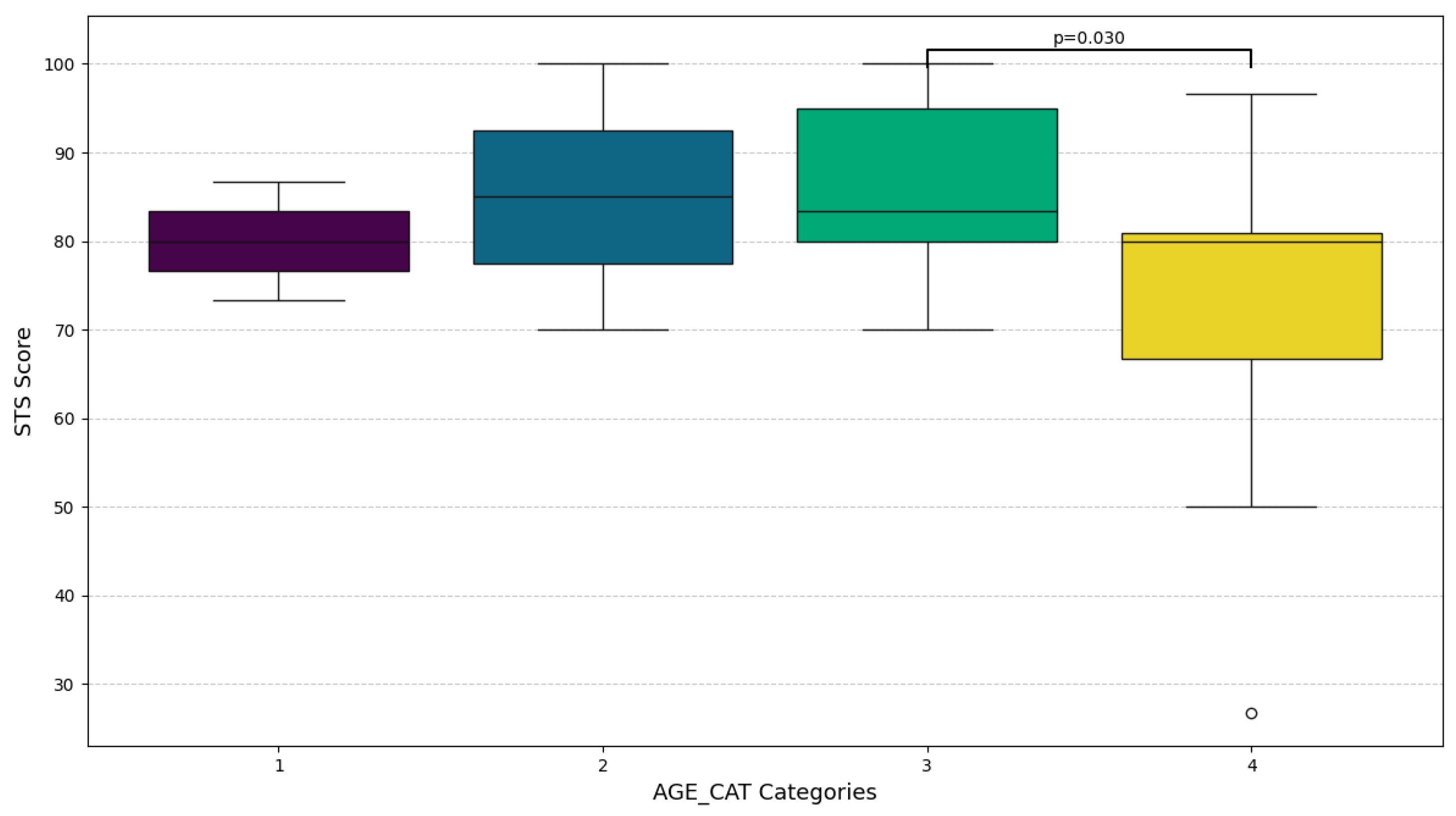
| AGE_CAT | STS | 8.1442 | 0.0431 | Significant difference |
| AGE_CAT | SCS | 9.1468 | 0.0274 | Significant difference |
| AGE_CAT | CTS | 7.9332 | 0.0474 | Significant difference |
| AGE_CAT | ITS | 7.5184 | 0.0571 | No significant difference |
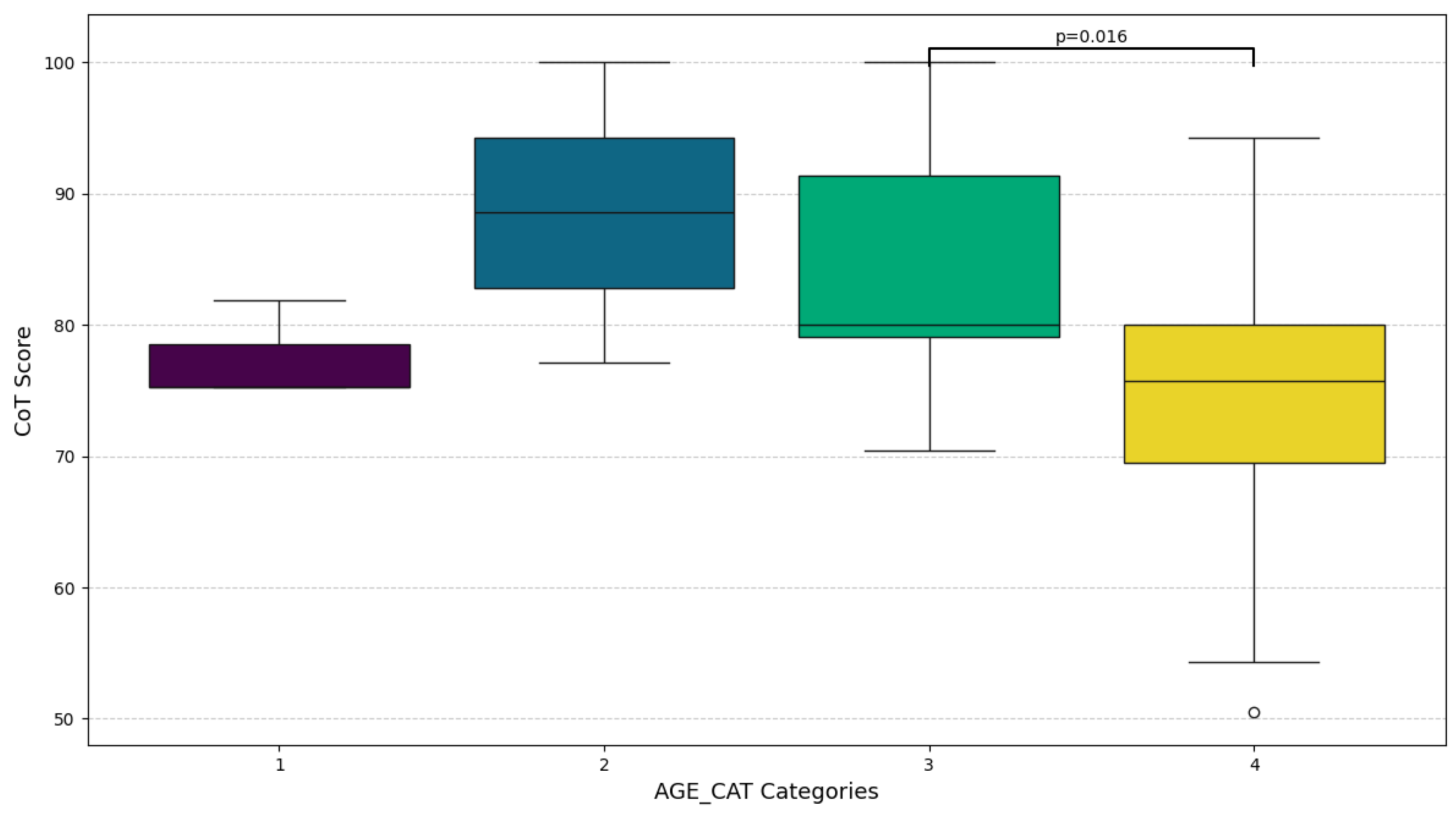
| AGE_CAT | CoT | 10.2275 | 0.0167 | Significant difference |
| EDUC | STS | 3.6985 | 0.4483 | No significant difference |
| EDUC | SCS | 3.0008 | 0.5577 | No significant difference |
| EDUC | CTS | 9.7133 | 0.0455 | Significant difference |
| EDUC | ITS | 3.4575 | 0.4844 | No significant difference |
| EDUC | CoT | 7.0469 | 0.1334 | No significant difference |
| INCOME | STS | 0.5469 | 0.9085 | No significant difference |
| INCOME | SCS | 3.9032 | 0.2721 | No significant difference |
| INCOME | CTS | 2.5485 | 0.4666 | No significant difference |
| INCOME | ITS | 0.3373 | 0.9529 | No significant difference |
| INCOME | CoT | 1.5477 | 0.6713 | No significant difference |
| EMP_STAT | STS | 4.3509 | 0.2260 | No significant difference |
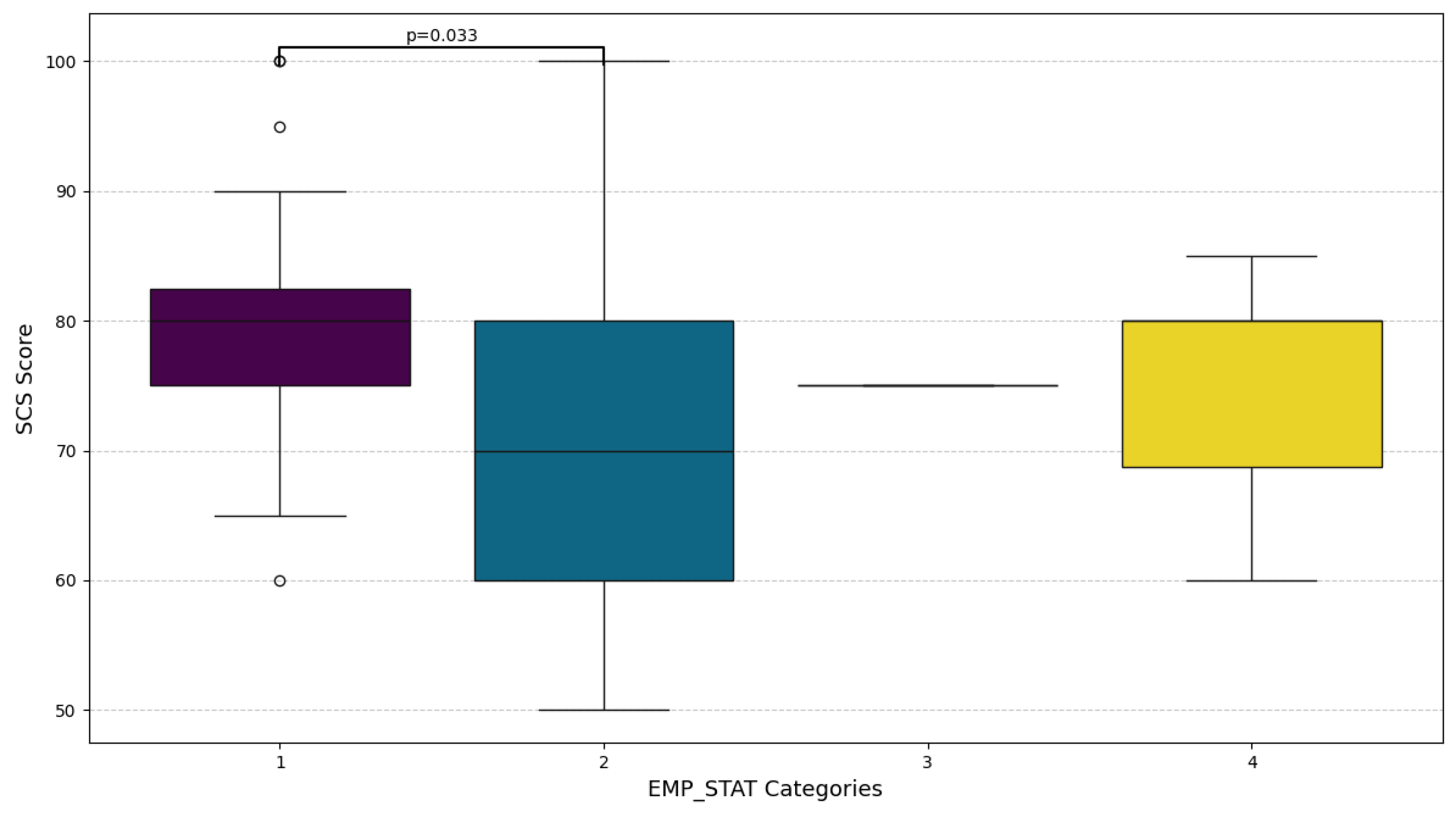
| EMP_STAT | SCS | 7.8306 | 0.0496 | Significant difference |
| EMP_STAT | CTS | 3.8870 | 0.2739 | No significant difference |
| EMP_STAT | ITS | 3.4271 | 0.3303 | No significant difference |
| EMP_STAT | CoT | 4.4957 | 0.2127 | No significant difference |
| Grouping Variable | Type of Thinking | Meaningful Comparisons (Dunn, Bonferroni) |
|---|---|---|
| AGE_CAT | STS | 31–40 vs. 41–50 (adjusted p = 0.0296) |
| AGE_CAT | SCS | No significant difference between pairs |
| AGE_CAT | CTS | No significant difference between pairs |
| AGE_CAT | CoT | 31–40 vs. 41–50 (adjusted p = 0.0158) |
| EDUC | CTS | No significant difference between pairs |
| EMP_STAT | SCS | Permanent vs. contract/project (adjusted p = 0.0329) |
| Grouping Variable | Type of Thinking | Kruskal–Wallis p-Value | Significant Pair | Adjusted p (Dunn–Bonferroni) | Median Group A | Median Group B | Group with Higher Median |
|---|---|---|---|---|---|---|---|
| AGE_CAT | STS | 0.0431 | 31–40 vs. 41–50 | 0.0296 | 83.33 (31–40) | 80.00 (41–50) | 31–40 |
| AGE_CAT | SCS | 0.0274 | None (post hoc not significant) | — | — | — | — |
| AGE_CAT | CTS | 0.0474 | None (post hoc not significant) | — | — | — | — |
| AGE_CAT | CoT | 0.0167 | 31–40 vs. 41–50 | 0.0158 | 80.00 (31–40) | 75.71 (41–50) | 31–40 |
| EDUC | CTS | 0.0455 | None (post hoc not significant) | — | — | — | — |
| EMP_STAT | SCS | 0.0496 | Permanent vs. contract/project | 0.0329 | 80.00 (Permanent) | 70.00 (Contractual/project) | Permanent |
Disclaimer/Publisher’s Note: The statements, opinions and data contained in all publications are solely those of the individual author(s) and contributor(s) and not of MDPI and/or the editor(s). MDPI and/or the editor(s) disclaim responsibility for any injury to people or property resulting from any ideas, methods, instructions or products referred to in the content. |
© 2026 by the authors. Licensee MDPI, Basel, Switzerland. This article is an open access article distributed under the terms and conditions of the Creative Commons Attribution (CC BY) license.
Share and Cite
Vázquez-Parra, J.C.; N. Talili, I.; Lis-Gutiérrez, J.P.; Saniel, D.M.; Henao Rodríguez, L.C.; B. Chio, M.E. Complex Thinking as Cognitive Competence in Local Public Leadership: A Descriptive Study of Public Servants in the Philippines. Adm. Sci. 2026, 16, 154. https://doi.org/10.3390/admsci16030154
Vázquez-Parra JC, N. Talili I, Lis-Gutiérrez JP, Saniel DM, Henao Rodríguez LC, B. Chio ME. Complex Thinking as Cognitive Competence in Local Public Leadership: A Descriptive Study of Public Servants in the Philippines. Administrative Sciences. 2026; 16(3):154. https://doi.org/10.3390/admsci16030154
Chicago/Turabian StyleVázquez-Parra, José Carlos, Ismael N. Talili, Jenny Paola Lis-Gutiérrez, Demetria May Saniel, Linda Carolina Henao Rodríguez, and Ma Esther B. Chio. 2026. "Complex Thinking as Cognitive Competence in Local Public Leadership: A Descriptive Study of Public Servants in the Philippines" Administrative Sciences 16, no. 3: 154. https://doi.org/10.3390/admsci16030154
APA StyleVázquez-Parra, J. C., N. Talili, I., Lis-Gutiérrez, J. P., Saniel, D. M., Henao Rodríguez, L. C., & B. Chio, M. E. (2026). Complex Thinking as Cognitive Competence in Local Public Leadership: A Descriptive Study of Public Servants in the Philippines. Administrative Sciences, 16(3), 154. https://doi.org/10.3390/admsci16030154