Autonomous Administrative Intelligence: Governing AI-Mediated Administration in Decentralized Organizations


Abstract
1. Introduction
2. Technical and Theoretical Foundations
2.1. Strategic Decentralized Resilience Theory as an AI Governance Framework
2.2. Agentic AI and the Limits of Task-Level Autonomy
2.3. Decentralized Governance and Protocol-Based Control
2.4. Toward Autonomous Administrative Intelligence
2.5. Research Design and Scope
3. Autonomous Administrative Intelligence (AAI)
3.1. Conceptual Definition
3.2. Differentiating AAI from Existing AI Paradigms and Automated Governance Systems
3.3. Core Technical Properties of AAI
3.4. AAI Within the SDRT-AI Framework
3.5. Administrative Functions Under AAI
3.6. Implications for AI and Administrative Theory
4. ADRT-AI Architecture for Autonomous Administrative Intelligence
4.1. Layered SDRT-AI Architecture
- (1)
- the Strategic Control Layer,
- (2)
- the Agentic Decision Layer, and
- (3)
- the Decentralized Governance Layer.
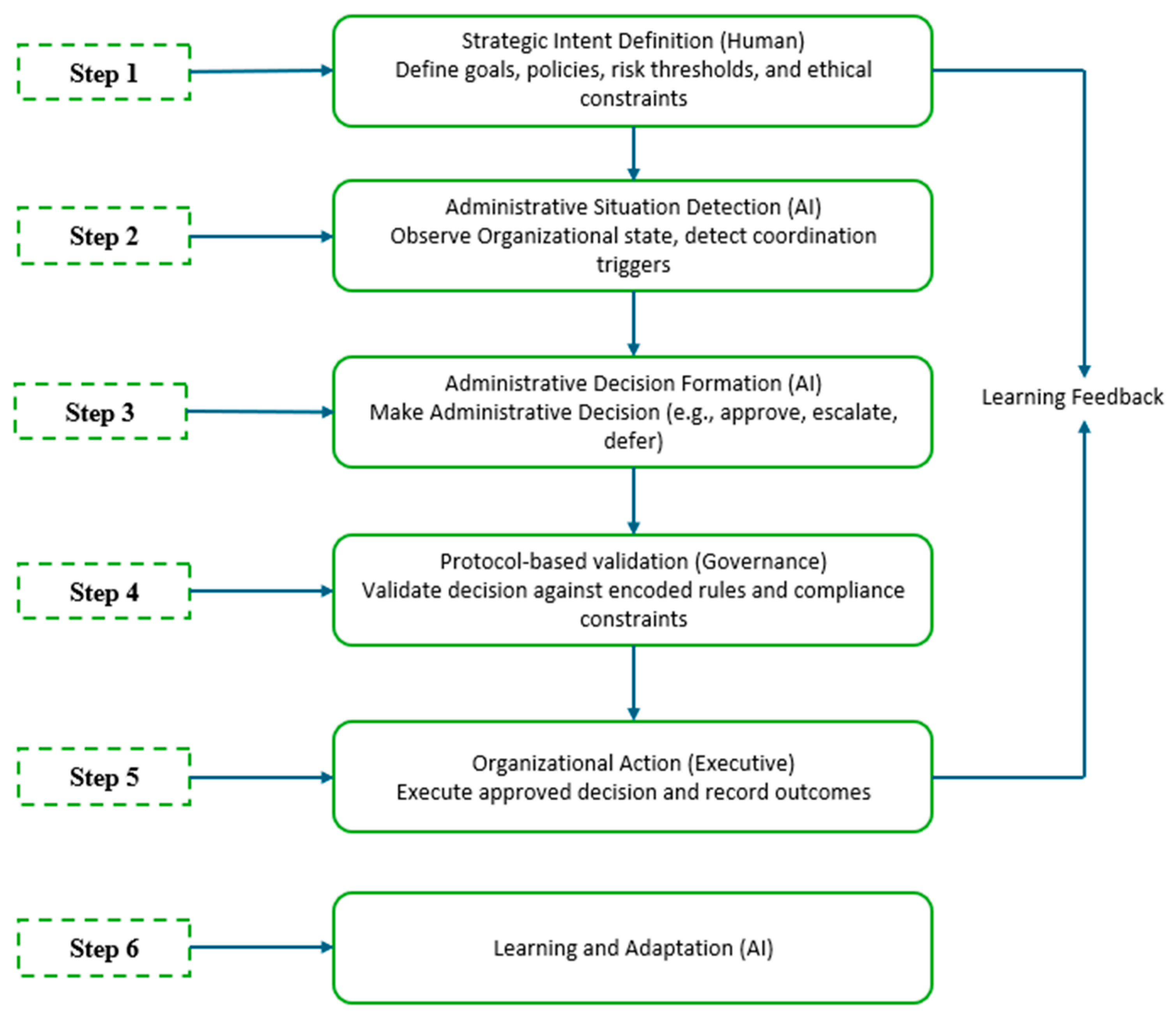
4.2. Six-Step Operational Flow Across the SDRT-AI Layers
- Step 1:
- Strategic Intent Definition (Human) occurs within the Strategic Control Layer, where organizational goals, policies, risk tolerances, and ethical constraints are codified. This step establishes the boundaries for all subsequent autonomous behavior.
- Step 2:
- Administrative Situation Detection (AI)
- Step 3:
- Administrative Decision Formation (AI) take place within the Agentic Decision Layer. Here, autonomous agents monitor organizational conditions, identify coordination or compliance triggers, and generate administrative decisions such as approval, deferral, escalation, or reallocation.
- Step 4:
- Protocol-Based Validation (Governance) is executed within the Decentralized Governance Layer, where proposed decisions are validated against encoded rules, authorization limits, and compliance constraints prior to execution.
- Step 5:
- Organizational Action (Execution) also resides within the Decentralized Governance Layer, ensuring that approved administrative decisions are executed and recorded in an immutable organizational state.
- Step 6:
- Learning and Adaptation (AI) returns to the Agentic Decision Layer, where execution outcomes are evaluated and used to update decision policies. This feedback mechanism enables adaptive administrative behavior while remaining constrained by strategic intent and governance rules (Amershi et al., 2019). Importantly, Step 6 does not determine whether AAI is adopted or activated; rather, it continuously refines how the AI executes administrative decisions over time based on the outcomes generated in Step 5.
4.3. Governance-Aware Learning Loop (Operational Mechanism)
- The system observes the organizational state.
- An administrative agent selects a candidate action.
- The action is validated against protocol rules.
- If approved, the action is executed.
- Outcomes are recorded immutably.
- The agent updates its policy based on feedback.
4.4. Human-in-the-Loop via Exception Governance
4.5. Illustrative Example: Autonomous Administration in a Decentralized Supply Network
5. Propositions and Theoretical Implications
5.1. Administrative Autonomy and Coordination Efficiency
5.2. Governance-Aware Learning and Administrative Stability
5.3. Decentralized Governance and Accountability
5.4. Strategic Alignment Through Ex Ante Control
5.5. Human Roles Under Autonomous Administration
5.6. Autonomous Administration and Organizational Resilience
5.7. Construct Clarification and Operational Logic
6. Implications for Administrative Science and AI System Design
6.1. Implications for Administrative Science
6.2. Implications for Organizational Governance
6.3. Implications for AI Systems Design
6.4. Implications for Human-AI Collaboration
6.5. Implications for Research and Practice
7. Limitations and Future Research
7.1. Limitations
7.2. Directions for Future Research
8. Conclusions
Funding
Institutional Review Board Statement
Informed Consent Statement
Data Availability Statement
Conflicts of Interest
References
- Amershi, S., Weld, D., Vorvoreanu, M., Fourney, A., Nushi, B., Collisson, P., Suh, J., Iqbal, S., Bennett, P. N., Inkpen, K., Teevan, J., Kikin-Gil, R., & Horvitz, E. (2019, May 4–9). Guidelines for human-AI interaction. 2019 CHI Conference on Human Factors in Computing Systems (pp. 1–13), Glasgow, UK. [Google Scholar] [CrossRef]
- Beck, R., Czepluch, J. S., Lollike, N., & Malone, S. (2016). Blockchain—The gateway to trust-free cryptographic transactions. Research Papers. Available online: https://aisel.aisnet.org/ecis2016_rp/153 (accessed on 12 December 2025).
- Beck, R., Müller-Bloch, C., & King, J. (2018). Governance in the blockchain economy: A framework and research Agenda. Journal of the Association for Information Systems, 19(10), 1. [Google Scholar] [CrossRef]
- Davenport, T. H., & Ronanki, R. (2018). Artificial intelligence for the real world. Harvard Business Review, 96(1), 108–116. [Google Scholar]
- Davidson, S., Filippi, P. D., & Potts, J. (2018). Blockchains and the economic institutions of capitalism. Journal of Institutional Economics, 14(4), 639–658. [Google Scholar] [CrossRef]
- Janssen, M., Estevez, E., & Janowski, T. (2014). Interoperability in big, open, and linked data–organizational maturity, capabilities, and data portfolios. Computer, 47(10), 44–49. [Google Scholar] [CrossRef]
- Malone, T. W., & Bernstein, M. S. (Eds.). (2022). Handbook of collective intelligence. MIT Press. [Google Scholar]
- Mintzberg, H. (1979). The structuring of organizations: A synthesis of the research. Prentice-Hall. [Google Scholar]
- Narayanan, A., Bonneau, J., Felten, E., Miller, A., & Goldfeder, S. (2016). Bitcoin and cryptocurrency technologies. Princeton University Press. Available online: https://press.princeton.edu/books/hardcover/9780691171692/bitcoin-and-cryptocurrency-technologies (accessed on 9 December 2025).
- Rai, A., Constantinides, P., & Sarker, S. (2019). Next-generation digital platforms: Toward human-AI hybrids. MIS Quarterly, 43(1), iii–ix. [Google Scholar]
- Raji, I. D., Smart, A., White, R. N., Mitchell, M., Gebru, T., Hutchinson, B., Smith-Loud, J., Theron, D., & Barnes, P. (2020). Closing the AI accountability gap: Defining an end-to-end framework for internal algorithmic auditing. arXiv, arXiv:2001.00973. [Google Scholar] [CrossRef]
- Russell, S. J., & Norvig, P. (2022). Artificial intelligence: A modern approach (4th ed., global edition). Pearson. [Google Scholar]
- Shoham, Y., & Leyton-Brown, K. (2008). Multiagent systems: Algorithmic, game-theoretic, and logical foundations. Cambridge University Press. [Google Scholar]
- Sutton, R. S., & Barto, A. G. (2018). Reinforcement learning: An introduction (2nd ed.). MIT Press. Available online: https://mitpress.mit.edu/9780262039246/reinforcement-learning/ (accessed on 1 December 2025).
- Weber, M. (1947). The theory of social and economic organization. Available online: http://archive.org/details/weber-max.-the-theory-of-social-and-economic-organization-1947_202106 (accessed on 16 December 2025).
- Wooldridge, M. (2009). An introduction to multi-agent systems (2nd ed.). Wiley. Available online: https://www.wiley.com/en-us/An+Introduction+to+MultiAgent+Systems%2C+2nd+Edition-p-978EUDTE00553R150 (accessed on 13 December 2025).
- Xu, X., Weber, I., & Staples, M. (2019). Architecture for blockchain applications. Springer. Available online: https://link.springer.com/book/10.1007/978-3-030-03035-3 (accessed on 12 December 2025).

Disclaimer/Publisher’s Note: The statements, opinions and data contained in all publications are solely those of the individual author(s) and contributor(s) and not of MDPI and/or the editor(s). MDPI and/or the editor(s) disclaim responsibility for any injury to people or property resulting from any ideas, methods, instructions or products referred to in the content. |
© 2026 by the author. Licensee MDPI, Basel, Switzerland. This article is an open access article distributed under the terms and conditions of the Creative Commons Attribution (CC BY) license.
Share and Cite
Sekar, A. Autonomous Administrative Intelligence: Governing AI-Mediated Administration in Decentralized Organizations. Adm. Sci. 2026, 16, 95. https://doi.org/10.3390/admsci16020095
Sekar A. Autonomous Administrative Intelligence: Governing AI-Mediated Administration in Decentralized Organizations. Administrative Sciences. 2026; 16(2):95. https://doi.org/10.3390/admsci16020095
Chicago/Turabian StyleSekar, Aravindh. 2026. "Autonomous Administrative Intelligence: Governing AI-Mediated Administration in Decentralized Organizations" Administrative Sciences 16, no. 2: 95. https://doi.org/10.3390/admsci16020095
APA StyleSekar, A. (2026). Autonomous Administrative Intelligence: Governing AI-Mediated Administration in Decentralized Organizations. Administrative Sciences, 16(2), 95. https://doi.org/10.3390/admsci16020095