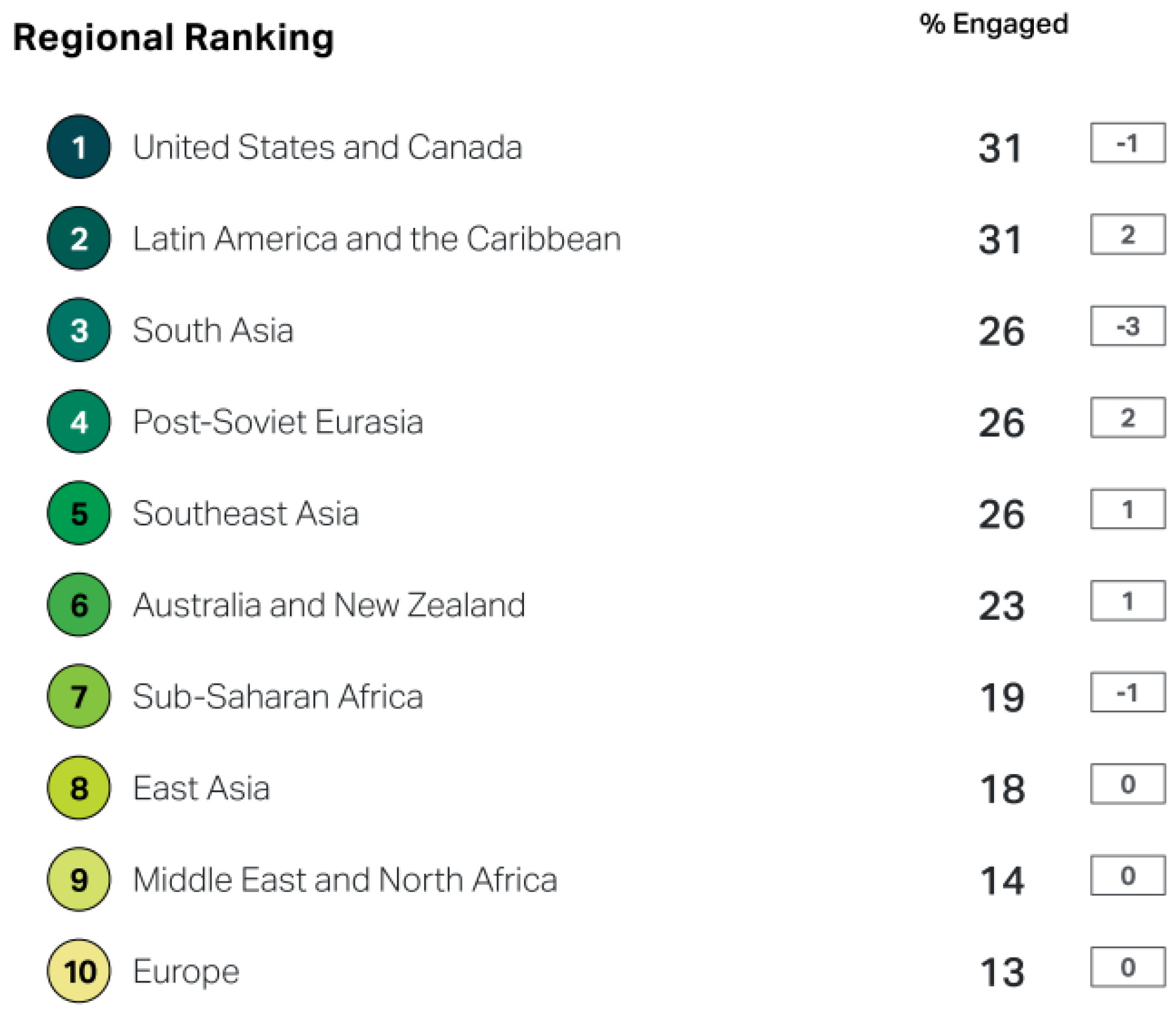
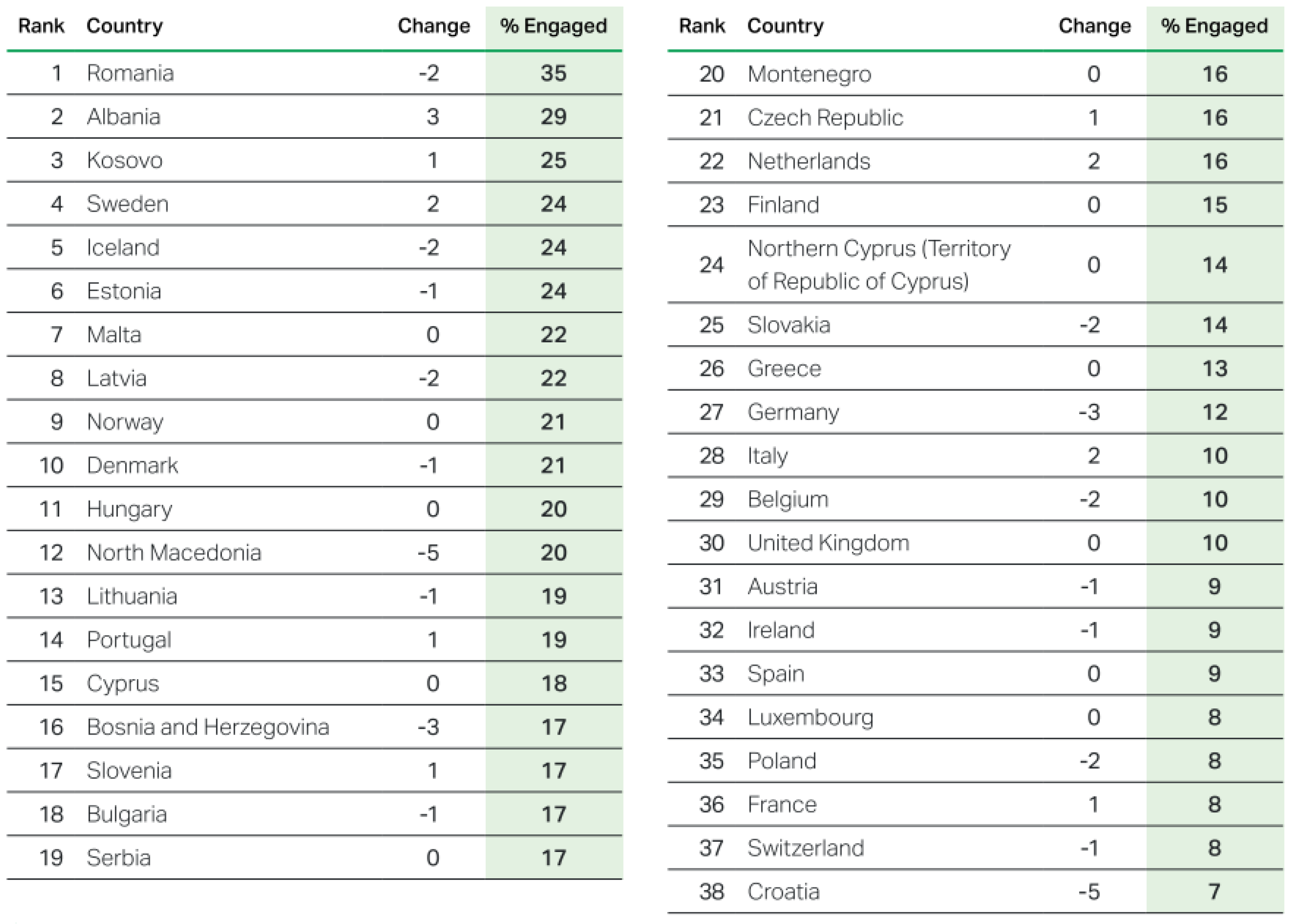
New Principles for Work Engagement in Switzerland


Abstract
1. Introduction
2. Literature Review
3. Methodology
3.1. Research Design
3.2. Literature Search Strategy
3.3. Inclusion and Exclusion Criteria
- Explicitly proposed, applied, or extended a theory of work engagement.
- Were peer-reviewed or widely recognized seminal works.
- Have demonstrable academic impact.
- Non-English sources (to maintain consistency of analysis).
- Purely empirical studies without theoretical grounding.
- Practitioner-focused articles without conceptual rigor.
3.4. Analytical Procedure
4. Discussion
4.1. Newly Developed Principles for Employee Work Engagement
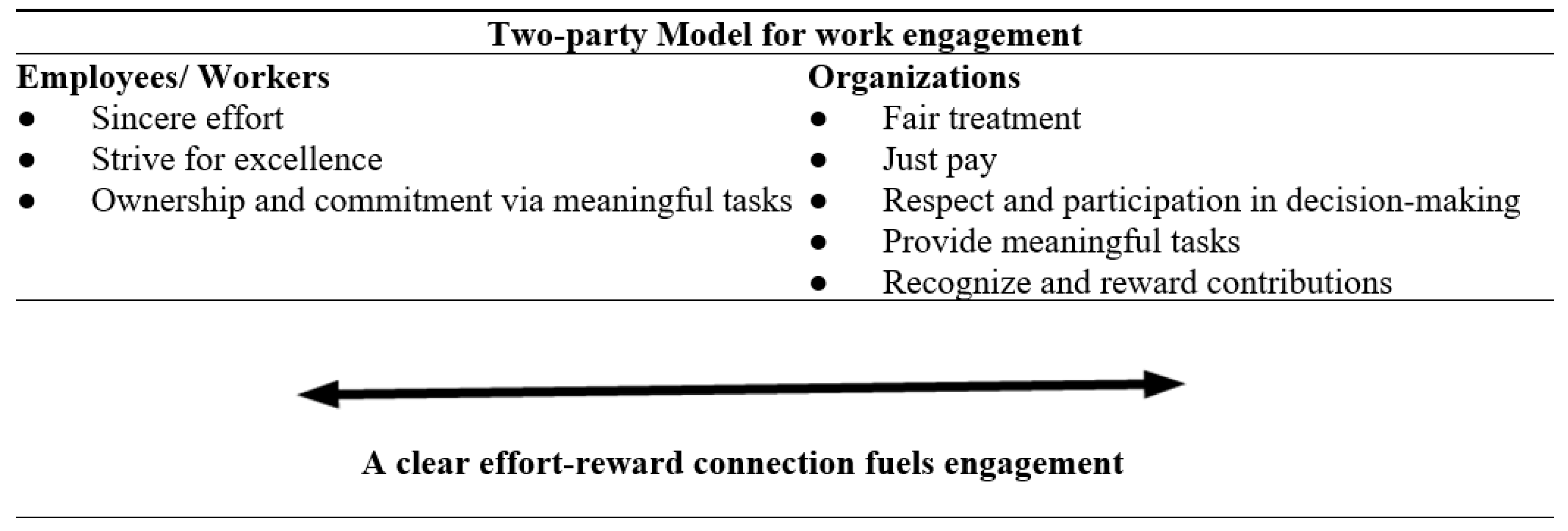
- Employees should be encouraged to work sincerely and strive for excellence rather than giving only minimal effort (McDermott et al., 2025; Naz & Rashid, 2025; Ng, 2025).
- They remain more engaged when treated fairly, paid justly, and respected (Nubail & Sulthani, 2025; Vosburg, 2025; Van Til, 2025; Jing, 2025).
- Engagement is further strengthened when organizations encourage participation in decision-making, allowing employees to feel that their voices matter (Sutikno et al., 2025; Muloongo, 2025; Ruble, 2025).
- When workers are entrusted with responsibility and meaningful tasks, their sense of ownership and commitment increases (Shehab, 2025; Dilang & Simanjuntak, 2025; Naz & Rashid, 2025).
- Motivation and sustained engagement grow when there is a clear connection between effort and reward, ensuring that contributions are valued and recognized (Codex Gigas, n.d.; Kayedian & Gaeini, 2025; Aman-Ullah et al., 2025; Marchiori, 2025; Ng, 2025).
4.2. Executing the Newly Developed Work Engagement Principles in Switzerland
4.3. The Development of Propositions Based on Newly Developed Principles of Work Engagement
5. Measurements
6. Theoretical Contribution
7. Limitations and Mitigation Strategies
8. Conclusions
Author Contributions
Funding
Institutional Review Board Statement
Informed Consent Statement
Data Availability Statement
Conflicts of Interest
References
- Aharpour, S. (1999). Social identity theory and group diversity: An analysis of functions of group identification. University of Kent (United Kingdom). [Google Scholar]
- Ahmad, R., Nawaz, M. R., Ishaq, M. I., Khan, M. M., & Ashraf, H. A. (2023). Social exchange theory: Systematic review and future directions. Frontiers in Psychology, 13, 1015921. [Google Scholar] [CrossRef] [PubMed]
- Ahrens, L. (2019). Theorizing the impact of fairness perceptions on the demand for redistribution. Political Research Exchange, 1(1), 1–17. [Google Scholar] [CrossRef]
- Aman-Ullah, A., Hassan, M., Vargas, S. K., Bisma, M. A., & Nugraha, J. (2025). Does Islamic work ethics matter? A serial mediation study through organizational commitment and employee loyalty. Semarak International Journal of Islamic Studies and Culture, 5(1), 54–68. [Google Scholar] [CrossRef]
- Bakker, A. B., & Demerouti, E. (2007). The job demands-resources model: State of the art. Journal of Managerial Psychology, 22(3), 309–328. [Google Scholar] [CrossRef]
- Bardach, L., & Murayama, K. (2025). The role of rewards in motivation—Beyond dichotomies. Learning and Instruction, 96, 102056. [Google Scholar] [CrossRef]
- Bass, B. M., & Avolio, B. J. (1995). MLQ: Multifactor leadership questionnaire for research: Permission set. Mind Garden. [Google Scholar]
- Bassett-Jones, N., & Lloyd, G. C. (2005). Does Herzberg’s motivation theory have staying power? Journal of Management Development, 24(10), 929–943. [Google Scholar] [CrossRef]
- Boonzaier, B., Ficker, B., & Rust, B. (2001). A review of research on the job characteristics model and the attendant job diagnostic survey. South African Journal of Business Management, 32(1), 11–34. [Google Scholar] [CrossRef]
- Brown, R. (2000). Social identity theory: Past achievements, current problems and future challenges. European Journal of Social Psychology, 30(6), 745–778. [Google Scholar] [CrossRef]
- Burke, L. A., & Saks, A. M. (2009). Accountability in training transfer: Adapting Schlenker’s model of responsibility to a persistent but solvable problem. Human Resource Development Review, 8(3), 382–402. [Google Scholar] [CrossRef]
- Cameron, K. (2009). An introduction to the competing values framework. In Organizational culture white paper. Haworth. [Google Scholar]
- Cameron, K., & Quinn, R. (2010). Organizational culture assessment instrument (OCAI). University of Michigan. [Google Scholar]
- Codex Gigas. (n.d.). The Devil’s bible (13th century). National Library of Sweden, Stockholm. [Google Scholar]
- Colquitt, J. A. (2001). On the dimensionality of organizational justice: A construct validation of a measure. Journal of Applied Psychology, 86(3), 386. [Google Scholar] [CrossRef]
- Colquitt, J. A., Conlon, D. E., Wesson, M. J., Porter, C. O., & Ng, K. Y. (2001). Justice at the millennium: A meta-analytic review of 25 years of organizational justice research. Journal of Applied Psychology, 86(3), 425. [Google Scholar] [CrossRef] [PubMed]
- Cook, K. S., Cheshire, C., Rice, E. R., & Nakagawa, S. (2013). Social exchange theory. In Handbook of social psychology (pp. 61–88). Springer. [Google Scholar]
- Crant, J. M. (2000). Proactive behavior in organizations. Journal of Management, 26(3), 435–462. [Google Scholar] [CrossRef]
- Demerouti, E. (2025). Job demands-resources and conservation of resources theories: How do they help to explain employee well-being and future job design? Journal of Business Research, 192, 115296. [Google Scholar] [CrossRef]
- Deming, W. E. (1986). Out of crisis (pp. 367–388). Centre for Advanced Engineering Study, Massachusetts Institute of Technology. [Google Scholar]
- Dilang, M., & Simanjuntak, F. (2025). The response of the faithful to the issue of global recession. East Asian Journal of Multidisciplinary Research, 4(7), 3185–3200. [Google Scholar] [CrossRef]
- Eisenberger, R., Huntington, R., Hutchison, S., & Sowa, D. (1986). Perceived organizational support. Journal of Applied Psychology, 71(3), 500. [Google Scholar] [CrossRef]
- Flynn, B. B., Schroeder, R. G., & Sakakibara, S. (1994). A framework for quality management research and an associated measurement instrument. Journal of Operations Management, 11(4), 339–366. [Google Scholar] [CrossRef]
- Forner, V. W., Jones, M., Berry, Y., & Eidenfalk, J. (2021). Motivating workers: How leaders apply self-determination theory in organizations. Organization Management Journal, 18(2), 76–94. [Google Scholar] [CrossRef]
- Frese, M., Fay, D., Hilburger, T., Leng, K., & Tag, A. (1997). The concept of personal initiative: Operationalization, reliability and validity in two German samples. Journal of Occupational and Organizational Psychology, 70(2), 139–161. [Google Scholar] [CrossRef]
- Frink, D. D., & Ferris, G. R. (1998). Accountability, impression management, and goal setting in the performance evaluation process. Human Relations, 51(10), 1259–1283. [Google Scholar] [CrossRef]
- Frink, D. D., & Klimoski, R. J. (2004). Advancing accountability theory and practice: Introduction to the human resource management review special edition. Human Resource Management Review, 14(1), 1–17. [Google Scholar] [CrossRef]
- Gallup. (2025). State of the global workplace (pp. 1–142). Employee Engagement Insights for Business Leaders Worldwide. Available online: https://www.gallup.com/workplace/349484/state-of-the-global-workplace.aspx (accessed on 21 September 2025).
- Hackman, J. R., & Oldham, G. R. (1975). Development of the job diagnostic survey. Journal of Applied Psychology, 60(2), 159. [Google Scholar] [CrossRef]
- Hall, A. T., Blass, F. R., Ferris, G. R., & Massengale, R. (2004). Leader reputation and accountability in organizations: Implications for dysfunctional leader behavior. The Leadership Quarterly, 15(4), 515–536. [Google Scholar] [CrossRef]
- Heneman, H. G., III, & Schwab, D. P. (1985). Pay satisfaction: Its multidimensional nature and measurement. International Journal of Psychology, 20(1), 129–141. [Google Scholar] [PubMed]
- Jing, J. (2025). Hierarchical structure of the Qing dynasty—Preface. In Hierarchical structure of the Qing dynasty (pp. 1–69). Springer Nature. [Google Scholar]
- Katzenbach, J. R., & Smith, D. K. (1993). The wisdom of teams: Creating the high-performance organisation, Harvard business school. Harvard Business Press. [Google Scholar]
- Kayedian, M., & Gaeini, A. (2025). An analytical study of louis fry’s spiritual leadership model from the perspective of Quranic teachings. The Quran: Contemporary Studies, 4(11), 6–42. [Google Scholar]
- Lanivich, S. E. (2015). The RICH entrepreneur: Using conservation of resources theory in contexts of uncertainty. Entrepreneurship Theory and Practice, 39(4), 863–894. [Google Scholar] [CrossRef]
- London, M., & Smither, J. W. (2002). Feedback orientation, feedback culture, and the longitudinal performance management process. Human Resource Management Review, 12(1), 81–100. [Google Scholar] [CrossRef]
- Lunenburg, F. C. (2011). Expectancy theory of motivation: Motivating by altering expectations. International Journal of Management, Business, and Ad-ministration, 15(1), 1–6. [Google Scholar]
- Luther, L., Fischer, M. W., Firmin, R. L., & Salyers, M. P. (2019). Clarifying the overlap between motivation and negative symptom measures in schizophrenia research: A meta-analysis. Schizophrenia Research, 206, 27–36. [Google Scholar] [CrossRef]
- Marchiori, E. A. (2025). Business and religion: Comparing strategies and values that both entities share. Springer Nature. [Google Scholar]
- McAnally, K., & Hagger, M. S. (2024). Self-determination theory and workplace outcomes: A conceptual review and future research directions. Behavioral Sciences, 14(6), 428. [Google Scholar] [CrossRef]
- McDermott, S., Fabry, L., Clum, C. S., Arockiam, C., & Mulkey, D. C. (2025). Faith and Christian worldview in the doctor of nursing practice project. Journal of Christian Nursing, 42(4), E53–E59. [Google Scholar] [CrossRef]
- Miller, M. J., Woehr, D. J., & Hudspeth, N. (2002). The meaning and measurement of work ethic: Construction and initial validation of a multidimensional inventory. Journal of Vocational Behavior, 60(3), 451–489. [Google Scholar] [CrossRef]
- Monje-Amor, A., Xanthopoulou, D., Calvo, N., & Vázquez, J. P. A. (2021). Structural empowerment, psychological empowerment, and work engagement: A cross-country study. European Management Journal, 39(6), 779–789. [Google Scholar] [CrossRef]
- Morgeson, F. P., & Humphrey, S. E. (2006). The Work Design Questionnaire (WDQ): Developing and validating a comprehensive measure for assessing job design and the nature of work. Journal of Applied Psychology, 91(6), 1321. [Google Scholar] [CrossRef]
- Morrison, E. W. (2011). Employee voice behavior: Integration and directions for future research. Academy of Management Annals, 5(1), 373–412. [Google Scholar] [CrossRef]
- Muloongo, K. H. (2025). Walking in the light: Biblical insights for daily living: Shining the light of scripture on life’s challenges. WestBow Press. [Google Scholar]
- Naz, S., & Rashid, J. (2025). Analytical study of major themes of the Bhagavad Gita. Journal of World Religions and Interfaith Harmony, 4(1), 310–326. [Google Scholar]
- Neveu, J. P., & Bégout, P. (2025). Measuring motivational patterns: A formal approach of conservation of resources theory. Nonlinear Dynamics, Psychology, and Life Sciences, 29, 431–451. [Google Scholar]
- Ng, T. K. (2025). A summoned life: Vocation in the analects. Journal of Religious Ethics, 53(2), 282–300. [Google Scholar] [CrossRef]
- Nubail, A., & Sulthani, D. A. (2025). The fundamentals of the Quranic message and its timeless nature. Misykat al-Anwar Jurnal Kajian Islam dan Masyarakat, 8(2), 307–322. [Google Scholar] [CrossRef]
- Osemeke, M., & Adegboyega, S. (2017). Critical review and comparism between Maslow, Herzberg and McClelland’s theory of needs. Funai Journal of Accounting, Business and Finance, 1(1), 161–173. [Google Scholar]
- Pearce, C. L., & Sims, H. P., Jr. (2002). Vertical versus shared leadership as predictors of the effectiveness of change management teams: An examination of aversive, directive, transactional, transformational, and empowering leader behaviors. Group Dynamics: Theory, Research, and Practice, 6(2), 172. [Google Scholar] [CrossRef]
- Peters, T. J., & Waterman, R. H., Jr. (1982). In search of excellence. Harper and Row. [Google Scholar]
- Pfeffer, J. (1998). Seven practices of successful organizations. California Management Review, 40(2), 96–124. [Google Scholar] [CrossRef]
- Porter, L. W., & Lawler, E. E. (1968). What job attitudes tell about motivation (pp. 118–126). Harvard Business Review Reprint Service. [Google Scholar]
- Ruble, A. R. (2025). A guide to understanding your sage-ruler: Andrew R. Ruble. Dao, 24, 413–432. [Google Scholar]
- Schaufeli, W. B., Bakker, A. B., & Salanova, M. (2006). Utrecht work engagement scale-9 (UWES-9) [Database record]. APA PsycTests. [Google Scholar]
- Schaufeli, W. B., Salanova, M., González-Romá, V., & Bakker, A. B. (2002). Utrecht work engagement scale-17 [Database record]. APA PsycTests. [Google Scholar]
- Schaufeli, W. B., & Taris, T. W. (2013). A critical review of the job demands-resources model: Implications for improving work and health. In Bridging occupational, organizational and public health: A transdisciplinary approach (pp. 43–68). Springer. [Google Scholar]
- Schneider, J., & Locke, E. A. (1971). A critique of Herzberg’s incident classification system and a suggested revision. Organizational Behavior and Human Performance, 6(4), 441–457. [Google Scholar] [CrossRef]
- Scholze, A., & Hecker, A. (2024). The job demands-resources model as a theoretical lens for the bright and dark side of digitization. Computers in Human Behavior, 155, 108177. [Google Scholar] [CrossRef]
- Senge, P. M. (1990). The art and practice of the learning organization (Vol. 1). Doubleday. [Google Scholar]
- Shehab, A. B. M. I. (2025). The impact of work ethics on the employee’s behavior: A Quranic perspective. Journal of Posthumanism, 5(4), 515–528. [Google Scholar] [CrossRef]
- Siegrist, J. (1996). Adverse health effects of high-effort/low-reward conditions. Journal of Occupational Health Psychology, 1(1), 27. [Google Scholar] [CrossRef]
- Snyder, H. (2019). Literature review as a research methodology: An overview and guidelines. Journal of Business Research, 104, 333–339. [Google Scholar] [CrossRef]
- Spreitzer, G. M. (1995). Psychological empowerment in the workplace: Dimensions, measurement, and validation. Academy of Management Journal, 38(5), 1442–1465. [Google Scholar] [CrossRef]
- Steelman, L. A., Levy, P. E., & Snell, A. F. (2004). The feedback environment scale: Construct definition, measurement, and validation. Educational and Psychological Measurement, 64(1), 165–184. [Google Scholar] [CrossRef]
- Sutikno, A., Dakir, D., & Jasiah, J. (2025). The implementation of total quality management (TQM) from Qur’anic perspective and its problems in schools. Urwatul Wutsqo: Jurnal Studi Kependidikan dan Keislaman, 14(2), 637–656. [Google Scholar] [CrossRef]
- Swiss HR-Barometer. (2024). Sense and nonsense at work (pp. 1–6). Available online: https://www.unilu.ch/en/faculties/faculty-of-economics-and-management/institutes-and-research-centres/center-for-human-resource-management/research/swiss-human-relations-barometer/results/editions/swiss-human-relations-barometer-2022-1/ (accessed on 7 September 2025).
- Thierry, H. (2001). The reflection theory on compensation. In Work motivation in the context of a globalizing economy. Lawrence Erlbaum Associates Publishers. [Google Scholar]
- Torraco, R. J. (2005). Writing integrative literature reviews: Guidelines and examples. Human Resource Development Review, 4(3), 356–367. [Google Scholar] [CrossRef]
- Troussas, C., Krouska, A., & Virvou, M. (2017). Reinforcement theory combined with a badge system to foster student’s performance in e-learning environments. In 2017 8th international conference on information, intelligence, systems & applications (IISA) (pp. 1–6). IEEE. [Google Scholar]
- VandeWalle, D. (1997). Development and validation of a work domain goal orientation instrument. Educational and Psychological Measurement, 57(6), 995–1015. [Google Scholar] [CrossRef]
- Van Til, J. (2025). A reformed psychology of human relations in business: Part II. Pro Rege, 53(4), 20–29. [Google Scholar]
- Vosburg, D. P. (2025). “I thank God we’re rich”: Justifying economic inequality in an evangelical congregation. Journal for the Scientific Study of Religion, 64, 303–316. [Google Scholar] [CrossRef]
- Vroom, V. H. (1964). Work and motivation. Wiley. [Google Scholar]
- Wageman, R. (2001). How leaders foster self-managing team effectiveness: Design choices versus hands-on coaching. Organization Science, 12(5), 559–577. [Google Scholar] [CrossRef]
- Weiss, H. (2013). Affective events theory. In Encyclopedia of management theory (Vol. 2, pp. 29–30). SAGE Publications, Ltd. [Google Scholar]
- Weiss, H. M., & Cropanzano, R. (1996). Affective events theory. Research in Organizational Behavior, 18(1), 1–74. [Google Scholar]
- Zimmerman, M. A. (1995). Psychological empowerment: Issues and illustrations. American Journal of Community Psychology, 23(5), 581–599. [Google Scholar] [CrossRef]



| Items (Work Engagement) | Source/s (Theoretically Derived and Adapted) |
|---|---|
| I feel that I have unlimited energy in the workplace (vigor) | Schaufeli et al. (2006) |
| I feel strong and vigorous at my job (vigor) | |
| I am passionate about my job (dedication) | |
| My job inspires me (dedication) | |
| When I get up in the morning, I feel like going to work (vigor) | |
| I feel happy when I work deeply (absorption) | |
| I am proud of the work that I do (dedication) | |
| I am totally focused on my job (absorption) | |
| When I work, I lose myself in my work (absorption) |
| Item (Employee Contributions) | Source (Theoretically Derived and Adapted) |
| I put my full effort into completing my job tasks (Sincere Effort) | Personal Initiative Scale (Frese et al., 1997) |
| I remain dedicated and focused on my work, even when it is challenging (Sincere Effort) | |
| I approach my work tasks with care and attention to detail (Sincere Effort) | |
| I persist in my work until the desired results are achieved (Sincere Effort) | |
| I consistently strive to exceed the expectations of my role (Sincere Effort) | Proactive Work Behavior Scale (Crant, 2000) |
| I take initiative to improve the quality of my work (Sincere Effort) | |
| I set high standards for the quality of my work (Striving for Excellence) | Achievement Orientation/Performance Orientation (VandeWalle, 1997) |
| I continuously strive to improve my skills and performance (Striving for Excellence) | |
| I consistently give my best effort in my work (Striving for Excellence) | Work Ethic Scale (Miller et al., 2002) |
| I am committed to doing tasks carefully and thoroughly (Striving for Excellence) | |
| Items (Organizational Contributions) | Source (Theoretically Derived and Adapted) |
| Decisions at my organization are made fairly (Fair Treatment) | Organizational Justice (Colquitt, 2001) |
| Policies and procedures are applied consistently to all employees (Fair Treatment) | |
| I am treated fairly by my supervisors and colleagues (Fair Treatment) | |
| I feel that organizational rules are applied without bias (Fair Treatment) | |
| My salary is fair for the work I perform (Just Pay) | Pay Satisfaction Questionnaire (Heneman & Schwab, 1985) |
| My compensation reflects the responsibilities of my role (Just Pay) | |
| I am satisfied with the equity of my pay compared to colleagues (Just Pay) | |
| My pay is appropriate for my skills and contributions (Just Pay) | |
| My supervisors treat me with respect (Respect) | Interactional Justice (Colquitt, 2001) |
| I am valued as a person in my organization (Respect) | |
| I am treated politely and considerately by management (Respect) | |
| My opinions are acknowledged respectfully (Respect) | |
| I have the opportunity to express my opinions before decisions are made (Participation in Decision-Making) | Employee Voice (Morrison, 2011) |
| My input is considered when important workplace decisions are taken (Participation in Decision-Making) | |
| I feel involved in decisions that affect my work (Participation in Decision-Making) | |
| I can influence how my tasks are carried out (Participation in Decision-Making) | |
| The tasks I perform at work are meaningful (Provision of Meaningful Tasks) | Job Diagnostic Survey (Hackman & Oldham, 1975); Work Design Questionnaire (Morgeson & Humphrey, 2006) |
| My work has a positive impact on others or the organization (Provision of Meaningful Tasks) | |
| I understand the significance of my work to the organization’s goals (Provision of Meaningful Tasks) | |
| I feel that my job makes a difference (Provision of Meaningful Tasks) | |
| My contributions are recognized by my supervisor (Recognition and Reward of Contributions) | Cook et al. (2013); Siegrist (1996); Steelman et al. (2004); Eisenberger et al. (1986) |
| Good performance at work is rewarded appropriately (Recognition and Reward of Contributions) | |
| I receive feedback that acknowledges my achievements (Recognition and Reward of Contributions) | |
| When I perform well, my efforts are valued by the organization (Recognition and Reward of Contributions) |
| Items (Effort–Reward Alignment) | Sources (Theoretically Derived and Adapted) |
|---|---|
| My work efforts are directly reflected in the rewards I receive (Connection Between Effort and Reward) | Vroom (1964); Porter and Lawler (1968) |
| When I perform well, I receive appropriate recognition or rewards (Connection Between Effort and Reward) | |
| Putting extra effort into my job leads to positive outcomes for me (Connection Between Effort and Reward) | |
| High job performance leads to tangible rewards such as pay increases or promotions (Connection Between Effort and Reward) | |
| I understand how my performance influences the rewards I receive (Connection Between Effort and Reward) | |
| There is a clear link between how hard I work and what I gain from my job (Connection Between Effort and Reward) | Porter and Lawler (1968); Siegrist (1996) |
| Employees who contribute more receive greater rewards in this organization (Connection Between Effort and Reward) | Siegrist (1996); Colquitt et al. (2001) |
| Rewards in this organization are distributed fairly according to effort and performance (Connection Between Effort and Reward) | |
| Extra effort at work is recognized and rewarded by management (Connection Between Effort and Reward) | |
| Knowing that effort leads to rewards motivates me to work harder (Connection Between Effort and Reward) | Vroom (1964) |
| Items (Culture of Excellence) | Source (Theoretically Derived and Adapted) |
| Our organization consistently emphasizes high standards of performance in all activities. | Cameron and Quinn (2010)—Organizational Culture Assessment Instrument (OCAI) |
| Employees are encouraged to strive for excellence rather than just meeting minimum requirements. | Peters and Waterman (1982)—Excellence Theory |
| Continuous improvement is strongly valued in this organization. | Deming (1986)—Total Quality Management (TQM) |
| Management promotes a mindset of learning and improvement to achieve superior results. | Senge (1990)—Learning Organization |
| Quality is prioritized over speed or short-term outcomes. | Flynn et al. (1994)—Quality Management Practices |
| Innovation and best practices are encouraged to achieve excellence. | Cameron (2009)—Competing Values Framework |
| Leaders act as role models for excellence and high performance. | Bass and Avolio (1995)—Transformational Leadership |
| The organization rewards behaviors that contribute to outstanding performance. | Pfeffer (1998)—High-Performance Work Practices |
| Items (Mutual Accountability) | Source (Theoretically Derived and Adapted) |
| Team members in my organization hold each other responsible for meeting agreed-upon goals | Frink and Klimoski (2004) |
| Employees are accountable not only to supervisors but also to their colleagues. | Frink and Ferris (1998) |
| When problems occur, team members collectively take responsibility rather than blaming individuals. | Burke and Saks (2009) |
| There is a shared understanding that everyone is responsible for team outcomes. | Katzenbach and Smith (1993) |
| Team members feel responsible for the quality of each other’s work. | Pearce and Sims (2002) |
| In this organization, accountability is shared among employees rather than imposed only from the top. | Hall et al. (2004) |
| Employees provide constructive feedback to one another when expectations are not met. | London and Smither (2002) |
| Successes and failures are viewed as collective rather than individual outcomes. | Wageman (2001) |
| Management supports employees in holding each other accountable for work engagement. | Katzenbach and Smith (1993); Hall et al. (2004) |
Disclaimer/Publisher’s Note: The statements, opinions and data contained in all publications are solely those of the individual author(s) and contributor(s) and not of MDPI and/or the editor(s). MDPI and/or the editor(s) disclaim responsibility for any injury to people or property resulting from any ideas, methods, instructions or products referred to in the content. |
© 2026 by the authors. Licensee MDPI, Basel, Switzerland. This article is an open access article distributed under the terms and conditions of the Creative Commons Attribution (CC BY) license.
Share and Cite
Hossan, D.; Zhang, Q.; Wolfs, B.; Jesmin, N.-E.-M.S. New Principles for Work Engagement in Switzerland. Adm. Sci. 2026, 16, 86. https://doi.org/10.3390/admsci16020086
Hossan D, Zhang Q, Wolfs B, Jesmin N-E-MS. New Principles for Work Engagement in Switzerland. Administrative Sciences. 2026; 16(2):86. https://doi.org/10.3390/admsci16020086
Chicago/Turabian StyleHossan, Dalowar, Qing Zhang, Bert Wolfs, and Noor-E-Medina Suraiya Jesmin. 2026. "New Principles for Work Engagement in Switzerland" Administrative Sciences 16, no. 2: 86. https://doi.org/10.3390/admsci16020086
APA StyleHossan, D., Zhang, Q., Wolfs, B., & Jesmin, N.-E.-M. S. (2026). New Principles for Work Engagement in Switzerland. Administrative Sciences, 16(2), 86. https://doi.org/10.3390/admsci16020086